They Live, We Sleep: A Dictatorship Disguised as a Democracy

leadtheylive1

By John W. Whitehead

Source: The Rutherford Institute

“You see them on the street. You watch them on TV. You might even vote for one this fall. You think they’re people just like you. You’re wrong. Dead wrong.”—They Live

We’re living in two worlds, you and I.

There’s the world we see (or are made to see) and then there’s the one we sense (and occasionally catch a glimpse of), the latter of which is a far cry from the propaganda-driven reality manufactured by the government and its corporate sponsors, including the media.

Indeed, what most Americans perceive as life in America—privileged, progressive and free—is a far cry from reality, where economic inequality is growing, real agendas and real power are buried beneath layers of Orwellian doublespeak and corporate obfuscation, and “freedom,” such that it is, is meted out in small, legalistic doses by militarized police armed to the teeth.

All is not as it seems.

This is the premise of John Carpenter’s film They Live (1988), in which two migrant workers discover that the world’s population is actually being controlled and exploited by aliens working in partnership with an oligarchic elite. All the while, the populace—blissfully unaware of the real agenda at work in their lives—has been lulled into complacency, indoctrinated into compliance, bombarded with media distractions, and hypnotized by subliminal messages beamed out of television and various electronic devices, billboards and the like.

It is only when homeless drifter John Nada (played to the hilt by the late Roddy Piper) discovers a pair of doctored sunglasses—Hoffman lenses—that Nada sees what lies beneath the elite’s fabricated reality: control and bondage.

When viewed through the lens of truth, the elite, who appear human until stripped of their disguises, are shown to be monsters who have enslaved the citizenry in order to prey on them. Likewise, billboards blare out hidden, authoritative messages: a bikini-clad woman in one ad is actually ordering viewers to “MARRY AND REPRODUCE.” Magazine racks scream “CONSUME” and “OBEY.” A wad of dollar bills in a vendor’s hand proclaims, “THIS IS YOUR GOD.”

When viewed through Nada’s Hoffman lenses, some of the other hidden messages being drummed into the people’s subconscious include: NO INDEPENDENT THOUGHT, CONFORM, SUBMIT, STAY ASLEEP, BUY, WATCH TV, NO IMAGINATION, and DO NOT QUESTION AUTHORITY.

This indoctrination campaign engineered by the elite in They Live is painfully familiar to anyone who has studied the decline of American culture. A citizenry that does not think for themselves, obeys without question, is submissive, does not challenge authority, does not think outside the box, and is content to sit back and be entertained is a citizenry that can be easily controlled.

In this way, the subtle message of They Live provides an apt analogy of our own distorted vision of life in the American police state, what philosopher Slavoj Žižek refers to as dictatorship in democracy, “the invisible order which sustains your apparent freedom.”

We’re being fed a series of carefully contrived fictions that bear no resemblance to reality. The powers-that-be want us to feel threatened by forces beyond our control (terrorists, shooters, bombers). They want us afraid and dependent on the government and its militarized armies for our safety and well-being. They want us distrustful of each other, divided by our prejudices, and at each other’s throats. Most of all, they want us to continue to march in lockstep with their dictates.

Tune out the government’s attempts to distract, divert and befuddle us and tune into what’s really going on in this country, and you’ll run headlong into an unmistakable, unpalatable truth: the moneyed elite who rule us view us as expendable resources to be used, abused and discarded.

In fact, a 2014 study conducted by Princeton and Northwestern University concluded that the U.S. government does not represent the majority of American citizens. Instead, the study found that the government is ruled by the rich and powerful, or the so-called “economic elite.” Moreover, the researchers concluded that policies enacted by this governmental elite nearly always favor special interests and lobbying groups.

In other words, we are being ruled by an oligarchy disguised as a democracy, and arguably on our way towards fascism—a form of government where private corporate interests rule, money calls the shots, and the people are seen as mere subjects to be controlled.

Consider this: it is estimated that the 2016 presidential election could cost as much as $5 billion, more than double what was spent getting Obama re-elected in 2012.

Not only do you have to be rich—or beholden to the rich—to get elected these days, but getting elected is also a surefire way to get rich. As CBS News reports, “Once in office, members of Congress enjoy access to connections and information they can use to increase their wealth, in ways that are unparalleled in the private sector. And once politicians leave office, their connections allow them to profit even further.”

In denouncing this blatant corruption of America’s political system, former president Jimmy Carter blasted the process of getting elected—to the White House, governor’s mansion, Congress or state legislatures—as “unlimited political bribery… a subversion of our political system as a payoff to major contributors, who want and expect, and sometimes get, favors for themselves after the election is over.”

Rest assured that when and if fascism finally takes hold in America, the basic forms of government will remain. As I point out in my book Battlefield America: The War on the American People, fascism will appear to be friendly. The legislators will be in session. There will be elections, and the news media will continue to cover the entertainment and political trivia. Consent of the governed, however, will no longer apply. Actual control will have finally passed to the oligarchic elite controlling the government behind the scenes.

By creating the illusion that it preserves democratic traditions, fascism creeps slowly until it consumes the political system. And in times of “crisis,” expediency is upheld as the central principle—that is, in order to keep us safe and secure, the government must militarize the police, strip us of basic constitutional rights, criminalize virtually every form of behavior, and build enough private prisons to house all of us nonviolent criminals.

Clearly, we are now ruled by an oligarchic elite of governmental and corporate interests. We have moved into “corporatism” (favored by Benito Mussolini), which is a halfway point on the road to full-blown fascism.

Vast sectors of the economy, government and politics are managed by private business concerns, otherwise referred to as “privatization” by various government politicians. Just study modern government policies. “Every industry is regulated. Every profession is classified and organized,” writes economic analyst Jeffrey Tucker. “Every good or service is taxed. Endless debt accumulation is preserved. Immense doesn’t begin to describe the bureaucracy. Military preparedness never stops, and war with some evil foreign foe, remains a daily prospect.”

In other words, the government in America today does whatever it wants.

Corporatism is where the few moneyed interests—not elected by the citizenry—rule over the many. In this way, it is not a democracy or a republican form of government, which is what the American government was established to be. It is a top-down form of government and one which has a terrifying history typified by the developments that occurred in totalitarian regimes of the past: police states where everyone is watched and spied on, rounded up for minor infractions by government agents, placed under police control, and placed in detention (a.k.a. concentration) camps.

For the final hammer of fascism to fall, it will require the most crucial ingredient: the majority of the people will have to agree that it’s not only expedient but necessary. But why would a people agree to such an oppressive regime? The answer is the same in every age: fear.

Fear makes people stupid.

Fear is the method most often used by politicians to increase the power of government. And, as most social commentators recognize, an atmosphere of fear permeates modern America: fear of terrorism, fear of the police, fear of our neighbors and so on.

The propaganda of fear has been used quite effectively by those who want to gain control, and it is working on the American populace.

Despite the fact that we are 17,600 times more likely to die from heart disease than from a terrorist attack; 11,000 times more likely to die from an airplane accident than from a terrorist plot involving an airplane; 1,048 times more likely to die from a car accident than a terrorist attack, and 8 times more likely to be killed by a police officer than by a terrorist, we have handed over control of our lives to government officials who treat us as a means to an end—the source of money and power.

We have allowed ourselves to become fearful, controlled, pacified zombies.

In this regard, we’re not so different from the oppressed citizens in They Live. Most everyone keeps their heads down these days while staring zombie-like into an electronic screen, even when they’re crossing the street. Families sit in restaurants with their heads down, separated by their screen devices and unaware of what’s going on around them. Young people especially seem dominated by the devices they hold in their hands, oblivious to the fact that they can simply push a button, turn the thing off and walk away.

Indeed, there is no larger group activity than that connected with those who watch screens—that is, television, lap tops, personal computers, cell phones and so on. In fact, a Nielsen study reports that American screen viewing is at an all-time high. For example, the average American watches approximately 151 hours of television per month.

The question, of course, is what effect does such screen consumption have on one’s mind?

Psychologically it is similar to drug addiction. Researchers found that “almost immediately after turning on the TV, subjects reported feeling more relaxed, and because this occurs so quickly and the tension returns so rapidly after the TV is turned off, people are conditioned to associate TV viewing with a lack of tension.” Research also shows that regardless of the programming, viewers’ brain waves slow down, thus transforming them into a more passive, nonresistant state.

Historically, television has been used by those in authority to quiet discontent and pacify disruptive people. “Faced with severe overcrowding and limited budgets for rehabilitation and counseling, more and more prison officials are using TV to keep inmates quiet,” according to Newsweek.

Given that the majority of what Americans watch on television is provided through channels controlled by six mega corporations, what we watch is now controlled by a corporate elite and, if that elite needs to foster a particular viewpoint or pacify its viewers, it can do so on a large scale.

If we’re watching, we’re not doing.

The powers-that-be understand this. As television journalist Edward R. Murrow warned in a 1958 speech:

We are currently wealthy, fat, comfortable and complacent. We have currently a built-in allergy to unpleasant or disturbing information. Our mass media reflect this. But unless we get up off our fat surpluses and recognize that television in the main is being used to distract, delude, amuse, and insulate us, then television and those who finance it, those who look at it, and those who work at it, may see a totally different picture too late.

This brings me back to They Live, in which the real zombies are not the aliens calling the shots but the populace who are content to remain controlled.

When all is said and done, the world of They Live is not so different from our own. As one of the characters points out, “The poor and the underclass are growing. Racial justice and human rights are nonexistent. They have created a repressive society and we are their unwitting accomplices. Their intention to rule rests with the annihilation of consciousness. We have been lulled into a trance. They have made us indifferent to ourselves, to others. We are focused only on our own gain.”

We, too, are focused only on our own pleasures, prejudices and gains. Our poor and underclasses are also growing. Racial injustice is growing. Human rights is nearly nonexistent. We too have been lulled into a trance, indifferent to others.

Oblivious to what lies ahead, we’ve been manipulated into believing that if we continue to consume, obey, and have faith, things will work out. But that’s never been true of emerging regimes. And by the time we feel the hammer coming down upon us, it will be too late.

NATO and the West Just Became Irrelevant

antinato

By F. William Engdahl

Source: New Eastern Outlook

The dual summits that took place in Russia’s Ufa beginning 9 July were anything but routine. In fact it may be seen by future historians as a signal event that marked the definitive decline of the global hegemony of European civilization including North America. This is no small event in human history. It’s the most significant shift in relative global economic relations since the Fourth Crusade in 1204 when the Republic of Venice emerged as a world power following their brutal, disgraceful capture and sacking of Constantinople, marking the demise of the Byzantine Empire.

First a look at what transpired. Russia was host to two overlapping summits of emerging alternative organizations, the annual meeting of the BRICS nations as well as the annual meeting of the Shanghai Cooperation Organization. The larger significance has been all but entirely blacked out by western mainstream media such as the New York Times.

First we look at the results from the BRICS meeting where Brazil, Russia, India, China and South Africa are the five member states. The BRICS formally put their New Development Bank (NDB) into operation. It has world headquarters in Shanghai, China’s banking and financial center with a branch in South Africa to serve the African region.

It is explicitly operating as an alternative to the post-1945 domination of the IMF and World Bank, the heart of Washington’s Dollar System. It has member contributions of $50 billion for infrastructure projects mainly, but not exclusively, in the BRICS states. As well it has created a $100 billion financial defense fund, a so-called Contingent Reserves Arrangement, in event of speculative attacks such as were launched by Washington with the Soros Quantum Fund in 1997 to destroy the independent Asian Tiger economies.

The NDB bank is in business one year after the last BRICS summit agreed to its creation, and the meeting announced that first approved infrastructure projects will begin at the beginning of 2016. That’s an impressive testament to the mutual will to create an alternative to the IMF and World Bank, both of the latter controlled by Washington where they are headquartered. Notably BRICS agreed for the first time to institute formal cooperation with the leaders of the Eurasian Economic Union of Russia, Belarus, Kazakhstan, Armenia and Kyrgyzstan.

As well they agreed to meet the leaders of the Shanghai Cooperation Organization (SCO)–Russia, China, Kazakhstan, Kyrgyzstan, Russia, Tajikistan, and Uzbekistan.

SCO adds major security dimension

For its part, the nations of the SCO–Shanghai Cooperation Organization–in addition to formally admitting both India and Pakistan, agreed to increase its role combating terrorism in the region. The SCO was established in 2001 originally to settle border conflicts between China, Russia, Uzbekistan, Kyrgyzstan and Kazakhstan in the years after the dissolution of the Soviet Union. It is now undergoing an organic metamorphosis into something quite different and, in combination with China’s One Belt, One Road New Economic Silk Road high-speed rail network crisscrossing Russia and all Eurasia, potentially the kernel of an economic region whose growth over the next century and more can pale anything the debt-bloated OECD economies of the west are capable of.

This year the SCO members admitted Pakistan and India as full members, a move that undercuts some seventy years of Anglo-American geopolitics on the Indian Subcontinent by bringing the two bitter enemies into a forum dedicated to resolving border conflicts diplomatically. The Ufa BRICS declaration also stressed the importance of reaffirming the UN Charter and condemned unilateral military intervention, a clear reference to guess who?

That enlargement to include India and Pakistan into the Eurasian SCO has huge implications for China’s New Economic Silk Road high-speed rail infrastructure network across all Eurasia as well as potential gas and oil pipeline routes in the region. Significantly, for an Obama Administration that wants to pit Iran against Russia and China with the signing of the latest nuclear Geneva 6-power deal, Iranian President Hassan Rouhani attended the BRICS/SCO summits and held private talks with Russian President Vladimir Putin. Tehran will likely join the Shanghai Cooperation Organization after the embargo is withdrawn, perhaps as early as 2016, something that will give the SCO a major presence in the Middle East geographically.

With the planned lifting now of US economic sanctions on Iran, this could mean a huge economic deepening of the Eurasian economic space from Shanghai to St. Petersburg to Teheran and beyond, the nightmare scenario of US geopolitical actors like Zbigniew Brzezinski or Henry Kissinger.

Notably, the BRICS final declaration also pledged greater cooperation on combating terrorism and dealing with security problems of member states. This overlaps the Russia-initiated Collective Security Treaty Organization (CSTO), created in 1992 after the collapse of the Soviet Union to provide some semblance of security from rampant CIA monkey business using veterans of the CIA’s Afghani Mujahideen to “stir up” (to use Brzezinski’s term for it) the peoples of former Soviet states with large Muslim populations across Central Asia, especially Azerbaijan and the Caucasus.

Today, the CSTO is emerging as a far more serious organization and a means by which Russia can legitimately provide direct security expertise to weaker states inside the Eurasian Economic Union such as Kyrgyzstan or Armenia, both of whom have been targets of new US-sponsored Color Revolutions to spread chaos across the emerging Eurasian economic space.

What is notable about the joint BRICS-SCO-Eurasian Economic Union summit hosted by Russia’s Putin in Ufa, a city of some one million at the foot of the Ural mountain range near to Kazakhstan, is not only the degree of harmonizing that is taking place among the three vast organizations. It is also the fact that Russia uniquely is a member of all three, facilitating the harmonization of the three in terms of strategic goals. Moreover the member states have everything and everyone necessary to be fully independent of the dollar world and the dying EU with its misbegotten Euro sham.

As The Saker pointed out in a recent perceptive piece, “the full list of BRICS/SCO members will now look like this: Brazil , China , India , Kazakhstan , Kyrgyzstan , Pakistan , Russia , South Africa , Tajikistan and Uzbekistan. The BRICS/SCO will thus include 2 Permanent UN Security Council, 4 countries with nuclear weapons (only 3 NATO countries have nukes!), it’s members account for a full third of the world’s land area: they produce 16 trillion dollars in GDP and have a population of 3 billion people or half of the global world population.”

A new architecture of Eurasia is being formed, something which, were they of a mind to, the nations of the EU, above all Germany, France, Italy, could hugely benefit from cooperating with. Yet, what is the response of Washington and her “vassals” in European NATO, to use the term of Brzezinski?

The NATO Washington response

The response of Washington and NATO to all this is a bleak, pathetic contrast to put it mildly.

The new Obama nominee to become US Joint Chiefs of Staff chairman, Marine Corps General Joseph Dunford, declared Russia to be America’s greatest threat in his Congressional testimony some days ago. Conveniently forgetting all about the “existential threat” from ISIS, an organization US and Israeli intelligence brought into being to spread their chaos, Dunford declared, “If you want to talk about a nation that could pose an existential threat to the United States, I’d have to point to Russia.” The alarming thing is there was scarcely a peep of protest aside from blog remarks by retired Congressman Ron Paul and a few others. The tom-toms of bellicosity are pounding louder along the Potomac these days.

The war rage in Washington goes deeper than just one general. The Pentagon just released its Military Strategy of the United States, 2015. There the focus has clearly shifted away from “non-state actors” such as ISIS as being the greatest threat to the US and refocuses on “state actors” that are “challenging international norms.” The Pentagon strategy document goes on to name Russia, China, Iran, North Korea as the greatest threatsWhat they do not admit is the “threat” is to the continued sole Superpower hegemony of a United States that insists its will is the only valid one as self-appointed guardian of “democracy” and “human rights,” their New World Order as George Bush senior termed it in 1991.

On the economic front, what is emerging across the vast expanse of Eurasia is the greatest infrastructure investment in real physical infrastructure, which in turn will create new markets where today the remote regions of Siberia or Mongolia remain virtually untouched. By contrast, Obama’s Washington, a once-hegemon that has lost its soul, can only offer the US-dominated secret free trade pact, Trans-Pacific Partnership (TPP), for Asian states absent China, as a way to contain china economically, and the Trans-Atlantic Trade and Investment Partnership (TTIP) that offers the same geopolitical dead end for the economies of the EU. Both trade proposals are a desperate attempt by Washington strategists and their corporate backers in agribusiness such as Monsanto or the pharmaceutical industry to dominate world trade and finance.

Just as an individual can lose themselves through a trauma, so it’s possible for entire nations, even nations as large and apparently mighty as the United States of America, to lose its soul. Once a nation loses its soul, it loses its ability to do good, to be good. That tragically describes America today. The process has been a slow-motion rot from within, much as the Roman Empire in the Third and Fourth centuries AD. The rot has proceeded over decades.

There were many seminal events we as a people let pass without acting. One such over the past century or more was the US Congress’ surrender of the Constitutional responsibility to control the issue of money, handing it over to a private cabal of Wall Street bankers who named it the Federal Reserve. Another was the perfidy of our turning on our wartime allies in Russia and making them the “new Hitler,” so that Nelson Rockefeller’s national security state, complete with a CIA, could be built to justify the devaluation of the essence of the US Constitution. Another was the decision, well, perhaps you can fill in the blanks there are so many, each seemingly minor, but as a cumulative totality toxic to genuine respect for human life and individual freedom. Then, following the events of September 11,2001 we as a nation, crippled by our fear, stood by silently as the Bill of Rights went into the paper shredder of George W. Bush with the misnamed Patriots Act and other police state laws.

Once a people as once-wonderful as the American people lose all that that made them good, it takes a conscious decision and determination to regain that goodness. The first essential step is to become conscious of what is bad in us as a people today. David Rockefeller or George H.W. Bush or Bill Gates or Hillary Clinton or Jeb Bush did not do this. We did, and they merely took the use out of our action. There we must begin if we wish to take ourselves seriously again as a nation and as a people. Seeing ourselves as “victims” regardless of what or whoever is a dead end, literally.

F. William Engdahl is strategic risk consultant and lecturer, he holds a degree in politics from Princeton University and is a best-selling author on oil and geopolitics, exclusively for the online magazine “New Eastern Outlook”.

What?!? Private prisons suing states for millions if they don’t stay full

national-occupy-day-in-support-of-prisoners-022012-by-kevin-rashid-johnson-web

By Terry Shropshire

Source: rollingout.com

The prison-industrial complex is so out of control that private prisons have the sheer audacity to order states to keep beds full or face their wrath with stiff financial penalties, according to reports. Private prisons in some states have language in their contracts that state if they fall below a certain percentage of capacity that the states must pay the private prisons millions of dollars, lest they face a lawsuit for millions more.

And guess what? The private prisons, which are holding cash-starved states hostage, are getting away with it, says advocacy group, In the Public Interest.

In the Public Interest has reviewed more than 60 contracts between private prison companies and state and local governments across the country, and found language mentioning “quotas” for prisoners in nearly two-thirds of those contracts reviewed. Those quotas can range from a mandatory occupancy of, for example, 70 percent occupancy in California to up to 100 percent in some prisons in Arizona.

It is very interesting and telling that so few major national news organization are willing to report on the monstrous, ravenous and criminal system that is devouring hundreds of thousands of black and brown boys. Even those who do not subscribe to conspiracy theories have looked askance at this shocking report.

Welcome to the greatest manifestation of modern-day slavery, ladies and gentlemen.

One of those private prisons, The Corrections Corporation of America, made an offer last year to the governors of 48 states to operate their prisons on 20-year contracts, according to In the Public Interest.

What makes these deals so odious and unscrupulous? Take a look:

1) The offer included a demand that those prisons remain 90 percent full for the duration of the operating agreement. You know what that means: if there are not enough prisoners then there will be an unspoken push for police to arrest more people and to have the courts send more to prison for petty, frivolous and nonviolent crimes. There will also be a “nudge” for judges to hand down longer or maximum sentences to satisfy this “quota.”

2) Private prison companies have also backed measures such as “three-strike” laws to maintain high prison occupancy.

3) When the crime rate drops so low that the occupancy requirements can’t be met, taxpayers are left footing the bill for unused facilities.

The report found that 41 of 62 contracts reviewed contained occupancy requirements, with the highest occupancy rates found in Arizona, Oklahoma and Virginia.

In Colorado, Democratic Gov. John Hinklooper agreed to close down five state-run prisons and instead send inmates to CCA’s three corrections facilities. That cost taxpayers at least $2 million to maintain the unused facilities.

It is getting more difficult to rationalize the societal cost of keeping prisons full just to satisfy private investors who treat prisoners as commodity and cattle .

25 Signs That The Global Elite’s Ship Is About To Sink

225473091_Rats_300x231_xlarge

By Lance Schuttler

Source: The Mind Unleashed

Make no mistake about it. The tide has turned on the global elite and there will be no going back. A new day is rising for humanity as those who have planned for complete control are now being exposed, cornered and investigated from many different angles. There is no need to buy into the fear-based propaganda the major media and even several alternative media outlets dispense. Very good things are happening and even better things are coming. Let’s take a look at some of the major stories that have occurred in the last 8 weeks alone. Piecing the puzzle together, we see that the jig is up and the events surrounding it are growing in size and speed.

1. 57 Nations approved as founding members of the China-led Asian Infrastructure Investment Bank. Notable countries who signed on June 29th, 2015 include Russia, India, Iran, Switzerland, Germany, France, Saudi Arabia, Australia, Indonesia, the UK, Italy and Austria. Notables who did not join are the U.S. and Japan.

2. May 12th, 2015: Russia asks Greece to join the BRICS Alliance. Notice the BRICS trend in the stories to follow.

3. May 24th, 2015: The Pentagon released documents to Judicial Watch, a government watchdog law firm,
proving that the US Government played a central role in creating ISIL. Interestingly, the mainstream media failed to cover this story. A few weeks later, ex US Intelligence officials confirm the report.

4. May 31st, 2015: Greece’s Prime Minister Alexis Tsipras writes an open letter, warns European leaders they are “making a grave mistake,” and suggests they re-read Hemingways’s “For Whom The Bell Tolls.”

5. June 2nd, 2015: The U.S. Federal Government was hacked as the personal data of 4 million current, former and prospective employees believed to have been breached. 3 weeks later FBI Director James Comey told US Senators the actual number could be 18 million. Some believe the hack was coordinated to gather further evidence
of crimes by certain government officials. More on that further down.

6. June 2nd, 2015: Kentucky Senator Rand Paul calls for the U.S. Government to declassify 28 pages in the 9/11 attack report that the Bush Administration blacked out.

7. June 3rd, 2015: Famous musician Akon announces his Solar Academy will bring solar power to over 600 million people in Africa. A major victory for clean energy and humanity.

8. June 4th, 2015: Whistle-blower Edward Snowden says a “profound difference” had occurred since releasing the NSA documents and that the balance of power has shifted in our world.  Is he referring to the BRICS Alliance?

9. June 5th, 2015: “There Will Be A Reset of The Financial Industry.” The International Monetary Fund says the Chinese yuan is no longer undervalued. This sets the stage for the yuan to be recognized as a global reserve currency, something the U.S. Dollar (which is backed by war and oil) does not like.

10. June 7, 2015: Deutsche Bank, one of the world’s largest banks, co-CEO’s Jain and Fitschen resign. Two days later, German prosecutors raided the Bank’s headquarters in a criminal tax-fraud probe.

11. June 15, 2015: China says the G-7 Summit in Germany was a “gathering of debtors.” They mean this literally as the Bretton Woods western financial system is based on debt. And in fact, the entire western financial system has been running illegally and is technically bankrupt. For more on the real history of Bretton Woods and its connection to JFK, The Global Collateral Accounts and the gold standard, read here.

12. June 17th, 2015 is quite the day with the next four stories all being reported at that time. First, JP Morgan’s number 2, the Vice Chairman Jimmy Lee, suddenly and unexpectedly passes over. Since late 2013, the list of high-level banking officials to have passed over has grown to 70. Clearly, something is happening.

13. June 17, 2015: Russia and China announced that all natural gas and crude oil sales between
the two countries will now be done in Chinese yuan( formerly the U.S. Dollar) and will be convertible into Russian Rubles. The U.S. Dollar hegemony is waning.

14. June 17, 2015: The State of Texas has signed a bill that calls for the repatriation of their gold from the Federal Government. When asked what would happen if the government tried to steal back the gold, State Representative Giovanni Capriglione said this: There is a motto in the office of almost every state legislator in Texas, and it’s a flag that we have [from the Texas Revolution], it’s below a cannon and what the motto says is, “Come and Take it.”

15. June 17, 2015: Greece’s Hellenic Parliament’s Debt Truth Committee released a report stating that the debt Greece “owes” is illegal, illegitimate and odious, according to international law. Further, they stated the IMF and ECB ( European Central Bank) having illegally and knowingly imposed these illegitimate debts upon Greece and other nations. A direct call out to the global banking cartel.

16. June 18th, 2015: Baron David de Rothschild has been indicted by a French court over financial fraud. French police have been ordered by the court to track down Baron. The Rothschild family has long been viewed as the family sitting atop the global financial ponzi scheme. Lawyer Antonio Flores told reporters, ” it’s a real breakthrough moment for everyone involved.”

17. June 18, 2015: In a 2-1 ruling, the 2nd Circuit U.S. Court of Appeals says Bush era officials can be held liable for detaining innocent people after the 9/11 attack. Will this lead to some major arrests?

18. June 19, 2015: While European leaders try to save face on the debt crisis, Greek PM Alexis Tsipras was in Russia and gave a speech at the St. Petersburg Economic Forum, stating that “the economic center of the planet has already shifted” and that new powers are playing an “important role on an economic and geopolitical level.” * Reread story header number 8…BRICS, anyone? Oh, and Greece and Russia signed a €2 billion gas pipeline deal that day too…a strategic economic and geopolitical game-changer.

19. July 5th, 2015: Greece votes “NO” to the creditors’ bailout offer. This is a massive stance for humanity that Greece just took against the banking elite. As of this writing, a “deal” has been reached but is expected to fall apart in the coming days. Kicking the can down the road does not solve the issue, but rather speeds up the revolution mindset of many frustrated Greek citizens. September/October is when many financial experts are saying that some fireworks are to be expected. 

20. July 7th, 2015: The BRICS Bank officially opens for business.

21. July 8th, 2015: On this day, several strange events occurred. The NYSE was taken down for multiple hours, the Wall Street Journal was taken offline just after the stock exchange went down, United Airlines was forced to ground all of its flights nationwide due to computer “issues,” and 2,500 people losing power in Washington D.C. This whistle-blower journalist just wrote that his Pentagon sources said the Pentagon/BRICS Alliance took it down as a “dry run.”

22. July 7th, 2015: Backing up one day we see that the hacking group Anonymous tweeted this on the evening prior to the stock exchange hack: Wonder if tomorrow is going to be bad for Wall Street….we can only hope. 
David Wilcock has previously written a detailed document stating that Anonymous is working with certain patriotic US Military forces to legally take down the banking elite.. This aligns nicely with what the whistle-blower journalist, Benjamin Fulford, just wrote this week about the Pentagon and BRICS Alliance in the previous story.

23. July 14th, 2015: Iran, China, Russia, France, Germany, the U.K. and the U.S. reach a historic deal on Iran’s nuclear program. Entire books could be written on the geopolitical, financial and technological implications of this move. There are also reports that the reality of this situation is that Iran has free energy technology and will be using this to help bring down the banking/political/oil industry elite. This would make sense as the strongest opponents to this deal have been Israel and its Prime Minister and several American politicians like the Bushes, Marco Rubio and Ted Cruz. 

24. July 15th, 2015: Santa Cruz County votes to stop doing business with 5 major banks, including JP Morgan Chase, Barclays, Citigroup, Royal Bank of Scotland and UBS. Watch this set off a chain reaction in those who will follow suit.

25. Now: You are here on the planet at this time to make a wonderful contribution. Please continue playing your role for the benefit of us all.

It is clear that something big is happening. Use this information to move forward with optimism and hope. Share with your friends. Discuss with your friends. Continue to search and dig for the truth. Two people I strongly suggest the reader looking into are Benjamin Fulford, the whistleblower who was the Asia Pacific Bureau Chief for Forbes Magazine and is listed in stories number 21 and 22, and Neil Keenan, who is working with many well connected sources to open up the global collateral accounts. These accounts are what President Kennedy was assassinated over and are what the banking elite does not want the public to know exists. This revolution WILL NOT be televised.

The Human Aversion to “Doing the Right Thing”

war-is-when-you-government-tells-you-who-the-enemy-is

Does Anyone Want to Make the World a Better Place?

The Eurasian Big Bang

0-6-brics-staaten-wollen-in-ufa-engere-partnerschaft-vereinbaren.bffa6cfe

How China and Russia Are Running Rings Around Washington

By Pepe Escobar

Source: TomDispatch.com

The several hundred Republicans who have thrown their hats into the ring for the 2016 presidential race and the war hawks in Congress (mainly but hardly only Republicans) have already been in full howl about the Vienna nuclear deal with Iran. Jeb Bush took about two seconds to label it “appeasement,” instantly summoning up the image of British Prime Minister Neville Chamberlain giving in to Hitler before World War II; former Arkansas Governor Mike Huckabee spared no metaphor in labeling the agreement “a deal that empowers an evil Iranian regime to carry out its threat to ‘wipe Israel off the map’ and bring ‘death to America’”; Senator Lindsey Graham called it a “possible death sentence for Israel”; this year’s leading billionaire candidate, Donald Trump, summed up his opinion of the deal in one you’re-fired-style word, “ridiculous”; Senator John McCain described Secretary of State John Kerry, who negotiated the deal, as “delusional”; and Senator… I mean, Israeli Prime Minister Benjamin Netanyahu mockingly turned Chamberlain’s infamous “peace in our time” into “peace at any price,” dismissed the deal as a catastrophe filled with “absurdities,” and then appeared on every American media venue imaginable to denounce it.  And that’s just to start down the usual list of suspects. Even Senator Rand Paul swore he would vote against the agreement (though his father called it “to the benefit of world peace”), while Wisconsin Governor Scott Walker was typical of Republican presidential candidates in swearing that he would personally scuttle the deal on his first day in the Oval Office.

This, in short, is the mad version of international policy that makes Washington a claustrophobic echo chamber.  After all, the choice isn’t actually between Iran having no nuclear “breakout” capacity or regaining that capacity 15 years from now (as the present deal seems to offer); the choice is between an agreement for 15 verifiably non-weaponized years and a guarantee of nothing whatsoever.  And if you’ve just checked off that nothing-whatsoever column, the alternative is to somehow crush the Iranians, to force them into submission.  It is, in other words, some version of war.  Two questions on that: How successful has war in the Greater Middle East been as an American policy weapon these last 13 years?  And what makes anyone think that, when even Dick Cheney and crew couldn’t bring themselves to pull the trigger on Iran, Jeb B. or any of the other candidates will be likely to do so in an ISIS-enriched world in 2017?

When you’ve satisfied yourself on those two questions, consider the seldom-discussed larger context within which twenty-first-century nuclear politics has taken place.  In these last years, the Pakistanis, the Indians, the Russians, and the Americans, to name just four nuclear powers, have either been expanding or “modernizing” their nuclear stockpiles in significant ways.  And god knows what the Israelis were doing with their super-secret, never officially acknowledged, but potentially civilization-busting atomic arsenal of 80 or more weapons, while the North Koreans were turning themselves into a nuclear mini-power.  Nonetheless, the focus of nuclear attention and the question of “disarmament” has remained almost exclusively on a country that had no such weapons, has officially disavowed them, and at this point, at least, doesn’t even have a weapons program.  And note that no one who is anyone in Washington considers any of this the least bit strange.

In this context, that irrepressible TomDispatch regular Pepe Escobar offers another kind of lens-widening exercise when it comes to the Iranian deal.  He focuses on a subject that Washington has yet to fully absorb: changing relations in Eurasia.  Few here have noticed, but while the Vienna deal was being negotiated, Russia and China, countries the Pentagon has just officially labeled as “threats,” have been moving mountains (quite literally in some cases) to integrate ever larger parts of that crucial land mass, that “world island,” into a vast economic zone that, if all goes as they wish, will be beyond Washington’s power and control.  This is a remarkable development that, despite the coming two months of sound and fury about Iran, won’t be at the top of any news report, which is why you need a website like TomDispatch to keep up with the times. Tom

The Eurasian Big Bang 
How China and Russia Are Running Rings Around Washington
By Pepe Escobar

Let’s start with the geopolitical Big Bang you know nothing about, the one that occurred just two weeks ago. Here are its results: from now on, any possible future attack on Iran threatened by the Pentagon (in conjunction with NATO) would essentially be an assault on the planning of an interlocking set of organizations — the BRICS nations (Brazil, Russia, India, China, and South Africa), the SCO (Shanghai Cooperation Organization), the EEU (Eurasian Economic Union), the AIIB (the new Chinese-founded Asian Infrastructure Investment Bank), and the NDB (the BRICS’ New Development Bank) — whose acronyms you’re unlikely to recognize either.  Still, they represent an emerging new order in Eurasia.

Tehran, Beijing, Moscow, Islamabad, and New Delhi have been actively establishing interlocking security guarantees. They have been simultaneously calling the Atlanticist bluff when it comes to the endless drumbeat of attention given to the flimsy meme of Iran’s “nuclear weapons program.”  And a few days before the Vienna nuclear negotiations finally culminated in an agreement, all of this came together at a twin BRICS/SCO summit in Ufa, Russia — a place you’ve undoubtedly never heard of and a meeting that got next to no attention in the U.S.  And yet sooner or later, these developments will ensure that the War Party in Washington and assorted neocons (as well as neoliberalcons) already breathing hard over the Iran deal will sweat bullets as their narratives about how the world works crumble.

The Eurasian Silk Road

With the Vienna deal, whose interminable build-up I had the dubious pleasure of following closely, Iranian Foreign Minister Javad Zarif and his diplomatic team have pulled the near-impossible out of an extremely crumpled magician’s hat: an agreement that might actually end sanctions against their country from an asymmetric, largely manufactured conflict.

Think of that meeting in Ufa, the capital of Russia’s Bashkortostan, as a preamble to the long-delayed agreement in Vienna. It caught the new dynamics of the Eurasian continent and signaled the future geopolitical Big Bangness of it all. At Ufa, from July 8th to 10th, the 7th BRICS summit and the 15th Shanghai Cooperation Organization summit overlapped just as a possible Vienna deal was devouring one deadline after another.

Consider it a diplomatic masterstroke of Vladmir Putin’s Russia to have merged those two summits with an informal meeting of the Eurasian Economic Union (EEU). Call it a soft power declaration of war against Washington’s imperial logic, one that would highlight the breadth and depth of an evolving Sino-Russian strategic partnership. Putting all those heads of state attending each of the meetings under one roof, Moscow offered a vision of an emerging, coordinated geopolitical structure anchored in Eurasian integration. Thus, the importance of Iran: no matter what happens post-Vienna, Iran will be a vital hub/node/crossroads in Eurasia for this new structure.

If you read the declaration that came out of the BRICS summit, one detail should strike you: the austerity-ridden European Union (EU) is barely mentioned. And that’s not an oversight. From the point of view of the leaders of key BRICS nations, they are offering a new approach to Eurasia, the very opposite of the language of sanctions.

Here are just a few examples of the dizzying activity that took place at Ufa, all of it ignored by the American mainstream media. In their meetings, President Putin, China’s President Xi Jinping, and Indian Prime Minister Narendra Modi worked in a practical way to advance what is essentially a Chinese vision of a future Eurasia knit together by a series of interlocking “new Silk Roads.” Modi approved more Chinese investment in his country, while Xi and Modi together pledged to work to solve the joint border issues that have dogged their countries and, in at least one case, led to war.

The NDB, the BRICS’ response to the World Bank, was officially launched with $50 billion in start-up capital. Focused on funding major infrastructure projects in the BRICS nations, it is capable of accumulating as much as $400 billion in capital, according to its president, Kundapur Vaman Kamath. Later, it plans to focus on funding such ventures in other developing nations across the Global South — all in their own currencies, which means bypassing the U.S. dollar.  Given its membership, the NDB’s money will clearly be closely linked to the new Silk Roads. As Brazilian Development Bank President Luciano Coutinhostressed, in the near future it may also assist European non-EU member states like Serbia and Macedonia. Think of this as the NDB’s attempt to break a Brussels monopoly on Greater Europe. Kamath even advanced the possibility of someday aidingin the reconstruction of Syria.

You won’t be surprised to learn that both the new Asian Infrastructure Investment Bank and the NDB are headquartered in China and will work to complement each other’s efforts. At the same time, Russia’s foreign investment arm, the Direct Investment Fund (RDIF), signed a memorandum of understanding with funds from other BRICS countries and so launched an informal investment consortium in which China’s Silk Road Fund and India’s Infrastructure Development Finance Company will be key partners.

Full Spectrum Transportation Dominance

On the ground level, this should be thought of as part of the New Great Game in Eurasia. Its flip side is the Trans-Pacific Partnership in the Pacific and the Atlantic version of the same, the Transatlantic Trade and Investment Partnership, both of which Washington is trying to advance to maintain U.S. global economic dominance. The question these conflicting plans raise is how to integrate trade and commerce across that vast region. From the Chinese and Russian perspectives, Eurasia is to be integrated via a complex network of superhighways, high-speed rail lines, ports, airports, pipelines, and fiber optic cables. By land, sea, and air, the resulting New Silk Roads are meant to create an economic version of the Pentagon’s doctrine of “Full Spectrum Dominance” — a vision that already has Chinese corporate executives crisscrossing Eurasia sealing infrastructure deals.

For Beijing — back to a 7% growth rate in the second quarter of 2015 despite a recent near-panic on the country’s stock markets — it makes perfect economic sense: as labor costs rise, production will be relocated from the country’s Eastern seaboard to its cheaper Western reaches, while the natural outlets for the production of just about everything will be those parallel and interlocking “belts” of the new Silk Roads.

Meanwhile, Russia is pushing to modernize and diversify its energy-exploitation-dependent economy. Among other things, its leaders hope that the mix of those developing Silk Roads and the tying together of the Eurasian Economic Union — Russia, Armenia, Belarus, Kazakhstan, and Kyrgyzstan — will translate into myriad transportation and construction projects for which the country’s industrial and engineering know-how will prove crucial.

As the EEU has begun establishing free trade zones with India, Iran, Vietnam, Egypt, and Latin America’s Mercosur bloc (Argentina, Brazil, Paraguay, Uruguay, and Venezuela), the initial stages of this integration process already reach beyond Eurasia. Meanwhile, the SCO, which began as little more than a security forum, is expanding and moving into the field of economic cooperation.  Its countries, especially four Central Asian “stans” (Kazakhstan, Kyrgyzstan, Uzbekistan, and Tajikistan) will rely ever more on the Chinese-driven Asia Infrastructure Investment Bank (AIIB) and the NDB. At Ufa, India and Pakistan finalized an upgrading process in which they have moved from observers to members of the SCO. This makes it an alternative G8.

In the meantime, when it comes to embattled Afghanistan, the BRICS nations and the SCO have now called upon “the armed opposition to disarm, accept the Constitution of Afghanistan, and cut ties with Al-Qaeda, ISIS, and other terrorist organizations.” Translation: within the framework of Afghan national unity, the organization would accept the Taliban as part of a future government. Their hopes, with the integration of the region in mind, would be for a future stable Afghanistan able to absorb more Chinese, Russian, Indian, and Iranian investment, and the construction — finally! — of a long-planned, $10 billion, 1,420-kilometer-long Turkmenistan-Afghanistan-Pakistan-India (TAPI) gas pipeline that would benefit those energy-hungry new SCO members, Pakistan and India. (They would each receive 42% of the gas, the remaining 16% going to Afghanistan.)

Central Asia is, at the moment, geographic ground zero for the convergence of the economic urges of China, Russia, and India. It was no happenstance that, on his way to Ufa, Prime Minister Modi stopped off in Central Asia.  Like the Chinese leadership in Beijing, Moscow looks forward (as a recent document puts it) to the “interpenetration and integration of the EEU and the Silk Road Economic Belt” into a “Greater Eurasia” and a “steady, developing, safe common neighborhood” for both Russia and China.

And don’t forget Iran. In early 2016, once economic sanctions are fully lifted, it is expected to join the SCO, turning it into a G9. As its foreign minister, Javad Zarif, made clear recently to Russia’s Channel 1 television, Tehran considers the two countries strategic partners. “Russia,” he said, “has been the most important participant in Iran’s nuclear program and it will continue under the current agreement to be Iran’s major nuclear partner.” The same will, he added, be true when it comes to “oil and gas cooperation,” given the shared interest of those two energy-rich nations in “maintaining stability in global market prices.”

Got Corridor, Will Travel

Across Eurasia, BRICS nations are moving on integration projects. A developing Bangladesh-China-India-Myanmar economic corridor is a typical example. It is now being reconfigured as a multilane highway between India and China. Meanwhile, Iran and Russia are developing a transportation corridor from the Persian Gulf and the Gulf of Oman to the Caspian Sea and the Volga River. Azerbaijan will be connected to the Caspian part of this corridor, while India is planning to use Iran’s southern ports to improve its access to Russia and Central Asia. Now, add in a maritime corridor that will stretch from the Indian city of Mumbai to the Iranian port of Bandar Abbas and then on to the southern Russian city of Astrakhan. And this just scratches the surface of the planning underway.

Years ago, Vladimir Putin suggested that there could be a “Greater Europe” stretching from Lisbon, Portugal, on the Atlantic to the Russian city of Vladivostok on the Pacific. The EU, under Washington’s thumb, ignored him. Then the Chinese started dreaming about and planning new Silk Roads that would, in reverse Marco Polo fashion, extend from Shanghai to Venice (and then on to Berlin).

Thanks to a set of cross-pollinating political institutions, investment funds, development banks, financial systems, and infrastructure projects that, to date, remain largely under Washington’s radar, a free-trade Eurasian heartland is being born. It will someday link China and Russia to Europe, Southwest Asia, and even Africa. It promises to be an astounding development. Keep your eyes, if you can, on the accumulating facts on the ground, even if they are rarely covered in the American media. They represent the New Great — emphasis on that word — Game in Eurasia.

Location, Location, Location

Tehran is now deeply invested in strengthening its connections to this new Eurasia and the man to watch on this score is Ali Akbar Velayati. He is the head of Iran’s Center for Strategic Research and senior foreign policy adviser to Supreme Leader Ayatollah Khamenei. Velayati stresses that security in Asia, the Middle East, North Africa, Central Asia, and the Caucasus hinges on the further enhancement of a Beijing-Moscow-Tehran triple entente.

As he knows, geo-strategically Iran is all about location, location, location. That country offers the best access to open seas in the region apart from Russia and is the only obvious east-west/north-south crossroads for trade from the Central Asian “stans.” Little wonder then that Iran will soon be an SCO member, even as its “partnership” with Russia is certain to evolve. Its energy resources are already crucial to and considered a matter of national security for China and, in the thinking of that country’s leadership, Iran also fulfills a key role as a hub in those Silk Roads they are planning.

That growing web of literal roads, rail lines, and energy pipelines, asTomDispatch has previously reported, represents Beijing’s response to the Obama administration’s announced “pivot to Asia” and the U.S. Navy’s urge to meddle in the South China Sea. Beijing is choosing to project power via a vast set of infrastructure projects, especially high-speed rail lines that will reach from its eastern seaboard deep into Eurasia. In this fashion, the Chinese-built railway from Urumqi in Xinjiang Province to Almaty in Kazakhstan will undoubtedly someday be extended to Iran and traverse that country on its way to the Persian Gulf.

A New World for Pentagon Planners

At the St. Petersburg International Economic Forum last month, Vladimir Putin told PBS’s Charlie Rose that Moscow and Beijing had always wanted a genuine partnership with the United States, but were spurned by Washington. Hats off, then, to the “leadership” of the Obama administration. Somehow, it has managed to bring together two former geopolitical rivals, while solidifying their pan-Eurasian grand strategy.

Even the recent deal with Iran in Vienna is unlikely — especially given the war hawks in Congress — to truly end Washington’s 36-year-long Great Wall of Mistrust with Iran. Instead, the odds are that Iran, freed from sanctions, will indeed be absorbed into the Sino-Russian project to integrate Eurasia, which leads us to the spectacle of Washington’s warriors, unable to act effectively, yet screaming like banshees.

NATO’s supreme commander Dr. Strangelove, sorry, American General Philip Breedlove, insists that the West must create a rapid-reaction force — online — to counteract Russia’s “false narratives.” Secretary of Defense Ashton Carter claims to be seriously considering unilaterally redeploying nuclear-capable missiles in Europe. The nominee to head the Joint Chiefs of Staff, Marine Commandant Joseph Dunford, recently directly labeled Russia America’s true “existential threat”; Air Force General Paul Selva, nominated to be the new vice chairman of the Joint Chiefs, seconded that assessment, using the same phrase and putting Russia, China and Iran, in that order, as more threatening than the Islamic State (ISIS). In the meantime, Republican presidential candidates and a bevy of congressional war hawks simply shout and fume when it comes to both the Iranian deal and the Russians.

In response to the Ukrainian situation and the “threat” of a resurgent Russia (behind which stands a resurgent China), a Washington-centric militarization of Europe is proceeding apace. NATO is now reportedly obsessed with what’s being called “strategy rethink” — as in drawing up detailed futuristic war scenarios on European soil. As economist Michael Hudson has pointed out, even financial politics are becoming militarized and linked to NATO’s new Cold War 2.0.

In its latest National Military Strategy, the Pentagon suggests that the risk of an American war with another nation (as opposed to terror outfits), while low, is “growing” and identifies four nations as “threats”: North Korea, a case apart, and predictably the three nations that form the new Eurasian core: Russia, China, and Iran. They are depicted in the document as “revisionist states,” openly defying what the Pentagon identifies as “international security and stability”; that is, the distinctly un-level playing field created by globalized, exclusionary, turbo-charged casino capitalism and Washington’s brand of militarism.

The Pentagon, of course, does not do diplomacy. Seemingly unaware of the Vienna negotiations, it continued to accuse Iran of pursuing nuclear weapons. And that “military option” against Iran is never off the table.

So consider it the Mother of All Blockbusters to watch how the Pentagon and the war hawks in Congress will react to the post-Vienna and — though it was barely noticed in Washington — the post-Ufa environment, especially under a new White House tenant in 2017.

It will be a spectacle.  Count on it.  Will the next version of Washington try to make it up to “lost” Russia or send in the troops? Will it contain China or the “caliphate” of ISIS? Will it work with Iran to fight ISIS or spurn it? Will it truly pivot to Asia for good and ditch the Middle East or vice-versa? Or might it try to contain Russia, China, and Iran simultaneously or find some way to play them against each other?

In the end, whatever Washington may do, it will certainly reflect a fear of the increasing strategic depth Russia and China are developing economically, a reality now becoming visible across Eurasia. At Ufa, Putin told Xi on the record: “Combining efforts, no doubt we [Russia and China] will overcome all the problems before us.”

Read “efforts” as new Silk Roads, that Eurasian Economic Union, the growing BRICS block, the expanding Shanghai Cooperation Organization, those China-based banks, and all the rest of what adds up to the beginning of a new integration of significant parts of the Eurasian land mass. As for Washington, fly like an eagle? Try instead: scream like a banshee.

Pepe Escobar is the roving correspondent for Asia Times, an analyst for RTand Sputnik, and a TomDispatch regular. His latest book is Empire of Chaos. Follow him on Facebook by clicking here.

Countering the Neo-Cold Warriors

afghanistanuscommander-e1376475869307

By Wayne Madsen

Source: Strategic Culture Foundation

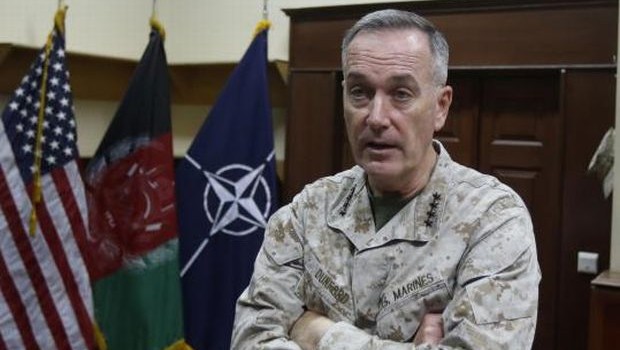
Shortly, the «gruesome twosome» of U.S.-Russian relations, Assistant Secretary of State for European and Eurasian Affairs Victoria Nuland and NATO Supreme Commander General Philip Breedlove, will be joined by a third neo-Cold Warrior, Marine Corps General Joseph Dunford, the prospective Chairman of the Joint Chiefs of Staff, to become the «terrible troika» of American officials clamoring for a military showdown with Moscow.

During his confirmation hearings before the Senate Armed Services Committee, Dunford said he viewed Russia as the greatest threat to America. But not just any «threat». In language that could have been pulled out of a U.S. newspaper from the 1960s, Dunford testified, «If you want to talk about a nation that could pose an existential threat to the United States, I’d have to point to Russia», adding, «and if you look at their behavior, it’s nothing short of alarming».

While Dunford’s Cold War rhetoric warmed the cockles of the hearts of leading Senate committee war hawks such as John McCain, McCain’s eyelash-batting pal Lindsey Graham – a 2016 presidential candidate – and Texas Joseph McCarthy lookalike Ted Cruz, it was not well-received at the White House or the State Department. White House Press Secretary John Earnest distanced President Obama from Dunford’s views, stating at a press conference that Dunford was expressing «his own view and [it] doesn’t necessarily reflect the . . . consensus analysis of the president’s national security team».

State Department spokesman Mark Toner, in commenting on Dunford’s remarks, was more emphatic when stating that Secretary of State John Kerry rejected the general’s comments, «The secretary doesn’t agree with the assessment that Russia is an existential threat to the United States, nor China, quite frankly». Toner was referring to Dunford’s testimony that China was second only to Russia in posing a significant threat to the United States.

However, it was Kerry who promoted Nuland, who is married to arch-neoconservative and Project for the New American Century (PNAC) architect Robert Kagan, to the position that placed her in charge of U.S.-Russian relations. Previously, Nuland served as Secretary of State Hillary Clinton’s press spokeswoman. And if Mrs. Clinton’s penchant for «standing by her women» is any indication, a Hillary Clinton presidency could see Nuland, who once worked for Vice President Dick Cheney, promoted to a higher-level position, including Secretary of State or National Security Adviser. Obama and Kerry can distance themselves from Dunford’s alarming comments all they want, however, it is they who have permitted individuals like Nuland, Breedlove, Dunford, and the saber-rattling Defense Secretary Ashton Carter to become major policy officials within the Obama administration.

Dunford and Breedlove appear to have been pulled from central casting for a remake of the 1960s Stanley Kubrick noire comedy film, «Dr. Strangelove». Dunford, who bears the problematic nickname «Fighting Joe» and has been described as a «fervent Catholic», sounds like the blusterous General Buck Turgidson, who, after a wayward B-52 continues on to Russia, against orders, to drop its nuclear payload on a missile base, tells a bewildered president, «It is necessary now to make a choice, to choose between two admittedly regrettable, but nevertheless ‘distinguishable,’ postwar environments: one where you got twenty million people killed, and the other where you got a hundred and fifty million people killed». Breedlove, on the other hand, is just as much an ideologue as is the fictional General Jack Ripper, who in «Dr. Strangelove» tells his British liaison officer, «Today, war is too important to be left to politicians. They have neither the time, the training, nor the inclination for strategic thought».

Dunford, Breedlove, Nuland, and Carter could very well push the United States and Russia to the brink of a hot war. Breedlove championed the creation of NATO’s Very High Readiness Joint Task Force, or VHRJTF as it is known to the acronym- and abbreviation-addicts of the Pentagon. VHRJTF brings ground forces from nine NATO nations to Russia’s borders. The new rapid-response unit took part in the first «live fire» exercise in Poland, code-named NOBLE JUMP, since the end of the Cold War. VHRJTF also consists of U.S.-supplied drones. The possibility that an unmanned drone could bring about a replay of the 1960 U-2 incident, in which a manned American spy plane was shot down over Russia, this time with a drone straying into Russian airspace from one of the Baltic countries, cannot be ruled out.

Obama and Kerry were quick to distance themselves from «Fighting Joe» Dunford’s saber rattling before the Senate committee. However, if they wanted to truly reset relations with Russia, Kerry could fire Nuland, Obama could pull Dunford’s nomination, and both could ask NATO to request a new Supreme Commander. However, as President Dwight Eisenhower warned in his 1961 Farewell Address about the menace of the «military-industrial complex», Obama and Kerry are powerless to get rid of those who were placed in power by what has now become a «military-intelligence-contractor» complex.

What is even more troubling is that Breedlove, Dunford, Nuland, and Carter appear prepared to not only take on Russia and China in a new Cold War, but are willing to confront the new «anti-NATO», the Shanghai Cooperation Organization (SCO), which just wrapped up its summit in Ufa, the capital of the Russian Federation’s autonomous republic of Bashkortostan. If the «gruesome twosome» of Nuland and Breedlove, soon to become the «terrible troika» after Dunford is confirmed by the Senate, have their way, NATO and the United States will not only be willing to face off militarily against SCO members China and Russia but also the new members of Pakistan and India, in addition to charter members Kazakhstan, Uzbekistan, Kyrgyzstan, and Tajikistan.

Russia has savaged the West’s attempts to isolate it and China has broken America’s attempt to establish a military containment «cordon sanitaire» around China by welcoming Belarus as a new observer nation of SCO, joining Afghanistan, Mongolia, and Iran as prospective full members of the alliance. Cambodia, Nepal, Armenia, and Azerbaijan joined the organization as dialogue partners, supplementing existing partners Sri Lanka and Turkey. Egypt, Bangladesh, and Syria are also prospective members of the organization that is a counter to the ever-expanding NATO. SCO’s geopolitical security mission, coupled with the emerging economic power of the BRICS alliance of Brazil, Russia, India, China, and South Africa, equates to a majority of the world’s population rejecting America’s military and economic dominance and NATO’s and the Pentagon’s menacing swagger. It is as if Dunford, Breedlove, and Nuland have never heard of SCO, BRICS, or the Eurasian Economic Union.

It is amazing that Dunford and Breedlove can issue challenges to their perceived enemies when Carter has announced a 40,000 troop strength cut for the U.S. Army. Instead, Carter plans to supplement NATO forces in Europe with more Bradley Fighting Vehicles and tanks that would be manned by a smaller number of U.S. troops. Like the Roman Empire, the United States has over-extended itself around the world.

It is not Russia nor China that maintain troops in 150 countries around the world. That dubious distinction falls on the United States. Fighting Joe Dunford and General Breedlove can talk all they want about the Russian and Chinese «threat». But for the rest of the world, which sees SCO and BRICS as welcome foils to the plans for further NATO expansion, it is America and its policy of fostering «color revolutions» and displaying military shows of force that represent the true threats to global stability.

The enduring reality of government by wealth and some of its consequences

Plutocracy-2

By John Chuckman

Source: Intrepid Report

If you really want to understand the world in which we live—its endless wars, coups, interventions, and brutality towards great masses of people—you need to start with a correct understanding of the political machinery at work.

Talk of liberal interventions or fighting for rights, Western values, and democracy are hopelessly naïve and mostly deliberately deceptive. America’s record in such matters is one of securing everything from bananas, copper, and crude oil concessions to, at the very least, foreign governments obedient to its mandates after removing a disliked leader, whether elected or not. There is no concern for principles outside of their being featured in blowhard, insincere political speeches. The interests of America’s government do not match the interests of ordinary people, those in America or anywhere else, and, were the informed consent of the governed genuinely involved in launching bloody adventures, they likely never would happen.

The underlying reality of how people in the West are governed now compared to hundreds of years ago is surprisingly unchanged, much the way the rules governing how chemical bonds form have not changed despite a long and great parade of events and discoveries in the visible world. Despite all the revolts, revolutions, congresses, constitutions, and great movements over the centuries, we are in fact governed in the same essential way, people.

Of course to see this, you have to strip away the forms and rituals we have constructed over the centuries, forms and rituals which create impressive effects much like the green smoke and thunderous voice of the Wizard of Oz, a wizened old man who worked from his curtained control room, pulling levers and hitting buttons to create intimidating effects. Most Americans remain impressed with the smoke and thunder and cheap magic tricks, it requiring some dedicated effort to shake off well-done illusions, and, as I’ve written before, Americans work extremely hard in their jobs or live a kind of marginal life trying to scrape by on low wages or part-time work, either of which situations leaves little time or inclination to question what government is really doing and for whose benefit.

And so long as America remains under the rule of wealth, it is unlikely other states, as in Western Europe, will emerge from it because America’s establishment has such decisive influence—economic, financial, military, and political—over many of them.

What is considered as wealth changes over time and with economic development, and with those changes so do its interests as well as the practices of its power. Great deposits of copper ore or crude oil In the Middle Ages were virtually worthless. Wealth then was land for agriculture, forestry, and hunting, with the family names of owners determined by their estates. The revenue from that natural wealth was converted to great houses and jewels and the implements of war. War, too, was a source of wealth with most wars being little more than adventures for dominance and looting on a grand scale. Again, as in our own day, they were dressed up with slogans about principles or causes which had almost no meaning. The case of the “Christian” Crusades, which continued their pillaging and orgy of killing, on and off, for centuries, springs to mind. Soldiers and sailors, up until modern times, were not motivated by their paltry pay and poor supplies, it being understood as a condition of employment that they would enjoy a share of the bounty looted in any campaign.

Today, the forms wealth are as diverse and complex as is our society, and many of them are not apparent to ordinary people in the way great estates and hunting rights and obligations in war and peace to great lords were apparent in 800. Even as late as, say, 1850, wealth in the form of belching factories employing armies of people was often still quite apparent, but today’s complex banking and securities and financial institutions are not well understood by most people, although they represent immense wealth just as real in its demands and power as estates and obligations of the 9th century. Wealth today also comes from huge global manufacturing concerns of every description often with operations scattered out of sight, great shipping and transportation fleets, or electronic and communications empires. Land itself remains an important form of wealth where it can produce industrial-scale crops or contains deposits of valuable minerals or can generate flows of electricity or has been developed into great cities or resorts. War remains a source of wealth, only on a scale which could not have been imagined a few hundred years ago, but the spoils no longer go to soldiers in professional armies, they go to those responsible for the war, often in forms not easily recognized, as with special rights and concessions and secret arrangements.

As the nature of wealth evolved from the Middle Ages to the Modern Era, outward forms and rituals of government also changed. We have moved from the near-absolute power of kings and autocrats through aristocracies and republics with senates to a great variety of forms, parliaments and congresses, which appear designed to yield, to one degree or another, to the consent of the governed.

But appearances, as in the case of the Wizard of Oz, can be deceiving.

Today, a single wealthy individual cannot make the kind of demands upon ordinary people that marked arrangements in the Middle Ages—although that must be qualified as I’m sure anyone who has become involved in a dispute with a wealthy neighbor or a great corporation will be happy to explain—but the class of wealthy people can indeed make just such demands, and they do so all the time. You will be taxed to pay for the schemes that their lobbying establishes, your water and air will contain the pollution of their manufacturing and mining, your children will be sent to kill and die in their wars, the ethics or morals you were taught as a child will be trampled upon, and virtually all important legislation will deal with the rights and interests of wealth, and not those of the broad mass of people.

In America, once in four years you will be asked to choose between two names, both of which have been closely vetted by the powers that be, to elect as head of government. Not only have they been vetted, but the immense costs of their campaigns in reaching you on television, at rallies, and with opinion polls to regularly fine tune their words will be paid almost exclusively by those whose real interests are at stake in every major election, the wealthy and their important serving institutions of government. The end effect is not really all that different than the old single-candidate Soviet elections at which the press trained Americans to sneer.

Many of America’s founding fathers had dark suspicions about the existence of wealth being secure in the presence of democratic government, and that is why they created forms—mostly adapted from Britain, a place no one regarded as a democracy then—to keep wealth safe. Over a couple of centuries, the original arrangements were modified, the country moving from a tiny one percent or so privileged voters—for perspective, that’s roughly the same as the percent of voters in China’s Communist Party deciding who rules the country—to something approaching universal suffrage, but always arrangements were made to safeguard wealth against the assumed predations of democracy.

In elections for the American Senate, the legislative body with real power, authority, and privilege, you again will be asked to choose between two well-vetted and well-connected candidates. Others may run, but they will be rendered helpless by the vetted candidates’ flood of money and resources, you will never hear their voices, and America’s press—itself an empire of wealth serving wealth—will waste no time on their views. In the case of the Senate, you will be asked once in six years to vote, with the elections staggered so that only one-third of that body faces election at any time—a perfectly-conceived formula for keeping the old bunch in charge despite issues which might have generated election discontent. In fact, you can never “throw the bums out” in America. Anyway, there really isn’t much risk for senators running for re-election, with incumbents winning about 95% of the time. Senate seats are so secure they sometimes become family sinecures, handed down from father to son. After the election, unless you live in a small-population, insignificant state, you will never see or meet your senator, and you will certainly have no opportunity to lobby. Virtually all seeing, meeting, and lobbying will be done by the wealthy sponsors of the successful candidates or by their hired help.

The average American senator is said to spend two-thirds of his or her time securing funds for the next election, and such elections have now been bid-up to unbelievable amounts of money. The huge costs serve as what economists call “a barrier to entry,” a kind of high financial wall which keeps others from entering the political market, or, if somehow they do manage to enter, keeps them from effectively competing. Only the other wealth-vetted and connected candidate will have any hope of collecting a big enough pot of money to threaten an incumbent. The belief that people giving millions of dollars to candidates expect nothing in return is not even worth discussing. What they get—apart from goodies like important and prestigious appointments or valuable government contracts—is access, and access is exactly what most people never enjoy. Intimate access to politicians in high office, people always mindful of the necessity for another overflowing campaign war chest, is genuine power.

It is not impossible to have compatibility between democracy and wealth, but it requires a set of laws and regulations concerned with campaign financing, lobbying, and disestablishing a political duopoly of two privileged parties, laws which simply cannot happen in America over our lifetimes. In America, law makes corporations persons, and the highest court, packed by judges appointed to serve wealth’s interests, has ruled that campaign money is free speech. These are not things easily turned around.

The American system of campaign financing not only assures the secure power of domestic wealth, it assures also the influence of wealthy lobbies serving the interests of foreign states, Israel being the most outstanding example. Other foreign states also exploit this system to varying degrees, but no other state has more than five million American citizens in great part keen to serve its interests. And many of them are successful, affluent, and well-placed people enjoying a connected set of organizations and well-funded lobbies. Other foreign states also do not enjoy having many of their lobbyists in America being dual-citizens, free to move back and forth between the country being lobbied and the country being lobbied for, surely an ethical issue for politics and foreign affairs of the first magnitude. It is a unique situation in many respects, and it has helped create a unique set of problems in the world.

The wealthy interests of America happen to share some important interests with lobbyists for Israel, including securing the Western world’s supply of energy and not permitting the rise of states of any power in the Middle East who disagree with America’s essential views. It is important to keep in mind that “America’s essential views” are not necessarily the views of most of the American people and that many of those “essential views” have never received genuine informed consent. Elections conducted the way America’s high-level elections are conducted are incapable of bestowing meaningful consent, especially in vitally important matters.

The Israeli-American alliance is something of an unholy one because in binding America so closely to Israel, some huge and unresolvable conflicts have been created. Israel is associated with a long series of wars and abuses in the region, and, ipso facto, so is America. Israel, given the nature of its founding, expansion, and practices, is not liked by any neighboring states, although many now cooperate secretly, and sometimes even openly, in areas of mutual interest and have learned to tolerate its existence, the way generally eased by large American bribes or equally large American threats.

Traditionally, states in the Middle East are not democracies. Their often short histories have given limited opportunity for wide-spread development and prosperity creating a strong middle-class, the sine qua non for democracy. With the United States always (insincerely) praising democracy—including Israel’s grotesque contradiction of “democracy for some but not others”—it has been caught in a bind between supporting what it says it opposes and opposing what it says it supports.

Its proposed solution was a huge CIA project, nicknamed “the Arab Spring” by America’s wealth-serving and often dishonest press, a set of manufactured uprisings intended to bring a semblance of democracy to the region. It has been largely a failure, ending with some countries trapped in chaos or civil war and others, notably Egypt, briefly gaining a government Israel hated intensely, the truth being that genuine democracy in virtually any of these countries will not be friendly to Israel’s geopolitical ambitions in the region nor to those of its American promoter and protector. While the “Arab Spring” was allowed to proceed in some states, in others, where it was neither intended nor desired, such as Saudi Arabia or Bahrain, spill-over effects were deliberately and violently suppressed with American assistance. So the American-Israeli relationship now still locks the United States effectively in fighting against democracy in some countries and in supporting absolute monarchs and oligarchs in others, while in still others, such as Syria and Iraq, it is involved literally in smashing them as states, in violation of all international law and long-term good sense.

The entire situation is an ongoing disaster and is almost certainly not sustainable over the long term. How do you insist a huge country like Egypt remain a backwater without democratic rights indefinitely? How can you justify the destruction of an ancient and beautiful country like Syria? How can you justify supporting absolute monarchs and keeping their people in total political darkness? How do you continue supporting Israel in its abuse of millions, depriving them of every human right, or in its constant aggression to secure its hegemony? The drive for regional hegemony is all that is behind Israel’s constant hectoring of Iran, and how is that behavior different to the aggressive wars condemned by the Nuremburg Tribunal? It’s not, of course. Further, destructive, deliberately-induced conflicts like that in Syria, by degrading its economic advance, only slow the day for democracy’s having a real chance to emerge.

So here is America, self-proclaimed land of the free, mired in a vast situation where it works to suppress democracy, supports tyrants, and supports aggressive war because its leaders, with no genuine consent of the governed, have put it there, and this is just one of many unhealthy and destructive consequences of wealth’s rule in the United States. Wealth has no inherent interest in democracy, and it is entirely up to a people anywhere to demand respect for democracy through laws.

John Chuckman is former chief economist for a large Canadian oil company. He has many interests and is a lifelong student of history. He writes with a passionate desire for honesty, the rule of reason, and concern for human decency. John regards it as a badge of honor to have left the United States as a poor young man from the South Side of Chicago when the country embarked on the pointless murder of something like 3 million Vietnamese in their own land because they happened to embrace the wrong economic loyalties. He lives in Canada, which he is fond of calling “the peaceable kingdom.” John’s columns appear regularly on Counterpunch, Media Monitors, Politics Canada, Baltimore Chronicle, Intrepid Report, Scoop (New Zealand), Asian Tribune, Aljazeerah.info, Smirking Chimp, Dissident Voice, and many other Internet sites. He has been translated into at least ten languages and is regularly translated into Italian and Spanish. Several of his essays have been published in book collections, including two college texts. His first book has just been published, “The Decline of the American Empire and the Rise of China as a Global Power,” published by Constable and Robinson, London. Contact him at jc60649@yahoo.com.