If we assume this was written by a prominent doctor at a Harvard-affiliated hospital – an academic professional who bases his opinions on sound medical principles and scientific knowledge – it makes no sense at all. In fact, it is an embarrassment to the writer and the institution he represents.
The following are the medical and scientific fictions (or, if you prefer, lies) supposedly advocated by infectious-disease-physician Callahan, followed by an explanation of why CIA-agent/biosecurity-propagandist Callahan would want to promulgate them:
Fiction #1: Zero Covid works
Callahan opens his article with a bold statement: “China rolled back its longstanding pandemic strategy ‘zero Covid,’ which had protected the country for nearly three years.” As many, including myself, have noted, there is no evidence – except the repeated statements of people like Callahan and the lockdown-narrative-promoting mainstream press – for the fact that the “zero Covid” strategy protected anyone from anything.
Callahan, who has worked for the intelligence community in Asia, knows (as we all should) that information from the Chinese Communist Party (CCP) is not reliable, to say the least. Therefore, there is no reason to think he believes the CCP’s absurd claims that there were no Covid deaths in China for three years thanks to lockdowns.
So why is this his lede? Because the biosecurity propaganda machine has to maintain the illusion that lockdowns, at least to some degree, are effective, and that ending them is somehow undesirable.
Fiction #2: China’s Lunar New Year is a very scary time
Callahan returns to a favorite trope of the quarantine-until-vaccine cabal from exactly three years ago: the Lunar New Year in China. Due to “enormous” travel, “densely packed transit systems, winter conditions and multigenerational gatherings,” Callahan tells us “the Lunar New Year is a common tabletop simulation for training public health officials.” What about the real world? Do we have any proof that it was disastrous in 2020, as mainstream media warned, or will be disastrous in 2023?
Furthermore, if Lunar New Year travel in 2020 already exported Covid far and wide (we know that by the time lockdowns were initiated in China on January 23, 2020, the virus had already spread to nearly every Chinese province, and many other countries) – what use were lockdowns in one or two specific areas for containing its worldwide spread? And if it spread everywhere, including in China, despite lockdowns, how can we believe the zero deaths for three years narrative?
Fiction #3: the most dangerous subvariant
Ever since Delta, variants and subvariants have provided a never-ending source of fear mongering for the quarantine-until-vaccine junta. In his op-ed, Callahan makes an unsubstantiated claim that the “subvariant XBB1.5” is “the most infectious to date.” There is no reference, so I’m not sure where the information is from. I found one doctor in North Carolina saying it “seems to be the most infectious” with no meaningful data to support the claim. A WHO official says it’s the “most transmissible” (again, no numbers or data) but adds “there’s no indication it makes people more sick than previous subvariants.”
As has been true for SARS-CoV-2 and every one of its mutations, and as is true for every infectious disease humanity has ever encountered: If it’s not very lethal to most people, it can infect the entire world’s population while causing very little serious disease or death.
Dr. Callahan knows this. Propagandist Callahan is using the tried and true biodefense network’s tactic of constantly citing high case numbers (regardless of illness or death) to send the media and public into paroxysms of panic.
Fiction #4: vaccines work
Next, Callahan says the United States has a high vaccination rate using “highly protective vaccines.” If he means against the original SARS-CoV-2 virus, Callahan might be able to dig up some evidence (though it is highly contestable). But if he means against this subvariant, he has zero evidence, and he knows it.
Fiction #5: some vaccines (ours) are better than others (theirs)
“Domestically made Chinese vaccines,” according to Callahan, “may provide less lasting protection against the virus and its variants.”
Since he says “may,” this is clearly just a hypothesis. Since we know our vaccines provide at most a few months of protection from the original strain (again, a contestable statement) and none from any variant or subvariant thereafter, the meaning of “less lasting protection” basically is “less than zero,” which again makes no sense.
However, as a member of the quarantine-until-vaccine biosecurity network, Callahan is using this piece of propaganda to bolster the case that lockdowns and vaccines work.
How anyone can believe such preposterous fiction is a mystery.
Postscript: a very scary non-fiction
The vast expansion of surveillance in general, and biosurveillance in particular, is one of the biosecurity community’s biggest achievements during Covid, and Callahan manages to include a plug for more:
In December, at least one online pharmacy in China began selling the Covid drug Paxlovid, made by the American pharmaceutical company Pfizer, directly to patients. The pharmacy shipped Paxlovid to any Chinese person with a positive coronavirus test. If the Beijing government were to tie the government’s home test result reporting system to the commercial Paxlovid home delivery providers, many lives could be saved.
If anyone is wondering why it’s important to debunk and expose all of the fictions and propaganda of the Covid biosecurity agenda, this tiny window into the terrifying vision they have for our future is the answer.
I don’t have to tell you that your money doesn’t go as far as it once did. You see it every time that you go shopping. Our leaders flooded the system with money and pursued highly inflationary policies for years, and now we are all paying the price. The cost of living has been rising much faster than our incomes have, and this is systematically destroying the middle class. Survey after survey has shown that a solid majority of the population is living paycheck to paycheck, and at this point most U.S. consumers are tapped out. In fact, one brand new survey just discovered that 57 percent of Americans cannot even afford to pay a $1,000 emergency expense…
According to Bankrate’s Annual Emergency Fund Report, 68% of people are worried they wouldn’t be able to cover their living expenses for just one month if they lost their primary source of income. And when push comes to shove, the majority (57%) of U.S. adults are currently unable to afford a $1,000 emergency expense.
When broken down by generation, Gen Zers (85%) and Millennials (79%) are more likely to be worried about covering an emergency expense.
These numbers are quite ominous, because they clearly demonstrate that we are completely and utterly unprepared for any sort of a major economic downturn.
And thanks to the rapidly rising cost of living, we are losing even more ground with each passing month.
Nearly three-quarters, or 72%, of middle-income families say their earnings are falling behind the cost of living, up from 68% a year ago, according to a separate report by Primerica based on a survey of households with incomes between $30,000 and $100,000. A similar share, 74%, said they are unable to save for their future, up from 66% a year ago.
We haven’t experienced anything like this in the United States in decades.
When I walked into a Walmart store the other day, I was shocked by how high the prices are now.
Isn’t Walmart supposed to be the place with “low prices every day”?
Well, the prices were certainly not “low” when I walked through the store.
And I was stunned to learn that McDonald’s is now selling one hash brown for three dollars.
I am sure that many of you can remember a time when they were 50 cents.
Sadly, those days are not coming back.
Food prices are going to continue to go up, and the CEO of Unilever recently admitted that his company has actually “been accelerating the rate of price increases that we’ve had to put into the market”…
“For the last 18 months we’ve seen extraordinary input cost pressure … it runs across petrochemical derived products, agricultural derived products, energy, transport, logistics,” he said.
“It’s been feeding through for quite some time now and we’ve been accelerating the rate of price increases that we’ve had to put into the market,” he added.
US retail sales continued their fall in December, dropping by 1.1% as inflation remained high, the Commerce Department reported Wednesday.
That’s the largest monthly decline since December 2021, and practically every category (except for building materials, groceries and sporting goods) saw sales drop from the prior month.
U.S. existing home sales slowed for the 11th consecutive month in December as higher mortgage rates, surging inflation and steep home prices sapped consumer demand from the housing market.
-More Americans than ever before are being forced to pay at least 30 percent of their incomes on rent…
The average US household is now considered ‘rent-burdened’ as a record-high number of people are spending more than 30 percent of their income on rent.
According to Moody’s Analytics’ latest affordability report, the national average rent-to-income (RTI) ratio reached 30 percent for the first time since the company began tracking the data more than 20 years ago.
U.S. consumers are being stretched financially like never before, and many are turning to debt to help them maintain their current lifestyles.
As a result, the savings rate has plunged to a historic low, credit card debt has surged to a record high, and the average rate of interest on credit card balances has also risen to a record high. As Zero Hedge has aptly noted, this is “nothing short of catastrophic”…
The combination of record high credit card debt and record high credit card interest is nothing short of catastrophic for both the US economy, and the strapped consumer who has no choice but to keep buying on credit while hoping next month’s bill will somehow not come. Unfortunately, it will and at some point in the very near future, this will also translate into massive loan losses for US consumer banks; that’s when Powell will finally panic.
For a long time, we have been warned that the very foolish economic policies that our leaders were implementing would have deeply tragic consequences.
And now it is starting to happen right in front of our eyes.
Sadly, the truth is that this is just the beginning.
The entire system is cracking and crumbling all around us, and there is much more pain ahead.
Saudi Crown Prince Mohammed bin Salman, Masayoshi Son, SoftBank Group Corp. Chairman and CEO, and Christine Lagarde, International Monetary Fund (IMF) Managing Director, attend the Future Investment Initiative conference in Riyadh, Saudi Arabia October 24, 2017. REUTERS/Faisal Al Nasser
The decline of a currency’s world reserve status is often a long process rife with denials. There are numerous economic “experts” out there that have been dismissing any and all warnings of dollar collapse for years. They just don’t get it, or they don’t want to get it. The idea that the US currency could ever be dethroned as the defacto global trade mechanism is impossible in their minds.
One of the key pillars keeping the dollar in place as the world reserve is its petro-status, and this factor is often held up as the reason why the Greenback cannot fail. The other argument is that the dollar is backed by the full force of the US military, and the US military is backed by the US Treasury and the Federal Reserve – In other words, the dollar is backed by…the dollar; it’s a very circular and naive position.
These sentiments are not only pervasive among mainstream economists, they are also all over the place within the alternative media. I suspect the main hang-up for liberty movement analysts is the notion that the globalist establishment would ever allow the dollar or the US economy to fail. Isn’t the dollar system their “golden goose”?
The answer is no, it is NOT their golden goose. The dollar is just another stepping stone towards their goal of a one-world economy and a one-world currency. They have killed the world reserve status of other currencies in the past, why wouldn’t they do the same to the dollar?
Globalist white papers and essays specifically outline the need for a diminished role for the US currency as well as a decline in the American economy in order to make way for Central Bank Digital Currencies (CBDCs) and a new global currency system controlled by the IMF. I warned about this years go, and my position has always been that the derailment of the dollar would likely start with the end of its petro status.
In 2017 I published an article titled ‘Saudi Coup Signals War And The New World Order Reset’. I noted at the time that the sudden power shift over to crown prince Mohammed Bin Salman indicated a change in Saudi Arabia’s relationship to the US. I stated that:
“To understand how drastic this coup has been, consider this — for decades Saudi Kings maintained political balance by doling out vital power positions to separate, carefully chosen successors. Positions such as Defense Minister, the Interior Ministry and the head of the National Guard. Today, Mohammed Bin Salman controls all three positions. Foreign policy, defense matters, oil and economic decisions and social changes are now all in the hands of one man.”
The rise of MBS was backed by the Public Investment Fund (PIF), a fund comprised of trillions of dollars supplied by globalists within Carlyle Group (Bush family, etc.), Goldman Sachs, Blackstone and Blackrock. MBS garnered the favor of the globalists for one specific reason – He openly supported their “Vision For 2030”, a plan for the dismantling of “fossil fuel” based energy and the implementation of carbon controls. Yes, that’s right, the head of Saudi Arabia is backing the eventual end of oil based energy, and part of that includes the end of the dollar as the petro currency.
In exchange for their cooperation, the Saudis are being given access to ESG-like funding as well as access to AI advancements and the so-called “digital economy.” It sounds crazy, but there is much talk of AI developments to cure numerous health problems and extend lifespan. With those kinds of promises, it’s not surprising that Saudi elites would be willing to dump the dollar and even oil.
In 2017 I noted that:
“I believe the next phase of the global economic reset will begin in part with the breaking of petrodollar dominance. An important element of my analysis on the strategic shift away from the petrodollar has been the symbiosis between the U.S. and Saudi Arabia. Saudi Arabia has been the single most important key to the dollar remaining as the petrocurrency from the very beginning.”
I believed that the threat to petro status would ultimately be spurred on by a proxy war between East and West:
“World economic war is the real name of the game here, as the globalists play puppeteers to East and West. It is a geopolitical crisis they will have created to engineer public support for a solution they predetermined.”
Back then I thought that such a proxy war would be initiated in the Middle East, possibly in Iran. However, it’s clear that Ukraine is the powderkeg the globalists have chosen, at least for now, with Taiwan being the next shoe to drop.
In the years since I made these predictions the relationship between Saudi Arabia, Russia and China has grown very close. Arms deals and energy deals are becoming a mainstay of trade and this has led to a quiet but steady distancing of the Saudis from the dollar. This past week, the dominoes were set in motion for dollar collapse when Saudi Arabia announced at Davos that they are now willing to trade oil in alternative currencies.
In response, Xi Jinping pledged to ramp up efforts to promote the use of the Chinese yuan in energy deals. This falls in line with another article I wrote in 2017 titled ‘The Economic End Game Continues,’ in which I described how conflict with Eastern nations (China and Russia) would be exploited to create a catalyst for the end of the dollar’s petro status.
The importance of the Saudi announcement cannot be overstated; this is the beginning of the end of the dollar. The dollar’s world reserve status is largely dependent on its petro-status. Without one, you cannot have the other. This is almost the exact same dynamic that led to the implosion of the British Sterling decades ago as the global petro currency which resulted in the rise of the dollar to take its place.
This time, though, it will not be a single foreign currency that takes on the role of world reserve, it will be a basket currency system controlled by the IMF called Special Drawing Rights, along with a single global digital currency that is yet to be named but is now under development.
The consequences of the loss of reserve status will be devastating to the US economy. It is the only glue holding our system together – The ability to defer inflation by exporting it overseas is a superpower only the US enjoys. The Fed can print money perpetually if it wants to in order to fund the government or prop up US markets, as long as foreign central banks and corporate banks are willing to absorb dollars as a tool for global trade. If the dollar is no longer the primary international trade mechanism, the trillions upon trillions of dollars the Fed has created from thin air over the years will all come flooding back to the US through various avenues, and hyperinflation (or hyperstagflation) will be the result.
This dynamic is already in play, as foreign holders of US debt and dollars have been dumping them at record pace since 2017. The process continues at a time when the Federal Reserve is cutting it’s balance sheet and raising interest rates, which means there is no longer a buyer of last resort.
This may be why multiple foreign central banks have renewed their purchases of gold reserves and are once again stockpiling precious metals. They seem to be well aware of what is about to happen to the dollar, while the American public is kept in the dark.
The effects of the decline of the dollar may not be immediately felt, or become obvious for another year or two. What will happen is consistent inflation on top of the high prices we are already dealing with. Meaning, the Federal Reserve will continue to hold interest rates higher and prices will barely budge or they may climb in spite of monetary tightening. Even in the face of a major recessionary contraction, which I predict will be triggered starting in April, prices will STILL remain higher.
All the while the mainstream media and government economists will say they have “no idea” why inflation is so persistent, and that “nobody could have seen this coming.” Some of us saw it coming, but only because we accept the reality that the dollar’s days are numbered.
In this age of ubiquitous surveillance, there are no private lives: everything is public.
Surveillance cameras mounted on utility poles, traffic lights, businesses, and homes. License plate readers. Ring doorbells. GPS devices. Dash cameras. Drones. Store security cameras. Geofencing and geotracking. FitBits. Alexa. Internet-connected devices.
There are roughly one billion surveillance cameras worldwide and that number continues to grow, thanks to their wholehearted adoption by governments (especially law enforcement and military agencies), businesses, and individual consumers.
With every new surveillance device we welcome into our lives, the government gains yet another toehold into our private worlds.
Indeed, empowered by advances in surveillance technology and emboldened by rapidly expanding public-private partnerships between law enforcement, the Intelligence Community, and the private sector, police have become particularly adept at sidestepping the Fourth Amendment.
As law professor Avidan Y. Cover explains:
A key feature of the surveillance state is the cooperative relationship between the private sector and the government. The private sector’s role is vital to the surveillance both practically and legally. The private sector, of course, provides the infrastructure and tools for the surveillance… The private sector is also critical to the surveillance state’s legality. Under the third-party doctrine, the Fourth Amendment is not implicated when the government acquires information that people provide to corporations, because they voluntarily provide their information to another entity and assume the risk that the entity will disclose the information to the government. Therefore, people do not have a reasonable expectation of privacy in their calling data, or potentially even their emails. As a result, the government does not normally need a warrant to obtain information transmitted electronically. But the Fourth Amendment is not only a source of protection for individual privacy; it also limits government excess and abuse through challenges by the people. The third-party doctrine removes this vital and populist check on government overreach.
Critical to this end run around the Fourth Amendment’s prohibitions against unreasonable searches and seizures by government agents is a pass play that allows police to avoid public transparency requirements (open bids, public meetings, installation protocols) by having private companies and individuals do the upfront heavy lifting, leaving police to harvest the intel on the back end.
Stingray devices, facial recognition technology, body cameras, automated license plate readers, gunshot detection, predictive policing software, AI-enhanced video analytics, real-time crime centers, fusion centers: all of these technologies and surveillance programs rely on public-private partnerships that together create a sticky spiderweb from which there is no escape.
As the cost of these technologies becomes more affordable for the average consumer, an effort underwritten by the tech industry and encouraged by law enforcement agencies and local governing boards, which in turn benefit from access to surveillance they don’t need to include in their budgets, big cities, small towns, urban, suburban and rural communities alike are adding themselves to the surveillance state’s interconnected grid.
What this adds up to for government agencies (that is, FBI, NSA, DHS agents, etc., as well as local police) is a surveillance map that allows them to track someone’s movements over time and space, hopscotching from doorbell camera feeds and business security cameras to public cameras on utility poles, license plate readers, traffic cameras, drones, etc.
It has all but eliminated the notion of privacy and radically re-drawn the line of demarcation between our public and private selves.
Over the past 50 years, surveillance has brought about a series of revolutions in how governments govern and populations are policed to the detriment of us all. Cybersecurity expert Adam Scott Wandt has identified three such revolutions.
The first surveillance revolution came about as a result of government video cameras being installed in public areas. There were a reported 51 million surveillance cameras blanketing the United States in 2022. It’s estimated that Americans are caught on camera an average of 238 times every week (160 times per week while driving; 40 times per week at work; 24 times per week while out running errands and shopping; and 14 times per week through various other channels and activities). That doesn’t even touch on the coverage by surveillance drones, which remain a relatively covert part of police spying operations.
The second revolution occurred when law enforcement agencies started forging public-private partnerships with commercial establishments like banks and drug stores and parking lots in order to gain access to their live surveillance feeds. The use of automatic license plate readers (manufactured and distributed by the likes of Flock Safety), once deployed exclusively by police and now spreading to home owners associations and gated communities, extends the reach of the surveillance state that much further afield. It’s a win-win for police budgets and local legislatures when they can persuade businesses and residential communities to shoulder the costs of the equipment and share the footage, and they can conscript the citizenry to spy on each other through crowdsourced surveillance.
The third revolution was ushered in with the growing popularity of doorbell cameras such as Ring, Amazon’s video surveillance doorbell, and Google’s Nest Cam.
Amazon has been particularly aggressive in its pursuit of a relationship with police, enlisting them in its marketing efforts, and going so far as to hosting parties for police, providing free Ring doorbells and deep discounts, sharing “active camera” maps of Ring owners, allowing access to the Law Enforcement Neighborhood Portal, which enables police to directly contact owners for access to their footage, and coaching police on how to obtain footage without a warrant.
Ring currently partners with upwards of 2,161 law enforcement agencies and 455 fire departments, and that number grows exponentially every year. As Vice reports, “Ring has also heavily pursued city discount programs and private alliances with neighborhood watch groups. When cities provide free or discounted Ring cameras, they sometimes create camera registries, and police sometimes order people to aim Ring cameras at their neighbors, or only give cameras to people surveilled by neighborhood watches.”
In November 2022, San Francisco police gained access to the live footage of privately owned internet cameras as opposed to merely being able to access recorded footage. No longer do police even have to request permission of homeowners for such access: increasingly, corporations have given police access to footage as part of their so-called criminal investigations with or without court orders.
We would suggest a fourth revolutionary shift to be the use of facial recognition software and artificial intelligence-powered programs that can track people by their biometrics, clothing, behavior and car, thereby synthesizing the many strands of surveillance video footage into one cohesive narrative, which privacy advocates refer to as 360 degree surveillance.
Finally, Wandt sees autonomous cars equipped with cameras that record everything around them as yet another revolutionary expansion of surveillance to be tapped by police.
Yet in the present moment, it’s those public-private partnerships that signify a watershed moment in the transition from a police state to a surveillance state and sound a death knoll for our privacy rights. This fusion of government power and private power is also at the heart of the surveillance state’s growing stranglehold on the populace.
As always, these intrusions into our personal lives are justified in the name of national security and fighting crime. Yet while the price to be paid for having the government’s so-called protection is nothing less than our right to privacy, the guarantee of safety remains dubious, at best.
As a study on camera surveillance by researchers at City University of New York concluded, the presence of cameras were somewhat effective as a deterrent for crimes such as car burglaries and property theft, but they had no significant effect on violent crimes.
On the other hand, when you combine overcriminalization with wall-to-wall surveillance monitored by police in pursuit of crimes, the resulting suspect society inevitably gives way to a nation of criminals. In such a society, we are all guilty of some crime or other.
The predatory effect of these surveillance cameras has also yet to be fully addressed, but they are vulnerable to being hacked by third parties and abused by corporate and government employees.
After all, power corrupts. We’ve seen this abuse of power recur time and time again throughout history. For instance, as an in-depth investigative report by the Associated Press concludes, the very same mass surveillance technologies that were supposedly so necessary to fight the spread of COVID-19 are now being used to stifle dissent, persecute activists, harass marginalized communities, and link people’s health information to other surveillance and law enforcement tools. As the AP reports, federal officials have also been looking into how to add “‘identifiable patient data,’ such as mental health, substance use and behavioral health information from group homes, shelters, jails, detox facilities and schools,” to its surveillance toolkit.
These cameras—and the public-private eyes peering at us through them—are re-engineering a society structured around the aesthetic of fear and, in the process, empowering “people to not just watch their neighborhood, but to organize as watchers,” creating not just digital neighborhood watches but digital gated communities.
Finally, there is a repressive, suppressive effect to surveillance that not only acts as a potentially small deterrent on crime but serves to monitor and chill lawful First Amendment activity. As Matthew Feeney warns in the New York Times, “In the past, Communists, civil rights leaders, feminists, Quakers, folk singers, war protesters and others have been on the receiving end of law enforcement surveillance. No one knows who the next target will be.”
No one knows, but it’s a pretty good bet that the surveillance state will be keeping a close watch on anyone seen as a threat to the government’s chokehold on power.
In my latest article for TomDispatch.com, I parse the meaning of America’s latest National Defense Strategy. Hint: It’s not about defense.
More than two millennia ago, in the History of the Peloponnesian War, Thucydides recounted a disastrous conflict Athens waged against Sparta. A masterwork on strategy and war, the book is still taught at the U.S. Army War College and many other military institutions across the world. A passage from it describing an ultimatum Athens gave a weaker power has stayed with me all these years. And here it is, loosely translated from the Greek: “The strong do what they will and the weak suffer as they must.”
Recently, I read the latest National Defense Strategy, or NDS, issued in October 2022 by the Pentagon, and Thucydides’s ancient message, a warning as clear as it was undeniable, came to mind again. It summarized for me the true essence of that NDS: being strong, the United States does what it wants and weaker powers, of course, suffer as they must. Such a description runs contrary to the mythology of this country in which we invariably wage war not for our own imperial ends but to defend ourselves while advancing freedom and democracy. Recall that Athens, too, thought of itself as an enlightened democracy even as it waged its imperial war of dominance on the Peloponnesus. Athens lost that war, calamitously, but at least it did produce Thucydides, a military leader who became a historian and wrote all too bluntly about his country’s hubristic, ultimately fatal pursuit of hegemony.
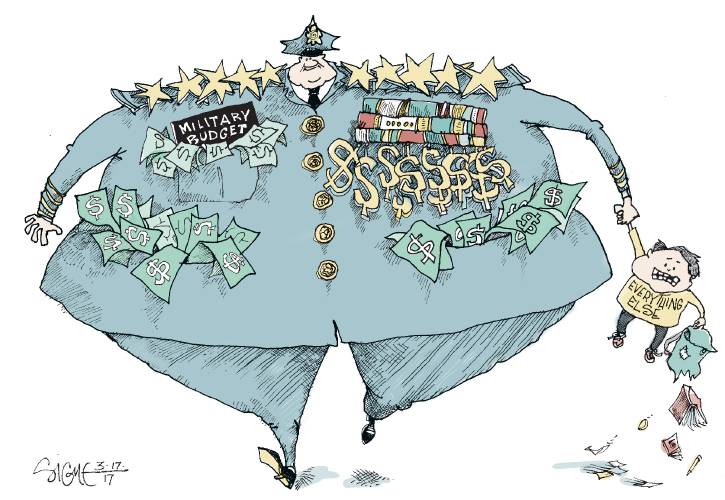
Imperial military ambitions contributed disastrously to Athens’s exhaustion and ultimate collapse, a lesson completely foreign to U.S. strategists. Not surprisingly, then, you’ll find no such Thucydidean clarity in the latest NDS approved by Secretary of Defense Lloyd Austin. In place of that Greek historian’s probity and timeless lessons, the NDS represents an assault not just on the English language but on our very future. In it, a policy of failing imperial dominance is eternally disguised as democratic deterrence, while the greatest “strategic” effort of all goes (remarkably successfully) into justifying massive Pentagon budget increases. Given the sustained record of failures in this century for what still passes as the greatest military power on the planet — Afghanistan, Iraq, and Libya, of course, but don’t forget Somalia, Syria, Yemen, and indeed the entire $8 trillion Global War on Terror in all its brutality — consider the NDS a rare recent “mission accomplished” moment. The 2023 baseline “defense” budget now sits at $858 billion, $45 billion more than even the Biden administration requested.
With that yearly budget climbing toward a trillion dollars (or more) annually, it’s easy to conclude that, at least when it comes to our military, nothing succeeds like failure. And, by the way, that not only applies to wars lost at a staggering cost but also financial audits blown without penalty. After all, the Pentagon only recently failed its fifth audit in a row. With money always overflowing, no matter how it may be spent, one thing seems guaranteed: some future American Thucydides will have the material to produce a volume or volumes beyond compare. Of course, whether this country goes the way of Athens — defeat driven by military exhaustion exacerbated by the betrayal of its supposedly deepest ideals leading to an ultimate collapse — remains to be seen. Still, given that America’s war colleges continue to assign Thucydides, no one can say that our military and future NDS writers didn’t get fair warning when it comes to what likely awaits them.
Bludgeoning America with Bureaucratese
If you can’t dazzle them with brilliance, baffle them with BS.
That’s a saying I learned early in my career as an Air Force officer, so I wasn’t exactly surprised to discover that it’s the NDS’s guiding philosophy. The document has an almost Alice in Wonderland-like quality to it as words and phrases take on new meanings. China, you won’t be surprised to learn, is a “pacing challenge” to U.S. security concerns; Russia, an “acute threat” to America due to its “unprovoked, unjust, and reckless invasion of Ukraine” and other forms of “irresponsible behavior”; and building “combat-credible forces” within a “defense ecosystem” is a major Pentagon goal, along with continuing “investments in mature, high-value assets” (like defective aircraft carriers, ultra-expensive bombers and fighter jets, and doomsday-promising new ICBMs).
Much talk is included about “leveraging” those “assets,” “risk mitigation,” and even “cost imposition,” a strange euphemism for bombing, killing, or otherwise inflicting pain on our enemies. Worse yet, there’s so much financial- and business-speak in the document that it’s hard not to wonder whether its authors don’t already have at least one foot in the revolving door that could, on their retirement from the military, swing them onto the corporate boards of major defense contractors like Boeing and Raytheon.
Perhaps my favorite redefined concept in that NDS lurks in the word “campaigning.” In the old days, armies fought campaigns in the field and generals like Frederick the Great or Napoleon truly came to know the price of them in blood and treasure. Unlike U.S. generals since 1945, they also knew the meaning of victory, as well as defeat. Perish the thought of that kind of campaigning now. The NDS redefines it, almost satirically, not to say incomprehensibly, as “the conduct and sequencing of logically-linked military initiatives aimed at advancing well-defined, strategy-aligned priorities over time.” Huh?
Campaigning, explains the cover letter signed by Secretary of Defense Austin (who won’t be mistaken for Frederick II in his bluntness or Napoleon in his military acuity), “is not business as usual — it is the deliberate effort to synchronize the [Defense] Department’s activities and investments to aggregate focus and resources to shift conditions in our favor.”
Got it? Good!
Of course, who knows what such impenetrable jargon really means to our military in 2023? This former military officer certainly prefers the plain and honest language of Thucydides. In his terms, America, the strong, intends to do what it will in the world to preserve and extend “conditions in our favor,” as the NDS puts it — a measure by which this country has failed dismally in this century. Weaker countries, especially those that are “irresponsible,” must simply suffer. If they resist, they must be prepared for some “cost imposition” events exercised by our “combat-credible forces.” Included in those are America’s “ultimate backstop” of cost imposition… gulp, its nuclear forces.
Again, the NDS is worthy of close reading (however pain-inducing that may be) precisely because the secretary of defense does claim that it’s his “preeminent guidance document.” I assume he’s not kidding about that, though I wish he were. To me, that document is to guidance as nuclear missiles are to “backstops.” If that last comparison is jarring, I challenge you to read it and then try to think or write clearly.
Bringing Clarity to America’s Military Strategy
To save you the trauma of even paging through the NDS, let me try to summarize it quickly in my version — if not the Pentagon’s — of English:
China is the major threat to America on this planet.
Russia, however, is a serious threat in Europe.
The War on Terror continues to hum along successfully, even if at a significantly lower level.
North Korea and Iran remain threats, mainly due to the first’s growing nuclear arsenal and the second’s supposed nuclear aspirations.
Climate change, pandemics, and cyberwar must also be factored in as “transboundary challenges.”
“Deterrence” is frequently used as a cloak for the planetary dominance the Pentagon continues to dream of. Our military must remain beyond super-strong (and wildly overfunded) to deter nations and entities from striking “the homeland.” There’s also lots of talk about global challenges to be met, risks to be managed, “gray zone” methods to be employed, and references aplenty to “kinetic action” (combat, in case your translator isn’t working) and what’s known as “exploitable asymmetries.”
Count on one thing: whatever our disasters in the real world, nobody is going to beat America in the jargon war.
Missing in the NDS — and no surprise here — is any sense that war is humanity’s worst pastime. Even the mass murder implicit in nuclear weapons is glossed over. The harshest realities of conflict, nuclear war included, and the need to do anything in our power to prevent them, naturally go unmentioned. The very banality of the document serves to mask a key reality of our world: that Americans fund nothing as religiously as war, that most withering of evils.
Perhaps it’s not quite the banality of evil, to cite the telling phrase political philosopher Hannah Arendt used to describe the thoughts of the deskbound mass-murderers of the Holocaust, but it does have all of war’s brutality expunged from it. As we stare into the abyss, the NDS replies with mind-numbing phrases and terms that wouldn’t be out of place in a corporate report on rising profits and market dominance.
Yet as the military-industrial complex maneuvers and plots to become ever bigger, ever better funded, and ever more powerful, abetted by a Congress seemingly lustful for ever more military spending and weapons exports, hope for international cooperation, productive diplomacy, and democracy withers. Here, for instance, are a few of the things you’ll never see mentioned in this NDS:
Any suggestion that the Pentagon budget might be reduced. Ever.
Any suggestion that the U.S. military’s mission or “footprint” should be downsized in any way at all.
Any acknowledgement that the U.S. and its allies spend far more on their militaries than “pacing challengers” like China or “acute threats” like Russia.
Any acknowledgment that the Pentagon’s budget is based not on deterrence but on dominance.
Any acknowledgement that the U.S. military has been far less than dominant despite endless decades of massive military spending that produced lost or stalemated wars from Korea and Vietnam to Afghanistan and Iraq.
Any suggestion that skilled diplomacy and common security could lead to greater cooperation or decreased tensions.
Any serious talk of peace.
In brief, in that document and thanks to the staggering congressional funding that goes with it, America is being eternally spun back into an age of great-power rivalry, with Xi Jinping’s China taking the place of the old Soviet Union and Vladimir Putin’s Russia that of Mao Zedong’s China. Consistent with that retro-vision is the true end goal of the NDS: to eternally maximize the Pentagon budget and so the power and authority of the military-industrial-congressional complex.
Basically, any power that seeks to push back against the Pentagon’s vision of security through dominance is defined as a threat to be “deterred,” often in the most “kinetic” way. And the greatest threat of all, requiring the most “deterrence,” is, of course, China.
In a textbook case of strategic mirror-imaging, the Pentagon’s NDS sees that country and its People’s Liberation Army (PLA) as acting almost exactly like the U.S. military. And that simply cannot be allowed.
Here’s the relevant NDS passage:
“In addition to expanding its conventional forces, the PLA is rapidly advancing and integrating its space, counterspace, cyber, electronic, and information warfare capabilities to support its holistic approach to joint warfare. The PLA seeks to target the ability of the [U.S.] Joint Force to project power to defend vital U.S. interests and aid our Allies in a crisis or conflict. The PRC [China] is also expanding the PLA’s global footprint and working to establish a more robust overseas and basing infrastructure to allow it to project military power at greater distances. In parallel, the PRC is accelerating the modernization and expansion of its nuclear capabilities.”
How dare China become more like the United States! Only this country is allowed to aspire to “full-spectrum dominance” and global power, as manifested by its 750 military bases scattered around the world and its second-to-none, blue-water navy. Get back to thy place, China! Only “a free people devoted to democracy and the rule of law” can “sustain and strengthen an international system under threat.” China, you’ve been warned. Better not dare to keep pace with the U.S. of A. (And heaven forfend that, in a world overheating in a devastating way, the planet’s two greatestgreenhouse gas emitters should work together to prevent true catastrophe!)
Revisiting the Oath of Office
Being a retired U.S. military officer, I always come back to the oath of office I once swore to uphold: “To support and defend the Constitution of the United States against all enemies, foreign and domestic.” Naturally, if China, Russia, or any other country or entity attacks or otherwise directly menaces the U.S., I expect our military to defend this country with all due vigor.
That said, I don’t see China, Russia, or weaker countries like Iran or North Korea risking attacks against America proper, despite breathless talk of world “flashpoints.” Why would they, when any such attack would incur a devastating counterattack, possibly including America’s trusty “backstop,” its nuclear weapons?
In truth, the NDS is all about the further expansion of the U.S. global military mission. Contraction is a concept never to be heard. Yet reducing our military’s presence abroad isn’t synonymous with isolationism, nor, as has become ever more obvious in recent years, is an expansive military structure a fail-safe guarantor of freedom and democracy at home. Quite the opposite, constant warfare and preparations for more of it overseas have led not only to costly defeats, most recently in Afghanistan, but also to the increasing militarization of our society, a phenomenon reflected, for instance, in the more heavily armed and armored police forces across America.
The Pentagon’s NDS is a classic case of threat inflation cloaked in bureaucratese where the “facts” are fixed around a policy that encourages the incessant and inflationary growth of the military-industrial complex. In turn, that complex empowers and drives a “rules-based international order” in which America, as hegemon, makes the rules. Again, as Thucydides put it, the strong do what they will and the weak suffer as they must.
Yet, to paraphrase another old book, what does it profit a people to gain the whole world yet lose their very soul? Like Athens before it, America was once a flawed democracy that nevertheless served as an inspiration to many because militarism, authoritarianism, and imperial pretense didn’t drive it. Today, this country is much like Thucydides’s Athens, projecting power ever-outwards in a misbegotten exercise to attain mastery through military supremacy.
It didn’t end well for Athens, nor will it for the United States.
In recent weeks I’ve been seeing an interesting narrative fallacy being sold to the general public when it comes to the designs of globalists. The mainstream media and others are now openly suggesting that it’s actually okay to be opposed to certain aspects of groups like the World Economic Forum. They give you permission to be concerned, just don’t dare call it conspiracy.
This propaganda is a deviation from the abject denials we’re accustomed to hearing in the Liberty Movement for the past decade or more. We have all been confronted with the usual cognitive dissonance – The claims that globalist groups “just sit around talking about boring economic issues” and nothing they do has any bearing on global politics or your everyday life. In some cases we were even told that these groups of elites “don’t exist”.
Now, the media is admitting that yes, perhaps the globalists do have more than just a little influence over governments, social policies and economic outcomes. But, what the mainstream doesn’t like is the assertion that globalists have nefarious or authoritarian intentions. That’s just crazy tinfoil hat talk, right?
The reason for the narrative shift is obvious. Far too many people witnessed the true globalist agenda in action during the pandemic lockdowns and now they see the conspiracy for what it is. The globalists, in turn, seem to have been shocked to discover many millions of people in opposition to the mandates and the refusals to comply were clearly far greater than they expected. They are still trying to push their brand of covid fear, but the cat is out of the bag now.
They failed to get what they wanted in the west, which was a perpetual Chinese-style medical tyranny with vaccine passports as the norm. So, the globalist strategy has changed and they are seeking to adapt. They admit to a certain level of influence, but they pretend as if they are benevolent or indifferent.
The response to this lie is relatively straightforward. I could point out how Klaus Schwab of the WEF savored the thrill of the initial pandemic outbreak and declared that covid was the perfect “opportunity” to initiate what the WEF calls the “Great Reset.”
I could also point out that Klaus Schwab’s vision of the Reset, what he calls the “4th Industrial Revolution”, is a veritable nightmare world in which Artificial Intelligence runs everything, society is condensed into digital enclaves called “smart cities” and people are oppressed by carbon taxation. I could point out that the WEF actively supports the concept of the “Shared Economy” in which you will “own nothing, have no privacy” and you will supposedly be happy about it, but only because you won’t have any other choice.
What I really want to talk about, however, is the process by which the elites hope to achieve their dystopian epoch, as well as the globalist mindset which lends itself to the horrors of technocracy. The common naive assumption among skeptics of conspiracy is that the globalists are regular human beings with the same drives and limited desires as the rest of us. They might have some power, but world events are still random and certainly not controlled.
This is a fallacy. The globalists are not like us. They are not human. Or, I should say, they despise humanity and seek to do away with it. And, because of this, they have entirely different aspirations compared to the majority of us which include aspirations of dominance.
What we are dealing with here are not normal people with conscience, ethics or empathy. Their behavior is much more akin to higher functioning psychopaths and sociopaths rather than the everyday person on the street. We saw this on full display during the covid lockdowns and the vicious attempts to enforce vaccine passports; their actions betray their long game.
Take a look at comments by New Zealand’s prime minister and WEF attendee, Jacinda Ardern, from a year ago. She admits to the deliberate tactic of creating a two-tier class system within her own country based on vaccination status. There is no remorse or guilt in her demeanor, she is proud of taking such authoritarian actions despite numerous studies that prove the mandates are ineffective.
Beyond the covid response, though, I suggest people who deny globalist conspiracy take a deeper dive into the philosophical roots of organizations like the WEF. Their entire ideology can be summed up in a couple words – Futurism and godhood.
Futurism is an ideological movement which believes that all “new” innovations, social or technological, should supplant the previous existing systems for the sake of progress. They believe that all old ways of thinking, including notions of principles, heritage, religious belief systems, codes of conduct, etc. are crutches holding humanity back from greatness.
But what is the greatness the futurists seek? As mentioned above, they want godhood. An era in which the natural world and human will is enslaved by the hands of a select few. Case in point – The following presentation from 2018 by WEF “guru” Yuval Harari on the future of humanity as the globalists see it:
Harari’s conclusions are rooted in elitist biases and ignore numerous psychological and social realities, but we can set those aside for a moment and examine his basic premise that humanity as we know it will no longer exist in the next century because of “digital evolution” and “human hacking.”
The foundation of the WEF vision is built on the idea that data is the new Holy Grail, the new conquest. This is something I have written about extensively in the past (check out my article ‘Artificial Intelligence: A Secular Look At The Digital Antichrist’) but it is good to see it expressed with such arrogance by someone like Harari because it is undeniable evidence – The globalists think they are going to build a completely centralized economy and society based on human data rather than production. In other words, YOU become the product. The average citizen, your thoughts and your behaviors, become the stock in trade.
Globalists also believe that data is most valuable because it can be exploited to control people’s behaviors, to hack the body and mind in order to create human puppets, or create super-beings. They dream of becoming little gods with omnipotent knowledge. Yuval even proudly proclaims that intelligent design will no longer be the realm of God in heaven, but of the new digitized man.
While Harari pays lip service to “democracy” vs “digital dictatorship”, he goes on to assert that centralization may become the defacto system of governance. He says this not because he fears dictatorship, but because that has always been the WEF’s intent. The globalist argues that governments cannot be trusted to hold a monopoly on the digital wellspring and that someone needs to step in to regulate data; but “who would do this?”, he asks.
He already knows the answer. The UN, a globalist edifice, has consistently said it should be the governing body that takes control of AI and data regulation through UNESCO. That is to say, Harari is playing coy, he knows that the people who will step in to control the data are people just like him.
At no point in Harari’s speech does he suggest that that any of these developments should be obstructed or stopped. At no point does he offer the idea that the digitization of humanity is wrong and that there are other better ways of living. He actually mocks the concept of “going back” to old ways; only the future and the Tabula Rasa (blank slate) hold promise for the globalists, everything else is an impediment to their designs.
But here’s the thing, what the globalists are trying to accomplish is a fantasy. People are not algorithms, despite how much Harari would like them to be. People have habits, yes, but they are also unpredictable and are prone to sudden awakenings and epiphanies in the moment of crisis.
Psychopaths tend to be robotic people, acting impulsively but also very predictably. They lack imagination, intuition and foresight, and so it’s not surprising that organizations of psychopaths like the WEF would place such an obsessive value on AI, algorithms and a cold technocratic evolution. They don’t view their data Shangri-La as humanity’s future; they see it as THEIR future – The future of the non-humans, or the anti-humans as it were.
Who will produce all the goods, services and necessities required in this brave new world? Well, all of us peons, of course. Sure, the globalists will offer grand promises of a robot driven production economy in which people no longer need to engage in menial labor, but this will be another lie. They’ll still need people to plant the crops, maintain infrastructure, take care of manufacturing, do their fighting for them, etc., they’ll just need less of us.
At bottom, an economy built on data is an economy dependent on illusion.
Data is vaporous and oftentimes meaningless because it is subject to the biases of the interpreter. Algorithms can also be programmed to the biases of the engineers. There is nothing inherently objective about data – it is all dependent on the intentions of the people analyzing it.
For example, to use Harari’s anecdote of an algorithm that “knows you are gay” before you do; any twisted group of people could simply write code for an algorithm that tells the majority of easily manipulated kids that they are gay, even when they are not. And, if you are gullible enough to believe the algorithm is infallible, then you could be led to believe that numerous falsehoods are true and be convinced to behave against your nature. You have allowed a biased digital phantom to dictate your identity, and have made yourself “hackable.”
In the meantime, the elitists entertain delusions of surpassing their mortal limitations by “hacking” the human body, as well as reading the minds of the masses and predicting the future based on data trends. This is an obsession which ignores the unpredictable wages of the human soul, that very element of conscience and of imagination which psychopaths lack. It’s something that cannot be hacked.
The legitimacy of the data based system and the hacking of humanity that the WEF aspires to is less important than what the masses can be convinced of. If the average person can be persuaded to implant their cell phone in their skull in the near future, then yes, humanity might become hackable in a rudimentary way.
The algorithms then supplant conscience, empathy and principles. And, without these things all morality becomes relative by default. Evil becomes good, and good becomes evil.
By the same token, if humanity can be persuaded to set down their cell phones and live a less tech focused life, then the digital empire of the globalists comes crashing down quite easily. There is no system the elites can impose that would make their digital consciousness a reality without the consent of the public at large.
Without a vast global framework in which people willingly embrace the algorithms rather than their own experience and intuitions, the globalist religion of total centralization dies. The first step is to accept that the conspiracy does indeed exist. The second step is to accept that the conspiracy is malicious and destructive. The third step is to refuse to comply, by whatever means necessary.
How do you trust a government that continuously sidesteps the Constitution and undermines our rights? You can’t.
When you consider all the ways “we the people” are being bullied, beaten, bamboozled, targeted, tracked, repressed, robbed, impoverished, imprisoned and killed by the government, one can only conclude that you shouldn’t trust the government with your privacy, your property, your life, or your freedoms.
Consider for yourself.
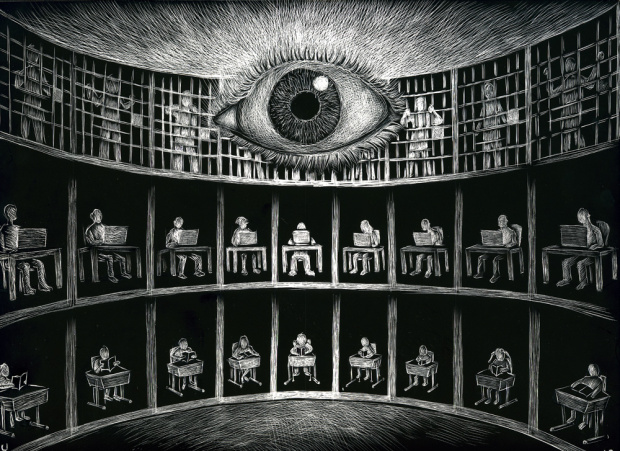
Don’t trust the government with your privacy, digital or otherwise. In the two decades since 9/11, the military-security industrial complex has operated under a permanent state of emergency that, in turn, has given rise to a digital prison that grows more confining and inescapable by the day. Wall-to wall surveillance, monitored by AI software and fed to a growing network of fusion centers, render the twin concepts of privacy and anonymity almost void. By conspiring with corporations, the Department of Homeland Security “fueled a massive influx of money into surveillance and policing in our cities, under a banner of emergency response and counterterrorism.” For instance, all across the country, police are installing Flock Safety license plate readers as part of a public-private partnership program between police and the surveillance industry. These cameras, which upload data in real time to fusion crime centers, signal a turning point in the transition from a police state to a police-driven surveillance state.
Don’t trust the government with your property. In yet another effort to legitimize warrantless searches, police are employing “hit-and-hold” tactics in which police enter a home, carry out an initial sweep of the property, handcuff the occupants, then wait for official search warrants to be secured and applied retroactively. In the meantime, police have managed to bypass the Fourth Amendment. The rationale, to prevent possible destruction of evidence, is the same one used to deadly effect with no-knock raids. If government agents can invade your home, break down your doors, kill your dog, damage your furnishings and terrorize your family, your property is no longer private and secure—it belongs to the government. Hard-working Americans are having their bank accounts, homes, cars electronics and cash seized by police under the assumption that they have allegedly been associated with some criminal scheme.
Don’t trust the government with your finances. The U.S. government—and that includes the current administration—is spending money it doesn’t have on programs it can’t afford, and “we the taxpayers” are being forced to foot the bill for the government’s fiscal insanity. The national debt is $31.3 trillion and growing, and we’re paying more than $300 billion in interest every year on that public debt, yet there seems to be no end in sight when it comes to the government’s fiscal insanity. According to Forbes, Congress has raised, extended or revised the definition of the debt limit 78 times since 1960 in order to allow the government to essentially fund its existence with a credit card.
Don’t trust the government with your health. For all intents and purposes, “we the people” have become lab rats in the government’s secret experiments, which include MKULTRA and the U.S. military’s secret race-based testing of mustard gas on more than 60,000 enlisted men. Indeed, you don’t have to dig very deep or go very back in the nation’s history to uncover numerous cases in which the government deliberately conducted secret experiments on an unsuspecting populace—citizens and noncitizens alike—making healthy people sick by spraying them with chemicals, injecting them with infectious diseases and exposing them to airborne toxins. Unfortunately, the public has become so easily distracted by the political spectacle out of Washington, DC, that they are altogether oblivious to the grisly experiments, barbaric behavior and inhumane conditions that have become synonymous with the U.S. government, which has meted out untold horrors against humans and animals alike.
Don’t trust the government with your life: At a time when growing numbers of unarmed people have been shot and killed for just standing a certain way, or moving a certain way, or holding something—anything—that police could misinterpret to be a gun, or igniting some trigger-centric fear in a police officer’s mind that has nothing to do with an actual threat to their safety, even the most benign encounters with police can have fatal consequences. The number of Americans killed by police continues to grow, with the majority of those killed as a result of police encounters having been suspected of a non-violent offense or no crime at all, or during a traffic violation. According a report by Mapping Police Violence, police killed more people in 2022 than any other year within the past decade. In 98% of those killings, police were not charged with a crime.
Don’t trust the government with your freedoms. For years now, the government has been playing a cat-and-mouse game with the American people, letting us enjoy just enough freedom to think we are free but not enough to actually allow us to live as a free people. Freedom no longer means what it once did. This holds true whether you’re talking about the right to criticize the government in word or deed, the right to be free from government surveillance, the right to not have your person or your property subjected to warrantless searches by government agents, the right to due process, the right to be safe from militarized police invading your home, the right to be innocent until proven guilty and every other right that once reinforced the founders’ belief that this would be “a government of the people, by the people and for the people.” On paper, we may be technically free, but in reality, we are only as free as a government official may allow.
Whatever else it may be—a danger, a menace, a threat—the U.S. government is certainly not looking out for our best interests, nor is it in any way a friend to freedom.
Remember the purpose of a good government is to protect the lives and liberties of its people.
Unfortunately, what we have been saddled with is, in almost every regard, the exact opposite of an institution dedicated to protecting the lives and liberties of its people.
As I make clear in my book Battlefield America: The War on the American People and in its fictional counterpart The Erik Blair Diaries, “we the people” should have learned early on that a government that repeatedly lies, cheats, steals, spies, kills, maims, enslaves, breaks the laws, overreaches its authority, and abuses its power at almost every turn can’t be trusted.
In a society this controlling, it’s no wonder so many people can’t let go of their grip on false realities, and pressure others to conform to their point of view. In my work as a self-mastery coach I help people see what false realities they’ve made for themselves, and help them let go of their grip on useless beliefs. ~Dylan Charles
“It is no measure of health to be well adjusted to a profoundly sick society.” ~J. Krishnamurti
Society is directed by a never-ending mainstream narrative which is always evolving, and always reaching new dramatic peaks in sensationalism and hype. They fill your mind with topics they select, they keep your attention on these topics, and they invite and encourage you to argue amongst each other about these topics. In this way our collective attention is permanently commandeered, preventing us from diving too deeply into matters which have more than a superficial impact on day-today life.
Free-thinking is the ability and willingness to explore of ideas and areas of the mind which are yet undiscovered or are off-limits. It is a vanishing art that is deliberately being stamped out by a control system which demands conformity, acquiescence and obedience of body, mind, and spirit.
For your consideration, here are three questions you’re not supposed to ask about life in our profoundly sick society.
1. Who owns the money supply, and the world’s debt?
Pretty much the entire world is in financial debt, an insidious form of slavery which enables the exploitation of human beings and of all things in nature. It’s maddening when you think about it. The United States alone supposedly owes some $20 trillion, while the world at large owes a shocking $215 trillion?
Money is just a medium of exchange which facilitates transactions between people. In and of itself it has no intrinsic value as we could just as easily use sea shells instead of dollar bills and still be able to get things done. But today’s money is the property of private third-parties who rent it out to national governments, who then use the labor of their citizens as collateral against these loans. This is a highly refined form of slavery, which has already put future unborn generations of human beings in debt.
But who, exactly does the human race owe? Who are our debt-slave masters?
2. Who owns your body?
Ownership means having the explicit right to use, control and dispose of something in the manner of your choosing. The one thing you are born with that you take with you to your death is your own body, but do you own it? If not you, then who does own your body?
If this question were already settled in our society then there wouldn’t be ever-increasing pressure on those who choose to refuse vaccines. Children battling cancer and other serious illnesses wouldn’t be forced to take chemo and radiation under penalty of law and under threat of being taken from their parents. Water wouldn’t be fluoridated without our consent. Natural medicines wouldn’t be outlawed under threat of fines and prison time.
We are rapidly approaching a time when people will be required by law to take psychotropic medications as citizens were in Aldous Huxley’s dystopian classic, Brave New World.
Do you own your body, or does it belong to the state?
3. Why is the exploration of consciousness restricted and illegal?
The most effective prisons are not material, but are constructed inside the mind. Perception, opinion and understanding are all dynamic concepts, not at all static. These can all change in the blink of an eye just because a new idea or experience resonates with you in a special way. Our evolution depends on our ability to expand the frontiers of what’s possible, and when the mind is held in confinement by an entrenched system and powerful cultural paradigm, progress, even happiness, is stunted.
In this societal trap you are given free rein to debase your consciousness and your spirit with alcohol, dangerous drugs, pharmaceuticals, television, pornography, theatrical violence, and then some, yet many natural medicines which elevate consciousness and provide a window into the soul are illegal.
“This is the way freedom is hijacked—not all at once, out in the open, but stealthily, little by little, behind closed doors, and with our own agreement. How will we be able to resist when so many of us have already willingly handed over the keys to our own consciousness to the state and accepted without protest that it is OK to be told what we may and may not do, what we may and may not explore, even what we may and may not experience, with this most precious, sapient, unique, and individual part of ourselves?
If we are willing to accept that then we can be persuaded to accept anything.” ~Graham Hancock





 After the Crash