Two for Tuesday
Reply

From its founding in 2017, the one-man company rose to a “partner organisation” of the WEF and second largest donor to Biden and the Democrats’ mid-term election. It has now gone bust.

Sam Bankman-Fried during the Bitcoin 2021 conference. (Cointelegraph, CC BY 3.0, Wikimedia Commons)
By Craig Murray
Source: Consortium News
NOTE: This is is what I think of as a signpost article — it points you to something the mainstream media is deliberately not giving the prominence it needs, but I have no personal expertise or inside knowledge to give you. I am just giving you a start to get going. Several readers will have a much better understanding than I, and I encourage you to give your thoughts in comments below.
The FTX story seems truly remarkable. From being founded only in 2017 it rose to be a “partner organisation” of the World Economic Forum and the second largest donor to U.S. President Joe Biden and the Democrats’ mid-term election campaign. It has now gone completely bust, taking every penny of its depositors’ money with it.
That is some trajectory.
The World Economic Forum has deleted its FTX page, but the Wayback machine has it:

I suppose it is inevitable that dodgy chancers would create derivatives markets for gambling on crypto, but I confess I had not given the matter much thought. It goes without saying that in those five years the founder of FTX had managed to take a huge personal fortune out of the company before it went bust.
FTX was a one-man company belonging to Sam Bankman-Fried. The board consisted of him, an employee and the company lawyer. Over $20 billion of investors’ funds from FTX were funneled to a fund management company, Alameda Research, also owned by Sam Bankman-Fried.
Bankman-Fried donated $37 million to the Democrats for the 2022 elections. Every penny of that originated with duped FTX investors. That is in addition to the $5 million given to the Biden 2020 campaign. FTX, of course, crashed instantly after those mid-term elections, which is interesting timing.
The BBC and The Guardian were constantly bombarding us with the term “democracy denier” in their coverage of the U.S. elections, strangely not in reference to presidential candidate Hillary Clinton’s ludicrous claims that Russian interference was the cause of her loss in 2016.
I view as a joke any notion that the U.S. is a democracy. Democracy is about giving citizens a choice of political direction. The 2022 elections saw a simply incredible expenditure on campaigning of $ 9.7 billion. Yes, nearly $10 billion. This is not democracy. It is a huge exercise in corporate control from which the ordinary citizen is frozen out.
Despite an aggressive tribalism which has stalemated the political system for decades, the difference in policy platform between Democrats and Republicans is highly marginal, with no alternative on offer to rampant and uninhibited commercial exploitation of the population by the super-wealthy.
The Democrats are marginally more keen on attacking other countries; the Republicans are marginally more against measures to curb carbon emissions. Vaunted differences on immigration and welfare turn out to be very small indeed, with very little changing when the White House does.
American elections are simply about the super-rich funneling in vast donations, expecting to benefit when their team gets its nose in the trough, or often donating to both sides to benefit either way.
I am not sure what the connection to democracy is supposed to be.
One simple fact illustrates the true nature of the bribery fest. By far the majority of the funds channeled through Political Action Committees, or PACs, are given to incumbents who face no serious threat to re-election anyway.
The PACs are interested in bribing those in power, not changing those in power. They are simply lobby groups with an opportunity for legal bribery. To illustrate that, the largest donating PACs are:
National Association of Realtors
National Beer Wholesalers Association
American Israel Public Affairs Committee
Credit Union National Association
Blue Cross/Blue Shield
American Crystal Sugar
It is worth noting that Bankman-Fried donated 10 times as much as the largest PAC donation. This brought access — he and his brother had meetings inside the White House on March 7, April 22 and May 12.
It is perhaps unsurprising therefore that FTX was involved in Ukraine, offering to exchange cryptocurrency for fiat and send it to Ukraine in an official partnership with the Ukrainian government. This from their press release
“Aid For Ukraine is cooperating with the cryptocurrency exchange FTX which converts crypto funds received into fiat and sends the donations to the National Bank of Ukraine. This marks the first-ever instance of a cryptocurrency exchange directly cooperating with a public financial entity to provide a conduit for crypto donations. Earlier this month, FTX already converted $1 million worth of SOL and transferred it to the National Bank of Ukraine.”
The collapse of the Bankman Fried scam was allegedly caused by hackers stealing what should have been a comparatively small portion of the assets of FTX, had they not been hived off elsewhere. Doubtless we will shortly hear from state salaried conspiracy theorists that this was Russia/Guccifer/an ISP address traced by Bellingcat to inside the Kremlin.
What we really have here is an Allen Stanford for 2022, with added political connections.
We would do well to heed the advice of crypto developer Nikolai Mushegian, who had as his Twitter profile: “Larpers who self-style as CEOs or CTOs or VCs are a bigger problem than the establishment. They can’t build anything and will sell you out in 2 seconds.”
His final tweet was posted on Oct. 28:

The next day he drowned in the sea off a beach in Puerto Rico, where he lived. He was fully clothed including a jacket. The police are not treating it as homicide so presumably their theory is suicide by wading out to sea.
States of course have a massive incentive to destroy non-fiat currencies, or convert them into a new category of regulation. I am interested in the current discussion on smart state digital currencies where the state can track, control and block any transaction and know in real time exactly where each citizen or entity is spending or keeping every penny.
It occurs to me this is the wrong way round. The state belongs to its citizens, not the citizens to the state. We should be able to track online every single penny of public money in real time and see how it is spent. Imagine being able to follow every penny of the billions the Tories spent on fraudulent PPE contracts, for example.
The only people whose personal currency should be able to be tracked are those who hold, or have held, positions of power in the state. Their wealth and dealings should be available in great detail to public view. As for the rest of us, our money is ours and we are entitled to privacy.
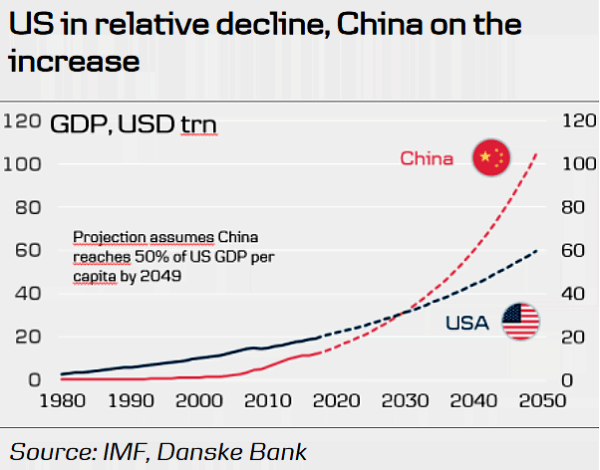
Look at the chart above. The chart explains everything.
By Mike Whitney
Source: The Unz Review
It explains why Washington is so worried about China’s explosive growth. It explains why the US continues to hector China on the issues of Taiwan and the South China Sea. It explains why Washington sends congressional delegations to Taiwan in defiance of Beijing’s explicit requests. It explains why the Pentagon continues to send US warships through the Taiwan Strait and ship massive amounts of lethal weaponry to Taipei. It explains why Washington is creating anti-China coalitions in Asia that are aimed at encircling and provoking Beijing. It explains why the Biden administration is stepping up its trade war on China, imposing onerous economic sanctions on its businesses, and banning critical high-tech semi-conductors that are “are essential not just… for virtually every aspect of modern society, from electronic products and transport to the design and production of all manner of goods.” It explains why China has been singled-out in the US National Security Strategy (NSS) as “the only competitor with both the intent and, increasingly, the capability to reshape the international order.” It explains why Washington now regards China as its biggest and most formidable strategic adversary that must be isolated, demonized and defeated.
The chart above explains everything, not just the hostile diplomatic jabs that are designed to discredit and humiliate China, but also the openly belligerent policies that are aimed at Russia as well. People need to understand this. They need to see what is really going on so they can put events in their proper geopolitical context.
And what “context” is that?
The context of a Third World War; a war that was thoroughly-planned, instigated and (now) prosecuted by Washington and Washington’s proxies. That’s what’s really going on. The increasingly violent conflagrations we see cropping-up in Ukraine and Asia are not the result of “Russian aggression” or “evil Putin”. No. They are the actualization of a sinister geopolitical strategy to quash China’s meteoric rise and preserve America’s dominant role in the world order. Can there be any doubt about that?
No. None.
This is why we are experiencing the redivision of the world into warring blocs. This is why we are seeing the roll back of 30 years of Globalization and massive suppyline disruption. And this is why Europe has been thrust headlong into frigid darkness and forced deindustrialisation. All of these suicidal policies were concocted for one purpose and one purpose alone, to maintain America’s exalted spot in the global system. That is why all of humanity is presently embroiled in a Third World War; a war that is designed to prevent China from becoming the world’s biggest economy; a war that is designed to preserve US global primacy. Check out this excerpt from an article at the World Socialist Web Site:
An October 19 Financial Times article by Edward Luce, entitled “Containing China is Biden’s explicit goal,” sounded the following alarm: “Imagine that a superpower declared war on a great power and nobody noticed. Joe Biden this month launched a full-blown economic war on China—all but committing the US to stopping its rise—and for the most part, Americans did not react.
“To be sure, there is Russia’s war on Ukraine and inflation at home to preoccupy attention. But history is likely to record Biden’s move as the moment when US-China rivalry came out of the closet.”
Moreover, last week, a top Biden administration official indicated that the US was preparing new bans on China in key hi-tech areas. Speaking at the Center for a New American Security, Alan Estevez, the under-secretary of Commerce for Industry and Security, was asked if the US would ban China from accessing quantum information science, biotechnology, artificial intelligence software or advanced algorithms. Estevez admitted that this was already being actively discussed. “Will we end up doing something in those areas? If I was a betting person, I would put down money on that,” he said….
Luce concluded his Financial Times article cited above by declaring: “Will Biden’s gamble work? I’m not relishing the prospect of finding out. For better or worse, the world has just changed with a whimper not a bang. Let us hope it stays that way.”…(“Biden’s technology war against China”, World Socialist Web Site)
Once again, look at the chart. What does it tell you?
The first thing it tells you is that the hostilities we see in Ukraine (and eventually Taiwan), can be traced back to a fundamental shift in the global economy. China is growing stronger. It’s on a path to overtake the United States economy within the decade. And with growth, come certain benefits. As the world’s biggest economy, China will naturally become Asia’s regional hegemon. And, as Asia’s regional hegemon it will be able “to settle regional disputes in its own favor and to de-legitimize U.S. regional and global leadership.”
Can you see the problem here?
For nearly two decades, the US has oriented its foreign policy around a “rebalancing of forces” strategy called the “pivot to Asia”. In short, the US intends to be the dominant player in the world’s most populous and prosperous region, Asia. Can you see how China’s rise derails Washington’s plan for the future?
The United States is not going to let this happen without a fight. Washington is not going to let China muscle-it-out of the markets that it plans to dominate. That’s not going to happen. And if you think that’s going to happen, you’d better think again. The United States will go to war to avoid a scenario in which the US plays “second fiddle” to China. In fact, the foreign policy establishment has already decided that the US will engage China militarily for that very objective.
So, our thesis is simple; we think WW3 has already begun. That’s all we’re saying. The ructions we see in Ukraine are merely the first salvo in a Third World War that has already triggered an unprecedented energy crisis, massive worldwide food insecurity, a catastrophic break-down in global supply lines, widespread and out-of-control inflation, the steady reemergence of extreme nationalism, and the redivision of the world into warring blocs. What more proof do you need?
And it’s all economic. The origins of this conflict can all be traced back to the seismic changes in the global economy, the rise of China and the unavoidable decline of the United States. It is a case of one empire replacing the other. Naturally, a transition of this magnitude is going to generate tectonic changes in global distribution of power. And along with those changes will come more flashpoints, more devastation, and the looming prospect of nuclear war. And this is precisely how things are playing out.
So, how does the chart explain what is happening in Ukraine?
Washington’s proxy war in Ukraine is actually aimed at China not Russia. Russia is not a peer competitor and Russia does not have the economic wherewithal to displace the United States in the global order. NordStream, however, did pose a significant risk to the US by greatly strengthening Moscow’s economic relations with the EU and particularly with Europe’s industrial powerhouse, Germany. The Moscow-Berlin alliance—which was mutually beneficial and key to German prosperity—had to be sabotaged to prevent further economic integration that would have drawn the continents closer together into the world’s biggest free trade zone. Washington had to stop that in order to preserve its economic stranglehold on Europe and defend the dollar as the world’s reserve currency. Even so, no one expected the US to blow up the pipeline itself in—what appears to be—the greatest act of industrial terrorism in history. That was truly shocking.
In essence, Washington sees Russia as an obstacle to its “pivot” plan to encircle, isolate and weaken China. But Russia is not the greatest threat to US global primacy; not even close. That designation belongs to China.
The Third World War is being waged to contain China not Russia. What the war in Ukraine suggests is that—among foreign policy elites—there is general agreement that, The road to Beijing goes through Moscow. That appears to be the consensus view. In other words, US powerbrokers want to weaken Russia in order to spread US military bases across Asia. Ultimately, the military will be called upon to enforce Washington’s economic rule over its new Asian subjects. If that day ever comes.
We think it is extremely unlikely that Washington’s ambitious plan will succeed, but we have no doubt that it will be implemented all the same. Tens of millions of people are likely to die in a desperate attempt to turn-back the clock to the fleeting ‘unipolar moment’ and the equally short-lived American Century. It is a tragedy beyond comprehension.

By Dylan Charles
Source: Waking Times
“No society can understand itself without looking at its shadow side.” ― Gabor Maté, In the Realm of Hungry Ghosts: Close Encounters with Addiction
Something wicked bubbles just beneath the surface of the collective conscience. Our society is rife with corruption, predation, perversion, over-consumption, violence, addiction and so much more. Somehow enough is never enough, as if the driving force behind human existence is pure want.
This is not true, though, for we know that spiritually well beings are content beings, looking no further than the present moment’s blessings for satisfaction. We don’t have an inherent need for want. Want is a symptom, not the condition. It’s something that enters when the spirit is untended to.
It must then be a spiritual illness which plagues society. Something secretly driving so many of us mad with insatiable desire for sensation and objects. Unforgiving cravings that manifest in any way imaginable, from sex, to money, to food, to power and even in the need to be perfect. It’s a war against the self, waged unconsciously by the self. A below subconscious campaign of self-annihilation.
There are no contemporary metaphors to understand this kind of emptiness. The void just is. And since the void is so rarely acknowledged and so rarely looked at deeply, it sits in the shadows driving us mad, steering with impulse.
In Chinese Buddhist philosophy, though, there is a story that fits. The hungry ghost.
“In Chinese Buddhist teachings, “hungry ghosts are unable to take in or assimilate what they desperately need. The problem lies in their constricted throats — which cannot open for nourishment. They wander aimlessly in search of relief that is not forthcoming.”” [Source]
Interestingly, according to some of its origin myths, the hungry ghost was born out an act of cruelty. In many of the stories, it is a wealthy man’s wife who did some terrible thing to a monk, and when she eventually dies her spirit takes the form of the hungry ghost, forever lurking in purgatory, unable to ever fill its distorted belly and therefore always needing and wanting more.
The hungry ghost, then, is an expression of karma.
Hungry ghosts are the demon-like creatures described in Buddhist, Taoist, Hindu, Sikh, and Jain texts as the remnants of the dead who are afflicted with insatiable desire, hunger or thirst as a result of bad deeds or evil intent carried out in their life times. [Source]
In the realm of hungry ghosts, a deep drama between the ego and the ghost plays out ad infinitum. It’s an interplay that feeds the ego just enough for it to survive, so that in turn the ego can feed the hungry ghost. A dead-end cul-de-sac of sorts. A looping projection of one of our worst human vulnerabilities.
“The work of the ghost does not want to completely destroy its prey. Having fed off the other through dissociative trajectories of turbulence, the ego again becomes more robust. The hungry ghost now has, as companion and source of nurture, a replenished ego on which internal feeding may resume inside the space of erasure until the plenitude of the ghost-within again permeates the intersubjective.” ~ Nick Totton, Psychoanalysis and the Paranormal: Lands of Darkness
Spiritually healthy people understand their cravings for what they, expressions of innumerable forms of pain. Manifestations of the suffering caused by disconnection from the self, and from nature. And the self is nature. There really is no distinction between the two. The illusion is of separateness.
The ghosts are there to remind us that our real work is transmuting our suffering and cruelty into resilience and compassion. It’s not enough to numb the pain, it must be used to our advantage, for our growth, to serve as a catalyst for transformation, and to provide a chrysalis in which the transformation can take place.
“We are social beings. When we feel disconnected or alienated, we experience pain. Addiction, depression, anger, and violence are different ways we react to pain. To heal our society we must heal the emotional wounds.” ~Chris Agnos
Few understand this more clearly than Dr. Gabor Maté, whose work with drug addicts has transformed our understanding of what it means to be stuck in the realm of hungry ghosts.

By Bence Janek
Source: Kafkadesk
The Tenant by Roman Polanski, considered the last chapter of the Polish-French director’s notorious “apartment trilogy” (after Repulsion and Rosemary’s Baby), sketches a masterful adaptation of Roland Topor’s psychological horror novel on the screen and leads the unsuspicious viewer into the darkest corners of a paranoid person’s mind struggling with a myriad of social and community stereotypes in 1970’s Paris.
Polanski not only directed The Tenant but took on the main character’s costume to play the anxious character of Trelkovsky, a middle-aged Polish-born French-naturalized bureaucrat, who is planning to rent a tiny condo in a far from ordinary apartment house in Paris.
The former tenant committed suicide, the landlord is a grumpy old man, and the residential community is full of xenophobic prejudices. All the conditions are set for a surrealistic and dramatic experience.
Whether it is owned or rented, a house is arguably the most private place in anyone’s life, a space where individuals are entitled to live their undisturbed, non-public existence as they see fit.
In Trelkovsky’s case, there is no place for such privacy: instead, he becomes a constant victim of contemptuous comments from his neighbors targeting his Polish origins, his lifestyle and at some point is even asked to sign a petition to kick out other tenants from the apartment house.
In this sense, the residential community portrayed in The Tenant is a clear representation of a resentful and hypocritical society full of stigma and prejudices, where the individual is cornered with no place to thrive.
Trelkovsky can hardly cope with such a harsh environment and becomes convinced that his neighbors want to drive him to suicide, just as they allegedly did with the previous tenant.
Given the protagonist’s evident paranoid behavior and the tyrannical policy of the residential community, this duality and continuous tension bring out the hidden bisexuality, trans-sexuality, and paranoid fear that pave the way for the complete mental and sexual transformation of Trelkovsky.
What makes this film absolutely unique is the portrayal of an utterly vulnerable character with no courage to stand up against any type of abnormality in his life, even forced to lie in the most trivial cases. Trelkovsky’s character is founded on the lack of the most basic norms of personality, an anti-hero whose identity can easily be shaped and transformed by his environment and surroundings.
The majestic peak of Polanski’s horror psychological drama is how it brings up the ruthless question of whether it is possible for an already paranoid and disturbed person to merge into a community, and what happens if he or she can’t.
And most importantly, how a group of bullies can light up latent psychological problems in an individual’s mind and bring these mental and social challenges to the surface in an irredeemable way.

By Nolan Higdon
Source: Project Censored
A September 2022 report from Tessa Jolls, president of the Center for Media Literacy, titled “Building Resiliency: Media Literacy as a Strategic Defense Strategy for the Transatlantic,” read like a blueprint for how to indoctrinate students in corporatism and militarism under the auspices of media literacy education. Jolls received a Fulbright-NATO Security Studies Award to study “aspects of the current information ecosystem and the state of media literacy in NATO countries.”
For historical context, the North Atlantic Treaty Organization (NATO) was created after World War II during the Cold War and has long since outlived its stated purpose of stopping the spread of communism. Indeed, as political sociologists such as Peter Phillips have noted, NATO has morphed into a global army that engages in questionable conflicts and other human rights abuses in an effort to serve the “transnational capitalist class.”
Just like the crisis of “fake news,” media literacy can and is being weaponized by organizations and individuals seeking to increase their power by influencing the public’s perception of reality. For example, Steve Bannon, former White House Chief Strategist for President Donald Trump has a long history of spreading false information. Form 2012-18, he was the executive chairman of Breitbart’s website which has been caught manipulating videos, manufacturing stories, and spreading baseless conspiracies. Starting with Bannon’s tenure, Breitbart published articles lauding media literacy as a way to combat “fake news,” while touting that its founder, Andrew Breitbart, integrated media literacy into the platform. However, their consistent spreading of false information seems to run counter to traditional definitions of media literacy.
The standard U.S. definition of media literacy is “the ability to access, analyze, evaluate, create, and act using all forms of communication.” In response to the post-2016 moral panic over fake news, there was a demand for more media literacy education in schools. This provided a window of opportunity for media companies – which had long sought to enter the classroom to advertise products and collect student data- to move at rapid speed to indoctrinate students with their corporate propaganda.
Jolls’ report aids these efforts by arguing that corporations’ “allocations for media literacy education are few and far between.” Jolls’ report speaks to the military industrial complex when it calls for “funding and programming from all corners: government, foundations, and the private sector (tech and media companies, other corporations).” The military industrial complex refers to the relationship between the military and related defense and national security industries. In fact, Big-Tech emerged from and continues to serve the same military industrial complex.
Rather than advocate for a critical media literacy education that would account for the power dynamics invested in NATO and its long history of working against democracy and social justice, Jolls’ lauds the “values that NATO states” arguing that they represent an “excellent foundation” for “media literacy initiatives.” To normalize NATO values in the educational process, Jolls suggests what amounts to a psychological operations campaign (PSYOP) to spread NATO’s version of media literacy to the public through “mass media, media aggregators such as AP, Reuters and LexisNexis, social media and influencers.” The report calls on NATO to “nurture grassroots efforts,” which sounds more like astroturfing.
Jolls’ report ignores that members of the very same military and intelligence community that she lauds have been producing and spreading fake news to U.S. citizens from Operation Mockingbird in the 20th century up through the present on various social media platforms. It dismisses the public’s rejection of empowering the military industrial complex to determine truth for the citizenry. For example, in 2022, critics from the left and the right successfully lobbied to have the Department of Homeland Security scrap its Disinformation Governance Board because it was reminiscent of the Ministry of Truth in George Orwell’s 1984.
Instead, Jolls is following the lead of similar media literacy projects from the military industrial complex such as the NewsGuard browser extension. Known as an “Internet Trust Tool,” NewsGuard’s Advisory Board includes numerous people who served in the military and intelligence community as well as bureaucrats known for opposing the interests of educators. Yet, NewsGuard positions itself as an objective tool for educators while its rating system is ideologically driven. It touts the legitimacy of establishment and legacy media sources that echo the status quo – even when they have been proven to spread false information – and downgrades independent and alternative media outlets that challenge powerful institutions of government, industry, and the military. Jolls’ mirrors NewsGuard’s top-down approach to media literacy education calling on NATO leaders to determine “the intent and purposes for media literacy interventions” by choosing the “social problem or behavior or ideology” or issue for educators to focus on.
It is clear that we do need a critical media literacy curriculum in the U.S., but that is not what Jolls and her ilk are promoting. A true media literacy education empowers students to be autonomous and sophisticated media users, who ask their own questions about who controls media messaging and interrogate the power structures behind them. When a student is left dependent on the military industrial complex to analyze content for them, it is not education, it is indoctrination.
What is wrong with the United States of America?

By Philip Giraldi
Source: The Unz Review
Prussian Major General Carl von Clausewitz famously drew on his own experience in the Napoleonic Wars to examine war as a political phenomenon. In his 1832 book “On War” he provided a frequently quoted pithy summary of war versus peace, writing in terms of politico-military strategy that “War is a mere continuation of politics by other means.” In other words, war-making is a tool provided to statesmen to achieve a nation’s political objectives when all else fails.
One can reject the ultimate amorality of Clausewitz’s thinking about war while also recognizing that some nations have historically speaking exploited war-making as a tool for physical expansion and the appropriation of foreigners’ resources. As far back as the Roman Republic, the country’s elected leaders doubled as heads of its consular armies, which were expected to go out each spring to expand the imperium. More recently, Britain notably engaged in almost constant colonial wars over the course of centuries to establish what was to become history’s largest empire.
America’s dominant neocons characteristically believe they have inherited the mantle of empire and of the war powers that go hand-in-hand with that attribute, but they have avoided other aspects of the transition in turning the United States into a nation made and empowered by war. First of all, what comes out the other end after one has initiated hostilities with another country is unpredictable. Starting with Korea and continuing with Vietnam, Afghanistan, Iraq as well as other minor operations in Latin America, Africa and Asia, American war-making has brought nothing but grief on those on the receiving end with little positive to show for the death, destruction and accumulated debt. Also forgotten in the rush to use force is the raison d’etre to have a federal national government at all, which is to bring tangible benefit to the American people. There has been none of that since 9/11 and even before, while Washington’s hard-line stance on what has become a proxy war against Russia over Ukraine promises more pain – perhaps disastrously so – and no real gain.
If one has any doubt that going to war has become the principal function of both Democrats and Republicans in Washington, it is only necessary to consider several stories that have appeared in the past several weeks. The first comes from the Republican side, and it includes a possibly positive development. House Minority leader Republican Kevin McCarthy warned two weeks ago that the GOP will not necessarily continue to write a “blank check” for Ukraine if they obtain the House majority in next month’s election, reflecting his party’s growing skepticism about unlimited financial support for the corrupt regime in place in Kiev. McCarthy explained “I think people are gonna be sitting in a recession and they’re not going to write a blank check to Ukraine. They just won’t do it. … It’s not a free blank check.”
America’s uncritical support for Ukraine, which has been a contrivance by the White House and media since the fighting started, has led to a growing number of Republicans, particularly some of those aligned with Donald Trump’s “America First” approach, to challenge the need for massive federal spending abroad at a time of record-high inflation at home. Since Russia launched its invasion in February, Congress has approved tens of billions in emergency security and humanitarian assistance for Ukraine, while the Biden administration has shipped billions more worth of weapons and equipment from military inventories, all done with only limited or even no oversight of where the money and weapons are winding up.
But, unfortunately, the GOP is far from unified on its approach to Ukraine-Russia. Congressman Liz Cheney demonstrated that her apple did not fall far from her father’s tree, taking some time off from trying to hang Donald Trump to denounce what she refers to as the “Putin wing of the Republican Party.” She put it this way: “You know, the Republican Party is the party of Reagan, the party that essentially won the Cold War. And you look now at what I think is really a growing Putin wing of the Republican Party.”
Cheney criticized Fox News for “running propaganda” on the issue and in particular called out Fox host Tucker Carlson as “the biggest propagandist for Putin on that network… You really have to ask yourself, whose side is Fox on in this battle? And how could it be that you have a wing of the Republican Party that thinks that America would be standing with Putin as he conducts that brutal invasion of Ukraine?”
Cheney notably did not address the issue of how the war developed in the first place because the US and UK preferred saber rattling to diplomacy with Moscow. Or why the United States feels compelled to tip-toe to the brink of a possible nuclear war over a foreign policy issue that is of no real national interest to the American people. And where did she make her comments? At the McCain Institute in Arizona. Yes, that’s a legacy of Senator John McCain another Republican who never saw a war he couldn’t enthusiastically support.
Both President Joe Biden and Speaker of the House Nancy Pelosi have confirmed that the US is in with Ukraine until “victory” is obtained, whatever that is supposed to mean, while other Administration officials have indicated that the actual purpose of the fighting is to weaken Russia and remove President Putin. White House press secretary Karine Jean-Pierre glibly spouted the party line when asked about McCarthy’s comments. She thanked congressional leaders for bipartisan work to “support Ukraine to defend itself from Russia’s war crimes and atrocities,” adding that “We will continue to work with Congress and continue to monitor those conversations on these efforts and support Ukraine as long as it takes. We are going to keep that promise that we’re making to the brave Ukrainians who are fighting every day, to fight for their freedom and their democracy.”
Perhaps more bizarre than Cheney’s comments is the tale of a letter that was prepared by thirty Democratic Party progressives urging US support for negotiations to end the fighting in Ukraine. The letter was prepared in June but not released until last week before being quickly retracted under pressure on the following day. Pramila Jayapal, who heads the Congressional Progressive Caucus, said it was retracted because it “was being conflated with [the] comments” made by McCarthy over his warning about budget cutting for Ukraine. Jayapal referred to the letter as a “distraction,” but what she really meant was that her group had no desire to make common cause with the Republicans over any issue, including war and peace in an escalating conflict that is manifestly pointless.
A clueless Jayapal also took pains to contradict the message put out by her own group, emphasizing that there has been no opposition to the administration’s Ukraine policy from Democrats in Congress. She said Democrats “have strongly and unanimously supported and voted for every package of military, strategic, and economic assistance to the Ukrainian people.” She doubled down on the White House message, affirming that the war in Ukraine will only end with diplomacy after “a Ukrainian victory.”
So basically, anyone talking sense about Ukraine in Washington is being shut down by forces within the political parties themselves working together with a compliant national media that is mis-representing everything that is taking place on the ground. It is a formula for tragedy as the Biden administration has shown no sign of seeking diplomacy with Russia to end the conflict despite the president’s recent surprising warning that the world is now facing the highest risk of nuclear “Armageddon,” which he, of course, blames on Putin. Given all of that, in my humble opinion a government that is unable or unwilling to take reasonable steps to protect its own citizens while also avoiding a possible nuclear catastrophe that could end up engulfing the entire world is fundamentally evil and has lost all legitimacy. It should recognize that fact before submitting its resignation.
INDIAN COUNTRY NEWS
"It is the duty of every man, as far as his ability extends, to detect and expose delusion and error"..Thomas Paine
Human in Algorithms
From the Roof Top
I See This
blog of the post capitalist transition.. Read or download the novel here + latest relevant posts
अध्ययन-अनुसन्धानको सार
 After the Crash