10 Things You Didn’t Know About the History of Marijuana

Cannabis_sativa_Koehler_drawing

By Keri Blakinger

Source: Waking Times

Fancy yourself a connoisseur of all things weed? Then see whether this trip from ancient China to modern Alaska takes you anywhere unexpected.

What do Sarah Palin, Barack Obama, Justin Bieber, Maya Angelou and well over 100 million Americans all have in common? They’ve all smoked pot. Throughout its history, marijuana has attracted plenty of unexpected users and proponents. And much of the history of greenery is now familiar to us—thanks to History Channel specials, the burgeoning legalization movement and the popularity of anti-pot propaganda films like Reefer Madness. But even if you’re intimately familiar with the plant in all its forms, we’re willing to wager that some of these facts will surprise you.

1. The first known potheads lived in ancient China, circa 2,727 BC. Emperor Shen Nung helpfully compiled an encyclopedic list of drugs and their uses, which includes “ma,” or cannabis. But ancient Chinese weed consumption is indicated by more than just written records: Six years ago, archaeologists on a dig in the Gobi Desert found the world’s oldest pot stash in the grave of a shaman of the Gushi tribe. The purpose of the cannabis was easily identified because the male plant parts, which are less psychoactive, had been removed.

The Chinese certainly weren’t the only ancient culture to enjoy toking. The Greeks and Romans used marijuana, as did the citizens of the Islamic empires. In 1545, Spanish conquistadors introduced it to the New World when they began planting cannabis seed in Chile to be used for fiber.

2. You probably heard that a bunch of the Founding Fathers grew weed, but did you know the details? Technically, you can’t really classify them as pot farmers because they were growing hemp, which is not the same cannabis variety that you’ll find in a joint. Hemp and pot are the same species—cannabis sativa—but the hemp variety has a lower THC content and was useful instead as a source of fiber for those distinguished dudes’ duds.

But debate continues about whether the Founding Fathers actually smoked cannabis in addition to growing it. While many traditional sources say there’s no evidence of it, other, less buttoned-down ones—including, predictably, High Times—contend that there is.

One factor that muddies the water and the Internet is an oft-repeated Thomas Jefferson “quote” that experts agree is not legit. Although he was a hemp farmer, Thomas Jefferson never said: “Some of my finest hours have been spent sitting on my back veranda, smoking hemp and observing as far as my eye can see.”

Admittedly, that’s a pretty difficult image to forget.

3. Hashish, which is a compressed or purified form of pot resin, became faddish in the mid-1800s, as a result of its prominence in popular novels of the era, including two classics: The Count of Monte Cristo and Arabian Nights, an early English translation of One Thousand and One Nights.

In one scene fit to make any DARE instructor shudder, the Count of Monte Cristo virtually coerces another character into a mind-bending hashish adventure, urging, “Taste the hashish, guest, taste the hashish!”

Arabian Nights meanwhile contains multiple references to hashish, including the story “The Tale of the Hashish Eater.” Both Monte Cristo and Arabian Nights found wide audiences due to their exotic settings, foreign cultures and adventure plots that heightened the allure of the drug described on the pages. Contemporary readers who would never had the opportunity to go Persia could at least cop a little bit of Persia off seafaring vessels from foreign ports.

4. Pot’s reputation began to go south when the first English-language newspaper started in Mexico in the 1890s. Sensationalized stories of marijuana-induced violence gave the drug a bad rap, although pot didn’t really hit the US until after the Mexican Revolution in 1910, when a flood of Mexican immigrants moved north, bringing their favorite weed.

US groups began spreading stories of violence induced by the drug, playing on anti-immigrant sentiment, and referring to the drug by the Mexican-sounding name “marijuana.” This highly racialized propaganda led to widespread fear of the drug, which grew into a panic in the early 1930s when government research “determined” that marijuana-induced criminal acts were “primarily committed by ‘racially inferior’ or underclass communities.”

Interestingly, some of the accounts of violence and crime may not have been entirely fabricated. Just as the myth of the unicorn may have been based on early and inaccurate descriptions of the rhinoceros, the tales may have partly been the result of some confusion regarding plant names. Some media stories of the era conflated marijuana with locoweed, a type of poisonous plant. So it’s just possible that some of the horror stories held a grain of truth—relating to a completely different plant.

5. There is no consensus about where the word “marijuana” came from. The word sounds like a Spanish language cognate, but some etymologists trace its origins to China or India. The plant itself originated in Central Asia, and China and India were the first two regions to begin cultivating it.

One theory is that Chinese immigrants brought the phrase ma ren hua—which translates more or less as “hemp seed flowers”—to Mexico, where it became Spanishized into “marijuana.” Another theory is that Angolan slaves brought the Bantu word for cannabis—ma’kaña—to the Americas via Brazil and Spanish-speakers later adapted it. Yet another theory traces the word back to the Semitic root mrr.

Whatever its origins, there is some agreement that the first recorded use of a similar term was in a feature called “The American Congo” published in Scribner’s Magazine in 1894. In the article, author John G. Burke used the word “mariguan” to refer to a species of plant included in his description of the flora on the banks of the Rio Grande River between Texas and Mexico.

6.  But we do know that the term “pot” entered the lexicon in the 1930s as a shortened form of the Spanish potiguaya, an alcoholic drink in which cannabis buds have been steeped. A literal translation of potiguaya or potacion de guaya is “the drink of grief.”

Other terms are also far easier than “marijuana” to trace. “Ganja,” for example, likely entered the English lexicon in the 1800s when it was borrowed from a similar Hindi word. While words like pot and ganja endured, other terms for cannabis—such as “gage” (17th-century word for a pipe)  and “muggles” (used in the 1920s by the New Orleans jazz crowd)—have sadly fallen by the wayside.

7. Henry Ford experimented with the invention of a car that was possibly partially made of hemp. Some pro-pot sites claim that Ford actually developed a hemp-based automobile, but the evidence suggests that they are blowing smoke.

In the early 1940s, Ford developed a plastic car intended to be a lighter, stronger and more affordable alternative to traditional metal vehicles. Newspaper articles stated that the new car was a combination of resin binder and cellulose fiber supposedly drawn from pine fiber, hemp, soybean and ramie. However, The Henry Ford, a museum in Michigan, says that the exact ingredients for the car’s recipe have been lost, so they can’t confirm that hemp was in the mix.

Whether or not Ford’s car contained hemp, current scientists have apparently drawn inspiration from the concept as they work to develop cars made of plant fibers such as hemp and elephant grass.

8. Marijuana was initially criminalized by the federal government in an indirect, de facto way: a 1937 tax act. The act set such high taxes on the purchase of weed that it discouraged people from going through the proper legal channels. And because arrest was the penalty for non-compliance, the tax act essentially criminalized marijuana possession.

In 1969, the act was ruled unconstitutional because paying the federal tax required admitting to the possession of something already made illegal by some state laws—and thus violated the right against self-incrimination spelled out in the Fifth Amendment. The following year the law was repealed and replaced with a measure that fully criminalized marijuana. Prior to the federal bans, though, many states had adopted the Uniform Narcotics Drug Act in the early 1930s, which made pot and other drugs illegal under state law.

Today, in a reversal of that situation, marijuana remains illegal on a federal level but two states—Colorado and Washington—legalized recreational use in 2012. More are likely to follow soon.

9. Popular urban legend has it that the term “420” is a reference to a 1970s police code, but in fact a group of high school kids coined the term. In 1971, five California high school students heard about a plot of pot plants whose owner could no longer tend them. Eager to find the green, sticky treasure, the students agreed to meet outside the school at 4:20 pm to look for the plants until they found them. They never did, even after weeks of hunting.

But their fruitless search would be immortalized. Because their school was in Marin County, a counterculture hotspot, and because the treasure hunters had an indirect contact with Grateful Dead member Phil Lesh, the term 420 gradually became a part of drug culture throughout California and then the country.

10. Alaska effectively legalized marijuana 39 years ago. You might have thought otherwise—especially considering the viral video of Alaskan reporter Charlo Greene quitting on-air last month in order to campaign for marijuana legalization. And policy wonks would insist that pot is technically decriminalized, rather than legalized, in the state. But marijuana in Alaska occupies an interesting legal gray area.

In 1975, the Alaska Supreme Court decided that the state’s constitutional right to privacy protects the right of adults to use and possess small amounts of marijuana in their own homes. However, Alaskan criminal law currently bans the possession of even small amounts of pot. As a result, Alaskans can be charged with possession for having pot in their homes—but technically courts should throw out the charges for amounts under four ounces.

This confusing state of affairs may be cleared up very soon, though: Next month, Alaskans go to the polls to vote on an initiative to officially legalize marijuana for recreational use.

Saturday Matinee: The Return of the Living Dead

The_Return_of_the_Living_Dead_(film)


“The Return of the Living Dead” (1985) was written and directed by Dan O’Bannon (writer of “Dark Star” and “Alien”), and remains among the all-time horror/comedy classics. Unlike typical zombie film scenarios, this one is set off by bumbling employees who release military-grade toxic waste inexplicably stored in the basement of a medical storage facility. The girlfriend of one of the employees and her punk rocker friends end up at the scene and find themselves under siege from reanimated bodies in the storage facility and the neighboring cemetery. While zombie apocalypse films are a dime a dozen today, Return of the Living Dead still has an edge thanks to it’s nihilistic slapstick humor and biting social satire. Four sequels followed Return of the Living Dead, none of them nearly as good.

Another “Gift” From Monsanto: Cancer-Causing Astroturf

images

Could artificial turf cause cancer?

Source: La Opinion

Artificial turf has always been seen as practical; not only are old tires being put to good use, athletic facilities are spared the expense and maintenance costs of keeping up with real grass. There appears to be a huge potential down-side to this common athletic tool, however–it may be giving people cancer.

Artificial turf is made of synthetic grass fibers, filled in with black or green pieces of re-purposed rubber, typically gained from old tires. It was first introduced to the public in 1965 by Donald L. Elbert, James M. Faria, and Robert T. Wright, employees of Monsanto Company, a company now best-known for its genetically modified crop products. The University of Connecticut Health Center indicates in 1967, Indiana State built the first stadium with outdoor artificial turf, a product called Astroturf.

Since then, many debates have surfaced as to the health risks of artificial turf exposure. Concerns have ranged from an increase in athletic injuries to cancer, with parents, teachers and other officials worried what prolonged exposure to tire particles might mean for children. The rubber in artificial turf heats up on hot days, causing the rubber particles to release small amounts of chemicals. The question is: Are these chemicals being released in enough quantity to actually cause someone harm?

What the research says about artificial turf and cancer

First and foremost, there are no studies linking artificial turf to cancer, and the Synthetic Turf Council, an industry group, says that the evidence collected so far by scientists and state and federal agencies proves that artificial turf is safe.

“We’ve got 14 studies on our website that says we can find no negative health effects,” said to NBC News, Dr. Davis Lee, a Turf Council board member. While those studies aren’t “absolutely conclusive,” he added, “There’s certainly a preponderance of evidence to this point that says, in fact, it is safe.”

Other research and a number of case studies suggest otherwise, though, like the inconclusive evidence saying artificial turf is safe, these studies and individual accounts also don’t prove the turf causes cancer. What has been proven is that, in its natural setting, artificial turf does leech out potentially dangerous substances.

Environment and Human Health, Inc. (EHHI) notes artificial turf was examined in the Connecticut Agricultural Experiment Station report, and found to leech more than two dozen chemicals into the environment, some of which have been linked to cancer in other studies, with four compounds conclusively identified with confirmatory tests: benzothiazole; butylated hydroxyanisole; n-hexadecane; and 4-(t-octyl) phenol.

“Those chemicals identified with confirmatory analytical studies at the Connecticut Agricultural Experiment Station study have the following reported actions:

  • Benzothiazole: Skin and eye irritation, harmful if swallowed. There is no available data on cancer, mutagenic toxicity, teratogenic toxicity, or developmental toxicity.
  • Butylated hydroxyanisole: Recognized carcinogen, suspected endocrine, gastrointestinal toxicant, immunotoxicant, neurotoxicant, skin and sense-organ toxicant. There is no available data on cancer, mutagenic toxicity, teratogenic toxicity, or developmental toxicity.
  • n-hexadecane: severe irritant based on human and animal studies. There is no available data on cancer, mutagenic toxicity, teratogenic toxicity, or developmental toxicity.
  • 4-(t-octyl) phenol: corrosive and destructive to mucous membranes. There is no available data on cancer, mutagenic toxicity, teratogenic toxicity, or developmental toxicity.

The study also detected metals that were leached from the tire crumbs. Zinc was the predominant metal, but selenium, lead and cadmium were also identified,” states EHHI.

In addition to the substances found in the Connecticut Agricultural Experiment Station study, in 2013, the Centers for Disease Control (CDC) updated their artificial turf data, stating another concern for individuals in close contact with this athletic product was exposure to lead.

“The risk for harmful lead exposure is low from new fields with elevated lead levels in their turf fibers because the turf fibers are still intact and the lead is unlikely to be available for harmful exposures to occur,” stated the CDC. “As the turf ages and weathers, lead is released in dust that could then be ingested or inhaled, and the risk for harmful exposure increases. If exposures do occur, CDC currently does not know how much lead the body will absorb; however, if enough lead is absorbed, it can cause neurological development symptoms (e.g., deficits in IQ). Additional tests are being performed by NJDHSS to help us better understand the absorption of lead from these products.”

While no link between these risks and actual cancer cases have been established, some experts believe the individual reports speak for themselves.

In the NBC News report, soccer coach Amy Griffin said she was visiting athletes in the hospital during 2009, two of which were goalkeepers diagnosed with non-Hodgkin lymphoma. She hadn’t thought much about the correlation between the illness and artificial turf until a nurse made the comment, “Don’t tell me you guys are goalkeepers. You’re the fourth goalkeeper I’ve hooked up this week.”

Since then, Griffin has compiled a list of 38 American soccer players who have been diagnosed with cancer. Thirty-four of those players are goalies, individuals who have the most contact with the turf compared to other players.

The case reports suggest athletes and those spending time on artificial turf may be putting themselves at-risk in a manner similar for people who work in rubber and tire plants.

“Use of recycled tire shreds or crumbs in athletic fields, gardening and playgrounds involves repeated and direct exposures for both children and adults to tire dust and some chemicals similar to those in tire plants,” stated EHHI. “A comprehensive assessment of the information known about the health risks to the public is necessary to assess safety.”

There is no reasoning with an empire waging a world war of deception

aa-American-Empire-statue-of-liberty-and-military

By Larry Chin

Source: Intrepid Report

On September 24, 2014, the United Nations passed a resolution paving the way to open-ended “anti-terror” warfare against the Islamic State (IS), the “network of death,” promising a war that will “last for years.”

The “war on the Islamic State” is a lie. It is the same fetid Big Lie that is the “war on terrorism,” reheated and updated with new, bloodier special effects, new propaganda, a familiar but revised cast of demonic villains and a new military attack calendar.

Three thousand lives were sacrificed on 9/11 for the fabricated “war on terrorism” against “Al-Qaeda” and Osama bin Laden. Now, thirteen years of continuous imperial onslaught and tens of thousands of deaths and atrocities later, the “Islamic State” escalation will topple Syria, Iran, transform Iraq, and provide yet another pretext to wreak havoc anywhere else the empire wishes.

But it is the same lie, built on the same propaganda cornerstones: the myth of the “outside enemy,” the threat of “Islamic terror,” eternal pretexts to galvanize public opinion behind an Anglo-American agenda of conquest and war that will never end.

It is the same lie, founded upon the idea that “Islamic terrorists” are enemies of the West, when, in amply documented fact, these terrorists are the West’s finest foot soldiers and military-intelligence assets.

The Islamic State, like Al-Qaeda and all entities that comprise the “Islamic Jihad” is a creation of the CIA and Anglo-American intelligence (Pakistan’s ISI, Saudi intelligence, British MI6, the Israeli Mossad, etc.). The various jihadist militias and military-intelligence assets and fronts—IS, Al-Qaeda, Al-Nusrah, etc.—are “American made,” openly supported and utilized by the United States and its allies, as they have been continuously from the Cold War to this very second. These forces are carefully manipulated and guided weapons for US-NATO. Terrorists are instrumental to the ongoing US-led covert and overt operations in Syria. Terrorists run by the US and CIA destabilized and toppled Libya, are integral to coming regime changes. Under both direct and indirect orders of US-NATO sponsors and handlers, these “demon hordes” are, and will continue to be, the leading military-intelligence assets behind every major geostrategic action in the region.

The IS joins Al-Qaeda as today’s favorite “boogeyman” target. The war masks the true intent, which is the toppling of Syria and Iran, and onward.

The “terrorists” are depicted in propaganda as either villains or “freedom fighters,” depending on the day and the military theater. The horrific acts of the death squads, including beheadings and other atrocities, are standard operating procedure in CIA black operations, terror techniques going back to the Vietnam War and the Phoenix Program, and are done upon orders of US and US-allied military-intelligence. Decapitations of Syrian civilians have been ongoing for years, to media silence. The recent spate of beheadings of Americans and British have been selectively carried out (and in some cases staged) for propaganda purposes. Political theater designed to galvanize the dimwitted, ignorant masses to support massive retaliatory war.

According to recent polls, four out of five registered American voters overwhelmingly support military attacks against the Islamic State. The acquiescent, ignorant American masses, still irretrievably pacified by the propaganda “shock and fear” effect of 9/11, enthusiastically back any “retaliation” against “bad guys who cut off heads” and “threaten America,” and have no problem sending American youth to the front lines to be cannon fodder. They are “defending freedom.” The American sheeple believe—even love to believe—the Big Lie. Whereas the citizens of Hong Kong and in other countries take passionately to the streets to fight for their democracy, the average American has long abdicated his and her duty as an informed, vigilant citizen. Far too busy shooting nude selfies on handheld gadgets—their brains addled by inane entertainment, and Hollywood celebrations of the national security apparatus—to care.

So-called liberals and progressives also back action against the Islamic State. The few who have any inkling that Islamic terror is a product of the US war machine wind up wringing their sweaty hands over the red herring of “blowback”: the tired idea that the US created but lost control of a Jihadist force that it now must contain. It is bogus. These militias are the American empire’s key foot soldiers and operatives, the leading force behind plans to topple Syria, just as they were in Libya. This is not blowback, but a well orchestrated military-intelligence operation, cloaked beneath a criminal conspiracy that is maintained by an ironclad elite consensus.

Islamic terrorism “stops” the minute that its sponsors at CIA, MI, ISI, etc. stop using it. The war itself stops when the elites who have planned this Final Solution to seize control of the last remaining oil supplies on the planet—the very life blood of the Anglo-American empire—stop, and give up their war of conquest and greed. The entire apparatus collapses. But this will not happen in this lifetime. Not even in the event of planetary calamity.

To threaten humanity, to pretend to wage war against boogeyman that they themselves created, and continue to support and use, only those of world class evil could conceive of and carry out this horror.

The American network of death goose-steps to the abyss

With each passing day, more of the Anglo-American empire’s veneer falls away, revealing the violence at its core.

Leading the charge in front of the United Nations, the mendacious President Barack Obama thundered: “No God condones this terror. There can be no reasoning—no negotiation—with this brand of evil. The only language understood by killers like this is the language of force.”

Here was a performance directly out of the playbook of the Third Reich and Bush/Cheney, brimming with threats, false morality, pseudo-religious claptrap, and invective directed against the perceived enemies. Here was Obama being who he really is, a war criminal. The ghost of Hitler has to be envious.

No God condones deceit. No God condones the terror of the Anglo-American empire’s war of conquest. No God condones the extermination of tens of thousands of lives in more than a decade of imperial conquest for oil.

There is no reasoning—no negotiation—with the criminal leadership of an empire that will thrash and kill to the brink of extinction. There is no reasoning—no negotiation—with warmongers who have wiped out entire swaths of humanity.

There is no reasoning—no negotiation—with an empire so desperate and out of answers that gangsterism replaces the rule of law, and false flag operations constitute foreign policy. There is no reasoning with those who could, in the span of just a few months, set off false flag destabilizations in Syria, false flag operations in support of a neo-Nazi cabal in Ukraine, plan and cover up the false flag shootdown of Flight MH-17 (blamed on Russia), support the bombing and conquest of Gaza by Israel (blamed on Hamas, in the wake of the murder of Israeli teenagers by ISIL terrorists), and set off the “sudden” rise of the Islamic State.

There is no reasoning—no negotiation—with an empire that must and will stop at nothing to control every inch of the Eurasian subcontinent, and destroy all opposition along the way, including potential nuclear confrontations with Russia and China.

There is no reasoning—no negotiation—with the functionaries and enablers of this empire in governments, in media, everywhere. There is also no reasoning—no negotiation—with the cognitively impaired sheeple.

There is no reasoning—no negotiation—with the killers, the world planning orchestrators speaking the “language of force”; these “great men and women” who hold humanity in contempt.

There is, indeed, no reasoning—no negotiation—with this brand of evil.

Larry Chin is an Associate Editor of Intrepid Report.


Treading water in the stream

yun_2729

By Chris Arkenberg

Source: URBEINGRECORDED

I haven’t posted much here in a while and, honestly, I don’t know if I have an audience anymore. You gotta feed the beast or it’ll just go gorge elsewhere at the unlimited trough of spankulation that is the Internet. It’s easier to tweet, and now there’s Ello which hasn’t yet found its center of gravity or true genus locii to root down a thriving community. But it’s refreshing to post more than 140 char without the expectation of serious long-form journeys. And I don’t use Facebook so Ello at least offers some potential to have an intellectual cohort that won’t rat-hole into that heady blend of extremism and uncritical non-thinking that seems to be coded directly into the DNA of Disgracebook. So consider this post my sort of Fakebook personal rant…

But then, I’m not sure I have a lot to say these days. Partly, I do so much of this sort of thing at work where the audience is internal. The content is fairly narrow but still insightful. Not the broad random walks through techno-behaviorology that I’m inclined to pursue here. Partly, on another axis, the Twitters and the constant streams of the technoverse and geopolity have got me a bit swirly, like the inertia of information is too great to adequately slow down and process into some sort of theory. The fascination with the stream is at the expense of any fascination with the particulars of life, like it’s all moving too fast and I’m being entrained to be little more than a relay node in the network. Click, retweet, copy-past, post. A servant to the memes, like apes collared to silicon just to grind out more 1’s and 0’s.

So much of the stream seams meaningless – fleeting glimpses, spikes of outrage, stories about things and events that will be wiped from the collective memory within a week. And maybe that’s the point, to bring all the mundane details to light, to share the bits with each other, to fully become the eyes of the world, in witness of it all. But then, if I really think about it, it’s appalling how many resources, how much energy, how much labor born on the backs of the impoverished, how much of this all goes to keeping the platters spinning and the switches switching and the rare earth’s rare-earthing, across global data centers sucking down megawatts to make sure we archive every random bleating of the global mind. To a post-psychedelic techno-futurist like myself, it’s a bit confusing to feel at odds with the marvel of it all.

I can’t remember the source but this phrase about digital transformation really stuck with me: that it’s emulsifying entire industries. Which underlines that there’s very real import to the network spankulation, that we have some obligation to roll the dung ball of modernity around and around beneath the Sun, to check it for deformations that might drive truly dangerous emulsifications. We can snicker at the death of old industries but what about the demise of comfort or wellness or nutrition or the oft-anticipated end of the state… Are we really ready for this degree of transformation? So I’m left with a crutch of faith that the stream is, on balance, a positive tool to keep us all engaged with the Great Work of unfolding the possible with some integrity, without destroying more than we create. That the relentless bleating of sheep is what keeps the shepherds attentive and considerate, and that the global mind helps us better evolve the animal within towards something more tenable than base self-preservation, something much holier than religion, something much more wise than science.

It’s a lot to put on a stream, I know, but maybe having a degree of faith is what keeps us swimming, lest we give in to the rushing depths and fall like stones, inert and silent.

9 Crucial Ballot Measures that Could Legalize Marijuana and Help End the Drug War this Election

war-on-drugs

There are more drug policy reform questions on the ballot this November than ever in American history.

By Stephen Gutwillig

Source: Alternet

It may be an off-year election, but it’s a big one for drug policy reform. In seven weeks, voters across the country will have a chance to accelerate the unprecedented momentum to legalize marijuana and end the wider drug war. In fact, there are more drug policy reform questions on the ballot this November than ever in American history. Voter initiatives — primarily reforming or repealing marijuana laws — appear on the ballots in seven states, at least 17 municipalities and one U.S. territory. To help you keep score at home, here’s an overview, starting with the highest-profile measures.

Oregon: Passage of Measure 91 [3] will make the Beaver State the third to legalize marijuana for adults outright. Like the historic laws adopted in Colorado and neighboring Washington two short years ago, this initiative would legalize possession of small amounts of marijuana for adults 21 and older and create a statewide system to regulate production and sales. And similar to Colorado’s law, Measure 91 would allow adults to cultivate small amounts of marijuana under controlled circumstances. In this entirely vote-by-mail election, the initiative has already been endorsed by the Pacific Northwest’s largest daily paper [4] and would likely boost efforts across its southern border to end marijuana prohibition in California two years from now.

Alaska: The other statewide marijuana legalization initiative, Measure 2 [5], is closely modeled on Colorado’s Amendment 64 and tracks many of the elements in Oregon’s prospective law. Alaska was something of a marijuana reform pioneer as possession and cultivation of small amounts for personal use in a private residence has been protected under the Alaska Constitution since the 1970s. Alongside Oregon in 1998, Alaska was among the first states to legalize medical marijuana. With a deep-rooted respect for personal freedom, Alaska would become the first red state to legalize marijuana for adult use, no doubt raising eyebrows across the political spectrum.

Florida: Amendment 2 [6] is the only statewide medical marijuana initiative on the ballot this year, and it’s one to watch. Victory would make Florida, with its huge population and bell weather status in American politics, the very first southern state to adopt a medical marijuana law. With 23 other medical marijuana states and super-majority support [7] nationally, passage of Amendment 2 would effectively settle any lingering questions on public acceptance of marijuana as medicine. It’s going to be a challenge, though, since Florida law requires 60% to pass a voter initiative. While polls indicate enormous support [8], casino mogul Sheldon Adelson contributed a few million dollars [9] to stop it as Amendment 2 is associated with Charlie Crist’s comeback gubernatorial campaign. Adelson’s intervention has created the first well-funded opposition to a statewide marijuana reform campaign ever.

California: On the heels of reforming its harshest-in-the-nation Three Strikes law in 2012, Californians are now poised to refine six low-level, nonviolent offenses, including simple drug possession, from felonies to misdemeanors. Proposition 47 [10]would then dedicate the savings — likely more than $1 billion a year — to schools, victim services, and mental health treatment. With retroactive sentencing and expungement provisions, the impact of Prop 47 in California on wasteful corrections spending and individual lives would be profound and surely resonate across the country.

District of Columbia: Earlier this year, the D.C. Council adopted the nation’s most far-reaching marijuana decriminalization law [11]. In November, voters in the nation’s capital will decide whether to go even further. Initiative 71 [12] makes it legal for adults over the age of 21 to possess and cultivate small amounts of marijuana. While District law prevents the ballot initiative from addressing the sale of marijuana, the D.C. Council is considering a bill that would tax and regulate marijuana within the District. D.C. has the highest per capita marijuana arrest rates in the U.S. with enormous racial disparities as police target African Americans for 91 percent of these arrests. Initiative 71 will be the first marijuana reform campaign fought primarily on the issue of the drug war’s ongoing toxic impact on black communities.

Other races: Voters in municipal elections from the Northeast to Micronesia will weigh in November 4th on a range of marijuana focused issues.

  • Guam: Voters could make this U.S. territory the first to adopt medical marijuana. The binding referendum [13] would allow for dispensaries regulated by the Department of Public Health and Social Services.
  • Maine: By a wide margin in 2013, Portlanders chose to eliminate criminal penalties for adult possession of up to an ounce of marijuana. In seven weeks, voters in York, South Portland, and Lewiston [14] will tackle the same question.
  •  Michigan: In the last two years, residents of seven cities have voted to remove local penalties for adult possession of small amounts of marijuana in a private residence. As of now, a whopping 11 other cities [15] (with apparently more to come) will have the chance to follow suit this year.
  • New Mexico: Last month, the City of Santa Fe became the first in the state to decriminalize possession of small amounts of marijuana. On the ballot in November, voters in Bernalillo (Albuquerque) and Santa Fe Counties will decide [16] if their county should affirm decriminalization efforts.

Public opinion has shifted dramatically over the last decade in favor of reforming marijuana laws and dismantling the egregious excesses of the drug war. And elected officials have begun to take notice. The U.S. House has voted five times in recent months to let states set their own marijuana policies while Senators Rand Paul and Cory Booker have introduced similar bi-partisan legislation in the U.S. Senate in addition to a cluster of other long-overdue criminal justice reforms. When the dust settles on November 5th, the momentum for change in this country will only have accelerated.

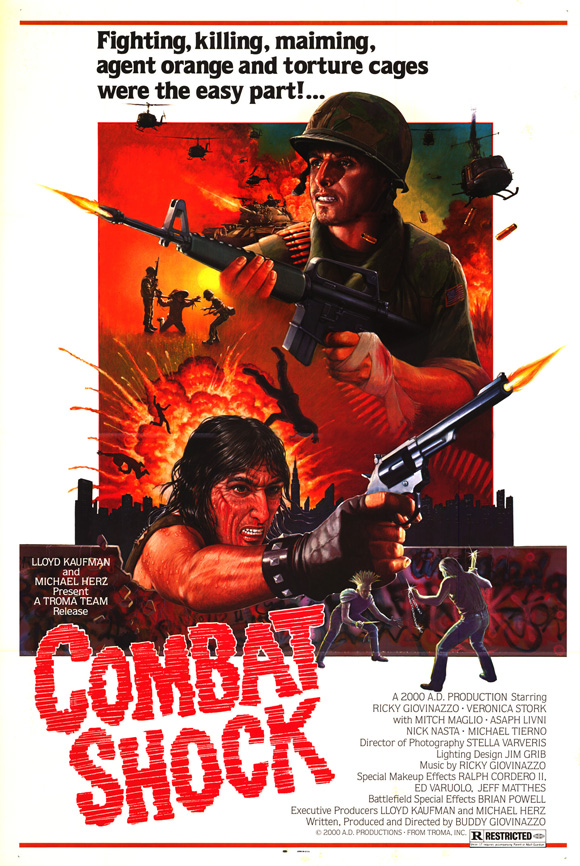
Saturday Matinee: Combat Shock

combatshock

By Oliver Hall

Source: Dangerous Minds

Frankie’s having a terrible day. His wife and infant son are starving. He’s run out of money and food. Now he’s going to be evicted. He’s got a gun. Let’s hear it for Frankie…

If this sounds familiar, it’s because the story of the 1984 Troma movie Combat Shock bears a striking resemblance to that of Suicide’s harrowing song “Frankie Teardrop.” The movie concerns the struggle of a young man named Frankie to feed his wife and child in blighted Staten Island, and if you’ve heard the song, I don’t have to tell you that it ends pretty badly for Frankie, his family, you, me, and the entire human race.

Frankie isn’t a factory worker in this version of the story, but an unemployed Vietnam vet whose days and nights are continually interrupted by flashbacks of ‘Nam and the torture he suffered at the hands of the VC. These, in turn, lead to flashbacks within flashbacks where, for purposes of exposition, Frankie relives arguments with his father, now estranged because a) Frankie has refused to carry on the family legacy of race hate and b) Dad disapproves of Mrs. Frankie. Suffering through the exposition of any movie is itself a form of torture.

However, these gestures toward the conventions of plot are mercifully few and brief, and Combat Shock soon makes with the laffs and gasps you crave from late-night horror fare. Much of the pleasure of watching Combat Shock comes from the genre detail writer, director, producer and editor Buddy Giovinazzo adds to extend Suicide’s story to feature length. For instance, because of Frankie’s exposure to Agent Orange, and because this is a Troma movie, the child looks like a cross between the Eraserhead baby and Edvard Munch’s screamer.

Until the awful climax, the movie takes its time presenting a loser’s-eye view of urban anomie. If you’ve ever lived in a place that had a TV set, you already know all these characters: Frankie’s slow descent into madness involves demoralizing encounters with small-time hoods (Frankie’s creditors), child prostitutes, junkie thieves and social workers (one of whom is missing a Ronco Veg-O-Matic). There are also one or two thrilling surprises, even for the very jaded.

And in case you somehow feel cheated of your full share of human misery after watching Combat Shock, here’s a kind of sequel to “Frankie Teardrop,” Alan Vega’s 12-minute bum-out “Viet Vet.”