American Cartel: How America’s Two Major Parties Helped Destroy Democracy

cartel

By Frank Castro

Source: The Hampton Institute

Cartel: An association of manufacturers or suppliers with the purpose of maintaining prices at a high level and restricting competition.

A little over two decades ago, on December 2, 1993, the principle engineer of Colombia’s infamous cocaine empire, Pablo Escobar, was killed while fleeing police on the barrio rooftops of his hometown, Medellin. Before he died he had amassed an organization of state-like power, challenging, in fact, the government of Columbia itself over the question of its extradition policies-and winning. Dubbed the Medellin drug cartel, his international cocaine operation grew to prominence functioning similarly to the corporations which dominate today’s global economy. Escobar knew, by controlling every possible link in the drug chain from production to retail, he could corral suppliers under a single umbrella, dictate the price of his product, and severely limit any would-be competitors from challenging his power.

Escobar was not alone in learning from the strategies of corporate giants. If anything he was late. Few organizations have pervasively and durably monopolized a market as well as America’s Republican and Democratic parties. The two dominant machines steering the U.S. electorate have consistently diminished the potential for a freer America. That’s because the reality is, rather than arch rivals, liberals and conservatives are two factions of the same team. Both are capitalist. Both are imperialist. Both are white supremacist surrogates. And both are controlled by a plutocratic elite who have discovered what Escobar learned in his early twenties, that competition is best neutralized by eliminating all possible outliers. We merely perceive the two parties as markedly different because of the degree to which the spectrum of possibilities has been narrowed.
American Cartel

Politics, at its barest, is a market characterized by power-and the struggle for how power will be distributed. As CrimethInc illustrated some time ago, in this market ideas function similar to currency. Delineated by ideas which can build capital enough for the acquisition of more power, and those which might unbind power, political parties are tethered to the same basic operating principles of any capitalist enterprise. They must solidify market share in the realm of ideas and grow, wherever and whenever possible, or go bankrupt. Incubated within this constant power play, self-preservation becomes the party’s central priority; and it does not matter if the ideas which accomplish this outcome are beneficial to the electorate or detrimental, so long as it achieves the imperative to survive.

Political organizations which maintain growth long enough to survive often do so by normalizing their ideological framework. When they have obtained a disproportionate amount of influence over their immediate surroundings, they can metastasize into monopolies and control large swaths of the idea-economy. New ideas about how society ought to function can enter the market to contest old ideas, but usually encapsulated within reforms incapable of unseating the dominant paradigm. Characteristic of any capitalist system, once market monopolies are established “power tends to flow upward to the top of a hierarchy, from which the masters, the ones qualified to employ it, decide matters for everyone else.”

Remember the age-old question, what do all those with power want? More power. As such, two monopolies have dominated American politics for over 150 years-the Democratic Party, founded in 1828, and the Republican Party, founded in 1854. Together, they form a political cartel, or an association of political parties with the purpose of maintaining concentrated power and restricting or repressing competition. Throughout the past century its loosely managed agreements, often wholly unofficial, but embedded deep within its standard operation, have been the quasi-coordinated production, distribution, and enforcement of a set of normalized choices which reflect only the range of needs of private corporate power.

Essentially, to solidify and gain greater control, the two parties staked out a set of positions within a predetermined and standardized framework which express the basic ideas of the status quo. This way any “new” solutions about what might be possible tend toward ideas which pose no serious danger to the framework itself, which produce reforms only capable of gutting radical resistance while leaving the underlying problems intact. Any outliers are assimilated or positioned to enhance the strength of current institutions. In other words, all ideas must first be filtered through the umbrella of the Democrat-Republican cartel, which dictates the pedigree of ideas both old and new, and therefore severely limiting any competition from threatening its hegemony.
American Sicarios

Central to the project of any cartel is control. And within most drug cartels there is an armed group responsible for carrying out violence in an effort to maintain it. In Colombia they were called sicarios. Though the violence is systematically different, American sicarios are most accurately found in state institutions like the Central Intelligence Agency (CIA) and the Federal Bureau of Investigation (FBI). Such an observation should not be seen as hyperbole. Even the most marginally informed American should know their government frequently has been involved in shameful acts of violence, whether it was the assassination, framing, and political neutralization of black, brown, indigenous, and left-radical movements and their leaders, or organized coups in the Middle East, Africa, and Central or South America.

Without enforcers America’s political cartel simply could not exist. As I wrote in Gangs Of The State: Police And The Hierarchy Of Violence , our society operates on a clearly defined, yet often unarticulated, hierarchy of violence; and the function of politicians and police agencies is to normalize and enforce that violence. As an institution, these agencies act as state-sanctioned gangs, or, in this instance, the sicarios of America’s political ideology, charged with the task of upholding the violent, racist hierarchy of white supremacist capitalism. Wherever and whenever possible, they are tasked with solidifying a monopoly of power where all violence from/by those higher on the hierarchy upon those lower can be normalized into business as usual. Any deviation from the status quo, any resistance whatsoever, is met with brutal repression.

For those familiar with United States history, the record of repression against anti-capitalist groups has been a source of considerable alliance between Democrats and Republicans. In A People’s History of the United States, recounting America’s anti-leftist atmosphere after Russia’s Bolshevik Revolution, Howard Zinn wrote:

“In early September 1917, Department of Justice agents made simultaneous raids on forty-eight IWW [International Workers of the World] meetings across the country, seizing correspondence and literature that would become courtroom evidence. Later that month, 165 IWW leaders were arrested for conspiracy to hinder the draft, encourage desertion, and intimidate others in connection with labor disputes. One hundred and one went on trial [en masse] in April 1918; it lasted five months, the longest criminal trial in American history up to that time… [T]he jury found them all guilty. The judge sentenced [IWW president William “Big Bill”] Haywood and fourteen others to twenty years in prison; thirty-three were given ten years, the rest shorter sentences. They were fined a total of $2,500,000. The IWW was shattered.”

Commonality between the United States’ two major political parties has been most visible when viewed through its historically imperialist and anti-communist foreign policy. Beginning with the expansion of Soviet influence, the relationship is best described by a popularized euphemism of the Cold War Era: Partisanship ends at the water’s edge, meaning, if the two factions of the cartel could ever totally agree, it must be on the dismembering of communism everywhere. As the growth of nationalist and anti-colonialist movements abroad strengthened in concert with labor movements in America, a fierce need for bipartisan crackdown to preserve the dominant regime emerged. Zinn once again lends clarity:

“The United States was trying, in the postwar decade [of World War II], to create a national consensus-excluding the radicals, who could not support a foreign policy aimed at suppressing revolution-of conservatives and liberals, Republicans and Democrats, around the policies of the Cold War and anti-Communism. Such a coalition could best be created by a liberal Democratic President, whose aggressive policy abroad would be supported by conservatives… [I]f the anti-Communist mood became strong enough, liberals could support repressive moves at home which in ordinary times would be seen as violating the tradition of liberal tolerance.”

Repressive moves were exactly what happened. Imperialist consensus not only generated cohesion on issues of foreign policy, it refined a coordinated relationship of narrowed domestic power between Democrats and Republicans, providing the groundwork to enact an increasingly clandestine police-state. Repression of previous magnitude would continue against not only anti-capitalists, but against movements for self-determination throughout the ’60s and ’70s among black people, Puerto Ricans, Chicanos, and indigenous populations, most notably through the FBI’s COINTELPRO operations. The tactics for gutting competing political currents pioneered by police agencies then became standard operating procedure, evolved into pervasive surveillance apparatuses, and have been deployed in both recent uprisings against Occupy Wall Street and Black Lives Matter protesters.
American Crime Lords

If there is a position within the cartel’s classic hierarchy embodied by most liberal and conservative politicians, it would not be the rank of crime lord, but rather that of lieutenant, the second highest position. Lieutenants are responsible for supervising the sicarios within their own territories-in our case, their respective states. They are allowed discretion to carry-out the day-to-day operations of the cartel, to ensure its smooth operation. Crucial duties include voting on legislation filtered through existing idea-monopolies, which remain firmly rooted within the sanctioned political spectrum, and policing the spectrum’s established borders by criminalizing outliers, especially ones that cannot be assimilated and must be repositioned to reinforce the existing framework. If they perform well enough, they become the focus of investigative inquiry and obscure the higher authority they serve.

The rank of real crime boss goes to richest of the rich. The multi-billionaires of America who-in recent years-have given up to 42 percent of all election contributions, and captured the state in the process. Brothers Charles and David Koch, owners of Koch Industries, the second largest privately owned company in the United States, are known for funding the Republican political machine, giving over one hundred million dollars to far-right causes. But the Kochs are no more alone in their policy purchasing than Republicans are in begging the super wealthy for campaign funds. Democrats have increasingly relied on it too. Money awarded to Democrats from corporate PACs now far outstrips what used to come from labor unions and trial lawyers. For instance, corporate PACs donated $164.3 million to Republicans during the 2010 election season and $164.3 million to Democrats also. Unions gave $59-$79 million.

Owning a cartel may not seem cheap, but it pays dividends. It accomplishes this not only through generating enormously disproportionate wealth, or even through buying elections, but by imposing upon the impoverished a set of values which ensure their continued exploitation. Karl Marx himself pointed this out, explaining that “the class which is the ruling material force of society, is at the same time its ruling intellectual force.” For the poor American voter this means individuals are made to develop in such a fashion that their development fosters the strength of the capitalist state. At their core, working class people are constantly being sold and resold their own disempowerment, until finally we sell it to ourselves-over and over again. It is a sinister, but brilliant, stroke of genius-what better way to destroy the possibility of expropriation than to make disparity gold.

Michel Foucault described this process of perpetually re-inscribing within ourselves, and each other, the relation we have to power as the effect of unspoken warfare, a war where we build within our social institutions, and our very bodies, an ultimate disequilibrium. We self-police so thoroughly that when power’s effects upon us begin self-reproducing “there is no need for arms, physical violence, [or] material constraints,” just an inspecting gaze, “which each individual under its weight will end by interiorisation to the point that he is his own overseer, each individual thus exercising this surveillance over, and against, himself.” In short, we become our own worst enemies. The rules and values of the rich become the self-inflicted rules and values of the poor. But they never benefit us. And we quit asking why.
American Plutocracy

Democracy describes today’s America by only the most facile standards. It has never really described America anyway. Plutocracy is the accurate word. And our plutocratic overlords keep us in a hamster-wheel choosing which lieutenant we will take orders from next for practical reasons. It gives them, and the political parties they own, a sort of object permanence. We understand the prescriptions of those in power even when we cannot observe them directly; because we have been inundated by their surrogates and transformed into a passive body meant only to ratify our subjugation. Imagine waking up in a prison cell with the choice to continue sleeping on an unpadded iron bench or a concrete floor. No matter what “decision” you make, neither can destroy the cage. This is the reality of our political climate, a series of non-decisions masquerading as choice.

Ultimately, the emergence of plutocracy has not been the fault of the working class. Even though we have internalized many of the mechanisms used to exploit us, we constantly have been outpaced, outgunned, and outright demoralized. And in our attempts at democracy we have fundamentally failed to understand that political freedom cannot exist in the absence of economic freedom. They are inextricably linked, like a tree to its roots. Now that many Americans are beginning to see how capitalism has been the physical incarnation of inequality, we must move forward in this moment and reconcile with another unassailable truth: That capitalism’s relation to democracy will always be characterized by adversary, not coexistence. In such an environment, America’s major political parties remain henchmen to a perverse and morally bankrupt distribution of power.


‘Corruption’ as a Propaganda Weapon

By Robert Parry

Source: Consortium News

Sadly, some important duties of journalism, such as applying evenhanded standards on human rights abuses and financial corruption, have been so corrupted by the demands of government propaganda – and the careerism of too many writers – that I now become suspicious whenever the mainstream media trumpets some sensational story aimed at some “designated villain.”

Far too often, this sort of “journalism” is just a forerunner to the next “regime change” scheme, dirtying up or delegitimizing a foreign leader before the inevitable advent of a “color revolution” organized by “democracy-promoting” NGOs often with money from the U.S. government’s National Endowment for Democracy or some neoliberal financier like George Soros.

We are now seeing what looks like a new preparatory phase for the next round of “regime changes” with corruption allegations aimed at former Brazilian President Luiz Ignacio Lula da Silva and Russian President Vladimir Putin. The new anti-Putin allegations – ballyhooed by the UK Guardian and other outlets – are particularly noteworthy because the so-called “Panama Papers” that supposedly implicate him in offshore financial dealings never mention his name.

Or as the Guardian writes: “Though the president’s name does not appear in any of the records, the data reveals a pattern – his friends have earned millions from deals that seemingly could not have been secured without his patronage. The documents suggest Putin’s family has benefited from this money – his friends’ fortunes appear his to spend.”

Note, if you will, the lack of specificity and the reliance on speculation: “a pattern”; “seemingly”; “suggest”; “appear.” Indeed, if Putin were not already a demonized figure in the Western media, such phrasing would never pass an editor’s computer screen. Indeed, the only point made in declarative phrasing is that “the president’s name does not appear in any of the records.”

A British media-watch publication, the Off-Guardian, which criticizes much of the work done at The Guardian, headlined its article on the Putin piece as “the Panama Papers cause Guardian to collapse into self-parody.”

But whatever the truth about Putin’s “corruption” or Lula’s, the journalistic point is that the notion of objectivity has long since been cast aside in favor of what’s useful as propaganda for Western interests.

Some of those Western interests now are worried about the growth of the BRICS economic system – Brazil, Russia, India, China and South Africa – as a competitor to the West’s G-7 and the International Monetary Fund. After all, control of the global financial system has been central to American power in the post-World War II world – and rivals to the West’s monopoly are not welcome.

What the built-in bias against these and other “unfriendly” governments means, in practical terms, is that one standard applies to a Russia or a Brazil, while a more forgiving measure is applied to the corruption of a U.S. or European leader.

Take, for instance, former Secretary of State Hillary Clinton’s millions of dollars in payments in speaking fees from wealthy special interests that knew she was a good bet to become the next U.S. president. [See Consortiumnews.com’s “Clinton Stalls on Goldman-Sachs Speeches.”]

Or, similarly, the millions upon millions of dollars invested in super-PACS for Clinton, Sen. Ted Cruz and other presidential hopefuls. That might look like corruption from an objective standard but is treated as just a distasteful aspect of the U.S. political process.

But imagine for a minute if Putin had been paid millions of dollars for brief speeches before powerful corporations, banks and interest groups doing business with the Kremlin. That would be held up as de facto proof of his illicit greed and corruption.

Losing Perspective

Also, when it’s a demonized foreign leader, any “corruption” will do, however minor. For example, in the 1980s, President Ronald Reagan’s denounced Nicaraguan President Daniel Ortega for his choice of eyewear: “The dictator in designer glasses,” declared Reagan, even as Nancy Reagan was accepting free designer gowns and free renovations of the White House funded by oil and gas interests.

Or, the “corruption” for a demonized leader can be a modest luxury, such as Ukrainian President Viktor Yanukovych’s “sauna” in his personal residence, a topic that got front-page treatment in The New York Times and other Western publications seeking to justify the violent coup that drove Yanukovych from office in February 2014.

Incidentally, both Ortega and Yanukovych had been popularly elected but were still targeted by the U.S. government and its operatives with violent destabilization campaigns. In the 1980s, the CIA-organized Nicaraguan Contra war killed some 30,000 people, while the U.S.-orchestrated “regime change” in Ukraine sparked a civil war that has left some 10,000 people dead. Of course, in both cases, Official Washington blamed Moscow for all the trouble.

In both cases, too, the politicians and operatives who gained power as a result of the conflicts were arguably more corrupt than the Nicaraguan Sandinistas or Yanukovych’s government. The Nicaraguan Contras, whose violence helped pave the way for the 1990 election of U.S.-backed candidate Violeta Chamorro, were deeply implicated in cocaine trafficking. [See Consortiumnews.com’s “The Sordid Contra-Cocaine Saga.”]

Today, the U.S.-supported Ukrainian government is wallowing in corruption so deep that it has provoked a new political crisis.[See Consortiumnews’com’s “Reality Peeks Through in Ukraine.”]

Ironically, one of the politicians actually named in the Panama Papers for having established a shadowy offshore account is the U.S.-backed Ukrainian President Petro Poroshenko, although he got decidedly second-billing to the unnamed Putin. (Poroshenko denied there was anything improper in his offshore financial arrangements.)

Double Standards

Mainstream Western journalism no longer even tries to apply common standards to questions about corruption. If you’re a favored government, there might be lamentations about the need for more “reform” – which often means slashing pensions for the elderly and cutting social programs for the poor – but if you’re a demonized leader, then the only permissible answer is criminal indictment and/or “regime change.”

One stark example of these double standards is the see-no-evil attitude toward the corruption of Ukraine’s Finance Minister Natalie Jaresko, who is touted endlessly in the Western media as the paragon of Ukrainian good governance and reform. The documented reality, however, is that Jaresko enriched herself through her control of a U.S.-taxpayer-financed investment fund that was supposed to help the people of Ukraine build their economy.

According to the terms of the $150 million investment fund created by the U.S. Agency for International Development (USAID), Jaresko’s compensation was supposed to be capped at $150,000 a year, a pay package that many Americans would envy. But it was not enough for Jaresko, who first simply exceeded the limit by hundreds of thousands of dollars and then moved her compensation off-books as she amassed total annual pay of $2 million or more.

The documentation of this scheming is clear. I have published multiple stories citing the evidence of both her excessive compensation and her legal strategies for covering up evidence of alleged wrongdoing. [See Consortiumnews.com’s “How Ukraine’s Finance Minister Got Rich” and “Carpetbagging Crony Capitalism in Ukraine.”]

Despite the evidence, not a single mainstream Western news outlet has followed up on this information even as Jaresko is hailed as a “reform” candidate for Ukrainian prime minister.

This disinterest is similar to the blinders that The New York Times and other major Western newspapers put on when they were assessing whether Ukrainian President Yanukovych was ousted in a coup in February 2014 or just wandered off and forgot to return.

In a major “investigative” piece, the Times concluded there was no coup in Ukraine while ignoring the evidence of a coup, such as the intercepted phone call between U.S. Assistant Secretary of State for European Affairs Victoria Nuland and U.S. Ambassador to Ukraine Geoffrey Pyatt discussing who they would put into power. “Yats is the guy,” said Nuland – and surprise, surprise, Arseniy Yatsenyuk ended up as prime minister.

The Times also ignored the observation of George Friedman, president of the global intelligence firm Stratfor, who noted that the Ukraine coup was “the most blatant coup in history.” [See Consortiumnews.com’s “NYT Still Pretends No Coup in Ukraine.”]

The Propaganda Weapon

The other advantage of “corruption” as a propaganda weapon to discredit certain leaders is that we all assume that there is plenty of corruption in governments as well as in the private sector all around the world. Alleging corruption is like shooting large fish crowded into a small barrel. Granted, some barrels might be more crowded than others but the real decision is whose barrel you choose.

That’s part of the reason why the U.S. government has spread around hundreds of millions of dollars to finance “journalism” organizations, train political activists and support “non-governmental organizations” that promote U.S. policy goals inside targeted countries. For instance, before the Feb. 22, 2014 coup in Ukraine, there were scores of such operations in the country financed by the National Endowment for Democracy (NED), whose budget from Congress exceeds $100 million a year.

But NED, which has been run by neocon Carl Gershman since its founding in 1983, is only part of the picture. You have other propaganda fronts operating under the umbrella of the State Department and USAID. Last year, USAID issued a fact sheet summarizing its work financing friendly journalists around the globe, including “journalism education, media business development, capacity building for supportive institutions, and strengthening legal-regulatory environments for free media.”

USAID estimated its budget for “media strengthening programs in over 30 countries” at $40 million annually, including aiding “independent media organizations and bloggers in over a dozen countries,” In Ukraine before the coup, USAID offered training in “mobile phone and website security,” which sounds a bit like an operation to thwart the local government’s intelligence gathering, an ironic position for the U.S. with its surveillance obsession, including prosecuting whistleblowers based on evidence that they talked to journalists.

USAID, working with billionaire George Soros’s Open Society, also funds the Organized Crime and Corruption Reporting Project, which engages in “investigative journalism” that usually goes after governments that have fallen into disfavor with the United States and then are singled out for accusations of corruption. The USAID-funded OCCRP also collaborates with Bellingcat, an online investigative website founded by blogger Eliot Higgins.

Higgins has spread misinformation on the Internet, including discredited claims implicating the Syrian government in the sarin attack in 2013 and directing an Australian TV news crew to what looked to be the wrong location for a video of a BUK anti-aircraft battery as it supposedly made its getaway to Russia after the shoot-down of Malaysia Airlines Flight 17 in July 2014.

Despite his dubious record of accuracy, Higgins has gained mainstream acclaim, in part, because his “findings” always match up with the propaganda theme that the U.S. government and its Western allies are peddling. Though most genuinely independent bloggers are ignored by the mainstream media, Higgins has found his work touted by both The New York Times and The Washington Post.

In other words, the U.S. government has a robust strategy for deploying direct and indirect agents of influence. Indeed, during the first Cold War, the CIA and the old U.S. Information Agency refined the art of “information warfare,” including pioneering some of its current features like having ostensibly “independent” entities and cut-outs present U.S. propaganda to a cynical public that would reject much of what it hears from government but may trust “citizen journalists” and “bloggers.”

But the larger danger from this perversion of journalism is that it sets the stage for “regime changes” that destabilize whole countries, thwart real democracy (i.e., the will of the people), and engender civil warfare. Today’s neoconservative dream of mounting a “regime change” in Moscow is particularly dangerous to the future of both Russia and the world.

Regardless of what you think about President Putin, he is a rational political leader whose legendary sangfroid makes him someone who is not prone to emotional decisions. His leadership style also appeals to the Russian people who overwhelmingly favor him, according to public opinion polls.

While the American neocons may fantasize that they can generate enough economic pain and political dissension inside Russia to achieve Putin’s removal, their expectation that he will be followed by a pliable leader like the late President Boris Yeltsin, who will let U.S. operatives back in to resume plundering Russia’s riches, is almost certainly a fantasy.

The far more likely possibility is that – if a “regime change” could somehow be arranged – Putin would be replaced by a hard-line nationalist who might think seriously about unleashing Russia’s nuclear arsenal if the West again tries to defile Mother Russia. For me, it’s not Putin who’s the worry; it’s the guy after Putin.

So, while legitimate questions about Putin’s “corruption” – or that of any other political leader – should be pursued, the standards of evidence should not be lowered just because he or anyone else is a demonized figure in the West. There should be single not double standards.

Western media outrage about “corruption” should be expressed as loudly against political and business leaders in the U.S. or other G-7 countries as it is toward those in the BRICS.


Investigative reporter Robert Parry broke many of the Iran-Contra stories for The Associated Press and Newsweek in the 1980s. You can buy his latest book, America’s Stolen Narrative, either in print here or as an e-book (from Amazon and barnesandnoble.com).

Related Video:

A Crisis of the Heart

AAEAAQAAAAAAAANZAAAAJDE2ODFkMTY5LTcyYTktNGIwMi1iMDUxLWQ5MzA4ZDQ3OWU4ZA

By rahkyt

Source: Sacred Space in Time

The loss of life for any reason is always to be commiserated with and in instances of collective horror such as the terrorist attacks that have recently beset the West, the heart of oceanic humanity breaks a bit more.

With that said, our social media feeds become filled with national colors and heartful memes in solidarity with members of the human family hit by unthinkable tragedy. It is right to do so. But it is also right to understand that tragedies are occurring all around us, in our own nations as well as others, every single day.  Middle-aged whites in the US are killing themselves with drugs and alcohol and poor eating habits at a rate never seen before. They are hopeless and despairing as the American dream fades. Blacks remain mired in the same hopelessness caused by the same reasons, economic and social, with the added addition of racism and eugenic tactics centuries in the formation. Native Americans on Reservations continue to experience the effects of genocide, a program running in the collective American consciousness since this nation’s inception. The deaths add up and fade into consciousness as the background cries of the disillusioned and dehumanized.

Inhumanity reigns and the statistics state that people have been growing less and less compassionate toward each other for decades in this nation. These computers and smart phones draw us together but also tear us apart, the virtual world is as real as the real one. People spend hours per day jacked into the matrix, seamlessly moving between one and the other. Death by texting is on the rise,  porn increases objectification and consumer culture further consolidates the banality of social interaction and heart-based intimacy.

These realities indicate a crisis of the soul. Of the heart. When we are upset and outraged about one group of people but care nothing for others, something is very wrong. When there is compassion for those whom we might share something in common with and lack of compassion for those with whom we do not, there is a division of the heart, a dehumanization that speaks to the pervasivity of mainstream media programming of the mind.

Perhaps those who say humanity cannot change are right. Perhaps this is the best we can do. But perhaps it is also true that by consciously examining the memes and events and seeking to understand the issues at levels beyond those trumpeted in the mainstream we will come to realize that we have more in common with the Oppressed everywhere than the privileged so many of us wish to join in their glass mansions and private retreats. It is in the experience of self as seen through the eyes of others and experienced in the visceral engagement of souls on an eternal journey that true empathy and compassion are known.

When life ends, all that matters is the love. The love we give and the love we receive. The divisions dissipate. Living as if each one of us was from Beirut, or Paris, or Chicago, or Kenyan, every, single, day, and sharing our portion of love is how the dogs of war are banished. How the flames of hate are extinguished. The source is never what we are told and the cause goes back so far in the past that the effect is shrouded in mystery.

Share this outpouring of love with the world. Feel the pain of all those sacrificed on the alters of political and economic gain. Those next door, down the street, in the next city and state, and even across the nation. We must stand in solidarity with those who’ve made the ultimate sacrifice, but the war is not just between nations and ideologies. The war is within each of us. Every, single day.

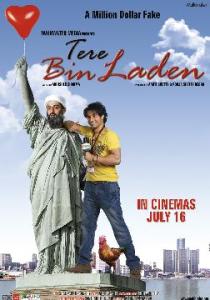
Saturday Matinee: Tere Bin Laden

Statu_With_Ali_Poster_With_Date

“Tere Bin Laden” (2010) is a Bollywood comedy written and directed by Abhishek Sharma. Pakistani pop star Ali Zafar stars as Ali Hassan, a TV reporter for a low budget news station in Karachi. Determined to find success in America despite previously being deported after being mistaken for a terrorist, he hatches a plan to raise funds for a fake ID with a sensational video using Noora (Pradhuman Singh), a dimwitted chicken farmer who happens to be a convincing Bin Laden lookalike. The plan rapidly spins out of control when it gets the attention of US government officials and the Pakistani intelligence agency. Though some gags dependent on regional references and wordplay may be lost on western audiences, much of it is broad enough to transcend cultures (especially bits mocking the paranoid and xenophobic post 9/11 milieu). Not surprisingly, the film was banned upon release in the US and several countries in the Middle East including Pakistan. The sequel Tere Bin Laden: Dead or Alive was released last February.

Happy April 1st

Rather than post a prank (which can all too easily be mistaken for “news” in today’s increasingly absurd media landscape) here’s a random assortment of intentionally funny clips:

The hypothesis behind The Walk of Life Project is that “Walk of Life” by Dire Straits improves the ending of any movie.

It certainly seems to work for The Shining, ideally the version depicted in this trailer:

From ClickHole:

Beautiful: This Video Shows Why We Need Diversity In Hollywood

rickroll


Hillary’s Latest Bow to AIPAC

hillaryclintonaipacspeechtranscript

By Ralph Nader

Source: CounterPunch

It is well known to Washington political observers that politicians invited to speak at the annual, giant AIPAC convention ask for suggested talking points from this powerful pro-Israeli government lobby. Hillary Clinton’s pandering speech must have registered close to 100% on AIPAC’s checklist.

Of course, both parties pander to AIPAC to such depths of similar obeisance that reporters have little to report as news. But giving big-time coverage to sheer political power is automatic. Compare it to the sparse attention given to the conference a few days earlier at the National Press Club on the Israeli lobby featuring scholars, authors and the well-known Israeli dissenter, Gideon Levy of the respected Ha’aretz newspaper (see israellobbyus.org/).

But Mrs. Clinton’s speech was newsworthy for its moral obtuseness and the way in which it promised unilateral White House belligerence should she become president. A reader would never know that her condemnation of Palestinian terrorism omitted any reference to the fact that Israel is the occupier of what is left of Palestinian lands, colonizing them, seizing their water and land, brutalizing the natives and continuing the selective blockade of Gaza, the world’s largest Gulag ever since Israel closed its last colony there in 2005.

Clinton emphasized her condemnation of Palestinian children being taught “incitement” against their Israeli oppressors and the recent deplorable knife attacks against Israeli soldiers and civilians. She neglected to point to massive, daily Israeli incitement backed up by U.S.-supplied deadly weapons that over the last decade have caused 400 times more Palestinian fatalities and serious injuries to innocents than the defenseless Palestinians have caused their Israeli counterparts. One of Prime Minister Netanyahu’s coalition partners, for example, from the Jewish Home Party, called for the slaughter of all Palestinians, the elderly and women in general. “Otherwise,” the partner said (in an English-language translation from the Hebrew), “more little snakes will be raised there.”

Clinton did not mention any of these brutalities, though they are components of what is an illegal occupation under international law and the United Nations charter. The Yale Law graduate simply chooses not to know better. Instead, she told her wildly-applauding audience of her support for increasing the amount of U.S. taxpayer spending for the latest military equipment and technology to over $4 billion a year. For the record, Israel is an economic, technological and military powerhouse that provides Israelis with universal health insurance and other social safety nets that are denied the American people.

In an obvious slap at President Obama, whose name she never mentioned (even Netanyahu thanked Obama in his address to AIPAC), Clinton almost shouted out: “one of the first things I’ll do in office is invite the Israeli Prime Minister to visit the White House.” This was a thinly-veiled reference to Netanyahu’s trip to a joint session of Congress, where he tried to undermine President Obama’s negotiations with Iran in what was an unprecedented interference by a foreign leader. Not surprisingly, Obama did not ask Netanyahu over to visit the White House for a drink before he headed back to Israel.

High on AIPAC’s checklist is to insist that all speakers condemn what Clinton called the “alarming boycott, divestment and sanctions movement known as BDS.” She then twice slanderously associated this modest effort (in which many Jews are active participants) to get Israel to lift some oppression from the occupied Palestinian territories, with antisemitism. However, by totally erasing any nod, any mention, any compassion toward the slaughter of Palestinian children, women and men in their homes, schools and hospitals, Hillary Clinton makes a mockery of her touted Methodist upbringing and her declared concern for children everywhere.

For repeated applause at AIPAC’s convention and its associated campaign contributors, she has lost all credibility with the peoples of the Arab world. Moreover, such hostility in her words registers “the other antisemitism,” to cite the title of an address by James Zogby before an Israeli university in 1994.

With all her self-regarded experience in foreign affairs, Mrs. Clinton could pause to ponder why she is backing state terrorism against millions of Arab Palestinians trapped in two enclaves, surrounded by walls, military outposts, and suffering from deep poverty, including widespread diseases and severe anemia among Palestinian infants and children.

Unlimited is her militant animosity toward Iran, bragging about crippling sanctions that she spearheaded (which caused untold harm to the health and care of civilians), and threatening military force “for even the smallest violations of this [nuclear] agreement.” Yet for decades Israel has violated numerous U.N. resolutions to withdraw its occupation and repression of Palestinians without a murmur from Secretary of State Clinton, who as a candidate opposes a role for the U.N. Security Council (over which the U.S. has an often-used veto) in the peace process.

There were some restraints. She repeated her support for a Palestinian state but wondered whether the Palestinian Leadership was up to the negotiations. Also, she resisted going along with recognizing the shift of Israel’s capital from Tel Aviv to Jerusalem.

Her very oblique reference to illegal, expanding Israeli settlements did not amount to anything more than a wink, foreshadowing no action on her part to stop the expansion of colonies in the occupied territories should she reach the White House.

Near the conclusion of her deferential remarks, she stated “If you see bigotry, oppose it. If you see violence, condemn it. If you see a bully, stand up to him.” Some courageous Israeli human rights groups, such as B’Tselem, who defend Palestinian human rights, might view her words as applicable daily to how they perform their noble work.

Ralph Nader is a consumer advocate, lawyer and author of Only the Super-Rich Can Save Us! 

The Weird Politics Of Aspartame: Conspiracy Theory Or Startling Truth?

050406aspartame3

By Paanii Powell Cleaver

Source: Inquisitr

Earlier this month, news wires and Twitter feeds were abuzz with info about the potential danger of certain artificial sweeteners.

In reality, recent reports about the potential perils of low-calorie sweeteners are not exactly breaking news. Almost 20 years ago, on December 29, 1996, Mike Wallace conducted an eye-opening segment about aspartame, also known as NutraSweet, on 60 Minutes.

The segment aired in response to a flurry of reports noting a dramatic increase in brain tumors and other serious health issues following the approval of aspartame for use in dry foods in 1981. Fifteen years after its somewhat dubious approval, (the most controversial FDA decision to date), more than 7,000 consumer reports of adverse reaction to aspartame had been delivered to the FDA. As reported by 60 Minutes, the litany of consumer complaints included severe headaches, dizziness, respiratory issues, and seizures. The FDA countered with a statement that aspartame was the most tested product in FDA history.

Dr. Virginia V. Weldon, a pediatrician from Missouri and Vice President of Public Policy for the Monsanto Company from 1989 through 1998, told 60 Minutes that aspartame is “one of the safest food ingredients ever approved by the Food and Drug Administration.”

Dr. John W. Olney, a neuroscientist at Washington University School of Medicine, vehemently disagreed with Dr. Weldon’s assessment of the controversial super sweetener. Notable for his discovery of the brain-harming effects of an amino acid called glutamate, Dr. Olney was influential in legislating the ban of MSG in baby food. At the time of the 60 Minutes segment, he had been studying the effects of aspartame and other compounds on brain health for more than two decades.

Olney told 60 Minutes’ Mike Wallace that since the approval of aspartame, there had been “a striking increase in the incidence of malignant brain tumors.” The doctor did not directly blame aspartame for the increase. He did, however, state that there was enough questionable evidence to merit reevaluating the chemical compound. He said that the FDA should reassess aspartame and that “this time around, they should do it right.”

Dr. Erik Millstone, Professor of Science Policy at the University of Sussex, told 60 Minutes that Searle’s testing procedures in the early 1970s were so flawed that there was no way to know for certain if aspartame was safe for human consumption. Millstone claimed that the company’s failure to dissect a test animal that died during an aspartame experiment was merely one example of “deficiencies” in Searle’s conduct. He also noted that when test mice presented with tumors, the tumors were “cut out and discarded and not reported.” In addition, Dr. Millstone told Mike Wallace that G.D. Searle and contractors hired by the drug company administered antibiotics to some test animals yet neglected to reveal this information in official reports.

In 1974, after the G.D. Searle company had already manufactured a significant quantity of aspartame, then-commissioner of the FDA, Alexander Schmidt, came very close to approving the chemical for human food purposes. Relying solely on evidence provided by Searle, the FDA allowed a mere 30 days for the public to respond before putting the FDA seal of approval on the now-controversial food additive. Dr. John Olney wasted no time in joining forces with James Turner, a public interest attorney who also worked with consumer advocate Ralph Nader. Just before the allotted time for public response ran out, Dr. Olney and his attorney petitioned the FDA with data that indicated the dangerous similarities between aspartame and glutamate.

In his 1970 best seller, The Chemical Feast, Turner detailed numerous ways the FDA shirked its obligation to protect the American people. At the time of its publication, Time magazine described the tome as “the most devastating critique of a U.S. government agency ever issued.”

In response to Dr. Olney’s allegations that aspartame was potentially as brain-damaging as glutamate, the FDA called for a task force to investigate the matter. By late 1975, the FDA found that Searle’s own research into the safety of aspartame was so flawed that they stayed the approval process, citing “a pattern of conduct which compromises the scientific integrity of the studies.”

Former U.S. Senator Howard Metzenbaum told 60 Minutes that when Searle presented information to the FDA in 1974, the drug company “willfully misrepresented” and omitted facts that may have halted approval of what would soon become its best-selling product. Metzenbaum went on to say that the FDA was so disturbed by its findings, it forwarded a file to the U.S. Attorney’s Chicago office in 1975 in the interest of calling a grand jury to determine whether criminal indictments against Searle were warranted.

When did the grand jury convene? Never. According to 60 Minutes, U.S. Attorney Samuel Skinner requested a grand jury investigation in 1977 but recused himself from the case when he was offered a job at the Sidley & Austin law firm, which also happened to be the Chicago law firm that represented the G.D. Searle company. The investigation was stalled until the statute of limitations ran its course, and no grand jury ever heard the case against Searle’s questionable research standards. Skinner, by the way, did eventually accept the job with Searle’s Chicago law office.

In 1977, a new FDA task force convened in Skokie, Illinois, with the sole purpose of investigating the research methods employed by G.D. Searle in its effort to gain FDA approval of aspartame. The task force examined raw data from 15 studies that Searle used to back up its uniformly positive claims about aspartame. According to journalist Andrew Cockburn, the task force noted numerous “falsifications and omissions” in Searle’s research reports.

In 1980, at the tail end of the Carter administration, the FDA conducted two-panel investigations into claims that aspartame caused brain tumors. Led by scientific and medical experts, each panel concluded that more tests were needed to prove the safety of the sweetener. Both panels concluded that aspartame should not be approved at that time.

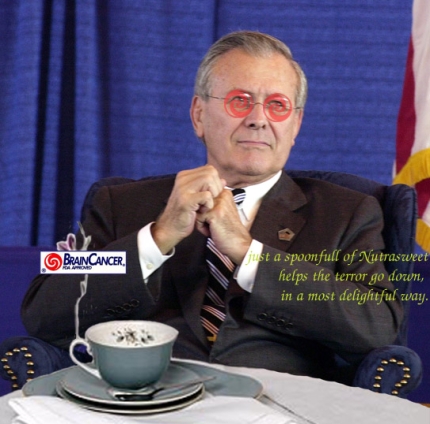
So, how does the fellow in the cover picture figure into this equation?

If you do not recognize the face in the feature photo, here is a memory refresher: The man in the pic — and up to his ears in the aspartame controversy — is Donald Rumsfeld. Perhaps best known as Secretary of Defense during the George W. Bush presidency, Donald Rumsfeld also happened to be CEO of the G.D. Searle drug company when Ronald Reagan was sworn in as President of the United States on January 1981.

Regardless of its safety or potential peril, the fact remains that without the clout and political influence of Donald Rumsfeld, aspartame might never have been approved for human use at all.

Donald Rumsfeld, who at one time aspired to be Reagan’s running mate, was a member of the new president’s transition team. Part of the team’s duties involved the selection of a new FDA Commissioner. Rumsfeld et al chose a pharmacist with no experience in food additive science to lead the agency.

On January 21, 1981, Ronald Reagan’s first full day as president, the G.D. Searle company, headed by Donald Rumsfeld, reapplied for FDA approval of aspartame. That same day, in one of his first official acts, President Reagan issued an executive order that rescinded much of the FDA commissioner’s power.

In April 1981, newly appointed FDA commissioner Arthur Hayes Hull, Jr., put together a five-person panel tasked to reevaluate the agency’s 1975 decision to not approve aspartame as a food additive. At first, the panel voted 3-2 to uphold non-approval of the chemical sweetener. Hayes then invited another member to the official FDA panel, and the vote was retaken. The panel deadlocked, and Hayes contributed his own vote to break the tie. Two months later, the product that the FDA refused to approve for seven long years was suddenly approved for human consumption.

Four years later, in 1985, the Monsanto corporation bought G.D. Searle and established a separate division, The NutraSweet Company, to manage the sales and public relations of one of its best-selling and most profitable products. It may be worth noting that when Monsanto purchased Searle and the patent on aspartame, Donald Rumsfeld reportedly received a fat $12 million bonus.

Before reading this, how much did you know about the origins of aspartame? If you’re like most Americans, the answer is “not much.” And, if you’re like many Americans, your interest in a story such as this one will wane as soon as the next hot topic comes along. Perhaps this is the reason that there has been little if any public outcry regarding aspartame or the weird way that it received FDA approval.

Updates:

In 1987, UPI investigative journalist Gregory Gordon reported that Dr. Richard Wurtman, a neuroscientist at Massachusetts Institute of Technology and a die-hard supporter of aspartame during its 1981 rush to approval, had reversed his thoughts on the sweetener. He noted the once-ardent supporter as saying his views had evolved along with scientific studies and his increased skepticism of industry research standards.

In 1997, the U.K. government obliged makers of sweetened food to prominently include the words “with sweeteners” on product labels. Ten years later, U.K. supermarket chain Mark & Spencer announced the end of artificial sweeteners and coloring in their chilled goods and bakery departments, according to the Daily Mail.

In his well received 2007 book, Rumsfeld: His Rise, Fall and Catastrophic Legacy, author Andrew Cockburn described the results of the 1977 FDA task force that found “falsifications and omissions” in Searle’s research data. The New York Times called author Cockburn’s biographical tome “quite persuasive.”

In 2009, Woolworths, a South African retailer, announced that it would no long brand products containing aspartame.

On February 28, 2010, Dr. Arthur Hayes Hull, Jr., the FDA Commissioner who hurried aspartame to market and later squelched public fear of Tylenol during the 1982 poisoning scare, died in Connecticut. According to his New York Times obituary, Hayes was employed as president of E. M. Pharmaceuticals after his term at the FDA. Hayes succumbed to leukemia at age 76.

A 2011 report in the Huffington Post noted that 10,000 American consumers notified the FDA about the ill effects of aspartame between 1981 and 1995. According to the article, the use of aspartame elicited more complaints than any other product in history, comprising 75 percent of complaints received by the U.S. Food and Drug Administration.

In 2013, the EFSA (the British equivalent of the FDA), reiterated its claim that aspartame is harmless. Professor Erik Millstone responded with his own reevaluation of aspartame, in which he noted that every study the EFSA used to approve aspartame was funded by the same industry that manufactures and profits from the controversial sweetener.

Dr. John W. Olney passed away at the age of 83 on April 14, 2015. In addition to his campaigns against aspartame and glutamate, the doctor devoted half a century of his life to finding a cure for Multiple Sclerosis, the crippling neurological disease that claimed his own sister when she was 16. According to the St. Louis Post Dispatch, cause of death of the pioneering brain researcher included complications of ALS, a neurological disorder more commonly known as Lou Gehrig’s Disease.

Those interested in learning more about the approval of aspartame are invited to read the FDA Commissioner’s Final Report, published by the Department of Health and Human Services on July 24, 1981. A detailed version of the aspartame timeline is available at Rense.com.