
US Sanctions Symptomatic of a Failing Empire

By James ONeill
Source:  New Eastern Outlook

On 26 July 2017 the US Congress overwhelmingly approved a Bill providing for fresh sanctions against North Korea, Russia and Iran. The passage of this Bill , and its level of support in the US Congress, is instructive on a number of levels.

The first point is that the US, or more accurately factions within the US establishment, are prepared to pursue policies irrespective of the lack of an evidential foundation; run counter to the interests of its supposed friends and allies, and completely lacks any knowledge of or reference to historical realities. The net result of the latest sanctions is to create a singularly dangerous situation that could very easily lead to a nuclear war. Contrary to the bizarre beliefs of some US policy makers, there would be no winners in such an outcome.

These points may be illustrated by reference to the sanctions applied to Iran. For years, the rhetoric from the US and its close ally Israel was that Iran was on “the verge of developing a nuclear bomb”. For more than a decade, the Israel government was saying that Iran was “only months away” from such a development. That the deadlines came and went without incident did not deter the repetition of what were manifest falsehoods.

Israel’s Prime Minister Netanyahu appeared before the UN General Assembly brandishing a cartoon depiction of the alleged “imminent threat”. The western media largely omitted to mention the fact that it was Israel that was the Middle East’s sole nuclear power; that Israel was not a signatory to the nuclear Non-Proliferation Treaty; and that it was Israel that consistently refused to allow inspections by the IAEA of its nuclear facilities.

Not only was there no evidence that Iran had or wished to develop a nuclear weapons capability, it was the unanimous view of all 17 US intelligence agencies on two separate occasions that Iran was not developing a nuclear weapons program.

To head off the prospect of the constant anti-Iran propaganda escalating to an attack by the US and its allies upon Iran, the Russian government was instrumental in achieving an agreement in 2015 that prevented an alleged non-existent nuclear weapons program becoming a justification for war. The recent historical example of Iraq was illustrative of how constant demonization, undermining by sanctions, and overblown false allegations of nuclear and other weapons of mass destruction could quickly lead to the utter devastation of a previously prosperous nation.

The lessons that should have been learned from Iraq, Libya and Syria are determinedly ignored by the western media that is currently beating the drums of war over North Korea, again ignoring history, logic and military realities.

The Joint Comprehensive Plan of Action (JCPOA) negotiated in 2015 and agreed by the participating parties, including the United States, provided an instrument through which it became virtually impossible for Iran to become a nuclear-armed power. The mechanisms for ensuring compliance included regular IAEA inspections, and six-monthly reports certifying Iran’s compliance. Those reports went to the US Congress.

For the Americans and their allies however, it was not enough. Although the JCPOA deprived them of an immediate casus belli for war, the anti-Iran rhetoric continued non-stop. One example of the false propaganda was the constant claim that Iran was a supporter of Shia groups, intent on fostering terrorism and destabilization across the Middle East and elsewhere.

This allegation bore no resemblance to the facts. The US Carnegie Foundation, for example, in a report entitled “Iran’s Small Hand in Yemen” criticized the depiction of Iran as supporting “Shia rebels” against the forces supporting the deposed President Hadi. The reality is that Hadi was a dictator, elected in an election where he was the only candidate, and whom popular opposition forced him to flee to Saudi Arabia.

The Houthis, who are the main opposition to Hadi, are Zaidi Muslims, much closer theologically to the Sunni branch of Islam than they are to predominantly Shia Iran. The brutal war currently being waged on Yemen is led by Sunni Saudi
Arabia, supported by the UK, US and a heavy involvement of mercenaries, including Australians, about which the Australian government is silent. The reality has more to do with Yemen’s strategic location overlooking the narrow outlet from the Red Sea to the Arabian Sea and its massive oil reserves coveted by the Saudis than it does with any alleged Iranian support. Djibouti, across the strait from Yemen, has similarly attracted US and Chinese strategic involvement, without as yet being ravaged by war.

Iran also offers political and moral support for Hamas in Palestine, Muslims in Kashmir and the Rohingya in Myanmar, all of whom are overwhelmingly Sunni. The feature they all have in common is that they are repressed and subject to genocidal policies by other political and religious groupings.

The Trump administration is demonstrating the truth of President Putin’s observation about the previous Obama administration, that they “are not agreement capable.”

Trump told the Wall Street Journal “if it was up to me I would have found (the Iranians) non-compliant 180 days ago” (when he was sworn in). According to an article in the US Journal Foreign Policy Trump threw a tantrum in the Oval Office and berated his three senior foreign policy advisers (Tillerson, Mattis and McMaster) for not having found a way to claim that Iran was in breach of the provisions of the JCPOA. The New York Times ran a similar story.

In fact it is the United States that is in violation of the JCPOA, both the letter and the spirit of the agreement, and also of UN Security Council Resolution 2231 (2015) that approved the agreement. Article 29 of the JCPOA commits the US to refrain from any policy intended to affect the normalization of trade and economic relations with Iran.

The latest round of sanctions, and the bellicose rhetoric accompanying them are manifestly not in compliance with Article 29.

Among the many falsehoods asserted against Iran is the claim that Iran’s missile tests are a violation of the JCPOA. There is nothing in the agreement that inhibits Iran from developing a self-defence capability, including the use of anti-aircraft and anti-missile technology. That is also a right enshrined in the UN Charter.

Iran took delivery of the Russian made S300 anti-missile system in 2016, also in pursuance of its right to self-defence. Given the bellicose threats made against Iran on an almost constant basis; the two recent incidents of “warning shots” being fired at Iranian vessels by US Navy ships operating close to Iran’s territorial waters; and the recent history of American actions in Iran’s neighborhood, self defence measures are at the very least a prudent course of action.

Iran’s compliance with the terms of the JCPOA has enabled action in another area arguably more important than military self-defence measures. Rapid progress has been made by Iran in strengthening its economic ties to China, India and Russia. Memoranda of Understanding worth $40 billion have been signed with Russia or Russian companies. The Russian company Gazprom has signed a multi-billion dollar deal to develop Iran’s Farzad B gas field. Gazprom is also helping to develop the Azar and Ghanguleh oil fields in Lurestan province where there is an estimated 3.5 billion barrels of oil reserves.

Iran similarly has $7 trillion in natural gas reserves. The $200 billion needed to develop those reserves will come from Russia, China and other non-western sources. Iran has announced that it will give preference in infrastructure and other development deals to those nations who were supportive through the years of sanctions and other forms of warfare.

China, that is currently building a high-speed rail link between Mashad and Tehran (to link with other Central Asian lines) sees Iran as a key player in its massive Belt and Road Initiative (BRI) that is transforming the Eurasian economic and geopolitical landscape.

Iran is similarly a key player in the North South Transportation Corridor that links India via Iran and Azerbaijan with Russia, transporting goods at a fraction of the cost and time of existing conventional routes that are vulnerable to US Navy interference.

Also of major significance is Iran’s associate membership of the Shanghai Cooperation Organisation, with full membership highly likely in 2018. The SCO is a central component of the BRI with ever growing trade and security links with the Russian initiated Eurasian Economic Union (EEU). Russia is the common denominator of BRICS, the SCO, the EEU, the SCO and the NSTC. The countries in these four groups, as well as other nations (now more than 60) who have joined the BRI, are increasingly trading in other than dollar denominated arrangements. The days of the US dollar’s dominance are clearly numbered.

It is this combination of major economic and geopolitical shifts in the balance of power away from US dominance that has prevailed for the past seven decades that is the key to understanding why the Americans are reacting in the desperate, dangerous and irrational manner that they are. It is the classic end of empire syndrome. One hopes that the adults in the room will constrain the US from traveling further down a path that could spell the end of humanity.

Color Revolution Comes Home?

By Kevin Zeese and Margaret Flowers

Source: Popular Resistance

The United States has perfected the art of regime change operations. The US is the largest empire in world history with more than 1,000 military bases and troops operating throughout the world. In addition to military force, the US uses the soft power of regime change, often through ‘Color Revolutions.’ The US has been building its empire since the Civil War era, but it has been in the post-World War II period that it has perfected regime change operations.

Have the people of the United States been the victims of regime change operations at home? Have the wealthiest and the security state created a government that serves them, rather than the people? To answer these questions, we begin by examining how regime change works and then look at whether those ingredients are being used domestically.

Color Revolutions and Regime Change Operations

Almost from the start, the CIA’s role has been more than intelligence gathering. It has been a key player in putting in place governments friendly to the United States and conducting other operations, e.g. the CIA is currently involved in drone strikes.

One of the first regime change operations of the CIA was Operation Ajax conducted in Iran, and led by Kermit Roosevelt, the grandson of Teddy Roosevelt, who was president when the US solidified its global empire ambitions. The CIA was founded in 1947 and the regime change coup in Iran was 1953. Greg Maybury writes in “Another Splendid Little Coup“: “Placing to one side an early dress rehearsal in Syria in 1949, the Iran coup was the first post-War exercise in regime change upon the part of Anglo-American alliance…”  Just this month the US government released documents showing the CIA and State Department’s planning and implementation of the coup against the democratically-elected prime minister of Iran, Mohammed Mossadegh. This release supplements one from 2013 that did not reveal the full role of the US in the coup.

The Iran coup was crude compared to more modern efforts but had the ingredients that have become common – civil society protests against the government, media reports supporting the protests, agents within the government supporting the coup and replacement of the government with a US-friendly regime. The Iran coup may have been the most costly mistake in US foreign policy because it undermined a secular democratic government in Iranthat could have been the example for the region. Instead the US installed the brutal Shah of Iran, whose rule ended in the 1979 revolution, in which, as Maybury reports, the US was also implicated because it felt the Shah had overstayed his welcome.

The Iran coup was perceived as a great CIA success, so it was copied in other Middle Eastern countries as well as countries in Latin America, Africa, and the Caribbean. Regime change is still a major tool of US foreign policy. There is a long-term ongoing coup campaign in Venezuela, with its most recent episode last week in which a helicopter attack on the Supreme Court was tied to the US DEA and CIA. The US has allied with oligarchs, supported violent protests and provided funds for the opposition, which has also worked to undermine the Venezuelan economy — a tactic the US has used in other coups, e.g. the coup of Allende in Chile.

The coup in Ukraine, which the media falsely calls a ‘democratic revolution,’ was, as the head of the ‘private CIA’ firm Stratfor says, “the most blatant coup in history.” The CIA and State Department played the lead roles.

Victoria Nuland, an assistant secretary of state under Clinton, bragged that the US spent $5 billion to build civil society opposition against a government that leaned toward Russia. The government funded civil society opposition through US AID, which is the open vehicle for what the CIA used to do covertly, along with the National Endowment for Democracy. This funding was used to build oppositional civil society groups and create destabilization. They focused on the issue of corruption, which exists in every government, and built it up to a centerpiece for regime change. The US allied with extremist right-wing groups in Ukraine.

The US picked the new leaders of Ukraine. This included Petro Poroshenko, whom U.S. officials refer to as “Our Ukraine (OU) insider Petro Poroshenko” in a classified diplomatic cable from 2006 . The selected Prime Minister was Arseniy Yatsenyuk. Before the coup, Victoria Nuland told the US Ambassador to Ukraine that ‘Yats’ should be the prime minister. And, the Finance Minister was Natalia Jaresko, a long-time State Department official who moved to Ukraine after the US-inspired coup, the Orange Revolution, to become a conduit for US funding of civil society through her hedge fund. She was a US citizen whom Poroshenko made a Ukrainian on the day she was appointed Finance Minister. To top it off, fmr. Vice President Joe Biden’s son, Hunter Biden, and fmr. Secretary of State John Kerry’s longtime financial ally, Devon Archer, were put on the board of the largest private gas corporation in the Ukraine. Yet, the US media refuses to call this complete take over of the country by the United States a coup and instead describes Russia as the aggressor.

The US has perfected regime change operations from the 1950s up through today. The standard method of operation is finding an issue to cause dissent, building opposition in a well funded civil society ‘movement’, manipulating the media, putting in place US friendly leaders and blaming US opposition for the coup to hide US involvement. This approach is consistent no matter which party is in power in the US.

The Kleptocratic Oligarch Coup In The United States

Let’s apply the lessons from around the world to the United States. There is no question the US is an oligarchy. We say no question because recent political studies have proven it in multiple ways.

One difference in the US is that money plays an outsized influence in US elections. The wealthy can buy the government they want through campaign donations and by anonymous spending but the tools of color revolutions are still needed to legitimize the government. Legitimacy is getting harder to buy. Many realize we live in a mirage democracy. The Associated Press-NORC Center for Public Affairs reported in 2016 the extent of the loss of legitimacy of US government:

“Nine in 10 Americans lack confidence in the country’s political system, and among a normally polarized electorate, there are few partisan differences in the public’s lack of faith in the political parties, the nominating process, and the branches of government.”

Jimmy Carter has pointed to the “unlimited bribery” of government as turning the US into an oligarchy. The government needs to use the tools of regime change at home in order to create an veneer of legitimate government.

The Donald Trump presidency, which we regularly criticize, brings a lot of these tools to the forefront because Trump beat the system and defeated the elites of both parties. As a result, Democratic Party propaganda is being used to undermine Trump not only based on his policies but also through manufactured crises such as RussiaGate. The corporate media consistently hammers home RussiaGate, despite the lack of evidenceto support it. Unlike the Watergate or Iran-Contra scandals, there is no evidence that Trump colluded with Russia to get elected. And, the security state – the FBI and the agencies that conduct regime change operations around the world – is working to undermine Trump in a still unfolding domestic coup.

Civil society also has a strong role. John Stauber writes that:

“The professional Progressive Movement that we see reflected in the pages of The Nation magazine, in the online marketing and campaigning of MoveOn and in the speeches of Van Jones, is primarily a political public relations creation of America’s richest corporate elite, the so-called 1%, who happen to bleed Blue because they have some degree of social and environmental consciousness, and don’t bleed Red.  But they are just as committed as the right to the overall corporate status quo, the maintenance of the American Empire, and the monopoly of the rich over the political process that serves their economic interests.”

Civil society groups created or aligned with the Democratic Party are defining the new form of false-resistance as electing Democrats. The Democrats, as they have done throughout history as the oldest political party, know how to control movements and lead them into ineffectiveness to support the Democratic Party agenda. We described, in “Obamacare: The Biggest Insurance Scam in History,” how this was done skillfully during the health reform process in 2009. This new resistance is just another tool to empower the elites, not resistance to the oligarchic-kleptocrats that control both parties. In fact, a major problem in progressive advocacy is the funding ties between large non-profits and corporate interests. The corruption of money is seen in organizations that advocate for corporate-friendly policies in education, health care, energy and climate, labor, and other issues.

Color Revolution Tools Used In The US

Now the tools the US uses for regime change around the world are being used at home to funnel activist energy and efforts into the Democratic party and electoral activities. In order to resist this new “resistance” we need to be aware of it and how it operates. We need to see through propaganda, such as RussiaGate, and attempts to manipulate the masses through scripted events that are portrayed as organic, such as the recent “sit in” by Rep. John Lewis and Sen. Cory Booker on the Capitol steps, or through highly emotional cultural content that portrays the plutocratic parties as parties of the people. We have to remember that the root issue is plutocracy and the US has two plutocratic parties, often referred to as “The Duopoly.”

We must continue to focus on the issues that are in crisis such as the economy, health care, education, housing, racism, inequality and militarization at home and abroad. We must fight for these issues independent of political party. We must be clear and uncompromising in our demands so that we are not taken off track. And we must have a clear vision of the future that we want to see.

Popular Resistance is a co-convener of the People’s Congress of Resistance. The People’s Congress will bring people together from around the US to meet in Washington, DC this September to outline a vision from the grassroots. A draft of that vision will be circulated over the next few months so that many people will provide input. Check out the People’s Congress here and get involved however you are able.

Dear America: If You Want to Stop Racism, Tear Down the Drug War—Not Statues

We cannot change the future by trying to erase the past. Tearing down a statue is not a solution to racism — ending the drug war is.

By Matt Agorist

Source: The Free Thought Project

On Monday, protesters — reacting to the violence in Charlottesville over the weekend — brought a ladder and some rope to North Carolina and tore down a near century old statue of a Confederate soldier. Unsurprisingly, nothing changed. However, the Durham Police Department and the Durham County Sheriff’s Office announced that they will be seeking criminal charges for those involved in the destruction of the statue.

Watching people wage violence against their fellow human in the name of protecting or tearing down some arbitrary government artifact is as disheartening as it is frustrating. The future cannot be changed by attempting to erase the past.

A statue holds no magical power to make people racists. If anything, the monuments to former racists serve as reminders that the state can and always will be open to the influence of bigotry — and only the state has the power to enforce racism.

An ignorant racist is exactly that — however, if society grants that ignorant racist a political position or a badge and a gun, this ignorant racist now has power over you. Removing or keeping a piece of concrete will never change this.

Jim Crow laws weren’t overturned because people went around town tearing down statues.

Racist government laws were brought to an end because people refused to obey them. Had Rosa Parks used her time and energy lobbying to take down a statue instead of disobeying a racist law, rest assured Browder v. Gayle, which ruled that segregated buses were unconstitutional, would’ve never happened.

Had the Civil Rights Movement in the 1950s not organized the Montgomery Bus Boycott, rest assured, desegregation would’ve taken much longer.

Society has the amazing ability to force positive change through nonviolent and nondestructive means. However, all too often, we let emotions rule our thoughts and take to yelling and fighting in the streets and destroying property. This only serves to create more divide and empower the ranks of the racists.

If we really want to put the brakes on a racist system, fighting with other citizens (even if they are devout racists) will never work.

Boycotts, refusal of service, shaming, exposing — these are the tools we as citizens have against other citizens who are spreading hate and racism.

One amazing private solution to racism actually just happened on Tuesday in Washington. Richard Spencer, the ostensible leader of the white supremacists, was forced to hold his press conference in his own house because businesses refused to allow him to rent their hotels. This campaign of public shaming and refusal of service is far more effective than tearing down a statue or attempting to use the government to ban hate speech.

But what do we do when the state is perpetuating a racist system and prolonging the suffering of minorities? Again, the answer to that question is not to tear down a statue, but to realize where the power of this racism rests.

In America, the area of government that is most responsible for maintaining a racist system, allowing racist actors to oppress their targets with impunity, and perpetuating the suffering and plight of millions through the persecution of morally innocent individuals — is the war on drugs.

Without a doubt, the war on drugs fuels the racist system by targeting minorities and the poor. It serves to increase interactions between police—who are often caught joining the force to act out their racist desires—and the citizens.

The drug war, from the police departments to the court systems, unequivocally targets and punishes minorities harder for the same victimless crimes for which their white counterparts receive slaps on the wrist.

As TFTP reported last year, a scathing report in Harper’s Magazine, written by Dan Baum set the record straight and relieved all doubt over the intentions of the drug war. John Daniel Ehrlichman, counsel and domestic policy chief to President Richard Nixon, came clean on the real reason behind the war on drugs — to criminalize blacks and hippies.

According to Baum, he tracked down Ehrlichman in 1994 at his engineering firm in Atlanta, Georgia.

“You want to know what this was really all about?” Ehrlichman bluntly asked Baum of the war on drugs. “The Nixon campaign in 1968, and the Nixon White House after that, had two enemies: the antiwar left and black people. You understand what I’m saying? We knew we couldn’t make it illegal to be either against the war or black, but by getting the public to associate the hippies with marijuana and blacks with heroin, and then criminalizing both heavily, we could disrupt those communities. We could arrest their leaders, raid their homes, break up their meetings, and vilify them night after night on the evening news. Did we know we were lying about the drugs? Of course we did.”

To this day, the racist intentions behind the war on drugs serve to further oppress black communities. The war on drugs is still creating criminals out of otherwise innocent individuals who’re caught in possession of arbitrary substances, removing their opportunity for employment by giving them criminal records, and guaranteeing a difficult future within the working class.

It is no coincidence that the ACLU refers to the drug war as the new Jim Crow.

As Graham Boyd wrote in 2001, in a report in NACLA:

The war on drugs subjects the United States to much of the same harm, with much of the same economic and ideological underpinnings, as slavery itself. Just as Jim Crow responded to emancipation by rolling back many of the newly gained rights of African-Americans, the drug war is again replicating the institutions and repressions of the plantation. And like slavery and Jim Crow, the drug war garners appalling levels of support. Each has its own rhetoric, each its own claims to unassailable legitimacy. The brutality of slavery was justified on economic and paternalistic grounds. Jim Crow pretended that separate but equal treatment sufficed, even as blacks faced daily lynchings and every form of overt discrimination. The drug war claims morality and protection of children as its goals, while turning a blind eye to the racial injustice it promotes. And with all three systems of oppression, much of society sits idly by, accepting the rhetoric that later will seem so unbelievably corrupt. We will one day understand that the war on drugs was a war on people and communities.

If we really want to deal a blow to this racist system we must strike the root. The drug war is one such root. Until we eliminate the cause of this strife, tearing down all the statues in the world will do nothing. Until we realize that we are financing our own oppression and refuse to support the government programs that keep us in the days of Jim Crow, the tyranny will remain.

It is high time we realize this real solution to this real problem before the entire country is so divided that we enter a new American civil war.

End of Nuclearism or the End of the World: Utopian Dreams, Dystopian Nightmares

By Richard Falk

Source: Global Justice in the 21st Century

We are living amid contradictions whether we like it or not, driving expectations about the future toward opposite extremes. Increasingly plausible are fears that the ‘sixth extinction’ will encompass the human species, or at least, throw human society back to a technology of sticks and stones, with a habitat limited to caves and forests. This dark vision is countered by gene editing designer promises of virtual immortality and super-wise beings programming super-intelligent machines, enabling a life of leisure, luxury, and security for all. Whether the reality of such a scientistic future would be also dark is a matter of conjecture, but from a survival perspective, it offers an optimistic scenario.

On political levels, a similar set of polar scenarios are gaining ground in the moral imagination, producing national leaders who seem comfortable embracing an apocalyptic telos without a second thought. The peoples of the world, entrapped in a predatory phase of global capitalism, are using their democratic prerogative to shut down dissent, rationality, and science. On one side, 122 governments pledge a legal commitment to the prohibition of nuclear weapons as an unprecedented prelude to the abolition of the weaponry; on the other side, all nine nuclear weapons states, and their closest allies, oppose the prohibition and opt for modernizing their nuclear weapons arsenals even devising strategic plans for their possible use, prompting an urgent search for counter measures.

John Pilger issues a solemn reminder that Nevile Shute’s On the Beach depicting a post-nuclear human future that is now more resonant than when it was published in 1957. Leaders that could bluff their way to shared catastrophe bellow forth in Washington and Pyongyang, each deluded by the belief that military options even with nuclear weapons are the only geopolitical security blanket worth relying upon, projecting a reckless obliviousness to the risk of losing their balance while engaging in inflammatory rhetorical posturing alarmingly close to the nuclear precipice.

As Pilger also points out, the liberal opposition to this right wing populism in the West is also dangerously disposed toward warmongering. Donald Trump is being pilloried by a bipartisan anti-Russian hysteria that imposes harsh sanctions, seemingly intent on driving Putin’s Kremlin into a corner from which there is no retreat except by way of confrontation, and possibly war.

We read of record heat waves, extreme weather events, extended droughts, and wild fires as common as clouds in the sky without blinking. The newspapers report that climate scientists are ready to push the panic button in reaction to the latest studies of grim global warning trends, while the Trump factor renews coal mining and treats denial a political virtue.

While these alarming realities dim the light of hope for many of us, the American stock market, a barometer of capitalist expectations by the shrewdest investors, achieves record heights. At the same time famine warnings have been officially endorsed for a series of long suffering populations: Syria, Yemen, South Sudan, northern Nigeria, Gaza. The entire Middle East is being turned into a war and conflict zone, with an anti-Iran warmongering coalition pressuring Iran to choose between nuclear deterrence and sectarian warfare inflamed by militarist Israeli/U.S. grand strategy that appears to be motivated by a regional vision of geopolitical pacification.

How best to endure in the face of such fatalistic dualisms? That may be the question of our time, dodged for the sake of sanity by almost all of us, at least most of the time. Business as usual, while living with therapeutic forms of cultural blindness, the opioids of those fortunate enough to live for now in gated communities, whether on the scale of private dwellings or walled off countries.

Recently a lively young woman told me that many of her friends had decided not to have children because they are so fearful of the storm clouds of the future, and refuse to wait around for liberating rainbows. At the other extreme, today’s International Edition of the New York Times contains a front page ad of enticement encouraging attendance at an International Luxury Conference to be held in Brussels, November 13-14, on the demeaning theme of “What’s Next: Luxury in a Turbulent World.” My somewhat impatient response—‘whatever turns out to be next, it will not be and should not be luxury!’ More likely, those grown accustomed to luxury will shift their residences to those underground homes built by Silicon Valley billionaires on vast tracts of lands in the New Zealand countryside as the ultimate hedge against an imminent global catastrophe. It could be that the NYT conference will devote its attention to this form of post-apocalyptic luxury living! Yet that assumes a quite unlikely focus on how the world of luxury is adapting to the unpleasant realities of the Sixth Extinction.

Rest in Peace and Rise in Power Dick Gregory

As many of you may have heard over the weekend, pioneering comedian and activist Dick Gregory died of heart failure on August 19th at age 84. For those not familiar to him, it’s difficult to encapsulate the scope of his work, but the following excellent synopsis is provided from his own website, Global Watch:

Gregory, Richard Claxton “Dick” (Born, October 12, 1932, St. Louis, Mo.), African American comedian and civil rights activist whose social satire changed the way white Americans perceived African American comedians since he first performed in public.

Dick Gregory entered the national comedy scene in 1961 when Chicago’s Playboy Club (as a direct request from publisher Hugh Hefner) booked him as a replacement for white comedian, “Professor” Irwin Corey. Until then Gregory had worked mostly at small clubs with predominantly black audiences (he met his wife, Lillian Smith, at one such club). Such clubs paid comedians an average of five dollars per night; thus Gregory also held a day job as a postal employee. His tenure as a replacement for Corey was so successful — at one performance he won over an audience that included southern white convention goers — that the Playboy Club offered him a contract extension from several weeks to three years. By 1962 Gregory had become a nationally known headline performer, selling out nightclubs, making numerous national television appearances, and recording popular comedy albums.

It’s important to note that no biography of Gregory would be complete without mentioning that he and his beloved wife, Lil, had ten kids who have become highly respected members of the national community in a variety of fields. They are: Michele, Lynne, Pamela, Paula, Stephanie (aka Xenobia), Gregory, Christian, Miss, Ayanna and Yohance. The Gregory’s had one child who died at birth but they have shared 49 years of historic moments, selfless dedication and tremendous personal love.

Gregory began performing comedy in the mid-1950s while serving in the army.
(See Black sin the Military). Drafted in 1954 while attending Southern Illinois University at Carbondale on a track scholarship, Gregory briefly returned to the university after his discharge in 1956, but left without a degree because he felt that the university “didn’t want me to study, they wanted me to run.” In the hopes of performing comedy professionally, he moved to Chicago, where he became part of a new generation of black comedians that included Nipsey Russell, Bill Cosby, and Godfrey Cambridge. These comedians broke with the minstrel tradition, which presented stereotypical black characters. Gregory, whose style was detached, ironic, and satirical, came to be called the “Black Mort Sahl” after the popular white social satirist. Friends of Gregory have always referred to Mort Sahl as the “White Dick Gregory.” Gregory drew on current events, especially the racial issues, for much of his material: “Segregation is not all bad. Have you ever heard of a collision where the people in the back of the bus got hurt?”

From an early age, Gregory demonstrated a strong sense of social justice. While a student at Sumner High School in St. Louis he led a March protesting Segregated schools. Later, inspired by the work of leaders such as Dr. Martin Luther King Jr., and organizations such as the Student Nonviolent Coordinating Committee (SNCC), Gregory took part in the Civil Rights Movement and used his celebrity status to draw attention to such issues as segregation and disfranchisement. When local Mississippi governments stopped distributing Federal food surpluses to poor blacks in areas where SNCC was encouraging voter registration, Gregory chartered a plane to bring in several tons of food. He participated in SNCC’s voter registration drives and in sit-ins to protest segregation, most notably at a restaurant franchise in downtown Atlanta, Georgia. Only later did Gregory disclose that he held stock in the chain.

Gregory’s autobiography, Nigger, was published in 1963 prior to The assassination of President Kennedy, and became the number one best-selling book in America. Over the decades it has sold in excess of seven million copies. His choice for the title was explained in the forward, where Dick Gregory wrote a note to his mother. “Whenever you hear the word ‘Nigger’,” he said, “you’ll know their advertising my book.”

Through the 1960s, Gregory spent more time on social issues and less time on performing. He participated in marches and parades to support a range of causes, including opposition to the Vietnam War, world hunger, and drug abuse. In addition, Gregory fasted in protest more than 60 times, once in Iran, where he fasted and prayed in an effort to urge the Ayatollah Khomeini to release American embassy staff who had been taken hostage. The Iranian refusal to release the hostages did not decrease the depth of Gregory’s commitment; he weighed only 97 lbs when he left Iran.

Gregory demonstrated his commitment to confronting the entrenched political powers by opposing Richard J. Daley in Chicago’s 1966 mayoral election. He ran for president in 1968 as a write-in candidate for the Freedom and Peace Party, a splinter group of the Peace and Freedom Party and received 1.5 million votes. Democratic candidate Hubert Humphrey lost the election to Republican Richard Nixon by 510,000 votes, and many believe Humphrey would have won had Gregory not run. After the assassinations of King, President John F. Kennedy, and Robert Kennedy, Gregory became increasingly convinced of the existence of political conspiracies. Gregory wrote books such as Code Name Zorro: The Murder of Martin Luther King Jr. (1971) with Mark Lane, world famous author, attorney and documentary filmmaker, whose findings published in the best-selling 1966 book Rush To Judgment Gregory credited with reversing the nation’s opinion on who assassinated the president and the facts which contradicted the official government version contained in the Warren Report. Lane’s book contained answers and facts, which Gregory has espoused in Numerous lectures from then until now. Lane and Gregory have been best friends, co-authors and have lectured together for over 40 years and both livein Washington D.C. Gregory and Lane’s book on the assassination of Dr. King was recently released under another title, Murder In Memphis, as a trade paperback.

Gregory’s activism continued into the 1990s. In response to published allegations that the Central Intelligence Agency (CIA) had supplied cocaine to predominantly African American areas in Los Angeles, thus spurring the crack epidemic, Gregory protested at CIA headquarters and was arrested. In 1992 he began a program called Campaign for Human Dignity to fight crime in St. Louis neighborhoods.

In 1973, the year he released his comedy album Caught in the Act, Gregory moved with his family to Plymouth, Massachusetts, where he developed an interest in vegetarianism and became a nutritional consultant. In 1984 he founded Health Enterprises, Inc., a company that distributed weight loss products. In 1987 Gregory introduced the Slim-Safe Bahamian Diet, a powdered diet mix, which was immensely profitable. Economic losses caused in part by conflicts with his business partners led to his eviction from his home in 1992. Gregory remained active, however, and in 1996 returned to the stage in his critically acclaimed one-man show, Dick Gregory Live! The reviews of Gregory’s show compared him to the greatest stand-ups in the history of Broadway.

In 1998 Gregory spoke at the celebration of the birthday of Dr. Martin Luther King, Jr. and President Clinton were in attendance. Not long after that, the President told Gregory’s long-time friend and PR. Consultant, Steve Jaffe, “I love Dick Gregory, he is one of the funniest people on the planet.” They spoke of how Gregory had made a comment on Dr. King’s birthday that broke everyone into laughter, when he noted that the President made Speaker Newt Gingrich ride “in the back of the plane,” on an Air Force One trip overseas. In 2001, Gregory announced to the world that he had been diagnosed with a rare form of Cancer. He refused traditional medical treatment – chemotherapy –and with the assistance of some of the finest minds in alternative medicine, put together a regimen of a variety of diet, vitamins, exercise, and modern devices not even known to the public, which ultimately resulted in his reversing the trend of the Cancer to the point where today he is 100% Cancer free.

Gregory’s going public with his diagnosis has helped millions of his fans around the world to understand what Cancer specialists have been trying to explain for decades, which is that “Cancer is curable.” Gregory was honored recently at the Kennedy Center in Washington D.C., by a sold out house and a tribute hosted by Bill Cosby, with special tributes by Mrs. Martin Luther King Jr., Stevie Wonder, Isaac Hayes, Cicely Tyson, Mark Lane, Marion Barry and many more.

His most recent book, Callus On My Soul, (Longstreet Press, Atlanta, Ga.) which became a best-seller within weeks of publication, is an autobiography that updates his earlier autobiography (Nigger), because as Dick says, “I’ve lived long enough to need two autobiographies which is fine with me. I’m looking forward to writing the third and fourth volumes as well.”

In 2001, Gregory escaped death once again when a massive tree fell on his car in a storm in Washington D.C. crushing it completely, causing him to have to be extricated from the car by emergency crews. One witness said, “I knew the driver and his passengers had died when I saw the tree fall.” Gregory said, “I knew that God had more work for me to do when I saw the tree falling. ” He saved his own life by driving into the oncoming lanes of traffic. The word of the accident circulated the globe immediately in the media, underscoring the power, influence, and support that Gregory has earned from people of all nations.

Doctor’s at George Washington Hospital refused to release Gregory for a few days causing his first-ever “State of the Union Address” to African Americans to be delayed by a month. Gregory gave the first “State of The Union” address live on the Internet from Los Angeles on April 21st.


End-times for humanity


Humanity is more technologically powerful than ever before, and yet we feel ourselves to be increasingly fragile. Why?

By Claire Colebrook

Source: Aeon

The end of the world is a growth industry. You can almost feel Armageddon in the air: from survivalist and ‘prepper’ websites (survivopedia.com, doomandbloom.net, prepforshtf.com) to new academic disciplines (‘disaster studies’, ‘Anthropocene studies’, ‘extinction studies’), human vulnerability is in vogue.

The panic isn’t merely about civilisational threats, but existential ones. Beyond doomsday proclamations about mass extinction, climate change, viral pandemics, global systemic collapse and resource depletion, we seem to be seized by an anxiety about losing the qualities that make us human. Social media, we’re told, threatens our capacity for empathy and genuine connection. Then there’s the disaster porn and apocalyptic cinema, in which zombies, vampires, genetic mutants, artificial intelligence and alien invaders are oh-so-nearly human that they cast doubt on the value and essence of the category itself.

How did we arrive at this moment in history, in which humanity is more technologically powerful than ever before, and yet we feel ourselves to be increasingly fragile? The answer lies in the long history of how we’ve understood the quintessence of ‘the human’, and the way this category has fortified itself by feeding on the fantasy of its own collapse. Fears about the frailty of human wisdom go back at least as far as Ancient Greece and the fable of Plato’s cave, in which humans are held captive and can only glimpse the shadows of true forms flickering on the stone walls. We prisoners struggle to turn towards the light and see the source (or truth) of images, and we resist doing so. In another Platonic dialogue, the Phaedrus, Socrates worries that the very medium of knowledge – writing – might discourage us from memorising and thinking for ourselves. It’s as though the faculty of reason that defines us is also something we’re constantly in danger of losing, and even tend to avoid.

This paradoxical logic of loss – in which we value that which we’re at the greatest risk of forsaking – is at work in how we’re dealing with our current predicament. It’s only by confronting how close we are to destruction that we might finally do something; it’s only by embracing the vulnerability of humanity itself that we have any hope of establishing a just future. Or so say the sages of pop culture, political theory and contemporary philosophy. Ecological destruction is what will finally force us to act on the violence of capitalism, according to Naomi Klein in This Changes Everything: Capitalism vs the Climate (2014). The philosopher Martha Nussbaum has long argued that an attempt to secure humans from fragility and vulnerability explains the origins of political hierarchies from Plato to the present; it is only if we appreciate our own precarious bodily life, and the emotions and fears that attach to being human animals, that we can understand and overcome racism, sexism and other irrational hatreds. Disorder and potential destruction are actually opportunities to become more robust, argues Nassim Nicholas Taleb in Antifragile (2012) – and in Thank You for Being Late (2016), the New York Times’ columnist Thomas Friedman claims that the current, overwhelming ‘age of accelerations’ is an opportunity to take a pause. Meanwhile, Oxford University’s Future of Humanity Institute pursues research focused on avoiding existential catastrophes, at the same time as working on technological maturity and ‘superintelligence’.

It’s here that one can discern a tight knit between fragility and virility. ‘Humanity’ is a hardened concept, but a brittle one. History suggests that the more we define ‘the human’ as a subject of intellect, mastery and progress – the more ‘we’ insist on global unity under the umbrella of a supposedly universal kinship – the less possible it becomes to imagine any other mode of existence as human. The apocalypse is typically depicted as humanity reduced to mere life, fragile, exposed to all forms of exploitation and the arbitrary exercise of power. But these dystopian future scenarios are nothing worse than the conditions in which most humans live as their day-to-day reality. By ‘end of the world’, we usually mean the end of our world. What we don’t tend to ask is who gets included in the ‘we’, what it cost to attain our world, and whether we were entitled to such a world in the first place.

Stories about the end of time have a long history, from biblical eschatology to medieval plague narratives. But our fear of a peculiarly ‘human’ apocalypse really begins with the 18th-century Enlightenment. This was the intellectual birthplace of the modern notion of ‘humanity’, a community of fellow beings united by shared endowments of reason and rights. This humanist ideal continues to inform progressive activism and democratic discourse to this day. However, it’s worth taking a moment to go back to René Descartes’s earlier declaration of ‘I think, therefore I am’, and ask how it was possible for an isolated self to detach their person from the world, and devote writing, reading and persuasion to the task of defending an isolated and pure ego. Or fast-forward a few centuries to 1792, and consider how Mary Wollstonecraft had the time to read about the rights of man, and then demand the rights of woman.

The novelist Amitav Ghosh provides a compelling answer in his study of global warming, The Great Derangement (2017). Colonisation, empire and climate change are inextricably intertwined as practices, he says. The resources of what would become the Third World were crucial in creating the comfortable middle-class existences of the modern era, but those resources could not be made available to all: ‘the patterns of life that modernity engenders can only be practised by a small minority … Every family in the world cannot have two cars, a washing machine and a refrigerator – not because of technical or economic limitations but because humanity would asphyxiate in the process.’

Ghosh disputes one crucial aspect of the story of humanity: that it should involve increasing progress and inclusion until we all reap the benefits. But I’d add a further strand to this dissenting narrative: the Enlightenment conception of rights, freedom and the pursuit of happiness simply wouldn’t have been imaginable if the West had not enjoyed a leisured ease and technological sophistication that allowed for an increasingly liberal middle class. The affirmation of basic human freedoms could become widespread moral concerns only because modern humans were increasingly comfortable at a material level – in large part thanks to the economic benefits afforded by the conquest, colonisation and enslavement of others. So it wasn’t possible to be against slavery and servitude (in the literal and immediate sense) until large portions of the globe had been subjected to the industries of energy-extraction. The rights due to ‘us all’, then, relied on ignoring the fact that these favourable conditions had been purchased at the expense of the lives of other humans and non-humans. A truly universal entitlement to security, dignity and rights came about only because the beneficiaries of ‘humanity’ had secured their own comfort and status by rendering those they deemed less than human even more fragile.

What’s interesting about the emergence of this 18th-century humanism isn’t only that it required a prior history of the abjection it later rejected. It’s also that the idea of ‘humanity’ continued to have an ongoing relation to that same abjection. After living off the wealth extracted from the bodies and territories of ‘others’, Western thought began to extend the category of ‘humanity’ to capture more and more of these once-excluded individuals, via abolitionism, women’s suffrage and movements to expand the franchise. In a strange way these shifts resemble the pronouncements of today’s tech billionaires, who, having extracted unimaginable amounts of value from the mechanics of global capitalism, are now calling for Universal Basic Income to offset the impacts of automation and artificial intelligence. Mastery can afford to correct itself only from a position of leisured ease, after all.

But there’s a twist. While everyone’s ‘humanity’ had become inherent and unalienable, certain people still got to be more fully ‘realised’ as humans than others. As the circle of humanity grew to capture the vulnerable, the risk that ‘we’ would slip back into a semi-human or non-human state seemed more present than before – and so justified demands for an ever more elevated and robust conception of ‘the human’.

One can see this dynamic at work in the 18th-century discussions about slavery. By then the practice itself had become morally repugnant, not only because it dehumanised slaves, but because the very possibility of enslavement – of some humans not realising their potential as rational subjects – was considered pernicious for humanity as a whole. In A Vindication of the Rights of Woman (1792), for example, Wollstonecraft compared women to slaves, but insisted that slavery would allow no one to be a true master. ‘We’ are all rendered more brutal and base by enslaving others, she said. ‘[Women] may be convenient slaves,’ Wollstonecraft wrote, ‘but slavery will have its constant effect, degrading the master and the abject dependent.’

These statements assumed that an entitlement to freedom was the natural condition of the ‘human’, and that real slavery and servitude were no longer genuine threats to ‘us’. When Jean-Jacques Rousseau argued in The Social Contract (1762) that ‘man is born free, and everywhere he is in chains’, he was certainly not most concerned about those who were literally in chains; likewise William Blake’s notion of ‘mind-forg’d manacles’ implies that the true horror is not physical entrapment but a capacity to enslave oneself by failing to think. It’s thus at the very moment of abolition, when slavery is reduced to a mere symbol of fragility, that it becomes a condition that imperils the potency of humanity from within.

I’m certainly not suggesting that there is something natural or inevitable about slavery. What I’m arguing is that the very writers who argued against slavery, who argued that slavery was not fitting for humans in their very nature, nevertheless saw the unnatural and monstrous potential for slavery as far too proximate to humans in their proper state. Yet rather than adopt a benevolence towards the world in light of this vulnerability in oneself, the opposite has tended to be the case. It is because humans can fail to reach their rational potential and be ‘everywhere in chains’ that they must ever more vigilantly secure their future. ‘Humanity’ was to be cherished and protected precisely because it was so precariously elevated above mere life. The risk of debasement to ‘the human’ turned into a force that solidified and extended the category itself. And so slavery was not conceived as a historical condition for some humans, subjected by ruthless, inhuman and overpowering others; it was an ongoing insider threat, a spectre of fragility that has justified the drive for power.

How different are the stories we tell ourselves today? Movies are an interesting barometer of the cultural mood. In the 1970s, cinematic disaster tales routinely featured parochial horrors such as shipwrecks (The Poseidon Adventure, 1972), burning skyscrapers (The Towering Inferno, 1974), and man-eating sharks (Jaws, 1975). Now, they concern the whole of humanity. What threatens us today are not localised incidents, but humans. The wasteland of Interstellar (2014) is one of resource depletion following human over-consumption; the world reduced to enslaved existence in Elysium (2013) is a result of species-bifurcation, as some humans seize the only resources left, while those left on Earth enjoy a life of indentured labour. That the world will end (soon) seems to be so much a part of the cultural imagination that we entertain ourselves by imagining how, not whether, it will play out.

But if you look closely, you’ll see that most ‘end of the world’ narratives end up becoming ‘save the world’ narratives. Popular culture might heighten the scale and intensity of catastrophe, but it does so with the payoff of a more robust and final triumph. Interstellar pits the frontier spirit of space exploration over a miserly and merely survivalist bureaucracy, culminating with a retired astronaut risking it all to save the world. Even the desolate cinematic version (2009) of Cormac McCarthy’s novel The Road (2006) concludes with a young boy joining a family. The most reduced, enslaved, depleted and lifeless terrains are still opportunities for ‘humanity’ to confront the possibility of non-existence in order to achieve a more resilient future.

Such films hint at a desire for new ways of being. In Avatar (2009), a militaristic and plundering West invades the moon Pandora in order to mine ‘unobtanium’; they are ultimately thwarted by the indigenous Na’vi, whose attitude to nature is not one of acquisition but of symbiotic harmony. Native ecological wisdom and attunement is what ultimately leads to victory over the instrumental reason of the self-interested invaders. In Mad Max: Fury Road (2015), a resource-depleted future world is controlled by a rapacious, parasitic, and wasteful elite. But salvation comes from the revolutionary return of a group of ecologically attuned and other-directed women, all blessed with a mythic wisdom that enables ultimate triumph over the violent self-interest of the literally blood-sucking tyrant family. These stories rely on quasi-indigenous and feminist images of community to offer alternatives to Western hyper-extraction; both resolve their disaster narratives with the triumph of intuitive and holistic modes of existence over imperialism and militarism. They not only depict the post-post-apocalyptic future in joyous terms, but do so by appealing to a more benevolent and ecologically attuned humanity.

These films whisper: take a second glance at the present, and what looks like a desperate situation might actually be an occasion for enhancement. The very world that appears to be at the brink of destruction is really a world of opportunity. Once again, the self-declared universal humanity of the Enlightenment – that same humanity that enslaved and colonised on the grounds that ‘we’ would all benefit from the march of reason and progress – has started to appear as both fragile and capable of ethical redemption. It’s our own weakness, we seem to say, that endows humanity with a right to ultimate mastery.

What contemporary post-apocalyptic culture fears isn’t the end of ‘the world’ so much as the end of ‘a world’ – the rich, white, leisured, affluent one. Western lifestyles are reliant on what the French philosopher Bruno Latour has referred to as a ‘slowly built set of irreversibilities’, requiring the rest of the world to live in conditions that ‘humanity’ regards as unliveable. And nothing could be more precarious than a species that contracts itself to a small portion of the Earth, draws its resources from elsewhere, transfers its waste and violence, and then declares that its mode of existence is humanity as such.

To define humanity as such by this specific form of humanity is to see the end of that humanity as the end of the world. If everything that defines ‘us’ relies upon such a complex, exploitative and appropriative mode of existence, then of course any diminution of this hyper-humanity is deemed to be an apocalyptic event. ‘We’ have lost our world of security, we seem to be telling ourselves, and will soon be living like all those peoples on whom we have relied to bear the true cost of what it means for ‘us’ to be ‘human’.

The lesson that I take from this analysis is that the ethical direction of fragility must be reversed. The more invulnerable and resilient humanity insists on trying to become, the more vulnerable it must necessarily be. But rather than looking at the apocalypse as an inhuman horror show that might befall ‘us’, we should recognise that what presents itself as ‘humanity’ has always outsourced its fragility to others. ‘We’ have experienced an epoch of universal ‘human’ benevolence, a globe of justice and security as an aspiration for all, only by intensifying and generating utterly fragile modes of life for other humans. So the supposedly galvanising catastrophes that should prompt ‘us’ to secure our stability are not only things that many humans have already lived through, but perhaps shouldn’t be excluded from how we imagine our own future.

This is why contemporary disaster scenarios still depict a world and humans, but this world is not ‘the world’, and the humans who are left are not ‘humanity’. The ‘we’ of humanity, the ‘we’ that imagines itself to be blessed with favourable conditions that ought to extend to all, is actually the most fragile of historical events. If today ‘humanity’ has started to express a sense of unprecedented fragility, this is not because a life of precarious, exposed and vulnerable existence has suddenly and accidentally interrupted a history of stability. Rather, it reveals that the thing calling itself ‘humanity’ is better seen as a hiatus and an intensification of an essential and transcendental fragility.

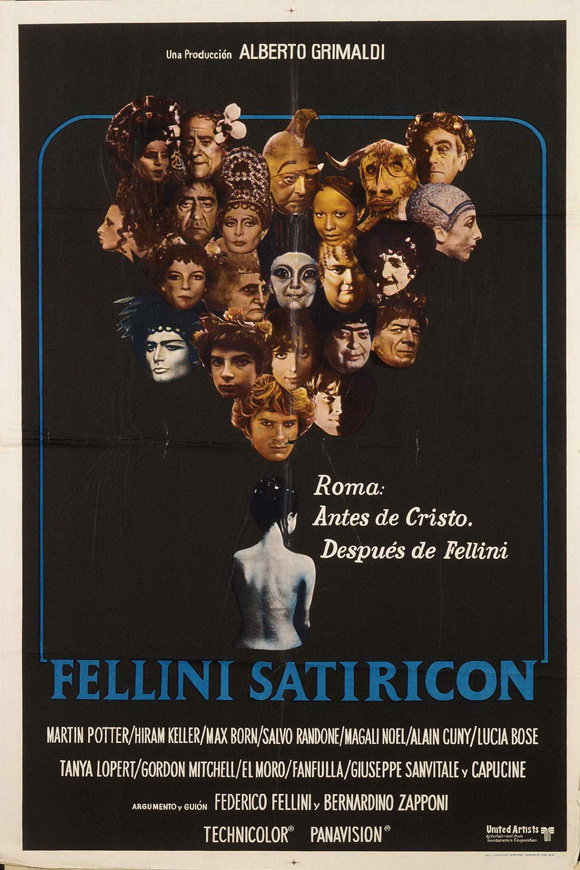
Saturday Matinee: Fellini Satyricon

“Fellini Satyricon” (1969) is a surreal fantasy written and directed by Federico Fellini and loosely based on Satyricon, written by Petronius during Nero’s reign over imperial Rome. The film’s episodic structure follows the scholar Encolpius and friend Ascyltus as they navigate a dreamlike and decadent Roman landscape.

An English subtitled version of the film can be found here.