I’m going to talk about some things that many people take for granted and that most writers not will write about. I’m going to throw a lot of information and figures out in this article and I really hope that people start to think about what these facts and figures really mean.
I want to preface this that I am not a mathematician nor am I an economist. I am however, someone who can read and the figures on going to give you come directly from the government. I didn’t make these numbers up.
Many people have read some of my articles know that I detest the fact that 55% of our national budget is comprised of our so-called “defense budget”. Many Americans have written and talked about the fact that this nation is involved “in endless war”. What most people don’t realize is how much of our national treasure is devoted to our military.
Let me start by telling how much this nation spends on our so-called “defense budget”. This money that we spend isn’t to defend people of the United States, these funds go to enrich the defense contractors and the people who fund our politicians in Congress.
This is the part where I throw the amounts that fund our so-called “defense budget”:
$2,988,083.00 is the total amount for the US budget. Out of this almost $3 trillion, $582 billion dollars go to the Department of Defense. This doesn’t include all the money that goes to the defense investigative agency the DIA, or to the CIA, or to the NSA, or to the FBI or any other intelligence agencies.
The number of people in the United States in 2017 is 326,474,083. If Congress cut the defense budget for 25% by closing overseas bases and cutting the number military that serve in our endless war machine, we would save $145 billion dollars. If you divide that number by the number of people living in the United States, every man woman and child, it would come out to almost $485,260,952. If Congress only returned 5% of that money “as a dividend” to the American people that would mean a windfall of almost $25,000. A family of four would receive hundred thousand dollars.
I’m not supposing that the government would do anything of the sort, I’m just throwing some numbers around to make people think. We always hear the United States is the richest nation on earth, and this just illustrates where all our wealth is going. Many people explain that the defense industry and shore up our economy and we stop producing arms and having a large military it would hurt the United States economically. What I’m saying is that if we cut the military spending by 25% we would not only give a windfall to the American people, but we could also rebuild our infrastructure and pay down our national debt.
If people honestly looked at those numbers, it should make them angry. How many aircraft carriers do we need to defend the people of the United States? How many cruise missiles do we need to protect the people of the United States? How many spy agencies do we need to protect us from our so-called enemies? We have an ocean on each side of the United States. We have enemies across the world that we ourselves have created. One only must look at the demonization of Russia to understand how United States makes an enemy. The United States needs an enemy to justify the amount of money spent on the military. We are all being sold a giant bill of goods that is unjustifiable and really is criminal when you look at how much money we spend.
I am not isolationist nor my pacifist, I’m just someone who holds citizenship in a country that has lost its perspective.
I would also like to point out that the recent fires in California should be looked at by every citizen in the United States. There are anomalies about these fires vaporizing brick, melting glass and vaporizing steel. There also anomalies where houses were demolished by this fire, yet trees next to these houses were not touched by fire. There also videos on YouTube that showed a tree burning from the inside out. What disturbs me is that many of the videos I looked at looked much like the anomalies that happened at the World Trade Center. I’m not explaining the fires, but I would like people to look at these videos and judge for yourself. I wasn’t going to write about this, but I felt an obligation to at least mention it.
Instead of just accepting the way America puts its money into our war Department, we should demand accountability and justification for all that they do. As a retired servicemember with over 20 years in the United States Army I feel that the military is out of control. Never in my lifetime have I seen military spending on the scale with no discernible enemy creeping up on our shores. As citizens I believe that every American should hold count Congress accountable for this wasteful military spending that should really go to rebuilding United States infrastructure and creating an economy that consumes things instead of just treading water to stay alive. “As the richest nation on earth” we should be helping our citizens instead of interfering in the affairs of other nations. As an American citizen I am angry as hell and I believe that every citizen should feel the same anger that I feel.
Tim Gatto is Ret. US Army and has been writing against the Duopoly for the last decade. He has two books on Amazon, “Kimchee Days, or Stoned-Cold Warriors” and “Complicity to Contempt”.
The grand experiment with western democracy, badly listing thanks to broadsides from profiteering oligarchs, may finally run ashore on the rocks of thought crime. In the uneven Steven Spielberg project Minority Report, starring excitable scientologist Tom Cruise, Cruise plays a futuristic policeman who investigates pre-crimes and stops them before they happen. The police owe their ability to see the criminal plots developing to characters called pre-cognitives, or pre-cogs, kind of autistic prophets who see the future and lie sleeping in sterile pools of water inside the police department. Of course, it turns out that precogs can pre-visualize different futures, a hastily hidden flaw that threatens to jeopardize the profits of the pre-crime project. Here is the crux of the story: thought control is driven by a profit motive at bottom. As it turns out, just like real life.
Now, the British government has decided to prosecute pre-crime but has done away with the clunky plot device of the pre-cogs, opting rather to rely on a hazy sense of higher probability to justify surveilling, nabbing, convicting, and imprisoning British citizens. The crime? Looking at radical content on the Internet. What is considered radical will naturally be defined by the state police who will doubtless be personally incentivized by pre-crime quotas, and institutionally shaped to criminalize trains of thought that threaten to destabilize a criminal status quo. You know, the unregulated monopoly capitalist regime that cuts wages, costs, and all other forms of overhead with psychopathic glee. Even a Grenfell Towers disaster is regarded more as a question of how to remove the story from public consciousness than rectify its wrongs.
The Triple Evils
Martin Luther King, Jr. famously, or infamously, depending on whether you are a penthouse mandarin or garden-variety prole, linked the triple evils of poverty, racism, and militarism. These evils are as yet unaddressed in our society, as we are daily shown on the media mouthpieces of imperial capitalism. Wars must be waged. Victims of social injustice must be incarcerated. Society itself must be made poor to ensure higher profits.
Yet there is another set of evils that are primarily used to mask the original trifecta outlined by King. In fact, the connection between propaganda, surveillance, and censorship is clear and inseparable. Take as your initial premise that imperial capitalists want to control the world. Not an unjustified claim. As an imperial capitalist, you are part of a privileged minority whose objective is to further exploit the disenfranchised whose only recourse is the resources you are pillaging. War, be it with bombs or sanctions or special forces or proxies, is immensely profitable to the capitalists. Arms makers make money. Chemical companies make money. Energy companies make money. Media companies make money. Presidents not only make money, they also make history. But the workers, the poor, and the downtrodden pay the price. That’s why they won’t be happy to hear of your plans. Therefore, they must be lied to, lied to so convincingly and comprehensively that they accept, without a second thought, the plans you have laid out before them.
This convincing requires three decisive actions: propaganda, surveillance, and censorship. The first is the official lie you craft to convince them to believe you. The second is the dragnet of digital observation by which you assess whether or not they do believe you. The third is the coercive methods by which you punish those that don’t believe you (justified by the imperial tale you first wove).
The official interpretation of reality is already in place: western civilization is beset on all sides by maniacs that want to take away our freedoms. The surveillance is already in place through programs like the Five Eyes alliance and ECHELON, PRISM, Boundless Informant, FISA, Stellar Wind, and many others. What remains is to tighten the noose of censorship around the neck of our open western societies.
Idiots Abroad
To that end, British Home Secretary Amber Rudd recently announced that citizens that view too much extremist material online could face up to 15 years in jail. Rudd related,
“I want to make sure those who view despicable terrorist content online, including jihadi websites, far-right propaganda and bomb-making instructions, face the full force of the law.”
This flaxen cipher of totalitarian control opened by tabulating some 67,000 tweets by ISIS, along with 44,000 links to ISIS propaganda, had been generated in the last year. Already, Section 58 of the Terrorist Act 2000 criminalized the possession of information that might be useful to a terrorist. But this is not enough for 10 Downing Street. Rudd is taking that law of possession and expanding it into a law of perception. It is now enough to simply watch extremist content. You needn’t download it, distribute it, or otherwise act on it. You need only see it more than once. At that point, by Rudd’s surely flawlessly calculated probabilities, you have become an existential threat to the state, or rather, to national security. You are more likely to commit acts of terror than those who have not seen the extremist content. Pre-crime without the pre-cogs.
But Rudd’s was another step in a long line of encroachments peddled by fascist-minded western governments. Theresa May, the reviled Thatcherite epigone, wants to play a paternal role in preventing citizens from even having the chance to view extremist content. The Tory manifesto tells us, “Some people say that it is not for government to regulate when it comes to technology and the internet. We disagree.” Britain plans, quite proudly it seems, to become the “global leader” in the regulation of the Internet. Just before these announcements were made, Britain had passed the Investigatory Powers Act, which lets the government sweep up user browsing histories. So the surveillance data authorities would use to implement Rudd’s plan is already there. Want to read that eloquent jeremiad against the Tories? Sorry, that was just labeled hate speech. Want to visit your favorite leftist forum? Apologies, mate, but that was deemed a “safe space” for extremist speech and shut down. Want to watch some attractive young people copulate? No problem. Just submit a request to your local minister outlining your precise reasons for wanting access to such nominally proscribed content. Otherwise, forget it.
The Germans aren’t far behind. The so-called Network Enforcement Act is said to create a framework for managing Internet activity, particularly in social media. The act is part of the country’s fake fight against fake news and hate speech, or rather its quite real fight against progressive, leftist, or communist thought and expression. This law demands, on pain of a fifty million euro penalty, that companies with two million or more web visitors must, on receipt of complaint, remove “unlawful content” from their sites. Facebook has opened a new data center in Germany to deal with removal requests, sure to be flooding in from the Bundestag. As the World Socialist Web Sitemakes clear, if your fake news promotes war (Iraq 2003), mischaracterizes coup d’états (Ukraine 2014), or spreads anti-immigrant hysteria (Cologne 2015), then you’ve got nothing to fear. Of course, it falls to the government itself to decide what is and what isn’t extremist content, no doubt a comforting thought for myriad Der Spiegel loyalists. And, of course, the erstwhile European Commission, destroyer of Greece and perpetrator of other ills, has published guidelines to help member states remove “illegal” content. Even the Russians have joined in, promoting legislation designed to curtail digital freedoms.
Stateside Schlemiels
None of this would be news to Barack Obama, whose own legacy of crumpled writs of habeas corpus, worthless privacy platitudes, and high-altitude wetwork, sits like a canker on the body politic. On his way out the door, through the turnstile of public weal into private gain, he provided the deep state with millions of dollars when he added the Countering Disinformation and Propaganda Act to the annual National Defense Authorization Act (NDAA), which consecrates black budgets, cost overruns, price gouging, and all other manner of insecurity practiced by the Pentagon and its parasitic defense contractor community. The CDPA, if that’s how it will eventually be known, will effectively pay people to generate officially sanctioned narratives. The U.S. government is fighting fact by calling it propaganda and then producing its own propaganda and calling it fact.
Thanks in part to pressure from Congressional Senate Intelligence Committee that, and the indefatigable efforts of Democrats Adam Schiff and Mark Warner, major brands have been hopping on the clanging tumbrel of Russiagate, as it wheels unsteadily through the digital space, collecting the corpses of freethinkers. Facebook is now blocking “fake news” from its ads. YouTube has begun to fetter content producers with a more restrictive ad network and murky review policies. Google has tweaked its algorithm to keep “fake news” from surfacing high in Search Engine Results Pages, or SERPS. What precisely constitutes fake news is evidently up to the Zuckerbergs and Schmidts of the world. For Google, it has decidedly meant suppressing progressive and left-wing content, as plummeting traffic numbers have indicated. Of course, it won’t mean suppressing the fake news produced by the CIA or Mi5 or the standard state-fluffing smorgasbord of lies, deceits and hit jobs offered up by the so-called mainstream media.
The always sharp Glen Ford at Black Agenda Reportwrites that the FBI has created a fresh construct to deal with African-American unrest, called, “Black Identity Extremism,” already truncated into another mind-murdering acronym, BIE. (As though an acronym adds just the note of tenability required to pass off a fatuity on a mal-educated populace.) Foreign Policy, in an otherwise surprisingly liberal-minded story, suggests the construct risks reviving the racism the agency has worked so hard to overcome. Ford drily notes the overlooked matter of J. Edgar Hoover targeting blacks since the 1920s, not to mention COINTELPRO and attacks on the Black Panthers. Regardless, in the eyes of the FBI, blacks angry about police abuses, persistent economic inequalities, and the New Jim Crow, are little more than “identity extremists,” a danger to national security, notably the security of the white plutocracy which it serves.
(Fore) Closing Thoughts
Remember that much of this apparatus of thought control has been applied beneath the banner of the fake Russia hacking story. That story, created by the Clinton camp to distract from the DNC email revelations provided by WikiLeaks, at first blamed Russia for hacking into “our democracy”, then suggested Donald Trump had colluded with Russia to swing the election, and then emphasized that Russia had launched an “influence campaign” designed to swing the election, with the focus subtly shifting from hacking to collusion to influence. At each turn, the evidence proves paltry, the claims absurd, and the virtue signaling nauseating. The bar is being progressively lowered until it meets a threshold of credibility by which the Senate Intel Committee can prosecute Donald Trump or justify some sort of punitive measures against Russia.
The story is so transparently false, from the technical detail to the geopolitical motive, that it is only sustained by the permanent—or deep state—elements of the foreign policy community that need a means by which to control and direct the Trump administration. Russia collusion served as an ideal pretext to force Trump away from campaign-trail odes to conciliation and toward a continuation of the hostile foreign policies glibly enabled and advanced by Barack Obama. The comedy of it all is that Facebook found ‘incriminating’ ads that amounted to less than one percent of the Facebook total ad buys. Congress would like to ban RT, which has ratings that are 0.3 percent of Judge Judy’s. And the infamous hack has been shown to be a leak. What are we left with? A grandiose deceit based on a need to sustain a brutal ideology of oppression, austerity, and war.
But this is how the imperialists do it. They organize globally to oppress locally. That’s why they’ve been rightly rebranded as ‘the globalists’. The workers always trail behind, left to cope with recently discovered alliances of institutional powers collaborating to fence in the prospects for economic equality, social justice, and the fair distribution of a nation’s wealth. We find ourselves beneath the a pregnant cloud of metastasizing repression, conceived and constructed beneath our own gaze. In his recent novel Purity, one of author Jonathan Franzen’s characters, a famous East German exile and whistleblower extraordinaire (a more charismatic Assange), finds himself a global celebrity, the subject of countless interviews wherein,
“…he’d taken to dropping the word totalitarian. Younger interviewers, to whom the word meant total surveillance, total mind control, gray armies in parade with medium-range missiles, had understood him to be saying something unfair about the Internet. In fact, he simply meant a system that was impossible to opt out of.”
Whether it is too late for a world of working class people and the ubiquitous poor to opt out of the globalized imperium dreamed up by our post-war planners, is hard to say. But if you think there’s still time, be extremely careful, since the pre-crime police are nearly omnipresent, and they might overhear you quoting Marx or see you scrawling ideas about redistribution on the walls of some abandoned underpass. Just imagine some future advertisement for the pre-crime program, a glistening LCD ad floating between skyscrapers, a smiling family at play, a nation secure, and an omniscient narrator softly reminding you, “Don’t forget—it’s the thought that counts.”
“I rebel—therefore we exist.” ~Albert Camus, The Rebel
Dissent is a tricky subject. The need to rebel against atrocity is deeply ingrained in the human condition. Even if most of us don’t act on it, the impulse is still there, churning our guts with disgust, getting our hearts pumping, moving us to spit curse words in lathered fury and shout in angry defiance. The problem is that most of us don’t know what to do with this powerful and sometimes overwhelming energy.
Most of us were raised in violent societies that use violence to keep the culture churning in a diabolical conquer-control-consume-repeat cycle. So, most of us tend to use violence to channel our deep and powerful need for dissent, thus perpetuating more violence. When the culture is jamming violence down our throat as a solution to its problems, are we really that surprised when our acts of rebellion turn out to be violent? Something’s got to give if we want to break this cycle of violence deeply imbedded in our culture.
In his book, The Rebel: An Essay on Man in Revolt, Albert Camus wrote about the “true rebel.”The true rebel is in revolt against oppression, violence, slavery and tyranny for the sake of others through constructive and life-affirming action. The true rebel protests out of love, so that others may be free. Intent is everything. True rebellion, Camus argues, is an act motivated but concerned with the common good rather than by self-interest. The rebel in revolt out of selfishness, greed, or need for power, eventually becomes a tyrant. The rebel in revolt for the sake of others, becomes a hero.
Whether you are alt-right or alt-left, republican’t or democan’t, voluntarist or anarchist, if you are seeking power over others for your own selfish and greedy ends, your revolution means fuck-all. You’re just another would-be-tyrant getting churned out of the meat-mill of violence begetting violence. It doesn’t matter how noble or important you think your cause is; if you need to use violence to persuade others to follow it, your cause is fundamentally flawed and immoral. Acting violently in a violent culture only perpetuates violence. Similarly, acting immorally in an immoral society just perpetuates immorality. Unhealthy acts beget unhealthy acts. Like Gandhi said, “An eye for an eye makes the whole world blind.”
Lest we all go blind, we must rebel so that others may freely exist. This requires our dissent to be based in freedom for everyone, even those we don’t agree with. A kind of metamorality arises from this kind of thinking, like Joshua Greene writes about in his book, Moral Tribes. But, and here’s the rub, any freedom which seeks to violate the nonaggression principle must not be tolerated. Violence is where the line must be drawn. As someone once said, “Your freedom to swing your fist ends an inch from my nose” (unknown). In such cases, self-defense is paramount. As Gandhi also advised, “When there is only a choice between cowardice and violence, I would advise violence.”
A true rebel doesn’t seek out rebellion for the sake of rebellion, or just as an excuse to act out violently. No. A true rebel passionately seeks a healthy environment (physically, culturally, and psychologically) and they rebel against anything that stands in the way of that healthy environment. As Camus said, “Rebellion, though apparently negative, since it creates nothing, is profoundly positive in that it reveals the part of man which must always be defended.” And that’s what it comes down to: self-defense, self-preservation, and survival. Not just personal survival, but the survival of the species.
That’s where life-affirming action comes in. When our rebellion is life-affirming, freedom-affirming, and based on nonviolence, it is healthy (heroic). When our rebellion is life-denying, freedom-denying, and based on violence, it is unhealthy (tyrannical). The hero is free, and uses that freedom with the soul intent to free others. The tyrant (or would be tyrant) is also free, but uses that freedom with the soul intent to rule others. We escape tyranny when we seek to free others through our own freedom. Liberty coincides with heroism when we’re able to go from asking, ‘free from what?’ to asking, ‘free for what?’
At the end of the day, the history of our culture of violence is only fruitful through a vigilant rebellion against it. This means a vigilant rebellion against oppression, hate, violence, and slavery of all kinds. Those who dedicate themselves to this culture of violence dedicate themselves to nothing and, in turn, are nothing. But those who dedicate themselves to life, freedom, and health, despite the culture of violence, dedicate themselves to survival and reap from it the harvest that sows its seed in the progressive evolution of our species.
A species hellbent on violence against itself is unhealthy and eventually destroys itself. A species determined to be healthy only ever uses violence as a last resort in self-defense and for the preservation of the species itself. From the former, the defiant tyrant juts his ugly head, declaring himself free at the expense of the freedom of others. From the latter, the defiant hero rises up, denying the tyrant’s violent oppression, and affirming freedom through the freedom of us all. That’s what Camus meant when he wrote: “I rebel –therefore we exist.”
Story artist for film and television, Lubomir Arsov, has just released his most recent creation titled In Shadow. It is a 13-minute animated short that is a powerful and sometimes grim look at the veil that modern society has placed upon nearly every epidemic that plagues the human condition. However, as the story progresses, the seeds are planted in the journey toward awakening and self-empowerment.
Written, Directed & Produced by Lubomir Arsov
Original Soundtrack “Age of Wake” by Starward Projections
Composited by Sheldon Lisoy
Additional Compositing by Hiram Gifford
Art Directed & Edited by Lubomir Arsov
As someone who grew up on the internet, I credit it as one of the most important influences on who I am today. I had a computer with internet access in my bedroom from the age of 13. It gave me access to a lot of things which were totally inappropriate for a young teenager, but it was OK. The culture, politics, and interpersonal relationships which I consider to be central to my identity were shaped by the internet, in ways that I have always considered to be beneficial to me personally. I have always been a critical proponent of the internet and everything it has brought, and broadly considered it to be emancipatory and beneficial. I state this at the outset because thinking through the implications of the problem I am going to describe troubles my own assumptions and prejudices in significant ways.
One of the thus-far hypothetical questions I ask myself frequently is how I would feel about my own children having the same kind of access to the internet today. And I find the question increasingly difficult to answer. I understand that this is a natural evolution of attitudes which happens with age, and at some point this question might be a lot less hypothetical. I don’t want to be a hypocrite about it. I would want my kids to have the same opportunities to explore and grow and express themselves as I did. I would like them to have that choice. And this belief broadens into attitudes about the role of the internet in public life as whole.
I’ve also been aware for some time of the increasingly symbiotic relationship between younger children and YouTube. I see kids engrossed in screens all the time, in pushchairs and in restaurants, and there’s always a bit of a Luddite twinge there, but I am not a parent, and I’m not making parental judgments for or on anyone else. I’ve seen family members and friend’s children plugged into Peppa Pig and nursery rhyme videos, and it makes them happy and gives everyone a break, so OK.
But I don’t even have kids and right now I just want to burn the whole thing down.
Someone or something or some combination of people and things is using YouTube to systematically frighten, traumatise, and abuse children, automatically and at scale, and it forces me to question my own beliefs about the internet, at every level. Much of what I am going to describe next has been covered elsewhere, although none of the mainstream coverage I’ve seen has really grasped the implications of what seems to be occurring.
To begin: Kid’s YouTube is definitely and markedly weird. I’ve been aware of its weirdness for some time. Last year, there were a number of articles posted about the Surprise Egg craze. Surprise Eggs videos depict, often at excruciating length, the process of unwrapping Kinder and other egg toys. That’s it, but kids are captivated by them. There are thousands and thousands of these videos and thousands and thousands, if not millions, of children watching them.
As I write this he has done a total of 4,426 videos and counting. With so many views — for comparison, Justin Bieber’s official channel has more than 10 billion views, while full-time YouTube celebrity PewDiePie has nearly 12 billion — it’s likely this man makes a living as a pair of gently murmuring hands that unwrap Kinder eggs. (Surprise-egg videos are all accompanied by pre-roll, and sometimes mid-video and ads.)
That should give you some idea of just how odd the world of kids online video is, and that list of video titles hints at the extraordinary range and complexity of this situation. We’ll get into the latter in a minute; for the moment know that it’s already very strange, if apparently pretty harmless, out there.
Another huge trope, especially the youngest children, is nursery rhyme videos.
Little Baby Bum, which made the above video, is the 7th most popular channel on YouTube. With just 515 videos, they have accrued 11.5 million subscribers and 13 billion views. Again, there are questions as to the accuracy of these numbers, which I’ll get into shortly, but the key point is that this is a huge, huge network and industry.
On-demand video is catnip to both parents and to children, and thus to content creators and advertisers. Small children are mesmerised by these videos, whether it’s familiar characters and songs, or simply bright colours and soothing sounds. The length of many of these videos — one common video tactic is to assemble many nursery rhyme or cartoon episodes into hour+ compilations —and the way that length is marketed as part of the video’s appeal, points to the amount of time some kids are spending with them.
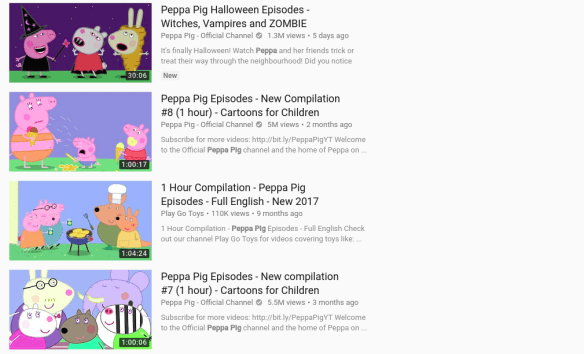
YouTube broadcasters have thus developed a huge number of tactics to draw parents’ and childrens’ attention to their videos, and the advertising revenues that accompany them. The first of these tactics is simply to copy and pirate other content. A simple search for “Peppa Pig” on YouTube in my case yielded “About 10,400,000 results” and the front page is almost entirely from the verified “Peppa Pig Official Channel”, while one is from an unverified channel called Play Go Toys, which you really wouldn’t notice unless you were looking out for it:
Play Go Toys’ channel consists of (I guess?) pirated Peppa Pig and other cartoons, videos of toy unboxings (another kid magnet), and videos of, one supposes, the channel owner’s own children. I am not alleging anything bad about Play Go Toys; I am simply illustrating how the structure of YouTube facilitates the delamination of content and author, and how this impacts on our awareness and trust of its source.
As another blogger notes, one of the traditional roles of branded content is that it is a trusted source. Whether it’s Peppa Pig on children’s TV or a Disney movie, whatever one’s feelings about the industrial model of entertainment production, they are carefully produced and monitored so that kids are essentially safe watching them, and can be trusted as such. This no longer applies when brand and content are disassociated by the platform, and so known and trusted content provides a seamless gateway to unverified and potentially harmful content.
(Yes, this is the exact same process as the delamination of trusted news media on Facebook feeds and in Google results that is currently wreaking such havoc on our cognitive and political systems and I am not going to explicitly explore that relationship further here, but it is obviously deeply significant.)
A second way of increasing hits on videos is through keyword/hashtag association, which is a whole dark art unto itself. When some trend, such as Surprise Egg videos, reaches critical mass, content producers pile onto it, creating thousands and thousands more of these videos in every possible iteration. This is the origin of all the weird names in the list above: branded content and nursery rhyme titles and “surprise egg” all stuffed into the same word salad to capture search results, sidebar placement, and “up next” autoplay rankings.
Play Go Toys’ channel consists of (I guess?) pirated Peppa Pig and other cartoons, videos of toy unboxings (another kid magnet), and videos of, one supposes, the channel owner’s own children. I am not alleging anything bad about Play Go Toys; I am simply illustrating how the structure of YouTube facilitates the delamination of content and author, and how this impacts on our awareness and trust of its source.
As another blogger notes, one of the traditional roles of branded content is that it is a trusted source. Whether it’s Peppa Pig on children’s TV or a Disney movie, whatever one’s feelings about the industrial model of entertainment production, they are carefully produced and monitored so that kids are essentially safe watching them, and can be trusted as such. This no longer applies when brand and content are disassociated by the platform, and so known and trusted content provides a seamless gateway to unverified and potentially harmful content.
(Yes, this is the exact same process as the delamination of trusted news media on Facebook feeds and in Google results that is currently wreaking such havoc on our cognitive and political systems and I am not going to explicitly explore that relationship further here, but it is obviously deeply significant.)
A second way of increasing hits on videos is through keyword/hashtag association, which is a whole dark art unto itself. When some trend, such as Surprise Egg videos, reaches critical mass, content producers pile onto it, creating thousands and thousands more of these videos in every possible iteration. This is the origin of all the weird names in the list above: branded content and nursery rhyme titles and “surprise egg” all stuffed into the same word salad to capture search results, sidebar placement, and “up next” autoplay rankings.
A striking example of the weirdness is the Finger Family videos (harmless example embedded above). I have no idea where they came from or the origin of the children’s rhyme at the core of the trope, but there are at least 17 million versions of this currently on YouTube, and again they cover every possible genre, with billions and billions of aggregated views.
Once again, the view numbers of these videos must be taken under serious advisement. A huge number of these videos are essentially created by bots and viewed by bots, and even commented on by bots. That is a whole strange world in and of itself. But it shouldn’t obscure that there are also many actual children, plugged into iphones and tablets, watching these over and over again — in part accounting for the inflated view numbers — learning to type basic search terms into the browser, or simply mashing the sidebar to bring up another video.
What I find somewhat disturbing about the proliferation of even (relatively) normal kids videos is the impossibility of determining the degree of automation which is at work here; how to parse out the gap between human and machine. The example above, from a channel called Bounce Patrol Kids, with almost two million subscribers, show this effect in action. It posts professionally produced videos, with dedicated human actors, at the rate of about one per week. Once again, I am not alleging anything untoward about Bounce Patrol, which clearly follows in the footsteps of pre-digital kid sensations like their fellow Australians The Wiggles.
And yet, there is something weird about a group of people endlessly acting out the implications of a combination of algorithmically generated keywords: “Halloween Finger Family & more Halloween Songs for Children | Kids Halloween Songs Collection”, “Australian Animals Finger Family Song | Finger Family Nursery Rhymes”, “Farm Animals Finger Family and more Animals Songs | Finger Family Collection – Learn Animals Sounds”, “Safari Animals Finger Family Song | Elephant, Lion, Giraffe, Zebra & Hippo! Wild Animals for kids”, “Superheroes Finger Family and more Finger Family Songs! Superhero Finger Family Collection”, “Batman Finger Family Song — Superheroes and Villains! Batman, Joker, Riddler, Catwoman” and on and on and on. This is content production in the age of algorithmic discovery — even if you’re a human, you have to end up impersonating the machine.
Other channels do away with the human actors to create infinite reconfigurable versions of the same videos over and over again. What is occurring here is clearly automated. Stock animations, audio tracks, and lists of keywords being assembled in their thousands to produce an endless stream of videos. The above channel, Videogyan 3D Rhymes — Nursery Rhymes & Baby Songs, posts several videos a week, in increasingly byzantine combinations of keywords. They have almost five million subscribers — more than double Bounce Patrol — although once again it’s impossible to know who or what is actually racking up these millions and millions of views.
I’m trying not to turn this essay into an endless list of examples, but it’s important to grasp how vast this system is, and how indeterminate its actions, process, and audience. It’s also international: there are variations of Finger Family and Learn Colours videos for Tamil epics and Malaysian cartoons which are unlikely to pop up in any Anglophone search results. This very indeterminacy and reach is key to its existence, and its implications. Its dimensionality makes it difficult to grasp, or even to really think about.
We’ve encountered pretty clear examples of the disturbing outcomes of full automation before — some of which have been thankfully leavened with a dark kind of humour, others not so much. Much has been made of the algorithmic interbreeding of stock photo libraries and on-demand production of everything from tshirts to coffee mugs to infant onesies and cell phone covers. The above example, available until recently on Amazon, is one such case, and the story of how it came to occur is fascinating and weird but essentially comprehensible. Nobody set out to create phone cases with drugs and medical equipment on them, it was just a deeply weird mathematical/probabilistic outcome. The fact that it took a while to notice might ring some alarm bells however.
Likewise, the case of the “Keep Calm and Rape A Lot” tshirts (along with the “Keep Calm and Knife Her” and “Keep Calm and Hit Her” ones) is depressing and distressing but comprehensible. Nobody set out to create these shirts: they just paired an unchecked list of verbs and pronouns with an online image generator. It’s quite possible that none of these shirts ever physically existed, were ever purchased or worn, and thus that no harm was done. Once again though, the people creating this content failed to notice, and neither did the distributor. They literally had no idea what they were doing.
What I will argue, on the basis of these cases and of those I’m going to describe further, is that the scale and logic of the system is complicit in these outputs, and requires us to think through their implications.
(Also again: I’m not going to dig into the wider social implications of such processes outside the scope of what I am writing about here, but it’s clear that one can draw a clear line from examples such as these to pressing contemporary issues such as racial and gender bias in big data and machine intelligence-driven systems, which require urgent attention but in the same manner do not have anything resembling easy or even preferable solutions.)
Let’s look at just one video among the piles of kid videos, and try to parse out where it comes from. It’s important to stress that I didn’t set out to find this particular video: it appeared organically and highly ranked in a search for ‘finger family’ in an incognito browser window (i.e. it should not have been influenced by previous searches). This automation takes us to very, very strange places, and at this point the rabbithole is so deep that it’s impossible to know how such a thing came into being.
Once again, a content warning: this video is not inappropriate in any way, but it is decidedly off, and contains elements which might trouble anyone.It’s very mild on the scale of such things, but. I describe it below if you don’t want to watch it and head down that road. This warning will recur.
The above video is entitled Wrong Heads Disney Wrong Ears Wrong Legs Kids Learn Colors Finger Family 2017 Nursery Rhymes. The title alone confirms its automated provenance. I have no idea where the “Wrong Heads” trope originates, but I can imagine, as with the Finger Family Song, that somewhere there is a totally original and harmless version that made enough kids laugh that it started to climb the algorithmic rankings until it made it onto the word salad lists, combining with Learn Colors, Finger Family, and Nursery Rhymes, and all of these tropes — not merely as words but as images, processes, and actions — to be mixed into what we see here.
The video consists of a regular version of the Finger Family song played over an animation of character heads and bodies from Disney’s Aladdin swapping and intersecting. Again, this is weird but frankly no more than the Surprise Egg videos or anything else kids watch. I get how innocent it is. The offness creeps in with the appearance of a non-Aladdin character —Agnes, the little girl from Despicable Me. Agnes is the arbiter of the scene: when the heads don’t match up, she cries, when they do, she cheers.
The video’s creator, BABYFUN TV (screenshot above), has produced many similar videos. As many of the Wrong Heads videos as I could bear to watch all work in exactly the same way. The character Hope from Inside Out weeps through a Smurfs and Trolls head swap. It goes on and on. I get the game, but the constant overlaying and intermixing of different tropes starts to get inside you. BABYFUN TV only has 170 subscribers and very low view rates, but then there are thousands and thousands of channels like this. Numbers in the long tail aren’t significant in the abstract, but in their accumulation.
The question becomes: how did this come to be? The “Bad Baby” trope also present on BABYFUN TV features the same crying. While I find it disturbing, I can understand how it might provide some of the rhythm or cadence or relation to their own experience that actual babies are attracted to in this content, although it has been warped and stretched through algorithmic repetition and recombination in ways that I don’t think anyone actually wants to happen.
Toy Freaks is a hugely popular channel (68th on the platform) which features a father and his two daughters playing out — or in some cases perhaps originating — many of the tropes we’ve identified so far, including “Bad Baby”, above. As well as nursery rhymes and learning colours, Toy Freaks specialises in gross-out situations, as well as activities which many, many viewers feel border on abuse and exploitation, if not cross the line entirely, including videos of the children vomiting and in pain. Toy Freaks is a YouTube verified channel, whatever that means. (I think we know by now it means nothing useful.)
As with Bounce Patrol Kids, however you feel about the content of these videos, it feels impossible to know where the automation starts and ends, who is coming up with the ideas and who is roleplaying them. In turn, the amplification of tropes in popular, human-led channels such as Toy Freaks leads to them being endlessly repeated across the network in increasingly outlandish and distorted recombinations.
There’s a second level of what I’m characterising as human-led videos which are much more disturbing than the mostly distasteful activities of Toy Freaks and their kin. Here is a relatively mild, but still upsetting example:
A step beyond the simply pirated Peppa Pig videos mentioned previously are the knock-offs. These too seem to teem with violence. In the official Peppa Pig videos, Peppa does indeed go to the dentist, and the episode in which she does so seems to be popular — although, confusingly, what appears to be the real episode is only available on an unofficial channel. In the official timeline, Peppa is appropriately reassured by a kindly dentist. In the version above, she is basically tortured, before turning into a series of Iron Man robots and performing the Learn Colours dance. A search for “peppa pig dentist” returns the above video on the front page, and it only gets worse from here.
Disturbing Peppa Pig videos, which tend towards extreme violence and fear, with Peppa eating her father or drinking bleach, are, it turns out very widespread. They make up an entire YouTube subculture. Many are obviously parodies, or even satires of themselves, in the pretty common style of the internet’s outrageous, deliberately offensive kind. All the 4chan tropes are there, the trolls are out, we know this.
In the example above, the agency is less clear: the video starts with a trollish Peppa parody, but later syncs into the kind of automated repetition of tropes we’ve seen already. I don’t know which camp it belongs to. Maybe it’s just trolls. I kind of hope it is. But I don’t think so. Trolls don’t cover the intersection of human actors and more automated examples further down the line. They’re at play here, but they’re not the whole story.
I suppose it’s naive not to see the deliberate versions of this coming, but many are so close to the original, and so unsignposted — like the dentist example — that many, many kids are watching them. I understand that most of them are not trying to mess kids up, not really, even though they are.
I’m trying to understand why, as plainly and simply troubling as it is, this is not a simple matter of “won’t somebody think of the children” hand-wringing. Obviously this content is inappropriate, obviously there are bad actors out there, obviously some of these videos should be removed. Obviously too this raises questions of fair use, appropriation, free speech and so on. But reports which simply understand the problem through this lens fail to fully grasp the mechanisms being deployed, and thus are incapable of thinking its implications in totality, and responding accordingly.
The New York Times, headlining their article on a subset of this issue “On YouTube Kids, Startling Videos Slip Past Filters”, highlights the use of knock-off characters and nursery rhymes in disturbing content, and frames it as a problem of moderation and legislation. YouTube Kids, an official app which claims to be kid-safe but is quite obviously not, is the problem identified, because it wrongly engenders trust in users. An article in the British tabloid The Sun, “Kids left traumatised after sick YouTube clips showing Peppa Pig characters with knives and guns appear on app for children” takes the same line, with an added dose of right-wing technophobia and self-righteousness. But both stories take at face value YouTube’s assertions that these results are incredibly rare and quickly removed: assertions utterly refuted by the proliferation of the stories themselves, and the growing number of social media posts, largely by concerned parents, from which they arise.
But as with Toy Freaks, what is concerning to me about the Peppa videos is how the obvious parodies and even the shadier knock-offs interact with the legions of algorithmic content producers until it is completely impossible to know what is going on. (“The creatures outside looked from pig to man, and from man to pig, and from pig to man again; but already it was impossible to say which was which.”)
Here’s what is basically a version of Toy Freaks produced in Asia (screenshot above). Here’s one from Russia. I don’t really want to use the term “human-led” any more about these videos, although they contain all the same tropes and actual people acting them out. I no longer have any idea what’s going on here and I really don’t want to and I’m starting to think that that is kind of the point. That’s part of why I’m starting to think about the deliberateness of this all. There is a lot of effort going into making these. More than spam revenue can generate — can it? Who’s writing these scripts, editing these videos? Once again, I want to stress: this is still really mild, even funny stuff compared to a lot of what is out there.
Here are a few things which are disturbing me:
The first is the level of horror and violence on display. Some of the times it’s troll-y gross-out stuff; most of the time it seems deeper, and more unconscious than that. The internet has a way of amplifying and enabling many of our latent desires; in fact, it’s what it seems to do best. I spend a lot of time arguing for this tendency, with regards to human sexual freedom, individual identity, and other issues. Here, and overwhelmingly it sometimes feels, that tendency is itself a violent and destructive one.
The second is the levels of exploitation, not of children because they are children but of children because they are powerless. Automated reward systems like YouTube algorithms necessitate exploitation in the same way that capitalism necessitates exploitation, and if you’re someone who bristles at the second half of that equation then maybe this should be what convinces you of its truth. Exploitation is encoded into the systems we are building, making it harder to see, harder to think and explain, harder to counter and defend against. Not in a future of AI overlords and robots in the factories, but right here, now, on your screen, in your living room and in your pocket.
Many of these latest examples confound any attempt to argue that nobody is actually watching these videos, that these are all bots. There are humans in the loop here, even if only on the production side, and I’m pretty worried about them too.
I’ve written enough, too much, but I feel like I actually need to justify all this raving about violence and abuse and automated systems with an example that sums it up. Maybe after everything I’ve said you won’t think it’s so bad. I don’t know what to think any more.
This video, BURIED ALIVE Outdoor Playground Finger Family Song Nursery Rhymes Animation Education Learning Video, contains all of the elements we’ve covered above, and takes them to another level. Familiar characters, nursery tropes, keyword salad, full automation, violence, and the very stuff of kids’ worst dreams. And of course there are vast, vast numbers of these videos. Channel after channel after channel of similar content, churned out at the rate of hundreds of new videos every week. Industrialised nightmare production.
For the final time: There is more violent and more sexual content like this available. I’m not going to link to it. I don’t believe in traumatising other people, but it’s necessary to keep stressing it, and not dismiss the psychological effect on children of things which aren’t overtly disturbing to adults, just incredibly dark and weird.
A friend who works in digital video described to me what it would take to make something like this: a small studio of people (half a dozen, maybe more) making high volumes of low quality content to reap ad revenue by tripping certain requirements of the system (length in particular seems to be a factor). According to my friend, online kids’ content is one of the few alternative ways of making money from 3D animation because the aesthetic standards are lower and independent production can profit through scale. It uses existing and easily available content (such as character models and motion-capture libraries) and it can be repeated and revised endlessly and mostly meaninglessly because the algorithms don’t discriminate — and neither do the kids.
These videos, wherever they are made, however they come to be made, and whatever their conscious intention (i.e. to accumulate ad revenue) are feeding upon a system which was consciously intended to show videos to children for profit. The unconsciously-generated, emergent outcomes of that are all over the place.
To expose children to this content is abuse. We’re not talking about the debatable but undoubtedly real effects of film or videogame violence on teenagers, or the effects of pornography or extreme images on young minds, which were alluded to in my opening description of my own teenage internet use. Those are important debates, but they’re not what is being discussed here. What we’re talking about is very young children, effectively from birth, being deliberately targeted with content which will traumatise and disturb them, via networks which are extremely vulnerable to exactly this form of abuse. It’s not about trolls, but about a kind of violence inherent in the combination of digital systems and capitalist incentives. It’s down to that level of the metal.
This, I think, is my point: The system is complicit in the abuse.
And right now, right here, YouTube and Google are complicit in that system. The architecture they have built to extract the maximum revenue from online video is being hacked by persons unknown to abuse children, perhaps not even deliberately, but at a massive scale. I believe they have an absolute responsibility to deal with this, just as they have a responsibility to deal with the radicalisation of (mostly) young (mostly) men via extremist videos — of any political persuasion. They have so far showed absolutely no inclination to do this, which is in itself despicable. However, a huge part of my troubled response to this issue is that I have no idea how they can respond without shutting down the service itself, and most systems which resemble it. We have built a world which operates at scale, where human oversight is simply impossible, and no manner of inhuman oversight will counter most of the examples I’ve used in this essay. The asides I’ve kept in parentheses throughout, if expanded upon, would allow one with minimal effort to rewrite everything I’ve said, with very little effort, to be not about child abuse, but about white nationalism, about violent religious ideologies, about fake news, about climate denialism, about 9/11 conspiracies.
This is a deeply dark time, in which the structures we have built to sustain ourselves are being used against us — all of us — in systematic and automated ways. It is hard to keep faith with the network when it produces horrors such as these. While it is tempting to dismiss the wilder examples as trolling, of which a significant number certainly are, that fails to account for the sheer volume of content weighted in a particularly grotesque direction. It presents many and complexly entangled dangers, including that, just as with the increasing focus on alleged Russian interference in social media, such events will be used as justification for increased control over the internet, increasing censorship, and so on. This is not what many of us want.
I’m going to stop here, saying only this:
What concerns me is not just the violence being done to children here, although that concerns me deeply. What concerns me is that this is just one aspect of a kind of infrastructural violence being done to all of us, all of the time, and we’re still struggling to find a way to even talk about it, to describe its mechanisms and its actions and its effects. As I said at the beginning of this essay: this is being done by people and by things and by a combination of things and people. Responsibility for its outcomes is impossible to assign but the damage is very, very real indeed.
“As we express our gratitude, we must never forget that the highest appreciation is not to utter words, but to live by them.”—John F. Kennedy
It’s been a hard, heart-wrenching, stomach-churning kind of year filled with violence and ill will.
It’s been a year of hotheads and blowhards and killing sprees and bloodshed and takedowns.
It’s been a year in which tyranny took a step forward and freedom got knocked down a few notches.
It’s been a year with an abundance of bad news and a shortage of good news.
It’s been a year of too much hate and too little kindness.
Now we find ourselves approaching that time of year when, as George Washington and Abraham Lincoln proclaimed, we’re supposed to give thanks as a nation and as individuals for our safety and our freedoms.
It’s not an easy undertaking.
How do you give thanks for freedoms that are constantly being eroded? How do you express gratitude for one’s safety when the perils posed by the American police state grow more treacherous by the day? How do you come together as a nation in thanksgiving when the powers-that-be continue to polarize and divide us into warring factions?
It’s not going to happen overnight. Or with one turkey dinner. Or with one day of thanksgiving.
Thinking good thoughts, being grateful, counting your blessings and adopting a glass-half-full mindset are fine and good, but don’t stop there.
This world requires doers, men and women (and children) who will put those good thoughts into action.
Unfortunately, you hear about these kinds of incidents too often.
A 15-year-old girl was gang raped in a schoolyard during a homecoming dance. As many as 20 people witnessed the assault over the course of two and a half hours. No one intervened to stop it.
A 58-year-old man waded into chest-deep water in the San Francisco Bay in an apparent suicide attempt. For an hour, Raymond Zack stood in the shallow water while 75 onlookers watched. Police and firefighters were called in but failed to intervene, citing budget cuts, a lack of training in water rescue, fear for their safety and a lack of proper equipment. The man eventually passed out and later died of hypothermia. Eventually, an onlooker volunteered to bring the body back to the beach.
A homeless man intervened to save a woman from a knife-wielding attacker. He saved the woman but was stabbed repeatedly in the process. As The Guardianreports, “For more than an hour he lay dying in a pool of his own blood as dozens walked by. Some paused to stare, others leaned in close. One even shook his body and then left, while someone else recorded a video of the entire proceeding.”
This is how evil prevails: when good men and women do nothing.
By doing nothing, the onlookers become as guilty as the perpetrator.
“If I were to remain silent, I’d be guilty of complicity,” declared Albert Einstein.
It works the same whether you’re talking about kids watching bullies torment a fellow student on a playground, bystanders watching someone dying on a sidewalk, or citizens remaining silent in the face of government atrocities.
There’s a term for this phenomenon where people stand by, watch and do nothing—even when there is no risk to their safety—while some horrific act takes place (someone is mugged or raped or bullied or left to die): it’s called the bystander effect.
Psychological researchers John Darley and Bibb Latane mounted a series of experiments to discover why people respond with apathy or indifference instead of intervening.
Their findings speak volumes about the state of our nation and why “we the people” continue to suffer such blatant abuses by the police state.
According to Darley and Latane, there are two critical factors that contribute to this moral lassitude.
First, there’s the problem of pluralistic ignorance in which individuals in a group look to others to determine how to respond. As Melissa Burkley explains in Psychology Today, “Pluralistic ignorance describes a situation where a majority of group members privately believe one thing, but assume (incorrectly) that most others believe the opposite.”
Now the temptation is to label the bystanders as terrible people, monsters even.
Yet as Mahzarin Banaji, professor of psychology at Harvard University points out, “These are not monsters. These are us. This is all of us. This is not about a few monsters. This is about everybody. It says something very difficult to us. It says that perhaps had we been standing there, we ourselves, if we were not better educated about this particular effect and what it does to us, we may fall prey to it ourselves.”
Historically, this bystander syndrome in which people remain silent and disengaged—mere onlookers—in the face of abject horrors and injustice has resulted in whole populations being conditioned to tolerate unspoken cruelty toward their fellow human beings: the crucifixion and slaughter of innocents by the Romans, the torture of the Inquisition, the atrocities of the Nazis, the butchery of the Fascists, the bloodshed by the Communists, and the cold-blooded war machines run by the military industrial complex.
“Each of us has an inner hero we can draw upon in an emergency,” Zimbardo concluded. “If you think there is even a possibility that someone needs help, act on it. You may save a life. You are the modern version of the Good Samaritan that makes the world a better place for all of us.”
Zimbardo is the psychologist who carried out the Stanford Prison Experiment which studied the impact of perceived power and authority on middleclass students who were assigned to act as prisoners and prison guards. The experiment revealed that power does indeed corrupt (the appointed guards became increasingly abusive), and those who were relegated to being prisoners acted increasingly “submissive and depersonalized, taking the abuse and saying little in protest.”
What is the antidote to group think and the bystander effect?
Be an individual. Listen to your inner voice. Take responsibility.
“If you find yourself in an ambiguous situation, resist the urge to look to others and go with your gut instinct,” says Burkley. “If you think there is even a possibility that someone is in need, act on it. At worst, you will embarrass yourself for a few minutes, but at best, you will save a life.”
“Even if people recognize that they are witnessing a crime, they may still fail to intervene if they do not take personal responsibility for helping the victim,” writes Burkley. “The problem is that the more bystanders there are, the less responsible each individual feels.”
In other words, recognize injustice. Don’t turn away from suffering.
Refuse to remain silent. Take a stand. Speak up. Speak out.
This is what Zimbardo refers to as “the power of one.” All it takes is one person breaking away from the fold to change the dynamics of a situation. “Once any one helps, then in seconds others will join in because a new social norm emerges: Do Something Helpful.”
“I swore never to be silent whenever and wherever human beings endure suffering and humiliation,” stated Holocaust Elie Wiesel in his Nobel Peace Prize acceptance speech in 1986. “We must always take sides. Neutrality helps the oppressor, never the victim. Silence encourages the tormentor, never the tormented. Sometimes we must interfere. When human lives are endangered, when human dignity is in jeopardy, national borders and sensitivities become irrelevant. Wherever men or women are persecuted because of their race, religion, or political views, that place must – at that moment – become the center of the universe.”
Unfortunately, as I make clear in my book Battlefield America: The War on the American People, too many Americans have opted to remain silent when it really matters while instead taking a stand over politics rather than human suffering.
That needs to change.
I don’t believe we’re inherently monsters. We just need to be more conscientious and engaged and helpful.
The Good Samaritans of this world don’t always get recognized, but they’re doing their part to push back against the darkness.
One by one, they rescued those in trouble and pulled each other in.
There’s a moral here for what needs to happen in this country if we only can band together and prevail against the riptides that threaten to overwhelm us.
Here’s what I suggest.
Instead of just giving thanks this holiday season with words that are too soon forgotten, why not put your gratitude into action with deeds that spread a little kindness, lighten someone’s burden, and brighten some dark corner?
What I’m suggesting is something that everyone can do no matter how tight our budgets or how crowded our schedules.
Pay your blessings forward.
Engage in acts of kindness. Smile more. Fight less.
Focus on the things that unite instead of that which divides. Be a hero, whether or not anyone ever notices.
Do your part to push back against the meanness of our culture with conscious compassion and humanity. Moods are contagious, the good and the bad. They can be passed from person to person. So can the actions associated with those moods, the good and the bad.
Even holding the door for someone or giving up your seat on a crowded train are acts of benevolence that, magnified by other such acts, can spark a movement.