
By chilke
Source: The HipCrime Vocab
During my long discursion on the history of money, the academic James C. Scott published an important book called Against the Grain: A Deep History of the First States.
Regular readers will know that this has been a longstanding area of research (or obsession) of mine. I’ve referred to Scott’s work before, particularly Seeing Like A State, which I think is indispensable in understanding many of the political divisions of today (and why left/right is no longer a useful distinction). We’re in an era where much of the “left” is supporting geoengineering and rockets to Mars, and the “right” (at least the alt-right) is criticizing housing projects and suburban sprawl.
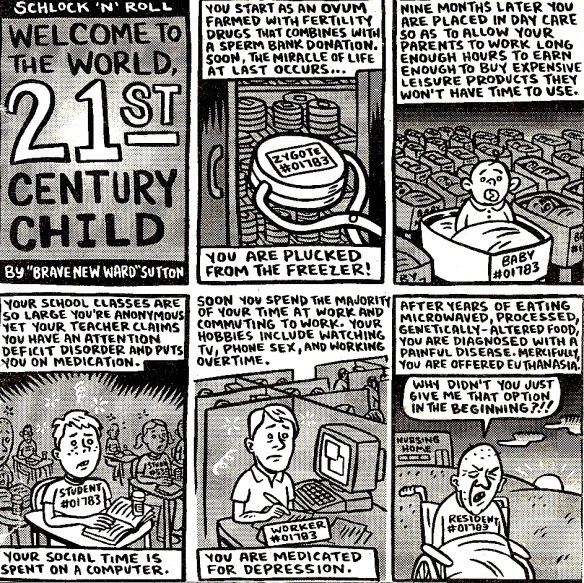
It’s unfortunate that Scott’s title is the same as another one of my favorite books on that topic by journalist Richard Manning: Against the Grain: How Agriculture Hijacked Civilization, another book I’ve referred to often. Manning’s book is not only a historical account about how the rise of grain agriculture led to war, hierarchy, slavery and sickness, but a no-hold-barred exploration of today’s grain-centric agribusiness model, where wheat, corn, soy and sugar are grown in mechanized monocultures and processed by the food industry into highly-addictive junk food implicated in everything from type two diabetes, to depression to Alzheimer’s disease (via inflammation):
Dealing with surplus is a difficult task. The problem begins with the fact that, just like the sex drive, the food drive got ramped up in evolution. If you have a deep, yearning need for food, you’re going to get along better than your neighbor, and over the years that gene is going to be passed on. So you get this creature that got fine-tuned to really need food, especially carbohydrates. Which brings us to the more fundamental question: can we ever deal with sugar? By making more concentrated forms of carbohydrates, we’re playing into something that’s quite addictive and powerful. It’s why we’re so blasted obese. We have access to all this sugar, and we simply cannot control our need for it—that’s genetic.
Now, can we gain the ability to overcome that? I’m not sure. You have to add to this the fact that there’s a lot of money to be made by people who know how to concentrate sugar. They have a real interest in seeing that we don’t overcome these kinds of addictions. In fact, that’s how you control societies—you exploit that basic drive for food. That’s how we train dogs—if you want to make a dog behave properly, you deprive him or give him food. Humans aren’t that much different. We just like to think we are. So as an element of political control, food and food imagery are enormously important.
The Scourge of Agriculture (The Atlantic)
Cancers linked to excess weight make up 40% of all US diagnoses, study finds (The Guardian)
Child and teen obesity spreading across the globe (BBC)
In that interview, Manning also makes this point which got so much attention in Yuval Noah Harari’s blockbuster, Sapiens (which came out years later):
…it’s not just human genes at work here. It’s wheat genes and corn genes—and how they have an influence on us. They took advantage of our ability to travel, our inventiveness, our ability to use tools, to live in a broad number of environments, and our huge need for carbohydrates. Because of our brains’ ability, we were able to spread not only our genes, but wheat’s genes as well. That’s why I make the argument that you have to look at this in terms of wheat domesticating us, too. That co-evolutionary process between humans and our primary food crops is what created the agriculture we see today.
As for the title, I guess Against the Grain is just too clever a title to pass up 🙂
I’m still waiting on the book from the library, but I have seen so many reviews by now that I’m not sure I’ll be able to add too much. What’s interesting to me is the degree to which the idea that civilization was a great leap backward from what we had before is starting to go mainstream.
The old, standard “Whig version” of universal progress is still pretty strong, though. Here’s one reviewer describing how it was articulated in the turn-of-the-century Encyclopedia Britannica:
The Encyclopaedia took its readers through a panorama of universal history, from “the lower status of savagery,” when hunter-gatherers first mastered fire; to the “middle status of barbarism,” when hunters learned to domesticate animals and became herders; to the invention of writing, when humanity “graduated out of barbarism” and entered history. Along the way, humans learned to cultivate grains, such as wheat and rice, which showed them “the value of a fixed abode,” since farmers had to stay near their crops to tend and harvest them. Once people settled down, “a natural consequence was the elaboration of political systems,” property, and a sense of national identity. From there it was a short hop—at least in Edwardian hindsight—to the industrial revolution and free trade.
Some unfortunate peoples, even entire continents such as aboriginal North America and Australia, might fall off the Progress train and have to be picked up by kindly colonists; but the train ran along only one track, and no one would willingly decline to board it…
What made prehistoric hunter-gatherers give up freedom for civilization? (The New Republic)
But, it turns out that the reality was quite different. In fact, hunter-gatherers resisted agriculture. Even where farmers and H-G’s lived side-by-side, the H-G’s (and herders) avoided farming as long as they could. When Europeans equipped “primitive” societies with seeds and hoes and taught them to farm, the natives threw away the implements and ran off into the woods. The dirt farmers of colonial America often ran away to go and live with the nomadic Indians, to the extent that strict laws had to be passed to prevent this (as documented in Sebastian Junger’s new book Tribe).
The shift to agriculture was in some respects…harmful. Osteological research suggests that domiciled Homo sapiens who depended on grains were smaller, less well-nourished and, in the case of women, more likely to be anaemic, than hunter-gatherers. They also found themselves vulnerable to disease and able to maintain their population only through unprecedentedly high birthrates. Scott also suggests that the move from hunting and foraging to agriculture resulted in ‘deskilling’, analogous to the move in the industrial revolution from the master tradesman’s workshop to the textile mill. State taxation compounded the drudgery of raising crops and livestock. Finally, the reliance on only a few crops and livestock made early states vulnerable to collapse, with the reversion to the ‘dark ages’ possibly resulting in an increase in human welfare.
Book Review: Against the Grain: A Deep History of the Earliest States by James C. Scott (London School of Economics)
So why did they do it? That is a question that nobody know the answer to, but it appears they stumbled into not because it was a better way of life, but due to some sort of pressures beyond their control. As Colin Tudge put it, “People did not invent agriculture and shout for joy; they drifted or were forced into it, protesting all the way.”Rather than taking up agriculture because it presented a better, more secure way of life as the Victorians thought (due to chauvinism and ignorance), it was actually much more unpleasant and much more work. Here’s a bit from Richard Manning’s book (pp. 23-24):
Why agriculture? In retrospect, it seems odd that it has taken archaeologists and paleontologists so long to begin answering this essential question of human history. What we are today–civilized city-bound, overpopulated, literate, organized, wealthy, poor, diseased, conquered, and conquerors–is all rooted in the domestication of plants and animals. The advent of farming re-formed humanity. In fact, the question “Why agriculture?” is so vital, lies so close to the core of our being that it probably cannot be asked or answered with complete honesty. Better to settle for calming explanation of the sort Stephen Jay Gould calls “just-so stories.”
In this case, the core of such stories is the assumption that agriculture was better for us. Its surplus of food allowed the leisure and specialization that made civilization. It’s bounty settled, refined, and educated us, freed us from the nasty, mean, brutish, and short existence that was the state of nature, freed us from hunting and gathering. Yet when we think about agriculture, and some people have thought intently about it, the pat story glosses over a fundamental point. This just-so story had to have sprung from the imagination of someone who never hoed a row of corn or rose with the sun for a lifetime of milking cows. Gamboling about plain and forest, hunting and living off the land is fun. Farming is not. That’s all one needs to know to begin a rethinking of the issue. The fundamental question was properly phrased by Colin Tudge of the London School of Economics: “The real problem, then, is not to explain why some people were slow to adopt agriculture but why anybody took it up at all when it is so obvioulsy beastly.” Research has supported Tudge’s skepticism.
Circumstances beyond their control must have played a role. Climate change is most commonly implicated. Overpopulation must have played a role, but this raises a chicken-and-egg problem: overpopulation is a problem created by agrarianism, so how could it have caused it?
One novel idea I explored earlier this year was Brian Hayden’s idea that the production of ever-increasing surpluses was part of a strategy by aggrandizing individuals in order to gain political power.
Periodic feasting events were ways to increase social cohesion and deal with uneven production in various climatic biomes–it was a survival strategy for peoples spread-out among a wide geographical area (mountains, plains, wetlands, riparian, etc.). If food was scarce in one area, resources could be pooled. Such feasting/resource pooling regimes were probably the earliest true “civilizations” (albeit before cities). It was also the major way to organize mass labor, and this lasted well into the historical period (both Egyptian and Mesopotamian texts testify to celebratory work feasts).
At these events, certain individuals would loan out surplus food and other prestige items in order to get people in debt to them. Cultural expectations meant that the debts would have to repaid and then some (i.e. with interest). These people would get their families and allies to work their fingers to the bone in order to produce big surpluses in societies where this was possible, such as horticultural and affluent forager societies. They would then become “Big Men”–tribal leaders without “official” status.
Would-be Big-Men would then try and outdo one another by throwing bigger feasts than their rivals. Competitive feasting provided an opportunity for aggrandizers to try and outdo one another in a series of power games and status jockeying. But the net effect such power games had across the society was to ramp up food production to unsustainable levels. This, in turn, led to intensification.
At these feasts, highly “prized” foodstuffs would be used by aggrandizers to lure people into debt and other lopsided obligations, as well as get people to work for them. Manning notes above how food has been traditionally used to control people. And, Hayden speculates, the foods used were probably ones with pleasurable or mind-altering effects. One common one was almost certainly alcohol.
He speculates that grains were initially grown not for flavor or for carbohydrates, but for fermentation. It’s fairly certain that alcohol consumption played a major role in feasting events, and it’s notable that the earliest civilizations were all big beer drinkers (Egypt, Mesopotamia, China, Mesoamerica). Most agricultural village societies around the world have some sort of beer drinking/fermentation ritual, as Patrick E. McGovern has documented. The first “recipe” ever written down was for beer brewing. Hayden speculates that early monoliths like Gobeckli Tepe and Stonehenge were built as places for such feasting events to take place, wedded to certain religious ideologies (all of them have astronomical orientations), and archaeology tends to confirm this. It’s notable that the earliest sites of domestication/agrarianism we know of are typically in the vicinity of these monoliths.
In other words, the root of this overproduction was human social instincts, and not just purely environmental or climatic factors. Is there some connection between plant/animal domestication and religious ideology? Is it any wonder that religious concepts in these societies transform to become very different from the animist/shamanic ones of hunter-gatherers? Flannery and Marcus point out that the establishment of a hereditary priesthood that constructs temples (replacing the shaman) is always a marker of the transition from an egalitarian society to a hierarchical one with hereditary leadership. Even in the Bible, king and temple arise more or less simultaneously (e.g. Saul/David/Solomon).
Scott’s book emphasizes the key role that cereal agriculture played in the rise of the early states.
It was the ability to tax and to extract a surplus from the produce of agriculture that, in Scott’s account, led to the birth of the state, and also to the creation of complex societies with hierarchies, division of labor, specialist jobs (soldier, priest, servant, administrator), and an élite presiding over them. Because the new states required huge amounts of manual work to irrigate the cereal crops, they also required forms of forced labor, including slavery; because the easiest way to find slaves was to capture them, the states had a new propensity for waging war. Some of the earliest images in human history, from the first Mesopotamian states, are of slaves being marched along in neck shackles. Add this to the frequent epidemics and the general ill health of early settled communities and it is not hard to see why the latest consensus is that the Neolithic Revolution was a disaster for most of the people who lived through it.
It’s worth noting that it wasn’t simply agriculture, but cereal production that relied on artificial irrigation that saw the rise of the first states. The need to coordinate all that labor, partition permanent plots of land, and resolve settlement disputes, must have led to the rise of an elite managerial class, as Ian Welsh points out:
Agriculture didn’t lead immediately to inequality, the original agricultural societies appear to have been quite equal, probably even more so than the late hunter-gatherer societies that preceded them. But increasing surpluses and the need for coordination which arose, especially in hydraulic civilizations (civilizations based around irrigation which is labor intensive and require specialists) led to the rise of inequality. The pharoahs created great monuments, but their subjects did not live nearly as well as hunter-gatherers.
The Right Stuff: What Prosperity Is and Isn’t (Ian Welsh)
And sedentism, as I’ve noted, is not so much a product of agriculture as a cause. Sedentary societies coexisted with high mobility for some time. Likely sedentary societies needed to be around for some time in order to build up the kind of surpluses aggrandizing elites needed to gain power. These probably started as “redistributor chiefs” who justified their role through a combination of martial leadership and religious ideology:
Sedentism does not have its origins in plant and animal domestication. The first stratified states in the Tigris and Euphrates Valley appeared ‘only around 3,100 BCE, more than four millennia after the first crop domestications and sedentism’. Sedentism has its roots in ecologically rich, preagricultural settings, especially wetlands. Agriculture co-existed with mobile lifestyles in which people gathered to harvest crops. Domestication itself is part of a 400,000 year process beginning with the use of fire. Moreover, it is not a process (or simply a process) of humans gaining increasing control over the natural world. People find themselves caring for dogs, creating an ecological niche for mice, ticks, bedbugs and other uninvited guests, and spending their lives ‘strapped to the round of ploughing, planting, weeding, reaping, threshing, grinding, all on behalf of their favorite grains and tending to the daily needs of their livestock’.
This was also noted in the Richard Manning interview, above:
…we always think that agriculture allowed sedentism, which gave people time to create civilization and art. But the evidence that’s emerging from the archeological record suggests that sedentism came first, and then agriculture. This occurred near river mouths, where people depended on seafood, especially salmon. These were probably enormously abundant cultures that had an enormous amount of leisure time—they just had to wait for the salmon runs to occur. There are some good records of those communities, and from the skeleton remains we can see that they got up to 95 percent of their nutrients from salmon and ocean-derived sources. Along the way, they developed highly refined art—something we always associate with agriculture.
Of course, agrarian societies using irrigation and plow-based agricuture in set plots are very different from horicultural societies practicing shifting cultivation. This is likley why early agricutural societies were rougly about as egalitarian as their predecessors, as Ian Welsh pointed out above. By the time the trap snapped shut, however, it was too late.
How agriculture grew on us (Leaving Babylon)
I’ve often wondered if, when certain humans learned how to domesticate, they used it as much on their fellow man as they did their animals. In this Aeon article, this passage really struck me:
When humans start treating animals as subordinates, it becomes easier to do the same thing to one another. The first city-states in Mesopotamia were built on this principle of transferring methods of control from creatures to human beings, according to the archaeologist Guillermo Algaze at the University of California in San Diego. Scribes used the same categories to describe captives and temple workers as they used for state-owned cattle.
How domestication changes species including the human (Aeon)
Indeed, the idea that humans domesticated themselves is another key concept in Harari’s Sapiens. Perhaps that domestication was much more “literal” than we have been led to believe. Perhaps human sacrifice was a way for early religious leaders to “cull” individuals who had undesirable traits from their standpoint: independence, aggression, a questioning attitude, etc. Indeed, hunter-gatherers do not like obeying orders from a boss. I wonder to what extent this process is still going on, especially in modern-day America with its schools, prisons, corporate cubicles, police, military, etc.:
Anthropologists and historians have put forward the ‘social control hypothesis’ of human sacrifice. According to this theory, sacrificial rites served as a function for social elites. Human sacrifice is proposed to have been used by social elites to display their divinely sanctioned power, justify their status, and terrorise underclasses into obedience and subordination. Ultimately, human sacrifice could be used as a tool to help build and maintain systems of social inequality.
How human sacrifice helped to enforce social inequality (Aeon)
And this is very relevent to our recent discussion of money: writing and mathematics were first used as methods of social control. As Janet Gleeson-White points out in this essay, accounting was our first writing technology. Money–and taxes–were an outgrowth of this new communications technology:
War, slavery, rule by élites—all were made easier by another new technology of control: writing. “It is virtually impossible to conceive of even the earliest states without a systematic technology of numerical record keeping,” Scott maintains. All the good things we associate with writing—its use for culture and entertainment and communication and collective memory—were some distance in the future. For half a thousand years after its invention, in Mesopotamia, writing was used exclusively for bookkeeping: “the massive effort through a system of notation to make a society, its manpower, and its production legible to its rulers and temple officials, and to extract grain and labor from it.”
Early tablets consist of “lists, lists and lists,” Scott says, and the subjects of that record-keeping are, in order of frequency, “barley (as rations and taxes), war captives, male and female slaves.” Walter Benjamin, the great German Jewish cultural critic, who committed suicide while trying to escape Nazi-controlled Europe, said that “there is no document of civilization which is not at the same time a document of barbarism.” He meant that every complicated and beautiful thing humanity ever made has, if you look at it long enough, a shadow, a history of oppression.
The Case Against Civilization (The New Yorker)
And the connection between writing and domestication/subjugation is powerfully made by this article from the BBC documenting the world’s oldest writing:
In terms of written history, this is the very remote past. But there is also something very direct and almost intimate about it too. You can see fingernail marks in the clay. These neat little symbols and drawings are clearly the work of an intelligent mind.
These were among the first attempts by our human ancestors to try to make a permanent record of their surroundings. What we’re doing now – my writing and your reading – is a direct continuation. But there are glimpses of their lives to suggest that these were tough times. It wasn’t so much a land of milk and honey, but porridge and weak beer.
Even without knowing all the symbols, Dr Dahl says it’s possible to work out the context of many of the messages on these tablets. The numbering system is also understood, making it possible to see that much of this information is about accounts of the ownership and yields from land and people. They are about property and status, not poetry.
This was a simple agricultural society, with a ruling household. Below them was a tier of powerful middle-ranking figures and further below were the majority of workers, who were treated like “cattle with names”. Their rulers have titles or names which reflect this status – the equivalent of being called “Mr One Hundred”, he says – to show the number of people below him.
It’s possible to work out the rations given to these farm labourers. Dr Dahl says they had a diet of barley, which might have been crushed into a form of porridge, and they drank weak beer. The amount of food received by these farm workers hovered barely above the starvation level. However the higher status people might have enjoyed yoghurt, cheese and honey. They also kept goats, sheep and cattle.
For the “upper echelons, life expectancy for some might have been as long as now”, he says. For the poor, he says it might have been as low as in today’s poorest countries.
Breakthrough in world’s oldest undeciphered writing (BBC)
So the earliest writing tends to confirm Scott’s account. And not just Scott’s account, but that of anthropologist James Suzman, who has simultaneously come out with a book about the disappearing way of life of the the !Kung San Bushmen of the Kalahari. This is also reviewed in the New Yorker article, above. These hunter-gatherers are going through today exactly what those people in the Near East experienced roughly 6-8000 years ago, giving us a window into history:
The encounter with modernity has been disastrous for the Bushmen: Suzman’s portrait of the dispossessed, alienated, suffering Ju/’hoansi in their miserable resettlement camps makes that clear. The two books even confirm each other’s account of that sinister new technology called writing. Suzman’s Bushman mentor, !A/ae, “noted that whenever he started work at any new farm, his name would be entered into an employment ledger, documents that over the decades had assumed great mystical power among Ju/’hoansi on the farms. The secrets held by these ledgers evidently had the power to give or withhold pay, issue rations, and determine an individual’s right to stay on any particular farm.”
Writing turned the majority of people into serfs and enabled a sociopathic elite to live well and raise themselves and their offspring above everyone else.
And here we are at the cusp of a brand new “information revolution” where literally our every thought and move can be monitored and tracked by a tiny centralized elite and permanently stored. And yet we’re convinced that this will make all our lives infinitely better! Go back and reread the above. I’m not so sure. I already feel like “cattle with a name” in our brave new nudged, credit-scored, Neoliberal world.
We’re also experiencing another period of rapid climate change and resource depletion, just like that experienced at the outset of the original coming of the state. We’re now doing exactly what they did: intensification, and once again it’s empowering a small sociopathic elite at the cost of the rest of us. And yet Panglossians confidently tell us we’re headed for a peaceful techno-utopia where all new discoveries will be shared with all of us instead of hoarded, and we’ll all live like gods instead of being exterminated like rats because we’re no longer necessary to the powers that be. Doubtless the same con (“We’ll all be better off!!!”) was played on the inhabitants of early states, too. Given the human social instincts noted above, let’s just say I’m not optimistic. Please pass the protein blocks.
Scott points out that the state is a very novel development, despite what we read in history books. We read about the history of states because states left written history, and we are their descendants. But that doesn’t mean most people lived under them. By Scott’s account, most humans lived outside of nation-states well into the 1500’s. A review of Jared Diamond’s The World Until Yesterday by Scott published a few years back in The London Review of Books was a foreshadowing of his current book (and may have even inspired it). In that review, he stated:
…Homo sapiens has been around for roughly 200,000 years and left Africa not much earlier than 50,000 years ago. The first fragmentary evidence for domesticated crops occurs roughly 11,000 years ago and the first grain statelets around 5000 years ago, though they were initially insignificant in a global population of perhaps eight million.
More than 97 per cent of human experience, in other words, lies outside the grain-based nation-states in which virtually all of us now live. ‘Until yesterday’, our diet had not been narrowed to the three major grains that today constitute 50 to 60 per cent of the world’s caloric intake: rice, wheat and maize. The circumstances we take for granted are, in fact, of even more recent vintage …Before, say, 1500, most populations had a sporting chance of remaining out of the clutches of states and empires, which were still relatively weak and, given low rates of urbanisation and forest clearance, still had access to foraged foods. On this account, our world of grains and states is a mere blink of the eye (0.25 per cent), in the historical adventure of our species.
Crops, Towns, Government (London Review of Books)
Why a leading political theorist thinks civilization is overrated (VOX)
Wither Collpase?
One of the more provocative ideas from Scott’s book is to question whether the withering away of state capacity–that is, a collapse–is really a bad thing at all!
We need to rethink, accordingly, what we mean when we talk about ancient “dark ages.” Scott’s question is trenchant: “ ‘dark’ for whom and in what respects”? The historical record shows that early cities and states were prone to sudden implosion.
“Over the roughly five millennia of sporadic sedentism before states (seven millennia if we include preagriculture sedentism in Japan and the Ukraine),” he writes, “archaeologists have recorded hundreds of locations that were settled, then abandoned, perhaps resettled, and then again abandoned.” These events are usually spoken of as “collapses,” but Scott invites us to scrutinize that term, too.
When states collapse, fancy buildings stop being built, the élites no longer run things, written records stop being kept, and the mass of the population goes to live somewhere else. Is that a collapse, in terms of living standards, for most people? Human beings mainly lived outside the purview of states until—by Scott’s reckoning—about the year 1600 A.D. Until that date, marking the last two-tenths of one per cent of humanity’s political life, “much of the world’s population might never have met that hallmark of the state: a tax collector.”
Book Review: Against the Grain: A Deep History of the Earliest States by James C. Scott (LSE)
Is the Collapse of Civilizations A Good Thing? (Big Think)
Indeed, is collapse even a relevant concept? What, really is collapsing?
We also need to think about what we apply the term ‘collapse’ to – what exactly was it that collapsed? Very often, it’s suggested that civilisations collapse, but this isn’t quite right. It is more accurate to say that states collapse. States are tangible, identifiable ‘units’ whereas civilisation is a more slippery term referring broadly to sets of traditions. Many historians, including Arnold Toynbee, author of the 12-volume A Study of History (1934-61), have defined and tried to identify ‘civilisations’, but they often come up with different ideas and different numbers. But we have seen that while Mycenaean states collapsed, several strands of Mycenaean material and non-material culture survived – so it would seem wrong to say that their ‘civilisation’ collapsed. Likewise, if we think of Egyptian or Greek or Roman ‘civilisation’, none of these collapsed – they transformed as circumstances and values changed. We might think of each civilisation in a particular way, defined by a particular type of architecture or art or literature – pyramids, temples, amphitheatres, for example – but this reflects our own values and interests.
[…]
States collapsed, civilisations or cultures transformed; people lived through these times and employed their coping strategies – they selectively preserved aspects of their culture and rejected others. Archaeologists, historians and others have a duty to tell the stories of these people, even though the media might find them less satisfactory. And writers who appropriate history for moral purposes need to think carefully about what they are doing and what they are saying – they need to make an effort to get the history as right as possible, rather than dumbing it down to silver-bullet theories.
What the idea of civilisational collapse says about history (Aeon)
Scott’s book gives us hope that the collapse of states, rather than being a bad thing, might lead to a flourishing of human freedom. In that, there is some hope. I’ll end with this thought from Scott’s review of Diamond:
Anthropology can show us radically different and satisfying forms of human affiliation and co-operation that do not depend on the nuclear family or inherited wealth. History can show that the social and political arrangements we take for granted are the contingent result of a unique historical conjuncture.