Two for Tuesday
Reply


By John Whitehead
Source: The Rutherford Institute
“You had to live—did live, from habit that became instinct—in the assumption that every sound you made was overheard, and, except in darkness, every movement scrutinized.”—George Orwell, 1984
It had the potential for disaster.
Early in the morning of Monday, December 15, 2020, Google suffered a major worldwide outage in which all of its internet-connected services crashed, including Nest, Google Calendar, Gmail, Docs, Hangouts, Maps, Meet and YouTube.
The outage only lasted an hour, but it was a chilling reminder of how reliant the world has become on internet-connected technologies to do everything from unlocking doors and turning up the heat to accessing work files, sending emails and making phone calls.
A year earlier, a Google outage resulted in Nest users being unable to access their Nest thermostats, Nest smart locks, and Nest cameras. As Fast Company reports, “This essentially meant that because of a cloud storage outage, people were prevented from getting inside their homes, using their AC, and monitoring their babies.”
Welcome to the Matrix.
Twenty-some years after the Wachowskis’ iconic film, The Matrix, introduced us to a futuristic world in which humans exist in a computer-simulated non-reality powered by authoritarian machines—a world where the choice between existing in a denial-ridden virtual dream-state or facing up to the harsh, difficult realities of life comes down to a blue pill or a red pill—we stand at the precipice of a technologically-dominated matrix of our own making.
We are living the prequel to The Matrix with each passing day, falling further under the spell of technologically-driven virtual communities, virtual realities and virtual conveniences managed by artificially intelligent machines that are on a fast track to replacing human beings and eventually dominating every aspect of our lives.
Science fiction has become fact.
In The Matrix, computer programmer Thomas Anderson a.k.a. hacker Neo is wakened from a virtual slumber by Morpheus, a freedom fighter seeking to liberate humanity from a lifelong hibernation state imposed by hyper-advanced artificial intelligence machines that rely on humans as an organic power source. With their minds plugged into a perfectly crafted virtual reality, few humans ever realize they are living in an artificial dream world.
Neo is given a choice: to take the red pill, wake up and join the resistance, or take the blue pill, remain asleep and serve as fodder for the powers-that-be.
Most people opt for the blue pill.
In our case, the blue pill—a one-way ticket to a life sentence in an electronic concentration camp—has been honey-coated to hide the bitter aftertaste, sold to us in the name of expediency and delivered by way of blazingly fast Internet, cell phone signals that never drop a call, thermostats that keep us at the perfect temperature without our having to raise a finger, and entertainment that can be simultaneously streamed to our TVs, tablets and cell phones.
Yet we are not merely in thrall with these technologies that were intended to make our lives easier. We have become enslaved by them.
Look around you. Everywhere you turn, people are so addicted to their internet-connected screen devices—smart phones, tablets, computers, televisions—that they can go for hours at a time submerged in a virtual world where human interaction is filtered through the medium of technology.
This is not freedom.
This is not even progress.
This is technological tyranny and iron-fisted control delivered by way of the surveillance state, corporate giants such as Google and Facebook, and government spy agencies such as the National Security Agency.
So consumed are we with availing ourselves of all the latest technologies that we have spared barely a thought for the ramifications of our heedless, headlong stumble towards a world in which our abject reliance on internet-connected gadgets and gizmos is grooming us for a future in which freedom is an illusion.
Yet it’s not just freedom that hangs in the balance. Humanity itself is on the line.
If ever Americans find themselves in bondage to technological tyrants, we will have only ourselves to blame for having forged the chains through our own lassitude, laziness and abject reliance on internet-connected gadgets and gizmos that render us wholly irrelevant.
Indeed, we’re fast approaching Philip K. Dick’s vision of the future as depicted in the film Minority Report. There, police agencies apprehend criminals before they can commit a crime, driverless cars populate the highways, and a person’s biometrics are constantly scanned and used to track their movements, target them for advertising, and keep them under perpetual surveillance.
Cue the dawning of the Age of the Internet of Things (IoT), in which internet-connected “things” monitor your home, your health and your habits in order to keep your pantry stocked, your utilities regulated and your life under control and relatively worry-free.
The key word here, however, is control.
In the not-too-distant future, “just about every device you have — and even products like chairs, that you don’t normally expect to see technology in — will be connected and talking to each other.”
By the end of 2018, “there were an estimated 22 billion internet of things connected devices in use around the world… Forecasts suggest that by 2030 around 50 billion of these IoT devices will be in use around the world, creating a massive web of interconnected devices spanning everything from smartphones to kitchen appliances.”
As the technologies powering these devices have become increasingly sophisticated, they have also become increasingly widespread, encompassing everything from toothbrushes and lightbulbs to cars, smart meters and medical equipment.
It is estimated that 127 new IoT devices are connected to the web every second.
This “connected” industry has become the next big societal transformation, right up there with the Industrial Revolution, a watershed moment in technology and culture.
Between driverless cars that completely lacking a steering wheel, accelerator, or brake pedal, and smart pills embedded with computer chips, sensors, cameras and robots, we are poised to outpace the imaginations of science fiction writers such as Philip K. Dick and Isaac Asimov. (By the way, there is no such thing as a driverless car. Someone or something will be driving, but it won’t be you.)
These Internet-connected techno gadgets include smart light bulbs that discourage burglars by making your house look occupied, smart thermostats that regulate the temperature of your home based on your activities, and smart doorbells that let you see who is at your front door without leaving the comfort of your couch.
Nest, Google’s suite of smart home products, has been at the forefront of the “connected” industry, with such technologically savvy conveniences as a smart lock that tells your thermostat who is home, what temperatures they like, and when your home is unoccupied; a home phone service system that interacts with your connected devices to “learn when you come and go” and alert you if your kids don’t come home; and a sleep system that will monitor when you fall asleep, when you wake up, and keep the house noises and temperature in a sleep-conducive state.
The aim of these internet-connected devices, as Nest proclaims, is to make “your house a more thoughtful and conscious home.” For example, your car can signal ahead that you’re on your way home, while Hue lights can flash on and off to get your attention if Nest Protect senses something’s wrong. Your coffeemaker, relying on data from fitness and sleep sensors, will brew a stronger pot of coffee for you if you’ve had a restless night.
Yet given the speed and trajectory at which these technologies are developing, it won’t be long before these devices are operating entirely independent of their human creators, which poses a whole new set of worries. As technology expert Nicholas Carr notes, “As soon as you allow robots, or software programs, to act freely in the world, they’re going to run up against ethically fraught situations and face hard choices that can’t be resolved through statistical models. That will be true of self-driving cars, self-flying drones, and battlefield robots, just as it’s already true, on a lesser scale, with automated vacuum cleaners and lawnmowers.”
For instance, just as the robotic vacuum, Roomba, “makes no distinction between a dust bunny and an insect,” weaponized drones—poised to take to the skies en masse this year—will be incapable of distinguishing between a fleeing criminal and someone merely jogging down a street. For that matter, how do you defend yourself against a robotic cop—such as the Atlas android being developed by the Pentagon—that has been programmed to respond to any perceived threat with violence?
Moreover, it’s not just our homes and personal devices that are being reordered and reimagined in this connected age: it’s our workplaces, our health systems, our government, our bodies and our innermost thoughts that are being plugged into a matrix over which we have no real control.
Indeed, it is expected that by 2030, we will all experience The Internet of Senses (IoS), enabled by Artificial Intelligence (AI), Virtual Reality (VR), Augmented Reality (AR), 5G, and automation. The Internet of Senses relies on connected technology interacting with our senses of sight, sound, taste, smell, and touch by way of the brain as the user interface. As journalist Susan Fourtane explains:
Many predict that by 2030, the lines between thinking and doing will blur. Fifty-nine percent of consumers believe that we will be able to see map routes on VR glasses by simply thinking of a destination… By 2030, technology is set to respond to our thoughts, and even share them with others… Using the brain as an interface could mean the end of keyboards, mice, game controllers, and ultimately user interfaces for any digital device. The user needs to only think about the commands, and they will just happen. Smartphones could even function without touch screens.
In other words, the IoS will rely on technology being able to access and act on your thoughts.
Fourtane outlines several trends related to the IoS that are expected to become a reality by 2030:
1: Thoughts become action: using the brain as the interface, for example, users will be able to see map routes on VR glasses by simply thinking of a destination.
2: Sounds will become an extension of the devised virtual reality: users could mimic anyone’s voice realistically enough to fool even family members.
3: Real food will become secondary to imagined tastes. A sensory device for your mouth could digitally enhance anything you eat, so that any food can taste like your favorite treat.
4: Smells will become a projection of this virtual reality so that virtual visits, to forests or the countryside for instance, would include experiencing all the natural smells of those places.
5: Total touch: Smartphones with screens will convey the shape and texture of the digital icons and buttons they are pressing.
6: Merged reality: VR game worlds will become indistinguishable from physical reality by 2030.
Unfortunately, in our race to the future, we have failed to consider what such dependence on technology might mean for our humanity, not to mention our freedoms.
Ingestible or implantable chips are a good example of how unprepared we are, morally and otherwise, to navigate this uncharted terrain. Hailed as revolutionary for their ability to access, analyze and manipulate your body from the inside, these smart pills can remind you to take your medication, search for cancer, and even send an alert to your doctor warning of an impending heart attack.
Sure, the technology could save lives, but is that all we need to know?
Have we done our due diligence in asking all the questions that need to be asked before unleashing such awesome technology on an unsuspecting populace?
For example, asks Washington Post reporter Ariana Eunjung Cha:
What kind of warnings should users receive about the risks of implanting chip technology inside a body, for instance? How will patients be assured that the technology won’t be used to compel them to take medications they don’t really want to take? Could law enforcement obtain data that would reveal which individuals abuse drugs or sell them on the black market? Could what started as a voluntary experiment be turned into a compulsory government identification program that could erode civil liberties?
Let me put it another way.
If you were shocked by Edward Snowden’s revelations about how NSA agents have used surveillance to spy on Americans’ phone calls, emails and text messages, can you imagine what unscrupulous government agents could do with access to your internet-connected car, home and medications? Imagine what a SWAT team could do with the ability to access, monitor and control your internet-connected home—locking you in, turning off the lights, activating alarms, etc.
While President Trump signed the Internet of Things Cybersecurity Improvement Act into law on Dec. 4, 2020, in order to establish a baseline for security protection for the billions of IoT devices flooding homes and businesses, the law does little to protect the American people against corporate and governmental surveillance.
In fact, the public response to concerns about government surveillance has amounted to a collective shrug.
After all, who cares if the government can track your whereabouts on your GPS-enabled device so long as it helps you find the fastest route from Point A to Point B? Who cares if the NSA is listening in on your phone calls and downloading your emails so long as you can get your phone calls and emails on the go and get lightning fast Internet on the fly? Who cares if the government can monitor your activities in your home by tapping into your internet-connected devices—thermostat, water, lights—so long as you can control those things with the flick of a finger, whether you’re across the house or across the country?
Control is the key here.
As I make clear in my book Battlefield America: The War on the American People, total control over every aspect of our lives, right down to our inner thoughts, is the objective of any totalitarian regime.
George Orwell understood this.
Orwell’s masterpiece, 1984, portrays a global society of total control in which people are not allowed to have thoughts that in any way disagree with the corporate state. There is no personal freedom, and advanced technology has become the driving force behind a surveillance-driven society. Snitches and cameras are everywhere. And people are subject to the Thought Police, who deal with anyone guilty of thought crimes. The government, or “Party,” is headed by Big Brother, who appears on posters everywhere with the words: “Big Brother is watching you.”
Make no mistake: the Internet of Things and its twin, the Internet of Senses, is just Big Brother in disguise.

By Dylan Charles
Source: Waking Times
“The modern world needs true spiritual guidance and development.” ~ Taoist Master Hua Ching Ni
A spiritual war is upon us and the individual is challenged to maintain integrity in a sea of greed, egotism, terror and fear. With no clear path toward spiritual evolution, so many of us floundering and losing ourselves to addiction, despair and self-destruction.
When in the past ordinary religions might have served to offer a pathway toward spiritual awakening based upon the experiences of their ancient sages, today, the best they seem to offer is communal support. Far too often, though, modern religions are mired in greed, scandal, pedophilia and outright terrorism. Religions are failing to provide the help one needs to spiritually thrive in this insane world.
In a reading from the book 8,000 Years of Wisdom, Taoist Master Hua-Ching Ni talks about the state of religions today:
“Spirit can hardly be found in noisy, crowded churches and temples. Even where the teachings of the past sages have been established they have been spoiled by the insensitive trend of the times.
The spirit of the world’s religions died long ago and left most temples and churches merely empty shells.
These places continue as superficial social conventions and can only supply their devotees with shallow activities, psychological games of shadow playing, and hypnosis, all of which have absolutely nothing to do with spiritual reality.
This is the faith of today’s world, and most of their achievements are not the true answer.” ~ Taoist Master Hua Ching Ni
What then, is spiritual reality? And what does it look like in a world governed by fear, distracted by materialism, and kept in conflict by egotism? It’s really quite straightforward, says Master Ni, who refers to it as the “plain, simple truth of your life,’ which is best understood as the profoundly important concept of inner peace.
“The first spiritual goal of Taoism is the restoration and realization of one’s own well-balanced being, and then one’s spiritual evolution.
The highest goal of life is to combine oneself with the spiritual energy of the universe. There is one way to eliminate all wonder, bewilderment and confusion and that is to have inner peace.
The primary method or principle for personal cultivation is to keep peace within oneself and maintain normalcy in one’s environment; thus you can dwell with the spiritual energy and the spiritual energy dwells within you.” ~ Taoist Master Hua Ching Ni
Comparing the teachings of ordinary religions to true personal spiritual cultivation, Master Ni notes that undeveloped human beings follow and devote themselves to belief systems, deities and spiritual figureheads. In contrast, individuals seeking genuine spiritual evolution understand these systems for what they are: illusions and traps.
“People mistake religious emotionalism and hypnosis for spiritual reality.
Often in history religious emotion has been exalted as truth itself. This gave birth to all kinds of religious prejudice and persecution. Religious mobs have carried out the mischief caused by the hot-blooded in the forceful image of a spiritual sovereign. This has not the slightest connection with spiritual reality. It is the manifestation of the impure, heavy, bloody energy of undeveloped human beings before having completed their spiritual evolution.
Many people are fooled by their own ignorance or that of others. And in their ignorance they fool others too. People like this have no hope of reaching the spiritual realm. They will have no chance to touch the real spiritual life. So, before you commit yourself to any religion, you should develop the mental ability to discern what is religious emotion and what is the spiritual truth. One is the right way to follow, and the other is only a psychological pitfall and trap. This is very important for a seeker of truth on the spiritual path.” ~ Taoist Master Hua Ching Ni
Generating this type of spiritual emotionalism has become a profitable art form. Take note of the costumes worn by Catholic Cardinals and deference to the Pope in his symbolic Mitre hat. Islamic fundamentalists and ISIS do the same when they emote fear and terror by parading captives in front of religious soldiers clad in all black robes with faces covered, armed with rifles and sabres. Using symbolic imagery as tools of dominance and control, as Master Ni points out, has absolutely nothing to do with true spiritual reality.
What would the world look like if individuals first placed their own spiritual development ahead of their desire to change the world in accordance with their beliefs about spirituality and feelings of religious emotionalism? What if individuals were instead offered a plan of genuine spiritual cultivation, a path that led to actual inner peace?
“The spiritual process itself is a process of the evolution of the human spirit.” ~ Taoist Master Hua Ching Ni

By Alexis Garcia
Source: The Cut
Am I alone in thirsting for normalcy when Christmas rounds the corner? No matter how contrarian I fancy myself to be, once local radio stations incessantly drone “Jingle Bells” I become a walking cliché hellbent on conjuring the magic of a Winter Wonderland fantasy. Whether it’s stealing a kiss under the mistletoe, a family dinner that doesn’t end in a full-blown argument, or finally sticking to that Christmas gift budget — invariably, my idea of the perfect Hallmark holiday all goes to hell. And when I can’t go to sleep because of the jolly nightmare of my own making, I’m comforted by the thought of Kate Bush’s blood-splashed Christmas special.
The first thing you should know about her 1979 BBC holiday broadcast is that it’s almost entirely devoid of Christmas. Recorded after the English singer-songwriter’s first (and only) tour, the special is composed of 12 songs gathered from her first three studio albums and features an appearance from former Genesis frontman Peter Gabriel. There’s no coherent theme or message to the show — the only constant is Kate’s stunning ability to shock viewers at every turn. This is most effectively accomplished with her mind-boggling performance of “The Wedding List,” a song based on a French New Wave film about a grieving bride avenging her husband-to-be after he’s slain at the altar.
It all starts innocently. A heavenly pitch fills the room as green cartoon hands and red text animate the screen. Is this the voice of an angel? As the titles fade out and the stage lights come on, we see Kate dangling from the ceiling — not as the Christmas cherub we first envisioned, but as a gothic bat rising from the abyss, clad in black sequins and plush feathers. As the opening salvo of “Violin” comes to a close I begin to wonder if this was actually meant to be a Halloween show. (After all, parts of the taped performance were filmed in a South London cemetery).
The next 40 minutes of Kate’s festive fever dream veer from the chaotic to the surreal to the just downright horny. In one scene, Kate, only 21 at the time, looks everything like the Victorian ideal of the virtuous woman as she plays an emotional andante called “Symphony in Blue” at the piano. Her figure shimmers in a sparkling silver cardigan and emerald-green skirt. But just as we settle into the moment, Kate peers at the camera, a twinkle in her charcoal-lined eyes, and seductively chirps, “The more I think about sex, the better it gets.” Not exactly the family-friendly content you’d expect from a holiday show!
I’ve watched this special dozens of times since I discovered it on YouTube years ago. I had always been a Kate Bush fan. Many of the artists I grew up listening to — like Tori Amos, Fiona Apple, and Big Boi — had cited her as a musical influence. But I didn’t fully start to appreciate her dazzling panache until I entered my 30s. Like many women, I found myself exhausted from trying to “have it all” and stretching myself to meet everyone else’s expectations. And here was Kate, a total unapologetic weirdo, being celebrated and revered for letting her freak flag fly. She’s written songs about menstruation and embarking on a steamy love affair with a snowman (so hot, in fact, that he melts). Her maniacal style of pouring tea, as captured in a 1989 BBC interview, has been made into a meme, as has footage of her rather unappetizing vegetarian cooking. And every year fans across the globe gather in parks dressed in flowing red gowns to recreate dance moves from her iconic “Wuthering Heights” music video. Her authenticity is the reason she’s cultivated such a devoted fan base and why her music still resonates after all these years.
The 1979 Christmas special is also significant because in many ways, it’s Kate’s departing gift to fans — a bow atop a year that would mark the end of her concert career for the next three decades. Like anything with the notoriously private singer, the more information I try to find on this special, the more questions I ultimately end up having. Why, for instance, did Kate think it was appropriate to perform a murder-suicide ballad for a holiday show? Who at the BBC approved this to go on air? How does she pop out of a garbage can so effortlessly in skin-tight leather pants? And does she even know what a Christmas special is? Do we?
But this is why I keep coming back to the Kate Bush Christmas special, year after year. The desire to conform to the cookie-cutter — and completely unattainable — Christmas ideal unleashes my inner control freak, but I never stop to ask myself why I want this version of the holidays in the first place.
Even her one Christmas song is a wink to this idea. In “December Will Be Magic Again,” she sings with childlike yearning for the idyllic Christmas. “The white city, she is so beautiful, upon the black-soot-icicled roofs,” Kate coos. It’s a beautiful image, the dusting of pure white snow, falling like the haze of nostalgia to cover the tarnished memories we’d rather forget. But Kate knows it’s a pipe dream. And she gives us permission to let it all go.
Her Christmas special feels especially relevant this year, as normal has never felt more out of reach. It would be easy to give into a collective sense of despair as we enter an uncertain winter. But when I watch Kate roll around on the floor, fake blood dripping from her lips as she gleefully shoots a hole into the chest of her lover’s murderer, I am embraced by the warm comfort that things will be okay. Even if this holiday isn’t what we envisioned, it doesn’t make it any less special — all we need is to give ourselves the space to get a little weird.

By John W. Whitehead
Source: The Rutherford Institute
“When the song of the angels is stilled, when the star in the sky is gone, when the kings and princes are home, when the shepherds are back with their flocks, the work of Christmas begins: to find the lost, to heal the broken, to feed the hungry, to release the prisoner, to rebuild the nations, to bring peace among the people, to make music in the heart.” ― Howard Thurman
The Christmas story of a baby born in a manger is a familiar one.
The Roman Empire, a police state in its own right, had ordered that a census be conducted. Joseph and his pregnant wife Mary traveled to the little town of Bethlehem so that they could be counted. There being no room for the couple at any of the inns, they stayed in a stable (a barn), where Mary gave birth to a baby boy, Jesus. Warned that the government planned to kill the baby, Jesus’ family fled with him to Egypt until it was safe to return to their native land.
Yet what if Jesus had been born 2,000 years later?
What if, instead of being born into the Roman police state, Jesus had been born at this moment in time? What kind of reception would Jesus and his family be given? Would we recognize the Christ child’s humanity, let alone his divinity? Would we treat him any differently than he was treated by the Roman Empire? If his family were forced to flee violence in their native country and sought refuge and asylum within our borders, what sanctuary would we offer them?
A singular number of churches across the country have asked those very questions in recent years, and their conclusions were depicted with unnerving accuracy by nativity scenes in which Jesus and his family are separated, segregated and caged in individual chain-link pens, topped by barbed wire fencing.
Those nativity scenes were a pointed attempt to remind the modern world that the narrative about the birth of Jesus is one that speaks on multiple fronts to a world that has allowed the life, teachings and crucifixion of Jesus to be drowned out by partisan politics, secularism, materialism and war, all driven by a manipulative shadow government called the Deep State.
The modern-day church has largely shied away from applying Jesus’ teachings to modern problems such as war, poverty, immigration, etc., but thankfully there have been individuals throughout history who ask themselves and the world: what would Jesus do?
What would Jesus—the baby born in Bethlehem who grew into an itinerant preacher and revolutionary activist, who not only died challenging the police state of his day (namely, the Roman Empire) but spent his adult life speaking truth to power, challenging the status quo of his day, and pushing back against the abuses of the Roman Empire—do about the injustices of our modern age?
Dietrich Bonhoeffer asked himself what Jesus would have done about the horrors perpetrated by Hitler and his assassins. The answer: Bonhoeffer was executed by Hitler for attempting to undermine the tyranny at the heart of Nazi Germany.
Aleksandr Solzhenitsyn asked himself what Jesus would have done about the soul-destroying gulags and labor camps of the Soviet Union. The answer: Solzhenitsyn found his voice and used it to speak out about government oppression and brutality.
Martin Luther King Jr. asked himself what Jesus would have done about America’s warmongering. The answer: declaring “my conscience leaves me no other choice,” King risked widespread condemnation when he publicly opposed the Vietnam War on moral and economic grounds.
Even now, despite the popularity of the phrase “What Would Jesus Do?” (WWJD) in Christian circles, there remains a disconnect in the modern church between the teachings of Christ and the suffering of what Jesus in Matthew 25 refers to as the “least of these.”
Yet this is not a theological gray area: Jesus was unequivocal about his views on many things, not the least of which was charity, compassion, war, tyranny and love.
After all, Jesus—the revered preacher, teacher, radical and prophet—was born into a police state not unlike the growing menace of the American police state. When he grew up, he had powerful, profound things to say, things that would change how we view people, alter government policies and change the world. “Blessed are the merciful,” “Blessed are the peacemakers,” and “Love your enemies” are just a few examples of his most profound and revolutionary teachings.
When confronted by those in authority, Jesus did not shy away from speaking truth to power. Indeed, his teachings undermined the political and religious establishment of his day. It cost him his life. He was eventually crucified as a warning to others not to challenge the powers-that-be.
Can you imagine what Jesus’ life would have been like if, instead of being born into the Roman police state, he had been born and raised in the American police state?
Consider the following if you will.
Had Jesus been born in the era of the America police state, rather than traveling to Bethlehem for a census, Jesus’ parents would have been mailed a 28-page American Community Survey, a mandatory government questionnaire documenting their habits, household inhabitants, work schedule, how many toilets are in your home, etc. The penalty for not responding to this invasive survey can go as high as $5,000.
Instead of being born in a manger, Jesus might have been born at home. Rather than wise men and shepherds bringing gifts, however, the baby’s parents might have been forced to ward off visits from state social workers intent on prosecuting them for the home birth. One couple in Washington had all three of their children removed after social services objected to the two youngest being birthed in an unassisted home delivery.
Had Jesus been born in a hospital, his blood and DNA would have been taken without his parents’ knowledge or consent and entered into a government biobank. While most states require newborn screening, a growing number are holding onto that genetic material long-term for research, analysis and purposes yet to be disclosed.
Then again, had Jesus’ parents been undocumented immigrants, they and the newborn baby might have been shuffled to a profit-driven, private prison for illegals where they first would have been separated from each other, the children detained in make-shift cages, and the parents eventually turned into cheap, forced laborers for corporations such as Starbucks, Microsoft, Walmart, and Victoria’s Secret. There’s quite a lot of money to be made from imprisoning immigrants, especially when taxpayers are footing the bill.
From the time he was old enough to attend school, Jesus would have been drilled in lessons of compliance and obedience to government authorities, while learning little about his own rights. Had he been daring enough to speak out against injustice while still in school, he might have found himself tasered or beaten by a school resource officer, or at the very least suspended under a school zero tolerance policy that punishes minor infractions as harshly as more serious offenses.
Had Jesus disappeared for a few hours let alone days as a 12-year-old, his parents would have been handcuffed, arrested and jailed for parental negligence. Parents across the country have been arrested for far less “offenses” such as allowing their children to walk to the park unaccompanied and play in their front yard alone.
Rather than disappearing from the history books from his early teenaged years to adulthood, Jesus’ movements and personal data—including his biometrics—would have been documented, tracked, monitored and filed by governmental agencies and corporations such as Google and Microsoft. Incredibly, 95 percent of school districts share their student records with outside companies that are contracted to manage data, which they then use to market products to us.
From the moment Jesus made contact with an “extremist” such as John the Baptist, he would have been flagged for surveillance because of his association with a prominent activist, peaceful or otherwise. Since 9/11, the FBI has actively carried out surveillance and intelligence-gathering operations on a broad range of activist groups, from animal rights groups to poverty relief, anti-war groups and other such “extremist” organizations.
Jesus’ anti-government views would certainly have resulted in him being labeled a domestic extremist. Law enforcement agencies are being trained to recognize signs of anti-government extremism during interactions with potential extremists who share a “belief in the approaching collapse of government and the economy.”
While traveling from community to community, Jesus might have been reported to government officials as “suspicious” under the Department of Homeland Security’s “See Something, Say Something” programs. Many states, including New York, are providing individuals with phone apps that allow them to take photos of suspicious activity and report them to their state Intelligence Center, where they are reviewed and forwarded to law-enforcement agencies.
Rather than being permitted to live as an itinerant preacher, Jesus might have found himself threatened with arrest for daring to live off the grid or sleeping outside. In fact, the number of cities that have resorted to criminalizing homelessness by enacting bans on camping, sleeping in vehicles, loitering and begging in public has doubled.
Viewed by the government as a dissident and a potential threat to its power, Jesus might have had government spies planted among his followers to monitor his activities, report on his movements, and entrap him into breaking the law. Such Judases today—called informants—often receive hefty paychecks from the government for their treachery.
Had Jesus used the internet to spread his radical message of peace and love, he might have found his blog posts infiltrated by government spies attempting to undermine his integrity, discredit him or plant incriminating information online about him. At the very least, he would have had his website hacked and his email monitored.
Had Jesus attempted to feed large crowds of people, he would have been threatened with arrest for violating various ordinances prohibiting the distribution of food without a permit. Florida officials arrested a 90-year-old man for feeding the homeless on a public beach.
Had Jesus spoken publicly about his 40 days in the desert and his conversations with the devil, he might have been labeled mentally ill and detained in a psych ward against his will for a mandatory involuntary psychiatric hold with no access to family or friends. One Virginia man was arrested, strip searched, handcuffed to a table, diagnosed as having “mental health issues,” and locked up for five days in a mental health facility against his will apparently because of his slurred speech and unsteady gait.
Without a doubt, had Jesus attempted to overturn tables in a Jewish temple and rage against the materialism of religious institutions, he would have been charged with a hate crime. Currently, 45 states and the federal government have hate crime laws on the books.
Had anyone reported Jesus to the police as being potentially dangerous, he might have found himself confronted—and killed—by police officers for whom any perceived act of non-compliance (a twitch, a question, a frown) can result in them shooting first and asking questions later.
Rather than having armed guards capture Jesus in a public place, government officials would have ordered that a SWAT team carry out a raid on Jesus and his followers, complete with flash-bang grenades and military equipment. There are upwards of 80,000 such SWAT team raids carried out every year, many on unsuspecting Americans who have no defense against such government invaders, even when such raids are done in error.
Instead of being detained by Roman guards, Jesus might have been made to “disappear” into a secret government detention center where he would have been interrogated, tortured and subjected to all manner of abuses. Chicago police have “disappeared” more than 7,000 people into a secret, off-the-books interrogation warehouse at Homan Square.
Charged with treason and labeled a domestic terrorist, Jesus might have been sentenced to a life-term in a private prison where he would have been forced to provide slave labor for corporations or put to death by way of the electric chair or a lethal mixture of drugs.
Indeed, as I show in my book Battlefield America: The War on the American People, given the nature of government then and now, it is painfully evident that whether Jesus had been born in our modern age or his own, he still would have died at the hands of a police state.
Thus, as we draw near to Christmas with its celebrations and gift-giving, we would do well to remember that what happened on that starry night in Bethlehem is only part of the story. That baby in the manger grew up to be a man who did not turn away from evil but instead spoke out against it, and we must do no less.

By Charles Hugh Smith
Source: Of Two Minds
The profit-maximizing Big Tech / Big Media Totalitarian regime hasn’t just strangled free speech and civil liberties; it’s also strangled democracy.
The U.S. has entered an extremely dangerous time, and the danger has nothing to do with the Covid virus. Indeed, the danger long preceded the pandemic, which has served to highlight how far down the road to ruin we have come.
The danger we are ill-prepared to deal with is the consolidation of the private-sector media and its unification of content into one Approved Narrative which is for sale to the highest bidders. This is the perfection of for-profit Totalitarianism in which dissent is crushed, dissenters punished and billions of dollars are reaped in managing the data and content flow of the one Approved Narrative.
So don’t post content containing the words (censored), (censored) or (censored), or you’ll be banned, shadow-banned, demonetized, demonized and marginalized. Your voice will be erased from public access via the Big Media platforms and you will effectively be disappeared but without any visible mess or evidence–or recourse in the courts.
That’s the competitive advantage of for-profit Totalitarianism–no legal recourse against the suppression of free speech and dissent. And if you’re shadow-banned as I was, you won’t even know just how severely your free speech has been suppressed because the Big Tech platforms are black boxes: no one outside the profit-maximizing corporation knows what its algorithms and filters actually do or exactly what happens to the disappeared / shadow-banned.
Shadow-banning is an invisible toxin to free speech: if you’re shadow-banned, you won’t even know that the audience for your posts, tweets, etc. has plummeted to near-zero and others can no longer retweet your content. You only see your post is online as usual, because this is the whole point of shadow-banning: you assume your speech is still free even as its been strangled to death by Big Tech black box platforms.
Since Andy Grove’s dictum only the paranoid survive is my Prime Directive, I’ve paid a bit more to have access to server traffic data. So I can pinpoint precisely when I was shadow-banned: my overall traffic fell off a cliff and the number of readers visiting from links on Big Tech platforms fell from thousands to near-zero.
The new consolidated Big Media Totalitarians play an interesting game of circular sources: in the traditional, now-obsolete / suppressed form of journalism, a reporter would be required to identify a minimum of three different sources for the story, and make at least a desultory effort to present two sides of the issue.
That model is out the window in the USSA’s Big Media Totalitarian regime. Now reporters only have to use a completely bogus, fabricated source in another Big Media story. Just being in another Big Media platform / publication is now “proof” that the source is legitimate.
In other words, investigative journalism is nothing but a Potemkin Village of circular sources conjured out of thin air by Big Media. Here’s an example from my own experience of being shadow-banned.
1. A completely bogus organization pops up out of nowhere and doesn’t bother identifying its owners, managers or sources.
2. This complete travesty of a mockery of a sham fabrication then issues a list of websites which it claims, with zero evidence, are stooges / outlets of Russian propaganda.
3. With zero investigation of this slanderous, evidence-free “source,” the venerable Washington Post (owned by Jeff Bezos) publishes an evidence-free hit piece glorifying this fabrication on Page One.
4. The other Big Media giants then amplify the bogus slander because it came from a “legitimate source,” the Washington Post.
Do you understand how circular sourcing works now? Once a flagrantly bogus bit of propaganda is embraced by one Big Media giant as part of the Approved Narrative, then every other Big Media / Big Tech corporation promotes the fabrication as “real news” even as it is obviously the acme of “fake news”, a complete fabrication.
The fake “source” was called PropOrNot, and the list included dozens of well-respected independent websites, all slandered with a completely fake accusation for one reason: each site had published some content that cast a skeptical eye on the crowning of Hillary Clinton in 2016 and the crushing of Bernie Sanders’ campaign by Big Media’s Approved Narrative.
As long as you post videos of kittens and kids dancing, you’re OK because your content (owned and controlled by the platform you posted it on–read the terms of Service) is free to the platforms and they use your content to “engage” users which generates billions in profits.
But if you question the Approved Narrative, you put a big day-glo target on your back. Now if you’re a multi-millionaire, you know, a top 0.1% per-center, you can afford to keep posting dissenting views even after you’ve been demonetized and your income falls to near-zero.
The rest of us aren’t quite so privileged. This is another of the toxic elements in Big Media / Big Tech’s consolidated control of what was once known as free speech: They don’t have to ban your content outright, which might cause a few ripples of tame protest; all they have to do is starve you into submission by strangling your source of income.
Thanks to watertight terms of service, even a multi-millionaire is legally powerless against the USSA’s Big Media Totalitarian regime. By posting content, you already gave away all your rights. So you can go solo and post content on some obscure corner of the web that no one knows exist, but that’s the functional equivalent of being banned and demonetized.
So go right ahead and enter a sound-proof box and scream your head off; nobody can hear you. Welcome to the totally privately owned, legally untouchable Big Tech / Big Media Totalitarian regime that will let you know what’s in the Approved Narrative because that’s all you’re allowed to see.
Gordon Long and I cover these topics and many more in our latest video Buying the Narrative (35:41) Since I’d like the video to actually be viewed more than 11 times, I avoided using the terms (censored), (censored) or (censored), and that’s the final fatal poison delivered by our profit-maximizing Big Tech / Big Media Totalitarian regime: self censorship. You know what you can’t say, so don’t say it. Stick with the kitten videos and you’ll be just fine.
You’ll be just fine but you no longer live in a functioning democracy. The profit-maximizing Big Tech / Big Media Totalitarian regime hasn’t just strangled free speech and civil liberties; it’s also strangled democracy.
It’s all fun and games until the pendulum of Totalitarian Consolidation and its Approved Narrative reaches an extreme (like, say, right now) and the pendulum swings back to an equal extreme at the other end of the spectrum. Keep in mind that hubris and money are no match for history: the more powerful you claim to be, the greater your fall. The way of the Tao is reversal.
Welcome to the U.S.S.A.’s Banquet of Consequences (December 8, 2020)
By Ghassan and Intibah Kadi
Source: The Saker
The revolving results and aspirations of having a clear outcome of the American Presidential elections are bringing many related issues to the surface. Perhaps none bigger than the heightened call by the World Economic Forum (WEF) for a ‘Great Reset’.
The mission of the WEF, stated beneath its logo reads that it is: ‘Committed to improving the state of the world by engaging business, political, academic and other leaders of society to shape global, regional, and industry agendas’.
This is a vague mission statement that is riddled with logical and philosophical flaws.
What does ‘improving the state of the world’ exactly mean? There are many issues in the world that can be improved, and not all of them are based on economics for an economic forum to attempt to improve. Consider freedom of speech for example, freedom of information, the abuse of information in the form of mis-information and dis-information, just to name one example. Have we not seen that this very aspect has reached unprecedented heights in the American elections?
When the WEF invited Greta Thunberg to attend the January 2020 meeting, not only did it endorse her concept of climate change, but it also advertently ignored the counter-theory which is actually supported by many climatologists and scientists in other related areas. So how can the state of the world be improved if science is hushed up and theories are accepted for fact without proof?
By way of its mission statement and putting it into practice therefore, the WEF does not seem to take much notice of the importance of correct information and, on the contrary, works against it. Is this improvement of the world or moving it backwards towards the dark ages?
And talking about Greta, according to the mission statement, she ‘qualified’ to participate and be engaged even though she is not a leader in either business, politics or academia. She must then, by definition, be considered by the WEF as a ‘leader of society’. But even if we assume that she is a leader in this capacity, realistically what kind of input can she make in reaching and implementing realistic recommendations in order to improve the world? Was she only invited to mesmerize and recruit the youth?
But Greta is not the only oddity. Guess who else was there in January 2020? George Soros. Actually, Soros has been a repeat contributor.
Soros is definitely a huge business person and I have no problem with him fitting the qualification criteria. But isn’t Mr. Soros one of the main reasons behind many of the problems and issues facing humanity and which the WEF proclaims the desire to improve?
How can one invite the butcher to the ‘Save the Sheep’ forum?
This brings in the issue of morality.
Who gave the WEF the moral mandate to decide what is good and bad for the rest of the world? This again takes us back to the flaws of the mission statement. The statement does not make any mention of morality and/or the engagement of renowned ethicists in the membership panel.
Whilst many may have some reservations about Mandela, he was nonetheless an ethicist and a moralist over and above being a political and community leader. He was once invited and he gave an address to the 1992 WEF forum in Davos. But people of the caliber of Mandela, and they are far and few between, should be more than just occasional guests. They should be on a permanent panel of elders who inform and advise policy and legislation action based on moral value. Will the world be able to find enough ‘perfect’ humans to empanel and assign such a huge task to? Certainly not. No one is perfect, but a group of wise elders is certainly more trustworthy than a pact of globalists.
The WEF can amend its mission statement and come clean and admit that it is comprised of the elites who are the actual reason behind the world problems and not the ones to offer solutions. To be able to be truthful to its mission statement however, it must not base its criteria and recommendations on economics and economics only.
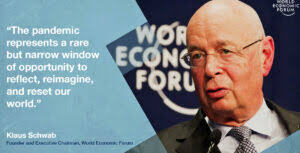
We have taken recent interest in the WEF because the term ‘Great Reset’ [1] has jumped up from almost nowhere, suddenly [2] becoming almost everyone’s mantra. It took us a while to realize that the term actually refers to a new book by the name of ‘COVID-19 The Great Reset’ written by none other than Dr. Klaus Schwab, the 82 y/o founder and ongoing CEO of the WEF ever since its inception in 1971. The above WEF link includes toward the end of the document an interesting diagram which summarizes the Great Reset plan, titled “The Great Reset Transformation Map”. [3]
And what is exactly the position of Dr. Schwab? How can he take the wiser-than-thou stand and proclaim to be the saviour of the world? Under which mandate is he allowed to tell governments, people, all people of all nations, cultures, religions and political views to follow his vision of how to create a better new world?
A most eloquent, smooth speaker, but it doesn’t take much probing to see that Schwab is at best either a megalomaniac or a fool, but he definitely displays archetypal symptoms of megalomania, and in a very dangerous attire. When Mao declared his short-sighted Cultural Revolution, he was seen in the West as a new Hitler. But ironically the same West sees Schwab as a saviour.
Don’t listen to these words, hear him speak about what he calls the ‘fourth industrial revolution’. He claims that the steam engine heralded the first revolution, mass production the second, and computers the third. And now, according to him, the fourth industrial revolution is about ‘a fusion of our physical, digital and biological identities’ This is an hour-long video, [4] and if readers cannot listen to it all, they can find those exact words at the 15m:45s mark. And what is our ‘digital identity’ by the way?
Actually, he is perhaps neither a megalomaniac nor a fool, but a freak, the kind of villain that jumps straight out of Batman comics. Alongside the Penguin and the Joker, Schwab should be locked up behind bars, dressed in a straight jacket and pumped to the hilt with antipsychotic drugs, but he is not. He has appointed himself as an advisor to global political leaders, and those buffoons take him seriously.
The man has not been elected by anyone, he does not represent anyone, he seems to not have consulted with anyone elected to speak on behalf of citizens. If this is not what defines a dictator, what does? The WEF is actually his own lovechild, and its name gives it a guise of legitimacy, but it is in fact an NGO just like any other. It neither has any official structure nor the power to generate binding policies. And Soros is not the only shady dude ever invited to speak at the forum.
Schwab is the person who invites whom he chooses. Over the years, the guest list included movie stars and rock stars, but the ‘permanent’ members are CEO’s of big business with turnovers in the billions. We are only talking about some 1000 “leading” companies [5] among millions worldwide who are given a “platform”. They are the biggest pollutants and profiteering culprits on the face of the planet. They are also the biggest benefactors; they donate millions of dollars annually to support the WEF.
Other members include the Saudi royals, the Ford Foundation, Mastercard Foundation, the Rockefeller Foundation, Monsanto, just to name a few. One would have to have rocks in his/her head to even imagine that those people and the globalist entities they represent get together in order to discuss how to make the world a better place for the underprivileged. He/she would have to be delusional to believe that those rascals convene for any reason other than bolstering their grab-hold of global wealth and monopoly of power.
This is not to mention the irony of Monsanto and Greta being on the same forum.
If anything, the WEF is the biggest known organization that is comprised of the elite of the elite, the culprits behind the inequity and injustice in this world. It is perhaps the biggest wolf in sheep’s clothing on the prowl.
But how will the ordinary man and woman on the street respond to the concept of being part human part machine? And what is more frightening here is; how seriously are world leaders going to take Schwab’s recommendations and how will they implement them in democratic countries in which changes much smaller than what he is recommending require referendums? Furthermore, what will be the ‘fate’ of individuals and nations that do not heed and comply with his directives? Will they be sanctioned? Will non-compliant individuals be able to find jobs or keep existing ones? Will non-compliant nations face trade sanctions?
Many ideologies have come and gone, but none in recent times, since the various versions of Marxism, including Maoism, tried to portray itself in a manner that attempts to sound rational and pragmatic. We must exclude religions here, because religions are based on faith, they are spiritual beliefs, and they are not only and specifically based on and aimed for social reform. But this ‘Great Reset’ theory is very different from any of its predecessors. On the surface, it is based on living frugally in order to protect the environment and generate greater social justice [6], and this does not sound like a bad idea. But at a deeper level, it is a call for thought policing and control of individuals and robbing them of their choices; including their own identity.
Did pre-COVID humanity go wrong to the extent that it needed a great reset?
Well, we only have to look at the trajectory of humanity to realize that it was (still is in fact) unsustainable. All we need to look at is one major aspect; population growth. We simply cannot expect the trend in population growth to go unchecked especially when coupled with increases in affluence and higher standards of living in some countries. If anything, that trend has been generating a huge growing gap between the haves and the have-nots. But even with this knowledge, humanity did not flinch at the news and images of wide-spread famines and literally thousands dying on a daily basis because of their inability to find food; all the while the ‘other half’ is dying from being overweight and overfed.
Whilst some evil-minded people think that the practical way out of this dilemma can be achieved by implementing different modes of eugenics, the voices of compassion have become less audible, and at best, ignored even muted.
Did the pre-COVID world need a reset? Definitely. Many of its founding determinants have been based on injustice, shortsightedness, divisiveness, lack of good old values, the inability of being sustainable; just to name a few.
When millions cannot find food to eat and clean water to drink yet others fly half the way across the world to attend a baby shower, something must be amiss and a reset is way overdue.
But what is it that the vision of the WEF and its ‘Bible’ (COVID-19 The Great Reset) have to offer in order to provide the world and future generations with a brighter new direction?
It doesn’t take long to see that within the WEF “Great Reset” article [7] there are clear indications that what it is attempting to do is to create more compliant robotic individuals and draw the world and its population deeper into the abyss.
The WEF “Great Reset” article is carefully written and worded in a manner that by the time the reader builds a huge deal of trust in the writer, trust in his intentions, and eventually reaches the recommendations, he/she finds that there is no reason, none at all, to disagree with any of its recommendations. If you examine the diagram [8] in the article titled “The Great Reset Transformation Map”, you will find it is very telling.
Even a quick analysis of the WEF principles and modus operandi shows that the whole ethos is based on individuals and companies the practices of whom have led the world to the current state of loss and despair and entrapment that it is in. Certainly, the cause cannot be the cure; not in this instance.
The paper is a blatant endorsement of the Neo-Left, its agendas and attempts to break down cultural values that glue society together, and turn the world into an obedient slave camp.
Apart from the frightening Schwab’s definition of the fourth industrial revolution, the actual recommendations for the ‘Great Reset’ are quite alarming and unsettling to say the least. It promotes digital currency. How does this restore hope in this new world? This is not to mention encouraging the use of robots, drones, and exponentially increasing reliance on technology instead of aspiring to reinstate the good old values of morality that have worked for millennia.
The words morality, honesty, care, compassion, kindness, happiness, courage, generosity, charity etc., are not mentioned even once in the document; not even a single one of them. Why, one may ask? What is it that drones can do to save humanity from an impending disaster that none of the above innate human values can?
Actually, when it comes to human values, Schwab shamelessly argues that as in the future there will be less cooperation based on shared values with an increasingly multipolar world emerging, relationships will have to be based on shared interests; not values (see at 40:00 min)[9]. For him not to believe in the goodness within humanity, he surely must have deeply-founded psychological disorders. We should pity him, but not if he wants to dictate to us how to lead our lives.
What is more concerning about the man is that he asks, almost demands, that all that he proposes must be implemented now and without any further delay, because he argues that the COVID crisis [10] is giving humanity an opportunity that must not be missed. During a recent visit to India, it was reported that Schwab has said that the country now has the opportunity in leapfrogging [11] to a more digital and sustainable economy.
If we want to be cynics, which we are, we would conclude that those who design and run the WEF do not only sleep in the same bed as those who have destroyed the world, THEY ARE the ones who destroyed it, and yet have the audacity to say they are trying to save it. Unfortunately many follow them and take them at face value.
The great reset humanity really needs is one that takes it back to its roots, its values that include freedom of choice and expression. It needs a reboot, not just a reset, and definitely not the reset that is pre-set by maniacal dictators who wish to create implantable microchips that can read one’s mind. [12]
To the likes of Dr. Schwab, the world population must rise, even against their leaders if they must, and together chant ‘no pasarán’
INDIAN COUNTRY NEWS
"It is the duty of every man, as far as his ability extends, to detect and expose delusion and error"..Thomas Paine
Human in Algorithms
100% Accurate Google Sheets + KDP Book Formatting | 24hr Delivery
From the Roof Top
I See This
blog of the post capitalist transition.. Read or download the novel here + latest relevant posts
अध्ययन-अनुसन्धानको सार

