Ben Nimmo, a former NATO press officer and current senior fellow at the Atlantic Council, has announced Facebook has hired him to “lead global threat intelligence strategy against influence operations” and “emerging threats.” Nimmo specifically named Russia, Iran and China as potential dangers to the platform.
His announcement was greeted with joybyseveral NATO officials but was not met with such enthusiasm by others. “More censorship on the way as the former NATO press officer turned Pentagon-funded ‘researcher’ who labeled real people as Russian bots and peddled disinformation to link Jeremy Corbyn to Russian active measures moves to big tech,” responded investigative journalist Max Blumenthal.
Nimmo’s questionable past certainly raises questions over whether such an official having a substantial say in what 2.8 billion Facebook users worldwide see in their feeds is such a positive step for the free and open exchange of information.
More censorship on the way as the former NATO press officer turned Pentagon-funded “researcher” who labeled real people as Russian bots and peddled disinformation to link Jeremy Corbyn to Russian active measures moves to Big Tech https://t.co/XcfGbdPJtv
For example, in 2019, U.K. Labour Party leader Jeremy Corbyn revealed secret Conservative Party documents showing negotiations the Tory government had with the U.S. over the privatization of the National Health Service (NHS). With just days to go before the U.K. general election, the scandal could have toppled the government and brought into power the most radical antiwar, anti-establishment government in the country’s history. Corporate media went into overdrive to spin the news, and Nimmo was a key part of this, immediately announcing, without evidence, that the documents “closely resemble…a known Russian operation.” His supposedly expert conjecture allowed the story to become “Corbyn’s links to Russia” rather than “Tories privatizing the NHS in secret.” Nimmo’s work helped the Conservatives to an election victory and consigned Corbyn to the scrapheap.
This was much to the relief of Nimmo’s Atlantic Council, who had branded Corbyn the “Kremlin’s Trojan Horse” — someone pushing Moscow’s agenda abroad. A British Army general was of a similar opinion, claiming that if Corbyn were to win the election, the military would respond. Secretary of State Mike Pompeo also said that the U.S. government was “doing its best” to prevent a radical leftist from winning power in the U.K.
Nimmo has been extremely liberal with whom he labels Russian disinformation agents. In 2018, his research identified one Twitter user, @Ian56789, as a “Kremlin troll.” In reality, the user, Ian Shilling, was a British pensioner, as Sky News was easily able to confirm, interviewing him on air and asking him the patently absurd question if he was actually a Russian bot or not. Despite clearly being a flesh and blood human, Shilling’s account was later deleted anyway.
In the past, Nimmo has also insisted that Valentina Lisitsa was an influential Russian bot. In reality, she is an internationally known concert pianist, as one Google search would have shown. This sort of behavior does not augur well for those critical of Western foreign policy, who have faced constant harassment, suspension, or outright bans from social media.
The Atlantic Council began as an offshoot of NATO itself and maintains extremely close connections to the military alliance. It continues to receive major funding from Western governments and weapons contractors, and its board of directors is filled to the brim with former American foreign policy officials such as Colin Powell, Condoleezza Rice, and Henry Kissinger. Also appearing on the board are no fewer than seven former CIA directors and a number of top military generals, such as Jim “Mad Dog” Mattis, Wesley Clark, and David Petraeus.
In recent years, the council’s employees have penetrated deep into big tech and social media organizations. In 2018, it announced it had partnered with Facebook to aid in the curation of Facebook news feeds of users worldwide, giving it considerable power over what sort of views to highlight and which to demote. One year previously, Jessica Ashooh left the position of the council’s Deputy Director of Middle Eastern Strategy to take the position of Director of Policy at Reddit, the eighth-most visited website in the United States. However, as with many intelligence agencies, it is unclear whether one truly “leaves” the Atlantic Council.
It is not just Russia that is in NATO’s crosshairs. Last week, the Atlantic Council published an anonymous, 26,000-word report stating that their goal for China was regime change and advising President Biden to draw a number of “red lines” around it, beyond which the U.S. would respond militarily. Meanwhile, the head of STRATCOM, Admiral Charles A. Richard, wrote that the U.S. must prepare for a potential nuclear war with Beijing.
Greater control
The military escalation has been mirrored by an intensifying online propaganda war, where the U.S. has attempted to isolate China economically and stop advancing Chinese technologies such as Huawei’s 5G network, mobile phone, and semiconductor manufacturer Xiaomi, and video sharing app TikTok. Nimmo has played his part in ramping up suspicions of nefarious Chinese activity online, claiming the existence of a wide-ranging pro-Beijing bot network encouraging Americans to believe that China has handled the COVID-19 pandemic far better than the United States. That Americans might have come to that conclusion on their own appears not to have been considered.
There is an enormous government effort to convince its population of the existence of (foreign) government efforts to manipulate their opinions online. In a massive case of projection, Western governmental organizations point the finger at their enemies, all the while securing greater access and control over the means of communication themselves, to the point where it is now difficult to distinguish where the deep state ends and the fourth estate begins. Nimmo’s move from NATO to NATO-aligned think tank to Facebook is just another example of this phenomenon. Perhaps the reason Nimmo is not looking for any Western influence operations online is that he is part of one.
Ever since the words were first introduced, conspiracy theories have carried the weight and stigma of mysterious enigmas wrapped in multiple layers of intrigue, deception, black-ops and lies. The very notion of conspiracy theories is itself considered by some to be a conspiracy theory. There are those who maintain that the CIA invented the term or at least brought it into our common language as a way of ridiculing those who questioned the Warren Report account of the murder of president JFK.
Whether the CIA did or did not intentionally use those words, conspiracy theory, to discredit those who were non-believers of the official Warren Report line, we will never know. And that’s the thing about a conspiracy theory, as to its truth, we may never know. What should be known however, what we would be better to believe, is that in this world of intrigue, deception, black-ops and lies, that there are without a doubt conspiracies. If the CIA ever had the desire to de-legitimize someone or some entire group, then or especially now, this moment is certainly ripe for supplying them with all the necessary ingredients for pulling off a grand conspiracy of mass de-legitimization of those they see as being political rabble-rousers.
The group who stormed the capitol on Jan.6th is one such group who follow conspiracy theories but although they are unique in being the ones who stormed the capitol, they are not unique in their beliefs in conspiracy theories. It might be hard, if one were to look, to find someone who does not believe in some conspiracy theory or another and it would be right for that to be the case because surely, one or the other of those theories is true, based on facts and even provable if the right material evidence could be produced. In this world of intrigue, deception, black-ops and lies however, it is sometimes very hard, impossible even for most of us, to get our hands on the right material evidence and those shady CIA operators are loving it. Nothing produces the environment where conspiracy theories thrive like reams of hidden or redacted evidence.
Are many of the conspiracy theories we hear nothing but pure bunk made-up by who knows who for no other reason than to confuse and distract? Yes, many of them are. Are some of those theories the result of half understood notions that are used in an effort to understand hidden truth? Yes, many of them are. Are some of those theories true but only the tip of even greater conspiracies that we still haven’t even begun to suspect? It’s likely so. Would it be of some value to the public to keep an open mind where conspiracy theories are concerned? Yes, as it would be one of the tyrants greatest moments in psy-op history if we were not keeping an open mind where conspiracy theories are concerned. Are conspiracy theories currently being down-played and ridiculed as being absurd and the domain of idiots and fools? Yes they are!
Is this treatment of conspiracy theories as some form of mental illness or instability, coupled with corporate and government censorship of things that they and they alone deem as being conspiracy theories with no redeeming even harmful value to the public, a smart way to go in societies hoping to retain some shred of truth and freedom? No it is not. Let us ask ourselves then, would we be wise to write off as unacceptable any theories that suggest conspiracy and to then allow government and corporate control of censorship of those theories? I think not. Would you then prefer to live in a society where people are allowed to freely suggest conspiracies where there may or may not be conspiracies or would you prefer to live in a society where no conspiracy theories are allowed even though they may or may not be true?
Do you wish to live in a society where you and you alone are allowed to discern truth from fiction according to the evidence you yourself are able to uncover or do you want corporations and government to do that for you?
Seeking Truth in a Country of Lies is a selection of essays. They reveal what stirs author Ed Curtin’s heart, his mind, and his path toward clarity. With each chapter he passionately reflects on the state of his country and what matters most to him. It is a compelling read.
The epigraph at the beginning of Seeking Truth in a Country of Lies, “In a dark time, the eye begins to see,” comes from Theodore Roethke’s poem “In A Dark Time”. Here the poet describes a state of disorientation and dislocation of identity. Roethke asserts this is essential to achieve clarity, insight and wisdom. In a dark time, one discovers the fragmented and broken state of things. With this fitting epigraph, Ed Curtin proceeds to alert his readers to the fragmented and broken state of things in America, and the task of its citizenry to begin to see more clearly.
The topics Curtin, a former professor at the Massachusetts College of Liberal Arts, takes up are not original to him. But they are marked with his own articulate original stamp. One aspect of his novel contribution is that Curtin steps beyond standard frameworks of political analyses.
Three themes have permeated his attention from a young age: truth, death and freedom. He cites an excerpt from an interview with the poet Kenneth Rexroth who told journalist Lawrence Lipton in 1959:
Since all society is organized in the interest of exploiting classes and since if men knew this they would cease to work and society would fall apart, it has always been necessary, at least since the urban revolutions, for societies to be governed ideologically by a system of fraud.
Rexroth referred to this system of fraud as the “social lie.” And in Seeking Truth in a Country of Lies, Curtin takes on the task of describing the roots of the fraud, and its more recent manifestations. He also takes time to point out, despite the burdens society grapples with in an age of deceit, that beauty, art, love, and whimsy are among the qualities that persist as signs of grace.
In his essay “Inside America’s Doll House: A Vast Tapestry Of Lies” Curtin cites Jim Garrison, the District Attorney of New Orleans who in 1969 brought to trial a case naming persons connected to the assassination of President John F. Kennedy. Garrison attempted to show that the assassination of JFK was the work of the CIA and Allen Dulles.
However, Garrison was routinely described as a lunatic by CIA-connected media spokespersons. It was Garrison’s conclusion that American citizens passively consumed television news that was laced with propaganda. Such propaganda was manufactured to preclude Americans from “understanding…what is really happening….”
Garrison warned that Americans were living “in a doll’s house.” Building on the hard lessons Jim Garrison learned from the trial in 1969, Ed Curtin observes:
In the doll’s house into which America gradually has been converted, a great many of our basic assumptions are totally illusory.
His book was also released in winter 2020, some 57 years after JFK’s assassination.
Curtin notes that in 2009:
[President] Obama backed the 2009 coup d’état in Honduras that has resulted in so many deaths at the hands of U.S. trained killers, and now [followers of Trump complain about] all these ‘non-white’ people fleeing to the U.S. to escape a hell created by the U.S…
After 2009. it was learned that U.S. officers at the Center for Hemispheric Defense Studies trained members of the Honduran military to oust democratically elected President Manuel Zelaya. In 2009 and the years following Honduras has had one of the highest rates of murder in the world. These have been driven by death squads connected to the Honduran military. But this coup mattered little to both President’s Obama and Trump, while Hondurans have paid the price in murder, increased debt and poverty.
Examples of what Curtin raises continue since his book was published in late 2020. For Venezuelans it matters little whether a Republican or a Democrat is president in the USA. Under Donald Trump there was a failed attempt in May 2020 to kidnap Venezuelan President Nicolas Maduro. And on the first day of his presidency, Joe Biden signed an executive order declaring the United States recognizes Venezuelan opposition leader Juan Guaidó as the nations’ President. This despite Maduro winning over 67% of the popular vote in 2018; That the second candidate in the election results was Henri Falcón who won 21%; And Juan Guaidó wasn’t even a candidate in 2018. Imagine if Venezuela protested the result of the 2020 United States election, and recognized Mitt Romney as president (who ran in 2012 but didn’t run in 2020).
With Biden there is a change of tone from Trump, but many American foreign policies remain the same. Former President Jimmy Carter said of Venezuela’s 2012 elections when Hugo Chavez was re-elected:
…of the 92 elections that we’ve [Carter Centre Foundation in Atlanta] monitored, I would say the election process in Venezuela is the best in the world.
But that story that doesn’t conform with the media’s narrative. So, it goes down the memory hole.
Curtin notes that while average Americans have not constructed the doll’s house they live in, they are complicit. It is average Americans who have accepted “decades of fabricated reality for so-called peace of mind.” A consequence of accepting illusory narratives is that people are not really free.
In order to cope with a plausible lie, consumers of the news play dumb. And Curtin notes most Americans…
want to be nice (Latin, nescire, not to know, to be ignorant) and to be liked.
As they become a people of the lie, repeating the lies they are fed, a memetic desire arises in society. And the repetition of these lies fuels violence and scapegoating. The doll’s house that Americans (and many citizens of other countries who consume the news uncritically) live in, are reinforced by contracts they have made with the world. This is in order to enhance their social standing, financial status, professional advancement and maintain familial harmony. That kind of peace of mind and contentment require individuals not to venture out far from the doll house, in case they encounter truths they find hard to handle.
Curtin notes that the Central Intelligence Agency began to use the term “conspiracy theory” in a memo on April 1, 1967. This was to discredit assassination theories about other plausible actors in the death of the slain president on November 22, 1963. And he notes that it just so happens that the term “9/11” was first used on September 12, 2001, by future New York Times editor Bill Keller to designate the language for how to refer to the day of the attacks. By using a term synonymous with dialing an emergency number in the United States, the term became fused with feelings of “anxiety, depression, panic and confusion.”
It is useful to note that at the time of the attacks on September 11, 2001, the emergency number in Saudi Arabia was 999. In Afghanistan the emergency numbers were 102, 112 and 119. The numbers in Yemen were 191 and 194. The emergency numbers in the United Arab Emirates were 112, 998 and 999. The emergency number in Libya was 1515. The number in Kuwait was 112. The numbers in Iraq were 104, 115 and 122. In Syria emergency numbers were 110, 112 and 113. In Lebanon the numbers variously were 112, 140, 175 and 999. The emergency numbers in Egypt were 122, 123 and 180. Across continental Europe the emergency number to call on September 11, 2001, was 112. The emergency numbers in Iran were 110, 112, 115 and 125.
Curiously, 911 was a number to dial an emergency uniquely in the United States, Canada, Mexico (as well as 065, 066 and 068), and South America. 911 was not an emergency number in the states where Arabs were alleged to have plotted to attack the Pentagon and the World Trade Center.
In some future scenario – were it to ever happen – might rogue American terrorists fly planes into skyscrapers in Tehran, Iran? And in such a scenario, might such terrorists plot an attack on a January 10th, 12th or 15th of a given year, fusing the day of the atrocity with the abbreviation for a date synonymous with one of the numbers Iranians dialed in case of an emergency?
an endless national emergency became wedded to an endless war on terror aimed at preventing Hitler-like terrorists from obliterating us with nuclear weapons that could create another ground zero or holocaust. It is a term that pushes all the right buttons evoking unending social fear and anxiety. It is language as sorcery; it is propaganda at its best.
Because Curtin suspects that the repetition of the term “9/11” is embedded in an advanced form of mind-control, he refuses to use the term in relation to the attacks. Instead, he uses the phrase “the attacks of September 11, 2001.” Whatever vocabulary we use to refer to the attacks, Curtin advises that we find one that can unbind us from the mesmerizing impact of its official shorthand repeated endlessly, subliminally evoking confusion, depression and panic in its hearers.
As our post-modern society has evolved, the task of creating propaganda is more complex. And so, the complexity of society drives a majority to want ready-made frameworks for understanding their reality coherently. Curtin shows that…
people want to be provided with myths to direct them to the ‘truth,’ but that so-called truth has been preconceived within the overarching myth provided by propaganda.
Nonetheless, the propaganda is efficient enough to allow most people to deduce that they’ve reached their conclusions of their own free will. Most people will assume that they’ve been provided with a suitable range of information about the key points of a given topic in order to decide what is trustworthy. However, the same consumers of the news will regard as inconceivable that the narrative they’ve been led to accept contains cherry-picked news that omits perspectives that are off-message. Surely, wouldn’t any dissenting voices that are worth knowing about would be given a hearing on the six o’clock news?
The way the CIA took over America in the 1960s is the story of our time, and too few recognize this. We can’t fix a problem we can’t even acknowledge exists.
To support his assessment, Curtin points to numerous examples in different chapters across his book. This includes a chapter on “The Message From Dallas, JFK and The Unspeakable,” where he summarizes JFK author James W. Douglass’ layer-by-layer excavation of a CIA-backed assassination of a president who had turned from war-making toward peace-making.
In another chapter titled “What Are We Working For ‘At Eternity’s Gate’,” Curtin writes about the rat-race. He recalls a summer job as a clerk in a General Motors office in Manhattan. The “bait” was the salary, and so his youth was spent that summer confined to a boring job.
As I read Curtin’s description, I thought about some of the jobs I had: working a night shift as a hotel security guard, a cleaner at a private golf club, and working at a vehicle repair shop for the Ministry of Forests for the Province of British Columbia. The latter I spent a summer affixing forestry vehicle identification serial numbers on the side of government trucks.
The author mentions a film about the life of Vincent Van Gogh, titled At Eternity’s Gate, which offers a vision of new possibilities for what it means to work, to be alive. For Van Gogh it was the “act of painting” that was “the stroke of genius.” And so, for the impoverished painter it was not the completion of paintings that was important, but immersing himself in painting. This was the key to life.
In this essay, Curtin invites the reader to contemplate what it means to live and to ask ourselves why we work. He tells us:
For Vincent the answer was simple: reality. But reality is not given to us and is far from simple; we must create it in acts that penetrate the screens and clichés that wall us off from it.
One of the screens that Curtin had to penetrate was a slogan he was taught as a United States Marine:
My rifle is my life.
Curtin saw through the slogan, recognizing that being human meant to be a lover of life and being committed to waging peace.
In yet another essay, “The Sexual Passion of Winston Smith”, Curtin details the commodification of society, where everything can be bought and sold. As he speaks about the body’s commodification, Curtin reminds us that part of the body – “the tongue is a bell, tolling out its [language’s] meaning.” It is finally the tongue that helps us in speech to “tell the truth that propagandists try to deny.”
In his book, the author offers suggestions for pointing a way forward that can help us search for truth in a landscape of falsehoods. One of these is poetry. He points out that citizens in Chile, Ireland and Russia know their national poets and can quote their works “by heart.” But in America poets and poetry are ignored. A new generation is too busy checking Facebook, Twitter or Instagram. But Curtin argues:
Poetry is the search for truth. It marries outer to inner.
The best of what poetry can offer helps a society…
address questions of value and ultimate concern…of truth and lies.
He contrasts these with…
screen and selfie culture [where] these matters are irrelevant.
In addition to truth and lies, Curtin points to myriad oddities that dot the landscape of America’s cultural past. Many of the rock n’ roll bands in the mid-sixties were viewed as part of a countercultural/anti-war protest movement against the establishment. There are books like one by Alex Constantine, The Covert War Against Rock, that document operations by the CIA and FBI to discredit and disrupt the lives of pop-rock stars identified as subversive. Jimi Hendrix, John Lennon and others had extensive intelligence files on them. Constantine cites a leaked intelligence memorandum discussed in testimony before the Church Committee on April 26, 1976.
Regarding certain recording artists, the FBI wrote to its agents:
Show them as scurrilous and depraved. Call attention to their habits and living conditions, explore every possible embarrassment. Send in women and sex, break up marriages. Have members arrested on marijuana charges….Send articles to newspapers showing their depravity. Use narcotics and free sex to entrap. Use misinformation to confuse and disrupt….Provoke target groups into rivalries that may result in death.
But was another arm of the intelligence community simultaneously grooming anti-establishment recording artists? In Seeking Truth in a Country of Lies Curtin notes that Buffalo Springfield performed in concert, along with the Beach Boys, at the United States Military Academy at West Point, in Orange County, New York, on November 25, 1967.
Curtin points out that this is “a very odd venue for a ‘dissident’ rock group.” Their Top Ten hit in the spring of ’67 – “For What It’s Worth” – invited radio listeners to consider, though it wasn’t “exactly clear” what was “happening,” to “stop,” and “look” at what was “going down.”
How did members of Buffalo Springfield feel about performing at the military academy when there were “battle lines being drawn?” And what an odd thing for cadets at West Point to be listening to lyrics that warn:
step out of line, the man come and take you away.
Citing David McGowan’s Weird Scenes Inside the Canyon, Curtin notes that “Papa” John Philips of the Mamas and the Papas attended the US Naval Academy at Annapolis, Maryland, and that his dad was a Marine Corps Captain:
John’s wife had worked at the Pentagon and her father was involved in covert intelligence in Vietnam.
The Doors Jim Morrison, a neighbor and friend of Philips, was the son of U.S. Navy Admiral George Morrison who was the commander of American Naval ships during the Gulf of Tonkin incident that accelerated the Vietnam War.
Frank Zappa’s father happened to be a chemical warfare specialist.
Curtin notes others like David Crosby and Stephen Stills were also from military family backgrounds. And many of these young musicians all converged at Laurel Canyon:
Although they were draft age, none of them [were] drafted as they played music, dropped acid, and created the folk-rock movement…
Were these musicians’ part of intelligence community operations, as much as the agents who were harassing them? Or as David McGowan asks, was…
the entire youth culture of the 1960s…created not as a grass-roots challenge to the status quo, but as a cynical exercise in discrediting and marginalizing the budding anti-war movement and creating a fake opposition that could be easily controlled and led astray…?
With each chapter, Ed Curtin takes us into different rooms in the doll’s house, and helps us connect the dots. His stories and reflections, in an age of “fake news”, are essential reading.
In the quest for truth, readers of Seeking Truth in a Country of Lies will be advised to take the road less travelled. This road requires we quiet our minds, and welcome silence. It is a road less travelled where each must ask: what can I do to help transform our terrible, corrupt, beautiful world longing to be more human, just and peaceful?
Curtin does not intend for us as readers to simply finish his book unfazed. He hopes his chapters might rouse us to find ways to resist in this age of permanent war and oligarchy, in a world still longing for peace and justice.
A recent story floating around mainstream media regarding “modern-day nomads” reads like a contemporary article on Henry David Thoreau. It shares stories of people looking to downsize their life and live simply and stories of people who have fallen on hard times, unable to afford rent.
However, what is lacking is the exposure of the dark underbelly of the “modern-day nomad” culture. In other words, they neglect to mention the fact that the enormous growth of the “modern-day nomad” is rooted in the fact that the world economy has all but collapsed, now mired in a global economic depression of unemployment, low wages, and personal financial catastrophes.
While it sounds romantic, it’s often rooted in desperation.
If you look closely on city streets, campgrounds, and stretches of desert run by the Bureau of Land Management, you’ll see more Americans living in vehicles than ever before. It was never their plan.
“I wasn’t prepared when I had to move into my SUV. The transmission was going. I had no money saved. I was really scared,” said April Craren, 52, bundled in blankets atop a cot inside her new minivan, a 2003 Toyota Sienna.
She flipped the camera on her phone to show me the camp stove she uses to make coffee and her view of the sun rising over the Colorado River. She has no toilet, shower, or refrigeration.
After separating from her husband, April found herself homeless in June 2020, exacerbating the depressive disorder for which she receives $1,100 a month in disability benefits.
“I could have gotten an apartment but in a crappy unsafe place with no money to do anything at all,” she explained.
Last year, where April lived in Nixa, Missouri, the average rent for an apartment was $762, slightly less than the national average. Like nearly half of American renters, she would have been crippled by the cost.
It’s not surprising, then, that job loss, divorce, or, say, the sudden onset of global health or financial crisis can push so many over the edge.
It doesn’t sound so bad to those of us with minimalist persuasions
At 52, April Craren didn’t choose this life. It was thrust upon her by unfortunate life circumstances. Craren couldn’t afford the exorbitant rent that is now average across the country on a fixed income. (Partly due to inflation but mostly due to the housing crash in 2008.)
The coordination of lockdowns and COVID restrictions have plunged the world into a deep depression of which we are only beginning to see. Even Wall Street couldn’t have caused this much damage.
“If the Great Recession was a crack in the system, Covid and climate change will be the chasm,” says Bob Wells, the nomad who plays himself in the film Nomadland. Thankfully, Wells was able to help Craren adopt her lifestyle so she can now survive as a “nomad” through his Home On Wheels Alliance.
Wells’s lifestyle was a choice. But the newfound interest in the nomadic lifestyle is not a choice for many.
From Yahoo:
Realizing he had something valuable to share, he bought the domain name Cheap RV Living in 2005. He posted tips and tricks about better vehicle-dwelling, but what he was really offering was a road map to a better life.
Four years later, when close to 10 million Americans were displaced after the Great Recession, traffic to his site exploded. Finding himself at the center of a growing online community, he decided to create a meet-up in Quartzsite, Arizona. He dubbed it the Rubber Tramp Rendezvous (RTR), and in January 2011, 45 vehicles showed up. Eight years later, an estimated 10,000 vehicles convened for what was said to be the largest nomad gathering in the world.
The event’s explosive growth is undoubtedly a reflection of America’s increasing interest in van life as an answer to the affordable housing crisis, an idea made accessible by Bob on his YouTube channel, also named Cheap RV Living, created in 2015.
The “increasing interest in van life” that Yahoo News refers to is not some petit-bourgeois fantasy being realized by privileged middle-class white kids, able to go home at any time. It is the necessity of formerly middle class, working-class, and poor people all across America who are out of work or are working but cannot afford housing.
Minimalism is a legitimate lifestyle for some; others have no choice
For many, this culture of minimalism is genuinely how they wish to live. Nomads have a genuine desire to see empty overconsumption come to an end. However, we can not ignore that minimalism is being promoted to prepare the Western population who are used to high living standards to accept those that are much lower.
For those who are already nomads, whether by choice or forced by economic circumstance, it might be helpful to know that there are many prepping options available to you. There is no need to be left to the mercy of wherever you are right now.
I highly encourage you to access Daisy Luther’s article, “There’s Another Option Besides Hunkering Down and Bugging Out: Nomadic Living.” It will give you the perspective of someone who has voluntarily experienced and lived the nomadic lifestyle while also the mindset of remaining prepared for anything and everything.
At the rate the Great Reset is taking shape, many of us may find ourselves embracing the nomadic lifestyle, willingly or not.
New leaked documents show Reuters’ and the BBC’s involvement in covert UK FCO programs to effect “attitudinal change” and “weaken the Russian state’s influence,” alongside intel contractors and Bellingcat.
The UK Foreign and Commonwealth Office (FCO) have sponsored Reuters and the BBC to conduct a series of covert programs aimed at promoting regime change inside Russia and undermining its government across Eastern Europe and Central Asia, according to a series of leaked documents.
The leaked materials show the Thomson Reuters Foundation and BBC Media Action participating in a covert information warfare campaign aimed at countering Russia. Working through a shadowy department within the UK FCO known as the Counter Disinformation & Media Development (CDMD), the media organizations operated alongside a collection of intelligence contractors in a secret entity known simply as “the Consortium.”
Through training programs of Russian journalists overseen by Reuters, the British Foreign Office sought to produce an “attitudinal change in the participants,” promoting a “positive impact” on their “perception of the UK.”
“These revelations show that when MPs were railing about Russia, British agents were using the BBC and Reuters to deploy precisely the same tactics that politicians and media commentators were accusing Russia of using,” Chris Williamson, a former UK Labour MP who attempted to apply public scrutiny to the CDMD’s covert activities and was stonewalled on national security grounds, told The Grayzone.
“The BBC and Reuters portray themselves as an unimpeachable, impartial, and authoritative source of world news,” Williamson continued, “but both are now hugely compromised by these disclosures. Double standards like this just bring establishment politicians and corporate media hacks into further disrepute.”
Thomson Reuters Foundation spokesperson Jenny Vereker implicitly confirmed the authenticity of the leaked documents in an emailed response to questions from The Grayzone. However, she contended, “The inference that the Thomson Reuters Foundation was engaged in ‘secret activities’ is inaccurate and misrepresents our work in the public interest. We have for decades openly supported a free press and have worked to help journalists globally to develop the skills needed to report with independence.”
The tranche of leaked files closely resemble UK FCO-related documented released between 2018 and 2020 by a hacking collective calling itself Anonymous. The same source has claimed credit for obtaining the latest round of documents.
The new leaks illustrate in alarming detail how Reuters and the BBC – two of the largest and most distinguished news organizations in the world – attempted to answer the British foreign ministry’s call for help in improving its “ability to respond and to promote our message across Russia,” and to “counter the Russian government’s narrative.” Among the UK FCO’s stated goals, according to the director of the CDMD, was to “weaken the Russian State’s influence on its near neighbours.”
Reuters and the BBC solicited multimillion-dollar contracts to advance the British state’s interventionist aims, promising to cultivate Russian journalists through FCO-funded tours and training sessions, establish influence networks in and around Russia, and promote pro-NATO narratives in Russian-speaking regions.
In several proposals to the British Foreign Office, Reuters boasted of a global influence network of 15,000 journalists and staff, including 400 inside Russia.
The UK FCO projects were carried out covertly, and in partnership with purportedly independent, high-profile online media outfits including Bellingcat, Meduza, and the Pussy Riot-founded Mediazona. Bellingcat’s participation apparently included a UK FCO intervention in North Macedonia’s 2019 elections on behalf of the pro-NATO candidate.
The intelligence contractors that oversaw that operation, the Zinc Network, boasted of establishing “a network of YouTubers in Russia and Central Asia” while “supporting participants [to] make and receive international payments without being registered as external sources of funding.” The firm also touted its ability to “activate a range of content” to support anti-government protests inside Russia.
The new documents provide critical background on the role of NATO member states like the UK in influencing the color revolution-style protests waged in Belarus in 2020, and raise unsettling questions about the intrigue and unrest surrounding jailed Russian opposition figure Alexei Navalny.
Further, the materials cast serious doubt on the independence of two of the world’s largest and most prestigious media organizations, revealing Reuters and the BBC as apparent intelligence cut-outs feasting at the trough of a British national security state that their news operations are increasingly averse to scrutinizing.
Reuters solicits secret British Foreign Office contract to infiltrate Russian media
A series of official documents declassified in January 2020 revealed that Reuters was secretly funded by the British government throughout the 1960s and 1970s to assist an anti-Soviet propaganda organization run by the MI6 intelligence agency. The UK government used the BBC as a pass-through to conceal payments to the news group.
The revelation prompted a Reuters spokesman to declare that “the arrangement in 1969 [with the MI6] was not in keeping with our Trust Principles and we would not do this today.”
The Trust Principles outline a mission of “preserving [Reuters’] independence, integrity, and freedom from bias in the gathering and dissemination of information and news.”
In its own statement of values, the BBC proclaims, “Trust is the foundation of the BBC. We’re independent, impartial and honest.”
However, the newly leaked documents analyzed by The Grayzone appear to reveal that both Reuters and the BBC are engaged yet again in a non-transparent relationship with the UK’s foreign ministry to counter and undermine Russia.
In 2017, the non-profit arm of the Reuters media empire, the Thomson Reuters Foundation (TRF), delivered a formal tender offering to “enter into a Contract with the Secretary of State for Foreign Affairs, as represented by the British Embassy Moscow, for the provision of a project ‘Capacity Building in Russian Media.’” The letter was signed by Reuters CEO Monique Ville on July 31, 2017.
Reuters’ tender was a response to a call for bids by the FCO, which sought help in implementing “a programme of themed tours to the UK by Russian journalists and online influencers.”
Working through the British Embassy in Moscow, the FCO sought to produce an “attitudinal change in the participants,” promoting a “positive impact” on their “perception of the UK.”
In 2019, the FCO put forward a similar initiative, this time articulating a more aggressive plan to “counter the Russian government’s narrative and domination of the media and information space.” In effect, the British government was seeking to infiltrate Russian media and propagate its own narrative through an influence network of Russian journalists trained in the UK.
Reuters responded to both calls by the FCO with detailed tenders. In its first bid, the media giant boasted of establishing a global network of 15,000 journalists and bloggers through “capacity building interventions.” In Russia, it claimed at least 400 journalists had been cultivated through its training programs.
Reuters claimed to have performed 10 previous training tours for 80 Russian journalists on behalf of the British embassy in Moscow. It proposed eight more, promising to promote “UK cultural and political values” and “create a network of journalists across Russia” bonded together by a shared “interest in British affairs.”
Reuters’ tender highlighted the institutional prejudices and interventionist agenda that underlined its training programs. Detailing a series of UK FCO-funded programs dedicated to “countering Russian state-funded propaganda,” Reuters conflated Russian government narratives with extremism. Ironically, it referred to its own efforts at weakening them as “unbiased journalism.”
At the same time, Reuters appeared to recognize that its covert collaboration with the British Embassy in Moscow was highly provocative and potentially destructive to diplomatic relations. Recounting a UK FCO-funded tour it ran for Russian journalists in the midst of the Sergei Skripal affair, after the British government accused Moscow of poisoning a turncoat Russian intelligence officer who spied for Britain, the tender stated, “[Thomson Reuters Foundation] was in constant communication with the British Embassy in Moscow, to assess levels of risk, including reputational risk to the embassy.”
The mention by Reuters of the Belarusian TV Station Belsat, and its particular relevance “to the UK Government Strategy’s capacity to detect and counter the spread of Russian information” was notable. While describing itself as “the first independent television channel in Belarus,” Belsat is, as the Reuters tender makes clear, a vehicle of NATO influence.
Based in Poland and funded by the Polish Foreign Ministry and other EU governments, Belsat played an influential role in promoting the color revolution-style protests that erupted in May 2020 to demand the ouster of Belarusian President Alexander Lukashenko.
Ultimately, Reuters’ bid appears to have been successful, as it received a July 2019 contract with the FCO’s Conflict, Stability & Security Fund (CSSF). But neither entity seemed to want the public to know about their collaboration on a project designed to counter Russia. The contract was marked “Strictly Confidential.”
“Weaken the Russian state’s influence”
The programs exposed through the latest leak of documents operate under the auspices of a shadowy division of the Foreign and Commonwealth Development Office called Counter Disinformation & Media Development (CDMD). Led by an intelligence operative named Andy Pryce, the program has shrouded in secrecy.
Indeed, the British government has denied freedom of information requests about the division’s budget and stonewalled members of parliament like Chris Williamson who sought data about its budget and agenda, citing national security to block their demands for information.
“When I tried to probe further,” former MP Williamson told The Grayzone, “ministers refused to let me have access to any documents or correspondence relating to this organization’s activities. I was told that releasing this information could ‘disrupt and undermine the program’s effectiveness.’”
During a meeting convened in London on June 26, 2018, Pryce outlined a new FCO program “to weaken the Russian State’s influence on its near neighbors.” He solicited a consortium of firms to assist the British state in establishing new and seemingly independent media outlets to counter Russian government-backed media in Moscow’s immediate sphere of influence, and to amplify the messaging of NATO-aligned governments.
Justified on the basis of Russia’s supposed intention to “sow disunity and course[sic] disruption to democratic processes,” the campaign Pryce laid out was more aggressive and far-reaching than anything Russia has been caught doing in the West.
Pryce emphasized that secrecy was of the essence, warning that “some grantees will not wish to be linked to the FCO.”
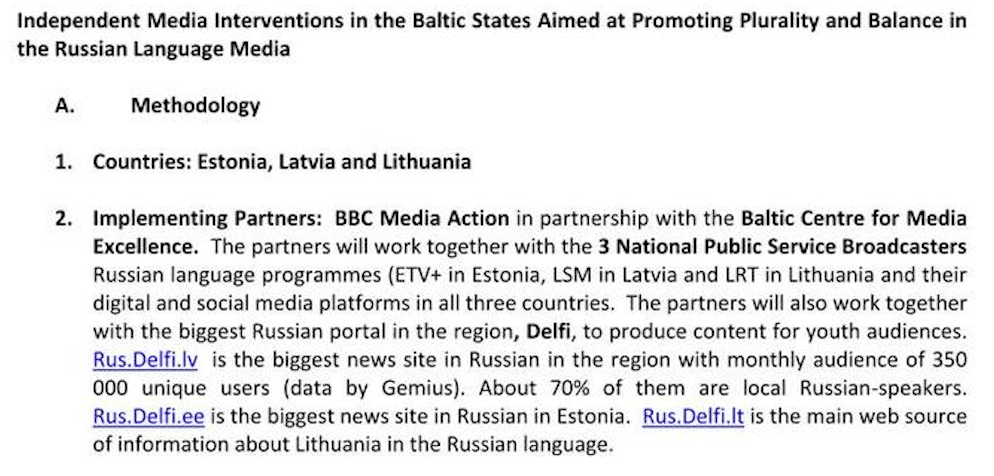
A year later, the FCO’s CDMD division outlined a program to run through 2022 at a cost of $8.3 million to the British taxpayer. It aimed to establish new outlets and support preexisting media operations “to counter Russia’s efforts to sow disunity” and “increase resilience to hostile Kremlin messaging in the Baltic states.”
Thus the British government set out with an array of intelligence contractors to dominate Baltic media with pro-NATO messaging – and perhaps sow some disunity of its own.
As seen below, the BBC placed an apparently successful bid to participate in the covert Baltic program through its non-profit arm, known as BBC Media Action.
The BBC also proposed to participate in a separate UK FCO media propaganda program in Ukraine, Moldova, and Georgia. It named Reuters and a now-defunct intelligence contractor called Aktis Strategy, which participated in previous FCO CDMD programs, as key allies in its consortium.
The BBC identified local partners like Hromadske, a Kiev-based broadcast network born in the midst of the so-called Maidan “Revolution of Dignity” in 2014 that relied on ultra-nationalist muscle to remove an elected president and install a pro-NATO regime. Hromadske materialized almost overnight with seed money and logistical support from the US Agency for International Development (USAID) and billionaire media mogul Pierre Omidyar’s Network Fund.
BBC Media Action proposed working through Aktis to cultivate and grow pro-NATO media in conflict areas like the Donbas region of eastern Ukraine, where a proxy war has raged since 2014 between the Western-backed Ukrainian military and pro-Russian separatists. It was textbook information warfare, weaponizing broadcast media to turn the tide of battle in a protracted, grinding conflict.
The UK FCO propaganda campaign warned that “Kremlin-affiliated structures” could undermine the project if it was exposed. For a media organization that claims to place trust at the heart of its charter of values, the BBC was certainly operating under a high degree of secrecy.
The UK FCO’s meddling in Eastern Europe and the Baltics created a feeding frenzy among contractors seeking to provide “capacity building” and media development assistance on Russia’s periphery. Among the bidders were Reuters and veteran FCO contractors that had participated in an array of information warfare campaigns from Syria to the British home front.
The Consortium
Among the intelligence contractors bidding to participate in the UK FCO-funded Consortium were the Zinc Network and Albany Communications. As journalist Kit Klarenberg noted in a February 18 report on the recent FCO leaks, these firms “boast staff possessed of [security] clearances, individuals who previously served at the highest levels of government, the military and security services. They furthermore have extensive experience in conducting information warfare operations on London’s behalf the world over.”
Previously known as Breakthrough, Zinc has contracted for the UK Home Office to covertly implement media projects propagandizing British Muslims under the auspices of the Prevent de-radicalization initiative. In Australia, Zinc was caught running a clandestine program to promote support for government policies among Muslims.
Ben Norton reported for The Grayzone on Albany’s record of “secur[ing] the participation of an extensive local network of over 55 stringers, reporters and videographers” to influence media narratives and advance Western regime-change goals in Syria, while conducting public relations services on behalf of extremist Syrian militias funded by NATO member states and Gulf monarchies to destabilize the country.
In its bid for the UK FCO media program in the Baltic region, Albany proposed a series of satirical “interactive games” like “Putin Bingo” to encourage opposition to the Russian government and exploit “frustrations experienced by Russians in the EU.”
Albany pitched a Latvia-based outlet called Meduza as “a leading proponent of these games.” A top website among Russian opposition supporters, Meduza has received financial support from the Swedish government and several billionaire-backed pro-NATO foundations.
As a UK FCO contractor, the Zinc Network said it was “delivering audience segmentation and targeting support” not only to Meduza, but also to Mediazona, a supposedly independent media venture founded by two members of the anti-Kremlin performance art group Pussy Riot.
One of Mediazona’s founders, Nadya Tolokonnikova, shared a stage with former US President Bill Clinton at the Clinton Foundation’s 2015 conference. The following year, Tolokonnikova trashed now-imprisoned Wikileaks founder Julian Assange, claiming, “He’s connected with the Russian government, and I feel that he’s proud of it.”
Besides delivering “targeting support” for “independent” outlets pushing the right line against the Kremlin, Zinc proposed leveraging UK FCO funding into a program of direct payments and gaming Google search results in their favor. The intelligence cut-out was explicit about its desire to reduce the search visibility of the Russian government-backed broadcaster RT.com.
The UK covertly funded and managed a network of Russian YouTubers and “activated” anti-government protest content
In a document marked “private and confidential,” Zinc revealed the Consortium’s role in setting up a “YouTuber network” in Russia and Central Asia designed to propagate the message of the UK and its NATO allies.
According to Zinc, the Consortium was “supporting participants mak[ing] and receiv[ing] international payments without being registered as external sources of funding,” presumably to circumvent Russian registration requirements for foreign-funded media outfits.
Zinc also helped the YouTube influencers “develop editorial strategies to deliver key messages” while working “to keep their involvement confidential.” And it carried out its entire program of covert propaganda in the name of “promoting media integrity and democratic values.”
Perhaps the most prominent Russian YouTube influencer is Alexei Navalny, a previously marginal nationalist opposition figure who was nominated for a Nobel Prize after becoming the target of a high-profile poisoning incident that brought relations between Russia and the West to its post-Cold War nadir.
The Russian government’s sentencing of Navalny to a 2.5-year prison term for evading parole has inspired a new wave of anti-government protests. Back in 2018, Navalny personally co-sponsored national demonstrations against the banning of the encrypted messaging app Telegram.
In its bid for a UK FCO contract, Zinc revealed that it played a behind-the-scenes role “to activate a range of content within 12 hours of the recent telegram protests.” Whether those activities involved Navalny or his immediate network was unclear, but the private disclosure by Zinc appeared confirm that British intelligence played a role in amplifying the 2018 protests.
Russian intelligence services have released sting video footage showing Vladimir Ashurkov, the executive director of Navalny’s FBK anti-corruption organization, meeting in 2013 with a suspected British MI6 agent named James William Thomas Ford, who was operating out of the British embassy in Moscow. During the rendezvous, Ashurkov can be heard asking for 10 to 20 million dollars to generate “quite a different picture” of the political landscape.
In 2018, Ashurkov’s name appeared in leaked documents exposing a covert, UK FCO influence network called the Integrity Initiative. As The Grayzone reported, the Integrity Initiative operated behind the cover of a think tank called the Institute for Statecraft, which concealed its own location through a fake office in Scotland.
Run by a group of military intelligence officers, the secret propaganda group worked through clusters of media and political influencers to escalate tensions between the West and Russia. Listed among the London cluster of anti-Russian influencers was Ashurkov.
The Integrity Initiative’s military directors outlined their agenda in stark, unequivocal terms. As the leaked memo below illustrates, they aimed to exploit the media, think tanks and their influence network to stir up as much hysteria about Russia’s supposedly malign influence as possible. Since they embarked on their covert campaign, nearly all their wishes have come true.
Bellingcat joins the Zinc Network, allegedly meddles in Moldova’s elections
After Alexei Navalny’s poisoning, he collaborated with the UK-based “open source” journalism outfit Bellingcat to pin the crime on Russia’s FSB intelligence services. Though it is well established that Bellingcat is funded by the National Endowment for Democracy, a US government entity that supports regime-change operations around the globe, the fact has never appeared in the reams of fawning profiles that corporate media outlets, including Reuters, have published about the organization.
Bellingcat’s role as a partner in the Zinc Network’s UK FCO-funded EXPOSE Consortium may add an additional layer of suspicion about the outlet’s claim to independence.
Indeed, Bellingcat was listed in leaked 2018 documents as a key member of Zinc’s “Network of NGOs.” Among the members in the network was the Institute for Statecraft, the front for the Integrity Initiative.
Bellingcat founder Eliot Higgins has vehemently denied accepting funding from the UK FCO or collaborating with it. But after Zinc documents leaked in early 2019, Higgins disclosed that some version of the Zinc proposal had received the green light from the Foreign Office.
Christian Triebbert, a Bellingcat staff member who was named as a potential trainer by the Zinc documents, and who now heads the New York Times’ video investigations unit, claimed the program consisted of benign workshops on “digital research and verification skills.”
What he and Higgins did not mention, however, was that Bellingcat had apparently been dispatched by the Zinc Network to “respond” to the 2019 parliamentary elections in North Macedonia. Stakes were high as the elections were likely to determine whether the tiny country would enter NATO and join the EU. The pro-NATO candidate triumphed, and not without a little help from the British Foreign Office and its allies.
According to the Zinc proposal, Bellingcat provided training to the Most Network, a Macedonian media outlet. It was joined by DFR Lab, a project of the NATO- and US government-funded Atlantic Council in Washington, DC.
After apparently participating in the covert UK FCO-funded intervention in North Macedonia, Bellingcat published an article ahead of the country’s 2020 parliamentary elections entitled, “Russia’s interference in North Macedonia.”
Several Zinc Network documents list Reuters as a member of the UK FCO-funded Consortium media intervention in the Baltic states.
Asked by The Grayzone how Reuters’ participation in UK FCO-funded programs aimed at countering Russia conformed to the news organization’s Trust Principles, spokesperson Jenny Vereker stated, “This funding supports our independent work to assist journalists and journalism all over the world, as part of our mission to strengthen a free and vibrant global media ecosystem to support a plurality of voices and preserve the flow of accurate and independent information. This is because accurate and balanced news coverage is a crucial pillar of any free, fair and informed society.”
In recent years, the BBC and Reuters have played an increasingly aggressive part in demonizing the governments of countries where London and Washington are seeking regime change. Meanwhile, high-profile online investigative outlets like Bellingcat have sprouted up seemingly overnight to assist these efforts.
With the release of the UK FCO documents, questions must be raised about whether these esteemed news organizations are truly the independent and ethical journalistic entities they claim to be. While they hammer away at “authoritarian” states and malign Russian activities, they have little to say about the machinations of the powerful Western governments in their immediate midst. Perhaps they are reluctant to bite the hand that feeds them.
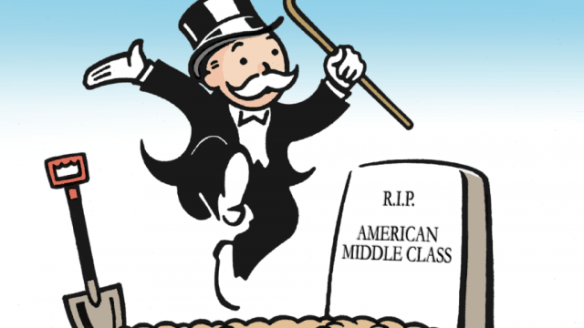
Please study these charts as a means of understanding the inevitability of economic stagnation and a revolt of the decapitalized middle class.
I’ve been covering the decline of America’s middle class for over a decade with charts, data and commentary on the social depression that has accompanied the decline.
While there are many mutually reinforcing dynamics in this 45-year decline–demographics, global energy costs, financialization and globalization, to name a few– one term describes the accelerating erosion of America’s middle class: decapitalization.
To understand decapitalization, we need to start with the fundamentals of any economy between labor (wages) and capital and between investment and speculation. Although it’s tempting to oversimplify and demonize one or the other of these basics (speculators bad! etc.), they each provide an essential role in a healthy economy, one which is in dynamic equilibrium, a state analogous to a healthy ecosystem with constantly changing interactions of numerous species, individuals and inputs (weather, etc.). This variability enables the order of fluctuations (to use Ilya Prigogine’s profound phrase), a dynamic stability / equilibrium.
If labor’s share of the economy drops too low, the workforce cannot consume enough to support their households and the economy as a whole. If capital can no longer earn an attractive return, investment dries up and production stagnates. If speculators are not allowed to take on risk, liquidity dries up and risk crushes investment. But if speculation becomes the foundation of the economy’s “growth,” then the inevitable collapse of speculative bubbles will crash the economy.
In modern social-capitalist systems, the core stabilizer of the system is the wage-earning middle class which provides the stable workforce driving production and the stable pool of consumers needed to borrow money and consume enough to soak up the production of goods and services at a profit to producers.
Without a stable, dominant middle class, capital has few opportunities to invest in productive capacity. Without a stable, dominant middle class, the economy stagnates and is prone to collapse as it is far from equilibrium.
The process of middle class decline is best explained as decapitalization because the middle class is fundamentally a means of transforming labor into capital via savings and investment. The traditional ladder of social mobility from the working class to the middle class is one of capitalizing work: time and savings are invested in higher education, in effect capitalizing future labor by increasing productivity.
Capital isn’t limited to cash, land or tools; in an information economy, knowledge and skills are also capital, as is the social capital of social networking and relationships formed with mentors, suppliers, lenders, colleagues, investors, etc.
The second way to capitalize work is to save earnings and invest the savings in assets that produce income or gain value: a house, land, rental property, small business and income-producing financial assets such as bonds or dividend-paying stocks.
Thrift, investing, long-term planning and deferred consumption are all essential to capitalizing work by turning that labor into income-producing assets. As the household’s ownership of these assets that yield unearned income rises, so does their income and wealth. These increase the financial security of the household and build a nestegg which can be passed down to the next generation, improving their security via inheritance of income-producing assets.
As long as productivity is increasing the value of their labor, the middle class can leverage future earnings into assets by borrowing money to invest in assets: to buy a house, a mortgage is borrowed against future earnings. As long as the mortgage is a fixed-interest loan and income can be expected to rise with productivity, then this is a win-win situation: capital earns a predictable, low-risk return from the mortgage and the middle class household has stake in a family home, an asset which acts as a savings mechanism as the mortgage slowly pays down the debt and increases the household’s home equity–a form of savings.
The processes of decapitalization have upended this entire structure. In the systems context outlined above, our economy is out of balance and far from equilibrium and thus prone to collapse.
For the bottom 90%, which of course includes the middle class however you define it, it’s increasingly difficult to capitalize labor into capital. There are a number of factors driving this decapitalization:
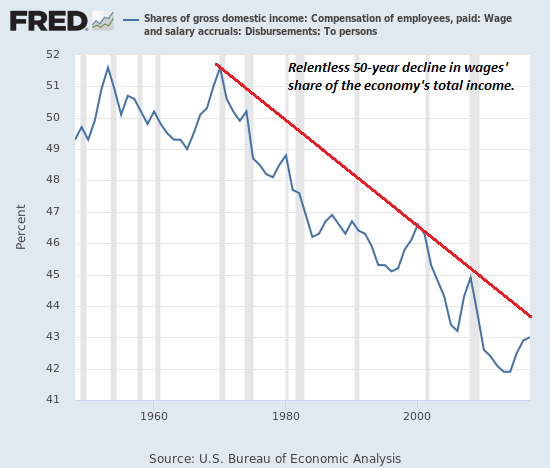
1. Wages’ share of the national income has continued a five-decade downtrend. (See chart below) National income since 1973 has shifted from labor (wages) to capital and more specifically, to debt and speculative gaming of the system, a.k.a. financialization.
Total household income in the U.S. in 2018 was $17.6 trillion. The decline in wages’ share of the national income from 1973 to 2018 is about 8.5%, which equals $1.5 trillion, the sum shifted from labor to capital every year. (See chart below)(source: https://www.statista.com/statistics/216756/us-personal-income/)
No, this is not a typo. As this RAND report documents, $50 trillion has been siphoned from labor (the lower 90% of the workforce) to the Financial Aristocracy and their technocrat lackeys (the top 10%) who own the vast majority of the capital (see charts below): Trends in Income From 1975 to 2018.
2. Within the workforce, wages have shifted to the top 10% who now earn 50% of all taxable income. (See RAND chart below) Financialization and globalization have decapitalized the skills of entire sectors of the workforce as automation and offshoring reduced the human capital of workers’ skills and experience and the value of their social capital. When the entire industry is offshored, skills and professional relationships lose their market value.
In a fully globalized economy, every worker producing tradable goods/services is competing with the entire global workforce, a reality that reduces wages in high-cost developed nations such as the U.S.
Financialization has heavily rewarded workers with specialized gaming the financial system skills and devalued every other skill as only the skills of financialization are highly profitable in a globalized, financialized economy.
3. As the high-wage jobs and capital shifted to coastal urban centers, middle class owners of homes and capital elsewhere saw the value of their assets decline. If a home valued at $100,000 in the late 1990s is now worth $150,000, the owners lost ground even with “official” inflation. In terms of real-world purchasing power, their home actually lost significant value in the past 23 years.
Meanwhile, middle class owners who bought their home in a coastal hot-spot for $100,000 23 years ago are now enjoying home valuations close to $1 million. Homes, along with every other asset, have been shifted into a casino where almost everyone is sorted into winners and losers, less often by skill and more often by luck.
For those who were too young to buy in 1997, sorry–the opportunity to buy a home for three times average middle class income is gone. The lucky generation who bought in the late 1990s in booming coastal magnets for global capital joined the top 10% and their colleagues in less desirable regions lost ground.
4. As capital siphoned off income and appreciation from labor (human and social capital), the gains accruing to capital accelerated. Those who already owned income-producing assets reaped both income and asset appreciation gains as yields on savings collapsed to near-zero as the Federal Reserve and other central banks dropped yields to near-zero in 2009 and kept them low for the following 13 years.
This had two devastating effects on the middle class: hundreds of billions of dollars that once flowed to savers and money markets disappeared, swallowed by the banks as a direct (and intentional) effect of the Fed’s ZIRP (zero-interest rate policy).
Since the Fed destroyed low-risk yields, anyone seeking any real yield (i.e. above inflation) would have to enter the casino and compete with hedge funds, insiders and the Financial Aristocracy. Very few middle class workers have the skills and experience to beat the pros in the casino, and so income and wealth accrued to those who already owned capital.
This is a key reason why the rich got richer and the poor got poorer. Those with capital accrued the majority of gains in income and wealth, leaving the bottom 90% in the dust.
Ten percent of Americans now control 97 percent of all capital income in the country. Nearly half of the new income generated since the global financial crisis of 2008 has gone to the wealthiest one percent of U.S. citizens. The richest three Americans collectively have more wealth than the poorest 160 million Americans. (emphasis added.)
The 3% of income from capital collected by the bottom 90%–which includes the middle class– is basically signal noise: the middle class collects inconsequential crumbs of income from capital.
Prior to the Fed’s ZIRP and financialization of the economy, the middle class could both collect income from capital they owned and they could afford to acquire assets that yielded low-risk solid returns. Now they can do neither. Even worse, the puchasing power of their labor continues to decline, leaving them less able to save and buy assets.
This is why The Top 10% Is Doing Just Fine, The Middle Class Is Dying on the Vine. Please study these charts as a means of understanding the inevitability of economic stagnation and a revolt of the decapitalized middle class.
One of the most effective information-operation weapons during the 2016 presidential election was to smear political targets as “Russian bots” working on behalf of the Kremlin. Journalists were de-platformed, presidential candidates were smeared, and lives were immeasurably damaged.
The art of attacking political targets by using open-sourced guilt-by-association is not new — nor is using Russians as foils. Joseph McCarthy and his ilk did it in the 1950s with “red-baiting” and the FBI tried to do it to Paul Robeson, Martin Luther King Jr. and others. Today that disgraceful tactic has reemerged. The smear du jour is to accuse someone of supporting the insane QAnon conspiracy — even if they don’t.
Assassinating the character of political opponents for “supporting” Q has migrated from dubious online provocateurs to television news programming. Suddenly, it seems as if every other word out of certain hosts and pundits on cable news shows begins with “Q,” and that a majority of Democrats sit around the dinner table every night discussing the conspiracy and how it is impacting Timmy’s fourth-grade class.
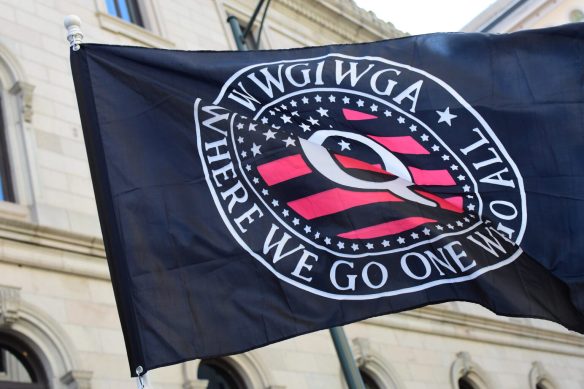
Ironically, according to the most recent Pew Research Center poll, while close to half the country has heard of QAnon, the majority of them are Democrats. Awareness of Q increased dramatically from 23 percent in March to 47 percent in September.
One reason for this is that the effort to hype the fringe conspiracy group has grown quickly. Increasingly, money flows to digital mercenaries to shame and cyberstalk not only individual targets but entire voting blocs.
QAnon is an idea with no structure, no chain of command and no rules. Anybody can pick up a YouTube channel or another social media account and claim to be an anonymous insider — and exploit and project whatever insane claim they want to make. With the rise of social media and recruitment of virtual reality and “gaming” technologists, these consultants have provided new mediums and taken the art of smearing to a new level. From slanderous TED Talks to inaccurate documentaries that defame individuals who have nothing to do with QAnon, the damage to the target can be severe. Often, those making the allegations are reliant on discredited sources.
But we cannot outlaw people who say crazy things. Whether it’s antifa in Portland, outrageous conspiracies from Q, or the Westboro Baptist Church protesting at funerals, the First Amendment protects problematic speech.
Increasingly, and regardless of your political affiliation, if you’re not echoing the establishment narrative, you are vulnerable to attack.
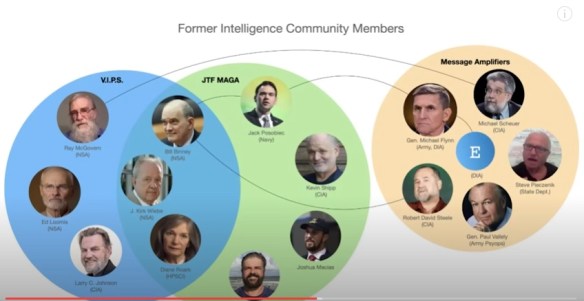
Discrediting Former Intel Members
Q character assassination has also been used in an attempt to discredit some of America’s most well-respected former members of the intelligence community, including Veteran Intelligence Professionals for Sanity. The targeting of VIPS members is strategic. One of them is former CIA analyst Ray McGovern, who chaired National Intelligence Estimates and prepared the President’s Daily Brief for Presidents Richard Nixon, Gerald Ford and Ronald Reagan. Another is former NSA technologist Bill Binney, who has also been targeted as part of the “top leadership” of Q.
For a refresher, VIPS is the group that correctly debunked from the outset the bogus “Russiagate” narrative that permeated the Trump presidency. VIPS’ report was spotlighted in The Nation with a story headlined “A New Report Raises Big Questions About Last Year’s DNC Hack.” For that criticism, these leaders were accused of working with Russia. Fast-forward to 2021 and the exact same leaders are accused of being members of the Q brain trust.
Another troubling trend is the use of foreign operatives to drive the defamation of Americans. For example, one defamer lives in Mexico while another, who lives in Europe, is a self-described former member of a fringe group known as Anonymous. It begs the question, “Who pays them?”
And what’s the potential risk in all of this as a society? Those targeted in this way can potentially lose their business, their home, their friends. All because some misguided or politically motivated cyber-mercenary on contract from Washington, D.C., or a foreign country decides to do it.
Many of the same powerful forces who drove Russiagate are the same operatives now driving the Q smears, colluding with YouTube, Twitter and Facebook to do their bidding. I’ve spoken out publicly and repeatedly against Q because I believe it is a dangerous psychological operation that harms those brainwashed by it and the innocent affected by it.
But for the past few months on social media and cable TV, there has been a dramatic uptick of pundits and shady online operatives turning Q accusations into modern-day Salem witch trials. Q is now a talking point, and painting someone with that brush can completely discredit them — even those who are innocent of the allegation.
On some days, it seems that America has entered the sort of dystopia Aldous Huxley described in his classic novel Brave New World. If this doesn’t give you pause, it should.










 After the Crash