Two for Tuesday
Reply

By John W. Whitehead & Nisha Whitehead
Source: The Rutherford Institute
“The executive power in our government is not the only, perhaps not even the principal, object of my solicitude. The tyranny of the legislature is really the danger most to be feared, and will continue to be so for many years to come. The tyranny of the executive power will come in its turn, but at a more distant period.”― Thomas Jefferson, Democracy in America
It is time to recalibrate the government.
For years now, we have suffered the injustices, cruelties, corruption and abuse of an entrenched government bureaucracy that has no regard for the Constitution or the rights of the citizenry.
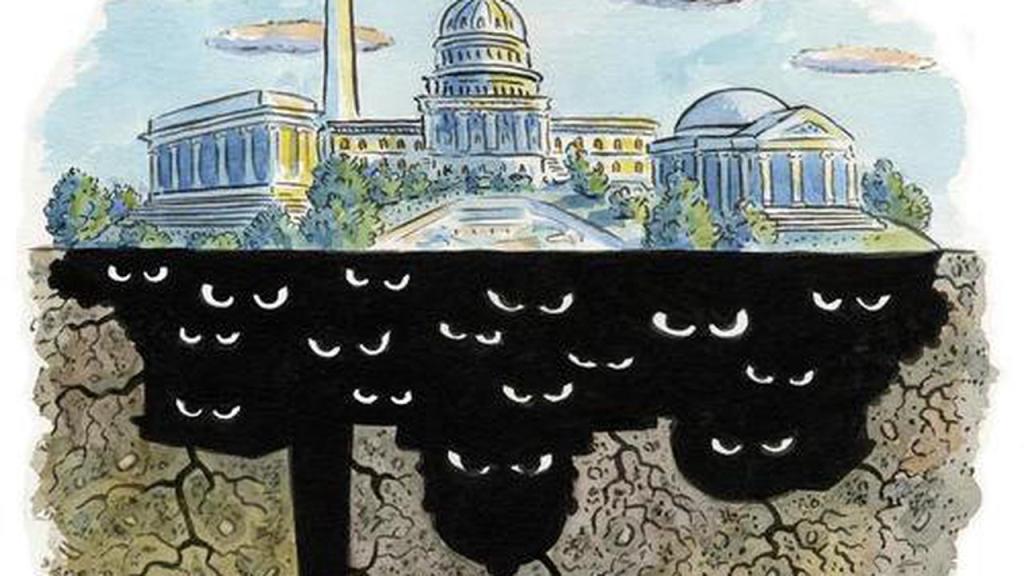
By “government,” I’m not referring to the highly partisan, two-party bureaucracy of the Republicans and Democrats. Rather, I’m referring to “government” with a capital “G,” the entrenched Deep State that is unaffected by elections, unaltered by populist movements, and has set itself beyond the reach of the law.
We are overdue for a systemic check on the government’s overreaches and power grabs.
We have lingered too long in this strange twilight zone where ego trumps justice, propaganda perverts truth, and imperial presidents—empowered to indulge their authoritarian tendencies by legalistic courts, corrupt legislatures and a disinterested, distracted populace—rule by fiat rather than by the rule of law.
This COVID-19 pandemic has provided the government with the perfect excuse to lay claim to a long laundry list of terrifying lockdown powers (at both the federal and state level) that override the Constitution: the ability to suspend the Constitution, indefinitely detain American citizens, bypass the courts, quarantine whole communities or segments of the population, override the First Amendment by outlawing religious gatherings and assemblies of more than a few people, shut down entire industries and manipulate the economy, muzzle dissidents, reshape financial markets, create a digital currency (and thus further restrict the use of cash), determine who should live or die, and impose health mandates on large segments of the population.
These kinds of crises tend to bring out the authoritarian tendencies in government.
That’s no surprise: power corrupts, and absolute power corrupts absolutely.
Where we find ourselves now is in the unenviable position of needing to rein in all three branches of government—the Executive, the Judicial, and the Legislative—that have exceeded their authority and grown drunk on power.
This is exactly the kind of concentrated, absolute power the founders attempted to guard against by establishing a system of checks of balances that separate and shares power between three co-equal branches: the executive, the legislative and the judiciary.
“The system of checks and balances that the Framers envisioned now lacks effective checks and is no longer in balance,” concludes law professor William P. Marshall. “The implications of this are serious. The Framers designed a system of separation of powers to combat government excess and abuse and to curb incompetence. They also believed that, in the absence of an effective separation-of-powers structure, such ills would inevitably follow. Unfortunately, however, power once taken is not easily surrendered.”
Unadulterated power in any branch of government is a menace to freedom.
There’s no point debating which political party would be more dangerous with these powers.
The fact that any individual—or branch of government—of any political persuasion is empowered to act like a dictator is danger enough.
So what we can do to wrest back control over a runaway government and an imperial presidency?
It won’t be easy.
We are the unwitting victims of a system so corrupt that those who stand up for the rule of law and aspire to transparency in government are in the minority.
This corruption is so vast it spans all branches of government: from the power-hungry agencies under the executive branch and the corporate puppets within the legislative branch to a judiciary that is, more often than not, elitist and biased towards government entities and corporations.
We are ruled by an elite class of individuals who are completely out of touch with the travails of the average American.
We are viewed as relatively expendable in the eyes of government: faceless numbers of individuals who serve one purpose, which is to keep the government machine running through our labor and our tax dollars. Those in power aren’t losing any sleep over the indignities we are being made to suffer or the possible risks to our health. All they seem to care about are power and control.
We are being made to suffer countless abuses at the government’s hands.
We have little protection against standing armies (domestic and military), invasive surveillance, marauding SWAT teams, an overwhelming government arsenal of assault vehicles and firepower, and a barrage of laws that criminalize everything from vegetable gardens to lemonade stands.
In the name of national security, we’re being subjected to government agencies such as the NSA, FBI and others listening in on our phone calls, reading our mail, monitoring our emails, and carrying out warrantless “black bag” searches of our homes. Adding to the abuse, we have to deal with surveillance cameras mounted on street corners and in traffic lights, weather satellites co-opted for use as spy cameras from space, and thermal sensory imaging devices that can detect heat and movement through the walls of our homes.
That doesn’t even begin to touch on the many ways in which our Fourth Amendment rights are trampled upon by militarized police and SWAT teams empowered to act as laws unto themselves.
In other words, freedom—or what’s left of it—is threatened from every direction.
The predators of the police state are wreaking havoc on our freedoms, our communities, and our lives. The government doesn’t listen to the citizenry, it refuses to abide by the Constitution, which is our rule of law, and it treats the citizenry as a source of funding and little else. Police officers are shooting unarmed citizens and their household pets. Government agents—including local police—are being armed to the teeth and encouraged to act like soldiers on a battlefield. Bloated government agencies are fleecing taxpayers. Government technicians are spying on our emails and phone calls. Government contractors are making a killing by waging endless wars abroad.
In other words, the American police state is alive and well and flourishing.
Nothing has changed, and nothing will change unless we insist on it.
We have arrived at the dystopian future depicted in the 2005 film V for Vendetta, which is no future at all.
Set in the year 2020, V for Vendetta (written and produced by the Wachowskis) provides an eerie glimpse into a parallel universe in which a government-engineered virus wreaks havoc on the world. Capitalizing on the people’s fear, a totalitarian government comes to power that knows all, sees all, controls everything and promises safety and security above all.
Concentration camps (jails, private prisons and detention facilities) have been established to house political prisoners and others deemed to be enemies of the state. Executions of undesirables (extremists, troublemakers and the like) are common, while other enemies of the state are made to “disappear.” Populist uprisings and protests are met with extreme force. The television networks are controlled by the government with the purpose of perpetuating the regime. And most of the population is hooked into an entertainment mode and are clueless.
Sounds painfully familiar, doesn’t it?
As director James McTeighe observed about the tyrannical regime in V for Vendetta, “It really showed what can happen when society is ruled by government, rather than the government being run as a voice of the people. I don’t think it’s such a big leap to say things like that can happen when leaders stop listening to the people.”
Clearly, our leaders have stopped listening to the American people.
We are—and have been for some time—the unwitting victims of a system so corrupt that those who stand up for the rule of law and aspire to transparency in government are in the minority. This corruption is so vast it spans all branches of government—from the power-hungry agencies under the executive branch and the corporate puppets within the legislative branch to a judiciary that is, more often than not, elitist and biased towards government entities and corporations.
We are ruled by an elite class of individuals who are completely out of touch with the travails of the average American. We are relatively expendable in the eyes of government—faceless numbers of individuals who serve one purpose, which is to keep the government machine running through our labor and our tax dollars.
What will it take for the government to start listening to the people again?
In V for Vendetta, as in my new novel The Erik Blair Diaries, it takes an act of terrorism for the people to finally mobilize and stand up to the government’s tyranny: in Vendetta, V the film’s masked crusader blows up the seat of government, while in Erik Blair, freedom fighters plot to unmask the Deep State.
These acts of desperation and outright anarchy are what happens when a parasitical government muzzles the citizenry, fences them in, herds them, brands them, whips them into submission, forces them to ante up the sweat of their brows while giving them little in return, and then provides them with little to no outlet for voicing their discontent: people get desperate, citizens lose hope, and lawful, nonviolent resistance gives way to unlawful, violent resistance.
This way lies madness.
Then again, this madness may be unavoidable unless we can wrest back control over our runaway government starting at the local level.
How to do this? It’s not rocket science.
There is no 10-step plan. If there were a 10-step plan, however, the first step would be as follows: turn off the televisions, tune out the politicians, and do your part to stand up for freedom principles in your own communities.
Stand up for your own rights, of course, but more importantly, stand up for the rights of those with whom you might disagree. Defend freedom at all costs. Defend justice at all costs. Make no exceptions based on race, religion, creed, politics, immigration status, sexual orientation, etc. Vote like Americans, for a change, not Republicans or Democrats.
Most of all, use your power—and there is power in our numbers—to nullify anything and everything the government does that undermines the freedom principles on which this nation was founded.
Don’t play semantics. Don’t justify. Don’t politicize it. If it carries even a whiff of tyranny, oppose it. Demand that your representatives in government cut you a better deal, one that abides by the Constitution and doesn’t just attempt to sidestep it.
That’s their job: make them do it.
As I make clear in my book Battlefield America: The War on the American People, all freedoms hang together. They fall together, as well.
The police state does not discriminate. Eventually, we will all suffer the same fate.
By John W. Whitehead & Nisha Whitehead
Source: The Rutherford Institute
“A house divided against itself cannot stand. I believe this government cannot endure, permanently, half slave and half free. I do not expect the Union to be dissolved—I do not expect the house to fall—but I do expect it will cease to be divided. It will become all one thing or all the other.”—Abraham Lincoln
History has a funny way of circling back on itself.
The facts, figures, faces and technology may change from era to era, but the dangers remain the same.
This year is no different, whatever the politicians and talking heads may say to the contrary.
Sure, there’s a new guy in charge, but for the most part, we’re still recycling the same news stories that have kept us with one eye warily glued to the news for the past 100-odd years: War. Corruption. Brutality. Economic instability. Partisan politics. Militarism. Disease. Hunger. Greed. Violence. Poverty. Ignorance. Hatred.
The more things change, the more they stay the same.
Brush up on your history, and you’ll find that we’ve been stuck on repeat for some time now.
Take the United States of America in the year 2021, which is not so far different from the United States of America during the Civil Rights era, or the Cold War era, or even the Depression era.
Go far enough afield, and you’ll find aspects of our troubled history mirrored in the totalitarianism of Nazi Germany, in the fascism of Mussolini’s Italy, and further back in the militarism of the Roman Empire.
We’re like TV weatherman Phil Connors in Harold Ramis’ classic 1993 comedy Groundhog Day, forced to live the same day over and over again.
Here in the American police state, however, we continue to wake up, hoping each new day, new president and new year will somehow be different from what has come before.
Unfortunately, no matter how we change the narrative, change the characters, change the plot lines, we seem to keep ending up in the same place that we started: enslaved, divided and repeating the mistakes of the past.
You want to know about the true State of our Nation? Listen up.
The State of the Union: The state of our nation is politically polarized, controlled by forces beyond the purview of the average American, and rapidly moving the nation away from its freedom foundation. Over the past year, due in part to the COVID-19 pandemic, Americans have found themselves repeatedly subjected to egregious civil liberties violations, invasive surveillance, martial law, lockdowns, political correctness, erosions of free speech, strip searches, police shootings of unarmed citizens, government spying, the criminalization of lawful activities, warmongering, etc.
The predators of the police state have wreaked havoc on our freedoms, our communities, and our lives. The government does not listen to the citizenry, refuses to abide by the Constitution, and treats taxpayers as a source of funding and little else. Police officers shoot unarmed citizens and their household pets. Government agents—including local police—remain armed to the teeth and act like soldiers on a battlefield. Bloated government agencies continue to fleece taxpayers. Government technicians spy on our emails and phone calls. And government contractors make a killing by waging endless wars abroad.
Consequently, the state of our nation remains bureaucratic, debt-ridden, violent, militarized, fascist, lawless, invasive, corrupt, untrustworthy, mired in war, and unresponsive to the wishes and needs of the electorate.
The policies of the American police state continue unabated.
The Executive Branch: All of the imperial powers amassed by Donald Trump, Barack Obama and George W. Bush—to kill American citizens without due process, to detain suspects indefinitely, to strip Americans of their citizenship rights, to carry out mass surveillance on Americans without probable cause, to suspend laws during wartime, to disregard laws with which he might disagree, to conduct secret wars and convene secret courts, to sanction torture, to sidestep the legislatures and courts with executive orders and signing statements, to direct the military to operate beyond the reach of the law, to act as a dictator and a tyrant, above the law and beyond any real accountability—were inherited by Joe Biden.
Biden has these powers because every successive occupant of the Oval Office has been allowed to expand the reach and power of the presidency through the use of executive orders, decrees, memorandums, proclamations, national security directives and legislative signing statements that can be activated by any sitting president. Those of us who saw this eventuality coming have been warning for years about the growing danger of the Executive Branch with its presidential toolbox of terror that could be used—and abused—by future presidents. The groundwork, we warned, was being laid for a new kind of government where it won’t matter if you’re innocent or guilty, whether you’re a threat to the nation or even if you’re a citizen. What will matter is what the president—or whoever happens to be occupying the Oval Office at the time—thinks. And if he or she thinks you’re a threat to the nation and should be locked up, then you’ll be locked up with no access to the protections our Constitution provides. In effect, you will disappear.
Our warnings continue to go unheeded.
The Legislative Branch: Congress may well be the most self-serving, semi-corrupt institution in America. Abuses of office runs the gamut from elected representatives neglecting their constituencies to engaging in self-serving practices, including the misuse of eminent domain, earmarking hundreds of millions of dollars in federal contracting in return for personal gain and campaign contributions, having inappropriate ties to lobbyist groups and incorrectly or incompletely disclosing financial information. Pork barrel spending, hastily passed legislation, partisan bickering, a skewed work ethic, graft and moral turpitude have all contributed to the public’s increasing dissatisfaction with congressional leadership. No wonder only 31 percent of Americans approve of the job Congress is doing.
The Judicial Branch: The Supreme Court was intended to be an institution established to intervene and protect the people against the government and its agents when they overstep their bounds. Yet through their deference to police power, preference for security over freedom, and evisceration of our most basic rights for the sake of order and expediency, the justices of the United States Supreme Court have become the guardians of the American police state in which we now live. As a result, sound judgment and justice have largely taken a back seat to legalism, statism and elitism, while preserving the rights of the people has been deprioritized and made to play second fiddle to both governmental and corporate interests. The courts have empowered the government to wreak havoc on our liberties. Protections for private property continue to be undermined. And Americans can no longer rely on the courts to mete out justice.
Shadow Government: Joe Biden inherited more than a bitterly divided nation teetering on the brink of financial catastrophe when he assumed office. He also inherited a shadow government, one that is fully operational and staffed by unelected officials who are, in essence, running the country. Referred to as the Deep State, this shadow government is comprised of unelected government bureaucrats, corporations, contractors, paper-pushers, and button-pushers who are actually calling the shots behind the scenes right now.
Law Enforcement: By and large the term “law enforcement” encompasses all agents within a militarized police state, including the military, local police, and the various agencies such as the Secret Service, FBI, CIA, NSA, etc. Having been given the green light to probe, poke, pinch, taser, search, seize, strip and generally manhandle anyone they see fit in almost any circumstance, all with the general blessing of the courts, America’s law enforcement officials, no longer mere servants of the people entrusted with keeping the peace but now extensions of the military, are part of an elite ruling class dependent on keeping the masses corralled, under control, and treated like suspects and enemies rather than citizens. As a result, police are becoming even more militarized and weaponized, and police shootings of unarmed individuals continue to increase.
A Suspect Surveillance Society: Every dystopian sci-fi film we’ve ever seen is suddenly converging into this present moment in a dangerous trifecta between science, technology and a government that wants to be all-seeing, all-knowing and all-powerful. By tapping into your phone lines and cell phone communications, the government knows what you say. By uploading all of your emails, opening your mail, and reading your Facebook posts and text messages, the government knows what you write. By monitoring your movements with the use of license plate readers, surveillance cameras and other tracking devices, the government knows where you go. By churning through all of the detritus of your life—what you read, where you go, what you say—the government can predict what you will do. By mapping the synapses in your brain, scientists—and in turn, the government—will soon know what you remember. And by accessing your DNA, the government will soon know everything else about you that they don’t already know: your family chart, your ancestry, what you look like, your health history, your inclination to follow orders or chart your own course, etc. Consequently, in the face of DNA evidence that places us at the scene of a crime, behavior sensing technology that interprets our body temperature and facial tics as suspicious, and government surveillance devices that cross-check our biometrics, license plates and DNA against a growing database of unsolved crimes and potential criminals, we are no longer “innocent until proven guilty.”
Military Empire: America’s endless global wars and burgeoning military empire—funded by taxpayer dollars—have depleted our resources, over-extended our military and increased our similarities to the Roman Empire and its eventual demise. Black budget spending has completely undermined any hope of fiscal transparency, with government contractors padding their pockets at the expense of taxpayers and the nation’s infrastructure—railroads, water pipelines, ports, dams, bridges, airports and roads—taking the hit. The U.S. now operates approximately 800 military bases in foreign countries around the globe at an annual cost of at least $156 billion. The consequences of financing a global military presence are dire. In fact, David Walker, former comptroller general of the U.S., believes there are “striking similarities” between America’s current situation and the factors that contributed to the fall of Rome, including “declining moral values and political civility at home, an over-confident and over-extended military in foreign lands and fiscal irresponsibility by the central government.”
I haven’t even touched on the corporate state, the military industrial complex, SWAT team raids, invasive surveillance technology, zero tolerance policies in the schools, overcriminalization, or privatized prisons, to name just a few. However, what I have touched on should be enough to show that the landscape of our freedoms has already changed dramatically from what it once was and will no doubt continue to deteriorate unless Americans can find a way to wrest back control of their government and reclaim their freedoms.
So how do we go about reclaiming our freedoms and reining in our runaway government?
Essentially, there are four camps of thought among the citizenry when it comes to holding the government accountable. Which camp you fall into says a lot about your view of government—or, at least, your view of whichever administration happens to be in power at the time.
In the first camp are those who trust the government to do the right thing, despite the government’s repeated failures in this department.
In the second camp are those who not only don’t trust the government but think the government is out to get them.
In the third camp are those who see government neither as an angel nor a devil, but merely as an entity that needs to be controlled, or as Thomas Jefferson phrased it, bound “down from mischief with the chains of the Constitution.”
Then there’s the fourth camp, comprised of individuals who pay little to no attention to the workings of government. Easily entertained, easily distracted, easily led, these are the ones who make the government’s job far easier than it should be.
It is easy to be diverted, distracted and amused by the antics of politicians, the pomp and circumstance of awards shows, athletic events, and entertainment news, and the feel-good evangelism that passes for religion today.
What is far more difficult to face up to is the reality of life in America, where unemployment, poverty, inequality, injustice and violence by government agents are increasingly norms.
The powers-that-be want us to remain divided, alienated from each other based on our politics, our bank accounts, our religion, our race and our value systems. Yet as George Orwell observed, “The real division is not between conservatives and revolutionaries but between authoritarians and libertarians.”
The only distinction that matters anymore is where you stand in the American police state.
In other words, you’re either part of the problem or part of the solution.
America is at a crossroads.
History may show that from this point forward, we will have left behind any semblance of constitutional government and entered into a militaristic state where all citizens are suspects and security trumps freedom.
Certainly, we have moved beyond the era of representative government and entered a new age: the age of authoritarianism. Even with its constantly shifting terrain, this topsy-turvy travesty of law and government has become America’s new normal.
As long as we continue to put our politics ahead of our principles—moral, legal and constitutional—“we the people” will lose.
And you know who will keep winning by playing on our prejudices, capitalizing on our fears, deepening our distrust of our fellow citizens, and dividing us into polarized, warring camps incapable of finding consensus on the one true menace that is an immediate threat to all of our freedoms? The government.
As I make clear in my book Battlefield America: The War on the American People and its fictional counterpart The Erik Blair Diaries, when we lose sight of the true purpose of government—to protect our rights—and fail to keep the government in its place as our servant, we allow the government to overstep its bounds and become a tyrant that rules by brute force.

By John Tierney
Source: Waking Times
The United States suffered through two lethal waves of contagion in the past year and a half. The first was a viral pandemic that killed about one in 500 Americans—typically, a person over 75 suffering from other serious conditions. The second, and far more catastrophic, was a moral panic that swept the nation’s guiding institutions.
Instead of keeping calm and carrying on, the American elite flouted the norms of governance, journalism, academic freedom—and, worst of all, science. They misled the public about the origins of the virus and the true risk that it posed. Ignoring their own carefully prepared plans for a pandemic, they claimed unprecedented powers to impose untested strategies, with terrible collateral damage. As evidence of their mistakes mounted, they stifled debate by vilifying dissenters, censoring criticism, and suppressing scientific research.
If, as seems increasingly plausible, the coronavirus that causes Covid-19 leaked out of a laboratory in Wuhan, it is the costliest blunder ever committed by scientists. Whatever the pandemic’s origin, the response to it is the worst mistake in the history of the public-health profession. We still have no convincing evidence that the lockdowns saved lives, but lots of evidence that they have already cost lives and will prove deadlier in the long run than the virus itself.
One in three people worldwide lost a job or a business during the lockdowns, and half saw their earnings drop, according to a Gallup poll. Children, never at risk from the virus, in many places essentially lost a year of school. The economic and health consequences were felt most acutely among the less affluent in America and in the rest of the world, where the World Bank estimates that more than 100 million have been pushed into extreme poverty.
The leaders responsible for these disasters continue to pretend that their policies worked and assume that they can keep fooling the public. They’ve promised to deploy these strategies again in the future, and they might even succeed in doing so—unless we begin to understand what went wrong.
The panic was started, as usual, by journalists. As the virus spread early last year, they highlighted the most alarming statistics and the scariest images: the estimates of a fatality rate ten to 50 times higher than the flu, the chaotic scenes at hospitals in Italy and New York City, the predictions that national health-care systems were about to collapse.
The full-scale panic was set off by the release in March 2020 of a computer model at the Imperial College in London, which projected that—unless drastic measures were taken—intensive-care units would have 30 Covid patients for every available bed and that America would see 2.2 million deaths by the end of the summer. The British researchers announced that the “only viable strategy” was to impose draconian restrictions on businesses, schools, and social gatherings until a vaccine arrived.
This extraordinary project was swiftly declared the “consensus” among public-health officials, politicians, journalists, and academics. Anthony Fauci, director of the National Institute of Allergy and Infectious Diseases, endorsed it and became the unassailable authority for those purporting to “follow the science.” What had originally been a limited lockdown—“15 days to slow the spread”—became long-term policy across much of the United States and the world. A few scientists and public-health experts objected, noting that an extended lockdown was a novel strategy of unknown effectiveness that had been rejected in previous plans for a pandemic. It was a dangerous experiment being conducted without knowing the answer to the most basic question: Just how lethal is this virus?
The most prominent early critic was John Ioannidis, an epidemiologist at Stanford, who published an essay for STAT headlined “A Fiasco in the Making? As the Coronavirus Pandemic Takes Hold, We Are Making Decisions Without Reliable Data.” While a short-term lockdown made sense, he argued, an extended lockdown could prove worse than the disease, and scientists needed to do more intensive testing to determine the risk. The article offered common-sense advice from one of the world’s most frequently cited authorities on the credibility of medical research, but it provoked a furious backlash on Twitter from scientists and journalists.
The fury intensified in April 2020, when Ioannidis followed his own advice by joining with Jay Bhattacharya and other colleagues from Stanford to gauge the spread of Covid in the surrounding area, Santa Clara County. After testing for Covid antibodies in the blood of several thousand volunteers, they estimated that the fatality rate among the infected in the county was about 0.2 percent, twice as high as for the flu but considerably lower than the assumptions of public-health officials and computer modelers. The researchers acknowledged that the fatality rate could be substantially higher in other places where the virus spread extensively in nursing homes (which hadn’t yet occurred in the Santa Clara area). But merely by reporting data that didn’t fit the official panic narrative, they became targets.
Other scientists lambasted the researchers and claimed that methodological weaknesses in the study made the results meaningless. A statistician at Columbia wrote that the researchers “owe us all an apology.” A biologist at the University of North Carolina said that the study was “horrible science.” A Rutgers chemist called Ioannidis a “mediocrity” who “cannot even formulate a simulacrum of a coherent, rational argument.” A year later, Ioannidis still marvels at the attacks on the study (which was eventually published in a leading epidemiology journal). “Scientists whom I respect started acting like warriors who had to subvert the enemy,” he says. “Every paper I’ve written has errors—I’m a scientist, not the pope—but the main conclusions of this one were correct and have withstood the criticism.”
Mainstream journalists piled on with hit pieces quoting critics and accusing the researchers of endangering lives by questioning lockdowns. The Nation called the research a “black mark” for Stanford. The cheapest shots came from BuzzFeed, which devoted thousands of words to a series of trivial objections and baseless accusations. The article that got the most attention was BuzzFeed’s breathless revelation that an airline executive opposed to lockdowns had contributed $5,000—yes, five thousand dollars!—to an anonymized fund at Stanford that had helped finance the Santa Clara fieldwork.
The notion that a team of prominent academics, who were not paid for their work in the study, would risk their reputations by skewing results for the sake of a $5,000 donation was absurd on its face—and even more ludicrous, given that Ioannidis, Bhattacharya, and the lead investigator, Eran Bendavid, said that they weren’t even aware of the donation while conducting the study. But Stanford University was so cowed by the online uproar that it subjected the researchers to a two-month fact-finding inquiry by an outside legal firm. The inquiry found no evidence of conflict of interest, but the smear campaign succeeded in sending a clear message to scientists everywhere: Don’t question the lockdown narrative.
In a brief interlude of journalistic competence, two veteran science writers, Jeanne Lenzer and Shannon Brownlee, published an article in Scientific American decrying the politicization of Covid research. They defended the integrity and methodology of the Stanford researchers, noting that some subsequent studies had found similar rates of fatality among the infected. (In his latest review of the literature, Ioannidis now estimates that the average fatality rate in Europe and the Americas is 0.3 to 0.4 percent and about 0.2 percent among people not living in institutions.) Lenzer and Brownlee lamented that the unjust criticism and ad hominem vitriol had suppressed a legitimate debate by intimidating the scientific community. Their editors then proceeded to prove their point. Responding to more online fury, Scientific American repented by publishing an editor’s note that essentially repudiated its own article. The editors printed BuzzFeed’s accusations as the final word on the matter, refusing to publish a rebuttal from the article’s authors or a supporting letter from Jeffrey Flier, former dean of Harvard Medical School. Scientific American, long the most venerable publication in its field, now bowed to the scientific authority of BuzzFeed.
Editors of research journals fell into line, too. When Thomas Benfield, one of the researchers in Denmark conducting the first large randomized controlled trial of mask efficacy against Covid, was asked why they were taking so long to publish the much-anticipated findings, he promised them as “as soon as a journal is brave enough to accept the paper.” After being rejected by The Lancet, The New England Journal of Medicine, and JAMA, the study finally appeared in the Annals of Internal Medicine, and the reason for the editors’ reluctance became clear: the study showed that a mask did not protect the wearer, which contradicted claims by the Centers for Disease Control and other health authorities.
Stefan Baral, an epidemiologist at Johns Hopkins with 350 publications to his name, submitted a critique of lockdowns to more than ten journals and finally gave up—the “first time in my career that I could not get a piece placed anywhere,” he said. Martin Kulldorff, an epidemiologist at Harvard, had a similar experience with his article, early in the pandemic, arguing that resources should be focused on protecting the elderly. “Just as in war,” Kulldorff wrote, “we must exploit the characteristics of the enemy in order to defeat it with the minimum number of casualties. Since Covid-19 operates in a highly age specific manner, mandated counter measures must also be age specific. If not, lives will be unnecessarily lost.” It was a tragically accurate prophecy from one of the leading experts on infectious disease, but Kulldorff couldn’t find a scientific journal or media outlet to accept the article, so he ended up posting it on his own LinkedIn page. “There’s always a certain amount of herd thinking in science,” Kulldorff says, “but I’ve never seen it reach this level. Most of the epidemiologists and other scientists I’ve spoken to in private are against lockdowns, but they’re afraid to speak up.”
To break the silence, Kulldorff joined with Stanford’s Bhattacharya and Sunetra Gupta of Oxford to issue a plea for “focused protection,” called the Great Barrington Declaration. They urged officials to divert more resources to shield the elderly, such as doing more tests of the staff at nursing homes and hospitals, while reopening business and schools for younger people, which would ultimately protect the vulnerable as herd immunity grew among the low-risk population.
They managed to attract attention but not the kind they hoped for. Though tens of thousands of other scientists and doctors went on to sign the declaration, the press caricatured it as a deadly “let it rip” strategy and an “ethical nightmare” from “Covid deniers” and “agents of misinformation.” Google initially shadow-banned it so that the first page of search results for “Great Barrington Declaration” showed only criticism of it (like an article calling it “the work of a climate denial network”) but not the declaration itself. Facebook shut down the scientists’ page for a week for violating unspecified “community standards.”
The most reviled heretic was Scott Atlas, a medical doctor and health-policy analyst at Stanford’s Hoover Institution. He, too, urged focused protection on nursing homes and calculated that the medical, social, and economic disruptions of the lockdowns would cost more years of life than the coronavirus. When he joined the White House coronavirus task force, Bill Gates derided him as “this Stanford guy with no background” promoting “crackpot theories.” Nearly 100 members of Stanford’s faculty signed a letter denouncing his “falsehoods and misrepresentations of science,” and an editorial in the Stanford Daily urged the university to sever its ties to Hoover.
The Stanford faculty senate overwhelmingly voted to condemn Atlas’s actions as “anathema to our community, our values and our belief that we should use knowledge for good.” Several professors from Stanford’s medical school demanded further punishment in a JAMA article, “When Physicians Engage in Practices That Threaten the Nation’s Health.” The article, which misrepresented Atlas’s views as well as the evidence on the efficacy of lockdowns, urged professional medical societies and medical-licensing boards to take action against Atlas on the grounds that it was “ethically inappropriate for physicians to publicly recommend behaviors or interventions that are not scientifically well grounded.”
But if it was unethical to recommend “interventions that are not scientifically well grounded,” how could anyone condone the lockdowns? “It was utterly immoral to conduct this society-wide intervention without the evidence to justify it,” Bhattacharya says. “The immediate results have been disastrous, especially for the poor, and the long-term effect will be to fundamentally undermine trust in public health and science.” The traditional strategy for dealing with pandemics was to isolate the infected and protect the most vulnerable, just as Atlas and the Great Barrington scientists recommended. The CDC’s pre-pandemic planning scenarios didn’t recommend extended school closures or any shutdown of businesses even during a plague as deadly as the 1918 Spanish flu. Yet Fauci dismissed the focused-protection strategy as “total nonsense” to “anybody who has any experience in epidemiology and infectious diseases,” and his verdict became “the science” to leaders in America and elsewhere.
Fortunately, a few leaders followed the science in a different way. Instead of blindly trusting Fauci, they listened to his critics and adopted the focused-protection strategy—most notably, in Florida. Its governor, Ron DeSantis, began to doubt the public-health establishment early in the pandemic, when computer models projected that Covid patients would greatly outnumber hospital beds in many states. Governors in New York, New Jersey, Pennsylvania, and Michigan were so alarmed and so determined to free up hospital beds that they directed nursing homes and other facilities to admit or readmit Covid patients—with deadly results.
But DeSantis was skeptical of the hospital projections—for good reason, as no state actually ran out of beds—and more worried about the risk of Covid spreading in nursing homes. He forbade long-term-care centers to admit anyone infected with Covid and ordered frequent testing of the staff at senior-care centers. After locking down last spring, he reopened businesses, schools, and restaurants early, rejected mask mandates, and ignored protests from the press and the state’s Democratic leaders. Fauci warned that Florida was “asking for trouble,” but DeSantis went on seeking and heeding advice from Atlas and the Great Barrington scientists, who were astonished to speak with a politician already familiar with just about every study they mentioned to him.
“DeSantis was an incredible outlier,” Atlas says. “He dug up the data and read the scientific papers and analyzed it all himself. In our discussions, he’d bounce ideas off me, but he was already on top of the details of everything. He always had the perspective to see the larger harms of lockdowns and the need to concentrate testing and other resources on the elderly. And he has been proven correct.”
If Florida had simply done no worse than the rest of the country during the pandemic, that would have been enough to discredit the lockdown strategy. The state effectively served as the control group in a natural experiment, and no medical treatment with dangerous side effects would be approved if the control group fared no differently from the treatment group. But the outcome of this experiment was even more damning.
Florida’s mortality rate from Covid is lower than the national average among those over 65 and also among younger people, so that the state’s age-adjusted Covid mortality rate is lower than that of all but ten other states. And by the most important measure, the overall rate of “excess mortality” (the number of deaths above normal), Florida has also done better than the national average. Its rate of excess mortality is significantly lower than that of the most restrictive state, California, particularly among younger adults, many of whom died not from Covid but from causes related to the lockdowns: cancer screenings and treatments were delayed, and there were sharp increases in deaths from drug overdoses and from heart attacks not treated promptly.
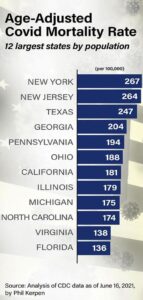
Chart by Jamie Meggas
If the treatment group in a clinical trial were dying off faster than the control group, an ethical researcher would halt the experiment. But the lockdown proponents were undeterred by the numbers in Florida, or by similar results elsewhere, including a comparable natural experiment involving European countries with the least restrictive policies. Sweden, Finland, and Norway rejected mask mandates and extended lockdowns, and they have each suffered significantly less excess mortality than most other European countries during the pandemic.
A nationwide analysis in Sweden showed that keeping schools open throughout the pandemic, without masks or social distancing, had little effect on the spread of Covid, but school closures and mask mandates for students continued elsewhere. Another Swedish researcher, Jonas Ludvigsson, reported that not a single schoolchild in the country died from Covid in Sweden and that their teachers’ risk of serious illness was lower than for the rest of the workforce—but these findings provoked so many online attacks and threats that Ludvigsson decided to stop researching or discussing Covid.
Social-media platforms continued censoring scientists and journalists who questioned lockdowns and mask mandates. YouTube removed a video discussion between DeSantis and the Great Barrington scientists, on the grounds that it “contradicts the consensus” on the efficacy of masks, and also took down the Hoover Institution’s interview with Atlas. Twitter locked out Atlas and Kulldorff for scientifically accurate challenges to mask orthodoxy. A peer-reviewed German study reporting harms to children from mask-wearing was suppressed on Facebook (which labeled my City Journal article “Partly False” because it cited the study) and also at ResearchGate, one of the most widely used websites for scientists to post their papers. ResearchGate refused to explain the censorship to the German scientists, telling them only that the paper was removed from the website in response to “reports from the community about the subject-matter.”
The social-media censors and scientific establishment, aided by the Chinese government, succeeded for a year in suppressing the lab-leak theory, depriving vaccine developers of potentially valuable insights into the virus’s evolution. It’s understandable, if deplorable, that the researchers and officials involved in supporting the Wuhan lab research would cover up the possibility that they’d unleashed a Frankenstein on the world. What’s harder to explain is why journalists and the rest of the scientific community so eagerly bought that story, along with the rest of the Covid narrative.
Why the elite panic? Why did so many go so wrong for so long? When journalists and scientists finally faced up to their mistake in ruling out the lab-leak theory, they blamed their favorite villain: Donald Trump. He had espoused the theory, so they assumed it must be wrong. And since he disagreed at times with Fauci about the danger of the virus and the need for lockdowns, then Fauci must be right, and this was such a deadly plague that the norms of journalism and science must be suspended. Millions would die unless Fauci was obeyed and dissenters were silenced.
But neither the plague nor Trump explains the panic. Yes, the virus was deadly, and Trump’s erratic pronouncements contributed to the confusion and partisanship, but the panic was due to two preexisting pathologies that afflicted other countries, too. The first is what I have called the Crisis Crisis, the incessant state of alarm fomented by journalists and politicians. It’s a longstanding problem—humanity was supposedly doomed in the last century by the “population crisis” and the “energy crisis”—that has dramatically worsened with the cable and digital competition for ratings, clicks, and retweets. To keep audiences frightened around the clock, journalists seek out Cassandras with their own incentives for fearmongering: politicians, bureaucrats, activists, academics, and assorted experts who gain publicity, prestige, funding, and power during a crisis.
Unlike many proclaimed crises, an epidemic is a genuine threat, but the crisis industry can’t resist exaggerating the danger, and doomsaying is rarely penalized. Early in the 1980s AIDS epidemic, the New York Times reported the terrifying possibility that the virus could spread to children through “routine close contact”—quoting from a study by Anthony Fauci. Life magazine wildly exaggerated the number of infections in a cover story, headlined “Now No One Is Safe from AIDS.” It cited a study by Robert Redfield, the future leader of the CDC during the Covid pandemic, predicting that AIDS would soon spread as rapidly among heterosexuals as among homosexuals. Both scientists were absolutely wrong, of course, but the false alarms didn’t harm their careers or their credibility.
Journalists and politicians extend professional courtesy to fellow crisis-mongers by ignoring their mistakes, such as the previous predictions by Neil Ferguson. His team at Imperial College projected up to 65,000 deaths in the United Kingdom from swine flu and 200 million deaths worldwide from bird flu. The death toll each time was in the hundreds, but never mind: when Ferguson’s team projected millions of American deaths from Covid, that was considered reason enough to follow its recommendation for extended lockdowns. And when the modelers’ assumption about the fatality rate proved too high, that mistake was ignored, too.
Journalists kept highlighting the most alarming warnings, presented without context. They needed to keep their audience scared, and they succeeded. For Americans under 70, the probability of surviving a Covid infection was about 99.9 percent, but fear of the virus was higher among the young than among the elderly, and polls showed that people of all ages vastly overestimated the risk of being hospitalized or dying.
The second pathology underlying the elite’s Covid panic is the politicization of research—what I have termed the Left’s war on science, another long-standing problem that has gotten much worse. Just as the progressives a century ago yearned for a nation directed by “expert social engineers”—scientific high priests unconstrained by voters and public opinion—today’s progressives want sweeping new powers for politicians and bureaucrats who “believe in science,” meaning that they use the Left’s version of science to justify their edicts. Now that so many elite institutions are political monocultures, progressives have more power than ever to enforce groupthink and suppress debate. Well before the pandemic, they had mastered the tactics for demonizing and silencing scientists whose findings challenged progressive orthodoxy on issues such as IQ, sex differences, race, family structure, transgenderism, and climate change.
And then along came Covid—“God’s gift to the Left,” in Jane Fonda’s words. Exaggerating the danger and deflecting blame from China to Trump offered not only short-term political benefits, damaging his reelection prospects, but also an extraordinary opportunity to empower social engineers in Washington and state capitals. Early in the pandemic, Fauci expressed doubt that it was politically possible to lock down American cities, but he underestimated the effectiveness of the crisis industry’s scaremongering. Americans were so frightened that they surrendered their freedoms to work, study, worship, dine, play, socialize, or even leave their homes. Progressives celebrated this “paradigm shift,” calling it a “blueprint” for dealing with climate change.
This experience should be a lesson in what not to do, and whom not to trust. Do not assume that the media’s version of a crisis resembles reality. Do not count on mainstream journalists and their favorite doomsayers to put risks in perspective. Do not expect those who follow “the science” to know what they’re talking about. Science is a process of discovery and debate, not a faith to profess or a dogma to live by. It provides a description of the world, not a prescription for public policy, and specialists in one discipline do not have the knowledge or perspective to guide society. They’re biased by their own narrow focus and self-interest. Fauci and Deborah Birx, the physician who allied with him against Atlas on the White House task force, had to answer for the daily Covid death toll—that ever-present chyron at the bottom of the television screen—so they focused on one disease instead of the collateral damage of their panic-driven policies.
“The Fauci-Birx lockdowns were a sinful, unconscionable, heinous mistake, and they will never admit they were wrong,” Atlas says. Neither will the journalists and politicians who panicked along with them. They’re still portraying lockdowns as not just a success but also a precedent—proof that Americans can sacrifice for the common good when directed by wise scientists and benevolent autocrats. But the sacrifice did far more harm than good, and the burden was not shared equally. The brunt was borne by the most vulnerable in America and the poorest countries of the world. Students from disadvantaged families suffered the most from school closures, and children everywhere spent a year wearing masks solely to assuage the neurotic fears of adults. The less educated lost jobs so that professionals at minimal risk could feel safer as they kept working at home on their laptops. Silicon Valley (and its censors) prospered from lockdowns that bankrupted local businesses.
Luminaries united on Zoom and YouTube to assure the public that “we’re all in this together.” But we weren’t. When the panic infected the nation’s elite—the modern gentry who profess such concern for the downtrodden—it turned out that they weren’t so different from aristocrats of the past. They were in it for themselves.

“Pootie Tang” (2001) is a comedy written and directed by Louis C.K. starring Lance Crouther, Chris Rock, Wanda Sykes, Jennifer Coolidge and Robert Vaughn. It’s a feature film adaptation of a comedy sketch from The Chris Rock Show and also features appearances by Kristen Bell, David Cross, Missy Elliot, Conan O’Brien, and Bob Costas. Louis C.K. has been in cultural exile for legitimate reasons and this early film of his was unanimously panned by film critics upon release. However, like even worse offenders such as Woody Allen, he was able to make people laugh (with collaboration of a talented cast and crew) and since none of the material in the film is related to what C.K. is now infamous for and he doesn’t appear in the film, it’s still possible to watch without constant reminding of the perversion of the director (whose actions aren’t as evil as Allen’s though still terrible). So I’d encourage anyone in the mood for a dumb comedy to check it out, especially those with an appreciation for blaxploitation b-movies and anti-corporate co-optation fables.
Watch Pootie Tang on Kanopy here: https://www.kanopy.com/product/pootie-tang

By Robert J. Burrowes
For many people desperate to see a return to a life that is more familiar, it is still easy to believe that the upheavals we have experienced since March 2020 and the changes that have been wrought in their train are ‘temporary’, even if they are starting to ‘drag on’ somewhat longer than hoped.
However, anyone who is paying attention to what is taking place in the background is well aware that the life we knew before 2020 has already ended and what is being systematically put in its place as the World Economic Forum (WEF) implements its ‘Great Reset’ will bear no comparison to any period prior to last year. See ‘Killing Democracy Once and for All: The Global Elite’s Coup d’état That Is Destroying Life as We Know It’.
Of course, those of us who qualify as ‘ordinary people’ have had no say in the shape of what is being implemented: that shaping has been the prerogative of the criminal global elite which is now implementing a plan that has been decades in the making and built on hundreds of years of steady consolidation of elite power.
Also, of course, there is nothing about this shaping that is good for us. In simple terms, it is reshaping the human ‘individual’ so that previously fundamental concepts such as human identity, human liberty, human rights (such as freedom of speech, assembly and movement), human privacy and human volition are not just notions of the past but are beyond the comprehension of the typical ‘transhuman’. At the same time, the global elite is restructuring human society into a technocratic dystopia which is a nightmarish cross between ‘Brave New World’, ‘1984’ and the Dark Age. See ‘Strategically Resisting the New Dark Age: The 7 Days Campaign to Resist The Great Reset’.
The only question remaining is this: ‘Can we mobilize adequate strategic resistance – that is, resistance that systematically undermines the power of the global elite to conduct this coup and restores power to ordinary people – to defeat this coup?’
But before I answer that question, I wish to highlight just one element of the elite coup that is taking place and outline the profound changes that are being left in its wake unless we stop them.
These changes are essentially related to the capacities of computerized technologies to deprive us of what little we have left of our financial autonomy, including because any notion of privacy is rapidly vanishing.
One reason for highlighting the issue of money is because while it is good to see increasing critical attention being paid to the ‘injectables’ program, with its devastating consequences for humanity, far too little attention is being paid to the profoundly important transformation being wrought under cover of the elite-driven narrative which has virtually all people’s attention distracted from this deeper agenda. And while this deeper agenda entails a great many aspects, one subset of these is related to the way in which the global financial system is being re-engineered to play its role in fully controlling the human population.
In a series of reports issued in early 2020, the Deutsche Bank claimed that ‘cash will be around for a long time’. See the three reports accessible from ‘Transition to digital payments could “rebalance global economic power”’.
However, these reports are contradicted by other research and the ongoing evidence that cash is vanishing. Most importantly, there is no doubt about the elite intention in this regard. They want cash gone.
The digitization of money has been occurring for decades and it is now being accelerated dramatically.
Moreover, the World Economic Forum and other elite organizations have been actively working towards achieving a cashless economy for years. To get a sense of this trend, see ‘Why we need a “less-cash society”’ and ‘The US should get rid of cash and move to a digital currency, says this Nobel Laureate economist’.
Notably, in this respect, the ‘Better Than Cash Alliance’ has 78 members ‘committed to digitizing payments.’ If you think that this is a grassroots initiative set up by people like you and me, you will be surprised to read that the Bill & Melinda Gates Foundation is a ‘Resource Partner’ to the initiative along with some UN agencies, many national governments and corporations such as Mastercard and Visa.
So while the trend toward a cashless society has been progressing steadily for some decades, with countries like Denmark, Norway and Sweden already virtually cashless and India rapidly moving in that direction – see ‘India’s PM Modi defends cash ban, announces incentives’ – the so-called ‘Covid-19 pandemic’ was contrived partly to provide a pretext for further accelerating the move from cash to cards and apps, with increasing numbers of people using the digital methods, even for small sums, partly because some people were scared into believing that the ‘virus’ could be transmitted by bills and coins.
But there is more. In addition to measures not mentioned here, other plans include the use of a facial scan that records your entry to a store and is linked to artificial intelligence that identifies you and your credit rating. This then enables, or otherwise, your ability to pay for goods and services based on this facial scan.
‘Does all of this matter’, you might ask. Well the convenience of cards and apps has two significant costs: your privacy and your freedom. You lose both simply because while paying with cash is anonymous, paying by card or app leaves a digital trail that is as difficult to follow as an elephant whose tail you are already holding. And this digital trail forms a vital part of the surveillance grid that enables all of those who are tracking and documenting your movement, your payments and your behaviour to do so without leaving the comfort of their chairs. For more detail on this, watch ‘Cash or card – will COVID-19 kill cash?’ which is embedded in the article ‘Cash or Card – Will COVID-19 Kill Cash? Leaving a Digital Footprint With Every Payment’.
But it goes beyond this. As touched on above in relation to privacy and explained at some length by Whitney Webb, ‘there is a related push by WEF partners to “tackle cybercrime” that seeks to end privacy and the potential for anonymity on the internet in general, by linking government-issued IDs to internet access. Such a policy would allow governments to surveil every piece of online content accessed as well as every post or comment authored by each citizen, supposedly to ensure that no citizen can engage in “criminal” activity online.
‘Notably, the WEF Partnership against Cybercrime employs a very broad definition of what constitutes a “cybercriminal” as they apply this label readily to those who post or host content deemed to be “disinformation” that represents a threat to “democratic” governments. The WEF’s interest in criminalizing and censoring online content has been made evident by its recent creation of a new Global Coalition for Digital Safety to facilitate the increased regulation of online speech by both the public and private sectors.’ See ‘Ending Anonymity: Why the WEF’s Partnership Against Cybercrime Threatens the Future of Privacy’.
But to get back to cash: Unfortunately for us, the global elite does not intend to leave the abolition of cash to our ‘preference for the convenience of cards’ and other moves to entice us to switch to digital payment. It fully intends to force us to accept digital methods as the only means of payment.
In part, this is because electronic payments are extremely lucrative for banks and payment service providers, while the data broker industry is also making huge revenues. See ‘Cash or Card – Will COVID-19 Kill Cash? Leaving a Digital Footprint With Every Payment’.
And in some ways, ‘killing cash’ is simple. Two obvious ways of doing so are by removing ATMs (including from shopping centres) and closing local bank branches so that cash is simply unavailable. As has been happening for some time. See ‘Why Are ATMs Disappearing at an Alarming Rate after a Wave of Branch Closures?’ and ‘Australian bank branches and ATMs are vanishing’.
But, in this instance, even profitability is at the trivial end of the elite motivation spectrum.
Cash is being forced out of existence because it undermines the elite agenda to take all power from ordinary people.
So, in parallel with other regressions over the past 18 months as the elite coup to take complete control of our lives has continued to unfold, there have been ‘warnings’ from various institutions – including the World Economic Forum and the Carnegie Endowment for International Peace – about the possibility of an ‘allegedly imminent cyber attack that will collapse the existing financial system’.
Following a simulation in 2020, in which the World Economic Forum along with the Russian government and global banks conducted a high-profile cyberattack simulation that targeted the financial industry, another simulation was held on 9 July 2021 involving the World Economic Forum and the Russian government-owned Sberbank as well as other key financial agents. See ‘Cyber Polygon’ and ‘Cyber Polygon 2021’. In reality, of course, such a collapse of the financial system would constitute ‘the final yet necessary step’ to implement the World Economic Forum’s desired outcome of forcing a widespread shift ‘to digital currency and increased global governance of the international economy’.
If this financial collapse happens, the ‘solution’ suggested by key agencies – ‘to unite the national security apparatus and the finance industry first, and then use that as a model to do the same with other sectors of the economy’ – will ensure that we lose what little control is left in our lives, not just in relation to our financial resources but in all other domains as well. For a full explanation, see ‘WEF Warns of Cyber Attack Leading to Systemic Collapse of the Global Financial System’.
And for another account of the deeper agenda and its financial impacts already, including its ‘economic genocide’, as well as what is yet to happen, watch this interview of Catherine Austin Fitts: ‘Globalist Central Banking New World Order Reset Plan’.
Beyond this, if you want some insight into another key threat in the cybercrime realm, check out this video by the Ice Age Farmer in relation to the cyber threat to the power grid. See ‘“Next Crisis Bigger than COVID” – Power Grid/Finance Down – WEF’s Cyber Polygon’.
Fortunately, there is some resistance already.
In response to concerns in the United States that businesses that refuse cash will disadvantage communities with poor access to traditional banking systems, there are signs that ‘a national movement protecting consumers’ ability to pay in cash may be emerging’ with a number of states and cities already outlawing cashless outlets. See ‘Cash or Credit? State and City Bans on Cashless Retailers Are on the Rise’.
Realistically, however, given what is at stake, considerable elite pressure will be applied to reverse these decisions in time. So we need our defense to be more rigorous and less reliant on agents who are unlikely to be tough enough to defend our interests or will be sidelined or killed for doing so, as at least two national presidents who resisted the elite intention last year have since been killed. See ‘Coronavirus and Regime Change: Burundi’s Covid Coup’ and ‘John Magufuli: Death of an African Freedom Fighter’.
Moreover, given the likelihood that the financial system will be deliberately crashed at some point – and possibly soon – we need to employ a variety of tactics, that build resilience into our resistance, to defeat this initiative.
Hence, storing and paying with cash, moving your accounts to local community banks or credit unions (and away from the large corporate banks) and making the effort to become more self-reliant, particularly in food production, will increase your resilience, as will participating in local trading schemes, whether involving local currencies or goods and services directly.
As with all elements of the defense we implement, it will need to be multi-layered and integrated into the overall defense strategy. The elite intends to kill off many of us – as the depopulation measures within the coup, including the destruction of the global economy throwing 500,000,000 people out of work and killing millions as a result, as well as the ‘injectables’ program already killing tens of thousands, make perfectly clear – and enslave the rest.
For an integrated strategy to defeat the elite coup, see the ‘We Are Human, We Are Free’ campaign, which has 29 strategic goals for defeating the coup including meaningful engagement with police and military forces to assist them to understand and resist, rather than support, the elite agenda.
But for a simpler presentation, see the 7 Days Campaign to Resist The Great Reset. The Telegram group is here.
One of the interesting challenges about the current ‘Covid-19 Crisis’ is that it continues to very successfully distract most people from awareness of the deeper agenda: the Global Elite’s ‘Great Reset’ and related initiatives, such as that discussed above in relation to money.
Hence, apart from the perennial problem of raising awareness and mobilizing resistance among those still believing the elite-driven propaganda, we face two key strategic hazards.
The first hazard is a longstanding one: while virtually all people believe that elite agents – in this case, governments – are controlling events, much ‘resistance’ will focus on begging governments, through such things as petitions and protest demonstrations, to ‘fix it’ for us. The elite has long dissipated our dissent by having us direct it at one or other of its agents. This case is no different. And while we are not using our occasional large rallies to inform people how to resist powerfully every day of their life, these rallies are a waste of time whatever solidarity they build in the short term. History is categorically instructive on that point.
A second strategic hazard we face is that resistance to the ‘vaccine’ and the ‘vaccine’ passport might be ‘successful’ (in the sense that concerted actions stall some government implementation of some measures in relation to these two initiatives) and leave most people believing that they have ‘won’, while the deeper agenda remains in the shadows with virtually no-one resisting.
It is important, therefore, that those who are aware of the deeper agenda continue to provide opportunities for others to become aware of this too and the fundamental threat it poses to us all while also sharing how we can resist its key dimensions in a way that makes a difference. It is not enough to complain about elite agents, such as governments, the medical and pharmaceutical industries, and the corporate media.
We must strategically resist the elite coup itself with actions such as those in the 7 Days Campaign to Resist The Great Reset before we find ourselves locked in a technocratic prison without the free-willed minds necessary to analyze, critique, plan and act.
Robert J. Burrowes has a lifetime commitment to understanding and ending human violence. He has done extensive research since 1966 in an effort to understand why human beings are violent and has been a nonviolent activist since 1981. He is the author of ‘Why Violence?’ His email address is flametree@riseup.net and his website is here.

By Charles Hugh Smith
Source: Of Two Minds
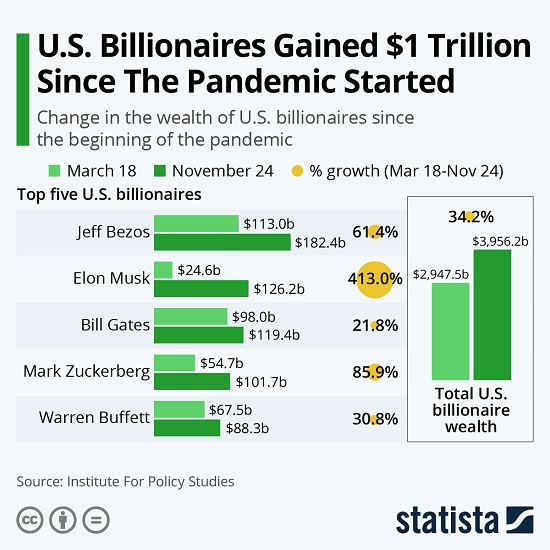
Perhaps we should update Marie Antoinette’s famous quip of cluelessness to: “Let them eat space tourism.”
As billionaires squander immense resources on self-glorifying space flights, the corporate media is nothing short of worshipful. Millions of average citizens, on the other hand, wish the self-glorifying billionaires had taken themselves and all the other parasitic, tax-avoiding, predatory billionaires with them on a one-way trip into space.
Have we reached Peak Self-Glorifying Billionaire? If so, where does the downhill slide take us? Let’s start with a bit of history. Correspondent Jim B. summarized historian Arnold Toynbee’s study of the rise and fall of civilizations thusly: “Civilizations fail when their elites change from an admired dynamic creative class to a despised Establishment of corrupt rentiers, an entrenched governing class unfit to govern.”
Despised, check. Corrupt, check. Entrenched, check.
The 2013 book Why Nations Fail: The Origins of Power, Prosperity, and Poverty discusses the differences between failed states and successful states, and concludes that the failed states are fundamentally kleptocracies that answer to a self-serving elite while successful states are answerable to the broad populace.
To summarize: When the few benefit at the expense of the many, the resulting kleptocracy ends up a failed state. When states maintain meaningful, transparent ways of responding to public needs and demands, the result is a successful state.
This is of course a simplification. The perverse effects of colonialism linger, the development of civic organizations public institutions, values and identities that make up what I call the social ontology are not pre-ordained, and nations with low-cost surplus energy can be quite successful kleptocracies until their energy surplus runs out.
But in the main, the question remains: How did previously successful political, social and economic systems change such that they no longer generated beneficial synergies but slid into fatal synergies?
From the point of view of how systems fail to maintain dynamic stability, three factors pop out:
1. Elites become too successful in sluicing the nation’s income, wealth and political power into their own hands.
2. Since the system continues to thrive despite their dominance, then there is obviously no need to change anything–especially if it reduces their share of the nation’s wealth and political power.
3. The elites ignore the intangible decay of leadership, the real-world dynamics of scarcity and over-estimate their own capabilities and the resilience of the system.
I recently described the feedback loop that occurs when a wealthy elite can purchase political power:“as a result of their campaign contributions and lobbying, the elites’ wealth continues expanding, enhancing their political power to further expand their wealth, and so on.”
In a healthy system, there are mechanisms that limit elite ownership of wealth and political power to what the system can bear. Over time, the feedback I described increases elite wealth and power to a point where the limits are crushed and the elite feedback gathers momentum.
With institutional limits no longer in the way, the elite reaches the point where the political system no longer responds to the broad public at all, and the vast majority of income-producing wealth is already in the hands of the elite.
The U.S. is already at this final stage: Wealth/Power Inequality and the Slide Into Disorder.
Testing Theories of American Politics: Elites, Interest Groups, and Average Citizens: “Contrary to what decades of political science research might lead you to believe, ordinary citizens have virtually no influence over what their government does in the United States.”
This dominance throws the system out of balance such that, as David Parsons recently put it: (Elite-dominated) “Capitalism makes everyone homeless and then makes award-winning movies about how resilient people are for living in their cars.”
The apparent success of the system even as it grows ever more imbalanced generates a self-serving confidence in the Elites that their dominance is not only benign but permanent.
But this self-serving view is illusory. Beneath the surface, major subsystems are attempting to re-establish stability, but the instability is so extreme that the measures being deployed are also extreme.
These policy extremes only push the system further out of balance in other directions, creating fatal synergies as mutually reinforcing imbalances pile up.
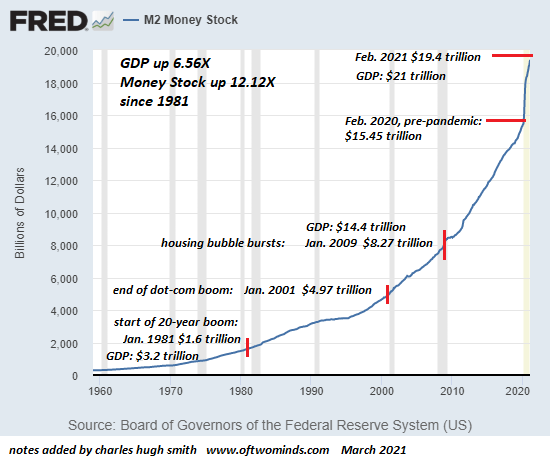
See the chart below of money supply as one example of many.
But the elite is blinded by their confidence and greed to these accelerating imbalances. They reckon that managing the narratives (a.k.a. propaganda), minor policy tweaks and creating more currency and credit are all that’s needed to maintain what they consider the optimal form of stability: they own 99% of political power and 97% of all the income from capital.
Monopoly Versus Democracy: How to End a Gilded Age: “Ten percent of Americans now control 97 percent of all capital income in the country. Nearly half of the new income generated since the global financial crisis of 2008 has gone to the wealthiest one percent of U.S. citizens. The richest three Americans collectively have more wealth than the poorest 160 million Americans.”
I’ve often noted that the wealth of Rome’s political and economic elite went from being 20 times the wealth of a landowning farmer or craftsman to 200,000 times the commoners’ wealth at the end of the Western Empire. Now that three individuals own more wealth than half the American populace, and the top 0.1% hold more wealth than the bottom 80%, I think we can safely declare we’ve reached the same extreme.
The first tranche of American presidents left office less wealthy than when they entered because serving in public office was understood as a noble and valued sacrifice of time and wealth. Now presidents leave office far wealthier than when they entered public service.
Per #3, the elite no longer sees any compelling reason to sacrifice their income, wealth and power to stabilize the system or benefit the common good. In the view of the billionaires, if any sacrifices are necessary, then they should be borne by the bottom 95%, or failing that, the bottom 99.5%.
Given their dominance, their willingness to use their wealth and power to protect their dominance dooms the system to destabilization and collapse, as the resources and value system required to successfully navigate eras of instability and scarcity are no longer available to the state or public.
In effect, the elite uses its power not to restabilize the system but to maintain its extreme dominance and protect it from any political threats.
A once vibrant ecosystem has become a monoculture whose stability is far more precarious than it appears on the surface, as the resilience of monocultures is entirely artificial.
Two recent books illuminate corners of this destabilizing inequality:
Billionaire Wilderness: The Ultra-Wealthy and the Remaking of the American West
‘Jackpot’ Looks at How Inequality Is Experienced by the Very, Very Rich
We are in the final stages of this accelerating destabilization: the refusal of the elite to sacrifice any meaningful share of their wealth and power to save the system from fatal synergies guarantees collapse.
Perhaps we should update Marie Antoinette’s famous quip of cluelessness to: “Let them eat space tourism.” We all know where this cluelessness ultimately leads.

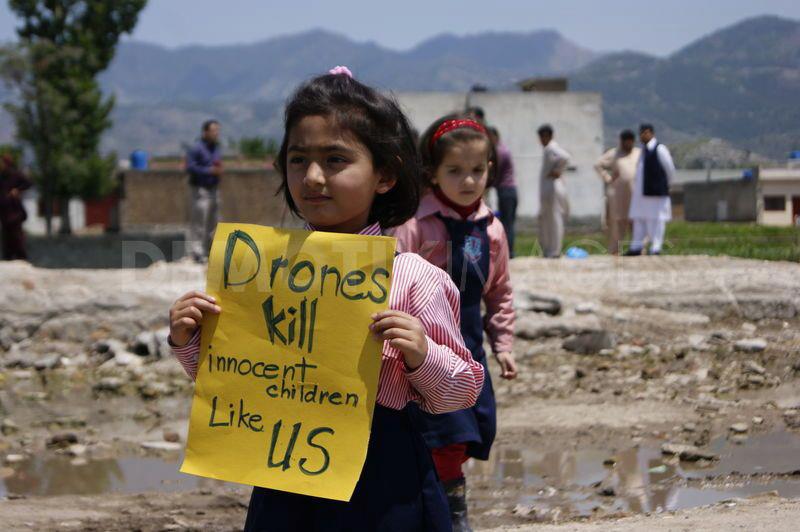
Drone warfare whistleblower sentenced to 45 months in prison for telling the American people the truth.
By Chris Hedges
Source: ScheerPost.com
Daniel Hale, a former intelligence analyst in the drone program for the Air Force who as a private contractor in 2013 leaked some 17 classified documents about drone strikes to the press, was sentenced today [7/27/21] to 45 months in prison.
The documents, published by The Intercept on October 15, 2015, exposed that between January 2012 and February 2013, US special operations airstrikes killed more than 200 people. Of those, only 35 were the intended targets. For one five-month period of the operation, according to the documents, nearly 90 percent of the people killed in airstrikes were not the intended targets. The civilian dead, usually innocent bystanders, were routinely classified as “enemies killed in action.”
The Justice Department coerced Hale, who was deployed to Afghanistan in 2012, on March 31 to plead guilty to one count of violating the Espionage Act, a law passed in 1917 designed to prosecute those who passed on state secrets to a hostile power, not those who expose to the public government lies and crimes. Hale admitted as part of the plea deal to “retention and transmission of national security information” and leaking 11 classified documents to a journalist. If he had refused the plea deal, he could have spent 50 years in prison.
Hale, in a handwritten letter to Judge Liam O’Grady on July 18, explained why he leaked classified information, writing that the drone attacks and the war in Afghanistan “had little to do with preventing terror from coming into the United States and a lot more to do with protecting the profits of weapons manufacturers and so-called defense contractors.”
At the top of the ten-page letter Hale quoted US Navy Admiral Gene LaRocque, speaking to a reporter in 1995: “We now kill people without ever seeing them. Now you push a button thousands of miles away … Since it’s all done by remote control, there’s no remorse … and then we come home in triumph.”
“In my capacity as a signals intelligence analyst stationed at Bagram Airbase, I was made to track down the geographic location of handset cellphone devices believed to be in the possession of so-called enemy combatants,” Hale explained to the judge. “To accomplish this mission required access to a complex chain of globe-spanning satellites capable of maintaining an unbroken connection with remotely piloted aircraft, commonly referred to as drones. Once a steady connection is made and a targeted cell phone device is acquired, an imagery analyst in the U.S., in coordination with a drone pilot and camera operator, would take over using information I provided to surveil everything that occurred within the drone’s field of vision. This was done, most often, to document the day-to-day lives of suspected militants. Sometimes, under the right conditions, an attempt at capture would be made. Other times, a decision to strike and kill them where they stood would be weighed.”
He recalled the first time he witnessed a drone strike, a few days after he arrived in Afghanistan.
“Early that morning, before dawn, a group of men had gathered together in the mountain ranges of Patika province around a campfire carrying weapons and brewing tea,” he wrote. “That they carried weapons with them would not have been considered out of the ordinary in the place I grew up, much less within the virtually lawless tribal territories outside the control of the Afghan authorities. Except that among them was a suspected member of the Taliban, given away by the targeted cell phone device in his pocket. As for the remaining individuals, to be armed, of military age, and sitting in the presence of an alleged enemy combatant was enough evidence to place them under suspicion as well. Despite having peacefully assembled, posing no threat, the fate of the now tea drinking men had all but been fulfilled. I could only look on as I sat by and watched through a computer monitor when a sudden, terrifying flurry of hellfire missiles came crashing down, splattering, purple-colored crystal guts on the side of the morning mountain.”
This was his first experience with “scenes of graphic violence carried out from the cold comfort of a computer chair.” There would be many more.
“Not a day goes by that I don’t question the justification for my actions,” he wrote. “By the rules of engagement, it may have been permissible for me to have helped to kill those men — whose language I did not speak, customs I did not understand, and crimes I could not identify — in the gruesome manner that I did. Watch them die. But how could it be considered honorable of me to continuously have laid in wait for the next opportunity to kill unsuspecting persons, who, more often than not, are posing no danger to me or any other person at the time. Never mind honorable, how could it be that any thinking person continued to believe that it was necessary for the protection of the United States of America to be in Afghanistan and killing people, not one of whom present was responsible for the September 11th attacks on our nation. Notwithstanding, in 2012, a full year after the demise of Osama bin Laden in Pakistan, I was a part of killing misguided young men who were but mere children on the day of 9/11.”
He and other service members were confronted with the privatization of war where “contract mercenaries outnumbered uniform wearing soldiers 2 to 1 and earned as much as 10 times their salary.”
“Meanwhile, it did not matter whether it was, as I had seen, an Afghan farmer blown in half, yet miraculously conscious and pointlessly trying to scoop his insides off the ground, or whether it was an American flag-draped coffin lowered into Arlington National Cemetery to the sound of a 21-gun salute,” he wrote. “Bang, bang, bang. Both served to justify the easy flow of capital at the cost of blood — theirs and ours. When I think about this, I am grief-stricken and ashamed of myself for the things I’ve done to support it.”
He described to the judge “the most harrowing day of my life” that took place a few months into his deployment “when a routine surveillance mission turned into disaster.”
“For weeks we had been tracking the movements of a ring of car bomb manufacturers living around Jalalabad,” he wrote. “Car bombs directed at US bases had become an increasingly frequent and deadly problem that summer, so much effort was put into stopping them. It was a windy and clouded afternoon when one of the suspects had been discovered headed eastbound, driving at a high rate of speed. This alarmed my superiors who believe he might be attempting to escape across the border into Pakistan.”
Now, whenever I encounter an individual who thinks that drone warfare is justified and reliably keeps America safe, I remember that time and ask myself how could I possibly continue to believe that I am a good person, deserving of my life and the right to pursue happiness.
— Daniel Hale, of learning about children killed by indiscriminate US drone attacks he participated in.
“A drone strike was our only chance and already it began lining up to take the shot,” he continued. “But the less advanced predator drone found it difficult to see through clouds and compete against strong headwinds. The single payload MQ-1 failed to connect with its target, instead missing by a few meters. The vehicle, damaged, but still driveable, continued on ahead after narrowly avoiding destruction. Eventually, once the concern of another incoming missile subsided, the driver stopped, got out of the car, and checked himself as though he could not believe he was still alive. Out of the passenger side came a woman wearing an unmistakable burka. As astounding as it was to have just learned there had been a woman, possibly his wife, there with the man we intended to kill moments ago, I did not have the chance to see what happened next before the drone diverted its camera when she began frantically to pull out something from the back of the car.”
He learned a few days later from his commanding officer what next took place.
“There indeed had been the suspect’s wife with him in the car,” he wrote. “And in the back were their two young daughters, ages 5 and 3 years old. A cadre of Afghan soldiers were sent to investigate where the car had stopped the following day. It was there they found them placed in the dumpster nearby. The eldest was found dead due to unspecified wounds caused by shrapnel that pierced her body. Her younger sister was alive but severely dehydrated. As my commanding officer relayed this information to us, she seemed to express disgust, not for the fact that we had errantly fired on a man and his family, having killed one of his daughters; but for the suspected bomb maker having ordered his wife to dump the bodies of their daughters in the trash, so that the two of them could more quickly escape across the border. Now, whenever I encounter an individual who thinks that drone warfare is justified and reliably keeps America safe, I remember that time and ask myself how could I possibly continue to believe that I am a good person, deserving of my life and the right to pursue happiness.”
“One year later, at a farewell gathering for those of us who would soon be leaving military service, I sat alone, transfixed by the television, while others reminisced together,” he continued. “On television was breaking news of the president giving his first public remarks about the policy surrounding the use of drone technology in warfare. His remarks were made to reassure the public of reports scrutinizing the death of civilians in drone strikes and the targeting of American citizens. The president said that a high standard of ‘near certainty’ needed to be met in order to ensure that no civilians were present. But from what I knew, of the instances where civilians plausibly could have been present, those killed were nearly always designated enemies killed in action unless proven otherwise. Nonetheless, I continued to heed his words as the president went on to explain how a drone could be used to eliminate someone who posed an ‘imminent threat’ to the United States. Using the analogy of taking out a sniper, with his sights set on an unassuming crowd of people, the president likened the use of drones to prevent a would-be terrorist from carrying out his evil plot. But, as I understood it to be, the unassuming crowd had been those who lived in fear and the terror of drones in their skies and the sniper in this scenario had been me. I came to believe that the policy of drone assassination was being used to mislead the public that it keeps us safe, and when I finally left the military, still processing what I’d been a part of, I began to speak out, believing my participation in the drone program to have been deeply wrong.”
Hale threw himself into anti-war activism when he left the military, speaking out about the indiscriminate killing of hundreds, perhaps thousands, of noncombatants, including children in drone strikes. He took part in a peace conference held in Washington, D.C. in November 2013. The Yemeni Fazil bin Ali Jaber spoke at the conference about the drone strike that killed his brother, Salem bin Ali Jaber, and their cousin Waleed. Waleed was a policeman. Salem was an Imam who was an outspoken critic of the armed attacks carried out by radical jihadists.
“One day in August 2012, local members of Al Qaeda traveling through Fazil’s village in a car spotted Salem in the shade, pulled up towards him, and beckoned him to come over and speak to them,” Hale wrote. “Not one to miss an opportunity to evangelize to the youth, Salem proceeded cautiously with Waleed by his side. Fazil and other villagers began looking on from afar. Farther still was an ever present reaper drone looking too.”
“As Fazil recounted what happened next, I felt myself transported back in time to where I had been on that day, 2012,” Hale told the judge. “Unbeknownst to Fazil and those of his village at the time was that they had not been the only watching Salem approach the jihadist in the car. From Afghanistan, I and everyone on duty paused their work to witness the carnage that was about to unfold. At the press of a button from thousands of miles away, two hellfire missiles screeched out of the sky, followed by two more. Showing no signs of remorse, I, and those around me, clapped and cheered triumphantly. In front of a speechless auditorium, Fazil wept.”
A week after the conference Hale was offered a job as a government contractor. Desperate for money and steady employment, hoping to go to college, he took the job, which paid $ 80,000 a year. But by then he was disgusted by the drone program.
“For a long time, I was uncomfortable with myself over the thought of taking advantage of my military background to land a cushy desk job,” he wrote. “During that time, I was still processing what I had been through, and I was starting to wonder if I was contributing again to the problem of money and war by accepting to return as a defense contractor. Worse was my growing apprehension that everyone around me was also taking part in a collective delusion and denial that was used to justify our exorbitant salaries, for comparatively easy labor. The thing I feared most at the time was the temptation not to question it.”
“Then it came to be that one day after work I stuck around to socialize with a pair of co-workers whose talented work I had come to greatly admire,” he wrote. “They made me feel welcomed, and I was happy to have earned their approval. But then, to my dismay, our brand-new friendship took an unexpectedly dark turn. They elected that we should take a moment and view together some archived footage of past drone strikes. Such bonding ceremonies around a computer to watch so-called “war porn” had not been new to me. I partook in them all the time while deployed to Afghanistan. But on that day, years after the fact, my new friends gaped and sneered, just as my old one’s had, at the sight of faceless men in the final moments of their lives. I sat by watching too; said nothing and felt my heart breaking into pieces.”
“Your Honor,” Hale wrote to the judge, “the truest truism that I’ve come to understand about the nature of war is that war is trauma. I believe that any person either called-upon or coerced to participate in war against their fellow man is promised to be exposed to some form of trauma. In that way, no soldier blessed to have returned home from war does so uninjured. The crux of PTSD is that it is a moral conundrum that afflicts invisible wounds on the psyche of a person made to burden the weight of experience after surviving a traumatic event. How PTSD manifests depends on the circumstances of the event. So how is the drone operator to process this? The victorious rifleman, unquestioningly remorseful, at least keeps his honor intact by having faced off against his enemy on the battlefield. The determined fighter pilot has the luxury of not having to witness the gruesome aftermath. But what possibly could I have done to cope with the undeniable cruelties that I perpetuated?”
“My conscience, once held at bay, came roaring back to life,” he wrote. “At first, I tried to ignore it. Wishing instead that someone, better placed than I, should come along to take this cup from me. But this too was folly. Left to decide whether to act, I only could do that which I ought to do before God and my own conscience. The answer came to me, that to stop the cycle of violence, I ought to sacrifice my own life and not that of another person. So, I contacted an investigative reporter, with whom I had had an established prior relationship, and told him that I had something the American people needed to know.”
Hale, who has admitted to being suicidal and depressed, said in the letter he, like many veterans, struggles with the crippling effects of post-traumatic stress disorder, aggravated by an impoverished and turbulent childhood.
“Depression is a constant,” he told the judge. “Though stress, particularly stress caused by war, can manifest itself at different times and in different ways. The tell-tale signs of a person afflicted by PTSD and depression can often be outwardly observed and are practically universally recognizable. Hard lines about the face and jaw. Eyes, once bright and wide, now deep-set, and fearful. And an inexplicably sudden loss of interest in things that used to spark joy. These are the noticeable changes in my demeanor marked by those who knew me before and after military service. To say that the period of my life spent serving in the United States Air Force had an impression on me would be an understatement. It is more accurate to say that it irreversibly transformed my identity as an American. Having forever altered the thread of my life’s story, weaved into the fabric of our nation’s history.”
INDIAN COUNTRY NEWS
"It is the duty of every man, as far as his ability extends, to detect and expose delusion and error"..Thomas Paine
Human in Algorithms
From the Roof Top
I See This
blog of the post capitalist transition.. Read or download the novel here + latest relevant posts
अध्ययन-अनुसन्धानको सार
 After the Crash