Saturday Matinee: Cops vs. Thugs

Cops Vs. Thugs — No Honour Among Thieves (or Cops)

By Ben Warnock

Source: Ben Warnock Blog

“Yakuza and cops are just the same. We respect the law instead of a code. We’re the dropouts who couldn’t get good jobs.”

“We too are the dropouts of society. We all are!”

Kinji Fukasaku’s yakuza films are perhaps best described as being surrounded by an almost impenetrable, bleak aura of despair and nihilism. The cops who are supposed to be the protectors of the people are corrupt to the core, Fukasaku basically presents them as a mercenary force — one that can be bought if the bid is high enough. Government officials often use the police to do their bidding and much like their underlings are as corrupt as they come. This damning indictment of these systems does not mean that the director sides with the yakuza — often portraying them as morally reprehensible criminals — whilst their code may be one of honour, post-war Japan has created a society that allows for greedy capitalists to gain power simply at the expense of sullying their morals and code. Those who stick to a code of honour become the dead that litters the senseless gang wars that follow. Corruption is a recurring theme throughout Fukasaku’s yakuza films and Cops Vs. Thugs is perhaps his most interesting example of this outside of his famous Battles Without Honour and Humanity series.

Much like the aforementioned series of films, Fukasaku looks to highlight the corrupting nature of power and that those who seek power are often those who are corrupted the easiest. The police of the film are split between those who are corrupt but perhaps honourable in their own, twisted way — as characterised by Bunta Sugawara’s Kuno whose corruption is described as a way of keeping the peace — and the new faction led by Kaida who is vehemently against collaboration with the yakuza. However, Kaida’s allegiances should not be mistaken as honourability as Fukasaku is certain to illustrate. Kaida’s behaviour humiliates his co-workers in public spectacles — including repeatedly using his judo skills on an elderly police officer — where his power is cemented amongst the other police officers. This damning indictment of the police is nothing new to the films of Fukasaku but here, the director highlights that those who seek the position of a police officer are those who are power-hungry and susceptible to corruption from many outside forces. As Sugawara’s Kuno states when asked why he became a cop:

“I wanted to carry a gun. After the war only cops and narcotic agents could carry guns….we were short of food…every time we tried to buy rice on the black market, the cops snatched it away. So I decided to be a snatcher”.

Unlike the famous notion that power corrupts, Fukasaku’s films prove that it is not power that corrupts but it is in the nature of those who seek positions of power in a patriarchal, capitalist system to become corrupt. It is the damaged system’s cyclical nature that corrupts individuals.

The fates of those characters who have a shred of honour — Kuno and Kawamoto — ultimately end in tragedy. Kuno’s honour and trust in his friend Hirotani ultimately leads to his escape attempt and forces Kuno’s hand in killing Hirotani. Violence begets violence and Kuno — after being demoted and transferred as a reward for saving Kaida’s life — is killed by the remaining members of Hirotani’s gang. The yakuza honour forces them to avenge the death of their leader. Kawamoto, on the other hand, attempts to save his friend’s life by getting them to surrender and is gunned down by the very friend he tried to save. The honour and trust showcased have no place within the world of the police and the yakuza. Corrupt institutions whose original purposes have become eroded and replaced by pawns of the capitalist society they inherit. This ever-changing, impermeable alliance between characters is highlighted by Fukasaku’s camera. Battles devolve into a sweeping landscape of betrayal with snitches followed by the judging eye of the camera and gunfights where the action can barely be contained within the confines of the screen. Fukasaku’s frantic kineticism within these scenes is indicative of the disorientating landscape of unknown allegiances which these characters inhabit and thrive.

The world which is represented in Cops Vs. Thugs is one that is inherently damaged from its systems of government to its criminals whose honour and code have become meaningless in the current political landscape. The real threat presented to the governing officials is not the yakuza who seek to exploit the corrupted system but a change in ideology that would bring the system crashing down. Fukasaku even highlights this own threat with the police officer whose entire character consists of his hatred of communists even ahead of the very criminals that are terrorising the streets he is meant to protect. Fukasaku’s (literal) red herring of communism here is one that rewards those who buy into the paranoia. The anti-communist officer is inexplicably a member of Kaida’s team and Fukasaku ensures that he is the first officer seen to be arresting the yakuza once they surrender. This perhaps explains that Kaida’s corruption does not lie with the yakuza but the capitalist government which seeks to strengthen its own resolve within society. The film’s epilogue showing the demotion and untimely fate of Kuno also highlights that Kaida is now a leading figure in Nikko Oil — a company that was mentioned to be corrupt as well. Hiding behind a facade of friendly exercising with his co-workers — Fukasaku pulls out from a close-up to a wide shot allowing the audience to realise that this corrupt institution is just one of many within the industrial landscape. Corruption does not just lie with the police working with the yakuza but also — and more dangerously so — lies with the police collaborating with the government.

Watch Cops vs. Thugs on Kanopy here: https://www.kanopy.com/product/cops-vs-thugs-0

Which Is Worse, the Tech Giant Censors or the Stuff You Want Censored?

By David Swanson

Source: War is a Crime

The communications system we live in is highly complex, mostly driven by greed and profit, in part semi-public, full of filth I know we’d be better off without, and increasingly openly censored and monitored by defenders of accepted good thinking.

Fascist nutcases are spreading dangerous nonsense, while billionaire monopolists are virtually disappearing critics and protesters. It’s easy to get confused about what ought to be done. It’s difficult to find any recommendation that isn’t confused. Different people want different outrages censored and censored by different entities; what they all have in common is a failure to think through the threats they are creating to the things they don’t want censored.

A 1975 Canadian government commission recommended censoring “libel, obscenity, breach of the Official Secrets Act, matters affecting the defense of Canada, treason, sedition, or promulgating information that leads to incitement of crime or violence.” This is a typical muddle. Half of those things were almost certainly already banned, as suggested by their identification through legal terminology. A few of those things probably should be banned, such as incitement of violence (though not promulgating information that “leads” to incitement of any crime or violence). Of course I would include as incitement of violence a speech by the Prime Minister advocating the shipping of Canadian “Peace Keepers” to Africa, but the Prime Minister (who would have more say than I) would no doubt have just identified me as commenting on a matter affecting the defense of Canada — plus, if he or she were in the mood, I’ve probably just promulgated something that will lead to inciting some crime or other, even if it’s just the crime of more people speaking on matters affecting the “defense” of Canada. (And it shouldn’t matter that I’m not Canadian, since Julian Assange is not from the United States.)

Well, what’s the solution? A simplistic and surprisingly popular one is to blame philosophers. Those idiot postmodernists said there was no such thing as truth, which allowed that great student of philosophy Donald Trump to declare news about him “fake” — which he never could have thought of doing without a bunch of leftist academics inspiring him; and the endless blatant lies about wars and economies and environmental collapse and straight-faced reporting of campaign promises can’t have anything at all to do with the ease people have in distrusting news reporting. So, now we need to swing the pendulum back in the direction of tattooing the Ten Commandments on our foreheads before morality perishes at the hands of the monster relativism. We can’t do that without censoring the numbskulls, regrettably of course.

This line of thinking is dependent on failing to appreciate the point of postmodern criticism. That the greater level of consensus that exists on chemistry or physics as opposed to on what should be banned as “obscenity” is a matter of degree, not of essential or metaphysical substance, is an interesting point for philosophy students, and a correct one, but not a guide to life for politicians or school teachers. That there is no possible basis for declaring some law of physics permanent and incapable of being replaced by a better one is not a reason for treating a law of physics as a matter of opinion or susceptible to alteration via fairy dust. If Isaac Newton not being God, and God also not being God, disturbs you and you’re mad at philosophers for saying it, you should notice what follows from it: the need for everyone to support your right to try to persuade them of their error. And what does not follow from it: the elimination of chemistry or physics because some nitwit claims he can fly or kill a hurricane with his gun. If that idiot has 100,000 followers on social media, your concern is not with philosophy but with stupidity.

The tech-giant censors’ concern is — in part — also with stupidity, but it’s not clear they have the tools to address it. For one thing, they just cannot help themselves. They have other concerns too. They are concerned with their profits. They are concerned with any challenges to power — their power and the power of those who empower them. They are concerned, therefore, with the demands and national bigotry of national governments. They are concerned — whether they know it or not — with creative thinking. Every time they censor an idea they believe crazy, they risk censoring one of those ideas that proves superior to existing ones. Their combination of interests appears to be self-defeating. Rather than persuade people of the benefits of their censorship, they persuade more and more people of the rightness of what was censored and of the arbitrary power-interests of those doing the censoring.

Our problem is not too many voices on the internet. It is too much concentration of wealth and power in too few media outlets that are too narrowly restricted to too few voices, relegating other voices to marginal and ghettoized corners of the internet. Nobody gets to find out they’re mistaken through respectful discourse. Nobody gets to show someone else they’re right. We need to prioritize that sort of exchange, before a flood of misguided good intentions drowns us all.

The “promulgating information that leads to incitement of crime or violence” bit of that proposed law seems to have had a surprisingly good intention, namely benevolent parental concern with all the “action-filled” (violence-filled) children’s entertainment on television, the violence-normalizing enter/info-tainment programming for all ages that studies and commonsense suggest increase violence. But can we ban all that garbage, or do we have to empower people who actually give a damn to produce and select programming, and empower families to turn it all off, and schools to be more engaging than cartoons?

The difficulty of censoring such content should be clear from the fact that discussions of it tend to stray into numerous unrelated topics, including the supposed need to censor wars for the protection of, not children, but weapons dealers. Once you allow a corporation to censor damaging news — poof! — there go all negative reports on its products. Once you tell it to put warning labels over recommendations to drink bleach as medicine, it starts putting warning labels on anything related to climate collapse or originating outside the United States of Goddamn Righteousness. You can imagine whether that ends up helping or hurting the supposed target, stupidity.

Censoring news, and labeling news as “factual,” seems to me a cheap fix that doesn’t fix. It’s a bit like legalizing bribery and gerrymandering and limited ballot access and corporate airwaves domination and then declaring that you’ll institute term limits so that every rotten candidate has to be quickly replaced by an even more rotten one. It’s a lovely sounding solution until you try it. Look at the “fact-checker” sections of corporate media outlets. They’re as wrong and inconsistent as any other sections; they’re just labeled differently.

The solutions that will work are not easy, and I’m no expert on them, but they’re not new or mysterious either. We should democratize and legitimize government. We should use government to break up media monopolies. We should publicly and privately facilitate and support numerous independent media outlets. We should invest in publicly funded but independent media dedicated to allowing a wide range of people to discuss issues without the overarching control of the profit interest or the immediate interests of the government.

We should not be simplistic about banning or allowing censorship, but highly wary of opening up any new types of censorship and imagining they won’t be abused. We should stick to what is already illegal outside of communications (such as violence) and censor communications only when it is actually directly a part of those crimes (such as instigating particular violence). We should be open to some limits on the forces empowered by our choice through our public dollars to shape our communications; I’d be happy to ban militaries from having any role in producing movies and video games (if they’re going to bomb children in the name of “democracy,” well, then, that’s my vote for the use of my dollars).

At the same time, we need — through schools and outside of them — radically better education that includes education in the skills of media consumption, BS-spotting, propaganda deciphering, fact-verification, respect, civility, decency, and honesty. I hardly think it’s entirely the fault of youtube that kids get less of their education from their classrooms — part of the fault lies with the classrooms. But I hardly think the eternal project of learning, and of learning how to learn, can be restricted to classrooms.

Who’s to Blame for Losing Afghanistan?

By Peter Van Buren

Source: We Meant Well

Who should we blame for losing Afghanistan? Why blame anyone?

Did anyone expect the U.S. war in Afghanistan to end cleanly? If so, you bought the lies all along and the cold water now is hitting sharp. While the actual ending is particularly harsh and clearly spliced together from old clips of Saigon 1975, those are simply details.

Why blame Biden? He played his part as a Senator and VP keeping the war going, but his role today is just being the last guy in a long line of people to blame, a pawn in the game. That Biden is willing to be the “president who lost Afghanistan” is all the proof you need he does not intend to run again for anything. Kind of an ironic version of a young John Kerry’s take on Vietnam “how do you ask the last man to die for a mistake?” Turns out, it’s easy: call Joe.

Blame Trump for the deal? One of the saddest things about the brutal ending of the U.S.-Afghan war is we would have gotten the same deal — just leave it to the Taliban and go home — at basically any point during the last 20 years. That makes every death and every dollar a waste. Afghanistan is simply reverting, quickly, to more or less status quo 9/10/01 and everything between then and now, including lost opportunities, will have been wasted.

Blame the NeoCons? No one in Washington who supported this war was ever called out, with the possible exception of Donald Rumsfeld who, if there is a hell, now cleans truck stop toilets there. Dick Cheney walks free. The generals and diplomats who ran the war have nice think tank or university jobs, if they are not still in government making equally bad decisions. No one has been legally, financially, or professionally disadvantaged by the blood on their hands. Some of the era’s senior leaders — Blinken, Rice, Power, Nuland — are now working in better jobs for Biden. I’d like to hope they have trouble sleeping at night, but I doubt it.

George Bush is a cuddly grandpa today, not the man who drove the United States into building a global prison archipelago to torture people. Barack Obama, who kept much of that system in place and added the drone killing of American citizens to his resume, remains a Democratic rock god. Neither man nor any of his significant underlings has expressed any regret or remorse.

For example, I just listened to Ryan Crocker, our former ambassador to Iraq and Afghanistan, on CNN. Making myself listen to him was about as fun as sticking my tongue in a wood chipper. Same for former general David Petraeus and the usual gang of idiots. None of them, the ones who made the decisions, accept any blame. Instead. they seem settled on blaming Trump because, well, everything bad is Trump’s fault even if he came into all this in the middle of the movie.

In the end the only people punished were the whistleblowers.

No one in the who is to blame community seems willing to take the story back to its beginning, at least the beginning for America’s latest round in the Graveyard of Empires (talk about missing an early clue.) This is what makes Blame Trump and Blame Biden so absurd. America’s modern involvement in this war began in 1979 when Jimmy Carter, overreacting to the Soviet invasion of Afghanistan to prop up what was already a pro-Soviet puppet government, began arming and organizing Islamic warriors we now collectively know as “The Taliban.”

People who want to only see trees they can chop down and purposely want to miss the vastness of the forest ahead at this point try to sideline things by claiming there never was a single entity called “The Taliban” and the young Saudis who flocked to jihad to kill Russians technically weren’t funded by the U.S. (it was indirectly through Pakistan) or that the turning point was the 1991 Gulf War, etc. Quibbles and distractions.

If Carter’s baby steps to pay for Islamic warriors to fight the Red Army was playing with matches, Ronald Reagan poured gas, then jet fuel, on the fire. Under the Reagan administration the U.S. funded the warriors (called mujaheddin if not freedom fighters back then), armed them, invited their ilk to the White House, helped lead them, worked with the Saudis to send in even more money, and fanned the flames of jihad to ensure a steady stream of new recruits.

When we “won” it was hailed as the beginning of the real end of the Evil Empire. The U.S. defeated the mighty Red Army by sending over some covert operators to fight alongside stooge Islam warriors for whom a washing machine was high technology. Pundits saw it as a new low-cost model for executing American imperial will.

We paid little attention to events as we broke up the band and cut off the warriors post-Soviet withdrawal (soon enough some bozo at the State Department declared “the end of history.” He teaches at Stanford now) until the blowback from this all nipped us in the largely unsuccessful World Trade Center bombing of 1993, followed by the very successful World Trade Center bombing on September 11, 2001. Seems like there was still some history left to go.

How did U.S. intelligence know who the 9/11 culprits were so quickly? Several of them had been on our payroll, or received financing via proxies in Pakistan and Saudi Arabia, or were inspired by what had happened in Afghanistan, the defeat of the infidels (again; check Alexander the Great, Genghis Khan, the Mughal Empire, various Persian Empires, the Sikhs, the British, et al.)

If post-9/11 the U.S. had limited itself to a vengeful hissy fit in Afghanistan, ending with Bush’s 2003 declaration of “Mission Accomplished,” things would have been different. If the U.S. had used the assassination of Osama bin Laden, living “undiscovered” in the shadow of Pakistan’s military academy, as an excuse of sorts to call it a day in Afghanistan, things would have been different.

Instead Afghanistan became a petri dish to try out the worst NeoCon wet dream, nation-building across the Middle East. Our best and brightest would not just bomb Afghanistan into the stone age, they would then phoenix-it from the rubble as a functioning democracy. There was something for everyone: a military task to displace post-Cold War budget cuts, a pork-laden reconstruction program for contractors and diplomats, even a plan to empower Afghan women to placate the left.

Though many claim Bush pulling resources away from Afghanistan for Iraq doomed the big plans, it was never just a matter of not enough resources. Afghanistan was never a country in any modern sense to begin with, just an association of tribal entities who hated each other almost as much as they hated the west. The underpinnings of the society were a virulent strain of Islam, about as far away from any western political and social ideas as possible. Absent a few turbaned Uncle Toms, nobody in Afghanistan was asking to be freed by the United States anyway.

Pakistan, America’s “ally” in all this, was a principal funder and friend of the Taliban, always more focused on the perceived threat from India, seeing a failed state in Afghanistan as a buffer zone. Afghanistan was a narco-state with its only real export heroin. Not only did this mean the U.S. wanted to build a modern economy on a base of crime, the U.S. in different periods actually encouraged/ignored the drug trade into American cities in favor of the cash flow.

The Afghan puppet government and military the U.S. formed were uniformly corrupt, and encouraged by the endless inflow of American money to get more corrupt all the time. They had no support from the people and could care less. The Afghans in general and the Afghan military in particular did not fail to hold up their end of the fighting; they never signed up for the fight in the first place. No Afghan wanted to be the last man to die in service to American foreign policy.

There was no way to win. The “turning point” was starting the war at all. Afghanistan had to fail. There was no other path for it, other than being propped up at ever-higher costs. That was American policy for two decades: prop up things and hope something might change. It was like sending more money to a Nigerian cyber-scammer hoping to recoup your original loss.

Everything significant our government, the military, and the MSM told us about Afghanistan was a lie. They filled and refilled the bag with bullhockey and Americans bought it every time expecting candy canes. Keep that in mind when you decide who to listen to next time, because of course there will be a next time. Who has not by now realized that? We just passively watched 20 years of Vietnam all over again, including the sad ending. So really, who’s to blame?

A Tool of Control: How Health Officials Weaponize Language to Manage Public Perception of COVID Vaccines

The deployment of clever linguistic tricks has created a hostile upside-down universe, where even the vaccine-injured are tarnished as “anti-vaxxers” or liars rather than acknowledged as ex-vaxxers who took risks that turned out to be life-changing.

By Children’s Health Defense Team

Source: The Defender

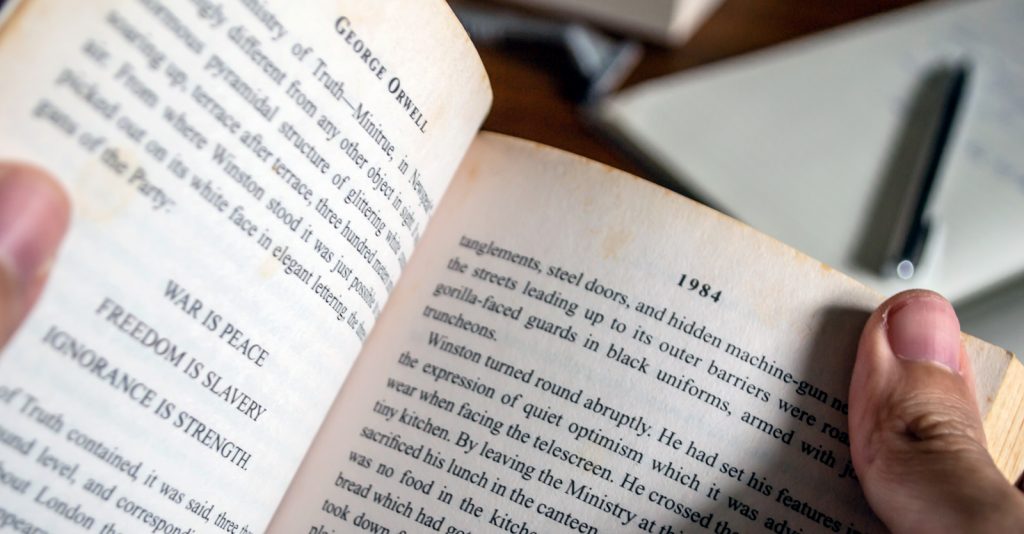
Psychological and linguistic manipulation are, for those in power, proven tools for building, consolidating and maintaining dominance — a reality keenly depicted in George Orwell’s never-more-relevant novel, “1984.”

As phrased by master propagandist Edward Bernays, an approximate contemporary of Orwell’s, the mind of the people “is made up for it by the group leaders in whom it believes and by those persons who understand the manipulation of public opinion.”

Recent events surrounding COVID vaccines have shown that medicine and public health — with the help of a complicit media — are particularly skilled at “pull[ing] the wires which control the public mind.”

The clever bag of linguistic tricks deployed by the medical cartel includes seeding evocative terms such as “vaccine hesitancy” and “lockdowns” (which is prison terminology) into popular and scientific discourse, forging slippery new definitions of words with formerly fixed meanings (such as “pandemic,” “herd immunity” and “vaccine”), and circling failed products back around by giving them the positive spin of “boosters.”

Ominously, medicine’s and public health’s verbal assaults encourage shaming of, or violence against, those who ask questions, while upholding the disingenuous pretense that vaccine mandates are compatible with freedom.

In this hostile upside-down universe, even the vaccine-injured are tarnished as “anti-vaxxers” or liars rather than acknowledged as ex-vaxxers who took risks that turned out to be life-changing.

‘Much like other stressors’

One of the more insulting recent examples of linguistic weaponization involves a dubious psychiatric cover term, “functional neurological disorder” (FND), that is suddenly being trumpeted as an explanation for the tsunami of adverse events — especially severe neurological reactions — being reported all over the world in the aftermath of COVID vaccination.

Psychiatrists conveniently define FND — which they also refer to as a “psychogenic” (originating in the mind) or “conversion” disorder — as “real” nervous system symptoms that “cause significant distress or problems functioning” but are “incompatible with” or “can’t be explained by” recognized neurological diseases or other medical conditions.

Lest members of the public derive a “simplistic impression of potential links between the [COVID] vaccine and major neurological symptoms,” neurologists pushing the FND story have hastened to reassure people that the “close development of functional motor symptoms after the vaccine does not implicate the vaccine as the cause of those symptoms.”

One of these individuals is National Institutes of Health-funded neurologist Alberto Espay, who implausibly adds that COVID vaccination (which entails injection with high-risk substances and technologies) is just “a stressor or precipitant, much like any other stressor … such as a motor vehicle accident or sleep deprivation.”

Officials and the media are audaciously trotting out the FND narrative on both sides of the pond, as evidenced by a recent Daily Mail headline that read, “Videos of people ‘struggling to walk’ after getting their COVID vaccine are NOT result of jab itself but a condition triggered by stress or trauma.”

Helping with the spin, a member of the UK’s Joint Committee on Vaccination and Immunization straight-facedly attributed this “stress” to coercion, stating: “If people begin to feel they are being kind of forced against their will to do something, then in a sense that’s quite a damaging thing to do because it gives people the impression vaccination is something being imposed on them.”

Hammering home the point that “there is nothing to see here,” Kings College London physician Matthew Butler solemnly (and without evidence) agrees that FND — though “serious and debilitating” — “does not implicate any vaccine constituents and should not hamper ongoing vaccination efforts.”

Butler is the lead author of a May 2020 paper proposing FND patients’ “abnormal body-focussed attention” be treated with psychedelics such as LSD and psilocybin — never mind that psychedelics themselves, admit Butler and co-authors, “sometimes produce abnormal physical and motor effects,” including seizures.

An all-too-familiar game

To past victims of vaccine injury, the “it’s all in your mind” sleight-of-hand being summoned to dismiss COVID vaccine injuries is all too familiar.

Consider autism, which psychiatrists blamed, in its earliest days, on emotionally distant “refrigerator moms.”

In more recent decades, families affected by autism have experienced the double whammy of regulatory indifference to likely culprits (including not just neurotoxic vaccines but other probable environmental triggers) alongside brazen denial of autism’s escalating prevalence.

Young people injured by human papillomavirus (HPV) vaccines tell similar stories of “denial and dismissal of reported harms and deaths.” Researchers who in 2017 reviewed the serious adverse events reported during two of the largest HPV vaccine clinical trials noted that “Practically, none of the serious adverse events occurring in any arm of both studies were judged [by the manufacturers] to have been vaccine-related.”

In the face of severe symptoms such as heart-attack-like chest pain, numbness and swelling of extremities, hair loss, whole-body aches and extreme fatigue, boys and girls injured by HPV vaccines have been repeatedly subjected to medical gaslighting — told they are “crazy” and just need to “slow down.”

In one incident in Australia, after “26 girls presented to the school’s sick bay with symptoms including dizziness, syncope [fainting] and neurological complaints” within two hours of receiving HPV vaccines at school, pharma-funded researchers had the chutzpah to dismiss the safety signal and characterize the episode as a “mass psychogenic event” — which they defined as “the collective occurrence of a constellation of symptoms suggestive of organic illness but without an identified cause in a group of people with shared beliefs about the cause.”

Recognize, question and reclaim

The medical-public health-pharma cartel, the “small cabal of wealthy countries, corporations and individuals” that support it, and their media mouthpieces are supremely confident in their ability to manage public perceptions through words and narratives, whether for the purpose of “mystifying” the public about key events, securing buy-in for oppressive policies or sowing discord to divide and conquer. (As journalists Caitlin Johnstone and Glenn Greenwald also remind us, many media personalities are intelligence agency veterans or assets, and the “sole owner of the Washington Post is a CIA contractor.”)

Thus, it pays to be attentive to how health authorities use language, for “the more you know about language, the more immune you become to its effects.”

Beyond noticing the manipulation, we must also stop ceding the linguistic terrain to our would-be manipulators — for example, by eschewing weaponized vocabulary such as the pejorative term “vaccine hesitancy.”

Catholic journalist Jane Stannus points out that the term “vaccine hesitant” portrays those who decline COVID (or other) vaccines as “‘trapped by irrational fears’ in a state of inaction or ignorantly opposed to science,” with the strong suggestion “that such backward and weak-minded persons are worthy of contempt, especially compared with the enlightened, confident people who signed up for the vaccine immediately.”

The unfortunate corollary of such language is the “witch hunt on the unvaccinated” that we are already witnessing, “an act of violence against the fabric of society,” says Stannus, that is “a greater evil … than the shared suffering of disease.”

We can and urgently need to see through these shenanigans and reclaim our humanity.

Fast-moving current events are proving those who have declined COVID injections are the wise ones, with science proving them correct in just about every way.

Whether we consider the many suspected dangers of products unleashed on the public less than a year ago, or the injuries and deaths occurring on a never-before-seen scale (including in teens who had their lives ahead of them), or the clear superiority of natural immunity, or the fact that the injections don’t even do the one thing the clinical trials alleged they could do (i.e., keep more severe illness at bay), it is clear that citizens who would rather think for themselves than swallow prefabricated lies are the ones who are going to come out ahead.

Everything points to Thierry Meyssan being right today

By challenging the official version of the 9/11 attacks, Thierry Meyssan opened a worldwide debate. But the essence of his book on the subject was a political science study predicting the evolution of the United States after these crimes. The problem is not how the attacks were committed, but why the US reacted that day by violating its own Constitution, why it implemented in the following days very deep reforms of its institutions that changed its nature. Thierry Meyssan had predicted the transformation of the American Empire that we are seeing with the planning of the fall of Kabul. Everything he predicted has been confirmed over the last twenty years.

By Thierry Meyssan

Source: VoltaireNet.org

At the end of 2001, I published a series of articles on the attacks of September 11, 2001, followed by a book in March 2002 [1]. The book was translated into 18 languages and opened a worldwide debate questioning the veracity of the official US narrative. However, the international press refused to discuss my arguments and launched a campaign accusing me of “amateurism” [2], “conspiracy theory” [3], and “denial” [4].

Above all, the US authorities and their supporters reduced my work to the first few pages of my book: the challenge to the official version of the attacks. But it is a work of political science aimed at denouncing what these false-flag attacks would make possible: the surveillance of Western populations and the endless war in the wider Middle East. In this article, I will therefore review what has been learned about these attacks over the past 20 years, but more importantly, I will check whether my predictions from 2002 were correct or not.

THE BLACK HOLE OF 9/11

If we are asked what happened on 9/11, we will all visualise the Twin Towers and the Pentagon. We have forgotten many other things, such as the insider trading in the shares of the affected airlines, the fire in the Old Eisenhower Building, or the collapse of a third tower in the World Trade Center.

What is most astonishing is that almost no one remembers that at 10am, Richard Clarke triggered the ’Continuity of Government Plan’ [5]. At that very moment, President Bush and Congress were suspended from office and placed under military protection. President Bush was taken to an air base in Nebraska where the CEOs of the upper floors of the Twin Towers had been since the previous evening [6]; and Congress to the Greenbrier megabunker. Power fell into the hands of the “Continuity Government”. It was in the Raven Rock Mountain megabunker (’Site R’) [7]. Power was not returned to the civilians until the end of the day.

Who exactly were the members of this ’Continuity Government’ and what did they do during the time they were in power? We still don’t know. The members of Congress who asked the question were not allowed to hold a session of their assembly on the subject.

Please understand that until we have clarification, the 9/11 controversy will continue. The procedure implemented on September 11 was designed by President Eisenhower at a time when nuclear war was feared. If he, the Speakers and a majority of Congress were killed, there would be no constitutional powers. The military would logically have to assume the continuity of government. But this was obviously not the case on that day. Not one elected official was dead. The transfer of power was therefore unconstitutional. It was strictly speaking a coup d’état.

THE ATTACKS OF SEPTEMBER 11

In my book and afterwards, I hypothesised about what really happened on that day. But this is irrelevant to my point. The people who perpetrated this crime wanted to create a shock comparable to Pearl Harbor, as the members of the Project for a New American Century wrote earlier, so that they could change the way the United States lives and functions. So they told us a tall tale that we swallowed without flinching. But :

• To this day, there is no evidence of the 19 designated hijackers on board the hijacked planes. They were not on the lists of passengers on board the planes released by the airlines on the same day. The videos of the hijackers at the airport were not taken in New York, but at other airports where they were transiting.

• To date, there is no evidence that the 35 telephone communications between passengers on the hijacked flights and the ground existed [8]. This applies both to the conversation attributed to the brave passenger who allegedly attacked the hijackers on UA 93, and to the conversation testified to by US Solicitor General Theodore Olson with his wife on AA 77. In contrast, at the trial of Zacarias Moussaoui (accused of being the 20th hijacker who would not have boarded the plane), the FBI testified that none of the planes had phones in the armrests, that passengers should have used mobile phones, that cell phones at the time could not work at altitudes above 5,000 feet, and that the records provided by the phone companies did not show any of the communications mentioned – including that of Attorney General Olson.

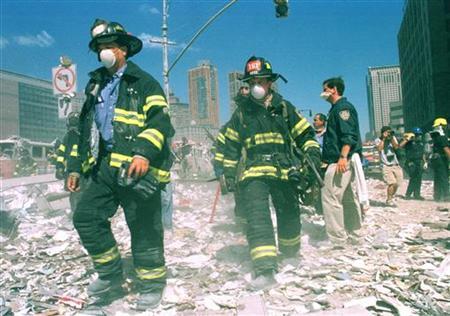
• To date, there is no physical explanation for the collapse of three of the World Trade Center towers onto their own footprints (i.e. vertically). The Twin Towers were hit by two planes, but were not shaken. However, their fuel would have run down the vertical beams and melted them. A third tower was destabilised by the fall of the first two to its side. It too would have collapsed, not laterally, but vertically. It should be noted that no explanation was given for the lateral explosions heard by the firemen and widely filmed, nor for the vertical beams that were severed and not melted; two pieces of evidence attesting not to an accidental but to a controlled demolition. It should also be noted that no collapse of skyscrapers has ever been observed, either before or after 9/11, following a large-scale fire… and that no one has learned the lessons of this attack and therefore changed the way such buildings are constructed to prevent such a catastrophe. Finally, the photographs taken by firefighters of “pools” of molten steel and those taken by FEMA (the disaster management agency) of the melting rocks in which the foundations were built are inexplicable according to the official version.

• To date, there is no evidence that an airliner hit the Pentagon. Already the next day, the fire brigade had given a press conference at the Pentagon during which they had attested that they had not found anything suggestive of a plane. The authorities, who had issued a vengeful statement against my book, announced that they had collected many parts of the plane and reconstructed it in a hangar. Then they stopped communicating on this subject. Moreover, the families of the passengers of the plane in question, after having been scandalised by my words, changed their minds when they were given back funeral urns, claiming to have identified the bodies of their relatives thanks to their fingerprints (which would have been totally destroyed during fires at those temperatures). Some refused to sign the confidentiality agreement offered to them in exchange for large compensation payments.

WIDESPREAD SURVEILLANCE OF WESTERN POPULATIONS

In the days following the attacks, the Bush Administration had Congress vote on an anti-terrorist code, known as the USA Patriot Act. This is a very large piece of legislation that had been drafted over the previous two years by the Federalist Society (of which Solicitor General Theodor Olson and Attorney General John Ashcroft were members). It suspends the Bill of Rights in cases of terrorism.

At the time of the formation of the United States, there were two opposing groups. The first, around Alexander Hamilton, drafted the Constitution to set up a system comparable to the British monarchy, but with governors instead of nobles. The second, around Thomas Jefferson and James Madison, only accepted the Constitution after it had been amended to prevent the use of Reason of State. These 10 amendments are called the Bill of Rights. Their suspension challenges the balance on which the United States was founded. It gives power to the first group, the descendants of the ’Pilgrim Fathers’, the Puritans exiled from England. President Bush is a direct descendant of one of the 41 signatories of the “Mayfower Pact” (1620).

In order to implement the USA Patriot Act, a new department was created, the Homeland Security Department, which brings together various existing agencies. It has a political police force capable of spying on any citizen. According to the Washington Post, which revealed this in 2011, it has hired 835,000 civil servants, 112,000 of whom are secretly employed [9], making the United States the most Orwellian country on the planet. The way this department works was revealed in 2013 by Edward Snowden. Snowden not only provided information about the NSA’s foreign eavesdropping system, but also about domestic mass surveillance in the US. He now lives as a political refugee in Russia.

This system, although less documented, is gradually spreading to all Western states, through the ’Five Eyes’ [10] and Nato.

THE “ENDLESS WAR”: FROM 9/11 TO THE FALL OF KABUL

A month and a half after the attacks, Secretary of Defense Donald Rumsfeld created the Office of Force Transformation, which he entrusted to Admiral Arthur Cebrowski. The idea was to change the very function of the Armed Forces. The Rumsfeld/Cebrowski doctrine [11] is a reform as important as the creation of the Pentagon after the 1929 crisis. This time, it is about adapting to financial capitalism. From now on, the United States will no longer try to win wars, but on the contrary to make them last as long as possible; this is what President Bush’s expression “endless war” means. Their aim will be to destroy local state structures so that natural wealth can be exploited without having to endure political control; as Colonel Ralph Peters summed it up: “Stability is America’s enemy” [12].

This is exactly what has just happened in Afghanistan. The war started there just after 9/11. It was only supposed to last a few weeks, but it never stopped. The Taliban victory that we have just witnessed was organised by the United States itself in order to make the conflict last even longer. That is why President Biden has just said that the US did not go into Afghanistan to build a state, as it did in Germany and Japan after the Second World War. Joe Biden had, during his meeting in Geneva with Vladimir Putin, rejected the endless war. However, he has just relaunched it, aligning himself with the Rumsfeld/Cebrowski doctrine like Barack Obama.

None of the conflicts that began after 9/11 have ended. On the contrary, instability has taken hold in Iraq, Libya, Syria, Yemen and Lebanon. One can of course call these conflicts “civil wars” and accuse their leaders of being “dictators”, or explain nothing at all, but the fact remains that they were stable before Western intervention and that Gaddafi’s Libya and Aoun’s Lebanon were US allies when their misfortunes began.

Vice President Cheney had set up a secret group in the White House to design the development of the National Energy Policy. He was convinced that oil would run out in the medium term. This is why the United States destroyed states in order to be able to exploit their oil in the long term, but not now. Moreover, the Rumsfeld/Cebrowski doctrine states that one should not fight globalised powers such as Russia and China. On the contrary, they should be given access to the natural resources they have conquered, but they should be forced to pay royalties to the US in order to exploit them.

By publishing a number of internal US military reports, Julian Assange has not revealed any sensitive information. But all these documents show that the Pentagon has never been interested in winning the post-9/11 wars. Assange was persecuted to the point of insanity.

To wage these wars, the Pentagon secretly created clandestine Special Forces: 60,000 soldiers without uniforms [13]. They are capable of assassinating anyone in any country without leaving any trace. Bob Woodward revealed the “Global Attack Matrix” operation, decided three days after the attacks [14]. Wayne Madsen published the names of the first victims in Papua, Nigeria, Indonesia and Lebanon [15].

CONCLUSION

All my predictions have been verified over the last 20 years. Unfortunately, few people have seen how the world has changed. Most refuse to make the connection between the revelations of one side and those of the other and to see the responsibility of the Western democracies for the crimes committed in the wider Middle East.

The problem remains the same: we cannot admit that the criminal is close to us.

Translation
Roger Lagassé

[1] L’Effroyable imposture, Thierry Meyssan, Carnot (2002). Second edition, revised and corrected L’Effroyable imposture suivie du Pentagate prefaced by General Leonid Ivashov (who was acting chief of the general staff of the Russian armed forces on September 11, 2001), Demi-Lune, 2006. English Version : The Big Lie. Version en español : La Gran Impostura.

[2] According to my detractors, I had not been at the scene, as a ” true journalist ” would have had to. But the United States had banned access to the three “crime scenes” for reasons of ” national security ” and for years no journalist, from absolutely no media, had access to them. So the reproach of ” amateurism ” would have to apply not only to me but also to all the journalists who repeated the official version.

[3] The adjective ” conspiratorial ” began to be used in the 1960s to designate those who questioned the official thesis of the lone sniper who supposedly assassinated President Kennedy and denounced that what he did was a conspiracy. possible that assassination.

[4] Indeed, I deny the official version of the attacks of September 11, 2001. But the term ” denialism ” actually alludes to an extreme right-wing current – whose ideas I have always fought – that denies the will of the Nazis to perpetrate the genocide of the Jews in Europe.

[5] Against All Enemies, Inside America’s War on Terror, Richard Clarke, Free Press, 2004.

[6] Like every year, Warren Buffet – who was then the richest man in the world – gave a charity dinner in Nebraska. But, something that had never happened before, that day the annual dinner was not organized in a large hotel but … in a military base. The invited company bosses had given their New York employees the day off, which explains the relatively low death toll in the collapse of the Twin Towers.

[7] A Pretext for War: 9/11, Iraq and the abuse of America’s intelligence agencies, James Bamford, Anchor Books (2004).

[8] «¿Quién inventó las falsas llamadas telefónicas desde los aviones secuestrados el 11 de Septiembre?», por Giulietto Chiesa, Megachip-Globalist (Italia) , Red Voltaire , 28 de julio de 2013.

[9] Top Secret America : The Rise of the New American Security State, Dana Priest & William M. Arkin, Little, Brown and Company (2011).

[10] The “Five Eyes” or Five Eyes is the name of the alliance of services for eavesdropping and interception of global communications in which Australia, Canada, the United States, New Zealand and the United Kingdom participate. in 1941 by the Atlantic Charter.

[11] “The Rumsfeld/Cebrowski doctrine”, by Thierry Meyssan, Translation Roger Lagassé, Voltaire Network, 25 May 2021.

[12] “Stabiliy American’s Ennemy”, col. Ralph Peters, Parameters #31-4 (winter 2001).

[13] “Exclusive : Inside the Military’s Secret Undercover Army”, William M. Arkin, Newsweek, May 17, 2021.

[14] Saturday, September 15, At Camp David, Advise and Dissent, Bob Woodward & Dan Balz, Washington Post, January 31, 2002.

[15] «J’accuse – Bush’s Death Squads», Wayne Madsen, Makingnews.com, January 31, 2002.

Saturday Matinee: The Prisoner: Arrival

Perfect Pilots: The Prisoner “Arrival”

By John Bernardy

Source: 25 Years Later

A man resigns from his previous post. He is followed and taken captive into a surreal resort town. He tries his best to escape over and over but the location proves inescapable. But the man never backs down from the challenge. He will not conform to his prison. He will escape it.

This is The Prisoner. And this is its pilot.

The adversaries in the Village want the main character to answer this question: “Why did you resign?” They’re not interested in facts and statistics because they have plenty of those. They’re interested in the reasons behind the events—the hard-to-quantify process an individual goes through as they make decisions.

We learn the main character—most often referred to as Number Six—draws this line in the sand: “I will not be pushed, filed, stamped, indexed, briefed, debriefed, or numbered. My life is my own.”

That, ladies and gentleman, is The Prisoner’s main conflict. Six thinks in terms of conformity versus individualism. The Village thinks in terms of security and power at all cost versus breach of security.

In this pilot episode we are introduced to the Village—its physical boundaries and its social ecosystem—and we learn how long Six could be trapped in it. We meet some of the people who run it and why they’re interested in keeping Number Six under their thumb. We see an escape plan and we see that the main villain, Number Two, is easily replaceable with different actors. We also see how the other villagers are pawns for whatever the Village wants of them. There is a lot of world-building necessary to understand The Prisoner’s high-concept premise yet it does so organically, with minimal words, and all within 49 minutes.

By the end of this pilot episode, it’s hard to decide if Number Six should trust anyone. It’s even difficult to know for sure if Number Six deserves our trust, but compared to how inhumanely the Village treats people with its ends-justify-the-means methods, Six sure behaves like one of the good guys. The one thing that you do understand, however, is Six’s situation. Fight at all costs and escape. Remain an individual. The Prisoner is a moody show about big ideas such as privacy and surveillance, and you understand this struggle well after just one episode.

That is an achievement all by itself, yet the camera work is worthy of its own discussion. It is visually stunning and surreal. When Six is disconcerted and making his first escape, we see rapid camera cuts between him moving through a “garden” and statues turning as Six moves past them.

There’s similar frantic camera work as Six looks around the #6 apartment for the source of the omnipresent classical music filling his room. You could tell how necessary it was for Six to have the option to turn that radio on and off himself. The show regularly makes the viewer feel the interior space of its characters without saying a word.

The show is purposely quiet. We don’t get a word of dialogue (counting the opening credits sequence) until four minutes in. Every chance it gets, The Prisoner shows rather than tells. Its ethos is baked into every stage of the show, and I’m glad that holds true with its dialogue.

I’ll show you with my subheadings how organically information is revealed to us over the course of this episode.

The Main Character Resigns

Each week, the show opens with the main character—played by auteur show-creator Patrick McGoohan—driving his Lotus into a parking garage. He walks down a hallway and announces something to a man behind a desk. There are no words in this sequence but the character is grandstanding—emphatic and demanding. Then he storms out and drives away while a file with his picture is being typed over with “X”s. The word “resigned” is shown. The main character heads home and begins to pack quickly, but a man in a top hat has been following him and gasses the main character’s apartment. The next thing we see is McGoohan’s character waking up in the new location.

The Village Gets Its Name

The room looks identical to the flat in London, except the view outside the window is of the eccentric buildings found in Portmeirion, Wales. Not that we knew that at the time; the resort town was not listed by name until The Prisoner’s final episode. Not even viewers knew where this location was.

We get a minute and a half of the disoriented main character searching for people he’d seen off in the distance. We finally get dialogue when he comes across a woman setting up an outdoor café. After being rebuffed a few times for his question, “where is this place?” she finally tells him, “the Village.”   

Local Service Only For This Multinational Operation

The café worker tells the main character where to find a phone but he can’t use the service without a number. He takes a taxi, which is basically a golf cart, and the driver speaks to the main character in English and French, proving they deal with multiple nationalities there. She also tells him that she only does local service inside the Village, just like the phone system. She takes him to a general store where he tries to buy a map. The small map looks like this:

The larger map is the same image, only bigger and in color. There is no way to pinpoint where The Village is in relation to the rest of the known world.

An Announcement System Tells You How to Feel about the Day and Doors Tell You to Enter Them

The main character leaves the store and a nearby speaker broadcasts (in Fenella Fielding’s voice, as always) about how today is another beautiful day. He returns to the room he woke up in. There is a “6” on its sign and the door opens automatically for him, beckoning him to enter.

The main character looks out his window and sees a maid walking away from the place. Absolutely nothing is left to the individual’s responsibility in the Village, and this is told to us with action rather than exposition.

Six Gets His Title and Number Two Is the Adversary

The phone rings and a man’s voice declares him “Number Six” and that he should stop by to get acquainted. “Number Two, Green Dome,” the man says.

“Pop Goes the Weasel” is a musical cue referenced in the soundtrack as the main character heads to the Green Dome. This cue will be referenced regularly and, in my interpretation, seems to be related to the logical conclusion of the Village’s method of ruling.

When the main character arrives, the unnamed butler (Angelo Muscat) opens the door and takes him into Number Two’s chamber.

Intimidation by Breakfast: The Village Knows Everything about Their Prisoners

Number Two asks Six what he’d like for breakfast. As Six answers him, the butler immediately uncovers the exact choices as asked for. The Village keeps track of the most normal behaviors and shows that they know how predictable people are.

Yet Number Two does not know why Six resigned. The information inside Six’s head makes him a valuable commodity to many different parties. This tells us that Six knows important secrets. The Village needs to protect these secrets from falling into the wrong hands. We do not, however, learn the Village’s allegiances.

This is the entire crux of the show’s conflict. If Six reveals his motives, the Village will get what they want. If Six does not reveal his secrets and escapes, he maintains his individuality and achieves his goal.

Over the course of Six and Two’s battle of words and wills, we are shown that the Village has multiple pictures of Six’s littlest decisions from before his capture. They surveyed every part of his life before he was captured.

A Helicopter Tour Reveals the Time Frame of a Sentence

In addition to Six revealing why he resigned, Number Two wants him to conform to the Village’s rule. It will help them break him. To that end, they take a helicopter tour of the Village grounds. It serves as exposition for viewers, but it’s organic and there’s a bite to it. There’s a council building where villagers put on amateur theatrics, implying that the villagers are expected to be there a while—but how long? Number Two points out that they have their own graveyard. It sounds like a standard town detail, but the threat is clear.

People Make the Choice to Conform or Face Rover

After the characters land, Six walks around the village and notices how extremely happy everyone appears. He has a conversation with Number Two, even though Two is across the square from Six using a bullhorn and everyone is listening. Yet the villagers appear completely oblivious until Two says “be still!”

Everyone freezes in place except for one man who freaks out. He is then chased by a creepy white bubble. We learn later that its name is Rover but when Six asks, “what’s that?” Number Two only says, “That would be telling.” The Village thinks it holds all the cards. They need not reveal anything, but they must know everything.

These people in the village square had a choice to come around to Number Two’s way of thinking: the choice to survive through conformity or die as a free thinker.

Six Refuses to Conform and First Speaks of Escape

Two takes Six to the labor exchange where they test Six to conform him to a role within the community. Inside we see creepy signs on the wall such as this one: “Questions are burdens to others. Answers a prison to oneself.”

True to form, Six refuses to answer the overly invasive questions asked of him. Therefore, he is not assigned a job; instead, he goes home.

He kicks the maid out because he doesn’t want the Village doing anything for him. He also searches everywhere for the music filling his house. He did not turn it on himself, therefore it must go. An announcement call for radio repair happens just as Six destroyed his radio speaker, showing the extent to which he is under surveillance.

The maid then returns and Six begins to grill her about whether anyone has ever escaped the Village. She is visibly uncomfortable with this. She also pleads with Six to tell her his secrets so she can get what she wants in return. It’s official: all the villagers work for the Village on all levels. It’s also official that Six is always being watched. This scene is being broadcast on a giant screen in the creepy camera room where both the unnamed director and Number Two are watching it play out.

This reinforces that Six is an important person with particularly special information in his head. Only necessary force is sanctioned, nothing extreme.

The Hospital Reveals the Extent of the Village’s Methods for Conforming

Six leaves his apartment and sneaks through the garden with the unnerving statues I described earlier. He sneaks past Rover, but the director is calling Station 14 to collect Number Six before his escape is finalized. Two men catch up with him on the beach and Six wins a round of fisticuffs. It takes Rover to stop him.

Six wakes up in a hospital with a creepily pleasant woman watching over him. When she leaves to get the doctor, Six notices an old colleague, Cobb, a few beds down. Then men exchange a few sentences and it’s revealed that Cobb is in the same boat as Six. But before anything else can be said, the doctor collects Six for his physical.

On the way, Six witnesses what group therapy looks like in the Village:

We hear Number Two conversing on the phone with an unknown party about Six’s progress, and we also learn that Six’s old clothes have been burned. The only clothes he has now are from the Village. Also, Cobb is declared dead after having jumped out a window, taking away an avenue of answers for Six.

The first thing Six does as he leaves the hospital is ditch the hat and his number badge. Then he makes an abrupt visit to the Green Dome.

The First New Number Two

Six wants answers from Number Two, but instead all he learns is that a different man wears the badge and sits in the office now. He announces himself as the new Number Two.

In the first episode, we learn that the power of the office is more important than the power of the individual in that office. You have to applaud the Village for message consistency.

The face may change, but the goal remains the same. The new Number Two is all business and matter-of-factly says, “I need facts.”

Six’s First Escape Plan

Back at his apartment, Six sees Cobb’s funeral procession and meets a villager woman who appears conflicted about the whole thing. They talk about Cobb, and how she and Cobb had a plan to escape but the Village got to him before they could enact it. In the episode’s final 12 minutes, she decides to help Six escape in the same manner.

Six sees her leave the Green Dome later on but he doesn’t know he wasn’t her assignment before then. She wants to help him anyway and tells Six they’re onto him so they have to move fast. He trusts her enough to try the plan. She gives him the device that will activate a helicopter. He moves past a suspicious Rover, gets in the helicopter, and takes off.

It looks like it’s going to work—at first—but then a villager tells the woman that she should learn to play chess, “because we’re all pawns, m’dear.” It looks like the woman was trustworthy after all. She was just playing a game rigged against her.

At that moment, the Director uses a remote control to bring Six’s helicopter right back to where it started.

Escape Is Predetermined to Fail

It turns out that Cobb was part of a plan to manipulate Six into revealing his secret. Send in someone he trusts from outside. Make Six feel that they’re in the same situation. Let them commiserate. What are you in for? Same thing you are, what secret are you holding onto?

But it didn’t work, and Cobb is not surprised by this. He says as much to the new Number Two, declaring Six a challenge for the Village. Not only do we know Six is seen as important, now we know he is seen as a formidable opponent.

Yet the episode still ends with the face of Six coming towards the screen, before prison bars slam shut on him before he can get to us. He did not escape, but they did not break him. Stalemate. This is the kind of victory we get in The Prisoner.

Who Is Number Six?

There are clues to this question’s answer: McGoohan played spy John Drake on his previous show, Danger Man. Most people think this is that character continuing into a new story. Another clue: when Six tells Number Two his birthday, the shot is of Patrick McGoohan right in front of the camera, telling us his own birthday. Is this show that meta? I would believe it.

We don’t know what occupation Six held in his previous life. He could be a spy, a politician, a scientist. He could have some other kind of job entirely, maybe in the military. We understand well the world he is in now, but we don’t know who he is or, for that matter, who his captors are. As Cobb—the only person with a spoken name—left the show for other masters, there’s a distinct feeling that names don’t belong on this show and they get ushered out the second we learn one.

Even though we may never know the names of characters, we understand the high concept and dynamic of Six’s struggle fairly well. This is a major victory of The Prisoner’s pilot, especially considering how out-there this concept was when it debuted in 1967.

What is the pilot’s other victory? It makes you need to watch the other 16 episodes. Get on it!

20 Years of Government-Sponsored Tyranny: The Rise of the Security-Industrial Complex from 9/11 to COVID-19

By John W. Whitehead & Nisha Whitehead

Source: The Rutherford Institute

“I tell you, freedom and human rights in America are doomed. The U.S. government will lead the American people in — and the West in general — into an unbearable hell and a choking life.”—Osama bin Laden (October 2001), as reported by CNN

What a strange and harrowing road we’ve walked since September 11, 2001, littered with the debris of our once-vaunted liberties. We have gone from a nation that took great pride in being a model of a representative democracy to being a model of how to persuade a freedom-loving people to march in lockstep with a police state.

Our losses are mounting with every passing day.

What began with the post-9/11 passage of the USA Patriot Act  has snowballed into the eradication of every vital safeguard against government overreach, corruption and abuse.

The citizenry’s unquestioning acquiescence to anything the government wants to do in exchange for the phantom promise of safety and security has resulted in a society where the nation has been locked down into a militarized, mechanized, hypersensitive, legalistic, self-righteous, goose-stepping antithesis of every principle upon which this nation was founded.

Set against a backdrop of government surveillance, militarized police, SWAT team raids, asset forfeiture, eminent domain, overcriminalization, armed surveillance drones, whole body scanners, stop and frisk searches, police violence and the like—all of which have been sanctioned by Congress, the White House and the courts—our constitutional freedoms have been steadily chipped away at, undermined, eroded, whittled down, and generally discarded.

The rights embodied in the Constitution, if not already eviscerated, are on life support.

Free speech, the right to protest, the right to challenge government wrongdoing, due process, a presumption of innocence, the right to self-defense, accountability and transparency in government, privacy, press, sovereignty, assembly, bodily integrity, representative government: all of these and more have become casualties in the government’s war on the American people, a war that has grown more pronounced since 9/11.

Indeed, since the towers fell on 9/11, the U.S. government has posed a greater threat to our freedoms than any terrorist, extremist or foreign entity ever could.

While nearly 3,000 people died in the 9/11 attacks, the U.S. government and its agents have easily killed at least ten times that number of civilians in the U.S. and abroad since 9/11 through its police shootings, SWAT team raids, drone strikes and profit-driven efforts to police the globe, sell weapons to foreign nations (which too often fall into the hands of terrorists), and foment civil unrest in order to keep the security industrial complex gainfully employed.

The American people have been treated like enemy combatants, to be spied on, tracked, scanned, frisked, searched, subjected to all manner of intrusions, intimidated, invaded, raided, manhandled, censored, silenced, shot at, locked up, denied due process, and killed.

In allowing ourselves to be distracted by terror drills, foreign wars, color-coded warnings, pandemic lockdowns and other carefully constructed exercises in propaganda, sleight of hand, and obfuscation, we failed to recognize that the U.S. government—the government that was supposed to be a “government of the people, by the people, for the people”—has become the enemy of the people.

Consider that the government’s answer to every problem has been more government—at taxpayer expense—and less individual liberty.

Every crisis—manufactured or otherwise—since the nation’s early beginnings has become a make-work opportunity for the government to expand its reach and its power at taxpayer expense while limiting our freedoms at every turn: The Great Depression. The World Wars. The 9/11 terror attacks. The COVID-19 pandemic.

Viewed in this light, the history of the United States is a testament to the old adage that liberty decreases as government (and government bureaucracy) grows. Or, to put it another way, as government expands, liberty contracts.

This is how the emergency state operates, after all, and we should know: after all, we have spent the past 20 years in a state of emergency.

From 9/11 to COVID-19, “we the people” have acted the part of the helpless, gullible victims desperately in need of the government to save us from whatever danger threatens. In turn, the government has been all too accommodating and eager while also expanding its power and authority in the so-called name of national security.

This is a government that has grown so corrupt, greedy, power-hungry and tyrannical over the course of the past 240-plus years that our constitutional republic has since given way to idiocracy, and representative government has given way to a kleptocracy (a government ruled by thieves) and a kakistocracy (a government run by unprincipled career politicians, corporations and thieves that panders to the worst vices in our nature and has little regard for the rights of American citizens).

What this really amounts to is a war on the American people, fought on American soil, funded with taxpayer dollars, and waged with a single-minded determination to use national crises, manufactured or otherwise, in order to transform the American homeland into a battlefield.

Indeed, the government’s (mis)management of various states of emergency in the past 20 years has spawned a massive security-industrial complex the likes of which have never been seen before. According to the National Priorities Project at the progressive Institute for Policy Studies, since 9/11, the United States has spent $21 trillion on “militarization, surveillance, and repression.”

Clearly, this is not a government that is a friend to freedom.

Rather, this is a government that, in conjunction with its corporate partners, views the citizenry as consumers and bits of data to be bought, sold and traded.

This is a government that spies on and treats its people as if they have no right to privacy, especially in their own homes while the freedom to be human is being erased.

This is a government that is laying the groundwork to weaponize the public’s biomedical data as a convenient means by which to penalize certain “unacceptable” social behaviors. Incredibly, a new government agency HARPA (a healthcare counterpart to the Pentagon’s research and development arm DARPA) will take the lead in identifying and targeting “signs” of mental illness or violent inclinations among the populace by using artificial intelligence to collect data from Apple Watches, Fitbits, Amazon Echo and Google Home.

This is a government that routinely engages in taxation without representation, whose elected officials lobby for our votes only to ignore us once elected.

This is a government comprised of petty bureaucrats, vigilantes masquerading as cops, and faceless technicians.

This is a government that railroads taxpayers into financing government programs whose only purpose is to increase the power and wealth of the corporate elite.

This is a government—a warring empire—that forces its taxpayers to pay for wars abroad that serve no other purpose except to expand the reach of the military industrial complex.

This is a government that subjects its people to scans, searches, pat downs and other indignities by the TSA and VIPR raids on so-called “soft” targets like shopping malls and bus depots by black-clad, Darth Vader look-alikes.

This is a government that uses fusion centers, which represent the combined surveillance efforts of federal, state and local law enforcement, to track the citizenry’s movements, record their conversations, and catalogue their transactions.

This is a government whose wall-to-wall surveillance has given rise to a suspect society in which the burden of proof has been reversed such that Americans are now assumed guilty until or unless they can prove their innocence.

This is a government that treats its people like second-class citizens who have no rights, and is working overtime to stigmatize and dehumanize any and all who do not fit with the government’s plans for this country.

This is a government that uses free speech zones, roving bubble zones and trespass laws to silence, censor and marginalize Americans and restrict their First Amendment right to speak truth to power.

This is a government that persists in renewing the National Defense Authorization Act (NDAA), which allows the president and the military to arrest and detain American citizens indefinitely based on the say-so of the government.

This is a government that saddled us with the Patriot Act, which opened the door to all manner of government abuses and intrusions on our privacy.

This is a government that, in direct opposition to the dire warnings of those who founded our country, has allowed the Department of Homeland Security (DHS) to establish a standing army by way of programs that transfer surplus military hardware to local and state police.

This is a government that has militarized American’s domestic police, equipping them with military weapons such as “tens of thousands of machine guns; nearly 200,000 ammunition magazines; a million hollow-point bullets; thousands of pieces of camouflage and night-vision equipment; and hundreds of silencers, armored cars and aircraft,” in addition to armored vehicles, sound cannons and the like.

This is a government that has provided cover to police when they shoot and kill unarmed individuals just for standing a certain way, or moving a certain way, or holding something—anything—that police could misinterpret to be a gun, or igniting some trigger-centric fear in a police officer’s mind that has nothing to do with an actual threat to their safety.

This is a government that has created a Constitution-free zone within 100 miles inland of the border around the United States, paving the way for Border Patrol agents to search people’s homes, intimately probe their bodies, and rifle through their belongings, all without a warrant. Nearly 66% of Americans (2/3 of the U.S. population, 197.4 million people) now live within that 100-mile-deep, Constitution-free zone.

This is a government that treats public school students as if they were prison inmates, enforcing zero tolerance policies that criminalize childish behavior, and indoctrinating them with teaching that emphasizes rote memorization and test-taking over learning, synthesizing and critical thinking.

This is a government that is operating in the negative on every front: it’s spending far more than what it makes (and takes from the American taxpayers) and it is borrowing heavily (from foreign governments and Social Security) to keep the government operating and keep funding its endless wars abroad. Meanwhile, the nation’s sorely neglected infrastructure—railroads, water pipelines, ports, dams, bridges, airports and roads—is rapidly deteriorating.

This is a government that has empowered police departments to make a profit at the expense of those they have sworn to protect through the use of asset forfeiture laws, speed traps, and red light cameras.

This is a government whose gun violence—inflicted on unarmed individuals by battlefield-trained SWAT teams, militarized police, and bureaucratic government agents trained to shoot first and ask questions later—poses a greater threat to the safety and security of the nation than any mass shooter. There are now reportedly more bureaucratic (non-military) government agents armed with high-tech, deadly weapons than U.S. Marines.

This is a government that has allowed the presidency to become a dictatorship operating above and beyond the law, regardless of which party is in power.

This is a government that treats dissidents, whistleblowers and freedom fighters as enemies of the state.

This is a government that has in recent decades unleashed untold horrors upon the world—including its own citizenry—in the name of global conquest, the acquisition of greater wealth, scientific experimentation, and technological advances, all packaged in the guise of the greater good.

This is a government that allows its agents to break laws with immunity while average Americans get the book thrown at them.

This is a government that speaks in a language of force. What is this language of force? Militarized police. Riot squads. Camouflage gear. Black uniforms. Armored vehicles. Mass arrests. Pepper spray. Tear gas. Batons. Strip searches. Surveillance cameras. Kevlar vests. Drones. Lethal weapons. Less-than-lethal weapons unleashed with deadly force. Rubber bullets. Water cannons. Stun grenades. Arrests of journalists. Crowd control tactics. Intimidation tactics. Brutality. Contempt of cop charges.

This is a government that justifies all manner of government tyranny and power grabs in the so-called name of national security, national crises and national emergencies.

This is a government that exports violence worldwide, with one of this country’s most profitable exports being weapons. Indeed, the United States, the world’s largest exporter of arms, has been selling violence to the world in order to prop up the military industrial complex and maintain its endless wars abroad.

This is a government that is consumed with squeezing every last penny out of the population and seemingly unconcerned if essential freedoms are trampled in the process.

This is a government that routinely undermines the Constitution and rides roughshod over the rights of the citizenry, eviscerating individual freedoms so that its own powers can be expanded.

This is a government that believes it has the authority to search, seize, strip, scan, spy on, probe, pat down, taser, and arrest any individual at any time and for the slightest provocation, the Constitution be damned.

In other words, as I make clear in my book Battlefield America: The War on the American People and in its fictional counterpart The Erik Blair Diaries, this is not a government that believes in, let alone upholds, freedom.