Two for Tuesday
Reply


The created food crisis, whether real or a smoke-and-mirrors psy-op, is all about tearing down the global food system and “building back better” – a new dystopian food system built by corporate monoliths and rigidly controlled in the name of the greater good.
By Kit Knightly
Source: Off-Guardian
We’re in the early stages of a food crisis.
The press has been predicting this for years, but up until now it always appeared to be nothing more than fearmongering, designed to worry or distract people, but the signs are there that this time, to quote Joe Biden, it “is going to be real”.
Nobody knows how bad it could get, except the people who are creating it.
Because the evidence is pretty clear, it is being deliberately & cold-bloodedly created. We’ve been documenting it for months.
We have Russia’s “special operation” in Ukraine driving up the price of staple foods, wheat and sunflower oil, as well as fertiliser.
We have the sudden “bird flu outbreak” driving up the price of poultry and eggs.
The soaring price of oil is driving up the cost of food distribution.
The inflation caused by huge influxes of fiat currency means families are spending more money on less food.
And as all this is happening, the US and UK (and maybe others, we don’t know) are literally paying farmers not to farm.
It’s pretty clear this is The Great Reset: Food Edition. The lockdown melody with slightly different lyrics. A process of breaking down the structures already in place so we can “build back better” with a more controlled and more corporatised food system
Just as the Covid “pandemic” was said to highlight “weaknesses in the multilateral system”, so this food crisis will show that our “unstable food systems are in need of reform” and we need to ensure our “food security”…or a thousand variations on that theme.
That’s not supposition. They already started, over a year ago.
The Journal of Agriculture, Food Systems & Community Developments published a paper in February 2021 titled:
Dismantling and rebuilding the food system after COVID-19: Ten principles for redistribution and regeneration
In an interview from July last year, Ruth Richardson the Executive Director of the NGO Global Alliance for the Future of Food literally said:
Our Dominant Food System Needs to Be Dismantled and Rebuilt”
Later, in September 2021, the UN convened the first-ever “Food Systems Summit”, whose mission statement included the line:
Rebuilding the food systems of the world will also enable us to answer the UN Secretary-General’s call to “build back better” from COVID-19.
Writing in the Guardian two weeks ago, George Monbiot, weathervane for every deep state agenda, states with his trademark lack of subtlety:
The banks collapsed in 2008 – and our food system is about to do the same…The system has to change.
But what does “change” and “rebuilt” actually mean in this context?
Well, that’s no mystery, they’ve been talking it up for years.
Almost all of these are stories from just the past month or so, many of them talking points at the World Economic Forum’s Davos Conference.
As is almost always the case, the problem to which they’re currently “reacting” already has a series of pre-ordained solutions.
Just as we saw lockdowns break the economy to pieces whilst the billionaire class land record profits whilst corporate megaliths expanded their monopolies, so too will any proposed food security policies end up benefiting the already mega-rich or installing infrastructure for corporate control.
They just announced the building of the largest “cultured meat factory” in the world. Fake meat, of course, can’t be raised at home and is subject to patented processes of creation. Genetically edited or modified plants and animals are likewise subject to patents.
Supranational companies, with profits larger than the budget of some nations, are developing carbon footprint tracker apps which reward people for making the “right decisions”. That could easily be applied to food.
Bill Gates has quietly become the largest owner of agricultural land in the United States. Land on which he can grow new Frankencrops, or which the US government will pay him not to use.
The play is clear: Right now they’re getting ready to tear all our old food systems down, with the stated aim of building them back better.
But better for them, not us.
By Edward Curtin
Source: Behind the Curtain
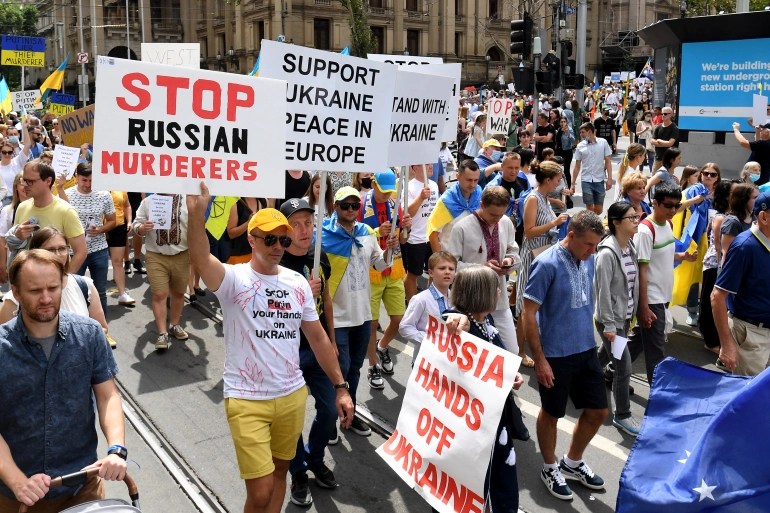
While the so-called liberal and conservative corporate mainstream media – all stenographers for the intelligence agencies – pour forth the most blatant propaganda about Russia and Ukraine that is so conspicuous that it is comedic if it weren’t so dangerous, the self-depicted cognoscenti also ingest subtler messages, often from the alternative media.
A woman I know and who knows my sociological analyses of propaganda contacted me to tell me there was an excellent article about the war in Ukraine at The Intercept, an on-line publication funded by billionaire Pierre Omidyar I have long considered a leading example of much deceptive reporting wherein truth is mixed with falsehoods to convey a “liberal” narrative that fundamentally supports the ruling elites while seeming to oppose them. This, of course, is nothing new since it’s been the modus operandi of all corporate media in their own ideological and disingenuous ways, such as The New York Times, CBS, the Washington Post, the New York Daily News, Fox News, CNN, NBC, etc. for a very long time.
Nevertheless, out of respect for her judgment and knowing how deeply she feels for all suffering people, I read the article. Written by Alice Speri, its title sounded ambiguous – “The Left in Europe Confronts NATO’s Resurgence After Russia’s Invasion of Ukraine” – until I saw the subtitle that begins with these words: “Russia’s brutal invasion complicates…” But I read on. By the fourth paragraph, it became clear where this article was going. Speri writes that “In Ukraine, by contrast [with Iraq], it was Russia that had staged an illegal, unprovoked invasion, and U.S.-led support to Ukraine was understood by many as crucial to stave off even worse atrocities than those the Russian military had already committed.” [my emphasis]
While ostensibly about European anti-war and anti-NATO activists caught on the horns of a dilemma, the piece goes on to assert that although US/NATO was guilty of wrongful expansion over many years, Russia has been an aggressor in Ukraine and Georgia and is guilty of terrible war crimes, etc.
There is not a word about the U.S. engineered coup in 2014, the CIA and Pentagon backed mercenaries in Ukraine, or its support for the neo-Nazi Azov Battalion and Ukraine’s years of attacks on the Donbass where many thousands have been killed. It is assumed these actions are not criminal or provocative. And there is this:
The uncertain response of Europe’s peace activists is both a reflection of a brutal, unprovoked invasion that stunned the world and of an anti-war movement that has grown smaller and more marginalized over the years. The left in both Europe and the U.S. have struggled to respond to a wave of support for Ukraine that is at cross purposes with a decades long effort to untangle Europe from a U.S.-led military alliance. [my emphasis]
In other words, the article, couched in anti-war rhetoric, was anti-Russia propaganda. When I told my friend my analysis, she refused to discuss it and got angry with me, as if I therefore were a proponent of war. I have found this is a common response.
This got me thinking again about why people so often miss the untruths lying within articles that are in many parts truthful and accurate. I notice this constantly. They are like little seeds slipped in as if no one will notice; they work their magic nearly unconsciously. Few do notice them, for they are often imperceptible. But they have their effects and are cumulative and are far more powerful over time than blatant statements that will turn people off, especially those who think propaganda doesn’t work on them. This is the power of successful propaganda, whether purposeful or not. It particularly works well on “intellectual” and highly schooled people.
For example, in a recent printed interview, Noam Chomsky, after being introduced as a modern day Galileo, Newton, and Descartes rolled into one, talks about propaganda, its history, Edward Bernays, Walter Lippman, etc. What he says is historically accurate and informative for anyone not knowing this history. He speaks wisely of U.S. media propaganda concerning its unprovoked war against Iraq and he accurately calls the war in Ukraine “provoked.” And then, concerning the war in Ukraine, he drops this startling statement:
I don’t think there are ‘significant lies’ in war reporting. The U.S. media are generally doing a highly creditable job in reporting Russian crimes in Ukraine. That’s valuable, just as it’s valuable that international investigations are underway in preparation for possible war crimes trials.
In the blink of an eye, Chomsky says something so incredibly untrue that unless one thinks of him as a modern day Galileo, which many do, it may pass as true and you will smoothly move on to the next paragraph. Yet it is a statement so false as to be laughable. The media propaganda concerning events in Ukraine has been so blatantly false and ridiculous that a careful reader will stop suddenly and think: Did he just say that?
So now Chomsky views the media, such as The New York Times and its ilk, that he has correctly castigated for propagandizing for the U.S. in Iraq and East Timor, to use two examples, is doing “a highly creditable job in reporting Russian crimes in Ukraine,” as if suddenly they were no longer spokespeople for the CIA and U.S. disinformation. And he says this when we are in the midst of the greatest propaganda blitz since WW I, with its censorship, Disinformation Governance Board, de-platforming of dissidents, etc., that border on a parody of Orwell’s Nineteen Eighty-Four.
Even slicker is his casual assertion that the media are doing a good job reporting Russia’s war crimes after he earlier has said this about propaganda:
So it continues. Particularly in the more free societies, where means of state violence have been constrained by popular activism, it is of great importance to devise methods of manufacturing consent, and to ensure that they are internalized, becoming as invisible as the air we breathe, particularly in articulate educated circles. Imposing war-myths is a regular feature of these enterprises.
This is simply masterful. Explain what propaganda is at its best and how you oppose it and then drop a soupçon of it into your analysis. And while he is at it, Chomsky makes sure to praise Chris Hedges, one of his followers, who has himself recently wrote an article – The Age of Self-Delusion – that also contains valid points appealing to those sick of wars, but which also contains the following words:
Putin’s revanchism is matched by our own.
The disorganization, ineptitude, and low morale of the Russian army conscripts, along with the repeated intelligence failures by the Russian high command, apparently convinced Russia would roll over Ukraine in a few days, exposes the lie that Russia is a global menace.
‘The Russian bear has effectively defanged itself,’ historian Andrew Bacevich writes.
But this is not a truth the war makers impart to the public. Russia must be inflated to become a global menace, despite nine weeks of humiliating military failures. [my emphasis]
Russia’s revanchism? Where? Revanchism? What lost territory has the U.S. ever waged war to recover? Iraq, Syria, Cuba, Vietnam, Yugoslavia, etc.? The U.S.’s history is a history not of revanchism but of imperial conquest, of seizing or controlling territory, while Russia’s war in Ukraine is clearly an act of self-defense after years of U.S./NATO/Ukraine provocations and threats, which Hedges recognizes. “Nine weeks of humiliating military failures”? – when they control a large section of eastern and southern Ukraine, including the Donbass. But his false message is subtly woven, like Chomsky’s, into sentences that are true.
“But this is not a truth the war makers impart to the public.” No, it is exactly what the media spokespeople for the war makers – i.e. The New York Times (Hedges former employer, which he never fails to mention and for whom he covered the Clinton administration’s savage destruction of Yugoslavia), CNN, Fox News, The Washington Post, the New York Post, etc. impart to the public every day for their masters. Headlines that read how Russia, while allegedly committing daily war crimes, is failing in its war aims and that the mythic hero Zelensky is leading Ukrainians to victory. Words to the effect that “The Russian bear has effectively defanged itself” presented as fact.
Yes, they do inflate the Russian monster myth, only to then puncture it with the myth of David defeating Goliath.
But being in the business of mind games (too much consistency leads to clarity and gives the game away), one can expect them to scramble their messages on an ongoing basis to serve the U.S. agenda in Ukraine and further NATO expansion in the undeclared war with Russia, for which the Ukrainian people will be sacrificed.
Orwell called it “doublethink”:
Doublethink lies at the very heart of Ingsoc, since the essential act of the Party is to use conscious deception while retaining the firmness of purpose that goes with complete honesty.To tell deliberate lies while genuinely believing in them, to forget any fact that has become inconvenient, and then, when it becomes necessary again, to draw it back from oblivion for just so long as it is needed, to deny the existence of objective reality and all the while to take account of the reality one denies – all this is indispensably necessary….with the lie always one step ahead of the truth.
Revealing while concealing and interjecting inoculating shots of untruths that will only get cursory attention from their readers, the writers mentioned here and others have great appeal for the left intelligentsia. For people who basically worship those they have imbued with infallibility and genius, it is very hard to read all sentences carefully and smell a skunk. The subterfuge is often very adroit and appeals to readers’ sense of outrage at what happened in the past – e.g. the George W. Bush administration’s lies about weapons of mass destruction in Iraq.
Chomsky, of course, is the leader of the pack, and his followers are legion, including Hedges. For decades they have been either avoiding or supporting the official versions of the assassinations of JFK and RFK, the attacks of September 11, 2001 that led directly to the war on terror and so many wars of aggression,and the recent Covid-19 propaganda with its devastating lockdowns and crackdowns on civil liberties. They are far from historical amnesiacs, of course, but obviously consider these foundational events of no importance, for otherwise they would have addressed them. If you expect them to explain, you will be waiting a long time.
In a recent article – How the organized Left got Covid wrong, learned to love lockdowns and lost its mind: an autopsy – Christian Parenti writes this about Chomsky:
Almost the entire left intelligentsia has remained psychically stuck in March 2020. Its members have applauded the new biosecurity repression and calumniated as liars, grifters, and fascists any and all who dissented. Typically, they did so without even engaging evidence and while shirking public debate. Among the most visible in this has been Noam Chomsky, the self-described anarcho-syndicalist who called for the unvaccinated to “remove themselves from society,” and suggested that they should be allowed to go hungry if they refuse to submit.
Parenti’s critique of the left’s response (not just Chomsky’s and Hedges’) to Covid also applies to those foundational events mentioned above, which raises deeper questions about the CIA’s and NSA’s penetration of the media in general, a subject beyond the scope of this analysis.
For those, like the liberal woman who referred me to The Intercept article, who would no doubt say of what I have written here: Why are you picking on leftists? my reply is quite simple.
The right-wing and the neocons are obvious in their pernicious agendas; nothing is really hidden; therefore they can and should be opposed. But many leftists serve two masters and are far subtler. Ostensibly on the side of regular people and opposed to imperialism and the predations of the elites at home and abroad, they are often tricksters of beguiling rhetoric that their followers miss. Rhetoric that indirectly fuels the wars they say they oppose.
Smelling skunks is not as obvious as it might seem. Being nocturnal, they come forth when most are sleeping.

By Charles Hugh Smith
Source: Of Two Minds
Let’s consider livelihood options in an unsustainable economy of extremes that are unraveling, an economy that is being forced to transition to Degrowth.
Nassim Taleb’s book Antifragile explains the differences between fragile systems (systems that cannot survive instability), resilient systems (systems that can survive instability and stay the same) and antifragile systems (systems that adapt and emerge stronger).
The ideal way of life is antifragile: resilient enough to survive adversity and adaptable enough to evolve solutions to whatever comes our way.
The key antifragile traits are adaptability and rapid, flexible evolution. Adversity puts selective pressure on organisms: only those organisms which adapt successfully survive.
The more antifragile our livelihood and way of life, the better prepared we will be to recognize and pursue opportunities.
An unsustainable, unstable economy puts a great deal of pressure on its participants. Only those with the skills and agency to move, adapt and experiment will emerge stronger.
Adaptability requires agency. Those without much control are stuck with the consequences of others’ decisions and actions.
In my experience, self-reliance is integral to an antifragile way of life.Self-reliance and self-sufficiency are similar but not identical.
Self-sufficiency means reducing our dependence on resources provided by others: growing our own food, doing our own repairs, etc. Self-sufficiency can also be understood as shortening dependency chains.
Compare being dependent on food shipped thousands of miles to relying mostly on food grown within 50 miles of home. There are so many ways long supply chains can break down because the entire system breaks down if even one link in the dependency chain breaks.
Total self-sufficiency isn’t practical. We all rely on industrial production of metals, tools, plastics, fertilizers, etc. But reducing our dependence on systems that are fragile by consuming less and wasting nothing increases our antifragility.
Self-reliance is being able to take care of oneself, being independent in thought and action, and maintaining control of decision-making–what I’ve been calling agency.
Self-reliance means being able to go against the crowd. This requires independence and confidence in one’s inner compass.
Being able to take care of oneself means drawing upon inner resources, being able to identify the essentials of a situation and coming up with solutions that are within reach.
Since households with multiple incomes are far more resilient than households with all their eggs in one basket, our goal is to develop income streams that we control. The ownership is more important than the scale of the income. A modest income we control is far more antifragile than a larger income we have little control over.
Developing income streams is easier if we approach the task with an entrepreneurial mindset.
This mindset looks at work in terms of markets, unmet demand, pricing power, networks of trustworthy peers, trial and error (experiments), optimizing new skills, seeking mentors, learning to make clear-eyed assessments of what’s working and what isn’t, and then acting decisively on the conclusions.
All these skills can be developed. They are very useful in navigating unstable conditions because they prepare us to act decisively rather than passively await others to decide what happens to us.
Some skills can be applied to virtually every field: project management, bookkeeping, working well with others, computer skills and communicating clearly. Being a fast learner is valuable in every field.
In my books and blog posts, I’ve covered the difference between tradable work–work that can be done anywhere–and untradable work, work that can only be done locally. Having skills that are untradable is advantageous, as the competition is local rather than global.
Skills that can’t be automated are also advantageous. Robots are optimized for repetitive tasks and factory / warehouse floors with sensors. They are not optimized for tasks that must be figured out on the fly and that require multiple skills.
Who fixes the robot when it fails out in the field? Another robot? Who replaces the dead battery in the drone? Another drone? The point is there are real-world limits on robotics, artificial intelligence, machine learning and automation that proponents gloss over or ignore.
Those with multiple skills who can problem-solve on the fly will continue to be valuable.
The models of work are changing, and this offers a wider range of options which is especially valuable to those emerging from burnout.
Combining various kinds and modes of work is called hybrid work. This could be mixing work from home (remote work) with occasional visits to an office, or it could be mixing a part-time job with self-employment.
I’ve written about one example in Japan called Half Farmer, Half X, where young urban knowledge workers move to the countryside to pursue small-scale farming while keeping a part-time, high-pay tech job they do online. Since the cost of living is so much lower in the countryside, these hybrid workers don’t need to work many hours remotely to cover their expenses, nor do they need their small-scale farming to be highly profitable.
Not all work is paid. Indeed, only a slice of human work globally is paid. The work that gives us the greatest fulfillment may well be unpaid or poorly paid. We may have to do some work to pay the bills while looking forward to the work we do that doesn’t earn much money.
Personally, I have always been drawn to both knowledge work and hands-on work. I worked my way through my university with a part-time job in construction. This was the ideal mix for my enthusiasms. Whenever I’ve been limited to one or the other, I feel dissatisfied. For me, hybrid work means having both knowledge work and hands-on physical labor, and having control of both.
Many people believe they need additional credentials to expand their opportunities. The alternative is to accredit yourself.
Since I’m enthusiastic about working with fruit trees and vegetable gardens, let’s say I decide to offer my services to potential customers.
One avenue is to spend money and time to get a certificate in horticulture. Alternatively, I could take photos of my own yard to document the trees I planted and how fast they’ve grown under my care. In other words, I could accredit myself, providing direct evidence of my skills and experience.
Employers have learned that completing a credential doesn’t mean the graduate will be productive. The diploma doesn’t prove the graduate learned much or has what it takes to work well with others.
The diploma actually tells us very little about the graduate. We learn much more from someone who accredits themselves by documenting projects they’ve completed.
The only real source of prosperity is improving productivity: doing more with fewer resources and labor. Economists expected the adoption of computers and the Internet to boost productivity. Instead, productivity gains have been extremely modest, 1% or 2% per year, far lower than the 10% annual gains achieved during industrialization.
This productivity paradox has puzzled economists for decades. One reason why the productivity of knowledge work ((white-collar work) has barely improved when compared to factory productivity (blue-collar work) is the methodical optimization of tasks is more difficult to apply to knowledge work. Much of this work is done by rule of thumb and what was passed down by senior workers.
There are a number of reasons for this. One is it’s easier to study the assembly of products than it is to break down the production of services.
Another is that many fields of knowledge work are so new that it’s difficult to optimize tasks because they’re constantly changing.
A third factor is that we’ve been wealthy enough to waste labor and capital on unproductive bureaucratic friction. Just as we waste water when it’s abundant and free, we also waste energy and money when they’re abundant.
In Global Crisis, National Renewal I describe the changes in the process of obtaining a building permit in the past 40 years.
In the early 1980s, I could submit a set of plans for a modest house in the morning and pick up the approved plans and building permit that afternoon. Now the process takes many months, even though the house being built hasn’t changed much at all. What changed was the permit approval process became terribly inefficient.
Since there’s few incentives to improve efficiencies in bureaucracies, it now takes a decade or longer to approve a bridge or landfill While the number of professors and doctors has increased modestly, the number of university and hospital administrators has soared.
Now that energy will no longer be cheap over the long term, incentives to improve the productivity of knowledge work will increase.
Unsustainable economies are prone to sudden changes in finance and the availability of essentials. We’re accustomed to predictable stability, and so few are prepared to respond effectively to instability.
If our lives only work when things are stable, our way of life is fragile. Recall Sun Tzu’s advice: “If a battle cannot be won, do not fight it.” If we’re only prepared for everything to stay the same, we’re fighting a battle we can’t win. We want to be prepared for sudden changes and scarcities by planning ahead and being flexible, nimble and responsive.
One facet of being antifragile is having a buffer or cushion against sudden shocks. In a 2018 interview, Nassim Taleb said, “Money can’t buy happiness, but the absence of money can cause unhappiness. Money buys freedom… to choose what you want to do professionally.”
Taleb went on to note that it takes great discipline to keep enough money stashed to give us the freedom to maintain our agency when faced with adversity. Self-reliance requires a buffer so we have time to figure out solutions and the means to pursue them.
In my experience, our willingness to consider all options, our ability to make careful decisions and take decisive action are just as important as a cushion of cash. Cash widens our options, but if we’re frozen by inexperience and fear then our options are severely limited.
The wider our range of skills, the greater our opportunities to add value. The basic needs of human life must be met and so those who can meet those needs will always be valued. This range of skills is also a buffer because it gives us more options in adversity.
How much money do we need as a cushion? The less we need, the lighter our expenses and the more options we have. If we need $10,000 a month just to pay our basic expenses, that demands a large cushion. If we’ve simplified and downsized our way of life so $1,000 a month is enough to keep us going, our cushion can be much smaller.
In other words, frugality, self-reliance and simplicity are key parts of antifragility, for they lower the cost of freedom. Money can lose its value in crisis, but our buffer of skills and self-reliance cannot be taken from us or devalued by a global crisis.
One final consideration is timing. The sooner we start preparing for degrowth, the better off we’ll be. A Chinese proverb captures this succinctly: By the time you’re thirsty, it’s too late to dig a well.
Spiritwalker (2021) Review
Director: Yoon Jae-Keun
Cast: Park Yong-Woo, Lim Ji-Yeon, Park Ji-Hwan, Yoo Seung-Mok, Lee Sung-Wook, Seo Hyun-Woo, Baek Do-Gyum, Woo Kang-Min
Running Time: 110 min.
By Paul Bramhall
Source: City on Fire
It’s fair to say the body-swap plot device has been a recurring theme in cinema over the years. While more often than not the gimmick has been used for comedic purposes, thankfully there are filmmakers out there who have been willing to apply it to further afield. Movies like the 1998 thriller Fallen spring to mind, in which Denzel Washington attempts to catch the spirit of a serial killer who can take over people’s bodies, as does the pulpy Jason Goes to Hell: The Final Friday, in which the spirit of everyone’s favorite hockey mask wearing psycho takes on similar abilities. Joining the ranks in 2021 is Yoon Jae-geun’s Spiritwalker, which sees the director and writer returning to the screen for the first time since his debut with 2010’s Heartbeat.
Opening with Yoon Kye-sang (The Outlaws, Poongsan) slumped against the door of a recently crashed vehicle and nursing a gun shot wound, things seem amiss when the reflection he sees of himself in the car window isn’t his own, and to confound matters further he has no recollection of who he is. Embarking on a mission to uncover his identity, matters aren’t helped by the fact that whenever it hits 12:00 (both noon and midnight), his spirit shifts into the body of someone else. The loss of memory and 12-hour body swap cycle make up the crux of what keeps Spiritwalker propelling itself forward, and it’s easy to imagine the Blu-ray cover containing the quote “The Bourne Identity meets The Beauty Inside!” Taking the amnesia plot device of the former, and the timed body-swapping gimmick of the latter, Jae-geun has created one of the more unique entries in Korea’s recent pool of action thrillers.
While the concept of Spiritwalker could easily result in confusion onscreen, especially when it becomes apparent that the bodies his spirit goes into are one’s we’re also familiar with, Jae-geun does a good job of translating it into cinematic language without insulting the audience’s intelligence. While during the first half he uses the trick of switching between showing Kye-sang and the actor of whoever’s body he’s in, by the latter half he trusts the audience to know whose body Kye-sang is supposed to be in, letting the actor take centre stage in the movie that’s billed as being his starring vehicle (something I’m sure he was thankful for).
Unfortunately as is the case with many high concept thrillers, the concept requires a lot of attention to execute and not stumble over its own logic, so much so that in the end other areas suffer. Kye-sang has a likeable screen presence, and I’ve enjoyed most of his performances since he first came on my radar through watching Poongsan at the time of its release in 2011. He left a considerable impression as the villain who faces off against Ma Dong-seok in 2017’s The Outlaws, however here his character feels underdeveloped and lacks personality. Surprisingly, considering how important it should be for a character to be well drawn in a plot that hinges on said character inhibiting other characters bodies, this doesn’t prove to be detrimental to the overall plot. As a central protagonist to root for though, through no fault of his own Kye-sang doesn’t really connect on any deeper level other than being a cipher onscreen.
A bigger issue is the narrative that’s been constructed around the body-swap device in order to explain it, which also feels undercooked and leaves several questions unanswered. It’s a shame, as the actual act of changing bodies every 12 hours is handled well and sets up a brisk pace maintained for the almost 110-minute runtime, so it feels like somewhat of a let down when the explanation for it all only feels half baked. Such criticisms point to the fact that Jae-geun clearly wasn’t looking to create an in-depth character study here, musing on the meaning of one’s identity and how deeply it’s connected to our physical appearance. For that, I guess we have The Beauty Inside. To enjoy Spiritwalker it’s best to take it at face value (pun intended), which is a body swap-thriller involving a guy with no memory being chased by a shadowy corporation who he may or may not have used to work for.
The 12-hour framing device instils a welcome sense of urgency into the narrative, and as predictable as it may be, Jae-geun does an admirable job of coming up with a variety of either life endangering or desperate situations that always happen in the closing minutes before Kye-sang’s spirit swaps into another body. Spiritwalker is at its best when playing around with the body-swapping device, such as when Kye-sang’s spirit is transferred into one of the lackeys he’s just threatened by pushing a pen into his neck, and then finds himself having to deal with his own self-inflicted injury. The unpredictable nature of both Kye-sang and the audience not knowing whose body he’ll go into next offsets the expected crises that crop up whenever 12:00 approaches, and keeps things engaging.
Clearly banking on its action credentials as much as its sci-fi leanings, Jae-geun has enlisted martial arts choreographers Park Young-sik and Jung Sung-ho to put together a sprinkling of grounded action scenes. Young-sik is a veteran of the Korean film industry, having lent his martial arts prowess to a countless number of productions since the early 2000’s, including being the martial arts director on the likes of 2008’s A Frozen Flower and 2010’s The Showdown. While Sung-ho has been around almost as long, he also comes with bragging rights of being part of the stunt team for the Netflix series Squid Game, which bagged the Best Stunt Ensemble award at 2022’s Screen Actors Guild Awards.
Recalling the grand tradition of Korean action thrillers made in that wonderful era during the early to mid 2010’s, a time when it seemed like they could do no wrong, the best action scene in Spritwalker takes place within the confines of an apartment (see also The Berlin File and No Tears for the Dead for reference). While in his best friends’ body (played by Lee Sung-wook – Collectors, Microhabitat) Kye-sang’s character finds himself in his girlfriends apartment facing off against a pair of assailants who want to track him down. The ensuing one on one fight against Seo Hyun-woo (The Man Standing Next, Believer) is expertly filmed, even going so far as to seamlessly switch between Sung-wook and Kye-sang without the use of CGI, a true testament of the action experience that’s behind the camera.
The ending also recalls the heyday of modern Korean action cinema, as Kye-sang conveniently finds himself in a character’s body decked out in a sharp black suit (which means he’s also now decked out in a sharp black suit). While fans of Korean cinema will likely recall Won Bin in the finale of The Man from Nowhere, the use of guns rather than blades inevitably brings to mind the John Wick franchise, and its influence is hard to deny. Kye-sang’s performance feels a little more gung-ho and frantic than Keanu Reeves, as he flings himself over tables and through wooden dividers, giving the scene a more frantic feel than Wick’s precision point and shoot technique, however the influence is clearly still there. While the finale gets suitably bloody and desperate, it somehow feels like it stops short before really ramping up, and there’s an odd decision that frames the whole movie to look like a tale of divided lovers which simply doesn’t work.
As a director and writer Yoon Jae-geun is one of those enigmas who seem to occasionally pop up in Korean cinema – defined by the fact that they were once active in the film industry, then drop completely off the map, before re-appearing more than 10 years later with a new movie out of the blue. As a sophomore feature Spiritwalker doesn’t necessarily indicate we can expect to wait less than 10 years for another movie from Jae-geun, however it is an entertaining action thriller that executes its novel premise with aplomb, let down by the fact that everything that surrounds it feels so slight.
Watch Spiritwalker on Hoopla here: https://www.hoopladigital.com/title/14986537
By John W. Whitehead & Nisha Whitehead
Source: The Rutherford Institute
“Rights aren’t rights if someone can take them away. They’re privileges. That’s all we’ve ever had in this country, is a bill of temporary privileges. And if you read the news even badly, you know that every year the list gets shorter and shorter. Sooner or later, the people in this country are gonna realize the government … doesn’t care about you, or your children, or your rights, or your welfare or your safety… It’s interested in its own power. That’s the only thing. Keeping it and expanding it wherever possible.”— George Carlin
We’re in a national state of denial.
For years now, the government has been playing a cat-and-mouse game with the American people, letting us enjoy just enough freedom to think we are free but not enough to actually allow us to live as a free people.
Case in point: on the same day that the U.S. Supreme Court appeared inclined to favor a high school football coach’s right to pray on the field after a game, the high court let stand a lower court ruling that allows police to warrantlessly track people’s location and movements through their personal cell phones, sweeping Americans up into a massive digital data dragnet that does not distinguish between those who are innocent of wrongdoing, suspects, or criminals.
Likewise, although the Supreme Court gave the go-ahead for a death row inmate to have his pastor audibly pray and lay hands on him in the execution chamber, it refused to stop police from using hidden cameras to secretly and warrantlessly record and monitor a person’s activities outside their home over an extended period of time.
For those who have been paying attention, there’s a curious pattern emerging: the government appears reasonably tolerant of those who want to exercise their First Amendment rights in a manner that doesn’t challenge the police state’s hold on power, for example, by praying on a football field or in an execution chamber.
On the other hand, dare to disagree with the government about its war crimes, COVID-19, election outcomes or police brutality, and you’ll find yourself silenced, cited, shut down and/or branded an extremist.
The U.S. government is particularly intolerant of speech that reveals the government’s corruption, exposes the government’s lies, and encourages the citizenry to push back against the government’s many injustices. For instance, Wikileaks founder Julian Assange, the latest victim of the government’s war on dissidents and whistleblowers, is in the process of being extradited to the U.S. to be tried under the Espionage Act for daring to access and disclose military documents that portray the U.S. government and its endless wars abroad as reckless, irresponsible, immoral and responsible for thousands of civilian deaths.
Even political protests are fair game for prosecution. In Florida, two protesters are being fined $3000 for political signs proclaiming stating “F—k Biden,” “F—k Trump,” and “F—k Policing 4 Profit” that violate a city ban on “indecent” speech on signs, clothing and other graphic displays.
The trade-off is clear: pray all you want, but don’t mess with the U.S. government.
In this way, the government, having appointed itself a Supreme and Sovereign Ruler, allows us to bask in the illusion of religious freedom while stripping us of every other freedom afforded by the Constitution.
We’re in trouble, folks.
Freedom no longer means what it once did.
This holds true whether you’re talking about the right to criticize the government in word or deed, the right to be free from government surveillance, the right to not have your person or your property subjected to warrantless searches by government agents, the right to due process, the right to be safe from militarized police invading your home, the right to be innocent until proven guilty and every other right that once reinforced the founders’ belief that this would be “a government of the people, by the people and for the people.”
Not only do we no longer have dominion over our bodies, our families, our property and our lives, but the government continues to chip away at what few rights we still have to speak freely and think for ourselves.
My friends, we’re being played for fools.
On paper, we may be technically free.
In reality, however, we are only as free as a government official may allow.
We only think we live in a constitutional republic, governed by just laws created for our benefit.
Truth be told, we live in a dictatorship disguised as a democracy where all that we own, all that we earn, all that we say and do—our very lives—depends on the benevolence of government agents and corporate shareholders for whom profit and power will always trump principle. And now the government is litigating and legislating its way into a new framework where the dictates of petty bureaucrats carry greater weight than the inalienable rights of the citizenry.
With every court ruling that allows the government to operate above the rule of law, every piece of legislation that limits our freedoms, and every act of government wrongdoing that goes unpunished, we’re slowly being conditioned to a society in which we have little real control over our lives.
As Rod Serling, creator of the Twilight Zone and an insightful commentator on human nature, once observed, “We’re developing a new citizenry. One that will be very selective about cereals and automobiles, but won’t be able to think.”
Indeed, not only are we developing a new citizenry incapable of thinking for themselves, we’re also instilling in them a complete and utter reliance on the government and its corporate partners to do everything for them—tell them what to eat, what to wear, how to think, what to believe, how long to sleep, who to vote for, whom to associate with, and on and on.
In this way, we have created a welfare state, a nanny state, a police state, a surveillance state, an electronic concentration camp—call it what you will, the meaning is the same: in our quest for less personal responsibility, a greater sense of security, and no burdensome obligations to each other or to future generations, we have created a society in which we have no true freedom.
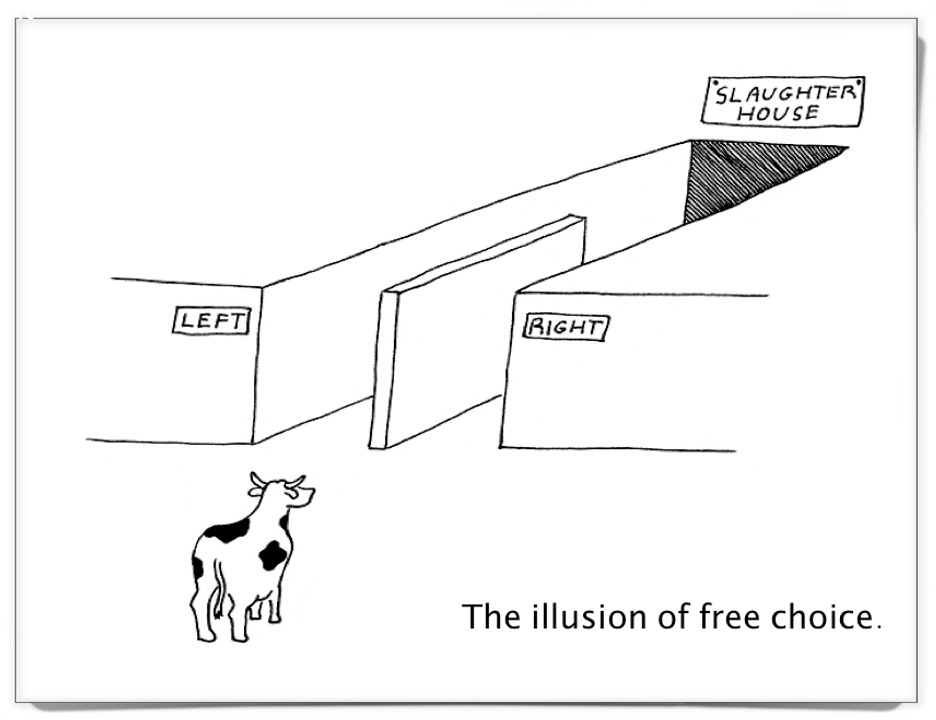
Government surveillance, police abuse, SWAT team raids, economic instability, asset forfeiture schemes, pork barrel legislation, militarized police, drones, endless wars, private prisons, involuntary detentions, biometrics databases, free speech zones, etc.: these are mile markers on the road to a fascist state where citizens are treated like cattle, to be branded and eventually led to the slaughterhouse.
Freedom, or what’s left of it, is being threatened from every direction. The threats are of many kinds: political, cultural, educational, media, and psychological. However, as history shows us, freedom is not, on the whole, wrested from a citizenry. It is all too often given over voluntarily and for such a cheap price: safety, security, bread, and circuses.
This is part and parcel of the propaganda churned out by the government machine.
That said, what we face today—mind manipulation and systemic violence—is not new. What is different are the techniques used and the large-scale control of mass humanity, coercive police tactics and pervasive surveillance.
We are overdue for a systemic check on the government’s overreaches and power grabs.
By “government,” I’m not referring to the highly partisan, two-party bureaucracy of the Republicans and Democrats. Rather, I’m referring to “government” with a capital “G,” the entrenched Deep State that is unaffected by elections, unaltered by populist movements, and has set itself beyond the reach of the law.
For years now, we have suffered the injustices, cruelties, corruption and abuse of an entrenched government bureaucracy that has no regard for the Constitution or the rights of the citizenry.
We have lingered too long in this strange twilight zone where ego trumps justice, propaganda perverts truth, and imperial presidents—empowered to indulge their authoritarian tendencies by legalistic courts, corrupt legislatures and a disinterested, distracted populace—rule by fiat rather than by the rule of law.
Where we find ourselves now is in the unenviable position of needing to rein in all three branches of government—the Executive, the Judicial, and the Legislative—that have exceeded their authority and grown drunk on power.
We are the unwitting victims of a system so corrupt that those who stand up for the rule of law and aspire to transparency in government are in the minority. This corruption is so vast it spans all branches of government: from the power-hungry agencies under the executive branch and the corporate puppets within the legislative branch to a judiciary that is, more often than not, elitist and biased towards government entities and corporations.
The predators of the police state are wreaking havoc on our freedoms, our communities, and our lives. The government doesn’t listen to the citizenry, it refuses to abide by the Constitution, which is our rule of law, and it treats the citizenry as a source of funding and little else.
The American kleptocracy (a government ruled by thieves) has sucked the American people down a rabbit hole into a parallel universe in which the Constitution is meaningless, the government is all-powerful, and the citizenry is powerless to defend itself against government agents who steal, spy, lie, plunder, kill, abuse and generally inflict mayhem and sow madness on everyone and everything in their sphere.
This dissolution of that sacred covenant between the citizenry and the government—establishing “we the people” as the masters and the government as the servant—didn’t happen overnight. It didn’t happen because of one particular incident or one particular president. It is a process, one that began long ago and continues in the present day, aided and abetted by politicians who have mastered the polarizing art of how to “divide and conquer.”
Unfortunately, there is no magic spell to transport us back to a place and time where “we the people” weren’t merely fodder for a corporate gristmill, operated by government hired hands, whose priorities are money and power.
As I make clear in my book Battlefield America: The War on the American People and in its fictional counterpart The Erik Blair Diaries, our freedoms have become casualties in an all-out war on the American people.
If we continue down this road, there can be no surprise about what awaits us at the end.
By Charles Hugh Smith
Source: Of Two Minds
Are we heading into another real estate bubble / crash? Those who say “no” see the housing shortage as real, while those who say “yes” see the demand as a reflection of the Federal Reserve’s artificial goosing of the housing market via its unprecedented purchases of mortgage-backed securities and “easy money” financial conditions.
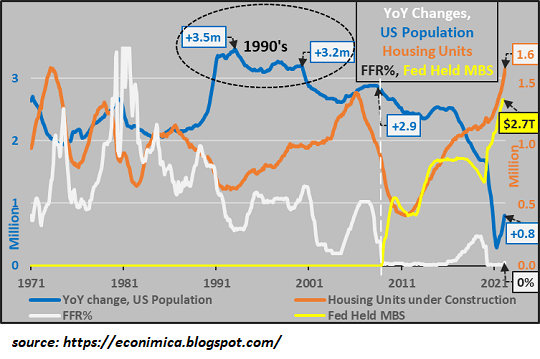
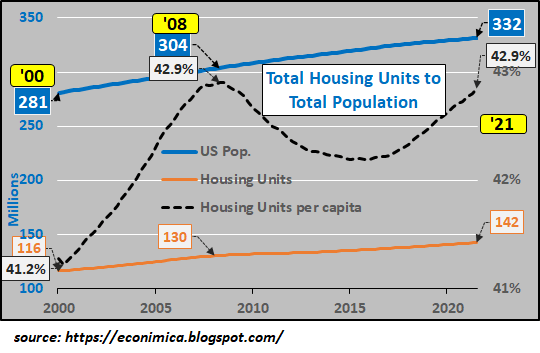
My colleague CH at econimica.blogspot.com recently posted charts calling this assumption into question. The first chart (below) shows the U.S. population growth rate plummeting as housing starts soar, and the second chart shows housing unit per capita, which has just reached the same extreme as the 2008 housing bubble.
Demographics and housing do not reflect a housing shortage nationally, though there could be scarcities locally, of course, and other factors such as thousands of units being held off the market as short-term rentals or investments by overseas buyers who have no interest in renting their investment dwellings.
On a per capita basis, housing has reached previous bubble levels. That suggests housing shortages are artificial or local, not structural.
Next, let’s consider how the current housing bubble differs from previous bubbles in the late 1970s and 2000s. In my view, the previous bubbles were driven by demographics, inflation and monetary policy: in the late 70s, the 65 million-strong Baby Boom generation began buying their first homes, pushing demand higher while inflation soared, making real-world assets such as housing more desirable.
Once the Federal Reserve pushed interest rates to 18%, mortgage rates rose in lockstep and housing crashed as few could afford sky-high housing prices at sky-high mortgage rates.
The housing bubble of 2007-08 was largely driven by declines in mortgage rates (as the Fed pursued an “easy money” policy to escape the negative effects of the Dot-Com stock market bubble crash) and a loosening of credit/mortgage standards. These fueled a bubble that morphed into a speculative free-for-all of no-down payment and no-document loans.
This decline in the cost of borrowing money (mortgage rates) enabled a sharp rise in the price of housing, a speculative boom that was greatly accelerated by “innovations” in the mortgage market such as zero down payments loans, interest-only loans, home equity loans, and no-document “liar loans”–mortgages underwritten without the usual documentation of income and net worth.
These forces generated a speculative frenzy of house-flipping, leveraging the equity in the family home to buy two or three homes under construction and selling them before they were even completed for fat profits, and so on.
Needless to say, the pool of potential buyers expanded tremendously when people earning $25,000 a year could buy $500,000 houses on speculation.
Once the bubble popped, the pool of buyers shrank along with the home equity.
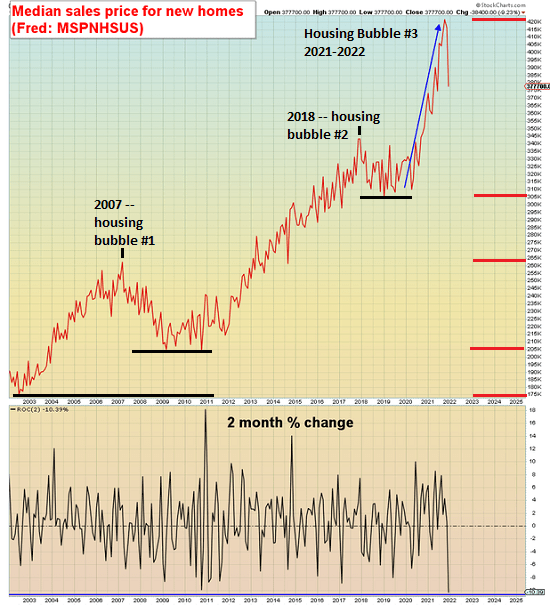
If we study this chart below of new home prices (courtesy of Mac10), we can see that the 21st century’s Bubble #2 rose as the Federal Reserve pushed mortgage rates far below historic norms. Once rates reached a bottom, the 7-year inflation of home prices (from 2011 to 2018) began rolling over.
This deflation of home prices was reversed by the pandemic recession, as the Fed’s vast expansion of credit and mortgage-buying, which pushed mortgage rates to new lows. Trillions of dollars in new credit and cash stimulus ignited a speculative frenzy in stocks, bonds and real estate, a frenzy which drove bubble #3 to extraordinary heights.
All this unprecedented fiscal and monetary stimulus also ignited inflation, and so rates are rising in response. Bubble #3 is already deflating, at least by the measure of new home prices.
But the current bubble has a number of dynamics that weren’t big factors in previous bubbles.
One is the rise of remote work. Many people have been working remotely since the late 1990s enabled Internet-based work, but the pandemic greatly increased the pool of employers willing to accept remote work as a permanent feature of employment.
This trend has been well documented, but the consequences are still unfolding: remote workers are no longer trapped in unaffordable, congested cities and suburbs.
Several other trends have attracted much less attention, but I see them as equally consequential.
1. Housing in many urban zones are out of reach of all but the top 10% without extraordinary sacrifice, and now that employment isn’t necessarily tied to urban zones, the bottom 90% of young people without family wealth or high incomes are coming to realize the benefits of urban living are not worth the extreme sacrifices needed to buy an overvalued house.
A middle-class life–home ownership, financial security, leisure and surplus income to invest in one’s family and well-being–is no longer affordable for the majority of young Americans.
Few are willing to concede this because it reveals the neofeudal nature of American life. Those who bought homes in coastal urban zones 20+ years ago are wealthy due to soaring housing valuations while young people can’t even afford the rent, much less buying a house.
If you’re not making $250,000 or more a year as a couple, the only hope for a middle-class life that includes leisure and some surplus income to invest is top move to some place with much lower housing and other costs. That place is rural America.
2. The benefits of urban living are deteriorating while the sacrifices and downsides are increasing. Urban living is fun if you’re wealthy, not so fun if you don’t have plenty of surplus income to spend.
Urban problems such as homelessness, traffic congestion and crime are endemic and unresolvable, though few are willing to state the obvious. Americans are expected to be optimistic and to count on some new whiz-bang technology to solve all problems.
Unfortunately, problems generated by dysfunctional, overly complex institutions, corruption and unaffordable costs can’t be solved by some new technology, and so the decay of cities will only gather momentum.
The hope that billions of federal stimulus funding would solve these problems is about to encounter reality as the funds dry up and all the problems remain or have actually expanded despite massive “investments” in solutions.
Few analysts have looked at the finances of high-cost cities. The decline in bricks-and-mortar retail, rising crime, soaring junk fees, rents and property taxes have all made urban small business insanely costly and therefore risky.
Small businesses are the core sources of employment and taxes. As high costs, crime, etc. choke small businesses, employment and tax revenues drop and commercial real estate sits empty, generating decay and defaults.
Once office and retail space is no longer affordable or necessary, commercial real estate crashes in value as owners who bought at the top default and go bankrupt.
People need shelter but they don’t need office space or to start a bricks-and-mortar retail business.
As urban finances unravel, cities won’t have the funding to run their bloated, inefficient, overly complex and unaccountable bureaucracies.
3. In geopolitics, we speak of the core and the periphery. Empires have a core (Rome and central Italy in the Roman Empire) and a periphery (Britain, North Africa, Egypt, the Levant).
As finances and trade decay and costs soar, the periphery is surrendered to maintain the core.
In urban zones, the same dynamic will become increasingly visible: the peripheral neighborhoods will be underfunded to continue protecting the wealthy enclaves.
Crime will skyrocket in the periphery even as residents of the wealthy enclaves see little decay in their neighborhoods.
This asymmetry–already extreme–will drive social unrest and disorder. This is a self-reinforcing feedback: as the periphery neighborhoods deteriorate, the remaining businesses flee and the smart money sells and moves away.
Tax revenues plummet and city services decay even further, persuading hangers-on to move before it gets even worse. Cities compensate for the lower revenues by increasing taxes on the remaining residents and cutting services.
Each turn of the screw triggers more closures and selling and fewer tax revenues.
4. Dependency chains will become increasingly consequential: the greater a city’s dependency on essentials trucked/shipped from hundreds or thousands of of kilometers/miles away, the more prone that city will be to disruptions of essentials: food, energy, materials and infrastructure.
Though few are willing to dwell on such vulnerabilities, most cities are totally dependent on diesel fueled fleets of trucks, rail and jet fuel for luxuries flown in from afar for virtually all goods. Cities produce very little in the way of essentials such as food and energy.
The past reliability of long supply chains has instilled a confidence that these supply chains stretching thousands of kilometers and miles are unbreakable and forever. They aren’t, and the initial disruptions will be a great shock to Americans who believe full gas tanks and fully stocked store shelves are their birthright.
5. As I’ve explained in my new book Global Crisis, National Renewal, the era of cheap, reliable abundance has drawn to a close and now we are entering an era of scarcity in essentials.
Another reality few discuss is the relative stability of global weather over the past 40 years. As weather becomes less reliable, so too do crop yields and food supplies.
Globalization has poured capital into expanding acreage under cultivation to the point that the planet’s forests are being decimated to grow more soy to feed animals to be slaughtered for human consumption.
On the margins, land that was once productive has been lost to desertification. Fresh water aquifers have been drained and glaciers feeding rivers are melting away. Soil fertility has declined even as fertilizer use has expanded.
The low-hanging fruit of GMO seeds, fertilizers, insecticides, herbicides and Green Revolution hybrids have all been plucked. The gains have been reaped but now the downsides of these dependencies are becoming increasingly consequential: fertilizer costs are rising fast, insects and diseases are evading chemicals and vaccines, and the vulnerabilities of mono-crop, industrialized agriculture and animal husbandry threaten to cascade into crop failures, soaring prices and shortages.
6. This will have two consequences: rural incomes which have been falling for decades due to globalization (i.e. bringing in cheap food from places with no environmental standards, cheap labor and few taxes / social costs) will start rising sharply, fueling a reversal in the long decline of rural communities based on agricultural income.
The soaring costs of essentials will reduce the disposable income of the bottom 90%, reducing the money they’ll have to spend on eating out, retail shopping, etc.–all the surplus spending that drives cities’ economies and tax revenues.
Few (if any) commentators forecast a cyclical reversal of the demographic trend of people moving from rural locales to cities. I think this trend has already reversed and will gather momentum as cities become increasingly unlivable, disposable incomes decline as scarcities push prices higher and people flee for lower cost, more secure environs.
7. As I often note, following what the super-wealthy are doing is a pretty sound investment strategy because the super-wealthy spend freely to buy the best advice and are highly motivated to protect their wealth.
People who live in well-known, highly desirable rural towns (Telluride, Jackson Hole, Lake Tahoe, etc.) are describing a feeding frenzy of wealthy urbanites buying multi-million dollar homes. Small cities such as Bozeman, MT and Ashville, NC are experiencing a flood of new residents that is straining infrastructure and pushing housing prices out of reach for local residents with average wages.
8. Rural towns in the U.S., Italy, Japan and even Switzerland are trying to attract new residents with offers of free land, subsidized rent, low cost homes, etc. This shows that the trends are global and not limited to any one nation. Would you take free land in rural America?
The decay of urban life isn’t yet consequential enough to push people into making a major move, but once someone has been robbed, repeatedly found human feces on their doorstep or experienced scarcities that trigger the madness of crowds, the decision to leave becomes much, much easier.
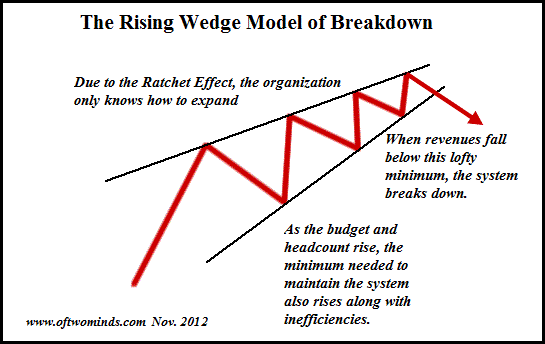
Some cities will manage the decline of employment and tax revenues more gracefully than others. Most will suffer from the dynamic I’ve often described on the blog: the Ratchet Effect. Costs move effortlessly higher as tax revenues have increased in one speculative bubble after another, but once revenues drop, cities have no mechanisms or political constituency to manage a sharp, long-term decline in revenues.
They then become prone to the other dynamic I’ve described, the Rising Wedge Breakdown (see chart below): as agencies and institutions become sclerotic, unaccountable and self-serving, even a relatively modest cut in revenues triggers institutional collapse, as the system requires 100% funding to function. A 10% reduction doesn’t cause a 10% decline in service, it causes an 50% decline in service, on the way to complete dysfunction.
Few believe cities can unravel, but remote work, geographic arbitrage (discussed below), tightening credit, rising crime, the decline of commercial real estate, end of massive stimulus, scarcities, the madness of crowds, the decline of civic services and amenities and an insanely high cost of living all have consequences and second-order effects.
What were beneficial synergies become fatal synergies as dynamics reverse and begin reinforcing each other.
So let’s put all this together.
A. The cycle of declining interest rates and inflation has ended and a cycle of much higher interest and mortgage rates and inflation is beginning. Higher mortgages rates will depress housing prices as only the highest income households will be able to afford today’s prices once mortgage rates rise.
B. The decay of urban finances and quality of life will accelerate as stimulus ends, credit dries up and inflation decimates disposable income.
C. The stress of trying to make enough money to afford the high costs of city/suburban living as the real estate bubble pops and the benefits of city living decline will burn out increasing numbers of people who will have no choice but to find more affordable, more secure and more livable places.
D. While the wealthy have already secured second or third homes in the toniest desirable towns, there are still opportunities for lower cost, more secure residences in rural areas.
E. This migration, even at the margins, will further depress urban housing prices and push prices in desirable rural locales higher.
F. This migration will have regional, ethnic and cultural variations. For example, some African-Americans leaving the upper Midwest are finding favor with communities in the South where family, church and cultural ties beckon.
G. Correspondent John F. used the phrase geographic arbitrage which means earning money remotely in high-wage sectors while living some place that’s low cost and secure.
I wrote about this many years ago in my post about young Japanese maintaining a part-time remote-work gig while pursuing farming in rural communities: Degrowth Solutions: Half-Farmer, Half-X (July 19, 2014).
H. Though monetary / inflationary forces will pop housing prices based solely on low mortgage rates, this doesn’t mean housing everywhere will decline: as burned out urbanites seek lower cost, more secure and livable places in rural locales, homes in desirable towns and small cities could rise sharply because they’re starting from such low levels.
I. If urban areas decay rapidly, housing prices could plummet much faster than most people think possible.
When cities lose employment, tax revenues and desirability, they can go down fast. Property values can fall in half and then by 90%.
How is this possible? Supply and demand: if demand falls off a cliff, there won’t be buyers for thousands of homes that come on the market all at once. This is just like a stock market in which buyers disappear, as no one wants to buy an asset that’s rapidly losing value.
As I’ve noted many times, prices for assets are set on the margins: the last sale of a house resets the price for the entire neighborhood.
The stock market is easily manipulated by the big players, who can stop a slide in prices by buying huge chunks of stocks and call options. There are no equivalent forces which can stop a decline in housing prices.
And since rates will rise regardless of what the Federal Reserve does because global capital is demanding a real return above inflation, then the hope for lower mortgage rates to support bubble-level housing prices will be in vain.
How low could housing go? As explained above, there will likely be very asymmetric declines and increases in housing valuations going forward. But on a technical-analysis level, we can anticipate a general decline to previous lows, first to the 2019 lows and then to the 2011 lows.
Some analysts believe inflation will funnel capital into housing as investors seek assets that will go up with inflation, but this is a murky forecast: the bottom 90% of American households are already priced out of coastal housing, so inflation only robs their wages of purchasing power. They don’t have any hope of buying a house anywhere near current prices.
Corporations are buying thousands of houses for the rental income, but once all the stimulus runs out and the excesses of speculation reverse, they’ll find few renters can afford their sky-high rents. At that point corporate buyers become corporate sellers, but they won’t find buyers willing or able to pay their asking prices, which are based on bubble pricing, not reality.
All these swirling currents will affect housing valuations in different places differently. Some areas could see 50% declines while others see 50% increases, regardless of mortgage rates or Fed policy.
What will become most desirable is a low cost of living, security and livability, which includes community, reduced dependency on long supply chains and local production of essentials.
We are all prone to believing the recent past is a reliable guide to the future. But in times of dynamic reversals, the past is an anchor thwarting our progress, not a forecast.

By Dr, Mike Williams
Source: UK Column
UK Column has covered various aspects of the Covid-19 virus and has looked in depth at the significant negative effects of the Covid-19 vaccine, including clotting, and also the change in immunological mechanisms after vaccination. Those mechanisms were used to explain the poor performance of the Covid-19 vaccine campaign, highlighted by an increased relative risk of infection for those vaccinated compared to the unvaccinated.
This article will address the current atypical spread of monkeypox virus around the world. To be clear, up until now, monkeypox hasn’t caused large clusters of infection in separate countries at the same time—that is highly unusual.
Monkeypox is one of the four genera of pox viruses that can infect humans. There are two distinct clades of monkeypox virus; the current infections are the West African version and are typically mild, with a death rate of less than one per cent. Chicken pox is an unrelated herpes, specifically Varicella virus.
It needs to be explained why we are seeing such a highly unusual pattern of infections. The medical concern is that we are witnessing an increase in human-to-human transmission.
Current data indicate that there are 107 confirmed cases—of which 19 have been hospitalised—and 85 suspected cases, with four hospitalisations among them. Taking only the confirmed cases, we thus obtain an 18% hospitalisation rate; combining the cases of all statuses, we get a 12% hospitalisation rate. However, those percentages will change as the cases increase.
Early data suggest that there is an increased risk amongst men who have sex with men.
In Stabilising the Code, we learned that:
In 2005, Drs. Weissman and Kariko discovered a way to protect foreign mRNA from the body’s immune system. That scientific milestone would be key to the advancement of the mRNA vaccines in 2020.
Specifically, they altered the genetic code of RNA.
Their key discovery, that modifying the RNA code (modifying the nucleoside uridine) resulted in ablating the innate immune response, involved toll-like receptors (TLR).
This discovery was adopted in the mRNA technology used in Covid vaccines, in order that the foreign vaccine mRNA could enter cells without being destroyed.
The RNA alteration results in the body’s immune defences—specifically, toll-like receptors (TLR)—not recognising foreign invaders like viruses. As I continued to set out in Stabilising the Code:
The key TLRs affected are TLR 3, TLR 7 and TLR 8. They act as sentries, whose job is to recognise foreign invaders by way of their form or patterns […]
That technology—altering RNA—was adopted for the Covid-19 mRNA vaccines.
Dominguez-Andres et al. discovered that not only had that technology worked well, but it appeared to have induced long term immune tolerance in the vaccinated:
The response of innate immune cells to TLR4 and TLR7/8 ligands was lower after BNT162b2 vaccination[.]
Toll-like receptors were found not to work as well after vaccination as before. That was not supposed to happen. Obviously, you need your TLRs to be working in order to fend off viruses like monkeypox.
Stack and Bowie investigated monkeypox virus and the role of TLR 4:
Toll-like receptors (TLRs) have an anti-viral role in that they detect viruses, leading to cytokine and IFN induction, and as such are targeted by viruses for immune evasion. TLR4, although best known for its role in recognizing bacterial LPS, is also strongly implicated in the immune response to viruses […] This work reveals the molecular basis for poxviral antagonism of TLR4.
Harte et al. demonstrated that pox virus suppresses the host defence by blocking TLR 3:
Toll-like receptors (TLRs) are crucial in the innate immune response to pathogens, in that they recognize and respond to pathogen associated molecular patterns, which leads to activation of intracellular signaling pathways and altered gene expression […]
This study reveals a novel mechanism used by VV [pox virus] to suppress the host immunity. We demonstrate viral disabling of TLRs, providing further evidence for an important role for this family of receptors in the antiviral response.
We also know that TLRs, upon detecting a virus, will activate other parts of the immune system. Khanmohammedi and Rezaei write:
Toll‐like receptors (TLR) play an important role in recognition of viral particles and activation of the innate immune system. Activation of TLR pathways leads to secretion of pro‐inflammatory cytokines, such as interleukin‐1 (IL‐1), IL‐6, and tumor necrosis factor‐α, as well as type 1 interferon […]
Robust induction of type I IFN through the activation of TLRs constitutes a critical aspect of antiviral immunity.
It being the case that TLRs activate other parts of the immune system—and given that, due to alterations in the vaccine mRNA, TLRs are no longer as responsive—we should expect to see a difference in downstream immunological profiles as well after vaccination.
Myeloid cells with high expression of Toll-like receptors (TLR) and other pattern-recognition receptors are likely the first to respond to viral infection. Robust induction of type I IFN through the activation of TLRs constitutes a critical aspect of antiviral immunity[…]
IFN production is dependent on transcription factors IRF7 and IRF8, which interact with MyD88 (Lester and Li, 2014; Tailor et al., 2007; Xagorari and Chlichlia, 2008). Prior studies of immune responses during COVID-19 found increased activity of these innate immune pathways (Scagnolari et al., 2021; Xu et al., 2020; Zhou et al., 2020) […]
Differential gene expression analysis of pDCs from COVID-19 patients and immunized individuals revealed a dramatic upregulation of gene signature associated with type I and type II IFN production in the former and not the latter.
Clearly, the attenuation (weakening) of TLRs after Covid-19 vaccination is having a significant negative effect: in this case, the possible reduction of interferon in response to infection—an important defence against viruses.
Pox viruses, like so many other viruses, have developed to try to outwit the human immune defences.
That has been observed in the science literature, such as Arndt et al., Evasion of the Innate Immune Type I Interferon System by Monkeypox Virus; and Johnstone et al., who demonstrate just why the virus needs to do so, in: In vitro inhibition of monkeypox virus production and spread by Interferon-β.
Indeed, pivotal to the success or failure of the monkeypox virus is its ability to overcome TLRs and switch off interferon.
Of course, once the immune system is primed to have a weaker response by TLRs and IFN, then it is more susceptible to pox infection. All that is then required to challenge it is exposure to the target virus.
The immune system is a symphony of complex responses, so an altered TLR response does not guarantee successful infection upon exposure to monkeypox virus—but it does increase the chances of it, since a major, initial defence mechanism has been weakened; especially if other factors increase that susceptibility.
The list of those known to be infected with monkeypox in the recent outbreaks is almost exclusively male, with reports of male-to-male sex being a common factor. It is still very early in the investigation, so that picture may change. However, it is well understood that men who have sex with other men have a demonstrably increased risk of infection with such viruses.
The current published list of those infected with monkeypox has one woman on it. That, plus the relatively high percentage of gay and bisexual men on the list, suggests that monkeypox may be being spread through networks of sexual intercourse.
Kelleher writes in Pink News:
The UKHSA [UK Health Security Agency, formerly known as Public Health England—editorial note] has said cases are primarily being detected among gay and bisexual men, which has led to some level of concern in the LGBTQ+ community.
It’s thought that monkeypox is not sexually transmitted, but it’s possible that the virus is spreading through close contact in sexual networks, according to Mateo Prochazka, an epidemiologist with the UKHSA.
On 17 May, Prochazka said on Twitter that 57 per cent of the cases they had detected at that stage were among gay or bisexual men. That figure is “highly suggestive of spread in sexual networks”, he said.
The question has to be asked, though: why now? Men haven’t just started having sex with other men. And are all the cases connected?
The global incidences of monkeypox—and the apparent, highly unusual, velocity of spread—argues that something new has entered the equation; something has changed.
Lockdown my have played a part in immune reduction in adults, due to the deprival of human contact, as described in Medical News Today:
According to a paper by Stanford researcher Firdaus S. Dhabhar, Ph.D., in the journal Immunologic Research, “chronic stress can suppress protective immune responses and/or exacerbate pathological immune responses.”
For adults, it is the stress of isolation and the pandemic, rather than the lack of interaction with microbes, that is a concern for the immune system.
Yet most countries are relatively back to normal now, with people socialising again; and, unless there are chronic effects, the very fact that close contact is hypothesised as a mechanism of monkeypox spread argues against a policy of social isolation of those infected.
I suggest that we would be foolish to ignore chronic immune alteration due to Covid-19 mRNA vaccination, and the specific attenuation of TLRs that has been leading to altered interferon production and increasing susceptibility to viruses such as monkeypox.
Thankfully, most cases are mild, but tragically, we will see fatalities, as we do with other diseases. We will, no doubt, also be seeing more fear-mongering by the media and governments.
Of course, they have already started; in fact, long before the first reported cases this month even happened.
The Strengthening Global Systems to Prevent and Respond to High-Consequence Biological Threats tabletop exercise conducted in partnership with the Munich Security Conference (the largest annual meeting of the intelligence agencies of the Western world) in November 2021 seems accurately to have predicted this current monkeypox scenario—even down to the month it started.
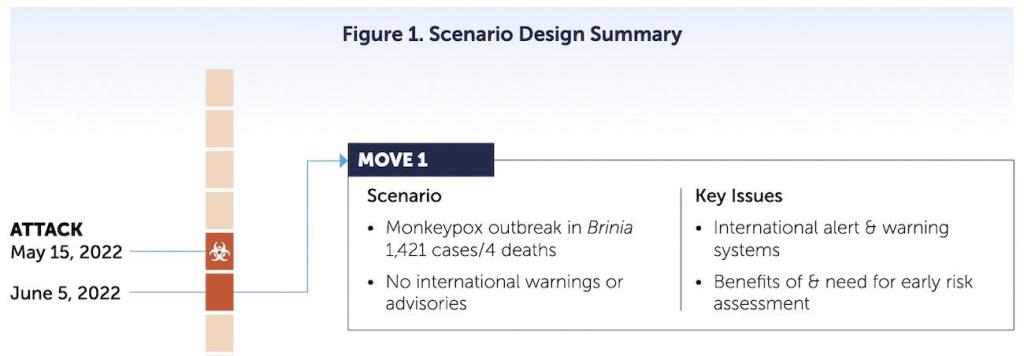
How are these tabletop exercises so accurate in their predictions?
According to that scenario, monkeypox is released as a biological weapon, billions across the globe will be affected, and hundreds of millions will die:
The exercise scenario concludes with more than three billion cases and 270 million fatalities globally […]
Strengthening Global Systems to Prevent and Respond to High-Consequence Biological Threats, p. 8
Absent any other evidence, and on the balance of probabilities, what we are witnessing now suggests vaccine-induced immunological attenuation and foul play.
INDIAN COUNTRY NEWS
"It is the duty of every man, as far as his ability extends, to detect and expose delusion and error"..Thomas Paine
Human in Algorithms
From the Roof Top
I See This
blog of the post capitalist transition.. Read or download the novel here + latest relevant posts
अध्ययन-अनुसन्धानको सार
 After the Crash