The true value of money

index

Economics needs a revolution.

By David Orrell

Source: Adbusters

This sentiment has been expressed by people from the physicist turned hedge-fund manager Jean-Philippe Bouchaud (in a 2008 paper), to the Bank of England’s Andrew Haldane (in a 2014 foreword for Manchester’s student-run Post-Crash Economics), to activist groups such as Kick It Over. So what would such a revolution look like?

Perhaps the archetypal model for a scientific revolution is the quantum revolution that shocked the world at the turn of the last century. In the space of a few short years, almost everything that was known about the nature of matter was overturned. The Newtonian view of the world as a predictable machine crumbled with it.

Except, that is, in economics – which continues to base its models on quasi-Newtonian economic laws.

A peculiar feature of orthodox economics is that money is treated as an inert medium of exchange, with no special properties of its own. As a result, money is largely excluded from macroeconomic models, which is one reason the financial crisis of 2007/8 was not predicted (it involved money). In many respects, when viewed through the lens of quantum physics, money behaves a lot like matter – and acknowledging that behavior promises to do to economics what quanta did for physics.

The main insight of quantum physics is that matter is composed of entities which behave in some ways as waves and in other ways as particles. This novel insight countered the Newtonian view that billiard ball-like atoms behaved independently of each other. A beam of light, for example, is an electromagnetic wave but it is also a stream of particles known as photons. At a quantum level, matter is fundamentally dualistic: neither the particle nor the wave description is complete by itself.

The same can be said of money, which turns out to have quantum properties of its own. Money is strange stuff, when you think about it – but because it has been around for millennia we rarely do. Consider for example a U.S. dollar bill. On the one hand it represents a number – in this case the number one. On the other hand it is a physical thing which can be possessed, exchanged and above all valued (even lusted after, if there are enough of them). It therefore lives partly in the abstract world of numbers and mathematics and partly in the real world of things, people and value.

The same is true of any money object that we use for payment. Here “object” could refer either to a physical object – such as a coin – or a virtual object, such as 1.2107 bitcoin (BTC) sent from a phone. What makes such objects special is that they have a fixed, defined value in currency units.

While seeing money objects as things with a fixed monetary value might appear trivial, it turns out to have complex and contradictory properties that feed into the economy as a whole. In particular, they combine two aspects, abstract number and real world value, which are as different as waves and particles.

For example numbers are subject to mathematical laws – such as compound interest – and can grow without limits, while in the real world natural processes tend to be subject to bounds. In 1850 an American lawyer did the math and calculated that five English pennies invested at 5 percent compound interest since 0 AD would have accumulated to 32 billion spheres of pure gold, each equal in size to the Earth. This is a useful exercise for anyone who thinks that gross domestic product (GDP) can grow forever.

Numbers can be negative, as in debts, but (as the English physicist-turned-economist Frederick Soddy pointed out) there is no such thing as a negative number of objects. You might be underwater on your mortgage but you can’t own a negative house. Throughout history the frightening ability of negative debt to grow without bounds has been responsible for forcing people into economic slavery.

Numbers are hard and precise, like the particle aspect of matter. Real-world concepts such as value are diffuse and fuzzy, like the wave aspect of matter. By combining these two aspects in a single package, money objects are our contribution to the quantum universe.

The dualistic nature of money explains its frequently paradoxical behavior. In the early 2000s, cheap credit in the United States meant that even low-income people could afford their own homes. Some cashed in and sold their houses at the top of the market. For them the money was real – they could go to the bank and withdraw dollar bills. But when the credit crunch kicked in most of the new money disappeared into the ether, as if it had never existed. Money seemed to be both real and unreal at the same time – a sensation familiar to anyone who has studied quantum physics.

Just as quantum physics overturned Newtonian physics, so a reexamination of money promises to disrupt economics. The reason that critics are calling for fundamental change is that neoclassical economics has failed to provide answers to problems such as wealth inequality, financial crises and environmental degradation – which is unsurprising if it treats money as nothing more than an inert, Newtonian medium of exchange. The tendency of money to clump and accumulate with a small group of creditors, or for financial markets to be inherently unstable, or for GDP growth to be valued over the environment, becomes clearer when we acknowledge the vital, active role of money and the tension and discrepancy between numbers and the real world that drives it.

Of course, one should not underestimate the resistance of economists to adopting new ideas, however the worldwide student movement calling for change is unlikely to go away. Economics is primed for a quantum revolution of its own.

— David Orrell is a mathematician and author. His latest book, Truth or Beauty: Science and The Quest for Order, explores the role of aesthetics in science. He is currently working on a book about money.

Why Hillary Won the Debate (Even though She Didn’t)

images

By Gary Leupp

Source: Dissident Voice

CNN and Facebook co-sponsored last week’s Democratic presidential frontrunners’ “debate.” After the event, CNN conducted a poll. “Who won the debate?” it asked. The result: 83% Bernie Sanders; 12% Hillary Clinton.

Facebook also took a poll. “Who do you think won?” Over 79% responded, “Bernie Sanders.”

The CNN editors’ take? “CLINTON’S CONFIDANT SWEEP.”

Slate conducted a poll. “Who won the presidential debate?” asked the magazine. 75% of respondents said Bernie Sanders; 18% gave it to Hillary Clinton.

“Hillary Clinton won,” reported Slate “senior writer” Josh Vorhees exuberantly. “She just needed to be solid in the debate. Instead, she was spectacular.”

Spectacular! with 18% of Slate’s own polling numbers. Go figure.

“Who do you think won?” asked Time Magazine. The response?  Bernie Sanders: 70%, Hillary Clinton 16%.

The Time headline:  “CLINTON IN CONTROL.”

Are you disgusted yet? This goes far beyond distortion, and far beyond the tampering with facts that characterized Soviet-style reporting in Izvestia and Pravda in the decade before the USSR collapsed. This is in-your-face rejection of empirical reality, to say nothing of an insult to the viewers polled. The entire mainstream news media is complicit.

Imagine if the “free” press—free to publish whatever its corporate editors want, including even the truth, at their discretion—had sought to spin this story differently.

“POLLS SHOW BIG WIN FOR SANDERS,” CNN might have proclaimed, between commercials.

“A great night for Sanders,” Slate might have announced.

“SANDERS TROUNCES CLINTON,” Time might have acknowledged.

But no, and this is par for the course. The TV cable news anchors took ages to concede that, well, yes, maybe Jed Bush—despite his solid RNC support and Wall Street’s firm endorsement—is not the inevitable GOP candidate. They’ve had to acknowledge that (for whatever reasons) Donald Trump’s actually striking a much deeper chord than warmonger Dubya’s little brother among likely voters.

But they’re stubbornly refusing to recognize some things they don’t want to see—things that don’t follow their script.

They don’t understand that people in their twenties who constitute the 75-year-old Sanders’ support base have no problem with “socialism” but rather have lots of problems with Wall Street. These “millenials” are even—horrors!—increasingly inclined to question the national god of capitalism itself. It has fewer positive connotations to them than it did for their parents who grew up during the Cold War and were subjected to its particular brainwashing agenda.

That’s the sort of brainwashing that allows Trump, a demagogue preying on the most abjectly ignorant to tell cheering crowds that he calls Sanders “a ‘socialist, slash, communist,’ okay? ‘Cause that’s what he is!”

‘Cause that’s what he is! Sanders is a communist. End of story. End of rational thought.

I myself am not a Sanders supporter. He’s nowhere nearly left enough for me. But then I’m not a supporter of the whole bogus, skewed, money-driven two-party electoral system itself, which seems designed to hoodwink people, channel their energies into itself, and then produce disillusionment soon after the election, as the elected official reneges on promises and proved to be anything other than a harbinger of “change.” The system is wired to then hoodwink people again, re-channel their energies (again back into itself), bouncing people back and forth between two hopelessly corrupt parties that are really two factions of a single corporate party.

The system tells us, “If you don’t vote, you have nothing to say” and reduces political involvement to endorsing one of its (safe) choices. It excludes from the debate stage even the discussion of needed radical change. The electoral process is designed to keep you out of the street (where history is really made) and lead you into a box, like a confessional booth or a porno video cubicle, a private space in which you’re touched by something greater than yourself and leave with a sense of gratification. You were a good citizen. You exercised your precious right to VOTE and did your part!

Casting that ballot in private is supposed to make you feel good about yourself, as a participant in the state. It’s supposed to make you think that, since you actually participated in the construction of the existing polity, when you talk about what it does, you can accept personal responsibility for its crimes.

For example, you might say: “We shouldn’t have invaded Iraq.” In doing so you implicitly include yourself—despite your disagreement—among those who actually did the vicious deed. I prefer to say, “Leave me out of that ‘we,’ since I had nothing to do with it. I fought against it, tooth and nail, attending every anti-war demonstration I could and railing against it to all who would listen.”

“Well, our government did it,” you might correct yourself. “We voted for it.” But I will reply I didn’t; I stayed at home on election day, 2000. It’s like I was invited to a party that day, and disliking all who’d be there, I politely declined to attend.

When you vote, you vote not so much for a person as for the system itself, validating it and the rules surrounding the procedure. Casting the ballot is the state’s highest ritual, the individual’s most intimate connection with the state. It makes you feel one with it. It’s rather like taking the Holy Communion at mass. You’re swallowing something, and making a statement of faith: I believe in this system!

This (corporate) system you vote for, every time you vote at all, commands the (corporate) media to such an extent that it can do what we see in the reportage cited above. It can turn reality on its head and get away with it, whether it’s shaping public opinion about Saddam’s weapons of mass destruction, a Russian invasion of Ukraine, U.S. successes against the Taliban in Afghanistan, Syrian “moderates” gaining against Assad, or victory in a farcical televised debate.

Whatever you think about Sanders, is it not outrageous that the mass media can obscure his plain victory in that exercise as a triumph for Hillary Clinton? Even a “spectacular” win? Isn’t it clear that she was pronounced the victor not because she actually won out over Sanders but because powerful people steering the “free” press needed her to do so?

As PR/disinformation master Karl Rove once put it (and this should be repeated as often as we repeat that wonderful quote from the imprisoned Goebbels at Nuremberg about using fear to build mass support for war): “We’re an empire now, and when we act, we create our own reality.”

It’s not a sentiment unique to Republicans. Recall how, during the 2012 Democratic national convention, the crowd clearly voted down the inclusion of a line supporting Jerusalem as the eternal, undivided capital of Israel in its platform. The change required a two-thirds majority of the vote, according to party rules. At least half the delegates voted against it.

Still, the convention chairman to the outrage of many present announced (after some hushed consultation) that the “Ayes” carried the day. So much for democracy at the “Democratic” Party’s convention.

The mainstream press, by and large, wants Hillary Clinton to be the Democratic nominee for president. Wall Street’s leading candidates are Jeb Bush and Clinton; both are beloved of big money and either one will do. Sanders (even though in office he would likely buckle to their will, the same way Greece’s “socialist” Alexis Tsipras buckled to the IMF and European Central Bank) is anathema to Wall Street. And the connections between Wall Street, the Washington power elite, and the press are—to use the Chinese expression—as close as lips and teeth.

Finance capital rules the world and will do so until the “millions and millions” Bernie keeps talking about find some way to effectively challenge it.

Thus Sanders could not win the debate, even though he did. And Hillary was destined to win the debate, even though she didn’t. Get it? And isn’t it great you have the right to vote for her?


Gary Leupp is a Professor of History at Tufts University, and author of numerous works on Japanese history. He can be reached at: gleupp@granite.tufts.edu. Read other articles by Gary.

The New American Order

natsec

1% Elections, The Privatization of the State, a Fourth Branch of Government, and the Demobilization of “We the People” 

By Tom Engelhardt

Source: TomDispatch.com

Have you ever undertaken some task you felt less than qualified for, but knew that someone needed to do? Consider this piece my version of that, and let me put what I do understand about it in a nutshell: based on developments in our post-9/11 world, we could be watching the birth of a new American political system and way of governing for which, as yet, we have no name.

And here’s what I find strange: the evidence of this, however inchoate, is all around us and yet it’s as if we can’t bear to take it in or make sense of it or even say that it might be so.

Let me make my case, however minimally, based on five areas in which at least the faint outlines of that new system seem to be emerging: political campaigns and elections; the privatization of Washington through the marriage of the corporation and the state; the de-legitimization of our traditional system of governance; the empowerment of the national security state as an untouchable fourth branch of government; and the demobilization of “we the people.”

Whatever this may add up to, it seems to be based, at least in part, on the increasing concentration of wealth and power in a new plutocratic class and in that ever-expanding national security state. Certainly, something out of the ordinary is underway, and yet its birth pangs, while widely reported, are generally categorized as aspects of an exceedingly familiar American system somewhat in disarray.

1. 1% Elections

Check out the news about the 2016 presidential election and you’ll quickly feel a sense of been-there, done-that. As a start, the two names most associated with it, Bush and Clinton, couldn’t be more familiar, highlighting as they do the curiously dynastic quality of recent presidential contests.  (If a Bush or Clinton should win in 2016 and again in 2020, a member of one of those families will have controlled the presidency for 28 of the last 36 years.)

Take, for instance, “Why 2016 Is Likely to Become a Close Race,” a recent piece Nate Cohn wrote for my hometown paper.  A noted election statistician, Cohn points out that, despite Hillary Clinton’s historically staggering lead in Democratic primary polls (and lack of serious challengers), she could lose the general election.  He bases this on what we know about her polling popularity from the Monica Lewinsky moment of the 1990s to the present.  Cohn assures readers that Hillary will not “be a Democratic Eisenhower, a popular, senior statesperson who cruises to an easy victory.”  It’s the sort of comparison that offers a certain implicit reassurance about the near future.  (No, Virginia, we haven’t left the world of politics in which former general and president Dwight D. Eisenhower can still be a touchstone.)

Cohn may be right when it comes to Hillary’s electability, but this is not Dwight D. Eisenhower’s or even Al Gore’s America. If you want a measure of that, consider this year’s primaries. I mean, of course, the 2015 ones. Once upon a time, the campaign season started with candidates flocking to Iowa and New Hampshire early in the election year to establish their bona fides among party voters. These days, however, those are already late primaries.

The early primaries, the ones that count, take place among a small group of millionaires and billionaires, a new caste flush with cash who will personally, or through complex networks of funders, pour multi-millions of dollars into the campaigns of candidates of their choice.  So the early primaries — this year mainly a Republican affair — are taking place in resort spots like Las Vegas, Rancho Mirage, California, and Sea Island, Georgia, as has been widely reported. These “contests” involve groveling politicians appearing at the beck and call of the rich and powerful, and so reflect our new 1% electoral system. (The main pro-Hillary super PAC, for instance, is aiming for a kitty of $500 million heading into 2016, while the Koch brothers network has already promised to drop almost $1 billion into the coming campaign season, doubling their efforts in the last presidential election year.)

Ever since the Supreme Court opened up the ultimate floodgates with its 2010 Citizens United decision, each subsequent election has seen record-breaking amounts of money donated and spent. The 2012 presidential campaign was the first $2 billion election; campaign 2016 is expected to hit the $5 billion mark without breaking a sweat.  By comparison, according to Burton Abrams and Russell Settle in their study, “The Effect of Broadcasting on Political Campaign Spending,” Republicans and Democrats spent just under $13 million combined in 1956 when Eisenhower won his second term.

In the meantime, it’s still true that the 2016 primaries will involve actual voters, as will the election that follows. The previous election season, the midterms of 2014, cost almost $4 billion, a record despite the number of small donors continuing to drop. It also represented the lowest midterm voter turnout since World War II. (See: demobilization of the public, below — and add in the demobilization of the Democrats as a real party, the breaking of organized labor, the fragmenting of the Republican Party, and the return of voter suppression laws visibly meant to limit the franchise.) It hardly matters just what the flood of new money does in such elections, when you can feel the weight of inequality bearing down on the whole process in a way that is pushing us somewhere new.

2. The Privatization of the State (or the U.S. as a Prospective Third-World Nation)

In the recent coverage of the Hillary Clinton email flap, you can find endless references to the Clintons of yore in wink-wink, you-know-how-they-are-style reporting; and yes, she did delete a lot of emails; and yes, it’s an election year coming and, as everyone points out, the Republicans are going to do their best to keep the email issue alive until hell freezes over, etc., etc.  Again, the coverage, while eyeball gluing, is in a you’ve-seen-it-all-before, you’ll-see-it-all-again-mode.

However, you haven’t seen it all before. The most striking aspect of this little brouhaha lies in what’s most obvious but least highlighted.  An American secretary of state chose to set up her own private, safeguarded email system for doing government work; that is, she chose to privatize her communications.  If this were Cairo, it might not warrant a second thought.  But it didn’t happen in some third-world state.  It was the act of a key official of the planet’s reigning (or thrashing) superpower, which — even if it wasn’t the first time such a thing had ever occurred — should be taken as a tiny symptom of something that couldn’t be larger or, in the long stretch of history, newer: the ongoing privatization of the American state, or at least the national security part of it.

Though the marriage of the state and the corporation has a pre-history, the full-scale arrival of the warrior corporation only occurred after 9/11.  Someday, that will undoubtedly be seen as a seminal moment in the formation of whatever may be coming in this country.  Only 13 years later, there is no part of the war state that has not experienced major forms of privatization.  The U.S. military could no longer go to war without its crony corporations doing KP and guard duty, delivering the mail, building the bases, and being involved in just about all of its activities, including training the militaries of foreign allies and even fighting.  Such warrior corporations are now involved in every aspect of the national security state, including torture, drone strikes, and — to the tune of hundreds of thousands of contract employees like Edward Snowden — intelligence gathering and spying.  You name it and, in these years, it’s been at least partly privatized.

All you have to do is read reporter James Risen’s recent book, Pay Any Price, on how the global war on terror was fought in Washington, and you know that privatization has brought something else with it: corruption, scams, and the gaming of the system for profits of a sort that might normally be associated with a typical third-world kleptocracy.  And all of this, a new world being born, was reflected in a tiny way in Hillary Clinton’s very personal decision about her emails.

Though it’s a subject I know so much less about, this kind of privatization (and the corruption that goes with it) is undoubtedly underway in the non-war-making, non-security-projecting part of the American state as well.

3. The De-legitimization of Congress and the Presidency

On a third front, American “confidence” in the three classic check-and-balance branches of government, as measured by polling outfits, continues to fall.  In 2014, Americans expressing a “great deal of confidence” in the Supreme Court hit a new low of 23%; in the presidency, it was 11%, and in Congress a bottom-scraping 5%.  (The military, on the other hand, registers at 50%.)  The figures for “hardly any confidence at all” are respectively 20%, 44%, and more than 50%.  All are in or near record-breaking territory for the last four decades.

It seems fair to say that in recent years Congress has been engaged in a process of delegitimizing itself.  Where that body once had the genuine power to declare war, for example, it is now “debating” in a desultory fashion an “authorization” for a war against the Islamic State in Syria, Iraq, and possibly elsewhere that has already been underway for eight months and whose course, it seems, will be essentially unaltered, whether Congress authorizes it or not.

What would President Harry Truman, who once famously ran a presidential campaign against a “do-nothing” Congress, have to say about a body that truly can do just about nothing?  Or rather, to give the Republican war hawks in that new Congress their due, not quite nothing.  They are proving capable of acting effectively to delegitimize the presidency as well.  House Majority Leader John Boehner’s invitation to Israeli Prime Minister Benjamin Netanyahu to undercut the president’s Iranian nuclear negotiations and the letter signed by 47 Republican senators and directed to the Iranian ayatollahs are striking examples of this.  They are visibly meant to tear down an “imperial presidency” that Republicans gloried in not so long ago.

The radical nature of that letter, not as an act of state but of its de-legitimization, was noted even in Iran, where fundamentalist Supreme Leader Ali Khamenei proclaimed it “a sign of a decline in political ethics and the destruction of the American establishment from within.” Here, however, the letter is either being covered as a singularly extreme one-off act (“treason!”) or, as Jon Stewart didon “The Daily Show,” as part of a repetitive tit-for-tat between Democrats and Republicans over who controls foreign policy.  It is, in fact, neither.  It represents part of a growing pattern in which Congress becomes an ever less effective body, except in its willingness to take on and potentially take out the presidency.

In the twenty-first century, all that “small government” Republicans and “big government” Democrats can agree on is offering essentially unconditional support to the military and the national security state.  The Republican Party — its various factions increasingly at each other’s throats almost as often as at those of the Democrats — seems reasonably united solely on issues of war-making and security.  As for the Democrats, an unpopular administration, facing constant attack by those who loath President Obama, has kept its footing in part by allying with and fusing with the national security state.  A president who came into office rejecting torture and promoting sunshine and transparency in government has, in the course of six-plus years, come to identify himself almost totally with the U.S. military, the CIA, the NSA, and the like.  While it has launched an unprecedented campaign against whistleblowers and leakers (as well as sunshine and transparency), the Obama White House has proved a powerful enabler of, but also remarkably dependent upon, that state-within-a-state, a strange fate for “the imperial presidency.”

4. The Rise of the National Security State as the Fourth Branch of Government

One “branch” of government is, however, visibly on the rise and rapidly gaining independence from just about any kind of oversight.  Its ability to enact its wishes with almost no opposition in Washington is a striking feature of our moment.  But while the symptoms of this process are regularly reported, the overall phenomenon — the creation of a de facto fourth branch of government — gets remarkably little attention.  In the war on terror era, the national security state has come into its own.  Its growth has been phenomenal.  Though it’s seldom pointed out, it should be considered remarkable that in this period we gained a second full-scale “defense department,” the Department of Homeland Security, and that it and the Pentagon have become even more entrenched, each surrounded by its own growing “complex” of private corporations, lobbyists, and allied politicians.  The militarization of the country has, in these years, proceeded apace.

Meanwhile, the duplication to be found in the U.S. Intelligence Community with its 17 major agencies and outfits is staggering.  Its growing ability to surveil and spy on a global scale, including on its own citizens, puts the totalitarian states of the twentieth century to shame.  That the various parts of the national security state can act in just about any fashion without fear of accountability in a court of law is by now too obvious to belabor.  As wealth has traveled upwards in American society in ways not seen since the first Gilded Age, so taxpayer dollars have migrated into the national security state in an almost plutocratic fashion.

New reports regularly surface about the further activities of parts of that state.  In recent weeks, for instance, we learned from Jeremy Scahill and Josh Begley of the Intercept that the CIA has spent years trying to break the encryption on Apple iPhones and iPads; it has, that is, been aggressively seeking to attack an all-American corporation (even if significant parts of its production process are actually in China).  Meanwhile, Devlin Barrett of the Wall Street Journal reported that the CIA, an agency barred from domestic spying operations of any sort, has been helping the U.S. Marshals Service (part of the Justice Department) create an airborne digital dragnet on American cell phones.  Planes flying out of five U.S. cities carry a form of technology that “mimics a cellphone tower.” This technology, developed and tested in distant American war zones and now brought to “the homeland,” is just part of the ongoing militarization of the country from its borders to its police forces.  And there’s hardly been a week since Edward Snowden first released crucial NSA documents in June 2013 when such “advances” haven’t been in the news.

News also regularly bubbles up about the further expansion, reorganization, and upgrading of parts of the intelligence world, the sorts of reports that have become the barely noticed background hum of our lives.  Recently, for instance, Director John Brennan announced a major reorganization of the CIA meant to break down the classic separation between spies and analysts at the Agency, while creating a new Directorate of Digital Innovation responsible for, among other things, cyberwarfare and cyberespionage.  At about the same time, according to the New York Times, the Center for Strategic Counterterrorism Communications, an obscure State Department agency, was given a new and expansive role in coordinating “all the existing attempts at countermessaging [against online propaganda by terror outfits like the Islamic State] by much larger federal departments, including the Pentagon, Homeland Security and intelligence agencies.”

This sort of thing is par for the course in an era in which the national security state has only grown stronger, endlessly elaborating, duplicating, and overlapping the various parts of its increasingly labyrinthine structure.  And keep in mind that, in a structure that has fought hard to keep what it’s doing cloaked in secrecy, there is so much more that we don’t know.  Still, we should know enough to realize that this ongoing process reflects something new in our American world (even if no one cares to notice).

5. The Demobilization of the American People

In The Age of Acquiescence, a new book about America’s two Gilded Ages, Steve Fraser asks why it was that, in the nineteenth century, another period of plutocratic excesses, concentration of wealth and inequality, buying of politicians, and attempts to demobilize the public, Americans took to the streets with such determination and in remarkable numbers over long periods of time to protest their treatment, and stayed there even when the brute power of the state was called out against them.  In our own moment, Fraser wonders, why has the silence of the public in the face of similar developments been so striking?

After all, a grim new American system is arising before our eyes.  Everything we once learned in the civics textbooks of our childhoods about how our government works now seems askew, while the growth of poverty, the flatlining of wages, the rise of the .01%, the collapse of labor, and the militarization of society are all evident.

The process of demobilizing the public certainly began with the military.  It was initially a response to the disruptive and rebellious draftees of the Vietnam-era.  In 1973, at the stroke of a presidential pen, the citizen’s army was declared no more, the raising of new recruits was turned over to advertising agencies (a preview of the privatization of the state to come), and the public was sent home, never again to meddle in military affairs.  Since 2001, that form of demobilization has been etched in stone and transformed into a way of life in the name of the “safety” and “security” of the public.

Since then, “we the people” have made ourselves felt in only three disparate ways: from the left in the Occupy movement, which, with its slogans about the 1% and the 99%, put the issue of growing economic inequality on the map of American consciousness; from the right, in the Tea Party movement, a complex expression of discontent backed and at least partially funded by right-wing operatives and billionaires, and aimed at the de-legitimization of the “nanny state”; and the recent round of post-Ferguson protests spurred at least in part by the militarization of the police in black and brown communities around the country.

The Birth of a New System

Otherwise, a moment of increasing extremity has also been a moment of — to use Fraser’s word — “acquiescence.”  Someday, we’ll assumedly understand far better how this all came to be.  In the meantime, let me be as clear as I can be about something that seems murky indeed: this period doesn’t represent a version, no matter how perverse or extreme, of politics as usual; nor is the 2016 campaign an election as usual; nor are we experiencing Washington as usual.  Put together our 1% elections, the privatization of our government, the de-legitimization of Congress and the presidency, as well as the empowerment of the national security state and the U.S. military, and add in the demobilization of the American public (in the name of protecting us from terrorism), and you have something like a new ballgame.

While significant planning has been involved in all of this, there may be no ruling pattern or design.  Much of it may be happening in a purely seat-of-the-pants fashion.  In response, there has been no urge to officially declare that something new is afoot, let alone convene a new constitutional convention.  Still, don’t for a second think that the American political system isn’t being rewritten on the run by interested parties in Congress, our present crop of billionaires, corporate interests, lobbyists, the Pentagon, and the officials of the national security state.

Out of the chaos of this prolonged moment and inside the shell of the old system, a new culture, a new kind of politics, a new kind of governance is being born right before our eyes. Call it what you want. But call it something. Stop pretending it’s not happening.

Tom Engelhardt is a co-founder of the American Empire Project and the author of The United States of Fear as well as a history of the Cold War, The End of Victory Culture. He is a fellow of the Nation Institute and runs TomDispatch.com. His latest book is Shadow Government: Surveillance, Secret Wars, and a Global Security State in a Single-Superpower World(Haymarket Books).

[Note: My special thanks go to my friend John Cobb, who talked me through this one.  Doing it would have been inconceivable without him.  Tom]

Follow TomDispatch on Twitter and join us on Facebook. Check out the newest Dispatch Book, Rebecca Solnit’s Men Explain Things to Me, and Tom Engelhardt’s latest book, Shadow Government: Surveillance, Secret Wars, and a Global Security State in a Single-Superpower World

The Rise of “Criminal Capitalism”

corporate-crime-525

By James Petras

Source: Dissident Voice

About 75% of US employees work 40 hours or longer, the second longest among all OECD countries, exceeded only by Poland and tied with South Korea. In contrast, only 10% of Danish workers, 15% of Norwegian, 30% of French, 43% of UK and 50% of German workers work 40 or more hours. With the longest work day, US workers score lower on the ‘living well’ scale than most western European workers. Moreover, despite those long workdays US employees receive the shortest paid holidays or vacation time (one to two weeks compared to the average of five weeks in Western Europe). US employees pay for the costliest health plans and their children face the highest university fees among the 34 countries in the Organization for Economic Cooperation and Development (OECD).

In class terms, US employees face the greatest jump in income inequalities over the past decade, the longest period of wage and salary decline or stagnation (1970 to 2014) and the greatest collapse of private sector union membership, from 30% in 1950 down to 8% in 2014.

On the other hand, profits, as a percentage of national income, have increased significantly. The share of income and profits going to the financial sector, especially the banks and investment houses, has increased at a faster rate than any other sector of the US economy.

There are two polar opposite trends: Employees working longer hours, with costlier services and declining living standards while finance capitalists enjoy rapidly rising profits and incomes.

Paradoxically, these trends are not directly based on greater ‘workplace exploitation’ in the US.

The historic employee-finance capitalist polarization is the direct result of the grand success of the trillion dollar financial swindles, the tax payer-funded trillion dollar Federal bailouts of the crooked bankers, and the illegal bank manipulation of interest rates. These uncorrected and unpunished crimes have driven up the costs of living and producing for employees and their employers.

Financial ‘rents’ (the bankers and brokers are ‘rentiers’ in this economy) drive up the costs of production for non-financial capital (manufacturing). Non-financial capitalists resort to reducing wages, cutting benefits and extending working hours for their employees, in order to maintain their own profits.

In other words, pervasive, enduring and systematic large-scale financial criminality is a major reason why US employees are working longer and receiving less – the ‘trickle down’ effect of mega-swindles committed by finance capital.

Mega-Swindles, Leading Banks and Complicit State Regulators

Mega-swindles, involving trillions of dollars, are routine practices involving the top fifty banks, trading houses, currency speculators, management fund firms and foreign exchange traders.

These ‘white collar’ crimes have hurt hundreds of millions of investors and credit-card holders, millions of mortgage debtors, thousands of pension funds and most industrial and service firms that depend on bank credit to meet payrolls, to finance capital expansion and technological upgrades and raw materials.

Big banks, which have been ‘convicted and fined’ for mega-swindles, include Citi Bank, Bank of America, HSBC, UBS, JP Morgan, Barclay, Goldman Sachs, Royal Bank of Scotland, Deutsche Bank and forty other ‘leading’ financial institutions.

The mega-swindlers have repeatedly engaged in a great variety of misdeeds, including accounting fraud, insider trading, fraudulent issue of mortgage based securities and the laundering of hundreds of billions of illegal dollars for Colombian, Mexican, African and Asian drug and human traffickers.

They have rigged the London Interbank Official Rate (LIBOR), which serves as the global interest benchmark to which hundreds of trillions of dollars of financial contracts are tied. By raising LIBOR, the financial swindlers have defrauded hundreds of millions of mortgage and credit-card holders, student loan recipients and pensions.

Bloomberg News (5/20/2015) reported on an ongoing swindle involving the manipulation of the multi-trillion-dollar International Swaps and Derivatives Association (ISDA) fix, a global interest rate benchmark used by banks, corporate treasurers and money managers to determine borrowing costs and to value much of the $381 trillion of outstanding interest rate swaps.

The Financial Times (5/23/15, p. 10) reported how the top seven banks engaged in manipulating fraudulent information to their clients, practiced illegal insider trading to profit in the foreign exchange market (forex), whose daily average turnover volume for 2013 exceeded $5 trillion dollars.

These seven convicted banks ended up paying less than $10 billion in fines, which is less than 0.05% of their daily turnover. No banker or high executive ever went to jail, despite undermining the security of millions of retail investors, pensioners and thousands of companies.

The Direct Impact of Financial Swindles on Declining Living Standards

Each and every major financial swindle has had a perverse ripple effect throughout the entire economy. This is especially the case where the negative consequences have spread downward through local banks, local manufacturing and service industries to employees, students and the self-employed.

The most obvious example of the downward ripple effect was the so-called ‘sub-prime mortgage’ swindle. Big banks deliberately sold worthless, fraudulent mortgage-backed securities (MBS) and collateralized debt obligation (CDO) to smaller banks, pension funds and local investors, which eventually foreclosed on overpriced houses causing low income mortgage holders to lose their down payments (amounting to most of their savings).

While the effects of the swindle spread outward and downward, the US Treasury propped up the mega-swindlers with a trillion-dollar bailout in working people’s tax money. They anointed their mega-give-away as the bail out for ‘banks that are just too big to fail”! They transferred funds from the public treasury for social services to the swindlers.

In effect, the banks profited from their widely exposed crimes while US employees lost their jobs, homes, savings and social services. As the US Treasury pumped trillions of dollars into the coffers of the criminal banks (especially on Wall Street), the builders, major construction companies and manufacturers faced an unprecedented credit squeeze and laid off millions of workers, and reduced wages and increased the hours of un-paid work.

Service employees in consumer industries were hit hard as wages and salaries declined or remained frozen. The costs of the FOREX, LIBOR and ISDA fix swindles’ fell heavily on big business, which passed the pain onto labor: cutting pension and health coverage, hiring millions of ‘contingent or temp’ workers at minimum wages with no benefits.

The bank bailouts forced the Treasury to shift funds from ‘job-creating’ social programs and national infrastructure investment to the FIRE (finance, insurance and real estate) sector with its highly concentrated income structure.

As a result of the increasing concentration of wealth among the financial swindlers, inequalities in income grew; wages and salaries were frozen or reduced and manufacturers outsourced production, resulting in declines in production.

Employees, suffering from the loss of income brought on by the mega-swindles, found that they were working longer hours for less pay and fewer benefits. Productivity suffered. With the total breakdown of the ‘capitalist rules of the game’, investors lost confidence and trust in the system. Mega-swindles eroded ‘confidence’ between investors and traders, and made a mockery of any link between performance at work and rewards. This severed the nexus between highly motivated workers, engaged in ‘hard work, long hours’ and rising living standards, and between investment and productivity.

As a result, profits in the finance sector grew while the domestic economy floundered and living standards stagnated.

Financial Impunity: Regulatees Controlling the Regulators

Despite the proliferation of mega-swindles and their pervasive ripple effects throughout the economy and society, none of the dozens of federal or state regulatory agencies intervened to stop the swindle before it undermined the domestic economy. No CEO or banker was ever arrested for their part in the swindle of trillions. The regulators only reacted after trillions had ‘disappeared’ and swindles were ‘a done deal’. The impunity of the swindlers in planning and executing the pillage of hundreds of millions of employees, taxpayers and mortgage holders was because the federal and state regulatory agencies are populated by ‘regulatory administrators’ who came from or aspired to join the financial sector they were tasked with ‘regulating’.

Most of the high officials appointed to lead the regulatory agencies had been selected by the ‘Lords of Wall Street, Frankfurt, the City of London or Zurich.’ Appointees are chosen on the basis of their willingness to enable financial swindles. It therefore came as no surprise on May 28 2015 when US President Obama approved the appointment of Andrew Donahue, Managing Director and Associate General Council for the repeatedly felonious, mega-swindling banking house of Goldman Sachs to be the ‘Chief of Staff’ of the Security and Exchange Commission. His career has been typical of the Washington-Wall Street ‘Revolving Door’.

Only after fraud and swindles evoked the nationwide public fury of mortgage holders, investors and finance companies did the regulators ‘investigate’ the crimes and even then not a single major banker was jailed, not a single major bank was closed down.

There were a few low-level bond traders and bank employees who were fired or jailed as scapegoats. The banks paid puny (for them) fines, which they passed on to their customers. Despite pledges to ‘mend their ways’ the bankers concocted new schemes with their windfalls of billions of Federal ‘bailout’ money while the regulators looked on or polished their CV’s for the next pass through the ‘revolving door’.

Every top official in Treasury, Commerce and Trade, and every regulator in the Security Exchange Commission (SEC) who ‘retired to the private sector’ has ended up working for the same mega-criminal banks and finance houses they had investigated, regulated and ‘slapped on the wrist’.

As one banker, who insists on anonymity, told me: ‘The most successful swindlers are those who investigated financial transgressions’.

Conclusion

Mega-swindles define the nature of contemporary capitalism. The profits and power of financial capital is not the outcome of ‘market forces’. They are the result of a system of criminal behavior that pillages the Treasury, exploits the producers and consumers, evicts homeowners and robs taxpayers.

The mega swindlers represent much less than 1% of the class structure. Yet they hold over 40% of personal wealth in this country and control over 80% of capital liquidity.

They grow inexorably rich and richer, even as the rest of the economy wallows in crisis and stagnation. Their swindles send powerful ripples across the national economy, which ultimately freeze or reduce the income of the skilled (middle class) employees and undermine the living conditions for poor working-class whites, and especially under and unemployed Afro-American and Latino American young workers.

Efforts to ‘moralize’ capital have failed repeatedly since the regulators are controlled by those they claim to ‘regulate’.

The rare arrest and prosecution of any among the current tribe of mega-swindlers would only results in their being replaced by new swindlers. The problem is systemic and requires deep structural changes.

The only answer is to build a political movement independent of the two party system, willing to nationalize the banks and to pass legislation outlawing derivatives, forex trading and other unnatural parasitic speculative activities.

James Petras is author of Extractive Imperialism in the Americas: Capitalism’s New Frontier (with Henry Veltmeyer) and The Politics of Empire: The US, Israel and the Middle East. Read other articles by James, or visit James’s website.

Pillage and Class Polarization: The Rise of “Criminal Capitalism”

wealth

By Prof. James Petras

Source: GlobalResearch.ca

About 75% of US employees work 40 hours or longer, the second longest among all OECD countries, exceeded only by Poland and tied with South Korea.  In contrast, only 10% of Danish workers, 15% of Norwegian, 30% of French, 43% of UK and 50% of German workers work 40 or more hours.  With the longest work day, US workers score lower on the ‘living well’ scale than most western European workers. 

Moreover, despite those long workdays US employees receive the shortest paid holidays or vacation time (one to two weeks compared to the average of five weeks in Western Europe).  US employees pay for the costliest health plans and their children face the highest university fees among the 34 countries in the Organization for Economic Cooperation and Development (OECD).

In class terms, US employees face the greatest jump in income inequalities over the past decade, the longest period of wage and salary decline or stagnation (1970 to 2014) and the greatest collapse of private sector union membership, from 30% in 1950 down to 8% in 2014.

On the other hand, profits, as a percentage of national income, have increased significantly.  The share of income and profits going to the financial sector, especially the banks and investment houses, has increased at a faster rate than any other sector of the US economy.

There are two polar opposite trends: Employees working longer hours, with costlier services and declining living standards  while finance capitalists enjoy rapidly rising profits and incomes.

Paradoxically, these trends are not directly based on greater ‘workplace exploitation’ in the US.

The historic employee-finance capitalist polarization is the direct result of the grand success of the trillion dollar financial swindles, the tax payer-funded trillion dollar Federal bailouts of thecrooked bankers, and the illegal bank manipulation of interest rates.  These uncorrected and unpunished crimes have driven up the costs of living and producing for employees and their employers.

Financial ‘rents’ (the bankers and brokers are ‘rentiers’ in this economy) drive up the costs of production for non-financial capital (manufacturing).   Non-financial capitalists resort to reducing wages, cutting benefits and extending working hours for their employees, in order to maintain their own profits.

In other words, pervasive, enduring and systematic large-scale financial criminality is a major reason why US employees are working longer and receiving less – the ‘trickle down’ effect of mega-swindles committed by finance capital.

Mega-Swindles, Leading Banks and Complicit State Regulators

Mega-swindles, involving trillions of dollars, are routine practices involving the top fifty banks, trading houses, currency speculators, management fund firms and foreign exchange traders.

These ‘white collar’ crimes have hurt hundreds of millionsof investors and credit-card holders, millions of mortgage debtors, thousands of pension funds and most industrial and service firms that depend on bank credit to meet payrolls, to finance capital expansion and  technological upgrades and raw materials.

Big banks, which have been ‘convicted and fined’ for mega-swindles, include Citi Bank, Bank of America, HSBC, UBS, JP Morgan, Barclay, Goldman Sachs, Royal Bank of Scotland, Deutsch Bank and forty other ‘leading’ financial institutions.

The mega-swindlers have repeatedly engaged in a great variety of misdeeds, including accounting fraud, insider trading, fraudulent issue of mortgage based securities and the laundering of hundreds of billions of illegal dollars for Colombian, Mexican, African and Asian drug  and human traffickers.

They have rigged the London Interbank Official Rate (LIBOR), which serves as the global interest benchmark to which hundreds of trillions of dollars of financial contracts are tied.  By raising LIBOR, the financial swindlers have defrauded hundreds of millions of mortgage and credit-card holders, student loan recipients and pensions.

Bloomberg News (5/20/2015) reported on an ongoing swindle involving the manipulation of the multi-trillion-dollar International Swaps and Derivatives Association (ISDA) fix, a global interest rate benchmark used by banks, corporate treasurers and money managers to determine borrowing costs and to value much of the $381 trillion of outstanding interest rate swaps.

The Financial Times (5/23/15, p. 10)   reported how the top seven banks engaged in manipulating fraudulent information to their clients, practiced illegal insider trading to profit in the foreign exchange market (forex), whose daily average turnover volume for 2013 exceeded $5 trillion dollars.

These seven convicted banks ended up paying less than $10 billion in fines, which is less than 0.05% of their daily turnover.  No banker or high executive ever went to jail, despite undermining the security of millions of retail investors, pensioners and thousands of companies.

The Direct Impact of Financial Swindles on Declining Living Standards

Each and every major financial swindle has had a perverse ripple effect throughout the entire economy.  This is especially the case where the negative consequences have spread downward through local banks, local manufacturing and service industries to employees, students and the self-employed.

The most obvious example of the downward ripple effect was the so-called ‘sub-prime mortgage’ swindle.  Big banks deliberately sold worthless, fraudulent mortgage-backed securities(MBS) and collateralized debt obligation (CDO)  to smaller banks, pension funds and local investors, which eventually foreclosed on overpriced houses causing low income mortgage holders to lose their down payments (amounting to most of their savings).

While the effects of the swindle spread outward and downward, the US Treasury propped up the mega-swindlers with a trillion-dollar bailout in working people’s tax money.  They anointed their mega-give-away as the bail out for ‘banks that are just too big to fail”!  They transferred funds from the public treasury for social services to the swindlers.

In effect, the banks profited from their widely exposed crimes while US employees lost their jobs, homes, savings and social services.  As the US Treasury pumped trillions of dollars into the coffers of the criminal banks (especially on Wall Street), the builders, major construction companies and manufacturers faced an unprecedented credit squeeze and laid off millions of workers, and  reduced wages and increased the hours of un-paid work.

Service employees in consumer industries were hit hard as wages and salaries declined or remained frozen.  The costs of theFOREX, LIBOR and ISDA fix swindles’ fell heavily on big  business, which passed the pain onto labor: cutting pension and health coverage, hiring millions of ‘contingent or temp’ workers at minimum wages with no benefits.

The bank bailouts forced the Treasury to shift funds from ‘job-creating’ social programs and national infrastructure investment to the FIRE (finance, insurance and real estate) sector with its highly concentrated income structure.

As a result of the increasing concentration of wealth among the financial swindlers, inequalities in income grew; wages and salaries were frozen or reduced and manufacturers outsourced production, resulting in declines in production.

Employees, suffering from the loss of income brought on by the mega-swindles, found that they were working longer hours for less pay and fewer benefits.  Productivity suffered.  With the total breakdown of the ‘capitalist rules of the game’, investors lost confidence and trust in the system.  Mega-swindles eroded ‘confidence’ between investors and traders, and made a mockery of any link between performance at work and rewards.  This severed the nexus between highly motivated workers, engaged in ‘hard work, long hours’ and rising living standards, and between investment and productivity.

As a result, profits in the finance sector grew while the domestic economy floundered and living standards stagnated.

Financial Impunity:  Regulatees Controlling the Regulators

Despite the proliferation of mega-swindles and their pervasive ripple effects throughout the economy and society, none of the dozens of federal or state regulatory agencies intervened to stop the swindle before it undermined the domestic economy.  No CEO or banker was ever arrested for their part in the swindle of trillions.  The regulators only reacted after trillions had ‘disappeared’ and swindles were ‘a done deal’.  The impunity of the swindlers in planning and executing the pillage of hundreds of millions of employees, taxpayers and mortgage holders was because the federal and state regulatory agencies are populated by ‘regulatory administrators’ who came from or aspired to join the financial sector they were tasked with ‘regulating’.

Most of the high officials appointed to lead the regulatory agencies had been selected by the ‘Lords of Wall Street, Frankfurt, the City of London or Zurich.’  Appointees are chosen on the basis of their willingness to enable financial swindles.  It therefore came as no surprise on May 28 2015 when US President Obama approved the appointment of Andrew Donahue, Managing Director and Associate General Council for the repeatedly felonious, mega-swindling banking house of Goldman Sachs to be the ‘Chief of Staff’ of the Security and Exchange Commission. His career has been typical of the Washington-Wall Street ‘Revolving Door’.

Only after fraud and swindles evoked the nationwide public fury of mortgage holders, investors and finance companies did the regulators ‘investigate’ the crimes and even then not a single major banker was jailed, not a single major bank was closed down.

There were a few low-level bond traders and bank employees who were fired or jailed as scapegoats.  The banks paid puny (for them) fines, which they passed on to their customers.  Despite pledges to ‘mend their ways’ the bankers concocted new schemes with their windfalls of billions of  Federal ‘bailout’ money while the  regulators looked on or polished their CV’s for the next pass through the ‘revolving door’.

Every top official in Treasury, Commerce and Trade, and every regulator in the Security Exchange Commission (SEC) who ‘retired to the private sector’ has ended up working for the same mega-criminal banks and finance houses they had investigated, regulated and ‘slapped on the wrist’.

As one banker, who insists on anonymity, told me: ‘The most successful swindlers are those who investigated financial transgressions’.

Conclusion

Mega-swindles define the nature of contemporary capitalism.  The profits and power of financial capital is not the outcome of ‘market forces’.  They are the result of a system of criminal behavior that pillages the Treasury, exploits the producers and consumers, evicts homeowners and robs taxpayers.

The mega swindlers represent much less than 1% of the class structure.  Yet they hold over 40% of personal wealth in this country and control over 80% of capital liquidity.

They grow inexorably rich and richer, even as the rest of the economy wallows in crisis and stagnation.  Their swindles send powerful ripples across the national economy, which ultimately freeze or reduce the income of the skilled (middle class) employees and undermine the living conditions for poor working-class whites,   and especially under and unemployed Afro-American and Latino American young workers.

Efforts to ‘moralize’ capital have failed repeatedly since the regulators are controlled by those they claim to ‘regulate’.

The rare arrest and prosecution of any among the current tribe of mega-swindlers would only results in their being replaced by new swindlers.  The problem is systemic and requires deep structural changes.

The only answer is to build a political movement independent of the two party system, willing to nationalize the banks and to pass legislation outlawing derivatives, forex trading and other unnatural parasitic speculative activities.

Capture, Smear, Contaminate: The Politics Of GMOs

gmo_crops_genfood_735_350-400x190

By Colin Todhunter

Source: RINF

When rich companies with politically-connected lobbyists and seats on public bodies bend policies for their own ends, we are in serious trouble. It is then that public institutions become hijacked and our choices, freedoms and rights are destroyed. Corporate interests have too often used their dubious ‘science’, lobbyists, political connections and presence within the heart of governments to subvert institutions set up to supposedly protect the public interest for their own commercial benefit. Once their power has been established, anyone who questions them or who stands in their way can expect a very bumpy ride.

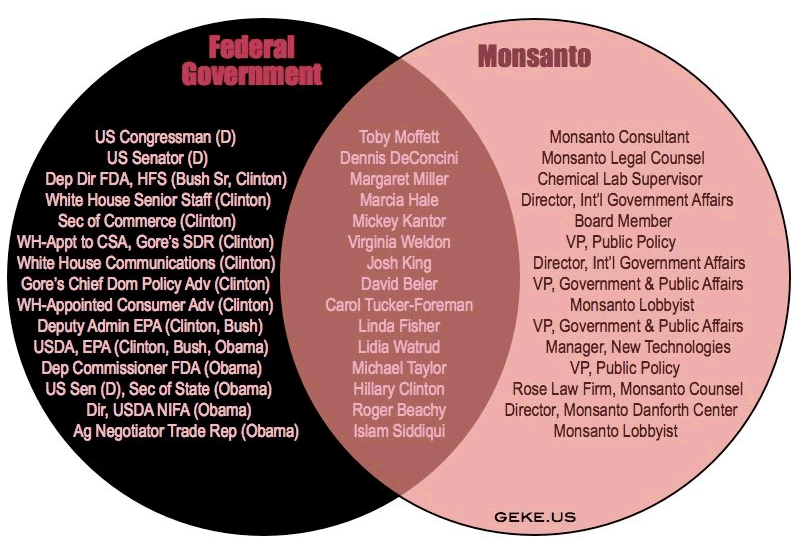
The revolving door between the private sector and government bodies has been well established. In the US, many senior figures from the Genetically Modified Organisms (GMOs) industry, especially Monsanto, have moved with ease to take up positions with the Food and Drug Administration and Evironmental Protection Agency and within the government. Writer and researcher William F Engdahl writes about a similar influence in Europe, noting the links between the GMO sector within the European Food Safety Authority. He states that over half of the scientists involved in the GMO panel which positively reviewed the Monsanto’s study for GMO maize in 2009, leading to its EU-wide authorisation, had links with the biotech industry.

“Monsanto should not have to vouchsafe the safety of biotech food. Our interest is in selling as much of it as possible. Assuring its safety is the FDA’s job” – Phil Angell, Monsanto’s director of corporate communications. “Playing God in the Garden” New York Times Magazine,October 25, 1998.

Phil Angell’s statement begs the question: then who should vouchsafe for it, especially when the public bodies have been severely comprised? Monsanto has all angles covered.

When corporate interests are able to gain access to such positions of power, little wonder they have some heavy-duty tools at their disposal to try to fend off criticism by all means necessary.

A well-worn tactic of the pro-GMO lobby is to slur and attack figures that have challenged the ‘science’ and claims of the industry. With threats of lawsuits and UK government pressure, some years ago top research scientist Dr Arpad Pusztai was effectively silenced over his research concerning the dangers of GM food. A campaign was set in motion to destroy his reputation. Professor Seralini and his team’s research was also met with intense industry pressure, with Monsanto effectively targeting the heart of science to secure its commercial interests. There are numerous examples of scientists being targeted like this. A WikiLeaks cable highlighted how GMOs were being forced into European nations by the US ambassador to France who plotted with other US officials to create a ‘retaliatory target list’ of anyone who tried to regulate GMOs. That clearly indicates the power of the industry.

What the GMO sector fails to grasp is that the onus is on it to prove that its products are safe. And it has patently failed to do this. No independent testing was done before Bush senior allowed GMOs onto the US market. The onus should not be on others to prove they are safe (or unsafe) after they are on the market, especially as public attorney Steven Druker‘s book ‘Altered Genes, Twisted Truth’ shows that GMOs are on the US market due to fraudulent practices and the bypassing of scientific evidence pointing to potential health hazards.

We therefore have the right to ask whether we should trust studies carried out by the sector itself that claims GM crops are safe? Let us turn to Tiruvadi Jagadisan for an answer.

He worked with Monsanto for nearly two decades, including eight years as the managing director of India operations. A few years ago, he stated that Monsanto “used to fake scientific data” submitted to government regulatory agencies to get commercial approvals for its products in India. The former Monsanto boss said government regulatory agencies with which the company used to deal with in the 1980s simply depended on data supplied by the company while giving approvals to herbicides. As reported in India Today, he is on record as saying that India’s Central Insecticide Board simply accepted foreign data supplied by Monsanto and did not even have a test tube to validate the data which at times was faked.

Now that scientists such as Professor Seralini are in a sense playing catch-up by testing previously independently untested GMOs, he is attacked. However, the attacks on Seralini and his study have been found to be based on little more than unscientific polemics and industry pressure. In fact, in new study, Seralini highlights the serious flaws of industry-backed studies that were apparently slanted to distort results. It remains to be seen whether he and his team are in for another bout of smears and attacks.

But this is symptomatic of the industry: it says a product is safe, therefore it is – regardless that science is being used as little more than an ideological smokescreen. We are expected to take its claims at face value. The revolving door between top figures at Monsanto and positions at the FDA makes it difficult to see where the line between lobbying and regulation is actually drawn. People are rightly suspicious of the links between the FDA and GMO industry in the US and the links between it and the regulatory body within the EU.

GM represents the so-called “Green Revolution’s” second coming. Agriculture has changed more over the last two generations than it did in the previous 12,000 years. Environmentalist Vandana Shiva notes that, after 1945, chemical manufacturers who had been involved in the weapons industry turned their attention to applying their chemical know-how to farming. As a result ‘dwarf seeds’ were purposively created to specifically respond to their chemicals. Agriculture became transformed into a chemical-dependent industry that has destroyed much biodiversity. What we are left with is crop monocultures, which negatively impact food security and nutrition. In effect, modern agriculture is part of the paradigm of control based on mass standardization and a dependency on corporate products.

The implications have been vast. Chemical-industrial agriculture has proved extremely lucrative for the oil and chemicals industry, courtesy of oil-rich Rockefeller interests which were instrumental in pushing for the green revolution throughout the world, and has served to maintain and promote Western hegemony, not least via ‘structural adjustment’ and the consequent uprooting of traditional farming practices in favour of single-crop export-oriented policies, dam building to cater for what became a highly water intensive industry, loans and indebtedness, boosting demand for the US dollar, etc.

Agriculture has been a major tool of US foreign policy since 1945 and has helped to secure its global hegemony. One must look no further than current events in Ukraine, where the strings attached to financial loans are resulting in the opening up of (GM) agriculture to Monsanto. From Africa to India and across Asia, the hijack of indigenous agriculture and food production by big corporations is a major political issue as farmers struggle for their rights to remain on the land, retain ownership of seeds, grow healthy food and protect their livelihoods.

Apart from tying poorer countries into an unequal system of global trade and reinforcing global inequalities, the corporate hijacking of food and agriculture has had many other implications, not least where health is concerned.

Dr Meryl Hammond, founder of the Campaign for Alternatives to Pesticides, told a Canadian parliament committee in 2009 that a raft of studies published in prestigious peer-reviewed journals point to strong associations between chemical pesticides and a vast range of serious life-threatening health consequences. Shiv Chopra, a top food advisor to the Canadian government, has documented how all kinds of food products that were known to be dangerous were passed by the regulatory authority and put on the market there due to the power of the food industry.

Severe anemia, permanent brain damage, Alzheimer’s, dementia, neurological disorders, reproductive problems, diminished intelligence, impaired immune system, behavioural disorders, cancers, hyperactivity and learning disability are just some of the diseases that numerous studies have linked to our food.

Of course, just like cigarettes and the tobacco industry before, trying to ‘prove’ the glaringly obvious link will take decades as deceit is passed off as ‘science’ or becomes institutionalized due to the hijacking of government bodies by the corporations involved in food production.

But anyone who questions the need for GMOs in the first place and the risks they bring and devastating impacts they have is painted as clueless and indulging in scare mongering and falsehoods, while standing in the way of human progress. But can we expect much better from an industry that has a record of smearing and attempting to ruin people who criticise it? Are those of us who question the political links of big agritech and the nature of its products ready to take lessons on ethics and high-minded notions of ‘human progress’ from anyone involved with it?

This is an industry that has contaminated crops and bullied farmers with lawsuits in North America, an industry whose companies have been charged with and most often found guilty of contaminating the environment and seriously damaging health with PCBs and dioxins, an industry complicit in concealing the deadly impact of GM corn on animals, an industry where bribery seems to be second nature (Monsanto in Indonesia), an industry associated with human rights violations in Brazil and an industry that will not label its foods in the US.

A great myth forwarded by the pro-GMO lobby is that governments are freely choosing to adopt GMOs. Any brief analysis of the politics of GM highlights that this is nonsense. Various pressures are applied and agritech companies have captured policy bodies and have a strategic hold over the WTO and trade deals like the TTIP.

For instance, take the 2005 US-India nuclear deal (allowing India to develop its nuclear sector despite it not being a signatory of the Non-Proliferation Treaty and allegedly pushed through with a cash for votes tactic in the Indian parliament). It was linked to the Knowledge Initiative on Agriculture, which was aimed at widening access to India’s agricultural and retail sectors. This initiative was drawn up with the full and direct participation of representatives from various companies, including Monsanto, Cargill and Walmart.

When the most powerful country comes knocking at your door seeking to gain access to your markets, there’s good chance that once its corporate-tipped jackboot is in, you won’t be able to get it out.

And it seems you can’t. So far, Bt cotton has been the only GM crop allowed in India, but the open field trials of many GM crops are now taking place around the country despite an overwhelming consensus of official reports warning against this. The work of numerous public bodies and research institutes is now compromised as a result of Monsanto’s strategic influence within India (see this and this).

If global victory cannot be achieved by the GMO biotech sector via the hijack of public bodies and trade deals or intimidation, then the politics of another form of contamination may eventually suffice:

“The hope of the industry is that over time the market is so flooded [with GMOs] that there’s nothing you can do about it. You just sort of surrender” – Don Westfall, biotech industry consultant and vice-president of Promar International, in the Toronto Star,January 9 2001.

Open field planting is but one way of achieving what Westfall states. Of course, there are numerous other ways too (see this).

As powerful agribusiness concerns seek to ‘consolidate the entire food chain’ with their seeds, patents and GMOs, it is clear that it’s not just the health of the nation (any nation) that is at stake but the global control of food and by implication nations.

“What you are seeing is not just a consolidation of seed companies, it’s really a consolidation of the entire food chain” – Robert Fraley, co-president of Monsanto’s agricultural sector 1996, in the Farm Journal. Quoted in: Flint J. (1998) Agricultural industry giants moving towards genetic monopolism. Telepolis, Heise.

Colin Todhunter is an independent writer: colintodhunter.com

Follow the trail of facts, hints, and allegations—connect the dots

images

By Edward Curtin

Source: Intrepid Report

“There were incidents and accidents/there were hints and allegations.—Paul Simon

Children love to trace, to connect the dots, to make connections, but often the connections they make frighten adults who try to ignore their points or offer some ridiculous circumlocutions. Maybe we adults are much like children in our desires to make connections, but the thought of it frightens us.

Suppose we could for a while calm those fears and concentrate long enough to trace through the dim glimmerings of a faded pattern a clarifying story that would jolt us into an awareness that could change our lives and society. I offer here an arc of history that you may consider tedious. Try patience. I could yell, I could scream, I could try all the classical argumentation and logic that comes “naturally” to me. I could be a wise guy, amuse you, try to provoke you, curse, sing a song, stomp my feet—even write post-modern gibberish. As Andre Vltchek says, it’s hard—I’m putting it nicely—to get through, to have an impact that counts. We desperately want to believe in a world where we really are children and BIG Daddy (apologies to Burl Ives) has told the truth. Obviously I have reached some stern conclusions, but I think the conclusions follow from the facts. See what you think.

  • 1957, Massachusetts Senator John Kennedy delivers a Senate speech in support of the Algerian liberation movement, in support of African liberation generally, and against colonial imperialism. The speech causes an international uproar, and Kennedy is harshly attacked by Eisenhower, Nixon, John Foster Dulles, and even liberals such as Adlai Stevenson. He is praised in the third world.
  • 1959, George H. W. Bush moves his oil company—Zapata Offshore—to Houston, Texas. One of Zapata’s drilling rigs, Scorpion, having been moved from the Gulf of Mexico the previous year, is now operating 54 miles north of Cuba
  • 1960. On March 17, President Eisenhower approves the Bay of Pigs project.
  • 1961. On January 17, in anticipation of Kennedy’s inauguration in three days, the Belgian government in complicity with the CIA assassinates Congolese nationalist leader Patrice Lumumba. On February 13, a devastated Kennedy receives a belated phone call informing him of Lumumba’s murder.
  • 1961, April. More than a week before the CIA led Bay of Pigs invasion of Cuba—code-named the Zapata Operation—the CIA discovers that the Soviets have learned the date of the invasion and informed Castro. Knowing the invasion is doomed in advance, the CIA Director Allen Dulles doesn’t tell Kennedy. When the invasion fails, the CIA blames JFK who angrily says he wants “to splinter the CIA into a thousand pieces and scatter it to the winds.” Kennedy fires Dulles.
  • 1962. On June 13, Lee Harvey Oswald, ex-Marine and alleged traitor, returns from the Soviet Union with a loan from the State Department that also arranges for him, together with his Russian wife, to be met at the dock in Hoboken, New Jersey by Spas T. Raikin, an official of an anti-communist organization with extensive intelligence connections. Oswald soon moves to Dallas, Texas where, at the behest of the CIA, he is chaperoned around by CIA asset and George H. W. Bush’s old friend, George de Mohrenschildt.
  • 1963, June 10. JFK delivers his famous American University address calling for an end to “a Pax Americana enforced on the world by American weapons of war.”
  • 1963. On October 11, Kennedy issues National Security Action Memorandum 263 calling for the withdrawal of 1,000 American troops from Vietnam by the end of 1963 and all of them by the end of 1965.
  • 1963, November 2. At the last minute JFK cancels his trip to Chicago to attend the Army-Air Force football game when it is learned that a four-man rifle team has plotted to assassinate him. The four are never charged or named, but an alienated ex-Marine scapegoat with CIA connections, Thomas Arthur Vallee, is arrested on a pretext. Vallee works in a building overlooking a dog-leg turn where JFK’s car was to pass.
  • 1963, November 22. JFK is shot in Dallas on a dog-leg turn at 12:30 P.M. and dies at 1 P.M. At 1:38 P.M. Walter Cronkite makes the first public announcement of the president’s death. At 1:45 P.M. George H. W. Bush, who is in Tyler, Texas an hour and a half southeast of Dallas, telephones Houston FBI agent Graham W. Kitchel to inform him that he’s heard gossip that a Houston man, James Parrot, has been talking about killing Kennedy when he comes to Houston (JFK had been in Houston the day before). Parrot is questioned and deemed harmless. Bush tells the FBI agent that he’ll be going to Dallas in the evening, though he fails to mention that he was there the night before. At 1:50 PM the Dallas police arrest Lee Harvey Oswald in the Texas theatre and charge him with the murder of Dallas police Officer J.D. Tippett. A few minutes after Oswald’s arrest and his exit out the front door to waiting police cars, a second Oswald is arrested in the theatre and surreptitiously taken out the back door. Later in the day Oswald is charged with also killing President Kennedy from behind from the 6th floor of the Texas School Book Depository. But the fatal shot to Kennedy’s head comes from the left front.
  • 1963. Two days later, Ruby kills Oswald, who claimed he was a patsy, in the Dallas police building. That same afternoon LBJ tells Henry Cabot Lodge that “I am not going to lose Vietnam.”
  • 1963, November 29. LBJ announces the formation of the Warren Commission whose key member is Allen Dulles, the former CIA Director fired by Kennedy.
  • 1963. On December 24, Johnson tells the Joint Chiefs of Staff: “Just get me elected, and then you can have your war.”
  • 1964, August. The fraudulent Tonkin Gulf Incidents and Tonkin Gulf Resolution. Johnson orders the bombing of North Vietnam. The Vietnam War starts in earnest.
  • 1964 ,September. The Warren Commission findings are made public. Oswald is declared the lone assassin with the magic bullet explanation being the key.
  • 1967. Martin Luther King delivers his Riverside Church speech—“A Time to Break Silence”—denouncing the Vietnam War and calling for opposition to it, while linking it to social and economic oppression at home.
  • 1968, April 4. Martin Luther King is assassinated in Memphis. The authorities blame it on James Earl Ray, a petty criminal loner.
  • 1968. On June 6 in Los Angeles, Senator Robert Kennedy. On the cusp of becoming the Democratic nominee for president, is assassinated. The accused lone assassin, Sirhan Sirhan, was standing in front and to the left of RFK. The autopsy shows Kennedy was killed by a bullet from behind and below that entered his head behind his right ear. Sirhan is subsequently convicted as the lone crazed gunman, despite many witnesses seeing a girl, in a polka dot dress, with a male companion, running down the back stairs of the hotel, shouting. “We shot him! We shot him! We shot Senator Kennedy.”
  • 1972, June 17. Five CIA employees and veterans of the Bay of Pigs operation are arrested inside the Watergate offices of the Democratic National Committee. Together with H. Howard Hunt (CIA) and G. Gordon Liddy, they are later indicted. The burglars are caught by a security guard who notices that these skilled undercover operatives have taped locks open from the outside so that the tape is showing.
  • The Watergate story is primarily reported by reporters Bob Woodward and Carl Bernstein who work at the Washington Post under Editor Ben Bradlee. Woodward had earlier served in Naval Intelligence, as had Bradlee, while Bradlee and the Washington Post have deep ties to the CIA and intelligence communities.
  • 1974, August 9. Nixon is forced to resign. He is the second president in eleven years to be removed from office. Gerald Ford, a former member of the Warren Commission assumes the presidency. Dick Cheney is named White House Chief of staff and Donald Rumsfeld, Secretary of Defense.
  • 1976, January 30. Having been nominated by Ford, George H. W. Bush assumes the directorship of the CIA, despite critics arguing that he has no intelligence experience. He serves in that capacity for 365 days.
  • 1976. George de Mohrenschildt, Oswald’s CIA chaperone and George H. W. Bush’s old friend, writes a letter to CIA Director Bush begging for help “we are being followed everywhere. . . .”
  • 1977, March 27. George de Mohrenschildt, about to be questioned by the House Select Committee on Assassinations, allegedly commits suicide in Florida.
  • 1979, November 4. Fifty-two Americans are taken hostage in the U.S. Embassy in Tehran.
  • 1980. Ronald Reagan is elected president and George H. W. Bush, vice-president. It is later alleged that Bush, CIA officer Robert Gates, and CIA Director William Casey met secretly with Iranian officials in Paris before the election and made a secret deal to insure Reagan/Bush an election victory by not releasing the hostages before the vote. The hostages were subsequently released a few minutes after Reagan and Bush were sworn in on January 20, 1981.
  • 1985-88. The Iran-Contra scandal plays out as it is discovered that the Reagan administration was secretly selling arms to Iran in exchange for hostages and using the proceeds to illegally arm the anti-Sandinista rebels in Nicaragua in violation of the Boland amendment. Oliver North becomes the public face of the secret machinations while Reagan and Bush plead ignorance. Many are indicted, while Bush, when running for president in 1988, claims he was “out of the loop.”
  • 1988, July 16. In the midst of the presidential campaign pitting Bush against Dukakis, the Nation magazine publishes an article by Joseph McBride, “The Man Who Wasn’t There, ‘George Bush,’ CIA Operative.” The article centers around a newly discovered memo from FBI Director J. Edgar Hoover, dated November 29, 1963, concerning the JFK assassination and an oral briefing the bureau had given on November 23 regarding the assassination to “Mr. George Bush of the Central Intelligence Agency.” A Bush spokesman denies it was candidate Bush.
  • 1988, July 3. The USS Vincennes shoots down in Iranian airspace civilian Iran Flight 655 killing 299, including 66 children. Vice President Bush says, “ I will never apologize for the U.S. I don’t care what the facts are . . . I’m not an apologize-for-America kind of guy.”
  • 1988. George H. W. Bush is elected president.
  • 1990-91. President Bush attacks Iraq, called the Gulf War, public and congressional support for which is given a huge boost on the testimony of a nurse who claims she witnessed Iraqi soldiers in Kuwait City hospital grabbing babies out of incubators and throwing them on the floor to die. It is later discovered that the “nurse” in question was the daughter of the Kuwaiti ambassador to the United States and that she hadn’t lived in Kuwait at the time. Her story had been hatched by the Hill and Knowlton public relations firm and was a lie—a successful lie.
  • 1991, May 19. A few weeks after filming had begun on Oliver Stone’s movie, JFK, the Washington Post’s national security reporter George Lardner, Jr., writes a scathing review of the film based on a stolen copy of the first draft of the screenplay.
  • 1991, December 20. Stone’s film, JFK, is released.
  • 1991,0n December 24, President Bush grants pardons to six former members of the Reagan/Bush administration facing prosecution in the Iran-Contra scandal.
  • 1993-2000. President Bill Clinton bombs Iraq, Yugoslavia, Afghanistan, Sudan . . . killing untold numbers of people, while maintaining economic sanctions on Iraq.
  • 1996, May 12. On CBS’s Sixty Minutes, Clinton’s Secretary of State Madeleine Albrecht says that the deaths of over 500,000 Iraqi children as a result of the sanctions are worth it.
  • 1997. The Project for the New American Century, a neoconservative enterprise, three of whose signatories are Dick Cheney, Donald Rumsfeld, and Jeb Bush, is launched. Among other things, they call for the overthrow of Saddam Hussein in Iraq. Ten signees of the statement of principles go on to serve in the George W. Bush administration.
  • 1999. On April 26, CIA headquarters was named the George Bush Center for Intelligence in honor of former president George H.W. Bush who served as CIA Director for 357 days.
  • 1999. A jury in Memphis, Tennessee returns a verdict in a civil trial brought by Martin Luther King’s family concluding that King was killed, not by James Earl Ray, but by a conspiracy involving agencies of the U. S. government and the Memphis police.
  • 2000, September. The Project for the New American Century releases a position paper, “Rebuilding America’s Defenses,” stating that the United States will not be able to enforce its will on Iraq, Iran, Syria, and Afghanistan and maintain a Pax Americana “absent some catastrophic and catalyzing event—like a new Pearl Harbor.” The paper introduces a new word to refer to the United States of America—“the homeland.”
  • 2000, November. George W. Bush is elected president after a disputed ballot count and the intervention of the Supreme Court. Dick Cheney becomes vice-president and Donald Rumsfeld is named secretary of defense.
  • 2001, May 1. George W. Bush gives a major foreign policy speech at the National Defense University and says that the U.S.A. must be willing to “rethink the unthinkable,” giving public notice that the U. S. planned to withdraw from the ABM treaty. He warns against “weapons of mass destruction” and “weapons of terror” in the hands of rogue actors. The speech closely follows the reasoning of the PNAC paper of the previous year in urging an aggressive foreign policy. Cheney and Rumsfeld are in the audience.
  • 2001, June 22-23. Exercise Dark Winter takes place at Andrews Air Force base. The scenario involves anonymous threatening letters sent to mainstream media. The letters threaten more letters to come with anthrax. Judith Miller, author of Germs, and a notoriously deceptive Iraq war hawk for The New York Times, participates, playing Judith Miller of the New York Times.
  • 2001, September 11. The terrorist attacks in NYC and Washington, D.C. occur. The media immediately starts referring to them as another Pearl Harbor, a new Pearl Harbor. CBS News reports that before going to bed at night George W. Bush wrote in his diary, “The Pearl Harbor of the 21st century took place today.” The site of the Twin Towers is first referred to as “ground zero,” a nuclear war term, by Mark Walsh, identified as a freelancer for Fox News by the Fox News interviewer on the street of lower Manhattan. Presciently anticipating the official explanation for the buildings collapse, Walsh adds that the towers obviously collapsed “mostly due to structural failure since the fires were too intense.”
  • 2001, September 12. The New York Times headlines a story: “Personal Accounts of a Morning Rush that Became the Unthinkable.” Another headline under the byline of future editor Bill Keller, Iraq war hawk, reads, “America’s Emergency Line: 9/11.” The endless emergency and war on terror begin. Henceforth, for the first time in American history, a very important day is referred to by numbers, not by name—an emergency phone number.
  • 2001, September 22. Tom Ridge is named director of the newly created Homeland Security and becomes in charge of politically motivated terror alerts.
  • 2001 September-October. Real and fake anthrax attacks occur. A sham investigation follows with the FBI eventually accusing government scientist Bruce Ivins on little to no evidence, resulting in Ivins alleged suicide.
  • 2001. Throughout the first three weeks of October the major media use the word “unthinkable” repetitively, echoing its association with nuclear war, just as the World Trade Center site is similarly referred to as “ground zero,” another nuclear term. A phony “anthrax” letter containing a harmless white powder, postmarked in St. Petersburg, Florida. On September 20, is sent to Tom Brokaw of NBC. The letter, not made public until October 22, after the media’s repeated use of the word “unthinkable,” begins: “The Unthinkabel” Sample Of How It Will Look. Judith Miller of the New York Times receives an anthrax threat letter also sent from St. Petersburg.
  • 2001, October 7. The U.S.A attacks Afghanistan.
  • 2001 October 27. The Patriot Act is passed.
  • 2001, December 4. George W. Bush says when he was outside the classroom in Florida on September 11, he “had seen this plane fly into the first building. There was a TV set on. . . .” Problem: No one saw the first plane hit the North Tower since it wasn’t televised live. Much later a tape someone had made was shown on television.
  • 2002, October 2. At the Cincinnati Museum Center President Bush gives a speech linking Saddam Hussein to the September 11 attacks and says that “we cannot wait for the final proof—the smoking gun—that that could come in the form of a mushroom cloud.” He urges the disarming of Iraq.
  • 2002-10. Regular color-coded terrorist alerts.
  • 2003, February. Secretary of State Colin Powell gives false testimony at the U.N., asserting that Iraq possesses chemical and biological weapons of mass destruction and must be confronted.
  • 2003, March. The U. S. attacks Iraq based on lies.
  • 2003-8. Bush wages war on Iraq, Afghanistan, etc. Homeland “security” leads to indefinite detention, black sites, torture, spying on Americans, the loss of constitutional rights, etc.
  • 2007, February 10. Barack Obama, having been a U.S. Senator for 2 years, 1 month, announces he is running for president.
  • 2008, September. An international financial meltdown occurs. The government claims it was unforeseen. The Bush administration bails out the big banks and financial institutions.
  • 2008, November. A seriously inexperienced Senator from Illinois, Barack Obama, comes out of nowhere to be elected president on a populist platform of “hope” and “change.” He receives more backing from Wall Street than his Republican rival. Liberals and progressives go wild for joy. Hope and change is proclaimed.
  • 2009. Lawrence Summers, former CEO of Goldman Sachs, takes up his position as head of Obama’s economic team. Timothy Geithner, former head of the New York Federal Reserve, whose father, Peter Geithner, oversaw the Ford Foundation’s programs in Indonesia developed by Obama’s mother, becomes secretary of the Treasury. And Robert Gates, former CIA Director and George W. Bush’s Secretary of Defense continues in that position for Obama.
  • 2009, March. Obama meets with the CEOs of fifteen big banks and tells them that “my administration is the only thing between you and the pitchforks. . . . I’m not out there to go after you. I’m protecting you.”
  • 2009. Obama intensifies the war on Afghanistan.
  • 2009, October 9. Obama is given the Nobel Peace Prize.
  • 2009, December. Obama sends 30,000 more American troops to Afghanistan, saying this “will bring this war to a successful conclusion.”
  • 2010. Obama vows to carry forward the Bush tax cuts for the richest Americans.
  • 2010 and ongoing. Obama chooses his drone war kill list every Tuesday; says the killing of American citizen Anwar al-Awlaki “is an easy one.”
  • 2011. Obama and partners attack Libya and brutally kill Muammar Gaddafi. Libya descends into chaos.
  • 2009 and ongoing. Obama attacks Afghanistan, Iraq, Syria, Yemen, Libya, Sudan, Somalia, etc. Does nothing to stop the Israeli slaughter of Palestinians. Supports and arms terrorists in Syria and other countries. Engineers a coup d’etat in Ukraine and supports neo-Nazi forces attacking eastern Ukraine. Encircles Russia with NATO troops and military exercises. Starts a new Cold War. Maintains military commissions and indefinite detention. Prosecutes more whistleblowers than all previous American presidents combined, but does not prosecute any banksters or torturers. Charges Edward Snowden, Thomas Drake, Jeffrey Sterling, Chelsea Manning, John Kiriakou, et al of violating the 1917 Espionage Act. Acquiesces in the military coup against the democratically elected leader of Egypt, Mohamed Morsi and his subsequent imprisonment. Spies on Americans and other countries. Maintains a national state of emergency and the Patriot Act with minor adjustments. Prosecutes “the war on terror” initiated by George W. Bush. Rules over a technological, computerized war of killing all over the globe and a technological, computerized spying apparatus here at home. And does all this and more with a smile.

It should be clear from this small portion of events over the years that there is a connecting link, that there is a bloody thread running through them connecting key players and the obvious ongoing presence of a secret structure that recruits its team to maintain this oppressive system. To see it should be gutsy child’s play. It is not an issue of either/or; we can’t explain how we have come to this terrifying situation of rule by a murderous, militarized national security apparatus serving the wealthy elites by concentrating on either individuals or structures. People such as Barack Obama, the Bushes, et al don’t emerge from thin air (though in Obama’s case it seems that way, and some have speculated on his CIA links). These people grow out of a system that has cultivated and nurtured them. They become spokesmen for the secretive and powerful monied forces some call the Deep State. (The scholar Peter Dale Scott sees a hidden link between the JFK assassination, Watergate, Iran-Contra, and 9/11.) Spokesmen, yes, but executive spokesmen; they are not innocent victims; they are free executioners. People and ongoing structures are intertwined. Individuals count, but so do structures. We are now living within a structure of non-stop and almost total propaganda that individuals, with the help of alternative structures of communication such as alternative media, can penetrate and understand, but only if they are willing to trudge through history that will allow for context and the connecting of dots. In the end, it takes desire and work. Many individuals concluding alike can lead to change. Connect and be outraged.

The psychiatrist Allen Wheelis once wrote a brilliant little book, called How People Change. His “childish” conclusion was that they change because they want to. Simple but true.

Edward Curtin is a sociologist and writer who teaches at Massachusetts College of Liberal Arts and has published widely.

#ACAB: Why the Institution of Policing Makes All Cops Bastards

police-state-founders-warning

By PM Beers

Source: AntiMedia

All cops are bastards because all cops, if ordered to, will enforce laws that oppress poor people.

Many people would like to believe that there are good cops and bad cops. I’m going to explain why this is simply not true. When we are children, we are ingrained with the belief that police officers are good people who want to help us. Children are taught that if they need help, they should ask a police officer. These early beliefs are so deeply ingrained that it is very hard to shake them off. For me, it took over two years to finally understand the concept of ACAB—all cops really ARE bastards, even if they believe themselves to be good people.

When you learn the history of policing, you will better understand the need to dismantle the inherently racist institution. When we were new to the anti-police brutality movement, we all thought there were good cops and bad cops. As with most binary thinking, this is incorrect. All cops are indeed bastards as they blindly enforce laws which were written to oppress poor people, such as laws against feeding the homeless. The primary role of the first police departments was to catch runaway slaves. Racism is ingrained in policing. Racism is the root cause of police brutality.

There are no good cops. Laws and ethics are not the same thing. Laws don’t prevent crime from happening—people having their needs met does. One cannot be a good person and enforce unjust laws.

Someone once asked me, “But how is the statement ‘ALL cops are bastards’ any different from ‘ALL priests are pedophiles,’ or ‘All women are lousy drivers?’“ Another friend replied,  “Nobody is born a cop. Joining that institution is a choice. It’s more akin to saying ‘all KKK are bastards.” Priests are not required to molest children, but cops are required to follow orders which oppress poor people and target people of color.

Every cop must obey orders without question. They are required to enforce unethical laws or risk losing a job that provides them with a comfortable income if they refuse. In the rare occasion that a cop does blow the whistle on an injustice, the thin blue line is immediately invoked and the seemingly well-intentioned cops are ostracized by their peers, almost always neutralizing their intentions.

Some cops think they are actually good people. Of course, they have to think they are good to rationalize what they are doing since in our society, one’s occupation is one’s identity.

We all know that many cops have done horrible things. They have abused their power, murdered people, and attempted to cover up those murders with lies. I’m not going to talk about those obvious injustices that we are already so aware of. I’m going to talk about more subtle ways that cops do unethical things under the color of law. The job of the police is not to protect people but to protect corporate assets.

When a person becomes a police officer, their job is to enforce the laws. Not all laws are good. Police are unthinking, unquestioning robots protecting a corrupt, unjust state. They simply do as they are told without question. The institution of policing is inherently corrupt because they enforce laws which have nothing to do with ethics and everything to do with serving corporate interests.

If your job requires you to do unethical things and you continue to do that job for a paycheck, you have sold out and can no longer consider yourself an ethical person.  Every cop has sold their soul for a middle class income. Their price is low.

But wait…what about that one cop who bought groceries for a mom who stole food for her kids?

Yes, that cop did a good thing. That doesn’t erase the unethical things the cop does or would do if given the order. I like to call these types of news stories #copaganda because they are often played by mainstream media to try to get us to think that cops are good people, when in reality, the news stations want to appease police departments so that they can keep access to information for their news stories. TV news folks do unethical things for money, as well, and that’s a whole other rant for another day. If cops did these kinds of things on a daily basis, they wouldn’t be newsworthy. Cops are not as lovely as the TV would have us think they are.

When protests are held, police say they are there to make sure no one gets hurt. Yet on most occasions, they are the ones hurting protesters with batons, “less lethal” bullets, and tear gas.  Sometimes, undercover cops are placed into crowds and are sometimes suspected by protesters of being the ones agitating the police. They use actions, such as throwing bottles, in order to give the police an excuse to become violent with the protesters.

Police have to enforce other unjust laws, like the criminalization of the medical use a cannabis. Smoking cannabis harms no one and is a victimless crime. Is it even a crime at all? Filling up jails with pot smokers only has negative consequences on society, as taxpayers are burdened and people prosecuted for drug offenses often have a difficult time finding employment after being released from prison. Children also suffer under the burden of having one less parent to care for them. This lack of need fulfillment leads to more crime as children mature.

Further, according to the LAPD, all cars are now under investigation. License plate scanners mounted on police cars and on light poles track drivers all over Los Angeles. The ACLU and the Electronic Frontier Foundation are currently suing the LAPD to find out how the technology is being used.  There is no probable cause to collect such data, making this practice a violation of our civil rights.

Police enforce unjust laws that harass and criminalize people who have no home. Sleep is a primary human need like air, food, and water. Is it ethically permissible to wake someone up at six AM because the only place they can afford to sleep is the sidewalk? Would a good cop do that?

In the summer of 2012, I participated in a sleepful protest in downtown Los Angeles in support of rights for people who didn’t have homes. Every morning, Officer Massey would come honk his horn to wake us up at 6 AM.  He was baffled at why I would scream at him every morning. He thought he was a good cop. He had no clue that waking up unhoused people at 6 AM is an unethical thing to do. In his mind, he was just doing his job—just following orders. Officer Massey tried his best to be polite, but what he was doing was still wrong. Is he going to quit his job?  What other job is he even qualified to do that can  still provide him such a comfortable middle-class income?  He is not going to quit his job. Instead, he will rationalize in his mind that he is a good cop. He never once kicked an unhoused person, so isn’t he lovely?

The police are an inherently violent institution where force is used to extort money from poor people and property is stolen. The racism and bias against the oppressed and poor is pervasive. The entire institution is so corrupt and violent that participating in it makes one corrupt and violent by silent consent. It is impossible to be a good person and participate in violence and oppression.

For example, a person unable to pay $150 for a car registration will have that car stolen from them with the assistance of the police. The car will then be held for ransom. If the person who was too poor to pay the $150 can’t pay the ransom, then the car, which has a value of thousands of dollars, will be sold and the state will profit off of the backs of the poor. Anyone willingly accepting money from such an institution that extorts poor people is by default not a good person.

People want to believe they are good without challenging their false beliefs. There are no good cops. Ethical and legal are completely separate things—therefore, there are no good cops as they are required to enforce unethical laws.

Are there decent individuals that become cops? Of course. However, the institution of policing means police officers, by default, are oppressors by occupation—meaning there truly are no good active-duty cops.

What is the alternative to policing? Community policing by the people who live in the community is a viable solution. Further, the situation will be improved by legalizing victimless crimes, making sure everyone’s needs are met, and reducing income inequality.

A conscious cop would think about quitting, realize they are not qualified for any other job that pays anything even close to what they currently get, and would quickly adjust their thinking back into justifying what they are doing.

All cops oppress poor people and are therefore evil. All cops make threats of death and are therefore evil.

Dismantling the institution of policing does not mean anarchy in the context of chaos. The word “anarchy” is a beautiful thing when used in certain contexts where people understand what the word actually means.  For me, anarchy means equality, horizontalism, and no false authority. Communities can and should police themselves.


This article (#ACAB: Why the Institution of Policing Makes All Cops Bastards) is free and open source. You have permission to republish this article under a Creative Commons license with attribution to the author and theAntiMedia.org. Tune in! Anti-Media Radio airs Monday through Friday @ 11pm Eastern/8pm Pacific. Help us fix our typos:edits@theantimedia.org.

PM Beers joined Anti-Media as an independent journalist in April of 2014. Her topics of interest include mental illness, neurology, quantum physics, Tourette’s, Autism, compassionate parenting, horizontal democracy, activism, and art. Born in Long Beach, California, she currently resides in Los Angeles, California. Learn more about Beers here!