Wikileaks Releases Smoking Gun Email Proving Once and For All Clinton is Lying Through Her Teeth

hillary-frustrated

By

Source: The Free Thought Project

Wikileaks appears to have found the smoking-gun email proving almost inarguably Hillary Clinton broke the law — but not necessarily simply because she used the now-infamous private email server.

“Is this the email the FBI’s star exhibit against Hillary Clinton (“H”)?” Wikileaks tweeted Tuesday night.

At issue is an email thread, beginning with a note from Clinton’s former chief of staff at the State Department, Jake Sullivan, which tellingly states:

“They say they’ve had issues sending secure fax. They’re working on it.”

To which an apparently impatient Hillary replies:

“If they can’t, turn it into nonpaper w no identifying headline and send nonsecure.”

What she’s requesting from Sullivan is that he strip sensitive information of anything marking it as sensitive so it can be sent through without following security protocols. Clinton, in other words, blatantly asked Sullivan to break the law — because she apparently didn’t want to wait.

Though she’s claimed the private email server had been employed for several unbelievable reasons — from a laughable claim of naivete to the ‘everyone’s doing it claim’ that her predecessors had similar arrangements — the truth might have just become clear.

In January, rumors of this email surfaced, however, the state department had it redacted. An actual image of the email hasn’t existed until now which dispells any doubt that Clinton did, in fact, commit a crime.

In the past, Clinton has explicitly denied she ever requested sensitive information be stripped of confidential markings in order to send through the private server. Now, we’ve been shown the truth.

Besides the basic issue of sending classified or sensitive information on an unsecure server, Clinton willfully requested documents be doctored so she could intentionally have them sent to her in that unsecure manner. To be clear, this isn’t a simple case of not knowing any better — or accidentally being on the sending or receiving end of sensitive information.

Interestingly, this email also shows a level of hypocrisy seemingly only possible by Clinton. Nearly a year ago, as The Free Thought Project reported, another batch of the notorious emails showed the then-secretary of state requesting — and receiving — censorship of an unidentified video on YouTube. So potentially-classified information, to Clinton, can justifiably be sent through an unsecure server, but a video she finds unfavorable should be removed from public viewing.

Lacking favorable public opinion, Clinton continues to succeed in primaries around the country — though she seems to garner the best results in places where voting machines have proven susceptible to hackers. In fact, questionable electoral practices seem to follow Clinton wherever primaries are held.

An outside observer might wonder what Hillary Clinton wouldn’t do to win the White House — or, based on today’s Wikileaks revelation — what she would do once there.

This is the deliberate thwarting of protocol and policy in place for reasons of national security. This statement shows Hillary plotting how to receive potentially classified information without having to bother with waiting for proper channels. This is, as Wikileaks suggested, at the very least, one smoking gun.

This is also reason to question why Clinton is running for office — instead of facing charges. Though, perhaps, this email proves that will soon change.


Related Video:

Keep Fear Alive

DHSFEAR3

The bald-eagle boondoggle of the terror wars

By Kade Crockford

Source: The Baffler

“If you’re submitting budget proposals for a law enforcement agency, for an intelligence agency, you’re not going to submit the proposal that ‘We won the war on terror and everything’s great,’ cuz the first thing that’s gonna happen is your budget’s gonna be cut in half. You know, it’s my opposite of Jesse Jackson’s ‘Keep Hope Alive’—it’s ‘Keep Fear Alive.’ Keep it alive.”

—Thomas Fuentes, former assistant director, FBI Office of International Operations

Can we imagine a free and peaceful country? A civil society that recognizes rights and security as complementary forces, rather than polar opposites? Terrorist attacks frighten us, as they are designed to. But when terrorism strikes the United States, we’re never urged to ponder the most enduring fallout from any such attack: our own government’s prosecution of the Terror Wars.

This failure generates all sorts of accompanying moral confusion. We cast ourselves as good, but our actions show that we are not. We rack up a numbing litany of decidedly uncivil abuses of basic human rights: global kidnapping and torture operations, gulags in which teenagers have grown into adulthood under “indefinite detention,” the overthrow of the Iraqi and Libyan governments, borderless execution-by-drone campaigns, discriminatory domestic police practices, dragnet surveillance, and countless other acts of state impunity.

The way we process the potential cognitive dissonance between our professed ideals and our actual behavior under the banner of freedom’s supposed defense is simply to ignore things as they really are. They hate us for our freedom, screech the bald-eagle memes, and so we must solemnly fight on. But what, beneath the official rhetoric of permanent fear, explains the collective inability of the national security overlords to imagine a future of peace?

Incentives, for one thing. In a perverse but now familiar pattern, what we have come to call “intelligence failures” produce zero humility, and no promise of future remedies, among those charged with guarding us. Instead, a new array of national security demands circulate, which are always rapidly met. In America, the gray-haired representatives of the permanent security state say their number one responsibility is to protect us, but when they fail to do so, they go on television and growl. To take but one recent example, former defense secretary Donald Rumsfeld appeared before the morally bankrupt pundit panel on MSNBC’s Morning Joe to explain that intractable ethnic, tribal, and religious conflict has riven the Middle East for more than a century—the United States, and the West at large, were mere hapless bystanders in this long-running saga of civilizational decay. This sniveling performance came, mind you, just days after Politico reported that, while choreographing the run-up to the 2003 invasion of Iraq, Rumsfeld had quietly buried a report from the Joint Chiefs of Staff indicating that military intelligence officials had almost no persuasive evidence that Saddam Hussein was maintaining a serious WMD program. Even after being forced to resign in embarrassment over the botched Iraq invasion a decade ago, Rumsfeld continues to cast himself as an earnestly outmanned casualty of Oriental cunning and backbiting while an indulgent clutch of cable talking heads nods just as earnestly along.

And the same refrain echoes throughout the echelons of the national security state. Self-assured and aloof as the affluenza boy, the FBI, CIA, and NSA fuck up, and then immediately apply for a frenzied transfer of ever more money, power, and data in order to do more of what they’re already doing. Nearly fifteen years after the “Global War on Terror” began, the national security state is a trillion-dollar business. And with the latest, greatest, worst-ever terrorist threat always on the horizon, business is sure to keep booming.

The paradox produces a deep-state ouroboros: Successful terrorist attacks against the West do not provoke accountability reviews or congressional investigations designed to truly understand or correct the errors of the secret state. On the contrary, arrogant spies and fearful politicians exploit the attacks to cement and expand their authority. This permits them, in turn, to continue encroaching on the liberties they profess to defend. We hear solemn pledges to collect yet more information, to develop “back doors” to decrypt private communications, to keep better track of Muslims on visas, send more weapons to unnamed “rebel groups,” drop more cluster bombs. Habeas corpus, due process, equal protection, freedom of speech, and human rights be damned. And nearly all the leaders in both major political parties play along, like obliging extras on a Morning Joe panel. The only real disagreement between Republican and Democratic politicians on the national stage is how quickly we should dispose of our civil liberties. Do we torch the Bill of Rights à la Donald Trump and Dick Cheney, or apply a scalpel, Obama-style?

Safety Last

Both Democrats and Republicans justify Terror War abuses by telling the public, either directly or indirectly, that our national security hangs in the balance. But national security is not the same as public safety. And more: the things the government has done in the name of preserving national security—from invading Iraq to putting every man named Mohammed on a special list—actually undermine our public safety.

That’s because, as David Talbot demonstrates in The Devil’s Chessboard, his revelatory Allen Dulles biography and devastating portrait of a CIA run amok, national security centers on “national interests,” which translates, in the brand of Cold War realpolitik that Dulles pioneered, into the preferred policy agendas of powerful corporations.

Public safety, on the other hand, is concerned with whether you live or die, and how. Any serious effort at public safety requires a harm-reduction approach acknowledging straight out that no government program can foreclose the possibility of terroristic violence. The national security apparatus, by contrast, grows powerful in direct proportion to the perceived strength of the terrorist (or in yesterday’s language, the Communist) threat—and requires that you fear this threat so hysterically that you release your grip on reason. Reason tells you government cannot protect us from every bad thing that happens. But the endlessly repeated national security meme pretends otherwise, though the world consistently proves it wrong.

When it comes to state action, the most important distinction between what’s good for public safety (i.e., your health) and what’s good for national security (i.e., the health of the empire, markets, and prominent corporations) resides in the concept of the criminal predicate. This means, simply, that an agent of the government must have some reasonable cause to believe you are involved with a crime before launching an investigation into your life. When the criminal predicate forms the basis for state action, police and spies are required to focus on people they have reason to believe are up to no good. Without the criminal predicate, police and spies are free to monitor whomever they want. Police action that bypasses criminal predicates focuses on threats to people and communities that threaten power—regardless of whether those threats to power are fully legal and legitimate.

Nearly fifteen years after the “Global War on Terror” began, the national security state is a trillion-dollar business.

We can see the results of this neglect everywhere the national security state has set up shop. Across the United States right now, government actors and private contractors paid with public funds are monitoring the activities of dissidents organizing to end police brutality and the war on drugs, Israeli apartheid and colonization in Palestine, U.S. wars in the Middle East, and Big Oil’s assault on our physical environment. In the name of fighting terrorism, Congress created the Department of Homeland Security, which gave state and local law enforcement billions of dollars to integrate police departments into the national intelligence architecture. As a result, we now have nearly a million cops acting as surrogates for the FBI. But as countless studies have shown, the “fusion centers” and intelligence operations that have metastasized under post-9/11 authorities do nothing to avert the terror threat. Instead, they’ve targeted dissidents for surveillance, obsessive documentation, and even covert infiltration. When government actors charged with protecting us use their substantial power and resources to track and disrupt Black Lives Matter and Earth First! activists, they are not securing our liberties; they’re putting them in mortal peril.

Things weren’t always like this. Once upon a time, America’s power structure was stripped naked. When the nation saw the grotesque security cancer that had besieged the body politic in the decades after World War II (just as Harry Truman had warned it would) the country’s elected leadership reasserted control, placing handcuffs on the wrists of the security agencies. This democratic counterattack on the national security state not only erected a set of explicit protocols to shield Americans from unconstitutional domestic political policing, but also advanced public safety.

Mission Creeps

As late as the 1970s, the FBI was still universally thought to be a reputable organization in mainstream America. The dominant narrative held that J. Edgar Hoover’s capable agents, who had to meet his strict height, weight, and dress code requirements, were clean-cut, straight-laced men who followed the rules. Of course, anyone involved with the social movements of that age—anti-war, Communist, Black Power, American Indian, Puerto Rican Independence—knew a very different FBI, but they had no evidence to prove what they could see and feel all around them. And since this was the madcap 1970s, the disparity between the FBI’s glossy reputation as honest crusaders and its actual dirty fixation on criminalizing the exercise of domestic liberties drove a Pennsylvania college physics professor and anti-war activist named William Davidon to take an extraordinary action. On the night of the Muhammad Ali vs. Joe Frazier fight of March 8, 1971, Davidon and some friends broke into an FBI office in Media, Pennsylvania. They stole every paper file they could get their hands on. In communiqués to the press, to which they attached some of the most explosive of the Hoover files, they called themselves the Citizens’ Commission to Investigate the FBI.

Not one of the costly post-9/11 surveillance programs based on suspicionless, warrantless monitoring stopped Tsarnaev from blowing up the marathon.

When Davidon and his merry band of robbers broke into the FBI office, they blew the lid off of decades of secret—and sometimes deadly—police activity that targeted Black and Brown liberation organizers in the name of fighting the Soviet red menace. According to Noam Chomsky, the Citizens’ Commission concluded that the vast majority of the files at the FBI’s Media, Pennsylvania, office concerned political spying rather than criminal matters. Of the investigative files, only 16 percent dealt with crimes. The rest described FBI surveillance of political organizations and activists—overwhelmingly of the left-leaning variety—and Vietnam War draft resisters. As Chomsky wrote, “in the case of a secret terrorist organization such as the FBI,” it was impossible to know whether these Pennsylvania figures were representative of the FBI’s national mandate. But for Bill Davidon and millions of Americans—including many in Congress who were none too pleased with the disclosures—these files shattered Hoover’s image as a just-the-facts G-man. They proved that the FBI was not a decent organization dedicated to upholding the rule of law and protecting the United States from foreign communist threats, but rather a domestic political police primarily concerned with preserving the racist, sexist, imperialist status quo.

In a cascade of subsequent transparency efforts, journalists, activists, and members of Congress all probed the darker areas of the national security state, uncovering assassination plots against foreign leaders, dragnet surveillance programs, and political espionage targeting American dissidents under the secret counterintelligence program known as COINTELPRO. Not since the birth of the U.S. deep state, with the 1947 passage of the National Security Act, had the activities of the CIA, FBI, or NSA been so publicly or thoroughly examined and contested.

Subsequent reforms included the implementation of new attorney general’s guidelines for domestic investigations, which, for the first time in U.S. history, required FBI agents to suspect someone of a crime before investigating them. Under the 1976 Levi guidelines, named for their author, Nixon attorney general Edward Levi, the FBI could open a full domestic security investigation against someone only if its agents had “specific and articulable facts giving reason to believe that an individual or group is or may be engaged in activities which involve the use of force or violence.” The criminal predicate was now engraved in the foundations of the American security state—and the Levi rules prompted a democratic revolution in law enforcement and intelligence circles. It would take decades and three thousand dead Americans for the spies to win back their old Hoover-era sense of indomitable mission—and their investigative MO of boundless impunity.

False Flags

In the years following the 9/11 attacks, the Bush administration began Hoovering up our private records in powerful, secret dragnets. When we finally learned about the warrantless wiretapping program in 2005, it was a national scandal. But just as important, and much less discussed, was the abolition of Levi’s assertion of the criminal predicate. So-called domestic terrorism investigations would be treated principally as intelligence or espionage cases—not criminal ones. This shift has had profound, if almost universally ignored, implications.

Michael German, an FBI agent for sixteen years working undercover in white supremacist organizations to identify and arrest terrorists, saw firsthand what the undoing of the 1970s intelligence reforms meant for the FBI. And German argues, persuasively, that the eradication of the criminal predicate didn’t just put Americans at risk of COINTELPRO 2.0. It also threatened public safety. The First and Fourth Amendments, which protect, respectively, our rights to speech and association and our right to privacy, don’t just create the conditions for political freedom; they also help law enforcement focus, laser-like, on people who have the intent, the means, and the plans to harm the rest of us.

Think of it like this, German told me: You’re an FBI agent tasked with infiltrating a radical organization that promotes violence as a means of achieving its political goals—the Ku Klux Klan, for example. KKK members say horrible and disgusting things. But saying disgusting things isn’t against the law; nor, as numerous studies have shown, is it a reliable predictor of whether the speaker will commit an act of political violence. When surrounded by white supremacists constantly spouting hate speech, a law enforcement officer has to block it out. If he investigates people based on their rhetoric, his investigations will lead nowhere. After all, almost no white supremacist seriously intending to carry out a terrorist attack is all that likely to broadcast that intent in public. (Besides, have you noticed how many Americans routinely say disgusting things?)

Today, more than a decade after it shrugged off the Levi guidelines, the FBI conducts mass surveillance directed at the domestic population. But dragnet surveillance, however much it protects “national security,” doesn’t increase public safety, as two blue-ribbon presidential studies have in recent years concluded. Indeed, the Boston bombings, the Paris attacks, and the San Bernardino and Planned Parenthood shootings have all made the same basic point in the cold language of death. The national security state has an eye on everyone, including the people FBI director James Comey refers to as “the bad guys.” But despite its seeming omniscience, the Bureau does not stop those people from killing the rest of us in places where we are vulnerable.

The curious case of Boston Marathon bomber Tamerlan Tsarnaev demonstrates the strange consequences of sidelining criminal investigations for national security needs. In 2011, about eighteen months before the bombings, Tsarnaev’s best friend and two other men were murdered in a grisly suburban scene in Waltham, Massachusetts—their throats slashed, marijuana sprinkled on their mutilated corpses. These murders were never solved. But days after the marathon bombings, law enforcement leaked that they had forensic and cellphone location evidence tying Tamerlan Tsarnaev to those unsolved crimes. Not one of the costly post-9/11 surveillance programs based on suspicionless, warrantless monitoring stopped Tsarnaev from blowing up the marathon. But if the police leaks were correct in assigning him responsibility for the 2011 murders, plain old detective work likely would have.

If security agencies truly want to stop terrorism, they should eliminate all domestic monitoring that targets people who are not suspected of crimes. This would allow agents to redirect space and resources now devoted to targeting Muslims and dissidents into serious investigations of people actually known to be dangerous. It’s the only reasonable answer to the befuddling question: Why is it that so many of these terrorists succeed in killing people even though their names are on government lists of dangerous men?

After the terrorist attacks in November, the French government obtained greater emergency powers in the name of protecting a fearful public. Besides using those powers to round up hundreds of Muslims without evidence or judicial oversight, French authorities also put at least twenty-four climate activists on house arrest ahead of the Paris Climate Change Conference—an approach to squashing dissent that didn’t exactly scream liberté, and had nothing to do with political violence. As with the Boston Marathon and countless other attacks on Western targets, the men who attacked the Bataclan were known to intelligence agencies. In May 2015, months before the attacks in Paris, French authorities gained sweeping new surveillance powers authorizing them to monitor the private communications of suspected terrorists without judicial approval. The expanded surveillance didn’t protect the people of Paris. In France, as in the United States, the devolution of democratic law enforcement practice has opened up space that’s filled with political spying and methods of dragnet monitoring that enable social and political control. This is not only a boondoggle for unaccountable administrators of mass surveillance; it also obstructs the kind of painstaking detective work that might have prevented the attacks on the Bataclan and the marathon.

Our imperial government won’t ever admit this, but we must recognize that the best method for stopping terrorism before it strikes is to stop engaging in it on a grand scale. Terrorist attacks are the price we pay for maintaining a global empire—for killing a million Iraqis in a war based on lies, for which we have never apologized or made reparations, and for continuing to flood the Middle East with weapons. No biometrics program, no database, no algorithm, no airport security system will protect us from ourselves.

Gurus of the progressive community . . . Chomsky and Goodman

Amy Goodman Say Something for FB Promo

By Dave Alpert

Source: Intrepid Report

There was a time when I, like tens of thousands of my progressive partners, held Noam Chomsky and Amy Goodman in awe. After all, Amy informed us and Noam spoke for us, coherently explaining the issues. However, as I became more aware and more informed, I realized that there were great differences between their thinking and mine.

In many instances, our gurus spoke with forked tongue. Although Amy’s program Democracy Now! was informative, there were many areas of reporting that were out of bounds and were not reported on.

One could legitimately claim that reporters cannot report on everything and they would be right. But let us be honest. When 9/11 occurred, it was an historical event and an event that changed the course of history. Where was Amy? Relatively silent. She invited David Ray Griffin, who has written several books illustrating the lies and misdirections of the government’s narrative about that day, to Democracy Now! which one could claim was a significant journalistic move.

However, instead of interviewing him so that he could reveal to her listening audience the facts that he had accumulated that put into question the government’s explanations of that day, she paired him with a pro-government guest who spent the hour attacking Griffin personally and ignoring any of the data Griffin produced. It became a three-ring circus and helped sabotage any impetus the Truth Movement might have gained within the progressive community. Was that her goal? I’m not sure I can answer that but it was a successful strategy, progressives seemed reluctant to support the Truth Movement. The Movement was being portrayed as one in which there were marginal “conspiracy nuts” leading the charge and should be avoided.

Where was Noam Chomsky on this issue? Despite the significance of 9/11, Chomsky has remained relatively passive concerning this event.

During an interview on Democracy Now!, Noam Chomsky stated that he believes Osama bin Laden was probably behind the attacks of September 11, 2001. The statement was curious because in earlier interviews Chomsky described the evidence against bin Laden as thin to nonexistent, which was accurate and, no doubt, explains why the US Department of Justice never indicted bin Laden for the 9/11 attacks.

In two peer-reviewed papers published in 2008–2009, independent scientists reported finding residues of nanothermite, an incendiary, military level explosive which is capable of cutting through steel, in dust samples from the collapsed World Trade Center. The scientists also found tiny flakes of unexploded nanothermite.

How did this explosive material get into the dust at the WTC? Certainly, one could conclude that the explosives were used to bring down all three towers (WTC #7 collapsed later that day in free fall time despite the fact a plane never touched it).

This evidence of explosives coupled with the testimony of many New York City firemen, who claimed they heard a continuing series of explosions before the towers collapsed, and the testimony of Willie Rodriquez, a maintenance worker in the towers, who stated that there was an explosion in the sub-basement before any planes flew into the towers, make it clear that it was the explosives, not the planes that brought the towers down. The question now is, who planted these explosives in the three buildings that collapsed? It takes time to set up a controlled demolition which means the explosives had been placed in the buildings prior to 9/11. Does this sound like a conspiracy to anyone?

In response to a question at the University of Florida recently, Noam Chomsky claimed that there were only “a minuscule number of architects and engineers” who felt that the official account of WTC Building 7 should be treated with skepticism. Chomsky followed-up by saying, “a tiny number—a couple of them—are perfectly serious.” The reality is that close to 2,500 architects and engineers have expressed their doubts about the government’s explanation of how and why the towers fell. It doesn’t matter how many professionals or intellectuals are willing to admit it. The facts remain that the U.S. government’s account for the destruction of the WTC on 9/11 is purely false. There is no science behind the government’s explanation for WTC 7 or for the Twin Towers and everyone, including the government, admits that WTC Building 7 experienced free fall on 9/11. There is no explanation for that other than the use of explosives.

Also, Chomsky’s assumption that only a small number of architects and engineers have expressed support for the notion that the towers fell because of explosives planted in the buildings and that a much larger majority of architects and engineers have remained silent, is the argument of the absurd. It is equivalent to implying that if 10,000 New Yorkers claim the schools are substandard, because the rest of New Yorkers remain silent, the schools cannot be considered substandard.

Chomsky and Goodman are bright, knowledgeable, intelligent people. What has influenced them to avoid confronting the government regarding the events of 9/11?

The fact that 9/11 investigators had already presented substantial documented evidence for: prior warnings, Air Force stand-down, anomalous insider trading connected to the CIA, withdrawal of most of the U.S. fighter planes from the east coast to participate in military exercises on that particular day, cover-up of the domestic anthrax attacks, inconsistencies in identities and timelines of “hijackers” did not appear to influence either Amy or Noam.

Their influence on people who view themselves as progressive cannot be over estimated. When I began questioning the government’s role regarding 9/11, several of my friends responded to me negatively and said specifically that if my suspicions had any legitimacy, Chomsky and Goodman would be speaking out.

Ever since the events of 9/11, the American Left and even ultra-Left have been downright fanatical in combating notions that the U.S. government was complicit in the attacks or at least had foreknowledge of the events.

This kind of response from Chomsky regarding possible government conspiracies is not new. He still insists that Lee Harvey Oswald was the lone gunman in Dallas. Anyone who still supports the Warren Commission hoax after 50 years of countering proofs is either ill-informed, dumb, gullible, afraid to speak truths to power or a disinformation agent.

Michael Morrissey stated, in one of his articles, “Rethinking Chomsky,” in 1994, “we should be clear about the stand that ‘America’s leading intellectual dissident,’ as he is often called, has taken on the assassination. It is not significantly different from that of the Warren Commission or the majority of Establishment journalists and government apologists, and diametrically opposed to the view ‘widely held in the grassroots movements and among left intellectuals’ and in fact to the view of the majority of the population.”

Michael Parenti states, “Conspiracy is a legitimate concept in law: the collusion of two or more people pursuing illegal means to effect some illegal or immoral end. People go to jail for committing conspiratorial acts. Conspiracies are a matter of public record, and some are of real political significance. The Watergate break-in was a conspiracy, as was the Watergate cover-up, which led to Nixon’s downfall. Iran-contra was a conspiracy of immense scope, much of it still uncovered. The savings and loan scandal was described by the Justice Department as “a thousand conspiracies of fraud, theft, and bribery,” the greatest financial crime in history.”

However, the word conspiracy is often used by those in power, who have participated in a conspiracy to advance their own power and/or wealth, as a label to marginalize and neutralize those who seek to reveal the conspiracy. Thus we, as a society, have developed what Parenti calls conspiracy phobia.

The behavior of both Chomsky and Goodman have led me to conclude that they hesitate to see the conspiracies for fear that such acknowledgment would compromise their reputations. Either that or they are controlled by powerful people who censor their behavior. We cannot afford to accept what they say at face value.

Chomsky’s questionable political positioning is still evident today. On May 17, Chomsky appeared on Democracy Now! and was asked by Amy Goodman to speak on the Syrian crisis. Chomsky is a linguist and words are very meaningful to him. So what he said and how he said it is significant.

“It’s necessary to cut off the flow of arms, as much as possible, to everyone. That means to the vicious and brutal Assad regime, primarily Russia and Iran, to the monstrous ISIS, which has been getting support tacitly through Turkey, through—to the al-Nusra Front, which is hardly different, has just the—the al-Qaeda affiliate, technically broke from it, but actually the al-Qaeda affiliate, which is now planning its own—some sort of emirate, getting arms from our allies, Qatar and Saudi Arabia. Our own—the CIA is arming them.”

I found it particularly informative that he describes Assad’s regime as vicious and brutal and places Russia and Iran right alongside ISIS.

If Assad’s government is really brutal and vicious, why did 86% of the Syrian people vote for him in the last election. Also, let it be clear that it was Russian’s entrance into the conflict last September that led to the retreat of ISIS from many cities and villages, a success that the U.S. had avoided for a year. Syrians who were freed from ISIS rule were openly happy to welcome Assad’s “brutal” army into their villages. Many Syrian refugees began returning to their homes.

Chomsky also managed to portray the Irish Republican Army (IRA) as terrorists in their conflict with Britain. He conveniently omitted the context for their behavior . . . the brutality of British rule against the Irish Catholics for hundreds of years.

Both Amy and Noam are extremely influential and have attained a degree of power amongst progressives. It is crucial that we remain aware of what they are telling us, how they are framing it, and what it is they are not telling us. Both seem to have provided, and continue to provide today, a cover from the left for the U.S.’s imperialist agenda.

Chomsky is called upon to address various issues periodically. Amy, on the other hand, is viewed every week, Monday through Friday. It is easy to identify her evolution into someone slightly to the left of MSNBC.

With the world collapsing around her, she offers relative silence on issues such as the U.S. supported takeover of the Ukrainian government by neo-Nazis, the surrounding of Russia by U.S. and NATO military forces, the threat of WW3 which would likely be a nuclear war, the Syrian crisis and the U.S. desire to overthrow Assad’s government, the humanitarian crisis in Libya, the coup to oust Dilma Rousseff from office in Brazil, the ongoing collapse of the Venezuelan economy and the threat to the Madero government (please note: both Rousseff and Madero are progressive thinkers—is the U.S. behind the collapse of their governments?). She does not address the continuous wars sponsored by the U.S. and NATO countries in their imperialistic ventures.

Instead, most of her time is spent covering the election and interviewing guests who have recently published books. Her program has mellowed. Most of her guests are establishment people, people MSNBC would not hesitate to have on. The radical view, the view that challenges the establishment, is no longer part of her coverage.

Amy’s audience expects to get the news coverage and the variety of views the MSM does not provide. Today’s Democracy Now! no longer provides that.


Dave Alpert has masters degrees in social work, educational administration, and psychology. He spent his career working with troubled inner city adolescents.


Mad About Rigged Elections? Mainstream Media Says YOU Are the Problem

CiincRGVAAAPuJf

By Claire Bernish

Source: AntiMedia

Mainstream headlines constantly decry Bernie Sanders supporters for disrupting events in outrage, as if their protests and demonstrations somehow illustrate the devolution of the elections. But that focus by the corporate media utterly negates the consistent and continual reports of fraud and disenfranchisement fueling their ire.

And it’s getting ridiculous.

Newsweek, though far from alone, offered a prime example of the obfuscation of the election fraud and questionable campaign tactics by Hillary Clinton in its skewering of Sanders’ supporters.

Get Control, Senator Sanders, or Get Out,” Newsweek’s Kurt Eichenwald titled his op-ed — which thoroughly blasts the Vermont senator — as if he were somehow responsible for both the electoral chaos and the actions of an irate voting public.

“So, Senator Sanders,” Eichenwald writes [with emphasis added], “either get control of what is becoming your increasingly unhinged cult, or get out of the race. Whatever respect sane liberals had for you is rapidly dwindling, and the damage being inflicted on your reputation may be unfixable. If you can’t even manage the vicious thugs who act in your name, you can’t be trusted to run a convenience store, much less the country.”

Really?

Because what Eichenwald obviates most readily in his attack is the inability to understand why those protests might be occurring in the first place. Judging by the timing of his article, it’s likely Eichenwald wrote it after chaos broke out at the Nevada Democratic Convention on Saturday — chaos that transpired after the party took it upon itself to ignore thousands who rightly believed Sanders delegates had been excluded unfairly from the caucus proceedings.

Despite the call for a recount, party officials refused to follow necessary procedure and abruptly adjourned the convention, leaving thousands of voters in the lurch — and hotel security and local law enforcement to deal with the aftermath. When things seem suspicious, apparently Eichenwald feels voters should not only have no recourse, they should be happy about it.

“Sanders has increasingly signaled that he is in this race for Sanders,” he continues, “and day after day shows himself to be a whining crybaby with little interest in a broader movement.”

It would be nice if Eichenwald’s hit piece were as much a joke as it comes across, but clearly he’s missed the point — and the vast movement supporting not only Sanders, but electoral justice. Worse, he didn’t stop there:

“Signs are emerging that the Sanders campaign is transmogrifying into the type of movement through which tyrants are born.

“The ugly was on display” at the aforementioned Nevada convention, Eichenwald adds, “where Hillary Clinton won more delegates than Sanders.”

No kidding. That would be precisely the issue that “cult” expressed fury about — Clinton managed to put yet another state under her belt under highly questionable circumstances. In fact, suspect happenings at nearly every primary and caucus so far oddly favor the former secretary of state — and Nevada stood as further testament to why voters are practically up in arms over what appears to be electoral favoritism.

But Eichenwald wasn’t alone in overlooking those concerns — or in blatantly mischaracterizing both that bias and its consequential thwarting of the wishes of a hefty segment of the voting public.

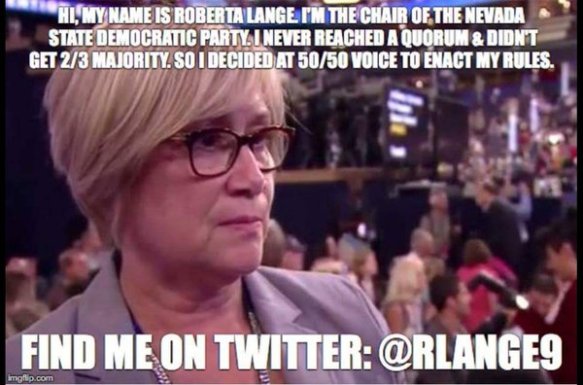
In the New York Times, Alan Rappeport also took the chance to strike at Sanders’ followers by citing Roberta Lange, Nevada State Democratic Party Chairwoman, who adjourned the convention early — earning the wrath of Nevada’s voters.

“‘It’s been vile,’ said Ms. Lange, who riled Sanders supporters by refusing their requests for rule changes at the event in Las Vegas,” Rappeport notes, adding, “The vicious response comes as millions of new voters, many of whom felt excluded by establishment politicians, have flocked to the insurgent campaigns of Mr. Sanders and Mr. Trump.”

Though he at least presented that aspect of the elections fairly, his description of what Lange actually did in Nevada misses the mark — that rules change had originally occurred prior to the convention, and Lange’s hasty and subjective decision on a contentious voice vote to permanently install the change arguably created the eruption of anger. But a number of Times staff have contributed sizeable amounts to Hillary’s campaign — and a Clinton family organization also donated $100,000 to the Times’ charitable organization the same year it endorsed her. Funny how bias thus peppers its reporting.

But the media roasting of Sanders and his supporters also appeared in the Sacramento Bee — where the editorial board also called the senator to task for the Nevada incident in lieu of calling out the controversial elections. According to the Bee,

“The episode had the reek of Trump rallies, where threats, insults, and sucker punches to defend the presumptive Republican nominee have been common. Yet looking back at the hundreds of Sanders supporters who descended on a Clinton rally in East Los Angeles earlier this month to intimidate her supporters, making one little girl cry, it now seems inevitable that the same kind of violent eruption would afflict those ‘feeling the Bern.’”

Seriously?

While the protest in L.A. certainly rattled Clinton supporters, violence didn’t pepper the event. One Sanders supporter — sporting a Free Hugs tee-shirt, no less — even assisted Clinton-supporting families with teary-eyed children in tow navigate through the crowd. While reports that someone ripped apart a young girl’s pro-Hillary sign might be valid, it would stand as the exception to what amounted to a boisterous demonstration over justifiable grievances. And, again, this obfuscation forgets entirely the need for demonstrations, which Hillary Clinton — in repeated lies, controversial policy proposals, and a campaign replete with fraud complaints — has clearly helped create.

Perhaps corporate, mainstream media — instead of targeting the symptom — should attempt to report its root cause.

Perhaps enormous swaths of voters being dropped from the rolls in New York; Clinton’s inexplicably astronomical luck in coin tosses in Iowa; inexcusably untrained elections volunteers and their equally inexcusable tendency allowing Clinton supporters to participate in caucuses without first being registered; or any number of other examples from the mountain of ever-growing evidence the elections are, indeed, rigged, are infinitely more deserving of headlines than hit pieces against those protesting such affronts to the American electoral process.

Or perhaps we should all just do as Eichenwald suggests — swallow our pride and our desire for a less corrupt and fairer system — and turn tail.

Or not. Because this system is rigged — and the corporate media helps pull the strings. But as long as independent media reports what the mainstream refuses, and as long as fraud inundates the 2016 election, there will be protests — regardless of whether or not Newsweek and the Times and the rest of their ilk ever grasp accuracy in reporting.

Bayer and Monsanto: A Marriage Made in Hell

146122_600

By Steven MacMillan

Source: New Eastern Outlook

In a world infected with a plethora of immoral multinational corporations, it is hard to think of two corporations who have more nefarious histories than Bayer AG and Monsanto. Considering this, it is a harrowing prospect that the two corporations could potentially strike a deal in the near future.

As Bloomberg reported earlier this month, Bayer AG – the German pharmaceutical and chemical corporation – is reportedly considering a bid for the agrochemical and biotechnology corporation, Monsanto. This comes two months after Monsanto showed some interest in acquiring Bayer Crop Sciences, a branch of Bayer AG.

Founded in 1863, Bayer may be familiar to many readers as the first company to widely sell and trademark Aspirin in the late nineteenth century. But there is a far more sinister history to this company that is often omitted. 

The Inception of Chemical Warfare

April 22nd, 1915 is widely considered to be the first successful large-scale use of poison gas in warfare, when the Germany army deployed chlorine gas against the French lines at the start of the Second Battle of Ypres. In January of that year, German forces had released gas against Russian forces, yet the cold conditions inhibited the main agents in the weapon from having the desired impact.

Even as far back as the First World War, Bayer was playing a major role in the development of Germany’s chemical weapons apparatus. Along with other German chemical giants at the time, Bayer was a key player in producing and supplying the German army with chemical weapons during WWI (it should be noted that other powers were developing and deploying chemical weapons during the Great War, not just Germany). 

Bayer and the Nazi War Machine

Fast-forward a decade or so, and Bayer was playing an integral part in amalgamating numerous chemical companies into one. The merger resulted in the creation of the most infamous chemical company in modern history – I.G. Farben. As the late Anthony C. Sutton – a former Economics Professor at California State University and Research Fellow at Stanford University’s Hoover Institution – wrote in his book, Wall Street and the Rise of Hitler:

“The Farben cartel dated from 1925, when organizing genius Hermann Schmitz (with Wall Street financial assistance) created the super-giant chemical enterprise out of six already giant German chemical companies – Badische Anilin, Bayer, Agfa, Hoechst, Weiler-ter-Meer and Griesheim-Elektron. There companies were merged to become I.G. Farben. Twenty years later the same Hermann Schmitz was put on trial at Nuremburg for war crimes committed by the I.G. cartel. Other I.G. Farben directors were placed on trial but the American affiliates of I.G. Farben and the American directors of I.G. itself were quietly forgotten; the truth was buried in the archives… Without the capital supplied by Wall Street, there would have been no I.G. Farben in the first place and almost certainly no Adolf Hitler and World War II.”

In more modern times, a division of Bayer was accused of ‘knowingly’ selling HIV-contaminated blood products to haemophiliacs, and has paid millions in damages in legal settlements.

Brothers in Death

During the Vietnam War, Monsanto was contracted to produce and supply the US government with a malevolent chemical for military application. Along with other chemical corporations at the time such as Dow Chemical, Monsanto produced the military herbicide Agent Orange which contained high quantities of the deadly chemical Dioxin. Between 1961 and 1971, the US Army sprayed between 50 and 80 million litres of Agent Orange across Vietnamese jungles, forests and strategically advantageous positions.

It was deployed in order to destroy forests and fertile lands which provided cover and food for the opposing troops. The fallout was devastating, with Vietnam estimating that 400,000 people died or were maimed due to Agent Orange, as well as 500,000 children born with birth defects and up to two million people suffered from cancer and other diseases. Millions of US veterans were also exposed and many have developed similar illnesses. The consequences are still felt today, and will continue to be felt for decades to come; with cancer rates, birth defects and other diseases still causing devastation to the victims and their families.

And today, Monsanto is still involved in producing chemical poison. Last year, the World Health Organisations (WHO) cancer agency – the International Agency for Research on Cancer (IARC) – conducted a study on glyphosate, the main ingredient in the most widely used weedkiller in the world, Monsanto’s Roundup – which is heavily sprayed on GMO crops. The IARC study revealed that glyphosate was “classified as probablycarcinogenic to humans”.

Given the history of these corporations and the atrocities they have been complicit in, the last sector they should be involved in is the agricultural industry.

Related Podcast: Radio WhoWhatWhy – Monsanto’s 50 Years of Death From Above and Below Is About to End

The Man Who Bought the Clintons: the Political Business of Terry McAuliffe

1081055032

(Editor’s note: In light of yesterday’s announcement that Hillary Clinton’s former campaign chairman Terry McAuliffe is being investigated by federal prosecutors for illegal foreign campaign donations made directly to him and through the Clinton Foundation, it’s worth revisiting this article from 10/15 to learn more about his shady history.)

By

Source: CounterPunch

In May 1999, the Labor Department brought suit against Jack Moore and John Grau, charging the two men with mismanaging the pension fund for the International Brotherhood of Electrical Workers. Moore was the longtime secretary of the union, while Grau was the vice-president of the National Electrical Contractor’s Association, which was partner in the fund. At issue was a series of sweetheart real estate deals in central Florida, which regulators labeled “imprudent”, and cost the fund money. Moore and Grau eventually settled the case for more than six figures. The union was forced to kick in another $5 million to cover the losses to the pension fund. The person at the center of the scandal, however, made out in the deal very well, indeed. His name: Terry McAuliffe, former head of the DNC, now governor of Virginia.

McAuliffe met Moore in 1988, when both were raising money for the doomed presidential bid of Dick Gephardt. They became close friends, allies in a campaign to redesign the Democratic Party into a more moderate political vessel, along the lines of the pre-Reagan Republicans. Moore controlled the $6 billion IBEW pension fund and had a reputation for investing money in businesses run by friends and political cronies.

So it was that in November 1990, McAuliffe approached Moore and his friend Grau with a proposal for a real estate partnership in central Florida with an investment company called American Capital Management, which McAuliffe owned with his wife Dorothy. The deal involved the purchase of the Woodland Square Shopping Center and five apartment complexes outside Orlando, Florida. It was a lopsided partnership. The pension fund put up $39 million to purchase the property. McAuliffe shelled out $100, yet he and his wife enjoyed 50 percent ownership in the project. He eventually parlayed his $100 investment into a $2.45 million profit.

Fresh from this triumph, McAuliffe approached Moore with a new proposal. He asked Moore to dip into the pension fund one more time for $6 million so that he could purchase a parcel of land south of Orlando called Country Run, which McAuliffe planned to subdivide into 500 single-family homes. Moore obliged and loaned McAuliffe the money. The development soon proved to be a bust. Only half the homes were built and many of them didn’t sell. Years passed, but McAuliffe never bothered to make a single payment to the pension fund on the loan. According to Labor Department records, McAuliffe was in default from December 1992 through October 1997. The managers of the pension fund never demanded payment or called in the loan. The only collateral they had required was the nearly worthless Country Run property itself.

Eventually, McAuliffe found a buyer for the property and repaid the loan. But the aroma of the deals attracted the attention of the Labor Department, which had been looking into the looting of worker pension funds. In May of 1999, the agency brought a suit against Moore and Grau for mismanagement of the fund. Both eventually settled, agreeing to six figure fines, and resigned their positions. The IBEW was compelled to reimburse the pension fund to the tune of five million dollars. The Labor Department didn’t have any authority to go after McAuliffe. That was up to the Clinton Justice Department and they took a pass. He wasn’t sued or otherwise inconvenienced. So a labor fund got looted and Terry McAuliffe got very rich.

This wasn’t the only time McAuliffe steered a labor union toward dangerous legal and financial shoals. In 1996, McAuliffe helped devise a political money-cycling scheme that led to the downfall of several leaders of the Teamster’s Union, including the union’s reform-minded president Ron Carey and his political director William Hamilton. At Hamilton’s trial on corruption charges, Richard Sullivan, the former director of finance for the Democratic National Committee, testified that McAuliffe asked Sullivan and other top DNC fundraisers to approach big Democratic donors who could make a contribution of at least $50,000 to the re-election campaign of Ron Carey, then in a pitched battle with James Hoffa, Jr. Under McAuliffe’s scheme, Sullivan testified, the Teamster’s Union would later recycle that $50,000 back into various Democratic Party accounts. Once again, McAuliffe was never charged with wrongdoing and his lawyer, Richard Ben-Veniste, repeatedly said there’s was nothing illegal in his client’s plan. He lives a charmed life.

* * *

Terry McAuliffe was born in 1957 in Syracuse, New York. His father was a longtime Democratic powerbroker in upper state New York and a top fundraiser for the party. Terry got into politics at a young age. But as anyone can tell there’s not much evidence that he was ever excited about policy issues. The environment, abortion rights, civil rights, peace. These great issues didn’t turn Terry on. Instead, he was entranced by the mechanics of political fundraising, party planning and schmoozing with business elites and Hollywood celebrities.

He made a beeline for the Beltway, attending Catholic University. Through his father’s influence, he got a position as a fundraiser for Jimmy Carter. And then he was off and running, renting his financial services to House and senate races and gubernatorial elections.

In the meantime, McAuliffe managed to earn the obligatory law degree from Georgetown University. Then in 1984, he began to fine-tune his craft under the wing of Tony Coelho, the longtime House whip and master fundraiser from California. At the time, Coelho was heading up the Democratic Congressional Campaign Committee, the main DNC fundraising apparatus for House races.

More than anyone, Coelho laid the foundations for the Democratic Party’s open courting of big business. And Terry McAuliffe, working from the master’s Rolodex, served as Coelho’s chief apprentice, sprinting from one Beltway lobby shop to the next offering prime access to Democratic powerbrokers for political cash, hard and soft money, the new coin of the realm.

The young fundraiser learned an early lesson. No enterprise was off-limits, no matter how tarnished the reputation of the company: weapons-makers, oil companies, chemical manufacturers, banks, sweatshop tycoons. Indeed, McAuliffe made his mark by targeting corporations with festering problems, ranging from liability suits to environmental and worker safety restraints to bothersome federal regulators. The more desperate these enterprises were for political intervention, the more money McAuliffe knew he could seduce into DNC coffers. What about environmental groups? Big labor? The traditional core of the Democratic Party? Not only didn’t their objections (assuming they voiced any) matter, they actually made McAuliffe’s pitch more appealing to the corporadoes. After all, the Republicans didn’t have any sway over these organizations. Triangulation, the backstabbing political playbook of Clintontime, originated as a fundraising gimmick. A very lucrative one.

In the early 90s, really big money began to pour into the DNC. McAuliffe recruited robust donations from Arco and Chevron, Entergy and Enron, Phillip Morris and Monsanto, Boeing and Lockheed, Citibank and Weyerhaeuser. Many of these corporations had all but abandoned the Democrats during the Reagan era. McAuliffe lured them back with promises of favorable treatment by a new generation of anti-regulatory Democrats attuned to the special needs of multinational corporations. This was the mulch bed from which the Clinton presidency took root.

By 1994, Clinton himself had aligned himself to McAuliffe’s magic touch. He tapped him as the chief fundraiser for the 1996 reelection campaign. In this capacity, McAuliffe masterminded some of the more risqué political fundraising operations since the Kennedy era. There were the fundraisers at Buddhist temples in California. There were the notorious coffee klatches, where for a six-figure contribution to the DNC, corporate executives were brought to the White House for some face-time with Bill and Hillary, Al and Tipper, and a retinue of cabinet secretaries, with pen in hand ready to address any nagging problem. McAuliffe also devised the plan to rent out the Lincoln Bedroom to top contributors for slumber parties with the president.

Over the course of the next six years, McAuliffe was personally responsible for raising, largely from corporate sources, more than $300 million for the DNC.

* * *

The scene: the MCI Center in Washington, D.C. The date: May 14, 2000. The Event: “BBQ and Blue Jeans Gala.” It’s Terry McAuliffe’s biggest party yet. A star-studded gathering of DC lobbyists, corporate executives and Hollywood liberals, all in dressed in blue jeans, eating BBQ and listening to the blues and country music. It was also the single biggest fundraiser in history. More than $25 million was raised for the DNC in a single night.

Toward the end of the evening, Al Gore lumbered his way onto the stage and seized the microphone. He directed the spotlight turned on McAuliffe, the real star of the evening. “Terry”, Gore said, “You are the greatest fundraiser in the history of the universe.” The crowd thundered with applause for the man who had just lightened their wallets of several thousands of dollars.

Gore would soon come to rue those fervent words. While most Democrats blamed Katherine Harris or the Supreme Court for the loss of the White House to George W. Bush, McAuliffe pointed the finger at Gore. The fundraiser believed that Gore ran an inept campaign, misspending the precious millions he had worked so diligently to raise. McAuliffe detested the way that Gore distanced himself from the Clintons and refused to allow the president to campaign for him even in key southern states. Even worse from McAuliffe’s perspective, Gore had subtly dissed Clinton on the campaign trail, suggesting that he himself was a man of firmer moral sinew than the embattled president.

When Gore lost, the party fell back into the control of the Clintons and their chief emissary, Terry McAuliffe. The fundraiser swiftly took his revenge out on Gore. In late January, as the moving vans where pulling away from the White House, McAuliffe planned a major send off for the Clintons at Andrews Air Base. All the top Democrats were there; many were invited to give tributes to the first couple in front of the national TV cameras. Al Gore, naturally, expected to give the keynote farewell address. But McAuliffe refused to allow Gore even near a microphone. Gore wasn’t permitted to speak a single word. “McAuliffe didn’t want Gore to speak”, a top aide at the DNC told the Washington Post. “McAuliffe didn’t even want Gore there. The send off was about good memories, success stories. And the VP wasn’t either.”

McAuliffe’s implacable loyalty to Clinton was soon rewarded. Later in 2001, Bill Clinton engineered the ouster of Joe Andrew as head of the DNC and installed McAuliffe, who only months earlier had offered to purchase the Clintons a house in Chappaqua, New York for $1.3 million, as the chief of the party. As the head of the DNC, McAuliffe was now in a position to protect the Clintons’ legacy, reward loyalists, punish party dissidents and select the next presidential nominee.

When Gore began to flirt with the notion of challenging Bush in 2004, McAuliffe went to work to kill off his campaign before it even started. He went straight to Gore’s top political sponsors and advised them to withhold funds from the Gore campaign chest. He was tremendously persuasive, convincing even some of Gore’s most loyal backers, such as financier James Tisch, to deny money to their old friend.

The sabotage of the nascent Gore 2004 campaign was just a run-up for demolition job McAuliffe directed against the unauthorized campaign of Vermont governor Howard Dean. The Dean threat had almost nothing to do with any perceived ideological heresy from the Vermonter. After all Dean was a run-of-the-mill neoliberal who pretty much aped the centrist economic policies of Clinton. The real threat posed by Dean came from his determination to raise millions in campaign contributions outside of the precincts of the DNC. McAuliffe’s control over the party stemmed from his role as the prime dispenser of campaign cash, the elixir necessary to keep political recipients loyal to the party leadership and its policies. Dean showed another way was possible and he had to be put down.

But after the Dean juggernaut was scuttled, McAuliffe reached out a helping hand to the defeated candidate. As usual, the hand proffered money. The Dean campaign was in debt, the legions of Deaniacs seething with rage over the demolition of their hero. McAuliffe offered to help pay off Dean’s debts and set up his new institute, Democracy for America. In return, Dean worked to calm his troops, imploring them not to abandon the party for the independent campaign of Ralph Nader.

* * *

Terry McAuliffe didn’t just use his business contacts to fatten the accounts of the Democratic National Committee; he also deftly exploited them to inflate his own fortune, which now nudges toward nine figures. A similar fruitful intimacy with corporate cronies led to Tony Coelho’s stunning fall from grace, but McAuliffe never looked back. His trajectory has been decidedly prosperous and, to this point, utterly immune to the slumping fortunes of the economy outside the confines of the Beltway. These days McAuliffe says he wants to resurrect the Misery Index, but he’s not acquainted with any of the numbers.

In 1996, McAuliffe met a young corporate tycoon named Gary Winnick, who had once referred to himself as the richest man in Los Angeles. Winnick ran Global Crossing, a fiber-optics company chartered in the tax-friendly haven of Bermuda. At the time McAuliffe met Winnick, Global Crossing was a privately held company, poised to cash in on the deregulation of the telecom industry and the new opportunities in China. In 1997, Winnick offered McAuliffe the opportunity to purchase $100,000 worth of Global Crossing stock.

When Global Crossing shares went public in 1998, the value of the stock soared. Operating with an acute sensitivity to the fluctuations of the market bordering on ESP, McAuliffe sold his shares at the precise moment the stock peaked. McAuliffe told the New York Times he pocketed $18 million in the deal. Within a few months, Global Crossing’s stock collapsed, the company plunged into bankruptcy and more than a third of its workforce were tossed into the ranks of the unemployed.

McAuliffe also served as an on-call DC fixer for Winnick in those optimistic days following the Clinton reelection. In early 1997, McAuliffe set up shop in an office in downtown DC owned by a Winnick company called Pacific Capital Group. According to a boastful McAuliffe, Winnick hired him as a consultant to “help work some deals” with the federal government. “Gary was looking for some political action”, McAuliffe told Worth magazine. “He wanted a stable of people around him with great contacts.”

Few people inside the Beltway enjoyed better contacts than McAuliffe, as Winnick would soon discover. At an appearance in Los Angeles later that year, Bill Clinton lavished on Winnick his personal endorsement. “Gary Winnick has been a friend of mine for some time now and I’m thrilled by the success that Global Crossing has had.”

There’s no evidence that Winnick and Clinton had even met each other before that evening. But the endorsement proved fruitful. It signaled not only Clinton’s faith in the company, but also sent a message to federal agencies that Global Crossing was a firm that they should do business with. It soon paid off. A few months later Global Crossing won a $400 million contract from the Pentagon after repeated prodding from the White House.

After the contract was awarded, McAuliffe arranged for Winnick to play a round of golf with Clinton. Shortly after the afternoon on the links, Winnick donated $1 million to the Clinton presidential library.

Winnick’s joy was short lived, however. In the winter of 2001, the Pentagon rescinded the Global Crossing deal following an investigation by the Inspector General of the Defense Department, which raised questions over how the contract was awarded and Global Crossing’s ability to fulfill its obligations. Later, the company fell into the financial death noted above.

The attack dogs in the Bush White House never really made much of McAuliffe’s ripe ties to Global Crossing. Why? Global Crossing had been almost equally generous to the Bush family.

In 1997, Global Crossing invited former President George H.W. Bush to address company executives in Tokyo, Japan. At the time, Bush’s standard speaking fee was $80,000. The morning after the speech, Bush had breakfast with Winnick. Winnick advised Bush that it would prove much more profitable for the former president to accept payment in Global Crossing stock, then privately held, than cash. Bush agreed. Soon the company went public and the value of Bush’s stock swelled to more than $14 million. Not a bad pay-off for an hour’s speech. To complete the symmetry, one of Winnick’s top executives also serves as a trustee of the G.H.W. Presidential Library Fund.

Winnick tried to cover all of his bases. Yet as with Enron and Tyco, even the most judicious dispensation of money across the political spectrum couldn’t save a company that had been looted from the inside out. Global Crossing went down and so did Winnick. But the politicians who made it all possible remain indemnified from any liability for the carnage, protected by a mutually advantageous non-aggression pact.

Never bite the hands that feed the system.


This essay will appear in “An Orgy of Thieves: Scenes from the Counter-Revolution” coming in 2016 from CounterPunch Books.

Jeffrey St. Clair is editor of CounterPunch. His new book is Killing Trayvons: an Anthology of American Violence (with JoAnn Wypijewski and Kevin Alexander Gray). He can be reached at: sitka@comcast.net.

Clinton Does Best Where Voting Machines Flunk Hacking Tests: Hillary Clinton vs. Bernie Sanders Election Fraud Allegations

1015636467

By Doug Johnson Hatlem

Source: CounterPunch

At the end of the climactic scene (8 minutes) in HBO’s Emmy nominated Hacking Democracy (2006), a Leon County, Florida Election official breaks down in tears. “There are people out there who are giving their lives just to try to make our elections secure,” she says. “And these vendors are lying and saying everything is alright.” Hundreds of jurisdictions throughout the United States are using voting machines or vote tabulators that have flunked security tests. Those jurisdictions by and large are where former Secretary of State Hillary Clinton is substantially outperforming the first full wave of exit polling in her contest against Senator Bernie Sanders.

CounterPunch has interviewed hackers, academics, exit pollsters, and elections officials and workers in multiple states for this series taking election fraud allegations seriously. The tearful breakdown in Hacking Democracy is not surprising. There is a well-beyond remarkable gap between what security experts and academics say about the vulnerability of voting machines and the confidence elections experts and academics, media outlets, and elections officials place in those same machines.

In Leon County, Bev Harris’ Black Box Voting team had just demonstrated a simple hack of an AccuVote tabulator for bubble-marked paper ballots. Ion Sancho, Leon County’s Supervisor of Elections, also fights back tears in the Hacking Democracy clip: “I would have certified this election as a true and accurate result of a vote.” Sancho adds, “The vendors are driving the process of voting technology in the United States.”

In 2010, and this reminder will pain those of you who can remember when Nate Silver’s outfit did real data journalism rather than primarily yay-Clinton boo-Trump punditry, a FiveThirtyEight column argued that hacking was one of two possibilities for statistical anomalies in a Democratic Senate primary in South Carolina: “B. Somebody with access to software and machines engineered a very devious manipulation of the vote returns.”

Joshua Holland’s column in The Nation “debunking” claims of election fraud benefiting Clinton rests its case on a simple proposition: why would Clinton need to cheat when she was winning anyway? Apparently, Mr. Holland has never heard of an obscure American politician named Richard Nixon.

More importantly, entering the South Carolina primary, the pledged delegate count was 52-51. CNN’s poll two weeks out projected an 18 point Clinton win. Ann Selzer, the best pollster in the United States, projected a 22 point Clinton win. RealClearPolitics’ polling average projected a 27.5% win. FiveThirtyEight was much bolder in projecting a 38.3% Clinton win. The early full exit poll said Clinton had won by 36%, pretty close to FiveThirtyEight’s call. Tellingly, white people in that exit poll went for Sanders 58-42. But the final results said Clinton won by 47.5%, an 11.5% exit polling miss. And the exit polls had to adjust their initial figures to a 53-47 Clinton win with white Democrats in South Carolina.

Three days after South Carolina’s primary, Clinton seriously outperformed her exit polling projections again in a bunch of states on Super Tuesday, including Massachusetts where she went from a projected 6.6% loss to a 1.4% win. Super Tuesday set the narrative that Sanders had no chance of beating Clinton in pledged delegates.

Correlating Exit Polling Misses and Bad Machines

Let’s be clear: yes, correlation does not equal causality. What strong correlation does do, however, is set the agenda for reasonable investigation. Mocking fraud claims where there is a strong correlative case and actual evidence of potential vote tampering in places like Arizona, New York, and Chicago is precisely the kind of thing that has seen confidence in media outlets plummet to an all-time low. Just 6% of people in the U.S., about the same number as for Congress, have high confidence that media are unbiased and accurate.

Meanwhile, according to a September 2015 study (.pdf) by the Brennan Center for Justice at New York University’s School of Law, South Carolina uses all machines more than ten years old. In fact, drawing on the source of the Brennan Center report over at Verified Voting, South Carolina uses provably hackable voting machines without a verified paper trail. Virtually all counties in South Carolina use two machines in particular – Electronic Systems and Software’s (ES&S) iVotronic, a touch screen voting machine without a paper trail, and ES&S’s Model 100, used to tabulate absentee and provisional ballots.

Kim Zetter, the best reporter on hacking and computer security at Wired Magazine, delved into the Brennan Center report with an article entitled “The Dismal State of America’s Decade-Old Voting Machines.” Zetter noted that in 2002, after the Bush v. Gore disaster, Congress passed the Help America Vote Act (HAVA) with billions of dollars available for counties throughout the U.S. to upgrade to new voting machines. Zetter then hits the critical point for discussion of election fraud allegations in the Democratic presidential primary:

But many of the machines installed then, which are still in use today, were never properly vetted—the initial voting standards and testing processes turned out to be highly flawed—and ultimately introduced new problems in the form of insecure software code and design.

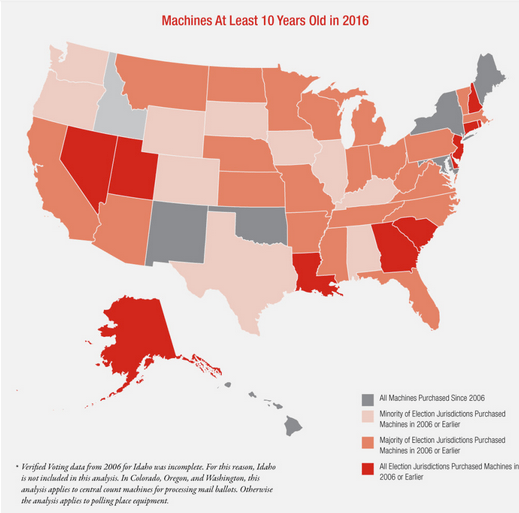
Things are dismal, yes, but they are not evenly so. As this map from the Brennan Center report shows, there are just a few states that are as bad off as South Carolina (all machines ten years old or greater). But there are also just as few states that are relatively well off with all machines newer than ten years old.

state-by-state-10-year-old-voting-machines

Of the nine places where the exit polling has missed by more than 7% (South Carolina, Alabama, Georgia, Massachusetts, Tennessee, Texas, Mississippi, Ohio, New York), two-thirds are states where all or the majority of election jurisdictions are using machines ten years old or greater. For these six states the average initial exit polling miss is a whopping 9.98%. From my column on exit polling misses last week, the average exit polling miss in Clinton’s favor is 5.1%. For the three states (Oklahoma, New York, Maryland) for which there is polling and for which all election jurisdictions use machines less than ten years old (gray in the map), the average is just a 1.67% miss in Clinton’s favor. Now take note, this 1.67% average includes New York with its huge miss in Clinton’s favor. Alabama is also worth looking at, with a minority of jurisdictions having machines more than ten years old, because I have been using an “Alabama Test” to see whether theories for the exit polling misses make sense.

I put figures like this to exit pollster and Executive Vice President of Edison Research Joe Lenski for question 10, which I’d previously left out of the published version of the interview I completed with him. I wanted to know whether the gap in exit polling misses raised any red flags. Here was Lenski’s reply:

The reliability of vote equipment is a true concern but I don’t see any evidence how the concentration of older voting machines in certain states would have affected either candidate more than the other.  There are many examples of vote count errors.  Here is a link reporting a recent vote count error in the Michigan primary that inflated Ted Cruz’s vote by 3000 votes  http://uselectionatlas.org/WEBLOGS/dave/ .  These types of errors are discovered all the time but there is no evidence that these are anything more than mistakes by local election officials – not a systematic attempt to affect a single candidate’s vote totals.  This reminds me of theories after the 2008 New Hampshire Democratic Primary based upon the fact that Hillary Clinton did better in towns with voting machines while Barack Obama did better in towns that voted on paper.  That was simply an artifact of the demographics in New Hampshire of the towns that had voting machines versus those that voted on paper.  Again the states with older voting machines in 2016 may just be the same states with demographics that favored Hillary Clinton over Bernie Sanders.

But again, as I argued last Wednesday, the demographics by state and other proposed reasons for exit polling misses do not actually add up. Big misses have happened in the South, in Massachusetts, and also in Ohio where Sanders otherwise did quite well in the Midwest. Nor do age or early voting patterns predict exit polling misses. Still, what is most remarkable about Lenski’s statement is that he is one of the few non-tech experts we spoke with who recognized that the “reliability of voting equipment is a true concern.”

None of the three elections academics I spoke with for last Wednesday’s piece appeared to be familiar with the Brennan Center report on aging and vulnerable machines, and Antonio Gonzalez, an exit polling expert and Latino voter registration guru who called for parties not to seat Arizona’s delegations in last Thursday’s piece, seemed a bit floored when I presented him with question ten from my interview with Lenski. “Oh,” he said, “I thought Congress was supposed to have taken care of that with HAVA.” HAVA, as noted earlier, offered money from 2002 to 2006 for states to upgrade to the then latest and greatest voting technology.

At this point we should take a look at the proven flaws in four very old and hackable machines in particular. These machines or similar elderly and vulnerable machines are in use in almost all places where Clinton outperforms exit polling most substantially. Because I am taking evidence and counter-evidence seriously, we will also look at the machines used in New York City, which are not quite so old (about six or seven years). While those machines, ES&S’s DS200, have had several problems over the years of the type suggested by Lenski, they also have not verifiably flunked independent security tests, so far as I know.

AccuVote (TS, OS, TSX models)

AccuVote technology is among the worst of the worst. This is the Diebold technology hacked in the Hacking Democracy clip. It is more than ten years old, can be hacked in such a way that even those models (OS, TSX) with a paper trail can be tricked, and it is in use throughout Georgia (12.2% miss) and in more than 300 counties or other election jurisdictions in more than 20 states.

AVC Edge and Edge II  (from my column on Chicago Friday)

The AVC Edge and Edge II (with paper trail) were provably hacked by a “Red Team” from UC Santa Barbara hired by the State of California in 2008. Jim Allen, spokesman for the Chicago Board of Elections, called and emailed to complain after my article last Friday. He dismissed the suggestion that Edge II could be hacked because of the paper trail. Not only is this laughable since his team engaged in a wildly inaccurate audit of the paper trail from the Chicago Democratic primary, but Allen apparently failed to click on the linkregarding the UCSB Red Team test that I included in the article. The first paragraph of that article notes that Edge machines, “even those with a so-called Voter Verified Paper Trail” can be successfully hacked by a single person. AVC Edge machines are in use without a paper trail throughout Louisiana (where there were no exit polls but where Clinton seriously outperformed her pre-election day polling average) and in more than 130 counties in various other states.

Model 100 (from ES&S)

Model 100 also badly flunked (.pdf) the California “Red Team” test in 2008. Like the other machines in this list, it is hackable in a way that spreads virally to other machines in the same network. Hundreds of jurisdictions still use Model 100 to tabulate votes, including especially Wayne County (Detroit), 27 counties in Ohio, 9 counties in Tennessee, 78 counties in Texas, and many more that match very well with where Clinton has outperformed exit polls.

iVotronic (ES&S)

iVotronic machines are touchscreen voting machines, many without a paper trail. iVotronic machines flunked a University of Pennsylvania test in 2007 and are the precise machines in question in the previous suspicious Democratic primary results in South Carolina in 2010. They continue to be used throughout South Carolina (no paper trail) and in hundreds of counties in states where Clinton has suspiciously overperformed exit polling.

DS200

DS200 machines have had a wide variety of malfunctioning problems, particularly in New York City, but those problems can and mostly have been addressed in places like New York City by retraining poll workers to check immediately whether each voters’ vote was counted and then offering a new chance to vote if necessary. As stated, the DS200 has not been provably hacked so far as I know. Newer machines of this sort were put into use just this year in Maryland where the overall exit polling missed in Sanders favor, for once, but by just 0.6 points. Still, the votes in Baltimore County have now been decertifiedbecause, among other things, there were more votes than voters who checked in at the polls. In Maryland, the DS200 machines are all networked to a statewide system for tabulating votes quickly. Networking, however, is not required, and my best information suggests that networking is not how the DS200 is used in New York City. Instead, precinct workers pull the results off the machine at the end of the voting day and relay them to county headquarters, according to my discussions with a poll worker from Brooklyn.

What About the Exceptions to This Correlation?

But we also would have to deal with where there are exceptions to this strong correlation between hackable machines and Clinton beating the exit polling badly. Here’s where my conversation with a particular veteran hacker comes into play. I chatted securely with a long-time member of Anonymous whom I’ll call the King of SciAm (not the handle they use publicly or privately). The King of SciAm has long worked with the Telecommix branch of Anonymous. Telecommix rose to fame when Hosni Mubarak cut off internet access in Egypt during the Arab Spring uprising. Telecommix found work-arounds via dial-up internet to keep information from activists on the ground flowing out of Egypt. As a general rule, Telecommix does not take part in Anonymous leaks or website shutdowns and defacements, but they made an exception to that rule early in this campaign cycle. Telecommix members defaced Donald Trump’s website with a tribute to Jon Stewart upon his retirement. The New Yorker’s Alex Koppleman called it the “classiest website hack ever,” a compliment the King of SciAm relishes.

The King of SciAm emphasized to me that, if hired to hack an election (which they would never do), the first thing they would do would be to figure out the best way to leave no trace: “we’d target the network packets or their headwater.” The key idea being for “a hack to survive the security audit trail after the vote is certified.” Furthermore, “we would likely try to target the thing most likely to get it’s logs wiped first – so – whatever it plugs into to move the data. Are the voting machines in use network connected?”

The King of SciAm told me that targeting old, provably hackable machines is “not an unfair theory,” but “you asked how (if we did these sort of things) we would do them.” The problem, they noted, “is that any change to the voting machine operating system or driver stack will likely be found in the security auditor’s rotation pretty quickly. This is because once the machines are down (end of election day) – they are no longer accessible to revert any source code changes or wipe any logs that said you were there, unless you’ve written STUXnet – in which case you wouldn’t be targeting the booth machines either.”

The King of SciAm was not at all surprised that sloppy hackers may be targeting older machines in places like South Carolina and Chicago, nor that elections officials were cluelessly trusting those machines and not even properly following procedures that could catch a less sophisticated hack.

So if, instead of targeting the DS200 in New York, hackers had targeted further upstream in the voting ecosystem, how would you catch it? The King of SciAm noted that you would have to use some procedure to “match 100% of the data, not 5%,” as in Chicago.

To do this, you would need to use a methodology much more like that used in the FiveThirtyEight article on irregularities in the South Carolina 2010 primary election. There, FiveThirtyEight referred to a Benford’s law test on precinct level results. That test showed an “unusual, non-random pattern in the precinct-level results suggest[ing] tampering, or at least machine malfunction, perhaps at the highest level.”

Intriguingly, after I began this series on election fraud allegations, a reader who would like to remain anonymous, emailed to point out similar irregularities in New York’s Democratic primary this year:

Results for Kings County and Bronx county [show] deviation from perfect 60-40 and 70-30 results was the same 0.035% The increase in votes in Kings (Brooklyn) from 2008 is incredible, almost a perfect 10%. Not only that but that’s where over a 100,000 voters lost their right to vote. Another 20,000 votes in Kings would mean almost a 20% increase which would be amazing compared to other counties that experienced decreases or mild increases. 

Furthermore, the overall results in New York, as announced on election night, deviated from a perfect 58-42 split “by 0.005345%. That’s 97 votes out of over 1.8 million.” Will FiveThirtyEight apply a Benford’s law test to 2016 primary results? Not a chance. They have boosted Clinton throughout and are already quite embarrassed by how badly they missed on the GOP side with Donald Trump.

But what about our test? The “Alabama Test.” What’s good for the goose is good for the gander. Alabama only has a minority of jurisdictions using old, provably hackable machines. Is that a weak correlation for the theory that in most places sloppy hackers targeted old, provably vulnerable machines while apparently more sophisticated hackers would have had to have been involved with targeting New York’s results as well as registration switching operations in a wide variety of states?

Taking a look at Alabama on a county level gives us a fairly strong answer. Most of Alabama’s counties also use hand cast ballots tabulated by the DS200, but a minority use Model 100, one of our flunked election machines. Three of the flunked Model 100 counties, however, are three of the four biggest counties in Alabama (Jefferson, Mobile, and Montgomery) and accounted for around 40% of the vote for Democrats in Alabama. Clinton won by a 64.2% spread in Jefferson, by 66.5% in Mobile, and by a stunning 73.4% in Montgomery. What happened in Madison, the one county of the top four by population that votes using the DS200 model? Clinton won by just a 38.5% spread! In fact, Clinton did not make it to 80% of the vote in any of the top twelve counties by population except for those three counties using Model 100 to tabulate votes.

And controlling for factors like African American voters or wealth does not account for this phenomenon. Take for instance Mobile where the population is 35.3% black versus a 24.6% black population in Madison County. A 10% difference in black population does not account for a 28% difference in the Clinton-Sanders spread. What’s more, if you compare Mobile to a very similar county in North Carolina (where the exit polls did not really miss), you see something similarly telling.

Cumberland County, NC is very comparative to Mobile, Alabama. They have similar populations, similar numbers of black residents (with Cumberland slightly higher at 37.6% African American), very similar per capita income figures, and both counties had about 35,000 Democratic voters. Clinton won Cumberland by 32.8%, very close to the Madison County (DS200 model) results and about half the percentage spread Clinton saw in Mobile (Model 100).

Of the theories we have so far for why exit polling missed in Alabama by a huge 14%, the only theory that provides a reasonable explanation is vote tabulating machine tampering. Now, perhaps someone else will come up with a non-fraudulent exit polling miss theory that passes the Alabama Test and explains other states as well. Such a theory cannot be about early voting (Alabama had none) and over-projecting young voters (there were very few according to exit polls of Alabama).

Until someone comes up with such a workable theory, election fraud benefiting Hillary Clinton to the tune of a 120 to 150 pledged delegate difference, is the best explanation we have. People wanting to prove this theory should be suing for a technologically sophisticated and independent review of results and the voting results’ entire computer ecosystems in places like Ohio, South Carolina, Alabama, Boston, Chicago, New York, and many others.

Part 1: Taking Election Fraud Allegations Seriously
Part 2: Debunking Some Election Fraud Allegations
Part 3: In-depth Report on Exit Polling and Election Fraud Allegations
An Interview With Lead Edison Exit Pollster Joe Lenski
Part 4: Purged, Hacked, Switched
Part 5: Chicago Election Official Admits “Numbers Didn’t Match”

Doug Johnson Hatlem is best known for his work as a street pastor and advocate with Toronto’s homeless population from 2005-2013. He is now a film producer and free-lance writer based in Chicago.

Wake Up Humanity: The Divide Of The Uninformed

1444793074811

By Ryan Cristian

Source: Collective Evolution

As the American people begin to closely examine the shroud that has been pulled over their eyes–seeing the veneer of misinformation that has been cast over the country’s exponential and perpetual profiteering and war-mongering–the people slowly awaken to the prospect that, in its simplest terms, they have been lied to.

The Choice To Follow Their Lead

This country is in the midst of a massive awakening, and the average person is being confronted with a choice: address the looming dark realization that their reality is not what it seems, or double down on the comforting lie and brace for the consequences. With the level of information being thrown at the public in today’s battle for the American mind, it is no wonder many have chosen the latter.

It is a far easier path to stick with what’s familiar, however sinister it might be. As Aldous Huxley predicted, people are being overwhelmed with so many conflicting narratives that most are choosing to stick with what they knew. Despite the pressing feeling that they are being misinformed, at least they can feel good about themselves, or so they are told to believe. It has almost become another form of religion: memorize these talking points, spread the talking points, and have faith that you are on the right side.

What this has produced is an entire class of Americans who have been convinced that they are “informed”; who’s attention, prior to this election cycle, was scarcely directed at much other than the latest reality TV scandal. In essence, that is what this election has been turned into, a crazy reality show. This was wildly ingenious, as those caught by the similarities of the two are slowly being turned on to the new reality show: American Politics. This has awakened a dumb sleeping giant, waiting to be pointed in the right direction. These are the very same individuals screaming at rallies and speaking about how we need to “Make America Great Again,” as if those that have been politically active, prior to the new shiny political show, have been just sitting on their hands waiting for this amazing slogan to come along and give Americans the insight they have been waiting for!

In reality they are simply parroting what they saw on their chosen pulpit and aggressively defending these falsehoods with no real understanding of the surrounding dynamics, or why they have the position they are claiming to hold. When confronted with contrasting information, even while attempting to have a civil discussion, these are the individuals who quickly get agitated and lash out, throwing out terms like “un-American” or a “conspiracy theorist” — the preconditioned responses to any idea that even slightly contradicts their treasured gospel of Truth.

The Divide

The current election cycle, with its supposed “anti-establishment candidates,” has completely changed what was previously a political insider’s game. With the increasing support for candidates such as Trump and Sanders, the country has witnessed a rise of the previously voiceless and currently uninformed. What is being witnessed is not only the sudden arrival of the silent 40%, who chose not to grace the nation with their opinions in previous years (by opting out of the voting process), but the staunch divide between who they have risen in defense of.

Whether these anti-establishment presidential potentials are genuine in their intentions or just more Manchurian candidates with designs to continue business as usual, a clear divide has arisen. This has invigorated a previously nonexistent “middle-class” (if there is still such a thing) to come out in droves to cast their vote for whoever their favorite show told them they were smart for already thinking about picking; nothing more than intentional validation of preexisting, preconceived ideas; no real critical thinking involved. This is by design.

Some feel that the intention is to syphon enough votes away from the other potential candidates, using Trump and Sanders, to allow for the clear establishment hopeful, Hillary Clinton, to easily fall into office as the obvious lesser of two evils. Yet, despite the legitimacy of that claim, no one actually informed can call Clinton the lesser of any evil, let alone the best choice. That can no doubt be argued, but all hinges on whether one feels the scandals surrounding Clinton are political hype, or legitimate crime.

It would seem the laughable idea of literally choosing the lesser of two evils to represent the American people and stand as commander-in-chief of the largest military force on the planet has become this country’s only option. As supposed free individuals, it is hard to address this fact and not come away feeling cheated. So, most ignore it, taking solace in the fact that at least they get to choose between the two; but do they?

Time and time again it has been shown in this country that the electoral college (the system that is used to dole out votes after they have been cast) is anything but democratic. Currently in 24 states, the electoral college does not even have to vote for the candidate who wins the popular vote; they can literally vote for whoever they want, despite what the people have chosen. Take that into account with gerrymandering and super delegates, and it becomes clear that this system is cleverly disguised as a democracy, but quite far from being one.

Some feel that this invigoration and divide of the previously uninvolved was created in order to garner the type of violence and unrest being witnessed in all political arenas at the current stage. The end goal being a push into “an obvious need for more control, more government, more more more,” and ultimatelythe big aversion for most of the uninformed, the New World Order, or a one world government; which has been openly discussed and is a genuine agenda.

Whether one chooses to listen to the obviously biased mainstream media or an independent source, not following up that observance with research of one’s own is equal to not truly being informed. It is just taking another’s word for it. Should one really bank their future and the future of this country on the thoughts and potential ulterior motives of another?

The only way to truly be informed is for one to take it upon themselves to not only research a topic they wish to understand, but to actually understand the topic, and not just repeat what was last heard as one’s personal opinion.

Do not be another manufactured tool of those pulling the strings. Do not allow yourself to be distracted and beguiled by the proverbial bells and whistles of the current political theatre. Take it upon yourself to understand the true inner workings of the US government and know when action must be taken and when it is in the best interest of the American people for that action to be avoided.


SOURCES

http://www.thenation.com/article/figuring-out-why-93-million-people-didnt-vote/

http://www.huffingtonpost.com/howard-steven-friedman/antidemocratic-electoral-college_b_1744138.html