Israel Lobby Rebuts Omar’s Claims About Its Immense Influence By Exerting Its Immense Influence

By Caitlin Johnstone

Source: CaitlinJohnstone.com

In response to criticisms made by Congresswoman Ilhan Omar that US political leaders have too much allegiance to Israel and its lobbying groups, House Democrats have put forward an entire House resolution in accordance with demands made by AIPAC and the Anti-Defamation League.

“The backlash [over Omar’s comments] continued on Monday, as the Anti-Defamation League wrote a letter to Pelosi calling for a House resolution to specifically reject what the organization calls Omar’s ‘latest slur,’” Politico reports. “‘We urge you and your colleagues to send the unambiguous message that the United States Congress is no place for hate,’ the group’s CEO, Jonathan Greenblatt, wrote in a letter.”

“The charge of dual loyalty not only raises the ominous specter of classic anti-Semitism, but it is also deeply insulting to the millions upon millions of patriotic Americans, Jewish and non-Jewish, who stand by our democratic ally, Israel,” tweeted the Israel lobbying group AIPAC on Friday in response to Omar’s comments.

“I hope @AIPAC isn’t too angry that it took Democratic House leaders almost 48 whole hours to do what they’re told to condemn their own member and will instead be understanding that it was a weekend and that’s what caused the delay,” snarked journalist Glenn Greenwald in response to the news of the House resolution.

US politicians of all faiths and in both parties have indeed been falling all over themselves in a mad scramble to tell the freshman congresswoman that she is wrong and evil for suggesting that there is undue loyalty to Israel among US politicians.

“It is disturbing that Rep. Omar continues to perpetuate hurtful anti-Semitic stereotypes that misrepresent our Jewish community,” tweeted California Congressman Juan Vargas, who is not Jewish. “Additionally, questioning support for the U.S.-Israel relationship is unacceptable,” Vargas continued, inadvertently re-stating Omar’s original argument.

“But serious question: How is it anti-Semitic to question Christian Republican allegiance to Israel?” asked journalist Rania Khalek in response to the controversy. “Because it’s people like Rep. Kevin McCarthy and Sen. Marco Rubio who Ilhan Omar and Rashida Tlaib were initially called anti-Semitic for challenging on loyalty to Israel.”

It is indeed interesting that the label “antisemitism” is being pinned on an argument directed at mostly non-Jewish lawmakers and not at Jews at all. It is also interesting that the House resolution’s current text twists that reality on its head by falsely implying that the comments were directed at Jewish politicians. The most Omar-specific parts of the resolution read as follows:

Whereas the definition further includes ‘‘accusing Jewish citizens of being more loyal to Israel, or to the alleged priorities of Jews worldwide, than to the interests of their own nations’’;

Whereas the myth of dual loyalty, including allegations that Jews should be suspected of being disloyal neighbors or citizens, has been used to marginalize and persecute the Jewish people for centuries for being a stateless minority;

Whereas accusing Jews of dual loyalty because they support Israel, whether out of a religious connection, a commitment to Jewish self-determination after millennia of persecution, or an appreciation for shared values and interests, suggests that Jews cannot be patriotic Americans and trusted neighbors, when Jews have served our Nation since its founding, whether in public life or military service;

Whereas accusations of dual loyalty generally have an insidious, bigoted history, including (1) the discriminatory internment of Americans of Japanese descent during World War II on the basis of race; (2) the Dreyfuss affair; when Alfred Dreyfuss, a Jewish French artillery captain was falsely convicted of passing secrets to Germany based on his Jewish background; (3) when the loyalty of President John F. Kennedy was questioned because of his Catholic faith; and (4) the post-9/11 conditions faced by Muslim-Americans in the United States, including unfounded, vicious attacks on and threats to Muslim-American Members of Congress;

Omar’s comments have nothing to do with Jews, Judaism or Jewishness, but with the geopolitical entanglements between the US and a nation which currently serves as an outpost for US military agendas in the Middle East. It’s a basic, unassailable fact that the agenda to maintain this relationship holds immense sway in America’s capitol, which is why the only arguments you see against it are fallacious, dishonest, irrelevant, or even prove it to be true.

“It is so disingenuous of some of these members of Congress who are lining up to condemn these questioning voices as if they have no campaign finance interest in the outcome,” former congressman Brian Baird told the New York Times today. “If one dares to criticize Israel or dares to criticize AIPAC, one gets branded anti-Semitic, and that’s a danger to a democratic republic.”

Ilhan Omar has sparked one of the most interesting conversations happening in America today, and the smear campaign against her has nothing to do with fighting antisemitism, but with silencing that conversation. The social engineers are not interested in fighting religious bigotry, they are interested in shutting her up.

In an increasingly neoliberalism-weary world, the old smear tactics of labeling a dissident voice a “communist” or a “socialist” don’t pack the kind of punching power they used to, so new ones are needed. The propagandists have been field testing them for a while now, and whenever a successful prototype rolls off the conveyor belt you quickly see it shipped around the world. Smears of Kremlin servitude found purchase in the US, and it wasn’t long before we saw the BBC posing an image of Labour leader Jeremy Corbyn against the backdrop of the Kremlin wearing what was made to resemble a Soviet-era hat. Antisemitism smears found purchase against Corbyn in the UK, and it wasn’t long before we saw those same smear tactics used across the pond against Ilhan Omar. If an imperial smear field tests well in our new political climate, you can be certain you’ll see it used elsewhere within the empire before long.

https://twitter.com/PrettyBadLefty/status/1102748288309231618

This bogus concern trolling about antisemitism has always been about smearing, and the smearing has always been about narrative control. If they can manipulate the public into distrusting someone who voices a dissenting narrative, they can keep that dissenting narrative from entering the bloodstream of mainstream consciousness. The need to keep a nuclear-armed branch of the US-centralized empire in the heart of the most crucial strategic location on earth is too important for our rulers to allow its fate to be left in the hands of the democratic process, so they control the narrative about it with extreme aggression and smear anyone who questions it. That’s all this has ever been.

Banishing Truth

By Chris Hedges

Source: TruthDig

The investigative reporter Seymour Hersh, in his memoir “Reporter,” describes a moment when as a young reporter he overheard a Chicago cop admit to murdering an African-American man. The murdered man had been falsely described by police as a robbery suspect who had been shot while trying to avoid arrest. Hersh frantically called his editor to ask what to do.

“The editor urged me to do nothing,” he writes. “It would be my word versus that of all the cops involved, and all would accuse me of lying. The message was clear: I did not have a story. But of course I did.” He describes himself as “full of despair at my weakness and the weakness of a profession that dealt so easily with compromise and self-censorship.”

Hersh, the greatest investigative reporter of his generation, uncovered the U.S. military’s chemical weapons program, which used thousands of soldiers and volunteers, including pacifists from the Seventh-day Adventist Church, as unwitting human guinea pigs to measure the impact of biological agents including tularemia, yellow fever, Rift Valley fever and the plague. He broke the story of the My Lai massacre. He exposed Henry Kissinger’s wiretapping of his closest aides at the National Security Council (NSC) and journalists, the CIA’s funding of violent extremist groups to overthrow the Chilean President Salvador Allende, the CIA’s spying on domestic dissidents within the United States, the sadistic torture practices at the Abu Ghraib prison in Iraq by American soldiers and contractors and the lies told by the Obama administration about the raid that killed Osama bin Laden. Yet he begins his memoir by the candid admission, familiar to any reporter, that there are crimes and events committed by the powerful you never write about, at least if you want to keep your job. One of his laments in the book is his decision not to follow up on a report he received that disgraced President Richard Nixon had hit his wife, Pat, and she had ended up in an emergency room in California.

Reporters embedded with military units in Iraq and Afghanistan routinely witness atrocities and often war crimes committed by the U.S. military, yet they know that access is dependent on keeping quiet. This collusion between the press and the powerful is a fundamental feature of journalism, one that even someone as courageous as Hersh, at least a few times, was forced to accept. And yet, there comes a time when reporters, at least the good ones, decide to sacrifice their careers to tell the truth. Hersh, relentlessly chronicling the crimes of the late empire, including the widespread use of torture, indiscriminate military strikes on civilian targets and targeted assassinations, has for this reason been virtually blacklisted in the American media. And the loss of his voice—he used to work for The New York Times and later The New Yorker—is evidence that the press, always flawed, has now been neutered by corporate power. Hersh’s memoir is as much about his remarkable career as it is about the death of investigative journalism and the transformation of news into a national reality television show that subsists on gossip, invective, officially approved narratives and leaks and entertainment.

Investigative journalism depends not only on reporters such as Hersh, but as importantly on men and women inside the systems of power who have the moral courage to expose lies and make public crimes. Writing off any institution, no matter how nefarious the activity, as filled with the irredeemable is a mistake. “There are many officers, including generals and admirals, who understood that the oath of office they took was a commitment to uphold and defend the Constitution and not the President, or an immediate superior,” he writes. “They deserve my respect and got it. Want to be a good military reporter? Find those officers.” One of the heroes in Hersh’s book is Ron Ridenhour, who served in a combat unit in Vietnam and who initiated the army’s investigation into the My Lai massacre and generously helped Hersh track down eyewitnesses and participants.

The government’s wholesale surveillance, however, has crippled the ability of those with a conscience, such as Chelsea Manning or Edward Snowden, to expose the crimes of state and remain undetected. The Obama administration charged eight people under the Espionage Act of leaking to the media—Thomas Drake, Shamai Leibowitz, Stephen Kim, Chelsea Manning, Donald Sachtleben, Jeffrey Sterling, John Kiriakou and Edward Snowden—effectively ending the vital connection between investigative reporters and sources inside the government.

This government persecution has, by default, left the exposure of government lies, fraud and crimes to hackers. And this is the reason hackers, and those who publish their material such as Julian Assange at WikiLeaks, are relentlessly persecuted. The goal of the corporate state is to hermetically seal their activities, especially those that violate the law, from outside oversight or observation. And this goal is very far advanced.

Hersh notes throughout his memoir that, like all good reporters, he constantly battled his editors and fellow reporters as much as he did the government or corporations. There is a species of reporter you can see on most cable news programs and on the floor of the newsrooms at papers such as The New York Times who make their living as courtiers to the powerful. They will, at times, critique the excesses of power but never the virtues of the systems of power, including corporate capitalism or the motivations of the ruling elites. They detest reporters, like Hersh, whose reporting exposes their collusion.

The Bertrand Russell War Crimes Tribunal was held in 1967 in Europe during the Vietnam War. It included the testimony of three American soldiers who spoke of watching soldiers and Marines routinely pump indiscriminate rounds of ammunition into villages with no regard for civilian casualties. Most of the American press dismissed the findings of the tribunal.  The Times foreign affairs columnist, C.L. Sulzberger, launched a venomous attack against the Noble Prize-winning philosopher and mathematician, who was then 94 years old. Sulzberger, a member of the family that owned the paper, wrote that Russell had “outlived his own conscious idea and become clay in unscrupulous hands.” The tribunal, Sulzberger went on, “cannot fairly be laid at the door of the wasted peer whose bodily endurance outpaced his brain.”

Hersh, however, tipped off by the testimony at the tribunal, eventually uncovered the My Lai massacre. But no publication would touch it. Magazines such as Life and Look turned down the story. “I was devastated, and frightened by the extent of self-censorship I was encountering in my profession,” Hersh writes. He finally published the story with the obscure, anti-war Dispatch News Service. Major publications, including The New York Times, along with Newsweek and Time, ignored the report. Hersh kept digging. More lurid facts about the massacre came to light.  It became too big to dismiss, as hard as the mainstream media initially tried, and Hersh was awarded the 1970 Pulitzer Prize for International Reporting. The only officer convicted of the war crime, which left 106 men, women and children dead, was Lt. William Calley, who spent three months and 13 days in prison.

Papers like the New York Times pride themselves on their special access to the powerful, even if that access turns them into a public relations arm of the elites. This desire for access—which news organizations feel gives them prestige and an inside seat, although the information they are fed is usually lies or half-truths—pits conscientious reporters like Hersh against most editors and reporters in the newsroom. Hersh, who at the time was working for the Times, describes sitting across from another reporter, Bernard Gwertzman, who was covering Henry Kissinger and the NSC.

“There was a near-daily ritual involving Bernie that stunned me,” Hersh writes. “On far too many afternoons around 5:00, Max Frankel’s secretary would approach Bernie and tell him that Max [the Times’ bureau chief in Washington] was at that moment on the phone with ‘Henry’ and the call would soon he switched to him. Sure enough, in a few moments Bernie would avidly begin scratching notes as he listened to Kissinger—he listened far more than he talked—and the result was a foreign policy story that invariably led the paper the next morning, with quotes from an unnamed senior government official. After a week or two of observing the process, I asked the always affable and straightforward Bernie if he ever checked what Henry was telling him with Bill Rogers, the secretary of state, or Mel Laird at the Pentagon. “Oh no,’ he said. ‘If I did that, Henry wouldn’t speak to us.’”

The Washington Post broke the Watergate story, in which operatives for the Nixon White House in June 1972 broke into the Democratic National Committee headquarters in the Watergate office complex in Washington while Hersh was at the Times. Kissinger’s assurances—Hersh writes that Kissinger “lied the way most people breathed”—that it was not an event of consequence saw the top editors at The New York Times initially ignore it. The paper, however, finally embarrassed by the revelations in The Washington Post, threw Hersh onto the story, although the paper’s executive editor, Abe Rosenthal, called Hersh with a mixture of affection and wariness “my little commie.”

Hersh left the paper after a massive expose he and Jeff Gerth wrote about the corporation Gulf and Western, which carried out fraud, abuse, tax avoidance and had connections with the mob, was rewritten by cautious and timid editors. Charles Bluhdorn, the CEO of Gulf and Western, socialized with the publisher Arthur “Punch” Sulzberger. Bluhdorn used his connections at the paper to discredit Hersh and Gerth, as well as bombard the paper with accusatory letters and menacing phone calls. When Hersh filed his 15,000-word expose, the business editor, John Lee, and “his ass-kissing coterie of moronic editors,” perhaps fearful of being sued, neutered it. It was one thing, Hersh found, to go up against a public institution. It was something else to take on a private institution. He would never again work regularly for a newspaper.

“The experience was frustrating and enervating,” he writes. “Writing about corporate America had sapped my energy, disappointed the editors, and unnerved me. There would be no check on corporate America, I feared: Greed had won out. The ugly fight with Gulf and Western had rattled the publisher and the editors to the point that the editors who ran the business pages had been allowed to vitiate and undercut the good work Jeff and I had done. … The courage the Times had shown in confronting the wrath of a president and an attorney general in the crisis over the Pentagon Papers in 1971 was nowhere to be seen when confronted by a gaggle of corporate con men. …”

His reporting, however, continued to relentlessly expose the falsifications in official narratives. The Navy intelligence official, Jonathan Pollard, for example, had been caught spying for Israel in 1985 and given a life sentence. Hersh found that Pollard primarily stole documents on how the United States spied on the Soviet Union. The Israeli government, Hersh suspected, “was trading Pollard’s information to Moscow in exchange for the emigration of Soviet Jews with skills and expertise needed by Israel.” Pollard was released, after heavy Israeli pressure, in 2015 and now lives in Israel.

The later part of Hersh’s career is the most distressing. He was writing for The New Yorker when Barack Obama was elected president. David Remnick, the magazine’s editor, socialized with Obama and was apparently wary of offending the president. When Hersh exposed the fictitious narrative spun out by the Obama administration about the killing of Bin Laden, the magazine killed the story, running instead a report about the raid, provided by the administration, from the point of view of one of the SEALs who was on the mission. Hersh resigned. He published the account of the raid in the London Review of Books, the beginning of his current exile to foreign publications. When we most urgently need Hersh and good investigative reporters like him, they have largely disappeared. A democracy, at best, tolerates them. A failed democracy, like ours, banishes them, and when it does, it kills its press.

Death Of Russiagate: Mueller Team Tied To Mifsud’s Network

By Elizabeth Vos

Source: Disobedient Media

In April last year, Disobedient Media broke coverage of the British involvement in the Trump-Russia collusion narrative, asking why All Russiagate Roads Lead To London, via the quasi-scholar Joseph Mifsud and others.

The issue was also raised by WikiLeaks’s Julian Assange, just days before the Ecuadorian government silenced him last March. Assange’s Twitter thread cited research by Chris Blackburn, who spoke with Disobedient Media on multiple occasions covering Joseph Mifsud’s ties to British intelligence figures and organizations, as well as his links to Hillary Clinton’s Presidential campaign, the FBI, CIA and the private cyber-security firm Crowdstrike.

We return, now, to this issue and specifically the research of Chris Blackburn, to place the final nail in the coffin of the Trump-Russia collusion charade. Blackburn’s insights are incredible not only because they return us to the earliest reporting on the role of British intelligence figures in manufacturing the Trump-Russia collusion narrative, but because they also implicate members of Mueller’s investigation. What we are left with is an indication of collusion between factions of the US and UK intelligence community in fabricating evidence of Trump-Russia collusion: a scandal that would have rocked the legacy press to its core, if Western establishment-backed media had a spine.

In Disobedient Media’s previous coverage of Blackburn’s work, he described his experience in intelligence:

“I’ve been involved in numerous investigations that involve counter-intelligence techniques in the past. I used to work for the 9/11 Families United to Bankrupt Terrorism, one of the biggest tort actions in American history. I helped build a profile of Osama bin Laden’s financial and political network, which was slightly different to the one that had been built by the CIA’s Alec Station, a dedicated task force which was focused on Osama bin Laden and Al-Qaeda. Alec Station designed its profile to hunt Osama bin Laden and disrupt his network. I thought it was flawed. It had failed to take into account Osama’s historical links to Pakistan’s main political parties or that he was the figurehead for a couple of organizations, not just Al-Qaeda.”

“I also ran a few conferences for US intelligence leaders during the Bush administration. After the 9/11 Commission published its report into the attacks on the World Trade Center and the Pentagon it created a public outreach program. The US National Intelligence Conference and Exposition (Intelcon) was one of the avenues it used. I was responsible for creating the ‘View from Abroad’ track. We had guidance from former Senator Slade Gorton and Jamie Gorelick, who both sat on the 9/11 Commission. We got leaders such as Sir John Chilcot and Baroness Pauline Neville Jones to come and help share their experiences on how the US would be able to heal the rifts after 9/11.”

“The US intelligence community was suffering from severe turf wars and firewalls, which were hampering counter-terrorism efforts. They were concentrating on undermining each other rather than tackling terrorism. I had mainly concentrated on the Middle East, but in 2003 I switched my focus to terrorism in South Asia.”

Counter Terrorism, Not Counter Intelligence, Sparked Probe

In an article published by The Telegraph last November, the paper acknowledged the following:

“It forces the spotlight on whether the UK played a role in the FBI’s investigation launched before the 2016 presidential election into Trump campaign ties to the Kremlin… Mr. Trump’s allies and former advisers are raising questions about the UK’s role in the start of the probe, given many of the key figures and meetings were located in Britain… One former top White House adviser to Mr. Trump made similar insinuations, telling this newspaper: “You know the Brits are up to their neck.” The source added on the Page wiretap application: “I think that stuff is going to implicate MI5 and MI6 in a bunch of activities they don’t want to be implicated in, along with FBI, counter-terrorism and the CIA.” [Emphasis Added]

The article cites George Papadopoulos, who asked why the “British intelligence apparatus was weaponized against Trump and his advisers.” Papadopoulos has also addressed the issue at length via Twitter. In response to the Telegraph’s coverage of the issue, Chris Blackburn wrote via Twitter: “The Telegraph story on Trump Russia acknowledges that activities involving counter-terrorism are at the heart of the scandal…not counter-intelligence. If the [London Centre for International Law Practice] was British state, not private, some Commonwealth countries are going to be seriously pissed off.”

Blackburn spoke with Disobedient Media, saying: “If you factor in the dreadful reporting to discredit Joseph Mifsud and leaks, it is pretty clear something rather strange happened to George Papadopoulos during the campaign while he was shuttling around Europe and the Middle East. He was working with people who have intelligence links at the London Centre of International Law Practice. A recent article in The Telegraph also alludes to MI5, MI6, and CIA using counter-terrorism assets which would tie into the London Centre of International Law Practice (LCILP), and its sister organizations, doing counter-terrorism work for the Australian, UK and US governments. They quote anonymous officials who believe that their intelligence agencies used counter-terrorism personnel to kick start the investigation/scandal.” [Emphasis Added]

Blackburn discussed this differentiation with Disobedient Media: “Counter-terrorism is obviously involved in more kinetic, violent political actions-concerning mass casualty events, bombings, assassinations, poisonings, and hacking. But, the lines are blurring between them. Counter-intelligence cases have been known to stretch for decades- often relying on nothing more than paranoia and suspicion to fuel investigations. Counter-terrorism is also a broader discipline as it involves tactical elements like hostage rescue, crime scene investigations, and explosive specialists. Counter-Terrorism is a collaborative effort with counter-terrorism officers working closely with local and regional police forces and civic organizations. There is also a wider academic field around countering violent, and radical ideology which promotes terrorism and insurgencies. Cybersecurity has become the third major discipline in intelligence. The London Center of International Law Practice, the mysterious intelligence company that employed both Papadopoulos and Mifsud, had also been working in that area.”

Continuing, Blackburn pinpointed the significance of defining counter-terrorism as the starting point of the investigation, saying: “It shows that there is a high probability that intelligence was deliberately abused to make Papadopoulos’ activities look like they were something else. As counter-terrorism and counterintelligence are close in tactics and methods, it would seem that they were used because they share the same skill sets – covert evidence gathering and deception. It’s basically sleight of hand. A piece of theatre would be more precise. However, we don’t know if the FBI knew it was real or make-believe. It’s more likely that the CIA played the FBI with the help of close allies who were suspicious and frightened of a Trump presidency.”

Mueller’s Team And Joseph Mifsud

Zainab Ahmad, a member of Mueller’s legal team, is the former Assistant United States Attorney in the Eastern District of New York. As pointed out by Blackburn, Ahmad attended a Global Center on Cooperative Security event in 2017. In recent days, Blackburn wrote via Twitter: “Zainab Ahmad is a major player in the Russiagate scandal at the DOJ. Does she work for SC Mueller? She was at a GCCS event in May 2017. Arvinder Sambei, a co-director of the [London Centre of International Law Practice], worked with Joseph Mifsud, [George Papadopoulos] and [Simona Mangiante]. She’s a GCCS consultant.”

Blackburn told this author: “Zainab Ahmad was one of the first DOJ prosecutors to have seen the Steele dossier. In May 2017, she attended a counter-terrorism conference in New York with the Global Center on Cooperative Security (GCCS), an organization which Joseph Mifsud, the alleged Russian spy, had been working within London and Riyadh, Saudi Arabia.”

“Richard Barrett, the Former Chief of Counter-Terrorism at MI6, Britain’s foreign intelligence department traveled with Mifsud to Saudi Arabia to give a talk on terrorism in 2017. Ex-CIA officers, US Defense, and US Treasury officials were also there. The London Centre of International Law Practice’s relationship to the Global Center had been established in 2014. The Global Center on Cooperative Security made Martin Polaine and Arvinder Sambei consultants, they then became directors at the London Centre of International Law Practice.”

“The Global Center on Cooperative Security’s first major UK conference was at Joseph Mifsud’s London Academy of Diplomacy (LAD). Mifsud then followed Arvinder Sambei and Nagi Idris over to the London Centre of International Law Practice. Sources have told me that Mifsud was moonlighting as a specialist on counter-terrorism and Islamism while working at LAD which explains why he went to work in counter-terrorism after LAD folded.”

“I don’t think it’s a coincidence that Global Center on Cooperative Security is connected to various elements that popped up in the Papadopoulos case. The fact that a prosecutor on Mueller’s team was at Global Center before Mueller was appointed as special counsel is also troubling.”

Days ago, The Hill reported on Congressional testimony by Bruce Ohr, revealing that when served as a DOJ official, he warned FBI and DOJ figures that the Steele dossier was problematic and linked to the Clintons. Critically, The Hill writes:

“Those he briefed included Andrew Weissmann, then the head of DOJ’s fraud section; Bruce Swartz, longtime head of DOJ’s international operations, and Zainab Ahmad, an accomplished terrorism prosecutor who, at the time, was assigned to work with Lynch as a senior counselor. Ahmad and Weissmann would go on to work for Mueller, the special prosecutor overseeing the Russia probe.” [Emphasis Added]

This point is essential, as it not only describes Ahmad’s role in Mueller’s team but places her at a crucial pre-investigation meeting.

Last year, Blackburn noted the connection between Mifsud and Arvinder Sambei, writing: “LCILP director and FBI counsel, works with Mike Smith at the Global Center. They ran joint counter-terrorism conferences and training with Mifsud’s London Academy. Sambei then brought Mifsud over to the [London Centre of International Law Practice]. [Global Center works with Aussies, UK and US State too.”

Sambei has been described elsewhere as a “Former practising barrister, Senior Crown Prosecutor with the Crown Prosecution Service of England & Wales, and Legal Adviser at the Permanent Joint Headquarters (PJHQ), Ministry of Defence.” [British spelling has been retained]

That Sambei has been so thoroughly linked to organizations where Mifsud was a central figure is yet another cause of suspicion regarding allegations that Joseph Mifsud was a shadowy, unknown Russian agent until the summer of 2016. She is also a direct link between Robert Mueller and Mifsud.

Blackburn wrote via Twitter: “Arvinder Sambei helped to organize LCILP’s counter-terrorism and corruption events. She used her contacts in the US to bring in Middle Eastern government officials that were seen to be vulnerable to graft. Lisa Osofsky, former FBI Deputy General Counsel, was working with her.” Below, Arvinder is pictured at a London Centre of International Law Practice (LCILP) event.

As Chris Blackburn told this author: “Mifsud and Papadopoulos’s co-director Arvinder Sambei was also the former FBI British counsel working 9/11 cases for Robert Mueller. She also runs a consultancy which deals with Special Investigative Measure (SIMs) which is just a posh description for covert espionage and evidence gathering. She has worked for major intelligence and national law agencies in the past. She wore two hats as a director of London Centre and a consultant for the Global Center on Cooperative Security (GCCS), a counter-terrorism think tank which is sponsored by the Australia, Canada, UK and US governments. Alexander Downer’s former Chief of Staff while at the Australian Department of Foreign Affairs and Trade now works for the Global Center. Mifsud was also due to meet with Australian private intelligence figures in Adelaide in March 2016. So. Australia is certainly a major focus for the investigation.” [Emphasis Added]

Below, former FBI Deputy General Counsel Lisa Osofsky is pictured at a London Centre for International Law Practice event. Osofsky also served as the Money Laundering Reporting Officer with Goldman Sachs International. Since 2018, she has served as the Director of the UK’s Serious Fraud Office (SFO).

An Embarrassment For John Brennan?

Disobedient Media previously reported that Robert Hannigan, then head of British spy agency GCHQ, flew to Washington DC to share ‘director-to-director’ level intelligence with then-CIA Chief John Brennan in the summer of 2016. This writer noted that “The Guardian reported Hannigan’s announcement that he would step down from his leadership position with the agency just three days after the inauguration of President Trump, on 23 January 2017. Jane Mayer, in her profile of Christopher Steele published in the New Yorker, also noted that Hannigan had flown to Washington D.C. to personally brief the then-CIA Director John Brennan on alleged communications between the Trump campaign and Moscow. What is so curious about this briefing “deemed so sensitive it was handled at director-level” is why Hannigan was talking director-to-director to the CIA and not Mike Rogers at the NSA, GCHQ’s Five Eyes intelligence-sharing partner.”

Blackburn told Disobedient Media: “Former Congressman Trey Gowdy, who has seen most of the information gathered by Congress from the intelligence community concerning the Russia investigation, said that if President Trump were to declassify files and present the truth to the American public, it would “embarrass John Brennan.” I think that is pretty concrete for me, but it’s not definitive. I know the polarization and spin in Washington has become perverse, but that statement is pretty specific for me. If Brennan is involved, it is most probably through Papadopoulos who sparked off the ‘official’ investigation at the FBI. He also made sure the Steele dossier was spread through the US government.”

Blackburn added: “Chris Steele was also working on FIFA projects, and a source has told me that he was working to investigate the Russian and Qatari World Cup bids. The London Centre of International Law Practice has been working with Majed Garoub, the former Saudi legal representative of FIFA, the world governing body for soccer. He’s also been working against the Qatari bid. Steele likes to get paid twice for his investigations.”

“Mifsud has also been associated with Prince Turki the former Saudi intelligence chief, Mifsud and the London Academy of Diplomacy used to train Saudi diplomats and intelligence figures while Turki was the Saudi Ambassador to London. Turki is a close friend of Bill Clinton and John Brennan. Nawaf Obaid was also courting Mifsud and tried to get him a cushy job working with CNN’s Freedom Project at Link Campus in Rome. He also knows John Brennan. Intelligence agencies like to give out professional gifts like this plum academic position for completing missions. In the US, it is widely known that intelligence agencies gift the children of assets to get them into prestigious Ivy League schools.”

At minimum, we can surmise that Mifsud was not a Russian agent, but was an asset of Western intelligence agencies. We are left with the impression that the Mifsud saga served as a ploy, whether he participated knowingly or not. It seems reasonable to conclude that the gambit was initially developed with participation of John Brennan and UK intelligence. Following this, Mueller inherited and developed the Mifsud narrative thread into the collusion soap opera we know today.

Ultimately, we are faced with the reality that British and US interests worked together to fabricate a collusion scandal to subvert a US Presidency, and in doing so, intentionally raised tensions between the West and a nuclear-armed power.

The Recession Will Be Unevenly Distributed

By Charles Hugh Smith

Source: Of Two Minds

Those households, enterprises and organizations that have no debt, a very low cost basis and a highly flexible, adaptable structure will survive and even prosper.

The coming recession will be unevenly distributed, meaning that it will devastate many while leaving others relatively untouched. A few will actually do better in the recession than they did in the so-called “recovery.”

I realize many of the concepts floated here are cryptic and need a fuller explanation: the impact of owning differing kinds of capital, fragmentation, asymmetry, opacity, etc. ( 2019: Fragmented, Unevenly Distributed, Asymmetric, Opaque).

These dynamics guarantee a highly uneven distribution of recessionary consequences and whatever rewards are generated will be reaped by a few.

One aspect of the uneven distribution is that sectors that were relatively protected in recent recessions will finally feel the impact of this one. Large swaths of the tech sector (which is composed of dozens of different industries and services) that were devastated in the dot-com recession of 2000-02 came through the 2008-09 recession relatively unscathed.

This time it will be different. The build-out of mobile telephony merging with the web has been completed, social media has reached the stagnation phase of the S-Curve and many technologies that are widely promoted as around the corner are far from profitability.

Then there’s slumping global demand for mobile phones and other consumer items that require silicon (processors) and other tech components: autos, to name just one major end-user of electronics.

The net result will be mass layoffs globally across much of the tech sector.Research is nice but it doesn’t pay the bills today or quiet the restive shareholders as profits tank.

The public sector is also ripe for uneven distribution of recessionary impacts.Local government and its agencies in boomtowns such as the SF Bay Area, Seattle, Los Angeles, NYC, etc. have feasted on soaring tax revenues and multi-billion dollar municipal bonds.

The Powers That Be in these boomtowns are confident that the good times will never end, and so the modest rainy-day funds they’ve set aside are widely viewed as immense bulwarks against recession when in reality they are mere sand castles that will melt away in the first wave.

A $1 billion reserve looks impressive in good times but not when annual deficits soar to $10 billion. Local governments depend on various revenue streams, and most rely on a mix of property, sales and income taxes, both wages (earned) and capital gains (unearned). All of these will be negatively impacted in the next recession.

Local governments are especially prone to The Ratchet Effect, the dynamic in which expenses move higher as revenues climb but the organization is incapable of shrinking, i.e. it only knows how to expand. This defines government as an organizational type.

Inefficiencies (including low-level corruption and fraud) pile up and are offset with higher revenues. When revenue crashes, the system is incapable of eliminating the inefficiencies or reducing benefits and headcount.

I call the endgame of The Ratchet Effect the Rising Wedge Model of Breakdown:

The Ratchet Effect is visible in organizations of all scales, from households to sprawling bureaucracies. The core of the Ratchet Effect is the ease with which the cost basis of an organization rises and the extreme resistance to any reduction in funding.

The psychology of this resistance is easy to understand: everyone hired in the expansion will fight to keep their job, regardless of the needs of the organization or the larger society. Every individual, department and division will fight with the fierceness of a cornered animal to retain their share of the budget, for their self-interest trumps the interests of the organization or society.

Since each “ratchet” will fight with desperate energy to resist being cut while those attempting to do the cutting are simply following directives, the group that has pulled out all the stops to resist cuts will typically win bureaucratic battles.

Broad-based cuts trigger Internecine Warfare Between Protected Fiefdoms as entrenched vested interests battle to shift the cuts to some politically less favored fiefdom. Bureaucracies facing cuts quickly shift resources to protecting their budget, leaving their mission on auto-control. (The Lifecycle of Bureaucracy December 2, 2010)

These dynamics create a rising wedge in which “minimum” costs continue to rise over time even if modest cuts are imposed from time to time. The eventual consequence is a cost basis that is so high that even a modest reduction collapses the organization.

In other words, incremental reductions and reforms have zero impact on the endgame. The organization has become so brittle that any structural reform triggers a breakdown.

Those households, enterprises and organizations that have no debt, a very low cost basis and a highly flexible, adaptable structure will survive and even prosper. Those with high debt loads, high fixed expenses and inflexible responses will find incremental reductions and reforms will have little impact on the endgame of breakdown and collapse.

This is one of the core topics of my latest book, Pathfinding our Destiny: Preventing the Final Fall of Our Democratic Republic.

Here’s a household example of the type of organization that won’t just survive but thrive in the recession: a household with $100,000 in revenues from multiple income sources and fixed expenses of $35,000, no debt and a management team (the spouses/adults) that’s willing to implement radical changes in lifestyle, expenses and work at the first disruption of revenues. The household that doesn’t just survive but thrives sees crisis / disruption as an opportunity, not a disaster to be mitigated with denial and wishful thinking.

National Bankruptcy as a Board Game

By Dmitry Orlov

Source: Club Orlov

Most people are familiar with the game Monopoly. Its goal is to teach capitalist kiddies a valuable lesson about capitalism; namely, that in running a business it isn’t useful to shoot for some happy modicum of accommodation with your competitors or to strive for a sustainable steady state. Instead, what you need to do to survive (never mind win) is to grow as quickly as possible and eat up your competitors alive, or you’ll get eaten up yourself. That’s not just a game; that’s exactly how capitalism actually works, and if that doesn’t work for you (it doesn’t for most people) then that’s exactly how capitalism doesn’t work.

And so the Waltons couldn’t just run Walmart as a mart; they had to make it into a global empire—just in order to survive. Now, most governments in the world realize that this sort of unbridled capitalism is harmful and seek to regulate it. For instance, Russia has a Federal Antimonopoly Service. The US Justice Department has an Antitrust Division, which is aptly named if its mission is to destroy Americans’ trust in their government’s ability to regulate business. It also has a website which currently says: “Due to the lapse in appropriations, Department of Justice websites will not be regularly updated.” Perhaps that’s all right for a country that seeks to monopolize everything—international finance and law, defense procurement and, of course, the dispensation of “freedom and democracy” and “universal values.”

Most people are also familiar with the concept of national debt. The federal debt of the US government currently equals… never mind; it’s going up much faster than you can write it down. If you want to watch it go up real time, you can look it up here. The exact number is useless: if you take a snapshot of it—say, $21,921,420,945,123.00—that will no longer be the payoff amount by the time you write out the check, and if you write out the check, no matter who you are, it will bounce. But it won’t even get that far: if you mail that check to the US Treasury Department, they wouldn’t be able to deposit it because “Due to the lapse in appropriations…” (You get the picture.)

The debt goes up all the time, and the rate at which it goes up is accelerating. The concept of acceleration may not be intuitive for some of you, so let me explain. Debt goes up with some speed. Acceleration is the amount by which that speed increases, measured in, for example, dollars per minute per minute. Calculating it is a fun little arithmetic exercise. During Barak Obama’s reign it went up by $8.6 trillion, starting from $11.6 trillion and gong up to $20.2 trillion. Trump plans to add $4.8 trillion during his first three years. (Relevant numbers can be looked up here).

Thus, Obama’s velocity was $8.6 trillion over 8 years—roughly $1 trillion per year or $2 million per minute while Trump’s velocity is roughly $1.6 trillion per year or a little over $3 million per minute. Therefore, the acceleration is only a few cents per minute per minute—but it sure adds up! Acceleration tends to sneak up on you. For instance, if you want to gain some intuitive appreciation for acceleration due to gravity (9.81m or 32 feet per second per second) then try jumping off a chair while keeping your knees straight. You can also ponder the fact that satellites that fall out of Earth’s orbit tend to burn up on reentry as they decelerate due to friction with the atmosphere.

Any sane, numerate person can tell you that increases in debt are fine provided your revenues are increasing significantly faster, but if that’s not the case then the eventual result is bankruptcy. And that is most definitely not the case. Hence the name of this board game is National Bankruptcy. But I am not sure what the objective of the game should be. Is it to go bankrupt as quickly and efficiently as possible, or is to go bankrupt as slowly and painfully as possible?

I am quite sure that players who aren’t on a path to national bankruptcy would prefer to keep it that way, and would furthermore prefer to be rid of all sovereign debt issued by whoever is going to go bankrupt before that happens. (Russia seems to have that problem solved already while China is far behind.) In any case, I am a very serious person who doesn’t like jokes and doesn’t have time to play games, board games included, so I’ll leave it to others to ponder such questions. Still, the board game metaphor seems useful for discussing this topic.

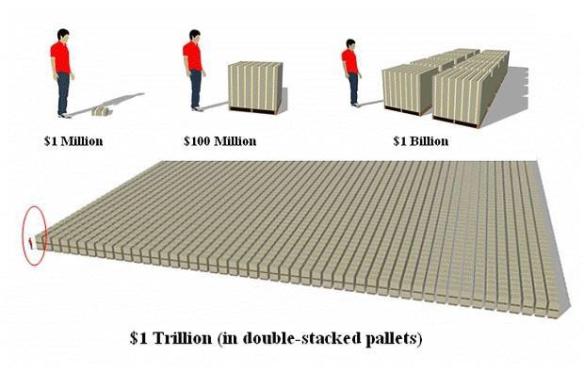
One problem with playing this game is the problem of scale. People have a problem appreciating such huge numbers. They are familiar with what a dollar is, but what’s a trillion? Here it is, represented as double-stacked pallets of $100 bills.

That seems a bit cumbersome for our board game. Reasonable values for the chips in our National Bankruptcy game would be $100 billion, $500 billion and $1 trillion. We could use a few $5 trillion and $10 trillion chips too, though not too many because I doubt that the game would go on long enough to make them useful.

I propose that for the sake of this game we introduce a handy new unit called a “piffle” which is equal to $100 billion. A trillion is 10 piffles, 10 trillion is 100 piffles. Then our chips can be 1, 5, 10, 50 and 100 piffles. Piffles allow us to express various huge quantities without going through any arithmetic contortions. US federal debt is currently 220 piffles. US trade deficit for 2018 was 6 piffles while the US defense budget was 7 piffles. For 2019 the federal budget deficit (covered by increased borrowing) is 10 piffles and rising while tax revenues are just 3 piffles and falling. The interest payment on federal debt is 3 piffles but with rising interest rates it’s going to 5 piffles within a few years.

Speaking of rising interest rates… just today Trump wished for 0% interest rates again, like Obama had while he was running up his 80 piffles’ worth of debt. But now it’s hovering around 3% and is unlikely to go down no matter what Trump wishes. Why? Well, here’s the reason. The US imports much more than it exports because it can’t afford to or lacks the ability to make all the stuff it needs; that’s why there are 6 piffles’ worth of trade deficit. When other nations sell to the US more than they buy, they end up holding lots of piffles, and since the US needs lots of piffles (remember, the budget deficit is 10 piffles) it makes plenty of sense to borrow that money right back. A little while back it was possible to borrow it back at 0% interest because the US was powerful enough to threaten those who refused to play this game with military annihilation (cue pictures of bombed-out Libya and Iraq). But times have changed, and unless the US bribes its debt-holders with 3% interest rate or better—no deal.

How have times changed? There are two effects worth mentioning. First, the military annihilation threat isn’t working any more. Yes, the US still spends a stunning, record-shattering sum of 7 piffles on defense, but none of that is working. Call it the free money effect. When people spend their own hard-earned money, they tend to be careful with it, but if it’s somebody else’s money that they got for free never intending to pay it back, then they tend to throw caution to the wind. And so US military spending has become less and less effective over time, in one of two ways: procurement costs have gone through the roof, and the resulting products have become useless.

In terms of procurement costs, the purchasing parity between the US and (just as an example) Russia seems to be at least ten to one: to get the same result, the US has to spend at least ten times more than Russia. And so although Russia spends well less than 1 piffle on defense, its military is far more effective. In terms of product uselessness, the Pentagon now resembles a woman who has a closet jam-packed with expensive designer labels but has absolutely nothing to wear because her entire wardrobe is no longer fashionable. There is the entire set of aircraft carriers none of which can operate close enough to enemy shores to be of any use at all because they can be readily sunk using hypersonic rockets launched from very far away. There are the stockpiles of Tomahawk cruise missiles which can’t make it past Soviet-era air defense systems (with a few electronics and software upgrades). There are the Patriot air defense systems which are useless even for stopping Soviet-era SCUD missiles, never mind anything more modern.

Add to this Russia’s (and soon China’s) new hypersonic weapons with conventional payloads and new air and space defense systems such as the S-400: these provide what’s known as “escalation dominance.” Suppose the US does something unspeakably nasty and Russia and/or China decide to teach it a lesson. They now have the ability to blow up any target within the US without getting anywhere near it and without placing any of their military assets at risk.

They could, for instance, take out the US electric grid in a way that will take many months to get it back on line. They can then reliably intercept anything that the US tries to retaliate with. Of course, the US can become suicidal—that’s always a risk—and launch a full-on nuclear first strike, then sit back and wait to be completely obliterated along with much of the rest of the planet. But that’s not a military strategy, that’s pure suicide, and the officers in charge of military strategy tend to be emotionally stable family men who look forward to playing with their grandchildren upon retirement.

So, why then should the US continue to spend 7 piffles on defense? The sad answer is that it will go bankrupt whether it zeroes out the defense budget or not. If the defense budget goes to 0, then there is still 3 piffles’ worth of budget deficit left, plus those 6 piffles of trade deficit aren’t going anywhere but up. But what about MAGA?—you might ask—What about firing up US manufacturing, bringing the jobs back and exporting our way out of this? After all, if we turn those 6 piffles of trade deficit into 6 piffles of trade surplus, suddenly it all works out and bankruptcy becomes avoidable.

No, sorry, that just not realistic. You see, in order to get an industrial economy going again the US needs several things. It needs cheap energy, cheap labor, low cost of doing business and readily available markets, both domestic and export. And the US doesn’t have any of these. In terms of energy—and oil is by far the most important form of energy—in 2019 the US will import exactly as much oil as it did in 1998—around 8 million barrels a day. Yes, the shale oil industry has sprung up in the meantime, and the US is currently producing 11.5 million barrels per day. But also in the meantime US oil consumption has gone up a lot—to 20 million barrels a day, which is a stunning 20% of the world’s consumption for 4.4% of the world’s population.

And so the oil deficit is still very much there. Plus the shale oil patch has never made any money but has accumulated over 2 piffles’ worth of debt and has spent over a piffle’s worth more than it made. With interest rates going up they are unlikely to be able to borrow enough to keep up the same hectic drilling rate, and with declines from existing wells at over half a million barrels per day per month it won’t take many months to whittle down that 11.5 million barrels per day, forcing the US to either boost imports or cut consumption.

But the oil price has gone down a lot lately, so there shouldn’t be a problem in any case, right? Again, sorry, no. Peak Oil for most countries has come and gone. There is now only a handful of countries left that are able to meaningfully boost oil production: Russia, Canada (mostly tar sands), Iran, Iraq, United Arab Emirates, Kuwait and Brazil. Russia has recently announced that it isn’t planning to boost production. Saudi Arabia is a huge oil producer but does not seem to have any spare capacity left. Canada’s tar sands patch is a money-losing environmental disaster. Iran and Iraq (call them Iranq, since they are both Shia Moslem, are politically aligned and neither loves America too much) aren’t exactly going to gallop to the rescue. That leaves UAE, Kuwait and Brazil, and if you add them all up together that’s nowhere near enough. So, get ready for oil price spikes, followed by a wave of demand destruction, followed by oil price collapses, followed by supply destruction—you know, the usual.

Moving on to labor. In order to stay competitive, the US will need to lower its median wage a lot. It has to be lower than what the Chinese and the Southeast Asians earn because the US needs to outcompete them to steal their export market share. Without various other major changes this will cause US workers to either rebel or starve to death in short order. The changes involve nationalizing medicine and education to drive down their costs by a factor of 1000 or so, converting to public transportation and pretty much banning the use of private cars to make transportation affordable, putting up high-rises right next to factories for affordable worker housing and so on. That’s a lot of piffles’ worth of effort!

The cost of doing business is a tough one too. The US spends way more on courts and lawyers, insurance and regulatory compliance than most other countries, and the regulatory maze that entrepreneurs have to run in order to run even a small and simple business is very costly and absolutely confounding. How does one take a machete to that whole ridiculous, corrupt scheme? I have no idea. It’s an imponderable. The Chinese would probably just call it a “cultural revolution,” round up all the lawyers and the bureaucrats, make them wear dunce caps and sandwich boards that say “I am what is wrong with this country” and march them in procession while pelting them with rocks and beating them with sticks. Something like that…

Finally, there is the question of export markets. What exactly is the US going to export more effectively than other countries are exporting already? China out-manufactures just about anybody on the planet and isn’t about to give up its spot. Russia exports grain and other foodstuffs (all non-GMO, unlike the US), nuclear and space technology, defense technology (that actually works) and much else. Pakistan and India, and various other countries, export textiles. The world is full up with product. It’s consumers to bankrupt that are in short supply. And if the US cuts its labor rates to make itself competitive, then its consumer base will shrink rather dramatically.

So it looks like bankruptcy is it, no use fighting it. But what should the US do in the meantime? I suggest that it should put up some really huge walls—just for the sake of leaving behind some spectacular ruins for future generations to marvel at. The one along the southern border seems to be going up already, but there should be at least two more. There needs to be a wall along the Mason-Dixon line, because given the heated state of US politics there needs to be a way to prevent people from trying to reenact the Civil War (a misnomer, that!) with actual real weapons and live ammo. And there also needs to be a wall along the northern border, to keep various groups of armed troglodytes from escaping to Canada and ransacking it (it’s the least we can do for our peaceful northern neighbors). How much will these three walls cost? Glad you asked! They will cost roughly 0.005 piffles apiece, 0.015 piffles total—a truly piffling amount. That’s my 0.000000002 piffle’s worth. But, you know, it’s the thought that counts.

Oh, and if you want to actually design this National Bankruptcy board game, please resist the temptation to contact me about it. Seriously, I don’t like games, board games especially. I am a very serious person who doesn’t have time for such piffles.

Wall Street, Banks, and Angry Citizens

The Inequality Gap on a Planet Growing More Extreme

By Nomi Prins

Source: TomDispatch.com

As we head into 2019, leaving the chaos of this year behind, a major question remains unanswered when it comes to the state of Main Street, not just here but across the planet. If the global economy really is booming, as many politicians claim, why are leaders and their parties around the world continuing to get booted out of office in such a sweeping fashion?

One obvious answer: the post-Great Recession economic “recovery” was largely reserved for the few who could participate in the rising financial markets of those years, not the majority who continued to work longer hours, sometimes at multiple jobs, to stay afloat. In other words, the good times have left out so many people, like those struggling to keep even a few hundred dollars in their bank accounts to cover an emergency or the 80% of American workers who live paycheck to paycheck.

In today’s global economy, financial security is increasingly the property of the 1%. No surprise, then, that, as a sense of economic instability continued to grow over the past decade, angst turned to anger, a transition that — from the U.S. to the Philippines, Hungary to Brazil, Poland to Mexico — has provoked a plethora of voter upheavals. In the process, a 1930s-style brew of rising nationalism and blaming the “other” — whether that other was an immigrant, a religious group, a country, or the rest of the world — emerged.

This phenomenon offered a series of Trumpian figures, including of course The Donald himself, an opening to ride a wave of “populism” to the heights of the political system. That the backgrounds and records of none of them — whether you’re talking about Donald Trump, Viktor Orbán, Rodrigo Duterte, or Jair Bolsonaro (among others) — reflected the daily concerns of the “common people,” as the classic definition of populism might have it, hardly mattered. Even a billionaire could, it turned out, exploit economic insecurity effectively and use it to rise to ultimate power.

Ironically, as that American master at evoking the fears of apprentices everywhere showed, to assume the highest office in the land was only to begin a process of creating yet more fear and insecurity. Trump’s trade wars, for instance, have typically infused the world with increased anxiety and distrust toward the U.S., even as they thwarted the ability of domestic business leaders and ordinary people to plan for the future. Meanwhile, just under the surface of the reputed good times, the damage to that future only intensified. In other words, the groundwork has already been laid for what could be a frightening transformation, both domestically and globally.

That Old Financial Crisis

To understand how we got here, let’s take a step back. Only a decade ago, the world experienced a genuine global financial crisis, a meltdown of the first order. Economic growth ended; shrinking economies threatened to collapse; countless jobs were cut; homes were foreclosed upon and lives wrecked. For regular people, access to credit suddenly disappeared. No wonder fears rose. No wonder for so many a brighter tomorrow ceased to exist.

The details of just why the Great Recession happened have since been glossed over by time and partisan spin. This September, when the 10th anniversary of the collapse of the global financial services firm Lehman Brothers came around, major business news channels considered whether the world might be at risk of another such crisis. However, coverage of such fears, like so many other topics, was quickly tossed aside in favor of paying yet more attention to Donald Trump’s latest tweets, complaints, insults, and lies. Why? Because such a crisis was so 2008 in a year in which, it was claimed, we were enjoying a first class economic high and edging toward the longest bull-market in Wall Street history. When it came to “boom versus gloom,” boom won hands down.

None of that changed one thing, though: most people still feel left behind both in the U.S. and globally. Thanks to the massive accumulation of wealth by a 1% skilled at gaming the system, the roots of a crisis that didn’t end with the end of the Great Recession have spread across the planet, while the dividing line between the “have-nots” and the “have-a-lots” only sharpened and widened.

Though the media hasn’t been paying much attention to the resulting inequality, the statistics (when you see them) on that ever-widening wealth gap are mind-boggling. According to Inequality.org, for instance, those with at least $30 million in wealth globally had the fastest growth rate of any group between 2016 and 2017. The size of that club rose by 25.5% during those years, to 174,800 members. Or if you really want to grasp what’s been happening, consider that, between 2009 and 2017, the number of billionaires whose combined wealth was greater than that of the world’s poorest 50% fell from 380 to just eight. And by the way, despite claims by the president that every other country is screwing America, the U.S. leads the pack when it comes to the growth of inequality. As Inequality.org notes, it has “much greater shares of national wealth and income going to the richest 1% than any other country.”

That, in part, is due to an institution many in the U.S. normally pay little attention to: the U.S. central bank, the Federal Reserve. It helped spark that increase in wealth disparity domestically and globally by adopting a post-crisis monetary policy in which electronically fabricated money (via a program called quantitative easing, or QE) was offered to banks and corporations at significantly cheaper rates than to ordinary Americans.

Pumped into financial markets, that money sent stock prices soaring, which naturally ballooned the wealth of the small percentage of the population that actually owned stocks. According to economist Stephen Roach, considering the Fed’s Survey of Consumer Finances, “It is hardly a stretch to conclude that QE exacerbated America’s already severe income disparities.”

Wall Street, Central Banks, and Everyday People

What has since taken place around the world seems right out of the 1930s. At that time, as the world was emerging from the Great Depression, a sense of broad economic security was slow to return. Instead, fascism and other forms of nationalism only gained steam as people turned on the usual cast of politicians, on other countries, and on each other. (If that sounds faintly Trumpian to you, it should.)

In our post-2008 era, people have witnessed trillions of dollars flowing into bank bailouts and other financial subsidies, not just from governments but from the world’s major central banks. Theoretically, private banks, as a result, would have more money and pay less interest to get it. They would then lend that money to Main Street. Businesses, big and small, would tap into those funds and, in turn, produce real economic growth through expansion, hiring sprees, and wage increases. People would then have more dollars in their pockets and, feeling more financially secure, would spend that money driving the economy to new heights — and all, of course, would then be well.

That fairy tale was pitched around the globe. In fact, cheap money also pushed debt to epic levels, while the share prices of banks rose, as did those of all sorts of other firms, to record-shattering heights.

Even in the U.S., however, where a magnificent recovery was supposed to have been in place for years, actual economic growth simply didn’t materialize at the levels promised. At 2% per year, the average growth of the American gross domestic product over the past decade, for instance, has been half the average of 4% before the 2008 crisis. Similar numbers were repeated throughout the developed world and most emerging markets. In the meantime, total global debt hit $247 trillion in the first quarter of 2018. As the Institute of International Finance found, countries were, on average, borrowing about three dollars for every dollar of goods or services created.

Global Consequences

What the Fed (along with central banks from Europe to Japan) ignited, in fact, was a disproportionate rise in the stock and bond markets with the money they created. That capital sought higher and faster returns than could be achieved in crucial infrastructure or social strengthening projects like building roads, high-speed railways, hospitals, or schools.

What followed was anything but fair. As former Federal Reserve Chair Janet Yellen noted four years ago, “It is no secret that the past few decades of widening inequality can be summed up as significant income and wealth gains for those at the very top and stagnant living standards for the majority.” And, of course, continuing to pour money into the highest levels of the private banking system was anything but a formula for walking that back.

Instead, as more citizens fell behind, a sense of disenfranchisement and bitterness with existing governments only grew. In the U.S., that meant Donald Trump. In the United Kingdom, similar discontent was reflected in the June 2016 Brexit vote to leave the European Union (EU), which those who felt economically squeezed to death clearly meant as a slap at both the establishment domestically and EU leaders abroad.

Since then, multiple governments in the European Union, too, have shifted toward the populist right. In Germany, recent elections swung both right and left just six years after, in July 2012, European Central Bank (ECB) head Mario Draghi exuded optimism over the ability of such banks to protect the financial system, the Euro, and generally hold things together.

Like the Fed in the U.S., the ECB went on to manufacture money, adding another $3 trillion to its books that would be deployed to buy bonds from favored countries and companies. That artificial stimulus, too, only increased inequality within and between countries in Europe. Meanwhile, Brexit negotiations remain ruinously divisive, threatening to rip Great Britain apart.

Nor was such a story the captive of the North Atlantic. In Brazil, where left-wing president Dilma Rouseff was ousted from power in 2016, her successor Michel Temer oversaw plummeting economic growth and escalating unemployment. That, in turn, led to the election of that country’s own Donald Trump, nationalistic far-right candidate Jair Bolsonaro who won a striking 55.2% of the vote against a backdrop of popular discontent. In true Trumpian style, he is disposed against both the very idea of climate change and multilateral trade agreements.

In Mexico, dissatisfied voters similarly rejected the political known, but by swinging left for the first time in 70 years. New president Andrés Manuel López Obrador, popularly known by his initials AMLO, promised to put the needs of ordinary Mexicans first. However, he has the U.S. — and the whims of Donald Trump and his “great wall” — to contend with, which could hamper those efforts.

As AMLO took office on December 1st, the G20 summit of world leaders was unfolding in Argentina. There, amid a glittering backdrop of power and influence, the trade war between the U.S. and the world’s rising superpower, China, came even more clearly into focus. While its president, Xi Jinping, having fully consolidated power amid a wave of Chinese nationalism, could become his country’s longest serving leader, he faces an international landscape that would have amazed and befuddled Mao Zedong.

Though Trump declared his meeting with Xi a success because the two sides agreed on a 90-day tariff truce, his prompt appointment of an anti-Chinese hardliner, Robert Lighthizer, to head negotiations, a tweet in which he referred to himself in superhero fashion as a “Tariff Man,” and news that the U.S. had requested that Canada arrest and extradite an executive of a key Chinese tech company, caused the Dow to take its fourth largest plunge in history and then fluctuate wildly as economic fears of a future “Great Something” rose. More uncertainty and distrust were the true product of that meeting.

In fact, we are now in a world whose key leaders, especially the president of the United States, remain willfully oblivious to its long-term problems, putting policies like deregulation, fake nationalist solutions, and profits for the already grotesquely wealthy ahead of the future lives of the mass of citizens. Consider the yellow-vest protests that have broken out in France, where protestors identifying with left and right political parties are calling for the resignation of neoliberal French President Emmanuel Macron. Many of them, from financially starved provincial towns, are angry that their purchasing power has dropped so low they can barely make ends meet.

Ultimately, what transcends geography and geopolitics is an underlying level of economic discontent sparked by twenty-first-century economics and a resulting Grand Canyon-sized global inequality gap that is still widening. Whether the protests go left or right, what continues to lie at the heart of the matter is the way failed policies and stop-gap measures put in place around the world are no longer working, not when it comes to the non-1% anyway. People from Washington to Paris, London to Beijing, increasingly grasp that their economic circumstances are not getting better and are not likely to in any presently imaginable future, given those now in power.

A Dangerous Recipe

The financial crisis of 2008 initially fostered a policy of bailing out banks with cheap money that went not into Main Street economies but into markets enriching the few. As a result, large numbers of people increasingly felt that they were being left behind and so turned against their leaders and sometimes each other as well.

This situation was then exploited by a set of self-appointed politicians of the people, including a billionaire TV personality who capitalized on an increasingly widespread fear of a future at risk. Their promises of economic prosperity were wrapped in populist platitudes, normally (but not always) of a right-wing sort. Lost in this shift away from previously dominant political parties and the systems that went with them was a true form of populism, which would genuinely put the needs of the majority of people over the elite few, build real things including infrastructure, foster organic wealth distribution, and stabilize economies above financial markets.

In the meantime, what we have is, of course, a recipe for an increasingly unstable and vicious world.

Reflections on 2018, Forecasting 2019

By Robert J. Burrowes

In many ways it is painful to reflect on the year 2018; a year of vital opportunities lost when so much is at stake.

Whether politically, militarily, socially, economically, financially or ecologically, humanity took some giant strides backwards while passing up endless opportunities to make a positive difference in our world.

Let me, very briefly, identify some of the more crucial backward steps, starting with the recognition by the Bulletin of the Atomic Scientists in January that the year had already started badly when they moved the Doomsday Clock to two minutes to midnight, the closest it has ever been to ‘doomsday’ (and equal to 1953 when the Soviet Union first exploded a thermonuclear weapon matching the US capacity). See ‘It is now two minutes to midnight’.

This change reflected the perilous state of our world, particularly given the renewed threat of nuclear war and the ongoing climate catastrophe. It didn’t even mention the massive and unrelenting assault on the biosphere (apart from the climate) nor, of course, the ongoing monumental atrocities against fellow human beings.

Some Lowlights of 2018

  1. The global elite, using key elite fora such as the Group of 30, the Trilateral Commission, the Bilderberg Group and the World Economic Forum, continued to plan, generate and exacerbate the many ongoing wars, deepening exploitation within the global economy, climate and environmental destruction, and the refugee crisis, among many other violent impacts, in pursuit of greater elite power, profit and privilege.
  1. International organizations (such as the United Nations, the World Bank and International Monetary Fund) and national governments used military forces, legal systems, police forces and prison systems around the world to serve the global elite by defending its interests against the bulk of the human population, including those individuals and organizations audacious enough to challenge elite power, profit and privilege.
  1. $US1.7 trillion was officially spent worldwide on military weapons to kill fellow human beings and other lifeforms, and to destroy the biosphere. See ‘Global military spending remains high at $1.7 trillion’.

However, so out-of-control is this spending that the United States has now spent $US21trillion on its military in the past 20 years for which it cannot even account! That’s right, $US1trillion each year, including 2018, above the official US national budget for killing is ‘lost’. See Army General Fund Adjustments Not Adequately Documented or Supported, ‘Has Our Government Spent $21 Trillion Of Our Money Without Telling Us?’ and ‘The Pentagon Can’t Account for $21 Trillion (That’s Not a Typo)’.

  1. War and other military violence continued to rage across the planet wreaking devastation on many countries and regions, particularly in the Middle East and Africa. If you missed this, read what is happening to Yemen, described as ‘ the world’s worst [humanitarian] crisis in decades’ with ‘three quarters of the entire Yemeni population – 22 million women, children and men – dependent on some form of humanitarian assistance to survive.’ See ‘Yemen: UN chief hails “signs of hope” in world’s worst man-made humanitarian disaster’.
  1. Not content with the nature and extent of the military violence they are inflicting already, during 2018 elites continued to plan how to do it more effectively in future with research and development of artificial intelligence just one manifestation of this: ‘an “arms race in AI” is now underway, with the U.S., China, Russia, and other nations (including Britain, Israel, and South Korea) seeking to gain a critical advantage in the weaponization of artificial intelligence and robotics’ so that ‘artificial intelligence will be applied to every aspect of warfare, from logistics and surveillance to target identification and battle management’. See ‘“Alexa, Launch Our Nukes!” Artificial Intelligence and the Future of War’.
  1. The United States government unilaterally withdrew from the Intermediate Nuclear Forces (INF) Treaty (which limits the deployment of intermediate range nuclear weapons).
  1. Another significant proportion of global private financial wealth – conservatively estimated by the Tax Justice Network in 2010 to already total between $US21 and $US32 trillion – has been invested virtually tax-free through the world’s still-expanding black hole of more than 80 ‘offshore’ tax havens (such as the City of London Corporation, Jersey, Guernsey, the Isle of Man, Bermuda, the Cayman Islands, Hong Kong, Nauru, St. Kitts, Antigua, Tortola, Switzerland, the Channel Islands, Monaco, Cyprus, Gibraltar and Liechtenstein). This is just financial wealth. ‘A big share of the real estate, yachts, racehorses, gold bricks – and many other things that count as non-financial wealth – are also owned via offshore structures where it is impossible to identify the owners.’ See Tax Justice Network.

Controlled by the global elite, Wall Street and other major banks manage this monstrous diversion of wealth under Government protection. ‘Their business is fraud and grand theft.’ Tax haven locations offer more than tax avoidance. ‘Almost anything goes on.’ It includes ‘bribery, illegal gambling, money laundering, human and sex trafficking, arms dealing, toxic waste dumping, conflict diamonds and endangered species trafficking, bootlegged software, and endless other lawless practices.’ See ‘Trillions Stashed in Offshore Tax Havens’.

  1. The world’s major corporations continued to inflict enormous ongoing violence (in a myriad of ways) in their pursuit of endless profit at the expense of living beings (human and otherwise) and Earth’s biosphere by producing and marketing a wide range of life-destroying products ranging from nuclear weapons and nuclear power to junk food, pharmaceutical drugs, synthetic poisons and genetically mutilated organisms (GMOs). These corporations include those involved in the following industries: weapons manufacturers, major banks and their ‘industry groups’ like the International Monetary Conference, asset management firms, investment companies, financial services companies, fossil fuel (coal, oil and gas) corporations, technology corporations, media corporations, major marketing and public relations corporations, agrochemical (pesticides, seeds, fertilizers) giants, pharmaceutical corporations, biotechnology (genetic mutilation) corporations, mining corporations, nuclear power corporations, food multinationals and water corporations. You can see a list of the major corporations in this article: ‘The Global Elite is Insane Revisited’.
  1. More than a billion people continued to live under occupation, dictatorship or threat of genocidal assault. See, for example, ‘500 Years is Long Enough! Human Depravity in the Congo’.
  1. 36,500,000 human beings (mainly in Africa, Asia and Central/South America) were starved to death.
  1. 18,250,000 children were killed by adults in wars, by starving them to death, and in a large variety of other ways.
  1. 8,000,000 children were trafficked into sexual slavery; executed in sacrificial killings after being kidnapped; bred to be sold as a ‘cash crop’ for sexual violation, to produce child pornography (‘kiddie porn’) and ‘snuff’ movies (in which children are killed during the filming); ritually tortured and murdered as well as raped by dogs trained for the purpose. See ‘Humanity’s “Dirty Little Secret”: Starving, Enslaving, Raping, Torturing and Killing our Children’.
  1. Hundreds of thousands of individuals were kidnapped or tricked into slavery, which now denies 46,000,000 human beings the right to live the life of their choice, condemning many individuals – especially women and children – to lives of sexual slavery, forced labor or as child soldiers. See The Global Slavery Index’ and 46 million people living as slaves, latest global index reveals’.
  1. Well over 100,000 people (particularly Falun Gong practitioners) in China, where an extensive state-controlled program is conducted, were subjected to forced organ removal for the trade in human organs. See Bloody Harvest and The Slaughter.
  1. 15,750,000 people were displaced by war, persecution or famine. There are now 68,500,000 people, more that half of whom are children and 10,000,000 of whom are stateless, who have been forcibly displaced worldwide and remain precariously unsettled, usually in adverse circumstances. One person in the world is forcibly displaced every two seconds. See ‘Figures at a Glance’.
  1. Millions of people were made homeless in their own country as a result of war, persecution, ‘natural’ disasters, internal conflict, poverty or as a result of elite-driven national economic policy. The last time a global survey was attempted – by the United Nations back in 2005 – an estimated 100 million people were homeless worldwide. As many as 1.6 billion people lack adequate housing (living in slums, for example). See ‘Global Homelessness Statistics’.
  1. 73,000 species of life (plants, birds, animals, fish, amphibians, insects and reptiles) on Earth were driven to extinction with the worldwide loss of insects, including vital pollinators such as bees, now between 75% and 90%, depending on the species. See ‘Insect Decimation Upstages Global Warming’. Have you seen a butterfly recently?
  1. Separately from global species extinctions, Earth continued to experience ‘a huge episode of population declines and extirpations, which will have negative cascading consequences on ecosystem functioning and services vital to sustaining civilization. We describe this as a “biological annihilation” to highlight the current magnitude of Earth’s ongoing sixth major extinction event.’ Moreover, local population extinctions ‘are orders of magnitude more frequent than species extinctions. Population extinctions, however, are a prelude to species extinctions, so Earth’s sixth mass extinction episode has proceeded further than most assume.’ See ‘Biological annihilation via the ongoing sixth mass extinction signaled by vertebrate population losses and declines’ and ‘Biological Annihilation on Earth Accelerating’.
  1. Wildlife trafficking, worth up to $20 billion in 2018, is pushing many endangered species to the brink of extinction. Illegal wildlife products include jewelry, traditional medicine, clothing, furniture, and souvenirs, as well as some exotic pets, most of which are sold to unaware/unconcerned consumers in the West. See, for example, Stop Wildlife Trafficking.
  1. 16,000,000 acres of pristine rainforest were destroyed (with more than 40,000 tropical tree species now threatened with extinction). See ‘Measuring the Daily Destruction of the World’s Rainforests’, ‘Estimating the global conservation status of more than 15,000 Amazonian tree species’ and ‘Half of Amazon Tree Species Face Extinction’.
  1. Vast quantities of soil were washed away as we destroyed the rainforests, and enormous quantities of both inorganic constituents (such as heavy metals like cadmium, chromium, lead, mercury, nickel and zinc) and organic pollutants (particularly synthetic chemicals in the form of fertilizers, pesticides and herbicides) were dumped into the soil as well, thus reducing its nutrients and killing the microbes within it. We also contaminated enormous quantities of soil with radioactive waste. See Soil-net, ‘Glyphosate effects on soil rhizosphere-associated bacterial communities’ and ‘Disposing of Nuclear Waste is a Challenge for Humanity’.
  1. The TEPCO nuclear power plant in Fukushima, Japan discharged 109,000 tons of radioactive waste into the Pacific Ocean killing an incalculable number of fish and other marine organisms and indefinitely contaminating expanding areas of that ocean. See ‘Fukushima: A Nuclear War without a War: The Unspoken Crisis of Worldwide Nuclear Radiation’.
  1. Human use of fossil fuels to power aircraft, shipping and vehicles (among other purposes) released 10 billion metric tons (gigatons) of carbon dioxide into Earth’s atmosphere, a 2.7% increase over 2017. See ‘Global Carbon Budget 2018’ and ‘Carbon dioxide emissions will hit a record high globally in 2018’. As a measure of their concern elite-controlled governments and corporations around the world are currently planning or have under construction 1,380 new coal plants? That’s right. 1,380 new coal plants. In 59 countries. See ‘NGOs Release List of World’s Top Coal Plant Developers’ and ‘2018 Coal Plant Developers List’.
  1. 90 billion land animals and 60 billion marine animals were killed for human consumption, more than 100 million animals were killed for laboratory purposes in the United States alone and there were other animal deaths in shelters, zoos and in blood sports. See ‘How Many Animals Are Killed Each Year?’

In addition, 40 million animals were killed for their fur. Approximately 30 million of these animals were raised on fur farms and killed, about 10 million wild animals were trapped and killed, and hundreds of thousands of seals were killed for their fur. See ‘How Many Animals are Killed Each Year?’

  1. Farming of animals for human consumption released 7,100,000,000 tonnes of CO2-equivalent into Earth’s atmosphere. About 44% of livestock emissions were in the form of methane (which was 44% of anthropogenic CH4 emissions), 29% as Nitrous Oxide (which was 53% of anthropogenic N2O emissions) and 27% as Carbon Dioxide (which was 5% of anthropogenic CO2 emissions). See ‘GHG Emissions by Livestock’.
  1. Human use of fossil fuels and farming of animals released 3.2 million metric tons of (CO2 equivalent) nitrous oxide (N2O) into Earth’s atmosphere. See ‘Nitrous oxide emissions’.
  1. As a result of previous greenhouse gas (GHG) emissions and the consequent rise of about one degree celsius in the global temperature, causing the melting of Arctic permafrost and undersea methane ice clathrates, an incalculable quantity of methane was uncontrollably released into the atmosphere during 2018 (with the quantity being released getting ever closer to ‘exploding’). See ‘7,000 underground gas bubbles poised to “explode” in Arctic’ and ‘Release of Arctic Methane “May Be Apocalyptic,” Study Warns’.
  1. Ice in the Antarctic is melting at a record-breaking rate, losing 219 billion tonnes of ice in 2018 at a rate that has accelerated threefold in the last five years. See ‘Antarctic ice melting faster than ever, studies show’.
  1. An incalculable amount of agricultural poisons, fossil fuels and other wastes was discharged into the ocean, adversely impacting life at all ocean depths – see ‘Staggering level of toxic chemicals found in creatures at the bottom of the sea, scientists say’ – and generating ocean ‘dead zones’: regions that have too little oxygen to support marine organisms. See ‘Our Planet Is Exploding With Marine “Dead Zones”’.
  1. At least 8 million metric tons of plastic, of which 236,000 tons were microplastics, was discharged into the ocean. See ‘Plastic waste inputs from land into the ocean’ and ‘Plastics in the Ocean’.
  1. Earth’s fresh water and ground water was further depleted and contaminated. These contaminants included bacteria, viruses and household chemicals from faulty septic systems; hazardous wastes from abandoned and uncontrolled hazardous waste sites (of which there are over 20,000 in the USA alone); leaks from landfill items such as car battery acid, paint and household cleaners; the pesticides, herbicides and other poisons used on farms and home gardens; radioactive waste from nuclear tests; and the chemical contamination caused by hydraulic fracturing (fracking) in search of shale gas, for which about 750 chemicals and components, some extremely toxic and carcinogenic like lead and benzene, have been used. See ‘Groundwater contamination’, ‘Groundwater drunk by BILLIONS of people may be contaminated by radioactive material spread across the world by nuclear testing in the 1950s’ and ‘Fracking chemicals’.
  1. The longstanding covert military use of geoengineering – spraying tens of millions of tons of highly toxic metals (including aluminium, barium and strontium) and toxic coal fly ash nanoparticulates (containing arsenic, chromium, thallium, chlorine, bromine, fluorine, iodine, mercury and radioactive elements) into the atmosphere from jet aircraft to weaponize the atmosphere and weather – in order to enhance elite control of human populations, continued unchecked. Geoengneering is systematically destroying Earth’s ozone layer – which blocks the deadly portion of solar radiation, UV-C and most UV-B, from reaching Earth’s surface – as well as adversely altering Earth’s weather patterns and polluting its air, water and soil at incredible cost to the health and well-being of living organisms and the biosphere. See ‘Geoengineering Watch’.
  1. As one outcome of our dysfunctional parenting model and political systems, fascism continued to rise around the world. See ‘The Psychology of Fascism’.
  1. Despite the belief that we have ‘the right to privacy’, privacy (in any sense of the word) was ongoingly eroded in 2018 and is now effectively non-existent, particularly thanks to Alphabet (owner of Google). Taken together, ‘Uber, Amazon, Facebook, eBay, Tinder, Apple, Lyft, Foursquare, Airbnb, Spotify, Instagram, Twitter, Angry Birds… have turned our computers and phones into bugs that are plugged in to a vast corporate-owned surveillance network. Where we go, what we do, what we talk about, who we talk to, and who we see – everything is recorded and, at some point, leveraged for value.’ Moreover, given Google’s integrated relationship with the US government, the US military, the CIA, and major US weapons manufacturers, there isn’t really anything you can do that isn’t known by those who want to know it. In essence, Google is ‘a powerful global corporation with its own political agenda and a mission to maximise profits for shareholders’ and it partly achieves this by expanding the surveillance programs of the national security state at the direction of the global elite. See ‘Google’s Earth: How the Tech Giant Is Helping the State Spy on Us’ and the documentary ‘The Modern Surveillance State’.
  1. The right to free speech was ongoingly eroded in 2018. For just a couple of examples in the United States alone, see ‘Marc Lamont Hill On Getting Fired From CNN, His Remarks On Palestine + More’ and ‘A Texas Elementary School Speech Pathologist Refused to Sign a Pro-Israel Oath, Now Mandatory in Many States – so She Lost Her Job’.
  1. Believing that we know better than evolution, humans created the first gene-edited baby in 2018. See ‘Why we are not ready for genetically designed babies’ and China’s Golem Babies: There is Another Agenda’.
  1. An incalculable amount of junk was added to the 100 trillion items of junk already in Space. See ‘Space Junk: Tracking & Removing Orbital Debris’.
  1. Incalculable amounts of antibiotic waste, nuclear waste, nanowaste and genetically engineered organisms were released into Earth’s biosphere. See ‘Junk Planet: Is Earth the Largest Garbage Dump in the Universe?’
  1. Ongoing violence against children – see Why Violence? and Fearless Psychology and Fearful Psychology: Principles and Practice – ensured that more people will grow up accepting (and quite powerless to challenge) our dysfunctional and violent world, as described above.
  1. The corporate media, education and entertainment industries continued to distract us from reality ensuring that most people remain oblivious to our predicament and their own role in it, let alone what they can do to respond powerfully.

While the above list of the setbacks humanity and the Earth suffered in 2018 is very incomplete, it still provides clear evidence that humanity is rapidly entering a dystopian future far more horrific than the worst novel or film in the genre. The good news is that, at the current rate, this dystopian world will be shortlived as humans drive themselves over the edge of extinction. See ‘Human Extinction by 2026? A Last Ditch Strategy to Fight for Human Survival’.

But so that the picture is clear and ‘balanced’: were there any gains made against this onslaught?

Of course, it goes without saying that the global elite, international organizations (such as the United Nations), governments, corporations and other elite agents continued to live in delusion/denial endlessly blocking any initiative requiring serious action that would cut into corporate profits, or arguing over tangential issues of insignificant consequence to humanity’s future.

In short, I could find no record of official efforts during the year to plan for the development and implementation of a comprehensive, just and sustainable peace, but perhaps I missed it.

Separately from this, there have been some minor activist gains: for example, some western banks and insurance companies are no longer financially supporting the expansion of the western weapons industry and the western coal industry, some rainforest groups have managed to save portions of Earth’s rainforest heritage, and activist groups continue to work on a variety of issues sometimes making modest gains.

In essence however, as you probably realize, many of the issues above are not even being tackled and, even when they are, activist efforts have been hampered by inadequate analysis of the forces driving conflicts and problems, limited vision (particularly unambitious aims such as those in relation to ending war and the climate catastrophe), unsophisticated strategy (necessary to have profound impact against a deeply entrenched, highly organized and well-resourced opponent, with the endless lobbying of elite institutions, such as governments and corporations, despite this effort simply absorbing and dissipating our dissent, as is intended – as Mark Twain once noted: ‘If voting made a difference, they wouldn’t let us do it.’) and failure to make the difficult decisions to promote necessary solutions that are ‘unpopular’.

Fundamentally, these ‘difficult decisions’ include the vital need to campaign for the human population, particularly in the West, to substantially reduce their consumption – by 80% – involving both energy and resources of every kind as the central feature of any strategy to curtail destruction of the environment and climate, to undermine capitalism and to eliminate the primary driver of war: violent resource acquisition from Middle Eastern and developing nations for the production of consumer goods and services for western consumers.

While we live in the delusion that we can simply substitute renewable energy for fossil fuels and nuclear power (or believe such delusions that a 1.5 degrees celsius increase above the preindustrial temperature is acceptable or that we have an ‘end of century’ timeframe to solve the climate crisis), we ignore the fundamental reality that Earth’s biosphere is under siege on many fronts as a result of our endless extraction of its natural resources – such as fresh water, minerals, timber and, again, fossil fuels – for consumer production and the provision of services that go well beyond energy.

In short, for example, we will not save the world’s rainforests because we switch to renewable energy. We must reduce demand for the consumer products that require rainforest inputs. We must stop mining the Earth for minerals that end up in our mobile phones, computers, vehicles, ships and aircraft by not using the products and services these minerals make possible. We must stop eating meat and other animal products. And so the list goes on.

Forecasting 2019

In many ways it is painful to forecast what will happen in 2019 mainly because of the absurd simplicity of doing so: It will be another year when vital opportunities will be lost when so much is at stake.

Given the insanity of the global elite – see ‘The Global Elite is Insane Revisited’ – which will continue to drive the dynamics producing the lowlights mentioned above with the active complicity of their agents in governments and corporations coupled with a human population that is largely terrified, self-hating and powerless to resist – see ‘In Defense of the Human Individual’ – it is a straightforward task to forecast what will happen in 2019.

So let me forecast 40 lowlights for 2019:

  1. See list above.
  2. See list above.
  3. See list above.

.
.

  1. See list above.

So unless you play your part, 2019 and the few years thereafter will simply be increasingly worse versions of 2018 and it will all be over by 2026. See ‘Human Extinction by 2026? A Last Ditch Strategy to Fight for Human Survival’ which cites a wide range of scientific and other evidence which you are welcome to consider for yourself if this date seems premature.

Responding Powerfully

If you already feel able to act powerfully in response to this multifaceted crisis, in a way that will have strategic impact, you are invited to consider joining those participating in The Flame Tree Project to Save Life on Earth, which outlines a simple plan for you to systematically reduce your consumption, by at least 80%, involving both energy and resources of every kind – water, household energy, transport fuels, metals, meat, paper and plastic – while dramatically expanding your individual and community self-reliance in 16 areas, so that all environmental and climate concerns are effectively addressed.

If you are also interested in conducting or participating in a campaign to systematically address one of the issues identified above, you are welcome to consider acting strategically in the way that Mohandas K. Gandhi did. Whether you are engaged in a peace, climate, environment or social justice campaign, the 12-point strategic framework and principles are the same. See Nonviolent Campaign Strategy. And, for example, you can see a basic list of the strategic goals necessary to end war and halt the climate catastrophe. See ‘Strategic Aims’.

If you want to know how to nonviolently defend against a foreign invading power or a political/military coup, to liberate your country from a dictatorship or a foreign occupation, or to defeat a genocidal assault, you will learn how to do so in Nonviolent Defense/Liberation Strategy.

If you are interested in nurturing children to live by their conscience and to gain the courage necessary to resist elite violence fearlessly, while living sustainably despite the entreaties of capitalism to over-consume, then you are welcome to make ‘My Promise to Children’.

To reiterate: capitalism, war and destruction of the environment and climate are outcomes of our dysfunctional parenting of children which distorts their intellectual and emotional capacities, destroys their conscience and courage, and actively teaches them to over-consume as compensation for having vital emotional needs denied. See ‘Love Denied: The Psychology of Materialism, Violence and War’.

If your own intellectual and/or emotional functionality is the issue and you have the self-awareness to perceive that, and wish to access the conscience and courage that would enable you to act powerfully, try ‘Putting Feelings First’.

And if you want to be part of the worldwide movement committed to ending all of the violence identified above, consider signing the online pledge of ‘The People’s Charter to Create a Nonviolent World’.

In summary: if we do not rapidly, systematically and substantially reduce our consumption in several key areas and radically alter our parenting model, while resisting elite violence strategically on several fronts, homo sapiens will enter Earth’s fossil record within a few years. Given the fear, self-hatred and powerlessness that paralyses most humans, your choices in these regards are even more vital than you realize.


Biodata: Robert J. Burrowes has a lifetime commitment to understanding and ending human violence. He has done extensive research since 1966 in an effort to understand why human beings are violent and has been a nonviolent activist since 1981. He is the author of Why Violence? His email address is flametree@riseup.net and his website is here.

Robert J. Burrowes
P.O. Box 68
Daylesford, Victoria 3460
Australia

Email: flametree@riseup.net

Websites:
Nonviolence Charter
Flame Tree Project to Save Life on Earth
‘Why Violence?’
Feelings First
Nonviolent Campaign Strategy
Nonviolent Defense/Liberation Strategy
Anita: Songs of Nonviolence
Robert Burrowes
Global Nonviolence Network

Mueller’s End Game

By Peter Van Buren

Source: We Meant Well

A baby born when Robert Mueller started his investigation would be talking by now. But would she have anything to say?

We last looked at what Mueller had publicly, and what he didn’t have, some ten months ago, and cautioned skepticism that he would prove “collusion.” It’s worth another look now, but we’ll give away the ending: there is still no real evidence of, well, much of anything significant about Russiagate. One thing clear is the investigation seems to be ending. Mueller’s office reportedly even told various defense lawyers it is “tying up loose ends.” The moment to wrap things up is politically right as well; the Democrats will soon take control of the House and it is time to hand this all off to them.

Ten months ago the big news was Paul Manafort flipped; that seems to have turned out to be mostly a bust, as we know now he lied like a rug to the Feds and cooperated with the Trump defense team as some sort of mole inside Mueller’s investigation (a heavily-redacted memo about Manafort’s lies, released by Mueller on Friday, adds no significant new details to the Russiagate narrative.) George Papadopoulos has already been in and out of jail — all of two weeks — for his sideshow role, Michael Avenatti is now a woman beater who is just figuring out he’s washed up, Stormy Daniels owes Trump over $300k in fees after losing to him in court, there is no pee tape, and if you don’t recall how unimportant Carter Page and Richard Gates turned out to be (or even remember who they are), well, there is your assessment of all the hysterical commentary that accompanied them a few headlines ago.

The big reveal of the Michael Flynn sentencing memo on Tuesday was he will likely do no prison time. Everything of substance in the memo was redacted, so there is little insight available. If you insist on speculation, try this: it’s hard to believe something really big and bad happened such that Flynn knew about it but still wasn’t worth punishing for it, and now, a year after he started cooperating with the government, nobody has heard anything about whatever the big deal is. So chances are the redactions focus on foreign lobbying in the U.S.

This week’s Key to Everything is Michael Cohen, the guy who lied out of self-interest for Trump until last week when we learned he is also willing to lie, er, testify against Trump out of self-interest. If you take Cohen’s most recent statements at face value the sum is failed negotiations we all knew about already to build a Trump hotel in Moscow went on a few months longer than originally stated. Meanwhile, the U.S. Attorney’s Office for the Southern District of New York submitted a sentencing memo Friday for Cohen recommending 42 months in jail. In a separate filing, Mueller made no term recommendation but praised Cohen for his “significant efforts to assist the special counsel’s office.” The memos reveal no new information.

Call it as sleazy as you want, but looking into a real estate deal is neither a high crime nor a misdemeanor, even if it’s in Russia. Conspiracy law requires an agreement to commit a crime, not just the media declaiming “Cohen was communicating directly with the Kremlin!” Talking about meeting Russian persons is not a crime, nor is meeting with them. The takeaway this was all about influence buying by the Russkies falls flat. If Putin sought to ensnare Trump, why didn’t he find a way for the deal to actually go through? Mueller has to be able to prove actual crimes by the president, not just twist our underclothes into a weekly conspiratorial knot. For fun, look here at the creative writing needed to even suggest anything illegal. Doesn’t sound like Trump’s on thin ice with hot shoes.

Sigh. It is useful at this point of binge-watching the Mueller mini-series to go back to the beginning.

The origin story for all things Russiagate is a less-than-complete intelligence finding hackers, linked to the Russian government, stole emails from the Democratic National Committee (DNC) in 2016. The details have never been released, no U.S. law enforcement agency has ever seen the server/scene of the crime, and Mueller’s dramatic indictments of said hackers, released as Trump met with Putin in Helsinki, will never be heard of again, or challenged, as none of his defendants will ever leave Russia. Meanwhile, despite contemporaneous denials of the same, it is now somehow accepted knowledge the emails (and Facebook ads!) had some unproven major affect on the election.

The origin story for everything else, that Trump is beholden to Putin for favors granted or via blackmail, is opposition research purchased by the Democrats and carried out by an MI6 operative with complex connectionsinto American intelligence, the salacious Steele Dossier. The FBI, under a Democratic-controlled Justice Department, then sought warrants to spy on the nominated GOP candidate for president, based on evidence paid for by his opponent.

Yet the real origin story for all things Russiagate is the media, inflamed by Democrats, searching for why Trump won (because it can’t be anything to do with Hillary, and “all white people and the Electoral College are racists” just doesn’t hold up.) Their position is Trump must have done something wrong, and Robert Mueller, despitehelping squash a Bush-era money-laundering probe, lying about the Iraq War, and flubbing the post-9/11 anthrax investigation, has been resurrected with Jedi superpowers to find it. It might be collusion with Russia or Wikileaks, or a pee tape, or taxes, all packaged as hard news but reading like Game of Thrones plot speculation. None of that is journalism to be proud of, and it underlies everything Mueller.

As the NYT said in a rare moment of candor, “From the day the Mueller investigation began, opponents of the president have hungered for that report, or an indictment waiting just around the corner, as the source text for an incantation to whisk Mr. Trump out of office and set everything back to normal again.”

The core problem is Mueller just hasn’t found a crime connected with Russiagate someone working for Trump might have committed. His investigation to date hasn’t been a search for the guilty party, Colonel Mustard in the library, but a search for an actual underlying crime, some crime, any crime. All Mueller has uncovered are some old financial misdealing by Manafort and chums that took place before and outside of the Trump campaign, payoffs to Trump’s mistresses which are not in themselves inherently illegal (despite what prosecutors simply assert in the Cohen sentencing report, someone will have to prove to a jury the money was from campaign funds and the transactions were “for the purpose of influencing” federal elections, not say simply “protecting his family from shame.” Cohen’s guilty pleas cannot legally be considered evidence of someone else’s guilt), and a bunch of people lying about unrelated matters.

And that’s the give away to Muller’s final report. There was no base crime as the starting point of the investigation. With Watergate there was the break-in at Democratic National Headquarters. With Russiagate you had… Trump winning the election (remembering the FBI concluded the DNC hack was done by the Russians forever ago, no Mueller needed.)

Almost everything Mueller has, the perjury and lying cases, are crimes he created through the process of investigating. He’s Schroeder’s Box; the crimes only exist when he tries to look at them. Mueller created most of his booked charges by asking questions he already knew the answers to, hoping his witness would lie and commit a new crime literally in front of him. Nobody should be proud of lying, but it seems a helluva way to contest a completed election as Trump enters the third year of his term.

Mueller’s end product, his report, will most likely claim a lot of unsavory things went on. But it seems increasingly unlikely he’ll have evidence Trump worked with Russia to win the election, and even less likely that Trump is now under Putin’s control. If Mueller had a smoking gun we’d be watching impeachment hearings by now.

Instead Mueller will end up concluding some people may have sort of maybe tried to interfere with an investigation into what turned out to be nothing, another “crime” that exists only because there was an investigation to trigger it. He’ll dump that steaming pile of legal ambiguity into the lap of the Democratic House to hold hearings on from now until global warming claims the city of Benghazi and returns it to the sea. Or the 2020 election, whichever comes first.


BONUS:

The uber-point of all this Ocean’s Nineteen-level conspiracy is supposedly so Putin can, whatever, sow dissent in America. Because if he wanted a puppet in the Oval Office it has been a damn poor return on investment — sanctions are still in place, NATO is still on Russia’s border, Montenegro joined NATO, Trump approved arms sales to the Ukraine, RT and Sputnik are sidelined as registered foreign agents, Cold Warrior-like hardliners Bolton and Pompeo are in power, the U.S. just delivered Russia an ultimatum on an arms control treaty that could return some American missiles to Europe, and more. On the plus side, there were those friendly Tweets.

Along the way new journalistic “norms” were created: Trump is too stupid to have made his money, so it must be ill-gotten. Trump did real estate deals in NYC and so is mobbed up. Trump’s taxes (albeit available to the IRS and Treasury for decades, the FBI and Mueller via warrant for years) hide secrets. Meanwhile, everyone in Russia with a few bucks is an oligarch, and everyone who anyone from the Trump side spoke with is “connected to Putin.” Trump doesn’t have lawyers, he has fixers and consigliere.

These tropes allow journalists to communicate in a kind of shorthand with the rubes who still imagine something will happen to annul the 2016 election. They allow each mini-development to appear to be a major event, as in the mind of the media everything is related, and everything accumulative. So a lie about a real estate deal in Russia is HUGE because it has something to do with Russia and see that connects all the dots!

None of that is journalism to be proud of, and it underlies everything Mueller. It is almost sad looking back at the old articles and TV tales to see how excited everyone got — Flynn was indicated! Sessions recused himself! Comey will save us! The Nunes Memo! They all used to matter sooooo much. Outlets like the NYT and WaPo rolled out a “source close to the White House” to comment whatever just happened means Mueller is getting close to nailing Trump. The nutters who took over once cogent places like HuffPo and Salon run “reporting” that reads like Game of Thrones plot speculation. Everybody runs the same headlines: BREAKING: Reports: Sources: Trump Fixer to Flip; Avenatti Says “Orange is the New Black, Buttercup!”

As one writer puts it, “For the last two years the mass media machine has been behaving very, very strangely, and it isn’t getting better, it’s getting worse. Not since the lead-up to the invasion of Iraq have we seen mainstream media outlets trying to shove narratives down our throats so desperately and aggressively.”