Dr. Peter Gotzsche On Coronavirus: “A Pandemic Of Panic, More Than Anything Else”

By Richard Enos

Source: Collective Evolution

Peter Gotzsche, a Danish physician and medical researcher, is well placed to comment on the measures being imposed to combat the Coronavirus. And he has his reasons to be suspicious of some of those measures.

In 1993, Gotzsche co-founded the Cochrane Collaboration, an international and independent non-profit organization that produces and disseminates systematic reviews of healthcare interventions and diagnostic tests, and promotes the search for evidence in the form of clinical trials and other interventional studies. As I examined in-depth in a previous article ‘Bill Gates Donation Turns Respected Independent Research Company Into HPV Vaccine Supporter,’ a massive donation of over $1M USD from Bill Gates was part of the transformation of Cochrane from an open and independent research company to a top-down hierarchy in which ‘there is stronger and stronger resistance to say anything that could bother pharmaceutical industry interests.’

In an unprecedented move, Peter Gotzsche was expelled from the Cochrane Collaboration in 2018 by a powerful minority within the newly-instituted Governing Board. Gotzsche’s outspoken and independent scrutiny of the pharmaceutical industry, highlighted in his 2014 book Deadly Medicines and Organized Crime: How big pharma has corrupted healthcare, made him an insufferable opponent to Cochrane’s new agenda. Suffice it to say, when we hear Peter Gotzsche’s opinion on health-related issues, they are sure to be direct, thoughtful, and unaffected by the prevailing narratives.

Weighing In On The Coronavirus Pandemic

Gotzsche, a specialist in internal medicine that has worked for two years at a department of infectious diseases, is not shy about calling out the ‘Elephant in the Room’ regarding the Coronavirus pandemic, even as some of our governments and medias organizations are treating it like the future of humanity is at stake if draconian measures of the highest order are not instituted across the board for the foreseeable future.

Gotzsche wrote in a recent blog post that he and most of those around him, both lay people and colleagues, ‘consider the Coronavirus pandemic a pandemic of panic, more than anything else.’ He believes that fear and panic are propagated by those with an agenda of control, not those who put the health and safety of citizens first. He cautioned that if people with mild symptoms are made to panic they are liable to flood the hospitals, which does more harm than good.

I do find it very prudent that they told people to stay in their homes in South Korea if they fall ill, and only if they become very sick, will a car come and bring them to a hospital that is not overcrowded. If the infectious dose is high, mortality will also be higher because there will not be sufficient time to establish an immune response. Therefore, overcrowded hospitals will have higher mortality rates. The panic does just that: leads to overcrowded hospitals.

The Perils Of Panic

Panic, in and of itself, is never useful. And during a crisis, it is even more dangerous. We see different types of recommendations coming out from our elected leaders, doctors and scientists, and mainstream media commentators. Often these recommendations are made based on unduly dire predictions about the danger of the virus.

It is important to have fine discernment around who is advocating for calm and who is actually stoking the fires of public panic. Whenever our elected leaders, with the power to legislate societal rules, try to instigate fear in our hearts, and threaten huge sanctions and punishment if we do not obey their decrees, we need to pay close attention to what the real motivation may be.

In a broader sense, we need to ask ourselves: how much are we agreeing to continue to play into the old parent-child relationship that has long existed between our elected leaders and ourselves? Do we really need to be shamed and threatened into a certain type of behavior if we really believe that such behavior will be beneficial for our community and world? And if a small percentage of people are not obeying in lock-step, does this justify the implementation of threats and more draconian measures for the rest of us?

As citizens, it is our duty to avoid following our elected leaders blindly. We actually need to be self-responsible for our actions and their impact on the health and well-being of the community around us. In the long run, it is much more beneficial for society to cultivate self-responsible citizens rather than blind followers. Of course, our leaders might not see it that way. They are aware that self-responsible citizens are more able and likely to hold them accountable and compel them to represent the will of the people, not their own agenda.

How Much Is Too Much?

Peter Gotzsche is the prototypical self-responsible citizen in this regard. And he characterizes some of the responses and measures applied to the Coronavirus as too much. He infers that if we had responded to the viral infection and mortality rates in previous years the way we have with the 2019 Coronavirus, the whole world would have had to be shut down permanently years ago!

Our main problem is that no one will ever get in trouble for measures that are too draconian. They will only get in trouble if they do too little. So, our politicians and those working with public health do much more than they should do. No such draconian measures were applied during the 2009 influenza pandemic, and they obviously cannot be applied every winter, which is all year round, as it is always winter somewhere. We cannot close down the whole world permanently.

Should it turn out that the epidemic wanes before long, there will be a queue of people wanting to take credit for this. And we can be damned sure draconian measures will be applied again next time. But remember the joke about tigers. “Why do you blow the horn?” “To keep the tigers away.” “But there are no tigers here.” “There you see!”

Since politicians have little to lose by overreacting, the citizens have to be vigilant about the current response to make sure we are not being drawn into dangerous precedents. Gotzsche calls out the ploy of the political establishment, which constantly seeks to gain more control over the people while making decisions based on what will make them look the best in the end. And the point he made that ‘we can be damned sure draconian measures will be applied again next time,’ is worth a much deeper examination–especially in the context of comments made by none other than Bill Gates.

Bill Gates Gives Chilling Forecast

In a recent interview with TED Talks founder Chris Anderson, Gates is given full latitude to speak from his home about the things we should be learning from the Covid-19 pandemic. The following is a summary of what Gates states in the interview:

(1) Covid-19 will fade away within a few months
(2) There will be fewer casualties than predicted
(3) That will be credited to strong action taken by governments
(4) Pandemics serve the purpose of testing and improving response
(5) The correct response centers on the development of vaccines, an industry in which he is heavily invested
(6) Pandemics and global warming have the common advantage of being sufficiently frightful to motivate the public and governments to accept drastic changes to society
(7) Leadership for this must come from technocrats, not politicians

What is most striking in this interview is the way Gates begins to pivot towards his vision of a post-Covid-19 world. Perhaps he had already given up on what may have been his original goal to orchestrate worldwide Coronavirus vaccine mandates; however, he takes the opportunity to explain that future pandemics will be met much more swiftly with medical interventions, and central to those interventions will be the timely development and implementation of vaccines for the entire population. He urges that scientists and technocrats, rather than our elected leaders, should be the decision makers regarding such policies, further alienating the general population from their individual sovereignty.

To listen to Bill Gates without understanding the agendas that truly drive those with power, it may be difficult to discern that he is not actually trying to help humanity. Perhaps for just that reason, it may be interesting to listen to the full interview to see if you can detect any signs of Bill Gates’ agenda of personal profit, depopulation and the creation of a global technocracy in which elite rulers like himself wield even more power than they have today.

Peter Gotzsche certainly has personal experience with how Bill Gates came into a company that was standing in the way of his vaccine-fueled profits and used his money and influence to turn that organization into an ally for his agenda. He has reason to believe that some of the way the response to the pandemic is playing out is aligned with that agenda.

Of course many in the public may dismiss the need for our vigilance and simply spout “it’s better to be safe than sorry.” And in principle I would agree with that sentiment. However if this motto is simply applied to the Coronavirus pandemic in a lazy and uncritical way, and we don’t collectively question seemingly unnecessary draconian moves by our leaders, then a society led by technocrats which further takes medical freedom away from individuals may be the future we are contributing to.

The Takeaway

I’ll be honest. Some of the restrictions and cancellations that have been put in place in our society have benefited me in terms of allowing me to take care of things around the house, reflect on my own life and spend more time with my family. But let’s not get lulled into complacency here. This should not stop us from being vigilant about the response to the Coronavirus in our communities and contemplating and talking to others about whether the response is measured and appropriate.

This applies as well to the responses going on all around the world. I certainly believe that many who are part of our global authority have agendas that are not in the best interests of humanity. It is imperative that we not assume the position that our political leaders and the medical ‘experts’ that are paraded out in mainstream media have the answers and we should blindly follow them. Would you not agree that the current goal for a humanity awakening to what is going on is to break the bonds of authority and become self-responsible and self-governing? In order to make this happen, we need all hands on deck.


Risings and Fallings

By James Howard Kunstler

Source: Kunstler.com

In the corkscrewing anguish of the social sequester, with careers, savings, futures, and dreams whirling down the drain, voices rise above the din of conflicting statistics to ask: what is going on here? To some, it looks like a deliberate attempt to demolish what’s left of the economy for political advantage. Clouds of suspicion gather over the two medical superstars of the Daily Briefing show, Doctors Fauci and Birx, as they somewhat sheepishly revise their numbers for contagion and death downward and attempt to “balance” the formula of modeled projections versus mitigation efforts. Was the stay-at-home panic necessary, after all? Will it save the day or kill off modern life as we knew it?

Well, everyplace else in the world was shutting down, weren’t they? Did they all go off their rockers, too? At least a hundred doctors died in Italy heroically tending the stricken, so they say. South Korea, Taiwan, and Singapore opted for flat-out medical Gestapo action. Britain, Spain, France, and Germany about the same, but minus testing at the grand scale and tracing of contacts. Honestly, how is it possible the whole planet punked itself?

I certainly don’t know the answer to all this, though readers are twanging on me to declare the whole Covid-19 story “a hoax,” which I’m not ready to do. I do know this: America has become utterly intolerant of uncertainty. And in the absence of certainty, that age-old human cognitive skill called pattern recognition, which has made us such a successful species, kicks into high gear scanning the field-of-view for answers. Any string-of-dots that affords even the slimmest plausibility goes on the table for review, including a lot of stories tagged as “conspiracy theories.”

I know this, too: the financial side of the gasping global economy was running off the rails well before Covid-19 flew out of its bat-cave into somebody’s soup bowl… or out of China’s Wuhan virus lab, if that’s how you like it… or before it seeped out of the Bill and Melinda Gates Foundation’s ark of world-saving secrets. In the USA and Europe, finance had come to mostly eclipse every other human endeavor of wealth production ­– with the catch that finance actually didn’t produce any real wealth, it only winkled and swindled wealth (or the mere ghosts of wealth) with its asset-stripping magic, from the places where wealth once did truly dwell. Or else it ginned up abstruse rackets that attempted to replace the utility of money with sheer math. Or, when all else failed, it just resorted to plain old accounting fraud… until, finally, there was so much there not actually there, that the whole holographic fantasy flickered out.

The pre-Easter bear market rally on Wall Street has been a wonder, don’t you think? As the numbers of able-bodied people out-of-work rocketed up past ten million during the same period, the stock indexes shot up three, five, six percent a day? Say, what? You’re telling me that’s based on the prospect of magnificent earnings in the third quarter? With every business on God’s green earth writhing in the dust like squashed bugs? And every supply line for basic goods and the gazillion spare parts for everything… all choked off?

And meanwhile, the American public sequesters and festers, waiting for those $1,200 checks that will fix… everything! Let’s face it: this is a twilight zone between stupor and fury. Nobody is paying anything to anyone. All obligations are suspended: rents, mortgages, bills, loans, bets, and vigs, all up in the air somewhere, but definitely not moving to their assigned destinations. The velocity of money is zero and all the various new term facilities and structured vehicles conjured by the Federal Reserve and Congress amount to a mere shadow of money moving ­– even though they are represented by trillions of brand-new alleged dollars. For every ten points that the Standard & Poor’s rose this week, somewhere down the line as many hedge funders will be dribbled like so many basketballs to the hoop of judgment.

The nation now has the long Easter weekend to stew and ruminate over its fate with spring achingly vivid and beckoning beyond the grim, streaked windows of sequestering. Those little cans of Easter Spam with pineapple rings won’t offer much consolation, combined with the abject discovery that even Netflix only has so many sequels to Frozen for children going catatonic with ennui. Kids are generally not so excited by stock and bond markets, but that’s probably where the genuine melodrama picks up on Monday. The weeks ahead there will give the phrase down-to-earth a whole new meaning.

Power Grab

By Michael Krieger

Source: Liberty Blitzkrieg

I met a traveller from an antique land
Who said: Two vast and trunkless legs of stone
Stand in the desert. Near them, on the sand,
Half sunk, a shattered visage lies, whose frown,
And wrinkled lip, and sneer of cold command,
Tell that its sculptor well those passions read
Which yet survive, stamped on these lifeless things,
The hand that mocked them and the heart that fed:
And on the pedestal these words appear:
‘My name is Ozymandias, king of kings:
Look on my works, ye Mighty, and despair!’
Nothing beside remains. Round the decay
Of that colossal wreck, boundless and bare
The lone and level sands stretch far away

– Percy Shelley, Ozymandias

It didn’t take long for the most opportunistic, nefarious and corrupt actors in the U.S. to turn a pandemic crisis into another massive power grab attempt. We’ve seen it before; after 9/11 and also throughout the response to the financial crisis a decade ago. The irredeemable sociopaths who always make the big, important decisions used those crises to consolidate wealth and power. They’re going for it again.

There are many examples, but let me list a few:

– The EARN IT bill, by which senators are attempting to destroy widespread public use of encryption, i.e. private communications. (EFF)

– The White House and the CDC are asking Facebook, Google and other tech giants to give them greater access to Americans’ smartphone location data. (CNBC)

– The Justice Department has quietly asked Congress for the ability to ask chief judges to detain people indefinitely without trial during emergencies. (Politico)

– U.S. Senators are attempting to use the crisis as an opportunity to pull off a gigantic corporate coup. (Matt Stoller, BIG)

Then there’s the really big one, the Federal Reserve. An institution with more unaccountable power to shape and manipulate our world than any other, yet whose actions remain subject to virtually zero public debate.

While we’re at it…

I wrote about the scam that is the Federal Reserve last year in the post, Monetary Looting, and what they’re doing now makes those repo operations look like child’s play.

We often get distracted debating the implications of Fed actions, and in the process lose sight of the bigger picture. The real question we need to be asking is why do we allow a handful of unelected banker welfare agents the right to shape our entire world? It’s a crazy system, and until we start questioning the underlying premises of everything about our world, we’ll remain confused and subjugated.

That said, I remain more optimistic than ever that once we get through this crisis and a rough transition period, a far better era awaits on the other side. I say this because I believe this pandemic will shake enough people to such an extent they’ll emerge from it very different people with a more enlightened understanding of the world and their roles in it. An event like this can make people less conscious, or it can make them more conscious. I think humanity will expand its consciousness.

Of course, the future is not written in stone. Each and every one of us needs to grow up and step up if we’re going to build a better world. We each have our skillsets, so I ask everyone reading this to think about how they can repurpose their talents to the great work of ushering in a new era. I don’t do any of this to change the world. I can’t do that. I do this to inspire as many people as possible to change their own worlds. Then everything changes.

If I had to summarize where we’ve been and where I think we’re going, it would be with the following.

The world you lived in no longer exists, but the world to come has not yet been created. The worst people in society will attempt to create it in their image, but we can’t allow that. We must step up and create it ourselves. It’s entirely possible. Get to work.

Economic effect of coronavirus could be revolutionary

By Paul Craig Roberts

Source: Intrepid Report

Coronavirus and globalism will teach us vital lessons. The question is whether we can learn vital lessons that do not serve the ruling interest groups and ideologies.

Coronavirus will teach us that a country without free national health care is severely handicapped. Millions of Americans live paycheck to paycheck. They cannot afford health care premiums, deductions, and copays. Millions have no insurance. This means millions of people infected with coronavirus who cannot get medical help. The morbidity from this is intolerable in any society.

Shutdowns associated with efforts to contain the spread of coronavirus will deny income to millions of Americans who live paycheck to paycheck. What do they do for food, shelter, transportation?  You don’t have to think very long along these lines to see a very frightening scenario.

Globalism has taken down the ladders of upward mobility by exporting American middle class jobs to Asia. A population once able to save now lives on debt, the service of which is interrupted by recession/depression and by debt service absorbing all net disposable income.

Globalism has also reduced the survivability of our society by making it dependent  on externally produced goods, the supply of which can be cut off by disruptions in other societies, by policy disagreements leading to sanctions, and by an inability to export enough to pay for imports, which is what the offshored production of US firms is.

The United States has an unprotected population and an economy in trouble. For years, corporate executives have run the companies for the benefit of their bonuses, which are largely dependent on rises in their company’s share price. Consequently, profits and borrowings have been invested in buying back the companies’ shares and not in new investment in the businesses. Corporate indebtedness is extreme and will threaten many corporations and many jobs in a downturn. Boeing is a case in point.

Economist Michael Hudson has for many decades studied the use of debt-forgiveness to restart economies killed by debt burdens. Debt forgiveness for corporations has a different implication than debt forgiveness for individuals. For corporations, forgiving debts lets those who financialized and indebted the economy and the population off the hook. To avoid rewarding them for the catastrophe they produced and to prevent widespread public outcry and distrust, nationalization is implied for insolvent companies and banks.

Nationalization would be limited to insolvent companies and financial institutions and doesn’t mean that there would be no private companies or businesses. Additional nationalization could be used to prevent strategic companies from substituting their interests for national interests, which they do when they move American jobs and factories offshore. Pharmaceuticals could be nationalized along with health care. Energy which often sacrifices the environment to its profits could be considered for nationalization. A successful society has to have more driving it than private profit.

For most Americans nationalization is a dirty word, but it has many benefits. For example, a national health care system reduces costs tremendously by taking profits out of the system. Additionally, nationalized pharmaceutical companies could be made more focused on research and cures than on profit avenues. Everyone knows how Big Pharma influences medical schools and medical practice in line with Big Pharma’s approach. A more open-minded approach to medicine would be beneficial.

Socialist is another American dirty word, one that is being used against Bernie Sanders.  I have not turned into a socialist overnight. I am simply thinking outloud. How can the economy recover when the population and corporations are smothered by debt?  Debt forgiveness is the only way out of this debt suffocation. Can debts be forgiven without nationalization? Not without a huge giveaway to financial mangers and Wall Street. It is the members of the “one percent” who have received 95% of the increase in us income and wealth since 2008. Do we want to reward them for smothering the economy with debt by bailing them out without nationalizing them?

The combination of an economy covered in debt and an unprotected population is clearly revolutionary. Do we have leadership capable of breaking out of interest group politics and ruling ideologies in order to save our society and put it on a more sustainable basis?

Or will the economic hardships be blamed on the virus, the catalyst that ignited the debt timebomb?

COVID-19’s Black Swan Timeline

Black swan events are characterized by their extreme rarity, their severe impact, and the widespread insistence that they were obvious in hindsight.”

By Steve Brown

Source: The Duran

According to Investopedia a Black Swan event “is an unpredictable event that is beyond what is normally expected of a situation and has potentially severe consequences. Black swan events are characterized by their extreme rarity, their severe impact, and the widespread insistence that they were obvious in hindsight.”

In the twentieth century, the financial market crash of 1929 was a black swan event. While Germany’s invasion of Poland in 1939 is sometimes attributed the same, World War 2 was partly the result of an existential power vacuum subsequent to the Great War and thus an extension of it.  911 looked like such an unpredictable surprise event but the imperial arrogance and hubris that afflicted the West for at least fifty years prior rendered the potential for 911 Blowback predictable and foretold.*

The “Great Recession” of 2008-2009 was spawned with reckless abandon by corrupt banks criminally endorsed by Congressional legislation. Pillars of financial debauchery like Goldman Sachs were shorting their own subprime products anticipating the crash. Based on such engineered systemic financial fraud the crash of ten years ago does not qualify as a black swan event.

Except for the financial collapse of 1929, all the foregoing resulted in some immediate plan of action to confront the particular crisis. This time the magnitude is exponentially greater when authorities have scant idea about how to respond and media scare tactics rule the day. The result is to place the global economy in a self-induced coma.  Searching for answers, the New World Order has none.

The great philosophers Epictetus, Socrates, and Aristotle viewed logic and science as the foundation for civilization in opposition to irrational belief systems, superstition, and religion.  The great philosophers believed that learning from humanity’s past mistakes and anticipating future events – with intent to avoid mistakes of the past — would greatly advance prospects for civilized societies.  One highly advanced civilization of the ancient world, the Etruscans, considered past cycles as indicative of future events.

Recognizing a singular relationship in years with regard to life and death, Etruscans defined their theory of Saeculum.  Saeculum posited that major cataclysmic events engendered by humans will follow a pattern of ninety-year cycles. So, people living through a catastrophe in one age will have fully died out by the next.  For example we have the crash of 1929 and the advent of Covid-19 in 2019…. precisely ninety years apart.

The Etruscan’s 90-year black swan cycle may be a bizarre coincidence, but defining COVID19 as such an event helps when confronting its ramifications.  We previously identified a unique confluence of geopolitical events threatening the western-led Warfare State.  And now a severe global health crisis – which promises to shut down the world economy — leverages this geopolitical mix to an even greater extent.  So, in what context may this current COVID cataclysm be viewed?

Putting aside the health factor for one moment this pandemic provides enormous cover for the far less than one percent along very broad lines:

  • Financial
  • Military
  • Socially
  • Politically

Essentially the political class now has carte blanche for:

  • Government bail-outs
  • Corporate bail-outs
  • Wall Street bail-outs
  • Control of a growing restive populace
  • Suppression of individual liberty
  • Increased militarization / powers for law enforcement
  • Political cover

As in 911, the Empire’s excuse is fear.  Perhaps not duct tape this time. But if Elites view this pandemic as an opportunity for draconian population control then the policy carries incredible risk… and not just for the people. Should this disease ease and the controls remain, an already highly stressed populace may lash out. Note that in the financial sector some passive investment firms have already failed. If oil markets cannot be stabilized then the world economy is at risk.

Meanwhile, it’s likely that $1200 monthly payments to the US populace will keep folks quiet. But what if the Fed, International Monetary Fund, and Bank of International Settlements can’t pay for the ponzi?  Perhaps China will bail – indications are that China already has. China is swapping for dollars, but not purchasing US Treasury debt.  That’s a big problem and a Big Risk for the US money masters.

Now there is no intent to make light of the serious health hazard posed by COVID19. Or to disrespect anyone who has become ill or died from the disease.  COVID19 is a deadly and serious illness. Of that there is no doubt.  The intent here is to heighten awareness that there may be a bigger picture for the too big to jail to exploit.  That picture is of a teetering New World Order mired in its own criminal system of usury and theft which hopes for a way out of the pickle it created (since 2009) at the expense of working people.  It’s just possible that those who wish to enslave us will attempt to do so using the prospect of their own demise to create an environment of escalating fear.

As this author has written for many years, when this system fails it will fail by its own hand and not by any fifth column or external enemy.  Until then, Elites may yet accomplish what Huxley and Orwell could not quite agree upon: that their vision of the future might ultimately coalesce and coexist.  So will this monetary system fail?  Probably not.  But if the pain is deep enough, it must reinvent itself.

Contrarily, in this crisis the law of unintended consequences may yet backfire on Elites. For now, they seem very confident.  But any hole in the COVID major media narrative or tear in the Elite’s agitprop universe will be carefully examined and amplified. If a COVID-analogous ‘Building 7’ scenario arises it will not be ignored this time.  That’s because we’ve known for far more than twenty years that those who rule us in the west are largely debauched liars, perverts, and thieves.  Under their control, we should expect nothing less.

*John O’Neill’s career history and death is a remarkable indictment of all US intelligence services.

Of Course Billionaires Shouldn’t Exist

By HipCrime Vocab

There’s apparently a row over whether billionaires should exist. That is, whether or not billionaires should be a thing in our society.

What a stupid question. Of course billionaires shouldn’t exist! But the reason has nothing to do with Socialism.

Rather, under a properly-functioning free-market capitalist system, billionaires shouldn’t exist. And that would have also been the opinion of the “Classical Liberals” so favored by the Right these days: Adam Smith, David Ricardo. Thomas Malthus, John Stuart Mill, and so on.

Billionaires are a sign of market failure.

Let me say that again: billionaires are a form of market failure! You cannot simultaneously be both pro-Market and pro-billionaire.

I’m amazed at how few people get this!

In a truly competitive market, excess profits would be competed away. Someone would come along and undercut outsize profits. That’s exactly how the Classical Liberals assumed free markets would work. In this, they saw markets as instruments of greater equality, not inequality, and certainly not as a way to construct a new and improved aristocracy even more powerful than the old one.

The Classical Liberals wrote in opposition to the main power centers of their day: aristocratic government and chartered monopolies like the East India Company. They didn’t see the purpose of their writings as defending privilege and power. One can dispute the end results, but that was not their goal. Quite the contrary. The idea that a single, solitary individuals would possess more wealth than the kings and pharaohs of old under a functioning free market system would have been unthinkable to them.

In their time, much of the national wealth was monopolized by a landed aristocracy who gained their wealth through disproportionate ownership of the country’s productive land. The other major source of wealth came from large joint-stock companies that were granted royal monopolies due to their political connections. Yet another source of unearned wealth came from the holders of bonds (gilts)—essentially loaning money to the state and getting the government’s tax revenues funneled to them via interest payments.

Classical English Liberals felt that competitive markets would do away with a good portion of the unearned and unproductive wealth common in Great Britain at the time. They believed that “free and open” markets would channel wealth and activity to more productive ends. That is, they would break up large pools of wealth and unproductive money. The kind of obscene fortunes that they saw in their day would no longer be possible thanks to competition, they assumed, and that British society would become more equal than it was under landed aristocracy, not less. We can dispute their logic (and I have issues with it), but I think we can safely say that this is what they believed, rightly or wrongly.

An inherent part of their conception of free markets is the possibility of failure. Unproductive or inefficient businesses would be competed away, they assumed, and the fortunes earned through such activities would disappear. But that is not the case today. Billionaires have so much money they can literally never lose it! That’s not capitalism, that’s aristocracy. I read recently that someone like Bill Gates literally cannot give away money to his pet causes fast enough to reduce his fortune even if he tried. In fact, he’s grown wealthier even while giving away billions.

The important point about [Adam] Smith’s system, on the other hand, is that it precluded steep inequalities not out of a normative concern with equality but by virtue of the design that aimed to maximize wealth. Once we put the building blocks of his system together, concentration of wealth simply cannot emerge.

In Smith, profits should be low and labor wages high, legislation in favor of the worker is “always just and equitable,” land should be distributed widely and evenly, inheritance laws should partition fortunes, taxation can be high if it is equitable, and the science of the legislator is necessary to thwart rentiers and manipulators.

Political theorists and economists have highlighted some of these points, but the counterfactual “what would the distribution of wealth be if all the building blocks were ever in place?” has not been posed. Doing so encourages us to question why steep inequality is accepted as a fact, instead of a pathology that the market economy was not supposed to generate in the first place.

Contrary to popular and academic belief, Adam Smith did not accept inequality as a necessary trade-off for a more prosperous economy (LSE Blogs)

Yet today the people who call themselves the heirs to “Classical English Liberals” emphatically defend the existence of billionaires and extreme inequality at every turn. Such people are not pro-market or pro-capitalism as they like to portray themselves; they are simply pro-wealth, or—to use a less complementary term—bootlickers. They are not defending capitalism or Markets; what they really are defending is oligarchy, power, privilege, and hierarchy. As Corey Robin opined, “The priority of conservative political argument has been the maintenance of private regimes of power,” with all the soaring rhetoric about markets and freedom being just a smokescreen and a cover for defending hierarchies and power imbalances. Their defense of billionaires is proof positive of this. This is true of presidential candidates as well.

The existence of obscene fortunes and extreme inequality are not a sign of capitalism’s success; they are a sign of capitalism’s failure.

This is pointed out by Chris Dillow:

“I don’t think anyone in this country should be a billionaire” said Labour’s Lloyd Russell-Moyle yesterday, at which the BBC’s Emma Barnett took umbrage. The exchange is curious, because from one perspective it should be conservative supporters of a free market who don’t want there to be billionaires.

I say so because in a healthy market economy there should be almost no extremely wealthy people simply because profits should be bid away by competition. In the textbook case of perfect competition there are no super-normal profits, and in the more realistic case of Schumpeterian creative destruction, high profits should be competed away quickly.

From this perspective, every billionaire is a market failure – a sign that competition has failed. The Duke of Westminster is rich because there’s a monopoly of prime land in central London. Would Ineos’ Jim Ratcliffe be so rich if pollution were properly priced, or if his firm faced more competition?

The Right’s Mega-Rich Problem (Stumbling and Mumbling)

How is this rectified? How do they square their supposed love of fair competition and free and open markets with the presence of outsize fortunes?

They don’t.

And the sad thing is how many people buy into their nonsense. Everyone seems to think that a defense of billionaires is a defense of capitalism.

It’s not. It’s the opposite.

What is a billionaire?

Billionaires are only made possible through monopolies and tollbooths. Period. And such monopolies are more possible than ever before thanks to technology.

This is argued by Matt Stoller, an expert on monopolies, in a post entitled, What Is A Billionaire?:

Most people think a billionaire is someone with a lot of money, a sort of Scrooge McDuck who goes swimming in a pool of gold coins. And why wouldn’t we? The name billionaire has the word billion contained within it, so clearly it means having a net worth of at least ten figures. And in a sense, that is technically true. But if you look at the top ranks of the Bloomberg billionaire index, you’ll notice that nearly all of the leaders are people who own a corporation with substantial amounts of market power in one or more markets.

Billionaires use market power to extract revenue the way that a tollbooth operator does.
 If you want to drive on a road, you have to pay for the privilege. It costs the tollbooth operator nothing, he/she just has a strategic chokepoint for extraction. Billionaire Warren Buffett, for instance, has such a ‘tollbooth’ strategy for investing, though he uses the term ‘moat’ because it sounds charming and quirky rather than rapacious.

Put another way, the Bloomberg billionaire index isn’t a list of the most important Scrooge McDuck’s, it’s a list of the biggest tollbooth operators in the world.

What he’s saying is that one becomes a billionaire only by short-circuiting the competitive market economy. Then their profits cannot be competed away. Only by gaming the system can one “earn” over a billion dollars. No one person is that valuable.

Stoller goes on to elucidate the operational tactics used by both Bill Gates and by his predecessor John D. Rockefeller, and finds that even though the industries are radically different, the techniques of short-circuiting and circumventing market competition are the same. Whether it’s horizontal and vertical integration, or using market influence to price out rivals, or exclusive contracts, the techniques are the same regardless of industry or time period:

In 1976 and 1980, Congress allowed the copyrighting of software. IBM had been under aggressive antitrust investigation and litigation since 1967, so when it built a personal computer, it outsourced the operating system – MS-DOS – to Gates’s company and allowed Gates to license it to other equipment makers. (Gates’s upbringing didn’t hurt; the CEO of IBM at the the time knew his mother.) Such a relationship with a vendor was a shocking change for IBM, which had traditionally made everything in-house or tightly controlled its suppliers. But IBM treated Microsoft differently, transferring large amounts of programming knowledge to the small corporation. IBM also did this with the microprocessor company Intel, which IBM protected from Japanese competition.

And yet, in 1982, the Department of Justice dropped the antitrust suit against IBM, signaling a new pro-concentration framework. Bill Baxter, Reagan’s antitrust chief, did not want to bring monopolization suits, and did not. The new fast-growing technology space of personal computers would be a monopolized industry. But it would not be monopolized by IBM, which had kept control of the computing industry since the 1950s, because IBM’s corporate structure was now skittish about the raw use of power. And it would not be monopolized by AT&T, which was kept out of the computing industry by a 1956 consent decree that lasted until 1984. Gates, in many ways, had a greenfield, an environment friendly to monopoly but one in which all the old monopolists had been cleared out by antitrust actions.

In the case of Amazon, even though it theoretically has competition, through vertical and horizontal integration it can effectively control online e-commerce to a large degree. The result is a fortune greater than that of entire nation-states controlled by a single individual. One hardly imagines that Adam Smith would approve.

I read an interesting concept, and I forget where it came from. It was that networks are natural monopolies. This explains things like Facebook, Apple, Amazon, etc. It’s entirely possible that the online world, due to features inherent in the technology, simply cannot be regulated by normal competition the way the market for goods and services can. Yet all our theories pretend that it can. It’s delusional.

Under these scenarios,’ profits’ are really a form of tribute (or perhaps plunder). In fact, we really shouldn’t even use the word ‘profits’ to describe them (just like we shouldn’t use ‘trade’ to describe global wage arbitrage).

And there are many more examples of competition being limited by deliberate legal policy. Much of Microsoft’s profits come from the fact that other people can’t copy their software—which they’ve arbitrarily labeled “piracy”—without facing legal repercussions enforced by the state and its legal system. In that sense, outsized fortunes are a consequence of laws, and not a feature inherent to technology:

…inequality is not in fact driven by technology, it is driven by our policy on technology, specifically patent and copyright monopolies. These forms of protection do not stem from the technology, they are policies created by a Congress which is disproportionately controlled by billionaires.

If the importance of these government granted monopolies is not clear, ask yourself how rich Bill Gates would be if any start-up computer manufacturer could produce millions of computers with Windows and other Microsoft software and not send the company a penny. The same story holds true with most other types of technology. The billionaires get rich from it, not because of the technology but because the government will arrest people who use it without the patent or copyright holder’s permission.

This point is central to the debate on the value of billionaires. If we could get the same or better technological progress without making some people ridiculously rich, then we certainly don’t need billionaires. But in any discussion of the merits of billionaires, it is important to understand that they got their wealth because we wrote rules that allowed it. Their immense wealth was not a natural result of the development of technology.

Farhad Manjoo promotes billionaire ideology in proposal to get rid of billionaires (Dean Baker, Real World Economic Review)

Baker has also pointed out that outsized salaries in many fields are determined by limiting competition though things like wildly expensive education and licensing requirements, which are ultimately determined by the government. Doctors and lawyers do not have compete against the wage rates in India or China thanks to the legal system, for example. Everyone else, however, is required to compete against the entire world for jobs.

On a global level, most billionaires are not the result of “hard work” or doing things beneficial for their society:

The vast majority of the world’s billionaires have not become rich through anything approaching ‘productive’ investment. Oxfam has showed that, approximately one third of global billionaire wealth comes from inheritance, whilst another third comes from ‘crony connections to government and monopoly’.

Why on Earth Shouldn’t People Be Able to Be Billionaires? (Novara Media)

And the monopolies that allow billionaires to exist are not good for the economy as a whole. In fact, they are highly detrimental, as Chris Dillow further points out:

What’s more, monopoly pricing is a form of tax – a tax which often falls upon other, smaller businesses…In this sense, not only are billionaires a symptom of an absence of a healthy competitive economy, but they are also a cause of it: their taxes on other firms restrict growth and entrepreneurship…

Tories are wrong, therefore, to portray attacks on the mega-rich as the politics of envy. It’s not. The existence of billionaires is a sign and cause of a dysfunctional economy…

In fact, logically, it is rightists who should be most concerned by the concentration of wealth. We lefties can point to it as evidence that the system is rigged. But Tories should worry that it undermines the legitimacy of the existing order not only because people don’t like inequality, but because it slows down economic growth and so encourages demands for change.

Furthermore, their existence is detrimental politically:

Controlling society’s wealth effectively gives the wealthy the right to plan economic activity. Billionaires – and the people who manage their money – determine which governments can access borrowing, which companies deserve to grow, and which ideas should be researched. This gives them an immense amount of political, as well as economic, power – allowing billionaires to provide favours to those politicians who helped them get rich in the first place.

Ultimately, the monopolisation of society’s resources by a tiny, closed-off elite means that most of society’s resources are used for dirty, unsustainable and unproductive speculation.

Why on Earth Shouldn’t People Be Able to Be Billionaires? (Novara Media)

In fact, the proliferation of billionaires in the developed world has accompanied a period of slow growth and stagnation, not rapid growth. As has been pointed out ad nauseum, yet still fails to sink in, America’s fastest period of growth came when there were fewer billionaires and tax rates ranged from 50 to 90 percent. There is no evidence that the proliferation of billionaires has benefited society as whole. And now, billionaires are attempting to buy political offices outright, making a joke of democracy.

People defending billionaires are only defending raw power, not capitalism, not democracy, and certainly not free markets.

Stoller concludes:

[Billionaires] are not people with a bunch of dollar bills stacked to the moon, they are (largely) men with a strategic position of power protected by public laws and rules. They aren’t better or smarter than anyone else, they are simply politically adept and in the right place at the right time. There’s no reason we have to enable such people to run our culture. At the end of the day, tollbooths are nothing but bottlenecks on a road on which we would otherwise travel faster and more freely.

What is a Billionaire? (Matt Stoller)

So, should there be billionaires? The answer is no. And you should believe that if you consider yourself a libertarian free marketeer or a democratic socialist. Anyone asserting anything else is just a bootlicker or a toady.

Addendum:

Here’s a good piece explaining how billionaires are basically mad kings:

…one of civilization’s great challenges stems from millionaire rhyming with billionaire. In holding them in the same linguistic corner of our minds, we conflate them, yet they’re so mathematically distinct as to be unrelated. A millionaire can, with some dedicated carelessness, lose those millions. Billionaires can be as profligate and eccentric as they wish, can acquire, without making a dent, all the homes and jets and islands and causes and thoroughbreds and Van Goghs and submarines and weird Beatles memorabilia they please. Unless they’re engaging in fraud or making extremely large and risky investments, they’re simply no match for the mathematical and economic forces—the compounding of interest, the long-term imperatives of markets—that make money beget more money. They can do pretty much whatever they want in this life, and therein lies the distinction. A millionaire enjoys a profoundly lucky economic condition. A billionaire is an existential state.

This helps explain the cosmic reverence draped over so many billionaires, their most banal notions about innovation and vision repackaged as inspirational memes, their insights on markets and customers spun into best sellers. Their extravagances are so over the top as to inspire legend more often than revolution…

The Gospel of Wealth According to Marc Benioff (Wired)

One of the most potent demonstrations that the modern-day rich are mad kings, comes form the story of Adam Neumann of WeWork. This is the impression I got from the Behind the Bastards podcast on Neumann: The Idiot Who Made, and Destoryed, WeWork (Podtail)

‘What More Do You Need to Know?’ Health Insurance Stocks Drive Wall Street Rebound on Biden Super Tuesday Wins

“Biden is the preferred candidate for the financial markets.”

By Eoin Higgins

Source: CommonDreams

Health insurance industry stocks surged Wednesday morning in the wake of former Vice President Joe Biden’s strong showing in the Democratic presidential primary’s Super Tuesday contests, opening up 600 points after traders appeared to bet the candidate’s resurgence would box out any chance of single-payer universal healthcare.

“What more do you need to know,” tweeted journalist Jack Mirkinson of the market’s spike.

Sanders has made Medicare for All a centerpiece of his campaign. The healthcare industry has poured millions in ad buys against Sanders after the Vermont senator won primaries in Iowa, New Hampshire, and Nevada.

“The industry has long seen Biden as their white knight,” said Dr. Adam Gaffney, the president of Physicians for a National Health Program and an outspoken Medicare for All advocate.

Biden on Tuesday won at least nine of the 14 states up for grabs to Sanders’ four. At press time, Maine was yet to be called, with Sanders and Biden locked in a razor-thin contest.

The market surge came after a rough week for the stock market, which at the end of February saw its biggest decline since the 2008 financial crisis after fears of the economic cost of a worldwide coronvirus pandemic increased.

Business commentators also made the connection between Sanders’ victories in the early primary states, particularly in Nevada, and the market’s poor performance last week.

On Fox Business February 28, billionaire Steve Forbes remarked that the weeklong drop was not only about fears of the coronavirus.

“There’s the political side,” Forbes said of the reason for the poor performance. “In the last week, week-and-a-half, the possibility of Bernie Sanders becoming president of the United States has increased, exponentially.”

According to the Washington Post:

Stocks of healthcare companies roared in response to Biden’s performance. Cigna was up more than 10 percent in morning trading, while UnitedHealth Group rose nearly 12 percent. Humana jumped 1.25 percent and Anthem soared nearly 14 percent.

Investor Ed Yardeni told the Post that Wednesday’s spike was a correction to earlier fears of what he called “Bernie Sanders’ socialist program.”

“The market’s sell-off last week on Sanders’ primary victories and rebound on Monday after Biden’s big win in South Carolina and this morning after Super Tuesday suggest that domestic U.S. politics may matter as much as the global health crisis on investors,” said Yardeni.

As Common Dreams reported, the results—which saw billionaire Michael Bloomberg and Sen. Elizabeth Warren (D-Mass.) coming in far behind the two frontrunners—transformed a once-crowded primary into a two-man race. Though Biden put up a good showing, exit polls from the contests showed a majority of Democratic voters backing the elimination of private insurance in favor of a government-run system guaranteeing healthcare for all.

The Dem Establishment Successfully Cinched a Biden Super Tuesday Victory

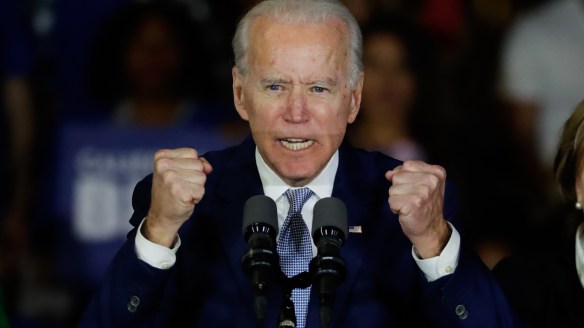
Democratic presidential candidate former Vice President Joe Biden speaks at a primary election night campaign rally Tuesday, March 3, 2020, in Los Angeles. (AP Photo/Chris Carlson)

Super Tuesday has raised the stakes and set the stage for a battle for the Democratic Party’s soul; one that will decide if it stays the course with neoliberalism with Biden or moves towards a progressive social-democratic model with Sanders.

By Alan Macleod

Source: Mint Press News

Former Vice-President Joe Biden built on his victory in South Carolina last week to emerge as the only credible “stop Bernie” candidate after Super Tuesday – where voters in 14 states decided on their nominations for president. While results are still not official, it is clear that the former Delaware senator won the popular vote in at least nine states yesterday, including in Texas, Massachusetts and North Carolina, amassing at least 433 delegates. Sanders has currently secured 388, although that number is likely to rise after all of California is counted.

In one of the most remarkable and drastic political turnarounds in American history, Biden – thought of by many as a yesterday’s man – secured a stunning upset victory after a series of key endorsements. His campaign had been flagging, virtually out of money and without organization or many activists on the ground. As of Monday, he had spent just $1.5 million on TV ads in Super Tuesday states, with aides admitting to CNN their goal was merely to “remain competitive;” a remarkable admission for a presidential campaign.

But facing a Sanders nomination, the establishment wing of the party went into overdrive to find a viable alternative to the Vermont senator. Both Pete Buttigieg and Amy Klobuchar dropped out and immediately endorsed him, as did other figures like former Texas congressman Beto O’Rourke. In a matter of mere hours, the Democratic Party higher-ups managed to coalesce around him in a way the Republicans were unable to in 2016 to stop Trump, proving to the world that the party is certainly not incompetent and can organize and carry out operations with military precision when they perceive it is in their interest to do so.

While the establishment pooled its resources (and delegates) in favor of Biden, Massachusetts senator Elizabeth Warren has refrained from dropping out, let alone endorsing Sanders, thus splitting the progressive vote. Warren finished a distant third in her home state and secured only 28 delegates yesterday. In a defeatist message, her campaign managers said they would hold a meeting to “assess the path forward.”

Biden declared victory in Los Angeles last night, presenting himself as an opponent of the wealthy and a champion of the people: “Let’s get something straight. Wall Street didn’t build this country. You built this country. The middle class built this country. And unions built the middle class,” he told the crowd. But his speech was upstaged by anti-dairy industry protestors who stormed the stage. Earlier in the speech he also confused his wife for his sister.

https://twitter.com/Breaking911/status/1235044512918941698

While it is clear that he will now be the establishment’s candidate for better or worse, the former vice-president has a long history of making egregious errors in speaking. Earlier this week at a rally he tried and failed to recite the preamble of the Declaration of Independence. “We hold these truths to be self evident. All men and women created by the…you know, the thing” he stuttered. And while he promises the working-class “cures for cancer, Alzheimer’s and diabetes” under his presidency, he also told his billionaire backers that he believes they are being “demonized” and that “nothing would change” about America if he were chosen. “I need you very badly,” he told a group of extremely wealthy donors last year.

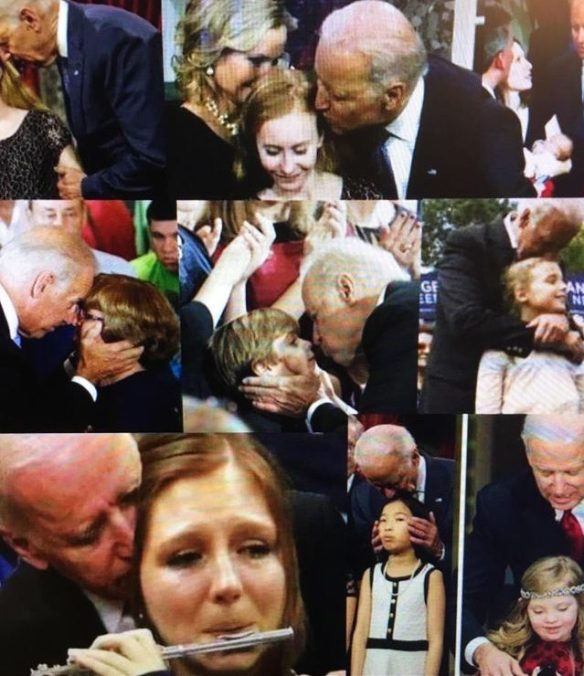
His policy history and positions, too, might be cause for concern for many voters in the presidential election. These include advocating for cuts to social services, fighting against abortion rights, and supporting NAFTA, the PATRIOT Act and the attacks on Iraq and Libya. And while he retains strong support among Southern black voters, he helped write the 1994 Crime Bill and the Anti-Drug Abuse Bill that exploded the prison population, and fought for segregation and against integration. President Trump has already nicknamed him “Handsy Joe” in reference to his inappropriate touching of women and girls.

While Sanders supporters will be disappointed with the results, other candidates had even worse nights. Chief among them was Michael Bloomberg, who spent more than half a billion dollars on his campaign, picking up just 12 delegates, a third of them in American Samoa. Given his poor performance, that works out to nearly $50 million per delegate. The former Mayor of New York dropped out today, endorsing Biden for the nomination. If he is willing to financially aid Biden anything like how he lavishly spent on himself, Sanders will be fighting a seriously uphill battle.

“It really is a class war we’re up against,” said author and progressive journalist Naomi Klein, who has been traveling with the Sanders team.

The vast majority of this campaign are working class people who are daring to hope for the barest decent things in life. It is this amazing process of raising people’s expectations…What we’re seeing with this establishment pushback, this is not against Bernie Sanders, it is against them. It is against people saying ‘I have a right to healthcare. I have a right to a living wage,’ and it is really sad to see.”

Biden has strong support among the wealthy, the elderly and among Southern black voters. But if he is to win outright and beat Trump in November, he will need to address the age gap in voting. Even in Alabama, where he fared worst, Sanders still comfortably won the vote of those under 30. While there is much work to be done, yesterday was a good day for the establishment wing of the Democratic Party.

Next week will see six more states as well as the Democrats Abroad primaries decided. But Super Tuesday has raised the stakes and set the stage for a battle for the Democratic Party’s soul; one that will decide if it stays the course with neoliberalism with Biden or moves towards a progressive social-democratic model with Sanders.