Our Real National Security Budget

$2 Trillion, Here We Come.
Signe’s second toon du jour SIGN17e Military

By Andrew Cockburn

Source: Spoils of War

The Biden Administration has just published its proposed budget, generating copious commentary, much of it displaying a commensurate degree of misunderstanding, especially regarding our gargantuan national security spending. To get at the truth of the matter, I consulted my friend Winslow Wheeler, who has been observing the insalubrious intricacies of the budget process over the past fifty years as a senior aide to Senators from both parties as well as a senior analyst for the General Accounting Office and directing the Center for Defense Information.

The defense budget has just been posted by the administration is being described as approaching a trillion dollars. Is that accurate?  :

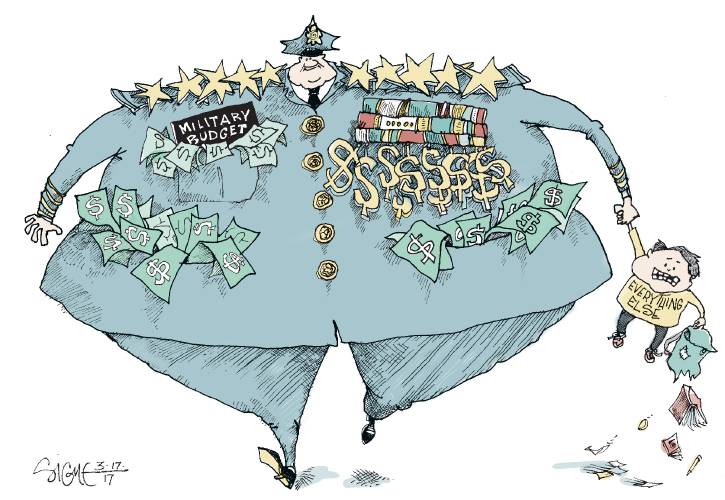
No. It’s actually a lot more than that. In fact it’s beginning to inch up on $2 trillion. 

How so?

The problem is that when most people look at the defense budget, they don’t count everything that we spend even for the Pentagon. But in addition to that, there are hundreds of billions of dollars outside of the Pentagon’s budget that we spend for national security. Things like the nuclear weapons activities in the Department of Energy; that’s $37 billion$26 billion for retired military pensions and healthcare and $12 billion for the Selective Service, the National Defense Stockpile, and a strange and suspicious looking category for the international activities of the FBI in something called “Defense Related Activities.”

Do we have any idea what that last one is for?

It has always been classified. In the 50 years I’ve been watching the defense budget, it’s never been explained other than some occasional hints. One year they admitted to a lot of money being spent by the FBI in, wait for it, Taiwan, and so it’s very unclear exactly what this is, but it’s always counted as part of so-called defense related activities.  

The expenses that I have just been describing come to $970 billion, but that leaves out a lot.. Add in about $800 billion for the Department of Veterans Affairs, the State Department and its associated agencies, the Department of Homeland Security. And we know now from our Republican friends that border protection is a dire national security issue. Add all that together. Then you can calculate the share for the interest on the debt that we pay each year. All those activities I’ve just described come to 21% of all federal spending. Calculating in that percentage as a the amount it contributes to the debt burden gives you $254 billion.. And so you add all of that up together and you get $1.767 trillion.

Jesus Christ.  What about CIA and other intelligence spending?

All the intelligence agencies are in the Pentagon budget except for the intelligence agencies for the State Department, Coast Guard and  the Department of Homeland Security. Those are the few other things that are not in the Pentagon budget that are distributed in the other agencies that I’ve described.  When they last published the total amount for the intel budget it was over $120 billion, but it’s all embedded in these various agencies.

Since the budget was published, there’s been some wailing and lamentation that because of irksome spending restraints, this budget  actually represents a cut or at least restraint on defense spending. What’s your view on that?

Well, last yea the budget deal that then-Speaker Kevin McCarthy negotiated with the Democrats for the Pentagon allowed only a 1% increase in defense spending. But because of the screwy way that we actually calculate things, if you put together everything we spent just for the Pentagon without all those other items I mentioned, last year, it looks like we will have spent $968 billion, while for 2025, Biden’s requesting $921 billion. So yes, that’s a cut. But that doesn’t include the supplementals that Biden will request later this year for the Pentagon, for Ukraine, Israel, God knows what, that will get us back into competition with 2024. The reason why 2024 is higher than the Biden request is because it had 60 billion worth of emergency supplementals that Congress is about to approve and that money is counted in my total. But because of the broken accounting rules that we use for the budget, that money’s not counted when you calculate the deal that McCarthy made with the Democrats, and that’s emergency money that doesn’t count on budget cap.

For years we had the Overseas Contingency Operations defense spending, the so called war budget, which was the extra money the military got for actually fighting wars in Afghanistan and elsewhere. Are we getting back to that?

Yes.  The politically-derived budget caps don’t apply to that money.  And it’s a lot more than just for the wars; lots of billions for goodies for everybody added each year thereIt’s all part of the hocus pocus ways that Congress allows itself to appropriate money so it can pretend that it’s using restraint, but actually is exploiting all kinds of loopholes to increase whatever cap or restraint they pretend that they’ve added to the defense budget.

What’s the next budgetary legislative stage that we’re going to endure?

:We haven’t finished with 2024 yet, because Congress  has gotten into this habit of never passing budgets on time. And it also helps the Speaker of the House and the Majority Leader of the Senate discipline members so they don’t get out of the line on things. We do these things called continuing resolutions that keep the money flowing but only at the level approved in the previous year. And we’re in that situation for the Defense Department for 2024. Next week or the week after, they’re going to resolve that and pick a final total for 2024, which will include most, but probably not all of the emergency supplemental that Biden requested for Ukraine, Israel, Taiwan, and defense industrial base spending. So that number will become final in two or three weeks. We have barely begun on the 2025 consideration in Congress that will take the next three, four months and we’ll have another continuing resolution because they won’t pass things in time for the beginning of the fiscal year on October 1st, and we’ll go through this charade once again. And because this is an election year, it’ll be all that more sloppy, painful, and unappealing to observe.

Then when they do it, Chuck Schumer and whoever is the Speaker of the House will pat themselves on the back and say, ‘well, we’ve done a great job. Who says we can’t do anything. We just got the budget finally passed.’ But that will be months late yet again.

Are there items tacked onto the defense bills that have nothing to do with defense? 

Yes. There’s two bills. One is the National Defense Authorization Act, which is the bill that goes to the House and Senate Armed Services Committees. That’s a policy bill. It doesn’t make money actually available to be spent, but it pretends it does. It has lots of numbers in it; it’s a tar baby for all kinds of crazy stuff or politically driven stuff because the legislative process is so broken.  Members don’t have an opportunity to do stuff on the floor of the House and Senate and especially in the Senate because the Majority Leader exploits the rules to make amendments impossible. The National Defense Authorization Act is one of those bills where they actually get a chance to do amendments and they do all kinds of crazy stuff, lots of stuff that has absolutely nothing to do with national defense.  Last year they had 600 amendments for that bill.

Whew.

But they don’t really get debated. This is yet another way that the Majority Leader, Chuck Schumer, controls things. If you’re a Senator, you have to supplicate Schumer to get him to accept your amendment. That will then will get into a package that he’s blessed and it’ll be adopted wholesale by the Senate with perfunctory debate and members giving staff-written speeches about ‘this is a wonderful bill. It includes my important amendment to increase ice block cutting in Minnesota’ and all kinds of other crazy stuff. Every one of these will have been approved by Schumer or his agents as politically acceptable. If you are a dissenter and have a problem with how things are done in the Pentagon or anywhere else, you will not get Schumer’s blessing and your amendment will not be added to his package to be dumped into the National Defense Authorization Act, and you’ll be out in the cold. We go through essentially the same process with the appropriations bill, which is the one that actually makes the money available to all these agencies. Yet again, Schumer controls the process where if he likes the smell of your amendments and it’s okay with the prevailing political dogma that week or that month or for the last decade, it’ll get included. And if you have something that that Chuck Schumer doesn’t like, your amendment will be out in the cold.

Was it always like this?

When the Senate described itself as the world’s greatest deliberative body back in the 1970s and eighties, it would have a process where a bill would come up on the floor in the Senate, and the Senate took great pride in the fact that it had unlimited amendments, and you could offer an amendment on anything you wanted to all of these bills, whether it’s the National Defense Authorization Act or the FAA Authorization Act, and there would be a proper debate, and then the Senate would vote and the majority of those senators present in voting would prevail.

Today it’s a fundamentally broken process because of the automatic filibuster, which allows the party leaders to totally control things. Unless a Senator can somehow put together sixty votes to override a filibuster, Schumer and McConnell can simply prevent your amendment from even coming to the floor, let alone get debated. It’s also a corrupt process because if you legislate in ways that Chuck Schumer, or whoever is the leader, doesn’t like or your idea is a pain in the ass for the Democratic, or Republican, caucus, you will be on the outs.  Furthermore, Schumer, and McConnell control a large portion of the money that you need for your reelection campaign. And if you don’t behave yourself, you’ll be on the outs, not just on getting your amendment adopted, but you’ll be on the outs so far as getting any of his money is concerned. And for the money that he doesn’t directly control, he’ll be sending the message to the big political donors, ‘don’t give anything to Senator So and So. He’s not one of us; he’s not a good boy.’  That’s the way we do business these days.

Getting back to the defense bill, I saw an item this morning that the Navy is saying they all have to cut back Virginia class submarine production from two to one next year because of their terrible financially straitened circumstances. How do we read that?

There’s two things going on there. One is that the Navy has requested a gigantic ship-building budget, something like $45 billion. The problem is that navy ships are so expensive these days that you can’t fit much dirt into that bag. Those submarines are about $3 billion apiece. Aircraft carriers, and we’re paying for two more, are about $13 billion apiece. They have a brand new ‘low cost’ frigate that’s getting into production this year. Those come in at $1 billion apiece. When you have ships that cost these amounts, even with a gigantic budget, like $45 billion, you can’t buy many of them. The second thing that’s going on is the Navy is tickling the system. They’re saying, ‘Oh dear, we can only afford one sub this year because we’re so stretched running. And isn’t that just terrible?’ So they’re tickling Congress where it feels good, and they’re saying, ‘okay, when you add money, add money for another submarine.’

So does that mean the budget will grow beyond what the President has asked for?

The Biden request is a floor, not a ceiling.

And the other game that goes on is they are actually limited in a relative sense in the billions of dollars that they can add on each year. So the staff on the appropriations committee and the two armed services committees, they go looking for things to cut in the accounts in the Pentagon budget where nobody’s paying much attention. So they can then plow that money back into the stuff that the Navy wants for these submarines, or that Senator X, Y, or Z wants for a research and development program that just happens to be performed in his, or her, state and just happens to be from that company that gave him a healthy political contribution last year.  One of the things the staffs love to cut is training money for the Air Force and others,  because they’ll declare the request to have been excessive. They’ll add that few hundred million dollars to the pot for goodies that members of Congress want. An added problem, of course, is that the Air Force is already way, way behind on trending hours for pilots, and that account needs more money, not less money. There are all kinds of other games that the staff at these committees play to pretend they’re taking out unuseful money, and paying for the oh, so wonderful ideas that members of Congress want for their special requests.

Thank you. At least we’ve been warned.
The Language of Force: How the Police State Muzzles Our Right to Speak Truth to Power

By John & Nisha Whitehead

Source: The Rutherford Institute

“If the state could use [criminal] laws not for their intended purposes but to silence those who voice unpopular ideas, little would be left of our First Amendment liberties, and little would separate us from the tyrannies of the past or the malignant fiefdoms of our own age. The freedom to speak without risking arrest is ‘one of the principal characteristics by which we distinguish a free nation.’”—Justice Neil Gorsuch, dissenting, Nieves v. Bartlett (2019)

Tyrants don’t like people who speak truth to power.

Cue the rise of protest laws, which take the government’s intolerance for free speech to a whole new level and send the resounding message that resistance is futile.

In fact, ever since the Capitol protests on Jan. 6, 2021, state legislatures have introduced a broad array of these laws aimed at criminalizing protest activities.

There have been at least 205 proposed laws in 45 states aimed at curtailing the right to peacefully assemble and protest by expanding the definition of rioting, heightening penalties for existing offenses, or creating new crimes associated with assembly.

Weaponized by police, prosecutors, courts and legislatures, these protest laws, along with free speech zones, bubble zones, trespass zones, anti-bullying legislation, zero tolerance policies, hate crime laws, and a host of other legalistic maladies have become a convenient means by which to punish individuals who refuse to be muzzled.

In Florida, for instance, legislators passed a “no-go” zone law making it punishable by up to 60 days in jail to remain within 25 feet of working police and other first responders after a warning.

Yet while the growing numbers of protest laws cropping up across the country are sold to the public as necessary to protect private property, public roads or national security, they are a wolf in sheep’s clothing, a thinly disguised plot to discourage anyone from challenging government authority at the expense of our First Amendment rights.

It doesn’t matter what the source of that discontent might be (police brutality, election outcomes, COVID-19 mandates, the environment, etc.): protest laws, free speech zones, no-go zones, bubble zones, trespass zones, anti-bullying legislation, zero tolerance policies, hate crime laws, etc., aim to muzzle every last one of us.

To be very clear, these legislative attempts to redefine and criminalize speech are a backdoor attempt to rewrite the Constitution and render the First Amendment’s robust safeguards null and void.

No matter how you package these laws, no matter how well-meaning they may sound, no matter how much you may disagree with the protesters or sympathize with the objects of the protest, these proposed laws are aimed at one thing only: discouraging dissent.

This is the painful lesson being imparted with every incident in which someone gets arrested and charged with any of the growing number of contempt charges (ranging from resisting arrest and interference to disorderly conduct, obstruction, and failure to obey a police order) that get trotted out anytime a citizen voices discontent with the government or challenges or even questions the authority of the powers-that-be.

These assaults on free speech are nothing new.

As Human Rights Watch points out, “Various states have long-tried to curtail the right to protest. They do so by legislating wide definitions of what constitutes an ‘unlawful assembly’ or a ‘riot’ as well as increasing punishments. They also allow police to use catch-all public offenses, such as trespassing, obstructing traffic, or disrupting the peace, as a pretext for ordering dispersals, using force, and making arrests. Finally, they make it easier for corporations and others to bring lawsuits against protest organizers.

Journalists have come under particular fire for exercising their right to freedom of the press.

According to U.S. Press Freedom Tracker, the criminalization of routine journalism has become a means by which the government chills lawful First Amendment activity.

Journalists have been arrested or faced dubious charges for “publishing,” asking too many questions of public officials, being “rude” for reporting during a press conference, and being in the vicinity of public protests and demonstrations.

For instance, Steve Baker, a reporter for Blaze News, was charged with four misdemeanors, including trespassing and disorderly conduct charges, related to his sympathetic coverage of the Jan. 6 riots. Dan Heyman, a reporter for the Public News Service, was arrested for “aggressively” questioning Tom Price, then secretary of the Department of Health and Human Services during an encounter in the West Virginia State Capitol.

It’s gotten so bad that merely daring to question, challenge or hesitate when a cop issues an order can get you charged with resisting arrest or disorderly conduct.

For example, Deyshia Hargrave, a language arts teacher in Louisiana, was thrown to the ground, handcuffed and arrested for speaking out during a public comment period at a school board meeting.

Fane Lozman was arrested for alluding to government corruption during open comment time at a City Council meeting in Palm Beach County, Fla.

College professor Ersula Ore was slammed to the ground and arrested after she objected to the “disrespectful manner” shown by a campus cop who stopped her in the middle of the street and demanded that she show her ID.

Philadelphia lawyer Rebecca Musarra was arrested for exercising her right to remain silent and refusing to answer questions posed by a police officer during a routine traffic stop. (Note: she cooperated in every other way by providing license and registration, etc.)

Making matters worse, the U.S. Supreme Court issued a ruling in Nieves v. Bartlett that protects police from lawsuits by persons arrested on bogus “contempt of cop” charges (ranging from resisting arrest and interference to disorderly conduct, obstruction, and failure to obey a police order) that result from lawful First Amendment activities (filming police, asking a question of police, refusing to speak with police).

These incidents reflect a growing awareness about the state of free speech in America: you may have distinct, protected rights on paper, but dare to exercise those rights, and you risk fines, arrests, injuries and even death.

Unfortunately, we have been circling this particular drain hole for some time now.

More than 50 years ago, U.S. Supreme Court Justice William O. Douglas took issue with the idea that merely speaking to a government representative (a right enshrined in the First Amendment) could be perceived as unlawfully inconveniencing and annoying the police.

In a passionate defense of free speech, Douglas declared: 

Since when have we Americans been expected to bow submissively to authority and speak with awe and reverence to those who represent us? The constitutional theory is that we the people are the sovereigns, the state and federal officials only our agents. We who have the final word can speak softly or angrily. We can seek to challenge and annoy, as we need not stay docile and quiet. The situation might have indicated that Colten’s techniques were ill-suited to the mission he was on, that diplomacy would have been more effective. But at the constitutional level speech need not be a sedative; it can be disruptive.

It’s a power-packed paragraph full of important truths that the powers-that-be would prefer we quickly forget: We the people are the sovereigns. We have the final word. We can speak softly or angrily. We can seek to challenge and annoy. We need not stay docile and quiet. Our speech can be disruptive. It can invite dispute. It can be provocative and challenging. We do not have to bow submissively to authority or speak with reverence to government officials.

In theory, Douglas was right: “we the people” do have a constitutional right to talk back to the government.

In practice, however, we live in an age in which “we the people” are at the mercy of militarized, weaponized, immunized cops who have almost absolute discretion to decide who is a threat, what constitutes resistance, and how harshly they can deal with the citizens they were appointed to “serve and protect.”

As such, those who seek to exercise their First Amendment rights during encounters with the police are increasingly finding that there is no such thing as freedom of speech.

Case in point: Tony Rupp, a lawyer in Buffalo, NY, found himself arrested and charged with violating the city’s noise ordinance after cursing at an SUV bearing down on pedestrians on a busy street at night with its lights off. Because that unmarked car was driven by a police officer, that’s all it took for Rupp to find himself subjected to malicious prosecution, First Amendment retaliation and wrongful arrest.

The case, as Jesse McKinley writes in The New York Times, is part of a growing debate over “how citizens can criticize public officials at a time of widespread reevaluation of the lengths and limits of free speech. That debate has raged everywhere from online forums and college campuses to protests over racial bias in law enforcement and the Israel-Hamas war. Book bans and other acts of government censorship have troubled some First Amendment experts. Last week, the Supreme Court heard arguments about a pair of laws — in Florida and Texas — limiting the ability of social media companies such as Facebook to ban certain content from their platforms.”

Bottom line: what the architects of the police state want are submissive, compliant, cooperative, obedient, meek citizens who don’t talk back, don’t challenge government authority, don’t speak out against government misconduct, and don’t resist.

What the First Amendment protects—and a healthy constitutional republic requires—are citizens who routinely exercise their right to speak truth to power.

Yet there can be no free speech for the citizenry when the government speaks in a language of force.

What is this language of force?

Militarized police. Riot squads. Camouflage gear. Black uniforms. Armored vehicles. Mass arrests. Pepper spray. Tear gas. Batons. Strip searches. Surveillance cameras. Kevlar vests. Drones. Lethal weapons. Less-than-lethal weapons unleashed with deadly force. Rubber bullets. Water cannons. Stun grenades. Arrests of journalists. Crowd control tactics. Intimidation tactics. Brutality. Contempt of cop charges.

This is not the language of freedom. This is not even the language of law and order.

Unfortunately, this is how the government at all levels—federal, state and local—now responds to those who choose to exercise their First Amendment right to speak freely.

If we no longer have the right to tell a Census Worker to get off our property, if we no longer have the right to tell a police officer to get a search warrant before they dare to walk through our door, if we no longer have the right to stand in front of the Supreme Court wearing a protest sign or approach an elected representative to share our views, if we no longer have the right to protest unjust laws by voicing our opinions in public or on our clothing or before a legislative body, then we do not have free speech.

What we have instead is regulated, controlled, censored speech, and that’s a whole other ballgame.

Remember, the unspoken freedom enshrined in the First Amendment is the right to challenge government agents, think freely and openly debate issues without being muzzled or treated like a criminal.

Americans are being brainwashed into believing that anyone who wears a government uniform—soldier, police officer, prison guard—must be obeyed without question.

Of course, the Constitution takes a far different position, but does anyone in the government even read, let alone abide by, the Constitution anymore?

The government does not want us to remember that we have rights, let alone attempting to exercise those rights peaceably and lawfully. And it definitely does not want us to engage in First Amendment activities that challenge the government’s power, reveal the government’s corruption, expose the government’s lies, and encourage the citizenry to push back against the government’s many injustices.

Yet by muzzling the citizenry, by removing the constitutional steam valves that allow people to speak their minds, air their grievances and contribute to a larger dialogue that hopefully results in a more just world, the government is creating a climate in which violence becomes inevitable.

When there is no First Amendment steam valve, then frustration builds, anger grows and people become more volatile and desperate to force a conversation.

As John F. Kennedy warned, “Those who make peaceful revolution impossible will make violent revolution inevitable.”

As I point out in my book Battlefield America: The War on the American People and in its fictional counterpart The Erik Blair Diaries, the government is making violent revolution inevitable.

A Low-Trust Society Is an Impoverished Society

By Charles Hugh Smith

Source: Of Two Minds

The sole remaining reservoirs of trust in American life are personal networks, local enterprises and local institutions.

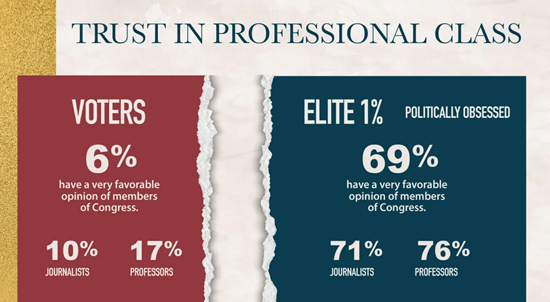
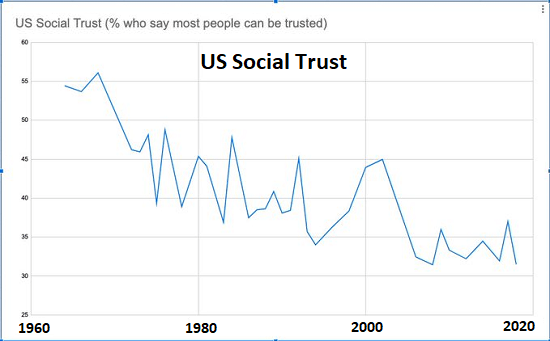
It’s not exactly news that social trust has declined significantly in the United States. Surveys find that public trust in institutions and the professional classes that dominate those institutions has cratered. (see chart below) Social trust–our confidence that other people are trustworthy–has also fallen to multi-decade lows.

This was not the case in decades past. Americans maintained high levels of trust in their institutions, government and fellow citizens. The decline in social trust is across the entire spectrum: our trust in institutions, professional elites and our fellow Americans has declined precipitously.

The causes of this decay of social trust can be debated endlessly, but several factors are obvious:

1. Institutions forfeited the trust of the citizenry by withholding / editing realities to serve the interests of hidden agendas and insiders’ careers. The Vietnam War was pursued on fabrications, as was the second Gulf War to topple Saddam. Watergate eroded trust on multiple levels, as did the Church Committee’s investigation of America’s security agencies’ domestic spying / over-reach.

2. The managerial / professional elites at the top of the nation’s institutions no longer put the citizenry’s interests above their own. The public’s trust has eroded as institutions are primarily viewed as vehicles for self-enrichment and career advancement: healthcare CEOs pay themselves millions, higher education is bloated with layers of non-teaching administration, defense contractors and the Pentagon have greased the revolving door to the benefit of incumbents and insiders, and so on, in an endless parade of self-serving cloaked with smirking PR claims of “serving the public.”

The shift from a high-trust society to a low-trust society is consequential economically, politically and socially. Low-trust societies have stagnant economies, as nobody trusts anyone they don’t know personally or through personally trusted networks, and nobody trust institutions to function effectively or fulfill their stated mission to serve the public good.

Faced with incompetent, unaccountable, corrupt bureaucracies and a culture overflowing with scams, frauds, imposters and get-rich-quick schemes, people give up and drop out. Rather than start a business and accept all the risks just to get dumped on or ripped off, they don’t even try to start a business. Given the financial insecurity that is now the norm, they decide not to get married or have children.

The vast trading networks of the Roman Empire were based on personal trusted networks and trust in Rome’s functionaries / institutions. The owners of trading ships dealt with trusted captains and merchants, who then paid duties to Roman functionaries in Alexandria and other major trading ports.

In other words, tightly bound personal trusted networks work well as long as the state institutions that bind the entire economy are trusted as fair and reliable–not perfect, of course, but efficient and “good enough.”

But when public institutions are viewed as unfair, unreliable, corrupt or incompetent, the entire economy decays. Even personal trusted networks cannot survive in an economy of unfair, unreliable, corrupt or incompetent state bureaucracies and private institutions.

The American economy is now dominated by enormous privately owned and managed monopolies and cartels that are the private-sector equivalent of self-serving state bureaucracies. Big Tech, Big Pharma, Big Healthcare, Big Ag, Big Finance, etc., are even worse than state bureaucracies because there are no legal requirements for transparency or recourse. Try getting a response from a Big Tech corporation when you’ve been shadow-banned or sent to Digital Siberia.

The sole remaining reservoirs of trust in American life are personal networks, local enterprises and local institutions. These are not guaranteed, of course; in many locales, even these reservoirs have been drained. But in other locales, enterprises and institutions such as the county water utility, the local newspaper, the local community college, etc. continue to earn the trust of the public by performing the services they exist to provide effectively and at a reasonable cost.

The larger the institution and the greater its wealth and power, the lower the social trust–for good reasons. The greater the influence of the managerial elites, the greater the disconnect from the everyday experiences of the citizenry and customers, and the more extreme the self-serving PR.

Sure, I trust Big Tech, Big Pharma, Big Healthcare, Big Finance–to rip me off, profiteer, send me obfuscating bills, jack up junk fees, make it impossible to contact them, and send me to Digital Siberia if I complain.

The divide between the elites and the commoners should prompt us to examine the low-trust path we’re sliding down:

In a society in which everything is phony, low quality or fraudulent, you’re taking a chance trusting anyone you don’t know personally–and even that can be risky now that self-aggrandizing flim-flam is the last remaining path to financial security for non-elites.

A low-trust society is an impoverished society, economically stagnant and socially threadbare. That’s where we are now, and the more fragmented, greedy, self-serving, desperate and deranged we become, the lower the odds that we’ll find the means to rebuild trust.

Sadly, we already know that anyone claiming to “rebuild trust” is spouting PR designed to mask self-enrichment. We also know that the vast army of well-paid flacks, factotums, enforcers, happy-story apologists, lackeys, toadies and sell-out minions are declaring “everything’s great!”

Just mumble, “Uh, sure” and continue to Tune in (to degrowth), drop out (of hyper-consumerism and debt-serfdom) and turn on (to self-reliance and relocalizing capital and agency).

Economic Earthquake Ahead? The Cracks Are Spreading Fast

By Brandon Smith

Source: The Burning Platform

One of my favorite false narratives floating around corporate media platforms has been the argument that the American people “just don’t seem to understand how good the economy really is right now.” If only they would look at the stats, they would realize that we are in the middle of a financial renaissance, right? It must be that people have been brainwashed by negative press from conservative sources…

I have to laugh at this notion because it’s a very common one throughout history – it’s an assertion made by almost every single political regime right before a major collapse. These people always say the same things, and when you study economics as long as I have you can’t help but throw up your hands and marvel at their dedication to the propaganda.

One example that comes to mind immediately is the delusional optimism of the “roaring” 1920s and the lead up to the Great Depression. At the time around 60% of the U.S. population was living in poverty conditions (according to the metrics of the decade) earning less than $2000 a year. However, in the years after WWI ravaged Europe, America’s economic power was considered unrivaled.

The 1920s was an era of mass production and rampant consumerism but it was all fueled by easy access to debt, a condition which had not really existed before in America. It was this illusion of prosperity created by the unchecked application of credit that eventually led to the massive stock market bubble and the crash of 1929. This implosion, along with the Federal Reserve’s policy of raising interest rates into economic weakness, created a black hole in the U.S. financial system for over a decade.

There are two primary tools that various failing regimes will often use to distort the true conditions of the economy: Debt and inflation. In the case of America today, we are experiencing BOTH problems simultaneously and this has made certain economic indicators appear healthy when they are, in fact, highly unstable. The average American knows this is the case because they see the effects everyday. They see the damage to their wallets, to their buying power, in the jobs market and in their quality of life. This is why public faith in the economy has been stuck in the dregs since 2021.

The establishment can flash out-of-context stats in people’s faces, but they can’t force the populace to see a recovery that simply does not exist. Let’s go through a short list of the most faulty indicators and the real reasons why the fiscal picture is not a rosy as the media would like us to believe…

The “miracle” labor market recovery

In the case of the U.S. labor market, we have a clear example of distortion through inflation. The $8 trillion+ dropped on the economy in the first 18 months of the pandemic response sent the system over the edge into stagflation land. Helicopter money has a habit of doing two things very well: Blowing up a bubble in stock markets and blowing up a bubble in retail. Hence, the massive rush by Americans to go out and buy, followed by the sudden labor shortage and the race to hire (mostly for low wage part-time jobs).

The problem with this “miracle” is that inflation leads to price explosions, which we have already experienced. The average American is spending around 30% more for goods, services and housing compared to what they were spending in 2020. This is what happens when you have too much money chasing too few goods and limited production.

The jobs market looks great on paper, but the majority of jobs generated in the past few years are jobs that returned after the covid lockdowns ended. The rest are jobs created through monetary stimulus and the artificial retail rush. Part time low wage service sector jobs are not going to keep the country rolling for very long in a stagflation environment. The question is, what happens now that the stimulus punch bowl has been removed?

Just as we witnessed in the 1920s, Americans have turned to debt to make up for higher prices and stagnant wages by maxing out their credit cards. With the central bank keeping interest rates high, the credit safety net will soon falter. This condition also goes for businesses; the same businesses that will jump headlong into mass layoffs when they realize the party is over. It happened during the Great Depression and it will happen again today.

Cracks in the foundation

We saw cracks in the narrative of the financial structure in 2023 with the banking crisis, and without the Federal Reserve backstop policy many more small and medium banks would have dropped dead. The weakness of U.S. banks is offset by the relative strength of the U.S. dollar, which lures in foreign investors hoping to protect their wealth using dollar denominated assets.

But something is amiss. Gold and bitcoin have rocketed higher along with economically sensitive assets and the dollar. This is the opposite of what’s supposed to happen. Gold and BTC are supposed to be hedges against a weak dollar and a weak economy, right? If global faith in the dollar and in the U.S. economy is so high, why are investors diving into protective assets like gold?

Again, as noted above, inflation distorts everything.

Tens of trillions of extra dollars printed by the Fed are floating around and it’s no surprise that much of that cash is flooding into the economy which simply pushes higher right along with prices on the shelf. But, gold and bitcoin are telling us a more honest story about what’s really happening.

Right now, the U.S. government is adding around $600 billion per month to the national debt as the Fed holds rates higher to fight inflation. This debt is going to crush America’s financial standing for global investors who will eventually ask HOW the U.S. is going to handle that growing millstone? As I predicted years ago, the Fed has created a perfect Catch-22 scenario in which the U.S. must either return to rampant inflation, or, face a debt crisis. In either case, U.S. dollar-denominated assets will lose their appeal and their prices will plummet.

“Healthy” GDP is a complete farce

GDP is the most common out-of-context stat used by governments to convince the citizenry that all is well. It is yet another stat that is entirely manipulated by inflation. It is also manipulated by the way in which modern governments define “economic activity.”

GDP is primarily driven by spending. Meaning, the higher inflation goes, the higher prices go, and the higher GDP climbs (to a point). Eventually prices go too high, credit cards tap out and spending ceases. But, for a short time inflation makes GDP (as well as retail sales) look good.

Another factor that creates a bubble is the fact that government spending is actually included in the calculation of GDP. That’s right, every dollar of your tax money that the government wastes helps the establishment by propping up GDP numbers. This is why government spending increases will never stop – It’s too valuable for them to spend as a way to make the economy appear healthier than it is.

The REAL economy is eclipsing the fake economy

The bottom line is that Americans used to be able to ignore the warning signs because their bank accounts were not being directly affected. This is over. Now, every person in the country is dealing with a massive decline in buying power and higher prices across the board on everything – from food and fuel to housing and financial assets alike. Even the wealthy are seeing a compression to their profit and many are struggling to keep their businesses in the black.

The unfortunate truth is that the elections of 2024 will probably be the turning point at which the whole edifice comes tumbling down. Even if the public votes for change, the system is already broken and cannot be repaired without a complete overhaul.

We have consistently avoided taking our medicine and our disease has gotten worse and worse.

People have lost faith in the economy because they have not faced this kind of uncertainty since the 1930s. Even the stagflation crisis of the 1970s will likely pale in comparison to what is about to happen. On the bright side, at least a large number of Americans are aware of the threat, as opposed to the 1920s when the vast majority of people were utterly conned by the government, the banks and the media into thinking all was well. Knowing is the first step to preparing.

The second step is securing your own financial future – that’s where physical precious metals can play a role. Diversifying your savings with inflation-resistant, uninflatable assets whose intrinsic value doesn’t rely on a counterparty’s promise to pay adds resilience to your savings. That’s the main reason physical gold and silver have been the safe haven store-of-value assets of choice for centuries (among both the elite and the everyday citizen).

Technocensorship: When Corporations Serve As a Front for Government Censors

By John & Nisha Whitehead

Source: The Rutherford Institute

“Once a government is committed to the principle of silencing the voice of opposition, it has only one way to go, and that is down the path of increasingly repressive measures, until it becomes a source of terror to all its citizens and creates a country where everyone lives in fear. We must, therefore, be on our guard against extremists who urge us to adopt police state measures. Such persons advocate breaking down the guarantees of the Bill of Rights in order to get at the communists. They forget that if the Bill of Rights were to be broken down, all groups, even the most conservative, would be in danger from the arbitrary power of government.”—Harry S. Truman, Special Message to the Congress on the Internal Security of the United States (August 8, 1950)

Nothing good can come from allowing the government to sidestep the Constitution.

Unfortunately, the government has become an expert at disregarding constitutional roadblocks intended to protect the rights of the citizenry.

When these end-runs don’t suffice, the government hides behind the covert, clandestine, classified language of national security; or obfuscates, complicates, stymies, and bamboozles; or creates manufactured diversions to keep the citizenry in the dark; or works through private third parties not traditionally bound by the Constitution.

This last tactic is increasingly how the government gets away with butchering our freedoms, by having its corporate partners serve as a front for its nefarious deeds.

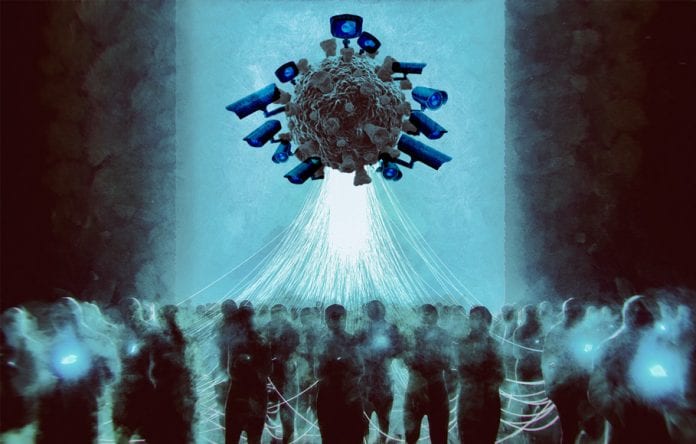
This is how the police state has managed to carry out an illegal secret dragnet surveillance program on the American people over the course of multiple presidential administrations.

Relying on a set of privacy loopholes, the White House (under Presidents Obama, Trump and now Biden) has been sidestepping the Fourth Amendment by paying AT&T to allow federal, state, and local law enforcement to access—without a warrant—the phone records of Americans who are not suspected of a crime.

The government used a similar playbook to get around the First Amendment, packaged as an effort to control the spread of speculative or false information in the name of national security.

As the House Judiciary Select Subcommittee on Weaponization of the Federal Government revealed, the Biden administration worked in tandem with social media companies to censor content related to COVID-19, including humorous jokes, credible information and so-called disinformation.

Likening the government’s heavy-handed attempts to pressure social media companies to suppress content critical of COVID vaccines or the election to “an almost dystopian scenario,” Judge Terry Doughty warned that “the United States Government seems to have assumed a role similar to an Orwellian ‘Ministry of Truth.’

Restricting access to social media has become a popular means of internet censorship.

Dare to voice politically incorrect views in anything louder than a whisper on social media and you might find yourself suspended on Twitter, shut out of Facebook, and banned across various social media platforms. This authoritarian intolerance masquerading as tolerance, civility and love is what comedian George Carlin referred to as “fascism pretending to be manners.”

Social media censorship runs the gamut from content blocking, throttling, and filtering to lockouts, shutdowns, shadow banning and de-platforming.

In fact, these tactics are at the heart of several critical cases before the U.S. Supreme Court over who gets to control, regulate or remove what content is shared on the internet: the individual, corporate censors or the government.

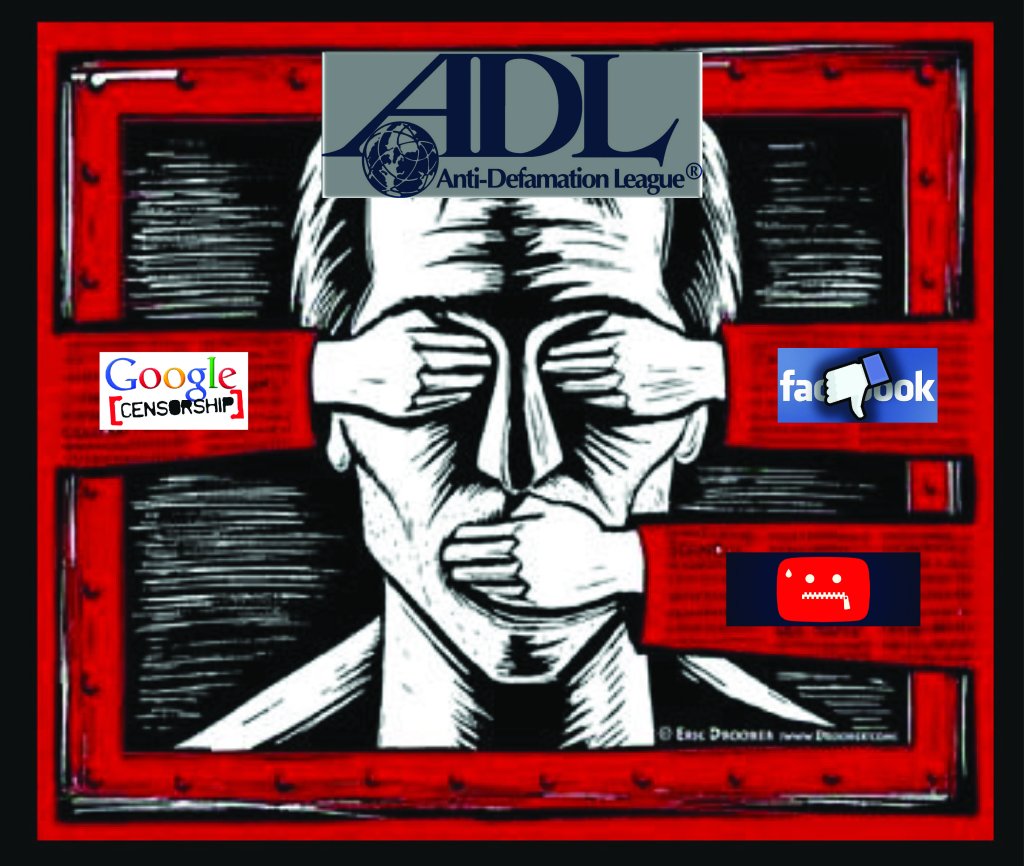
Yet what those who typically champion the right of corporations to be free from government meddling get wrong about these cases is that there can be no free speech when corporations such as Facebook, Google or YouTube become a front for—or extensions of—government censors.

This is the very definition of technocensorship.

On paper—under the First Amendment, at least—we are technically free to speak.

In reality, however, we are now only as free to speak as a government official—or corporate entities such as Facebook, Google or YouTube—may allow.

Clothed in tyrannical self-righteousness, technocensorship is powered by technological behemoths (both corporate and governmental) working in tandem to achieve a common goal: to muzzle, silence and altogether eradicate any speech that runs afoul of the government’s own approved narrative.

This is political correctness taken to its most chilling and oppressive extreme.

This authoritarian impulse to censor and silence “dangerous” speech masquerading as tolerance, civility and a concern for safety (what comedian George Carlin referred to as “fascism pretending to be manners”) is the end result of a politically correct culture that has become radicalized, institutionalized and tyrannical.

You see, the government is not protecting us from “dangerous” disinformation campaigns. It is laying the groundwork to insulate us from “dangerous” ideas that might cause us to think for ourselves and, in so doing, challenge the power elite’s stranglehold over our lives.

Thus far, the tech giants have been able to sidestep the First Amendment by virtue of their non-governmental status, but it’s a dubious distinction at best when they are marching in lockstep with the government’s dictates.

As Philip Hamburger and Jenin Younes write for The Wall Street Journal: “The First Amendment prohibits the government from ‘abridging the freedom of speech.’ Supreme Court doctrine makes clear that government can’t constitutionally evade the amendment by working through private companies.”

It remains to be seen whether the Supreme Court can see itself clear to recognizing that censorship by social media companies acting at the behest of the government runs afoul of the First Amendment.

Bottom line: either we believe in free speech or we don’t.

The answer to the political, legal and moral challenges of our day should always be more speech, not less.

Any individual or group—prominent or not—who is censored, silenced and made to disappear from Facebook, Twitter, YouTube and Instagram for voicing ideas that are deemed politically incorrect, hateful, dangerous or conspiratorial should be cause for alarm across the entire political spectrum.

To ignore the long-term ramifications of such censorship is dangerously naïve, because whatever powers the government and its corporate operatives are allowed to claim now will eventually be used against the populace at large.

These social shunning tactics borrow heavily from the mind control tactics used by authoritarian cults as a means of controlling its members. As Dr. Steven Hassan writes in Psychology Today: “By ordering members to be cut off, they can no longer participate. Information and sharing of thoughts, feelings, and experiences are stifled. Thought-stopping and use of loaded terms keep a person constrained into a black-and-white, all-or-nothing world. This controls members through fear and guilt.”

This mind control can take many forms, but the end result is an enslaved, compliant populace incapable of challenging tyranny.

As Rod Serling, creator of The Twilight Zone, once observed, “We’re developing a new citizenry, one that will be very selective about cereals and automobiles, but won’t be able to think.”

The problem is that we’ve allowed ourselves to be persuaded that we need someone else to think and speak for us, and we’ve bought into the idea that we need the government and its corporate partners to shield us from that which is ugly or upsetting or mean. The result is a society in which we’ve stopped debating among ourselves, stopped thinking for ourselves, and stopped believing that we can fix our own problems and resolve our own differences.

In short, we have reduced ourselves to a largely silent, passive, polarized populace incapable of working through our own problems and reliant on the government to protect us from our fears.

As Nat Hentoff, that inveterate champion of the First Amendment, once observed, “The quintessential difference between a free nation, as we profess to be, and a totalitarian state, is that here everyone, including a foe of democracy, has the right to speak his mind.”

What this means is championing the free speech rights of those with whom we might disagree.

That’s why James Madison, the author of the Bill of Rights, fought for a First Amendment that protected the “minority” against the majority, ensuring that even in the face of overwhelming pressure, a minority of one—even one who espouses distasteful viewpoints—would still have the right to speak freely, pray freely, assemble freely, challenge the government freely, and broadcast his views in the press freely. He understood that freedom for those in the unpopular minority constitutes the ultimate tolerance in a free society.

The government has no tolerance for freedom or free speech of any kind that challenges its chokehold on power.

At some point or another, depending on how the government and its corporate allies define what constitutes “disinformation,” “hate” or “extremism, “we the people” might all be considered guilty of some thought crime or speech transgression or other.

Yet as I make clear in my book Battlefield America: The War on the American People and in its fictional counterpart The Erik Blair Diaries, it’s a slippery slope from censoring so-called illegitimate ideas to silencing truth.

Eventually, as George Orwell predicted, telling the truth will become a revolutionary act.

Ultimately, the government’s war on free speech—and that’s exactly what it is—is a war that is driven by a government fearful of its people.

As President John F. Kennedy observed, “[A] nation that is afraid to let its people judge the truth and falsehood in an open market is a nation that is afraid of its people.”

Criminality in the White House: The Rise of the Political Psychopath

By John & Nisha Whitehead

Source: The Rutherford Institute

“When the President does it, that means that it is not illegal.”—Richard Nixon

Many years ago, a newspaper headline asked the question: “What’s the difference between a politician and a psychopath?

The answer, then and now, remains the same: None.

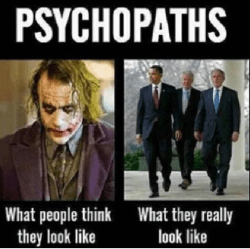
There is no difference between psychopaths and politicians.

Nor is there much of a difference between the havoc wreaked on innocent lives by uncaring, unfeeling, selfish, irresponsible, parasitic criminals and elected officials who lie to their constituents, trade political favors for campaign contributions, turn a blind eye to the wishes of the electorate, cheat taxpayers out of hard-earned dollars, favor the corporate elite, entrench the military industrial complex, and spare little thought for the impact their thoughtless actions and hastily passed legislation might have on defenseless citizens.

Psychopaths and politicians both have a tendency to be selfish, callous, remorseless users of others, irresponsible, pathological liars, glib, con artists, lacking in remorse and shallow.

Charismatic politicians, like criminal psychopaths, exhibit a failure to accept responsibility for their actions, have a high sense of self-worth, are chronically unstable, have socially deviant lifestyles, need constant stimulation, have parasitic lifestyles and possess unrealistic goals.

It doesn’t matter whether you’re talking about Democrats or Republicans.

Political psychopaths are all largely cut from the same pathological cloth, brimming with seemingly easy charm and boasting calculating minds. Such leaders eventually create pathocracies: totalitarian societies bent on power, control, and destruction of both freedom in general and those who exercise their freedoms.

Once psychopaths gain power, the result is usually some form of totalitarian government or a pathocracy. “At that point, the government operates against the interests of its own people except for favoring certain groups,” author James G. Long notes. “We are currently witnessing deliberate polarizations of American citizens, illegal actions, and massive and needless acquisition of debt. This is typical of psychopathic systems, and very similar things happened in the Soviet Union as it overextended and collapsed.”

In other words, electing a psychopath to public office is tantamount to national hara-kiri, the ritualized act of self-annihilation, self-destruction and suicide. It signals the demise of democratic government and lays the groundwork for a totalitarian regime that is legalistic, militaristic, inflexible, intolerant and inhuman.

Incredibly, despite clear evidence of the damage that has already been inflicted on our nation and its citizens by a psychopathic government, voters continue to elect psychopaths to positions of power and influence.

Indeed, a study from Southern Methodist University found that Washington, DC—our nation’s capital and the seat of power for our so-called representatives—ranks highest on the list of regions that are populated by psychopaths.

According to investigative journalist Zack Beauchamp, “In 2012, a group of psychologists evaluated every President from Washington to Bush II using ‘psychopathy trait estimates derived from personality data completed by historical experts on each president.’ They found that presidents tended to have the psychopath’s characteristic fearlessness and low anxiety levels — traits that appear to help Presidents, but also might cause them to make reckless decisions that hurt other people’s lives.”

The willingness to prioritize power above all else, including the welfare of their fellow human beings, ruthlessness, callousness and an utter lack of conscience are among the defining traits of the sociopath.

When our own government no longer sees us as human beings with dignity and worth but as things to be manipulated, maneuvered, mined for data, manhandled by police, conned into believing it has our best interests at heart, mistreated, jailed if we dare step out of line, and then punished unjustly without remorse—all the while refusing to own up to its failings—we are no longer operating under a constitutional republic.

Instead, what we are experiencing is a pathocracy: tyranny at the hands of a psychopathic government, which “operates against the interests of its own people except for favoring certain groups.”

Worse, psychopathology is not confined to those in high positions of government. It can spread like a virus among the populace. As an academic study into pathocracy concluded, “[T]yranny does not flourish because perpetuators are helpless and ignorant of their actions. It flourishes because they actively identify with those who promote vicious acts as virtuous.”

People don’t simply line up and salute. It is through one’s own personal identification with a given leader, party or social order that they become agents of good or evil.

Much depends on how leaders “cultivate a sense of identification with their followers,” says Professor Alex Haslam. “I mean one pretty obvious thing is that leaders talk about ‘we’ rather than ‘I,’ and actually what leadership is about is cultivating this sense of shared identity about ‘we-ness’ and then getting people to want to act in terms of that ‘we-ness,’ to promote our collective interests. . . . [We] is the single word that has increased in the inaugural addresses over the last century . . . and the other one is ‘America.’”

The goal of the modern corporate state is obvious: to promote, cultivate, and embed a sense of shared identification among its citizens. To this end, “we the people” have become “we the police state.”

We are fast becoming slaves in thrall to a faceless, nameless, bureaucratic totalitarian government machine that relentlessly erodes our freedoms through countless laws, statutes, and prohibitions.

Any resistance to such regimes depends on the strength of opinions in the minds of those who choose to fight back. What this means is that we the citizenry must be very careful that we are not manipulated into marching in lockstep with an oppressive regime.

Writing for ThinkProgress, Beauchamp suggests that “one of the best cures to bad leaders may very well be political democracy.”

But what does this really mean in practical terms?

It means holding politicians accountable for their actions and the actions of their staff using every available means at our disposal: through investigative journalism (what used to be referred to as the Fourth Estate) that enlightens and informs, through whistleblower complaints that expose corruption, through lawsuits that challenge misconduct, and through protests and mass political action that remind the powers-that-be that “we the people” are the ones that call the shots.

Remember, education precedes action. Citizens need to the do the hard work of educating themselves about what the government is doing and how to hold it accountable. Don’t allow yourselves to exist exclusively in an echo chamber that is restricted to views with which you agree. Expose yourself to multiple media sources, independent and mainstream, and think for yourself.

For that matter, no matter what your political leanings might be, don’t allow your partisan bias to trump the principles that serve as the basis for our constitutional republic. As Beauchamp notes, “A system that actually holds people accountable to the broader conscience of society may be one of the best ways to keep conscienceless people in check.”

That said, if we allow the ballot box to become our only means of pushing back against the police state, the battle is already lost.

Resistance will require a citizenry willing to be active at the local level.

Yet if you wait to act until the SWAT team is crashing through your door, until your name is placed on a terror watch list, until you are reported for such outlawed activities as collecting rainwater or letting your children play outside unsupervised, then it will be too late.

This much I know: we are not faceless numbers.

We are not cogs in the machine.

As I make clear in my book Battlefield America: The War on the American People and in its fictional counterpart The Erik Blair Diaries, we are not slaves.

We are human beings, and for the moment, we have the opportunity to remain free—that is, if we tirelessly advocate for our rights and resist at every turn attempts by the government to place us in chains.

The Founders understood that our freedoms do not flow from the government. They were not given to us only to be taken away by the will of the State. They are inherently ours. In the same way, the government’s appointed purpose is not to threaten or undermine our freedoms, but to safeguard them.

Until we can get back to this way of thinking, until we can remind our fellow Americans what it really means to be free, and until we can stand firm in the face of threats to our freedoms, we will continue to be treated like slaves in thrall to a bureaucratic police state run by political psychopaths.

If You’ve Just Started Paying Attention To US Foreign Policy

There are always, ALWAYS lies, obfuscations and manipulations involved in marketing a new war to the public, or in hiding its involvement in foreign wars from public attention.

By Caitlin Johnstone

Source: CaitlinJohnstone.com.au

If you’re among those who have only just begun paying attention to US foreign policy and western media bias in light of Israel’s destruction of Gaza and Biden’s act of war against Yemen, it’s important to understand that none of the depravity you’re seeing is new. The lies. The insane double standards. The murderousness. The western political/media class always does this.

Every war the US involves itself in is always facilitated by lies promulgated in one voice by the official government in Washington and by the “independent” “free” press (actually propaganda services) of the western world. They deceived the world about Ukraine. They deceived the world about Yemen. They deceived the world about Syria, Libya and Iraq. There are always, always lies, obfuscations and manipulations involved in marketing a new war to the public, or in hiding its involvement in foreign wars from public attention.

All of this manipulation and deceit is necessary to hide the fact that the US-centralized empire is the most tyrannical power structure on this planet. And make no mistake, it is an empire. Washington serves as the hub of an undeclared empire comprised of alliances, partnerships, assets, public deals and secret agreements which knit a large number of nations together into what functions as a single power structure with regard to international affairs.

Most of the beneficiaries of this power structure reside in the west, or global north, while the most exploited and abused victims of this power structure tend to reside in the east, or global south. There are all sorts of rules and regulations and narratives and justifications for why this all happens the way it happens, but if you mentally “mute” the soundtrack on the verbal overlay and just look at what’s actually happening, what you will see is the lion’s share of the world’s wealth and resources moving northward and westward from populations of a darker average skin tone toward populations of a paler average skin tone. Wherever that movement is hindered, diverted, threatened or inconvenienced, you will see western war machinery moving southward and eastward to get it back on the desired track.

Most major international conflicts can be understood as either direct or indirect efforts by the US empire to shore up planetary domination, which are often met with resistance by populations who wish to retain their sovereignty. Much of this conflict happens in the middle east because that’s where the world gets a lot of its oil from, with US-aligned nations like Israel and Saudi Arabia frequently serving as the frontline for hostilities with non-US-aligned nations like Iran and Syria as well as non-US-aligned forces like Hezbollah, Ansarallah and Hamas.

This struggle for US planetary hegemony is disguised by the western political/media class as something other than what it is, because you can’t allow the public in a democratic nation to understand clearly that their government is on the side of evil. They’ll frame it as a US-led international coalition to liberate a nation from a tyrannical dictator. As a humanitarian intervention to protect human rights. As support for Israel’s right to defend itself. As protection of freedom of navigation in the Red Sea. But what’s actually happening is the world’s most powerful and murderous power structure killing human beings in western Asia in order to secure control over a crucial resource.

You see this all over the world against nations which refuse to allow themselves to be absorbed into the US-centralized power structure like North Korea, Venezuela and Cuba, with China being by far the strongest of these and Russia a distant second. And you will notice that you have heard every nation I just mentioned cast in a very negative light by the western press over the years. This is not a coincidence. 

You don’t need to believe anything I’m saying on faith. If you just keep in mind what I said and start watching the patterns for yourself while seeking out the truth day by day, you will see it for yourself. You will see the same patterns emerging over and over again, year after year. Over and over again you will see the US and the states that are aligned with it acting with extreme aggression toward non-US-aligned powers in ways that benefit the US-centralized power structure, and you will see the western press deceiving the world about what’s happening. The next Official Bad Guy you see dominating western press coverage on international affairs will be a non-US-aligned power, and if you apply diligent research and critical thinking you will find that they are not presenting an accurate picture of what’s happening.

Just keep learning and studying the patterns with open curiosity and self-honesty, and the picture will inevitably become clear to you. And then you will clearly see who’s really driving the bulk of the violence and disorder in our world.

How to Navigate Our Low-Trust, Increasingly Dysfunctional Society and Economy

By Charles Hugh Smith

Source: Of Two Minds

Politicians and corporate managers have an enviable record of self-enrichment but very little to show in terms of putting the long-term interests of the citizenry above their own short-term gains.

This week’s focus is on self-reliance, a topic of increasing relevance than is more complex that it may seem.

Sociologists differentiate between high-trust and low-trust societies: in high-trust social orders, citizens tend to trust institutions and each other to conform to social norms, enabling strangers to trust a vast circle of transactions and socio-economic ties. Low-trust societies are plagued with distrust of authority and institutions and fear of getting taken advantage of by strangers, so the circles of trust are small, inhibiting social mobility and economic growth.

Economies and political systems can also be understood as high-trust or low-trust. If the political system excels at rewarding insiders and incumbents while leaving critical problems unsolved, citizens have little reason to trust the system.

The same is true of economies that greatly enrich insiders and incumbents at the expense of the citizenry via monopoly/cartel price-gouging, shrinkflation, degrading the quality of goods and services and the immiseration of standard services, forcing customers to “upgrade” from wretched to merely dismal.

Conventional pundits and economists are constantly whining that Americans “just don’t get it”: they tout our soaring per capita wealth, i.e. we’re getting richer, so everyone should be delighted, yet only 20% of the public are “satisfied with the way things are going.”

What the well-compensated pundits and economists are ignoring (or are paid to ignore) is the decay of the U.S. from a high-trust-functional to a low-trust-dysfunctional society and economy: Americans will still go out of their way to aid strangers, but their trust in institutions has plummeted to lows, as has their trust in the political-corporate elites’ leadership: politicians and corporate managers have an enviable record of self-enrichment but very little to show in terms of putting the long-term interests of the citizenry above their own short-term gains.

People understand the name of the game now is to spout all the expected optimistic PR of “innovation” and “serving the public” while maximizing their private gain at the expense of the nation. Offshoring America’s essential industrial supply chains wasn’t done to serve the nation; it was done to maximize profits, 90% of which flow to the top 10%. Pushing us into debt servitude is highly profitable, but it isn’t benefiting us or the nation.

Americans were told to trust long, hyper-globalized single-source supply chains as “efficient” (i.e. profitable) and trustworthy, yet they’ve discovered these supply chains are vulnerable and fragile. Americans were told that corporate monopolies were selling them “innovations” when in fact they were being sold highly addictive (and therefore highly profitable) goods and services.

Americans were told that their financial security was increasing even as the U.S. economy became increasingly dependent on hyper-financialized asset bubbles and central bank bailouts, the precise opposite of stability. Rather than producing more financial security for the bottom 80%, these “innovations” greatly expanded the gulf between the wealthy and the increasingly precarious bottom 80%.

Americans were told to trust that the hyper-centralization of political and financial power would benefit them, when the evidence is piling up that this hyper-centralization has increased the dysfunction of core institutions and the fragility of essential systems.

Doesn’t it ring hollow to glorify our soaring wealth while households declare bankruptcy due to medical bills, college students sign up for a lifetime of debt servitude to pay tuition and inflation has destroyed 20% of every wage earner’s paycheck just since January 2020? All that “soaring wealth” is asymmetrically distributed, but let’s not talk about that, let’s talk about statistics that mask that asymmetry.

What the well-compensated pundits and economists are paid to ignore is the concentration of the vast majority of all this new wealth and income in the top 10%. Soaring wealth only widens wealth inequality; it doesn’t benefit the nation, it weakens its foundations by accelerating the decay of trust in core institutions and systems.

What happens when high-trust decays to low-trust is the circle of reliable, trustworthy sources and people shrinks to the local, decentralized level. Rather than trust Big Ag, Big Fast-Food and supply chains of highly processed glop to feed us, we start turning to local sources of real food.

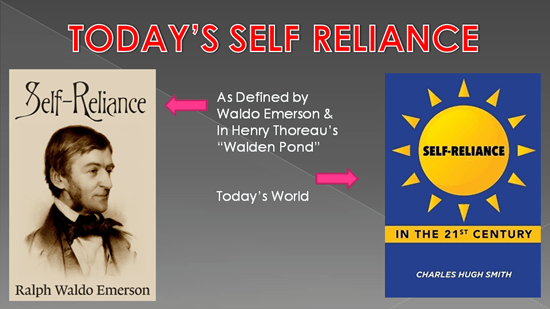
In the same way, we rediscover the value of thinking for ourselves rather than accepting self-serving memes-of-the-day. We rediscover the value of what Ralph Waldo Emerson wrote about in his 1841 essay Self-Reliance (free text, Project Gutenberg).

Emerson counsels us to “be our best selves,” and not to count property wealth above all else. (“They measure their esteem of each other by what each has, and not by what each is.”)

Emerson understood that the values of a society are the foundation of its economic order. A system lacking any principles and values other than greed and self-enrichment is a rotten structure doomed to collapse. It is not just the larger socio-economic order that needs a rock-solid value system; each individual must ground their choices and actions in a value system they have embraced on their own. (“Nothing can bring you peace but yourself. Nothing can bring you peace but the triumph of principles.”)

What Emerson is espousing is self-reliance, in thought, in values, and in economic and financial matters. In today’s world of crumbling hyper-globalization, self-reliance extends to the practical world of where our essential goods and services are coming from.

Gordon Long and I discuss these and many other aspects of Self-Reliance in the 21st Century in our wide-ranging podcast Self Reliance (45 min).

We discuss how the American economy has changed over the past 40 years, to the detriment of the nation’s values and the security of its citizenry, and what self-reliance means today– the topic of my book Self-Reliance in the 21st Century. (Read the first chapter for free.)

How can we best navigate our low-trust, increasingly dysfunctional society and economy? By strengthening our own self-reliance.