
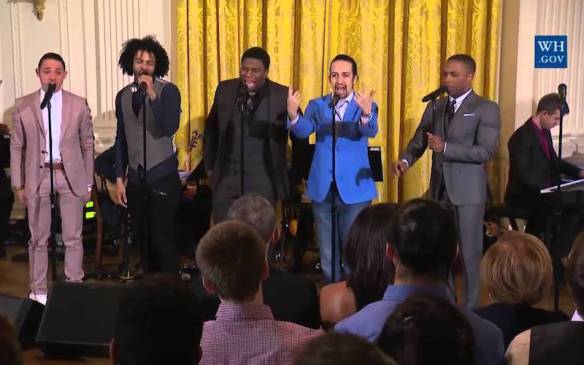
You Should Be Terrified That People Who Like “Hamilton” Run Our Country

maxresdefault

The American elite can’t get enough of a musical that flatters their political sensibilities and avoids discomforting truths.

By

Source: Current Affairs

In 2012, Captain Dan and his Scurvy Crew, a four-man hip-hop ensemble trying to cement “pirate rap” as a tenable subgenre, appeared on America’s Got Talent. The quartet had clearly put some thought, or at least effort, into the act; their pirate costumes might even have passed historical muster were it not for the leftmost crewmember’s Ray-Bans and Dan’s meticulously groomed chinstrap beard.

The routine itself went precisely in the direction one might have expected:

Captain Dan: When I say yo, you say ho. Yo!

Scurvy Crew: HO!

Captain Dan: YO!

Scurvy Crew: HO!

The group managed to rattle off two-and-a-half stilted lines before the judges began sounding their buzzers. Howard Stern was the last to give them the red “X,” preferring to let the audience’s boos come to a crescendo before he cut the Scurvy Crew off. Stern seemed to take great pleasure in calling the group “stupid,” “moronic,” “idiotic,” and “pathetic” on a national stage (Captain Dan grimaced through his humiliating dressing-down while his bandmates laughed it off, exposing a gap in emotional investment in the project between captain and crew, one that likely led to some intra-group tension during the post-show commiseration drinks).

Howie Mandel: They have restaurants like this—like Medieval Times—where you go and you get a pirates thing and you get a chicken dinner. We didn’t get a chicken dinner with this.

In 2012, everyone (save for Captain Dan himself, along with people whose tastes range from “music from video games” to “music about video games”) was in agreement that performing high-school-history-project rap in Colonial Williamsburg garb was culturally unconscionable. Right?

Wrong. The world in which we live now includes Hamilton, a wildly successful “hip-hop musical” about the first Secretary of the Treasury of the United States of America.

Now, perhaps the America’s Got Talent audience isn’t an accurate sample of the American population as a whole. Perhaps they actually thought “when I say yo, you say ho” was clever , but were directed to boo by an off-screen neon sign. Or perhaps something happened in the past four years that made everyone really stupid.

But what if the American public’s taste hasn’t devolved? What if Hamilton’s success is the result of something else altogether?

Brian Eno once said that the Velvet Underground’s debut album only sold a few thousand copies, but everyone who bought it started a band. The same principle likely applies to Hamilton: only a few thousand people could afford to see it, but everyone who did happened to work for a prominent New York/D.C. publication.

The media gushing over Hamilton has been downright torrential. “I am loath to tell people to mortgage their houses and lease their children to acquire tickets to a hit Broadway show,” wrote Ben Brantley of the New York Times. “But Hamilton… might just about be worth it.” The hyperbolic headlines poured forth unceasingly: “Is Hamilton the Musical the Most Addicting Album Ever?” Hamilton is the most important musical of our time.” Hamilton Haters Are Why We Can’t Have Nice Things.” The media then got high on their own supply, diagnosing all of America with a harrowing ailment called “Hamilton mania.” The work was “astonishing,” “sublime,” the “cultural event of our time.” Clarence Page of the Chicago Tribune said the musical was “even better than the hype.” Given the tenor of the hype, one can only imagine the pure, overpowering ecstasy that must comprise the Hamilton-viewing experience. The musical even somehow won a Pulitzer Prize this year, alongside Nicholas Kristof and that book by Ta-Nehisi Coates you bought but never read.

One of the publications to enter swooning raptures over Hamilton was BuzzFeed, which called it the smash musical “that everyone you know has been quoting for months.” (Literally nobody has ever quoted Hamilton in my presence.) BuzzFeed’s workplace obsession with the musical led to the birthing of the phrase “BuzzFeed Hamilton Slack.” That three-word monstrosity, incomprehensible to anyone outside the narrowest circle of listicle-churning media elites, describes a room on the corporate messaging platform “Slack” used exclusively by BuzzFeed employees to discuss Hamilton. J.R.R. Tolkien said that “cellar door” was the most beautiful phonetic phrase the English language could produce. “BuzzFeed Hamilton Slack,” by contrast, may be the most repellent arrangement of words in any tongue.

Those of us unfortunate enough not to work media jobs can never be privy to what goes on in a “BuzzFeed Hamilton Slack.” But the Twitter emissions of the Slack’s denizens suggest a swamp into which no man should tread. A tellingly ominous and thoroughly representative Tweet:

“When the Buzzfeed #Hamilton slack room has a heated debate about which Hogwarts houses the characters belong to” —@Arielle07

“Nerdcore” music (Wikipedia: “a genre of hip hop music characterized by themes and subject matter considered to be of general interest to nerds”) has always had trouble getting off the ground. The “first lady of nerdcore,” rapper MC Router (responsible for the song “Trekkie Pride”), never achieved the critical success for which she had seemed destined, instead ending up on the Dr. Phil show after an acrimonious dispute with her family over her unexpected conversion to Islam. Similarly, the YouTube series “Epic Rap Battles of History,” however numerous its subscribers may have been, has consistently been unjustly robbed of the Pulitzer. Now, finally, nerd rap has apparently found in Hamilton its own Sgt. Pepper, a lofty, expansive work that wins the hearts and minds of previously skeptical elite critics.

One should have no doubt that “expensively-staged nerdcore” is a perfectly accurate, even generous description of Hamilton. Doubters need only examine a brief lyrical snippet. Consider this, from “The Election of 1800”:

Madison: It’s a tie! …

Jefferson: It’s up to the delegates!…

Jefferson/Madison: It’s up to Hamilton!

Hamilton: Yo.

The people are asking to hear my voice ..

For the country is facing a difficult choice.

And if you were to ask me who I’d promote …

Jefferson has my vote.

Perhaps marginally less embarrassing than “when I say yo, you say ho.” But only ever so marginally.

One could question the fairness of appraising a musical before putting one’s self through its full three-hour theatrical experience. But if nobody could criticize Hamilton without having seen it, then nobody could criticize Hamilton. One of the strangest aspects of the whole “Hamiltonmania” public relations spectacle is that hardly anyone in the country has actually attended the musical to begin with. The show is exclusive to Broadway and has spent most of its run completely sold out, seemingly playing to an audience comprised entirely of people who write breathless BuzzFeed headlines. (Fortunately, when you can get off the waitlist it only costs $1,200 a ticket—so long as you can stand bad seats.) Hamilton is the “nationwide sensation” that only .001% of the nation has even witnessed.

There’s something revealing in the disjunction between Hamilton’s popularity in the world of online media and Hamilton’s popularity in the world of actual human persons. After all, here we have a cultural product whose appeal essentially consists of a broad coalition of the worst people in America: New York Times writers, 15-year-olds who aspire to answer the phone in Chuck Schumer’s office, people who want to get into steampunk but have a copper sensitivity, and “wonks.” Yet because a large fraction of these people are elite taste-makers, Hamilton becomes a topic of disproportionate interest, discussed at unendurable length in The New Yorker and Slate and The New York Times Magazine, yet totally inaccessible to anyone besides the writers and members of their close social networks. When The New Yorker writes about a book that nobody in America wants to read, at least they could theoretically go out and purchase it. But Hamilton theatergoing is solely the provenance of Hamilton thinkpiece-writers. The endless swirl of online Hamilton-buzz shows the comical extreme of cultural insularity in the New York and D.C. media. The “cultural event of our time” is totally unknown to nearly all who actually live in our time.

Given that Hamilton is essentially Captain Dan with an American Studies minor, one might wonder how it became so inordinately adored by the blathering class. How did a ten-million-dollar 8th Grade U.S. History skit become “the great work of art of the 21st century” (as the New Yorker’s Adam Gopnik says those in his circle have been calling it)?

To judge from the reviews, most of the appeal seems to rest with the forced diversity of its cast and the novelty concept of a “hip-hop musical.” Those who write about Hamilton often dwell primarily on its “groundbreaking” use of rap and its “bold” choice to cast an assemblage of black, Asian, and Latino actors as the Founding Fathers. Indeed, Hamilton exists more as a corporate HR department’s wet dream than as a biographical work.

The most obvious historical aberration is the portrayal of Washington and Jefferson as black men, a somewhat audacious choice given that both men are strongly associated with owning, and in the case of the latter, raping and impregnating slaves. Changing the races allows these men to appear far more sympathetic than they would otherwise be. Hamilton creator Lin-Manuel Miranda says he did this intentionally, to make the cast “look like America today,” and that having black actors play the roles “allow[s] you to leave whatever cultural baggage you have about the founding fathers at the door.” (“Cultural baggage” is an odd way of describing “feeling discomfort at warm portrayals of slaveowners.”) Thus Hamilton’s superficial diversity lets its almost entirely white audience feel good about watching it: no guilt for seeing dead white men in a positive light required. Now, The New York Times can delight in the novel incongruousness of “a Thomas Jefferson who swaggers like the Time’s Morris Day, sings like Cab Calloway and drawls like a Dirty South trap-rapper.” Indeed, it does take some getting used to, because the actual Thomas Jefferson raped slaves.

“Casting black and Latino actors as the founders effectively writes nonwhite people into the story, in ways that audiences have powerfully responded to,” said the New York Times. But fixing history makes it seem less objectionable than it actually was. We might call it a kind of, well, “blackwashing,” making something that was heinous seem somehow palatable by retroactively injecting diversity into it.

Besides, you don’t actually need to “write nonwhite people into the story.” As historians have pointed out, there were plenty of nonwhite people around at the time, people who already had fully-developed stories and identities. But none of these people appears in the play. As some have quietly noted, the vast majority of African American cast members simply portray nameless dancing founders in breeches and cravats, and “not a single enslaved or free person of color exists as a character in this play.” (Although Jefferson’s slave and mistress Sally Hemings gets a brief shout-out.)

Slavery is left out of the play almost completely. Historian Lyra Monteiro observes that “Unless one listens carefully to the lyrics—which do mention slavery a handful of times—one could easily assume that slavery did not exist in this world.” The foundation of the 18th century economic system, the vicious practice that defined the lives of countless black men and women, is confined to the odd lyrical flourish here and there.

Miranda did consider adding a slavery number. But he cut it from the show, as he explains:

There was a rap battle about slavery, where it was Hamilton and Jefferson and Madison knocking it from all sides of the issue. Jefferson being like, “Hey, I wrote about this, and no one wanted to touch it!” And Hamilton being very self-righteous, like, “You’re having an affair with one of your slaves!” And Madison hits him with a “You want to talk about affairs?” And in the end, no one does anything. Which is what happened in reality! So we realized we were bringing our show to a halt on something that none of them really did enough on.

Miranda found that by trying to write a song about his main characters’ attitudes toward slavery, he ran into the inconvenient fact that all of them willfully tolerated or participated in it. That made it difficult to square with the upbeat portrayals he was going for, and so slavery had to go. Besides, dwelling on it could “bring the show to a halt.” And as cast member Christopher Jackson, who plays George Washington, notes: ‘‘The Broadway audience doesn’t like to be preached to.” Who would want to spoil the fun?

Instead, Hamilton’s Hamilton is what Slate called simply “lovable—a product of the play’s humanizing focus on Hamilton’s vulnerabilities and ambitions.” The play avoids depicting his unabashed elitism and more repellent personal characteristics. And in the brief references that are made to slavery, the play even generously portrays Hamilton as far more committed to the cause of freedom than he actually was. In this way, Hamilton carefully makes sure its audience is neither challenged nor discomforted, and can leave the theater without having to confront any unpleasant truths.

Just as Hamilton ducks the question of slavery, much of the actual substance of Alexander Hamilton’s politics is ignored, in favor of a story that stresses his origins as a Horatio Alger immigrant and his rivalry with Aaron Burr. But while Hamilton may have favored opening America’s doors to immigration, he also proposed a degree of economic protectionism that would terrify today’s free market establishment.

Hamilton believed that free trade was never equal, and worried about the ability of European manufacturers (who got a head start on the Industrial Revolution) to sell goods at lower prices than their American counterparts. In Hamilton’s 1791 Report on Manufactures, he spoke of the harms to American industry that came with our reliance on products from overseas. The Report sheds light on many of the concerns Americans in the 21st century have about outsourcing, sweatshops, and the increasing trade deficit, albeit in a different context. Hamilton said that for the U.S., “constant and increasing necessity, on their part, for the commodities of Europe, and only a partial and occasional demand for their own, in return, could not but expose them to a state of impoverishment, compared with the opulence to which their political and natural advantages authorise them to aspire.” For Hamilton, the solution was high tariffs on imports of manufactured goods, and intensive government intervention in the economy. The prohibitive importation costs imposed by tariffs would allow newer American manufacturers to undersell Europe’s established industrial framework, leading to an increase in non-agricultural employment. As he wrote: “all the duties imposed on imported articles… wear a beneficent aspect towards the manufacturers of the country.”

Does any of this sound familiar? It certainly went unmentioned at the White House, where a custom performance of Hamilton was held for the Obamas. The livestreamed presidential Hamilton spectacular at one point featured Obama and Miranda performing historically-themed freestyle rap in the Rose Garden.

The Obamas have been supporters of Hamilton since its embryonic days as the “Hamilton Mixtape song cycle.” By the time the fully-fledged musical arrived in Washington, Michelle Obama called it the “best piece of art in any form that I have ever seen in my life,” raising disquieting questions about the level of cultural exposure offered in the Princeton undergraduate curriculum.

In introducing the White House performance, Barack Obama gave an effusive speech worthy of the BuzzFeed Hamilton Slack:

[Miranda] identified a quintessentially American story in the character of Hamilton — a striving immigrant who escaped poverty, made his way to the New World, climbed to the top by sheer force of will and pluck and determination… And in the Hamilton that Lin-Manuel and his incredible cast and crew bring to life — a man who is “just like his country, young, scrappy, and hungry” — we recognize the improbable story of America, and the spirit that has sustained our nation for over 240 years… In this telling, rap is the language of revolution. Hip-hop is the backbeat. … And with a cast as diverse as America itself, including the outstandingly talented women — (applause) — the show reminds us that this nation was built by more than just a few great men — and that it is an inheritance that belongs to all of us.

Strangely enough, President Obama failed to mention anything Alexander Hamilton actually did during his long career in American politics, perhaps because the Obama Administration’s unwavering support of free trade and the tariff-easing Trans-Pacific Partnership goes against everything Hamilton believed. Instead, Obama’s Hamilton speech stresses just two takeaways from the musical: that America is a place where the poor (through “sheer force of will” and little else) can rise to prominence, and that Hamilton has diversity in it. (Plus it contains hip-hop, an edgy, up-and-coming genre with only 37 years of mainstream exposure.)

The Obamas were not the only members of the political establishment to come down with a ghastly case of Hamiltonmania. Nearly every figure in D.C. has apparently been to see the show, in many cases being invited for a warm backstage schmooze with Miranda. Biden saw it. Mitt Romney saw it. The Bush daughters saw it. Rahm Emanuel saw it the day after the Chicago teachers’ strike over budget cuts and school closures. Hillary Clinton went to see the musical in the evening after having been interviewed by the FBI in the morning. The Clinton campaign has also been fundraising by hawking Hamilton tickets; for $100,000 you can watch a performance alongside Clinton herself.

Unsurprisingly, the New York Times reports that “conservatives were particularly smitten” with Hamilton. “Fabulous show,” tweeted Rupert Murdoch, calling it “historically accurate.” Obama concluded that “I’m pretty sure this is the only thing that Dick Cheney and I have agreed on—during my entire political career.” (That is, of course, false. Other points of agreement include drone strikes, Guantanamo, the NSA, and mass deportation.)

The conservative-liberal D.C. consensus on Hamilton makes perfect sense. The musical flatters both right and left sensibilities. Conservatives get to see their beloved Founding Fathers exonerated for their horrendous crimes, and liberals get to have nationalism packaged in a feel-good multicultural form. The more troubling questions about the country’s origins are instantly vanished, as an era built on racist forced labor is transformed into a colorful, culturally progressive, and politically unobjectionable extravaganza.

As the director of the Hamilton theater said, “It has liberated a lot of people who might feel ambivalent about the American experiment to feel patriotic.” “Ambivalence,” here, means being bothered by the country’s collective idol-worship of men who participated in the slave trade, one of the greatest crimes in human history. To be “liberated” from this means never having to think about it.

In that respect, Hamilton probably is the “musical of the Obama era,” as The New Yorker called it. Contemporary progressivism has come to mean papering over material inequality with representational diversity. The president will continue to expand the national security state at the same rate as his predecessor, but at least he will be black. Predatory lending will drain the wealth from African American communities, but the board of Goldman Sachs will have several black members. Inequality will be rampant and worsening, but the 1% will at least “look like America.” The actual racial injustices of our time will continue unabated, but the power structure will be diversified so that nobody feels quite so bad about it. Hamilton is simply this tendency’s cultural-historical equivalent; instead of worrying ourselves about the brutal origins of the American state, and the lasting economic effects of those early inequities, we can simply turn the Founding Fathers black and enjoy the show.

Kings George I and II of England could barely speak intelligible English and spent more time dealing with their own failed sons than ruling the Empire —but they gave patronage to Handel. Ludwig II of Bavaria was believed to be insane and went into debt compulsively building castles — but he gave patronage to Wagner. Barack Obama deported more immigrants than any other president and expanded the drone program in order to kill almost 3,500 people — but he gave patronage to a neoliberal nerdcore musical. God bless this great land.

Related Article:

 The Hardest Politics to Catch: Lin-Manuel Comes to Puerto Rico

‘Stop Drinking the Kool-Aid, America: Political Fiction in an Age of Televised Lies’

20120527040549-stop-drinking-kool-aid

By John W. Whitehead

Source: A Government of Wolves

“We’ve got to face it. Politics have entered a new stage, the television stage. Instead of long-winded public debates, the people want capsule slogans—‘Time for a change’—‘The mess in Washington’—‘More bang for a buck’—punch lines and glamour.”— A Face in the Crowd (1957)

Politics is entertainment.

It is a heavily scripted, tightly choreographed, star-studded, ratings-driven, mass-marketed, costly exercise in how to sell a product—in this case, a presidential candidate—to dazzled consumers who will choose image over substance almost every time.

This year’s presidential election, much like every other election in recent years, is what historian Daniel Boorstin referred to as a “pseudo-event”: manufactured, contrived, confected and devoid of any intrinsic value save the value of being advertised. It is the end result of a culture that is moving away from substance toward sensationalism in an era of mass media.

As author Noam Chomsky rightly observed, “It is important to bear in mind that political campaigns are designed by the same people who sell toothpaste and cars.” In other words, we’re being sold a carefully crafted product by a monied elite who are masters in the art of making the public believe that they need exactly what is being sold to them, whether it’s the latest high-tech gadget, the hottest toy, or the most charismatic politician.

Tune into a political convention and you will find yourself being sucked into an alternate reality so glossy, star-studded, emotionally charged and entertaining as to make you forget that you live in a police state. The elaborate stage show, the costumes, the actors, the screenplay, the lighting, the music, the drama: all carefully calibrated to appeal to the public’s need for bread and circuses, diversion and entertainment, and pomp and circumstance.

Politics is a reality show, America’s favorite form of entertainment, dominated by money and profit, imagery and spin, hype and personality and guaranteed to ensure that nothing in the way of real truth reaches the populace.

After all, who cares about police shootings, drone killings, SWAT team raids, asset forfeiture schemes, private prisons, school-to-prison pipelines, overcriminalization, censorship or any of the other evils that plague our nation when you can listen to the croonings of Paul Simon, laugh along with Sarah Silverman, and get misty-eyed over the First Lady’s vision of progress in America.

But make no mistake: Americans only think they’re choosing the next president.

In truth, however, they’re engaging in the illusion of participation culminating in the reassurance ritual of voting. It’s just another Blue Pill, a manufactured reality conjured up by the matrix in order to keep the populace compliant and convinced that their vote counts and that they still have some influence over the political process.

Stop drinking the Kool-Aid, America.

The nation is drowning in debt, crippled by a slowing economy, overrun by militarized police, swarming with surveillance, besieged by endless wars and a military industrial complex intent on starting new ones, and riddled with corrupt politicians at every level of government. All the while, we’re arguing over which corporate puppet will be given the honor of stealing our money, invading our privacy, abusing our trust, undermining our freedoms, and shackling us with debt and misery for years to come.

Nothing taking place on Election Day will alleviate the suffering of the American people.

The government as we have come to know it—corrupt, bloated and controlled by big-money corporations, lobbyists and special interest groups—will remain unchanged. And “we the people”—overtaxed, overpoliced, overburdened by big government, underrepresented by those who should speak for us and blissfully ignorant of the prison walls closing in on us—will continue to trudge along a path of misery.

With roughly 22 lobbyists per Congressman, corporate greed will continue to call the shots in the nation’s capital, while our elected representatives will grow richer and the people poorer. And elections will continue to be driven by war chests and corporate benefactors rather than such values as honesty, integrity and public service. Just consider: it’s estimated that more than $5 billion will be spent on the elections this year, yet not a dime of that money will actually help the average American in their day-to-day struggles to just get by.

And the military industrial complex will continue to bleed us dry. Since 2001 Americans have spent $10.5 million every hour for numerous foreign military occupations, including in Iraq and Afghanistan. There’s also the $2.2 million spent every hour on maintaining the United States’ nuclear stockpile, and the $35,000 spent every hour to produce and maintain our collection of Tomahawk missiles. And then there’s the money the government exports to other countries to support their arsenals, at the cost of $1.61 million every hour for the American taxpayers.

Then again, when faced with the grim, seemingly hopeless reality of the American police state, it’s understandable why Americans might opt for escapism. “Humankind cannot bear too much reality,” T. S. Eliot once said. Perhaps that is one reason we are so drawn to the unreality of the American political experience: it is spectacle and fiction and farce all rolled up into one glossy dose of escapism.

Frankly, escapism or not, Americans should be mad as hell.

Many of our politicians live like kings. Chauffeured around in limousines, flying in private jets and eating gourmet meals, all paid for by the American taxpayer, they are far removed from those they represent. Such a luxurious lifestyle makes it difficult to identify with the “little guy”—the roofers, plumbers and blue-collar workers who live from paycheck to paycheck and keep the country running with their hard-earned dollars and the sweat of their brows.

Conveniently, politicians only seem to remember their constituents in the months leading up to an election, and yet “we the people” continue to take the abuse, the neglect, the corruption and the lies. We make excuses for the shoddy treatment, we cover up for them when they cheat on us, and we keep hoping that if we just stick with them long enough, eventually they’ll treat us right.

People get the government they deserve.

No matter who wins the presidential election come November, it’s a sure bet that the losers will be the American people.

As political science professor Gene Sharp notes in starker terms, “Dictators are not in the business of allowing elections that could remove them from their thrones.” As I make clear in my book Battlefield America: The War on the American People, the Establishment—the shadow government and its corporate partners that really run the show, pull the strings and dictate the policies, no matter who occupies the Oval Office—are not going to allow anyone to take office who will unravel their power structures. Those who have attempted to do so in the past have been effectively put out of commission.

So what is the solution to this blatant display of imperial elitism disguising itself as a populist exercise in representative government?

Stop playing the game. Stop supporting the system. Stop defending the insanity. Just stop.

Washington thrives on money, so stop giving them your money. Stop throwing your hard-earned dollars away on politicians and Super PACs who view you as nothing more than a means to an end. There are countless worthy grassroots organizations and nonprofits working in your community to address real needs like injustice, poverty, homelessness, etc. Support them and you’ll see change you really can believe in in your own backyard.

Politicians depend on votes, so stop giving them your vote unless they have a proven track record of listening to their constituents, abiding by their wishes and working hard to earn and keep their trust.

Stop buying into the lie that your vote matters. Your vote doesn’t elect a president. Despite the fact that there are 218 million eligible voters in this country (only half of whom actually vote), it is the electoral college, made up of 538 individuals handpicked by the candidates’ respective parties, that actually selects the next president. The only thing you’re accomplishing by taking part in the “reassurance ritual” of voting is sustaining the illusion that we have a democratic republic. What we have is a dictatorship, or as political scientists Martin Gilens and Benjamin Page more accurately term it, we are suffering from an “economic élite domination.”

A healthy, representative government is hard work. It takes a citizenry that is informed about the issues, educated about how the government operates, and willing to make the sacrifices necessary to stay involved, whether that means forgoing Monday night football in order to attend a city council meeting or risking arrest by picketing in front of a politician’s office.

It takes a citizenry willing to do more than grouse and complain. We must act—and act responsibly—keeping in mind that the duties of citizenship extend beyond the act of voting.

Most of all, it takes a citizenry that cares enough to get mad and get active. As Howard Beale declares in the 1976 film Network:

“I want you to get up right now, sit up, go to your windows, open them and stick your head out and yell, ‘I’m as mad as hell and I’m not going to take this anymore.’ Things have got to change. But first, you’ve gotta get mad!…You’ve got to say, ‘I’m as mad as hell, and I’m not going to take this anymore!’ Then we’ll figure out what to do about the depression and the inflation and the oil crisis. But first get up out of your chairs, open the window, stick your head out, and yell, and say it.”


Wikileaks Emails Bring New Attention to Hillary Victory Fund “Money Laundering” Charges

index

By Pam Martens and Russ Martens

Source: Wall Street on Parade

The problem with conspiracy theorists is that, quite frequently, the theorists lack adequate imagination. That seems to be the case when it comes to the Democratic National Committee’s behind-the-scenes machinations to muscle Hillary Clinton into the White House while plotting against her main challenger, Bernie Sanders. That conclusion stems from the trove of 20,000 DNC emails dumped into the public sphere by Wikileaks last Friday.

The leaked emails have cost Debbie Wasserman Schultz her job as Chair of the DNC but other top DNC officials captured in devious plots against Sanders in the email exchanges still have their jobs – or at least no official firings have been announced. This makes the conspiracies seem more like a DNC business model.

The DNC’s own charter demands that it treat all Democratic primary candidates fairly and impartially, but top DNC officials made a mockery of that mandate. In addition to conjuring up ways to smear Clinton challenger Bernie Sanders during the primary battles, the leaked emails show a coordinated effort to cover up what the Sanders camp called “money laundering” between the Hillary Victory Fund and the DNC.

Despite the fact that the Sanders campaign had no such active arrangement with the DNC, the DNC agreed to participate in the Hillary Victory Fund, a joint fundraising committee that sluiced money to both Hillary’s main candidate committee, Hillary for America, as well as into the DNC. To a much tinier degree, funds also went to dozens of separate State Democratic committees.

On May 2 of this year, the Sanders campaign released a statement charging Clinton with “looting funds meant for the state parties to skirt fundraising limits on her presidential campaign,” and exploiting “the rules in ways that let her high-dollar donors like Alice Walton of Wal-Mart fame and the actor George Clooney and his super-rich Hollywood friends skirt legal limits on campaign contributions.”

Despite Clinton’s promise to rein in tax dodges by hedge funds, Wall Street On Parade reported in April that major hedge fund titans were also big donors to the Hillary Victory Fund. We wrote at the time:

“Federal Election Commission records show that S. Donald Sussman, founder of hedge fund Paloma Partners, gave $343,400 to the Hillary Victory Fund while also donating $2.5 million to Priorities USA, the Super Pac supporting Hillary. Hedge Fund billionaire George Soros donated $343,400 to the Hillary Victory Fund while sluicing a whopping $7 million into Priorities USA to enhance Hillary’s efforts to move into the Oval Office.”

Today, reporters Ken Vogel and Isaac Arnsdorf of Politico have provided significant new details from the leaked emails to show how the DNC worked behind the scenes to control the media’s handling of revelations involving the Hillary Victory Fund.

Vogel was criticized by some media outlets when the Wikileaks emails revealed he had allowed a DNC official to review one of his articles critical of the joint fundraising operation prior to publication. Erik Wemple of the Washington Post has provided some necessary clarity to that issue here.

The Clinton camp and the DNC had attempted publicly to defend the joint fundraising operation as providing critical help to State Committees in order to help down-ticket candidates. But today, Vogel and Arnsdorf report the following:

“Between the creation of the victory fund in September and the end of last month, the fund had brought in $142 million, the lion’s share of which — 44 percent — has wound up in the coffers of the DNC ($24.4 million) and Hillary for America ($37.6 million), according to a POLITICO analysis of FEC filings. By comparison, the analysis found that the state parties have kept less than $800,000 of all the cash brought in by the committee — or only 0.56 percent.”

Vogel and Arnsdorf also detail how the DNC attempted to stonewall reporters on the topic, writing:

“The emails show the officials agreeing to withhold information from reporters about the Hillary Victory Fund’s allocation formula, working to align their stories about when — or if — the DNC had begun funding coordinated campaign committees with the states.”

The Politico reporters also note that Hillary Clinton’s campaign attorney, Marc Elias of law firm Perkins Coie, also appears in a Wikileaks email suggesting media strategy to the DNC:

“ ‘The DNC should push back DIRECTLY at Sanders and say that what he is saying is false and harmful to the Democratic party,’ Marc Elias, an attorney who advises the DNC and the Clinton campaign, wrote in an email to DNC officials. [DNC] CEO Amy Dacey responded ‘I do think there is too much of this narrative out there — I also worry since they are emailing to their list (which has overlap with ours!)’

“In another email, Miranda, the [DNC] communications director, suggested that the campaign tell other journalists seeking to follow POLITICO’s story that “Politico got it wrong.” But the rest of his email failed to indicate any errors in POLITICO’s story, nor did the DNC or the Clinton campaign seek a correction.”

Politico’s latest revelations build on the allegations in the class action lawsuit that has been filed against the DNC and Wasserman Schultz by Sanders’ supporters. One document submitted in that lawsuit came from a previous hack of the DNC server by an individual known as Guccifer 2.0. That document shows that even after Bernie Sanders had announced he was entering the race on April 30, 2015, the DNC was brainstorming on how it could advance Hillary Clinton to the top of the ticket. The memo is described as follows in the lawsuit:

“Among the documents released by Guccifer 2.0 on June 15th is a two-page Microsoft Word file with a ‘Confidential’ watermark that appears to be a memorandum written to the Democratic National Committee regarding ‘2016 GOP presidential candidates’ and dated May 26, 2015. A true and correct copy of this document (hereinafter, ‘DNC Memo’) is attached as Exhibit 1. The DNC Memo presents, ‘a suggested strategy for positioning and public messaging around the 2016 Republican presidential field.’ It states that, ‘Our goals in the coming months will be to frame the Republican field and the eventual nominee early and to provide a contrast between the GOP field and HRC.’ [HRC means Hillary Rodham Clinton.] The DNC Memo also advises that the DNC, ‘[u]se specific hits to muddy the waters around ethics, transparency and campaign finance attacks on HRC.’ In order to ‘muddy the waters’ around Clinton’s perceived vulnerabilities, the DNC Memo suggests ‘several different methods’ of attack including: (a) ‘[w]orking through the DNC’ to ‘utilize reporters’ and create stories in the media ‘with no fingerprints’; (b) ‘prep[ping]’ reporters for interviews with GOP candidates and having off-the-record conversations with them; (c) making use of social media attacks; and (d) using the DNC to ‘insert our messaging’ into Republican-favorable press.” [Read the full memorandum here.]

The response to all of this from Hillary Clinton has further enraged Sanders’ supporters. After the emails were leaked and written about in the media over the weekend, Hillary Clinton made Wasserman Schultz the honorary chairperson of her 50-state program and President Obama praised Wasserman Schultz in a statement that can only be described as bizarre, given the contents of the leaked emails. Obama said on Sunday:

“For the last eight years, Chairwoman Debbie Wasserman Schultz has had my back. This afternoon, I called her to let her know that I am grateful. Her leadership of the DNC has meant that we had someone who brought Democrats together not just for my re-election campaign, but for accomplishing the shared goals we have had for our country.”

Apparently, missing from those “shared goals” is allowing a fair primary process within the Democratic party or a challenge to the political machine that controls Washington.


Related Article: IRS Will Investigate Clinton Foundation ‘Pay-to-Play’ Corruption Accusations

Proving She Can Do Anything She Wants, Clinton Hires Disgraced DNC Chair for Own Campaign

1107afterforum1

By Clair Bernish

Source: The Free Thought Project

A spectacular implosion has beset the Democratic Party following the Wikileaks release of memos and emails proving, well, just about every accusation from independent media and Sanders supporters made throughout the past year — many of which had been mocked publicly as conspiracies by party insiders.

In the latest jaw-dropper over the nearly 20,000-document leak deserving of the title, DNC-Gate, already-loathed Democratic National Committee Chair Debbie Wasserman Schultz — shamed into resignation from decisive evidence of party collusion with corporate presstitutes against Sanders, among multiple other once-conspiracies — has been dutifully scooped up in an act of mordant hubris by none other than her teflon idol, Hillary Clinton.

“There’s simply no one better at taking the fight to the Republicans than Debbie,” Clinton pontificated on her loyal lackey, “which is why I am glad that she has agreed to serve as honorary chair of my campaign’s 50-state program to gain ground and elect Democrats Robby Mooin every part of the country, and will continue to serve as a surrogate for my campaign nationally, in Florida, and in other states.”

Yes, the former secretary of state did, in fact, say exactly what Sanders’ adherents, Republicans, and responsible journalists have been screaming about for months — Wasserman Schultz will continue to serve as a Clinton campaign proxy.

At least one thing is too patently obvious to warrant Clinton-esque deception.

As the daytime drama cum reality show now masquerading as the Democratic Party kicks off its convention in Philadelphia today, complete with tens of thousands of protesters of every stripe, Bernie Sanders issued a statement praising Wasserman Schultz’ scandal-tinged resignation.

“Debbie Wasserman Schultz has made the right decision for the future of the Democratic Party,” the Guardian quoted Sanders, adding party leaders must “always remain impartial in the presidential nominating process, something which did not occur in the 2016 race.”

Such moralizing, however, glistens only with a gilded glint given Sanders’ refusal to withdraw support for the establishment monarch, Hillary Clinton — in fact, the choice to remain loyal in the face of staggering coordination against his own campaign only lends credence to widely-held suspicions he’d been sheepdogging for Hillary for the duration. For Sanders to continue to plead fealty to the party whose insiders secretly denigrated his faith, derided his ardent supporters, and unscrupulously plotted his downfall either betrays his surreptitious role as longstanding Hillary shill, or denotes an ethically-void capitulation to the manufacturers of his demise.

Rendered effectively moot by both the DNC-Clinton alliance and his own lackluster lack of retort, Sanders’ affirmation of Wasserman Schultz’ rightful, humiliating self-removal from the helm merited little more than a footnote in the party’s bizarre damage-control scramble on the eve of its quadrennial main event.

In an apparent attempt to besmirch the legitimacy of the massive document drop — and distract from the telling contents — DNC officials proffered a ridiculous Russian red herring.

“Mrs. Clinton’s campaign manager, Robby Mook, argued on ABC’s ‘This Week’ that the emails were leaked ‘by the Russians for the purpose of helping Donald Trump’ citing ‘experts’ but offering no other evidence,” the New York Times reported. “Mr. Mook also suggested that the Russians might have good reason to support Mr. Trump: The Republican nominee indicated in an interview with The New York Times last week that he might not back NATO nations if they came under attack from Russia — unless he was first convinced that the countries had made sufficient contributions to the Atlantic alliance.”

Mook only slightly elaborated on this gelastic allegation for CNN, stating:

“What’s disturbing to us is that experts are telling us Russian state actors broke into the DNC, stole these emails, and other experts are now saying that the Russians are releasing these emails for the purpose of actually helping Donald Trump.”

He added, “I don’t think it’s coincidental that these emails are being released on the eve of our convention here” in Philadelphia.

Though Mook unsurprisingly failed to provide even a smidgen of evidence — much less names — to back up his claim, apparently the public should rest assured, because, he promised humorlessly:

“This isn’t my assertion. This is what experts are telling us.”

In echo-chamber support of this theoretical Russian plot — which the Trump camp and others have written off to absurd musings of an unraveling party — the Clinton campaign attested in a statement cited by the Guardian:

“This is further evidence the Russian government is trying to influence the outcome of the election.”

A similar accusation of Russian infiltration, dutifully parroted by corporate media in June, cited nameless, unverified DNC and U.S. ‘officials’ and anonymous ‘security experts’ claiming “Russian government hackers” penetrated the DNC’s network and, reported the Washington Post, had “so thoroughly compromised the DNC’s system that they were able to read all email and chat traffic.”

Of course, Russian officials wholly denied the claim, offering a far more sound explanation for the breach:

“Usually these kinds of leaks take place not because hackers broke in, but, as any professional will tell you, because someone simply forgot the password or set the simple password 123456,” mused President Putin’s top Internet advisor, German Kimeko, according to RIA Novosti state news agency cited by the Post. “Well, it’s always simpler to explain this away as the intrigues of enemies, rather than one’s own incompetence.”

Floundering under the weight of leaks revealing its slavish devotion to Clinton and inability to remain neutral while mendaciously claiming the contrary throughout the election season, the DNC might have effectively swindled a rift so broad as to be insurmountable.

As the convention gets underway, Sanders delegates and protesters might be sufficiently enraged to splinter from the Democratic Party so blatantly servile to its establishment darling against the conspicuous will of the people — with or without support from their populist hero, Bernie Sanders, himself.

The Eye of the Beholder: There is Never Anything New

414JCSYLsPL._SX332_BO1,204,203,200_

A review of John Steppling’s new book, Aesthetic Resistance and Dis-Interest

By Paul Haeder

Source: Dissident Voice

it is through mimesis, (identification with the mirror image) that one gains a sense of unity, self-containment and mastery over the body. If that was all that there was to it, humanity would be condemned to dwell forever entombed in the hell of mirrors. However, the identification with an Other in the mirror opens out the possibility for symbolic thought.

— John Desmond, author, thinker, who is interested in the history of marketing; construction of knowledge in marketing; consuming culture; morality and marketing; advertising and public policy

The beauty of ideas and words and sculpting frames and philosophical groundings is that we in Western culture having nothing more challenging than the numbness of a consumer-wrecked world where crass hucksterism and financial voodoo wizardry – even with its nuclear tipped propaganda, surveillance and missile dragnet technological orgasm science serves up – pales in comparison to any tried and tested narrative grammar of idea wizards.

Yet, dealing with words now, we see, as one noted playwright and thinker attests, involves PR packaged thinking, possibly a flagrant fascism tied to what can be written (thought) and what cannot be (said).

The title to his book says it all, sometimes – Aesthetic Resistance and Dis-Interest – That Which Will Not Allow Itself to be Said. This is just out in 2016, by playwright, raconteur and philosopher, John Steppling, from the organization, Mimesis International. The book is a compilation of some of his blog postings, and not to denigrate the word “blog” to mean anyone and their uncle expressing anything out there on the world wide web.

Like stepping stones into Steppling’s mind, each essay is a revving reverberating call to mental action, as each essay follows the Introduction with more nitrous oxide pumped into each cylinder of the 12 cylinder motor of his mind: one, Narrative & Empathy; two, Magical Thinking; three, Pedagogy; four, Nothing is Art; five, The Impossible Playwright; six, Someone to Watch Over Me; seven, The Political Uncanny; eight, That Which Will Not Allow Itself to be Said; nine, The Hidden Narrative.

Here, Steppling drills down into the cortex of the American – European, white, patriarchal, Puritan and Elitist – brain, sort of the flash mob mentality we are downloading determinedly. He plugs holes in the tinny junk thinking and pseudo intellectualism hovering around academia, the So Called Liberal Media, the Corporate boardrooms, the waiting rooms at TED Talks 3.0, and the ER’s resuscitating the pop culture that doubles in the minds of the masters of consumption as true art (sic). It’s a violent country, the art is anti-art, and the world of the Imperialist, right-wing or leftie, is predicated on a Heart of Darkness destruction that Steppling decants into the incantation:

The unfinished and fragmentary now emerge as comments all by themselves. When the worst aggressions in society today are often those paraded as benign, or self branded as innocent, even curative, the default response must be one of disconnection. The age of marketing, fueled by Imperialist Capital, has obliterated ideas of belief. Ideas of evidence and trust in our own feelings are all the time under duress and coercion. Aesthetic coercion is the staple of a system of image and narrative control the erases the individual while unrelentingly trumpeting his triumph.

Mimesis conceptually and psychoanalytically is something Theodore Adorno, Robert Hullor-Kentor and Fabo Akcelrud Durao study as they break into the mind of the human condition under the duress of capitalism-hucksterism-market competition-cultural posturing in order to understand how we as thinkers and believers re-narrate when we read a novel or watch a film, as well as engage with poetry and theater. Steppling is looking at this sirocco of thought tied to art, and it’s only that, art, if it changes us somehow. Art can mean buildings, parks, ways entire city blocks and towns are laid out and made to be something more than a mess against nature or utilitarian. Or practical in the Puritanical way. Looking at the Palaeolithic rock paintings around the world, Steppling posits that these sophisticated and voluminous paintings are “exclusively mimetic participation in a magical object .. and that Neolithic artifacts represent a significant change of consciousness, and of the human relationship to the group.”

This short book delves into the heart of what it is to be human, what Pierre Janet (L’Evolution de la Memoire) says how we become the very beingness of “I” – Narration created humanity. This book is just a small sluice into the larger wetlands that spread across the more rarefied postulations of Steppling’s thoughts and comments, here, at this blog: John Steppling – The Practice of Writing – Theatre Film Culture).

Ironically, his most recent post talks about his youth, when he was born in 1951, Laguna Beach, where his mother worked at Woolsworth and father acted in community theater. Steppling looks at Charles Olson and his work in the Yucatan, the same year, 65 years ago, and in that looking back, Steppling unfragments the fragments of memory, youth, childhood, origin, which all boils down to a Western culture seeded with capitalism that is moved by destruction and the boom in the bust:

When Olson dug into the dirt of the Yucatan hills, my parents had moved to Laguna Beach. My mother worked at Woolworths as a counter girl. My father acted in the community theatre there. It was a sleepy beautiful barely touched village, really. It lay off the old Highway — the old PCH. In those years nobody thought about the destruction of entire pine forest in the San Bernadino mountains. Olson didn’t dream of tourist high rises, resorts for white people, all across the Yucatan peninsula.

A half century has been spent in the West destroying things, and destroying people, and destroying beauty. A post apocalyptic treeless suburb, that is the inner circle of hell. Having to live next to affluent white men who bitch about Jews, and then look to play a round of golf at one of the thousands of courses in drought ravaged California. While in far off corners of the globe U.S. made bombs explode and kill and maim. These same guys, over drinks, might discuss topics like ‘reverse racism’. Fifty solid years of this. — John Steppling’s blog

Imagine in this crass, Hollywood-drenched, Chosen Few World of high financial and structural violence and rape and rapine, resource wars, total cultural and physical annihilation of the tribes, and we have Steppling surfing these monster 100-foot waves seeking what it means to be in the present reading the footprints of the past, histories written and rewritten, and into the eye of the poet, which is the vortex of our cultural wars: “The sedimentation of terror into language, specifically into the naming of things, is that magical element in spoken text that differentiates it from reading to oneself silently. Both can be mimetic, but the range of the frightening is greater when it happens on stage.”

Steppling dis-interns the graveyards of humanity and philosophy in a process of eliminating vis-a-vis this modern, scientific and technocratic metallic world the magic, the thoughtful, the greater good of humanity to express, as poets and as the players, actors, in this life theater. He ties this into those who have fought to erase memory, to dominate:

The domination of nature coincided with the neutralizing of Language. Shorn of terror, the cry became the concept, Dionysian energy was expelled, superstition replaced by logic. This was the force of Enlightenment thinking, and the correctives were real, but less observed, the cleansing of that which allowed for the tragic to reveal itself. The tragic as a sensibility; and without that sensibility, the infinite domination, unchecked rational horror grow on the underside of the image and word.

He’s looking at class in most of his work, and Steppling discovers that corporate interests have eliminated the outsider, helped to cull the very idea of class and what the artist’s role is in “the great Spectacle today.” We see threaded like glacial melt Steppling’s look at how we in this punishment society put down the poor, forcing the poor into some crazy reformulaton in our theater or film.

Housebreak them. Make them heel. Make them sentimental. This is the paternalism of ‘encouragement.’ I’ve always felt insulted when anyone wanted to encourage me. Encouragement is the sadism of the ownership class, the good plantation owner, those who enjoy the power that comes from encouragement. I’ve said before, grants and the writing of applications for grants is a form of psychological servitude.

Art, politics, education, and creativity, the word, the intersection of a neoliberalism, a fake Left, all those ideas come into the mental landscape of Steppling, who is a studied playwright, living in a world of intellectual conceptualizations, and he sees the bright line of mimesis as how Adorno formulated it – “as a way out from under the crushing conformity and standardization of mass culture, to trace authentic artworks and to trace the path of their occurrence,” John writes.

I’ve been experiencing first-hand this deadening of culture, ideas, words, poetry, in the education systems I have taught in, and the echo of William Burroughs who called school “the Job” is a place where Steppling and I and so many others see as penal colonies where “the spontaneous fantasies of children are literally beaten out of them . . . the business of extinguishing that fantasy and creativity.”

Mimesis is a form of expression, not a Xerox copier in the head. – John Steppling

This book is a slice on the microscope slide looking at the DNA of modern American psychosis – and the truth is in the antithesis of human and narrative truth, Steppling has discovered in his six decades on the planet:

The only truth now is bureaucratic, administrative, or data based. The fixedness of both ideas and beliefs in those ideas, has disappeared from the contemporary life. One feels that people, in general, deal with quantifications, with administrative rules and regulations. The age of regulations. They do not explore the nature of meaning.

I can digress here, which is one of Steppling’s favorite pastimes writing — entering and exiting the rabbit hole. Punishment, retribution, class war, patriarchal bullshit. Check this out — state of ever-Blue Politics of Washington State:

Division of child support services killing the parent (mostly men) big time if some part of child support has not been paid:

a warning — driver’s license will be suspended; no commercial driver’s license shall be gotten; all Fish and Wildlife licenses issued suspended (can’t fish, hunt, or trap); can’t gather seaweed or shellfish; you won’t be able to maintain insurance coverage; doing business in the state of WA will be affected; your ability to practice your licensed profession, occupation, or trade in WA will be suspended; you shall be held in contempt of court by the state of WA.

In so many ways, Steppling speaks to my own struggle with education and social work and social justice in this state or anywhere. Imagine, you fuck up and don’t pay child support, so, the state goes after you with vengeance. Ahh, then you end up in Haeder’s casebook, homeless, strung out, lost, abandoned. It does happen, these laws and punishments, this retributive society, one that is spittle from Hollywood and the leadership (sic) class that is bent on eviscerating the poor. Steppling says there are no writers, poets, musicians, artists, philosophers really chipping away at the pedantic or the narrow self-important angles to get a real narrative of what sort of fascism that is here now and has been here for decades. Again, time and time again, I talk to these Democrats, these people voting for same sex marriage, same sex adoption, goofy ideas about girls and women in war, all the shitty PC and broken diversity crap, and, alas, we are in a time of collective abandonment, a psyche that is cleaved by trauma, because really very few care to know the cause of so much class hate, class pain.

The bedrock of this lack of thinking and struggle to see meaning as the universal pathway to thought is a society transforming nature and the inclination of the human to work within self outward, working to be original and the same at the time, but now we are a culture denuded of agency, split into identities created by marketing and advertising, and transfixed into a “giant apparatus of policing.” The checks and balances are those so-called culture purveyors, those gesticulating freaks that are unwilling to see a life, live a life, outside of Capital Imperialism, Neoliberalism, Fascism of Privatization.

Steppling doesn’t delve deeply in some of the neo-tribalist thinkers in any of his work; I’ve always been able to make that leap by thinking about the ideas of tribalism cocooned in the philosopher Daniel Quinn’s brain, who calls this a period of remembering, dislodging the great forgetting around what it is to be human outside the narrow constraints of 12,000 or 8,000 years of totalitarian agriculture. John does see tribes of the past living in relatively stable settings. The elimination of so many tribes around the world in the name of capital, manifest destiny, whiteness, is a testament to Western societies slurping up the coin of the realm at a price: “ . . . contemporary societies of the West have perfected a kind of industrial level violence and irrational lust for conquest, and a fetid clenched jaw blindness that has no rival in history. It is the culmination of something that went very wrong.”

Steppling looks at theater, architecture, post-modernism, Freudian and Jungian psychology, the art scene, fine art, photography, Hollywood, propaganda, education, all the lower forms of capitalism, all those devolving collective dendrites of a culture preened by cultural gatekeepers and the models of each generation’s tragically hip pseudo thinkers, all those posing intellectuals.

The crucible of Steppling’s galvanizing thinking is tied to what is authentic artwork, what is the concrete thing that is the spontaneous creative gravity pulling forth this flash-point of the highly creative, which is at the same instance a series of contradictions that make the process magic and concrete.

Edward Said calls this the undefined time and place. Steppling adds, “These are the contours of the imagination. We hear, we invent, we are deaf – but all of it is engaged with, and absorbed.”

In the larger frame of Steppling’s looming and far-ranging essays on/at/in his blog, we are taken into a minefield of the depraved minds of those cultural and propaganda spinners who have not only co-opted liberalism and urbanity . . . but what it means to be a writer, someone telling stories versus someone marketing stories, spinning and PR-lobbing things that are not accurate. This world Steppling covers extensively in his writing, calling to task the posings/posturing and the denaturing of figurative art into something set in a ghost-land of misled identities, narratives and characters.

We get to the data driven shit world of today, all the bureaucracies, this punishment culture, this one driven by a war machine run by USA, Israel, the G-7, the wicked stinger of the scorpion called capitalism. There is a critique of the whiteness of this imperialism, depraved and puritan all in one heave, and there is gentrification of the land and culture and arts, as well as this art-loving haute bourgeoisie class that has denuded meaning and hard work from education, learning, and thinking. This is the class warfare that provides the fodder for ever more Draconian and pervasive punishment and retribution and financial recriminations.

A world people by bearded Duck Dynasty creeps and nerds stuck in Ikea-furnished prisons. It all comes down to lacking curiosity and dependence on technocratic dogma. Titrating back into this deadening tool of marketing and generic history and measured thinking. Steppling calls for open schools which “must offend, must drive some off, must never be bland or generic. Better to be wrong.”

Paulo Freire’s pedagogy, “teaching people to see and hear is the first thing. And then to stimulate the mimetic in relation to all of it. To relearn narrative and story. That is the beginning.”

What Freire posits – He who thinks and does not learn is in great danger.

The vocabulary of our times is not up to snuff in Steppling’s view. It’s torn from our collective memory, reshaped as a kind of amnesia, what Russell Jacoby calls “… the general loss of memory is not to be explained solely psychological . . . . Rather it is social amnesia – memory driven out of mind by the social and economic dynamics of this society.” In the critical mass of the mind in this human condition is what we might like to consider true artwork, a type of “force of negativing the madness of society, the waste and abuse, and this is the negative dialectic; negate the negation, for that is the reality today.”

Daily I toil teaching people around me – younger – to live with resistance and refusal as the underpinning of any life in this hijacked capitalism, the drone warfare of consumerism bombarding us every nano second. Steppling is a friend of Henry Giroux, and in this short book pulls from one of his books, The Violence of Organized Forgetting (2014):

Students are now taught to ignore human suffering and to focus mainly on their own self-interests and by doing so they are being educated to exist in a political and moral vacuum. Education under neoliberalism is a form of radical depoliticization, one that kills the radical imagination and the hope for a world that is more just, equal, and democratic.

This insight Steppling brings to art, unraveling the fabric of mass media, his microscope on those attempts at art in TV, and his dog-earing philosophy-psychology-the dark arts of culture. For him, there is a real sense of lamentation in America, longing for some imagined or pre-invented past where there was “order” or some sense of commonly held beliefs.

We are in a time of conformity, Steppling poses, even in our supposed non-conforming perception, and in that broken covenant this society has a  “narcissistic desire . . . self aggrandizement . . . splitting and projection of our bad selves onto the Other.”

He ventures back to how much we have changed in America, how culture is tied to an infantile psyche, “ever afraid of being found out in its incompleteness, in turn cannot afford to gaze too long at certain things.”

I see it everyday, working in Chinatown, Portland, serving as a case manager for homeless, recovering addicts, early release prisoners, veterans, families. This gaze, this head down society looking at those flip after flip pages of self-loathing and self-aggrandizement, well, it is madness to see the broken people living on pavement, actually in the doorways of fancy restaurants and hip shoe stores. Raging lunacy, pickled brains, entire families and their dogs out there, in the oh so hip Portlandia represents what Steppling pinpoints in his work.

I stop and talk to those really down and out, on my way to my office where I serve people who have at least gotten teeth yanked, bellies checked, and are in temporary housing and tied to the recovery model of Narcotics Anonymous, Heroin Anonymous, Alcoholics Anonymous, you name it, all those sponsors and other case managers. These people on the streets have their stories too, amazing ones, torn from the psychological hell that people create for their children, spouses, friends, lovers.

“The purpose of Western capitalist society is to erase ALL stories and replace them with commercials, or, in other words, with anti-stories,” he writes. This is the crux of what Steppling uncovers throughout his musings and philosophical ministerial show. Until the story we have in 21st America is one where the working stiffs, including social workers and teachers like me, imagine we may be moving up some ladder, to be the kings and queens of our castles, to have those two week trips to Machu Pichu, or wherever, any fantasy that has been peddled in the crap we consume — TV, drama, movies, news, magazines, the WWW, education.

I find it more and more difficult to find empathy coming from these people, and even supposedly successful folk with jobs and mortgages and some flimsy undergraduate degrees can spew some of the most hateful fascist craps — “Way too many people on earth. Seven-point-one billion, so someone has to go. I have no problem putting the needle in the arm of some loser druggies shooting or snorting up. They should be the first to go.”

This propaganda consumed by these suburbanites, calling for eugenics and mass slaughter against those we love to stigmatize. You know, people who were once loved or held as babies, now on the streets, struggling, lunatics panhandling, voices in their heads, forever driven to show us how close we are to disaster. Ourselves.

Steppling cites Arno Gruen, how hatred is fueled to destroy empathy. “Sometimes we blame the victims. They make us feel very uncomfortable; we are ashamed of our empathy because we hate the victim ourselves.” (The Betrayal of the Self, 2007)

This is what Steppling unseals in this hermetically coffined society where the stories of struggle — real struggle, the hardscrabble struggle of barely knowing who we are, let alone the struggle of the streets, this school to prison pipeline and cradle to grave social system that has been set up by Capitalism  — are never written about with depth and empathy and understanding, and the victims grow, and nothing Hollywood or literary-wood or drama-wood produces even is close to the reality of struggle, near death, Dickensian and Kafka-esque, all of the stories that need to be told, never get told.

Just cut-outs, the reality of people who do not exist in the minds of the controllers, those gate-keepers, those plied with money artists and editors and MFA instructors and super-star Oprah Book of the Month folk.

His look at the death of agency and the death of independent thought, the killing of questioning minds and the suffocation of the soul speak loudly in this book and on/in/at his blog.

Just today . . . . Thinking about Steppling’s look at this failure of the punishment state, the war on drugs, the war on people, I ran into story after story on my caseload — people the triple victim of a penality-corrupt legal-penal system. Older women, now clean and sober, in stable housing my organization provides, with some hands up, and yet, story after story of obscene legal bills being busted for possession, spending 75 days in the clinker and coming out with $3000 bills for the court costs and the fees and such, and, then, two years later, after homelessness, after living on the streets, dumpster diving, scrapping, anything but dealing with letter and summons and warrnats, bam, the $3000 is now $5000, and then the driver’s license is suspended, another $1500 owed there for penalities.

Imagine, trying to get these people minimum wage jobs, and then all these fees and retributions and pounds of flesh held against them, in the tens of thousands per person. Former homeless people, who were not worrying about US Postal deliveries or summons or the long arm of the law creating debtors’ fees, prison, etc. These are not the stories of the elite, the vaunted value-added ones educated at Harvard or UCLA. The stories of my people are on the police blotters or are ripped to shreds by the middle class Speilbergs or anyone with hearts of stone and brains channeled for the One Percent, to tell stories that are both lies and false memories.

Imagine this entire gambit broken down as a way to push more propaganda and the dark arts of vilifying and blaming the victim.

Foreclosure after couch surfing after stolen children after endless payments to the ferryman and the financial philanderers.

This is the way Steppling points his readers to, as the underskin of his work:

And one sees it today in corporate news coverage. The control by the state of “message.” The “message” of the Olympics is Russia is bad, and full of stupid people. You see terms like “cassocks” used a lot. You see the control in what is covered and what is NOT covered. Your see it in the idiotic disinformation on the planned covert destabilizing of Venezuela (as an example). . . . The media distorts Israeli violence and apartheid. It treats all dissent in the US as either terrorism or kooks. And most of all, the control is exercised via ” entertainment.” The constant, CONSTANT, outpouring of stupidity.

So we are here, where disagreements with the law, the financial rules, all those bankers’ games, everything that culls any sense of common sense, that is somehow suspect. There is madness in what Steppling points to, and this is a country that is in possession of a stone (stoic) heart of a killer, as D.H, Lawrence wrote.

The struggle to understand and value art that “knows something that we do not know” is a constant theme in John Steppling’s work-world.

New Hillary leak: Wikileaks releases 20K DNC emails; reveals anti-Sanders bias, pro-Clinton collusion among top officials

110505_hillary_clinton_situation_room_522_regular

Source: RT

A WikiLeaks dump of nearly 20,000 Democratic National Committee (DNC) emails, the supposedly neutral governing organization of the Democratic Party, indicates that the committee strategized with the Clinton campaign and plotted against Bernie Sanders.

Collusion with Clinton and the media

communication from late May laid out the pros and cons of DNC Chairwoman Debbie Wasserman Schultz accepting an invitation to CBS’s ‘Face the Nation’, and indicated that the DNC was plotting its moves based on what would be amenable to Hillary Clinton’s presidential campaign.

“Clinton campaign is a mess, they’re afraid of their own shadow and didn’t like that we engaged,” DNC communications director Luis Miranda wrote. “But they’ll be unhappy regardless, so better to get out there and do some strong pivots and land good punches on Trump. They can’t tell us NOT to do TV right now, we shouldn’t pull ourselves out until they actually do.”

“It’s clear that Bernie messed up and that we’re on the right side of history,” Miranda wrote in another bullet point, referring to the Nevada convention.

“Let’s take this offline,” Wasserman Schultz said in response. “I basically agree with you.”

Wasserman Schultz and Miranda brainstormed ideas to attack Sanders’ position on the Israel/Palestine conflict with her communications team in one thread, with Wasserman Schultz saying that “the Israel stuff is disturbing” in reference to Sanders’ platform committee appointees attempts to include language denouncing the occupation of Palestinian territory in the Democratic platform.

The chairwoman says that the idea “HFA,” or Hillary For America, originally proposed the idea of using Israel/Palestine as “an ideal issue to marginalize Sanders on,” suggesting that the DNC were exchanging communications about anti-Sanders strategies with the Clinton campaign.

The DNC also appears to have made a secret “agreement” with Kenneth Vogel, an influential report for Politico.

An email from late April with the subject line “per agreement… any thoughts appreciated” shows that Vogel sent an advanced copy of a story about Hillary Clinton’s fundraising to the DNC even before his editor even saw it.

“Vogel gave me his story ahead of time/before it goes to his editors as long as I didn’t share it,” DNC press secretary Mark Paustenbach wrote to  Miranda. “Let me know if you see anything that’s missing and I’ll push back.”

The published version of the story did not appear to have any significant edits from and was not favorable to the Clinton campaign, but the sending of a full, advanced copy to the subject of a story is considered to be a violation of journalistic ethics.

A source with familiar with the interaction between Politico and the DNC told RT America that the message was sent to officials to ensure accuracy in the story, and that it would have been difficult to ask for piecemeal clarifications due to its complexity. The “agreement,” in fact, referred to the DNC promising not to pass the story to a more favorable news outlet who might publish before  Politco.

Another email released in the Friday leak indicates that the DNC was in close contact with news websites on articles related to the Democratic Party.

A Real Clear Politics article said that Sanders supporters were causing a lack of unity at the Nevada Democratic Convention.

“This headline needs to be changed,”  Wasserman Schultz wrote to Miranda.

“We need to push back… Patrice, what happened, DNC had nothing to do with this, right?” Miranda replied, referring to DNC Director of Party Affairs Patrice Taylor.

Taylor responded saying that the article should be changed the event was run by the state party and the disorder “sounds like internal issues amount [sic] Sanders supporters.”

“Walter, please connect with Stewart and get him to push back,” Miranda wrote. The last email on the thread says: “Done. Article has been updated.”

Plotting against Sanders

In a May 5 email, two top DNC executives plotted a smear against Sanders by drawing his Jewish faith into question and painting him as an atheist in strongly religious states.

READ MORE: New Hillary leak: Wikileaks releases 20K DNC emails

“It might may no difference, but for KY and WVA can we get someone to ask his belief,” DNC Chief Financial Officer Brad Marshall wrote. “Does he believe in a God. He had skated on saying he has a Jewish heritage. I think I read he is an atheist. This could make several points difference with my peeps. My Southern Baptist peeps would draw a big difference between a Jew and an atheist.”

“AMEN,” DNC Chief Executive Officer Amy K. Dacey replied.

In an email that concerned Sanders out-polling Clinton in Rhode Island, where the state reportedly only had a fraction of voting stations open, one staffer took a contemptuous tone of Sanders’ supporters,  speaking about them more as a nuisance than an arm of the party.

“If she outperforms this polling, the Bernie camp will go nuts and allege misconduct,” the staffer writes, “They’ll probably complain regardless, actually.”

Another email shows similar ‘us and them’ language being directed at Sanders supporters.

“We have the Sanders folks admitting that they lost fair and square, not because we ‘rigged’ anything,” the email said. “Clinton likely to win the state convention with a slim margin and we’ll send a release with final delegate numbers.”

An email titled ‘Bernie narrative’ sent by DNC National Press Secretary Mark Paustenbach to Miranda indicates that top officials in the party were trying to find an angle to disparage the Vermont senator in the media.

“Wondering if there’s a good Bernie narrative for a story, which is that Bernie never ever had his act together, that his campaign was a mess,” Paustenbach wrote in the May 21 message. “Specifically, [Debbie Wasserman Schultz] had to call Bernie directly in order to get the campaign to do things because they’d either ignored or forgotten to something critical.”

“It’s not a DNC conspiracy, it’s because they never had their act together,” Paustenbach suggested.

Writing off Bernie

Wasserman Schultz seemed to have already counted Sanders out of the race in a May 21 email, when there were still nine primaries to go.

“This is a silly story,” the chairwoman said. “He isn’t going to be president.”

In another email, Paustenbach informed her that Sanders campaign manager Jeff Weaver said the candidate should continue to the convention, Wasserman Shultz said: “He is an ASS,” referring to Weaver.

The chairwoman made her opinion clear about Sanders in an message concerning the candidate alleging that the party hadn’t been fair to him.

“Spoken like someone who has never been a member of the Democratic Party and has no understanding of what we do,” she said.

Search the DNC Email Database: https://wikileaks.org/dnc-emails/

Latest Guccifer 2.0 Leak Reaffirms Primaries Were Rigged for Clinton

 DEM_2016_Clinton.JPEG-19e1f_c0-266-3500-2306_s885x516

And, of course, a dodgy DNC blames Russian hackers

By Michael Sainato

Source: Observer

On July 18, hacker Guccifer 2.0 released a new batch of documents obtained from DNC servers. Among the files given exclusively to The Hill is a DNC memo to Clinton political operatives on March 24, 2015—before she formally announced her candidacy—outlining how to legally solicit pro-Clinton super-PACs. “The memo was sent to political consultant John Podesta, now Clinton’s campaign chairman; Clinton fundraising guru Dennis Cheng; and campaign manager Robby Mook,” reported The Hill.

The memo is just one of several documents released by Guccifer 2.0 proving the Democratic National Committee rigged the system for Clinton. Before the primaries began, DNC strategies were developed with Clinton in mind as the presidential nominee. The leak affirms claims by Bernie Sanders’ supporters that the Democratic primaries were not an election, but rather a coronation for Hillary Clinton.

Because many of the documents implicate mainstream media outlets in their complacency to adhere to the DNC’s strategy, the Guccifer 2.0 hacks have gone largely unreported. Some of the documents even unveil how the Clinton campaign fed specific stories to the media in order to boost their political agenda.In May 2015, The Intercept alluded to similar strategies, when it discovered that a CNN op-ed published under Atlanta Mayor Kasim Reed’s name had actually been written by a Clinton lobbyist, edited by a Clinton super-PAC, and sent directly to CNN from the super-PAC. In June, Daily Beast reporter Olivia Nuzzi tweeted that she might lend some credence to the Bernie Bros narrative if the Clinton Campaign hadn’t pitched her Bernie Bros stories to write. In refusing to cover how the DNC and the Clinton campaign united, mainstream media has rewarded corruption.

Instead of confirming or denying the validity of the documents, the DNC has reverberated the same tired excuse, claiming Russian hackers are responsible: “Our experts are confident in their assessment that the Russian government hackers were the actors responsible for the breach detected in April and we believe that the subsequent release and the claims around it may be a part of a disinformation campaign by the Russians. We’ve deployed the recommended.”

While the DNC and Clinton campaign have called for party unityClinton has continued the politically-expedient tactic of adopting several of Sanders’ popular ideas. Even though Clinton claimed to support a constitutional amendment to overturn Citizen’s United, she has profited off of the decision in the past—receiving millions of dollars from super-PACs and wealthy billionaires, including George Soros, James Simons and Haim Saban. Her highly-publicized support to overturn Citizens United comes shortly after Sanders’ formal endorsement for Clinton resulted in a wave of backlash and resentment against Clinton—rather than the increase in favorability her campaign had hoped to generate.

Although Hillary Clinton’s coronation may have widespread Establishment support, the Democratic Party has disenfranchised millions of voters—hurting Democrats’ chances not only in the upcoming general election, but for years to come.

#Brexit confirms: the neoliberal center cannot hold

eu-broken1-701x351

By Jerome Roos

Source: ROAR Magazine

The post-Brexit pandemonium has less to do with Britain’s relationship to Europe than it has with elites losing control over the monsters they have created.

Britain finds itself in a general state of pandemonium. The UK is in the midst of a full-blown constitutional crisis, Prime Minister David Cameron has resigned, and both the country’s governing party and the opposition are in the throngs of a fierce internal power struggle.

As the cheerleaders of the leave campaign dither with no clear plan on how to move forward, the financial consequences continue to ripple through the City: within days, the pound collapsed to its lowest level since 1985, the government’s credit rating was slashed by two full points, and world markets were sent into a tailspin, with a record $3 trillion shaved off stock values on Friday and Monday alone. As if things could not get any worse, recent days have also seen reports of an epidemic of hate crimes spreading across the UK.

Reading the headlines, one could easily be forgiven for experiencing the creeping sensation of living through the postmodern equivalent of the apocalypse: the financial press is providing minute-to-minute coverage of the “battering” of world markets; liberal establishment columnists repeatedly declare this to be Britain’s and Europe’s “worst crisis” since the Second World War; and the New York Times has already held Brexit up as the telltale sign of a world order that is slowly falling apart.

To top it all off, a hysterical Tony Blair took to the same pages last weekend to make a desperate plea in defense of globalization and for more of his failed Third Way recipe, proclaiming in characteristic platitudes that “the center must hold” ­— as if Yeats’ “blood-dimmed tide” and “mere anarchy” were about to be loosed upon the world once more.

The immediate cause for all the commotion is clear: Cameron’s risky bet to hold a referendum on Britain’s EU membership has backfired disastrously. The unexpected victory for the leave camp has shaken both Unions to their very core, dividing left and right on either side of the Channel and burning all bridges between them. There is no denying the historic nature of these developments; the world is a different place after last Thursday, and it is clear that Europe and Britain now find themselves in uncharted territory.

Yet the unspeakable truth is that, at a deeper level, the financial fallout and political pandemonium of recent days has less to do with Britain’s place in Europe than it has with the widening gulf between political elites and European citizens more generally. While racism and anti-immigrant sentiment have been central to the leave campaign from the very start, it is difficult to believe that all 52 percent of Britons who voted leave are committed fascists. Many of these people are ordinary working class folks who are simply fed up with the erosion of their living standards, the disintegration of their communities, and the lack of responsiveness of their political representatives and the unaccountable technocracy that has “taken control” over their lives. Brexit was first and foremost a political statement by the dispossessed and disempowered.

The reason this statement has proven so explosive is because the referendum happened to sit on the convergence point of a number of profoundly unstable social and political fault-lines, all of which were shaking well before Brexit, all of which would have trembled even in the absence of Brexit, and all of which will continue to quake and thunder for a very long time after Brexit. It is highly unlikely that a victory for remain would have produced a very different outcome in the long run — it would certainly not have stemmed any of the discontent, pacified any of the social tensions, or resolved any of the political conflicts that underlie the referendum’s shock outcome.

While Brexit clearly hands victory to the bigots of UKIP and the Tory right, a victory for remain would simply have perpetuated the anti-democratic neoliberal masochism that produced the motivation for people to align themselves with these bigots in the first place. In this light, we have to stop seeing the rabid nationalism of the far-right and the neoliberal cosmopolitanism of the pro-EU camp as polar opposites — in reality, the former is the logical outgrowth of the latter; its deformed Siamese twin in flesh and blood. The only thing the pro-EU camp was able to offer British voters was a continuation of the structural conditions that led to Brexit, combined with fanatical fear-mongering over the consequences of that outcome.

Ultimately, the British vote to leave the EU, whether it eventually materializes or not (and there is no guarantee that it will), is symptomatic of a much deeper and much more debilitating crisis: a structural crisis of democratic capitalism that has in recent years evolved from a global financial crisis into a deepening legitimation crisis of the political establishment, which is now in turn exploding into a full-blown crisis of governability of the existing social and political order. The fault-lines currently opening up in British and European politics would have eventually laid waste to the stability of the continent’s postwar order regardless of the outcome of this particular referendum. Brexit will simply speed up that ongoing process of political decomposition.

It is important to remember in this respect that David Cameron did not call this referendum because he truly cared about the opinion of ordinary people on the EU. Like Alexis Tsipras last year, he called the referendum in a risky and desperate gambit to keep his flailing party together — to silence the Tories’ eurosceptic right wing, disarm the constant backbencher challenges to his leadership, and inoculate the government against future defections to UKIP. This vote was never really about the EU; it was about one of the figureheads of Europe’s crumbling neoliberal center trying to reassert his hold over a party that was once the stable bedrock of the UK’s landed aristocracy and its metropolitan bourgeoisie, but that is now rapidly disintegrating in the face of a resurgent reactionary right.

The ongoing coup against Jeremy Corbyn similarly has little to do with Europe. As an article in the Telegraph from June 13 confirms, Labour MPs and the Blairite wing of the party have been plotting an anti-Corbyn revolt for weeks, if not months, aiming to bring down their leftist leader in “a 24-hour blitz” after the referendum, regardless of its outcome. Again, this is not about the EU; it is about the incompetent lackeys of a crumbling neoliberal center trying to reclaim their hold over a party that was once Europe’s most enthusiastic cheerleader of neoliberalism, financialization and overseas military intervention, but that is now rapidly disintegrating — or realigning itself — in the face of an insurgent “hard” left.

In this respect, Blair’s apocalyptic reference to Yeats in his New York Times opinion piece was awkwardly on point: things are falling apart; the center cannot hold. This is the crux of the matter, and it helps explain the hysterical doomsday discourse of the centrist establishment: their globalized post-democratic fantasy world is crumbling before their very eyes, as their once-passive voter-cum-consumer base is suddenly gobbled up and mobilized by a motley crew of “angry populists” who thrive on the electoral spoils of a crippling legitimation crisis and feast on the popular discontent sowed by years of austerity and decades of neoliberal restructuring.

The answer to the steady disintegration of the established political order clearly cannot be more of the same. Against Blair’s hopeless cries that “the center must hold”, and against the thinly-veiled conspiracies of his neoliberal acolytes in Parliament — who are now closing in on Jeremy Corbyn in a last-ditch attempt to reclaim the Labour Party and destroy from within, once and for all, the only political force that could possibly pose an electoral counterweight to the far-right in this defining moment in British history — against all of these turncoats, the left must stand firm and insist: the center will fall.

But to avoid ceding the resulting void to the racists and reactionaries, the weakened and dispersed forces of the left will need to rally in face of the historic battles now coming their way. Despair as one may, this means the choice is now fairly straightforward: it’s Corbyn or nothing. Not because the embattled Labour leader will bring democratic socialism or fully automated luxury communism to a newly independent Britain, but because this decent, principled leftist is now the only bulwark still standing between ordinary working people of all colors, and the monsters that are about to be unleashed on them.

About the author:

Jerome Roos is the founder and editor of ROAR Magazine, and a researcher in International Political Economy at the European University Institute. For more on his research and writings, visit jeromeroos.com.