“If liberty means anything at all, it means the right to tell people what they do not want to hear.”― George Orwell
This is the slippery slope that leads to the end of free speech as we once knew it.
In a world increasingly automated and filtered through the lens of artificial intelligence, we are finding ourselves at the mercy of inflexible algorithms that dictate the boundaries of our liberties.
Martin Niemöller’s warning about the widening net that ensnares us all still applies.
“First they came for the socialists, and I did not speak out—because I was not a socialist. Then they came for the trade unionists, and I did not speak out— because I was not a trade unionist. Then they came for the Jews, and I did not speak out—because I was not a Jew. Then they came for me—and there was no one left to speak for me.”
In our case, however, it started with the censors who went after extremists spouting so-called “hate speech,” and few spoke out—because they were not extremists and didn’t want to be shamed for being perceived as politically incorrect.
Eventually, “we the people” will be the ones in the crosshairs.
At some point or another, depending on how the government and its corporate allies define what constitutes “extremism, “we the people” might all be considered guilty of some thought crime or other.
When that time comes, there may be no one left to speak out or speak up in our defense.
Whatever we tolerate now—whatever we turn a blind eye to—whatever we rationalize when it is inflicted on others, whether in the name of securing racial justice or defending democracy or combatting fascism, will eventually come back to imprison us, one and all.
Watch and learn.
We should all be alarmed when prominent social media voices such as Donald Trump, Alex Jones, David Icke and Robert F. Kennedy Jr. are censored, silenced and made to disappear from Facebook, Twitter, YouTube and Instagram for voicing ideas that are deemed politically incorrect, hateful, dangerous or conspiratorial.
The question is not whether the content of their speech was legitimate.
The concern is what happens after such prominent targets are muzzled. What happens once the corporate techno-censors turn their sights on the rest of us?
It’s a slippery slope from censoring so-called illegitimate ideas to silencing truth. Eventually, as George Orwell predicted, telling the truth will become a revolutionary act.
Knowing what we know about the government’s tendency to define its own reality and attach its own labels to behavior and speech that challenges its authority, this should be cause for alarm across the entire political spectrum.
Here’s the point: you don’t have to like Trump or any of the others who are being muzzled, nor do you have to agree or even sympathize with their views, but to ignore the long-term ramifications of such censorship would be dangerously naïve.
In other words, whatever powers you allow the government and its corporate operatives to claim now, for the sake of the greater good or because you like or trust those in charge, will eventually be abused and used against you by tyrants of your own making.
The glaring fallacy that always lies at the heart of pro-censorship sentiments is the gullible, delusional belief that censorship powers will be deployed only to suppress views one dislikes, but never one’s own views… Facebook is not some benevolent, kind, compassionate parent or a subversive, radical actor who is going to police our discourse in order to protect the weak and marginalized or serve as a noble check on mischief by the powerful. They are almost always going to do exactly the opposite: protect the powerful from those who seek to undermine elite institutions and reject their orthodoxies. Tech giants, like all corporations, are required by law to have one overriding objective: maximizing shareholder value. They are always going to use their power to appease those they perceive wield the greatest political and economic power.
Welcome to the age of technofascism.
Clothed in tyrannical self-righteousness, technofascism is powered by technological behemoths (both corporate and governmental) working in tandem to achieve a common goal.
Thus far, the tech giants have been able to sidestep the First Amendment by virtue of their non-governmental status, but it’s a dubious distinction at best. Certainly, Facebook and Twitter have become the modern-day equivalents of public squares, traditional free speech forums, with the internet itself serving as a public utility.
When given a choice, the government always goes for the option that expands its powers at the expense of the citizenry’s. Moreover, when it comes to free speech activities, regulation is just another word for censorship.
Right now, it’s trendy and politically expedient to denounce, silence, shout down and shame anyone whose views challenge the prevailing norms, so the tech giants are lining up to appease their shareholders.
This is the tyranny of the majority against the minority—exactly the menace to free speech that James Madison sought to prevent when he drafted the First Amendment to the Constitution—marching in lockstep with technofascism.
With intolerance as the new scarlet letter of our day, we now find ourselves ruled by the mob.
Those who dare to voice an opinion or use a taboo word or image that runs counter to the accepted norms are first in line to be shamed, shouted down, silenced, censored, fired, cast out and generally relegated to the dust heap of ignorant, mean-spirited bullies who are guilty of various “word crimes” and banished from society.
For example, a professor at Duquesne University was fired for using the N-word in an academic context. To get his job back, Gary Shank will have to go through diversity training and restructure his lesson plans.
This is what passes for academic freedom in America today.
If Americans don’t vociferously defend the right of a minority of one to subscribe to, let alone voice, ideas and opinions that may be offensive, hateful, intolerant or merely different, then we’re going to soon find that we have no rights whatsoever (to speak, assemble, agree, disagree, protest, opt in, opt out, or forge our own paths as individuals).
No matter what our numbers might be, no matter what our views might be, no matter what party we might belong to, it will not be long before “we the people” constitute a powerless minority in the eyes of a power-fueled fascist state driven to maintain its power at all costs.
We are almost at that point now.
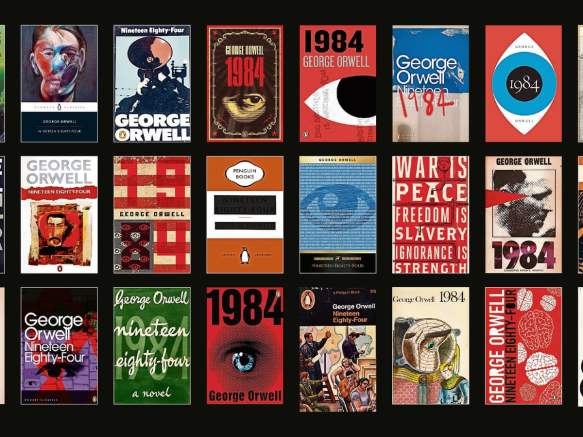
The steady, pervasive censorship creep that is being inflicted on us by corporate tech giants with the blessing of the powers-that-be threatens to bring about a restructuring of reality straight out of Orwell’s 1984, where the Ministry of Truth polices speech and ensures that facts conform to whatever version of reality the government propagandists embrace.
Orwell intended 1984 as a warning. Instead, it is being used as a dystopian instruction manual for socially engineering a populace that is compliant, conformist and obedient to Big Brother.
Censorship power, like the tech giants who now wield it, is an instrument of status quo preservation. The promise of the internet from the start was that it would be a tool of liberation, of egalitarianism, by permitting those without money and power to compete on fair terms in the information war with the most powerful governments and corporations. But just as is true of allowing the internet to be converted into a tool of coercion and mass surveillance, nothing guts that promise, that potential, like empowering corporate overlords and unaccountable monopolists to regulate and suppress what can be heard.
As I make clear in my book Battlefield America: The War on the American People, these internet censors are not acting in our best interests to protect us from dangerous, disinformation campaigns. They’re laying the groundwork to preempt any “dangerous” ideas that might challenge the power elite’s stranglehold over our lives.
Therefore, it is important to recognize the thought prison that is being built around us for what it is: a prison with only one route of escape—free thinking and free speaking in the face of tyranny.
Ben Nimmo, a former NATO press officer and current senior fellow at the Atlantic Council, has announced Facebook has hired him to “lead global threat intelligence strategy against influence operations” and “emerging threats.” Nimmo specifically named Russia, Iran and China as potential dangers to the platform.
His announcement was greeted with joybyseveral NATO officials but was not met with such enthusiasm by others. “More censorship on the way as the former NATO press officer turned Pentagon-funded ‘researcher’ who labeled real people as Russian bots and peddled disinformation to link Jeremy Corbyn to Russian active measures moves to big tech,” responded investigative journalist Max Blumenthal.
Nimmo’s questionable past certainly raises questions over whether such an official having a substantial say in what 2.8 billion Facebook users worldwide see in their feeds is such a positive step for the free and open exchange of information.
More censorship on the way as the former NATO press officer turned Pentagon-funded “researcher” who labeled real people as Russian bots and peddled disinformation to link Jeremy Corbyn to Russian active measures moves to Big Tech https://t.co/XcfGbdPJtv
For example, in 2019, U.K. Labour Party leader Jeremy Corbyn revealed secret Conservative Party documents showing negotiations the Tory government had with the U.S. over the privatization of the National Health Service (NHS). With just days to go before the U.K. general election, the scandal could have toppled the government and brought into power the most radical antiwar, anti-establishment government in the country’s history. Corporate media went into overdrive to spin the news, and Nimmo was a key part of this, immediately announcing, without evidence, that the documents “closely resemble…a known Russian operation.” His supposedly expert conjecture allowed the story to become “Corbyn’s links to Russia” rather than “Tories privatizing the NHS in secret.” Nimmo’s work helped the Conservatives to an election victory and consigned Corbyn to the scrapheap.
This was much to the relief of Nimmo’s Atlantic Council, who had branded Corbyn the “Kremlin’s Trojan Horse” — someone pushing Moscow’s agenda abroad. A British Army general was of a similar opinion, claiming that if Corbyn were to win the election, the military would respond. Secretary of State Mike Pompeo also said that the U.S. government was “doing its best” to prevent a radical leftist from winning power in the U.K.
Nimmo has been extremely liberal with whom he labels Russian disinformation agents. In 2018, his research identified one Twitter user, @Ian56789, as a “Kremlin troll.” In reality, the user, Ian Shilling, was a British pensioner, as Sky News was easily able to confirm, interviewing him on air and asking him the patently absurd question if he was actually a Russian bot or not. Despite clearly being a flesh and blood human, Shilling’s account was later deleted anyway.
In the past, Nimmo has also insisted that Valentina Lisitsa was an influential Russian bot. In reality, she is an internationally known concert pianist, as one Google search would have shown. This sort of behavior does not augur well for those critical of Western foreign policy, who have faced constant harassment, suspension, or outright bans from social media.
The Atlantic Council began as an offshoot of NATO itself and maintains extremely close connections to the military alliance. It continues to receive major funding from Western governments and weapons contractors, and its board of directors is filled to the brim with former American foreign policy officials such as Colin Powell, Condoleezza Rice, and Henry Kissinger. Also appearing on the board are no fewer than seven former CIA directors and a number of top military generals, such as Jim “Mad Dog” Mattis, Wesley Clark, and David Petraeus.
In recent years, the council’s employees have penetrated deep into big tech and social media organizations. In 2018, it announced it had partnered with Facebook to aid in the curation of Facebook news feeds of users worldwide, giving it considerable power over what sort of views to highlight and which to demote. One year previously, Jessica Ashooh left the position of the council’s Deputy Director of Middle Eastern Strategy to take the position of Director of Policy at Reddit, the eighth-most visited website in the United States. However, as with many intelligence agencies, it is unclear whether one truly “leaves” the Atlantic Council.
It is not just Russia that is in NATO’s crosshairs. Last week, the Atlantic Council published an anonymous, 26,000-word report stating that their goal for China was regime change and advising President Biden to draw a number of “red lines” around it, beyond which the U.S. would respond militarily. Meanwhile, the head of STRATCOM, Admiral Charles A. Richard, wrote that the U.S. must prepare for a potential nuclear war with Beijing.
Greater control
The military escalation has been mirrored by an intensifying online propaganda war, where the U.S. has attempted to isolate China economically and stop advancing Chinese technologies such as Huawei’s 5G network, mobile phone, and semiconductor manufacturer Xiaomi, and video sharing app TikTok. Nimmo has played his part in ramping up suspicions of nefarious Chinese activity online, claiming the existence of a wide-ranging pro-Beijing bot network encouraging Americans to believe that China has handled the COVID-19 pandemic far better than the United States. That Americans might have come to that conclusion on their own appears not to have been considered.
There is an enormous government effort to convince its population of the existence of (foreign) government efforts to manipulate their opinions online. In a massive case of projection, Western governmental organizations point the finger at their enemies, all the while securing greater access and control over the means of communication themselves, to the point where it is now difficult to distinguish where the deep state ends and the fourth estate begins. Nimmo’s move from NATO to NATO-aligned think tank to Facebook is just another example of this phenomenon. Perhaps the reason Nimmo is not looking for any Western influence operations online is that he is part of one.
Ever since the words were first introduced, conspiracy theories have carried the weight and stigma of mysterious enigmas wrapped in multiple layers of intrigue, deception, black-ops and lies. The very notion of conspiracy theories is itself considered by some to be a conspiracy theory. There are those who maintain that the CIA invented the term or at least brought it into our common language as a way of ridiculing those who questioned the Warren Report account of the murder of president JFK.
Whether the CIA did or did not intentionally use those words, conspiracy theory, to discredit those who were non-believers of the official Warren Report line, we will never know. And that’s the thing about a conspiracy theory, as to its truth, we may never know. What should be known however, what we would be better to believe, is that in this world of intrigue, deception, black-ops and lies, that there are without a doubt conspiracies. If the CIA ever had the desire to de-legitimize someone or some entire group, then or especially now, this moment is certainly ripe for supplying them with all the necessary ingredients for pulling off a grand conspiracy of mass de-legitimization of those they see as being political rabble-rousers.
The group who stormed the capitol on Jan.6th is one such group who follow conspiracy theories but although they are unique in being the ones who stormed the capitol, they are not unique in their beliefs in conspiracy theories. It might be hard, if one were to look, to find someone who does not believe in some conspiracy theory or another and it would be right for that to be the case because surely, one or the other of those theories is true, based on facts and even provable if the right material evidence could be produced. In this world of intrigue, deception, black-ops and lies however, it is sometimes very hard, impossible even for most of us, to get our hands on the right material evidence and those shady CIA operators are loving it. Nothing produces the environment where conspiracy theories thrive like reams of hidden or redacted evidence.
Are many of the conspiracy theories we hear nothing but pure bunk made-up by who knows who for no other reason than to confuse and distract? Yes, many of them are. Are some of those theories the result of half understood notions that are used in an effort to understand hidden truth? Yes, many of them are. Are some of those theories true but only the tip of even greater conspiracies that we still haven’t even begun to suspect? It’s likely so. Would it be of some value to the public to keep an open mind where conspiracy theories are concerned? Yes, as it would be one of the tyrants greatest moments in psy-op history if we were not keeping an open mind where conspiracy theories are concerned. Are conspiracy theories currently being down-played and ridiculed as being absurd and the domain of idiots and fools? Yes they are!
Is this treatment of conspiracy theories as some form of mental illness or instability, coupled with corporate and government censorship of things that they and they alone deem as being conspiracy theories with no redeeming even harmful value to the public, a smart way to go in societies hoping to retain some shred of truth and freedom? No it is not. Let us ask ourselves then, would we be wise to write off as unacceptable any theories that suggest conspiracy and to then allow government and corporate control of censorship of those theories? I think not. Would you then prefer to live in a society where people are allowed to freely suggest conspiracies where there may or may not be conspiracies or would you prefer to live in a society where no conspiracy theories are allowed even though they may or may not be true?
Do you wish to live in a society where you and you alone are allowed to discern truth from fiction according to the evidence you yourself are able to uncover or do you want corporations and government to do that for you?
New leaked documents show Reuters’ and the BBC’s involvement in covert UK FCO programs to effect “attitudinal change” and “weaken the Russian state’s influence,” alongside intel contractors and Bellingcat.
The UK Foreign and Commonwealth Office (FCO) have sponsored Reuters and the BBC to conduct a series of covert programs aimed at promoting regime change inside Russia and undermining its government across Eastern Europe and Central Asia, according to a series of leaked documents.
The leaked materials show the Thomson Reuters Foundation and BBC Media Action participating in a covert information warfare campaign aimed at countering Russia. Working through a shadowy department within the UK FCO known as the Counter Disinformation & Media Development (CDMD), the media organizations operated alongside a collection of intelligence contractors in a secret entity known simply as “the Consortium.”
Through training programs of Russian journalists overseen by Reuters, the British Foreign Office sought to produce an “attitudinal change in the participants,” promoting a “positive impact” on their “perception of the UK.”
“These revelations show that when MPs were railing about Russia, British agents were using the BBC and Reuters to deploy precisely the same tactics that politicians and media commentators were accusing Russia of using,” Chris Williamson, a former UK Labour MP who attempted to apply public scrutiny to the CDMD’s covert activities and was stonewalled on national security grounds, told The Grayzone.
“The BBC and Reuters portray themselves as an unimpeachable, impartial, and authoritative source of world news,” Williamson continued, “but both are now hugely compromised by these disclosures. Double standards like this just bring establishment politicians and corporate media hacks into further disrepute.”
Thomson Reuters Foundation spokesperson Jenny Vereker implicitly confirmed the authenticity of the leaked documents in an emailed response to questions from The Grayzone. However, she contended, “The inference that the Thomson Reuters Foundation was engaged in ‘secret activities’ is inaccurate and misrepresents our work in the public interest. We have for decades openly supported a free press and have worked to help journalists globally to develop the skills needed to report with independence.”
The tranche of leaked files closely resemble UK FCO-related documented released between 2018 and 2020 by a hacking collective calling itself Anonymous. The same source has claimed credit for obtaining the latest round of documents.
The new leaks illustrate in alarming detail how Reuters and the BBC – two of the largest and most distinguished news organizations in the world – attempted to answer the British foreign ministry’s call for help in improving its “ability to respond and to promote our message across Russia,” and to “counter the Russian government’s narrative.” Among the UK FCO’s stated goals, according to the director of the CDMD, was to “weaken the Russian State’s influence on its near neighbours.”
Reuters and the BBC solicited multimillion-dollar contracts to advance the British state’s interventionist aims, promising to cultivate Russian journalists through FCO-funded tours and training sessions, establish influence networks in and around Russia, and promote pro-NATO narratives in Russian-speaking regions.
In several proposals to the British Foreign Office, Reuters boasted of a global influence network of 15,000 journalists and staff, including 400 inside Russia.
The UK FCO projects were carried out covertly, and in partnership with purportedly independent, high-profile online media outfits including Bellingcat, Meduza, and the Pussy Riot-founded Mediazona. Bellingcat’s participation apparently included a UK FCO intervention in North Macedonia’s 2019 elections on behalf of the pro-NATO candidate.
The intelligence contractors that oversaw that operation, the Zinc Network, boasted of establishing “a network of YouTubers in Russia and Central Asia” while “supporting participants [to] make and receive international payments without being registered as external sources of funding.” The firm also touted its ability to “activate a range of content” to support anti-government protests inside Russia.
The new documents provide critical background on the role of NATO member states like the UK in influencing the color revolution-style protests waged in Belarus in 2020, and raise unsettling questions about the intrigue and unrest surrounding jailed Russian opposition figure Alexei Navalny.
Further, the materials cast serious doubt on the independence of two of the world’s largest and most prestigious media organizations, revealing Reuters and the BBC as apparent intelligence cut-outs feasting at the trough of a British national security state that their news operations are increasingly averse to scrutinizing.
Reuters solicits secret British Foreign Office contract to infiltrate Russian media
A series of official documents declassified in January 2020 revealed that Reuters was secretly funded by the British government throughout the 1960s and 1970s to assist an anti-Soviet propaganda organization run by the MI6 intelligence agency. The UK government used the BBC as a pass-through to conceal payments to the news group.
The revelation prompted a Reuters spokesman to declare that “the arrangement in 1969 [with the MI6] was not in keeping with our Trust Principles and we would not do this today.”
The Trust Principles outline a mission of “preserving [Reuters’] independence, integrity, and freedom from bias in the gathering and dissemination of information and news.”
In its own statement of values, the BBC proclaims, “Trust is the foundation of the BBC. We’re independent, impartial and honest.”
However, the newly leaked documents analyzed by The Grayzone appear to reveal that both Reuters and the BBC are engaged yet again in a non-transparent relationship with the UK’s foreign ministry to counter and undermine Russia.
In 2017, the non-profit arm of the Reuters media empire, the Thomson Reuters Foundation (TRF), delivered a formal tender offering to “enter into a Contract with the Secretary of State for Foreign Affairs, as represented by the British Embassy Moscow, for the provision of a project ‘Capacity Building in Russian Media.’” The letter was signed by Reuters CEO Monique Ville on July 31, 2017.
Reuters’ tender was a response to a call for bids by the FCO, which sought help in implementing “a programme of themed tours to the UK by Russian journalists and online influencers.”
Working through the British Embassy in Moscow, the FCO sought to produce an “attitudinal change in the participants,” promoting a “positive impact” on their “perception of the UK.”
In 2019, the FCO put forward a similar initiative, this time articulating a more aggressive plan to “counter the Russian government’s narrative and domination of the media and information space.” In effect, the British government was seeking to infiltrate Russian media and propagate its own narrative through an influence network of Russian journalists trained in the UK.
Reuters responded to both calls by the FCO with detailed tenders. In its first bid, the media giant boasted of establishing a global network of 15,000 journalists and bloggers through “capacity building interventions.” In Russia, it claimed at least 400 journalists had been cultivated through its training programs.
Reuters claimed to have performed 10 previous training tours for 80 Russian journalists on behalf of the British embassy in Moscow. It proposed eight more, promising to promote “UK cultural and political values” and “create a network of journalists across Russia” bonded together by a shared “interest in British affairs.”
Reuters’ tender highlighted the institutional prejudices and interventionist agenda that underlined its training programs. Detailing a series of UK FCO-funded programs dedicated to “countering Russian state-funded propaganda,” Reuters conflated Russian government narratives with extremism. Ironically, it referred to its own efforts at weakening them as “unbiased journalism.”
At the same time, Reuters appeared to recognize that its covert collaboration with the British Embassy in Moscow was highly provocative and potentially destructive to diplomatic relations. Recounting a UK FCO-funded tour it ran for Russian journalists in the midst of the Sergei Skripal affair, after the British government accused Moscow of poisoning a turncoat Russian intelligence officer who spied for Britain, the tender stated, “[Thomson Reuters Foundation] was in constant communication with the British Embassy in Moscow, to assess levels of risk, including reputational risk to the embassy.”
The mention by Reuters of the Belarusian TV Station Belsat, and its particular relevance “to the UK Government Strategy’s capacity to detect and counter the spread of Russian information” was notable. While describing itself as “the first independent television channel in Belarus,” Belsat is, as the Reuters tender makes clear, a vehicle of NATO influence.
Based in Poland and funded by the Polish Foreign Ministry and other EU governments, Belsat played an influential role in promoting the color revolution-style protests that erupted in May 2020 to demand the ouster of Belarusian President Alexander Lukashenko.
Ultimately, Reuters’ bid appears to have been successful, as it received a July 2019 contract with the FCO’s Conflict, Stability & Security Fund (CSSF). But neither entity seemed to want the public to know about their collaboration on a project designed to counter Russia. The contract was marked “Strictly Confidential.”
“Weaken the Russian state’s influence”
The programs exposed through the latest leak of documents operate under the auspices of a shadowy division of the Foreign and Commonwealth Development Office called Counter Disinformation & Media Development (CDMD). Led by an intelligence operative named Andy Pryce, the program has shrouded in secrecy.
Indeed, the British government has denied freedom of information requests about the division’s budget and stonewalled members of parliament like Chris Williamson who sought data about its budget and agenda, citing national security to block their demands for information.
“When I tried to probe further,” former MP Williamson told The Grayzone, “ministers refused to let me have access to any documents or correspondence relating to this organization’s activities. I was told that releasing this information could ‘disrupt and undermine the program’s effectiveness.’”
During a meeting convened in London on June 26, 2018, Pryce outlined a new FCO program “to weaken the Russian State’s influence on its near neighbors.” He solicited a consortium of firms to assist the British state in establishing new and seemingly independent media outlets to counter Russian government-backed media in Moscow’s immediate sphere of influence, and to amplify the messaging of NATO-aligned governments.
Justified on the basis of Russia’s supposed intention to “sow disunity and course[sic] disruption to democratic processes,” the campaign Pryce laid out was more aggressive and far-reaching than anything Russia has been caught doing in the West.
Pryce emphasized that secrecy was of the essence, warning that “some grantees will not wish to be linked to the FCO.”
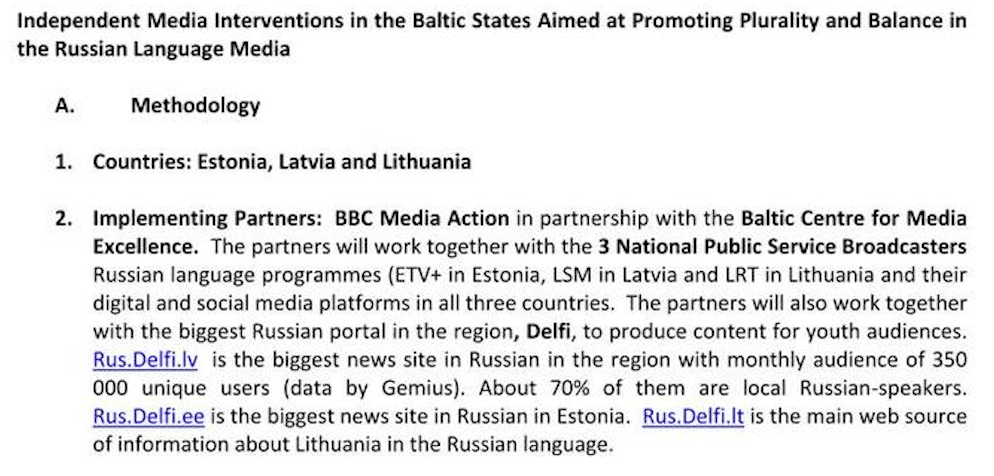
A year later, the FCO’s CDMD division outlined a program to run through 2022 at a cost of $8.3 million to the British taxpayer. It aimed to establish new outlets and support preexisting media operations “to counter Russia’s efforts to sow disunity” and “increase resilience to hostile Kremlin messaging in the Baltic states.”
Thus the British government set out with an array of intelligence contractors to dominate Baltic media with pro-NATO messaging – and perhaps sow some disunity of its own.
As seen below, the BBC placed an apparently successful bid to participate in the covert Baltic program through its non-profit arm, known as BBC Media Action.
The BBC also proposed to participate in a separate UK FCO media propaganda program in Ukraine, Moldova, and Georgia. It named Reuters and a now-defunct intelligence contractor called Aktis Strategy, which participated in previous FCO CDMD programs, as key allies in its consortium.
The BBC identified local partners like Hromadske, a Kiev-based broadcast network born in the midst of the so-called Maidan “Revolution of Dignity” in 2014 that relied on ultra-nationalist muscle to remove an elected president and install a pro-NATO regime. Hromadske materialized almost overnight with seed money and logistical support from the US Agency for International Development (USAID) and billionaire media mogul Pierre Omidyar’s Network Fund.
BBC Media Action proposed working through Aktis to cultivate and grow pro-NATO media in conflict areas like the Donbas region of eastern Ukraine, where a proxy war has raged since 2014 between the Western-backed Ukrainian military and pro-Russian separatists. It was textbook information warfare, weaponizing broadcast media to turn the tide of battle in a protracted, grinding conflict.
The UK FCO propaganda campaign warned that “Kremlin-affiliated structures” could undermine the project if it was exposed. For a media organization that claims to place trust at the heart of its charter of values, the BBC was certainly operating under a high degree of secrecy.
The UK FCO’s meddling in Eastern Europe and the Baltics created a feeding frenzy among contractors seeking to provide “capacity building” and media development assistance on Russia’s periphery. Among the bidders were Reuters and veteran FCO contractors that had participated in an array of information warfare campaigns from Syria to the British home front.
The Consortium
Among the intelligence contractors bidding to participate in the UK FCO-funded Consortium were the Zinc Network and Albany Communications. As journalist Kit Klarenberg noted in a February 18 report on the recent FCO leaks, these firms “boast staff possessed of [security] clearances, individuals who previously served at the highest levels of government, the military and security services. They furthermore have extensive experience in conducting information warfare operations on London’s behalf the world over.”
Previously known as Breakthrough, Zinc has contracted for the UK Home Office to covertly implement media projects propagandizing British Muslims under the auspices of the Prevent de-radicalization initiative. In Australia, Zinc was caught running a clandestine program to promote support for government policies among Muslims.
Ben Norton reported for The Grayzone on Albany’s record of “secur[ing] the participation of an extensive local network of over 55 stringers, reporters and videographers” to influence media narratives and advance Western regime-change goals in Syria, while conducting public relations services on behalf of extremist Syrian militias funded by NATO member states and Gulf monarchies to destabilize the country.
In its bid for the UK FCO media program in the Baltic region, Albany proposed a series of satirical “interactive games” like “Putin Bingo” to encourage opposition to the Russian government and exploit “frustrations experienced by Russians in the EU.”
Albany pitched a Latvia-based outlet called Meduza as “a leading proponent of these games.” A top website among Russian opposition supporters, Meduza has received financial support from the Swedish government and several billionaire-backed pro-NATO foundations.
As a UK FCO contractor, the Zinc Network said it was “delivering audience segmentation and targeting support” not only to Meduza, but also to Mediazona, a supposedly independent media venture founded by two members of the anti-Kremlin performance art group Pussy Riot.
One of Mediazona’s founders, Nadya Tolokonnikova, shared a stage with former US President Bill Clinton at the Clinton Foundation’s 2015 conference. The following year, Tolokonnikova trashed now-imprisoned Wikileaks founder Julian Assange, claiming, “He’s connected with the Russian government, and I feel that he’s proud of it.”
Besides delivering “targeting support” for “independent” outlets pushing the right line against the Kremlin, Zinc proposed leveraging UK FCO funding into a program of direct payments and gaming Google search results in their favor. The intelligence cut-out was explicit about its desire to reduce the search visibility of the Russian government-backed broadcaster RT.com.
The UK covertly funded and managed a network of Russian YouTubers and “activated” anti-government protest content
In a document marked “private and confidential,” Zinc revealed the Consortium’s role in setting up a “YouTuber network” in Russia and Central Asia designed to propagate the message of the UK and its NATO allies.
According to Zinc, the Consortium was “supporting participants mak[ing] and receiv[ing] international payments without being registered as external sources of funding,” presumably to circumvent Russian registration requirements for foreign-funded media outfits.
Zinc also helped the YouTube influencers “develop editorial strategies to deliver key messages” while working “to keep their involvement confidential.” And it carried out its entire program of covert propaganda in the name of “promoting media integrity and democratic values.”
Perhaps the most prominent Russian YouTube influencer is Alexei Navalny, a previously marginal nationalist opposition figure who was nominated for a Nobel Prize after becoming the target of a high-profile poisoning incident that brought relations between Russia and the West to its post-Cold War nadir.
The Russian government’s sentencing of Navalny to a 2.5-year prison term for evading parole has inspired a new wave of anti-government protests. Back in 2018, Navalny personally co-sponsored national demonstrations against the banning of the encrypted messaging app Telegram.
In its bid for a UK FCO contract, Zinc revealed that it played a behind-the-scenes role “to activate a range of content within 12 hours of the recent telegram protests.” Whether those activities involved Navalny or his immediate network was unclear, but the private disclosure by Zinc appeared confirm that British intelligence played a role in amplifying the 2018 protests.
Russian intelligence services have released sting video footage showing Vladimir Ashurkov, the executive director of Navalny’s FBK anti-corruption organization, meeting in 2013 with a suspected British MI6 agent named James William Thomas Ford, who was operating out of the British embassy in Moscow. During the rendezvous, Ashurkov can be heard asking for 10 to 20 million dollars to generate “quite a different picture” of the political landscape.
In 2018, Ashurkov’s name appeared in leaked documents exposing a covert, UK FCO influence network called the Integrity Initiative. As The Grayzone reported, the Integrity Initiative operated behind the cover of a think tank called the Institute for Statecraft, which concealed its own location through a fake office in Scotland.
Run by a group of military intelligence officers, the secret propaganda group worked through clusters of media and political influencers to escalate tensions between the West and Russia. Listed among the London cluster of anti-Russian influencers was Ashurkov.
The Integrity Initiative’s military directors outlined their agenda in stark, unequivocal terms. As the leaked memo below illustrates, they aimed to exploit the media, think tanks and their influence network to stir up as much hysteria about Russia’s supposedly malign influence as possible. Since they embarked on their covert campaign, nearly all their wishes have come true.
Bellingcat joins the Zinc Network, allegedly meddles in Moldova’s elections
After Alexei Navalny’s poisoning, he collaborated with the UK-based “open source” journalism outfit Bellingcat to pin the crime on Russia’s FSB intelligence services. Though it is well established that Bellingcat is funded by the National Endowment for Democracy, a US government entity that supports regime-change operations around the globe, the fact has never appeared in the reams of fawning profiles that corporate media outlets, including Reuters, have published about the organization.
Bellingcat’s role as a partner in the Zinc Network’s UK FCO-funded EXPOSE Consortium may add an additional layer of suspicion about the outlet’s claim to independence.
Indeed, Bellingcat was listed in leaked 2018 documents as a key member of Zinc’s “Network of NGOs.” Among the members in the network was the Institute for Statecraft, the front for the Integrity Initiative.
Bellingcat founder Eliot Higgins has vehemently denied accepting funding from the UK FCO or collaborating with it. But after Zinc documents leaked in early 2019, Higgins disclosed that some version of the Zinc proposal had received the green light from the Foreign Office.
Christian Triebbert, a Bellingcat staff member who was named as a potential trainer by the Zinc documents, and who now heads the New York Times’ video investigations unit, claimed the program consisted of benign workshops on “digital research and verification skills.”
What he and Higgins did not mention, however, was that Bellingcat had apparently been dispatched by the Zinc Network to “respond” to the 2019 parliamentary elections in North Macedonia. Stakes were high as the elections were likely to determine whether the tiny country would enter NATO and join the EU. The pro-NATO candidate triumphed, and not without a little help from the British Foreign Office and its allies.
According to the Zinc proposal, Bellingcat provided training to the Most Network, a Macedonian media outlet. It was joined by DFR Lab, a project of the NATO- and US government-funded Atlantic Council in Washington, DC.
After apparently participating in the covert UK FCO-funded intervention in North Macedonia, Bellingcat published an article ahead of the country’s 2020 parliamentary elections entitled, “Russia’s interference in North Macedonia.”
Several Zinc Network documents list Reuters as a member of the UK FCO-funded Consortium media intervention in the Baltic states.
Asked by The Grayzone how Reuters’ participation in UK FCO-funded programs aimed at countering Russia conformed to the news organization’s Trust Principles, spokesperson Jenny Vereker stated, “This funding supports our independent work to assist journalists and journalism all over the world, as part of our mission to strengthen a free and vibrant global media ecosystem to support a plurality of voices and preserve the flow of accurate and independent information. This is because accurate and balanced news coverage is a crucial pillar of any free, fair and informed society.”
In recent years, the BBC and Reuters have played an increasingly aggressive part in demonizing the governments of countries where London and Washington are seeking regime change. Meanwhile, high-profile online investigative outlets like Bellingcat have sprouted up seemingly overnight to assist these efforts.
With the release of the UK FCO documents, questions must be raised about whether these esteemed news organizations are truly the independent and ethical journalistic entities they claim to be. While they hammer away at “authoritarian” states and malign Russian activities, they have little to say about the machinations of the powerful Western governments in their immediate midst. Perhaps they are reluctant to bite the hand that feeds them.
One of the most effective information-operation weapons during the 2016 presidential election was to smear political targets as “Russian bots” working on behalf of the Kremlin. Journalists were de-platformed, presidential candidates were smeared, and lives were immeasurably damaged.
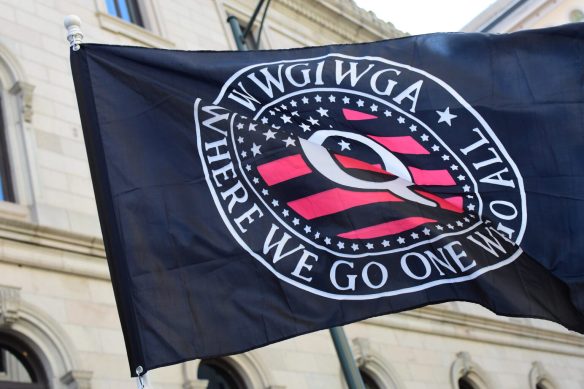
The art of attacking political targets by using open-sourced guilt-by-association is not new — nor is using Russians as foils. Joseph McCarthy and his ilk did it in the 1950s with “red-baiting” and the FBI tried to do it to Paul Robeson, Martin Luther King Jr. and others. Today that disgraceful tactic has reemerged. The smear du jour is to accuse someone of supporting the insane QAnon conspiracy — even if they don’t.
Assassinating the character of political opponents for “supporting” Q has migrated from dubious online provocateurs to television news programming. Suddenly, it seems as if every other word out of certain hosts and pundits on cable news shows begins with “Q,” and that a majority of Democrats sit around the dinner table every night discussing the conspiracy and how it is impacting Timmy’s fourth-grade class.
Ironically, according to the most recent Pew Research Center poll, while close to half the country has heard of QAnon, the majority of them are Democrats. Awareness of Q increased dramatically from 23 percent in March to 47 percent in September.
One reason for this is that the effort to hype the fringe conspiracy group has grown quickly. Increasingly, money flows to digital mercenaries to shame and cyberstalk not only individual targets but entire voting blocs.
QAnon is an idea with no structure, no chain of command and no rules. Anybody can pick up a YouTube channel or another social media account and claim to be an anonymous insider — and exploit and project whatever insane claim they want to make. With the rise of social media and recruitment of virtual reality and “gaming” technologists, these consultants have provided new mediums and taken the art of smearing to a new level. From slanderous TED Talks to inaccurate documentaries that defame individuals who have nothing to do with QAnon, the damage to the target can be severe. Often, those making the allegations are reliant on discredited sources.
But we cannot outlaw people who say crazy things. Whether it’s antifa in Portland, outrageous conspiracies from Q, or the Westboro Baptist Church protesting at funerals, the First Amendment protects problematic speech.
Increasingly, and regardless of your political affiliation, if you’re not echoing the establishment narrative, you are vulnerable to attack.
Discrediting Former Intel Members
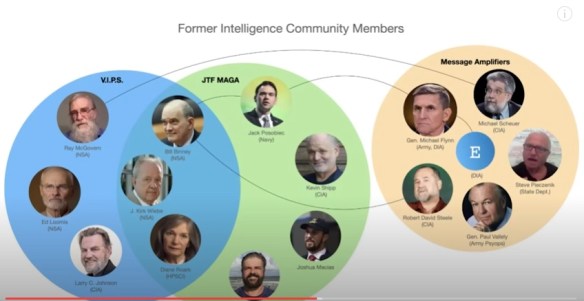
Q character assassination has also been used in an attempt to discredit some of America’s most well-respected former members of the intelligence community, including Veteran Intelligence Professionals for Sanity. The targeting of VIPS members is strategic. One of them is former CIA analyst Ray McGovern, who chaired National Intelligence Estimates and prepared the President’s Daily Brief for Presidents Richard Nixon, Gerald Ford and Ronald Reagan. Another is former NSA technologist Bill Binney, who has also been targeted as part of the “top leadership” of Q.
For a refresher, VIPS is the group that correctly debunked from the outset the bogus “Russiagate” narrative that permeated the Trump presidency. VIPS’ report was spotlighted in The Nation with a story headlined “A New Report Raises Big Questions About Last Year’s DNC Hack.” For that criticism, these leaders were accused of working with Russia. Fast-forward to 2021 and the exact same leaders are accused of being members of the Q brain trust.
Another troubling trend is the use of foreign operatives to drive the defamation of Americans. For example, one defamer lives in Mexico while another, who lives in Europe, is a self-described former member of a fringe group known as Anonymous. It begs the question, “Who pays them?”
And what’s the potential risk in all of this as a society? Those targeted in this way can potentially lose their business, their home, their friends. All because some misguided or politically motivated cyber-mercenary on contract from Washington, D.C., or a foreign country decides to do it.
Many of the same powerful forces who drove Russiagate are the same operatives now driving the Q smears, colluding with YouTube, Twitter and Facebook to do their bidding. I’ve spoken out publicly and repeatedly against Q because I believe it is a dangerous psychological operation that harms those brainwashed by it and the innocent affected by it.
But for the past few months on social media and cable TV, there has been a dramatic uptick of pundits and shady online operatives turning Q accusations into modern-day Salem witch trials. Q is now a talking point, and painting someone with that brush can completely discredit them — even those who are innocent of the allegation.
On some days, it seems that America has entered the sort of dystopia Aldous Huxley described in his classic novel Brave New World. If this doesn’t give you pause, it should.
The interplay between the First Amendment and corporations like Twitter, Google, Amazon, Apple and Facebook is the most significant challenge to free speech in our lifetimes. Pretending a corporation with the reach to influence elections is just another place that sells stuff is to pretend the role of debate in a free society is outdated.
From the day the Founders wrote the 1A until very recently no entity existed that could censor at scale other than the government. It was difficult for one company, never mind one man, to silence an idea or promote a false story in America, never mind the entire world. That was the stuff of Bond villains.
The arrival of global technology controlled by mega-corporations like Twitter brought first the ability the control speech and soon after the willingness. The rules are their rules, so we see the permanent banning of a president for whom some 70 million Americans voted from tweeting to his 88 million followers (ironically the courts earlier claimed it was unconstitutional for the president to block those who wanted to follow him.) Meanwhile the same censors allowed the Iranian and Chinese governments (along with the president’s critics) to speak freely. For these companies violence in one form is a threat to democracy while similar violence is valorized under a different color flag.
The year 2020 also saw the arrival of a new tactic by global media, sending a story down the memory hole to influence an election. The contents of Hunter Biden’s laptop, which strongly suggest illegal behavior on his part and unethical behavior by his father the president, were purposefully and effectively kept from the majority of voters. It was no longer for a voter to agree or disagree, it was now know and judge yourself or remain ignorant and just vote anyway.
Try an experiment. Google “Peter Van Buren” with the quotes. Most of you will see on the first page of results articles I wrote four years ago for outlets like The Nation and Salon. Almost none of you will see the scores of columns I wrote for The American Conservative over the past four years. Google buries them.
The ability of a handful of people nobody voted for to control the mass of public discourse has never been clearer. It represents a stunning centralization of power. It is this power which negates the argument of “why not start your own web forum.” Someone did until Amazon withdrew its server support, and Apple and Google banned the Parler app.
The same thing happened to The Daily Stormer, driven offline through a coordinated effort by tech companies, and 8Chan, deplatformed by Cloudflare. Amazon partner GoDaddy deplatformed the world’s largest gun forum AR15. Tech giants have also killed off local newspapers and other forums by gobbling up ad revenues. The companies are not, in @jack’s words, “one small part of the larger public conversation.”
The tech companies’ logic in destroying Parler was particularly evil – either start censoring like we do (“moderation”) or we shut you down. Parler allowing ideas and people banned by the others is what brought its demise. Amazon, et al, brought their power to censor to another company. The tech companies also said while Section 230 says we are not publishers, we just provide the platform, if Parler did not exercise editorial control to tech’s satisfaction it was finished. Even if Parler comes back online it will live only at the pleasure of the powerful.
Since democracy was created it has required a public forum, from the Acropolis to the town square on down. That place exists today, for better or worse, across global media. It is this seriousness of the threat to free speech that requires us to move beyond platitudes like “it’s not a violation of free speech, just a breach of the terms of service!” People once said “I’d like to help you vote ladies, but the Constitution specifically refers to men, my hands are tied.” That’s the side of history some are standing on.
This new reality must be the starting point, not the end point of discussions on the First Amendment and global media. Facebook, et al, have evolved into something new which can reach beyond their own corporate borders, beyond the idea of a company that just sells soap or cereal. Never mind being beyond the vision of the Founders when they wrote the 1A, it is hard to imagine Thomas Jefferson endorsing having a college dropout determine what the president can say to millions of Americans. The magic game play of words – it’s a company so it does not matter – is no longer enough to save us from drowning.
Tech companies currently work in casual consultation with one another, taking turns being the first to ban something so the others can follow. The next step is when a decision by one company ripples instantly across to the others, and then down to their contractors and supplies as a requirement to continue business. The decision by AirBnB to ban users for their political stance could cross platforms automatically so that same person could not fly, use a credit card, etc., essentially a non-person unable to participate in society beyond taking a walk. And why not fully automate the task, destroying people who use a certain hashtag, or like an offending tweet? Perhaps create a youth organization called Twitter Jugend to watch over media 24/7 and report dangerous ideas? A nation of high school hall monitors.
Consider linkages to the surveillance technology we idolize when it helps arrest the “right” people. So with the Capitol riots we fetishize how cell phone data was used to place people on site, coupled with facial recognition run against images pulled off social media. Throw in the calls from the media for people to turn in friends and neighbors to the FBI, alongside amateur efforts across Twitter and even Bumble to “out” participants. The goal was to jail people if possible, but most loyalists seemed equally satisfied if they could cause someone to lose their job. Tech is blithely providing these tools to users it approves of, knowing full well how they will be used. Orwellian? Orwell was an amateur.
There are legalarguments to extend limited 1A protections to social media. Section 230 could be amended. However, given Democrats benefit disproportionately from corporate censorship and current Democratic control of the government, no legislative solution appears likely. Those people care far more for the rights of some of its citizens (trans people seem popular now, it used to be disabled folks) then the most basic right for all the people.
They rely on the fact it is professional suicide today to defend all speech on principle. It is easy in divided America to claim the struggle against fascism (racism, misogyny, white supremacy, whatever) overrules the old norms. And they think they can control the beast.
But imagine someone’s views, which today match @jack and Zuck’s, change. Imagine Zuck finds religion and uses all of his resources to ban legal abortion. Consider a change of technology which allows a different company, run by someone who thinks like the MyPillow Guy, replacing Google in dictating what you can read. As one former ACLU director explained “Speech restrictions are like poison gas. They seem like they’re a great weapon when you’ve got your target in sight. But then the wind shifts.”
The election of 2020, when they hid the story of Hunter Biden’s laptop from voters, and the election’s aftermath, when they banned the president and other conservative voices, was the coming-of-age moment, the proof of concept for media giants that they could operate behind the illusion of democracy.
Hope rests with the Supreme Court expanding the First Amendment to social media, as it did when it grew the 1A to cover all levels of government, down to the hometown mayor, even though the Constitution specifically only mentions Congress. The Court has long acknowledged the flexibility of the 1A in general, expanding it over the years to acts of “speech” as disparate as nudity and advertising. But don’t expect much change any time soon. Landmark decisions on speech, like those on other civil rights, tend to be more evolutionary in line with society’s changes than revolutionary.
It is sad that many of the same people who quoted that “First they came for…” poem over Trump’s Muslim Ban are now gleefully supporting social media’s censorship of conservative voices. The funny part is both Trump and Twitter claim what they did was for peoples safety. One day people will wake up and realize it doesn’t matter who is doing the censoring, the government or Amazon. It’s all just censoring.
What a sad little argument “But you violated the terms of service nyah nyah!” is going to be then.
The Google-owned video sharing platform YouTube has demonetized numerous independent media accounts, a jarring escalation in the steadily intensifying campaign against alternative news outlets online.
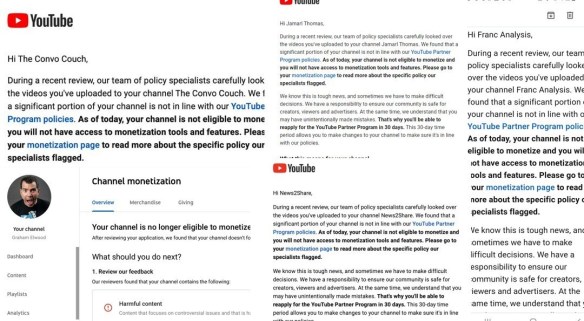
Progressive commentators Graham Elwood, The Progressive Soapbox, The Convo Couch, Franc Analysis, Hannah Reloaded and Cyberdemon531 have all received notifications from YouTube that their videos are no longer permitted to earn money through the platform’s various monetization features, as has Ford Fischer, a respected freelancer who films US political demonstrations. No explanation has been offered for this decision beyond the vague claim that “your channel is not in line with our YouTube Partner Program policies” due to “harmful content”.
You guys have destroyed my channel without legit explanation as to why. No videos are given – and frankly there is literally zero "harmful' content on my channel. This is a radically bad error that needs to be corrected. @TeamYouTube@YouTubeCreators@YouTube
Like all large online platforms, YouTube’s appeals process is notoriously opaque and unaccountable. These accounts could remain demonetized for months, or forever, without any clear explanation at all. Ford Fischer, who has been in this situation before, said on Twitter that his account was left demonetized for seven months before YouTube reversed its decision.
“Last time you demonetized my channel, I spoke out for seven months. I didn’t delete a single piece of content. You admitted you were wrong. I forgive you. Please don’t do this again,” Fischer tweeted.
“No superchats, no ad revenue, no YouTube premium money,” tweeted Elwood, who also said “I have a call with my lawyers later today.”
“You guys have destroyed my channel without legit explanation as to why,” tweeted Jamarl Thomas of Progressive Soapbox. “No videos are given – and frankly there is literally zero ‘harmful’ content on my channel. This is a radically bad error that needs to be corrected.”
The Convo Couch’s Jonathan Mayorca tweeted the notification he received from YouTube which gave the reason as “Harmful content: Content that focuses on controversial issues and that is harmful to viewers,” saying no specific video or subject was named. Nobody receiving these notifications appears to have any idea what is meant by “harmful” or “controversial” or why YouTube is mentioning them in the same breath as though these two things are connected or synonymous in some way.
Demand @YouTubeCreators allow @grahamelwood to monetize his channel! Open discussion is crucial to a healthy society. Graham’s livelihood is being taken away because he doesn’t bow down to corporate talking points! https://t.co/fAXom5OPAy
YouTube has been providing template responses saying “We recommend making the needed changes to your content and reapply in 30 days” while refusing to specify what the “needed changes” even are.
Speaking for myself, I can say with absolute certainty that I would not be able to create content at anywhere near the pace I do were I not making enough money from it to do it full time. Life is far too demanding with far too much else going on for me to be able to maintain anything like daily output; being financially deplatformed and having to get another job would force me down to an essay a week in my spare time, if that. Anyone who works in independent media full time knows this, and so do the powerful people who are steadily ratcheting up the campaign to silence anyone who hasn’t passed through the gatekeepers of the plutocratic media.
Financial deplatforming is censorship. People were given an opportunity to devote themselves to the vocation of creating media outside the gatekeeping apparatus of billionaire news institutions, which is arguably the single most important vocation anyone can give themselves to in our world right now, and they built their lives around their ability to do this. Now it’s being ripped away from them; their literal jobs are being taken away. They were offered a reason to think they’d be able to make a living doing very important work, and then they were sucker punched with what amounts to political censorship.
This has been a continually escalating trend for years. The general population is herded onto huge monopolistic social media platforms offering democratization of information where your voice can be heard, and then those platforms proceed to censor an increasing amount of political speech in increasing coordination with the US government.
If the democratization of information online is successfully reversed and the mass media gatekeepers are again the sole authorities on what’s real and true, people will be locked into forming their ideas on how to think, act and vote based on what they are told by the same plutocratic media institutions which have been deceiving them into every war and manipulating them into accepting the status quo for generations.
If the door is locked to the possibility of a grassroots information rebellion against the narrative hegemony of our rulers, we will remain doomed to continue along the same ecocidal, omnicidal trajectory these bastards have us on until it reaches its inevitable conclusion. This must be resisted.
Complaining about authoritarian government intrusion into one’s life or surreptitious rewriting of history no longer qualify as “Orwellian,” according to an article that ironically embodies the concept in trying to redefine it.
News outlet USA Today has managed to personify the term ‘Orwellian’ in its profoundly condescending writeup scolding readers for “using the term ‘Orwellian’ wrong.” Published on Monday, the piece goes to great lengths to shame those insecure about their vocabulary by suggesting the term “Orwellian” can only be used correctly by liberals.
“Chances are, you’ve seen George Orwell’s name thrown around a lot in the past week on social media, either by conservatives invoking his name with sincerity or by liberals poking fun at conservatives for its misuse,” the article starts, smirkingly laying the groundwork for canceling out all usage of the term by those on the Right.
But the examples it holds up to mock – presidential scion Donald Trump Jr.’s complaint about the disappearance of his father’s Twitter account and Missouri Senator Josh Hawley’s blaming the “woke mob” for the cancellation of his book contract – are not as wide of the mark as the thought police at USA Today would have us believe.
Hawley’s book denouncing the “tyranny of Big Tech,” for example, isn’t just “a publisher drop[ping] your book because your brand has become toxic” – it’s a disturbing example of what are supposed to be separate industries (social media, book publishing) marching in ideological lockstep with the prevailing political ideology.
Nor is the younger Trump’s complaint about Twitter deleting his father’s account ‘just’ an example of “an internet platform enforcing its terms of service.” For better or worse, Trump’s Twitter feed was a historical document, his primary means of addressing the American public throughout his presidency. Suspending it permanently is the equivalent of throwing four years of official proclamations down the memory hole, never to be seen again, as 1984’s protagonist Winston Smith did with inconvenient historical documents as a loyal Party member.
USA Today brings in a scholar who wrote his dissertation on Orwell to connect the iconic “Two Minutes Hate” to the “social media mob mentality” and the QAnon conspiracy theory, perhaps missing the forest (four years of “Orange Man Bad!” ritualistically shouted at the top of one’s digital lungs) for the trees.
The article notes that Orwell fought fascism in Spain, strongly implying today’s conservatives are the ideological descendants of Franco’s fascists – a conclusion it doesn’t try to support with facts, but merely guilt by association. Which dovetails perfectly with the writer’s efforts to narrow the definition of “Orwellian” by the use of “the manipulation of language” to conceal reality.
After all, even this heavy-handed propaganda piece acknowledges that Orwell discovered “the failures of Soviet communism,” finding it one of “two sides of the same totalitarian coin” with fascism and disowning both extremes.
And as much as 21st century liberal revisionists would like to lay claim to the term “Orwellian” just for themselves, the dystopian future-Britain of 1984 was crafted in the image of the Soviet Union, not fascist Spain or Germany. “INGSOC,” the name of the Party’s totalitarian ideology, is short for “English Socialism.” Attempting to dismantle the author’s own intent to sell the ideological flavor-of-the-month is pretty, well, Orwellian.






 After the Crash