After the Crash

Dispatches From a Long Recovery (Est. 10/2024)

After the Crash

Skynet Ascendant

t2skynetbdcap1

By Cory Doctorow

Source: Locus Online

As I’ve written here before, science fiction is terrible at predicting the future, but it’s great at predicting the present. SF writers imagine all the futures they can, and these futures are processed by a huge, dynamic system consisting of editors, booksellers, and readers. The futures that attain popular and commercial success tell us what fears and aspirations for technology and society are bubbling in our collective imaginations.

When you read an era’s popular SF, you don’t learn much about the future, but you sure learn a lot about the past. Fright and hope are the inner and outer boundaries of our imagination, and the stories that appeal to either are the parameters of an era’s political reality.

Pay close attention to the impossibilities. When we find ourselves fascinated by faster than light travel, consciousness uploading, or the silly business from The Matrix of AIs using human beings as batteries, there’s something there that’s chiming with our lived experience of technology and social change.

Postwar SF featured mass-scale, state-level projects, a kind of science fictional New Deal. Americans and their imperial rivals built cities in space, hung skyhooks in orbit, even made Dyson Spheres that treated all the Solar System’s matter as the raw material for the a new, human-optimized megaplanet/space-station that would harvest every photon put out by our sun and put it to work for the human race.

Meanwhile, the people buying these books were living in an era of rapid economic growth, and even more importantly, the fruits of that economic growth were distributed to the middle class as well as to society’s richest. This was thanks to nearly unprecedented policies that protected tenants at the expense of landlords, workers at the expense of employers, and buy­ers at the expense of sellers. How those policies came to be enacted is a question of great interest today, even as most of them have been sunsetted by successive governments across the developed world.

Thomas Piketty’s data-driven economics bestseller Capital in the Twenty-First Century argues that the vast capital destruction of the two World Wars (and the chaos of the interwar years) weakened the grip of the wealthy on the governments of the world’s developed states. The arguments in favor of workplace safety laws, taxes on capital gains, and other policies that undermined the wealthy and benefited the middle class were not new. What was new was the political possibility of these ideas.

As developed nations’ middle classes grew, so did their material wealth, political influence, and expectations that governments would build am­bitious projects like interstate highways and massive civil engineering projects. These were politically popular – because lawmakers could use them to secure pork for their voters – and also lucrative for government contractors, making ‘‘Big Government’’ a rare point of agreement between the rich and middle-income earners.

(A note on poor people: Piketty’s data suggests that the share of the national wealth controlled by the bottom 50% has not changed much for several centuries – eras of prosperity are mostly about redistributing from the top 10-20% to the next 30-40%)

Piketty hypothesizes that the returns on investment are usually greater than the rate of growth in an economy. The best way to get rich is to start with a bunch of money that you turn over to professional managers to invest for you – all things being equal, this will make you richer than you could get by inventing something everyone uses and loves. For example, Piketty contrasts Bill Gates’s fortunes as the founder of Microsoft, once the most profitable company in the world, with Gates’s fortunes as an investor after his retirement from the business. Gates-the-founder made a lot less by creating one of the most successful and profitable products in history than he did when he gave up making stuff and started owning stuff for a living.

By the early 1980s, the share of wealth controlled by the top decile tipped over to the point where they could make their political will felt again – again, Piketty supports this with data showing that nations elect seriously investor-friendly/worker-unfriendly governments when investors gain control over a critical percentage of the national wealth. Leaders like Reagan, Thatcher, Pinochet, and Mulroney enacted legislative reforms that reversed the post-war trend, dis­mantling the rules that had given skilled workers an edge over their employers – and the investors the employers served.

The greed-is-good era was also the cyberpunk era of literary globalized corporate dystopias. Even though Neuromancer and Mirrorshades predated the anti-WTO protests by a decade and a half, they painted similar pictures. Educated, skilled people – people who comprised the mass of SF buyers – became a semi-disposable under­class in world where the hyperrich had literally ascended to the heavens, living in orbital luxury hotels and harvesting wealth from the bulk of humanity like whales straining krill.

Seen in this light, the vicious literary feuds between the cyberpunks and the old guard of space-colonizing stellar engineer writers can be seen as a struggle over our political imagination. If we crank the state’s dials all the way over the right, favoring the industrialist ‘‘job creators’’ to the exclusion of others, will we find our way to the stars by way of trickle-down, or will the overclass graft their way into a decadent New Old Rome, where reality TV and hedge fund raids consume the attention and work we once devoted to exploring our solar system?

Today, wealth disparity consumes the popular imagination and political debates. The front-running science fictional impossibility of the unequal age is rampant artificial intelligence. There were a lot of SF movies produced in the mid-eighties, but few retain the currency of the Termina­tor and its humanity-annihilating AI, Skynet. Everyone seems to thrum when that chord is plucked – even the NSA named one of its illegal mass surveillance programs SKYNET.

It’s been nearly 15 years since the Matrix movies debuted, but the Red Pill/Blue Pill business still gets a lot of play, and young adults who were small children when Neo fought the AIs know exactly what we mean when we talk about the Matrix.

Stephen Hawking, Elon Musk, and other luminaries have issued pan­icked warnings about the coming age of humanity-hating computerized overlords. We dote on the party tricks of modern AIs, sending half-admiring/half-dreading laurels to the Watson team when it manages to win at Jeopardy or randomwalk its way into a new recipe.

The fear of AIs is way out of proportion to their performance. The Big Data-trawling systems that are supposed to find terrorists or figure out what ads to show you have been a consistent flop. Facebook’s new growth model is sending a lot of Web traffic to businesses whose Facebook followers are increasing, waiting for them to shift their major commercial strategies over to Facebook marketing, then turning off the traffic and demanding recurr­ing payments to send it back – a far cry from using all the facts of your life to figure out that you’re about to buy a car before even you know it.

Google’s self-driving cars can only operate on roads that humans have mapped by hand, manually marking every piece of street-furniture. The NSA can’t point to a single terrorist plot that mass-surveillance has disrupted. Ad personalization sucks so hard you can hear it from orbit.

We don’t need artificial intelligences that think like us, after all. We have a lot of human cognition lying around, going spare – so much that we have to create listicles and other cognitive busy-work to absorb it. An AI that thinks like a human is a redundant vanity project – a thinking version of the ornithopter, a useless mechanical novelty that flies like a bird.

We need machines that don’t fly like birds. We need AI that thinks unlike humans. For example, we need AIs that can be vigilant for bomb-parts on airport X-rays. Humans literally can’t do this. If you spend all day looking for bomb-parts but finding water bottles, your brain will rewire your neurons to look for water bottles. You can’t get good at something you never do.

What does the fear of futuristic AI tell us about the parameters of our present-day fears and hopes?

I think it’s corporations.

We haven’t made Skynet, but we have made these autonomous, transhuman, transnational technolo­gies whose bodies are distributed throughout our physical and economic reality. The Internet of Things version of the razorblade business model (sell cheap handles, use them to lock people into buying expensive blades) means that the products we buy treat us as adversaries, checking to see if we’re breaking the business logic of their makers and self-destructing if they sense tampering.

Corporations run on a form of code – financial regulation and accounting practices – and the modern version of this code literally prohibits corporations from treating human beings with empathy. The principle of fiduciary duty to inves­tors means that where there is a chance to make an investor richer while making a worker or customer miserable, management is obliged to side with the investor, so long as the misery doesn’t backfire so much that it harms the investor’s quarterly return.

We humans are the inconvenient gut-flora of the corporation. They aren’t hostile to us. They aren’t sympathetic to us. Just as every human carries a hundred times more non-human cells in her gut than she has in the rest of her body, every corpora­tion is made up of many separate living creatures that it relies upon for its survival, but which are fundamentally interchangeable and disposable for its purposes. Just as you view stray gut-flora that attacks you as a pathogen and fight it off with anti­biotics, corporations attack their human adversaries with an impersonal viciousness that is all the more terrifying for its lack of any emotional heat.

The age of automation gave us stories like Chap­lan’s Modern Times, and the age of multinational hedge-fund capitalism made The Matrix into an enduring parable. We’ve gone from being cogs to being a reproductive agar within which new cor­porations can breed. As Mitt Romney reminded us, ‘‘Corporations are people.’’

Financial Predators and Parasites Want to Live, Regardless of the Cost

Bankers-and-Tick1

By Charles Hugh Smith

Source: Of Two Minds

Reform is impossible in a system optimized for centralized power and financial predators and parasites.

The problem with optimizing private gain by any means available is you also optimize financial predators and parasites. The problem with optimizing a system for centralized power (i.e. the federal government and Federal Reserve) is that you also optimize regulatory capture, influence-peddling and the unholy marriage of wealth and power.

Optimization is a key principle of all technologies. Though the political class claims perfection is possible (with just a few more regulations and laws, heh), engineers understand every system is a series of trade-offs. If you want to optimize one output, everything else in the system is rendered secondary.

The master narrative of the status quo is that maximizing private gain by any means available is good because to get rich is glorious: the goal of getting rich motivates entrepreneurs to do wonderful things that benefit humanity while they amass vast fortunes.

This is the happy propaganda story, and we all know the few outliers who are endlessly trotted out to “prove” its truth: Steve Jobs, the Larrys (Ellison and Page) Bill Gates, et al. Nice, but the handful who fulfill the propaganda version of optimizing private gain by any means available only succeeded because there were no powerful vested interests in their way.

What our system actually optimizes is the assembly of vested interests that buy protection of their racket from the state. These vested interests include wealthy individuals, corporations, cartels and public unions.

Want to earn a 1,000% return on your investment? It’s very difficult to do so by producing a good or service. By any measure, the easiest, lowest-risk way to earn a 1,000% return on your investment is to buy political protection with lobbying and campaign contributions.

What we’ve done is optimize financial predation and parasitism. We’ve created enormous incentives for too big to fail/jail banks, financiers manipulating dark pools and high-frequency trading that add nothing to the real economy, public unions guaranteeing their members unbeatable pensions and benefits while taxpayers foot the bill, politicos who enter office with ambition and few financial means who leave office with great wealth, cartels that buy protection from competition from the centralized state and corporations that rewrite the tax code in their favor with campaign contributions.

Now that we’ve created vast menageries of insatiably greedy financial predators and parasites, we’ve created monsters who want to live regardless of the cost to the nation. Parasites prefer not to kill their host, but their ability to fine-tune the process of sucking as much money out of the system as possible without bringing it down is not as well-developed as their greed.

The Global Financial Meltdown of 2008 proved this. The financial parasites and their parasitic partners in the halls of federal power were blind to the risks of collapse their insatiable greed were generating; they continued sucking the maximum private gain out of the system until the moment it collapsed in a heap.

Predators don’t worry about maintaining the flock of sheep or the schools of little fish. They will dive into the swirling school of frantic fish and consume every last one. Financial predators are the same: financial predators will sell a subprime auto loan to every last debt-serf in the flock, until the ecosystem of prey collapses and there are no marks left for their cons.

This is why our system is well and truly doomed: we have optimized the system for vast menageries of insatiably greedy financial predators and parasites, and now that they exist and have gained power, they want to live and prosper regardless of the cost to the decimated prey and the nation. By optimizing centralized power, we have optimized the protection of financial predators and parasites by the all-powerful central state and bank.

Reform is impossible in a system optimized for centralized power and financial predators and parasites. The predators and parasites will gorge themselves until the system collapses.


The Rise of “Criminal Capitalism”

corporate-crime-525

By James Petras

Source: Dissident Voice

About 75% of US employees work 40 hours or longer, the second longest among all OECD countries, exceeded only by Poland and tied with South Korea. In contrast, only 10% of Danish workers, 15% of Norwegian, 30% of French, 43% of UK and 50% of German workers work 40 or more hours. With the longest work day, US workers score lower on the ‘living well’ scale than most western European workers. Moreover, despite those long workdays US employees receive the shortest paid holidays or vacation time (one to two weeks compared to the average of five weeks in Western Europe). US employees pay for the costliest health plans and their children face the highest university fees among the 34 countries in the Organization for Economic Cooperation and Development (OECD).

In class terms, US employees face the greatest jump in income inequalities over the past decade, the longest period of wage and salary decline or stagnation (1970 to 2014) and the greatest collapse of private sector union membership, from 30% in 1950 down to 8% in 2014.

On the other hand, profits, as a percentage of national income, have increased significantly. The share of income and profits going to the financial sector, especially the banks and investment houses, has increased at a faster rate than any other sector of the US economy.

There are two polar opposite trends: Employees working longer hours, with costlier services and declining living standards while finance capitalists enjoy rapidly rising profits and incomes.

Paradoxically, these trends are not directly based on greater ‘workplace exploitation’ in the US.

The historic employee-finance capitalist polarization is the direct result of the grand success of the trillion dollar financial swindles, the tax payer-funded trillion dollar Federal bailouts of the crooked bankers, and the illegal bank manipulation of interest rates. These uncorrected and unpunished crimes have driven up the costs of living and producing for employees and their employers.

Financial ‘rents’ (the bankers and brokers are ‘rentiers’ in this economy) drive up the costs of production for non-financial capital (manufacturing). Non-financial capitalists resort to reducing wages, cutting benefits and extending working hours for their employees, in order to maintain their own profits.

In other words, pervasive, enduring and systematic large-scale financial criminality is a major reason why US employees are working longer and receiving less – the ‘trickle down’ effect of mega-swindles committed by finance capital.

Mega-Swindles, Leading Banks and Complicit State Regulators

Mega-swindles, involving trillions of dollars, are routine practices involving the top fifty banks, trading houses, currency speculators, management fund firms and foreign exchange traders.

These ‘white collar’ crimes have hurt hundreds of millions of investors and credit-card holders, millions of mortgage debtors, thousands of pension funds and most industrial and service firms that depend on bank credit to meet payrolls, to finance capital expansion and technological upgrades and raw materials.

Big banks, which have been ‘convicted and fined’ for mega-swindles, include Citi Bank, Bank of America, HSBC, UBS, JP Morgan, Barclay, Goldman Sachs, Royal Bank of Scotland, Deutsche Bank and forty other ‘leading’ financial institutions.

The mega-swindlers have repeatedly engaged in a great variety of misdeeds, including accounting fraud, insider trading, fraudulent issue of mortgage based securities and the laundering of hundreds of billions of illegal dollars for Colombian, Mexican, African and Asian drug and human traffickers.

They have rigged the London Interbank Official Rate (LIBOR), which serves as the global interest benchmark to which hundreds of trillions of dollars of financial contracts are tied. By raising LIBOR, the financial swindlers have defrauded hundreds of millions of mortgage and credit-card holders, student loan recipients and pensions.

Bloomberg News (5/20/2015) reported on an ongoing swindle involving the manipulation of the multi-trillion-dollar International Swaps and Derivatives Association (ISDA) fix, a global interest rate benchmark used by banks, corporate treasurers and money managers to determine borrowing costs and to value much of the $381 trillion of outstanding interest rate swaps.

The Financial Times (5/23/15, p. 10) reported how the top seven banks engaged in manipulating fraudulent information to their clients, practiced illegal insider trading to profit in the foreign exchange market (forex), whose daily average turnover volume for 2013 exceeded $5 trillion dollars.

These seven convicted banks ended up paying less than $10 billion in fines, which is less than 0.05% of their daily turnover. No banker or high executive ever went to jail, despite undermining the security of millions of retail investors, pensioners and thousands of companies.

The Direct Impact of Financial Swindles on Declining Living Standards

Each and every major financial swindle has had a perverse ripple effect throughout the entire economy. This is especially the case where the negative consequences have spread downward through local banks, local manufacturing and service industries to employees, students and the self-employed.

The most obvious example of the downward ripple effect was the so-called ‘sub-prime mortgage’ swindle. Big banks deliberately sold worthless, fraudulent mortgage-backed securities (MBS) and collateralized debt obligation (CDO) to smaller banks, pension funds and local investors, which eventually foreclosed on overpriced houses causing low income mortgage holders to lose their down payments (amounting to most of their savings).

While the effects of the swindle spread outward and downward, the US Treasury propped up the mega-swindlers with a trillion-dollar bailout in working people’s tax money. They anointed their mega-give-away as the bail out for ‘banks that are just too big to fail”! They transferred funds from the public treasury for social services to the swindlers.

In effect, the banks profited from their widely exposed crimes while US employees lost their jobs, homes, savings and social services. As the US Treasury pumped trillions of dollars into the coffers of the criminal banks (especially on Wall Street), the builders, major construction companies and manufacturers faced an unprecedented credit squeeze and laid off millions of workers, and reduced wages and increased the hours of un-paid work.

Service employees in consumer industries were hit hard as wages and salaries declined or remained frozen. The costs of the FOREX, LIBOR and ISDA fix swindles’ fell heavily on big business, which passed the pain onto labor: cutting pension and health coverage, hiring millions of ‘contingent or temp’ workers at minimum wages with no benefits.

The bank bailouts forced the Treasury to shift funds from ‘job-creating’ social programs and national infrastructure investment to the FIRE (finance, insurance and real estate) sector with its highly concentrated income structure.

As a result of the increasing concentration of wealth among the financial swindlers, inequalities in income grew; wages and salaries were frozen or reduced and manufacturers outsourced production, resulting in declines in production.

Employees, suffering from the loss of income brought on by the mega-swindles, found that they were working longer hours for less pay and fewer benefits. Productivity suffered. With the total breakdown of the ‘capitalist rules of the game’, investors lost confidence and trust in the system. Mega-swindles eroded ‘confidence’ between investors and traders, and made a mockery of any link between performance at work and rewards. This severed the nexus between highly motivated workers, engaged in ‘hard work, long hours’ and rising living standards, and between investment and productivity.

As a result, profits in the finance sector grew while the domestic economy floundered and living standards stagnated.

Financial Impunity: Regulatees Controlling the Regulators

Despite the proliferation of mega-swindles and their pervasive ripple effects throughout the economy and society, none of the dozens of federal or state regulatory agencies intervened to stop the swindle before it undermined the domestic economy. No CEO or banker was ever arrested for their part in the swindle of trillions. The regulators only reacted after trillions had ‘disappeared’ and swindles were ‘a done deal’. The impunity of the swindlers in planning and executing the pillage of hundreds of millions of employees, taxpayers and mortgage holders was because the federal and state regulatory agencies are populated by ‘regulatory administrators’ who came from or aspired to join the financial sector they were tasked with ‘regulating’.

Most of the high officials appointed to lead the regulatory agencies had been selected by the ‘Lords of Wall Street, Frankfurt, the City of London or Zurich.’ Appointees are chosen on the basis of their willingness to enable financial swindles. It therefore came as no surprise on May 28 2015 when US President Obama approved the appointment of Andrew Donahue, Managing Director and Associate General Council for the repeatedly felonious, mega-swindling banking house of Goldman Sachs to be the ‘Chief of Staff’ of the Security and Exchange Commission. His career has been typical of the Washington-Wall Street ‘Revolving Door’.

Only after fraud and swindles evoked the nationwide public fury of mortgage holders, investors and finance companies did the regulators ‘investigate’ the crimes and even then not a single major banker was jailed, not a single major bank was closed down.

There were a few low-level bond traders and bank employees who were fired or jailed as scapegoats. The banks paid puny (for them) fines, which they passed on to their customers. Despite pledges to ‘mend their ways’ the bankers concocted new schemes with their windfalls of billions of Federal ‘bailout’ money while the regulators looked on or polished their CV’s for the next pass through the ‘revolving door’.

Every top official in Treasury, Commerce and Trade, and every regulator in the Security Exchange Commission (SEC) who ‘retired to the private sector’ has ended up working for the same mega-criminal banks and finance houses they had investigated, regulated and ‘slapped on the wrist’.

As one banker, who insists on anonymity, told me: ‘The most successful swindlers are those who investigated financial transgressions’.

Conclusion

Mega-swindles define the nature of contemporary capitalism. The profits and power of financial capital is not the outcome of ‘market forces’. They are the result of a system of criminal behavior that pillages the Treasury, exploits the producers and consumers, evicts homeowners and robs taxpayers.

The mega swindlers represent much less than 1% of the class structure. Yet they hold over 40% of personal wealth in this country and control over 80% of capital liquidity.

They grow inexorably rich and richer, even as the rest of the economy wallows in crisis and stagnation. Their swindles send powerful ripples across the national economy, which ultimately freeze or reduce the income of the skilled (middle class) employees and undermine the living conditions for poor working-class whites, and especially under and unemployed Afro-American and Latino American young workers.

Efforts to ‘moralize’ capital have failed repeatedly since the regulators are controlled by those they claim to ‘regulate’.

The rare arrest and prosecution of any among the current tribe of mega-swindlers would only results in their being replaced by new swindlers. The problem is systemic and requires deep structural changes.

The only answer is to build a political movement independent of the two party system, willing to nationalize the banks and to pass legislation outlawing derivatives, forex trading and other unnatural parasitic speculative activities.

James Petras is author of Extractive Imperialism in the Americas: Capitalism’s New Frontier (with Henry Veltmeyer) and The Politics of Empire: The US, Israel and the Middle East. Read other articles by James, or visit James’s website.

Towards a Critical Public Pedagogy of Predatory Anthropocene

blogs_500x400_5619_695657_poll_xlarge

By Michael B. McDonald

Source: The Hampton Institute

In 2015, a group of scientists published ” The trajectory of the Anthropocene: The Great Acceleration “. They showed that rising consumption and increasing rates of impact on Earth Systems began after the Second World War. It was the expansion of economic activity charged by increasing resource use that created new technologies that expanded rates of consumption. This was a celebrated new socio-economic phase called the Great Acceleration that was supposed to lead to full employment and a bright future for all. It was also the beginning of a next phase of world capitalism accelerated by increasing urbanization. By 2008 humanity officially entered a new urban phase where 50% of the earth’s population lives in urban spaces. More cities will be built in the next thirty years than in all previous human history. Earth System scientists have shown that all of these changes are having unprecedented impacts on the Earth. Human life is changing the Earth, they call it anthropocene.

But the Great Acceleration did not lead to full employment nor a bright future. In fact, it has led to massive inequality created by a very small percentage of people controlling a staggering amount of wealth. In 2010, OECD countries had 18% of the earth’s population but accounted for 74% of GDP. But only .1% controlled this vast wealth through a system that I call predatory anthropocene.

The system of predatory anthropocene can be found in changes to the global economy and a fundamental shift in the way the economy works through its transformation of subjective, social and environmental ecologies, what Felix Guattari called the Three Ecologies. One aspect of this change has been called semiocapitalism, the blending of imagination, ideas, language and capital. Semiocapitalism works by capturing evolutionary life. Belonging, for instance, is now produced by the consumption of psycho-social products that gain economic value in consumption and are financed by increasing debt. The GDP of the United States is now 70% consumption.

Making community through mass consumption is eroding the anthropological basis upon which human life is built. We need a language for this. Perhaps we need to recognize that the communicative and biological systems of the human species have habitats. The biosphere sustains biological life while the ethnosphere sustains communicational life. The biosphere is quite well known but the ethnosphere less so. Wade Davis suggests that the ethnosphere is a global quilt of local cultures, a band of cultural life functioning in tandem with the biosphere for the creation, organization, and expression of human communicational life.[1] The ethnosphere is a collection of languages, ideas, and dreams. It is the anthropological rituals that have accompanied human evolution, has organized social reproduction, it is the institution of language [2] in all its complexity, but is also beyond language.[3] When people talk about humanity in general, they mean the biosphere and ethnosphere, the cultures of the world in their physical, expressive, subjective dimensions. But now ethnosphere complexity is reduced by global commodities, unique cultures consumed by Hollywood-hegemony, human imagination consumed by consumer products, dreams being replaced by corporate produced and globalized desires. A single system is producing hegemony in ways that no single system was ever before capable. It is necessary for us to see that our species is under threat by a monster system that we have created, a monsterous, cancerous, predatory system poisoning the Earth. Henry Giroux has argued that:

What makes American society distinct in the present historical moment are a culture and social order that have not only lost their moral bearings but produce levels of symbolic and real violence whose visibility and existence set a new standard for cruelty, humiliation, and mechanizations of a mad war machine, all of which serves the interest of the political and corporate walking dead-the new avatars of death and cruelty-that plunder the social order and wreak ecological devastation. We now live in a world overrun with flesh-eating zombies, parasites who have a ravenous appetite for global destruction and civic catastrophe. (2014, xi-xii)[4]

Because I follow Guattari’s cybernetic view I am less certain than Giroux appears to be, that is it possible to tell zombies from non-zombies in a period where a) agribusiness replaces agriculture and transforms all aspects of domestic life that b) creates stretches of suburbs that wipe out, without social discussion, the farmland that has laid the foundation of human flourishing, c) as mounting debt continues without slowing and without discourse in the public sphere, as d) waves of fellow humans are dislocated everyday due to military, economic, and environmental calamities. And none of this is news, we watch all of it studiously, staring at our displays unmoved by the misery and pain we see on the faces, and hear in the cries of fellow humans. Too many of us escape our responsibilities to confront this pain by fleeing to walled-in communities whose walls are maintained, not by bricks but by the capacity to carry the mortgage debt (that machinically contributes to predatory anthropocene) in the hopes of living in relative safety while the poor (who can not access debt) are left in decaying city centers. But as foreclosures swept across America after the housing bubble burst, suburban safety was shown to be precarious. It is important for us to take notice of the fact that we know all of this and collectively do very little to change it. We sign petitions on Facebook, but we still shop at malls that we built on farmland and we clearly have little access to empathy. And I am not saying this to be critical of you. I am truly stuck. After many years of being inspired by Adbusters and semio-politics and culture jamming I’m not sure what the next step is. I feel free space disappearing. I’m looking for options.

This difficulty of expressing empathy tells us something about hegemony under semiocapitalism. We now know that empathy is not something we develop, but something that we shut down. Vittorio Gallese in ” The Manifold Nature of Interpersonal Relations: The Quest for a Common Mechanism” has shown that for us to “know that another human being is suffering or rejoicing, is looking for food or shelter, is about to attack or kiss us, we do not need verbal language” (Virno 2008: 175) we only need the activation of what Gallese called mirror neurons a “class of premotor neurons [that] was discovered in the macaque monkey brain that discharged not only when the monkey executes goal-related hand actions like grasping objects, but also when observing other individuals (monkeys or humans) executing similar actions” (Gallese: 522). Experiments successfully illustrated that mirror neurons were also in the human brain “positioned in the ventral part of the inferior frontal lobe, consisting of two areas, 44 and 45, both of which belong to the Broca region” (Virno: 177). Mirror neurons allow us to experience what we see. When we see someone doing something that we’ve never done, our brain reacts as if we are doing it, what Gallese calls “embodied simulation.” This means that empathy is not something that we need to develop it is something that is functioning in our brains whether we like it or not. But as Paulo Virno points out, humans are clearly adept at seeing other humans as not-humans in order to override “embodied simulation”. We are constantly unmoved watching violent death in both fiction and non-fiction, and constantly enacting laws to restrict sexuality and eroticism in the social sphere. In this context there is little doubt that a public pedagogy of human negation is taking place that values violence and negates the erotic energy that produces new human life! What this means is that “every naturalist thinker must acknowledge one given fact: the human animal is capable of not recognizing another human animal as being on of its own kind.” How does this public pedagogy of negation occur? Virno argues that verbal language, “distinguishes itself from other communicative codes, as well as from cognitive prelinguistic performance, because it is able to negate any type of semantic content.”(176). Through language we are able to negate others as not-human, shutting down the empathy that is produced by mirror neurons. But all is not lost as Paulo Freire points out, pedagogies of dehumanization can be countered through critical pedagogy. That we might learn to negate dehumanization is our hope, to dissolve the oppressor-oppressed binary through the creation of new anti-predatorial segnifications. Virno suggests that while language introduced human-negation into communication it also provides us the technology to negate-negation. In this way critical pedagogy is the negation-of-negation. But only when it is used in this way. I make one amendment to Virno’s suggestion, that it is necessary to go beyond the notion of linguistic negation to identify the ways that negation is in the production of subjectivity, not just in the linguistic negation but in complex existential negations that occur within complex machinic semiotics. It is necessary to see the ways that the production of aesthetic systems produces collective subjectivities that produce We’ness as well as Other’ness.

Cultural technologies produce cultural workers who reproduce subjectivity-producing systems that produce subjects who reduce the ethnosphere and pollute the biosphere. Theodore Adorno was right to be concerned about the culture industry just as Walter Benjamin saw with clear sight the dangers of the absorption of aesthetics into politics. They both saw that the industrialization of the satisfaction of desire, what we might call affective-capitalism, has significant socio-political-economic impacts. There is a real danger when anthropological rituals developed for the social life are replaced by capitalist products. The production and satisfaction of desire on the marketplace is a constantly undermining of love of the local, a replacement of belonging with having the same mass manufactured private property, the replacement of environmentally-embedded anthropological bonds with capital resource consuming exchange. The production of subjectivity is consumed by the factory, negating living, thus extending the contractions of capitalism beyond the factory into all aspects of live time. Giroux has called this a “new kind of authoritarianism that does not speak in the jingoistic discourse of empowerment, exceptionalism, or nationalism. Instead, it defines itself in the language of cruelty, suffering, and fear, and it does so with a sneer and an unbridled disdain for those considered disposable. Neoliberal society mimics the search for purity we have seen in other totalitarian societies” (2014, xvii). And it does so through the production of subjectivity, in the distribution of social subjection and the institution of machinic enslavement. Together these form the contents of the public pedagogy of culture industry, the negation of lived time that blocks access to mirror neurons, limits our ability to negate the negations of the neoliberal culture industry, thus limiting our ability to resist through the production life affirming social machines, liberatory and collectively produced social subjectivations and life affirming machinic enslavements.
I, Terminator

Some people however, are arguing that the changes I call predatory anthropocene are a step forward for humanity. Luciano Floridi, for instance, imagines a new humanity as interconnected informational organisms (inforgs) active in “sharing with biological agents and engineered artifacts, a global environment ultimately made of information” (2011,9). Collectively these inforgs produce an infosphere that either replaces or contributes to the ethnosphere. But Floridi does not account for political economy and therefore misses that his dreams of the infosphere are enslaved by the algorithms of capitalism.

Franco ‘Bifo’ Berardi however, shows that inforgs are not liberated informational workers but are ‘cognitariate’ (exploited proletarians of information) controlled by the automatisms of machinic enslavements, no longer disciplined but under subjectively captured within the new means of control. Machinic enslavement is not discipline, but it is none-the-less controlling. No longer is there a need for an authority to hover over your shoulder to keep you in line. Machinic enslavement works to lead you into accepting the circuits of capture and control embedded cybernetically in modes of production, exchange and consumption. In the machinic enslavement of predatory anthropocene your only value is through economic consumption, and control is located in your desire to fulfill your consumptive role. Desire (libidinal, economic, social) is no longer a location of liberation, but a mechanism of discipline. This is power within predatory anthropocene.

Floridi’s infosphere and its cognitarians are colonizers machinically enslaving dreams and desires. Their colonization does not in fact produce the infosphere but instead a nightmarish mechanosphere. The mechanosphere converts the anthropological ethnosphere into capitalist products, cognitive capitalism “produces and domesticates the living on a scale never before seen” (Boutang 2011, 48). Felix Guattari and Franco Berardi “emphasize that entire circuits and overlapping and communicating assemblages integrate cognitive labor and the capitalistic exploitation of its content”[5] in a model they call semiocapitalism, that captures “the mind, language and creativity as its primary tools for the production of value”( Berardi 2009, 21). Our language is being transformed into capitalist value, our words, dreams, desires and subjectivities are lost to the mechanosphere, “the authoritarian disimagination machine that affirms everyone as a consumer and reduces freedoms to unchecked self-interest while reproducing subjects who are willingly complicit with the plundering of the environment, resources, and public goods by the financial elite” (Giroux 2014, xxi).

Predatory anthropocene not only massively increases earth system impacts but creates massive inequality. In early 2015 year Oxfam released Working for the Few a terrifying document that shows, “Almost half of the world’s wealth is now owned by just one percent of the population” and that, “The bottom half of the world’s population owns the same as the richest 85 people in the world,” and that this already extreme economic disparity is getting worse.

But we do not tell stories of predatory anthropocene to our children. Instead we tell myths of consumption, stories of gleeful elves happily working in non-unionized factories making toys for unproblematically good children, all the while supported by a covert group of elf spies that complicit parents move around their house for weeks. This is the childhood public pedagogy of predatory anthropocene where domestic life is machinically enslaved to global capitalism, domesticated to surveillance-of-consumption, young lives converted to effective consumer-citizens. Perhaps it’s time to start telling our children the very true story of predatory anthropocene, the killer system that we have created and released into our world but refuse to name, refuse to accept, and spend a great deal of money and words denying. There is no sense denying predatory anthropocene, we need to talk of the monster that is killing our planet, we need to develop a critical pedagogy of predatory anthropocene, to learn to negate the negation.

Notes


[1] Davis, Wade. (2007). Light at the Edge of the World: A Journey Through the Realm of Vanishing Cultures. Vancouver, BC: Douglas &McIntyre Ltd.

[2] Virno, Paolo. (2008). Multitude: Between Innovation and Negation. Los Angeles, California: Semiotext(e)Foreign Agents Series.

[3] Here I am thinking about post Spinozist philsophers that argue for a semiotics beyond language signification and even beyond logocentric significations and include Gilles Deleuze, Felix Guattari, Michel Foucault, Maurizio Lazzarato, Rosi Braidotti. Most compelling is the Deleuze and Guatarri suggestion that Lazzarato has picked up on in Signs and Machines and Governing by Debt that there is a machinic order as well as a logocentric order. My argument here is that predatory anthropocene functions through a machinic order that is little impacted by traditional semiotics, by political sloganeering, or even by radical critique. That there must be a politics of doing, or dropping out of predatory anthropocene in the way that Franco ‘Bifo’ Berrardi suggests in After the Future.

[4] Giroux, Henry (2014). Zombie Politics and Culture in the Age of Casino Capitalism New York: Peter Lang Press.

[5] Genosko, Gary. 2012. Remodeling Communication: From WWII to WWW. Toronto, Can: University of Toronto Press. (pg. 150)

Pillage and Class Polarization: The Rise of “Criminal Capitalism”

wealth

By Prof. James Petras

Source: GlobalResearch.ca

About 75% of US employees work 40 hours or longer, the second longest among all OECD countries, exceeded only by Poland and tied with South Korea.  In contrast, only 10% of Danish workers, 15% of Norwegian, 30% of French, 43% of UK and 50% of German workers work 40 or more hours.  With the longest work day, US workers score lower on the ‘living well’ scale than most western European workers. 

Moreover, despite those long workdays US employees receive the shortest paid holidays or vacation time (one to two weeks compared to the average of five weeks in Western Europe).  US employees pay for the costliest health plans and their children face the highest university fees among the 34 countries in the Organization for Economic Cooperation and Development (OECD).

In class terms, US employees face the greatest jump in income inequalities over the past decade, the longest period of wage and salary decline or stagnation (1970 to 2014) and the greatest collapse of private sector union membership, from 30% in 1950 down to 8% in 2014.

On the other hand, profits, as a percentage of national income, have increased significantly.  The share of income and profits going to the financial sector, especially the banks and investment houses, has increased at a faster rate than any other sector of the US economy.

There are two polar opposite trends: Employees working longer hours, with costlier services and declining living standards  while finance capitalists enjoy rapidly rising profits and incomes.

Paradoxically, these trends are not directly based on greater ‘workplace exploitation’ in the US.

The historic employee-finance capitalist polarization is the direct result of the grand success of the trillion dollar financial swindles, the tax payer-funded trillion dollar Federal bailouts of thecrooked bankers, and the illegal bank manipulation of interest rates.  These uncorrected and unpunished crimes have driven up the costs of living and producing for employees and their employers.

Financial ‘rents’ (the bankers and brokers are ‘rentiers’ in this economy) drive up the costs of production for non-financial capital (manufacturing).   Non-financial capitalists resort to reducing wages, cutting benefits and extending working hours for their employees, in order to maintain their own profits.

In other words, pervasive, enduring and systematic large-scale financial criminality is a major reason why US employees are working longer and receiving less – the ‘trickle down’ effect of mega-swindles committed by finance capital.

Mega-Swindles, Leading Banks and Complicit State Regulators

Mega-swindles, involving trillions of dollars, are routine practices involving the top fifty banks, trading houses, currency speculators, management fund firms and foreign exchange traders.

These ‘white collar’ crimes have hurt hundreds of millionsof investors and credit-card holders, millions of mortgage debtors, thousands of pension funds and most industrial and service firms that depend on bank credit to meet payrolls, to finance capital expansion and  technological upgrades and raw materials.

Big banks, which have been ‘convicted and fined’ for mega-swindles, include Citi Bank, Bank of America, HSBC, UBS, JP Morgan, Barclay, Goldman Sachs, Royal Bank of Scotland, Deutsch Bank and forty other ‘leading’ financial institutions.

The mega-swindlers have repeatedly engaged in a great variety of misdeeds, including accounting fraud, insider trading, fraudulent issue of mortgage based securities and the laundering of hundreds of billions of illegal dollars for Colombian, Mexican, African and Asian drug  and human traffickers.

They have rigged the London Interbank Official Rate (LIBOR), which serves as the global interest benchmark to which hundreds of trillions of dollars of financial contracts are tied.  By raising LIBOR, the financial swindlers have defrauded hundreds of millions of mortgage and credit-card holders, student loan recipients and pensions.

Bloomberg News (5/20/2015) reported on an ongoing swindle involving the manipulation of the multi-trillion-dollar International Swaps and Derivatives Association (ISDA) fix, a global interest rate benchmark used by banks, corporate treasurers and money managers to determine borrowing costs and to value much of the $381 trillion of outstanding interest rate swaps.

The Financial Times (5/23/15, p. 10)   reported how the top seven banks engaged in manipulating fraudulent information to their clients, practiced illegal insider trading to profit in the foreign exchange market (forex), whose daily average turnover volume for 2013 exceeded $5 trillion dollars.

These seven convicted banks ended up paying less than $10 billion in fines, which is less than 0.05% of their daily turnover.  No banker or high executive ever went to jail, despite undermining the security of millions of retail investors, pensioners and thousands of companies.

The Direct Impact of Financial Swindles on Declining Living Standards

Each and every major financial swindle has had a perverse ripple effect throughout the entire economy.  This is especially the case where the negative consequences have spread downward through local banks, local manufacturing and service industries to employees, students and the self-employed.

The most obvious example of the downward ripple effect was the so-called ‘sub-prime mortgage’ swindle.  Big banks deliberately sold worthless, fraudulent mortgage-backed securities(MBS) and collateralized debt obligation (CDO)  to smaller banks, pension funds and local investors, which eventually foreclosed on overpriced houses causing low income mortgage holders to lose their down payments (amounting to most of their savings).

While the effects of the swindle spread outward and downward, the US Treasury propped up the mega-swindlers with a trillion-dollar bailout in working people’s tax money.  They anointed their mega-give-away as the bail out for ‘banks that are just too big to fail”!  They transferred funds from the public treasury for social services to the swindlers.

In effect, the banks profited from their widely exposed crimes while US employees lost their jobs, homes, savings and social services.  As the US Treasury pumped trillions of dollars into the coffers of the criminal banks (especially on Wall Street), the builders, major construction companies and manufacturers faced an unprecedented credit squeeze and laid off millions of workers, and  reduced wages and increased the hours of un-paid work.

Service employees in consumer industries were hit hard as wages and salaries declined or remained frozen.  The costs of theFOREX, LIBOR and ISDA fix swindles’ fell heavily on big  business, which passed the pain onto labor: cutting pension and health coverage, hiring millions of ‘contingent or temp’ workers at minimum wages with no benefits.

The bank bailouts forced the Treasury to shift funds from ‘job-creating’ social programs and national infrastructure investment to the FIRE (finance, insurance and real estate) sector with its highly concentrated income structure.

As a result of the increasing concentration of wealth among the financial swindlers, inequalities in income grew; wages and salaries were frozen or reduced and manufacturers outsourced production, resulting in declines in production.

Employees, suffering from the loss of income brought on by the mega-swindles, found that they were working longer hours for less pay and fewer benefits.  Productivity suffered.  With the total breakdown of the ‘capitalist rules of the game’, investors lost confidence and trust in the system.  Mega-swindles eroded ‘confidence’ between investors and traders, and made a mockery of any link between performance at work and rewards.  This severed the nexus between highly motivated workers, engaged in ‘hard work, long hours’ and rising living standards, and between investment and productivity.

As a result, profits in the finance sector grew while the domestic economy floundered and living standards stagnated.

Financial Impunity:  Regulatees Controlling the Regulators

Despite the proliferation of mega-swindles and their pervasive ripple effects throughout the economy and society, none of the dozens of federal or state regulatory agencies intervened to stop the swindle before it undermined the domestic economy.  No CEO or banker was ever arrested for their part in the swindle of trillions.  The regulators only reacted after trillions had ‘disappeared’ and swindles were ‘a done deal’.  The impunity of the swindlers in planning and executing the pillage of hundreds of millions of employees, taxpayers and mortgage holders was because the federal and state regulatory agencies are populated by ‘regulatory administrators’ who came from or aspired to join the financial sector they were tasked with ‘regulating’.

Most of the high officials appointed to lead the regulatory agencies had been selected by the ‘Lords of Wall Street, Frankfurt, the City of London or Zurich.’  Appointees are chosen on the basis of their willingness to enable financial swindles.  It therefore came as no surprise on May 28 2015 when US President Obama approved the appointment of Andrew Donahue, Managing Director and Associate General Council for the repeatedly felonious, mega-swindling banking house of Goldman Sachs to be the ‘Chief of Staff’ of the Security and Exchange Commission. His career has been typical of the Washington-Wall Street ‘Revolving Door’.

Only after fraud and swindles evoked the nationwide public fury of mortgage holders, investors and finance companies did the regulators ‘investigate’ the crimes and even then not a single major banker was jailed, not a single major bank was closed down.

There were a few low-level bond traders and bank employees who were fired or jailed as scapegoats.  The banks paid puny (for them) fines, which they passed on to their customers.  Despite pledges to ‘mend their ways’ the bankers concocted new schemes with their windfalls of billions of  Federal ‘bailout’ money while the  regulators looked on or polished their CV’s for the next pass through the ‘revolving door’.

Every top official in Treasury, Commerce and Trade, and every regulator in the Security Exchange Commission (SEC) who ‘retired to the private sector’ has ended up working for the same mega-criminal banks and finance houses they had investigated, regulated and ‘slapped on the wrist’.

As one banker, who insists on anonymity, told me: ‘The most successful swindlers are those who investigated financial transgressions’.

Conclusion

Mega-swindles define the nature of contemporary capitalism.  The profits and power of financial capital is not the outcome of ‘market forces’.  They are the result of a system of criminal behavior that pillages the Treasury, exploits the producers and consumers, evicts homeowners and robs taxpayers.

The mega swindlers represent much less than 1% of the class structure.  Yet they hold over 40% of personal wealth in this country and control over 80% of capital liquidity.

They grow inexorably rich and richer, even as the rest of the economy wallows in crisis and stagnation.  Their swindles send powerful ripples across the national economy, which ultimately freeze or reduce the income of the skilled (middle class) employees and undermine the living conditions for poor working-class whites,   and especially under and unemployed Afro-American and Latino American young workers.

Efforts to ‘moralize’ capital have failed repeatedly since the regulators are controlled by those they claim to ‘regulate’.

The rare arrest and prosecution of any among the current tribe of mega-swindlers would only results in their being replaced by new swindlers.  The problem is systemic and requires deep structural changes.

The only answer is to build a political movement independent of the two party system, willing to nationalize the banks and to pass legislation outlawing derivatives, forex trading and other unnatural parasitic speculative activities.

Capture, Smear, Contaminate: The Politics Of GMOs

gmo_crops_genfood_735_350-400x190

By Colin Todhunter

Source: RINF

When rich companies with politically-connected lobbyists and seats on public bodies bend policies for their own ends, we are in serious trouble. It is then that public institutions become hijacked and our choices, freedoms and rights are destroyed. Corporate interests have too often used their dubious ‘science’, lobbyists, political connections and presence within the heart of governments to subvert institutions set up to supposedly protect the public interest for their own commercial benefit. Once their power has been established, anyone who questions them or who stands in their way can expect a very bumpy ride.

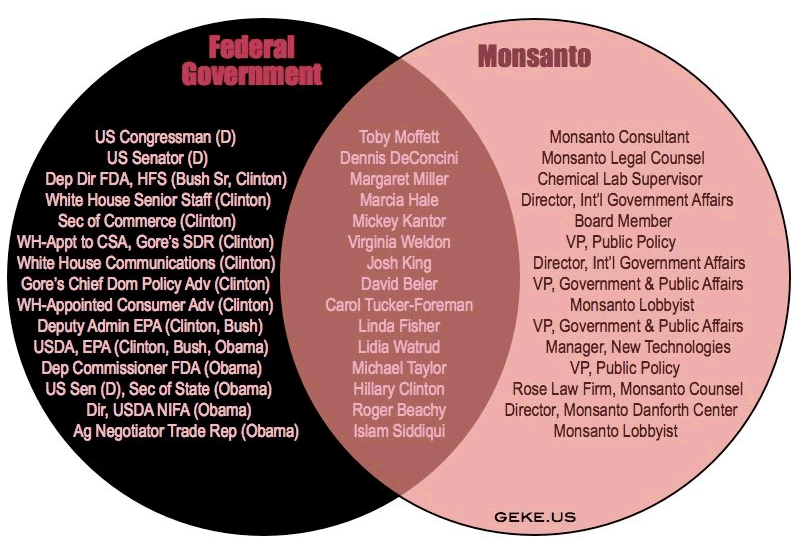
The revolving door between the private sector and government bodies has been well established. In the US, many senior figures from the Genetically Modified Organisms (GMOs) industry, especially Monsanto, have moved with ease to take up positions with the Food and Drug Administration and Evironmental Protection Agency and within the government. Writer and researcher William F Engdahl writes about a similar influence in Europe, noting the links between the GMO sector within the European Food Safety Authority. He states that over half of the scientists involved in the GMO panel which positively reviewed the Monsanto’s study for GMO maize in 2009, leading to its EU-wide authorisation, had links with the biotech industry.

“Monsanto should not have to vouchsafe the safety of biotech food. Our interest is in selling as much of it as possible. Assuring its safety is the FDA’s job” – Phil Angell, Monsanto’s director of corporate communications. “Playing God in the Garden” New York Times Magazine,October 25, 1998.

Phil Angell’s statement begs the question: then who should vouchsafe for it, especially when the public bodies have been severely comprised? Monsanto has all angles covered.

When corporate interests are able to gain access to such positions of power, little wonder they have some heavy-duty tools at their disposal to try to fend off criticism by all means necessary.

A well-worn tactic of the pro-GMO lobby is to slur and attack figures that have challenged the ‘science’ and claims of the industry. With threats of lawsuits and UK government pressure, some years ago top research scientist Dr Arpad Pusztai was effectively silenced over his research concerning the dangers of GM food. A campaign was set in motion to destroy his reputation. Professor Seralini and his team’s research was also met with intense industry pressure, with Monsanto effectively targeting the heart of science to secure its commercial interests. There are numerous examples of scientists being targeted like this. A WikiLeaks cable highlighted how GMOs were being forced into European nations by the US ambassador to France who plotted with other US officials to create a ‘retaliatory target list’ of anyone who tried to regulate GMOs. That clearly indicates the power of the industry.

What the GMO sector fails to grasp is that the onus is on it to prove that its products are safe. And it has patently failed to do this. No independent testing was done before Bush senior allowed GMOs onto the US market. The onus should not be on others to prove they are safe (or unsafe) after they are on the market, especially as public attorney Steven Druker‘s book ‘Altered Genes, Twisted Truth’ shows that GMOs are on the US market due to fraudulent practices and the bypassing of scientific evidence pointing to potential health hazards.

We therefore have the right to ask whether we should trust studies carried out by the sector itself that claims GM crops are safe? Let us turn to Tiruvadi Jagadisan for an answer.

He worked with Monsanto for nearly two decades, including eight years as the managing director of India operations. A few years ago, he stated that Monsanto “used to fake scientific data” submitted to government regulatory agencies to get commercial approvals for its products in India. The former Monsanto boss said government regulatory agencies with which the company used to deal with in the 1980s simply depended on data supplied by the company while giving approvals to herbicides. As reported in India Today, he is on record as saying that India’s Central Insecticide Board simply accepted foreign data supplied by Monsanto and did not even have a test tube to validate the data which at times was faked.

Now that scientists such as Professor Seralini are in a sense playing catch-up by testing previously independently untested GMOs, he is attacked. However, the attacks on Seralini and his study have been found to be based on little more than unscientific polemics and industry pressure. In fact, in new study, Seralini highlights the serious flaws of industry-backed studies that were apparently slanted to distort results. It remains to be seen whether he and his team are in for another bout of smears and attacks.

But this is symptomatic of the industry: it says a product is safe, therefore it is – regardless that science is being used as little more than an ideological smokescreen. We are expected to take its claims at face value. The revolving door between top figures at Monsanto and positions at the FDA makes it difficult to see where the line between lobbying and regulation is actually drawn. People are rightly suspicious of the links between the FDA and GMO industry in the US and the links between it and the regulatory body within the EU.

GM represents the so-called “Green Revolution’s” second coming. Agriculture has changed more over the last two generations than it did in the previous 12,000 years. Environmentalist Vandana Shiva notes that, after 1945, chemical manufacturers who had been involved in the weapons industry turned their attention to applying their chemical know-how to farming. As a result ‘dwarf seeds’ were purposively created to specifically respond to their chemicals. Agriculture became transformed into a chemical-dependent industry that has destroyed much biodiversity. What we are left with is crop monocultures, which negatively impact food security and nutrition. In effect, modern agriculture is part of the paradigm of control based on mass standardization and a dependency on corporate products.

The implications have been vast. Chemical-industrial agriculture has proved extremely lucrative for the oil and chemicals industry, courtesy of oil-rich Rockefeller interests which were instrumental in pushing for the green revolution throughout the world, and has served to maintain and promote Western hegemony, not least via ‘structural adjustment’ and the consequent uprooting of traditional farming practices in favour of single-crop export-oriented policies, dam building to cater for what became a highly water intensive industry, loans and indebtedness, boosting demand for the US dollar, etc.

Agriculture has been a major tool of US foreign policy since 1945 and has helped to secure its global hegemony. One must look no further than current events in Ukraine, where the strings attached to financial loans are resulting in the opening up of (GM) agriculture to Monsanto. From Africa to India and across Asia, the hijack of indigenous agriculture and food production by big corporations is a major political issue as farmers struggle for their rights to remain on the land, retain ownership of seeds, grow healthy food and protect their livelihoods.

Apart from tying poorer countries into an unequal system of global trade and reinforcing global inequalities, the corporate hijacking of food and agriculture has had many other implications, not least where health is concerned.

Dr Meryl Hammond, founder of the Campaign for Alternatives to Pesticides, told a Canadian parliament committee in 2009 that a raft of studies published in prestigious peer-reviewed journals point to strong associations between chemical pesticides and a vast range of serious life-threatening health consequences. Shiv Chopra, a top food advisor to the Canadian government, has documented how all kinds of food products that were known to be dangerous were passed by the regulatory authority and put on the market there due to the power of the food industry.

Severe anemia, permanent brain damage, Alzheimer’s, dementia, neurological disorders, reproductive problems, diminished intelligence, impaired immune system, behavioural disorders, cancers, hyperactivity and learning disability are just some of the diseases that numerous studies have linked to our food.

Of course, just like cigarettes and the tobacco industry before, trying to ‘prove’ the glaringly obvious link will take decades as deceit is passed off as ‘science’ or becomes institutionalized due to the hijacking of government bodies by the corporations involved in food production.

But anyone who questions the need for GMOs in the first place and the risks they bring and devastating impacts they have is painted as clueless and indulging in scare mongering and falsehoods, while standing in the way of human progress. But can we expect much better from an industry that has a record of smearing and attempting to ruin people who criticise it? Are those of us who question the political links of big agritech and the nature of its products ready to take lessons on ethics and high-minded notions of ‘human progress’ from anyone involved with it?

This is an industry that has contaminated crops and bullied farmers with lawsuits in North America, an industry whose companies have been charged with and most often found guilty of contaminating the environment and seriously damaging health with PCBs and dioxins, an industry complicit in concealing the deadly impact of GM corn on animals, an industry where bribery seems to be second nature (Monsanto in Indonesia), an industry associated with human rights violations in Brazil and an industry that will not label its foods in the US.

A great myth forwarded by the pro-GMO lobby is that governments are freely choosing to adopt GMOs. Any brief analysis of the politics of GM highlights that this is nonsense. Various pressures are applied and agritech companies have captured policy bodies and have a strategic hold over the WTO and trade deals like the TTIP.

For instance, take the 2005 US-India nuclear deal (allowing India to develop its nuclear sector despite it not being a signatory of the Non-Proliferation Treaty and allegedly pushed through with a cash for votes tactic in the Indian parliament). It was linked to the Knowledge Initiative on Agriculture, which was aimed at widening access to India’s agricultural and retail sectors. This initiative was drawn up with the full and direct participation of representatives from various companies, including Monsanto, Cargill and Walmart.

When the most powerful country comes knocking at your door seeking to gain access to your markets, there’s good chance that once its corporate-tipped jackboot is in, you won’t be able to get it out.

And it seems you can’t. So far, Bt cotton has been the only GM crop allowed in India, but the open field trials of many GM crops are now taking place around the country despite an overwhelming consensus of official reports warning against this. The work of numerous public bodies and research institutes is now compromised as a result of Monsanto’s strategic influence within India (see this and this).

If global victory cannot be achieved by the GMO biotech sector via the hijack of public bodies and trade deals or intimidation, then the politics of another form of contamination may eventually suffice:

“The hope of the industry is that over time the market is so flooded [with GMOs] that there’s nothing you can do about it. You just sort of surrender” – Don Westfall, biotech industry consultant and vice-president of Promar International, in the Toronto Star,January 9 2001.

Open field planting is but one way of achieving what Westfall states. Of course, there are numerous other ways too (see this).

As powerful agribusiness concerns seek to ‘consolidate the entire food chain’ with their seeds, patents and GMOs, it is clear that it’s not just the health of the nation (any nation) that is at stake but the global control of food and by implication nations.

“What you are seeing is not just a consolidation of seed companies, it’s really a consolidation of the entire food chain” – Robert Fraley, co-president of Monsanto’s agricultural sector 1996, in the Farm Journal. Quoted in: Flint J. (1998) Agricultural industry giants moving towards genetic monopolism. Telepolis, Heise.

Colin Todhunter is an independent writer: colintodhunter.com

Billionaire Fears The Poor RIsing Up Against The Rich

.

Source: Popular Resistance

A billionaire finally had a epiphany and told all his wealthy friends about it.

Johann Rupert is the filthy rich owner of Richemont, a luxury goods company that serves as parent company to jeweler Cartier. His net worth tops out at nearly $8 billion making him part of the 1% of wealthy people who are greedily taking control of most of the world’s wealth to the detriment of poor people and the middle class.

According to Oxfam, an organization that fights poverty, the richest one percent are on pace to control more global wealth than the rest of the 99 percent combined by 2016. And it doesn’t show any signs of stopping.

Unsurprisingly, most of the billionaires in the world live in the United States, where they hire armies of lobbyists to influence the passage of government policies that help them keep their vast wealth and keep it growing. Meanwhile, other nations, despite having a few billionaires, have more regulations designed to narrow the income inequality gap.

Nevertheless, the system that allows the rich to keep getting richer isn’t doing anything for the rest of humanity as most people around the world continue to struggle to make ends meet. While the wealthy continue to make more money, everyone else is making less, which is starting to cause social unrest and upheaval that worries Johann Rupert.

Rupert now fears that the greed of the 1 percent has gone too far, and the thought that one day the rest of the world will grab their pitchforks and torches makes sleeping more difficult for him.

How is society going to cope with structural unemployment and the envy, hatred and the social warfare? We are destroying the middle classes at this stage and it will affect us. It’s unfair. So that’s what keeps me awake at night.

Rupert revealed his terror at the Financial Times Business of Luxury Summit in Monaco, and frankly, he is right to fear this scenario.

There are 7 billion people in this world and only a few hundred grotesquely wealthy people. As people become more desperate to care for themselves and their struggling families in a world where rich people are making more money they don’t need off the backs of the working poor, it won’t be long before people get so fed up that they literally band together to bring down the greedy assholes who care more about owning the world than they do about everyone who lives in it.

That especially applies here in America as income inequality has cast millions of Americans into a never-ending cycle of poverty that becomes harder to escape year after year while the super-wealthy continually try to roll back policies such as minimum wage laws and other benefits in order to engineer a cheaper workforce through legislation. In other words, wealthy businessmen are treating the rest of the world as nothing more than slave labor put on this Earth to keep themselves rich.

Eventually, people will get sick and tired of the game that rich people are playing. They will rise up like Rupert fears and come for them. And then they will wish they had shared the wealth instead of hoarding it all for themselves.

Upside down economics of debt, poverty, unemployment: Ready to seize solutions now, or do you require more pain?

2013-09-07_1503

By Carl Herman

Source: The Daily Censored

“If people were really self-interested, they would stop trying to be individualistic.” – John B. Cobb, founder of Seizing an Alternative conference (and here, videos here)

Economic Hitman John Perkins’ 2-minutes on today’s neo-colonialism capitalism:

Demonocracy’s 2-minutes on what the US national debt looks like if shown in actual amounts of $100 bills:

Earth economics is upside down.

Accelerating technology can and should provide:

  • more personal freedom from labor,
  • more beauty in infrastructure and nature,
  • greater joy in our freedom to create and explore our beautiful, powerful, and diverse virtues (something like “resource-based economics” as researched by The Venus Project).

We know what we have is in contrived Orwellian opposition of what leadership should create. We know that what we receive is literal criminal fraud:

I could go on to literally ~100 areas of crucial concern.

The first challenge for the 99.99% is to trust their own Emperor’s New Clothes observations that Earth is truly in this tragic-comedy rather than listen to the .01%’s lies attempting to cover naked facts anyone can see.

Please understand that I represent likely hundreds of thousands of professionals making factual claims with objective evidence anyone with a high school-level of education can verify. For example, the June 2015 Seizing an Alternative conference (and here, videos here) at the Claremont Colleges had hundreds of professionals presenting data and solutions in over 80 areas of speciality. My paper and videos for this conference is here.

The purpose of education since the “Age of Enlightenment” is to present facts for public verification, and to seize the victory of refuting lies by would-be dictators, especially when such lies are obvious and of crucial public importance.

The path forward as we build a critical mass of humans recognizing the Emperor’s New Clothes truth is to demand arrests and solutions, obviously:

  1. ARRESTS: the first responsible action upon recognizing massive crimes that annually kill millions, harm billions, and loot trillions is to demand that law enforcement and military enact arrests of criminal leaders to stop the crimes and begin unwinding the truth of what happened in Earth’s tragic-comedy (four-part article series with videos on arrests as the obvious citizen response).
  2. SOLUTIONS: the .01% with corporate media have suppressed solutions documented beginning with Benjamin Franklin how government can abundantly operate without taxes: monetary and credit reform allow the public to have near-instant prosperity: full-employment, zero public deficits and debt, the best infrastructure we can imagine, falling prices, and release of public TRILLIONS held in “rainy day” accounts. Full documentation here.

Humanity’s choices:

  1. Ongoing .01% Orwellian, upside-down, tragic-comic, Emperor’s New Clothes crimes with all the pain, fear, harm, death, debt, poverty, enslavement, crime, destruction, and despair.
  2. Arrests to stop the crimes of the present, and ready-to-start solutions to build a brighter future.

Be your brightest light as the person you’ve always wanted to be.

Former World Bank economist Herman Daly and co-author John B. Cobb of For the Common Good discuss our condition and pathways forward in this 40-minute interview:

Carl Herman is a National Board Certified Teacher of US Government, Economics, and History; also credentialed in Mathematics. He worked with both US political parties over 18 years and two UN Summits with the citizen’s lobby, RESULTS, for US domestic and foreign policy to end poverty. He can be reached at Carl_Herman@post.harvard.edu

Lara Trace Hentz

INDIAN COUNTRY NEWS

In Saner Thought

"It is the duty of every man, as far as his ability extends, to detect and expose delusion and error"..Thomas Paine

ZEDJournAI

Human in Algorithms

Rooster Crows

From the Roof Top

Aisle C

I See This

The Free

blog of the post capitalist transition.. Read or download the novel here + latest relevant posts

अध्ययन-अनुसन्धान(Essential Knowledge of the Overall Subject)

अध्ययन-अनुसन्धानको सार