Life-Hacks of the Poor and Aimless

horrible-life-hacks-19

On negotiating the false idols of neoliberal self-care

By Laurie Penny

Source: The Baffler

Late capitalism is like your love life: it looks a lot less bleak through an Instagram filter. The slow collapse of the social contract is the backdrop for a modern mania for clean eating, healthy living, personal productivity, and “radical self-love”—the insistence that, in spite of all evidence to the contrary, we can achieve a meaningful existence by maintaining a positive outlook, following our bliss, and doing a few hamstring stretches as the planet burns. The more frightening the economic outlook and the more floodwaters rise, the more the public conversation is turning toward individual fulfillment as if in a desperate attempt to make us feel like we still have some control over our lives.

Coca-Cola encourages us to “choose happiness.” Politicians take time out from building careers in the debris of democracy to remind us of the importance of regular exercise. Lifestyle bloggers insist to hundreds of thousands of followers that freedom looks like a white woman practicing yoga alone on a beach. One such image (on the @selflovemantras Instagram) informs us that “the deeper the self love, the richer you are.” That’s a charming sentiment, but landlords are not currently collecting rent in self-love.

Can all this positive thinking be actively harmful? Carl Cederström and André Spicer, authors of The Wellness Syndrome, certainly think so, arguing that obsessive ritualization of self-care comes at the expense of collective engagement, collapsing every social problem into a personal quest for the good life. “Wellness,” they declare, “has become an ideology.”

There is an obvious political dimension to the claim that wellbeing, with the right attitude, can be produced spontaneously. Months after being elected leader of the most right-wing government in recent British history, yogurt-featured erstwhile PR man David Cameron launched an ill-fated “happiness agenda.” The scheme may have been better received if the former prime minister were not simultaneously engaged in decimating health care, welfare, and higher education—the very social structures that make life manageable for ordinary British people. As part of Cameron’s changes to the welfare system, unemployment was rebranded as a psychological disorder. According to a study in the Medical Humanities journal, in the teeth of the longest and deepest recession in living memory, the jobless were encouraged to treat their “psychological resistance” to work by way of obligatory courses that encouraged them to adopt a jollier attitude toward their own immiseration. They were harangued with motivational text messages telling them to “smile at life” and that “success is the only option.”

This mode of coercion has been adopted by employers, too, as Cederström and Spicer note. Zero-hour-contract laborers in an Amazon warehouse, “although they are in a precarious situation . . . are required to hide these feelings and project a confident, upbeat, employable self.” All of which begs the question: Who exactly are we being well for?

The well-being ideology is a symptom of a broader political disease. The rigors of both work and worklessness, the colonization of every public space by private money, the precarity of daily living, and the growing impossibility of building any sort of community maroon each of us in our lonely struggle to survive. We are supposed to believe that we can only work to improve our lives on that same individual level. Chris Maisano concludes that while “the appeal of individualistic and therapeutic approaches to the problems of our time is not difficult to apprehend . . . it is only through the creation of solidarities that rebuild confidence in our collective capacity to change the world that their grip can be broken.”

The isolating ideology of wellness works against this sort of social change in two important ways. First, it persuades all us that if we are sick, sad, and exhausted, the problem isn’t one of economics. There is no structural imbalance, according to this view—there is only individual maladaption, requiring an individual response. The lexis of abuse and gas-lighting is appropriate here: if you are miserable or angry because your life is a constant struggle against privation or prejudice, the problem is always and only with you. Society is not mad, or messed up: you are.

Secondly, it prevents us from even considering a broader, more collective reaction to the crises of work, poverty, and injustice. That’s the logic exposed by personal productivity gurus like Mark Fritz, who tells us, in The Truth About Getting Things Done, that:

The biggest barrier to achieving the success you have defined for your life is never anyone else or the circumstances you encounter. Your biggest barrier is almost always you. . . . Dr Maxwell Maltz, author of Psycho-Cybernetics [ETA: sounds legit to me!], put it best when he said, “Within you right now is the power to do things you never dreamed possible. This power becomes available to you as soon as you can change your beliefs.

This, of course, is a cyclopean lie—but it’s a seductive one nonetheless. It would be nice to believe that all it takes to change your life is to repeat some affirmations and buy a planner, just as it was once comforting for many of us to trust that the hardships of this plane of existence would be rewarded by an eternity of bliss in heaven. There is a reason that the rituals of well-being and self-care are followed with the precision of a cult (do this and you will be saved; do this and you will be safe): It is a practice of faith. It’s worth remembering that Marx’s description of religion as the opiate of the masses is often misinterpreted—opium, at the time when Marx was writing, was not just known as an addictive drug, but as a painkiller, a solace when the work of survival became unbearable.

With the language of self-care and well-being almost entirely colonized by the political right, it is not surprising that progressives, liberals, and left-wing groups have begun to fetishize a species of abject hopelessness. Positive thinking has become deeply unfashionable. The American punk kids I know describe it, disparagingly, as “posi.” The British ones, of course, describe it as “American.” Whatever you call it, it feels a lot like giving in.

In a scintillating essay at Open Democracy, activist Chloe King writes that

changing your attitude is not going to change or help to dismantle structural injustice and a failed and unsustainable economic model which serves only the elite rich of this world, and exploits the rest of us, particularly the working class and those living in poverty. As far as I am concerned positive thinking will fucking ruin your life. “Just think positive” is a precursor to “it gets better,” and the hard reality is it is only going to get much, much worse for our most vulnerable.

There is truth here. What is also true, however, is that the young people I know who are, in general, the very worst at taking basic care of themselves as individuals—the people whose problem is not that they don’t drink enough asparagus water, but that they don’t drink enough of anything that isn’t day-old wine from a foil bag—are those who went through the student and Occupy uprisings of 2010–2012 and experienced, briefly, what it meant to live a different sort of life. What it meant to be part of a community with common goals of which mutual aid and support were not the least. What it meant to experience that sudden, brief respite from individual striving and build a prefigurative society together. The lonely work of taking basic care of yourself as you wait for the world to change is a poor substitute. When you’re washed up and burned out from putting your body on the line to fight the state, it’s especially galling to be told to share a smile and eat more whole grains.

When modernity teaches us to loathe ourselves and then sells us quick fixes for despair, we can be forgiven for balking at the cash register. Anxious millennials now seem to have a choice between desperate narcissism and crushing misery. Which is better? The question is not rhetorical. On the one hand, Instagram happiness gurus make me want to drown myself in a kale smoothie. On the other, I’m sick and tired of seeing the most brilliant people I know, the fighters and artists and mad radical thinkers whose lives’ work might actually improve the world, treat themselves and each other in ludicrously awful ways with the excuse, implicit or explicit, that any other approach to life is counterrevolutionary.

Some of the left critique of self-care as a neoliberal conspiracy has to do with dismissing the work that women and queer people do to survive. “I have heard feminism be dismissed as a form of self-indulgence,” writes Professor Sara Ahmed of Goldsmiths, University of London. So have I. I’ve heard men on the left write off anti-sexist, anti-racist politics as hopelessly individualistic, whilst also refusing to do the basic work of self-care and mutual care that keeps hope alive and health possible, because that work is women’s work, undignified in comparison to watching your life fall apart while you wait for the revolution or for some girl to pick up the pieces, whichever comes first.

The left has a special talent for counterproductive, theory-enabled wallowing. “Neoliberalism sweeps up too much when all forms of self-care become symptoms of neo-liberalism,” writes Ahmed. “When feminist, queer, and anti-racist work that involves sharing our feelings, our hurt and grief, recognizing that power gets right to the bone, is called neo-liberalism, we have to hear what is not being heard. . . . A world against you can be experienced as your body turning against you. You might be worn down, worn out, by what you are required to take in.”

It is at this point that I confess to you that I’ve been doing yoga for two years and it’s changed my life to an extent that I almost resent. I have trained myself, through dedicated practice on and off the mat, to find enough inner strength not to burst out laughing when the instructor ends the class by declaring “let the light in me honor the light in you.” The instructor is a very nice person who smiles all the time like a drunk kindergarten teacher and could probably kill me with her abs alone, so I have refrained from informing her that the light in me is sometimes a government building on fire.

Downward-facing dog is not a radical position. Nonetheless, that particular asana is among a few small concessions I make to self-care while I wait for the end of patriarchy and the destruction of the money system. Overpriced charcoal health drinks aren’t good for liberating anything except your wallet and your colon in short succession, but walks in the park are free, so I occasionally go out in the sunshine and try to soak up a bit of Vitamin D without worrying about skin cancer, melting ice-caps, and millions of people drowning in Bangladesh. I no longer subsist entirely on chicken nuggets, cigarettes, and spite. I sometimes take a day off, because it became apparent that the revolution was not being driven any faster by my being sick and sad all the time. Late Capitalism is as good an excuse of any for not getting out of bed, but huddling under the covers worrying about Donald Trump is a very inefficient way of sticking it to the man.

The problem with self-love as we currently understand it is in our view of love itself, defined, too simply and too often, as an extraordinary feeling that we respond to with hearts and flowers and fantasy, ritual consumption and affectless passion. Modernity would have us mooning after ourselves like heartsick, slightly creepy teenagers, taking selfies and telling ourselves how special and perfect we are. This is not real self-love, no more than a catcaller loves the woman whose backside he’s loudly admiring in the street.

The harder, duller work of self-care is about the everyday, impossible effort of getting up and getting through your life in a world that would prefer you cowed and compliant. A world whose abusive logic wants you to see no structural problems, but only problems with yourself, or with those more marginalized and vulnerable than you are. Real love, the kind that soothes and lasts, is not a feeling, but a verb, an action. It’s about what you do for another person over the course of days and weeks and years, the work put in to care and cathexis. That’s the kind of love we’re terribly bad at giving ourselves, especially on the left.

The broader left could learn a great deal from the queer community, which has long taken the attitude that caring for oneself and one’s friends in a world of prejudice is not an optional part of the struggle—in many ways, it is the struggle. Writer and trans icon Kate Bornstein’s rule number one is “Do whatever it takes to make your life more worth living. Just don’t be mean.” It’s more than likely that one of the reasons that the trans and queer communities continue to make such gains in culture, despite a violent backlash, is the broad recognition that self-care, mutual aid, and gentle support can be tools of resistance, too. After the Orlando massacre, LGBTQ people across the world started posting selfies under the hashtag #queerselflove. In the midst of the horror, the public mourning, and the fear, queer people of all ages and backgrounds across the world engaged in some light-hearted celebration of ourselves, of one another.

The ideology of wellbeing may be exploitative, and the tendency of the left to fetishize despair is understandable, but it is not acceptable—and if we waste energy hating ourselves, nothing’s ever going to change. If hope is too hard to manage, the least we can do is take basic care of ourselves. On my greyest days, I remind myself of the words of the poet and activist Audre Lorde, who knew a thing or two about survival in an inhuman world, and wrote that self care “is not self-indulgence—it is self-preservation, and that is an act of political warfare.”

The Continuing Decline of McDonald’s

AC991E1E

By James Corbett

Source: The Corbett Report

Long-time Corbett Reporteers might recall my 2015 video, “Celebrate! McDonald’s is Dying!” where I detailed the many, many woes the fast “food” giant was dealing with at the time, including:

Since then, McCancer’s has been undergoing a sweeping “restructuring” that has seen many layers of lipstick slapped on their factory-farmed pig. This restructuring includes not only cosmetic changes (“All-day breakfasts and new value menus for everyone!”) but behind-the-scenes efforts to trim $500 million from the company’s operating expenses, including buyouts and layoffs at company headquarters and the re-franchising of 4,000 corporate “restaurants.”

The global giant’s influential PR machine has used sleight-of-hand and other tricks to make this restructuring look like a smash success. They used their cheerleaders at the Wall Street Journal to hype “stronger-than-expected” profit and sales figures and their boosters at US News & World Report to hype some highly-selective earnings comparisons suggesting that this “turnaround” is, to use the WSJ’s phrase, “sustainable.”

But one doesn’t have to scratch too hard to reveal the rusty reality beneath this PR paint job.

McPinkslime’s might have “beat expectations” for sales and profits, but beating diminished expectations is hardly a sign of booming business. Just look at the nuts and bolts of the Q3 2016 earnings report: Year-on-year revenue is down 2.9% and net income is down 2.6%. And keep in mind, those numbers are in comparison to the already-terrible 2015 figures.

And that “re-franchising” operation? It cost $130 million in pre-tax charges.

But don’t worry, everyone, they “beat expectations!” Pay no attention to the hemorrhaging corporation behind the curtain!

And now the latest sign of McDonteat’s global retreat (via Corbett Report member “BuddhaForce”): “McDonald’s gives up control of its China business in $2 billion deal.”

The story is fascinating enough in its own right, what with McDonteats throwing in the corporate towel on the largest and fastest-growing consumer market in the world. But the devil is, as always, in the details. Who is purchasing the majority stake in the company’s mainland operations? None other than The Carlyle Group and CITIC Group.

The Carlyle Group’s name will likely ring a bell as one of the largest swamp pits “private equity firms” in the world, and one with its fingers in many a pie, including, of course, 9/11.

CITIC Group, meanwhile, will be familiar to The Corbett Report faithful as a key player in “China and the New World Order,” a Chinese state-owned investment company that helped serve as the Rockefeller-Kissinger nexus between the Deng Xiaoping-era “capitalist roaders” and their western finance oligarch recolonizers.

That these two cesspools are converging on the giant turd of American fast food is fitting enough. The McDonaldization of China is proceeding apace, and the usual crew are there to profit from it.

But as to what this story says about the continuing decline of the once-mighty golden arches, there are two main takeaways to the story, one depressing and one positive.

On the depressing front, there is a simple reason for the across-the-board slowdown in fast food sales in recent years (despite the predictable attempts to overcomplicate the problem in clickbait-y listicle format). For once, the Wall Street Journal gets it right: It’s the economy, stupid. What greater rebuke to the easily-disprovable economic “recovery” nonsense of the Obama years could be possible than pointing out the simple fact that people are too worried about their economic future to splurge on a $5 value meal?

But on a positive note, we can take McFatfood’s woes as a sign that, try as they might with their considerable propaganda resources, the corporate chieftains can’t put their egg McMuffin back together again. People are fed up with fast food. And although some, concerned with cost, are turning to eating at home as the cheaper option, others are more concerned with what’s in their food, where it’s sourced from, how it’s being prepared and who is being paid for it. Who wants instant, nutritionless, food-like substitute rolled up in plastic and slapped down on a tray by surly, overworked servers (or, increasingly, robots) anyway?

For those interested in how they can take part in the real food revolution that will render the McFastfood economy obsolete, may I humbly offer this podcast on guerrilla gardening? Bon appétit!

Former World Bank Staffer Explains How Neoliberalism Is Destroying The World

neoliberal

By Dylan Charles

Source: Waking Times

More destructive than bombs, money has become the weapon of choice for the global elite, for the hidden hand of finance can plunder and conquer entire nations, assimilate whole cultures, exploit resources and rape the earth while forcing billions into poverty, all with the surprising stealth of pen-strokes and business contracts.

Neoliberalism is the economic and political philosophic driving force in the world today. It suggests that human progress is the result of competition, best expressed by an extremist version of unfettered capitalism, where privatization of profits and socialization of losses are acceptable ethics, regardless of human and environmental costs incurred along the way.

Neoliberalism is the killer plague of the 21st century. Neoliberalism is economic fascism. It is a criminal doctrine. Globalized neoliberalism privatizes public goods for private profit. Neoliberalism led by Washington with the shameful complicity of Europe has in the last fifteen years killed between 12 and 15 million people by wars, famine, deprived health services… forced refugees. Today a small world elite of corporate and Wall Street CEOs and selected politicians call the shots. ~Peter Koenig

First defined in 1938, its global implementation today is the product of the Washington Consensus of 1989 which describes a set of economic prescriptions for developing and crisis-wracked nations created by the World Bank, the International Monetary Fund and the U.S. Treasury Department. It is a policy which relies on the creation of social and financial crises to distract and soften target nations and peoples, creating problems while providing the ‘solutions.’

At present, Mexico is on the brink of revolution, a direct result of the fallout of three decades of neoliberal policy.

It [Neoliberalism] finds that representative democracy has been perverted through fear, putting central political decisions in the hands of power groups with special interests.The social impact of this process has been devastating, with a polarized income distribution, falling wages, increased precarious jobs, rising inequality, and extreme violence. Health conditions have also deteriorated and disorders associated with violence, chronic stress, and a changing nutritional culture have become dominating. [Source]

Journalist George Monbiot describes neoliberalism as follows:

Neoliberalism sees competition as the defining characteristic of human relations. It redefines citizens as consumers, whose democratic choices are best exercised by buying and selling, a process that rewards merit and punishes inefficiency. It maintains that “the market” delivers benefits that could never be achieved by planning.

Attempts to limit competition are treated as inimical to liberty. Tax and regulation should be minimised, public services should be privatised. The organisation of labour and collective bargaining by trade unions are portrayed as market distortions that impede the formation of a natural hierarchy of winners and losers. Inequality is recast as virtuous: a reward for utility and a generator of wealth, which trickles down to enrich everyone. Efforts to create a more equal society are both counterproductive and morally corrosive. The market ensures that everyone gets what they deserve. ~[Source]

Economic hitman turned whistleblower, John Perkins, wrote in detail of his ‘boots-on-the-ground’ experiences in conquering third-world nations through economic aid and infrastructure financing in his seminal classic, Confessions of an Economic Hitman. He’s since been on a world crusade to expose the madness of neoliberalism, seeking redemption by connecting with many of the indigenous cultures he previously had worked to enslave and oppress.

In recent years, Greece has become a more visible victim of this policy as the IMF and the European Union have forced the people of this ancient culture into austerity and starvation as part of a plan of economic restructuring to force repayment of illegitimate debts to international bankers.

Speaking at The Delphi Initiative in 2015, economist, geopolitical analyst, and former World Bank staffer, Peter Koenig, explained the scourge of this political and economic philosophy and how it is destroying our world today.

What we are confronted with today is the globalization, and the globalization basically that we are living is like a fetish of the neoliberals. The neoliberals who want to reduce the world to one culture, to one set of values, all based on greed consumption and maximizing profits. ~Peter Koenig

Koenig also speaks of neoliberalism as the root of the type of endless global conflict we see today, including wars of occupation and their resulting terrorism, noting that the U.S. economy is now so dependent on military spending that if peace were to break out, our economy would collapse.

Although from 2015, Koenig’s message is critically important today as the world continues to wake up to the reality that our lives are in the hands of a small exploitative group of inhumane corporations and governments who will stop at nothing to control the resources which make life possible, including water, destroying any civilization that stands in its way.


Something Is Happening

collapse-era

By William Hawes

Source: Gods & Radicals

SOMETHING IS HAPPENING HERE, but you don’t know what it is: Do you? No one knows, really, as this something is still evolving. As we look back to 2016, though, it is abundantly clear that history has awoken from its slumber. We’ve had a couple events in the West last year: Brexit and Trump.

Politically-charged, dynamic events (as Alain Badiou might define them) have been rare in the West since the fall of the Berlin Wall and the disintegration of the USSR. Capitalism made it seem as if neoliberalism was winning in the 1990s, even as the US wantonly murdered in Iraq and took perverse pleasure in helping to dismember Yugoslavia, among other things.

In fact, one could argue there have only been four notable Western political events in the post-Cold War era: the 9/11 attacks, the 2003 protests against the Iraq War, the 2008 banking crisis and following protest movements of 2011 (Occupy and 15-M Movement), and the populist, anger-driven aforementioned events of 2016.

You see, authentic, spontaneous political events (in the form of uprisings or popular revolts against the elite) are a no-no in the West. History is supposed to have ended, remember? Max Weber called this the Iron Cage, and for good reason.

Now, though, the meaninglessness and rootlessness of our lives trapped inside the cage have become too obvious to ignore, for most of us. As each day passes, our political discourse glosses over how lazy, ignorant, mean-spirited, and numb our society has become. We import luxuries from all over the globe, but can’t be bothered to cook or grow our own food, assemble our own electronics, expand renewable energy projects, provide clean water to inner cities, organize high-speed transport, or educate our youth without drowning them in debt, etc.

So, many have lashed out against the system, and our more vulnerable members of society, in anger, defiance, out of sheer ignorance. Could it be because, deep down, we know how helpless, sheltered, and out-of-touch our society is, compared to the rest of the world? What are the root causes of this disintegration of public discourse?

One cause is our utter dependency on the capitalist system to clothe, feed, and shelter us. What we used to inherit from our mothers and fathers, important agricultural knowledge, artisanal and cultural wisdom, a sense of place and belonging, have all been traded in for money, the privilege to be exploited by capitalism, toiling in jobs that alienate us from ourselves, families, the Earth. Paper bills and electronic bank accounts are a pitiful substitute for self-reliance. This loss, this grief, isn’t allowed to be expressed in public. Logical positivism tells us that progress will prevail, the future will be better than the past, and anyone who thinks otherwise must be some sort of Luddite.

Since real income has fallen and social services have been slashed in the last 40-plus years, many have seen their loved ones’ lives cut short (lack of access to health care and quality food and produce, air and water pollution), their dreams defiled (steady jobs gone, factories shuttered), their entertainment homogenized and dangerous (sports mania has become normalized, “Go Team!”, alcohol, painkiller, and opiate addiction is rampant), their hopes for the future shattered (community and public space swallowed by corporations).

There are those, as well, still too plugged into the system (both Trump and Clinton voters), too attached to their gadgets, to the hum of their slave-labor appliances, to the glow emanating from their screens. They will cry incessantly about the turning away of Muslims from flights, but there is only silence for the millions killed abroad by the US war machine. Mainstream liberals are just as likely as the meanest, most selfish conservatives to fall prey to emotional pleas, demagoguery, and pathetic attempts to see themselves as victims in this Age of Anger.

The urge to resort to the myth of a righteous, homogenous, “pure” social group, to denigrate the other, is strong in such dire, despondent situations. In America, though, material poverty cannot be said to be the only, or even the main causal factor, behind this return of nativism and tribalism. Rather, it is undoubtedly a spiritual malaise that has swept over the West. Ever since the rise of the Industrial Revolution, it has been technology which has provided the underlying weltanschauung for our culture. Sprouting from this, an inhuman and Earth-destroying morality has formed. Jacques Ellul explains:

“A principal characteristic of technique … is its refusal to tolerate moral judgments. It is absolutely independent of them and eliminates them from its domain. Technique never observes the distinction between moral and immoral use. It tends on the contrary, to create a completely independent technical morality.” (1)

Thus, Western society, through the use of mass-produced electronics and disseminated in what some call our “Information Age”, has now seemingly accelerated the pace of change and ecological destruction beyond the scope of any group or nation which could possibly control it. We are then confronted with the thought that only an economic collapse or series of natural disasters could possibly provide the impetus for revolutionary change to occur. This only leaves us feeling helpless, depressed, and passive in the face of government oppression and capitalist exploitation.

Not only that, but capitalism has quite literally dulled our senses and disconnected us from our source of being, planet Earth. Don’t believe me? Read this amazing paper on how Polynesian wayfinders discovered islands thousands of miles apart without any modern technology. This is part of what Morris Berman means by Coming to our Senses. To re-establish our unity with nature, the Western notion of an ego-driven, domineering and reductionist search for truth, meaning, and creativity must be thrown out. Here, Berman invokes Simone Weil:

“‘decreate’ yourself in order to create the work, as God (Weil says) diminished Himself in order to create the world. It would be more accurate to say that you don’t create the work, but rather you step out of the way and let it happen.” (2)

This isn’t really discussed among wide swaths of leftists, the social-justice crowd, or with mainstream liberals. It’s anathema to a materialistic, dead world where freedom has been traded for comforting lies, money has been substituted for the ability to provide for ourselves and our communities, and the abundance and resiliency (truly a miracle!) of the Earth is taken for granted as we chase our next fix for consumer goods, our next chance for drugs or gadgets to dim our perception.

What you’re not supposed to say in public, of course, is that our world is falling apart, and we are doing nothing to stop it. The reactions are too raw, the reality too grim, even as we know, for example, that 10% or more of the total species on Earth will be gone by 2050.

Yet we can do something: there is an opening now in political discourse which has been previously denied to us. The Republican and Democratic parties have thoroughly delegitimized themselves by offering up Trump and Clinton as their figureheads: these were widely considered the most widely disliked candidates in recent memory, if not the history of our republic. There is room for Libertarians, Greens, and Socialists to gain power: yet only if they avoid their own regrettable sectarianism, organize, and promote an inclusive, broad-based platform.

To do so, citizens will have to gain some perspective on their lives. A slow pace of life needs to be seen as a virtue, not a sin: many on the right and left are quick to denounce the hedonism of the jet-setting, parasitic globalists, the Davos men; yet refuse to see their own lifestyles and actions as smaller examples of such outlandish consumption.

If we are open to life and our environment as part of a greater whole, an unfathomable mystery, we can refuse our culture’s siren songs of death, misery, and destruction. While modern technology can be useful if reined in by an Earth-conscious, responsible morality, some things are better left unknown, undiscovered, if it risks destroying the Earth in order to find the answer. Rather than running a cost/benefit analysis to determine the land’s worth, some aspects of the planet and the universe are better Left Sacred.

Also, acknowledging our mortality, and accepting the basic fact that death could come for you at any moment, can liberate our souls and propel them to unimaginable heights. Joe Crookston explains this quite well:

“And then when I turn dry and brown
I’ll lay me down to rest
I’ll turn myself around again
As part of an eagle’s nest
And when that eagle learns to fly
I’ll flutter from that tree
I’ll turn myself around again
As part of the mystery”


Notes:
1.) Ellul, Jacques. The Technological Society. Vintage Books, 1964. p. 97.
2.) Berman, Morris. Coming to Our Senses: Body and Spirit in the Hidden History of the West. Simon & Schuster, 1989. p. 337


William Hawes is a writer specializing in politics and environmental issues. His articles have appeared online at Global Research, Countercurrents, Dissident Voice, The World Financial Review, Gods & Radicals, and Counterpunch. He is author of the ebook Planetary Vision: Essays on Freedom and Empire. You can reach him at wilhawes@gmail.com

The Acquisitive Self, Minus the Self

article-2386232-1B30C5F9000005DC-668_634x633

By Natasha Vargas-Cooper

Source: The Baffler

Los Angeles isn’t exactly the place that comes to mind when you think of decorous restraint in the display of wealth, even in the dregs of the Great Recession. Here in my hometown, possibly more than in any other outpost of faux-meritocratic privilege in our republic of getting and spending, untrammeled acquisition is understood as an expression of individual will—and more than that, a matter of taste.

Yet for all the studio money sloshing around our bright, stucco world, most of us have never encountered the miniscule stratum of humans that hovers above the rich: the pure, gilt-edged, entrenched, multigenerational wealthy. Movie star money is food stamps compared to oil money, hedge fund money, and even some of that dank old money that still floats around the haciendas of Pasadena. We might have stood kegside next to Kirsten Dunst once, but we don’t know the kinds of rich people that F. Scott Fitzgerald had in mind when he wrote that the rich “are different from you and me”: the Vanderbilts, Rothschilds, and Astors. Hell, our L.A. doesn’t even boast a new-money Midwestern poultry heiress.

We don’t see these types—let alone interact with them—because they’ve largely seceded from public view. This is the guilt-prone social formation that Paul Fussell dubbed the “top out-of-sight class,” because you typically can’t see their houses/compounds unless you have access to a helicopter. Prior to the mid-twentieth century, the top out-of-sight class had been very much in sight; Manhattan’s Fifth Avenue and Philadelphia’s Main Line mansions are still monuments to their Caligulan self-regard. But ever since the Great Depression, and its attendant booms in Social Realist art and Popular Front politics, they staged a quiet but striking mass retreat. So spooked out were the über-rich that they became almost discreet. “The situation now is very different from the one in the 1890s satirized by Thorstein Veblen in The Theory of the Leisure Class,” Fussell wrote in 1983. “In [Veblen’s] day the rich delighted to exhibit themselves conspicuously. . . . Now they hide.”

Thirty years later, this is still mostly true, but thanks to the exhibition-friendly canons of social media, the scions of excess are back and flaunting it, baby—and it’s an entirely underwhelming display. These aren’t the out-of-sight rich but their twentysomething children, flouting their parents’ wealth-whispers code of silence. With acres of unproductive time on their hands, bored rich kids are using their gold-plated iPhones to post images of their baubles of privilege, their chemical stimulants of preference, and their outlandish bar tabs on Instagram, the photo-sharing service of the moment. It’s a bit as though a Bret Easton Ellis novel has come blandly to life, without the benefit of any irony.

Predictably enough, a Tumblr photo-blog has stirred vacantly into being, to compile all these outpourings of opulence in one convenient place. Launched in 2012 by a founder who remains anonymous, Rich Kids of Instagram (RKOI for short) curates and tags photos posted on Instagram by the likes of Barron Hilton, Tiffany Trump, and other “funemployed” trust-funders. The Tumblr, which slaps a whimsical, intricately scrolled frame around each photo but adds little else, doesn’t come with a explanation or an editorial policy, other than that it purports to show you the lifestyles that the unseen rich had previously shared only with their similarly rich friends. “They have more money than you do and this is what they do,” goes the tagline.

Why should we look? The payoffs for the nonrich civilian viewer are oddly perfunctory. After all of the social mythologies we’ve lovingly constructed to envelop the delusions of the 1 percent, this is the lurid end-of-the-rainbow payoff they’ve decided to lord over the rest of us—a fistful of watches, car interiors, and European spa photos? The content of Rich Kids of Instagram is less the aftermath of an imperial Roman bacchanal than the shamefaced hangover of an especially inane and oversexed (though well-appointed!) frat party. Around about the dozenth selfie featuring a buff and/or emaciated scion nestled into a private jet with a bottle of Cristal and a $10,000 clip of cash (“Always make sure to tip your pilot and co-pilot 10k. #rulesofflyingprivate”), you can’t help but wonder, “Is that all there is?”

The Duller Image

Indeed, in strictly visual terms, the site is hard to distinguish from a luxe Sharper Image catalog—merchandised out, to be sure, but disappointingly clichéd. The rich boys of Instagram—the son of fashion mogul Roberto Cavalli, for example, and a weak-chinned fellow with the handle Lord_Steinberg—post pictures of their IWC Grande Complication Perpetual watches, multiple Lamborghinis, and six-figure bar tabs. Here, all the shiny expensive crap seems to cry out, is what I’ve done with my life in lieu of becoming an adult. The young rich ladies, such as Alexa Dell (of, you know, the Dell computers fortune), mainly document how all this pelf looks from the other side of the gender divide: they snap pics of themselves surrounded by tangerine Hermès shopping bags, eating sushi sprinkled with 24K gold flakes, and holding their American Express Centurion card minimum payment notifications (typically $40,000).

There’s not even much in the way of the makings of righteous socialist outrage. (Swazi Leaks this most definitely is not; that project, by contrast, pairs leaked photographs of Swaziland’s high-rolling absolute monarch with pictures of $1-a-day sub-subsistence conditions in the slums.) Yes, the rich kids seem determined to remind us that they have stuff the rest of us will never have. The captions they post with their photos are, at times, slyly aware of their part in inequality (cf. a picture of a private jet and a luxury car with the caption “The struggle is real”). But for all that, the kids don’t seem especially power-hungry so much as aimless and languid. Behind these faux-provocative posts lurks a desperate clamor for attention that almost verges on a cry for help—something that makes you feel a certain involuntary (and certainly undeserved) pity for these manically self-documented upper-crusters.

Nevertheless, the rich kids keep on multiplying their blandified self-inventories, and some among the rest of us, presumably, keep looking. In the beginning, few of the kids knew their Instagram feeds were being monitored by RKOI; the security detail for Alexa Dell, for one, wasn’t prepared to see some of her pictures, with recognizable details that could give away her whereabouts (usually closely guarded by her family), show up on the site. Her social media presence was quickly scrubbed. But now, many of the kids featured know they’re getting Tumblr’d, and some court the attention by submitting photos for consideration, tagged with #rkoi. Rich Kids of Instagram has earned its subjects thousands of followers for their individual feeds, and even momentarily catapulted some of the sort-of rich, perhaps splashing out on a once-a-year chartered yacht to Saint Tropez, into better company than they could ordinarily afford.

American media culture has done its part by spinning off these social-media maunderings into a full complement of incoherent dreck. Last winter, the E! cable network debuted #RichKids of Beverly Hills, a reality TV series loosely organized around the premise (if we can call it that) of the Tumblr account. (The show even features—wink, wink—an “Instagram-obsessed” cast member named Morgan Stewart, who delivers such walk-on anathemas to viewer interest as “I’ve taken so many selfies on my cell phone today it’s, like, embarrassing.” No, son, what’s embarrassing is that you’re saying this shit out loud, in front of a television camera.)

The PG-13 Class War

If an E! show wasn’t enough, this summer saw the release of a book-like object, also called The Rich Kids of Instagram, credited to the site’s anonymous founder together with a ghostwriter/collaborator named Maya Sloan. Like its “inspiration,” the book—billed for some reason as a novel—is unrelentingly dumb, though it does supply an important clue to the weird demographic marketing strategy behind the Rich Kids franchise. It’s clearly written for kids or, um, young adults, suggesting that the notion of “aspirational” reading and viewing—the grand media euphemism for the lifestyle-voyeurism genre—is ripe for retirement. Instead, this plotless, and nearly character-less, flight of fancy is something far more inert, and less interesting: an empty vessel of careless adolescent fantasy.

The book’s careful observance of PG-13 canons of teen rebellion is so pronounced as to be obtrusive. There’s little in the way of appalling or casual sex; the cussing and chronic drug use (nothing too hard, mind you: pills, weed, blow) is there mainly for box-checking shock value. In this, as well, the book is true to the real-life Tumblr; nowhere do you see anything truly threatening or transgressive, like Jordan Belfort snorting coke out of a hooker’s ass in Martin Scorsese’s The Wolf of Wall Street. No, all you encounter, in the book as on the Tumblr feed, is the sort of teen spliff smoking you’d find at an average Dave Matthews show—but in a jet, bro!!

In the same way that such scenes beg to be seen as transgressive, the Rich Kids oeuvre begs to be seen as a populist-baiting vindication of privilege for privilege’s sake: Take that, plebes! But there’s a telling sleight of hand here. The book’s main gimmick is identical to the Tumblr’s MO: the outrage is all imputed to you, the reader, in advance, by its ostensible targets or by the medium itself. This means, in turn, that the proceedings float serenely above any semblance of real-world criticism. So, not surprisingly, the book suffers from the same thing the actual rich kids of Instagram kids do, only at far more tedious length: a depressing lack of imagination. Here, for example, is one of the novel’s rich kids fuming about her maid while also clumsily name-checking her 1,200-thread-count sateen sheet set: “Woven in Italy. For what I paid, I could buy your illegal Guatemalan cousins. That is, if you weren’t from Jersey.”

There’s no pulse-pounding social tension or class resentment on offer here—unless you’re especially aroused by inarticulate dialogue. The novel doesn’t proceed in a mood of detached anthropological inquiry, the way that, say, Louis Auchincloss or John Marquand’s old-money fictions did. There’s no anger, no weight, no insight. All you have in the way of a rich-kid call-to-arms is the empty bravado of the anonymous site creator’s acknowledgements at the front of the book: “To all the RKOI kids, who are unapologetically themselves; in a world where so few people will live out loud, you guys have guts, and for that you deserve admiration.” (And yes, Rich Kid self-awareness once again stops well short of the obvious irony involved in an anonymous social media impresario’s celebration of the overclass’s bold capacity “to live out loud.”)

For “gutsy” exemplars of individual lifestyle, the kids are distressingly uniform in their motivation, behavior, and dramatic purpose. Far from emblazoning their excellent individuality upon our collective prole brainpan, the novel’s cast of characters merges into an interchangeable ensemble of predictable, privileged reflexes and half-copped attitude. Each member of this brat pack is outfitted with a suffocatingly oversignifying name and a ponderous chapter rendered in his or her voice. To save time, here’s a rundown of the main players in the book (think of it as the literary equivalent of a bar-tab selfie):

• Annalise Hoff, a high-strung media heiress who dotes on her Murdoch/Hearst mashup Daddy: “I know: Freud would have a field day with me. I don’t take the short bus, after all. I have a Bentley waiting.”

• Christian Rixen, a Denmark Royal and jewelry designer, who employs an oddly clinical diction suggesting that this is what Southern Californian rich assholes hear when Europeans speak to them: “The countess may have birthed me, but she was far from maternal.”

• Miller Crawford, a Mayflower legacy, rifle heir, and aspiring record producer—and what passes for a self-starting entrepreneur in these circles: “I made a promise long ago: I won’t be that guy. The kind who orders staff to do petty bullshit. Sure, there are emergencies. Scoring coke for an after-hours, buying last-minute condoms. As for the rest? I can get my own double latte, thanks.”

• Todd Evergreen, a Mark Zuckerberg stand-in with a suitably generic name—an upper-middle-class kid who became an overnight billionaire by captaining an overcapitalized software startup. We don’t hear from Evergreen, who is eventually driven into paranoia and Howard Hughes–like seclusion until the novel’s crashingly unpersuasive, life-affirming coda. “I liked their things,” Evergreen says of the rich kids, “don’t get me wrong. Not for the things themselves, but how excited they got about them. How their faces lit up when they talked about them. But I liked the people for other reasons. Better reasons.”

• Desdemona Goldberg, a bipolar singer/actress: “Wow, I think, that coke was awesomeness.

You don’t say. This novelization rounds out the Rich Kids trifecta: Tumblr, TV show, and book. The net effect is, fittingly enough, akin to that of another notorious plutocratic foray into cultural exhibitionism—a Damien Hirst installation. In both, we see our culture lords courting outrage in the most safely inert and vanity-fed forms of display. Both aim to provoke an aesthetic response that is little more than a fleeting revulsion, compounded by the inevitable gawking at the price tag attached to the finished product. And both make a huge deal of curating predators, whether it be champagne-squirting twentysomethings captured in photo-blog form (RKOI) or a really big shark lifelessly preserved in a bath of acid (Hirst).

Binge and Purge

For that matter, the Rich Kids franchise outdoes even Hirst, and achieves a further refinement of this recursive aesthetic of total consumption: it’s a monument to the acquisitive self minus the actual self. Sometimes the kids don’t even bother to take pictures of items they buy. Instead, they share photos of the shopping bags from whatever luxury store they just blew through. Other times, they display pictures of receipts, personal check stubs, or their names embossed on credit cards.

Capital is always on the verge of dematerializing our common world; as Marx and Engels famously warned back in the day, under the height of bourgeois domination, “all that is solid melts into the air.” Here, however, is a gloss on that crippling dynamic that the founders of socialism never could have anticipated: the children of capital are rendering their innermost selves—their critics-be-damned determination to live out loud—as a random agglomeration of nonsignifying digits. The beauty they transmit back, what they see, is nothing more than a place-holding string of credit limits where a human self, or at least a measure of use value, might once have been.

Still, there are evidently some young self-starters who are gleaning a different aspirational message from the whole enterprise. When frequent RKOI contributor Aleem Iqbal, a nineteen-year-old whose dad owns a luxury car leasing service in England, went on a recent binge of selfie-taking, some unintended consequences ensued. The younger Iqbal saturated his Instagram feed with shots of himself driving really expensive cars with the vanity plate “LORD.” On June 6 the teenager leased a $560,000 Lamborghini Aventador Roadster, and a few hours later someone set it on fire. A week after that, three more of his luxury cars, two Audi R8 Spyder supercars and a Bentley Flying Spur, were torched. This was not his understanding of the new social contract at all. Instead of a reality TV or book deal, all his self-infatuated Instagram entries had earned him was the smoldering hulks of four plute-mobiles. On his Facebook page, the aggrieved teen called the campaign of high-end vandalism “a vile act of jealously towards my business.”

Maybe so; it could be like George Orwell said, and there really are only two classes, the rich and the haters. On the other hand, a follower of some RKOI property might have thought it was high time to perform a salutary act of simple math: subtracting some small amount of indecent luxury from the torrent of inert and unproductive excess that we all, inexplicably, must endure. Vileness, after all, is in the eye of the beholder.

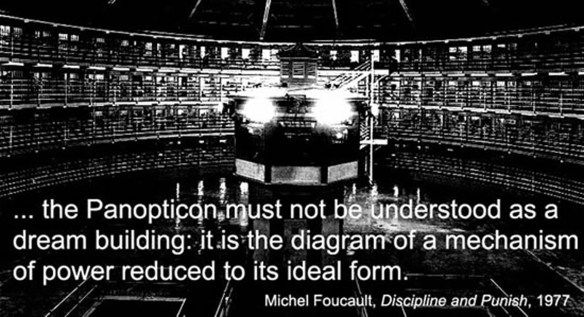
Media, Mind-Control, & Meditation: Plato’s E-Cave Panopticon and Beyond

panopticon-image

By Mankh (Walter E. Harris III)

Source: Axis of Logic

“Relax,” said the night man,
”We are programmed to receive.
You can check-out any time you like, 
But you can never leave!”

 – The Eagles, from “Hotel California”

In Plato’s Allegory of the Cave, people saw a shadow play on the wall and perceived it as reality. Today that Cave has morphed to provide umpteen TV channels and mini-screen gadgets; and the once sanctified living room cave has expanded into a free-range bubble of consciousness – heads bowed before an electronic altar, seemingly oblivious to the outside world.

“The “panopticon” refers to an experimental laboratory of power in which behaviour could be modified, and Foucault viewed the panopticon as a symbol of the disciplinary society of surveillance.”[1]

In Plato’s E-Cave, not only are the people watching a shadow play, they, and the shadows they watch, are being watched.

HyperNormalization
With a veneer of calm aplomb, the masses communicate 24-7, often in a frenetic urgency of the mundane, hence one interpretation of HyperNormalization. In all the years of overhearing cell-phone conversations in public, I can’t recall one snippet of philosophy or practical advice, rather stuff like, ‘yeah OMG I’ll get the chips!’ and ‘I’ll be there in like 30 seconds!’; if you’re old enough, you’d remember the days when, you got there when you got there! That said, a cell-phone can be a helpful even life-saving device.

The USEmpire election appears to have both proven and disproven the main theory of Adam Curtis’ fascinating new documentary “HyperNormalization.”

“Curtis argues that since the 1970s, governments, financiers, and technological utopians have given up on the complex “real world” and built a simple “fake world” that is run by corporations and kept stable by politicians.”[2]

The California cyber-tech-boom was a love-child of LSD-consciousness that found refuge in E-wizardy all the while looking to escape repressive politics. In his book “2030” Pepe Escobar describes it as: “Digital network capitalism would then shape post-modern globalization, from the New Economy before the end of the millennium to every digital wall to be broken beyond. California cosmology forged our world.”

According to Wikipedia:

“The term “hypernormalisation” is taken from Alexei Yurchak’s 2006 book Everything was Forever, Until it was No More: The Last Soviet Generation, about the paradoxes of life in the Soviet Union during the 20 years before it collapsed. A professor of anthropology at the University of California, Berkeley, he argues that everyone knew the system was failing, but as no one could imagine any alternative to the status quo, politicians and citizens were resigned to maintaining a pretence of a functioning society. Over time, this delusion became a self-fulfilling prophecy and the “fakeness” was accepted by everyone as real, an effect which Yurchak termed “hypernormalisation”.”[3]

First off, I see HyperNormalization as a half-truth because while the self-referential, gossipy world is fake, it is a veneer for a very real world of resource extraction and the violence perpetrated to maintain the status quo – and that is what the fakers ignore. As far as the election, many expected the Clinton dynasty to prevail as the corrupt, business as usual lesser of two evils. Breaking snooze: Where’s  the headline news that Melania Trump plans to focus on helping women and children?; I saw that mentioned on CNN’s Anderson Cooper 360, such a perfect antidote for Hillary’s loss and The Donald’s anti-feminist track record.

Even though WikiLeaks revealed the DNC (Democratic National Convention) was rigged against Sanders and leaks of Podesta/Clinton e-mails may have been proverbial straws for Hillary’s campaign camel, the prevailing media sentiment was that she would win – despite the fact that the day before the election some polls indicated a shrinking 3-4 point lead, thus with the typical margin of error, it was, in effect, tied. Yet the mass hyper-surprise!; and all that after the corporate media and comedy shows had simultaneously bashed Trump and given him more air-time than a kite on a windy day – both disdaining and elevating him, a media-mindfuck if ever there was one.

And there was little uproar when Gary Johnson and Jill Stein were excluded from debates and virtually banned from all corporate news, thus proving (if you didn’t know already) that it’s not a truly democratic election. Yet carry on we must and do the best we can with what we got, was the general sentiment, in other words, “the “fakeness” was accepted by everyone as real” aka HyperNormalization.

Yet the non-coastal, poor and middle America White working class (with sides of KKK and minorities!), which reportedly was the key demographic for The Don’s victory, was voting out of bare-bones needs; in effect they were not HyperNormalized. Then again, if Trump, who promises to challenge the status quo, caves-in to Deep State pressure, we will have an answer to an interesting article’s titular question: “President Trump: big liar going to Washington or Tribune of the People?”[4] And if that answer is the former, then the mostly White working poor will also have been duped/HyperNormalized.

You see, it’s hard to know what’s what; which all seems to prove HyperNormalization as the dominant societal charade; which screen is real, if any?

What you perceive is what you get
Another key phrase in Curtis’ documentary is “managed perception” – akin to Chomsky and Herman’s  “Manufacturing Consent: The Political Economy of the Mass Media” (1988) which showed how opinions and desensitized agreement to the status quo became a product to be mined and marketed. Witness CBS Chairman Les Moonves’ comment from February 2016:

“Man, who would have expected the ride we’re all having right now? … The money’s rolling in and this is fun. I’ve never seen anything like this, and this [is] going to be a very good year for us. Sorry. It’s a terrible thing to say. But, bring it on, Donald. Keep going.” [5] And, if i might satirically add, like an orangey topped Duracell battery, The Don does seem to have a lot of energy.

HyperNormalization is also akin to Sheldon Wolin’s theory  of “inverted totalitarianism,” where the faceless corporate machine wields so much entertainment and bureaucratic power that the people barely notice they are being played hook, line, and sinking feelings.

Some of Curtis’ info, however, is inaccurate or questionable. For examples, he blames the demise of the Occupy Movement on lack of vision and planning yet neglects to mention the FBI coordinated systemic crackdown on the ‘camps’ across the country. [6]

About Syria he says that President Bashar al-Assad retaliated with a “vengeful fury,” whereas Assad has defended his actions as self-defense for his people; numerous journalists back the Syrian President’s claim.

Post-election, I wonder: Why were so many liberals, lefties, and women more surprised that Trump won than that the DNC/HRC rigged it against Sanders? Were they simply feeling impotent due to HyperNormalized shadow play? Whatever the case, his victory revealed a crack in the smooth screen of HyperNormalization.

According to Patrick Caddell’s survey before the election, the populace seems to be hip to what’s happening:

“Powerful interests from Wall Street banks to corporations, unions and political interest groups have used campaign and lobbying money to rig the system for them. They are looting the national treasury of billions of dollars at the expense of every man, woman and child. AGREE = 81%; DISAGREE = 13%…

“The country is run by an alliance of incumbent politicians, media pundits, lobbyists and other powerful money interests for their own gain at the expense of the American people. AGREE = 87%; DISAGREE = 10%

The real struggle for America is not between Democrats and Republicans but between mainstream American and the ruling political elites. AGREE = 67%; DISAGREE = 24%.” [7]

This makes it seem it is the ‘how-to bring about change’ that is the deeper conundrum of the HyperNormalized world. Then again, people too often seem to have only their own best interests at heart. Approximately 90% of Americans want their food labeled so as to know if they contain GMOs etc. or not, yet hardly a peep out of anyone that climate change or the “environment” aka Mother Earth & Nature-beings were deliberately excluded as a main topic of the presidential debates. This makes it seem that, in general, Americans want clean food for themselves, they want a clean environment so they can go ‘play in the park’ by themselves. And that brings us to the Great Disconnect and Standing Rock.

Flow like water, be steady as a rock
Part of HyperNormalization is a disconnect from Nature and from being self- and community-guided, and therefore disconnected from the Original Peoples of Turtle Island. While many people are certainly aware of what’s happening with Standing Rock, the corporate media’s lack of attention, let alone empathy, fosters lack of concern for the outcome, lack of being outraged by the violent and racist treatment of those in prayer and peacefully protecting the main source of water for the Standing Rock Sioux and other Natives as well as approximately 17-million people downstream. The real-fake outrage is over the outcome of a fake election.

For many Native reservations where poverty and PTSD are prevalent, the people are anything but HyperNormalized; they are struggling to survive – as with Standing Rock, they are not asking for much: clean water and the space to live their lives with ancient traditions timelessly connected with the land, the water, the stones…

Plato, imagining a prisoner getting outside of the Cave, wrote: “Slowly, his eyes adjust to the light of the sun. First he can only see shadows. Gradually he can see the reflections of people and things in water and then later see the people and things themselves. Eventually, he is able to look at the stars and moon at night until finally he can look upon the sun itself .” [8]

Standing Rock is bringing people together, raising consciousness at many levels. As one example from a little over a week ago:

“In a “historic” show of interfaith solidarity, 500 clergy members prayed along the banks of North Dakota’s Cannonball River on Thursday where they “bore witness with the Standing Rock Sioux Nation,” which has faced intimidation, violence, and arrests for protecting their sacred land and water supply from the threats of a massive oil pipeline. According to the Episcopal News Service, “The interfaith group spent more than five hours on site, marching, singing hymns, sharing testimony, and calling others to join them in standing with the more than [300] tribes who have committed their support to the Sioux Nation as they protest the route of the Dakota Access Pipeline (DAPL).” [9]

This solidarity is in stark contrast with the election where a typically 51/49 system determines an outcome for a society literally programmed for exciting close-call winners – think sporting events,
reality shows, awards ceremonies.

Outside in and inside out
There are many ways to get outside the Cave. One of those is by going within. When I first started to meditate, as is common, I became aware of the constant chatter in my head and soon realized that the mind left unattended will rattle on endlessly. Meditation then showed me that once the chatter quiets, one then has access to other frequencies, other ‘channels’ – what happens then is a very personal matter yet also impersonal because one becomes connected with another source of thinking-seeing-feeling. Chatter, like cell-phones, has it’s usefulness, say, if you forgot to turn the stove off. My point to the personal anecdote is that the corporate media is too much chatter, endlessly looping itself. The gadgets, too, though useful, seem hard-wired for HyperNormalization.

Some of the chatter we must live with, yet by learning to follow our intuitions, listening to and connecting with Nature, talking with elders and little children we can better tune-out from the shadow-play, we can find new and ancient ways for more people – and that includes trees, rivers, etc. –  “to look at the stars and moon at night” and “look upon the sun itself.”

“Sin filo ya y derrotada se quejó: Soy más fuerte que ella, pero no le puedo hacer daño y ella a mi, sin pelear. me ha vencido.’”

“Without sharpness and defeated, it [the sword] complained: ‘I am stronger than the water, but I cannot harm her. And the water, without fighting, has conquered me.’” [10]

NOTES:
1.    Panopticism here and here.
2.    Ibid.
3.    HyperNormalization
4.    See here.
5.    “Les Moonves: Trump’s run is ‘damn good for CBS’”. See here.
6.    “Revealed: how the FBI coordinated the crackdown on Occupy
7.    “Patrick Caddell; The Pollster Who ‘Got it Right’
8.    “Allegory of the Cave
9.    “A Prayer for People and Planet: 500 Clergy Hold ‘Historic’ Mass Gathering for Standing Rock
10.    “Questions & Swords: Folktales of the Zapatista Revolution” as told by Subcomandante Marcos, Cino Puntos Press, El Paso, Texas, 2001, p.82.

To watch “HyperNormalization”, click here.

Mankh (Walter E. Harris III) is an essayist and resident poet on Axis of Logic. In addition to his work as a writer, he is a small press publisher and Turtle Islander. His new book of genre-bending poetic-nonfiction is “Musings With The Golden Sparrow.” You can contact him via his literary website.


We Still Want Everything: The Politicisation of Anti-work

balestrini-we-want-everything-650

By Hans Rollman

Source: PopMatters

If there is such a thing as a ‘revolutionary novel,’ Nanni Balestrini’s We Want Everything is as good an example as any. The novel, first published in Italy in 1971, recounts in dramatic narrative form actual events that occurred in late 1969 in Italy: a massive mobilization and strike against Italian auto-maker Fiat that erupted into civil violence and came close to political revolution.

Balestrini—a poet, visual artist and writer—was himself personally involved in these struggles. In 1979, explains Rachel Kushner in an introductory essay, he had to flee the country on skis through the Alps in order to avoid arrest on charges of insurrection and terrorism, later dropped. But more than offering a dramatic recount of the events of 1969, the book offers a potent political analysis of today’s ‘mass worker’ and the struggles they face, couched in everyday language and dramatic action.

The novel offers a fast-paced first-person narrative. The language is blunt, unadorned and honest; the action sticks to key points and races along without detours from the main theme. The narrator comes from southern Italy, and like others from the region, he is lured north by the promise of easy quick cash in the newly modernising factory towns.

The context of this historical moment of capitalist development in Italy is important. For centuries Italians, particularly in the south, had lived an essentially feudal subsistence lifestyle. They eked out a living working the fields and farms of petty landlords, meeting their needs with relative ease but living in a constant state of abject poverty. They could gather food from the forests and fields around them; they could live in fairly basic housing and even sleep comfortably outdoors for much of the year. They wore simple clothing, handed down and patched up.

But then the factories arrived, luring young people off the land with the promise of cash and all that it offered: things their families had never even dreamed of. Stylish clothes, cars, modern homes of their own. At first the lure seemed attractive. But once they left their traditional lifestyles, they discovered they had new needs as well that they had never had before: the need to pay for housing, for food, for clothes for their families. To meet these needs, they had to work, and work hard; they no longer had the right to take a day off whenever they wanted to sit at the beach. To obtain the consumer goods they wanted and needed, they had to surrender to the tyranny of bosses and to the tyranny of work itself.

But they didn’t go without a fight, and that fight is the subject of Balestrini’s classic novel.

Kushner makes an important point in her introduction: the struggle depicted in the novel is predominantly depicted as a masculinist struggle. Women have very little presence in the novel and are objectified when they are. This is an ironic oversight, as Kushner notes, because women more than anyone had call to demand everything. It’s an unfortunate oversight too, she observes, since “it’s accurate to say that feminism had the most lasting and successful impact among the demands made in the revolts of 1970s Italy.”

The narrator—based loosely on a real figure, Alfonso Natella, to whom the author dedicates his work—is a happy-go-lucky southerner who comes north looking for easy cash. He gets it, drifting through a series of jobs, filling his wallet and then quitting jobs just as quickly as he gets them in order to enjoy the cash he’s earned. Then he finds new jobs, and becomes quite adept at scamming employers, as well.

The point of his continuous lies and scams is this: work is not something to be respected. He wants to have a good time, a natural human inclination, and so wants money, but sees no reason to respect the principle of work. At first his hatred of work is primal and intuitive; he has no real political analysis, just knows he wants to enjoy life and is happy to take the quickest route to get there. He’s willing to work for money—and only as long and as hard as it takes to get some—but understands there is nothing intrinsically worthy or noble about work. His views crystallize after he obtains one of the coveted jobs at Fiat, the Italian automaker. There, he eagerly joins in with students, union organizers and other activists who are vying with each other to gain adherents among the Fiat workers.

So I started stirring things up at the gates. Comrades, today we must stop work. Because we’ve fucking had it up to here with work. You’ve seen how tough work is. You’ve seen how heavy it is. You’ve seen that it’s bad for you. They’d made you believe that Fiat was the promised land, California, that we’re saved.

I’ve done all kinds of work, bricklayer, dishwasher, loading and unloading. I’ve done it all, but the most disgusting is Fiat. When I came to Fiat I believed I’d be saved. This myth of Fiat, of work at Fiat. In reality it’s shit, like all work, in fact it’s worse. Every day here they speed up the line. A lot of work and not much money. Here, little by little, you die without noticing. Which means that it is work that is shit, all jobs are shit. There’s no work that is OK, it is work itself that is shit. Here, today, if we want to get ahead, we can’t get ahead by working more. Only by the struggle, not by working more, that’s the only way we can make things better. Kick back, today we’re having a holiday.

The Politicisation of Anti-work

Gradually he comes to develop a political analysis as well. It’s not just that work is bad and pointless: it’s hypocritical as well, with arbitrary determinations of whose work is valued over others, and who gets paid what.

But organizing the workers and inciting them to go on strike is challenging at first. One of the barriers is what the narrator refers to as workers’ ‘neurosis’.

What is this neurosis? Every Fiat worker has a gate number, a corridor number, a locker room number, a locker number, a workshop number, a line number, a number for the tasks they have to do, a number for the parts of the car they have to make. In other words, it’s all numbers, your day at Fiat is divided up, organised by this series of numbers that you see and by others that you don’t see. By a series of numbered and obligatory things. Being inside there means that as you enter the gate you have to go like this with a numbered ID card, then you have to take that numbered staircase turning to the right, then that numbered corridor. And so on.

In the cafeteria for example. The workers automatically choose a place to sit, and those remain their places for ever. It’s not as if the cafeteria is organised so that everyone has to sit in the same place all the time. But in fact you always end up sitting in the same place. It’s like, this is a scientific fact, it’s strange. I always ate in the same seat, at the same table, with the same people, without anyone ever having put us together. Well this signifies neurosis, according to me. I don’t know if you can say neurosis for this, if that is the exact word. But to be inside there you have to do this, because if you don’t you can’t stay.

The narrator’s point is clear: the regimentation and routinization of work tasks generates a tendency to accept the routinization of daily life—a hesitation to question or challenge norms; an inclination toward accepting the status quo, even when there is no rule saying they have to.

We Challenge Everything

Two aspects of the workers’ struggle are impressively articulated and conveyed in We Want Everything. The first is an abject hatred of work—a clear indictment of the pointlessness and myth of work. Work is not noble, work does not contribute to the self or society; it is oppression and exploitation, pure and simple.

“Workers don’t like work, workers are forced to work. I’m not here at Fiat because I like Fiat, because there isn’t a single fucking thing about Fiat that I like, I don’t like the cars that we make, I don’t like the foremen, I don’t like you. I’m here at Fiat because I need money.”

The narrator is careful to emphasize that it’s not just manual labour, it’s not just certain kinds of work that are useless and disgusting—it’s all work. The narrator knows from the beginning, with an instinctive honesty, that he doesn’t like work, but it’s only as the novel progresses that he understands the oppressive and exploitative nature of all work, realizes the political and social nature of the demand—“Less work!”

The other refreshing dimension of We Want Everything is the perceptive critique of unions. Yes, this is a workers’ struggle, but it’s not a union struggle. The unions are portrayed as the enemy of the working class. They’re exposed as serving a mediating role for the company bosses; it’s a critique that is still appropriate to level at many unions today. The unions, in their efforts to retain their control over the workers’ movement, to ensure that they control the workers and members, connive and conspire to undermine autonomous and spontaneous workers’ struggles. They fear loss of control as much as the company bosses do. The bosses want to control the factory, and the union leaders want to control the movement.

What both fear is a spontaneous, grassroots, autonomous and democratic movement self-organized by workers themselves. Example: when the struggle starts, there are various categories of workers, each of which earns different salaries. Because the workers are demanding more money, the union and bosses negotiate the creation of new categories, to provide more pay scales. The workers reject this: they want the elimination of all the different pay scales, so that all the workers earn the same amount, and that it’s an acceptable amount for all. The narrator’s lesson is this: the unions want tangible victories to wave in the air; but the workers want a powerful united movement capable of taking on the bosses.

The Outcome of the Struggle Has Yet to Be Written

“The unions try to start the struggles one at a time, one finishing and another starting, to avoid the struggle widening and to stop the workers organising themselves in the factories from expressing their will autonomously. But the working-class struggle won’t be controlled this way. Almost every day a new struggle starts, and it’s the workers who start it. This is a big test of the working class’s strength… If workers end up divided and disorganised after the struggle, this is a defeat, even if something has been gained. If workers come out of the struggle more united and organised, this is a victory, even if some demands remain unmet.”

The narrator does a superb job of chronicling the gradual evolution of the unions’ role in the struggle: at first encouraging strikes and actions, but as the workers start organizing autonomously and making their own—often more radical—decisions, the unions begin to panic and escalate their own efforts to suppress the autonomous workers’ struggle. Eventually, they even cooperate with the bosses in this effort, each of them terrified that a system which benefits them both might actually be overthrown.

“Unionists, PCI bureaucrats, fake Marxist-Leninists, cops and fascists all have one characteristic in common. They have a total fear of the workers’ struggle, of the workers’ ability to tell the bosses and the bosses’ servants to go to hell and to organise their struggle autonomously, in the factory and outside the factory. We made them a leaflet that finished like this: Someone once said that even whales have lice. The class struggle is a whale, and cops, Party and union bureaucrats, fascists and fake revolutionaries are its lice.”

The Assembly

The varied themes come together in a workers’ assembly that takes place toward the end of the novel. Workers denounce the fact that the union, instead of fighting for equal wages for everyone, has settled for an even more convoluted hierarchy of pay. Workers point out that even though the bosses have conceded a pay increase, the price of consumer goods and housing is rising accordingly. What good is a pay increase, then? Others demand a guaranteed wage for all, regardless of whether they’re employed or unemployed.

The unions warn them against radical demands, since they could upset the country’s economic system. But the workers counter that’s precisely what they want: the destruction of an economic system that perpetually exploits them. Union reforms only strengthen that system. “We say no to the reforms that the unions and the party want us to fight for. Because we understand that those reforms only improve the system that the bosses exploit us with. Why should we care about being exploited more, with a few more apartments, a few more medicines and a few more kids at school. All of this only advances the State…”

But communism is no solution either, observe other workers—the communists are just as obsessed as the capitalists with making people work hard for no reward. What the workers want is an end to work. “Comrades, I’m from Salerno, and I have done every kind of work in the south as well as the north and I have learned one thing. That a worker has only two choices: a grueling job when things are going well or unemployment and hunger when they go badly. I don’t know which of the two is worse.”

“We started this great struggle by demanding more money and less work. Now we know that this is a call that turns everything upside-down, that sends all the bosses’ projects, capital’s entire plan, up in smoke. And now we must move from the struggle for wages to the struggle for power. Comrades, let us refuse work. We want all the power, we want all the wealth.”

The Struggle Continues

The struggle against work portrayed in the novel was sparked by a particular type of worker. Earlier in the century, Italian workers’ struggles (like elsewhere) were defined by skilled workers who could more effectively demand more wealth because of their highly specialised skills. And it was that type of worker around which left-leaning political parties and labour unions organised their strategies. But in the ‘60s a new type of worker appeared: “adept at a thousand trades because he has no trade, without a single professional quality even when he possesses a diploma, lacking a steady job and often unemployed or forced into casual service, who can’t find work and so seeks it in Turin, in Milan, in Switzerland, in Germany, anywhere in Europe. Who finds the hardest, most exhausting, most inhuman jobs, those that no one else is prepared to do.” It is on this worker, Balestrini points out, that the postwar economies of the West were built.

What is significantly different about this worker is that unlike the skilled worker of the past, who could often take pride in their sought-after technical skills, the new worker is defined by “his ideological estrangement from work and from any professional ethic, the inability to present himself as the bearer of a trade and to identify himself in it. His single obsession is the search for a source of income to be able to consume and survive… For him work and development are understood solely as money, immediately transformable into goods to consume.”

As Balestrini notes in his afterword, this worker is in many ways still the worker of today. In the ‘60s and ‘70s the state and the capitalist system hastily responded to the workers’ challenge with a series of measures which suppressed that struggle for a time—automation and robotisation of factories, outsourcing of production to the third world, co-optation of unions and where none of these strategies worked, brutal police repression. But the workers, the issues, and the struggle continues today.

It was because of this new and unpredictable type of worker—who wasn’t fooled by the notion of a ‘work ethic’ and was uninterested in the elitist machinations of unions and political parties—that unprecedented revolts broke out across Italy (and elsewhere) during this period. The novel ends with a dramatic street battle between workers and police, the end of which is left hanging. Throughout that dramatically depicted battle, which rages throughout the city, it becomes clear that the workers’ strength comes from the self-empowered, self-organised movement they have been building in the weeks and months previous.

These weren’t workers following union instructions, or students playing at textbook revolutionary. These were workers who had challenged their bosses face-to-face in the factory; who had walked off the assembly lines in solidarity when one of their fellows was fired. It was their unity that was their strength—not their union or their political ideology. And as the battle rages, they realize that this unity can bring them real power.

“People kept coming from all around. You could hear a hollow noise, continuous, the drumbeat of stones rhythmically striking the electricity pylons. They made this sound, hollow, striking, continuous. The police couldn’t surround and search the whole area, full of building sites, workshops, public housing, fields. People kept attacking, the whole population was fighting. Groups reorganised themselves, attacked at one point, came back to attack somewhere else. But now the thing that moved them more than rage was joy. The joy of finally being strong. Of discovering that your needs, your struggle, were everyone’s needs, everyone’s struggle.”

The aftermath of the battle is left hanging, uncertain. Balestrini’s message is clear: the outcome of the struggle has yet to be written. “Capital only appeared to have won a victory; it has triggered a process that leads unavoidably to a confrontation with the underlying issue, expressed clearly 30 years ago in the struggles of the mass worker with the slogan ‘refusal of work’,” writes Balestrini in his afterword.

More and more the automation of production, and also the possibility in general of trusting almost every type of work and activity to machines and computers, requires a laughably small quantity of human labour power. Therefore why shouldn’t everyone profit from the wealth produced by machines and from the time freed from labour? Today, absurdly, work that is no longer necessary continues to be imposed because only through this is it possible to conceive of the distribution of money, allowing the continuation of the cycle of production and consumption and the accumulation of capital.

It’s surely no coincidence that Balestrini’s novel is undergoing a renewed popularity, at a time of mass mobilizations by a public whose ideological estrangement from work echoes so strongly with that of the characters in his 45-year old book. As demands arise again that echo the demands of the period—less work, more pay, more leisure, guaranteed income—We Want Everything sends a stirring reminder that these are not new demands, and that although it is a new generation rising to the challenge, it is the same fundamental struggle that continues.

“A new era is waiting for humanity, when it will be freed from the blackmail and the suffering of a forced labour that is already unnecessary and the enslavement to money, which prevent the free conduct of activity according to the aptitudes and desires of each and steal and degrade from the rhythm of life, at the same time that there is the real possibility of widespread and general wellbeing. This was the meaning, and could again be the meaning today and in the future, of that old rallying cry: Vogliamo tutto!” We want everything!

Stop Pretending the Rich Care About You

meryl-streep-poses-with-the-iron-lady-billboard-pic-getty-567547143

By Dr. Bones

Source: The Conjure House

One of the terrible things about being a lone bastion of bomb-throwing, fire-starting, up-against-the-wall-fascist-killing type of Anarchism is you have to mingle and jive with the enemy. Like a Seminole off the reservation and walking into the Hard Rock Casino for the first time your nerves and mind are almost assaulted by the sheer idiocy of what we call modern living. I speak of course of the fake empathy held by rich “left” liberals and their kin.

Take for instance the Meryl Streep acceptance speech, widely being lauded as…well, nobody really seems to say what it is besides some rich lady getting up on stage and talking about somebody she doesn’t like. Everywhere I look online the words “heroic” are being used, how the speech was “everything.”

Why?

Because some Hollywood actress who supported a widely acknowledged War Criminal feels salty that her personal team of bourgeoisie didn’t win an election? Because she “bravely” stood up at a catered event in a dress that cost more than you or I make in a month to tell other rich people how “persecuted” they were?

I heard the speech, actually sat down and watched it. No where is she saying that the United States is some fascist superpower, that we’ve fucked up the world and Donald Trump is set to make it even worse; she’s merely upset it’s not bombing the ever-living shit out of Syria with silk gloves on.

These people are not your goddamn comrades, they are not far away intellectuals that only need to read “the bread book” to figure out where they’ve gone wrong. These are the same people who RALLIED around a woman that called Black children “super-predators” for godsake!

These creatures, these slimy denizens of far off nooks and crannies filled with champagne and $100,000 fundraisers are absolutely wedded to the same system that produced Donald Trump in the first place. They are not looking to rock the boat, they are not feeling sorry for foreign-born people and outsiders when they declare anything not on TV as “fake news” from spooky ole’ Russia and casually muse how many megatons it might take to wipe Moscow off the fucking map.

How about that speech to a bunch of bankers where Hillary makes clear her support for a no-fly zone over Syria would end up turning its people into hamburger meat?

“They’re getting more sophisticated thanks to Russian imports. To have a no-fly zone you have to take out all of the air defense, many of which are located in populated areas.  So our missiles, even if they are standoff missiles so we’re not putting our pilots at risk—you’re going to kill a lot of Syrians.”

Where was the concern for foreign lives then?

Hollywood “care” for the most “at risk” is merely an act, a feigned empathy that is designed to make you forget that when push comes to shove they will make sure their money in tax-free offshore accounts stays safe rather than fund homeless shelters or soup kitchens.

They are as deceitful and treacherous as their cousins on the Right are stupid and violent. They are the Athenian merchants hailing their own empire while criticizing the growth of Sparta.

“Disrespect invites disrespect. Violence incites violence,” says Meryl, clutching her pearls amid other American aristocrats whose lives depend on the ongoing exploitation of millions. I looked twice to see if the fucking Romanovs or Marie Antoinette had possessed the woman but alas, she was spirit free. She is so out of touch she seems bewildered that anybody might disagree or even dislike the esteemed patricians she’s speaking to.

From where exactly does Meryl think the rage of the Red States comes from, their desire for change at any cost? Could it be the strip-mining of American manufacturing?

“The story changed dramatically in 2000. Since then, the U.S. has shed 5 million manufacturing jobs, a fact opponents of free trade mention often…

Since the 1960s, manufacturing has always paid substantially more than the minimum wage. Even today, the manufacturing jobs that remain average $20.17 an hour. That’s nearly three times the federal minimum wage.”

The fall in American standards of living?

“Today the average worker makes $8.50/hour — more than 57% less than in 1970. And since the average wage directly determines the standard of living of our society, we can see that the average standard of living in the U.S. has plummeted by over 57% over a span of 40 years.”

The obscene growth in CEO profits while Millennials earn less than their parents did?

“U.S. CEOs of major companies earned 20 times more than a typical worker in 1965; this ratio grew to 29.9-to-1 in 1978 and 58.7-to-1 by 1989, and then it surged in the 1990s to hit 376.1-to-1 by the end of the 1990s recovery in 2000. The fall in the stock market after 2000 reduced CEO stock-related pay (e.g., options) and caused CEO compensation to tumble until 2002 and 2003. CEO compensation recovered to a level of 345.3 times worker pay by 2007, almost back to its 2000 level. The financial crisis in 2008 and accompanying stock market decline reduced CEO compensation after 2007–2008, as discussed above, and the CEO-to-worker compensation ratio fell in tandem. By 2014, the stock market had recouped all of the value it lost following the financial crisis. Similarly, CEO compensation had grown from its 2009 low, and the CEO-to-worker compensation ratio in 2014 had recovered to 303.4-to-1, a rise of 107.6 since 2009.

“Single young people are getting poorer compared to the average population even those with dependent children, with stagnating disposable income and onerous living costs pressing down on prosperity.

New data accessed by the Guardian reveals that singletons aged 25 to 29 in eight rich countries – the US, UK, Australia, Canada, Spain, Italy, France and Germany – have become poorer over the last 20 years compared with the average population, and unattached young adults are finding it harder than ever to set up on their own.”

All facts conveniently left out of Meryl’s hard-hitting critique. The Left abandoned the working class for 50 years in favor of upper-middle class kids in college who spent more time dying their hair than reading Marx or even Stirner. NAFTA, a hellish neo-liberal agreement that looted Mexico to fatten the profits of American corporations, was drawn up not by some scary Republican tyrant but the “cool” Democrat and blowjob-aficionado Bill Clinton.

“During NAFTA, Mexico has had the slowest rate of economic growth than [with] any other previous economic strategy since the 1930s. From 1994 to 2013, Mexico’s gross domestic product per capita has grown at a paltry rate of 0.89 percent per year.” Additionally, “During NAFTA, Mexico’s economy grew much slower than almost every Latin American country. So to say that NAFTA has benefited the Mexican economy is also a myth. It has boosted trade and investment, but this has not translated into meaningful growth that generates jobs. One of the problems that NAFTA has generated is basically an exporting economy for transnational corporations, not for the Mexican industry per se.”

It turns out that not only did NAFTA, “flood Mexico with imported corn and cheap grains from the United States,” but “it also destroyed Mexico’s own industries,” according to Perez-Rocha.”

Where THE FUCK was Hollywood for that? For Libya? For Fast and Furious? For literally any of the ongoing despicable behavior this godforsaken Imperium has exported to millions of innocent human beings across the globe for the last eight fucking years?

Meryl Streep, and the millions of well-to-do liberals like her, want to live in a world where every McDonald’s is turned into a Panera, where every Wal-Mart blossoms into a Target. Sure you still work there, and you have no organizing rights and your pay is shitty, BUT at least your owners give money to gay charities and recycle!

Hooray ethical consumption! Never mind the suicide nets around those factories, did you know for every shirt you buy we’ll give $5 to help feed silverback gorillas? I mean, we don’t know how it works, and we can’t really say HOW we feed them but…but you can feel good about the shirt!

These people are only allies in the sense that they discredit our other enemies. Anybody that wants to shit on Donald Trump has my blessing but to pretend that they actually desire anything close to an increase in economic quality is a farce.

They are merely rich people that don’t want to feel guilty about being rich.

Don’t worry Meryl, as the US economy continues to take a shit and standards of living race to the bottom, more and more of us will be more than happy to help you overcome your feelings of guilt.

By seizing and redistributing the excesses that vex you so.


Gonzo journalism at no cost is my gift to you. Want to help keep me from starving to death or buy me a beer? Do me a favor and make a donation of any size and I’ll promise not to haunt you when I die.