ISIS Psyop Continues With “Counter Terror” Blackwater Commander

bwisis

By Bernie Suarez

Source: Activist Post

In the latest installment of the ISIS show the newest CNN report is pulling out a new storyline. The latest script now admits that a major Blackwater operative is an ISIS “counter-terror commander” leader training ISIS and sharing his combat secrets with them. Yes, the new ISIS psyop script is actually being spun in a way that the script writers are now admitting (one story at a time) that ISIS fighters are part of U.S.’s Blackwater. This is a way to admit that the U.S. continues to train ISIS, while at the same time maintaining the psyop. As usual, they are pretending this happened out of sheer coincidence and bad luck.

Why the change of script? Because it is now common knowledge amongst anyone not plugged into the CIA’s mainstream media that the West and its allies created ISIS; and in order to buffer and dodge future stories showing the connections, they are feeding the “crossover” and “defecting” narratives. Thus, anyone caught fighting for ISIS in the future who has clear ties to Israel or the U.S. can be disavowed as “defectors” (think plausible deniability!)

When the ISIS show began in the summer of 2014, many of us including yours truly were suspecting that at least some of the ISIS members are probably Blackwater (aka Academy, XE) continuing their terrorism of the Middle East under the control of course of U.S./Israeli Intelligence. Blackwater terrorists after all were the perfect foot soldiers in the U.S. occupation in Iraq; Iraq is essentially the birthplace of the Islamic State, Blackwater terrorist mercenaries are criminals that operate outside the law. Everything seemed to fit, the marriage seemed to be made in heaven. Well now we know for sure thanks to the latest CNN report which essentially admits that this is the case.

The new ISIS show script says that Gulmurod Khalimov, a special forces commander from Tajikistan, “disappeared” since April of 2014 and of course now has resurfaced with brand new pledged allegiance to the Islamic State! Coincidence? It gets better. The report claims that-

Gulmurod Khalimov is perhaps the highest-profile defector from the majority-Muslim ex-Soviet republic in central Asia.

The convenience of this supposed Blackwater Russian-speaking defector with super James Bond skills cannot be overstated. With this latest ISIS psyop CNN report we are asked by U.S./Israel Intelligence to believe that this super skilled killing machine operative is not only siding with ISIS, but for good measure he’s planning and training for ways to attack America and (the report implies) he and his trained ISIS fighter friends will come and get you in your city dwelling place wherever you live!

Above and beyond all of this, the report is careful to insert anti-Russian propaganda directly into the script. The suggestion in this latest episode is that there is a growing allegiance somehow building between Russia and ISIS! CNN is careful to show you the usual HD super high quality ISIS marketing-style videos, showing you ISIS fighters training, winning and being great. Even the background music is proper Middle Eastern style, perfect background that makes ISIS seem even greater and more intimidating.

As I’ve indicated in the past, no entity on the planet has received more promotion and marketing than ISIS at the hands of the Western CIA-controlled mainstream media. This promotional and marketing campaign has been very aggressive and has spanned the globe. If we consider the cost of advertising  today with any media platform it would be fair to say that the ISIS show is a multi-billion dollar marketing campaign that the U.S. created terror group is getting for free. That alone should wake readers up to the magnitude of this ISIS story being told predominantly since the summer of 2014. This should also help others realize how important the new world order is to the globalists who are using ISIS as a tool to advance their plans for world domination.

Since ISIS now represents one of the greatest hopes for the new world order, no one should be surprised that they are getting such incredible multi-billion dollar promotion and marketing effort. And no one should be surprised by the continued super marketing campaign the terror group will continue to get from CNN and the other CIA front media organizations. The reality of the matter is now becoming crystal clear to many – and is quite clear to those who had been paying attention all along – that without CNN’s and the rest of the mainstream media’s careful HD high quality coverage and glorification of the organization there will be no new world order.

So for now, arm yourself with knowledge, study the origins of ISIS, and see the truth about this fake terror group whose only purpose is to serve as a tool to advance the PNAC new world order plans. Once you see their role in the bigger picture you will probably never not see it again. Then as you do your part to expose this reality show, sit back and take note of this real-time reality show – It has a lot of money behind it, it has a sense of adventure, shock, irony, and it knows no boundaries in terms of believability.

Clearly the ISIS show has emerged as one of the central surreal psyop events of the century, and that alone makes it deserving of our individual attention. Let’s pay attention and consider some solutions.

Solutions

We must think in multiple dimensions when dealing with government psychological operations. Realize that as human beings we have to maintain simultaneous awareness of the greater (conspiratorial) picture, while at the same time maintaining an effective awareness of the real-time (matrix) deception that many people are still under. This will give us an operating dual consciousness – one mentally placing one foot in each side of the matrix. That allows us to tactfully, patiently and carefully wake others up from the ISIS show (in this case) and into the simple truth of the emerging, determined super fast moving globalist new world order plans.

For those who are wide awakened let’s realize that it is up to us to continue exposing the ISIS show at any cost. Let us prepare for the soon to be repeating future. Remember that the globalists like to repeat their tactics. Just look at the similarities between JFK and 9/11. Keep in mind the two events were about 40 years apart, yet the mindset, the script, and the propaganda logic behind the two events were the same, coming from the same primitive predictable minds.

I believe it is more important to focus on putting out solutions and ideas that appeal and resonate with those who get it not those who don’t get it. Worrying about those who still don’t get it could be a trap and energy/time waster because truth is realized.

Those who are still asleep will either realize the ISIS show or they will seek out the ending to the show and logically continue to try to rationalize it into their reality.

The RESTORED version of humanity, which is what many of us are, should pursue perfection, improvement and should strive to thrive. That’s right. The “restored” version of humanity means that you have been mentally rescued from the great human self-experiment propagated by the controllers. The species has been mentally enslaved for very long and you are awakened from that enslavement. As with any disease, those that are disease-free only look to care for those still diseased, not take on their disease. If the disease is mental, where the subject could represent a threat to you, (just as in medicine/psychiatry) the best thing to do is to isolate the subject. Similarly, in this case it is up to those who are awakened to intellectually isolate those who are still diseased by the deception and mental enslavement. Nurture them when possible with care (timely information) but don’t burden yourself with their disease (of not understanding or not accepting the truth outside their personal paradigm and illusions).

Part of practicing solutions is knowing how to deal with disinformation agents and those who are part of the system and thus part of the problem. Both those who are fooled and those who spread deliberate lies and disinformation on behalf of the control system suffer from a disease of mental enslavement. They are infected by their circumstances which may include the pressure to go along with the government paradigm for fear of losing their job, the offer of money and riches, government and CIA’s mainstream media mind control, etc.

So, in the end, it all comes down to mental enslavement versus mental freedom. Mental enslavement is the key to going along with the stories we’re told by CIA’s mainstream media and is the key to leading us to their new world order. Mental freedom, on the other hand, is the state humanity is in when it realizes, just like all the creatures on the planet, that it is free to express whatever it wants and be whatever nature leads it into being. This “freedom” and the quest to express this simple freedom is truly the story of humanity. The perception of being free can thus become the obstacle to actually being free as George Orwell outlines in his novel Animal Farm. This false perception of freedom in combination with learned helplessness thus accounts for the perpetual struggle to be free. True freedom therefore consists of the combination of perceiving that one is free plus ACTUALLY being free from the control system. This final stage of true freedom cannot be reached without the understanding of what it is to be truly (mentally) free. The ISIS show is nothing more than an obstacle to that understanding, an obstacle which utilizes the fear factor, one of the greatest historic tools for keeping humanity mentally enslaved and disconnected from the concept of freedom.

Bernie is a revolutionary writer with a background in medicine, psychology, and information technology. He has written numerous articles over the years about freedom, government corruption and conspiracies, and solutions. A former host of the 9/11 Freefall radio show, Bernie is also the creator of the Truth and Art TV project where he shares articles and videos about issues that raise our consciousness and offer solutions to our current problems. His efforts are designed to encourage others to joyfully stand for truth, to expose government tactics of propaganda, fear and deception, and to address the psychology of dealing with the rising new world order. He is also a former U.S. Marine who believes it is our duty to stand for and defend the U.S. Constitution against all enemies foreign and domestic. A peace activist, he believes information and awareness is the first step toward being free from enslavement from the globalist control system which now threatens humanity. He believes love conquers all fear and it is up to each and every one of us to manifest the solutions and the change that you want to see in this world, because doing this is the very thing that will ensure victory and restoration of the human race from the rising global enslavement system, and will offer hope to future generations.

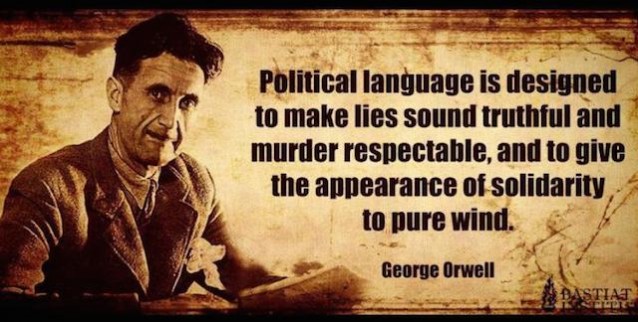
Language Leaps and the Information Shuffle

George-Orwell-political-speech-638x322

By Zen Gardner

Source: ZenGardner.com

So much can be told by language shifts. Both what’s being used more frequently in general as well as substantial new additions, and deletions, to the lexicon. This goes two ways. The controllers keep shifting their language and euphemisms to blanket their intentions, while the awakening community grabs hold of and proliferates empowering and revealing words and concepts that grow in usage at an astounding and truly inspiring rate.

This is a powerful manifestation of the awakening.

Just look how easily and readily words like Zionism, the matrix, the Illuminati, social engineering, transhumanism, freemasonry, psychopathy, cognitive dissonance, geoengineering, false flags and big brother surveillance are being used now. These were considered side line or taboo issues discussed by whack jobs not long ago. Now? They’re mainstays of conversation that bleed more and more into the mainstream dialogue.

That speaks volumes as to the effect the onslaught of true information is having. And something to be very encouraged and inspired about.

Droning Psychopaths Tell No Truth

The official narrative of the “powers that shouldn’t be” is also a changing landscape. While our language is rooted in truth, theirs is a constant smokescreen of disinformation designed to deceive, decoy and disempower.

Examples du jour? We’re all too familiar with misleading names like the “Patriot Act” or the always ready handle “national security” and the like, but lately they’ve taken to covering their tracks even more, no doubt due to the awakening taking place, even in simple language recognition they’re no doubt following with all of their invasive computer algorithms.

Mass surveillance has now become “bulk data collection” while torture is conveniently labelled “extraordinary renditions” and “enhanced interrogation programs.” All arrogantly perpetrated as if no one even notices. But these shifts in contrived perception work on the unwary, which is why the official narrative is laden with such misleading and obfuscating terms and labels couched in complete blather like any one of Obama’s wet cardboard speeches.

After all, to them, truth isn’t the issue, it’s control and getting their program across as seamlessly as possible. Therein lies the rub, and a very important one to identify.

Look for Real Empathy

What really resonates with you? And what confuses or disanimates you? These are ways to discern between the lines in the barrage of information coming at us. It’s truly an informational war going on in so many ways, but thankfully one that the truth is always destined to win.

It may be ever so incremental, but Truth stands its ground no matter what assails it.

There is no resonant sense of love or down to earth practical truth with propaganda. It always falls flat and only appeals to very dry and distant programmed self justification mechanisms. That’s the intent. Keep us in our self circumscribed socially engineered limits in a dazed state of some far off distant “belief” guaranteed by some voice from somewhere leading people on with some promised carrot to chase after.

However, real, good information feeds. It nourishes. It’s clear and empowering in some way. It embraces your soul, encourages your convictions, and leads you to new understandings that positively affect your life.

Know the difference.

You already do, just listen to your heart. And respond accordingly.

Much love always, Zen

The Path of the Sacred Clown: Where Trickster and Shaman Converge

1.200

By Gary Z McGee

Source: Fractal Enlightenment

“If the fool would persist in his folly, he would become wise.” –William Blake

Most of us are familiar with the prototypical clowns: red-nosed clowns, court jesters, and Tarot fools. But sacred clowns take clowning to a whole other level. The Ne’wekwe “mud-eaters” were the Zuni equivalent of a sacred clown. The Cherokee had sacred clowns known as Boogers who performed “Booger dances” around a community fire.

In Tibetan Buddhism it’s referred to as Crazy Wisdom, which the Guru adopts in order to shock their students out of fixed cultural and psychological patterns. But perhaps the most popular type of sacred clown is the Lakota equivalent of Heyoka, a contrary thunder shaman who taught through backwards humor.

Almost all types of sacred clowns combine trickster spirit with shamanic wisdom to create a kind of sacred tomfoolery that keeps the zeitgeist in check. Their methods are unconventional and typically antithetical to the status quo, but extremely effective. They indirectly re-enforce societal customs by directly enforcing their own powerful sense of humor into the social dynamic. They show by bad example how not to behave.

The main function of a sacred clown is to deflate the ego of power by reminding those in power of their own fallibility, while also reminding those who are not in power that power has the potential to corrupt if not balanced with other forces, namely with humor. But sacred clowns don’t out-rightly derive things. They’re not comedians, per se, though they can be. They are more like tricksters, poking holes in things that people take too seriously.

Through acts of satire and showy displays of blasphemy, sacred clowns create a cultural dissonance born from their Crazy Wisdom, from which anxiety is free to collapse on itself into laughter. Sacred seriousness becomes sacred anxiety which then becomes sacred laughter. But without the courageous satire of the sacred clown, there would only ever be the overly-serious, prescribed state of cultural conditioning.

Lest we write our lives off to such stagnated states, we must become something that has the power to perpetually overcome itself. The sacred clown has this power. Christ was a sacred clown, mocking the orthodoxy. Buddha was a sacred clown, mocking ego attachment. Even Gandhi was a sacred clown, mocking money and power.

Like Thomas Merton wrote, “In a world of tension and breakdown, it is necessary for there to be those who seek to integrate their inner lives not by avoiding anguish and running away from problems, but by facing them in their naked reality and in their ordinariness.” Sacred clowns are the epitome of such integration.

Heyokas, for example, remind their people that Wakan tanka, the great mystery, is beyond good and evil; that its primordial nature doesn’t correspond to human platitudes of right and wrong. Heyokas act as mirrors, reflecting the mysterious dualities of the cosmos back onto their people. They walk the Red Road, following in the bloody footprints left behind by their Heyoka fore-brothers.

They go forward, to that place where emptiness is full, and fullness empty. “As a representative of Thunderbird and Trickster,” writes Steve Mizrach, “the heyoka reminds his people that the primordial energy of nature is beyond good and evil. It doesn’t correspond to human categories of right and wrong. It doesn’t always follow our preconceptions of what is expected and proper. It doesn’t really care about our human woes and concerns. Like electricity, it can be deadly dangerous, or harnessed for great uses. If we’re too narrow or parochial in trying to understand it, it will zap us in the middle of the night.”

Sacred clowns are adept at uniting joy with pain, acting on the higher and more inscrutable imperatives of the Great Mystery. They tend to govern transition, introduce paradox, blur boundaries, and mix the sacred with the profane. They are called upon to reestablish the bridge between the physical and spiritual worlds. They dare to ask the questions that nobody wants answers to.

They are the uncontrollable avatars of the Trickster archetype, constant reminders of the contingency and arbitrariness of the social order, poking holes in anything taken too seriously, especially anything assuming the guise of power. They are a conduit to forces that defy comprehension, and by their absurd, backwards behavior, they are merely showing the ironic, mysterious dualities that exist within the universe itself.

Sacred clowns understand that humans fail, and failing means that sometimes we need to change. They remind us that the goal is not to stick to the same old path, but to embrace the vicissitudes of life and to discover new paths and the courage it takes to adapt and overcome. Taking the universe into deep consideration, letting it be, and then letting it go, is far superior to clinging to a “belief” and becoming stuck in a particular view. Sacred clowns realize that the highest wisdom lies in this type of counter-intuitive detachment, in accepting that nothing remains the same, and then being proactive about what it means to change.

Most importantly, they teach us that there is no such thing as an enlightened master. We’re all spiritually dumb. The closest we can ever get to being “enlightened” is simply to understand that we are naïve to it, and then to laugh about it together as a community. Sacred clowns have the ability to plant this seed of sacred humor. They are constantly in the throes of metanoia, disturbing the undisturbed, comforting the uncomfortable and freeing the unfree. They remind us, as Rumi did, that “the ego is merely a veil between humans and God.”

We wink to them, Good Night!

Liberation-Through-Lucid-Living-Creating-Your-Lucid-Reality

By The Raqs Media Collective

Source: Adbusters

For the past few decades, globally, many well-meaning but demoralized people, especially artists and intellectuals, but also activists, have been losing sleep. They suffer from a peculiarly debilitating activist insomnia consisting of relentless Facebook posting, forwarded petitions and other rituals of narrowing particularity that have taken the place of heretical, insurrectionary and transcendental visions.

We are restless, exhausted through the operation of the worst, most damaging technique available to torturers: sleep deprivation. We could all do with a “sleep in” on the long night shifts. It appears as if there has been a generalized forgetting of the arts and sciences of dreaming, especially lucid dreaming.

This makes it sobering, and even mildly therapeutic, to undertake a close reading of a different account of sleep, and of awakening — the one that opens this essay, from Faridabad Workers News (FMS), a workers’ newspaper.

During our regular night shifts, the general manager used to be abrasive with any worker he saw dozing. He used to take punitive action against them. One night, one hundred and eight of us went to sleep, all together, on the shop floor. Managers, one after the other, who came to check on us, saw us all sleeping in one place, and returned quietly. We carried on like this for three nights. They didn’t misbehave with us, didn’t take any action against us. Workers in other sections of the factory followed suit. It became a tradition of sorts.

We have been reading FMS — which is produced by some friends in Faridabad, a major industrial suburb of Delhi and one of the largest manufacturing hubs of Asia — for the past 25 years. The paper has a print run of 12 thousand, is distributed at regular intervals by workers, students, and itinerant fellow travellers at various traffic intersections, and is read on average by two hundred thousand workers all over the restless industrial hinterland of Delhi.

Over the years, this four-page, A1-size paper full of news and reports of what working people are doing and thinking in one of the biggest industrial concentrations of Asia has acted as a kind of reality check, especially against the echolalia — manic or melancholic, laudatory or lachrymose — that issues forth at regular intervals from the protagonists as well as the antagonists of the new world order. In these circumstances, the paper acts as a kind of weather vane, a device which helps us scent the wind, sense undercurrents and keep from losing our head either in the din of the ecstatic overture for capital and the state, or in the paralyzing grief over their attempts to strengthen their sway.

The issue of FMS, published a week before the results of India’s elections unleashed a frenzy of mourning and celebration, talks about questions coming to shore. It says,

While distributing the paper, we were stopped twice and advised: “Don’t distribute the paper here. Workers here are very happy. Are you trying to get factories closed?” That reading, writing, thinking and exchange can lead to factory closures — where does this thought come from?

Perhaps this fear is a result of messages that circulate between the mobile phones of tailors. Or perhaps this fear emerges because workers on the assembly line are humming!

The industrial belt that surrounds Delhi has been going through a deep churning over the last few years. Hundreds of thousands of young men and women are gathering enormous experience and thought at an early age. They are giving force to waves of innovative self-activity, finding new ways of speaking and thinking about life and work, creating new forms of relationships. In the gathering whirlwind of this milieu, many long-held assumptions have been swept away, and fresh, unfamiliar possibilities have been inaugurated. Here we are presenting some of the questions that have coursed through our conversations and which continue to murmur around us.

Why should anyone be a worker at all?

This question has gained such currency in these industrial areas that some readers may find it strange that it is being mentioned here at all. But still, we find it pertinent to underscore the rising perplexity at the demand that one should surrender one’s life to that which has no future. And again, why should one surrender one’s life to something that offers little dignity?

If we put aside the fear, resentment, rage and disappointment in the statement “What is to be gained through wage work after all?” we can begin to see outlines of a different imagination of life. This different imagination of life knocks at our doors today, and we know that we have between us the capacity, capability and intelligence to experiment with ways that can shape a diversity of ways of living.

Do the constantly emerging desires and multiple steps of self-activity not bring into question every existing partition and boundary?

In this sprawling industrial zone, at every work station, in each work break — whether it’s a tea break or a lunch break — conversations gather storm. Intervals are generative. They bring desires into the open, and become occasions to invent steps and actions. No one is any longer invested in agreements that claim that they might be able to bring forth a better future in three years, or maybe five. Instead, workers are assessing constantly, negotiating continually; examining the self and examining the strength of the collective, ceaselessly. And with it, a wink and a smile: “Let’s see how a manager manages this!” The borders drawn up by agreements are breached, the game of concession wobbles, middlemen disaggregate.

When we do — and can do — everything on our own, why then do we need the mediation of leaders?

“Whether or not to return to work after a break, and across how many factories should we act together — we decide these things on our own, between ourselves,” said a seamstress. Others concurred: “When we act like this, on our own, results are rapid, and our self-confidence grows,” and elaborated, “on the other hand, when a leader steps in, things fall apart; it’s disheartening. When we are capable of doing everything on our own, why should we go about seeking disappointment?”

Are these various actions that are being taken today breaking the stronghold of demand-based thinking?

The most remarkable and influential tendency that has emerged in this extensive industrial belt cannot be wrapped up, contained in, or explained via the language of conditions, demands and concessions. Why? Over the years, the dominant trend has been to portray workers as “poor things,” which effectively traps them in a language that makes them seem like victims of their condition and dependent on concessions. And then they are declared as being in thrall to the language of conditions, demands and concessions. This is a vicious cycle. In the last few years, the workers of Maruti Suzuki (Manesar) have ripped through this encirclement.

“What is it that workers want? What in the world do workers want?”

The company, the local government, the central government were clueless in 2011, they stayed clueless through 2012 and they are still clueless. This makes them nervous. That is why, when workers exploded despite the substantial concessions being offered by management, it resulted in six hundred paramilitary commandos being deputed to restore “normalcy.” One hundred and forty seven workers are political prisoners even today.

Do these questions hold for everyone, everywhere in the world?

The April 2014 issue of FMS featured a categorical statement.

Today we can say with full confidence that an unsettling courses through seven billion people. It is inspired by the desire for an assertion of the overflowing of the surplus of life. It is an expression of creative, boundless astonishment.

Today we can say with full confidence that an unsettling courses through seven billion people. And relatedly, a crisis-laden astonishment: What happens to the colossal wealth that is being produced? Where does it go? How is it that such a tiny sliver from it reaches daily life?

Astonishment is an interesting emotion. It can signal a profound delight alloyed with surprise, as well as the kind of deep anger that borders on puzzled rage. In dreams, we are far more comfortable with astonishment than we are when we are awake and distracted. This double-edged astonishment features both a joy at the self-discovery of the multitude’s own capacities as a planetary force, as well as a recognition of how life itself is being drained of worth and value. This takes us to a new ground — a place of radical uncertainty. Here, both the perils and the potentials of a new global subjectivity lie in wait. Why can we not see them? Why can we not hear them call out? Perhaps they are feigning sleep, restoring themselves with an unauthorized midshift siesta that could break, if they wanted it to, any moment.

Perhaps, in places, it has already broken.

Emergence of factory rebels. Attack on factories by congregations of workers. Frightened management. Industrial areas turn into war zones. Rising numbers of workers as political prisoners. Courts that keep refusing bail. A mounting rebuttal on shop floors of the unsavory behavior of managers and supervisors. The dismantling of the managerial game of concessions. Irrelevance of middlemen. An acceleration of linkages and exchanges between workers.

“This,” says the paper, “is the general condition of today.”

The one thing that we can say with certainty is that management no longer knows what workers are thinking. They do not know what happens next.

Ebullitions all around, the unshackling of factories. Workers refuse to leave the factory. The undoing of the occupation of factories by management. Making factories unfettered spaces for collective gathering. Creating environments that invite the self, others, the entire world to be seen anew. Ceaseless conversation, deep sleep, thinking, the exchange of ideas. The joining together of everyone in extended relays of singing. The invention of new relationships. Whirling currents of possibility opened up by the making of collective claims on life.

This too is the general condition of today.

So how will the sinking ship of the state keep sailing? How will orders be given and obeyed if so few are even speaking the language of the captain anymore? For the ship not to sink, at least not yet, these orders must at least appear to be given and obeyed. Someone must semaphore.

Perhaps the rise of nationalism of the far right across the world is not as much a sign of the increasing power of capital and the state as it is a recognition, by those at the helm of affairs, of their own besieged situation. They are under siege. Once again the rulers do not know what is going on in the minds of those they rule. For all practical purposes, the subjects are opaque, oblivious to every command. Management does not even know whether the workers are asleep or awake. When they are asleep, they seem to be animated by the current of vivid dreams. When they are awake, they doze at the machine. Is this why every leader asks his nation to awaken? So that he can be reassured that they are at least listening to him? The more they sleep, the louder is the call to rise.

This is the time to dream lucidly. To envision and realize the things that one cannot do when one is awake, distracted, bored, busy. This is the time for hearing voices, to become open to the murmur of the universe, for heresy, for audacious conversations, for acts to turn factories into orchards and a laughter that makes standing armies into brass bands.

Let them who rule risk fatigue with their watchfulness.

We wink to them, good night!

— The Raqs Media Collective plays a plurality of roles, appearing as artists, curators and philosophical agent provocateurs in India. This piece appeared in the e-flux journal No. 56, June 2014.

Related Video:

300

Legalizing Marijuana Now More Popular Than All Political Candidates

yes-we-cannabis-marijuana-poster

By John Vibes

Source: TheAntiMedia.org

It is no secret that Americans are losing faith in the US political system. With the potential of a choice between a Clinton and a Bush in 2016, it is likely that even more people will stop participating.

Now that there have been states where people have been allowed to vote for the legalization of marijuana, that topic has actually become more popular than the candidates themselves.

According to a Quinnipiac University poll conducted in March, in the key swing states of Ohio, Pennsylvania and Florida, marijuana is far more popular than all the major political candidates. The survey found that over 80% of people in all states supported medical marijuana, with over 50% also supporting full legalized recreational marijuana.

Meanwhile, all of the major political candidates have the approval of less than 50% of the people polled.

In some ways marijuana policy is the perfect issue for a presidential campaign. It has far reaching consequences that both parties have reason to engage,” John Hudak of the Brookings Institution told the Washington Post, in response to the poll.

Prohibition of any kind should be opposed for the reasons I have laid out in the past. However, marijuana is of specific immediate importance because of its ability to heal sick people and create environmentally friendly industrial products. It is also one of the safest drugs known to our species.

A recent Gallup poll found that major political parties in the United States are seeing their lowest popularity levels in recent memory.

Both the Democrats and the Republicans fall well below 50% in terms of approval, with 39% viewing the Democratic party favorable and 37% viewing the Republican party favorable.


John Vibes is an author, researcher and investigative journalist who takes a special interest in the counter culture and the drug war. In addition to his writing and activist work he organizes a number of large events including the Free Your Mind Conference, which features top caliber speakers and whistle-blowers from all over the world. You can contact him and stay connected to his work at his Facebook page. You can find his 65 chapter Book entitled “Alchemy of the Timeless Renaissance” at bookpatch.com.


Freedom – A Condition of the Human Heart

Freedom

By Kingsley L. Dennis

Source: Waking Times

Loving freedom, to me, means having the freedom to love yourself deeply, others deeply, and accepting the never-ending truth of change. It means having the freedom to be happy on your own and happy with others as they come in and out of our lives. It means having the freedom to connect wonderfully with those you meet and deal successfully with those who are difficult to relate to well.” – Owen Fitzpatrick

In my previous ‘Reflections’ article (Toward Synthesis), I noted how the humanistic philosopher Erich Fromm viewed the modern world as suffering from the  contradictory struggle between having and being. The human need to find meaning, well-being, and personal growth was in conflict with a different type of world external to us. For Fromm, the resolution of this conflict was to be found in ‘a radical change of the human heart.’ For me, the issue of personal well-being revolves around the perception and experience of freedom. The ability to recognize, and internalize, well-being is fundamentally linked to how a person experiences their freedom.

Freedom is not simply a condition linked to battlefields, nations, and human rights. On an essential level it concerns the freedom within the self, and our battle to maintain this personal freedom within our everyday life. Erich Fromm himself wrote much on our human fear of freedom[i]. Fromm concluded that our in-born fear of pursuing freedom against social conditioning originates in our human birth process. The helplessness of the newly born child and the need for extra long dependency upon protection continues into adulthood in our need for human security. Fromm views our susceptibility to social conditioning as thus based upon a biological predisposition. This can perhaps explain why we often reach out to an outside authority (parent, teacher, partner/lover) as a power or force to recompense us for a sense of personal isolation. Modern society has exploited this tendency by approving and supporting our dependency upon external social systems. In the same way, our cultures often disapprove of those individuals that show high levels of self-reliance and independence. In a world moving toward greater connectedness, collaboration, and shared compassion, the presence of personal freedom is critical. For too long we have been focused upon the play of freedom as it is exhibited outside of us – by external powers – whilst blinded to the inner restraints of personal freedom. For me, freedom is nothing if it is not a freedom of the heart.

We often talk about freedom, or hear other people talk about it, in terms of having. In this way it becomes a value of possession. We either have it or we don’t; other people have it, or manipulate it, or control it, etc. In our modern understanding of freedom we have turned it into a commodity – a material object that we bargain with. In many situations and for many people this has been true. Also, if a person has been kidnapped, or held in prison/confinement, then freedom becomes a very real physical reality. Yet this is just one manifestation of the essence of human freedom. For my purposes I wish to discuss freedom as a state of being.

On an interior level freedom is not about what we have; it is more about where we are and what we do. It is about having the right attitude and perspective. In this context freedom is a process: we need freedom from something or freedom to something. We don’t have or possess freedom – we do freedom. It is important we create a freedom to move into, otherwise where are we going? We can create our freedom from the past – and even the present – if we wish to move toward a different place or state of being. For example, our past should not define how we wish our present to be. We can learn from it, and develop from its experience; yet if it is no longer useful, or even detrimental, then we need to learn how to leave it behind. We all have this choice of where we want To Be.

If we are unable to create this freedom within ourselves then we become, in the words of Doris Lessing, the ‘prisons we choose to live inside.’[ii] Let us not forget also that our interior freedom goes with us wherever we go. If we feel a lack of true freedom within then this will still travel with us whether we are in a meditation retreat in India, or in the Andes of South America. After all, we cannot escape from our very self. It is thus essential that we have the freedom to deal with the events that affect us on a daily basis. We cannot control what events happen to us, yet we do have the freedom of choice to choose how we respond to them. By progressing through our experiences, and by choosing connections and situations that are aligned with our heart, we can become an intentional traveler rather than a random one. The fundamental question to ask ourselves is: how do we want to live?

For me, how we answer this question is part of what I call the ‘living work’ – the work we do inside ourselves to prepare us and make us better for living in the outer world. This is where both aspects of freedom converge – at the intersection where interior and exterior worlds meet. This is where our image of the world and the physical reality of the world also merge. If we can realize that we only experience the world as ‘we are’, then the freedom we find in the world is but a reflection of the freedom we consciously – or unconsciously – perceive within us. In other words, our sense of freedom is as near or as far away as we make it. It may sound contradictory, yet what we need to achieve is the liberation of our own perceptions of freedom. The reason why many of us do not stop to consider this, or perhaps we don’t see it as necessary, is because we do not yet have the freedom to assess the state of our own freedom! As I stated earlier, freedom is not a possession, it is a process – an action – and therefore something to be worked for, to be involved with. Our own freedom is a participatory process.

Perhaps this process involves the freedom to do the small things that are important for our lives; not necessarily the freedom to ‘save the world’ or make a grand gesture. What we need within ourselves is the freedom to make a choice; to act as we feel best; to create moments of joy that can be shared. Or it could be the freedom to begin making a change by changing one thing at a time. Our lives are part of a grand human, living tapestry. By making one small change we can influence change in many other ways through countless visible and invisible connections. Freedom is about having the choice to make these changes, and to take responsibility for our participation in the living tapestry that is life.

Personal freedom is also an expression of intelligence: not intellectual learning but rather social intelligence, spiritual intelligence, emotional intelligence, and instinctive intelligence. All this is the intelligence of personal freedom. I am reminded of Rumi who wrote of the difference between instinctive and acquired intelligence: ‘There are two kinds of intelligence: One acquired/as a child in school memorizes facts and concepts/from books and from what the teacher says, collecting information from the traditional sciences/……There is another kind/…one already completed and preserved inside you./A spring overflowing its spring box. A freshness/in the center of the chest…/This second knowing is a fountainhead/from within you, moving out.’ This second knowing – our instinctual intelligence – is already within each one of us. As a human being we inherently have this knowing. For me, freedom is being able to connect with this internal knowing – and to act from it. In the end, true freedom is a condition of the human heart.

[i] See his book ‘Fear of Freedom’

[ii] See Doris Lessing, Prisons We Choose To Live Inside (1987)

About the Author

Kingsley L. Dennis, author of The Phoenix Generation: A New Era of Connection, Compassion, and Consciousness. Visit him on the web at http://www.kingsleydennis.com/.


All For One: Individual attunement to collective evolution

https%3A%2F%2Fscontent-a.xx.fbcdn.net%2Fhphotos-xpa1%2Ft1.0-9%2F15766_822467467786350_6373119796713415991_n

By Mark Rockeymoore

Source: Sacred Space in Time

The energies of the day demand expression. Unconscious passage through life typifies the oceanic experience of the human family. One often seems more important than all.

The ability of life to provide exactly what is needed in order to challenge our ingrained patterns remains the test of self-awareness. Interactions with life in the form of other things and people – as well as ourselves – is reflected in the very cells of our bodies, affecting the aging process and self expression. Following periods of intense introspection and recrimination, often, times of outward projection into life and the world result. These times reveal the crux of our individual journeys, reveal the heart of who we are, the soul of what we’ve come to do, the spirit of our collective evolution through time and space.

There are very few who are actively aware of this growth. Even still, the conscious progression of the human race is stultified by seemingly oppositional forces that can seem human and other at times. Where and how stoppages to the flow of energy occur, or originate, is meaningless when it comes down to it. That they occur is the issue and how to move through and past them is the goal. The cascade of thoughts, words and actions that represent our general passage through life characterize our personalities and, if limited in understanding, become the self we call I, or me. In time habit coalesces and stagnates, thoughts influence the body’s capacity for growth and hearts harden, souls settle into beingness closed off from true inner growth and the capacity to shift, to change.

Once this point is reached, the actual cells of the body become more attuned to emotional states and the neuropeptides that shift them than the nutrients provided by the foods we eat and, as a result, the body ages and weakens and the world bears down upon us in all of its terrible and wondrous horror and splendor. Fear, as an expression of lower urges overwhelms the individual’s capacity for free and open thought and patterns of thought cycle through the mind endlessly, on repeat, ushering us through the final years and into the grave, unfulfilled, regretful and longing for relief and surcease from the pain and agony of life.

As we travel through our days we are being bombarded by energies. Coming from the earth, from the sun, from the planets, from the stars. The emanations of extra-solar bodies suffuse our physical bodies and interact with our energetic states, shifting our emotional expression accordingly. The extent to which this is unacknowledged is dependent upon the individualized state of self-awareness. The empathic connection between people often relegates the souled individual to claiming imposed emotional states as their own, tossed to and fro by emotions coming from outside, mistaken for originating inside. Understanding that thought precedes emotion allows the empath to recognize which emotions are coming from within and which are coming from without.  Active awareness in the form of mindfulness ushers in the state of conscious personal growth in the area of psychology and spirituality.

Outward projection of inner imperatives represent a clarity of understanding that can become the lived expression of those who consciously follow evolutionary processes ancient in conception and that seem to typify the human experience regardless of culture or geography. The many forms of psychological and spiritual practice are girded by an underlying reality that we all share as conscious beings immersed within the quantum zero-point field entangled intricately, our every action superimposed by endless potentiality, directed by individuated conscious volition.  Being true to Self, then, is merely the understanding that whatever is in the moment should be the focus of attention and intent.

As science is continually discovering, what we think, say and do is meaningful in an individual and also in a collective sense. Understanding that life responds to the perceiver, that consciousness is the fundamental state of existence itself is confirmation of every utterance of every sage in every culture in every corner of the world. The cyclical and spiral-like nature of existence resounds across the void of consciousness as lives coalesce around the shared journey and our interactions shoot off sparks of infinite possibility with each choice as the implicit wave-function collapses into the mundanity of normative perception and the days proceed as any other. We are fooled by sameness, bamboozled by boredom, into ignoring the magic of daily life. Effectively blinded to the terrific, inured to the amazing.

While, collectively, the human family remains mired in darkness, the awakening process as experienced by a significant proportion of the world’s population is indeed having an effect. Exuberant proclamations of ascension and wonder abound within minority communities of spiritual aspirants and projections of paradoxical incredulity are savaged by the sleeping minds, intellectually bound to dead paradigms and enclosed conceptions of egoic imposition. And yet, each and every contribution by all incarnate souls contributes to the whole and the manifest state of beingness in all of its infinite and eternal inscrutability represents an inexorable evolutionary drive shared by all expressions of consciousness in every potential form possible.

The heart of who we are is compassion. Electromagnetic thrums of intentionality emanate outwards from each person, affecting their immediate and distant surroundings through waves of interconnectivity at the quantum level. The soul of what we’ve come to do is transcendent, encompassing the purposing of soul-groups infinite in conception and eternal in origin, beyond the capacity of any egotistical personality structure to fully encompass within the purview of limited awareness.  The spirit of our collective evolution is grounding, into the moment, into the space of our lives as lived, our experiences as interpreted, our thoughts and feelings as expressed. In each moment we represent the eternal and each choice is a resounding foray into creation for better or worse, polarized pinpoints of potentiality sent out into the void lovingly received and transmitted to, through and around every iota of being and consciousness in creation and beyond. All, is more important than one.

It’s the End of the World as We Know It . . . and He Feels Fine

paul_kingsnorth

By Daniel Smith

Source: NYTimes Magazine

Late one night last August, on the chalk downlands of southern England, Paul Kingsnorth stood in a field beside an old-growth forest, two yurts and a composting toilet. Kingsnorth is 41, tall, slim and energetic, with sweeping brown hair and a sparse beard. He wears rimless glasses and a silver stud in his ear, and he talks with great ardor, often apologizing for having said too much or for having said it too strongly.

On this occasion, Kingsnorth was silent. It was the final night of Uncivilization, an outdoor festival run by the Dark Mountain Project, a loose network of ecologically minded artists and writers, and he was standing with several dozen others waiting for the festival’s midnight ritual to begin. Kingsnorth, a founder of the group, had already taken part in several sessions that day, including one on contemporary nature writing; a panel about the iniquities of mainstream psychiatric care; and a reading from his most recent book, “The Wake,” a novel set in the 11th century and written in a “shadow language” — a mash-up of Old and modern English. He had also helped his two young children assemble a train set while trying to encapsulate his views on climate change and environmental degradation in what Kingsnorth describes as an era of global disruption. The “human machine,” as he sometimes puts it, has grown to such a size that breakdown is inevitable. What, then, do we do?

In the clearing, above a pyre, someone had erected a tall wicker sculpture in the shape of a tree, with dense gnarls and hanging hoops. Four men in masks knelt at the sculpture’s base, at cardinal compass points. When midnight struck, a fifth man, his head shaved smooth and wearing a kimono, began to walk slowly around them. As he passed the masked figures, each ignited a yellow flare, until finally, his circuit complete, the bald man set the sculpture on fire. For a couple of minutes, it was quiet. Then as the wicker blazed, a soft chant passed through the crowd, the words only gradually becoming clear: “We are gathered. We are gathered. We are gathered.”

After that came disorder. A man wearing a stag mask bounded into the clearing and shouted: “Come! Let’s play!” The crowd broke up. Some headed for bed. A majority headed for the woods, to a makeshift stage that had been blocked off with hay bales and covered by an enormous nylon parachute. There they danced, sang, laughed, barked, growled, hooted, mooed, bleated and meowed, forming a kind of atavistic, improvisatory choir. Deep into the night, you could hear them from your tent, shifting every few minutes from sound to sound, animal to animal and mood to mood.

The next morning over breakfast, Dougie Strang, a Scottish artist and performer who is on Dark Mountain’s steering committee, asked if I’d been there. When he left, at 3 a.m., he said, people were writhing in the mud and singing, in harmony, the children’s song “Teddy Bears’ Picnic.” (“If you go down in the woods today, you’re sure of a big surprise.”) “Wasn’t it amazing?” he said, grinning. “It really went mental. I think we actually achieved uncivilization.”

The Dark Mountain Project was founded in 2009. From the start, it has been difficult to pin down — even for its members. If you ask a representative of the Sierra Club to describe his organization, he will say that it promotes responsible use of the earth’s resources. When you ask Kingsnorth about Dark Mountain, he speaks of mourning, grief and despair. We are living, he says, through the “age of ecocide,” and like a long-dazed widower, we are finally becoming sensible to the magnitude of our loss, which it is our duty to face.

Kingsnorth himself arrived at this point about six years ago, after nearly two decades of devoted activism. He had just completed his second book, “Real England,” a travelogue about the homogenizing effects of global capitalism on English culture and character. “Real England” was a great success — the first of his career. All the major newspapers reviewed the book; the archbishop of Canterbury and David Cameron (then the opposition leader) cited it in speeches; Mark Rylance, the venerated Shakespearean actor, adopted it as a kind of bible during rehearsals for his hit play “Jerusalem.” Yet Kingsnorth found himself strangely ambivalent about the praise. “Real England” was a painful book to write. For months he interviewed publicans, shopkeepers and farmers fighting to maintain small, traditional English institutions — fighting and losing. Everywhere Kingsnorth traveled, he saw the forces of development, conglomeration and privatization flattening the country. By the time he published his findings, he was in little mood to celebrate.

At the same time, he felt his longstanding faith in environmental activism draining away. “I had a lot of friends who were writing about climate change and doing a lot of good work on it,” he told me during a break from his festival duties. “I was just listening and looking at the facts and thinking: Wow, we are really screwed here. We are not going to stop this from happening.”

The facts were indeed increasingly daunting. The first decade of the 21st century was shaping up to be the hottest in recorded history. In 2007, the Arctic sea ice shrank to a level not seen in centuries. That same year, the NASA climatologist James Hansen, who has been ringing the climate alarm since the 1980s, announced that in order to elude the most devastating consequences, we’d need to maintain carbon dioxide in the atmosphere at a level of 350 parts per million. But we’d already surpassed 380, and the figure was rising. (It has since reached 400 p.p.m.) Animal and plant species, meanwhile, were dying out at a spectacular rate. Scientists were beginning to warn that human activity — greenhouse-gas emissions, urbanization, the global spread of invasive species — was driving the planet toward a “mass extinction” event, something that has occurred only five times since life emerged, 3.5 billion years ago.

“Everything had gotten worse,” Kingsnorth said. “You look at every trend that environmentalists like me have been trying to stop for 50 years, and every single thing had gotten worse. And I thought: I can’t do this anymore. I can’t sit here saying: ‘Yes, comrades, we must act! We only need one more push, and we’ll save the world!’ I don’t believe it. I don’t believe it! So what do I do?”

The first thing that Kingsnorth did was draft a manifesto. Also called “Uncivilization,” it was an intense, brooding document that vilified progress. “There is a fall coming,” it announced. “After a quarter-century of complacency, in which we were invited to believe in bubbles that would never burst, prices that would never fall . . . Hubris has been introduced to Nemesis.”

The initial print run of “Uncivilization” was only 500 copies. Yet the manifesto gained widespread attention. The philosopher John Gray reviewed it in The New Statesman. Professors included it on their reading lists. An events space in Wales invited Kingsnorth and Dougald Hine, Dark Mountain’s co-founder, to put on a festival; 400 people showed up. Doug Tompkins, the billionaire who started the outdoor-apparel company the North Face, and his wife, Kristine Tompkins, the former C.E.O. of Patagonia, offered financing and invited Kingsnorth and his family to spend two months on land they own in southern Chile.

There were others, however, who saw Kingsnorth’s new work as a betrayal. With waters rising, deserts spreading and resource wars looming, how could his message be anything but reckless — even callous? He and his sympathizers were branded “doomers,” “nihilists” and (Kingsnorth’s favorite epithet) “crazy collapsitarians.” One critic, a sustainability advocate, published an essay in The Ecologist — a magazine Kingsnorth once helped run — comparing Dark Mountaineers to the complacent characters in the Douglas Adams novel “The Restaurant at the End of the Universe”: “Diners [who] enjoyed watching the obliteration of life, the universe and everything whilst enjoying a nice steak.”

Kingsnorth regards such charges with equanimity, countering that the only hope he has abandoned is false hope. The great value of Dark Mountain, he has claimed, is that it gives people license to do the same. “Whenever I hear the word ‘hope’ these days, I reach for my whiskey bottle,” he told an interviewer in 2012. “It seems to me to be such a futile thing. What does it mean? What are we hoping for? And why are we reduced to something so desperate? Surely we only hope when we are powerless?”

Instead of trying to “save the earth,” Kingsnorth says, people should start talking about what is actually possible. Kingsnorth has admitted to an ex-activist’s cynicism about politics as well as to a worrying ambivalence about whether he even wants civilization, as it now operates, to prevail. But he insists that he isn’t opposed to political action, mass or otherwise, and that his indignations about environmental decline and industrial capitalism are, if anything, stronger than ever. Still, much of his recent writing has been devoted to fulminating against how environmentalism, in its crisis phase, draws adherents. Movements like Bill McKibben’s 350.org, for instance, might engage people, Kingsnorth told me, but they have no chance of stopping climate change. “I just wish there was a way to be more honest about that,” he went on, “because actually what McKibben’s doing, and what all these movements are doing, is selling people a false premise. They’re saying, ‘If we take these actions, we will be able to achieve this goal.’ And if you can’t, and you know that, then you’re lying to people. And those people . . . they’re going to feel despair.”Whatever the merits of this diagnosis (“Look, I’m no Pollyanna,” McKibben says. “I wrote the original book about the climate for a general audience, and it carried the cheerful title ‘The End of Nature’ ”), it has proved influential. The author and activist Naomi Klein, who has known Kingsnorth for many years, says Dark Mountain has given people a forum in which to be honest about their sense of dread and loss. “Faced with ecological collapse, which is not a foregone result, but obviously a possible one, there has to be a space in which we can grieve,” Klein told me. “And then we can actually change.”

Kingsnorth would agree with the need for grief but not with the idea that it must lead to change — at least not the kind of change that mainstream environmental groups pursue. “What do you do,” he asked, “when you accept that all of these changes are coming, things that you value are going to be lost, things that make you unhappy are going to happen, things that you wanted to achieve you can’t achieve, but you still have to live with it, and there’s still beauty, and there’s still meaning, and there are still things you can do to make the world less bad? And that’s not a series of questions that have any answers other than people’s personal answers to them. Selfishly it’s just a process I’m going through.” He laughed. “It’s extremely narcissistic of me. Rather than just having a personal crisis, I’ve said: ‘Hey! Come share my crisis with me!’ ”

In 2012, in the nature magazine Orion, Kingsnorth began to publish a series of essays articulating his new, dark ecological vision. He set his views in opposition to what he called neo-environmentalism — the idea that, as he put it, “civilization, nature and people can only be ‘saved’ by enthusiastically embracing biotechnology, synthetic biology, nuclear power, geoengineering and anything else with the prefix ‘new’ that annoys Greenpeace.” Or as Stewart Brand, the 75-year-old “social entrepreneur” best known as the publisher of the ” Whole Earth Catalog,” has put it: “We are as gods and have to get good at it.”

For Kingsnorth, the notion that technology will stave off the most catastrophic effects of global warming is not just wrong, it’s repellent — a distortion of the proper relationship between humans and the natural world and evidence that in the throes of crisis, many environmentalists have abandoned the principle that “nature has some intrinsic, inherent value beyond the instrumental.” If we lose sight of that ideal in the name of saving civilization, he argues, if we allow ourselves to erect wind farms on every mountain and solar arrays in every desert, we will be accepting a Faustian bargain.

When Kingsnorth describes how he came to this way of thinking, he nearly always begins with an ancient chalk hill outside Winchester, not far from the site of the recent Uncivilization festival. It was 1992, and the conservative British government was about to break ground on a vast network of highways across England.

The highways were proposed three years earlier by Margaret Thatcher, whose administration announced that they would constitute the “biggest road-building program since the Romans.” As it happened, they would also cut through areas that had remained unspoiled since the Romans. Direct opposition to the program began at a hill called Twyford Down, through which the government planned to build a six-lane highway. The purpose of the road was to reduce the commute to London by a matter of minutes. In 1992, a small band of radicals calling themselves the Dongas staged a demonstration. Soon road protests were popping up across the country, drawing support from itinerant hippies, the working classes and the nobility.

Students of popular movements often credit the road protests of the 1990s with radicalizing a generation of British youth. This is certainly true of Kingsnorth. While at Oxford, he spent many weekends at Twyford Down — locking arms, waving placards, shouting slogans. He found it intoxicating to put himself on the line for a cause. At Twyford Down, he was arrested for the first time, for chaining himself, along with 50 others, to a bridge. He loved it. (He later sued the police and received a settlement of $5,000.) Kingsnorth was even more intoxicated by the proud impracticality of the protests. The core of the demonstrators’ complaints was not that the new highways would worsen air pollution, cause car accidents or fracture communities; it was that some things, like wilderness and beauty, were — despite, or perhaps because of, their “uselessness” — more important than getting to work on time. The motivation was raw, intuitive and, in its Wordsworthian love of the Arcadian, very, very English. In an essay titled “Confessions of a Recovering Environmentalist,” Kingsnorth wrote that after Twyford Down, he “vowed, self-importantly, that this would be my life’s work: Saving nature from people. Preventing the destruction of beauty and brilliance, speaking up for the small and the overlooked and the things that could not speak for themselves.”

It proved easier to make this vow than to act on it. The chief obstacle was his father: a driven, competitive man who scraped his way up from a working-class background to become the head of a manufacturing firm. Kingsnorth’s father was not without a love of the outdoors, but it was a striving, willful kind of love. He often took Kingsnorth on long, arduous hiking trips, forcing him to carry heavy packs and disappearing far up the trail to teach his son the virtues of independence and struggle.

These trips were both trials and revelations. It was while backpacking with his father on the moors of Cornwall and atop the hills of Northumberland that Kingsnorth had his first cathartic experiences in nature — experiences that were responsible for the direction his life was now taking. But his father wasn’t prone to seeing that as a consolation. “I’d gone off to Oxford as a guy in jeans and a T-shirt,” Kingsnorth says, “then I started wearing tie-dye tops and putting beads in my hair and walking around in big boots, as dudes do.”

Kingsnorth wouldn’t tell his father about his arrest for 10 years. Nor would he find a way to elude the expectations placed on him. His 20s were an awkward — and not very successful — mix of idealism and ambition. At Oxford he was editor of Cherwell, the university’s longest-running student newspaper, whose staff has included Graham Greene, W. H. Auden and (on the business end) Rupert Murdoch. He parlayed this honor into an entry-level position as a researcher at The Independent, in London. He was miserable. He found the work frivolous and his superiors out of touch. In 1995, seven years after the creation of the Intergovernmental Panel on Climate Change and six years after a global treaty regulating CFCs, he had to explain to an editor the difference between global warming and ozone depletion.

Kingsnorth lasted on Fleet Street for less than a year. He stayed in London another two, working for a poorly run nonprofit, writing a protest novel no one wanted to publish and getting increasingly fed up with the congestion and noise. Finally he returned to Oxford, figuring he would freelance. The rent was cheap, and in the late 1990s the pubs were filled with green activists and writers. But Kingsnorth has always found it difficult to stand still — another trait, he says, he inherited from his father. In 2001, hungry to travel, he took his agent’s advice to write a book about the growing anti-globalization movement, which came to prominence two years before when thousands gathered to protest the World Trade Organization in Seattle.

For Kingsnorth, the anti-globalization movement was both opportunity and mission. He attended mass protests in Prague, where he was tear-gassed for the first time, and Genoa, where the police shot and killed a young anarchist two streets from where Kingsnorth was marching. The experiences radicalized him anew. “It was similar to what I’d felt at the road protests,” he told me. “Here’s millions of people who don’t like this way of measuring the world, don’t like this way of living, don’t like this way of seeing the world.” He made reporting trips to four continents, tracing the movement’s roots and common themes.

His timing could not have been worse. His book came out in March 2003, during the first week of the Iraq war. It landed “with an inaudible thud.” He returned to Oxford and spent the next few years writing pamphlets, articles and another novel (for which, again, he could not find a publisher), and he began “Real England.”

In August 2007, as he was picking flowers in the small back garden of his house, he got a call that his father had killed himself. Kingsnorth’s father had been living in Cyprus, in semiretirement. His marriage had fallen apart. He had a nervous breakdown and spent time in a psychiatric hospital. One morning, he wrote a bitter suicide note, got in his car and drove full speed into a parked truck.

Kingsnorth’s reaction to his father’s death was conflicted. He’d often suspected that behind his own drive to achieve — to have his opinions aired on television and his books published by mainstream presses, to lead mass movements — was a need to satisfy his father’s more conventional expectations of him. Now that need was obsolete. He felt a sense of release, as if he’d been given permission to say what he wanted to say, in any way he wanted to say it. He felt he could finally, with a clear conscience, “go to the margins.” All he had to do was figure out what that meant.

“Do you know what the ‘first follower’ is?” Dougald Hine, Dark Mountain’s co-founder, asked me. It was Friday at dusk during the Uncivilization festival, and we had taken our dinners out to the woods to talk. We were sitting on logs, our paper plates balanced on our knees.

The first follower is a concept introduced by the musician and entrepreneur Derek Sivers in a short TED talk titled, “How to Start a Movement.” In the talk, Sivers shows an amateur video that begins with a shirtless man gyrating wildly on a hillside at what seems to be a concert. For a while the man dances alone, swinging his hips and arms as if possessed, or more likely high. Eventually someone joins him, and they hold hands and gyrate together. Before you know it, a full-fledged dance party has broken out.

“The point being,” Hine said, “that the first follower transforms you from a lunatic into someone who’s got the beginning of something.”

For Hine, the equivalent of the lone dancer was a pair of blog posts Kingsnorth wrote in late 2007. The first was a bilious rant announcing his retirement from journalism. (“The media can go hang. I’ve had it. I’m out.”) The second, written after yet another international climate conference sputtered out, expressed his “joyous” abandonment of hope that global warming could be stopped. Hine was just turning 30. A scruffy, bright-eyed man with an unruly mop of hair, he had for years worked, unhappily and off and on, as a radio reporter for the BBC. Like Kingsnorth, he quit in a spasm of disgust. Also like Kingsnorth, Hine experienced a transformation in his feelings about climate change: first an obsessive phase of turning off light switches and idling electronics; then a despondent “Oskar Schindler phase of ‘It’s never enough’ ”; then a point of curious repose. He emailed Kingsnorth and introduced himself. In the fall of 2008, they met at a pub in Oxford to discuss how they might collaborate.

During their first meeting, Kingsnorth and Hine spent most of their time exchanging influences — “showing each other our maps,” is how Hine puts it. Hine talked about his passion for the author and critic John Berger, who for the past four decades has lived and farmed in a small French village, and for the late Austrian priest and polymath Ivan Illich, a fierce critic of Western culture. Kingsnorth, in turn, introduced Hine to the American poet Robinson Jeffers, who quickly became a kind of lodestar for Dark Mountain.

Jeffers is little read today, but he was one of the most celebrated writers of the 1930s and 1940s. A friend of Edward Weston and D. H. Lawrence, he lived, as one critic put it, “like a reclusive movie-star-wizard” in a stone tower overlooking the Pacific, writing hundreds of poems endowed with the spirit of what he came to call Inhumanism — “a shifting of emphasis and significance from man to not-man.” At a time when the Great Depression was destroying millions of lives and Europe was militarizing for a new war, Jeffers saw human history as an inexorable, almost naturally destructive force. “The beauty of modern/Man is not in the persons,” he wrote in “Rearmament,” a poem that became the epigraph for “Uncivilization,’, “but in the/Disastrous rhythm, the heavy and mobile masses, the dance of the/Dream-led masses down the dark mountain.”

Kingsnorth and Hine’s aspirations for their manifesto weren’t revolutionary, but neither were they nihilistic. Each man draws a distinction between a “problem,” which can be solved, and a “predicament,” which must be endured. “Uncivilization” was firm in its conviction that climate change and other ecological crises are predicaments, and it called for a cadre of like-minded writers to “challenge the stories which underpin our civilization: the myth of progress, the myth of human centrality and the myth of separation from ‘nature.’ ”

Writers whose work more or less fit the manifesto’s bill answered Kingsnorth’s and Hine’s call. In 2010, he and Hine published the first in what has become a series of Dark Mountain books — literary journals, essentially — hard-bound and lavishly illustrated. Naomi Klein is by far the best known of the contributors, but the series also includes lengthy interviews with the cultural ecologist David Abram and the social critic Derrick Jensen.

Kingsnorth and Hine consider the books to be the heart of Dark Mountain’s work. Had it not been for the surge of interest that greeted the manifesto, Kingsnorth might have stopped there, retreating into the private life of a father and an artist. Retreat was, after all, what he was after — or what he thought he was after. In 2009, he and his wife, a psychiatrist with the National Health Service, decided to move from Oxford to Cumbria, in the far north of England. Kingsnorth wanted to spend his time writing; taking his children for hikes in the hills, as his father had taken him; and improving his skills on the scythe, a tool he valued for its simplicity and efficiency. (For the past three summers, he has taught scything classes in the area around his home.) Instead he found himself at the head of a burgeoning organization that even its critics might concede was changing the environmental debate in Britain and the rest of Europe. It was a slightly awkward position. Just when Kingsnorth had publicly abandoned faith in movements, he became the leader of one.

On the first night of the Uncivilization festival, in an open-sided shelter made of soft-wood planks and cedar shingles drawn from the surrounding woods, there was a concert. A choral group from London, the Songlines Choir, stood in front of a wide clay fireplace and performed music from Cape Verde and Turkey, as well as a song based on a poem that appeared in the third Dark Mountain book. The song centered on the plaintive, almost pleading refrain, “What matters is already here.” All the performers were dressed in fire-engine red. Later, a singer-songwriter named Marmaduke Dando — he describes himself, alternately, as “a neo-pagan vaudeville crooner” and the “bard of disempire” — sang a bitter and languid ballad titled “Love My Country, Hate My State.”

Watching the concert at the edge of the shelter, I met a young woman, Sarah Thomas, who’d spent the summer backpacking around England. Halfway through the show, we decided to check out an art project by Strang, the Scottish artist, that had emerged as the festival’s most popular draw. It was raining, and we walked up and down hills in the dark until we came to a tiny makeshift hut with a red door and a round wooden sign that read “Charnel House for Roadkill.”

The installation was inspired by a Barry Lopez essay in which he suggests that people pay respect to the lives of animals killed crossing roads and highways. (“You never know,” Lopez writes, “the ones you give some semblance of a burial, to whom you offer an apology, may have been like seers in a parallel culture. It’s an act of respect, a technique of awareness.”) The hut was cramped and eerie, decorated with the bones of small animals in illuminated glass cases. Haunting music was piped in from an iPod. You walked through a curtain, sat down and put on a heavy papier-mâché mask — a badger surrogate. Directly across from you, seated behind a window in the back wall, was another person — a volunteer — also wearing a badger mask. He or she sat silently, except when mirroring whatever movements you made, until, driven by emotion, fatigue, satisfaction or plain discomfort, you left.

Sitting in the hut, the air stale and the light almost nonexistent, I thought of something Hine told me earlier. “People think that abandoning belief in progress, abandoning the belief that if we try hard enough we can fix this mess, is a nihilistic position,” Hine said. “They think we’re saying: ‘Screw it. Nothing matters.’ But in fact all we’re saying is: ‘Let’s not pretend we’re not feeling despair. Let’s sit with it for a while. Let’s be honest with ourselves and with each other. And then as our eyes adjust to the darkness, what do we start to notice?’ ”

Hine compared coming to terms with the scope of ecological loss to coming to terms with a terminal illness. “The feeling is a feeling of despair to begin with, but within that space other things begin to come through.” Yet arriving at this acute state of “awareness of what’s worth doing with the time you’ve got left” isn’t always easy for Dark Mountain’s followers. “Some people come here,” Hine told me, “they get very excited by the fact that people are inspired, and they go: ‘Right! Great! So what’s the plan?’ ” He and Kingsnorth have worked hard to check this impulse, seeing Dark Mountain as a space to set aside what Kingsnorth refers to as “activist-y” urges.

This wasn’t always the case. At the first festival, in 2010, Kingsnorth behaved the way he thought the leader of a new movement ought to behave. He proselytized. He lectured. He gave a talk that he describes as “Here’s what’s wrong with environmentalism, and this is what must change!” But he quickly concluded that a didactic tone was inappropriate for the new group. Dark Mountain had more in common with the anarchism of Occupy Wall Street than with the collectivism of 350.org: everyone was to choose his or her own course of action. Recently, Kingsnorth and Hine decided not to hold any more festivals. They want to focus their limited resources on publishing more books more frequently, but they also don’t want the gatherings to ossify into a predictable program — or worse, an annual party.

For more conventional activists, Dark Mountain’s insistence on remaining impractical can be not only disorienting but also irksome. George Monbiot, one of the England’s most prominent environmental journalists, is among Kingsnorth’s oldest friends. In 2009, after the manifesto was published, he and Kingsnorth held a debate in The Guardian, for which Monbiot writes a column. It was a heated exchange. Kingsnorth argued that civilization was approaching collapse and that it was time to step back and talk about how to live through it with dignity and honor. Monbiot responded that “stepping back” from direct political action was equivalent to a near-criminal disavowal of one’s moral duty. “How many people do you believe the world could support without either fossil fuels or an equivalent investment in alternative energy?” he asked. “How many would survive without modern industrial civilization? Two billion? One billion? Under your vision, several billion perish. And you tell me we have nothing to fear.”

Naomi Klein also sees a troubling abdication in Kingsnorth’s work. “I like Paul, but he’s said rather explicitly that he’s giving up,” she told me. “We have to be honest about what we can do. We have to keep the possibility of failure in our minds. But we don’t have to accept failure. There are degrees to how bad this thing can get. Literally, there are degrees.”

On the surface, it can indeed seem as if Kingsnorth is giving up. Last week, he and his wife made a long-planned move to rural Ireland, where they will be growing much of their own food and home schooling their children — a decision, he explained to me, that stemmed in part from a desire to distance himself from technological civilization and in part from wanting to teach his children skills they might need in a hotter future. Yet Kingsnorth has never intended to retreat altogether. For the past three years, he has spent a good portion of his time trying to stop a large supermarket from being built in Ulverston, in northern England. “Why do I do this,” he wrote to me in an email, anticipating my questions, “when I know that in a national context another supermarket will make no difference at all, and when I know that I can’t stop the trend caused by the destruction of the local economy, and when I know we probably won’t win anyway?” He does it, he said, because his sense of what is valuable and good recoils at all that supermarket chains represent. “I’m increasingly attracted by the idea that there can be at least small pockets where life and character and beauty and meaning continue. If I could help protect one of those from destruction, maybe that would be enough. Maybe it would be more than most people do. “

It’s an ethic reflected in the novel he has just published. When he was a schoolboy, Kingsnorth told me, his teachers described the Norman Conquest, in 1066, as a swift transformation. An army of Norman and French soldiers from across the channel invaded England and swept away Anglo-Saxon civilization. The old ways vanished, and a new world emerged. He was surprised to learn, much later, that a resistance movement bedeviled the conquerors for a full decade. These resisters were known as the Silvatici, or “wild men.” Eventually William the Conqueror drove them from the woods and slaughtered every last one of them. They were doomed from the start, and knew it. But that hadn’t stopped them from fighting.

In Kingsnorth’s telling, it also didn’t stop them from wondering whether they should keep fighting. On the afternoon following the concert, standing in the wooden shelter, he described his novel as being both about the collapse of a civilization and about the collapse of long-cherished certainties about what it means to be civilized. His introductory remarks were lively and entertaining, but nervously so, as if he were reluctant to begin. Later, he told me it was the first time he’d ever read publicly from the book. He read a strange excerpt, a sort of dream vision about a young boy and a stag. “I have no idea which part of my subconscious I dredged this up from,” he later wrote me, “but the conversation they end up having is pretty much the conversation I have with myself at the moment when it comes to what the hell I can possibly do to be of any use at all”:

when will i be free saes the cilde to the stag

and the stag saes thu will nefer be free

then when will angland be free

angland will nefer be free

then what can be done

naht can be done

then how moste i lif

thu moste be triewe that is all there is

be triewe

be triewe

“I hope these ramblings are of some use to you!” he signed off. “I will have a glass of wine now and try not to worry about it.”