Irrespective of nationality, religion, race, or gender; whether stinking rich, desperately poor, or somewhere in between, happiness is the one thing everyone is seeking – consciously or not.
The architects of the socio-economic system in which we live have devised a system that promises to satisfy this yearning. But instead of building a society at ease with itself, full of peaceful, happy people, collective discontent is fed, resulting in a range of mental health issues, and in some cases, suicide.
Happiness, according to the duplicitous devotees of Neo-Liberalism, is to be found in the homogenous shopping centers of the world, the sterile holiday resorts and brash casinos. In things, in products and services that stimulate and excite: Happiness in this perverse paradigm has been replaced by pleasure, love exchanged for desire, choice substituted for freedom.
Echoes of happiness
Happiness that lasts is what we yearn for, not a transient state in which one feels the tingle of happiness for a moment or so, only to see it evaporate as the source of our happiness loses its appeal, or is exhausted — the holiday comes to an end, a relationship breaks up, the gamble doesn’t pay off, a new I-Phone or handbag hits the high street making the old one redundant etc., etc. We sense that a state of lasting happiness is possible but know not where it is or how to find it. The mistake commonly made, and one we are constantly encouraged to make, is to search for happiness within the sensory world where all experiences, pleasant or unpleasant, are facile and transient. The inevitable consequence of such shallow encounters with happiness is discontent and frustration.
Despite being repeatedly confronted with disappointment, instead of refraining from this never-ending quest, the searcher becomes increasingly desperate; a new relationship may be sought, a change of job or new home, more shopping outings, dinners planned, alcohol and drugs taken and so on into the darker reaches of sensory satisfaction and hedonistic indulgence.
Of course, it is important to enjoy life, and, yes, something resembling happiness is experienced on these excursions, but it is a happiness dependent on something, other people, and on certain elements being in place: take these away and the “happiness” very quickly evaporates. Such happiness is a mere echo of ‘True Happiness’, and one that carries with it conflict, fear and anxiety; this taste of happiness, functioning via the desire principle and the medium of the senses is relentlessly stoked by the exponents of neo-liberal idealism.
The success of their divisive project; i.e., profitability, growth, development, progress, call it what you will, is totally contingent on consumerism and the act of consuming relies on, and is the result of, perpetual desire. To their utter shame, despite having a responsibility to create the conditions in which ‘True Happiness’, can be experienced, most, if not all governments collude with corporate man/woman to promote the unhealthy, materialistic values that are the source of unhappiness.
Desire is constantly agitated through advertising, television, film and print media; fantastical, sentimental, idealized images, of not just where happiness lies, but what love looks like, are pumped around the world every minute of every day. The aim of this extravagant pantomime is to manipulate people into believing they need the stuff that the corporate-state is selling in order to be happy. But happiness cannot be found within the world of sensations, pleasure yes, but not happiness, and pleasure will never fill the internal void that exists and is perpetuated through this movement into materiality. Pleasure is not happiness, nor does it bring lasting happiness, at best it creates a false sense of relief from unhappiness and inner conflict, a momentary escape before dissatisfaction and desire bubble up again.
Cycles of discontent
Nothing but discontent is to be found within this endless cycle of desire, temporary satisfaction, and continued longing. It is an insatiable, inherently painful pattern that moves the ‘Seeker of Happiness’ further and further away from the treasure he or she is searching for, creating disharmony and conflict, for the individual and society. Add to this polluted landscape competition and inequality and a cocktail of division and chaos emerges: Competition between individuals and nations separates and divides, working against humanity’s natural inclination towards cooperation, sharing and tolerance; qualities that were crucial in the survival of early man.
Competition fosters ideas of superiority and inferiority, and together with conformity, an image of ‘success’ and ‘failure’, of beauty, and what it means to be a man or a woman, particularly a young man or young, is projected and thrust into the minds of everyone from birth. One of the effects of this is the tendency towards comparison, leading to personal dissatisfaction (with myriad symptoms from self-harming to addiction and depression), and the desire, or pressure, to conform to the presented ideal.
At the root of these interconnected patterns of discontent and misery, lies desire. Desire not just for pleasure, but desire for things to be other than they are; it is this constant movement of desire that creates unhappiness and deep dissatisfaction. If desire is the obstacle to happiness, then all desire needs to be negated, including the desire for happiness. Perhaps the question to be addressed then is not what will bring lasting happiness, but how to be free of unhappiness and discontent.
In ancient Greece, where life was hard and happiness was widely believed to be reserved for those rare individuals whom the Gods favoured, Socrates (470 BC – 399 BC) proposed that happiness could be attained by everyone by controlling their hedonistic desires, turning their attention towards the soul and by living a moral life. His view finds its root in the teachings of the Buddha, who, almost 100 years earlier had made clear in the Second Noble Truth, that far from bringing happiness, desire is, in fact, the cause of all suffering, and further, that freedom from suffering and unhappiness is brought about when desire is overcome.
True Happiness is an aspect of our natural self. It will not be found within the world of pleasure and material satisfaction, comfort and indulgence. It is an inherent part of who and what we are, and in principle at least, the possibility of unshakable happiness exists for everyone, everywhere, irrespective of circumstances.
A number of recent press articles, including an over 8,000-word feature piece in The New York Times have asked, to quote the Times’ headline, “Why Are More American Teenagers Than Ever Suffering From Severe Anxiety?”
Although the question was proffered, the reporters and editors responsible for the articles remain resolutely obtuse to the obvious: The bughouse crazy environment of late-stage capitalist culture evokes classic fight-or-flight responses attendant to episodes of severe anxiety and panic attacks.
The word panic has its derivation in reference to Pan, the Greek god of wilderness and wildness, of the animal body encoded within human beings and its attendant animalistic imperatives. To wit, deracinate an animal from its natural habitat and it will evince, on an instinctual basis, a fight-or-flight response.
If caged, the unfortunate creature will pace the confines of its imprisonment, chew and tear at its fur and flesh, become irritable, enervated, languish and even die from the deprivation of the environment it was born to inhabit. A caged animal, even if the unfortunate creature endures captivity, is not the entity nature conceived; the living being has been reduced to A Thing That Waits For Lunch.
Human beings, animals that we are, respond in a similar fashion. Experiencing anxiety is among the ways our innate animal spirits react to the capitalist cage. Inundate a teenager with the soul-defying criteria of the corporate/consumer state, with its overbearing, pre-careerist pressures, its paucity of communal eros, its demands, overt and implicit, to conform to a shallow, manic, nebulously defined yet oppressive societal order, and insist that those who cannot adapt, much less excel, are “losers” who are fated to become “basement dwellers” in their parents’ homes or, for those who lack the privilege, be cast into homelessness, then the minds of the young or old alike are apt to be inundated with feelings of angst and dread.
Worse, if teenagers are culturally conditioned to believe said feelings and responses are exclusively experienced by weaklings, parasites, and losers then their suffering might fester to the point of emotional paralysis and suicidal inclinations.
No Real Remedies
What does the capitalist state offer as remedy? Obscenely profitable, corporately manufactured and widely prescribed psychoactive medications. Treatment, which, at best, merely masks symptoms and bestows the illusion of recovery.
As R. D. Laing observed: “What we call ‘normal’ is a product of repression, denial, splitting, projection, introjection and other forms of destructive action on experience. It is radically estranged from the structure of being.”
In short, it is insanity to be expected to adapt to socially acceptable insanity. Yet we are pressured to adapt to, thus internalize odious, groupthink concepts and tenets. To cite one such groupthink example: homelessness is natural to the human condition and is a communally acceptable situation.
Closer to fact: The problem of homelessness is the result of a societal-wide perception problem — the phenomenon is the very emblem of the scrambling, twisting, dissociating, and displacing of perception that capitalist propagandists specialize in. Homelessness would be considered a relic of a barbaric past if this very simple principle was applied: Having access to permanent shelter is a human right and not a privilege.
What kind of a vile, vicious people would deny that simple proposition? Those conditioned by a lingering Puritan/Calvinist mindset to believe: Punishment for resisting the usurpation of the fleeting hours of one’s finite life must be severe. If the over-class can no longer get away with, as was once common practice in the Puritan/Calvinist tradition, public floggings to whip the labor force into line, then those who will not or cannot comply will be cast onto the cold, unforgiving concrete of a soulless cityscape.
It comes down to this, societies that are ridden with vast wealth inequity, due to the machinations of a rapacious over-class, create the obscenity known as homelessness. Moreover, the situation is only one of the numerous obscenities inherent to state capitalism. Obscenities that include, events that are dominating the present news cycle, e.g., the predations of a lecherous movie mogul, to the sub-cretinous doings and pronouncements of a Chief of State who is a bloated, bloviating, two-legged toxic waste dump.
Trump, No Aberration
How is it then, liberals fail to grasp the fact that the Trump presidency is not an aberration; rather, his ascension to power should be regarded as being among the high probability variables of late-stage capitalism and empire building? The psychopathic, tangerine-tinged clown Trump is the embodiment of the Second Law of Thermodynamics, a development that is concomitant to over-expanded empires. Thus he will continue to flounce deeper into the quagmire of crash-engendering, economic legerdemain and perpetual war.
Empires are death cults, and death cults, on a subliminal basis, long for their own demise. Paradoxically, the collective mindset of imperium, even as it thrusts across the expanse of the world, renders itself insular, cut off from culturally enhancing novelty, as all the while, the homeland descends into a psychical swamp of churning madness.
A draining of the swamp of the collective mind cannot come to pass, for the swamp and citizenry are one. Withal, the likes of leaders such as Trump rise from and are made manifest by the morass of the culture itself. In a swamp, the gospel of rebirth and redemption is heard in the song of humus. New life rises from its compost.
In the presence of Trump’s debased mind and tombified carcass, one is privy to arias of rot. While Hillary Clinton’s monotonous tempo was the dirge of a taxidermist — cold, desiccated of heart, and devoid of life’s numinous spark — Trump’s voice carries the depraved cacophony of a Célinean fool’s parade … its trajectory trudging towards the end of empire.
As liberals new BFFL (Best Friend for Life) George W. Bush might ask, “Is our liberals learning.”
In a word, no. For example, the collective psyche of U.S. culture as been enflamed by the revelations that actresses were coerced into sexual encounters with a movie mogul whose power in the industry was only matched, even enhanced, by his sadistic nature. The staff of his company assisted, was complicit in, or remained silent about his lechery, as did the whole of the movie industry and the entertainment press. All as NFL athletes are being threatened with expulsion from the League if they kneel during the national anthem.
The Great Unspoken
Yet the great unspoken remains: The enabling of and submission to the degradation, exploitation and tyranny, and the lack of resistance thereof share a common and singular factor: The careerism of all concerned. The cultural milieu concomitant to capitalism is at the rotten root and noxious blossoming of the situation.
Jean-Luc Godard’s 1967 cinematic barnburner “Two or Three Things I Know About Her” should be required viewing for those unaware or in denial of the acuity of the film’s theme i.e., becoming enmeshed within the psychical landscape of dominance, degradation, and submission inherent to and inseparable from capitalist/consumer culture will cause one to become party to societal sanctioned prostitution. When life is negotiated within a collective value system that devalues and deadens the individual’s inner life thus warps every human transaction, anomie descends, the worst among a people ascend to positions of power.
“Panic is the sudden realization that everything around you is alive.” — William S. Burroughs, from Ghost of Chance
When friends visited me in New York, where I lived for decades, I would take them on walking tours through the city. We would cross the Westside Highway and stroll the pedestrian walk along the Hudson River, or cross the East River by walking across the Brooklyn Bridge.
The effect of these excursions on people was often profound … the combined elements of the elemental beauty of the rivers and vastness of the city’s architecture and scope, clamor, and the dense interweaving of traditional ethnic customs and ad hoc social codes of New Yorkers often would heighten the visitors’ senses and open them to larger, more intricate awareness of themselves and extant reality … the freeways of the contemporary mind (conditioned to be constantly engaged in manic motion, with one’s mind either frenzied by an obsession with performing (ultimately futile) maneuvers directed to saving time — or stalled at a frustration inducing standstill) were replaced by the exigencies of life at street level, i.e., novel situations that had to be apprehended and negotiated.
The possibilities of life seemed greater. The crimped eros of insular suburban thought became loosened before the city’s intricacies and expansiveness. Although: Not all, or even a scant few, New Yorkers can maintain the state of being. Few of us can live by Rilke’s resolve to “make every moment holy.” Life, in the city, becomes grotesquely distorted … High rents, inflicted by hyper-gentrification, in combination with the deification of success and its cult of careerism overwhelm one’s psyche … There is so far to fall.
Angst (the word originally can be traced to the ancient Greek deity Ananke, the immovable by prayer and offering bitch Goddess of Necessity and the root word of anxiety) clamps down one’s sense of awareness. Ananke dominates the lives of the non-privileged citizenry while Narcissus, Trump’s, the Clintons’, et.al. and their financial and cultural elitists’ patron God rules the day. The pantheon of possibility has been decimated, a cultural cleansing has been perpetrated, by the egoist caprice of the beneficiaries of the late capitalist dictatorship of money.
Hence, we arrive at the primal wisdom tacitly conveyed by anxiety-borne states of fight or flight. Due to the reality that capitalism, on both an individual and collective basis, drives individuals into madness, all as the system destroys forest and field, ocean and sea and the soul-scape of all who live under its rapacious dominion, our plight comes down to this: We either struggle and strive, by and any and all means, to end the system — or it will end us.
In his remarks on the recent International Day for the Elimination of Violence Against Women – see ‘Violence Against Women is Fundamentally About Power’ – United Nations Secretary-General António Guterres inadvertantly demonstrated why well-meaning efforts being undertaken globally to reduce violence against women fail to make any progress in addressing this pervasive crisis.
Hence, while the UN might be ‘committed to addressing violence against women in all its forms’ as he claimed, and the UN might have launched a range of initiatives over the past twenty years, including awarding $129 million to 463 civil society initiatives in 139 countries and territories through the UN Trust Fund to End Violence against women, his own article acknowledges that ‘Attacks on women are common to developed and developing countries. Despite attempts to cover them up, they are a daily reality for many women and girls around the world.’
And, without realizing it, the Secretary-General effectively nominated (by omission) why so little progress has been made on this vital issue: ‘As Prime Minister of Portugal, one of my most difficult battles was to win recognition that family violence and especially against women was a serious issue’. The omission here is appalling and yet few reading the line will be able to identify it.
While I want to acknowledge the commitment of those within and outside the UN who work on this critical issue, it is simply the case that if we do not understand the cause of violence against women then any ‘strategy’ to address the problem must fail, as the record in recent decades (since the issue gained a significant profile in response to feminist agitation) demonstrates.
In fact, of course, if we do not understand the fundamental cause of violence, then attempts to address it in any context must either fail outright or meet with only limited success.
So what is the cause of violence, including violence against women?
Perpetrators of violence learn their craft in childhood. If you inflict violence on a child, they learn to inflict violence on others. The terrorist suffered violence as a child. The political leader who wages war suffered violence as a child. The man who inflicts violence on women suffered violence as a child. The corporate executive who exploits working class people and/or those who live in Africa, Asia or Central/South America suffered violence as a child. The racist or religious bigot suffered violence as a child. The individual who perpetrates violence in the home, in the schoolyard or on the street suffered violence as a child.
If we want to end violence against women then we must finally end our longest and greatest war: the adult war on children. And here is an additional incentive: if we do not tackle the fundamental cause of violence, then our combined and unrelenting efforts to tackle all of its other symptoms must ultimately fail. And extinction at our own hand is inevitable.
How can I claim that violence against children is the fundamental cause of all other violence? Consider this. There is universal acceptance that behaviour is shaped by childhood experience. If it was not, we would not put such effort into education and other efforts to socialize children to fit into society. And this is why many psychologists have argued that exposure to war toys and violent video games shapes attitudes and behaviours in relation to violence.
But it is far more complex than this and, strange though it may seem, it is not just the ‘visible’ violence (such as hitting, screaming at and sexually abusing) that we normally label ‘violence’ that causes the main damage, although this is extremely damaging. The largest component of damage arises from the ‘invisible’ and ‘utterly invisible’ violence that we adults unconsciously inflict on children during the ordinary course of the day. Tragically, the bulk of this violence occurs in the family home and at school. See ‘Why Violence?’ and ‘Fearless Psychology and Fearful Psychology: Principles and Practice’.
So what is ‘invisible’ violence? It is the ‘little things’ we do every day, partly because we are just ‘too busy’. For example, when we do not allow time to listen to, and value, a child’s thoughts and feelings, the child learns to not listen to themSelf thus destroying their internal communication system. When we do not let a child say what they want (or ignore them when they do), the child develops communication and behavioral dysfunctionalities as they keep trying to meet their own needs (which, as a basic survival strategy, they are genetically programmed to do).
When we blame, condemn, insult, mock, embarrass, shame, humiliate, taunt, goad, guilt-trip, deceive, lie to, bribe, blackmail, moralize with and/or judge a child, we both undermine their sense of Self-worth and teach them to blame, condemn, insult, mock, embarrass, shame, humiliate, taunt, goad, guilt-trip, deceive, lie, bribe, blackmail, moralize and/or judge.
The fundamental outcome of being bombarded throughout their childhood by this ‘invisible’ violence is that the child is utterly overwhelmed by feelings of fear, pain, anger and sadness (among many others). However, mothers, fathers, teachers and other adults also actively interfere with the expression of these feelings and the behavioral responses that are naturally generated by them and it is this ‘utterly invisible’ violence that explains why the dysfunctional behavioral outcomes actually occur.
For example, by ignoring a child when they express their feelings, by comforting, reassuring or distracting a child when they express their feelings, by laughing at or ridiculing their feelings, by terrorizing a child into not expressing their feelings (e.g. by screaming at them when they cry or get angry), and/or by violently controlling a behavior that is generated by their feelings (e.g. by hitting them, restraining them or locking them into a room), the child has no choice but to unconsciously suppress their awareness of these feelings.
However, once a child has been terrorized into suppressing their awareness of their feelings (rather than being allowed to have their feelings and to act on them) the child has also unconsciously suppressed their awareness of the reality that caused these feelings. This has many outcomes that are disastrous for the individual, for society and for nature because the individual will now easily suppress their awareness of the feelings that would tell them how to act most functionally in any given circumstance and they will progressively acquire a phenomenal variety of dysfunctional behaviors, including some that are violent towards themself, others and/or the Earth.
From the above, it should also now be apparent that punishment should never be used. ‘Punishment’, of course, is one of the words we use to obscure our awareness of the fact that we are using violence. Violence, even when we label it ‘punishment’, scares children and adults alike and cannot elicit a functional behavioural response. See ‘Punishment is Violent and Counterproductive’.
If someone behaves dysfunctionally, they need to be listened to, deeply, so that they can start to become consciously aware of the feelings (which will always include fear and, often, terror) that drove the dysfunctional behaviour in the first place. They then need to feel and express these feelings (including any anger) in a safe way. Only then will behavioural change in the direction of functionality be possible. See ‘Nisteling: The Art of Deep Listening’.
‘But these adult behaviors you have described don’t seem that bad. Can the outcome be as disastrous as you claim?’ you might ask. The problem is that there are hundreds of these ‘ordinary’, everyday behaviors that destroy the Selfhood of the child. It is ‘death by a thousand cuts’ and most children simply do not survive as Self-aware individuals. And why do we do this? We do it so that each child will fit into our model of ‘the perfect citizen’: that is, obedient and hardworking student, reliable and pliant employee/soldier, and submissive law-abiding citizen.
Moreover, once we destroy the Selfhood of a child, it has many flow-on effects. For example, once you terrorise a child into accepting certain information about themself, other people or the state of the world, the child becomes unconsciously fearful of dealing with new information, especially if this information is contradictory to what they have been terrorized into believing. As a result, the child will unconsciously dismiss new information out of hand.
In short, the child has been terrorized in such a way that they are no longer capable of learning (or their learning capacity is seriously diminished by excluding any information that is not a simple extension of what they already ‘know’). If you imagine any of the bigots you know, you are imagining someone who is utterly terrified. But it’s not just the bigots; virtually all people are affected in this manner making them incapable of responding adequately to new (or even important) information. This is one explanation why some people are ‘climate deniers’ and most others do nothing in response to the climate catastrophe.
Of course, each person’s experience of violence during childhood is unique and this is why each perpetrator becomes violent in their own particular combination of ways. This explains, for example, why the violence of some men against women manifests as sexual violence, including rape.
So what is happening psychologically for the rapist when they commit the act of rape? In essence, they are projecting the (unconsciously suppressed) feelings of their own victimhood onto their rape victim. That is, their fear, self-hatred and powerlessness, for example, are projected onto the victim so that they can gain temporary relief from these feelings. Their fear, temporarily, is more deeply suppressed. Their self-hatred is projected as hatred of their victim. Their powerlessness is temporarily relieved by a sense of being in control, which they were never allowed to be, and feel, as a child. And similarly with their other suppressed feelings. For example, a rapist might blame their victim for their dress: a sure sign that the rapist was endlessly, and unjustly, blamed as a child and is (unconsciously) angry about that.
The central point in understanding violence is that it is psychological in origin and hence any effective response must enable both the perpetrator’s and the victim’s suppressed feelings (which will include enormous fear about, and rage at, the violence they have suffered) to be safely expressed. For an explanation of what is required, see ‘Nisteling: The Art of Deep Listening’.
Unfortunately, this nisteling cannot be provided by a psychiatrist or psychologist whose training is based on a delusionary understanding of how the human mind functions. See ‘Defeating the Violence of Psychiatry’. Nisteling will enable those who have suffered from trauma to heal fully and completely, but it will take time.
So if we want to end violence against women, we must tackle the fundamental cause. Primarily, this means giving everyone, child and adult alike, all of the space they need to feel, deeply, what they want to do, and to then let them do it (or to have the feelings they naturally have if they are prevented from doing so). See ‘Putting Feelings First’. In the short term, this will have some dysfunctional outcomes. But it will lead to an infinitely better overall outcome than the system of emotional suppression, control and punishment which has generated the incredibly violent world in which we now find ourselves.
This all sounds pretty unpalatable doesn’t it? So each of us has a choice. We can suppress our awareness of what is unpalatable, as we have been terrorized into doing as a child, or we can feel the various feelings that we have in response to this information and then ponder ways forward.
If feelings are felt and expressed then our responses can be shaped by the conscious and integrated functioning of thoughts and feelings, as evolution intended, and we can plan intelligently. The alternative is to have our unconscious fear controlling our thinking and deluding us that we are acting rationally.
It is time to end the adult war on children so that all of the other violence that emerges from this cause can end too.
So what do we do?
Well, if you are willing, you can make the commitment outlined in ‘My Promise to Children’. If you need to do some healing of your own to be able to nurture children in this way, then consider the information provided in the article ‘Putting Feelings First’.
You might also deeply consider, and act in response to, the extraordinary damage inflicted on children by sending them to school. See ‘Do We Want School or Education?’
Why are these so important? Because if you want a boy (or girl) who is nonviolent, truthful, compassionate, considerate, patient, thoughtful, respectful, generous, loving of themself and others, trustworthy, honest, dignified, determined, courageous and powerful, then the boy (or girl) must be treated with – and experience – nonviolence, truth, compassion, consideration, patience, thoughtfulness, respect, generosity, love, trust, honesty, dignity, determination, courage and power.
So each one of us has an important choice. We can acknowledge the painful truth that we inflict enormous violence on our children (which then manifests in all directions) and respond powerfully to that truth. Or we can keep deluding ourselves and continue to observe, powerlessly, as the violence in our world proliferates until human beings are extinct.
In addition to addressing this violence, you are also welcome to consider participating in ‘The Flame Tree Project to Save Life on Earth’ which maps out a fifteen-year strategy for creating a peaceful, just and sustainable world community so that everyone has an ecologically viable planet on which to live. And, if you like, you can join the worldwide movement to end all violence by signing online ‘The People’s Charter to Create a Nonviolent World’.
In essence, if you want a man who doesn’t inflict violence on women, then his mother and father should not inflict (visible, invisible and utterly invisible) violence on him as a boy.
Biodata: Robert J. Burrowes has a lifetime commitment to understanding and ending human violence. He has done extensive research since 1966 in an effort to understand why human beings are violent and has been a nonviolent activist since 1981. He is the author of ‘Why Violence?’ His email address is flametree@riseup.net and his website is here.
—
Robert J. Burrowes
P.O. Box 68
Daylesford
Victoria 3460
Australia
What about mind? If the world is vibration, is also mind and consciousness a form of vibration? Or on the contrary, are all vibrations, the observed world, a manifestation of mind?
Although it is true that when all is said and done all we know is our consciousness, it is also true that we do not know our own consciousness, not to mention the consciousness of anyone else. We do not know what consciousness really is or how it is related to the brain. Since our consciousness is the basis of our identity, we do not know who we really are. Are we a body that generates the stream of sensations we call consciousness, or are we a consciousness associated with a body that displays it? Do we have consciousness, or are we consciousness? Consciousness could be a kind of illusion, a set of sensations produced by the workings of our brain. But it could also be that our body is a vehicle, a transmitter of a consciousness that is the basic reality of the world. The world could be material, and mind could be an illusion. Or the world could be consciousness, and the materiality of the world could be the illusion.
Both of these possibilities have been explored in the history of philosophy, and today we are a step closer than before to understanding which of them is true. There are important insights emerging at the expanding frontiers where physical science joins consciousness research.
On the basis of a growing series of observations and experiments, a new consensus is emerging. It is that “my” consciousness is not just my consciousness, meaning the consciousness produced by my brain, any more than a program transmitted over the air would be a program produced by my TV set. Just like a program broadcast over the air continues to exist when my TV set is turned off, my consciousness continues to exist when my brain is turned off.
Consciousness is a real element in the real world. The brain and body do not produce it; they display it. And it does not cease when life in the body does. Consciousness is a reflection, a projection, a manifestation of the intelligence that “in-forms” the world.
Mystics and shamans have known that this is true for millennia, and artists and spiritual people know it to this day. Its rediscovery at the leading edge of science augurs a profound shift in our view of the world. It overcomes the answer the now outdated materialist science gives to the question regarding the nature of mind: the answer according to which consciousness is an epiphenomenon, a product or by-product of the workings of the brain. In that case, the brain would be like an electricity-generating turbine. The turbine is material, while the current it generates is not (or not strictly) material. In the same way, the brain could be material, even if the consciousness it generates proves to be something that is not quite material.
On first sight, this makes good sense. On a second look, however, the materialist concept encounters major problems. First, a conceptual problem. How could a material brain give rise to a truly immaterial stream of sensations? How could anything that is material produce anything immaterial? In modern consciousness research this is known as the “hard problem.” It has no reasonable answer. As researchers point out, we do not have the slightest idea how “matter” could produce “mind.” One is a measurable entity with properties such as hardness, extension, force, and the like, and the other is an ineffable series of sensations with no definite location in space and an ephemeral presence in time.
Fortunately, the hard problem does not need to be solved: it is not a real problem. There is another possibility: mind is a real element in the real world and is not produced by the brain; it is manifested and displayed by the brain.
Mind beyond Brain: Evidence for a New Concept of Consciousness
If mind is a real element in the real world only manifested rather than produced by the brain, it can also exist without the brain. There is evidence that mind does exist on occasion beyond the brain: surprisingly, conscious experience seems possible in the absence of a functioning brain. There are cases—the near-death experience (NDE) is the paradigm case—where consciousness persists when brain function is impaired, or even halted.
Thousands of observations and experiments show that people whose brain stopped working but then regained normal functioning can experience consciousness during the time they are without a functioning brain. This cannot be accounted for on the premises of the production theory: if there is no working brain, there cannot be consciousness. Yet there are cases of consciousness appearing beyond the living and working brain, and some of these cases are not easy to dismiss as mere imagination.
A striking NDE was recounted by a young woman named Pamela. Hers has been just one among scores of NDEs;* it is cited here to illustrate that such experiences exist, and can be documented.
*For a more extensive sampling see Ervin Laszlo with Anthony Peake from The Immortal Mind (Rochester, Vt.: Inner Traditions, 2014).
Pamela died on May 29, 2010, at the age of fifty-three. But for hours she was effectively dead on the operating table nineteen years earlier. Her near-demise was induced by a surgical team attempting to remove an aneurism in her brain stem.
After the operation, when her brain and body returned to normal functioning, Pamela described in detail what had taken place in the operating theater. She recalled among other things the music that was playing (“Hotel California” by the Eagles). She described a whole series of conversations among the medical team. She reported having watched the opening of her skull by the surgeon from a position above him and described in detail the “Midas Rex” bone-cutting device and the distinct sound it made.
About ninety minutes into the operation, she saw her body from the outside and felt herself being pulled out of it and into a tunnel of light. And she heard the bone saw activate, even though there were specially designed speakers in each of her ears that shut out all external sounds. The speakers themselves were broadcasting audible clicks in order to confirm that there was no activity in her brain stem. Moreover, she had been given a general anesthetic that should have assured that she was fully unconscious. Pamela should not have been able either to see or to hear anything.
It appears that consciousness is not, or not entirely, tied to the living brain. In addition to NDEs, there are cases in which consciousness is detached from the brain in regard to its location. In these cases consciousness originates above the eyes and the head, or near the ceiling, or above the roof. These are the out-of-body experiences: OBEs.
There are OBEs where congenitally blind people have visual awareness. They describe their surroundings in considerable detail and with remarkable accuracy. What the blind experience is not restored eyesight, because they are aware of things that are shielded from their eyes or are beyond the range of normal eyesight. Consciousness researcher Kenneth Ring called these experiences “transcendental awareness.”
Visual awareness in the blind joins a growing repertory of experiences collected and researched by Stanislav Grof: “transcendental experiences.” As Grof found, these beyond-the-brain and beyond-here-and-now experiences are widespread—more widespread than anyone would have suspected even a few years ago.
There are also reports of ADEs, after-death experiences. Thousands of psychic mediums claim to have channeled the conscious experience of deceased people, and some of these reports are not easy to dismiss as mere imagination. One of the most robust of these reports has come from Bertrand Russell, the renowned English philosopher. Lord Russell was a skeptic, an outspoken debunker of esoteric phenomena, including the survival of the mind or soul beyond the body. He once wrote, “I believe that when I die I shall rot, and nothing of my ego will survive.” Yet after he died he conveyed the following message to the medium Rosemary Brown.
You may not believe that it is I, Bertrand Arthur William Russell, who am saying these things, and perhaps there is no conclusive proof that I can offer through this somewhat restrictive medium. Those with an ear to hear may catch the echo of my voice in my phrases, the tenor of my tongue in my tautology; those who do not wish to hear will no doubt conjure up a whole table of tricks to disprove my retrospective rhetoric.
. . . After breathing my last breath in my mortal body, I found myself in some sort of extension of existence that held no parallel as far as I could estimate, in the material dimension I had recently experienced. I observed that I was occupying a body predominantly bearing similarities to the physical one I had vacated forever; but this new body in which I now resided seemed virtually weightless and very volatile, and able to move in any direction with the minimum of effort. I began to think I was dreaming and would awaken all too soon in that old world, of which I had become somewhat weary to find myself imprisoned once more in that ageing form which encased a brain that had waxed weary also and did not always want to think when I wanted to think. . . .
Several times in my life [Lord Russell continued] I had thought I was about to die; several times I had resigned myself with the best will that I could muster to ceasing to be. The idea of B.R. no longer inhabiting the world did not trouble me unduly. Befitting, I thought, to give the chap (myself) a decent burial and let him be. Now here I was, still the same I, with the capacities to think and observe sharpened to an incredible degree. I felt earth-life suddenly seemed very unreal almost as it had never happened. It took me quite a long while to understand that feeling until I realized at last that matter is certainly illusory although it does exist in actuality; the material world seemed now nothing more than a seething, changing, restless sea of indeterminable density and volume.
This report “from beyond” appears hardly credible, were it not that it is supported by other ADEs. One of the most striking and difficult to dismiss of these ADEs is the case of a deceased chess grand master who played a game with a living grand master.*
*For details see Laszlo with Peake, The Immortal Mind.
Wolfgang Eisenbeiss, an amateur chess player, engaged the medium Robert Rollans to transmit the moves of a game to be played with Viktor Korchnoi, the world’s third-ranking grand master. His opponent was to be a player whom Rollans was to find in his trance state. Eisenbeiss gave Rollans a list of deceased grand masters and asked him to contact them and ask who would be willing to play. Rollans entered his state of trance and did so. On June 15, 1985, the former grand master Geza Maroczy responded and said that he was available. Maroczy was the third-ranking grand master in the year 1900. He was born in 1870 and died in 1951 at the age of eighty-one. Rollans reported that Maroczy responded to his invitation as follows.
I will be at your disposal in this peculiar game of chess for two reasons. First, because I also want to do something to aid mankind living on Earth to become convinced that death does not end everything, but instead the mind is separated from the physical body and comes up to us in a new world, where individual life continues to manifest itself in a new unknown dimension. Second, being a Hungarian patriot, I want to guide the eyes of the world into the direction of my beloved Hungary.
Korchnoi and Maroczy began a game that was frequently interrupted due to Korchnoi’s poor health and numerous travels. It lasted seven years and eight months. Speaking through Robert Rollans, Maroczy gave his moves in the standard form: for example, “5. A3 – Bxc3+”; Korchnoi gave his own moves to Rollans in the same form, but by ordinary communication. Every move was analyzed and recorded. It turned out that the game was played at the grand-master level and that it exhibited the style for which Maroczy was famous. It ended on February 11, 1993, when at move forty-eight Maroczy resigned. Subsequent analysis showed that it was a wise decision: five moves later Korchnoi would have achieved checkmate.
In this case the medium Rollans channeled information he did not possess in his ordinary state of consciousness. And this information was so expert and precise that it is extremely unlikely that any person Rollans could have contacted would have possessed it.
There are also firsthand testimonies of consciousness without a functioning brain. The well-known Harvard neurosurgeon Eben Alexander, who was just as insistently skeptical about consciousness beyond the brain as Lord Russell had been, gave a detailed account of his conscious experience during the seven days he spent in deep coma. In the condition in which he found himself, conscious experience, he previously said, is completely excluded. Yet his experience—which he described in detail in several articles and three bestselling books—was so clear and convincing that it has changed his mind. Consciousness, he is now claiming, can exist beyond the brain.
The above-cited cases illustrate that there is remarkable, and on occasion remarkably robust, evidence that consciousness is not confined to the living brain. Although this evidence is widespread, it is not widely known. There are still people, including scientists, who refuse to take cognizance of it. This is not surprising, given that the evidence is anomalous for the dominant world concept. Those who strongly disbelieve that such phenomena exist, not only refuse to consider evidence to the contrary, they often fail to perceive evidence to the contrary.
Nonetheless, the view that consciousness is a fundamental element in the world is gaining recognition. The Manifesto of the Summit on Post-Materialist Science, Spirituality and Society (Tucson, Arizona, 2015) declared: “Mind represents an aspect of reality as primordial as the physical world. Mind is fundamental in the universe, i.e., it cannot be derived from matter and reduced to anything more
basic.”
“I rebel—therefore we exist.” ~Albert Camus, The Rebel
Dissent is a tricky subject. The need to rebel against atrocity is deeply ingrained in the human condition. Even if most of us don’t act on it, the impulse is still there, churning our guts with disgust, getting our hearts pumping, moving us to spit curse words in lathered fury and shout in angry defiance. The problem is that most of us don’t know what to do with this powerful and sometimes overwhelming energy.
Most of us were raised in violent societies that use violence to keep the culture churning in a diabolical conquer-control-consume-repeat cycle. So, most of us tend to use violence to channel our deep and powerful need for dissent, thus perpetuating more violence. When the culture is jamming violence down our throat as a solution to its problems, are we really that surprised when our acts of rebellion turn out to be violent? Something’s got to give if we want to break this cycle of violence deeply imbedded in our culture.
In his book, The Rebel: An Essay on Man in Revolt, Albert Camus wrote about the “true rebel.”The true rebel is in revolt against oppression, violence, slavery and tyranny for the sake of others through constructive and life-affirming action. The true rebel protests out of love, so that others may be free. Intent is everything. True rebellion, Camus argues, is an act motivated but concerned with the common good rather than by self-interest. The rebel in revolt out of selfishness, greed, or need for power, eventually becomes a tyrant. The rebel in revolt for the sake of others, becomes a hero.
Whether you are alt-right or alt-left, republican’t or democan’t, voluntarist or anarchist, if you are seeking power over others for your own selfish and greedy ends, your revolution means fuck-all. You’re just another would-be-tyrant getting churned out of the meat-mill of violence begetting violence. It doesn’t matter how noble or important you think your cause is; if you need to use violence to persuade others to follow it, your cause is fundamentally flawed and immoral. Acting violently in a violent culture only perpetuates violence. Similarly, acting immorally in an immoral society just perpetuates immorality. Unhealthy acts beget unhealthy acts. Like Gandhi said, “An eye for an eye makes the whole world blind.”
Lest we all go blind, we must rebel so that others may freely exist. This requires our dissent to be based in freedom for everyone, even those we don’t agree with. A kind of metamorality arises from this kind of thinking, like Joshua Greene writes about in his book, Moral Tribes. But, and here’s the rub, any freedom which seeks to violate the nonaggression principle must not be tolerated. Violence is where the line must be drawn. As someone once said, “Your freedom to swing your fist ends an inch from my nose” (unknown). In such cases, self-defense is paramount. As Gandhi also advised, “When there is only a choice between cowardice and violence, I would advise violence.”
A true rebel doesn’t seek out rebellion for the sake of rebellion, or just as an excuse to act out violently. No. A true rebel passionately seeks a healthy environment (physically, culturally, and psychologically) and they rebel against anything that stands in the way of that healthy environment. As Camus said, “Rebellion, though apparently negative, since it creates nothing, is profoundly positive in that it reveals the part of man which must always be defended.” And that’s what it comes down to: self-defense, self-preservation, and survival. Not just personal survival, but the survival of the species.
That’s where life-affirming action comes in. When our rebellion is life-affirming, freedom-affirming, and based on nonviolence, it is healthy (heroic). When our rebellion is life-denying, freedom-denying, and based on violence, it is unhealthy (tyrannical). The hero is free, and uses that freedom with the soul intent to free others. The tyrant (or would be tyrant) is also free, but uses that freedom with the soul intent to rule others. We escape tyranny when we seek to free others through our own freedom. Liberty coincides with heroism when we’re able to go from asking, ‘free from what?’ to asking, ‘free for what?’
At the end of the day, the history of our culture of violence is only fruitful through a vigilant rebellion against it. This means a vigilant rebellion against oppression, hate, violence, and slavery of all kinds. Those who dedicate themselves to this culture of violence dedicate themselves to nothing and, in turn, are nothing. But those who dedicate themselves to life, freedom, and health, despite the culture of violence, dedicate themselves to survival and reap from it the harvest that sows its seed in the progressive evolution of our species.
A species hellbent on violence against itself is unhealthy and eventually destroys itself. A species determined to be healthy only ever uses violence as a last resort in self-defense and for the preservation of the species itself. From the former, the defiant tyrant juts his ugly head, declaring himself free at the expense of the freedom of others. From the latter, the defiant hero rises up, denying the tyrant’s violent oppression, and affirming freedom through the freedom of us all. That’s what Camus meant when he wrote: “I rebel –therefore we exist.”
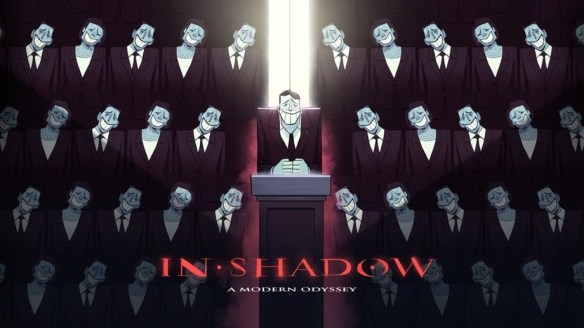
Story artist for film and television, Lubomir Arsov, has just released his most recent creation titled In Shadow. It is a 13-minute animated short that is a powerful and sometimes grim look at the veil that modern society has placed upon nearly every epidemic that plagues the human condition. However, as the story progresses, the seeds are planted in the journey toward awakening and self-empowerment.
Written, Directed & Produced by Lubomir Arsov
Original Soundtrack “Age of Wake” by Starward Projections
Composited by Sheldon Lisoy
Additional Compositing by Hiram Gifford
Art Directed & Edited by Lubomir Arsov
As someone who grew up on the internet, I credit it as one of the most important influences on who I am today. I had a computer with internet access in my bedroom from the age of 13. It gave me access to a lot of things which were totally inappropriate for a young teenager, but it was OK. The culture, politics, and interpersonal relationships which I consider to be central to my identity were shaped by the internet, in ways that I have always considered to be beneficial to me personally. I have always been a critical proponent of the internet and everything it has brought, and broadly considered it to be emancipatory and beneficial. I state this at the outset because thinking through the implications of the problem I am going to describe troubles my own assumptions and prejudices in significant ways.
One of the thus-far hypothetical questions I ask myself frequently is how I would feel about my own children having the same kind of access to the internet today. And I find the question increasingly difficult to answer. I understand that this is a natural evolution of attitudes which happens with age, and at some point this question might be a lot less hypothetical. I don’t want to be a hypocrite about it. I would want my kids to have the same opportunities to explore and grow and express themselves as I did. I would like them to have that choice. And this belief broadens into attitudes about the role of the internet in public life as whole.
I’ve also been aware for some time of the increasingly symbiotic relationship between younger children and YouTube. I see kids engrossed in screens all the time, in pushchairs and in restaurants, and there’s always a bit of a Luddite twinge there, but I am not a parent, and I’m not making parental judgments for or on anyone else. I’ve seen family members and friend’s children plugged into Peppa Pig and nursery rhyme videos, and it makes them happy and gives everyone a break, so OK.
But I don’t even have kids and right now I just want to burn the whole thing down.
Someone or something or some combination of people and things is using YouTube to systematically frighten, traumatise, and abuse children, automatically and at scale, and it forces me to question my own beliefs about the internet, at every level. Much of what I am going to describe next has been covered elsewhere, although none of the mainstream coverage I’ve seen has really grasped the implications of what seems to be occurring.
To begin: Kid’s YouTube is definitely and markedly weird. I’ve been aware of its weirdness for some time. Last year, there were a number of articles posted about the Surprise Egg craze. Surprise Eggs videos depict, often at excruciating length, the process of unwrapping Kinder and other egg toys. That’s it, but kids are captivated by them. There are thousands and thousands of these videos and thousands and thousands, if not millions, of children watching them.
As I write this he has done a total of 4,426 videos and counting. With so many views — for comparison, Justin Bieber’s official channel has more than 10 billion views, while full-time YouTube celebrity PewDiePie has nearly 12 billion — it’s likely this man makes a living as a pair of gently murmuring hands that unwrap Kinder eggs. (Surprise-egg videos are all accompanied by pre-roll, and sometimes mid-video and ads.)
That should give you some idea of just how odd the world of kids online video is, and that list of video titles hints at the extraordinary range and complexity of this situation. We’ll get into the latter in a minute; for the moment know that it’s already very strange, if apparently pretty harmless, out there.
Another huge trope, especially the youngest children, is nursery rhyme videos.
Little Baby Bum, which made the above video, is the 7th most popular channel on YouTube. With just 515 videos, they have accrued 11.5 million subscribers and 13 billion views. Again, there are questions as to the accuracy of these numbers, which I’ll get into shortly, but the key point is that this is a huge, huge network and industry.
On-demand video is catnip to both parents and to children, and thus to content creators and advertisers. Small children are mesmerised by these videos, whether it’s familiar characters and songs, or simply bright colours and soothing sounds. The length of many of these videos — one common video tactic is to assemble many nursery rhyme or cartoon episodes into hour+ compilations —and the way that length is marketed as part of the video’s appeal, points to the amount of time some kids are spending with them.
YouTube broadcasters have thus developed a huge number of tactics to draw parents’ and childrens’ attention to their videos, and the advertising revenues that accompany them. The first of these tactics is simply to copy and pirate other content. A simple search for “Peppa Pig” on YouTube in my case yielded “About 10,400,000 results” and the front page is almost entirely from the verified “Peppa Pig Official Channel”, while one is from an unverified channel called Play Go Toys, which you really wouldn’t notice unless you were looking out for it:
Play Go Toys’ channel consists of (I guess?) pirated Peppa Pig and other cartoons, videos of toy unboxings (another kid magnet), and videos of, one supposes, the channel owner’s own children. I am not alleging anything bad about Play Go Toys; I am simply illustrating how the structure of YouTube facilitates the delamination of content and author, and how this impacts on our awareness and trust of its source.
As another blogger notes, one of the traditional roles of branded content is that it is a trusted source. Whether it’s Peppa Pig on children’s TV or a Disney movie, whatever one’s feelings about the industrial model of entertainment production, they are carefully produced and monitored so that kids are essentially safe watching them, and can be trusted as such. This no longer applies when brand and content are disassociated by the platform, and so known and trusted content provides a seamless gateway to unverified and potentially harmful content.
(Yes, this is the exact same process as the delamination of trusted news media on Facebook feeds and in Google results that is currently wreaking such havoc on our cognitive and political systems and I am not going to explicitly explore that relationship further here, but it is obviously deeply significant.)
A second way of increasing hits on videos is through keyword/hashtag association, which is a whole dark art unto itself. When some trend, such as Surprise Egg videos, reaches critical mass, content producers pile onto it, creating thousands and thousands more of these videos in every possible iteration. This is the origin of all the weird names in the list above: branded content and nursery rhyme titles and “surprise egg” all stuffed into the same word salad to capture search results, sidebar placement, and “up next” autoplay rankings.
Play Go Toys’ channel consists of (I guess?) pirated Peppa Pig and other cartoons, videos of toy unboxings (another kid magnet), and videos of, one supposes, the channel owner’s own children. I am not alleging anything bad about Play Go Toys; I am simply illustrating how the structure of YouTube facilitates the delamination of content and author, and how this impacts on our awareness and trust of its source.
As another blogger notes, one of the traditional roles of branded content is that it is a trusted source. Whether it’s Peppa Pig on children’s TV or a Disney movie, whatever one’s feelings about the industrial model of entertainment production, they are carefully produced and monitored so that kids are essentially safe watching them, and can be trusted as such. This no longer applies when brand and content are disassociated by the platform, and so known and trusted content provides a seamless gateway to unverified and potentially harmful content.
(Yes, this is the exact same process as the delamination of trusted news media on Facebook feeds and in Google results that is currently wreaking such havoc on our cognitive and political systems and I am not going to explicitly explore that relationship further here, but it is obviously deeply significant.)
A second way of increasing hits on videos is through keyword/hashtag association, which is a whole dark art unto itself. When some trend, such as Surprise Egg videos, reaches critical mass, content producers pile onto it, creating thousands and thousands more of these videos in every possible iteration. This is the origin of all the weird names in the list above: branded content and nursery rhyme titles and “surprise egg” all stuffed into the same word salad to capture search results, sidebar placement, and “up next” autoplay rankings.
A striking example of the weirdness is the Finger Family videos (harmless example embedded above). I have no idea where they came from or the origin of the children’s rhyme at the core of the trope, but there are at least 17 million versions of this currently on YouTube, and again they cover every possible genre, with billions and billions of aggregated views.
Once again, the view numbers of these videos must be taken under serious advisement. A huge number of these videos are essentially created by bots and viewed by bots, and even commented on by bots. That is a whole strange world in and of itself. But it shouldn’t obscure that there are also many actual children, plugged into iphones and tablets, watching these over and over again — in part accounting for the inflated view numbers — learning to type basic search terms into the browser, or simply mashing the sidebar to bring up another video.
What I find somewhat disturbing about the proliferation of even (relatively) normal kids videos is the impossibility of determining the degree of automation which is at work here; how to parse out the gap between human and machine. The example above, from a channel called Bounce Patrol Kids, with almost two million subscribers, show this effect in action. It posts professionally produced videos, with dedicated human actors, at the rate of about one per week. Once again, I am not alleging anything untoward about Bounce Patrol, which clearly follows in the footsteps of pre-digital kid sensations like their fellow Australians The Wiggles.
And yet, there is something weird about a group of people endlessly acting out the implications of a combination of algorithmically generated keywords: “Halloween Finger Family & more Halloween Songs for Children | Kids Halloween Songs Collection”, “Australian Animals Finger Family Song | Finger Family Nursery Rhymes”, “Farm Animals Finger Family and more Animals Songs | Finger Family Collection – Learn Animals Sounds”, “Safari Animals Finger Family Song | Elephant, Lion, Giraffe, Zebra & Hippo! Wild Animals for kids”, “Superheroes Finger Family and more Finger Family Songs! Superhero Finger Family Collection”, “Batman Finger Family Song — Superheroes and Villains! Batman, Joker, Riddler, Catwoman” and on and on and on. This is content production in the age of algorithmic discovery — even if you’re a human, you have to end up impersonating the machine.
Other channels do away with the human actors to create infinite reconfigurable versions of the same videos over and over again. What is occurring here is clearly automated. Stock animations, audio tracks, and lists of keywords being assembled in their thousands to produce an endless stream of videos. The above channel, Videogyan 3D Rhymes — Nursery Rhymes & Baby Songs, posts several videos a week, in increasingly byzantine combinations of keywords. They have almost five million subscribers — more than double Bounce Patrol — although once again it’s impossible to know who or what is actually racking up these millions and millions of views.
I’m trying not to turn this essay into an endless list of examples, but it’s important to grasp how vast this system is, and how indeterminate its actions, process, and audience. It’s also international: there are variations of Finger Family and Learn Colours videos for Tamil epics and Malaysian cartoons which are unlikely to pop up in any Anglophone search results. This very indeterminacy and reach is key to its existence, and its implications. Its dimensionality makes it difficult to grasp, or even to really think about.
We’ve encountered pretty clear examples of the disturbing outcomes of full automation before — some of which have been thankfully leavened with a dark kind of humour, others not so much. Much has been made of the algorithmic interbreeding of stock photo libraries and on-demand production of everything from tshirts to coffee mugs to infant onesies and cell phone covers. The above example, available until recently on Amazon, is one such case, and the story of how it came to occur is fascinating and weird but essentially comprehensible. Nobody set out to create phone cases with drugs and medical equipment on them, it was just a deeply weird mathematical/probabilistic outcome. The fact that it took a while to notice might ring some alarm bells however.
Likewise, the case of the “Keep Calm and Rape A Lot” tshirts (along with the “Keep Calm and Knife Her” and “Keep Calm and Hit Her” ones) is depressing and distressing but comprehensible. Nobody set out to create these shirts: they just paired an unchecked list of verbs and pronouns with an online image generator. It’s quite possible that none of these shirts ever physically existed, were ever purchased or worn, and thus that no harm was done. Once again though, the people creating this content failed to notice, and neither did the distributor. They literally had no idea what they were doing.
What I will argue, on the basis of these cases and of those I’m going to describe further, is that the scale and logic of the system is complicit in these outputs, and requires us to think through their implications.
(Also again: I’m not going to dig into the wider social implications of such processes outside the scope of what I am writing about here, but it’s clear that one can draw a clear line from examples such as these to pressing contemporary issues such as racial and gender bias in big data and machine intelligence-driven systems, which require urgent attention but in the same manner do not have anything resembling easy or even preferable solutions.)
Let’s look at just one video among the piles of kid videos, and try to parse out where it comes from. It’s important to stress that I didn’t set out to find this particular video: it appeared organically and highly ranked in a search for ‘finger family’ in an incognito browser window (i.e. it should not have been influenced by previous searches). This automation takes us to very, very strange places, and at this point the rabbithole is so deep that it’s impossible to know how such a thing came into being.
Once again, a content warning: this video is not inappropriate in any way, but it is decidedly off, and contains elements which might trouble anyone.It’s very mild on the scale of such things, but. I describe it below if you don’t want to watch it and head down that road. This warning will recur.
The above video is entitled Wrong Heads Disney Wrong Ears Wrong Legs Kids Learn Colors Finger Family 2017 Nursery Rhymes. The title alone confirms its automated provenance. I have no idea where the “Wrong Heads” trope originates, but I can imagine, as with the Finger Family Song, that somewhere there is a totally original and harmless version that made enough kids laugh that it started to climb the algorithmic rankings until it made it onto the word salad lists, combining with Learn Colors, Finger Family, and Nursery Rhymes, and all of these tropes — not merely as words but as images, processes, and actions — to be mixed into what we see here.
The video consists of a regular version of the Finger Family song played over an animation of character heads and bodies from Disney’s Aladdin swapping and intersecting. Again, this is weird but frankly no more than the Surprise Egg videos or anything else kids watch. I get how innocent it is. The offness creeps in with the appearance of a non-Aladdin character —Agnes, the little girl from Despicable Me. Agnes is the arbiter of the scene: when the heads don’t match up, she cries, when they do, she cheers.
The video’s creator, BABYFUN TV (screenshot above), has produced many similar videos. As many of the Wrong Heads videos as I could bear to watch all work in exactly the same way. The character Hope from Inside Out weeps through a Smurfs and Trolls head swap. It goes on and on. I get the game, but the constant overlaying and intermixing of different tropes starts to get inside you. BABYFUN TV only has 170 subscribers and very low view rates, but then there are thousands and thousands of channels like this. Numbers in the long tail aren’t significant in the abstract, but in their accumulation.
The question becomes: how did this come to be? The “Bad Baby” trope also present on BABYFUN TV features the same crying. While I find it disturbing, I can understand how it might provide some of the rhythm or cadence or relation to their own experience that actual babies are attracted to in this content, although it has been warped and stretched through algorithmic repetition and recombination in ways that I don’t think anyone actually wants to happen.
Toy Freaks is a hugely popular channel (68th on the platform) which features a father and his two daughters playing out — or in some cases perhaps originating — many of the tropes we’ve identified so far, including “Bad Baby”, above. As well as nursery rhymes and learning colours, Toy Freaks specialises in gross-out situations, as well as activities which many, many viewers feel border on abuse and exploitation, if not cross the line entirely, including videos of the children vomiting and in pain. Toy Freaks is a YouTube verified channel, whatever that means. (I think we know by now it means nothing useful.)
As with Bounce Patrol Kids, however you feel about the content of these videos, it feels impossible to know where the automation starts and ends, who is coming up with the ideas and who is roleplaying them. In turn, the amplification of tropes in popular, human-led channels such as Toy Freaks leads to them being endlessly repeated across the network in increasingly outlandish and distorted recombinations.
There’s a second level of what I’m characterising as human-led videos which are much more disturbing than the mostly distasteful activities of Toy Freaks and their kin. Here is a relatively mild, but still upsetting example:
A step beyond the simply pirated Peppa Pig videos mentioned previously are the knock-offs. These too seem to teem with violence. In the official Peppa Pig videos, Peppa does indeed go to the dentist, and the episode in which she does so seems to be popular — although, confusingly, what appears to be the real episode is only available on an unofficial channel. In the official timeline, Peppa is appropriately reassured by a kindly dentist. In the version above, she is basically tortured, before turning into a series of Iron Man robots and performing the Learn Colours dance. A search for “peppa pig dentist” returns the above video on the front page, and it only gets worse from here.
Disturbing Peppa Pig videos, which tend towards extreme violence and fear, with Peppa eating her father or drinking bleach, are, it turns out very widespread. They make up an entire YouTube subculture. Many are obviously parodies, or even satires of themselves, in the pretty common style of the internet’s outrageous, deliberately offensive kind. All the 4chan tropes are there, the trolls are out, we know this.
In the example above, the agency is less clear: the video starts with a trollish Peppa parody, but later syncs into the kind of automated repetition of tropes we’ve seen already. I don’t know which camp it belongs to. Maybe it’s just trolls. I kind of hope it is. But I don’t think so. Trolls don’t cover the intersection of human actors and more automated examples further down the line. They’re at play here, but they’re not the whole story.
I suppose it’s naive not to see the deliberate versions of this coming, but many are so close to the original, and so unsignposted — like the dentist example — that many, many kids are watching them. I understand that most of them are not trying to mess kids up, not really, even though they are.
I’m trying to understand why, as plainly and simply troubling as it is, this is not a simple matter of “won’t somebody think of the children” hand-wringing. Obviously this content is inappropriate, obviously there are bad actors out there, obviously some of these videos should be removed. Obviously too this raises questions of fair use, appropriation, free speech and so on. But reports which simply understand the problem through this lens fail to fully grasp the mechanisms being deployed, and thus are incapable of thinking its implications in totality, and responding accordingly.
The New York Times, headlining their article on a subset of this issue “On YouTube Kids, Startling Videos Slip Past Filters”, highlights the use of knock-off characters and nursery rhymes in disturbing content, and frames it as a problem of moderation and legislation. YouTube Kids, an official app which claims to be kid-safe but is quite obviously not, is the problem identified, because it wrongly engenders trust in users. An article in the British tabloid The Sun, “Kids left traumatised after sick YouTube clips showing Peppa Pig characters with knives and guns appear on app for children” takes the same line, with an added dose of right-wing technophobia and self-righteousness. But both stories take at face value YouTube’s assertions that these results are incredibly rare and quickly removed: assertions utterly refuted by the proliferation of the stories themselves, and the growing number of social media posts, largely by concerned parents, from which they arise.
But as with Toy Freaks, what is concerning to me about the Peppa videos is how the obvious parodies and even the shadier knock-offs interact with the legions of algorithmic content producers until it is completely impossible to know what is going on. (“The creatures outside looked from pig to man, and from man to pig, and from pig to man again; but already it was impossible to say which was which.”)
Here’s what is basically a version of Toy Freaks produced in Asia (screenshot above). Here’s one from Russia. I don’t really want to use the term “human-led” any more about these videos, although they contain all the same tropes and actual people acting them out. I no longer have any idea what’s going on here and I really don’t want to and I’m starting to think that that is kind of the point. That’s part of why I’m starting to think about the deliberateness of this all. There is a lot of effort going into making these. More than spam revenue can generate — can it? Who’s writing these scripts, editing these videos? Once again, I want to stress: this is still really mild, even funny stuff compared to a lot of what is out there.
Here are a few things which are disturbing me:
The first is the level of horror and violence on display. Some of the times it’s troll-y gross-out stuff; most of the time it seems deeper, and more unconscious than that. The internet has a way of amplifying and enabling many of our latent desires; in fact, it’s what it seems to do best. I spend a lot of time arguing for this tendency, with regards to human sexual freedom, individual identity, and other issues. Here, and overwhelmingly it sometimes feels, that tendency is itself a violent and destructive one.
The second is the levels of exploitation, not of children because they are children but of children because they are powerless. Automated reward systems like YouTube algorithms necessitate exploitation in the same way that capitalism necessitates exploitation, and if you’re someone who bristles at the second half of that equation then maybe this should be what convinces you of its truth. Exploitation is encoded into the systems we are building, making it harder to see, harder to think and explain, harder to counter and defend against. Not in a future of AI overlords and robots in the factories, but right here, now, on your screen, in your living room and in your pocket.
Many of these latest examples confound any attempt to argue that nobody is actually watching these videos, that these are all bots. There are humans in the loop here, even if only on the production side, and I’m pretty worried about them too.
I’ve written enough, too much, but I feel like I actually need to justify all this raving about violence and abuse and automated systems with an example that sums it up. Maybe after everything I’ve said you won’t think it’s so bad. I don’t know what to think any more.
This video, BURIED ALIVE Outdoor Playground Finger Family Song Nursery Rhymes Animation Education Learning Video, contains all of the elements we’ve covered above, and takes them to another level. Familiar characters, nursery tropes, keyword salad, full automation, violence, and the very stuff of kids’ worst dreams. And of course there are vast, vast numbers of these videos. Channel after channel after channel of similar content, churned out at the rate of hundreds of new videos every week. Industrialised nightmare production.
For the final time: There is more violent and more sexual content like this available. I’m not going to link to it. I don’t believe in traumatising other people, but it’s necessary to keep stressing it, and not dismiss the psychological effect on children of things which aren’t overtly disturbing to adults, just incredibly dark and weird.
A friend who works in digital video described to me what it would take to make something like this: a small studio of people (half a dozen, maybe more) making high volumes of low quality content to reap ad revenue by tripping certain requirements of the system (length in particular seems to be a factor). According to my friend, online kids’ content is one of the few alternative ways of making money from 3D animation because the aesthetic standards are lower and independent production can profit through scale. It uses existing and easily available content (such as character models and motion-capture libraries) and it can be repeated and revised endlessly and mostly meaninglessly because the algorithms don’t discriminate — and neither do the kids.
These videos, wherever they are made, however they come to be made, and whatever their conscious intention (i.e. to accumulate ad revenue) are feeding upon a system which was consciously intended to show videos to children for profit. The unconsciously-generated, emergent outcomes of that are all over the place.
To expose children to this content is abuse. We’re not talking about the debatable but undoubtedly real effects of film or videogame violence on teenagers, or the effects of pornography or extreme images on young minds, which were alluded to in my opening description of my own teenage internet use. Those are important debates, but they’re not what is being discussed here. What we’re talking about is very young children, effectively from birth, being deliberately targeted with content which will traumatise and disturb them, via networks which are extremely vulnerable to exactly this form of abuse. It’s not about trolls, but about a kind of violence inherent in the combination of digital systems and capitalist incentives. It’s down to that level of the metal.
This, I think, is my point: The system is complicit in the abuse.
And right now, right here, YouTube and Google are complicit in that system. The architecture they have built to extract the maximum revenue from online video is being hacked by persons unknown to abuse children, perhaps not even deliberately, but at a massive scale. I believe they have an absolute responsibility to deal with this, just as they have a responsibility to deal with the radicalisation of (mostly) young (mostly) men via extremist videos — of any political persuasion. They have so far showed absolutely no inclination to do this, which is in itself despicable. However, a huge part of my troubled response to this issue is that I have no idea how they can respond without shutting down the service itself, and most systems which resemble it. We have built a world which operates at scale, where human oversight is simply impossible, and no manner of inhuman oversight will counter most of the examples I’ve used in this essay. The asides I’ve kept in parentheses throughout, if expanded upon, would allow one with minimal effort to rewrite everything I’ve said, with very little effort, to be not about child abuse, but about white nationalism, about violent religious ideologies, about fake news, about climate denialism, about 9/11 conspiracies.
This is a deeply dark time, in which the structures we have built to sustain ourselves are being used against us — all of us — in systematic and automated ways. It is hard to keep faith with the network when it produces horrors such as these. While it is tempting to dismiss the wilder examples as trolling, of which a significant number certainly are, that fails to account for the sheer volume of content weighted in a particularly grotesque direction. It presents many and complexly entangled dangers, including that, just as with the increasing focus on alleged Russian interference in social media, such events will be used as justification for increased control over the internet, increasing censorship, and so on. This is not what many of us want.
I’m going to stop here, saying only this:
What concerns me is not just the violence being done to children here, although that concerns me deeply. What concerns me is that this is just one aspect of a kind of infrastructural violence being done to all of us, all of the time, and we’re still struggling to find a way to even talk about it, to describe its mechanisms and its actions and its effects. As I said at the beginning of this essay: this is being done by people and by things and by a combination of things and people. Responsibility for its outcomes is impossible to assign but the damage is very, very real indeed.
Science. Does the word bring images of space ships and high-tech equipment doing miraculous things? Wonder drugs and new solutions to old problems? Good, because this article isn’t a declaration that science is evil, or dead. Keep that shining gaze on the things that amaze you, and buckle up.
Never before has it been so easy as in the modern era to find something to fill a person’s God-Hole with. What’s a God-Hole, you ask? Well, put simply its a metaphor for the part of our psyche where religious surety and faithful fanaticism would have been reserved for Yahweh and his earthly cohorts, as was the case with generations and generations of many of our ancestors. These days you can’t walk three steps without crushing some cult or dealing with apologists for yet another embryonic subculture, and one of the most wide-spread and pervasive modern cults is that of the materialist–positivists.
You might not be familiar with the names but you’re definitely familiar with the faces, the words, the general attitudes of the MP’s. They tend to identify themselves by their atheism though their atheism is the least descriptive part of their belief system. Erroneously, MP’s have been in the spotlight for so long that nowadays people assume that if you are an atheist, you must fall in line and along trends of attitudes of this group, despite the fact that an atheist could be a Buddhist, LaVeyan Satanist, religious naturalist, believe in the supernatural, ghosts, psychic powers, or what have you, (since none of these things are theoi, or gods). MP’s on the other hand are intrinsically opposed to the study of or contemplation of seemingly paranormal or preternatural phenomena.
Likewise they have taken hold of the term “skeptic” and have become its face in mainstream discourse. These days all you have to do to be thought of as a skeptic is to, firstly, tell everyone quite loudly that you are one, and secondly, start engaging in specified, surgical doubt of only the belief systems and ideologies you are already antagonistic towards, while neglecting to perform the same upon anything you tacitly presume to be true. Engage in rampant polemics against your opponents and frequently craft apologetics for your own beliefs, use your inquisitiveness and doubt like a blade with which to carve out the proverbial flesh of those whom you despise ideologically. This is far from philosophical skepticism as it was originally intended, but as long as you tell people often enough you are a skeptic, you must be one.
The combination of a certain brand of materialism (philosophical monism, in which they deem all things that exist are material) and positivism (belief that everything that exists can be verified scientifically and anything that can’t be verified scientifically doesn’t exist) forms a unique cocktail, an anti-belief based upon a sense of superiority against all other beliefs. “You have beliefs. We have facts.” It is a potentially useful worldview, which many people use as a metric with which to quantify worthiness, but use is only the same as truth to the strictest of pragmatists.
Most proponents of MP eschew philosophy as navel-gazing aphorisms and platitudes, seeing the field as the decrepit grandfather of science. Given that they are mostly unaware of philosophy — due to their aversion — they don’t usually know that their beliefs fall squarely under philosophy, and they don’t usually seem to know that there are still to this day debates about the validity of their philosophical presuppositions.
Again, being critical of the philosophies of positivism and materialism is not being anti-science, though such a claim is inevitable should you question the sacrosanct nature of anything tangentially related to science or adjacent to science. Karl Popper — the guy who came up with the concept of falsifiability — was a major opponent to positivism, for example. They’d probably say he was anti-science as well, though that is entirely inaccurate.
This isn’t a condemnation of (most) scientists. I’ve had the pleasure to meet a few over the years and I’ve always found them quite humble in terms of facing the mysterious of the universe. They were the least likely to make outrageous claims or swerve outside of their proverbial lanes. The problem lies mostly with what I’ve come to think of as “positivist laity”.
The “lay-person” is a concept found generally from religion, and refers to someone who is not a part of the clergy, who are not ordained or educated on the ‘inner mysteries’ of the religious order. They are deferential to the priests and clerics and put great faith in them but do not themselves have the same information, education or knowledge.
The materialist-positivist laity seems to consist of people who have no formal or informal education dealing with the scientific method(s) or in the fields of science. They often come from a Post-Christian background (at least in the United States) and are angry that they believed the literalism their parents or geographical region shoved down their throats. They end up seeing a few debunking videos, or those in which someone who is self-identified with atheism points out the inconsistencies of the Christian cosmological mythos. They start to notice that the explanations and descriptions of the world that scientists and science educators give are more functional, and are trusted to be provable, even though the concept of ‘proof’ is mathematical, not scientific.
Either way, for whatever reason, they come to replace Yahweh and his priests for their conception of Science and it’s own educated, inner-circle experts. Once again, not a critique of science nor atheism. Not even really a critique of materialist-positivism. We must focus on the issue at hand. Large swathes of lay-positivists are turning the concept of science into a cargo-cult religion, using it to fill in their empty God-Hole and clutching to their conception of a cohesive and explanatory world-story.
It was the jobs of priests for thousands upon thousands of years to give the simple folk a world-story, without such as story anxieties rise and existential doubt creeps in. The crafting and dissemination of a world-story has since been split up from between priests to spread into other areas and specialists such as philosophers, academics and of course, scientists.
Science isn’t a religion. Science isn’t a good many things. For example, science isn’t technology, which would probably shock quite a few lay-positivists. Humanity used and invented technology since as far back as we can find evidence for humans at all. We created aqueducts, agricultural technology, wartime technology, shipbuilding and navigational technology, calendars and time keeping technology, architectural technology, psychological techniques and so on and so forth, well before science was a twinkle in the eye of natural philosophy. People with no education on science or without any formal training to this day still invent new technology. So, next time someone points to a piece of technology and tries to conflate it with science, keep this in mind. One cannot simply anachronistically and retroactively claim for ‘science’ everything which works or is useful, though this does not prevent some from attempting such a thing.
Science is also not ethics. Nor can science tell you what to do with the information you glean from the universe via science. I’m sure people will disagree, but I’m also sure most of them are not scientists and/or do not have a clear understanding of the scientific method(s). Not every moment of clear-thinking and rationality is science, not every free-thought is evidence of science in the works. By trying to make it appear as though everything which makes sense and works is science, lay-positivists have before-the-fact designated everything that is not science as nonsensical and nonexistent.
Intuition and introspection are cast aside by positivism because they are not scientific, and I agree wholeheartedly that intuition can be flawed, rife with bias and misconceptions. But it’s a ‘don’t throw the baby out with the bathwater’ scenario. Don’t forget that most of us get up every day and manage to navigate this world without using the slightest bit of the scientific method. For instance, we’ve got inductive, deductive and abductive reasoning, none of which are isolated to scientific methods. You’ve got examples of people thought to be great scientists in bygone eras who never used an ounce of empiricism to figure out their great contributions. (Galileo, for example, used rational but non-empirical means to infer a heliocentric model).
Science isn’t a cult, a religion, or anything of the sort. But lay-positivism stands to become just that. People seeking to fill a God-Hole, to give their life a sense of meaning and to provide a cohesive world-story so that they do not feel they exist in a state of uncertainty and chaos. Nietzsche, Freud, Feuerbach, and many others have recognized this fact: the need for Gods is not so easily replaced as the Gods themselves are. If scientific findings are used with an ideological agenda to offer fragile humanity a security blanket against the cold, unpredictable unknown, misrepresented and misunderstood by those who have never even bothered to Google “scientific method” who are merely disenfranchised with their old Church, it very well stands that the word “science” will be appropriated akin to the terms “skepticism” and “atheism” to refer to specified, pigeon-holed belief systems, made sacred and subject to no criticism.