Remember that one from 1996? Funny, that was the American mainstream media bragging, after the fact, about our own meddling in another nation’s election.
WASHINGTON — A team of American political strategists who helped [California] Gov. Pete Wilson with his abortive presidential bid earlier this year said this week that they served as Russian President Boris N. Yeltsin’s secret campaign weapon in his comeback win over a Communist challenge.
—The Los Angeles Times, July 9, 1996
The beauty in Robert Mueller’s indictment of thirteen Russian Facebook trolls is that they’ll never face trial, so Mr. Mueller will never have to prove his case. In the new misrule of law made popular by the #Me Too movement, accusations suffice to convict the target of an investigation. Kind of sounds like going medieval to me, but that’s how we roll now in the Land of the Free.
Readers know, of course, that I’m not a Trump supporter, that I regard him as a national embarrassment, but I’m much more disturbed by the mindless hysteria ginned up Washington’s permanent bureaucracy in collusion with half a dozen major newspapers and cable news networks, who have run a psy-ops campaign to shove the country into a war mentality.
The New York Times published a doozy of a lead story on Saturday, the day after the indictments were announced. The headline said: Trump’s Conspicuous Silence Leaves a Struggle Against Russia Without a Leader. Dean Baquet and his editorial board are apparently seeking an American Napoleon who will mount a white horse and take our legions into Moscow to teach these rascals a lesson — or something like that.
I’m surely not the only one to notice how this hysteria is designed to distract the public attention from the documented misconduct among FBI, CIA, NSA, State Department officials and the leaders of the #Resistance itself: the Democratic National Committee, its nominee in the 2016 election, HRC, and Barack Obama’s White House inner circle. You would think that at least some of this mischief would have come to Robert Mueller’s attention, since the paper trail of evidence is as broad and cluttered as the DC Beltway itself. It actually looks like the greatest act of bureaucratic ass-covering inn US history.
Of course, Deputy Attorney General Rod Rosenstein was quick to qualify the announced indictments by saying that Russian trolling on Facebook had no effect on the 2016 election, and that the Trump campaign was not implicated in it. Maybe the indictments were just a table-setter for something more potent to come out of Mueller’s office. But what if it’s not. What if this is all he has to show for a year and a half of the most scrupulous delving into this “narrative?”
Meanwhile, the damage done among America’s former thinking class essentially leaves this polity like the Scarecrow in The Wizard of Oz: without a brain. I doubt they will be satisfied by Mueller’s indictment of the thirteen Russian trolls. Rather, it may tempt them to even more violent hysterics and greater acts of lawlessness. The only thing that will stop this nonsense is Big Trouble in the financial system — which the news media and most of the public are ignoring at their peril. It is coming at us good and hard and it will feel like a two-by-four to nation’s skull when it gets here.
It’s fitting that the ever-tightening repetitive loops of America’s increasingly schizophrenic partisan warfare finally hit peak shrillness and skyrocketed into a white noise singularity on Groundhog Day. Right now, we’re right about at the part of the movie where Bill Murray is driving over a cliff in a pickup truck with a large rodent behind the wheel.
If you only just started paying attention to U.S. politics in 2017 what I’m about to tell you will blow your mind, so you might want to sit down for this: believe it or not, there was once a time when both of America’s mainstream political parties weren’t screeching every single day that there was news about to break any minute now which would obliterate the other party forever. No Russiagate, no Nunes memo, no Rachel Maddow red yarn graphs, no Sean Hannity “tick tock,” no nothing. People screaming that the end is nigh and it’s all about to come crashing down were relegated to street corners and the occasional Infowars appearance, not practicing mainstream political punditry for multimillion dollar salaries on MSNBC and Fox News.
I’m not saying it’s a bad thing that Americans are starting to look critically at the power dynamics in their country, but the partisan filters they’ve pulled over their eyes are causing mass confusion and delusion. Now everyone who questions the CIA is a Russian agent and the term “deep state” suddenly means “literally anyone who doesn’t like Donald Trump.” Your take on the contents of the Nunes memo will put you in one of two radically different political dimensions depending on which mainstream cult you’ve subscribed to, and it will cause you to completely miss the point of the entire ordeal.
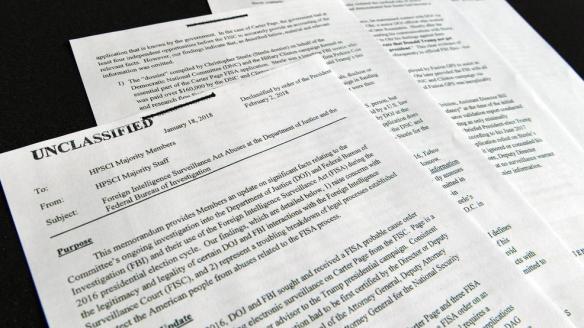
The part of the memo that has everyone talking today reads as follows: “Furthermore, Deputy Director McCabe testified before the Committee in December 2017 that no surveillance warrant would have been sought from the FISC without the Steele dossier information.”
This refers to a surveillance warrant requested by the FBI’s then-Deputy Director Andrew McCabe from the Foreign Intelligence Surveillance Court seeking permission to spy on the communications of Carter Page, a member of the 2016 Trump campaign. The controversy revolves around the claim that this surveillance warrant would never have even been requested if not for the clearly biased, Clinton-funded, and error-riddled Christopher Steele dossier which is acknowledged even by its former MI6 author to be 10 to 30 percent inaccurate.
Combine that with the fact that this has never been made clear to the public, and baby you’ve got yourself a scandal. The FBI knowingly using extremely tainted evidence from one presidential campaign to get permission to spy on another would indeed be a very big deal.
There are some problems with the “BOOM! Bigger than Watergate!” exclamations that pro-Trump partisans have been parading around about this, however. The first is that the memo is only an internal communication between Republican congressmen; it’s not a sworn testimony or legal transcript or anything legally binding. It’s basically just some Republican ideas about what happened. The assertions made therein are reportedly being hotly contested by Democrats with knowledge of the situation, which is in turn being disputed by Republicans.
Another thing putting a damper on the GOP’s “KABOOM!” parade is the fact that the memo’s contents are not even entirely new; CNN reported way back in April of last year that sources had informed them that the Steele dossier had been used to get a FISA warrant on the Trump campaign. Additionally, even if every single allegation in the memo is true, the revelations are still arguably far less earth shattering than the Edward Snowden revelations of 2013 exposing the NSA’s sprawling domestic espionage network, so the expectation that these less significant new revelations would cause a radical transformation in U.S. politics when the Snowden revelations did not seems highly unrealistic.
Nonetheless, there have been some extremely important revelations as a result of this memo; they just haven’t come from the contents of the memo itself. In the same way that cybersecurity analysts observe the metadata underlying hacked files rather than the contents of the files themselves, political analysts have been pointing out that a lot can be learned about the political establishment by looking at its response to the possibility of the memo’s release.
“Memo is clearly not a blockbuster. We can tell so by reading it. Which makes Dems’ frantic efforts to prevent anyone from reading it seem even more bizarre,” observed TYT’s Michael Tracey. “Veracity of memo’s claims aside, we were told that its release would undermine the rule of law. So, just checking: is the rule of law still in tact?” he added later.
“Now it is clear to all,” WikiLeaks’ Julian Assange tweeted. “The claims about how the ‘Nunes’ memo would destroy ‘national security’ were lies. Classification stickers are used by bureaucrats trying to obtain ‘political security’ for their cronies.”
“One effect of the memo – it’s an example of how extensively we overclassify information,” wrote National Review’s David French. “I’m highly dubious that any information disclosed threatens national security in any way, shape, or form. I’d be willing to bet the Dem response is similarly harmless. Release it.”
Indeed, both the FBI and high-profile Democrats have been claiming that the memo’s unredacted release would pose a national security threat, with California Congressman (and virulent Russiagater) Eric Swalwell going so far to call it “brainwashing.” A CNN panelist wandered completely off the paddock and suggested that yesterday may have been America’s last day as a democracy. Why were they all flipping out so hysterically over a release of information that plainly poses no threat to the American people?
In addition to Assange’s assertion that government secrecy has far less to do with national security than political security (a claim he has made before which seems to be proving correct time and time again), there’s the jarring question posed by Republican Congressman Thomas Massie: “who made the decision to withhold evidence of FISA abuse until after Congress voted to renew FISA program?”
Whoa, Nelly. Hang on. What is he talking about?
It would be understandable if you were unaware of the debate over the reauthorization of FISA surveillance which resulted in unconditional bipartisan approval last month – the mainstream media barely touched it. In point of fact, though, the very surveillance practices alleged to have been abused in this hotly controversial memo are the same which was waved through by both the House and the Senate, and by the very same people promoting the memo in many cases.
The McCabe testimony was in December. FISA was renewed in January. Why is all this just coming out now? If the Republicans truly believed that McCabe said what the memo claims he said, why wasn’t the public informed before their elected representatives renewed the intelligence community’s dangerously intrusive surveillance approval? Was this information simply forgotten about until after those Orwellian powers had been secured?
Of course not. Don’t be an idiot.
This makes the kicking, screaming, wailing and gnashing of teeth by the political establishment make a lot more sense, doesn’t it? Now suddenly we’re looking at a he-said, she-said partisan battle over an issue which can only be resolved with greater and greater transparency of more and more government documents, and we can all see where that’s headed. In their rush to win a partisan battle and shield their president from the ongoing Russiagate conspiracy theory, the Republicans may have exposed too much of the establishment foundation upon which both parties are built.
The term “deep state” does not mean “Democrats and Never-Trumpers” as Republican pundits would have you believe, nor does the term refer to any kind of weird, unverifiable conspiracy theory. The deep state is in fact not a conspiracy theory at all, but simply a concept used in political analysis for discussing the undeniable fact that unelected power structures exist in America, and that they tend to form alliances and work together in some sense.
There is no denying the fact that plutocrats, intelligence agencies, defense agencies and the mass media are both powerful and unelected, and there is no denying the fact that there are many convoluted and often conflicting alliances between them. All that can be debated is the manner and extent to which this is happening.
The deep state is America’s permanent government, the U.S. power structures that Americans don’t elect. These power structures plainly have a vested interest in keeping America’s Orwellian surveillance structures in place, as evidenced by the intelligence community’s menacingly urgent demand for FISA renewal back in December. If there’s any thread to be pulled that really could make waves in the way Official Washington (hat tip to the late Robert Parry) operates, it is in the plot holes between the bipartisan scramble toward unconditional surveillance renewal and the highly partisan battle over exposing the abuse of those very powers.
If we’re going to see a gap in the bars of our cages, that’s a great place to keep our eyes trained, so keep watching. Watch what happens in a partisan war where both parties have a simultaneous interest in revealing as little of the game as possible and exposing the other party. Things could get very interesting.
Last week, the US said it was working to create “alternative government authorities” on Syrian territory. This latest move, aside from demonstrating once again that the US has no respect for Syria’s territorial integrity, indicates we may be seeing more from that group of mercenaries known as Islamic State.
Thus, it seems to be an appropriate time to reflect upon a set of very strange circumstances that led to the rise of this loathsome terrorist group. Here are the top 10 reasons, in no particular order, as to why we should be very suspicious about this group.
10. Convenient Timing
In late August 2013, the United States was on the verge of initiating a massive attack on the government of Syrian President Bashar Assad over a deadly chemical attack that had occurred in the town of Ghouta just days earlier. Although it would have made no sense for Assad to have resorted to such dirty tactics, Washington had found its casus belli. It should be noted that at this time the so-called Islamic State of Iraq and the Levant was largely unknown. That would change soon enough.
Meanwhile, a terrible thing happened on the way to this jolly little war. UK Prime Minister David Cameron suffered a stunning defeat in the House of Commons, voting down his effort to join the Americans in Syria. Apparently the British were America’s obedient poodle no longer.
The setback had an apparent sobering effect on Barack Obama, who suddenly – in a feigned nod to democratic procedure and all that – called for Congress to decide whether or not to use military force against Syrian. Tellingly, that vote never materialized.
What did materialize, however, and with alarming speed and viciousness, was a terrorist group that rose up like a phoenix from the ashes of Iraq known as Islamic State (ISIS)*, with evil designs to create an Islamic caliphate across a wide swath of Iraq and Syria.
In other words, the perfect casus belli for the US in Syria that would require no need for a vote from Congress.
9. Journalist Killings
As if to draw gratuitous attention to itself more than anything else, the Sunni terrorist group ISIS, under the leadership of one Abu Bakr al Baghdadi, began to grab world headlines not by its battlefield exploits, but by carrying out videotaped executions of Western journalists, as well as destroying cultural heritage sites. I still can’t help wondering: Why didn’t the group just let its fighting skills speak for itself? Why the apparent need for such outrageous publicity stunts? Was this compensation for something the group was desperately lacking?
In any case, starting in August 2014, almost one year to the day that Obama was forced to put the brakes on his Syrian attack, the beheadings began in earnest.
On August 19, US journalist James Foley, seen kneeling on the ground in some undetermined location next to his apparent executioner, ‘Jihadi John,’ reads out a short statement before being beheaded by his captor. However, Islamic State spared its audience the gore by not showing the moment of the actual beheading; the video only shows a head lying on a body following the purported act.
Even Western mainstream publications admitted that something didn’t seem quite right.
Under the headline, ‘Foley murder video may have been staged’ the Telegraph, a reputable British newspaper, interviewed forensic experts who called into question the moment in the video when Foley is allegedly being beheaded by his captor.
“After enhancements, the knife can be seen to be drawn across the upper neck at least six times, with no blood evidence to the point the picture fades to black,” the expert said.
Another expert who examined the video for the newspaper said: “I think it has been staged. My feeling is that the execution may have happened after the camera was stopped.”
Incredibly, every subsequent beheading video put out by Islamic State attracted the same amount of scepticism – not just from alternative websites, who were also noticing the many irregularities contained in the videos, but from mainstream media news sources.
Following the release of the video purported to show the beheading of Steve Sotloff, a journalist who worked with the Jerusalem Post, The Australian newspaper reported that “the apparent beheading on camera of a second US hostage by a man with a British accent was again staged, according to forensic analysis.”
Then there was the video of 21 Egyptian Coptic Christians, dressed in impeccably clean orange jumpsuits, being led along a Libyan beach by black-clad members of ISIS, all of whom appear to be members of some NBA basketball team.
Veryan Khan, editorial director of the Florida-based Terrorism Research & Analysis Consortium, told Fox News that “the speaker, “Jihad Joseph” is much larger than the sea in both the close up and wide shots, and his head is bizarrely out of proportion, meaning he was filmed indoors and the sea added behind him… In addition, the jihadists featured in the film look to be more than 7 feet tall, towering as much as two feet above their victims…”
In July 2015, yet another strange report emerged, CyberBerkut, a Ukrainian group of hackers, said it hacked John McCain’s laptop while he was on an official visit to Kiev around the first week of June 2015. In a report by TechWorm, what they purported to find was a fully staged production of an ISIS execution video, with an actor portraying an executioner who is holding a knife in preparation to behead the prisoner.
The authenticity of this video has not been independently verified.
None of this proves that the individuals in all of the ISIS beheading videos did not go on to meet some grisly fate. However, it seems worth noting that so many forensic experts have spoken out on the “staged” nature of these videos, and that the actual moment of execution during these film productions is never actually shown. Why would such a barbarous group of villains like ISIS need to script and censor their videos?
8. ISIS freedom of movement
Despite employing state-of-the-art fighter jets, like the F-16 Fighting Falcon and A-10 Warthog, the US campaign to destroy Islamic State was largely an exercise in utter futility. There is no other way to explain it. In June 2014, a convoy of hundreds of ISIS fighters drove through 200 km of the Syro-Arabian Desert in fresh-off-the-lot Toyota pickup trucks on the way to Syria. For any modern military, eliminating such a target would have been the equivalent of a lazy afternoon at the shooting range, or shooting fish in a barrel. The fact that these terrorists made it to Syria unmolested tells us everything we need to know about America’s real agenda.
“With state of the art jet fighter aircraft … it would have been – from a military standpoint – ‘a piece of cake’, a rapid and expedient surgical operation, which would have decimated the Islamic State convoys in a matter of hours,” Michel Chossudovsky wrote in Global Research.
“Instead what we have witnessed is an ongoing drawn out six months of relentless air raids and bombings, and the terrorist enemy is apparently still intact.”
“And we are led to believe that the Islamic State cannot be defeated by a powerful US led military coalition of 19 countries,” he added.
The only reasonable conclusion to make from all of this is that the air campaign was not designed to eliminate Islamic State.
In 2002, Rita Katz and Josh Devon founded Search for International Terrorist Entities Institute (SITE), which, according to its website, is “the world’s leading non-governmental counterterrorism organization specializing in tracking and analyzing online activity of the global extremist community.”
In 2006, in a New Yorker article entitled, “Private Jihad: How Rita Katz got into the spying business,” it was mentioned how SITE spoke directly with jihadists via various message boards:
“Katz has a testy relationship with the government, sometimes acting as a consultant and sometimes as an antagonist. About a year ago, a SITE staffer, under an alias, managed to join an exclusive jihadist message board that, among other things, served as a debarkation point for many would-be suicide bombers.
For months, the staffer pretended to be one of the jihadis, joining in chats and watching as other members posted the chilling messages known as “wills,” the final sign-offs before martyrdom. The staffer also passed along technical advice on how to keep the message board going.
When Katz called officials in Washington, she was reportedly met with resistance: ‘Oh, Rita, I’m not sure you should even be communicating with them—you might be providing material support!,” they told her.
In an interview with CNN, Katz admitted that her group was able to “beat [ISIS] with a release” of a video before it had even been disseminated.
In 2007, SITE came under fire for obtaining an alleged Bin Laden video a month prior to its formal release.
Some have raised questions as to how this small group is able to do what the government has not been able to: track ISIS and other terrorist groups with uncanny efficiency.
6. Toyota Trucks
Watching mainstream media reports detail the adventures of Islamic State as they speed carefree across wide-open desert, beards blowing in the wind, one would be forgiven for thinking they were watching a Toyota commercial.
The Times of Israel went so far as to ridicule the leaders of the West for expressing such fear over these militants in their Toyotas like hell raising teenagers speeding around the parking lot of McDonald’s on a Friday night to impress their friends.
“It’s almost unbelievable,” Avi Issacharoff wrote. “They used to say in the IDF that ‘the man in the tank will win,’ justifying the preference for armor over infantry. Now we hear that, from a US source no less, ‘the man in the Toyota’ will defeat the West.”
Somehow we are expected to believe that these shiny new trucks, along with over 2,000 Humvee vehicles, fell into the terrorists’ control by winning some battles in Iraq, like in Mosul and Palmyra. That absurd explanation falls very wide of the mark and needs far more inquiry.
5. Drone attack on Russia
On New Year’s Eve and on January 6, 2018, Russia’s Khmeimim Airbase in Syria was attacked. The first incident involved militants armed with mortars that resulted in the death of two Russian soldiers and damage to several aircraft. The second attack involved a swarm of 13 drones armed with bomblets, which Russian forces countered by means of electronic warfare and air-defense systems. Around half of the drones were electronically hijacked by Russian forces, while the others were shot down without incident. Nevertheless, the attack required a high level of expertise from a “technologically advanced country,” according to Russia.
The United States countered the claim, suggesting that such technology can be easily purchased. Pentagon spokesman Maj. Adrian Rankin-Galloway said the “devices and technologies can easily be obtained in the open market.”
Meanwhile, however, President Putin never mentioned Islamic State when he discussed the incident with the media.
“Those aircraft were only camouflaged – I want to emphasize this – to look like handicraft production. In fact, it is quite obvious that there were elements of high-tech nature there,” the Russian leader said.
So are we expected to believe that Islamic State terrorists were able to buy these UAV drones, or is it more realistic to believe, along with the Russians, that some outside major power was needed to provide the know-how?
4. Never attacked mainland Israel
In March 2016, the warriors of Islamic State picked up their pens in an effort to explain away a question that has been perplexing many observers: why don’t they ever attack Israel?
In the article, translated by a group called MEMRI, the group said it holds to the position that the Palestinian cause does not take precedence over any other jihadi struggle.
“If we look at the reality of the world today, we will find that it is completely ruled by polytheism and its laws, except for the regions where Allah made it possible for the Islamic State to establish the religion…. Therefore, jihad in Palestine is equal to jihad elsewhere,” the article said.
“The apostate [tyrants] who rule the lands of Islam are graver infidels than [the Jews], and war against them takes precedence over war against the original infidels,” the article said, as reported in the Times of Israel.
Whatever the case may be, this seems to be the first time in modern history that a radical jihadist group has had no reason to quarrel with Israel.
3. Oil Export Business
After Islamic State managed to make it across the vast desert between Iraq and Syria without attracting so much as a damaged fender, it managed to do the unthinkable: it set up a very lucrative oil-export business practically overnight in the north of the country. And this was not some small-time operation.
According to one estimate, the motley crew of mercenaries was generating profits of more than £320million a year from oil exports, or about 40,000 barrels of crude every single day.
Are we really expected to believe that a 19-member military organization led by the United States was powerless to put this rag-tag operation out of business?
The reason why the story is so utterly preposterous is that Russia, in a matter of several days, was able to do what this multinational outfit could not do in over a year. In mid-November 2015, Russia had announced that it had destroyed in a matter of days some 500 fuel trucks – and there is plenty of videotape of the Russian attacks for the naysayers who doubt the Kremlin’s claim.
According to Russian General Staff spokesman Colonel General Andrey Kartapolov: “In just the first few days, our aviation has destroyed 500 fuel tanker trucks, which greatly reduced illegal oil export capabilities of the militants and, accordingly, their income from oil smuggling.”
2. Islamic State’s Israeli medical plan
In March 2015, The Wall Street Journal reported a rather stunning revelation that Israel was treating “Al-Qaeda* fighters wounded in the Syria civil war.”
Since the outbreak of the Syrian civil war, Israel has provided medical assistance to nearly 2,000 Syrians.
The Wall Street Journal quoted “an Israeli military official” who said no questions were asked of the patients.
“We don’t ask who they are, we don’t do any screening,” the official said. “Once the treatment is done, we take them back to the border and they go on their way.”
Amos Yadlin, the former military intelligence chief, told the Journal that Hezbollah and Iran “are the major threat to Israel, much more than the radical Sunni Islamists, who are also an enemy.”
“Those Sunni elements who control some two-thirds to 90% of the border on the Golan aren’t attacking Israel. This gives you some basis to think that they understand who is their real enemy – maybe it isn’t Israel.”
The Jerusalem Post repeated a joke allegedly told by Syrian President Bashar Assad to Foreign Affairs, ‘How can you say that al-Qaida doesn’t have an air force? They have the Israeli air force…They are supporting the rebels in Syria. It is very clear.”
1.The Pentagon report that speak volumes
In May 2015, a declassified Pentagon document provided shocking evidence that the US-led campaign in Syria not only contributed directly to the rise of the Islamic State (IS), but that Washington was perfectly satisfied with such an outcome.
The US Defence Intelligence Agency (DIA) report, obtained by Judicial Watch, dated August 2012, states that the “major forces driving the insurgency in Syria” comprise “the Salafist, the Muslim Brotherhood, and AQI [al-Qaeda in Iraq].”
Furthermore, it states, these forces are being supported by a Western-led coalition – “The West, Gulf countries and Turkey support the opposition.”
It went on to predict that the takeover of Hasaka and Deir Ezzor would possibly create a militant Islamist political entity in eastern Syria:
“If the situation unravels there is the possibility of establishing a declared or undeclared Salafist Principality in eastern Syria (Hasak and Der Zor), and this is exactly what the supporting powers want, in order to isolate the Syrian regime, which is considered the strategic depth of the Shia expansion (Iraq and Iran).”
According to Nafeed Ahmez from Middle East Eye, “This extraordinary passage confirms that at least three years ago, the Pentagon anticipated the rise of a ‘Salafist Principality’ as a direct consequence of its Syria strategy – and that the ‘supporting powers’ behind the rebels ‘wanted’ this outcome ‘to isolate the Syrian regime,’ and weaken Shiite influence via Iraq and Iran.”
Let that sink in for a moment. The US-backed coalition, which seemed so inexplicably lacklustre in its fight against Islamic State, to the point where this group was actually able to open an oil export business, not to mention drive its Toyota trucks across wide-open desert unmolested, was more content to let a band of terrorists occupy Syria than the legitimate government in Damascus.
It seems safe to say, based on the findings of this incredible document, that such a rationale is exactly what guided Washington’s hand not only in Syria, but in other regime-change war zones, like Iraq and Libya. Democracy building was not the desired result in these fated places, but absolute chaos.
* Terrorist organization, banned in Russia by court order.
After Robert Parry died on January 27, I asked another great investigative journalist, Seymour Hersh, for some words. “I ran into Bob more than three decades ago when he was the first to warn of the Iran/Contra affair, to little avail,” Hersh replied. “He was widely seen over the next years as a critic of the mainstream media in America. That was not so. He was a critic of lousy reporting, be it in Pravda or The New York Times. He wanted every journalist, everywhere, to do the research and the interviewing that it takes to get beyond the accepted headline.”
What made Bob Parry a trailblazer for independent journalism also made him a bridge burner with the media establishment. He refused to take on faith the official story, whether from governments or news outlets. After winning acclaim, including a Polk Award, as an Associated Press reporter who broke many big stories on deadly US policies in Central America, he spent three years at Newsweek—where he saw top editors collaborating with officials of the George H.W. Bush administration on what should be shared or withheld from the public. Bob left the magazine in 1990, and soon his relations with mainstream media had a whistle-blower quality. His 1992 book Fooling America: How Washington Insiders Twist the Truth and Manufacture the Conventional Wisdom named names and pulled no punches.
Midway through the decade, Bob did a stint as director of the Nation Institute’s investigative unit. His writing for The Nation during 1996 included pieces about the CIA and drug trafficking by the Nicaraguan contras, the bankrolled power of right-wing foundations, and a seven-page expose that is chilling to read more than 30 years later—an investigative report on the Koch brothers.
In 1995, Parry launched a unique journalistic space, Consortiumnews.com, where he worked intensely as publisher, editor, and writer. For the next 22 years, Parry oversaw the website’s scrutiny of elite wisdom. His work, which included authoring six books, won the I.F. Stone Medal for Journalistic Independence from Harvard’s Nieman Foundation in 2015 and, last year, the Martha Gellhorn Prize for Journalism.
I got to see Bob at work up close, in 1996, when we co-wrote a series on a media darling: “Behind Colin Powell’s Legend.” During interviews, Bob was politely unrelenting. He had a methodical zest for plowing through documents, determined to “master the material.” And he was professionally generous; I wrote just a small proportion of the articles, but he insisted that I share the byline on every one.
Bob was notably non-ideological. What propelled him was a moral core and determination to follow the facts. That devotion led him to expose the lethal deceptions and machinations of Reagan-era figures like Oliver North, Elliott Abrams, and Caspar Weinberger. Three decades later, the same resolve to separate fact from spun fiction put him on a collision course with the conventional wisdom of “Russiagate.”
No one knew better than Bob Parry how intelligence agencies and major media outlets can create a cascading frenzy. Beginning in late 2016, Bob was prolific as he debunked the torrent of hyperbolic claims about Russia that became an ever-present flood across the US media landscape. Some progressive sites went from often posting his articles in 2016 to rarely or never posting them in 2017.
“For years, the mainstream, establishment media have, by their malpractices in covering US-Russian relations from Ukraine to ‘Russiagate,’ been deeply complicit in the unfolding of this new Cold War and its unprecedented dangers,” said Russia scholar Stephen F. Cohen, a contributing editor at The Nation. “Bob Parry, very often alone, exposed those malpractices, especially those committed by the powerful New York Times and Washington Post, misreported story by misreported story, sometimes daily. For this, he was ostracized, slurred, certainly ignored by mainstream media.”
At the end of December, a week after his first stroke left him with badly blurred eyesight, Bob somehow was able to write what turned out to be his final article, brilliant and transcendent, a kind of cri de coeur that is a stunning last testament to “the journalistic principles of skepticism and evenhandedness.” Western journalists, he wrote, “now apparently see it as their patriotic duty to hide key facts that otherwise would undermine the demonizing of Putin and Russia. Ironically, many ‘liberals’ who cut their teeth on skepticism about the Cold War and the bogus justifications for the Vietnam War now insist that we must all accept whatever the US intelligence community feeds us, even if we’re told to accept the assertions on faith.”
At the close of a lengthy tribute that appeared the day after his father’s death, Nat Parry wrote that, “ultimately, Bob was motivated by a concern over the future of life on Earth. As someone who grew up at the height of the Cold War, he understood the dangers of allowing tensions and hysteria to spiral out of control, especially in a world such as ours with enough nuclear weapons to wipe out all life on the planet many times over.”
Robert Parry carried the lantern high. Now others will need to carry it on.
One of the more welcomed outcomes of the paring back of the U.S. State Department bureaucracy is the elimination of scores of “status quo enthusiasts.” Since the end of World War II, the State Department’s ranks have been populated by foreign service officers and career diplomats who have championed the international status quo.
These minions of Foggy Bottom received encouragement for their protective stance on post-World War II and the Cold War in President George H. W. Bush’s speech on September 11, 1990, which was titled, “Toward a New World Order.” Under the “new world order,” regional and global security concerns would supplant democratic independence movements. The immediate effect of this “order” was brutal crackdowns on secession in the periphery of the former Soviet Union, including Abkhazia, South Ossetia, Nagorno-Karabakh, Transnistria, as well as in Somalia, the Kurdish regions of Iraq and Turkey, East Timor, Sudan, and Ethiopia. However, in Yugoslavia, which the United States and European Union wanted to see dissolved, secessionists in seven constituent states were encouraged to secede from the federation. That resulted in the bloodiest military conflicts in Europe since World War II.
Leaders of secessionist groups visiting Washington were traditionally shunned by the State Department. These hapless would-be presidents and prime ministers would be lucky to meet with a low-ranking State Department employee. However, if their independence movements were championed by the Central Intelligence Agency, they would get red carpet treatment. Such was the case with Secretary of State Madeleine Albright’s favorite Balkans “toy boy,” Hashim Thaci, the leader of the terrorist Kosovo Liberation Army and now president of the Republic of Kosovo, which was carved out of Serbia but is still unrecognized by many of the world’s most important nations, including China and Russia.
Today, one of the most-commonly seen words in State Department Country Desk reports is “secession.” In the past, State Department senior bureaucrats would be raising this development with the secretary of state as a major threat to U.S. interests. The CIA would then be instructed to remedy the situation by providing intelligence support to the countries where secessionist activity was a rising problem. “Support” would range from intelligence assistance to full-blown military aid.
As the United States recedes from the “world’s only superpower” status, to the chagrin of neoconservatives who are pouring into the Donald Trump administration in order to right the capsizing ship-of-state, secessionist activity is seen from the streets of Catalonia, which recently re-elected a pro-independence parliament, to virtual city-states in Mexico, which are increasingly going it alone to offset the breakdown in federal security and law enforcement support.
In the secessionist-minded Republika Srpska, a restive constituent region of the Bosnia-Herzegovina federation, Serbian nationalists have held a banned “statehood” celebration in the regional capital of Banja Luka. Srpska President Milorad Dodik demanded more autonomy for his region, declaring there were two Serbian states, Serbia and Republika Srpska. Present at the banned event were Serbian Defense Minister Aleksandar Vulin, Interior Minister Nebojsa Stefanovic, and former Serbian President Tomislav Nikolic. Joining them was Anatoly Bibilov, the president of the breakaway Republic of the Republic of South Ossetia–the State of Alania in the Caucasus region.
To the consternation of Eurocrats in Brussels and in the Balkans, also in attendance was Aleksandar Karadjordjevic and his wife, the heirs presumptive to the throne of the former Yugoslavia, and Johann Gudenus, the chairman of the Austrian Freedom Party (FPO), which makes up half of the governing coalition of Austria. Dodik awarded a Republika Srpska medal to Austrian Vice-Chancellor Hans Christian Strache, the leader of the FPO faction in the Austrian government. In the past, such an international outpouring of support for a secessionist-minded republic would have resulted in a flurry of diplomatic protests and démarches from the State Department.
After a recent election returned a coalition of pro-independence Catalonian parties to a majority of 70 seats in the Catalonian 135-seat parliament, the neofascist Madrid government of Mariano Rajoy has been put into a quandary. The Catalonian parliament has re-elected former Catalonian President Carles Puigdemont, who was removed by Rajoy after an October 1, 2017, referendum that favored independence. Puigdemont, who is in self-exile in Belgium, where he has the support of the powerful Flemish pro-independence party, faces arrest by the Madrid regime if he returns to Catalonia. The thuggish reaction by the Rajoy regime has engendered sympathy for the Catalonian cause in other secessionist-minded regions of Spain, including the Basque region, Valencia, and Galicia, and around the world.
The case of Catalonia has resulted in popular blowback against Spain from other parts of Europe, including Scotland, which is demanding a second referendum on independence upon Britain’s exit from the European Union. Support for continued membership in the EU has also increased demands for independence from Wales and Northern Ireland in the United Kingdom.
Taking a cue from the Madrid government, Nigerian authorities recently arrested Cameroonian Anglophone secessionist movement leader Sessekou Julius Ayuk Tabe, along with some of his aides, in the Nigerian capital of Abuja. The arrests came after Cameroon accused Nigeria of harboring supporters of the breakaway region of Ambazonia on the Nigerian side of the border. French-speaking Cameroon considers the English-speaking secessionist movement to be a “terrorist” organization, the usual appellation assigned by Third World dictatorships to pro-democracy groups and movements.
The newly-inaugurated president of Somaliland, Muse Bihi Abdi, was received with full diplomatic honors on his first trip abroad to neighboring Djibouti. What makes this newsworthy is that no country has formally recognized Somaliland’s self-declared independence from Somalia, even though the country has been independent for 19 years. Somaliland, which has its own currency and issues its own passports, maintains an effective government as compared to that of Somalia’s. In the past, Djibouti’s full honors for the Somaliland president would have resulted in a curt diplomatic note from the U.S. embassy in Djibouti for extending de facto recognition of Somaliland. There is now a scramble for military and political influence in the Horn of Africa by the United States, China, France, Turkey, Germany, Russia, Japan, Britain, the United Arab Emirates, Iran, Saudi Arabia, Egypt, and Qatar.
The UAE sees Somaliland and a restored independent South Yemen as in its national interests, hence, the oil-rich federation is establishing de facto bases in Somaliland’s port of Berbera, the Yemeni island of Socotra in the Gulf of Aden, and two key Yemeni islands in the Red Sea: Perim and Kamaran. In the past, the United States, which always wanted Socotra for its own military use, merely because it was once a Soviet intelligence base, would have threatened Yemen and the UAE with reprisals. However, Yemen is a failed state and the UAE is now overshadowing American influence in the Red Sea/Gulf of Aden region.
In Mexico, the town of Tancítaro, which lies deep within the drug cartel-controlled state of Michoacán, has decided to establish a de facto city-state. The “avocado capital of the world” is now governed by a “junta,” which is backed by wealthy avocado growers who have hired their own security force to contend with the narco-gangs. Similar quasi-city states have been established in Monterrey, where local businesses have taken over security duties from corrupt police, and Ciudad Nezahualcóуotl (or “Neza”), outside of Mexico City, where the local leftist administration has established its control over the local police, monitoring their every activity for corruption or human rights abuses.
The Algerian government has decided, after years of opposition, to acceding to some of the demands of the minority Berber Kabylie Independence Movement. Amazigh, the Berber language, is now an official language of Algeria. Algeria now celebrates January 12 as Yennayer, the Amazigh New Year. An Amazigh language academy is now planned in Algeria. In the past, the U.S. State Department, influenced by U.S. oil and gas firms active in southern Algeria, would have been aghast at concessions by the Algerian government to Berber nationalists. In what worries Spain, Amazigh is now the third most widely spoken language in Catalonia, after Spanish and Catalan. The Catalans and Amazigh share common ancient roots that have manifested themselves in modern cooperation to advance their statehood goals.
In India, some “scheduled tribals,” the name assigned by the government to indigenous tribal groups, are examining historical documents between British colonial officials and their own past leaders and are discovering they have every right to independence from India. Indian police recently arrested for “sedition” the 83-year-old Ramo Birua, from a village in Jharkhand state, because he called for the raising of the flag of an independent Kolhan state. Birua and his followers cited the rule imposed in 1837 by the British Agent for Kolhan region, Sir Thomas Wilkinson. The “Wilkinson Rule” stipulated that the existing civil and criminal laws of tribal states would be recognized by the British authorities. India’s independence did nothing to change the Wilkinson Rule, thus, “scheduled tribes” across India have a legal right to go their own way. In the case of Mr. Birua, he claims his tribe’s right to sovereignty is ensured by British Queen Elizabeth II, as the heir to Queen Victoria, the British monarch whose royal imprimatur was conferred upon the Wilkinson Rule.
Even within the United States, there is talk of “autonomy” by states from federal intrusions. Colorado is prepared to fight the Trump administration’s stated crack down on marijuana sales. In Colorado and other states that have legalized marijuana, Democratic and Republican officials are prepared to fight the Drug Enforcement Administration in any moves against their legalized medical and recreational marijuana industries. The same applies to federal authority to conduct offshore oil exploration and drilling. California, which has also declared its independence from Trump’s withdrawal from the Paris Climate Accord, is standing opposed to drilling in its Pacific waters. Florida successfully persuaded Trump to exempt it from the drilling order, however, Virginia, North Carolina, and other states are seeking similar exemptions. Other matters that are driving states’ rights rebellions against Washington are in the areas of immigration, federal land use, engine emissions standards, voting rights, health care, and public education. Puerto Rico and the U.S. Virgin Islands, abandoned by Washington after repeated hurricane disasters, are subtly re-evaluating their previous opposition to independence.
The demise of neo-colonialist busybody diplomats at the State Department has ushered a “global spring,” where both active and long-dormant independence movements are seeing glimmers of hope for their own nation-states.
he US government may have misspent $21 trillion, a professor at Michigan State University has found. Papers supporting the study briefly went missing just as an audit was announced.
Two departments of the US federal government may have spent as much as $21 trillion on things they can’t account for between 1998 and 2015. At least that’s what Mark Skidmore, a Professor of Economics at MSU specializing in public finance, and his team have found.
They came up with the figure after digging the websites of departments of Defense (DoD) and Housing and Urban Development (HUD) as well as repots of the Office of the Inspector General (OIG) over summer.
The research was triggered by Skidmore hearing Catherine Austin Fitts, a former Assistant Secretary in the HUD in the first Bush administration, saying the Inspector General found $6.5 trillion worth of military spending that the DoD couldn’t account for. She was referring to a July 2016 report by the OIG, but Skidmore thought she must be mistaking billion for trillion. Based on his previous experience with public finances, he thought the figure was too big even for an organization as large as the US military.
“Sometimes you have an adjustment just because you don’t have adequate transactions… so an auditor would just recede. Usually it’s just a small portion of authorized spending, maybe one percent at most. So for the Army one percent would be $1.2 billion of transactions that you just can’t account for,” he explained in an interview with USAWatchdog.com earlier this month.
After discovering that the figure was accurate, he and Fitts collaborated with a pair of graduate students to comb through thousands of reports of the OIG dating back to 1998, when new rules of public accountability for the federal government were set and all the way to 2015, the time of the latest reports available at the time. The research was only for the DoD and the HUD.
“This is incomplete, but we have found $21 trillion in adjustments over that period. The biggest chunk is for the Army. We were able to find 13 of the 17 years and we found about $11.5 trillion just for the Army,” Skidmore said.
The professor would not suggest whether the missing trillions went to some legitimate undisclosed projects, wasted or misappropriated, but believes his find indicates that there is something profoundly wrong with the budgeting process in the US federal government. Such lack of transparency goes against the due process of authorizing federal spending through the US Congress, he said.
Skidmore also co-authored a column on Forbes, explaining his research.
The same week the interview took place the DoD announced that it will conduct its first-ever audit. “It is important that the Congress and the American people have confidence in DoD’s management of every taxpayer dollar,” Comptroller David Norquist told reporters as he explained that the OIG has hired independent auditors to dig through the military finances.
“While we can’t know for sure what role our efforts to compile original government documents and share them with the public has played, we believe it may have made a difference,” Skidmore commented.
Interestingly, in early December the authors of the research discovered that the links to key document they used, including the 2016 report, had been disabled. Days later the documents were reposted under different addresses, they say.
This is probably where the Deep State government called CIA and State Department took their extra fund to topple uncooperative governments around the world. The bulk, of course, may have gone to the military industrial complex.
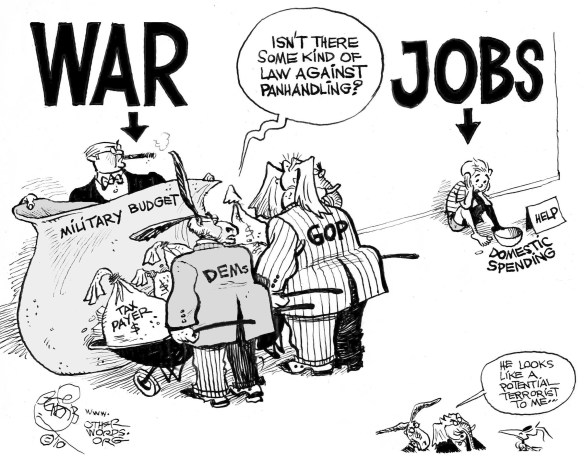
The United States has double the military budget of the combined military spending of Russia, China and G7 countries. Said military spending remains unauditable due to “widespread material internal control weaknesses, significant uncertainties, and other limitations” according to a GAO report in 2010.
So, how can a government spread its wings beyond its own borders, and demand democratic ideals elsewhere when it is not practicing the same values at home?
Movie critics are already hailing “The Post,” directed by Steven Spielberg and starring Meryl Streep as Washington Post publisher Katharine Graham. Millions of people will see the film in early winter. But the real-life political story of Graham and her newspaper is not a narrative that’s headed to the multiplexes.
“The Post” comes 20 years after Graham’s autobiography Personal History appeared and won enormous praise. Read as a memoir, the book is a poignant account of Graham’s long quest to overcome sexism, learn the newspaper business and gain self-esteem. Read as media history, however, it is deceptive.
“I don’t believe that whom I was or wasn’t friends with interfered with our reporting at any of our publications,” Graham wrote. However, Robert Parry — who was a Washington correspondent for Newsweek during the last three years of the 1980s — has shed some light on the shadows of Graham’s reassuring prose. Contrary to the claims in her book, Parry said he witnessed “self-censorship because of the coziness between Post-Newsweek executives and senior national security figures.”
Among Parry’s examples: “On one occasion in 1987, I was told that my story about the CIA funneling anti-Sandinista money through Nicaragua’s Catholic Church had been watered down because the story needed to be run past Mrs. Graham, and Henry Kissinger was her house guest that weekend. Apparently, there was fear among the top editors that the story as written might cause some consternation.” (The 1996 memoir of former CIA Director Robert Gates confirmed that Parry had the story right all along.)
Graham’s book exudes affection for Kissinger as well as Robert McNamara and other luminaries of various administrations who remained her close friends until she died in 2001. To Graham, men like McNamara and Kissinger — the main war architects for Presidents Lyndon Johnson and Richard Nixon — were wonderful human beings.
In sharp contrast, Graham devoted dozens of righteous pages to vilifying Post press operators who went on strike in 1975. She stressed the damage done to printing equipment as the walkout began and “the unforgivable acts of violence throughout the strike.” It is a profound commentary on her outlook that thuggish deeds by a few of the strikers were “unforgivable” — but men like McNamara and Kissinger were lovable after they oversaw horrendous slaughter in Southeast Asia.
Graham’s autobiography portrays union stalwarts as mostly ruffians or dupes. “Only a handful of [Newspaper Guild] members had gone out for reasons I respected,” she told readers. “One was John Hanrahan, a good reporter and a nice man who came from a longtime labor family and simply couldn’t cross a picket line. He never did come back. Living your beliefs is a rare virtue and greatly to be admired.”
But for Hanrahan (whose Republican parents actually never belonged to a union) the admiration was far from mutual. As he put it, “The Washington Post under Katharine Graham pioneered the union-busting ‘replacement worker’ strategy that Ronald Reagan subsequently used against the air-traffic controllers and that corporate America — in the Caterpillar, Bridgestone/Firestone and other strikes — used to throw thousands of workers out of their jobs in the 1980s and the ’90s.”
The Washington Post deserves credit for publishing sections of the Pentagon Papers immediately after a federal court injunction in mid-June 1971 stopped the New York Times from continuing to print excerpts from the secret document. That’s the high point of the Washington Post’s record in relation to the Vietnam War. The newspaper strongly supported the war for many years.
Yet Graham’s book avoids any semblance of introspection about the Vietnam War and the human costs of the Post’s support for it. Her book recounts that she huddled with a writer in line to take charge of the editorial page in August 1966: “We agreed that the Post ought to work its way out of the very supportive editorial position it had taken, but we couldn’t be precipitous; we had to move away gradually from where we had been.” Vast carnage resulted from such unwillingness to be “precipitous.”
Although widely touted as a feminist parable, Graham’s Pulitzer Prize-winning autobiography is notably bereft of solidarity for women without affluence or white skin. They barely seemed to exist in her range of vision; painful realities of class and racial biases were dim, faraway specks. Overall the 625-page book gives short shrift to the unrich and unfamous, whose lives are peripheral to the drama played out by the wealthy publisher’s dazzling peers. The name of Martin Luther King Jr. does not appear in her star-studded, history-drenched book.
Katharine Graham’s decision to publish the Pentagon Papers was indeed laudable, helping to expose lies that had greased the wheels of the war machinery with such horrific consequences in Vietnam. But the Washington Post was instrumental in avidly promoting the lies that made the Vietnam War possible in the first place. No amount of rave reviews or Oscar nominations for “The Post” will change that awful truth.
Norman Solomon is the coordinator of the online activist group RootsAction.org and the executive director of the Institute for Public Accuracy. He is the author of a dozen books including “War Made Easy: How Presidents and Pundits Keep Spinning Us to Death.”
As I indicated in a recent article, the B-team, or even the C-team, is now heading up the national evening news in America. These anchors’ faces and voices (Muir, Glor, and Holt) are not even faint reminders of the so-called Golden Age, when father figures like Cronkite and Reasoner fed official truth into the brains of viewers. The new C-team is vague gloss from a paint job on a used car. This is an ominous sign for the news bosses in the upstairs suites. They can’t find adequate hypnotists anymore.
What happened?
Many things—among them, the father figures left the fold. They decided to sell real estate or take corporate work in PR. They saw the handwriting on the wall: the networks were fostering a youth movement, seeking younger and prettier talent. Why? Because Madison Avenue was convinced the younger viewer demographic was the important one, in terms of consumer buying power. Therefore, on-air news faces had to be younger as well. This sounded right, but it overlooked one vital fact. The young news anchors couldn’t pull off the appropriate level of mind control. They were merely bland robots. Friendly, nice, literate to the point of being able read copy. (Lester Holt at NBC is a bit older, but he comes across as a corpse someone dug up at a cemetery for a role in a Frankenstein remake.)
There is another gross miscalculation. The commercials, between news segments, are overwhelmingly pharmaceutical. Those drugs aren’t intended for the youth demographic. They’re for the middle-aged and the seniors, who want to toxify themselves for the rest of their lives.
So the commercials are playing to the older crowd, while the faces of the news are supposedly attracting younger viewers. It’s a mess. The news execs and programmers really have no idea what they’re doing.
They’re basically hoping their game somehow lasts until they can retire.
There’s more.
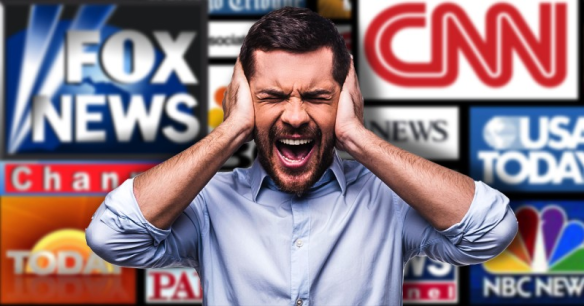
Terrified by “visionary” Ted Turner, who started CNN as a 24/7 cable news outlet in 1980, NBC decided they had to spin off their own cable news channel. This move, on its own, splintered the unitary hypnotic effect of having one anchor deliver one version of the news to one audience. Suddenly, there were several hypnotists on stage, all talking at once. It was a disaster in the making.
Then you had the various financial news channels, and FOX, and the sports channels, and the weather channel, and Bloomberg, and C-SPAN, etc. Plus all the local news outlets.
This fragmentation began to erode the programmed mind of the viewer. If, hoping to retreat to an earlier time, he sought out one face and one voice and one great father figure on ANY of these channels, he came up empty. The archetype was gone.
In a pinch, a viewer on the political right might opt for Bill O’Reilly, and a viewer on the Globalist left might choose Charlie Rose. But they’re both out of the picture now.
Enter, from stage left, the goo-goo behemoth, the CIA- connected Facebook, which, amidst building a tower of likes for infantile posts, is trying to convince its adherents that it IS the Internet and a source of tailored news that is sufficient unto the day. Unanchored news. No single voice or face.
Big media, in all its forms, has lost the mind control war.
It has lost it from inside itself.
Into the vacuum have swept the million voices of independent media. I’ve written about that revolution at length, and won’t recap it here.
Instead, consider the Youth Phenomenon. You could peg it at the Beatles’ US invasion of 1964.
Why? Because that was the moment when children began to be entertained by other children. Seriously, deeply, religiously.
Add in the drugs, and other factors, and you had the groundswell of the 1960s.
Stay young forever. Never grow up. Adults are dull dolts.
These children eventually became parents, and their children became parents…and you have the whole generation-to-generation, societal, eternal-youth package. “I want to be young. I want to be happy forever.”
How do you sell these people the news?
You put a nice face on it.
And you lose the hypnosis.
You still have all the lies and cover-ups and diversions and omissions…but the trance element at the core grows weaker over time.
Like the snowfall from a great blizzard, the aftermath shows patches of snow disappearing, piece by piece.
This is happening, and the news titans can do nothing to stop it.
It’s a long-term trend, and it’s called good news.




 After the Crash