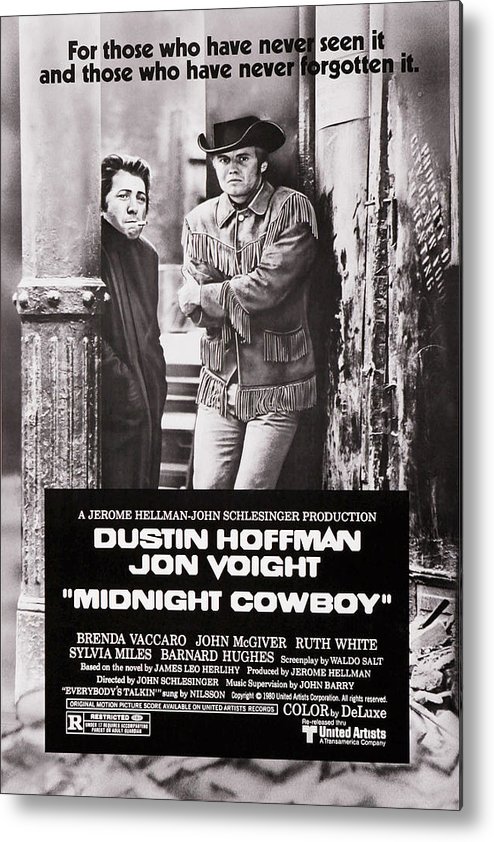
Midnight Cowboy is one of those movies that is so famous that even though this was the first time I’d ever actually watched it, I already felt familiar with it. I mean everybody knows the line, “I’m walking here!” by Dustin Hoffman. The AFI named that line the 27th greatest movie quote of all time (The movie itself is also on the AFI’s 100 greatest movies list). Most film fans also know that it is the only X-Rated film to ever win the Best Picture Oscar. Ratso Rizzo and Joe Buck are iconic cinematic characters. And yet, despite all that I’d never actually watched it until now.
Although Hoffman is top billed, Jon Voight stars as Joe Buck; a young, not very bright Texan who decides to head to New York where he thinks he’ll be able earn money as a male escort to rich New York women. Buck has a troubled past that is revealed through stream-of-consciousness flashbacks. Voight is good as the naive cowboy and his performance not only brought him to stardom, but also earned him an Oscar nomination.
As good as Voight is though, Hoffman steals the film as Enrico “Ratso” Rizzo; the streetwise, hustling New Yorker. His accent, his limp and his mannerisms form a character for the ages. His nickname is an apt one because he is very rat like as he crawls the streets of the city. Like Voight, Hoffman was also nominated for an Oscar for his role.
Together Buck and Rizzo form an unlikely friendship after a rough start when Rizzo cons Buck. As a pair they prove that the protagonists of a film don’t have to be likable for a movie to be good. You wouldn’t want to hang out with either of these two guys but at the same time you want to see what happens to them. Despite being fairly unlikable, you can empathize with their feelings of isolation, loneliness and the need to cling to another person for companionship no matter how unlikely the pairing.
The third main character in the story is New York City, but not the Disneyfied New York of today. This was a time when Times Square wasn’t a place you took the family to see. It was filled with adult theaters and male and female prostitutes on the prowl. Abandoned buildings had yet to be torn down and replaced by Condos, McDonalds and Baby Gaps. Director Schlesinger does a great job of capturing the gritty essence of that bygone city.
While the central characters are interesting and the acting is superb, the plot isn’t a cohesive whole. A series of events happen that aren’t always connected rather than a true story being told. The real story of the movie is the friendship between Joe and Ratso, but too often that is obscured by different episodes. It’s a platonic love story between two men essentially.
The fact that this movie was rated X at one time now seems quite quaint. The nudity is incredibly brief and the language is mild. Sex is talked about a great deal but only shown in a way that you could now practically get away with showing on network television. I imagine the biggest reason for the X might have been the scene when Joe gets a blow job from a strange man in a Times Square theater, although nothing is really shown of it. It has since been re-rated and now stands at the more sensible R rating.
Not every classic film lives up to its fame and I’m not sure as a whole if I’d say Midnight Cowboy does. Pieces of it though are brilliant, especially the performances of its two leads. They are the real reason this movie is remembered so well and they are the reason to watch it again or for the first time.
Brutal, sad, funny, and disarmingly sweet-natured, “Riders of Justice” is not so much a revenge movie as a movie about revenge. That might seem like a distinction without a difference until you get to the end of this surprising feature from writer/director Anders Thomas Jensen (“After the Wedding,” “Red Road,” “The Salvation“) and look back on every place that it has taken you.
The story starts a few days before Christmas in Estonia. A girl walking along a holiday-decorated street with her grandfather spots a red bicycle offered for sale by a street vendor but asks for a blue one instead. The vendor is part of a crime ring and calls an associate, who steals a blue bike belonging to Mathilde (Andrea Heick Gadeberg), which causes Mathilde’s mother Emma (Anne Birgitte Lind) to have to pick her up at the train station, only to have their car fail to start, which causes them to take a commuter train home. A statistics and probability expert named Otto (Nikolaj Lie Kaas) gives the girl’s mother his seat, and shortly after that, a freight train smashes into the commuter train and several passengers are killed, including Mathilde’s mother and a tattooed, bald, scowling fellow who was supposed to testify against a fearsome gang, Riders of Justice. Otto saw another man get off the train before the crash, oddly dropping a full beverage and a nearly uneaten sandwich in the trash on his way out, and becomes convinced that the crash was an assassination and the other victims were collateral damage. As it happens, Mathilde’s father is a stony-faced soldier named Markus (Mads Mikkelsen, a frequent leading man for the writer/director).
If this were almost any other movie, you’d be able to write the rest of this review yourself. But you soon figure out that this is not the sort of film that sets up the standard elements and switches to autopilot. For one thing, Jensen makes Otto not merely the messenger who sets the tale in motion and then disappears, but a crucial second lead, and part of a trio filled out by a fellow probability expert named Lennart (Lars Brygmann), whose secret manias and aversions are a constant source of plot complications; and a tightly wound, emotional computer hacker named Emmenthaler (Nicolas Bro). All three characters are written and performed with such skill that they form a comedy trio: a motor-mouthed intellectual answer to the Three Stooges. Like Mathilde, Markus, and everyone else who passes in front of Jensen’s viewfinder, Otto, Lennart and Emmenthaler are given endearing backstories that feed into the script’s fascination with fate, chance, justice, karma, and other subjects rarely discussed in films where the hero is a scary bald dude who can snap a man’s neck like a shingle.
“All events are products of a series of preceding events,” Otto tells an assembled panel of corporate clients who reject an algorithm he and Lennart are trying to sell them. “Because we often have insufficient data, we categorize events as coincidences.” His statement echoes through later scenes, including the church service where Mathilde’s mother and Markus’s wife is laid to rest. “When miracles happen,” the priest says, “we often attribute a divine character to them. However, when lightning strikes, when tragedy becomes reality, we have a hard time assigning a return address, and thus we refer to it as coincidence.” Once the stooges enter Markus’ life, bloodshed follows, but not in a lockstep, predictable way, thanks to the pinball-machine collisions of all the strong personalities involved (particularly Markus’s; he’s both hot-tempered and lethal, not an ideal combination).
The big question here is whether the train crash was a premeditated crime or the culmination of a series of things that quite simply happened. A large part of the charm of “Riders of Justice” (what an ironic title, in retrospect!) comes from the way that it keeps us guessing as to what side of the equation, so to speak, it’ll come down on, or whether it’ll take a position at all. What are we to make, for instance, of a seemingly precise calculation by Otto that the odds of that crash with that outcome were 234,287,121 to one? Or, for that matter, the movie’s wry awareness that no matter how bad things get, they could always be worse? “Only thing is, after all this crap, it’s unlikely more is going to happen,” Mathilde tells Otto. “That’s not how things work,” Otto replies. “A lot of awful things can happen in your life.”
Plots like the one that drive “Riders of Justice” tend to appear in crash-and-burn action thrillers wherein a curtain-raising death or atrocity is there to give the hero (or heroes) a pretext to embark on a spectacular and largely guilt-free rampage, stacking up bodies like firewood. Jensen and his cast and crew go in a different direction, creating a cast of main characters (and several colorful minor characters) with complex, contradictory psychologies that are unveiled a layer at a time, each revelation informing our understanding of what they did in a prior scene, or what they may be capable of later on. It’s hard to imagine the improvisatory, digressive, character-focused filmmaker Mike Leigh (“Secrets and Lies“) making a revenge thriller, but if he did, it might look like this. Sometimes the tangents are so out-of-nowhere, and are developed in such detail, that you and the characters sorta forget about the vengeance thing, which is the entire point.
This is a film that teaches you how to watch it. Once you’ve gotten acclimated, you understand that when a major character makes a decision that seems massively stupid—or simply counter to their self-interest—it’s always rooted in a traumatic past incident or secret, and they had no conscious control over it: it was something that had to happen, thanks to how they’re wired. Mikkelsen, the most still and reactive performer, seems a granite-faced question mark until you spend a bit of time with his character and understand the origins of his stoicism as well as his eruptions of fury. Unexpected connection points are made between him and the stooges and, more pointedly, between Mathilde and Emmenthaler, who are both sensitive about their weight; and Mathilde, Otto and Markus, who have a specific type of loss in common, and fill voids in each other’s lives.
Any of these characters could’ve been the main character in his or her own project, so attentive is the screenplay to the nuances of personality. Emmenthaler, especially, is one of the great secondary characters in action thrillers, up there with Al Powell from the original “Die Hard“—a sensitive man who sheds an angry tear when a friend makes fun of his weight, and has clearly been carrying around an unexploded bomb of suppressed rage throughout his life. He’s the first of the stooges to ask for weapons training.
But even that thread doesn’t go the way you anticipate, because this is a genre picture in which story is driven by characterization rather than the other way around. Not only are there no easy answers, the film goes out of its way to make you think it’s going to tie something off neatly, only to confound you by asking, “What would happen if these characters actually existed?” and doing that instead.
“Did a therapist write this?” is not a sentence once expects to see in one’s notes on a movie where Mads Mikkelsen guns men down with an assault rifle. But it’s consistent with the apparent mission statement of this odd, beguiling film, which is filled with philosophical, theological, moral, and ethical notions (and takes care to distinguish between them) and that weaves images of churches and snippets of religious chorales throughout its running time, as if to remind us of the Christian ideals of grace, healing, and redemption that, for many characters, remain just out of reach. The movie’s contextual scaffolding is constructed with such care that when a character insists that chess is the only game ever invented where luck isn’t a factor, your instinct is to think, “Is that true?” It is, and it isn’t. The closest Jensen gets to summing everything up is Mathilde’s statement that life “is just easier when there’s someone you can get mad at.”
What are we left with? In the best of all possible worlds, a line from Otto, offered when the gang is en route to a bloody showdown: “Let’s get this over with as a team so we can go home and eat banana cake.”
Who would have thought that Jacques Audiard, the French director of slow-burn, humanistic character studies would one day take on one of the most characteristically American of genres, the Western, with his English-language debut? While worlds apart from his socially realist “Dheepan” and “Rust and Bone,” Audiard’s “The Sisters Brothers” sports a similarly closely watched, leaned in sensitivity with its brotherly story. Adapted from Patrick deWitt’s 2011 novel (by Audiard and Thomas Bidegain) and infused with sweetness, graphic body horror (that, at times, spins a childlike icky humor) and a high body count, this alcohol-soaked Frontier road trip constantly reinvents itself at every turn in fun, witty and ultimately touching ways. Call it a revisionist or an absurdist Western if you will, but Audiard’s film feels both refreshingly new (without ever going to the extreme lengths the Zellner Brothers did with “Damsel”) and nostalgically familiar.
The backdrop is the Gold Rush, which is said to have made a Sherriff’s job much easier: if there’s trouble, you follow the gold to get to the source of the unrest. But when we meet the central brothers Eli (John C. Reilly, goofy, soulful and great at physical comedy as ever) and Charlie (Joaquin Phoenix, quietly enigmatic) one random dark night at the start of the film, there doesn’t seem to be any wealth to be pursued. With the playful last name “Sisters,” the pair of cold-blooded hit-men, without much thought about the consequences of their actions, murder a household of people in a tightly orchestrated set piece of nocturnal shootouts. The reason remains unknown—with this job and everything else, the ruthless duo answers to a much feared, mostly unseen mysterious crime boss called ‘The Commodore’ and habitually assassinates their way through the 1850s Oregon. Along the way, they bond and trivially bicker about life as casually as they kill.
But just when the soft-edged Eli starts contemplating his future and ongoing profession despite the unaffected heavy drinker Charlie’s shrugs, The Commodore sets them up for a new task. They will tail and kill a criminal called Hermann Kemit Warm (Riz Ahmed, cheekily mysterious) for reasons we would slowly piece together later—for now, he is just a thieving enemy who once betrayed their boss. Enter Morris (Jake Gyllenhaal, reuniting with Ahmed after “Nightcrawler”), a British-accented bounty hunter for hire, tasked with delivering Warm to the brothers. But then the prospect of immediate wealth turns tables for everyone involved—the brainy chemist Warm’s creamy invention that makes gold glaringly appear in water, redefines priorities at once. The two pairs, traced on parallel storylines for a while (that admittedly slows down the film’s previously absorbing rhythm), find themselves entangled in a ploy against each other. Along the way, local madams, kindly prostitutes, further the accidentally amusing events and some dead horses unfortunately enter the story, sharpening the film’s tone as an original yet studied homage to its genre.
A delightful tale of familial ties balanced well with a slick cat-and-mouse yarn, “The Sisters Brothers” owes much of its breezy charm to John C. Reilly, whose comic timing does wonders for the meatiest and most multifaceted character of the ensemble. Phoenix feels right at home in Charlie’s quieter shoes, while Gyllenhaal’s familiarly on-edge persona and a mischievous turn from Ahmed impress. Reilly and Phoenix demonstrate tremendous chemistry throughout—we buy both their longtime amity and occasional callousness, especially when the script drip-feeds the brothers’ back-story into the narrative. In this bittersweet tale with a sentimental heart, and among a dangerous milieu of blood, greed and spiders (one in particular that causes the film’s biggest gross-out moment), Audiard’s characteristically sensitive touch gradually lifts familial emotions, letting them linger in the air long after the credits roll.
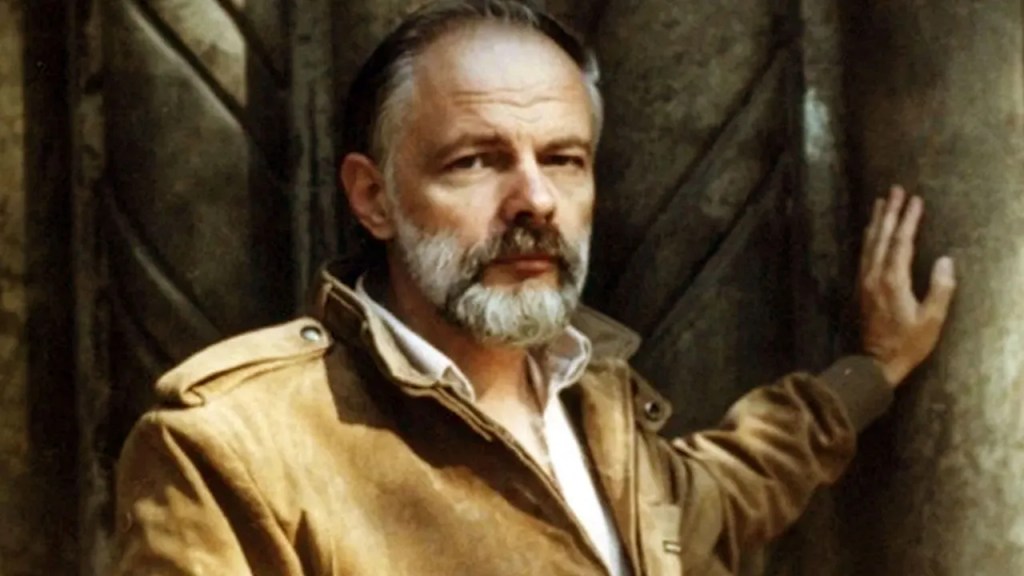
Philip K. Dick, whose novel Do Androids Dream of Electric Sheep? inspired the film Blade Runner, did not live to enjoy his Hollywood success. He died on March 2, 1982, three months before the film was released.
In the years since, the novelist once dismissed as a gutter pulp sci-fi weirdo has steadily climbed the ladder of posthumous literary reputation. The case for Dick’s genius has never rested on his dystopian vision of technology, which he shared in common with masters like HG Wells and Stanislaw Lem, and with hundreds of sci-fi writers since. Good science fiction — as opposed to fantasy novels set on other planets — is defined by a quasi-philosophical examination of interactions between men and machines and other products of modern science. It is part novel and part thought-experiment, centered on our idea of the human.
What made Dick a literary genius, then, was not any special talent for predicting hand-held personal devices or atom bombs the size of a shoe which might have led him to a job in Apple’s marketing department. His gift was for what might be called predictive psychology — how the altered worlds he imagined, whether futuristic or merely divergent from existing historical continuums, would feel to the people who inhabited them. Dick’s answer was, very often: “Not good.”
Dick’s dystopian-psychological approach marks him less as a conventional science fiction writer than as a member of the California anti-utopian school of the Sixties, whose best-known members include Robert Stone, Thomas Pynchon, Ken Kesey, Joan Didion and Hunter Thompson. Seen from this angle, Dick was perhaps the most powerfully and sweepingly paranoid of a group of writers whose stock-in-trade was conspiracy and paranoia, the hallmarks of a society marked — at that moment, and this one — by violent street crime, drug-induced psychosis, and visionary promises gone terribly wrong. Of his anti-utopian peers, Dick’s sci-fi genre background made him the only one who had any particular feel for the proposition that technology was inseparable from, and would therefore inevitably alter, our idea of the human.
Technology was and is perhaps the most Californian aspect of the American mythos. The idea that the universal constants of human nature were at war with the mutilating demands of technology-driven systems was a very Sixties Californian conceit, to which Dick’s fellow anti-utopians each adhered in their own way: In Kesey’s showdown between man and the castrating nanny-state; in Didion’s emphasis on the vanishing virtue of self-reliance; in Pynchon’s degenerate Ivy League Puritanism; in Thompson’s drug-addled primitivism; and in Stone’s Catholic idea of devotion to a God that might somehow salve the wounds of the survivors once the great American adventure goes bust.
What Dick saw, and what his fellow anti-utopians did not, was that human psychology and technology are not separate actors, and that whatever emerged from the other side of the future would be different to the human thing that entered it.
* * *
Seeing and describing how large numbers of people will perceive reality before anyone else does requires imagining states of consciousness that, in the moment, seem deeply strange. It is no accident that the greatest of works of speculative psychology were written by revolutionaries whose outlook was often bleak to the point of despair. The negative tone of these works often led future generations to describe their authors as conservatives, though artistically and psychologically speaking, they are radicals. Or rather, in their rejection of the dominant order, they are radicals and reactionaries at the same time.
The anti-utopian tradition emerged in earnest in 19th-century Russia. The Russian pioneers of the genre were superior to their rivals in England and elsewhere because the latter’s visions were constrained by attachments to a settled society, which one can argue never really existed in Russia — and because the ideas of revolution and violent reaction have always been so closely allied in the Russian psyche. Fyodor’s Dostoyevsky’s Notes From Underground struck many of its initial readers as a kind of artless mental vomit, before revealing itself as a Rosetta Stone for the century of Adolf Hitler and Lee Harvey Oswald. Yevgeny Zamyatin’s We is probably the greatest of at least a dozen weirdly prophetic novels written in the years immediately after the Bolshevik Revolution. In We, Zamyatin predicted what a surveillance society run by engineers would feel like to its inhabitants with a nauseating accuracy that did not become fully apparent until the rise of the modern tech surveillance complex.
The Dick novel that directly predicted our information-addicted, socially-networked 21st-century society, A Scanner Darkly, was both a prophecy of future psychological states and a half-veiled memoir of Dick’s own experiences in the California drug culture. Published in 1977, the book was a detective noir set in a druggy future in which large portions of the population appear to spend their lives scheming and snitching on each other to feed their addictions to a drug called Substance D — the “D” standing for Death, of course.
A Scanner Darkly, a reference to the line in Corinthians in which men at first see God “as in a glass, darkly”, is Dick’s rawest book and the one that reads least like science fiction. The book’s protagonist is simultaneously a narcotics agent known to his peers as Fred and a Substance D addict named Bob Arctor. Fred/Arctor lives in a house — his former marital abode — with two fellow addicts, and is in love with another addict named Donna, who comes to visit him there. Donna helps Arctor obtain Substance D, which he consumes, while Fred uses Donna to attempt to climb higher on the drug distribution ladder. At the end of the novel, Donna turns out to be a drug agent, who is spying on Bob Arctor.
What’s so striking about the book is not Dick’s heartfelt, if futuristically bent, portrayal of the evils of Sixties drug culture. For that, read Stone, who was a master of connecting the physical, mental and moral corruption of drug dealing and dependency, and the fantasies those pursuits inevitably engender to the deeper corruption of man’s nature.
What Dick uniquely captured was something else: The degenerative effects of the split-screen existence of a human brain ceaselessly spying on and doubting and implicating itself while at the same time being spied on by others, all of whom are embedded within machine systems that record everything for reasons that humans cannot understand. Over the course of this machine-and-chemical fed process of human self-contradiction and self-destruction, of which Fred/Arctor is only intermittently aware, we see his thoughts and perceptions being short-circuited and reduced to gibberish.
Drug-induced paranoia aside, the psychology of Dick’s addicts and narcs is as good a description as exists of the spreading incoherence of today’s information ecosystem, which none of us are able to fully see or understand. As a thought experiment, it doesn’t matter that Dick chose a drug rather than the stories we tell about ourselves and our world. It’s not the technology; it’s the psychology. What Dick saw was that the process of splitting ourselves in two — into subject and narc — was a brutal assault on the idea of being human and would make thoughts and communication impossible.
“What does a scanner see?” Arctor wonders, after examining the surveillance apparatus that has been planted, with his knowledge, in his own home. “I mean, really see? Into the head? Down into the heart? Does a passive infra-red holographic scanner like they used to use, or a cube-type holo-scanner like they use these days, the latest thing, see into me – into us – clearly or darkly? I hope it does, see clearly,” Arctor continues, “because I can’t any longer these days see into myself. I see only murk. Murk outside; murk inside. I hope, for everyone’s sake, the scanners do better.” They don’t.
* * *
Jeremy Bentham’s panopticon, which the English philosopher sketched out in a series of letters between 1786 and 1788 while visiting the Mogilev district of the Russian Empire, was an architectural system of control in which all inmates of an institution could be made visible to a single guard. Bentham’s utopian-utilitarian idea was widely applied in Victorian England to a range of public and private spaces including prisons, asylums, hospitals, factories and even schools. The unique horror of the Benthamite set-up was not the power imbalance inherent in places like prisons and factories, whose existence is obvious to guards and prisoners alike. It was the attempt to eliminate privacy, which is a necessary precondition for being human.
Over the last decade, Bentham’s architecture of unfreedom has been replaced by the architecture of machines. This has created a new social reality where everyone is at once inmate and guard; a panopticon where nothing is private and no one is free. The invisible operations of the machines and programmes we use every day to buy books or food or communicate, which are linked to each other and to the surveillance operations of large government agencies in a single net, induces in most sentient beings a kind of free-floating paranoia of the type that destroys the inhabitants of AScanner Darkly. On the one hand, everyone knows that everyone is being watched. On the other, it is necessary to deny that knowledge in order to appear to be functioning normally.
One of the most unpleasant characteristics of the weird split-screen mentality of our times is how people must routinely speak against themselves — deny what they see, hear, feel and believe — in order to maintain the appearance of sanity. It is now routine, for example, to hear Americans on the Left and the Right deride their political opponents for believing in far-reaching conspiracy theories — while in the next breath revealing their own.
No doubt both sides are at least half right. During lockdowns, it became normal for public officials in Western countries to issue draconian edicts in the name of “science” for the supposed good of large numbers of people, only to violate those edicts themselves. The meaning of “science”, it turned out, had nothing to do with the “common good”, or with demonstrating a theory through evidence; it was “one rule for me and another for thee”.
The flagrant doublespeak that is nurtured in the surveillance societies of the West, which have sprung up around us unnoticed, is characteristic of totalitarian societies and mental asylums. The difference is that both totalitarian societies and asylums allow for nonthreatening zones of privacy in order to make life easier for the guards. What we live in today is something else, a set of mirrors into which we are encouraged to look so that our reflections can be distorted and then returned to us. As Bob Arctor puts it, reflecting on the words of Corinthians: “it is not through glass but reflected back by a glass. And that reflection that returns to you: it is you, it is your face, but it isn’t.”
Powerful people in Western societies have lately become convinced of their ability to accomplish great feats of moral and social engineering by controlling these mirrors, altering our reflections and selling them back to us, while undermining our ability to think coherently. The mirrors are not meant to help anyone think; they are systems of control. They are mechanisms of profit, which foster dependence. They are used to mete out punishment, and spy on us.
What’s alarming is that the people who delight in their mastery of these devices seem not to have thought very hard about the damage they are doing to the people who shoot up, a category that includes those who shoot up schools and malls. None of them seem to calculate what creating a miasma of nonsensical conspiracy theories will do to the psyches of their own children, who will inherit “the murk”. They appear to believe that people with minds that have been permanently broken by their gibberish machines will make the perfect workers on their farm. Let’s see how that turns out for them.



 After the Crash