Saturday Matinee: Yojimbo

A fistful of samurai

By Roger Ebert

Source: RogerEbert.com

Almost the first thing the samurai sees when he arrives is a dog trotting down the main street with a human hand in its mouth. The town seems deserted until a nervous little busybody darts out and offers to act as an employment service: He’ll get the samurai a job as a yojimbo — a bodyguard. The samurai, a large, dusty man with indifference bordering on insolence, listens and does not commit. He wants sake and something to eat.

So opens “Yojimbo” (1961), Akira Kurosawa’s most popular film in Japan. He was deliberately combining the samurai story with the Western, so that the wind-swept main street could be in any frontier town, the samurai (Toshiro Mifune) could be a gunslinger, and the local characters could have been lifted from John Ford’s gallery of supporting actors.

Ironic, that having borrowed from the Western, Kurosawa inspired one: Sergio Leone’s “A Fistful of Dollars” (1964), with Clint Eastwood, is so similar to “Yojimbo” that homage shades into plagiarism. Even Eastwood’s Man With No Name is inspired, perhaps, by the samurai in “Yojimbo.” Asked his name, the samurai looks out the window, sees a mulberry field, and replies, “Kuwabatake Sanjuro,” which means “30-year-old mulberry field.” He is 30, and that is a way of saying he has no name.

He also has no job. The opening titles inform us that in 1860, after the collapse of the Tokugawa Dynasty, samurai were left unemployed and wandered the countryside in search of work. We see Sanjuro at a crossroads, throwing a stick into the air and walking in the direction it points. That brings him to the town, to possible employment, and to a situation that differs from Hollywood convention in that the bad guys are not attacking the good guys because there are no good guys: “There is,” the critic Donald Richie observes, “almost no one in the whole town who for any conceivable reason is worth saving.” It’s said Kurosawa’s inspiration was Dashiell Hammett’s novel Red Harvest, in which a private eye sets one gang against another.

Sanjuro’s strategy is to create great interest about himself while keeping his motives obscure. He needs money and so presumably must hire himself out as a bodyguard to one of the two warring factions. There is the silk dealer and the sake merchant, both with private armies, who occupy headquarters at either end of the town. In between, the townspeople cower behind closed shutters and locked doors, and the film’s visuals alternate between the emptiness of the windswept street, shots looking out through the slats of shutters and the chinks in walls, and shots from outdoors showing people peering through their shutters.

Richie, whose writings on Kurosawa are invaluable, notes that Kurosawa’s shots are always at right angles to what they show; they either look straight up and down the street, or straight into or out of the buildings, and “there are very few diagonal shots.” The purpose may be to emphasize the simplicity of the local situation: Two armies face each other, the locals observe the main street as if it’s a stage, and the samurai himself embodies the diagonal — the visitor who stands at an angle to everyone and upsets the balance of power. Indeed, in a crucial early scene, as the two sides face each other nervously from either end of the street and dart forward fearfully in gestures of attack, Sanjuro sits high above the action in the central bell tower, looks down and is vastly amused.

His strategy is to hire himself out as a yojimbo to first one side and then the other, and do no actual bodyguarding at all. His amorality is so complete that we are a little startled when he performs a good deed. A farmer and his wife, possibly the only two good people in the town, are kidnapped. Sanjuro, employed by the side that kidnapped them, kills their six guards, frees them, tears up a house to make it look like there was a fierce struggle, and blames it on the other side. Disloyal to his employer? Yes, but early in the film, he is offered 50 ryo by one of the leaders, only to overhear the man’s wife telling him, “We’d save the whole 50 ryo if we killed him after he wins.”

Sanjuro’s strategy is an elaborate chess game in which he is playing for neither side but plans instead to upset the board. “In this town, I’ll get paid for killing,” he muses, “and this town would be better off if they were dead.” His planning is upset by the unexpected appearance of Unosuke (Tatsuya Nakadai), the younger brother of one of the sake dealer’s bodyguards. The samurai often walk about with their empty sleeves flapping at the sides, their arms folded inside their kimonos. (Eastwood, in the Leone movies, always keeps one hand under his poncho.) When Unosuke finally reveals one of his hands, it holds a pistol — the first one seen in the village. This upsets the balance of power and tilts against Sanjuro’s plans, which depend on his skill as a swordsman who can kill any number of the others without being wounded himself.

The gun provides Unosuke with a sneaky kind of self-confidence, and he produces the weapon gloatingly from time to time. Occasionally, he kills people in cold blood, just to prove that he can, in events leading up to a final bloodbath. One of the first people Sanjuro meets in the town is the coffin-maker, and there is a nice moment when he first goes out to do battle and advises him, “Two coffins. Noon, maybe three.” By the end there is no business for the coffin-maker, because there is no one to pay for coffins.

That kind of dark humor is balanced in the film by other moments approaching slapstick, as when the injured Sanjuro is smuggled away in a large barrel; when his bearers pause in the middle of the street, the samurai tilts up the lid of the barrel to provide a droll commentary on the progress of the manhunt for him.

Richie believes “Yojimbo” is the best-photographed of Kurosawa’s films (by Kazuo Miyagawa, who also shot “Rashomon” and such other Japanese classics as Ozu’s “Floating Weeds” and Mizoguchi’s “Ugetsu“). The wide screen is fully employed for dramatic compositions, as when the armies face each other across an empty space. And there is a dramatic sense of depth in scenes were Sanjuro holds the foreground while forces gather in the background. Shutters, sliding doors and foreground objects bring events into view and then obscure them, and we get a sense of the town as a collection of fearful eyes granted an uncertain view of certain danger.

“Yojimbo” was followed quickly by Kurosawa’s “Sanjuro” (1962), which also stars Mifune, the greatest modern Japanese actor, playing the same character or one so similar as makes no difference. He acts as the adviser for nine uncannily similar brothers who are remarkably inept samurai. The choreography in “Sanjuro” is one of its best jokes; the brothers do everything together: Nod, recoil, agree, laugh, gasp, and they follow Sanjuro in a kind of conga line, until he snaps, “We can’t move around like a centipede.”

The difference between the two films is that “Sanjuro” is a comedy in which ancient samurai traditions are exposed as ludicrous by the pragmatic hero, while “Yojimbo” is more subversive: The samurai were famed for their unyielding loyalty to their employers, but Sanjuro, finding himself unemployed because of the collapse of the feudal system, becomes a modern man and is able to manipulate both sides because they persist in thinking he will be faithful to those who pay him.

There is a moment at the end when old and new hang in the balance. The wounded Sanjuro no longer has his sword, but we have seen him practicing with a knife — skewering a bit of paper as it flutters around a room. He faces Unosuke, the gunman. Without revealing precisely what happens between them, let me ask you to consider the moment when Unosuke aims his pistol at Sanjuro. It may be loaded, it may not be. Sanjuro cannot be absolutely sure. He is free to move away or to disarm Unosuke, but instead he sits perfectly motionless, prepared to accept whatever comes. This, it strikes me, is the act of a samurai aware that his time has passed and accepting with perfect equanimity whatever the new age has to offer.

If You’ve Just Started Paying Attention To US Foreign Policy

There are always, ALWAYS lies, obfuscations and manipulations involved in marketing a new war to the public, or in hiding its involvement in foreign wars from public attention.

By Caitlin Johnstone

Source: CaitlinJohnstone.com.au

If you’re among those who have only just begun paying attention to US foreign policy and western media bias in light of Israel’s destruction of Gaza and Biden’s act of war against Yemen, it’s important to understand that none of the depravity you’re seeing is new. The lies. The insane double standards. The murderousness. The western political/media class always does this.

Every war the US involves itself in is always facilitated by lies promulgated in one voice by the official government in Washington and by the “independent” “free” press (actually propaganda services) of the western world. They deceived the world about Ukraine. They deceived the world about Yemen. They deceived the world about Syria, Libya and Iraq. There are always, always lies, obfuscations and manipulations involved in marketing a new war to the public, or in hiding its involvement in foreign wars from public attention.

All of this manipulation and deceit is necessary to hide the fact that the US-centralized empire is the most tyrannical power structure on this planet. And make no mistake, it is an empire. Washington serves as the hub of an undeclared empire comprised of alliances, partnerships, assets, public deals and secret agreements which knit a large number of nations together into what functions as a single power structure with regard to international affairs.

Most of the beneficiaries of this power structure reside in the west, or global north, while the most exploited and abused victims of this power structure tend to reside in the east, or global south. There are all sorts of rules and regulations and narratives and justifications for why this all happens the way it happens, but if you mentally “mute” the soundtrack on the verbal overlay and just look at what’s actually happening, what you will see is the lion’s share of the world’s wealth and resources moving northward and westward from populations of a darker average skin tone toward populations of a paler average skin tone. Wherever that movement is hindered, diverted, threatened or inconvenienced, you will see western war machinery moving southward and eastward to get it back on the desired track.

Most major international conflicts can be understood as either direct or indirect efforts by the US empire to shore up planetary domination, which are often met with resistance by populations who wish to retain their sovereignty. Much of this conflict happens in the middle east because that’s where the world gets a lot of its oil from, with US-aligned nations like Israel and Saudi Arabia frequently serving as the frontline for hostilities with non-US-aligned nations like Iran and Syria as well as non-US-aligned forces like Hezbollah, Ansarallah and Hamas.

This struggle for US planetary hegemony is disguised by the western political/media class as something other than what it is, because you can’t allow the public in a democratic nation to understand clearly that their government is on the side of evil. They’ll frame it as a US-led international coalition to liberate a nation from a tyrannical dictator. As a humanitarian intervention to protect human rights. As support for Israel’s right to defend itself. As protection of freedom of navigation in the Red Sea. But what’s actually happening is the world’s most powerful and murderous power structure killing human beings in western Asia in order to secure control over a crucial resource.

You see this all over the world against nations which refuse to allow themselves to be absorbed into the US-centralized power structure like North Korea, Venezuela and Cuba, with China being by far the strongest of these and Russia a distant second. And you will notice that you have heard every nation I just mentioned cast in a very negative light by the western press over the years. This is not a coincidence. 

You don’t need to believe anything I’m saying on faith. If you just keep in mind what I said and start watching the patterns for yourself while seeking out the truth day by day, you will see it for yourself. You will see the same patterns emerging over and over again, year after year. Over and over again you will see the US and the states that are aligned with it acting with extreme aggression toward non-US-aligned powers in ways that benefit the US-centralized power structure, and you will see the western press deceiving the world about what’s happening. The next Official Bad Guy you see dominating western press coverage on international affairs will be a non-US-aligned power, and if you apply diligent research and critical thinking you will find that they are not presenting an accurate picture of what’s happening.

Just keep learning and studying the patterns with open curiosity and self-honesty, and the picture will inevitably become clear to you. And then you will clearly see who’s really driving the bulk of the violence and disorder in our world.

Saturday Matinee: A Life on the Farm

A LIFE ON THE FARM Review: Making Movies

By Ernesto Zelaya Miñano

Source: Screen Anarchy

“Charles Carson. Coombe End Farm.”

This story begins with a videotape. Director Oscar Harding finds an old tape he never got to watch in its entirety as a kid. Said video was titled “Life On The Farm”, a feature-length home movie made by Charles Carson, an elderly neighbor of his grandparents’. When looking into how this salt-of-the-earth, unassuming farmer managed to make a movie, Harding uncovers a great story. A Life On The Farm is the result.

At first, the contents of said tape –  a grainy home movie with bad tracking and all those other bugs that make one nostalgic for the VHS era – prove disturbing. Clad in a plaid red shirt and cowboy hat, Charles Carson takes Harding and his viewers on a tour of his laidback country life in Somerset, England, spending days looking after his animals, tending to the land, showing cows giving birth in graphic detail, talking incessantly to his dead cat and ultimately, taking the corpse of his deceased mother around the farm and posing her for pictures with the animals. It’s no wonder that one talking head compares him to Ed Gein, and you’ll probably be thinking of Norman Bates and his unhealthy attachment to Norma more than once.

But just as you expect Harding’s prized discovery to escalate into a full-blown snuff film or something similar, the director does a total bait-and-switch while digging into Charles Carson’s background, and discovers a simple, well-meaning guy who turned to filmmaking due to loneliness; meanwhile, all his interviewees go from laughing and pointing to sincerely admiring the man.

Carson’s story was pretty tragic; having lived nearly all his life on a remote farm, he lost both his parents, a brother, and his wife, who also did not live with him and only visited occasionally. Left alone in the company of cows, cats and other assorted animals, Carson turned to an old video camera and a photography hobby to have a link to the outside world, and one assumes to keep himself sane.

While he first regaled his neighbors with pictures of himself on his land along with funny captions, they soon started receiving what would be his legacy, “Life On The Farm”. Sadly, Carson passed away in the mid 00’s, alone and mostly forgotten. That is, until Harding and an entire community of found footage and vintage VHS enthusiasts got a hold of his film.

Harding’s doc goes from a budding backwoods horror picture to an uplifting story of an unlikely DIY guerrilla filmmaker whose unconventional work is being rediscovered. Carson’s VHS tape also highlights the love many film fans have for physical media, which is largely disappearing in this new era of streaming platforms; bizarre little gems like Carson’s magnum opus can disappear into the ether (though this one is uploaded to YouTube, so at least it’s safe for the time being), and this film is a rallying cry for their continued survival.

Even though it starts to lay the schmaltz on a bit thick, A Life On The Farm ends up as a portrait of a one-of-a-kind artist who’s finally getting his due, whose work for many will be nothing more than a passing curiosity, but who managed to make his mark. Movies are that one special thing that can bring people together, and for Carson, they’re what brought him to the rest of the world.

____________________

Watch A Life On The Farm on Kanopy here: https://www.kanopy.com/en/product/14052224

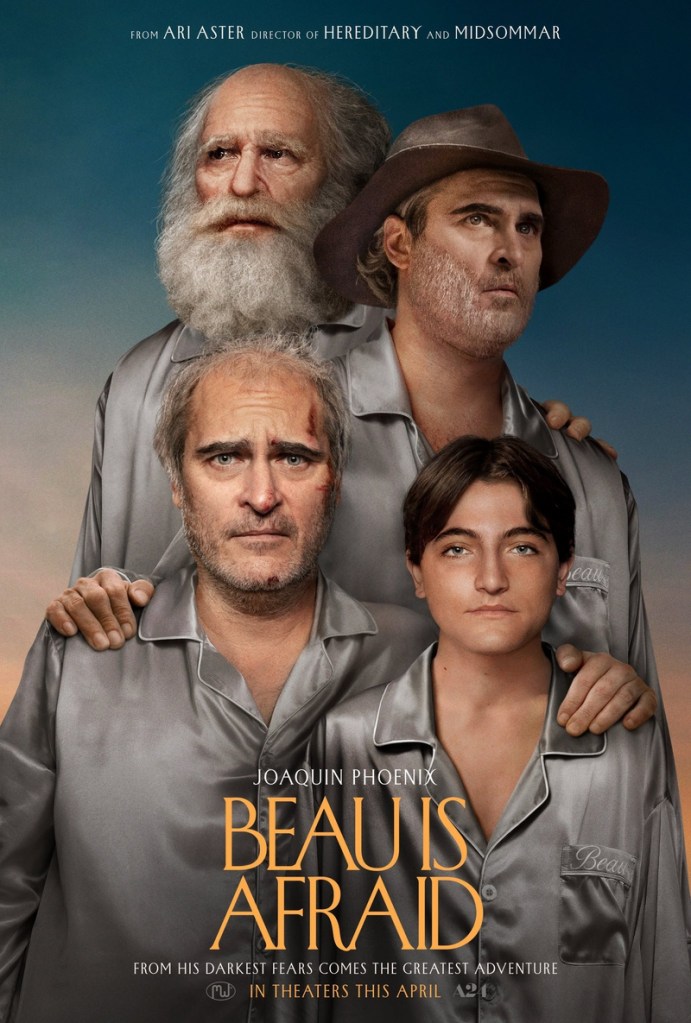
Saturday Matinee: Beau is Afraid

Beau Is Afraid (Film Review): A Baffling Nightmare

By Joseph Tomastik

Source: Loud and Clear

Beau is Afraid. And I’m afraid of what’s in Ari Aster’s head after watching his latest film. The director of Hereditary and Midsommar is back with Beau is Afraid, a baffling three-hour effort to make his other films look easily accessible in comparison. I love Hereditary and consider it one of the best horror films of the 2010s. I like Midsommar purely for the sensory experience of watching it, but its bare-bones, overblown story stops me from calling it good. Beau Is Afraid takes those strengths and weaknesses of Midsommar and cranks them up to eleven. And, fittingly enough, my feelings on that film are repeated twofold with this one.

Beau (Joaquin Phoenix) is an anxious man who lives in a broken-down apartment in a corrupt, violent city. He’s set to go on a trip to visit his overbearing mother (Patti LuPone), but shocking news and unfortunate events derail his trip, forcing him to cross paths with a variety of bizarre characters and surreal events. That’s as much of the plot as I’ll be revealing. Not just to avoid spoiling any surprises, but also because that’s about all I feel I’m even capable of saying. Outside of Beau being tended to along his way by a seemingly caring couple (Amy Ryan and Nathan Lane), the events of Beau is Afraid are increasingly difficult to properly wrap one’s head around.

Beau is Afraid is the kind of film that I’ve become more open to over the years. I once had the impulse to dislike any film that I didn’t instantly understand, but now I can appreciate the experience of such a baffling film if I find myself sucked into the craft, performances, visuals, or overall feel. Beau is Afraid is an unshakable 10/10 in all of those aspects. This is Aster’s most skillfully shot, visually haunting film to date. He has such an insanely perfect grasp on his directorial style that I struggle to comprehend how any human being could bring some of this film’s beauty to reality. That sounds hyperbolic, but I really was that mesmerized by what was accomplished here.

There’s so much detail in almost every single shot that you could blink and potentially miss a jarring detail. This is not only impressive, but it guarantees that no matter where or when you look, some form of misery is happening. This is especially true early on when we see what kind of environment Beau lives in. It looks like your typical city, but it feels downright alien because of how relentlessly cruel everyone is and how well the nightmare of such a place is captured. The entirety of Beau is Afraid feels like a nightmare, in fact. The are sights, sounds, and ideas are like something straight out of a David Lynch movie, and they’re never going to leave my head. And, as is typical of Aster, the whole film is effectively raw and relentlessly unpleasant. Even if you don’t always understand what’s happening or why, you feel it.

The editing emphasizes that nightmarish feel as well, not letting you skip out on a single second of the discomfort that would exist in these scenarios. There are no loud tactics or cheap jump scares here, as every dark reveal is slowly thrust upon you. The editing also gets morbidly funny. Beau is about to take a bath, he gets bad news, and a match cut shows the water spilling out onto to the floor, showing how long he’s been standing there stunned. The blocking of characters from wide shots gives so many of them the physical presence of a creeping demon, even if you don’t always know why you’re afraid of them, and the lighting outlines so many set pieces and characters in a disarming otherworldly void.

The actors are all spectacular. Phoenix is amazing as always, getting across Beau’s frightened vulnerability, uncertainty, and buried anger in a heartbreakingly sympathetic way, especially when it’s met with so much hostility. Everyone else works so well with the material they’re given. Their lines get so excessively cruel and heightened that they could easily come across as inauthentic, but every performance brings enough painfully realistic conviction to sell them.

There’s also a sequence at the center of Beau is Afraid involving a stage play that tells its own little story. This entire stretch is stunning enough to work as its own Oscar-worthy short film. It combines a variety of styles and artistry and works them into the emotion of the story being told. If other filmmakers take away anything from Beau is Afraid, it should be how innovative they can get with their own storytelling. Aster’s recurring cinematographer Pawel Pogorzelski needs to become one of the most sought-after people in his field. I’m really doing very little justice in describing what he does here.

If only that play sequence felt like it mattered in the grand scheme of things. Which leads me to where Beau is Afraid falls short: the story. I don’t know whether to classify this movie as ridiculously simple or excessively convoluted, because its story is a very long, winding road to what feels like a very basic destination. Beau is Afraid is, above all else, meant to be about a man dealing with the damage his overprotective, abuse mother inflicted onto him, and how that’s molded his paranoia and anxiety. But additionally, you’re also supposed to be trying to figure out the nature of Beau’s reality. Yet the more I think about it (without the luxury of a rewatch, I must stress), the more the story and structure begin to fall apart.

A lot of this has to do with character motivations. Beau’s are fine and understandable, but everyone else makes so many nonsensical and sporadic decisions that don’t feel baked into the well-established natures of who they are. They feel like excuses to show upsetting content or move us to the next set piece. The couple that takes care of Beau has a daughter (Kylie Rogers) who believes Beau is replacing her … and I have no idea why that is, let alone why it drives her to the drastic actions she takes. They have a veteran son (Denis Ménochet) with a severe but pointless and almost tastelessly portrayed mental illness. The parents’ outlook on Beau also eventually flips in a way that feels almost pointless in the grand scheme of things.

The play I brought up initially seems like it may connect somehow to Beau’s past, present, and future, but it really doesn’t. A character supposedly from his past soon shows up, and there are no hints as to how he got there, what he’s been doing, or even what he’s even trying to accomplish, especially after another reveal later on. Flashbacks to Beau’s childhood see him interacting with a very deranged girl whose unnatural, almost sociopathic dialogue is seemingly written that way just to be weird and off-putting.

think I know the very, very basic nature of what’s going on … maybe. The ending and the hints of said ending definitely lead me down one road, along with a few other theories that may hold some weight when I factor in my own interpretations of other reveals. But that road still leaves a lot of other threads and sequences failing to click into place, at least in a way that contributes to whatever Aster is going for thematically … I think? I swear, there’s something here that could potentially justify a lot of what I’m unclear on. I can’t say specifically what that is, but I’m hesitant to just dismiss the whole story entirely.

By the time the ending rolls around, you understand the core of what Beau is Afraid is supposed to be about. It just stretches what little meat that core has to such an absurd degree, throwing in all kinds of self-indulgent hurdles that distract from the point of the film more than they add to it. I get that certain films are supposed to not follow conventional, natural logic. But they should still have some method to their madness. Beau is Afraid goes all over the place. It’s a few minutes short of being three hours long, and that length is partially due to the many non sequiturs and needless details that muddy up the ambiguous information that probably is relevant to the bigger picture.

To the film’s credit, I never once felt that length, I was never bored, and I never wanted the glacial pacing to speed up. I also, despite how little I can grasp the film’s intentions, still find myself feeling more positively about Beau is Afraid than negatively. I think I’ll even watch it again just to relive this astonishingly constructed fever dream. I must stress that my enjoyment is almost only due to the visceral experience of the entire nightmare playing out, and not from the meaning behind it. Ari Aster is becoming a frustrating director for me because he clearly has god-tier levels of talent behind the camera. But that talent seems to lose its focus when he’s writing, a problem he’s so far only avoided with Hereditary.

I’ll give full props to A24: they clearly don’t care whether or not all of their films make money. There’s no way in my mind they could have looked at this script with this running time and thought it was going to do well. This is the kind of film that’s destined to get a C or D grade on Cinemascore and leave many audiences at odds with the general critical praise the film is getting. In that regard, if you can see yourself enjoying a film for the same reasons I enjoyed Beau is Afraid, then you should absolutely give it a shot in theaters. The same applies if you just like weird, trippy, dark films regardless of their substance. I’m still going to see Aster’s next film, because everything he’s made has shown him to be on another level of directing. He’s one of the few filmmakers who can win me over solelywith his craft, even when his stories are lacking. I just hope he eventually regains control of that crucial other half.

____________________

Watch Beau is Afraid on Hoopla here: https://www.hoopladigital.com/movie/beau-is-afraid-joaquin-phoenix/16497118

Saturday Matinee: Everything Everywhere All at Once

“Everything Everywhere All at Once” Review — Don’t Forget To Breathe

By Sergiu Inizian

Source: Medium

In 2016, Daniel Scheinert and Daniel Kwan (known collectively as Daniels) premiered their feature debut at the Sundance Film Festival. Swiss Army Man stunned audiences with a bizarre premise and is still one of the oddest films to come out of the prestigious festival.

It is a movie in which the emotional weight gets swallowed by a nevertheless entertaining childish cinematic approach. But it’s also a test run for Everything Everywhere All at Once, a whirlwind of a movie that brings so much more to the screen than downright weirdness.

The Daniels tell the story of Evelyn (Michelle Yeoh), a Chinese-American woman who runs a laundromat with her easy-going husband, Waymond (Ke Huy Quan). She is discouraged by life, has marital problems, and is unable to communicate with her daughter, Joy (Stephanie Hsu). On top of it all, she is at a loss when trying to challenge her father (James Hong) about past trauma or present issues.

Yeoh infuses so much dignity into Evelyn, a struggling mother who quietly looks for answers to her personal problems while trying to put the family business in order. Her two priorities are organizing a Chinese New Year party and successfully dealing with an IRS audit.

But, in the IRS building, a wholly changed Waymond introduces her to the Multiverse, a collection of realities that hosts endless versions of Evelyn. This is revealed to her because she is the one powerful enough to combat an entity that desires to destroy the fabric of reality.

What ensues next is a kaleidoscopic montage of possibility that showcases the protagonist’s alternate lives with gripping vigor. This interdimensional music video entertains through dynamic genre mashups, marvelous colors, and an eclectic Son Lux soundtrack. The directors decorate their psychedelic narrative with an abundance of references that range from arthouse drama to “Avengers-style” heroics and to completely silly antics.

At the center of the polychromatic experience, Evelyn is tasked to make sense of it all. Michelle Yeoh is fearless in her multifaceted role, bringing nuance and honesty to a captivating madhouse of a film. Within the Multiverse, Yeoh’s wide-open eyes pierce through all the outlandish embroidery and stand as the film’s brightest marvels.

Underneath the sci-fi-infused cinematic experience, the Daniels reveal an attentive treatment of sorrow, generational conflict, and reconciliation. The portrayal of familial disconnect especially absorbed me: Evelyn is both a mother and daughter and yet she finds herself in the middle of a discord that spans three generations. In Everything Everywhere All at Once, the fractures of reality pale in comparison to the emotional ruptures that define Evelyn’s family.

While the visual experience of the massive Multiverse can be overwhelming at times, the directors know when to hit the pause button and insert quiet moments, allowing the characters to shine. Ke Huy Quan steals the show in these scenes, especially in the universe in which Evelyn is a famous actress. He brings so much authenticity to the kind, hopeful Waymond and his presence is a fitting companion to Yeoh’s mesmerizing performance.

In Everything Everywhere All at Once, the Daniels create so many layers for the seemingly mundane story of Evelyn. It’s a breathtaking journey that deals with life’s “what-ifs” and entertains through sheer ambition. It also embraces a charming message which showcases the wonder of cinema and the craft of the quirky directorial pair: regardless of how seemingly ordinary a destiny is, it always involves plenty of fantasy, mystery, and hope.

____________________

Watch Everything Everywhere All at Once on Hoopla here: https://www.hoopladigital.com/movie/everything-everywhere-all-at-once-michelle-yeoh/16497128