There was a time when I, like tens of thousands of my progressive partners, held Noam Chomsky and Amy Goodman in awe. After all, Amy informed us and Noam spoke for us, coherently explaining the issues. However, as I became more aware and more informed, I realized that there were great differences between their thinking and mine.
In many instances, our gurus spoke with forked tongue. Although Amy’s program Democracy Now! was informative, there were many areas of reporting that were out of bounds and were not reported on.
One could legitimately claim that reporters cannot report on everything and they would be right. But let us be honest. When 9/11 occurred, it was an historical event and an event that changed the course of history. Where was Amy? Relatively silent. She invited David Ray Griffin, who has written several books illustrating the lies and misdirections of the government’s narrative about that day, to Democracy Now! which one could claim was a significant journalistic move.
However, instead of interviewing him so that he could reveal to her listening audience the facts that he had accumulated that put into question the government’s explanations of that day, she paired him with a pro-government guest who spent the hour attacking Griffin personally and ignoring any of the data Griffin produced. It became a three-ring circus and helped sabotage any impetus the Truth Movement might have gained within the progressive community. Was that her goal? I’m not sure I can answer that but it was a successful strategy, progressives seemed reluctant to support the Truth Movement. The Movement was being portrayed as one in which there were marginal “conspiracy nuts” leading the charge and should be avoided.
Where was Noam Chomsky on this issue? Despite the significance of 9/11, Chomsky has remained relatively passive concerning this event.
During an interview on Democracy Now!, Noam Chomsky stated that he believes Osama bin Laden was probably behind the attacks of September 11, 2001. The statement was curious because in earlier interviews Chomsky described the evidence against bin Laden as thin to nonexistent, which was accurate and, no doubt, explains why the US Department of Justice never indicted bin Laden for the 9/11 attacks.
In two peer-reviewed papers published in 2008–2009, independent scientists reported finding residues of nanothermite, an incendiary, military level explosive which is capable of cutting through steel, in dust samples from the collapsed World Trade Center. The scientists also found tiny flakes of unexploded nanothermite.
How did this explosive material get into the dust at the WTC? Certainly, one could conclude that the explosives were used to bring down all three towers (WTC #7 collapsed later that day in free fall time despite the fact a plane never touched it).
This evidence of explosives coupled with the testimony of many New York City firemen, who claimed they heard a continuing series of explosions before the towers collapsed, and the testimony of Willie Rodriquez, a maintenance worker in the towers, who stated that there was an explosion in the sub-basement before any planes flew into the towers, make it clear that it was the explosives, not the planes that brought the towers down. The question now is, who planted these explosives in the three buildings that collapsed? It takes time to set up a controlled demolition which means the explosives had been placed in the buildings prior to 9/11. Does this sound like a conspiracy to anyone?
In response to a question at the University of Florida recently, Noam Chomsky claimed that there were only “a minuscule number of architects and engineers” who felt that the official account of WTC Building 7 should be treated with skepticism. Chomsky followed-up by saying, “a tiny number—a couple of them—are perfectly serious.” The reality is that close to 2,500 architects and engineers have expressed their doubts about the government’s explanation of how and why the towers fell. It doesn’t matter how many professionals or intellectuals are willing to admit it. The facts remain that the U.S. government’s account for the destruction of the WTC on 9/11 is purely false. There is no science behind the government’s explanation for WTC 7 or for the Twin Towers and everyone, including the government, admits that WTC Building 7 experienced free fall on 9/11. There is no explanation for that other than the use of explosives.
Also, Chomsky’s assumption that only a small number of architects and engineers have expressed support for the notion that the towers fell because of explosives planted in the buildings and that a much larger majority of architects and engineers have remained silent, is the argument of the absurd. It is equivalent to implying that if 10,000 New Yorkers claim the schools are substandard, because the rest of New Yorkers remain silent, the schools cannot be considered substandard.
Chomsky and Goodman are bright, knowledgeable, intelligent people. What has influenced them to avoid confronting the government regarding the events of 9/11?
The fact that 9/11 investigators had already presented substantial documented evidence for: prior warnings, Air Force stand-down, anomalous insider trading connected to the CIA, withdrawal of most of the U.S. fighter planes from the east coast to participate in military exercises on that particular day, cover-up of the domestic anthrax attacks, inconsistencies in identities and timelines of “hijackers” did not appear to influence either Amy or Noam.
Their influence on people who view themselves as progressive cannot be over estimated. When I began questioning the government’s role regarding 9/11, several of my friends responded to me negatively and said specifically that if my suspicions had any legitimacy, Chomsky and Goodman would be speaking out.
Ever since the events of 9/11, the American Left and even ultra-Left have been downright fanatical in combating notions that the U.S. government was complicit in the attacks or at least had foreknowledge of the events.
This kind of response from Chomsky regarding possible government conspiracies is not new. He still insists that Lee Harvey Oswald was the lone gunman in Dallas. Anyone who still supports the Warren Commission hoax after 50 years of countering proofs is either ill-informed, dumb, gullible, afraid to speak truths to power or a disinformation agent.
Michael Morrissey stated, in one of his articles, “Rethinking Chomsky,” in 1994, “we should be clear about the stand that ‘America’s leading intellectual dissident,’ as he is often called, has taken on the assassination. It is not significantly different from that of the Warren Commission or the majority of Establishment journalists and government apologists, and diametrically opposed to the view ‘widely held in the grassroots movements and among left intellectuals’ and in fact to the view of the majority of the population.”
Michael Parenti states, “Conspiracy is a legitimate concept in law: the collusion of two or more people pursuing illegal means to effect some illegal or immoral end. People go to jail for committing conspiratorial acts. Conspiracies are a matter of public record, and some are of real political significance. The Watergate break-in was a conspiracy, as was the Watergate cover-up, which led to Nixon’s downfall. Iran-contra was a conspiracy of immense scope, much of it still uncovered. The savings and loan scandal was described by the Justice Department as “a thousand conspiracies of fraud, theft, and bribery,” the greatest financial crime in history.”
However, the word conspiracy is often used by those in power, who have participated in a conspiracy to advance their own power and/or wealth, as a label to marginalize and neutralize those who seek to reveal the conspiracy. Thus we, as a society, have developed what Parenti calls conspiracy phobia.
The behavior of both Chomsky and Goodman have led me to conclude that they hesitate to see the conspiracies for fear that such acknowledgment would compromise their reputations. Either that or they are controlled by powerful people who censor their behavior. We cannot afford to accept what they say at face value.
Chomsky’s questionable political positioning is still evident today. On May 17, Chomsky appeared on Democracy Now! and was asked by Amy Goodman to speak on the Syrian crisis. Chomsky is a linguist and words are very meaningful to him. So what he said and how he said it is significant.
“It’s necessary to cut off the flow of arms, as much as possible, to everyone. That means to the vicious and brutal Assad regime, primarily Russia and Iran, to the monstrous ISIS, which has been getting support tacitly through Turkey, through—to the al-Nusra Front, which is hardly different, has just the—the al-Qaeda affiliate, technically broke from it, but actually the al-Qaeda affiliate, which is now planning its own—some sort of emirate, getting arms from our allies, Qatar and Saudi Arabia. Our own—the CIA is arming them.”
I found it particularly informative that he describes Assad’s regime as vicious and brutal and places Russia and Iran right alongside ISIS.
If Assad’s government is really brutal and vicious, why did 86% of the Syrian people vote for him in the last election. Also, let it be clear that it was Russian’s entrance into the conflict last September that led to the retreat of ISIS from many cities and villages, a success that the U.S. had avoided for a year. Syrians who were freed from ISIS rule were openly happy to welcome Assad’s “brutal” army into their villages. Many Syrian refugees began returning to their homes.
Chomsky also managed to portray the Irish Republican Army (IRA) as terrorists in their conflict with Britain. He conveniently omitted the context for their behavior . . . the brutality of British rule against the Irish Catholics for hundreds of years.
Both Amy and Noam are extremely influential and have attained a degree of power amongst progressives. It is crucial that we remain aware of what they are telling us, how they are framing it, and what it is they are not telling us. Both seem to have provided, and continue to provide today, a cover from the left for the U.S.’s imperialist agenda.
Chomsky is called upon to address various issues periodically. Amy, on the other hand, is viewed every week, Monday through Friday. It is easy to identify her evolution into someone slightly to the left of MSNBC.
With the world collapsing around her, she offers relative silence on issues such as the U.S. supported takeover of the Ukrainian government by neo-Nazis, the surrounding of Russia by U.S. and NATO military forces, the threat of WW3 which would likely be a nuclear war, the Syrian crisis and the U.S. desire to overthrow Assad’s government, the humanitarian crisis in Libya, the coup to oust Dilma Rousseff from office in Brazil, the ongoing collapse of the Venezuelan economy and the threat to the Madero government (please note: both Rousseff and Madero are progressive thinkers—is the U.S. behind the collapse of their governments?). She does not address the continuous wars sponsored by the U.S. and NATO countries in their imperialistic ventures.
Instead, most of her time is spent covering the election and interviewing guests who have recently published books. Her program has mellowed. Most of her guests are establishment people, people MSNBC would not hesitate to have on. The radical view, the view that challenges the establishment, is no longer part of her coverage.
Amy’s audience expects to get the news coverage and the variety of views the MSM does not provide. Today’s Democracy Now! no longer provides that.
Dave Alpert has masters degrees in social work, educational administration, and psychology. He spent his career working with troubled inner city adolescents.
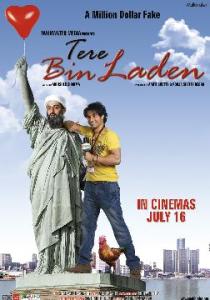
“Tere Bin Laden” (2010) is a Bollywood comedy written and directed by Abhishek Sharma. Pakistani pop star Ali Zafar stars as Ali Hassan, a TV reporter for a low budget news station in Karachi. Determined to find success in America despite previously being deported after being mistaken for a terrorist, he hatches a plan to raise funds for a fake ID with a sensational video using Noora (Pradhuman Singh), a dimwitted chicken farmer who happens to be a convincing Bin Laden lookalike. The plan rapidly spins out of control when it gets the attention of US government officials and the Pakistani intelligence agency. Though some gags dependent on regional references and wordplay may be lost on western audiences, much of it is broad enough to transcend cultures (especially bits mocking the paranoid and xenophobic post 9/11 milieu). Not surprisingly, the film was banned upon release in the US and several countries in the Middle East including Pakistan. The sequel Tere Bin Laden: Dead or Alive was released last February.
Editor’s note: Today marks the birthday of artist Mark Lombardi (born in 1951) and is also the day after the 16th anniversary of his suicide or murder. To learn more about Lombardi’s life, art and the suspicious circumstances surrounding his death, please take a moment to listen to the Radio WhoWhatWhy podcast and/or read the transcript.
A story of banking, organized crime, intelligence, petrodollars and politics…all seen through the lens of innovative Art.
Patricia Goldstone’s INTERLOCKis the first biography to explore the life and suspicious death of Mark Lombardi, a controversial artist whose drawings walked the line between art and information — and revealed the incestous connections between banking, organized crime, politicians, the FBI and the CIA.
His work highlighted such subjects as the Bank of Credit and Commerce International (BCCI), the Iran-Contra affair, the World Finance Corporation, and the relationship between George W. Bush and Harken Energy Corporation. The mystery of Lombardi’s alleged suicide has yet to be resolved. On March 22, 2000, he was found hanged. Friends find it suspicious because Lombardi was on the the cusp of achieving the recognition that would crown his career.
Goldstone talks to WhoWhatWhy’s Jeff Schechtman about the full scope of Lombardi’s life and work.
For a look at some of Lombardi’s dangerously revealing and possibly fatal work, go here, and here.
JEFF SCHECHTMAN: Welcome back to radio who-what-why. I’m Jeff Schechtman. In March of 2000 the acclaimed conceptual artist, Mark Lombardi, was found hanged in his New York apartment. It was ruled a suicide but Mark Lombardi was no ordinary artist. His work, ‘Interlocks’ as they were called, art was also information shining light on the Vatican, the Mafia, the Bushes, international financiers, and the CIA. In the words of his biographer Patricia Goldstone, his death transformed itself into the ultimate piece of conceptual art. In fact, after his death, Lombardi’s work drew the attention of the most influential art museums in the world as well as the FBI and the CIA. Patricia Goldstone has been a reporter for the Los Angeles Times and a bureau chief for Cablevision. She has written for the Washington Post, Maclean’s and The Economist Intelligence Unit. She’s an award-winning playwright and she’s just completed Interlock: Art, Conspiracy, and the Shadow Worlds of Mark Lombardi. It is my pleasure to welcome Patricia Goldstone here to radio who-what-why.
PATRICIA GOLDSTONE: Thank you for having me on the show.
JEFF S.: Great to have you here. First of all, who was Mark Lombardi? It’s not a name that a lot of people instantly recognize.
PATRICIA G.: That’s quite true. Mark was a conceptual artist, as you said, which means he essentially drew ideas and not water lilies. Some people considered him to be the first great artist of the 21st century. He is unique in the art world because he used interlocks to create his art. Now interlocks are basically a form of flowchart tracing overly cozy relationships between boards of directors. And they’re common in accounting and in some forms of litigation, but they’re very, very unusual in the art world. Mark used interlocks to draw what amounts to a continual visual history of the interconnections between intelligence and organized crime and corporations and governments in the shadow banking industry that we’ve heard so much about since 2007. He was particularly fascinated in tracing things like money laundering and tax evasion. He was actually way ahead of Edward Snowden and Julian Assange in releasing a very wide swath of extremely uncomfortable information to the public. What he created was a form of visual wiki-leaks. His own life is actually the missing strand and several of the shadowy visual narratives that make up his work. He died, as you said, a very mysterious death.
JEFF S.: Talk little bit about how Mark first got interested in the shadowy world that he would come to depict in all of these interlocks.
PATRICIA G.: Well, Mark’s research skills were well known in the Houston art world which was very progressive in its politics, at least at that time, through major patrons like the de Menils, who were the heirs to the Schlumberger fortune and the owners of the world-famous de Menil collection and the Rothko Chapel where Mark was married. Sissy Farenthold, a very prominent Texas politician who once ran for president of the United States, was on the board of the Rothko Chapel and she met Mark at a gathering around 1986. Farenthold introduced Mark to an informal investigative salon of young people, in her words, who included a number of lawyers and investigative journalists and prosecutors etc. She also introduced him to Bill White who was changing our Bath former business partner. White was engaged in a long-running series of lawsuits at the time so that the group was digging into interconnections of the Texas Savings and Loan scandals and the Iran Contra funding network. So Mark was tasked to draw out these interconnections in a readable way.
JEFF S.: To what extent was Lombardi simply creating this conceptual art, creating these interlocks from what was the assumed knowledge of the time, as opposed to doing additional work, additional research, to try and find connections that didn’t exist out there, in the popular press for example?
PATRICIA G.: That’s a very good question. Mark was actually very methodical and systematic. He worked very much like the way a historian works. He learned about the flow of hot money largely through published material by well-respected academics and journals. His library, which I ran through in the course of researching the book, consisted of hundreds of books on the financial debacle he drew, which he rigorously boiled down to bullet points of essentially academically and dictated information which he compiled in thousands of 3 x 5 index cards. He would arrange these in a narrative design on the floor next to the drawing he was composing, much like a film director uses a storyboard. But as I explained in the book, at that time he was given a very large stash of internal memos and other primary documents by one of the participants in the scandals. These are documents that were never previously published and would be a prize of any serious historian. At the time I discovered that he was taught how to do interlocks by the lawyer who deposed Richard Shelby who was one of the major middlemen in the Iran Contra scandal and in DCI. So his research was quite professionally grounded,
JEFF S.: Who was it that originally recruited Mark to really start doing this political work in Houston?
PATRICIA G.: Well, I would say it was Farenthold. And you know, he was already rather motivated personally to do it according to a note I found in his files which was apparently written by him. He had a personal run in with the Bushes and it was hard to put this story together because nobody really wanted to talk about it, not even Mark. But according to what I pieced together, Mark moved down to Houston straight out of Syracuse University to work as a curator at the Contemporary Art Museum of Houston, which was a very important job for such a young man. He was hired to do that by Jim Harithas who was the director of the museum and Mark’s college teacher and mentor. And from what I understood from a number of sources under pressure from the board, Harithas terminated him after a famous impromtu bread fight at a major art opening which turned into a major brawl when certain of the eminent guests, who were perhaps inflamed by alcohol, the naughty nature of the proceedings started ripping apart the installation and throwing it around. And a couple of unidentified artists sailed into the melee and started punching up the guests. Now Mark never spoke about this incident again and in fact his ex-wife told me that as the reason for his firing was introduced into a conversation he would actually get up and leave the room. But in his personal files I found this note which looks like it was written by him and it reads “In the late 1970s,” – which is when this incident occurred – “I was working as an organizer of art exhibitions in the Houston area. First International Bank, which was George HW Bush’s bank, barged into the scene at about this time effectively vetoing my participation in a large number of projects.” And Mark said in this note, which is an addendum to the journalism that he was attempting, that he embarked on his research as a form of revenge.
JEFF S.: Was there anybody specifically, a specific individual that he had had a run-in with from the Bush family that really precipitated this?
PATRICIA G.: No, again, this is shared conjecture on my part. From the way the note is put together, from the sounds of this, the Bushes might’ve been present at this gathering.
JEFF S.: What happened to all of Mark’s file cards after his death?
PATRICIA G.: Well, all of them is kind of a subjective number. Because I was told by one major collector of his work that there were as many as 40,000 file cards. And this collector had access to his studio. But what is archived at the Museum of Modern Art in Long Island, the number is about 14,000 cards, a considerably smaller number and when I went to use the cards, all but four on the financial activities of the Bushes, on whom he focused much of his attention, were missing. That really did strike me as extremely odd. I asked the chief archivist if they had archived the Bush material elsewhere, if I had missed it, and she couldn’t answer the question. She referred me to the security department instead.
JEFF S.: To what extent was his interest in these things driven by a desire to continue to uncover new stuff or really to continue to uncover new areas to expand his art and create more interesting interlocks essentially?
PATRICIA G.: I think that Mark was primarily an artist. I think in many ways he can be considered the heir to Marcel Duchamp who was the founder of Dada, one of the most important of the early 20th century art movements. Now Duchamp created his revolutionary art out of ordinary objects like the famous Urinal. Mark took another kind of ordinary object, the interlock, and he used it to pursue that to produce his main track of thought: how the political influence that he was essentially tracing took shape in flows of hot money. And those flows continually expanded and pooled together over the period of years that he was tracing them. So yes, he was constantly expanding his artwork. In fact, he linked all of his drawings together to form one continual drawing he called ‘the one continual drawing in my head’.
JEFF S.: To what degree did accuracy matter to Mark?
PATRICIA G.: A great deal. A great deal, as I said. He worked like a historian and the file cards are amazing because they are very much like what an academic would use in compiling the bibliography and index of a 600- page work. So I think he was very, very scrupulous in his research and he relied on primarily unpublished material but by academics and journalists.
JEFF S.: How was he seen in the art world, his early work, and as his work progressed?
PATRICIA G: He was a late bloomer. He turned out his initial body of work at white-hot speed in the mid 1990s when he was already in his 40s. And he garnered quite a bit of attention with this one body of drawings. He had a solo exhibit in Houston. And the amazing thing about these drawings was that they answered a lot of the questions that John Kerry’s Senate Investigating Committee on BCCI which was winding down at about the same time that Mark was turning out his work, he answered questions that if you read the Kerry committee report they said they didn’t have the time or the resources to pursue. And he was this artist sitting on the floor of a tiny studio in Houston pursuing them.
JEFF S.: How did the subjects of these pieces of art, those that he really reflected in this interlocking aspect of crime and as you say, ‘hot money’, how did they react to what he was doing?
PATRICIA G.: Well, with some discomfort, as you might expect. I was told a story by one of my interviews that one of Neil Bush’s friends came to Mark’s first solo show in Houston and he was looking at a painting on the wall. It was the Silverado painting in which Neil figures and he remarked to someone “Well, I’m going to have to tell Neil that he is represented here.”
JEFF S.: Talk a little bit about the evolution of his work. How did it progress? How were some his later works and later interlocks different from the early ones?
PATRICIA G.: Well, the work became much more complex as he progressed because it all interconnected. So the genesis of his work really was a huge bank called BCCI that some people may not remember. It was a bank that billed itself as Bank of America for the Third World but in fact it was the CIA’s first global money laundry and BCCI was very connected to the subprime crises of the 1970s and 1980s and it was officially closed down in the 1990s. But Mark really developed all of his drawings from his initial two boxes of research into BCCI and ended up in this immense continuum of drawings that makes up his work tracing the genesis of BCCI all the way back to a trove of stolen World War II plunder.
JEFF S.: Talk about the FBI and the CIA and their interest in Mark’s work.
PATRICIA G.: Well, the FBI, the CIA, the Department of Defense and the Office of Naval Research actually all had to study Mark’s work in the wake of 9/11 which wasn’t really made public until my book came out. They were looking for clues for two terrorist social networks. That’s a subject Mark covered in some of his drawings and also for traffic analysis tools which is kind of a funny story because although the NSA, which also studied Mark’s work, may be very good at collecting data on all of us but are not terrific in analyzing it. And when they feed it into a main computer, the visualization tends to come out looking like what they call ‘house of spagetti’. But Mark’s work is actually used in the computer science world to study traffic analysis because he spaced his players in a particular way that makes them very easy to read and sort of aesthetically pleasing and directs the eye in certain ways.
JEFF S.: Tell us a little bit about Mark’s personality . What was he like?
PATRICIA G.: He was a fascinating person. He was a workingclass guy from Syracuse, New York, who had nothing more than a bachelors in fine arts. And he was intensely ambitious, untrained in finance or anything like that but very, very quick intuitively. And his talent as an artist was to be able to apprehend a lot of visual information all at once and to get at the big picture that lies below the surface of things. I suppose many people would call him obsessive. People have tended to use Aspergers as an explanation for his ability to focus very intensely for a very long period of time. I don’t think that that is quite fair or true. Mark was very charming, very funny, exuberant, impish, intensely attractive to women, and very good socially when he wanted to be. And very good verbally. He was a shrewd communicator and a cunning player of the art game who never quite revealed what he was really up to. I mean nobody in the art world, for example, had a clue that he had actually created his work out of interlocks.
JEFF S.: Talk about what happened in March of 2000.
PATRICIA G.: Mark was in the process of opening a very important show at one of the iconic exhibition spaces in New York and everything seemed to be going beautifully for him. He was getting attention, he was getting a great deal of critical acclaim that people were lining up to buy his work, he was making money which had always been an issue for him. His personal life was a bit rocky but that was not unusual. He had recently broken up with a girlfriend depending on whom you talk to and I heard many, many different renditions of this story and in the course of interviewing over 80 people who knew him for over a 50 year period. Depending on whom you talk to he was either happy about that or unhappy about that but he was certainly seeing other women at the time. So he had had a suspicious flood in his studio about three weeks before the show opened. His masterwork, which was the third version of his BCCI series, was very badly water damaged, and this drawing is remarkable because he actually strung all of his previous drawings together on a series of timelines so that you can see exactly how all the scandals from the 1970s onwards sort of add up to this one huge scandal which is BCCI. That painting was almost, almost destroyed but it does remain readable today. So Mark re-created it in a mad workspace. He reconstructed the whole drawing in the space of about four days and some people say that the strain of doing that drove him into a suicidal depression. I don’t quite buy that because he did open the show very successfully with the drawing that he had re-created and people told me that he was quite happy with that drawing. Regardless, about three weeks later he was found hanged in his studio. And the police reports which I got hold of in the beginning of my research, were rather sketchy. A lot of things didn’t ring true. The time of death was never established, for one. Establishing death by hanging is a controversial area of forensic pathology, and the police based their very hasty verdict of death by suicide on the testimony of one witness who appeared increasingly unreliable during the interview process. I actually did track down the two cops who found him , one of whom was a rookie at the time, still very disturbed by the experience. He was a policeman who actually pushed open the transom which is how they got into Mark’s studio and there was Mark staring him straight in the face because he didn’t hang from a sprinkler pipe and he had an open bottle of champagne suspended beside him. Till today I have never really seen anyone take a drink on the way out.
JEFF S.: Talk about the flood. What is it that made it suspicious? What do we know about that?
PATRICIA G.: Well, it was a sprinkler flood. And a lot of rumor and conjecture exist in the art world about Mark’s suicide/death/murder. But one artist told me what sounded like a rather implausible story that he had tried to hang himself earlier, at the time of this flood from one of the sprinkler pipes, and that his weight is what broke the pipe and that’s what caused the flood. That’s actually very difficult for that kind of a factor to trigger a flood. I mean sprinkler pipes go off because of fire or they can go off because of a sharp blow applied to a pipe from an upstairs apartment to the gage, to the gage on the pipe line or to apply heat to that gage, that can trigger a flood in the downstairs apartment but someone hanging himself, no, not very likely.
JEFF S.: Talk a little bit about whether or not there was any history of depression or mental illness or anything else with respect to him.
PATRICIA G.: No, there was no critical history of depression. In retrospect certain members of Mark’s family told me that they felt he was depressed. However, his mother, who was really the closest person to call me before she died – she died in 2012 – she told me that she had talked to him a couple of days before he was found and he said he was absolutely jubilant at the success his work had brought him and at the prospect of moving in with his girlfriend. So, you know, a lot of this doesn’t compute.
JEFF S.: The police report after his death, and all the investigation was, as you talk about it, a bit sketchy. Talk about that and was that normal at the time in terms of police procedure or was that unusual?
PATRICIA G.: Well, the circumstances surrounding his death were really quite strange. He had no clinical history of depression and his mother to whom he was closest and to whom he spoke almost daily, told me that he had told her that he was actually very happy a couple of weeks, a couple of days rather, before he died. And I believe that because Mark was quite single-mindedly ambitious and he was getting the success that he had worked for, for decades by this time, to achieve. He may have been unhappy at the breakup of a relationship but he was extremely attractive to women and extremely attracted to women, and in fact he was seeing somebody else at the time. So I actually began my research by getting hold of the police report through a friend of mine in the homicide division in New York, and there were a lot of things that didn’t ring quite true. A time of death was never established for one thing and that’s very important in this kind of investigation and standard procedure and establishing death by hanging is a controversial area in forensic pathology. That and the fact that the police based their very hasty verdict of death by suicide to close the case today on the testimony of one witness who appeared increasingly unreliable during the interview process. I actually ended up tracking down the two cops who found him. One of them who was a rooky at the time and showed signs of doubt; that and the other pillar, that there are other pillars of evidence which was the absence of signs of struggle and the fact that the door was securely locked from the inside are also questionable as I explained in my book. But the exact nature of what’s in the drawing which can cause any number of people to want him dead.
JEFF S.: Is there anything in the drawings, all of them, that was what we would classify, I suppose, is original material? One of the things you’ve talked about is that in many ways he worked based upon academic reports, in journalism, and in all the material that he could get his hands on, and he was graded at bringing all of this together in these interlocks. But was there anything in this material that was revealing of anything that hadn’t been revealed anywhere else?
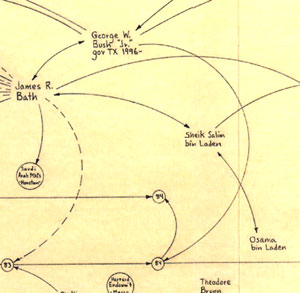
PATRICIA G.: Well, I did find in his files a large cache of internal memos and other primary documents from James R Bath Company Highway and some of these connections come up in in the George W. Bush Harken Energy Jackson Stevens drawing which was of interest to the FBI after Mark’s death.
JEFF S.: Did the FBI ever do anything with any of that to your knowledge?
PATRICIA G.: Well, it might be known that the FBI went to the Whitney after Mark died to look at one of his big BCCI drawings but the FBI was really interested in the relationship between how bin Mahfouz was anchored to the Saudi Royals and certain Islamic charities in Virginia that were allegedly funding Al Qaeda and that the FBI ended up raiding in 2002. And there are some clues to those interconnections in the Lombardi and the George W. Bush Harken Energy Jackson Stephens drawing which focuses on Bush’s oil companies. Now bin Mahfouz allegedly bankrolled Arbusto which was one of George W. Bush’s companies through James Bath who represented Saudi business interests in America; and one of the documents I did find in Mark’s files was a copy of the 1976 trust agreement between James Bath and Salem bin Laden who was Osama’s older brother and died in a crash a few years later. bin Mahfouz was also allegedly the real owner of that aircraft leasing company Skyways. Now interestingly, bin Mahfouz himself doesn’t actually appear in this drawing. However, Salem bin Laden and also Abdullah Taka Bakhsh who was a major Harken shareholder and CEO of a Halliburton subsidiary who had close ties to bin Mahfouz does appear as a central hub or connection along with James Bath and so does Fox’s representative on the Harken board, an influential business name, who opened the 2000 Republican national convention with the Muslim benediction on Bush’s behalf and later successfully protested the FBI raid on the Virginia charities in a private meeting with Bush’s treasury secretary, Paul O’Neill.
JEFF S.: If not suicide, where does your speculation, or where can speculation lead in terms of the cause of Mark’s death?
PATRICIA G.: Well, I have to point out that Mark was actually pretty equal opportunity in his finger-pointing. He did focus a lot of attention on the Bushes for the reasons I go into in the book and he did die during the presidential election in which at least one of his drawings might have had an impact. That he did a number of important drawings that focused attention on the Clintons and knowing a little group of Indonesians and the Riady family who were the sources of Chinese influence peddling during the Clinton administration. Also Mark Rich who is famously connected to the Clintons was one of the key middlemen that hooked Mark’s drawings together as is Jackson Stephens who funded both the Bush and the Clinton campaign, so you know overall Mark was really more like a social scientist and political partisan and that I believed his overwhelming interest was in getting this whole financial system done on paper for everyone to see. And in fact, he had reportedly been threatened in the late 1990s. He got a call from someone telling him to back off investigating the five major New York Times families who were the subject of a preparatory sketch he had been working on. He mentioned it to a Williamsburg publication and it was repeated after his death by a German freelance journalist. So there are a lot of names in these drawings. One of them told me that he wouldn’t know a Lombardi drawing from a Mona Lisa.
JEFF S.: In the material that you’ve uncovered since in your investigation and your work on this, does it lead anyplace in particular?
PATRICIA G.: Well, you know I have to be careful to point out that I don’t have anything like the smoking gun, that I don’t have the power to pin people and I have many, many different stories from almost everyone I talked to on this subject. But the heft of circumstantial evidence makes me feel that at the minimum a lot more questions should have been asked at the time of his death.
JEFF S.: And is your conclusion that didn’t really suicide just seem the most unlikely scenario?
PATRICIA G.: Well, it’s not my impression of Mark as a human being. He was tremendously vital and totally committed to his work. They said he was getting where he wanted to go and he was quite ebullient really, as a person, very high energy. Now of course, you know, I didn’t know the man and it’s always possible for certain personality types to be very volatile and from what people told me he was particularly, when he had been drinking, but no, it doesn’t stack up with where he was going in his life at the time. Because he was really on the verge of very major success.
JEFF S.: Is there any evidence that he was on to something or that he had made a connection, or that his research had taken him somewhere that was new and heretofore undiscovered?
PATRICIA G.: Well, that’s an interesting question. One of his drawings, one of his late drawings is called George
Bush Harken Energy Jackson Stephens and the drawing focuses on relationships that apparently – my source for this was a rather particular intelligence newsletter that came out in March of 2000 - said that the Bush campaign might run into trouble over the Bush relationship with Khaled bin Mahfouz who was anchored to the Saudi royals and very much a presence in Houston. This drawing that Mark had done focused on that relationship.
JEFF S.: What was the interest like in his work after his death?
PATRICIA G.: Well, his prices took off, certainly. One of his larger drawings recently went up for sale at one of the most prominent art galleries in the country priced at $450,000. He’s been quite avidly collected. The Whitney has a major holding of his works, the Museum of Modern Art has a major holding of his work. A number of eminent computer scientists collect his works. There’s Robert in Germany who I think owns four of the drawings. Robert, whom I interviewed, is engaged in trying to convert Mark’s drawings into hypertext, stringtext, which means you click on the name and it pulls up the whole history. Through the drawings of the problems he told me he had had in completing this, was that some of the drawings are not available to view because they are in private collections.
JEFF S.: is there any work that disappeared after his death that anybody is aware of?
PATRICIA G.: The George Bush Harken Energy drawing did migrate to Germany for quite a number of years but it’s back in the United States now. Some people that I interviewed said they felt that drawings had disappeared from his studio but his studio was not actually very well secured. But it’s after his death and impossible to substantiate that.
JEFF S.: Patricia Goldstone: the book is Interlock: Art,Conspiracy, and the Shadow Worlds of Mark Lombardi. Patricia, thanks so much for spending time with us here on radio who-what-why.
PATRICIA: Oh, thank you for having me on the show.
JEFF S.: Thank you. And thank you for listening and joining us here on radio who-what-why. I hope you’ll join us next week for another radio who-what-why podcast. I’m Jeff Schechtman. If you like this podcast, please feel free to share it and help other people find it by rating and reviewing it on iTunes. You can also support this podcast and all the work we do by going to who-what-why.org/donate
Recently I read another stinging rebuke of the 9-11 conspiracy theorists for their frightful mishandling of evidence, their will to believe only what gives them psychological comfort, and their general state of delusion. It was not the first I had read, nor will it be the last. The writer held unwaveringly to the party line: all those who seek to discredit the official, announced version of the events of 9-11 are “conspiracy theorists”- and should not be listened to. That this position constitutes an attempt at prior censorship does not seem to bother the deniers, nor the fact that the central tenets of conspiracy denial are an ad hominem attack. We are told that conspiracy theorists are crazy, or at least cowardly clingers to delusions that they find comforting.
It occurred to me that I haven’t seen anyone examine the mental comforts of conspiracy denial, using the handy tools of amateur psychology. It’s my guess that there’s considerable comfort to be had, especially for men, from an acceptance of the official explanation for 9-11. This is not to say that many women aren’t happy with the Arab hijacker theory, but for men, the provision of a clear enemy to fight is always especially gratifying.
To accept the official announcements of the story of 9-11 is instantly satisfying in several ways. Commercial airliners, hijacked by suicide terrorists, flew into buildings at the behest of a really smart master-terrorist named Osama Bin Laden. This is an immediately credible scenario””many of us had heard the name Bin Laden, and “knew” he was a terrorist who lived on the other side of the world. Indeed, the WTC had been attacked once before. And terrorism itself certainly exists–both sides of the 9-11 controversy can agree on that. So, to accept the official announcements that followed the attacks enabled you quickly to locate all the blame for the attacks in a tiny evil army of foreigners, all out of immediate reach, but accessible to the U.S. Army, you bet. The hijackers themselves were all dead, and their leader was extremely hard to find, but American forces could find and punish them. No need, really, to conduct any investigations or solve any mysteries–an evil super-hero with a small army of mentally enslaved unfortunates was able to penetrate the defenses of the finest air force in the world to murder 3000 Americans. A fluke, but in life and in sports, stuff like that happens.
The fact that this reads like a comic book plot doesn’t seem to be a source of embarrassment for the anti-truther movement. In fact, an evil mastermind who, through mindless suicidal drones, wreaks havoc on good and decent people is the major plot driver of The Lord of the Rings, and many other fantasy and science fiction epics. Mythically speaking, it’s golden.
And under the broad strokes of the main story, there’s also a layer of historically accurate information that supports the main plot line. Joe and Jane Six-Pack would accept the unadorned story eagerly, but there’s something to satisfy the more thoughtful as well. The back story is that American foreign policy for the last 30 years could easily result in some very unhappy Arabs. CIA meddling in the politics of Iran and Iraq, and above all, our support for Israel, have been highly unpopular on the Arab street. Well-read people could find the anti-American sentiments of the terrorists quite credible, if regrettable.
So the psychological comforts of the official story are several and real: you get a clearly defined enemy, a simple solution to a complex foreign policy problem, you get to feel morally superior to your enemy because you’re more civilized and don’t kill civilians, and finally, if you know something of the history of American policy in the Near East, you get to feel superior to those who don’t.
It’s entirely understandable that any American should believe the official 9-11 story. And, of course, to consider seriously for an instant that there could be something seriously wrong with that story, to imagine that as possible, really does change everything, just like 9-11 itself. If there’s a chance that Americans colluded in those horrors, then the entire mental structure of our sanity, which we’ve lived in all our lives, has a serious crack, a San Andreas Fault, right down the middle. If we think it possible that “We have met the enemy, and he is us,” then everything previously unthinkable is thinkable.
In fairness to their enemies among the truthers, the conspiracy deniers should admit that there is much psychological comfort in their own position, and that conspiracy theorists do not have a monopoly on convenient but deluded assumptions. 9-11 is, after all, a heap of facts, and it is open to human inquiry. Whether the heap was created by our enemies’ hatred or something worse has yet to be decided.
In 2015, the iron fist of power clamped down on humanity, from warfare to terrorism (I repeat myself) to surveillance, police brutality, and corporate hegemony. The environment was repeatedly decimated, the health of citizens was constantly put at risk, and the justice system and media alike were perverted to serve the interests of the powers that be.
However, while 2015 was discouraging for more reasons than most of us can count, many of the year’s most underreported stories evidence not only a widespread pattern that explicitly reveals the nature of power, but pushback from human beings worldwide on a path toward a better world.
1. CISA Pushed Through the Senate, Effectively Clamping Down on Internet Freedom: For years, Congress has attempted to legalize corporate and state control of the internet. First, in 2011, they attempted to pass PIPA and SOPA, companion bills slammed by internet and tech companies and ultimately defeated after overwhelming public outcry. Then they passed CISPA — which the president had threatened to veto, having caught wind of the public’s opposition to heavy regulation of the internet (earlier this year, Obama reversed his position). However, corporate interests, like Hollywood’s studio monopoly, kept lawmakers’ tenacity afloat.
In October, Congress passed CISA, the Cybersecurity Information Sharing Act, but as the Electronic Freedom Foundation explained: “CISA is fundamentally flawed. The bill’s broad immunity clauses, vague definitions, and aggressive spying powers combine to make the bill a surveillance bill in disguise. Further, the bill does not address problems from the recent highly publicized computer data breaches that were caused by unencrypted files, poor computer architecture, un-updated servers, and employees (or contractors) clicking malware links.” Just before Christmas, Congress went even further, adding an amendment to the annual omnibus budget bill that strips CISA’s minimal privacy provisions even more. That budget bill was approved, though Representative Justin Amash of Michigan has vowed to introduce legislation to repeal the CISA provisions when Congress reconvenes.
But CISA wasn’t the only attack on citizens’ privacy this year. Though lawmakers touted the USA Freedom Act as a repeal of the mass surveillance state, in reality, it simply added a bureaucratic step to the process by which government agencies obtain private information. Further, a hack on Italian security firm, aptly called Hacker Tools, revealed that various agencies — including the DEA, NSA, Army, and FBI — possess software that enables them to, as Anti-Mediareported, “view suspects’ photos, emails, listen to and record their conversations, and activate the cameras on their computers…” At the same time, the United Kingdom and France moved to tighten their already comprehensive surveillance States in the wake of multiple terrorist attacks. Though governments claim systematic surveillance is necessary to protect citizens — and Snowden’s leaks endangered that safety — the United States government has been unable to produce sufficient evidence the programs work. Instead, the documents the Department of Defense released this year as proof of the alleged endangerment were entirely redacted.
2. CIA Whistleblower Sent to Prison for Revealing Damning Information to a Journalist: While the government has no problem invading the privacy of its citizens, it offers swift backlash for those who attempt to violate its own clandestine operations. Jeffrey Sterling, a former CIA agent, had his first altercation with the CIA when he sued for racial discrimination in 2001. He was subsequently fired. Years later, the CIA filed espionage charges against him for speaking with New York Times journalist, James Risen. Sterling had revealed a botched CIA scheme, Operation Merlin, to infiltrate Iranian intelligence that ultimately worsened the situation, gave Iran a nuclear blueprint, and was deemed espionage, itself. Rather than acknowledge the woeful misstep, the CIA arrested him, charged him, and ultimately sentenced him to 42 months in prison. The trial was reportedly biased, but nevertheless, was severely underreported by the media. Sterling’s conviction reflects the ongoing war on whistleblowers, which Obama has successfully expanded during his presidency. Sterling joins the ranks of Edward Snowden, Chelsea (formerly Bradley) Manning, and others, including a whistleblower who worked for OSHA’s Whistleblower Protection Program and was fired for exposing dysfunction and incompetence within the ranks.
3. Press Freedom Continued to Deteriorate: An annual report from the World Press Freedom Index saw the United States slip 29 spots from last year, landing 49th out of 180 total. Investigative journalist Barrett Brown was sentenced to five years in prison for exposing the findings of hacker Jeremy Hammond. Brown was charged with obstructing justice, aiding and abetting, and separate charges of allegedly threatening the FBI in a rant. Hammond, who exposed severe violations of privacy on the part of Stratfor, a CIA contractor, was sentenced to ten years in prison. Brown’s experience was not an isolated incident. Journalists around the world, like several journalists who were killed while investigating ISIS in Turkey, faced increased danger. One small-town journalist in India was burned alive after exposing a corrupt politician.
4. Multiple Activists Arrested, Charged with Felonies for Educating Jurors About Their Rights: In an ongoing trend, otherwise peaceful, non-violent individuals were harassed by police and courts — not for exposing clandestine information, but for providing information to potential jurors about their rights in the courtroom. One Denver jury nullification activist, followed by another, was charged with multiple felonies for handing out pamphlets that explain a juror’s right to vote “not guilty” in a verdict, even if the defendant is clearly guilty. This right was established to allow jurors to vote with their conscience and question the morality of laws, from the 19th century’s Fugitive Slave Act to Prohibition, both of alcohol in the 1920s and of marijuana today. The Denver activists are awaiting trial, while more recently, a former pastor was charged with a felony for the same reason.
5. Six-year-old Autistic Boy Killed by Police: 2015 established not only that the justice system remains broken, but the the enforcement class — police officers — continues to terrorize citizens. In one underreported case, a six-year-old boy was fatally caught in the crossfire of a police shootout against his father, who was unarmed. In another case, an African-American motorist was shot and killed by University of Cincinnati police over a missing front license plate. While high-profile cases of misconduct, including Freddie Gray and Sandra Bland, rightly dominated the news cycle, many more cases of police brutality received little attention. In fact, in 2015, it was revealed not only that the media-propagated “War on Cops” in America was a myth, but that American police kill exponentially more people in weeks than other countries’ police kill in years. On the bright side, many police officers did face charges — and even prosecution — in 2015, including one repeat rapist who cried upon being convicted of his crimes. The officers involved in the shooting of the six-year-old boy were also charged with murder.
6. Earth Enters Sixth Mass Extinction: 2015, like many years before, was disastrous for the environment. Researchers from Stanford University, University of California, Berkeley, and Princeton determined Earth is entering its sixth mass extinction, citing that species are disappearing at a rate 100 times faster than the normal rate between mass extinctions. Further, thanks, in part, to the widespread use of Monsanto’s glyphosate-based Roundup herbicide, populations of bees and Monarch butterflies dwindled — though, happily, the Monarchs appear to have bounced back. Polar bears also met continued endangerment.
7. Civilian Casualties in Western Wars Continue: Though ISIS and other terrorist groups were rightly condemned for killing civilians in 2015, the West pointed fingers while committing the same crimes. In fact, one U.N. report released in September found U.S. drone strikes have killed more civilians in Yemen than al-Qaeda. Another analysis released this year proved Obama’s drone wars have killed more people than were murdered during the Spanish Inquisition. Though the U.S. military’s bombing of a Doctors Without Borders (MSF) hospital received global attention and outrage, many other incidents went underreported. In May, one U.S. airstrike on Syria killed 52 civilians in one fell swoop. Additionally, U.S.-backed coalitions have bombed civilian populations, like in Yemen, where Saudi Arabia killed at least 500 children, not to mention thousands more adult civilians. In other egregious misdeeds, it was revealed that the U.S. military sanctions pedophilia in Afghanistan.
8. Insurrection at the Pentagon’s Defense Intelligence Agency Over Misleading Reports on ISIS: Over the summer, dissent grew within the ranks of the DIA, the Pentagon’s internal intelligence agency. In September, news broke that 50 intelligence analysts filed a report with the Department of Defense’s Inspector General to expose their superiors’ alleged manipulation of intelligence. The intention of the coverup was to downplay the threat of ISIS and the U.S.’s losing effort to fight it, all to maintain the Obama administration’s narrative the bombing campaigns have been successful.
10. The FDA Approved OxyContin for Use in Children: Though the approval of the powerful, addictive painkiller for use in 11-year-olds and younger children was unsurprising, the FDA’s justification was shocking. After lawmakers wrote a letter expressing concern to the FDA, the agency’s spokesperson, Eric Pahon, said the news was, in fact, not that serious because it was already standard practice. “It’s important to stress that this approval was not intended to expand or otherwise change the pattern of use of extended-release opioids in pediatric patients,” Pahon said. “Doctors were already prescribing it to children, without the safety and efficacy data in hand with regard to the pediatric population.”
In other stories regarding the misconduct of agencies tasked with keeping people safe, the FDA continued to allow meat companies to use a pharmaceutical additive banned in 150 countries, while whistleblowers at the USDA revealed several plants were producing pork filled with fingernails, hair, bile, and feces.
11. The Federal Government Finally Admitted Cannabis May Help Fight Brain Cancer: Though the government has long known about the medical benefits of cannabis — it holds patents on several medicinal qualities — the National Institute on Drug Abuse made waves this year when it published a document acknowledging the healing properties of cannabidiol, a non-psychoactive endocannabinoid. In particular, it noted “[e]vidence from one animal study suggests that extracts from whole-plant marijuana can shrink one of the most serious types of brain tumors.” Though more research is needed, the government’s admission was unexpected, albeit welcomed by many cannabis enthusiasts. Other studies this year revealed cannabis may help heal broken bones and is associated with lower rates of obesity.
Though many Americans still faced criminal prosecution for treating themselves and their children with cannabis, 2015 demonstrated the long-term trend of decriminalization and legalization will not be reversed. Nations around the world, from Ireland to Costa Rica to Canada laid groundwork to legalize marijuana to various degrees, while a majority of Americans now support legalization.
12. Nestle Paid $524 to Plunder the Public’s Water Resources: This year, Anti-Mediareported on the insidious relationship between Nestle and the Forest Service in California. The investigation found not only that Nestle was using an expired permit to turn exponential profit on 27 million gallons of water, but that a former Forest Service official went on to consult for the company.
While corporate exploitation ran rampant in 2015, many countries around the world fought back. India banned one Nestle product for containing lead, while nations around the world banned Monsanto and GE products. Scotland, Denmark, and Bulgaria, among others, all moved to ban GE crops, while multiple lawsuits highlighted the serious potential health consequences of the widespread use of pesticides. Though corporate power remains all but monolithic, 2015 saw humans across the world rise up to resist it. Most recently (and comically), a proposed initiative in California is about to enter the next phase — signature gathering — to place it on the 2016 ballot. If placed on the ballot and passed, it will force California legislators to wear the logos of their top ten donors while they participate in legislative activities. The effort has drawn widespread praise and enthusiasm.
13. Establishment Caught Manipulating News to Fit Narratives: Following the death of Freddie Gray in Baltimore, contentious protests broke out, eventually resulting in limited rioting and looting. However, while the media attempted to paint protesters as aggressive, it failed to report officers’ systemic prohibition of their physical movement, to say nothing of the riot gear police showed up wearing. After being unable to move, a brick was thrown, but the media failed to reporting the instigation and discrimination law enforcement imposed that ultimately led the students and protesters to grow unruly.
In other manipulations, it was revealed that one Fox News contributor lied about his experience as a CIA agent; he had never been employed at the agency, and only obtained later national security jobs by lying about his CIA experience. Further, CBSedited out comments from Muslims, who discussed U.S. foreign policy as a driver of Islamic extremism during a televised focus group.
A study by fact checker, Politifact, revealed that all the major outlets surveyed — Fox News, CNN, and MSNBC— consistently report half-truths and lies. It is little wonder, then, that another survey found only 7% of Americans still harbor “a great deal of trust” in the mainstream media.
Still, it wasn’t just the media that lied. On multiple occasions, government agencies were caught attempting to distort facts. In March, news emerged that an IP address linked to the NYPD had attempted to edit the Wikipedia page on Eric Garner. Computers inside Britain’s parliament were linked to attempted edits on pages detailing sex scandals, among other transgressions. In a related story, the FBI reported it had foiled yet another terrorist plot, and once again, it was revealed the culprits were provided support from an informant working for the bureau.
15. Sharp Uptick in Islamophobia: Amid the carnage of the Paris terror attacks, the recent shooting in San Bernardino, and the surge in Syrian refugees seeking asylum in Western nations, attacks against Muslims skyrocketed in 2015. In the United States, Muslims have been attacked for praying in public, wearing traditional head scarves, and for simply being out in public. Sikhs have been caught in the crossfire for the crime of being brown and wearing cloth on their heads — and thus being confused with Muslims — while at least one Christian has been terrorized as a result of the unmitigated hate currently permeating modern society. Many European nations and U.S. states have rejected the influx of refugees from war-torn Syria.
2015 was a year of chaos, violence, hate, and an ongoing struggle of freedom versus oppression. In many ways, it was like the years, decades, and even centuries and millenia that came before. But amid the conflict and often discouraging headlines, humanity has continued to persevere, offering resistance to seemingly all-powerful forces and paving the way for, if nothing else, potential peace, freedom, and respect for human life.
In debunking Donald Trump’s big lie about Jersey City Muslims celebrating the destruction of the World Trade Center, the corporate media have told an even bigger lie of omission. There was, indeed, shameless cheering on the banks of the Hudson River on 9/11. But it was by young Israelis, as was widely reported at the time. Fourteen years later, corporate media are covering up for Israel – which makes them even bigger liars than Trump.
“By making only a partial correction of Donald Trump’s prevarication, the corporate media were telling their own lie about what happened on 9/11.”
The corporate media don’t like Donald Trump. They used to like him a lot; in fact, Big Business Media are responsible for making this minor multi-millionaire into a household name. But Trump is on their hit list, nowadays, because the Republican presidential candidate insists on telling his own lies, rather than sticking to the list of official lies parroted by corporate media every minute of every day.
Donald Trump told a really “HUGE” – as he would put it – lie when he claimed to have watched thousands of Muslims cheering in Jersey City, New Jersey, as the World Trade Center came down on 9/11. Every corporate news outlet in the country rushed to debunk Trump’s fictitious account. The Washington Post offered psychological theories for why Trump gets away with telling fantastic lies. The New York Times said there was no evidence that Jersey City Muslims cheered the destruction on 9/11. CNN said it never happened. And, they were right.
However, by making only a partial correction of Donald Trump’s prevarication, the corporate media were telling their own lie about what happened on 9/11. There was, in fact, celebration in Jersey City on that fateful morning, and the incident did, briefly, make a major news splash. But the people doing the cheering weren’t Muslims: they were five young Israelis in a white moving van, who were observed in Liberty Park ecstatically taking pictures of themselves framed against the smoking ruins of the Twin Towers. As ABC News reported, the five were later arrested at gunpoint near the New Jersey Giants football stadium. Most U.S. intelligence sources believed the men were Israeli spies, and that their “moving company” was an Israeli intelligence cover. They were detained for a while, and then deported.
“Who is the biggest liar?”
In the year before 9/11 scores of young Israelis posing as “art students” were arrested after penetrating U.S. Defense Department and other classified sites. Both stories made national news. The corporate media could not have avoided running across articles on the “cheering Israelis” when they set about debunking Donald Trump’s “cheering Muslims” account. But, not one of them dare to mention that, yes, some people were seen celebrating 9/11 at Liberty State Park in Jersey City.
I was in a different part of the park on 9/11 morning, alone except for two young Israelis with very expensive cameras, carrying phony New Jersey press credentials, who claimed to be Polish but spoke Hebrew to each other. The two young men were giddy with joy at the destruction that the three of us were observing across the Hudson River.
Later that day, I learned from local and national news outlets about the five Israelis who were dancing with delight about a mile upriver from me and the two other Israelis. Articles about Israelis celebrating 9/11 would have come up in any search to correct Donald Trump’s tall tale – but the corporate media kept that part of the story from the public. They censored their own correction of Donald Trump. So, who is the biggest liar? Trump, who lies to advance his own personal interests, or the U.S. corporate media, who lie to the people on behalf of the State of Israel, and Zionism.
In September 2000, an advocacy group called “Project for New American Century,” led by Jeb Bush, Dick Cheney, Donald Rumsfeld, Paul Wolfowitz and others — published a “blueprint” for “transforming” America’s future. PNAC acknowledged that the “revolutionary” changes it envisaged could take decades to bring about — unless, they said, the United States was struck by “some catastrophic and catalyzing event – like a new Pearl Harbor.” One year later, after the disputed election of George W. Bush, came the “catalyzing” event of the 9/11 attacks — which indeed “transformed” America’s future in many “revolutionary” ways.
Here are some of the changes PNAC called for in 2000, all of which came about after the “new Pearl Harbor” they had hoped for: An attack on Iraq. Vast increases in military spending. Planting new American bases all over the world. Embracing the concept of “pre-emptive war” and unilateral action as cornerstones of national strategy. Developing sophisticated new technologies to “control the global commons of cyberspace” by closely monitoring communications and transactions on the Internet. Pursuing the development of “new methods of attack – electronic, ‘non-lethal, biological…in new dimensions, in space, cyberspace and perhaps the world of microbes.”
Oddly enough, although “regime change” in Iraq was clearly a priority for PNAC, it had little to do with Saddam Hussein and his brutal rule. Instead, removing Saddam was tied to the larger goal of establishing a permanent U.S. military presence in the Persian Gulf in order to “secure energy supplies” and preclude any other power from dominating the vital oil regions of the Middle East and Central Asia. The PNAC report puts it quite plainly:
“The United States has for decades sought to play a more permanent role in Gulf regional security. While the unresolved conflict with Iraq provides the immediate justification, the need for a substantial American force presence in the Gulf transcends the issue of the regime of Saddam Hussein.”
This is why the Bush Administration offered a constantly shifting menu of rationales for the impending attack on Iraq: because the decision to remove Saddam was taken long ago, as part of a larger strategic plan, and had little to do with any imminent threat from the broken-backed Iraqi regime, which at that time was constantly bombed, partially occupied (with U.S. forces already working in the autonomous Kurdish territories) and swarming with UN inspectors. If the strategic need for the attack “transcends the issue of the regime of Saddam Hussein,” then almost any rationale will do.
The same desire to “secure energy supplies” and prevent any other power from gaining dominance in the oil regions also underlies current and recent US policies in Libya, Syria, Yemen and elsewhere. That’s why we see the same shifting rationales, see policies that on the surface seem to make no sense: we fight al Qaeda in Iraq, we support al Qaeda in Yemen and Syria; we say defeating ISIS is of supreme global importance, but we prevent other countries (Iran, Russia) from joining the fight; we push “regime change” to “liberate” Libya and Syria while partnering with one of most repressive, extremists nations on earth, Saudi Arabia, and arming other dictators like Sisi in Egypt. We are “fighting” terrorism while turning whole nations (Iraq, Libya, Syria) into swamps of ruin and violence where terrorism can breed. None of these contradictory rationales make sense on the surface. But viewed as part of an ongoing, bipartisan agenda of securing American dominance of economically strategic lands — and of “discouraging advanced industrial nations from challenging our leadership or even aspiring to a larger regional or global role” (as an earlier Cheney-Wolfowitz document put it) — it becomes easier to see a pattern in today’s howling chaos.
This is not “conspiracy theory.” These motives and agendas are out in the open, and always have been. Our bipartisan leaders eagerly trumpet them, and declare that it is our right and our duty to dominate the world in this way. What’s more, any actions we take to accomplish this — wars, regime change, intrusive surveillance, drone campaigns, death squads, torture, killing thousands of innocent people (mere “collateral damage”), fomenting more hatred and extremism, breaking our own laws, turning our own people into fearful cowards ready to throw away their liberties to “stay safe,” etc. — are automatically just and righteous, because we are “exceptional.”
So yes, the “transformations” wrought in American policy — and the American psyche — since that “new Pearl Harbor” have indeed been “revolutionary.” Post-9/11, we are all living in a PNAC world.
Note: The above post was adapted (and updated) from a much more detailed piece originally written in 2002, which can be found here.
There appears to be a bigger lie than “weapons of mass destruction.” It’s not simply that the illegal invasion of Iraq was based on lies, but that the entire “war on terrorism” is likely based on lies.
We were told by our government that Afghanistan was invaded for giving shelter to Osama bin Laden, who was responsible for the 9/11 attacks. Mainstream press have pushed this so repeatedly that “9/11″ and “Osama bin Laden” have become interchangeable.
While working on this piece I asked the first three people I ran into at my local grocery store “Who was responsible for the 9/11 attacks?,” three times getting “Osama bin Laden” for replies. This is not scientific, yet it makes one wonder how this would work out in national polling.
But what if bin Laden was not responsible for the 9/11 attacks despite the drumbeat of government officials and the corporate press? What if there has been a rush to judgment to make it appear the Bush regime was taking definitive action?
The invasion of Afghanistan certainly wasn’t about the Taliban – the Bush regime gave the Taliban $43 million in “aid” only four months before the 9/11 attacks, so were on friendly terms.
Following are three reasons to question official sources on their casus belli for invading Afghanistan.
Attempts to Peacefully Resolve the Issue
First, before the invasion of Afghanistan, the Taliban offered to try bin Laden in exchange for evidence that he was responsible for the 9/11 attacks.
President Bush provided no evidence, and invaded Afghanistan instead.
After the start of the U.S. air campaign, the Taliban offered to send bin Laden to a third country for trial if evidence could be provided that he had been involved in the 9/11 attacks – a proposal the United States also promptly rejected.
Why not provide evidence, if it were available, to prevent a war? It was obvious that the people of Afghanistan would defend their country from a foreign invasion, as they had since Alexander the Great invaded, and there would be a great loss of life (see Roman Empire, British Empire, USSR, etc.).
There can only be two answers– that there was no evidence supporting the cause for invasion, or that former President Bush is a psychopath who doesn’t care about human life, so contemptuously ignored the request for evidence.
Bin Laden’s Denials
Second, bin Laden denied, more than once, in the months following 9/11, that he was involved in the dirty deed. Less than a week after the 9/11 attacks, al Jazeera quoted bin Laden: “The U.S. government has consistently blamed me for being behind every occasion its enemies attack it. I would like to assure the world that I did not plan the recent attacks, which seem to have been planned by people for personal reasons.”
In an interview with Pakistan’s Karachi Ummat on 28 September 2001, bin Laden was quoted,
Neither I had any knowledge of these attacks nor I consider the killing of innocent women, children, and other humans as an appreciable act. Islam strictly forbids causing harm to innocent women, children, and other people. Such a practice is forbidden ever in the course of a battle. … I have already said that we are against the American system, not against its people, whereas in these attacks, the common American people have been killed.
This is a translation from Arabic to Urdu to English, and may not be entirely clear. But for those who believe bin Laden was lying, I would suggest they come up with a motive for such a lie. The USA had offered a $25 million reward for information leading to his capture, and President Bush had threatened “I want justice, and there’s an old poster out West that says, ‘Wanted Dead or Alive,’” so bin Laden had nothing to gain from such a lie – he was condemned either way. Bin Laden’s followers would have admired him as a great hero for having taken on the USA, so he had much to gain by accepting responsibility for the 9/11 attacks, were it a fact.
Demonization
Third, there was an extensive effort to demonize bin Laden, at times with apparently false charges. Why would this be necessary for one who was guilty?
Our government and corporate media, as one on National Security State issues, made him out to be abominable, and without providing evidence, unceasingly assumed his guilt. Recordings were blasted and headlined in Western corporate print and electronic media of bin Laden accepting responsibility for 9/11. The public were not given the same eyeball-grabbing headlines when the recordings were proven to be likely bogus.
Here is a Guardian report showing that Swiss Scientists suggested that an audio tape of bin Laden taking responsibility was likely faked, although widely broadcast in the corporate press as evidence of his involvement in 9/11 attacks.
Here’s a BBC report showing how the “smoking gun” video may have been faked, again, after the corporate press hyped the video as incontrovertible evidence.
Conclusion
The official version, that 19 Arab hijackers were responsible, has flaws. One flaw was that many of the alleged hijackers have been found alive and well since 9/11. Of course, it may be that the hijackers used pseudonyms to conceal their identities.
But getting beyond these 19 Arabs is difficult because they are all dead and cannot be interviewed. Official government investigations into 9/11, much of which are classified, look like reflexive actions to neatly tie up loose ends rather than serious inquiries.
Certainly, as Ward Churchill pointed out (and lost his job for raising the issue), Arabs had a clear motive for the 9/11 attacks, with the UN revealing, only two years earlier, that the sanctions pushed mainly by the USA on the people of Iraq resulted in over 500,000 deaths of children under age five, mostly Arab, and most Arabs were aware of this and seething with anger.
To jump to the conclusion that bin Laden was behind the 9/11 attacks causes one to wonder, “Why then did the FBI never bring charges against bin Laden for the hijackings and murders? Why did the wanted posters (up to his death he was on the FBI ten most wanted list) not mention the biggest crime, though they mentioned smaller terrorist incidents as reasons for his being on the list?
We may never know if bin Laden was responsible for 9/11, but his involvement was used as the excuse for invading Afghanistan and slaughtering a massive number of people, based on the assumption that they gave bin Laden refuge.
Just as nobody has been charged with a crime for the illegal invasion of Iraq based on lies, it would appear that an investigation is in order involving the justification behind invading Afghanistan, starting with the matter of proof that bin Laden was directly involved. The American people and the people of Afghanistan have every right to be presented with the evidence.





 After the Crash