
The crowning propaganda achievement of the next phase of authoritarian eradication of free speech is the theatrical takedown of Jack Teixeira.

By Kurt Nimmo
Source: Kurt Nimmo Substack
Substack’s days are numbered. The email newsletter platform is increasingly under attack, most recently by the ADL. The organization wrote on April 3 that Substack “continues to attract extremists and conspiracy theorists who routinely use the site to profit from spreading antisemitism, misinformation, disinformation and hate speech.”
The latest salvo by ADL against the First Amendment dovetails with a congressional push to further erode liberty with its draconian RESTRICT Act. There are a number of tweets that encapsulate the latest threat to liberty, but Substack no longer allows tweet embeds, thanks to an absurd ego-colliding tiff between Substack CEO Chris Best and Twitter boss, Elon Musk.
The RESTRICT Act is dressed up as a response to Tik Tok and China. Contrary to this propaganda, it will be used primarily to sanitize the internet and squash (and criminalize) all speech diverting from USG narratives.
“The Restrict Act Completes the Overthrow of the US Constitution,” writes Paul Craig Roberts. “The purpose is to silence all dissent from official explanations. Truth is criminalized. Propaganda and lies will reign supreme and unchallenged. The Matrix will be complete.”
Connor O’Keeffe writes for the Mises Institute,
With its vague language, the bill gives the government much leeway in defining what qualifies as illegal information. We’ve already seen government officials and their friends in media conflate antiestablishment arguments with foreign disinformation. They’ve even falsely labelled accurate news stories as foreign disinformation. It’s not hard to see these same people using the powers granted to them by the RESTRICT Act to criminalize certain dissenting views under the guise of counterintelligence.
The crowning propaganda achievement of the next phase of authoritarian control over free speech is the theatrical SWAT takedown of 21-year-old patsy Jack Teixeira, a low-level National Guard airman that, according to The Washington Post, somehow managed to get his hands on highly classified CIA and DOD documents. This is highly improbable, but then a blindsided American public is routinely fed improbable lies, exaggerations, and omissions by the USG and its corporate propaganda media.
CNN describes the event as a “carefully choreographed arrest,” and I’d agree with that assessment, although not as a result of the “Biden administration’s scramble” to contain sensitive leaks. The theatrical takedown of Mr. Teixeira is a propaganda event designed to bolster further eradication of dissent and grease the skids for the passage of RESTRICT.
The Washington Post has a documented history of working with the CIA to disseminate propaganda, so when we learn that the newspaper “wrote about the presence of problematic content on Substack, noting its use by spreaders of false information,” according to the ADL, we know for certain Substack will be brought to heel. (For more on the CIA’s takeover of the media, see The CIA and the Press: When the Washington Post Ran the CIA’s Propaganda Network, by Jeffrey St. Clair and Alexander Cockburn).
Add to this the Digital Services Act. It is “the EU’s latest incoming tech rulebook requiring them to stamp out illegal content on their platforms… including social media giants like Facebook, Instagram, TikTok and Twitter. These include quickly taking down flagged illegal content, including hate speech,” Politico reported last October. The corporate propaganda conduit conflated “hate speech” (that is, speech contrary to the narratives of the state) with “child pornography and terrorist videos.”
According to Slate, the Digital Services Act (DSA),
while written to protect EU residents, will almost certainly lead social media firms to change their moderation policies worldwide. Thus, with the DSA, the EU will effectively be doing what the First Amendment ostensibly prohibits our own government from doing: regulating the editorial judgments made by social media platforms on which Americans communicate with each other.
The jaws of the authoritarian vice are tightening. In the near future, the ability to express your opinion will be terminated if it runs counter to official government narratives. All avenues of expression are to be tightly monitored, moderated and censored at the behest of the state.
“The Biden administration is looking at expanding how it monitors social media sites and chatrooms after U.S. intelligence agencies failed to spot classified Pentagon documents circulating online for weeks,” NBC News reported on April 12. “The administration is now looking at expanding the universe of online sites that intelligence agencies and law enforcement authorities track.”
Undoubtedly, this will include Substack, one of the last remaining platforms where free speech is permissible without the heavy-handed interference of the state, and the narrowly focused and highly politicized censorship agenda of the ADL and other anti-First Amendment organizations.

By Paul Craig Roberts
Source: PaulCraigRoberts.org
Something fishy here.
First, corporate executives don’t give away $787 million of shareholders’ money without a test of the claim in court. The uncontested amount is so large that one wonders if Fox News itself paid it or whether this almost $800 million was a gift funneled through an uncontested lawsuit to fund Dominion by our ruling elites. Once elections are determined by how voting machines are programmed, the people are disenfranchised.
Second, it is not defamation to report the news. Tucker Carlson reported the claims of experts. That is news reporting. Dominion’s defamation lawsuit should have been filed against the experts. It wasn’t, because the experts had the evidence.
Third, Experts supplied evidence that the Dominion voting machines could be programmed to count votes differently from how the votes were cast; experts supplied evidence that the machines could be hacked; experts supplied evidence that the voting machines were connected to the Internet. Fox News could have called these experts as expert witnesses. By agreeing to settle, Fox News refused the evidence its day in court. Why?
A possible explanation is that Fox News, voluntarily or involuntarily, participated in an orchestration that established the precedent that reporting news different from the narrative, or news that is unfavorable to a person, company, or government institution, is defamation. Think about what this means. A prosecutor who charges a person with a crime has defamed the person. Truth becomes unreportable. Investigative reporter Seymour Hersh could be charged for defamation, and for being a Russian agent, for reporting that the US government destroyed the Nord Stream pipeline.
When we see the few truth-tellers who are the stars of their organizations jettisoned–Tucker Carlson from Fox News, Matt Taibbi from Rolling Stone, Glenn Greenwald from The Intercept, James O’Keefe from Project Veritas, President Trump charged under a non-existent law, and Wikileaks’ Julian Assange imprisoned for a decade without due process, we must face the fact that there is an organized conspiracy to suppress truth. We are experiencing the completion of The Matrix in which expressed doubt or even unspoken suspicion of official narratives are criminal offenses.
Truth-tellers receive almost nonexistent support. The inescapable conclusion is that in the Western world truth has no future.
Tyranny is upon us.

By Jason Happenstall
Source: Beyond the Wasteland
Is the human race under spiritual attack? And did the esoteric philosopher and clairvoyant Rudolf Steiner warn about it over a century ago when he said a ‘vaccine’ would be the delivery system for the defeat of humanity?
For many, the overly-authoritarian response by governments worldwide to Covid-19 pointed to some deeper, more sinister, driving force. But it hasn’t just been the governments that seemed to be acting strange. Over the last two years we’ve witnessed people across a broad spectrum of society meekly submit to draconian attacks on their freedoms, many even fiercely defending the assault. In the same way, we’ve seen politicians and parties who once ran on platforms of personal freedom and economic autonomy almost overnight turn into overbearing control freaks, intent on micromanaging every aspect of our lives. How has this happened?
Recently, the term ‘mass formation psychosis’ has been on everybody’s lips. It’s defined as a psychological phenomenon whereby a mass of people voluntarily go through a process of deindividuation and a herd mentality forms. Due to their contagious nature, the thoughtforms affecting these deindividuated people, catalysed by the positive feedback loops of news programmes, social media and peer interaction, spread like wildfire throughout the population. In the past, this used to be called mob psychology, or more plainly, the madness of crowds.
Psychology: from Science to the Occult
Someone for whom the events of the past couple of years would not have been so surprising was the Austrian esoteric philosopher and mystic Rudolf Steiner, who died almost a century ago. Throughout the course of his life Steiner wrote numerous books and delivered thousands of lectures on his theories, contributing greatly to diverse spheres from architecture to education, and agriculture to beekeeping. His highly unique – and sometimes controversial – insights and methods led to the founding of the spiritual movement known as Anthroposophy, which emphasises the existence of a boundless potential for human beings.
Unlike some esoteric thinkers, Steiner saw the great importance of materialistic science, but argued that it was vital to see it as only a single aspect of reality which should ideally be combined with what he called ‘spiritual science’ – gained by mystical experience – in order to present the full picture. After all, breakthroughs often occur when scientists receive insights from beyond the material realm, as in the famous case of James Watson, credited with the discovery of the double helix shape of DNA which came to him in a dream featuring two intertwined serpents. Similarly, Dmitri Mendeleev, created the period table after a dream of “… a table where all the elements fell into place as required.” These cases go to show that not all scientific discoveries are the result of logical deduction and experimentation.
In fact, Steiner, who had been on the receiving end of mystical insights since childhood, honed his clairvoyant skills to such an extent that the information he received from non-conventional sources became more than the occasional flash of insight, His quest became the establishment of methods for obtaining objective extrasensory perception – a task he considered of paramount importance for he believed an epic battle was being fought in the spiritual realm that would have disastrous consequences for humankind unless it was addressed head-on.
Spirits of Darkness
His clearest warnings about the future fate of humanity came in a series of lectures delivered towards the end of his life in Dornach, Switzerland; these lectures are reproduced in the book The Fall of the Spirits of Darkness. Although Steiner’s detractors say his prose can be leaden, his lectures meandering, and his concepts difficult to grasp, he is remarkably clear and straightforward when it comes to the fate that awaits humanity if our obsession with scientific materialism is allowed to reign free without being pulled back into balance by the counterbalancing forces of spirituality.
This is most clearly illustrated in the final two lectures in the series – 13 and 14 – which are respectively titled The Fallen Spirits’ Influence in the World and Into the Future. Steiner posits that an unseen battle took place in the early 19th century which certain ‘spirits of darkness’ lost. These spirits were duly ejected from their heavenly realms and cast down into a more material plane of existence i.e. here. He is remarkably precise about when this occurred: autumn 1879.
These newly arrived spirits joined those who were already here – the ones that have been existing alongside and influencing humanity since the mythological times associated with the Fall. Given that it takes time for these malign spirits to work their way through human societies, it wasn’t until 1914 when their malign influence manifested in human society in the form of the First World War – a disastrous event the cause of which still puzzles secular historians.
Lucifer and Ahriman – the Leaders of the Pack
The spirits Ahriman and Lucifer have been hacking humanity for thousands of years, says Steiner, with Lucifer being the ‘light bringer’ intent on making us more spiritual and granting us more free will, and Ahriman doing the opposite and making us more materialistic and easier to control. In simplistic terms, Lucifer is an ascending influence, which Ahriman is a descending one.
Why should they want to do this? Well, we just don’t know – it’s difficult for our human minds to figure out what makes angels and demons tick. But whenever there’s one of those periodic battles in the spirit world, Steiner said, it tends to result in a new batch of reinforcements being thrown down into the material realm to join forces with those already here.
Steiner told us that Ahriman – a demon first identified by the Zoroastrians in ancient Persia – has the upper hand right now. He had a personal beef with Ahriman and had seen his face in vision – in fact he was still carving a likeness of it out of wood at the time of his death. Ahriman’s main aim seems to be to drag humankind into a purely materialistic state devoid of any form of spirituality, removing even the impulse to connect with our souls. The method of attack would be through science and technology, and by taking possession of the minds of powerful and influential people in order to push through this agenda. These controlled people could be scientists, politicians, religious leaders, or anyone with any influence. Thus, demonic forces would work through these people, and the people themselves, blinded by all-too-human failings such as greed or a lust for power, would lack the basic awareness to recognise what was occurring.
A New Religion for a New Age
The background to this power grab was the rise of atheism and the worship of science and progress. Now, we have a situation in which a purely materialist perspective is presented as the only explanation for all creation. Atheism has, for some, become a de facto religion, while the rich traditions of native spirituality have been side-lined and crushed under its heel. People, animals and in fact all life is regarded in the same cold manner; merely receptacles of proteins and genetic code that can be exploited. The endgame of this play is presented as a bleak, monochrome world expunged of spirit and light, where humans – their minds and spirits broken – are herded together and monitored like lab animals.
We can see how this scenario is being expedited. The CEOs of tech corporations are viewed almost as saints or Bodhisattvas, dangling the carrot of eternal life in the form of uploading the ‘data’ contained within our brains onto microchips. At the same time, politicians, corporate scientists, civil servants and economists are regarded as technocratic engineers tasked with ensuring the smooth functioning of the juggernaut of the material economy. Free will? The implicit assumption is that this will be unnecessary once the AI powered algorithms – which know us better than we do – reach escape velocity. At this stage, human life would have no intrinsic value, and the shells of our former selves would be occupied by the demonic army that Steiner warned us was waiting for its moment.
In the Blood
Some people say that Rudolf Steiner predicted a vaccine would appear which would be the delivery system for the final defeat of humankind. In light of the clandestine efforts made over the last two years to inject almost everybody on the planet with a gene editing treatment, his prescience seems remarkable – but how true is it? Amazingly, Steiner was remarkably clear (by his own standards) about the physical process by which this takeover would occur. He states in his final lecture in The Fall of the Spirits of Darkness that the spiritual world where entities such as angels, demons and archangels dwell is within the human blood. He meant this quite literally, saying:
“Both the Archangels and the Angels had their dwelling place in the blood, as it were. Truly, the blood is not something merely for chemists to analyse; it is also the dwelling place of entities from higher worlds.”
To that end, he speculated that the delivery mechanism will be in the form of a vaccine, injected directly into our bodies.
“Today [in 1917] bodies are vaccinated against one thing and another; in future, children will be vaccinated with a substance which it will certainly be possible to produce, and this will make them immune so that they do not develop foolish inclinations connected with spiritual life – ‘foolish’ here, of course, in the eyes of the materialists.”
This ‘vaccine’, he goes on to say, would block off any communication from the spirit world, meaning no messages or impulses would be able to get through from the ‘spirits of light’ whose aim is always to help humanity progress and fulfil our destiny. Positive impulses which were once transmitted to us would be permanently locked out by the vaccine, and instead the hapless victims would only be able to receive the impulses coming to them from disruptive sources, which we can imagine today might include the media, the education system and even established religion. There would be great confusion, he says, and Ahrimanic forces will turn people’s thoughts upside down and inside out. Everything that once was good and sensible will appear evil and crazy, while everything that was once considered insane and evil will be presented as sensible and good.
Squid Games: From Wetiko to The Matrix
Does this all sound implausible, the ramblings of a long-dead mystic? Many will no doubt say that it does, and that there are more earthly and plausible explanations for the psychic epidemic which has gripped the world. Perhaps Steiner was speaking metaphorically after all, some may reason. Nevertheless, the phenomenon to which Steiner alluded bears striking similarities to the Native American concept of the demonic force they call wetiko. The author Paul Levy has written extensively about this, defining it as “a contagious psychospiritual disease of the soul, a parasite of the mind that is currently being acted out en masse on the world stage via a collective psychosis of titanic proportions.”
Listening to a recent Legalise Freedom podcast entitled Covid-19: War on Humanity, Emma Farrell, a plant healer who uses shamanic techniques to access inner realms, made the observation that she and others in the same field had seen a veritable horde of spiritual parasitic entities attached to people over the last two years – as if a floodgate had been opened and they had poured through it. These entities, she says, come in all shapes and sizes but there are two very common and recognisable ones, one of which is squid-like. These squid-like beings, she says, attach themselves to unprotected people and harvest their spiritual energy by causing division and discord among us.
This struck me as interesting as we’ve seen this squid archetype move into human consciousness over the past few years, not least becoming apparent through popular culture. Many people have reported having dreams of octopus or squid-like creatures, and artists such as Peter Yankowski have painted pictures of these visions. Indeed, the villainous machines that control humans and harvest their energies in the Matrix movies look like robotic squids, while one of the top Netflix series of 2021 was Squid Game, a grim and violent survival thriller that posits human nature as intrinsically barbaric. What’s more, the resurgence in popularity of H.P. Lovecraft’s supernatural tales of horrors from the deep adds another tentacled layer to this rugose cake.
And let’s not forget when Goldman Sachs, one of the world’s largest investment banks, was memorable described by Rolling Stone journalist Matta Taibbi as a “great vampire squid wrapped around the face of humanity, relentlessly jamming its blood funnel into anything that smells like money.” The description is apt, after all, what is the purpose of an investment bank other than to turn every aspect of the sacred world into a monetised asset that can be traded, exploited and leveraged?
The Path Back to Sanity
Could this manifestation of a squid/octopus archetype into human consciousness be what Steiner was warning us about? Are there really spiritual entities within our blood that could account for billionaire technocrats’ obsession with injecting substances into us that are said to contain nanoparticles we know very little about? And how does this sit with the psychospiritual disease of wetiko outlined by Paul Levy, and the concept of ‘mass formation psychosis’ being talked about in the alternative media?
Perhaps the truth lies somewhere in the nexus of these concepts, with the implicit suggestion that we should not rest in our deep enquiry into the manner of the affliction that is currently so prevalent across the world. Only by doing so can we hope to find the necessary tools and weapons to fight back against it.
Or maybe the Ahrimanic demons that Steiner warned us about, the wetiko mind parasites Paul Levy writes of, and the tentacled entities that have squirmed into our collective consciousness via popular culture are all playing on the same team. If so, what does our team look like? And how do we win this game? Perhaps the fight is a necessary one at this juncture in human development, and that by defeating these ‘spirits of darkness’ we can progress to a higher level.
Whatever the case, referring back to the old adage alluded to earlier, people it’s said, might go mad in crowds, but the path back to sanity happens one person at a time.

Enter the Void and the Inhuman Condition
By Matt Cipolla
Source: RogerEbert.com
“I know it is coming, and I do not fear it, because I believe there is nothing on the other side of death to fear … I was perfectly content before I was born, and I think of death as the same state.” — Roger Ebert
Inaccessible as mortality itself and as jolting as a bullet to the back, Gaspar Noé’s “Enter the Void,” which made its Cannes debut ten years ago this month, is a science fiction movie, but it isn’t worried about what exists outside our world. It isn’t concerned with aliens or spaceships. It’s about what we’re all obsessed with—pretending to live, refusing to die, and latching onto any ersatz empathy just for the sake of hope. It isn’t an optimistic film in its depiction of the afterlife, but that’s entirely the point—and that’s what makes it sort of beautiful.
Writer/director Gaspar Noé has been a staple of the New French Extremity movement since the turn of the millennium. His debut feature, “I Stand Alone” (1998), was a cauldron of rage centered on a man so seething the audience had to strain to see his humanity. “Irreversible” (2002) existed in the same narrative universe but was thematically adjacent more than anything else. They were neck-deep in social nihilism, drowning in the worst of human nature. But while they were each an hour-and-a-half of vitriol, “Enter the Void” acts as the answer to that: a nearly three-hour dissociation of living, dying, and repeating, all from an atheistic view.
Noé has regularly disagreed with the concept of a higher power and life after death. This isn’t too surprising given how antitheist his films are, and while “Enter the Void” is much more spiritual than his other films, it’s also much more accepting of death. That may sound depressing in theory, but Noé is so comfortable in his beliefs that there’s little room for depression. Here, death is not sad. It’s nothing to fear, or hate, or cry about. It simply is.
“Death is an extraordinary experience,” Noé told the Irish Times. “I believe that. No one can really tell you what it is like because once you’ve experienced death, you are done. But it only happens just once in your life. By its nature it is extraordinary. If you are suffering or in pain, death is the best thing that can happen. I’m annoyed by a culture in which death is always considered something bad.”
“Enter the Void” revels in death right away by treating it like a breath of fresh air in a world hogtied by plastic. First, the film dives into its opening credits, an assault of flashing words and staccato techno music. It’s hypnotic, sure, but it also feels like a game of chicken between the viewer and a case of epilepsy. Just as we adjust to the anarchy, it dies. Cut to black.
Now we’re in a first-person point of view. We are Oscar (Nathaniel Brown), an American drug dealer and addict living in Tokyo. We talk with our sister Linda (Paz de la Huerta) on a balcony overlooking a world of neon and, after she leaves, smoke some DMT. Then a phone call interrupts the trip: it’s Victor (Olly Alexander), an acquaintance asking for some more drugs. But he can’t pick them up, so we need to bring them to him.
We oblige just as there’s a knock on the door—is it the police? No, it’s just Alex (Cyril Roy), a friend who’s lent us his copy of The Tibetan Book of the Dead. We head over to Victor and discuss the afterlife and reincarnation, and despite being in one of the most populous cities in the world, it never feels like we’re in more than a bubble. We’re itching to pop out of it.
We part ways with Alex and eventually find Victor in a bar. He’s crying. “I’m so sorry,” he says—and then the police swarm in. We run into the bathroom, try to flush the drugs, and pop!—the police shoot us through the door. We keel over. We die. Slowly, oh so slowly. And as we finally leave our body, we take the perspective of our spirit as it floats around the city, reliving our past memories and seeing our death’s aftermath. The first-person perspective becomes third person when replaying memories, and an over-the-shoulder framing motif carries an uncanny degree of separation from our own body. It’s a piggyback ride with our eyes on our back, right by the angel wings that never come to be.
Over the course of the journey, we remember that Linda’s and our parents died in a car crash while we were small kids. Foster care put her in a different home and, in accordance with a childhood pact we made to never leave each other, we started selling drugs to help Linda to move to Tokyo. But we got more and more into drugs. We needed more and more until more was never enough. Just maybe if we can find a second life, we can get just that: more.
Noé may find death to be happy if anything, but that’s something Oscar can’t bring himself to believe. His fatal flaw is what keeps him from passing on.
Truthfully, “Enter the Void”’s climax is Oscar’s death, only 25 minutes into the 161-minute film. It would be the inciting incident in most films, but here it caps off the part that’s grounded to reality. The film then dives into science fiction and becomes unstuck in time for its remaining 136 minutes, and as our protagonist searches for reincarnation, Noé approaches his arc with the detachment often seen in the sci-fi work of Tarkovsky and Kubrick. The idea of living, dying, and repeating until breaking the cycle is fundamentally spiritual (and specifically Buddhist), but it’s also a genre staple. From “2001: A Space Odyssey” to “Solaris” to “Under the Skin,” the concept is divorced from theism. It’s a form of atheistic spiritualism that Noé treats as sci-fi, like a drug-fueled melodrama as told by “2001”’s star child.
In a September 2010 interview with Den of Geek, Noé said that he partly based the film’s premise on a theory that our brains contain limited amounts of DMT, which are unleashed during death. This was later echoed in a September 2018 article from the BBC that documented the reported similarities between DMT trips and near-death experiences. Combined with the languid pacing and psychedelic aesthetics, “Enter the Void”’s internalized sense of humanity feels just as elusive as the unknown encounters of “2001” or the personified dreams of “Solaris.”
As we do stumble out of the film, it ends with a rebirth. Could it be Oscar’s eventual reincarnation or could it just be a stoner’s dream that he had while dying? Was he trying to assign some sort of meaning to his life or was it actually there? If there was no latent purpose, is it better or worse for his life to reset? What if there is a latent purpose? Would the real damnation be an end to all emotions and the end of all life?
Whether Oscar’s life had meaning doesn’t matter because he couldn’t give himself to the possibility of it not. In the world of “Enter the Void,” it’s as good to cease to exist than it is to live and suffer.
____________________
Watch Enter the Void on tubi here: https://tubitv.com/movies/100000089/enter-the-void?start=true&tracking=google-feed&utm_source=google-feed

By Jeffrey A. Tucker
Source: Brownstone Institute
On a video podcast the other day, I made reference to the lockdown orders of March 2020. The host turned off the recording. He said it was fine to talk about this subject but from now on please refer to “the events of March 2020” with no specifics.
Otherwise, it will be taken down by YouTube and Facebook. He needs those platforms for reach, and reach is necessary for his business model.
I complied, but I was spooked. Are we really now in the position that talking about what happened to us is verboten on mainstream venues? Sadly, that seems to be where we headed. In big and small ways, and throughout the culture and the whole world, we are bit by bit being trained to forget and hence not learn and thus repeat the whole thing.
This makes no sense since nearly every public issue in play today traces to those fateful days and the fallout thereof, including censorship, the entrenchment of industry-government oligarchs, the corruption of media and tech, the educational upheaval, the abuse of courts and law, and the developing financial and banking crisis.
And yet hardly anyone wants to speak about the topic frankly. It is too upsetting. There is too much at stake. We cannot risk being canceled, the single greatest fear of every aspirational professional in today’s world. Plus too many powerful people were in on it and don’t want to admit it. It would appear that the whole subject is being memoryholed in ways of which they all approve.
For nearly two years, or longer, respectable intellectuals knew not to dissent from the prevailing norms and challenge the whole machinery. This was true of Washington think tanks, which went on their merry way from March 2020 either celebrating the “public health response” or just remaining quiet. The same was true of the leadership of major political parties and third parties.
Most religious leaders stayed quiet too, even as their doors were padlocked for as long as 2 holiday seasons. Civic organizations played along. If you thought that the job of the ACLU was to defend civil liberties, you were wrong: they one day decided that lockdowns, mandatory masks, and forced shots were essential to their mission.
So many were compromised over 3 years. These same people now just want the whole subject to go away. We find ourselves in an odd position, having experienced the biggest trauma in our lives and in many generations and yet there is precious little open talk about it. Brownstone was established to fill this void but we’ve become a target as a result.
The search engines have been gamed for the better part of 3 years to keep the science channeled in only one direction. If web platforms step out of line, it is easy enough for search engines and social-media companies to tag them as problematic and thus throttle their reach. But for Substackers – and they are being targeted now too – it would be hard to find out anything other than what the oligarchs want you to believe.
This silent treatment is filtering down to every aspect of our lives and becoming entrenched in the political culture too. Here is an example from this week.
When Donald Trump returned from his theatrical and ridiculous indictment on nothing in New York, he flew immediately back to Mar-a-Lago where he told his story to people gathered in a pastiche-baroque ballroom. He told of the fake news, the attempted impeachments for Russia and Ukraine, the plots and schemes, and onward to the fake ballots and the FBI raid on his home, and now this preposterous new thing.
It was a solid narrative overall. But his story left out a hugely important detail. He said not one word about Covid lockdowns and Operation Warp Speed that was supposed to be the great fix for the virus but flopped. This was a rather important detail to leave out since it wrecked the economy, the Bill of Rights, education, and led to a massive demographic upheaval in addition to the continuing fallout in terms of culture, economics, and everything else.
It also caused him to lose the presidency, whether because the shock resulted in mass demoralization (this was certainly not a path to making America great again) or because of the mail-in ballots made possible by Covid restrictions, or probably both. However you look at it, it was the most disastrous decision of his presidency or possibly any presidency in history.
How in the world are we just supposed to pretend that this did not happen? And yet he is playing along simply because he does not want to admit error. He thinks it makes him appear weak. Nor does he still slam the successor presidency for mask and shot mandates even though hundreds of millions were affected by them. He would rather not bring up the topic at all, lest doing so raises questions about his own judgment in those fateful days of March 2020.
Meanwhile, the DNC does not want to admit that it celebrated and built on Trump’s biggest disaster while the RNC does not want to discuss that the policies they decry from the DNC actually began under the RNC. And so you have a kind of “mutually assured destruction” pact between them that needs no plot or contract. In silencing all talk about this, each party is only doing what is in its interest.
We can fully expect that these issues will be locked out of the campaign narratives in 2024 just as they were in 2020 and 2022. Everyone seems to agree: the less said the better. And this is precisely why the announced candidacy of Robert Kennedy, Jr., has triggered the usual and expected gaslighting from the mainstream media. The plan is to flog him into marginalization. And if that doesn’t work, they will flog and flog again.
We are seeing a real-time example of how history is really written. The narrative is more self-serving than we knew. If all the power centers in society get something tremendously wrong, an informal conspiracy of silence develops around it, with the hope of just wiping it from the history books.
As Michael Senger has written, “Lockdowns met little resistance in part because they reinforced existing power structures. The rich got richer, the Zoom class got a vacation, workers got stimulus, while some business owners, their employees, and the most vulnerable had to sacrifice everything for this fantasy.”
And we can add to that: government gained vastly more power. In fact, Covid became the template for the biggest expansion of government power over the population in world history, more effective than ancient myths about god-like rulers, heresy trials and witch burnings of the Middle Ages, sedition purges of the 18th and 19th centuries, red scares of the 20th centuries, the Cold War, or even the wars on terror. Fear of infectious disease was more effective than all of them for ratcheting up despotism.
When something works this well for the most powerful people in society, why not just keep quiet about it?
The tellers of tales can write stories but they cannot invent their own realities. There will be no restoration of liberty, rights, and truth until we come to terms with what happened, why, and how to prevent it in the future. Playing along with this conspiracy of silence surrounding a policy that effectively blotted out every advance in human rights since the Magna Carta is a disastrous error that could lead to the entrenchment of a new dark age.
By Charles Hugh Smith
Source: Of Two Minds
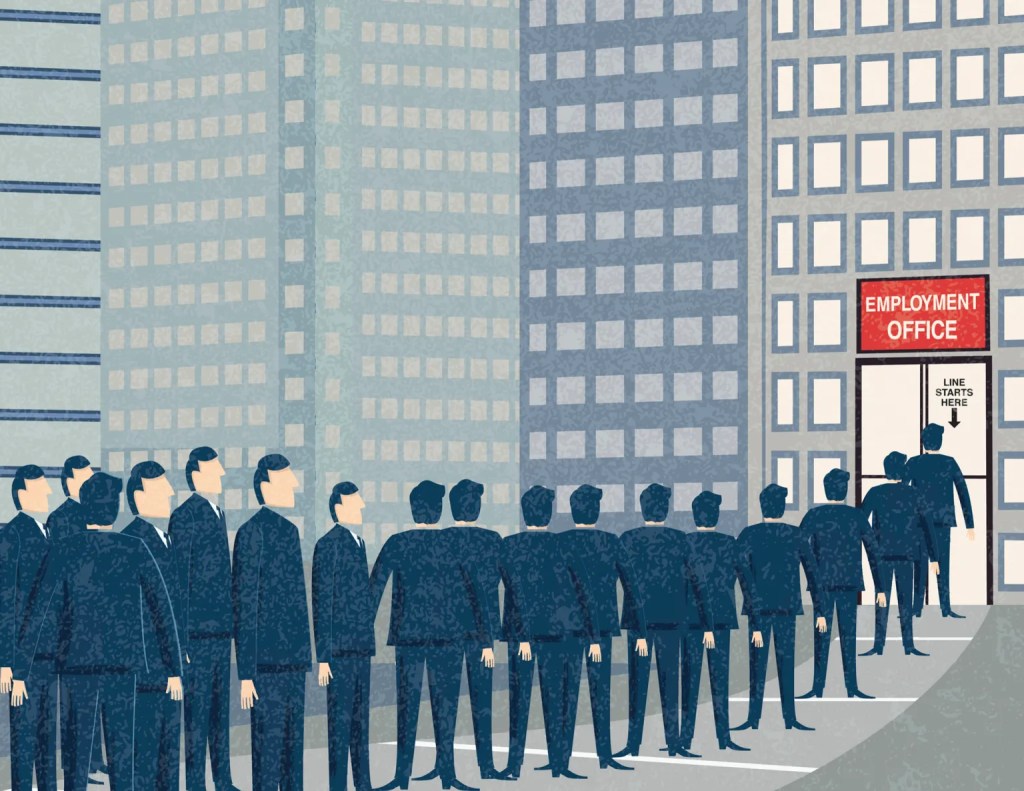
This is how we’ll end up with severe shortages of truly skilled labor and high unemployment of those who lack the necessary skills.
The labor force and the job market are referred to as if they were monolithic structures. But they’re not monolithic, they are complex aggregates of very different cohorts of age, skills, mobility, education, experience, opportunity, potential and motivation.
As a result, numbers such as the unemployment rate tell us very little about the labor force and the job market in terms of what matters going forward. So what does matter going forward?
1. Demographics–the aging and retirement of key sectors of the work force.
2. Skills and experience that will be increasingly scarce due to mismatched demand for skills that are diminishing as older workers retire.
3. What skills and experience will be demanded by re-industrialization, reshoring and expanding the electrification of the economy.
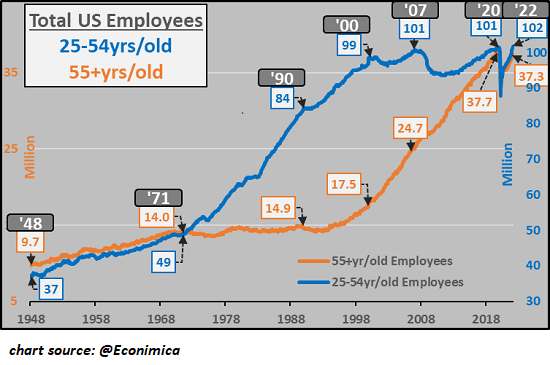
Consider these two charts of the US work force by age. (Courtesy of CH @econimica) In the first chart, Total US Employees, note that the prime working age work force (ages 25-54) has been flatlined for the past 20 years at 101-102 million. In contrast, the 55-and-older cohort of employees soared from 17 million to 37 million. This increase of 20 million accounts for virtually all growth in the employed work force.
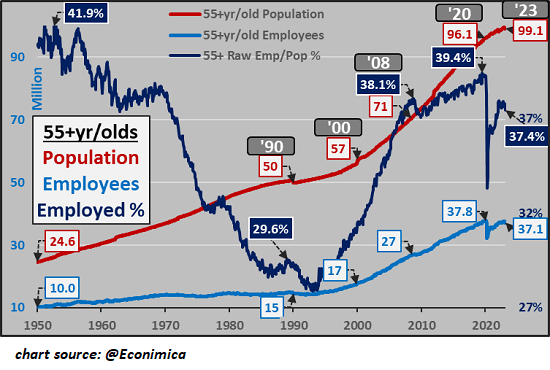
A funny thing happens as workers get old; they retire and leave the work force. Their skills and experience are no longer available to employers or the nation’s economy. The second chart shows the aging of the American populace, as the 55+ cohort increased from 57 million to 99 million since 2000, as the number of older employees skyrocketed from 17 million to 37 million.
While the total US population increased by 18% from 281 million in 2000 to 331 million today, the 55+ cohort increased 74% (from 57 million to 99 million).
The key takeaway here is the number of experienced workers who will retire in the next decade will track the explosive growth in the 55+ cohort. The general consensus is this will not be a problem because there are plenty of younger workers available to fill the vacated slots.
But this overlooks the qualitative and quantitative differences in the millions leaving the work force and those joining the work force. This is especially consequential in real-world jobs, i.e. all those jobs that require engaging real-world materials rather than staring at screens.
Though few analysts and commentators will admit to it, the implicit assumption is that the jobs that matter all involve staring at screens–processing data, finance, entertainment and shaping narrative make the world go round. All the real-world stuff (boring!) will magically get done by tax donkeys who are out of sight, out of mind.
This mindset has it backwards: it’s the real-world work of changing the industrial / energy / energy distribution foundation of the economy that matters going forward, not the staring-at-screens jobs.
What few seem to realize is the work force that’s aging and retiring is the cohort with the real-world skills. It’s a nice idea to remake the entire electrical grid of the nation to transport much larger quantities of electrical power, but who’s going to do all that work? Young people whose career goals are becoming YouTube influencers or day-traders? No. All the ChatAI bots in the world aren’t going to get the real work done, either.
In other words, there is a massive mismatch between the skills available to hire in the young-worker cohort and the skills and experience needed to rebuild the material, real-world foundations of the US economy. It’s well-known but apparently not worth worrying about that the average age of the US farmer is pushing 60 years of age. Nobody left to grow all our food? Hey, isn’t there a ChatAI bot to do all that for us? It can all be automated, right? No? Well, why not? Somebody out there, get it done! Food in super-abundance should be delivered to everyone staring at screens 24/7, it’s our birthright.
The average age of skilled tradespeople is also skewed to the aging work force. There is no easy way to quantify real-world skills gained by on-the-job experience. I suspect it follows a power-law distribution: the newly minted worker just out of school / apprenticeship can handle basic functions, but when tough problems arise, the number of workers with the requisite experience to diagnose and fix the problem diminishes rapidly.
This distribution presents an enormous problem for the economy and employers. Once the super-experienced workers who can solve any problem leave, they cannot be replaced by inexperienced workers. So when the really big problems arise, the systems will break down because those who knew how to deal with the problems are no longer available.
This is how you can have 10 million unemployed workers and 1 million unfilled positions that can’t be filled because few are truly qualified. You want to erect new electrical transmission lines? Nice, but you’re not going to get the job done with green workers accustomed to staring at screens. It takes years of hard labor to acquire even a bare minimum of the skills required. These are not assembly-line jobs that can be filled by unskilled labor, these are jobs in the messy real world, not a distribution center.
As I note in my book on Self-Reliance, individuals with a full spectrum of real-world skills are now extremely rare. Skills that were once common are now performed by specialists. We seem to have all the time in the world to stare at hundreds of cooking programs on TV but how many people actually prepare three meals a day, week in, week out, month in, month out, year in, year out? How many people know how to repair anything, build anything, or maintain a machine?
My direct experience is that many young people don’t know how to put air in the tires of the vehicle Mom and Dad gave them. Young people with graduate-level diplomas don’t know what a green bean plant looks like. (Eeew, gross, it grows in dirt?) The cultural value system that only values wealth, regardless of its source, and minting money from staring at screens has generated a fundamental mismatch between the skills that will be needed going forward and the skills being presented as oh-so-valuable.
Yes, there are many young workers with sharp real-world skills. The question is, are there enough?
This is how we’ll end up with severe shortages of truly skilled labor and high unemployment in the cohort of workers with few real-world skills and a surplus of skills for which there is limited demand. As a real-world experiment, go find a tough old rancher and ask them a series of questions about livestock, machinery, fencing, generators, etc., and then ask the average newly minted college graduate that followed the warped values embedded in our economy the same questions.
Of course the young worker can’t match the experience of the old worker, but do they have any experience at all of a spectrum of essential real-world skills? If not, do they have the requisite physical endurance and commitment needed to acquire real-world skills?
Who’s going to do all the real-world work going forward? A few people talk about it as an abstraction, but it’s not an issue to everyone focused on Federal Reserve policy or GDP. But eventually, the real world will matter more than staring at screens and day-trading, because when the systems break down due to lack of truly qualified employees, we’ll all wake up. But by then it will be too late. We’ll be staring at dead screens begging for somebody somewhere to restore power so we can continue playing with ChatAI to trade zero-day options.
By Thierry Meyssan
Source: VoltaireNet.org
Many are those who predict a World War. Indeed, some groups are preparing for it. But the States are reasonable and, in fact, consider rather an amicable separation, a division of the world into two different worlds, one unipolar and the other multipolar. Perhaps we are actually witnessing a third scenario: the “American Empire” is not struggling in the trap of Thucydides; it is collapsing like its former Soviet rival died.
The American “Straussians,” the Ukrainian “integral nationalists,” the Israeli “revisionist Zionists” and the Japanese “militarists” are calling for a generalized war. They are alone and they are not mass movements. No state has yet committed itself to this course.
Germany with 100 billion euros and Poland with much less money are rearming massively. But neither of them seems eager to take on Russia.
Australia and Japan are also investing in armaments, but neither of them has an autonomous army.
The United States is no longer able to replenish its military and is no longer able to create new weapons. They are content to reproduce the weapons of the 1980s in an assembly line fashion. However, they maintain their nuclear weapons.
Russia has already modernized its armies and is organizing itself to renew the ammunition it uses in Ukraine and to mass produce its new weapons, which no one can compete with. China, for its part, is rearming to control the Far East and, in the long term, to protect its trade routes. India thinks of itself as a maritime power.
It is therefore difficult to see who would and could start a World War.
Contrary to their speeches, French leaders are not at all preparing for a high-intensity war [1]. The military programming law, established for ten years, plans to build a nuclear aircraft carrier, but reduces the size of the army. It is a question of giving ourselves the means of projection, but not of defending our territory. Paris continues to reason as a colonial power while the world is becoming multipolar. It is a classic: the generals prepare for the previous war and ignore the reality of tomorrow.
The European Union is implementing its “Strategic Compass”. The Commission coordinates the military investments of its member states. In practice, they all play the game, but pursue different goals. The Commission, on the other hand, is trying to take control of decisions on the financing of armies, which until now have depended on their national parliaments. This would make it possible to build an empire, but not to declare a generalized war.
Clearly everyone is playing a game, but apart from Russia and China, none is preparing for a high-intensity war. Rather, we are witnessing a redistribution of the cards. This month, Washington is sending Liz Rosenberg and Brian Nelson, two specialists in unilateral coercive measures [2], to Europe with the mission of forcing the Allies to comply. In the words of former President George Bush Jr. during the war “against terrorism”: “Whoever is not with us is against us”.
Liz Rosenberg is efficient and unscrupulous. She is the one who brought the Syrian economy to its knees, condemning millions of people to poverty because they dared to resist and defeat the Empire’s surrogates.
The Hollywood western discourse a la George Bush Jr. of good guys and bad guys has failed with Türkiye, which has already experienced the 2016 coup attempt and the 2023 earthquake. Ankara knows that it has nothing good to expect from Washington and is already looking to the Shanghai Cooperation Organization. Yet the same discourse should succeed with the Europeans, who remain fascinated by the power of the United States. Of course this power is in decline, but so are the Europeans. No one has learned any lessons from the sabotage of the Russian-German-French-Dutch gas pipelines, North Stream. Not only did the victims take the blame without saying anything, but they are about to receive further punishment for crimes they did not commit.
The world should therefore be divided into two blocs, on the one hand the US hyperpower and its vassals, on the other the multipolar world. In terms of the number of states, this should be half and half, but in terms of population, only 13% for the Western bloc against 87% for the multipolar world.
The international institutions can no longer function. They should either fall into lethargy or be dissolved. The first examples that come to mind are the effective exit of Russia from the Council of Europe and the empty seats of Western Europeans in the Arctic Council during the year of the Russian presidency. Other institutions are no longer relevant, such as the Organization for Security and Cooperation in Europe (OSCE), which was supposed to organize East-West dialogue. Only the attachment of Russia and China to the United Nations should preserve them in the short term, as the United States is already thinking of transforming the Organization into a structure reserved exclusively for the Allied Nations.
The Western bloc should also reorganize itself. Until now, the European continent was dominated economically by Germany. In order to be certain that Germany would never get closer to Russia, the United States wanted Berlin to be content with the western part of the continent and leave the center in the hands of Warsaw. So Germany and Poland armed themselves to impose themselves in their respective zones of influence, but when the American star faded, they would fight against each other.
When the Soviet Empire fell, it abandoned its allies and vassals. Having seen its inability to solve the problems, the USSR first stopped supporting Cuba economically, then dropped its vassals of the Warsaw Pact, and finally collapsed on itself. The same process is beginning today.
The first U.S. Gulf War, the 9/11 attacks and their host of wars in the broader Middle East, the expansion of Nato and the Ukrainian conflict will have offered only three decades of survival to the American Empire. It was backed by its former Soviet rival. It has lost its raison d’être with its dissolution. It is time for it to disappear too.
Translation
Roger Lagassé
[1] «En 2030, l’armée française ne sera pas prête à une guerre de haute intensité», Jean-Dominique Merchet, L’Opinion, 7 avril 2023.
[2] «US sanction officials plan missions to clamp down on Russia», Fatima Hussein, Associated Press, April 7, 2023.
INDIAN COUNTRY NEWS
"It is the duty of every man, as far as his ability extends, to detect and expose delusion and error"..Thomas Paine
Human in Algorithms
From the Roof Top
I See This
blog of the post capitalist transition.. Read or download the novel here + latest relevant posts
अध्ययन-अनुसन्धानको सार
 After the Crash