Two for Tuesday
1

By Timothy Alexander Guzman
Source: Silent Crow News
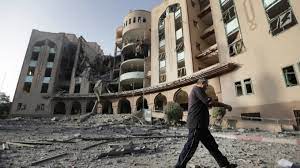
It’s not about Hamas, nor the Palestinian resistance hiding its weapons or any other excuse to attack Palestinian schools and universities, it’s a plot to destroy the Palestinian people. The Israeli government is deliberately targeting all educational institutions of Palestine whether they are in the Gaza strip or in the West Bank and beyond. So why would they do such a thing?
If the Palestinians don’t have educational institutions to train doctors, engineers, lawyers, historians, mathematicians, religious scholars, lawyers, and every other profession that is essential for a nation to survive and thrive, then what kind of society would they have? Trained doctors and nurses won’t be able to treat and cure their patients. Engineers and architects won’t be able to build critical infrastructure such as buildings, roads, water and sewer systems, railways and airports. An uneducated people won’t be able to maintain or compete with other countries in terms of finance and international trade with skilled accountants, economists, financial planners, and investment bankers. Professors, teachers, and school administrators won’t be able to teach their students reading and writing, math, history, religion and the sciences such as biology, chemistry and physics. Newspapers and media won’t have trained journalists, researchers, and radio broadcasters and so on. In other words, a nation without knowledge is doomed for failure and the Israelis are well aware of it.
Destroy the education of the Palestinians, you destroy a nation of people. Euro-Med Human Rights Monitor reported that “the Israeli army has killed 94 university professors, along with hundreds of teachers and thousands of students, as part of its genocidal war against Palestinians in the Gaza Strip.” Israel has killed many professors along with their family members in the Gaza Strip, “the Israeli army has targeted academic, scientific, and intellectual figures in the Strip in deliberate and specific air raids on their homes without prior notice. Those targeted have been crushed to death beneath the rubble, along with members of their families and other displaced families.” The number of Palestinian professors, teachers, administrators, and students killed is a sign that those involved in education is a legitimate target for the Israelis:
According to preliminary estimates, the ongoing Israeli attacks on the Gaza Strip have resulted in the deaths of hundreds of university students, reported Euro-Med Monitor. The rights group pointed out that destroying universities and killing academics and students will make it more difficult to resume university and academic life when the genocide ends, saying it may take years for studies to be resumed in an environment that has been completely destroyed.
According to the Palestinian Ministry of Education, 4,327 students have been killed and 7,819 others injured, while 231 teachers and administrators have been killed and 756 injured during the ongoing attacks. Meanwhile, 281 state-run schools and 65 UNRWA-run schools in the Gaza Strip have been completely or partially destroyed
Israel is targeting the cultural and historical properties of the Palestinian people to erase their history, but also to destroy any knowledge they have to rebuild their society:
Israel’s widespread and intentional destruction of Palestinian cultural and historical properties, including universities, schools, libraries, and archives, demonstrates its apparent policy of rendering the Gaza Strip uninhabitable, Euro-Med Monitor warned. The attacks are creating an environment devoid of basic services and necessities and may eventually force the Strip’s population to emigrate.
Euro-Med Human Rights Monitor stressed that the targeting of civilian objects by armed forces, particularly those that are historical or cultural artifacts protected by special laws, is not only a serious breach of international humanitarian law and a war crime under the Rome Statute of the International Criminal Court, but falls under the purview of the crime of genocide
There is an indication that there is an agenda behind the mass killings of people involved in education. The Toronto Star had an interesting article titled, ‘How Israel’s ‘scholasticide’ denies Palestinians their past, present and future’ said that “Academics raising concerns about this particular type of destruction call it “scholasticide,” and point to three related phenomena: the destruction of Gaza’s educational infrastructure, assaults on universities in Gaza and West Bank, as well as serious harassment and attacks on senior faculty and students supporting Palestine within the Israeli university system.” “Scholasticide’ is a term that shows how Israel’s destruction of the education system in Gaza directly impacts the past, present and future of the Palestinian people:
The destruction risks erasing Gaza’s past. For instance, the university that was blasted on Wednesday also housed a national museum containing rare artifacts. Whether those artifacts were destroyed or, as West Bank’s Birzeit University is accusing, stolen by Israel, they are lost to Palestinians. With archives and architecture destroyed, it’s as if Palestinians never lived there.
If the current situation continues, Gaza is also likely to be denied to its people in future. Israeli Prime Minister Benjamin Netanyahu reiterated his long-standing opposition to Palestinian statehood saying Thursday, “In the future, the state of Israel has to control the entire area from the river to the sea”
According to Abdel Razzaq Takriti, an associate professor of history at Rice University in Texas who is also the chair of the Arab American Educational Foundation said that “as scholars, we cannot fathom how it is possible that we’re supposed to stay silent while our colleagues are being bombed with bombs supplied by our countries” he also said that “this is an attack on the enlightenment in society” he continued“and it’s going to cause ignorance. It’s going to cause lack of opportunity. And it’s designed to do that. Scholasticide is a very dangerous aspect of genocide.”
It’s not just in Gaza, its all of Palestine’s educational institutions that are being targeted by the IDF forces. The Norwegian Refugee Council conducted a report from January 2018 until June 2020 and found that “Palestinian children in the West Bank contended with a deluge of attacks on education, at a crushing pace of 10 attacks per month, on average.” The research was based on a 30-month period and it “found that 296 attacks against education by Israeli forces or settlers and settlement private security guards took place during 235 separate incidents.”
Israel’s actions is nothing less than a diabolical plot to destroy a nation’s people. It gives the Israelis the excuse it needs to call the Palestinians animals who don’t even know how to read or write and that the Palestinians don’t know how to make a living and that’s why they are dependent on foreign aid. A report by Amnesty International said that “Palestinians across all areas under Israel’s control have fewer opportunities to earn a living and engage in business than Jewish Israelis” and that “They experience discriminatory limitations on access to and use of farmland, water, gas and oil amongst other natural resources, as well as restrictions on the provision of health, education and basic services.”
With no educational institutions to train and educate its people, the Palestinians will face a collapse of their society. Zionist warmongers want nothing more but to eradicate any hope for a better future for the Palestinian people by erasing all forms of education that would allow them to advance their society and that is something that the Israelis don’t want to see happen.

By Edward Curtin
Source: Dissident Voice
You have to hand it to the U.S. and its henchmen for brazenness. In order to protect their client state Israel and its genocide in Gaza, the U.S., together with the UK, have in one week launched air and sea attacks on the Houthis in Yemen five times, referring to it as “self-defense” in their Orwellian lingo. The ostensible reason being Yemen’s refusal to allow ships bound for Israel, which is committing genocide in Gaza, to enter the Red Sea, while permitting other ships to pass freely.
To any impartial observer, the Houthis should be lauded. Yet, while the International Court of Justice considers the South African charge of genocide against Israel that is supported by overwhelming evidence, the U.S. and its allies have instigated a wider war throughout the Middle East while claiming they do not want such a war. These settler colonial states want genocide and a much wider war because they have been set back on their heels by those they have mocked, provoked, and attacked – notably the Palestinians, Syrians, and Russians, among others.
While the criminalization of international law does not bode well for the ICJ’s upcoming ruling or its ability to stop Israeli’s genocide in Gaza, Michel Chossudovsky, of Global Research, as is his wont, has offered a superb analysis and suggestion for those who oppose such crimes: that Principle IV of the Nuremberg Charter – “The fact that a person [e.g. Israeli, U.S. soldiers, pilots] acted pursuant to order of his [her] Government or of a superior does not relieve him [her] from responsibility under international law, provided a moral choice was in fact possible to him.” – should be used to supplement the South African charges and appeal directly to the moral consciences of those asked to carry out acts of genocide. He writes:
Let us call upon Israeli and American soldiers and pilots “to abandon the battlefield”, as an act of refusal to participate in a criminal undertaking against the People of Gaza.
South Africa’s legal procedure at the ICJ should be endorsed Worldwide. While it cannot be relied upon to put a rapid end to the genocide, it provides support and legitimacy to the “Disobey Unlawful Orders, Abandon the Battlefield” campaign under Nuremberg Charter Principle IV.
While such an approach will not stop the continuing slaughter, it would remind the world that each person who participates in and supports it bears a heavy burden of guilt for their actions; that they are morally and legally culpable. This appeal to the human heart and conscience, no matter what its practical effect, will at least add to the condemnation of a genocide happening in real time and full view of the world, even though no one will ever be prosecuted for such crimes since any real just use of international law has long disappeared. Yet there is a edifying history of such conscientious objection to immoral war making, and though each person makes the decision in solitary witness, individual choices can inspire others and the solitary become solidary, as Albert Camus reminded us at the end of his short story, “The Artist at Work.”
With each passing day, it becomes more and more evident that Israel/U.S.A. and their allies do want a wider war. Iran is their special focus, with Gaza, the West Bank, Lebanon, Syria, Iraq, and Yemen targets on the way. Anyone who supports the genocide in Gaza, explicitly or through silence, bears responsibility for the conflagration to come. There are no excuses.
And the facts show that it is axiomatic that waging war has been the modus operandi of the U.S./Israeli alliance for a long time. Just as in early 2003 when the Bush administration said they were looking for a peaceful solution to their fake charges against Sadam Hussein with his alleged “weapons of mass destruction,” the Biden administration is lying, as the Bush administration lied about September 11, 2001 to launch its ongoing war on terror, starting in Afghanistan. Without an expanded war, President Biden – aka the Democrats, since he will most probably not be the candidate – and his psychopathic partner Benjamin Netanyahu, will not survive. It is bi-partisan war-mongering, of course, internationally and intramurally, since both U.S. political parties are controlled by the Israel Lobby and billionaire class that owns Congress and the “defense” industry that thrives on never-ending war to such an extent that even the notable independent candidate for the presidency, Robert Kennedy, Jr., who is running as an anti-war candidate, fully supports Israel which is tantamount to supporting Biden’s expanding war policy.
Biden and Netanyahu, who are always claiming after the fact that they were surprised by events or were fed bad advice by their underlings, are dumb scorpions. They are stupid but deadly. And many people in the West, while perhaps decent people in their personal lives, are living in a fantasy world of “sincere ignorance and conscientious stupidity,” in MLK, Jr.’s words, as the growing threat of a world war increases and insouciance reigns.
Neither the Israeli nor American government can allow themselves to be humiliated, U.S./NATO by the Russians in Ukraine and the Israelis by the Palestinians. Like cornered criminals with lethal weapons, they will kill as many as they can on their way down, taking their revenge on the weakest first.
Their “mistakes” are always well intentioned. They stumble into wars through faulty intelligence. They drop the ball because of bureaucratic mix-ups. They miscalculate the perfidy of the moneyed elites whom allegedly they oppose while pocketing their cash and ushering them into the national coffers out of necessity since they are too big to fail. They never see the storm coming, even as they create it. Their incompetence or the perfidy of their enemies is the retort to all those “nut cases” who conjure up conspiracy theories or plain facts to explain their actions or lack thereof. They are innocent. Always innocent. And they can’t understand why those they have long abused reach a point when they will no longer impetrate for mercy but will fight fiercely for their freedom.
All signs point to a major war on the horizon. Both the U.S.A. and Israel have been shown to be rogue states with no desire to negotiate a peaceful world. Believing in high-tech weapons and massive firepower, neither has learned the hard lesson that anti-colonial wars have historically been won by those with far less weapons but with a passionate desire to throw off the chains of their oppressors. Vietnam is the text-book case, and there are many others. Failure to learn is the name of their game.
The Zionist project for a Greater Israel is doomed to fail, but as it does, desperate men like Biden and Netanyahu are intent on launching desperate acts of war. Exactly when and how this expanded war will blaze across the headlines is the question. It has started, but I think it prudent to expect a black swan event sometime this year when all hell will break loose. The genocide in Gaza is the first step, and the U.S./Israel, “not wanting” a wider war, have already started one.
(For an excellent history lesson on the Zionist oppression of Palestinians and the current genocide, listen to Max Blumenthal’s and Miko Peled’s impassioned talk – “Where is the War in Gaza Going? – delivered from the heart of darkness, Washington D.C. Two Jewish men who know the difference between Zionism and Judaism and whose consciences are aflame with justice for the oppressed Palestinians.)
By Andy Prisbylla
Source: We Are The Mutants
In our current technocratic society, it’s incredibly rare to meet someone who is genuinely free. The erosion of the Consent Decrees of 1948—which allowed media conglomerates to own and control movie theaters—drastically altered the landscape of film and video production, further destabilizing an already unlevel playing field between corporate interests, content creators, and consumers. The trickle-down economics Reagan touted in his 1981 tax act proved only to favor the affluent, further alienating independent creators who were frozen out of a livelihood through economic blacklisting, a perpetual attack that continues to this day. Bill Clinton’s elimination of the fin-syn rules that required television networks to source 35% of their content from independent producers only helped to continue this trend into the new millennium, and soon the mainstream movie and TV-consuming public was offered a slate of hegemonic programming supplied by a monopoly rule.
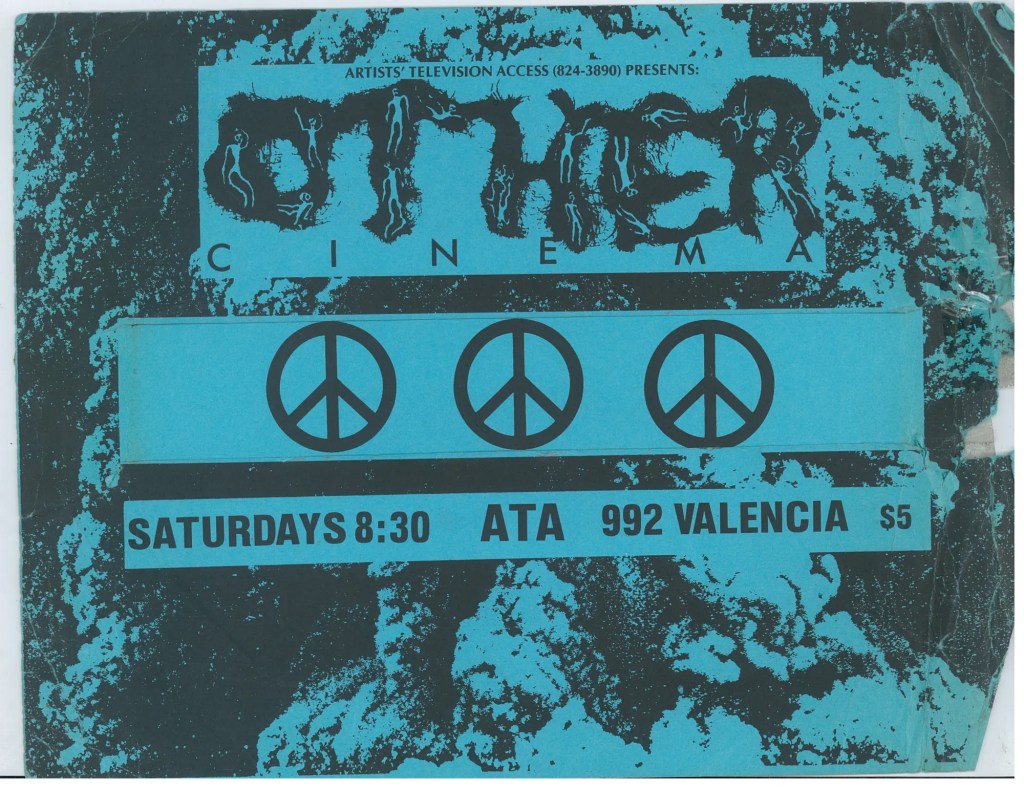
With traditional avenues of information exchange becoming more restricted, pockets of transgressive media resistance—inspired by the countercultural film and video collectives of the ‘60s and ‘70s—gained 501(c)(3) non-profit status in 1980s America. These artist-run community organizations championed alternative educational perspectives on media literacy and performance, such as Artists’ Television Access in the Mission District of San Francisco, California. Operating under the umbrella of this community space exists a cinematic collective with a subversive trajectory: a film screening series and analog archive curated from the margins of mainstream media and acceptable art practice. Under the stewardship of underground filmmaker and curator Craig Baldwin, Other Cinema stands as the vanguard of Baldwin’s personal artistic conviction—what he calls “cinema povera,” an anti-capitalist filmmaking creed where artists only use the materials at their disposal to create art. Combine this practice with an ethos of media archeology and mixed-media collage that predates our current remix culture activities and what’s generated is an exhibition calendar of the modern avant-garde—a thirty-six week screening schedule projecting experimental film and video to the masses. Every Saturday night, cartoons, B movies, and commercials hold equal ground with industrial, educational, documentary, personal essay, and public domain/orphan films, bringing together numerous artists and filmmakers from around the world under one cinematic ceiling for close to 40 years.
Specific details surrounding the origins of Other Cinema are hard to quantify, partially due to the vastly prolific yet oddly cryptic career of founder Craig Baldwin. Born into a self-admitted 1950s middle-class existence in the Sacramento suburb of Carmichael, California, Baldwin spent his teenage years nurturing a ravenous curiosity for subversive cultures and media. During high school, he was often at the local Towne Theater enjoying the latest midnight show of underground programming, absorbing the cinematic combustion of the ‘60s experimental scene led by filmmakers like George Kuchar and Bruce Conner, who as a teacher would later kick Baldwin out of his film class while attending San Francisco State University. In college Baldwin also indulged in subterranean films such as Peter Watkins’s 1966 pseudo-doc The War Game and exploitation flicks like Paul Bartel’s 1975 sci-fi dystopian romp Death Race 2000. Forming a fascination with film exhibition, Baldwin worked as a projectionist at several movie houses throughout the city, navigating the film worlds through an eclecticism of arthouse, exploitation, pornography, and political activism—including contributing programming and film services to El Salvador Film and Video Projects for the Salvadoran solidarity movement of northern California. His early activism with the artistic political action collective the Urban Rats saw him and his cohorts reclaim San Francisco’s urban landscape through adverse possession or “squatter’s rights,” which allowed Baldwin to experiment with expanded cinema performance, such as projecting film in abandoned buildings and other derelict dwellings.
This direct approach towards genre and social action speaks to Baldwin’s personal opposition towards the status quo, an attitude that not only informs Other Cinema’s motion picture programming but also Baldwin’s own filmmaking forays. His early experiments with Super 8 film—such as the prototypical culture jam/situationist prank Stolen Movie—bled into his 16mm attacks on advertising, consumerism, and colonialism in Wild Gunman and RocketKitKongoKit before gaining maximum velocity with his Dexedrine-driven, countermyth conspiracy report Tribulation 99. Making up the pure found footage/collage aesthetic of his filmography until introducing live-action performance into the mix with his films !O No Coronado!, Spectres of the Spectrum, and Mock Up on Mu, these early works draw heavily from Baldwin’s now massive archive of analog film. Housed beneath the Artists’ Television Access property, this subterranean scroll of marginalized media is continuously rescued from the bowels of civilization’s ever evolving technological burden and given new purpose. The shift from film in the 1970s to magnetic tape in the 1980s saw major institutions overhaul their audio/visual collections in favor of more economical video formats, sending reels of celluloid to the dumpsters and landfills. Much like the Dadaists of the early 20th century avant-garde, whose use of appropriation and photomontage expressed anti-bourgeois protest through their art, Baldwin and company salvaged these bastardized works from material obscurity and celebrated their ephemeral nature through collage and remix. These hybrid works of the late 20th century serve as precursor to many of our current 21st century new media innovations, resulting in the continued radicalization of modern artistic folklore, such as the mashups and supercuts of Everything Is Terrible! and the radical anti-authoritarian statements of the sister collective Soda Jerk.
Baldwin and Other Cinema’s defense of the diminished and discarded extends not only to the physical media he interacts with but to the audience he exhibits for. Maintaining a dialectical attitude, Baldwin expresses both respect and disrespect towards film genre and classification by spinning one off the other and forming new categories. Each screening is meant to give equal weight to diverse voices and provoke participation amongst attendees—an ethos Baldwin codified with his underground screening series The RAD, The MAD & The BAD while programming film events for Artists’ Television Access during the organization’s formative years. A protean yet practical film genre grouping system sorted through three major categories stripped of pretense and soaked in punk rock colloquialism, each selection was designated its own time slot on Wednesdays and Saturdays with those represented creating a continuity across each section:
The RAD: showcasing political and social action films
The MAD: mad genius or auteur cinema
The BAD: psychotronic themes of horror/sci-fi/exploitation
Defying the unspoken restraint behind many traditional classification systems that favor a false high-brow aesthetic to an honest low-brow sensibility, The RAD, The MAD & The BAD crossed the cultural demarcation line with an egalitarian stance towards genre representation, allowing for serious discussion about what constitutes a film’s importance and its commodification within society. More importantly, it displayed through example that poor production doesn’t always mean poor quality, and films created on the margins of capital contain a certain cultural influence and accessibility that corporate-backed productions can only hope to afford or inspire.
The authentic response audiences gave towards the weekly film schedule at Artists’ Television Access saw the prestigious San Francisco Cinematheque approach Baldwin to bring his street sensibility to their precocious crowd with Sub-Cinema, a RAD, MAD & BAD-inspired program that ran over the course of 1985. The creation of other pop-up programs like Anti-Films and Eyes of Hell inspired Baldwin to consolidate his film selections under his own programming umbrella, and soon the ethos that fueled The RAD, The MAD & The BAD manifested itself into the physical embodiment of Baldwin’s own psyche and practice with the foundation of Other Cinema.
If the RAD, MAD & BAD helped bring acceptance to the concept of marginalization in film selection and exhibition during the 1980s, the programming behind Other Cinema built upon this provocation by introducing new alternative voices from the microcinema scene of the 1990s. One of the forefronts of this new cinematic experience, Other Cinema became a home for a subculture of film using and reusing old and new technologies to create future underground works, with filmmakers and exhibitors from across the country like Sam Green, Martha Colburn, Greta Snider, Bill Daniel, Orgone Cinema, 3Ton Cinema, and “others” coalescing to this space like the children of Hamelin to the Pied Piper’s whimsical flute. Many of these groups and individuals appear in Baldwin’s upcoming career monograph Avant to Live!, a 500-page treatise detailing his cinematic trajectory in the media arts.
The decline of physical media coupled with our perpetual progression towards a digital state continues to divide us, with some championing the virtual realm and its democratization of new technologies and others questioning its effect on the human experience and how we interact with each other. The popularity of streaming services continues to challenge the economic longevity of physical media, forcing film formats into a wave of obsolescence. Despite this, Craig Baldwin and Other Cinema rise against the tide with an analog assault of expanded cinema every Saturday night. Filmmakers on the fringe and maverick media archeologists with an overwhelming responsibility to film history, yet hamstrung by a lack of resources, congregate at Other Cinema to embrace the struggle in an ever evolving motion picture renaissance. It’s a form of masochism one needs to make it on this side of the art world—the “masochism of the margins,” as Baldwin often says. It takes pain and sacrifice to live here, yet the psychic rewards far outweigh the material loss.
Craig Baldwin: Avant to Live! is a collaborative project between San Francisco Cinematheque and INCITE: Journal of Experimental Media and was released on May 30, 2023.
Andy Prisbylla is an underground filmmaker and exhibitor from the rust belt apocalypse of Steel City, PA. His screening series SUBCINEMA showcases subterranean movies and art through digital programming and live pop-up events. Find out more through Letterboxd and Mastodon.

A fistful of samurai
By Roger Ebert
Source: RogerEbert.com
Almost the first thing the samurai sees when he arrives is a dog trotting down the main street with a human hand in its mouth. The town seems deserted until a nervous little busybody darts out and offers to act as an employment service: He’ll get the samurai a job as a yojimbo — a bodyguard. The samurai, a large, dusty man with indifference bordering on insolence, listens and does not commit. He wants sake and something to eat.
So opens “Yojimbo” (1961), Akira Kurosawa’s most popular film in Japan. He was deliberately combining the samurai story with the Western, so that the wind-swept main street could be in any frontier town, the samurai (Toshiro Mifune) could be a gunslinger, and the local characters could have been lifted from John Ford’s gallery of supporting actors.
Ironic, that having borrowed from the Western, Kurosawa inspired one: Sergio Leone’s “A Fistful of Dollars” (1964), with Clint Eastwood, is so similar to “Yojimbo” that homage shades into plagiarism. Even Eastwood’s Man With No Name is inspired, perhaps, by the samurai in “Yojimbo.” Asked his name, the samurai looks out the window, sees a mulberry field, and replies, “Kuwabatake Sanjuro,” which means “30-year-old mulberry field.” He is 30, and that is a way of saying he has no name.
He also has no job. The opening titles inform us that in 1860, after the collapse of the Tokugawa Dynasty, samurai were left unemployed and wandered the countryside in search of work. We see Sanjuro at a crossroads, throwing a stick into the air and walking in the direction it points. That brings him to the town, to possible employment, and to a situation that differs from Hollywood convention in that the bad guys are not attacking the good guys because there are no good guys: “There is,” the critic Donald Richie observes, “almost no one in the whole town who for any conceivable reason is worth saving.” It’s said Kurosawa’s inspiration was Dashiell Hammett’s novel Red Harvest, in which a private eye sets one gang against another.
Sanjuro’s strategy is to create great interest about himself while keeping his motives obscure. He needs money and so presumably must hire himself out as a bodyguard to one of the two warring factions. There is the silk dealer and the sake merchant, both with private armies, who occupy headquarters at either end of the town. In between, the townspeople cower behind closed shutters and locked doors, and the film’s visuals alternate between the emptiness of the windswept street, shots looking out through the slats of shutters and the chinks in walls, and shots from outdoors showing people peering through their shutters.
Richie, whose writings on Kurosawa are invaluable, notes that Kurosawa’s shots are always at right angles to what they show; they either look straight up and down the street, or straight into or out of the buildings, and “there are very few diagonal shots.” The purpose may be to emphasize the simplicity of the local situation: Two armies face each other, the locals observe the main street as if it’s a stage, and the samurai himself embodies the diagonal — the visitor who stands at an angle to everyone and upsets the balance of power. Indeed, in a crucial early scene, as the two sides face each other nervously from either end of the street and dart forward fearfully in gestures of attack, Sanjuro sits high above the action in the central bell tower, looks down and is vastly amused.
His strategy is to hire himself out as a yojimbo to first one side and then the other, and do no actual bodyguarding at all. His amorality is so complete that we are a little startled when he performs a good deed. A farmer and his wife, possibly the only two good people in the town, are kidnapped. Sanjuro, employed by the side that kidnapped them, kills their six guards, frees them, tears up a house to make it look like there was a fierce struggle, and blames it on the other side. Disloyal to his employer? Yes, but early in the film, he is offered 50 ryo by one of the leaders, only to overhear the man’s wife telling him, “We’d save the whole 50 ryo if we killed him after he wins.”
Sanjuro’s strategy is an elaborate chess game in which he is playing for neither side but plans instead to upset the board. “In this town, I’ll get paid for killing,” he muses, “and this town would be better off if they were dead.” His planning is upset by the unexpected appearance of Unosuke (Tatsuya Nakadai), the younger brother of one of the sake dealer’s bodyguards. The samurai often walk about with their empty sleeves flapping at the sides, their arms folded inside their kimonos. (Eastwood, in the Leone movies, always keeps one hand under his poncho.) When Unosuke finally reveals one of his hands, it holds a pistol — the first one seen in the village. This upsets the balance of power and tilts against Sanjuro’s plans, which depend on his skill as a swordsman who can kill any number of the others without being wounded himself.
The gun provides Unosuke with a sneaky kind of self-confidence, and he produces the weapon gloatingly from time to time. Occasionally, he kills people in cold blood, just to prove that he can, in events leading up to a final bloodbath. One of the first people Sanjuro meets in the town is the coffin-maker, and there is a nice moment when he first goes out to do battle and advises him, “Two coffins. Noon, maybe three.” By the end there is no business for the coffin-maker, because there is no one to pay for coffins.
That kind of dark humor is balanced in the film by other moments approaching slapstick, as when the injured Sanjuro is smuggled away in a large barrel; when his bearers pause in the middle of the street, the samurai tilts up the lid of the barrel to provide a droll commentary on the progress of the manhunt for him.
Richie believes “Yojimbo” is the best-photographed of Kurosawa’s films (by Kazuo Miyagawa, who also shot “Rashomon” and such other Japanese classics as Ozu’s “Floating Weeds” and Mizoguchi’s “Ugetsu“). The wide screen is fully employed for dramatic compositions, as when the armies face each other across an empty space. And there is a dramatic sense of depth in scenes were Sanjuro holds the foreground while forces gather in the background. Shutters, sliding doors and foreground objects bring events into view and then obscure them, and we get a sense of the town as a collection of fearful eyes granted an uncertain view of certain danger.
“Yojimbo” was followed quickly by Kurosawa’s “Sanjuro” (1962), which also stars Mifune, the greatest modern Japanese actor, playing the same character or one so similar as makes no difference. He acts as the adviser for nine uncannily similar brothers who are remarkably inept samurai. The choreography in “Sanjuro” is one of its best jokes; the brothers do everything together: Nod, recoil, agree, laugh, gasp, and they follow Sanjuro in a kind of conga line, until he snaps, “We can’t move around like a centipede.”
The difference between the two films is that “Sanjuro” is a comedy in which ancient samurai traditions are exposed as ludicrous by the pragmatic hero, while “Yojimbo” is more subversive: The samurai were famed for their unyielding loyalty to their employers, but Sanjuro, finding himself unemployed because of the collapse of the feudal system, becomes a modern man and is able to manipulate both sides because they persist in thinking he will be faithful to those who pay him.
There is a moment at the end when old and new hang in the balance. The wounded Sanjuro no longer has his sword, but we have seen him practicing with a knife — skewering a bit of paper as it flutters around a room. He faces Unosuke, the gunman. Without revealing precisely what happens between them, let me ask you to consider the moment when Unosuke aims his pistol at Sanjuro. It may be loaded, it may not be. Sanjuro cannot be absolutely sure. He is free to move away or to disarm Unosuke, but instead he sits perfectly motionless, prepared to accept whatever comes. This, it strikes me, is the act of a samurai aware that his time has passed and accepting with perfect equanimity whatever the new age has to offer.

By Phil Butler
Source: New Eastern Outlook
If you read Western mainstream propaganda these days, you’ll find the truth hidden so deep no archaeologist could unearth it. A case in point is a buried lead in a story from the New York Post suggesting Russia has secret plans to hit NATO hard in the coming months.
According to the Post’s Chris Nesi, leaked secret documents released by German newspaper BILD tell of Europe preparing for Vladimir Putin to expand his military operation in Ukraine and to attack NATO ally countries next year. If readers take the headline and a keen graphic illustrating Putin’s alleged diabolical plan, you’d be in the right stocking up those bomb shelters in Wisconsin and Luxembourg.
Fortunately, Nesi’s story is entirely misleading. It suggests BILD got hold of Russian secret plans, conveniently categorised as a “plot” to sound more sinister, when in fact, German generals made plans to etch out WW3 like some chessboard game. The New York Post super sleuth waited until the article’s end to tell readers the truth about these “plans.” Here’s the passage.
“While the plans obtained by BILD are a potential scenario prepared by generals in the German army, European allies take Russia’s threat seriously and are preparing accordingly.”
The biggest problem with these misleading stories is the downstream effect of main outlets, and their tabloid cousins, spreading the lies to the broader public. Iona Cleave of The Sun titled her version “COUNTDOWN TO CONFLICT Putin’s ‘step-by-step plan to bring West to brink of WW3’ revealed in leaked intel doc…including date of ‘Day X’ in 2025.” In this case, the lead of the story is not just buried. It’s cremated and scattered into the digital air before publication by the tabloid. Still, grocery shoppers in London and Edinburgh catch the stunning revelations about “X-Day” while waiting in the checkout line. The Putin bad man campaign continues, and the everyday citizen wonders what their government will do to protect them.
Then the narrative arrives for curious business people via Banking News: “Britain sends 20,000 troops to mammoth NATO exercise against ‘Putin threat’.” Mail Online takes things further by quoting the former head of NATO forces in Europe, retired Lieutenant General Ben Hodges, assuring readers the “plot” is actual. So, the German Ministry of Defence’s so-called step-by-step doomsday guide is deftly transformed into a bored staff officer scenario-building game in leather armchairs somewhere beneath the Brandenburg Gate into a bonafide Putin strategy to take over Europe.
The media is not the only conduit for Russophobia these days. Leaders of state like Rishi Sunak, Prime Minister of the UK, say the Russians will not stop at Ukraine’s borders. American President Joe Biden has warned my people that if Putin wins a victory over Ukraine, Russia will attack a NATO country. And the minions of continual conflict for the Liberal Order are out in force in academia, business, and on the NGO and think tank circuit. One fine example is retired Colonel Hamish de Bretton-Gordon, who’s gone on the media/propaganda circuit to sell more gas masks and military headgear via companies he’s affiliated with, told The Telegraph, “Putin may be about to launch an apocalyptic assault.” For those unfamiliar, Colonel Hamish Stephen de Bretton-Gordon commanded NATO’s Rapid Reaction CBRN Battalion between 2005 and 2007. He was in all the right places about the time America was introduced to the post-9/11 idea of a “war on terror.” He later led a company profiting from his and other analysts’ apocalyptic prophecies. When regime change schemes came to Syria, it was the good colonel who “informed” the House of Commons and the waiting BBC audience of Assad’s alleged use of chemical weapons on his people. Bretton-Gordon and many others trained by the spooks and the Anglo-American military-industrial complex play a continuous melody of crisis and fear.
“The receptivity of the masses is very limited, their intelligence is small, but their power of forgetting is enormous. In consequence of these facts, all effective propaganda must be limited to a very few points and must harp on these in slogans until the last member of the public understands what you want him to understand by your slogan.” ― Adolf Hitler
Logic, the holy of holies these days, seems as lost as the Ark of the Covenant. Who could fail to notice, for instance, Russia taking up a defensive stance to save her soldiers’ lives and those of countless civilians in Ukraine cities like Kyiv, Karkhov, and Dnipro? With nearly half a million troops held in reserve and with Ukraine’s forces decimated, why haven’t the Russians already pushed through the weak spots on the way to the Dnieper River? And what about the billions and billions in arms and cash Western states have now lost to an impossible cause?
Looking at the latest tally of destroyed Ukraine equipment since the start of the operation tells the real story. So far, the Russians have knocked out almost 600 Ukrainian warplanes, 265 helicopters, almost 11,000 UAVs, 450 SAM systems, 14,645 tanks and armoured vehicles, 1,202 rocket launching systems, 7,750 artillery pieces, and 17,507 special military vehicles. Unbiased experts put the number of Ukraine dead at between 400 and 500 thousand combatants. And the number of wounded surely exceeds a million by now.
And finally, let’s remember that the elitist-controlled Western media, the politicians, and the so-called experts have been telling us Russia was finished for years now. Sanctions, the blown-up pipeline, and the weapons and money dump to Zelensky were supposed to weaken Russia. This is not the truth. Russia is more vital now than ever since the 1980s, militarily and economically. This points to another point of lost logic. Why would Russia want to take over states protected by NATO? Europe is a consumer continent. It’s where a billion people need feeding, not a breadbasket for good Russian families. There is nothing in Europe that Russia needs. It is Europe, on the other hand, that desperately needs Russia and the other BRICS countries. So, who are the most likely aggressors in all this?
Never believe their slogans, especially not NATO/good, Russia/bad.

By Peter Van Buren
Source: WeMeantWell.com
Joe Biden ordered airstrikes on Iraq, against Iranian-backed militants, in retaliation for recent attacks by those militants that severely injured three American soldiers. Joe didn’t consult with Congress or anyone else before ordering the strikes, and no declaration of war exists of course. Yet no one believes the militias, following their spanking, will disappear or stop harming Americans.
That sums up the Biden Foreign Policy, call it a doctrine if you’d like: a series of geopolitically unsuccessful, inconsequential, mostly reactive unilateral actions, with no end game. Underlying it all is the sense that no one is particularly frightened, respectful or wary of American power anymore. Let’s see how this worked on a global scale over the last three bloody years.
The disastrous evacuation of Kabul in August 2021 should have warned all of us we were dealing with foreign policy amateurs. The rush for the last planes was an expected unexpected event. Yet the Biden administration did not quietly start the evacuation in February with high-value personnel, nor did it negotiate ahead of time for third country landing rights. Mistakes made as long ago as Vietnam evacuating locals who worked with us were clear, yet Biden did not kick start processing SIV visas for translators and others until literally the last flights were scheduled out. The entire evacuation appeared as an unplanned free fall, just “land some planes and see if that works.” No endgame really, simply a unilateral decision to cap the evacuation off at a certain point in time and declare it over no matter who was or was not saved.
Ukraine is some yellowed vision of cold war. The Biden plan was based on a Wonka-like act of imagination, that U.S. arms wielded by amateur fighters backed up by intelligence, space-based targeting, and special forces infiltrated on the ground would hastily defeat a determined opponent (See Afghanistan, failure of the same strategy, 2001-2003.) When the miracle cure strategy failed, there was no Plan B except to continue to pour arms in to a war that had no clear end game, that was not winnable, only sustainable. Meanwhile, Biden restrictions on domestic mining mean the United States is the largest purchaser of Russian enriched uranium. If the Russians are scared of American power they hide that well.
The results have not been better elsewhere. The 2022 Russian invasion of Ukraine preceeded what one pundit described as “the 2023 brazen Chinese spy balloon’s uncontested trajectory over the United States, the recent Hamas invasion of Israel, the serial Iranian-fueled terrorist attacks on U.S. installations in Iraq and Syria, and the terrorist Houthis’ veritable absorption of the Red Sea. America’s enemies had become opportunistic, not deterred.” Biden took the bait at each open-ended opportunity, and now Joe is dangerously close to letting Gaza and Yemen spiral into a global conflict.
And so another “coalition” fight, this time in Ukraine with NATO, ended up a U.S. primary struggle. It is NATO mostly walking away from the meat of the Ukraine struggle, and the baby NATO coalition elsewhere of France, Italy, and others that was supposed to control the Red Sea breaking down. It is a thin gruel of happy talk about caring for civilians backed up by unlimited arms to Israel, handled so poorly diplomatically that the U.S. has inherited pariah status globally. The modern version of American power was demonstrated when Egypt snubbed Joe Biden’s visit over the mess in Gaza. The question of Palestine, always simmering, is now another major issue to divide Red and Blue and further polarize society. In addition to receiving $6 billion in frozen oil funds from Biden as a ransom for five American hostages, Iran controls the playbook, attacking with impunity via its proxies across Iraq, Syria, and southern Lebanon; Iran’s partners carried out more than 100 attacks on U.S. forces in Iraq, Syria and the Red Sea. They decide if and when the 1:1 conflict with Israel goes regional, and the U.S. will be again forced to react. The Houthis, also Iran-backed, have dragged the U.S. into a broad promise to keep the Red Sea open to shipping, as the world rolls its eyes as Pax Americana once again looks like a punchline. Can anyone say we are still indispensable?
Another Biden foreign policy disaster has come home, literally, in the immigration crisis. For reasons too vague to enunciate, the Biden administration did away with any semblance of immigration law and flung open the southern border to anyone interested in wandering in. Already more than eight million illegal entrants have come across, with another quarter-million entering each month. As in Ukraine and elsewhere, there is no endgame. When will the border close? How much will caring for the millions cost (New York City has processed more than 160,000 migrants; some 70,000 remain in the city’s care. In Denver, caring for the new migrants has consumed 10 percent of the city’s budget)? The United States has now exceeded, both in real numbers and in percentages, all past numbers of non-native born American residents. What impact on our greater society will such an influx have, especially given how it is targeted at a handful of cities? Will the Russians ever surrender? What about the immigrants?
Three years ago, there was no war in Ukraine and certainly no U.S. military involvement in the Crimea and Donbas. Israel and Hamas existed in their tinder-like stasis condition, no brutal massacre of 1,600 Jews (30 of whom were Americans) and no invasion of Gaza. Campus protestors limited their protestations that they were not anti-Semitic in their hatred of Israel. Iran and the U.S. cooperated on fighting ISIS in Iraq, uneasy partners for certain but not shooting cousins as now. The Houthi struggle was confined within Yemen’s borders. On the positive side, efforts were being made to watch diplomacy bloom with North Korea, which instead is now test firing missiles aplomb once again. Biden has made no progress on China either to limit their opportunistic stance or reduce their hold over America economically. Biden has largely ignored most of Africa and South America as well as the world’s most populous democracy (and nuclear power) India. It is impossible to call it progress and all too easy to call it sadly the Biden Doctrine.

By John & Nisha Whitehead
Source: The Rutherford Institute
“When the President does it, that means that it is not illegal.”—Richard Nixon
Many years ago, a newspaper headline asked the question: “What’s the difference between a politician and a psychopath?”
The answer, then and now, remains the same: None.
There is no difference between psychopaths and politicians.
Nor is there much of a difference between the havoc wreaked on innocent lives by uncaring, unfeeling, selfish, irresponsible, parasitic criminals and elected officials who lie to their constituents, trade political favors for campaign contributions, turn a blind eye to the wishes of the electorate, cheat taxpayers out of hard-earned dollars, favor the corporate elite, entrench the military industrial complex, and spare little thought for the impact their thoughtless actions and hastily passed legislation might have on defenseless citizens.
Psychopaths and politicians both have a tendency to be selfish, callous, remorseless users of others, irresponsible, pathological liars, glib, con artists, lacking in remorse and shallow.
Charismatic politicians, like criminal psychopaths, exhibit a failure to accept responsibility for their actions, have a high sense of self-worth, are chronically unstable, have socially deviant lifestyles, need constant stimulation, have parasitic lifestyles and possess unrealistic goals.
It doesn’t matter whether you’re talking about Democrats or Republicans.
Political psychopaths are all largely cut from the same pathological cloth, brimming with seemingly easy charm and boasting calculating minds. Such leaders eventually create pathocracies: totalitarian societies bent on power, control, and destruction of both freedom in general and those who exercise their freedoms.
Once psychopaths gain power, the result is usually some form of totalitarian government or a pathocracy. “At that point, the government operates against the interests of its own people except for favoring certain groups,” author James G. Long notes. “We are currently witnessing deliberate polarizations of American citizens, illegal actions, and massive and needless acquisition of debt. This is typical of psychopathic systems, and very similar things happened in the Soviet Union as it overextended and collapsed.”
In other words, electing a psychopath to public office is tantamount to national hara-kiri, the ritualized act of self-annihilation, self-destruction and suicide. It signals the demise of democratic government and lays the groundwork for a totalitarian regime that is legalistic, militaristic, inflexible, intolerant and inhuman.
Incredibly, despite clear evidence of the damage that has already been inflicted on our nation and its citizens by a psychopathic government, voters continue to elect psychopaths to positions of power and influence.
Indeed, a study from Southern Methodist University found that Washington, DC—our nation’s capital and the seat of power for our so-called representatives—ranks highest on the list of regions that are populated by psychopaths.
According to investigative journalist Zack Beauchamp, “In 2012, a group of psychologists evaluated every President from Washington to Bush II using ‘psychopathy trait estimates derived from personality data completed by historical experts on each president.’ They found that presidents tended to have the psychopath’s characteristic fearlessness and low anxiety levels — traits that appear to help Presidents, but also might cause them to make reckless decisions that hurt other people’s lives.”
The willingness to prioritize power above all else, including the welfare of their fellow human beings, ruthlessness, callousness and an utter lack of conscience are among the defining traits of the sociopath.
When our own government no longer sees us as human beings with dignity and worth but as things to be manipulated, maneuvered, mined for data, manhandled by police, conned into believing it has our best interests at heart, mistreated, jailed if we dare step out of line, and then punished unjustly without remorse—all the while refusing to own up to its failings—we are no longer operating under a constitutional republic.
Instead, what we are experiencing is a pathocracy: tyranny at the hands of a psychopathic government, which “operates against the interests of its own people except for favoring certain groups.”
Worse, psychopathology is not confined to those in high positions of government. It can spread like a virus among the populace. As an academic study into pathocracy concluded, “[T]yranny does not flourish because perpetuators are helpless and ignorant of their actions. It flourishes because they actively identify with those who promote vicious acts as virtuous.”
People don’t simply line up and salute. It is through one’s own personal identification with a given leader, party or social order that they become agents of good or evil.
Much depends on how leaders “cultivate a sense of identification with their followers,” says Professor Alex Haslam. “I mean one pretty obvious thing is that leaders talk about ‘we’ rather than ‘I,’ and actually what leadership is about is cultivating this sense of shared identity about ‘we-ness’ and then getting people to want to act in terms of that ‘we-ness,’ to promote our collective interests. . . . [We] is the single word that has increased in the inaugural addresses over the last century . . . and the other one is ‘America.’”
The goal of the modern corporate state is obvious: to promote, cultivate, and embed a sense of shared identification among its citizens. To this end, “we the people” have become “we the police state.”
We are fast becoming slaves in thrall to a faceless, nameless, bureaucratic totalitarian government machine that relentlessly erodes our freedoms through countless laws, statutes, and prohibitions.
Any resistance to such regimes depends on the strength of opinions in the minds of those who choose to fight back. What this means is that we the citizenry must be very careful that we are not manipulated into marching in lockstep with an oppressive regime.
Writing for ThinkProgress, Beauchamp suggests that “one of the best cures to bad leaders may very well be political democracy.”
But what does this really mean in practical terms?
It means holding politicians accountable for their actions and the actions of their staff using every available means at our disposal: through investigative journalism (what used to be referred to as the Fourth Estate) that enlightens and informs, through whistleblower complaints that expose corruption, through lawsuits that challenge misconduct, and through protests and mass political action that remind the powers-that-be that “we the people” are the ones that call the shots.
Remember, education precedes action. Citizens need to the do the hard work of educating themselves about what the government is doing and how to hold it accountable. Don’t allow yourselves to exist exclusively in an echo chamber that is restricted to views with which you agree. Expose yourself to multiple media sources, independent and mainstream, and think for yourself.
For that matter, no matter what your political leanings might be, don’t allow your partisan bias to trump the principles that serve as the basis for our constitutional republic. As Beauchamp notes, “A system that actually holds people accountable to the broader conscience of society may be one of the best ways to keep conscienceless people in check.”
That said, if we allow the ballot box to become our only means of pushing back against the police state, the battle is already lost.
Resistance will require a citizenry willing to be active at the local level.
Yet if you wait to act until the SWAT team is crashing through your door, until your name is placed on a terror watch list, until you are reported for such outlawed activities as collecting rainwater or letting your children play outside unsupervised, then it will be too late.
This much I know: we are not faceless numbers.
We are not cogs in the machine.
As I make clear in my book Battlefield America: The War on the American People and in its fictional counterpart The Erik Blair Diaries, we are not slaves.
We are human beings, and for the moment, we have the opportunity to remain free—that is, if we tirelessly advocate for our rights and resist at every turn attempts by the government to place us in chains.
The Founders understood that our freedoms do not flow from the government. They were not given to us only to be taken away by the will of the State. They are inherently ours. In the same way, the government’s appointed purpose is not to threaten or undermine our freedoms, but to safeguard them.
Until we can get back to this way of thinking, until we can remind our fellow Americans what it really means to be free, and until we can stand firm in the face of threats to our freedoms, we will continue to be treated like slaves in thrall to a bureaucratic police state run by political psychopaths.
INDIAN COUNTRY NEWS
"It is the duty of every man, as far as his ability extends, to detect and expose delusion and error"..Thomas Paine
Human in Algorithms
From the Roof Top
I See This
blog of the post capitalist transition.. Read or download the novel here + latest relevant posts
अध्ययन-अनुसन्धानको सार
 After the Crash