Columbians Tired of US Planes Dumping Tons of Monsanto’s Roundup on Them to Fight the Drug War

monsanto-columbian-drug-war

By Matt Agorist

Source: Free Thought Project

For over two decades now, US planes have been dumping tons of pesticides over Columbian coca fields. America’s immoral and asinine policy of the War on Drugs has perpetuated the aerial spraying of Monsanto’s Roundup over rural areas of Columbia since 1994.

Originally the Columbian government wholeheartedly supported the ridiculous notion of mass killing all vegetation in attempt to cull the drug trade. However, it is no longer a secret that the health effects of long-term exposure to glyphosate are less than desirable.

Just last month, the World Health Organization was forced to admit that glyphosate is “probably carcinogenic to humans.”

The recent acceptance by the mainstream that Monsanto’s Roundup causes a slew of negative health effects has sparked fear and infighting among the Columbian government.

According to the AFP,

Health Minister Alejandro Gaviria said last week that Colombia should “immediately suspend” spraying — a move vehemently opposed by Defense Minister Juan Carlos Pinzon, who said it would “give criminals the upper hand.”

The row erupted just as US Deputy Secretary of State Antony Blinken paid a visit to Colombia, which the United States sees as one of its closest allies in the region.

The politicians who are fear-mongering about stopping the program are likely scared of losing the hundreds of millions in funds received annually from the US to combat the cultivation of this plant.

Daniel Mejia, the head of Colombia’s Center for Research on Security and Drugs explained why they are worried about the program. “We carried out a study that showed fumigating caused dermatological and respiratory problems and provoked miscarriages,” he said.

Even if dumping massive amount of carcinogenic pesticides from airplanes was a good idea, it’s not effective. According to the United Nations Office on Drugs and Crime, this program has aided Colombia in reducing its coca fields from more than 140,000 hectares (346,000 acres) in 2001 to 48,000 hectares in 2013. However, they conveniently left out the increase seen last year. The amount of land under coca cultivation in Colombia jumped 39 percent in 2014 to 112,000 hectares (about 27,000 acres), according to the Office of National Drug Control Policy.

Cocaine trafficking in Latin American region has caused a slew violence and turmoil, including the Columbian civil war. However, this turmoil is a direct result of prohibition spearheaded by the United States.

Columbia never had a cocaine trafficking problem until the US-funded war on drugs began its destructive path across South America.

During the 1980s, Peru, Bolivia and Colombia were responsible for 65%, 25% and 10% of the world’s coca production respectively. By 2000, however, the US “war on drugs” in neighboring Andean countries had turned Colombia into the world’s largest cocaine producer by far, representing 90% of the total, according to a report from the from the Woodrow Wilson International Center for Scholars.

The coca plant is one of the most beneficial and astonishingly resilient plants in the world. Resistant to drought and disease, coca needs no irrigation and the alkaloids it contains provide a myriad of medicinal uses. From its analgesic effects to digestive aid, coca’s positive influence in medicine is vast.

The plant has played an important role in history dating back to the Pre-Inca period.

According to a study published by Harvard University in 1975, (Nutritional Value of Coca Leaf (Duke, Aulick, Plowman 1975)) chewing 100 grams of coca is enough to satisfy the nutritional needs of an adult for 24 hours. Thanks to the calcium, proteins, vitamins A and E, and other nutrients it contains, the plant offers even better possibilities to the field of human nutrition than it does to that of medicine, where it is commonly used today.

However, the state cares not about the benefit of such a plant, only that it can be turned into a white powdery substance and snorted to stimulate long and often nonsensical conversations. Instead of cultivating the plant for its benefits, the immoral war on drugs drops carcinogens from airplanes to stop its growth.

The president of Columbia, Juan Manuel Santos, is avoiding any stance on the aerial spraying program whatsoever. According to the AFP, his staff said the final authority on the matter is the National Narcotics Council, which falls under the Justice Ministry. In the meantime, however, the spraying continues.

Seymour Hersh Succumbs To Disinformation

fake_bin-laden

By Paul Craig Roberts

Source: PaulCraigRoberts.org

Seymour Hersh has published a long account of the homicide of Osama bin Laden:
http://www.lrb.co.uk/v37/n10/seymour-m-hersh/the-killing-of-osama-bin-laden
Hersh concludes that the Obama regime’s account of the killing of bin Laden is a total fabrication except for the fact that bin Laden was killed.

I do not believe Hersh’s story for three reasons. One reason is that bin Laden was suffering from disease that no one can survive for a decade. His death was widely reported in 2001. One reason is that even Hersh’s “true” account of “what really happened” is contradicted by eye witnesses and the initial Pakistani TV interviews of eye witnesses. One reason is that Hersh’s story is too convoluted for an assassination raid, a routine event. He exposes lies within lies, indecision within decision, payoffs within payoffs, and reports such a huge number of people with advance knowledge of the raid that it cannot possibly have been kept a secret.

I could add a fourth reason–the US government’s lack of credibility. Washington lies about everything. For example: Saddam Hussein’s weapons of mass destruction, Assad’s use of chemical weapons, Iranian nukes, Russian invasion of Ukraine. If, as Hersh reports, lies comprise 99% of Washington’s tale of the raid in Abbottabad, why believe that 1% of the story is true and that bin Laden was killed. It is difficult to have murder without a body. The only evidence that bin Laden was killed is the government’s claim.

In my opinion, Washington’s disinformation agencies have finally managed to deceive Seymour Hersh with a concocted “inside story” that saves Washington’s claim of having murdered bin Laden by proving that the US government is an extraordinary liar and violator of law.

Hersh’s story does prove that the US government is a liar, but it does not prove that a
SEAL team murdered Osama bin Laden.

Related Article: Osama bin Laden: A dead nemesis perpetuated by the US government

Bush-Clinton Mafia Dynasties Merry-Go-Round

The_Godfather_LogoBy Gilbert Mercier

Source: News Junkie Post

If a space or a time traveler would set his time ship’s dial to 2015, with the United States as its destination, one could think that a mandatory preparation for the journey to understand the US’ political system would be an attentive study of the Constitution. After all, the document, drafted in 1787 by the so called “founding fathers” and finally ratified three later in 1790 in its original form, is supposed to be the foundation of the US’ political edifice. Two hundred and twenty-five years later, the document has been so much thoroughly gutted of its substantial original merits, at least in its spirit if not its letter, that the foundation of the building has become a superfluous architectural ornament. While the US Constitution was far from being revolutionary and granted equal rights only to white male landowners, it marked, in conjunction with the French revolution of 1789, a resolute break from the European kingdoms. No kings or queens could ever claim this land again, under any circumstance. A republic, ruled by a meritocracy of well-educated Anglo-Saxon patrician men, was born. Since 190 years after the US Constitution’s ratification, however, which is exactly since 1980, the country has been ruled by two dynasties or their surrogates: the Bushes and the Clintons.

American royal mafia and co: organized crime as political model

To understand the undemocratic and extremely seedy side of US modern-day politics, it would be imperative for our time traveler, de Tocqueville in training, to watch two classics of American cinema: “The Godfather” and “The Godfather Part II”. Director Francis Ford Coppola, in his fictional, yet extremely well-researched and documented films, invited us inside the US’ underbelly. During the 19th century and up to the early 20th century, a massive numbers of poor immigrants, mainly Italians, Irish and Jews from eastern Europe, were lured to the Americas largely to escape economic hardship. Those who landed in the US quickly understood that they were excluded from or at best marginalized in this promised land run by white Anglo-Saxon Protestants. The more ambitious ones, unencumbered by moral boundaries, developed their own form of government and social code of conduct in the form of a tightly knit family-like structure that usually strictly followed ethnic lines. The birth of organized crime in the US, either Italian, Jewish or Irish, was a direct consequence of the fight for survival of communities that were deliberately excluded from power or even any political discourse.

Mafia families had a strictly enforced code of conduct and precise hierarchy, with a Don (boss) at the top; a Consiglierie (adviser to the head of the family) directly picked by the Don; an Under-Boss who was usually groomed to be the Don’s successor; Capos (the lieutenants), and “soldiers”. In the 1930s, under the supervision of Lucky Luciano, the Don of all Dons, not only the five Italian mafia families worked together, but they also collaborated on many occasions with the Jewish and Irish mafia. In this parallel brand of power and economy, mafia families extracted contributions (a primitive form of taxation of usually 10 percent of income) from businesses, ironically to protect them from random criminal activity. By the mid-1930s mafia families controlled large sections of the US economy. The prohibition of alcoholic beverages, which spanned from 1920 to 1933, marked the apogee of the mafia families, either Italian, Jewish or Irish. The mob controlled the flow of liquor, and Americans were thirsty.

During the prohibition era, Joe Kennedy (father of John F. Kennedy and Robert F. Kennedy), the patriarch of a family that passed for being true US aristocracy although he had been the grandson of a dirt-poor potato-famine Irish immigrant, substantially increased his vast fortune by importing, from the UK and Canada, and selling illicit liquor in association with Italian-American don Frank Costello and Jewish gangster Meyer Lansky. Joe Kennedy had an edge on the competition: he went into the prohibition era in 1920 with large stocks of booze from his father’s own stores. In what cannot be a coincidence, on the day prohibition ended 13 years later, Joe Kennedy had three exclusive deals to import British whiskey and gin, as well as a extensive network of retailers already in place. Kennedy understood that his political ambitions for his sons would require vast amounts of money. Like any mafia bosses, don Joe Kennedy wanted to start a dynasty at any cost and regardless of moral or even legal considerations. In the US, money meant power, and this is a notion that was the motto for both supposed blue-blood patriarch Kennedy and don Lucky Luciano.

Bush mafia vs Clinton mafia: Defining US politics from 1980 to 2016

Arguably, the first term of George H. Bush, founder of the Bush dynasty, started in 1980 when he officially became Vice President or, to use the mafia term, super under-boss to Ronald Reagan, an aging actor, perhaps already senile, hired to perform the role of global don: “Leader of the free world” and most powerful man on earth, according to US mainstream media propaganda. Bush Sr. had previously run the Central Intelligence Agency. During the two terms of the Reagan administration (1980 to 1988), it was common knowledge that he was the boss who led US policy. He officially became the don in 1988, and ran his own operation with pretty much the same crew until 1992. James Baker was the key consigliere to don Bush Sr, but he also listened closely to the Talleyrand of US politics, consigliere extraordinaire Henri Kissinger. Bush Sr’s under-boss was Donald Rumsfeld who picked his capo in the person of Dick Cheney. George W. Bush or Bush Jr, when his turn came, kept most of the old don’s crew with some minor changes and additions. Cheney became the under-boss, while Rumsfeld took the vital Pentagon portfolio.

Before George W. Bush’s turn, the Clinton dynasty came along in 1992, courtesy of WallMart, and with the firm intention, as an obligation to their sponsors, to facilitate a global corporate imperialist agenda. With the North American Free Trade Agreement (NAFTA), don Bill Clinton went the extra mile for the benefit of his friends in transnational corporations. Bill Clinton became a favorite of Wall Street’s investment banks, such as Goldman Sachs, by being instrumental in the repeal of the Glass-Steagall Act which was voted in 1933 during the Great Depression in the aftermath of the 1929 Wall Street crash. The Glass-Steagall Act limited commercial banks securities activities, and it clearly separated commercial banking from investment banking, to curtail speculation. The repeal of this Act allowed Wall Street investment banks to gamble money that was held in commercial banks, and this was arguably one of the lead systemic factors in the 2008 global financial-market crash.

Don Clinton’s consigliere was mainly first-lady Hillary, but he also took the advice of the other super-consigliere, beside Kissinger: Polish born Zbigniew Brzezinski. Consigliere Brzezinski started his career in 1966 when he advised Lyndon B. Johnson. He returned in the late 1970s to advise Jimmy Carter. When he was Carter’s consigliere, Brzezinski came up with the idea to finance and arm the Mujahideen in Afghanistan to fight the Soviet Union. Don Clinton’s under-boss was Leon Panetta, and the lead capo was Rahm Emanuel. When dona Hillary Clinton lost what she viewed as being her turn in the driver’s seat, both the Clinton and Bush mafias made sure that young capo Barack Obama, who had not patiently waited for his turn in the limelight, was surrounded by trusted hands. One can imagine the deal imposed on Obama by Bill and Dick. The Bush mafia would keep the Pentagon for the time being; Hillary would run US foreign policy from the State Department; don Bill’s under-boss Leon Panetta would become Obama’s CIA director (2009 to 2011) and boss of the Pentagon (2011 to 2013). Clinton’s trusted lead capo Rahm Emanuel became Obama’s under-boss. Don Bill did not stay idle after the 2008 election, he became Obama’s lead consigliere, with the occasional help on geopolitical dossiers such as Ukraine of… Brzezinski of course. The 88-year-old anti-Russian Democrat uber-consigliere’s latest contribution has been to bring back the Cold War into international affairs. Bill Clinton’s main task was to replenish the family coffers through the Clinton Global Initiative, a fund raising operation disguised as being humanitarian. After the 2010 earthquake, Haiti became don Bill’s pet project and personal fiefdom.

Is there anyway off this sinister merry go round?

By now, our time-traveler hero realizes that the premise of the upcoming 2016 US presidential  election “fight” is already set. It will be a rematch of an old time classic: Bush against Clinton, dona Hillary versus don Jeb. For good measure, and to give American consumers of elections a sense that their democracy is not an illusion, there will be unelectable challengers in the fake primaries. This will be strictly for entertainment purposes and to indulge the so-called American left. On a short list of likely seat warmers for Hillary are Elizabeth Warren, Bernie Sanders, perhaps even Joe Biden. On the Bush side of the ring, the supposed primary challengers will be harder to find: perhaps Mitt Romney again or phony Libertarian Rand Paul. But let us listen to what Consigliere extraordinaire Henry Kissinger recently said on the issue, after all he has advised more US presidents than anyone else alive. In a September 6, 2014 interview with NPR‘s Scott Simon, when asked if Hillary Clinton would make a good president, Kissinger said:“I know Hillary as a person, and as a personal friend. I would say, yes she would be a good president. But that would put me under a great conflict of interest if she were a candidate, because I intend to support the Republicans….Yes I would be comfortable with her as a president.” Our time traveler, de Tocqueville in training, is dazed, confused and disgusted by what the US has grown into: in this display of vile and raw power for power’s sake, the sort of charade that notions like democracy, the common good and morality have become.


We wink to them, Good Night!

Liberation-Through-Lucid-Living-Creating-Your-Lucid-Reality

By The Raqs Media Collective

Source: Adbusters

For the past few decades, globally, many well-meaning but demoralized people, especially artists and intellectuals, but also activists, have been losing sleep. They suffer from a peculiarly debilitating activist insomnia consisting of relentless Facebook posting, forwarded petitions and other rituals of narrowing particularity that have taken the place of heretical, insurrectionary and transcendental visions.

We are restless, exhausted through the operation of the worst, most damaging technique available to torturers: sleep deprivation. We could all do with a “sleep in” on the long night shifts. It appears as if there has been a generalized forgetting of the arts and sciences of dreaming, especially lucid dreaming.

This makes it sobering, and even mildly therapeutic, to undertake a close reading of a different account of sleep, and of awakening — the one that opens this essay, from Faridabad Workers News (FMS), a workers’ newspaper.

During our regular night shifts, the general manager used to be abrasive with any worker he saw dozing. He used to take punitive action against them. One night, one hundred and eight of us went to sleep, all together, on the shop floor. Managers, one after the other, who came to check on us, saw us all sleeping in one place, and returned quietly. We carried on like this for three nights. They didn’t misbehave with us, didn’t take any action against us. Workers in other sections of the factory followed suit. It became a tradition of sorts.

We have been reading FMS — which is produced by some friends in Faridabad, a major industrial suburb of Delhi and one of the largest manufacturing hubs of Asia — for the past 25 years. The paper has a print run of 12 thousand, is distributed at regular intervals by workers, students, and itinerant fellow travellers at various traffic intersections, and is read on average by two hundred thousand workers all over the restless industrial hinterland of Delhi.

Over the years, this four-page, A1-size paper full of news and reports of what working people are doing and thinking in one of the biggest industrial concentrations of Asia has acted as a kind of reality check, especially against the echolalia — manic or melancholic, laudatory or lachrymose — that issues forth at regular intervals from the protagonists as well as the antagonists of the new world order. In these circumstances, the paper acts as a kind of weather vane, a device which helps us scent the wind, sense undercurrents and keep from losing our head either in the din of the ecstatic overture for capital and the state, or in the paralyzing grief over their attempts to strengthen their sway.

The issue of FMS, published a week before the results of India’s elections unleashed a frenzy of mourning and celebration, talks about questions coming to shore. It says,

While distributing the paper, we were stopped twice and advised: “Don’t distribute the paper here. Workers here are very happy. Are you trying to get factories closed?” That reading, writing, thinking and exchange can lead to factory closures — where does this thought come from?

Perhaps this fear is a result of messages that circulate between the mobile phones of tailors. Or perhaps this fear emerges because workers on the assembly line are humming!

The industrial belt that surrounds Delhi has been going through a deep churning over the last few years. Hundreds of thousands of young men and women are gathering enormous experience and thought at an early age. They are giving force to waves of innovative self-activity, finding new ways of speaking and thinking about life and work, creating new forms of relationships. In the gathering whirlwind of this milieu, many long-held assumptions have been swept away, and fresh, unfamiliar possibilities have been inaugurated. Here we are presenting some of the questions that have coursed through our conversations and which continue to murmur around us.

Why should anyone be a worker at all?

This question has gained such currency in these industrial areas that some readers may find it strange that it is being mentioned here at all. But still, we find it pertinent to underscore the rising perplexity at the demand that one should surrender one’s life to that which has no future. And again, why should one surrender one’s life to something that offers little dignity?

If we put aside the fear, resentment, rage and disappointment in the statement “What is to be gained through wage work after all?” we can begin to see outlines of a different imagination of life. This different imagination of life knocks at our doors today, and we know that we have between us the capacity, capability and intelligence to experiment with ways that can shape a diversity of ways of living.

Do the constantly emerging desires and multiple steps of self-activity not bring into question every existing partition and boundary?

In this sprawling industrial zone, at every work station, in each work break — whether it’s a tea break or a lunch break — conversations gather storm. Intervals are generative. They bring desires into the open, and become occasions to invent steps and actions. No one is any longer invested in agreements that claim that they might be able to bring forth a better future in three years, or maybe five. Instead, workers are assessing constantly, negotiating continually; examining the self and examining the strength of the collective, ceaselessly. And with it, a wink and a smile: “Let’s see how a manager manages this!” The borders drawn up by agreements are breached, the game of concession wobbles, middlemen disaggregate.

When we do — and can do — everything on our own, why then do we need the mediation of leaders?

“Whether or not to return to work after a break, and across how many factories should we act together — we decide these things on our own, between ourselves,” said a seamstress. Others concurred: “When we act like this, on our own, results are rapid, and our self-confidence grows,” and elaborated, “on the other hand, when a leader steps in, things fall apart; it’s disheartening. When we are capable of doing everything on our own, why should we go about seeking disappointment?”

Are these various actions that are being taken today breaking the stronghold of demand-based thinking?

The most remarkable and influential tendency that has emerged in this extensive industrial belt cannot be wrapped up, contained in, or explained via the language of conditions, demands and concessions. Why? Over the years, the dominant trend has been to portray workers as “poor things,” which effectively traps them in a language that makes them seem like victims of their condition and dependent on concessions. And then they are declared as being in thrall to the language of conditions, demands and concessions. This is a vicious cycle. In the last few years, the workers of Maruti Suzuki (Manesar) have ripped through this encirclement.

“What is it that workers want? What in the world do workers want?”

The company, the local government, the central government were clueless in 2011, they stayed clueless through 2012 and they are still clueless. This makes them nervous. That is why, when workers exploded despite the substantial concessions being offered by management, it resulted in six hundred paramilitary commandos being deputed to restore “normalcy.” One hundred and forty seven workers are political prisoners even today.

Do these questions hold for everyone, everywhere in the world?

The April 2014 issue of FMS featured a categorical statement.

Today we can say with full confidence that an unsettling courses through seven billion people. It is inspired by the desire for an assertion of the overflowing of the surplus of life. It is an expression of creative, boundless astonishment.

Today we can say with full confidence that an unsettling courses through seven billion people. And relatedly, a crisis-laden astonishment: What happens to the colossal wealth that is being produced? Where does it go? How is it that such a tiny sliver from it reaches daily life?

Astonishment is an interesting emotion. It can signal a profound delight alloyed with surprise, as well as the kind of deep anger that borders on puzzled rage. In dreams, we are far more comfortable with astonishment than we are when we are awake and distracted. This double-edged astonishment features both a joy at the self-discovery of the multitude’s own capacities as a planetary force, as well as a recognition of how life itself is being drained of worth and value. This takes us to a new ground — a place of radical uncertainty. Here, both the perils and the potentials of a new global subjectivity lie in wait. Why can we not see them? Why can we not hear them call out? Perhaps they are feigning sleep, restoring themselves with an unauthorized midshift siesta that could break, if they wanted it to, any moment.

Perhaps, in places, it has already broken.

Emergence of factory rebels. Attack on factories by congregations of workers. Frightened management. Industrial areas turn into war zones. Rising numbers of workers as political prisoners. Courts that keep refusing bail. A mounting rebuttal on shop floors of the unsavory behavior of managers and supervisors. The dismantling of the managerial game of concessions. Irrelevance of middlemen. An acceleration of linkages and exchanges between workers.

“This,” says the paper, “is the general condition of today.”

The one thing that we can say with certainty is that management no longer knows what workers are thinking. They do not know what happens next.

Ebullitions all around, the unshackling of factories. Workers refuse to leave the factory. The undoing of the occupation of factories by management. Making factories unfettered spaces for collective gathering. Creating environments that invite the self, others, the entire world to be seen anew. Ceaseless conversation, deep sleep, thinking, the exchange of ideas. The joining together of everyone in extended relays of singing. The invention of new relationships. Whirling currents of possibility opened up by the making of collective claims on life.

This too is the general condition of today.

So how will the sinking ship of the state keep sailing? How will orders be given and obeyed if so few are even speaking the language of the captain anymore? For the ship not to sink, at least not yet, these orders must at least appear to be given and obeyed. Someone must semaphore.

Perhaps the rise of nationalism of the far right across the world is not as much a sign of the increasing power of capital and the state as it is a recognition, by those at the helm of affairs, of their own besieged situation. They are under siege. Once again the rulers do not know what is going on in the minds of those they rule. For all practical purposes, the subjects are opaque, oblivious to every command. Management does not even know whether the workers are asleep or awake. When they are asleep, they seem to be animated by the current of vivid dreams. When they are awake, they doze at the machine. Is this why every leader asks his nation to awaken? So that he can be reassured that they are at least listening to him? The more they sleep, the louder is the call to rise.

This is the time to dream lucidly. To envision and realize the things that one cannot do when one is awake, distracted, bored, busy. This is the time for hearing voices, to become open to the murmur of the universe, for heresy, for audacious conversations, for acts to turn factories into orchards and a laughter that makes standing armies into brass bands.

Let them who rule risk fatigue with their watchfulness.

We wink to them, good night!

— The Raqs Media Collective plays a plurality of roles, appearing as artists, curators and philosophical agent provocateurs in India. This piece appeared in the e-flux journal No. 56, June 2014.

Related Video:

300

Saturday Matinee: Step Across the Border

220px-FredFrith_VHScover_StepAcrossTheBorder

Synopsis from CineNomad:

In “Step Across the Border” two forms of artistic expression, improvised music and cinema direct, are interrelated. In both forms it is the moment that counts, the intuitive sense for what is happening in a space. Music and film come into existence out of an intense perception of the moment, not from the transformation of a preordained plan. In improvisation the plan is revealed only at the end. One finds it. The other connection concerns the work method: the film team as band. Much as musicians communicate via the music, our work, too, was realized within a very small and flexible team of equals. What mattered was exchange. And movement. Sometimes we started filming in the middle of the night, responding to a new idea that had arisen only minutes before. We had a fundamental feeling for what we wanted to do, for what kind of film this should be. And we followed that feeling. It was all very instinctive…


Do you know a white rabbit who, playing trumpet, circles the world on his flying carpet?
May be you have met him somewhere already, in Zurich, London, Leipzig, Tokyo or New York. That at least was about the route we took and what resulted from it was the black-and-white wink of an eye at the symphonic connection between subways, storms and electric guitars.
An American critic wrote: ‘Fred Frith’s music makes your jaw drop, your feet dance, and your neighbours move.’
Also starring: several telephones, puddles, scarecrows, saxophones, orchestrated cities and motors.
A music film.

Legalizing Marijuana Now More Popular Than All Political Candidates

yes-we-cannabis-marijuana-poster

By John Vibes

Source: TheAntiMedia.org

It is no secret that Americans are losing faith in the US political system. With the potential of a choice between a Clinton and a Bush in 2016, it is likely that even more people will stop participating.

Now that there have been states where people have been allowed to vote for the legalization of marijuana, that topic has actually become more popular than the candidates themselves.

According to a Quinnipiac University poll conducted in March, in the key swing states of Ohio, Pennsylvania and Florida, marijuana is far more popular than all the major political candidates. The survey found that over 80% of people in all states supported medical marijuana, with over 50% also supporting full legalized recreational marijuana.

Meanwhile, all of the major political candidates have the approval of less than 50% of the people polled.

In some ways marijuana policy is the perfect issue for a presidential campaign. It has far reaching consequences that both parties have reason to engage,” John Hudak of the Brookings Institution told the Washington Post, in response to the poll.

Prohibition of any kind should be opposed for the reasons I have laid out in the past. However, marijuana is of specific immediate importance because of its ability to heal sick people and create environmentally friendly industrial products. It is also one of the safest drugs known to our species.

A recent Gallup poll found that major political parties in the United States are seeing their lowest popularity levels in recent memory.

Both the Democrats and the Republicans fall well below 50% in terms of approval, with 39% viewing the Democratic party favorable and 37% viewing the Republican party favorable.


John Vibes is an author, researcher and investigative journalist who takes a special interest in the counter culture and the drug war. In addition to his writing and activist work he organizes a number of large events including the Free Your Mind Conference, which features top caliber speakers and whistle-blowers from all over the world. You can contact him and stay connected to his work at his Facebook page. You can find his 65 chapter Book entitled “Alchemy of the Timeless Renaissance” at bookpatch.com.


How America Became an Oligarchy

OLIGARCHY

By Ellen Brown

Source: Counterpunch

“The politicians are put there to give you the idea that you have freedom of choice. You don’t. . . . You have owners.”

— George Carlin, The American Dream

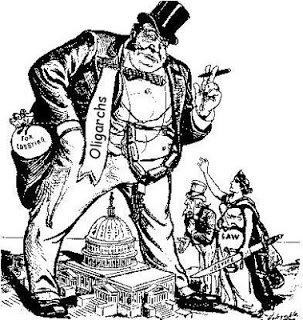
According to a new study from Princeton University, American democracy no longer exists. Using data from over 1,800 policy initiatives from 1981 to 2002, researchers Martin Gilens and Benjamin Page concluded that rich, well-connected individuals on the political scene now steer the direction of the country, regardless of – or even against – the will of the majority of voters. America’s political system has transformed from a democracy into an oligarchy, where power is wielded by wealthy elites.

“Making the world safe for democracy” was President Woodrow Wilson’s rationale for World War I, and it has been used to justify American military intervention ever since. Can we justify sending troops into other countries to spread a political system we cannot maintain at home?

The Magna Carta, considered the first Bill of Rights in the Western world, established the rights of nobles as against the king. But the doctrine that “all men are created equal” – that all people have “certain inalienable rights,” including “life, liberty and the pursuit of happiness” – is an American original. And those rights, supposedly insured by the Bill of Rights, have the right to vote at their core. We have the right to vote but the voters’ collective will no longer prevails.

In Greece, the left-wing populist Syriza Party came out of nowhere to take the presidential election by storm; and in Spain, the populist Podemos Party appears poised to do the same. But for over a century, no third-party candidate has had any chance of winning a US presidential election. We have a two-party winner-take-all system, in which our choice is between two candidates, both of whom necessarily cater to big money. It takes big money just to put on the mass media campaigns required to win an election involving 240 million people of voting age.

In state and local elections, third party candidates have sometimes won. In a modest-sized city, candidates can actually influence the vote by going door to door, passing out flyers and bumper stickers, giving local presentations, and getting on local radio and TV. But in a national election, those efforts are easily trumped by the mass media. And local governments too are beholden to big money.

When governments of any size need to borrow money, the megabanks in a position to supply it can generally dictate the terms. Even in Greece, where the populist Syriza Party managed to prevail in January, the anti-austerity platform of the new government is being throttled by the moneylenders who have the government in a chokehold.

How did we lose our democracy? Were the Founding Fathers remiss in leaving something out of the Constitution? Or have we simply gotten too big to be governed by majority vote?

Democracy’s Rise and Fall

The stages of the capture of democracy by big money are traced in a paper called “The Collapse of Democratic Nation States” by theologian and environmentalist Dr. John Cobb. Going back several centuries, he points to the rise of private banking, which usurped the power to create money from governments:

The influence of money was greatly enhanced by the emergence of private banking. The banks are able to create money and so to lend amounts far in excess of their actual wealth. This control of money-creation . . . has given banks overwhelming control over human affairs. In the United States, Wall Street makes most of the truly important decisions that are directly attributed to Washington.

Today the vast majority of the money supply in Western countries is created by private bankers. That tradition goes back to the 17th century, when the privately-owned Bank of England, the mother of all central banks, negotiated the right to print England’s money after Parliament stripped that power from the Crown. When King William needed money to fight a war, he had to borrow. The government as borrower then became servant of the lender.

In America, however, the colonists defied the Bank of England and issued their own paper scrip; and they thrived. When King George forbade that practice, the colonists rebelled.

They won the Revolution but lost the power to create their own money supply, when they opted for gold rather than paper money as their official means of exchange. Gold was in limited supply and was controlled by the bankers, who surreptitiously expanded the money supply by issuing multiple banknotes against a limited supply of gold.

This was the system euphemistically called “fractional reserve” banking, meaning only a fraction of the gold necessary to back the banks’ privately-issued notes was actually held in their vaults. These notes were lent at interest, putting citizens and the government in debt to bankers who created the notes with a printing press. It was something the government could have done itself debt-free, and the American colonies had done with great success until England went to war to stop them.

President Abraham Lincoln revived the colonists’ paper money system when he issued the Treasury notes called “Greenbacks” that helped the Union win the Civil War. But Lincoln was assassinated, and the Greenback issues were discontinued.

In every presidential election between 1872 and 1896, there was a third national party running on a platform of financial reform. Typically organized under the auspices of labor or farmer organizations, these were parties of the people rather than the banks. They included the Populist Party, the Greenback and Greenback Labor Parties, the Labor Reform Party, the Antimonopolist Party, and the Union Labor Party. They advocated expanding the national currency to meet the needs of trade, reform of the banking system, and democratic control of the financial system.

The Populist movement of the 1890s represented the last serious challenge to the bankers’ monopoly over the right to create the nation’s money. According to monetary historian Murray Rothbard, politics after the turn of the century became a struggle between two competing banking giants, the Morgans and the Rockefellers. The parties sometimes changed hands, but the puppeteers pulling the strings were always one of these two big-money players.

In All the Presidents’ Bankers, Nomi Prins names six banking giants and associated banking families that have dominated politics for over a century. No popular third party candidates have a real chance of prevailing, because they have to compete with two entrenched parties funded by these massively powerful Wall Street banks.

Democracy Succumbs to Globalization

In an earlier era, notes Dr. Cobb, wealthy landowners were able to control democracies by restricting government participation to the propertied class. When those restrictions were removed, big money controlled elections by other means:

First, running for office became expensive, so that those who seek office require wealthy sponsors to whom they are then beholden. Second, the great majority of voters have little independent knowledge of those for whom they vote or of the issues to be dealt with. Their judgments are, accordingly, dependent on what they learn from the mass media. These media, in turn, are controlled by moneyed interests.

Control of the media and financial leverage over elected officials then enabled those other curbs on democracy we know today, including high barriers to ballot placement for third parties and their elimination from presidential debates, vote suppression, registration restrictions, identification laws, voter roll purges, gerrymandering, computer voting, and secrecy in government.

The final blow to democracy, says Dr. Cobb, was “globalization” – an expanding global market that overrides national interests:

[T]oday’s global economy is fully transnational. The money power is not much interested in boundaries between states and generally works to reduce their influence on markets and investments. . . . Thus transnational corporations inherently work to undermine nation states, whether they are democratic or not.

The most glaring example today is the secret twelve-country trade agreement called the Trans-Pacific Partnership. If it goes through, the TPP will dramatically expand the power of multinational corporations to use closed-door tribunals to challenge and supersede domestic laws, including environmental, labor, health and other protections.

Looking at Alternatives

Some critics ask whether our system of making decisions by a mass popular vote easily manipulated by the paid-for media is the most effective way of governing on behalf of the people. In an interesting Ted Talk, political scientist Eric Li makes a compelling case for the system of “meritocracy” that has been quite successful in China.

In America Beyond Capitalism, Prof. Gar Alperovitz argues that the US is simply too big to operate as a democracy at the national level. Excluding Canada and Australia, which have large empty landmasses, the United States is larger geographically than all the other advanced industrial countries of the OECD (Organization for Economic Cooperation and Development) combined. He proposes what he calls “The Pluralist Commonwealth”: a system anchored in the reconstruction of communities and the democratization of wealth. It involves plural forms of cooperative and common ownership beginning with decentralization and moving to higher levels of regional and national coordination when necessary.

Dr. Alperovitz is co-founder of an initiative called The Next System Project, aimed at defining the issues in a national political debate as a first step to realizing the possible. He quotes Prof. Donald Livingston, who asked in 2002:

What value is there in continuing to prop up a union of this monstrous size? . . . [T]here are ample resources in the American federal tradition to justify states’ and local communities’ recalling, out of their own sovereignty, powers they have allowed the central government to usurp.

Taking Back Our Power

If governments are recalling their sovereign powers, they might start with the power to create money, which was usurped by private interests while the people were asleep at the wheel. State and local governments are not allowed to print their own currencies; but they can own banks, and all depository banks create money when they make loans, as the Bank of England recently acknowledged.

The federal government could take back the power to create the national money supply by issuing its own Treasury notes as Abraham Lincoln did. Alternatively, it could issue some very large denomination coins as authorized in the Constitution; or it could nationalize the central bank and use quantitative easing to fund infrastructure, education, job creation, and social services, responding to the needs of the people rather than the banks.

The freedom to vote carries little weight without economic freedom – the freedom to work and to have food, shelter, education, medical care and a decent retirement. President Franklin Roosevelt maintained that we need an Economic Bill of Rights. If our elected representatives were not beholden to the moneylenders, they might be able both to pass such a bill and to come up with the money to fund it.

Ellen Brown is an attorney, founder of the Public Banking Institute, and author of twelve books including the best-selling Web of Debt. Her latest book, The Public Bank Solution, explores successful public banking models historically and globally. Her 300+ blog articles are at EllenBrown.com. Listen to “It’s Our Money with Ellen Brown” on PRN.fm.