Garland Shooter Elton Simpson ‘Handled’ By Paid FBI Informant

indexSource: 21st Century Wire

In our story released late last night, we posed this question to our readers:

“Were these supposed ‘dead gunmen’ part of the drill, or were they patsies handled by a counter-terrorism federal ‘informant’?

We didn’t know it at the time, but it turns out that we were right.

Last night in the Dallas suburb of Garland, Texas, at Pam Geller’s “Muhammad Art Exhibit and Cartoon Contest”, two alleged “gunmen” were shot and killed by a Special Ops paramilitary ‘SWAT’ unit hired by the city of Garland to provide security for the controversial event.

It’s now been revealed that “gunman”, Elton Simpson, was already under surveillance by the FBI and was even the subject of a terror investigation. More importantly, we can also confirm Simpson was being handled by an FBI informant. Court papers filed in Arizona name the FBI undercover informant as Mr. Daba Deng, a Kenyan and who, from 2007, was paid $132,000 by the FBI to “become friends with Mr. Simpson”, and who appears to have groomed Simpson through a local mosque, and helped to develop Simpson’s ideas about “jihad”. Deng also helped to catch ‘Islamic convert’ Simpson on tape saying he wanted to travel to Somalia to join the terror orgaization al Shabaab. That recording was made on May 29, 2009, which shows Simpson telling his handler Deng, “It’s time to go to Somalia, brother… we gonna make it to the battlefield… it’s time to roll.” This recording was the basis for Simpson’s later FBI arrest, after which time he was ‘let off’ with 3 years probation.

The official misdirect device for this story can be found in a recent article from the Israeli-owned soft propaganda outlet, Vocativ, whose headline reads, “How Texas Terror Shooter Elton Simpson Avoided Prison In 2011″, which appears to be designed to pollute any inquiry by attempting to rationalize that Elton Simpson had avoided jail because a Judge was too lenient on this potential terrorist, furthering the popular talking point that somehow “the Feds dropped the ball.”

It is unknown exactly how far Deng had led Simpson in relation to yesterday’s attack, or if Simpson was assigned a new handler, but the revelation clearly demonstrates that not only have the FBI been aware of Simpson’s activities and movements for many years, but that the FBI has also had a hand in ‘managing’ Simpson. This fact should cast serious doubts on the official narrative being constructed about the Garland event being carried out by a bonafide and organic “home-gown jihadist” in America.

Authorities in Texas have identified the second “gunman” as Nadir Hamid Soofi (photo, above). It’s claimed that Soofi was Elton Simpson’s roommate and that they both shared an apartment in Phoenix, Arizona, and also attended the same mosque – the Islamic Center of North Phoenix. It is fairly certain that FBI informant Deng also knew and was interacting with Soofi as well.
We’re also meant to believe that just minutes before Simpson and Soofi launched their failed “terror attack”, they both posted Twitter messages and that ISIS Tweeters then joined-in to cheer them on, albeit, virtually.

SEE ALSO: Hebdo Redux in Garland, TX? ‘Mohammed Cartoon’ Shooting Reeks of a Staged False Flag

Not coincidentally, this is nearly the identical M.O. to the two dead ‘gunmen’ in the Charlie Hebdo shooting incident that took place in Paris earlier this year. 21WIRE reported back in January:

“At least one of the suspects was already “under surveillance” by French anti-terror authorities, and that his file was “shared with US security officials” as well. If this is indeed the case, then it’s highly improbable that the suspect would have staged his attack so easily. Once again, official admissions practically cancel out the official narrative.”

In addition to similarities to the Hebdo attack, it’s worth pointing out that in every high-profile US ‘terror bust’, the assailants had some connection beforehand to federal authorities. Only days after the media was beginning to close-out their round-the-clock Hebdo coverage, FBI agents concluded the frame-up of 20 year old Christopher Lee Cornell from Cincinnati, Ohio, claiming the youth was planning a “pipe bomb attack” against the nation’s Capitol in Washington DC, and that he was “linked to ISIS”, and that this was somehow an “ISIS-inspired attack”, only no attack actually took place.

The Guardian reported on the scale and scope of this trend in 2014:

“In some cases the FBI may have created terrorists out of law-abiding individuals by suggesting the idea of taking terrorist action or encouraging the target to act.”

The list of FBI-related ‘terrorist’ incidents inside the US is a long one. The formula for creating a ‘terror icon’ required a confidential informant to guide and manage the future “suspect” right up to the point of arrest, or in some cases, like the World Trade Center Bombing in 1993, the FBI have even allowed the terrorist incident to take place.

Other high-profile terror icons with informant and patsy stories include the other ‘Paris Shooter’, Amedi Coulibaby (see his compelling patsy-informant case here), ‘Ottawa Shooter’ Zehaf-Bibeau (see his patsy story here), ‘Boston Bomber’ Tamerlan Tsarnaev (see his FBI recruitment story here), ‘The Underwear Bomber’ Umar Farouk Abdulmutallab (see his patsy story here), Buford Rogers (read his patsy-informant story here), Jerad Miller (read his patsy-informant story here), Naji Mansour (read his informant story here), Quazi Mohammad Nafis (read his informant story here), Mohamed Osman Mohamud (read his informant story here), ‘OKC Bomber’ Timothy McVeigh (read his informant story here).

In addition to these examples, we could also include last month’s ‘Queens of Brooklyn’ terror plot, Washington Metro bomb plot, the New York City subway bomb plot, as well as the Sears Tower bomb plot in Chicago, and last but certainly not least – the attacks of 9/11… where the alleged hijackers lived with an FBI informant.

Just a few reasons to question the official narrative in Garland, Texas.
The Public Execution of Mumia Abu-Jamal?

By Linn Washington Jr.

Source: This Can’t Be Happening

In August 1936 nearly 20,000 people filled a vacant lot next to a municipal building in a small Kentucky town to watch the hanging of a man convicted of rape. This hanging, conducted by two executioners retained by that town, would be the last official ‘public execution’ in America.

Although states across this country have banned executions where the public can freely attend, some contend that the American public is again witnessing the spectacle of a public execution – more precisely: the spectacle of a killing occurring in plain sight administered by governmental authorities.

This current spectacle of governmental killing involves a high-profile inmate in Pennsylvania that evidence indicates is quite possibly experiencing a ‘slow execution’ through calculated medical mistreatment.

Author/activist Mumia Abu-Jamal, perhaps the most widely known prison inmate in America, is gravely ill, hardly able to walk or talk because of severe complications related largely to the diabetes which medical personnel inside a Pennsylvania prison failed to diagnose for months. Prison medical personnel either did not detect the diabetes earlier this year while giving Abu-Jamal numerous blood tests that easily identify the elevated blood sugar levels of diabetes or did not inform Abu-Jamal of the blood test results.

That failure to find his raging diabetes led to Abu-Jamal’s emergency hospitalization at the end of March, after he collapsed, unconscious and in sugar shock. When authorities finally transported Abu-Jamal from the SCI Mahanoy prison to the hospital, he was on the verge of a potentially fatal diabetic coma. Weeks before that emergency hospitalization, Abu-Jamal’s blood pressure spiked to a level that required hospitalization that he did not receive, stated persons working with Abu-Jamal.

Despite Abu-Jamal’s obvious painful and deteriorating medical condition, Pennsylvania prison authorities have barred Abu-Jamal from receiving access to or consultation from medical experts assembled by his supporters.

Those experts could provide the quality of care unavailable at either the demonstrably incompetent infirmary inside SCI Mahanoy or that non-prison hospital authorities utilized. (Abu-Jamal has had adverse reactions to medications he has received from the Mahanoy prison infirmary, his supporters said.)

The refusal of Pennsylvania prison authorities to properly treat Abu-Jamal or permit him access to non-prison medical personnel who could effectively treat his conditions fuel understandable fears among Abu-Jamal’s far-flung supporters that anti-Abu-Jamal forces are trying to effectuate the death sentence that once hung over Abu-Jamal.

The ‘fear’ that foul play could be apart of Abu-Jamal’s poor medical care arises from the fact that police, politicians and others had vigorously campaigned for Abu-Jamal’s execution for 28-years. Abu-Jamal received a death sentence following his controversial 1982 conviction for killing a Philadelphia policeman. That campaign for execution included many forms of harassment. The extraordinary punishments from that campaign provide proof for many that Abu-Jamal is a political prisoner.

“They are outright killing him in front of us,” Pam Africa said. Africa, a close associate of Abu-Jamal and head of International Concerned Friends and Family of Mumia Abu-Jamal, visits him regularly.
(Abu-Jamal’s death sentence was converted to life in prison after federal courts repeatedly upheld the dismissal of the death sentence citing constitutional violations.)

“He is in pain. His skin is so bad from that rash that he looks like a burn victim,” Africa said. “The is F*%king horrible …”

When prison authorities returned Abu-Jamal to SCI Mahanoy from that hospital, following a few days care in the ICU, he was still seriously ill.

Yet, prison authorities ordered him returned to his prison cell after a brief stay in the Mahanoy infirmary following his return from the ICU. Authorities returned him to his cell despite his visibly weakened condition, dramatic 70-lb.weight loss, labored breathing, swelling of his body parts and open sores on his skin from a festering rash.

Prison authorities certainly knew that Abu-Jamal’s weakened condition would make it difficult for him to walk back to the infirmary for help since the distance from his cell to the infirmary is the distance of about three-city-blocks. Certainly authorities knew the difficulties facing Abu-Jamal even in obtaining meals from the dining hall, a nearly two-block distance from his cell.

Prison Radio, the San Francisco-based media entity that has broadcast Abu-Jamal’s prison commentaries for decades, recently issued an update on his medical condition utilizing information provided by Abu-Jamal’s wife, Wadiya following her latest visit.

According to that report Abu-Jamal “is extremely swollen in his neck, chest, legs and his skin is worse than ever, with open sores. He was not in a wheelchair, but can only take baby steps. He is very weak. He was nodding off during the visit. He was not able to eat – he was fed with a spoon. These are symptoms that could be associated with hyper glucose levels, diabetic shock, diabetic coma, and with kidney stress and failure.”

Prison Radio, a few days before that updated report on Abu-Jamal’s condition, had released information that Pennsylvania prison authorities were refusing proposals to address Abu-Jamal’s worsening medical condition.

Prison Radio revealed that prison authorities had notified Bret Grote, a lawyer for Abu-Jamal, that they would not allow Abu-Jamal to be examined by his own doctor, and would not allow his doctor to speak with prison medical staff to assist or direct Abu-Jamal’s care. Prison officials are also refusing to allow regular phone calls between Abu-Jamal and his doctor and they said they would not allow Abu-Jamal to be examined by an endocrinologist (a diabetes specialist).

Proposals for Abu-Jamal receiving medical care from personnel outside the prison system are not out of line. Authorities allowed millionaire John DuPont to have his medical issues treated by his own private physician at his expense while he served a life sentence for murder before dying in a Pennsylvania prison. Authorities denying Abu-Jamal allowances that authorities have extended to other inmates is a part of the pattern of punishments that target Abu-Jamal.

Charges that prison authorities are deliberating mistreating Abu-Jamal are routinely dismissed as hyperbole by authorities despite abundant examples of mistreatment directed at Abu-Jamal and other inmates.

For example, in 2010 an inmate serving a life sentence like Abu-Jamal filed a lawsuit against Pennsylvania prison authorities challenging their refusal to provide him with medical treatment for acute kidney stones despite a previous court settlement where authorities had agreed to provide that inmate with his needed treatment.

That inmate, Walter Chruby, secured an injunction from a trial court judge ordering immediate treatment. Chruby’s lawsuit, according to a court ruling on that injunction, stated that immediately after Chruby won that first court order for treatment, prison authorities “began withholding or intentionally delaying adequate medical care…”

The medical mistreatment of Mumia Abu-Jamal comes at a time when callous law enforcement, particularly brutality and fatal shootings by police, is in the national spotlight. Abu-Jamal, in his books and commentaries produced in prison, has been a strident critic of inequities in the criminal justice system. The medical mistreatment of Abu-Jamal is rife with callousness and inhumanity.
Call and write these people and demand that Abu-Jamal be provided with appropriate medical care for this eminently treatable disease!:

Gov. Tom Wolf, PA Governor: 717-787-2500 • governor@PA.gov 508 Main Capitol Building, Harrisburg PA 17120

John Wetzel Secretary of the Deparment of Corrections ra-crpadocsecretary@pa.gov 717-728-4109 • 717-728-4178 Fax 1920 Technology Pkwy, Mechanicsburg PA 17050

John Kerestes, Superintendent SCI Mahanoy: 570-773-2158 x8102 570-783-2008 Fax 301 Morea Road, Frackville PA 17932

Susan McNaughton, Public Information Office PA DOC DOC Press secretary: 717-728-4025 PA DOC smcnaughton@pa.gov
Public Information Officer, SCI Mahanoy

Jane Hinman 570-773-2158; then dial zero SCI Mahanoy: 570-773-2158 x8102 • 570-783-2008 Fax 301 Morea Road, Frackville PA 17932

The Trans-Pacific Partnership and the Death of the Republic

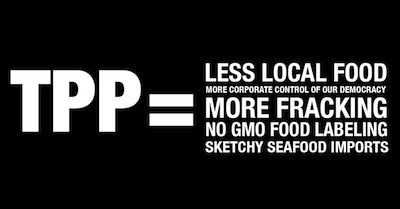
TPPequals

By Ellen Brown

Source: Washington’s Blog

The United States shall guarantee to every State in this Union a Republican Form of Government.    — Article IV, Section 4, US Constitution

A republican form of government is one in which power resides in elected officials representing the citizens, and government leaders exercise power according to the rule of law. In The Federalist Papers, James Madison defined a republic as “a government which derives all its powers directly or indirectly from the great body of the people . . . .”

On April 22, 2015, the Senate Finance Committee approved a bill to fast-track the Trans-Pacific Partnership (TPP), a massive trade agreement that would override our republican form of government and hand judicial and legislative authority to a foreign three-person panel of corporate lawyers.

The secretive TPP is an agreement with Mexico, Canada, Japan, Singapore and seven other countries that affects 40% of global markets. Fast-track authority could now go to the full Senate for a vote as early as next week. Fast-track means Congress will be prohibited from amending the trade deal, which will be put to a simple up or down majority vote. Negotiating the TPP in secret and fast-tracking it through Congress is considered necessary to secure its passage, since if the public had time to review its onerous provisions, opposition would mount and defeat it.

Abdicating the Judicial Function to Corporate Lawyers

James Madison wrote in The Federalist Papers:

The accumulation of all powers, legislative, executive, and judiciary, in the same hands, . . . may justly be pronounced the very definition of tyranny. . . . “Were the power of judging joined with the legislative, the life and liberty of the subject would be exposed to arbitrary control, for the judge would then be the legislator. . . .”

And that, from what we now know of the TPP’s secret provisions, will be its dire effect.

The most controversial provision of the TPP is the Investor-State Dispute Settlement (ISDS) section, which strengthens existing ISDS  procedures. ISDS first appeared in a bilateral trade agreement in 1959. According to The Economist, ISDS gives foreign firms a special right to apply to a secretive tribunal of highly paid corporate lawyers for compensation whenever the government passes a law to do things that hurt corporate profits — such things as discouraging smoking, protecting the environment or preventing a nuclear catastrophe.

Arbitrators are paid $600-700 an hour, giving them little incentive to dismiss cases; and the secretive nature of the arbitration process and the lack of any requirement to consider precedent gives wide scope for creative judgments.

To date, the highest ISDS award has been for $2.3 billion to Occidental Oil Company against the government of Ecuador over its termination of an oil-concession contract, this although the termination was apparently legal. Still in arbitration is a demand by Vattenfall, a Swedish utility that operates two nuclear plants in Germany, for compensation of €3.7 billion ($4.7 billion) under the ISDS clause of a treaty on energy investments, after the German government decided to shut down its nuclear power industry following the Fukushima disaster in Japan in 2011.

Under the TPP, however, even larger judgments can be anticipated, since the sort of “investment” it protects includes not just “the commitment of capital or other resources” but “the expectation of gain or profit.” That means the rights of corporations in other countries extend not just to their factories and other “capital” but to the profits they expect to receive there.

In an article posted by Yves Smith, Joe Firestone poses some interesting hypotheticals:

Under the TPP, could the US government be sued and be held liable if it decided to stop issuing Treasury debt and financed deficit spending in some other way (perhaps by quantitative easing or by issuing trillion dollar coins)? Why not, since some private companies would lose profits as a result?

Under the TPP or the TTIP (the Transatlantic Trade and Investment Partnership under negotiation with the European Union), would the Federal Reserve be sued if it failed to bail out banks that were too big to fail?

Firestone notes that under the Netherlands-Czech trade agreement, the Czech Republic was sued in an investor-state dispute for failing to bail out an insolvent bank in which the complainant had an interest. The investor company was awarded $236 million in the dispute settlement. What might the damages be, asks Firestone, if the Fed decided to let the Bank of America fail, and a Saudi-based investment company decided to sue?

Abdicating the Legislative Function to Multinational Corporations

Just the threat of this sort of massive damage award could be enough to block prospective legislation. But the TPP goes further and takes on the legislative function directly, by forbidding specific forms of regulation.

Public Citizen observes that the TPP would provide big banks with a backdoor means of watering down efforts to re-regulate Wall Street, after deregulation triggered the worst financial crisis since the Great Depression:

The TPP would forbid countries from banning particularly risky financial products, such as the toxic derivatives that led to the $183 billion government bailout of AIG. It would prohibit policies to prevent banks from becoming “too big to fail,” and threaten the use of “firewalls” to prevent banks that keep our savings accounts from taking hedge-fund-style bets.

The TPP would also restrict capital controls, an essential policy tool to counter destabilizing flows of speculative money. . . . And the deal would prohibit taxes on Wall Street speculation, such as the proposed Robin Hood Tax that would generate billions of dollars’ worth of revenue for social, health, or environmental causes.

Clauses on dispute settlement in earlier free trade agreements have been invoked to challenge efforts to regulate big business. The fossil fuel industry is seeking to overturn Quebec’s ban on the ecologically destructive practice of fracking. Veolia, the French behemoth known for building a tram network to serve Israeli settlements in occupied East Jerusalem, is contesting increases in Egypt’s minimum wage. The tobacco maker Philip Morris is suing against anti-smoking initiatives in Uruguay and Australia.

The TPP would empower not just foreign manufacturers but foreign financial firms to attack financial policies in foreign tribunals, demanding taxpayer compensation for regulations that they claim frustrate their expectations and inhibit their profits.

Preempting Government Sovereignty

What is the justification for this encroachment on the sovereign rights of government? Allegedly, ISDS is necessary in order to increase foreign investment. But as noted in The Economist, investors can protect themselves by purchasing political-risk insurance. Moreover, Brazil continues to receive sizable foreign investment despite its long-standing refusal to sign any treaty with an ISDS mechanism. Other countries are beginning to follow Brazil’s lead.

In an April 22nd report from the Center for Economic and Policy Research, gains from multilateral trade liberalization were shown to be very small, equal to only about 0.014% of consumption, or about $.43 per person per month. And that assumes that any benefits are distributed uniformly across the economic spectrum. In fact, transnational corporations get the bulk of the benefits, at the expense of most of the world’s population.

Something else besides attracting investment money and encouraging foreign trade seems to be going on. The TPP would destroy our republican form of government under the rule of law, by elevating the rights of investors – also called the rights of “capital” – above the rights of the citizens.

That means that TPP is blatantly unconstitutional. But as Joe Firestone observes, neo-liberalism and corporate contributions seem to have blinded the deal’s proponents so much that they cannot see they are selling out the sovereignty of the United States to foreign and multinational corporations.

For more information and to get involved, visit:

Flush the TPP

The Citizens Trade Campaign

Public Citizen’s Global Trade Watch

Eyes on Trade

__________________

Ellen Brown is an attorney, founder of the Public Banking Institute, and author of twelve books including the best-selling Web of Debt. Her latest book, The Public Bank Solution, explores successful public banking models historically and globally. Her 300+ blog articles are at EllenBrown.com.

Baltimoreans Pushed to Their Limits

Suspect_Dies_Baltimore.JPEG-01b3c_c0-199-4709-2943_s561x327

By David S. D’Amato

Source: Center for a Stateless Society

We speak of the blowback that results from American foreign policy, the senseless, heinous acts of terror that represent an unfocused and irrational rebellion against American imperialism. We understand that calling it what it is, blowback — pointing out the causal relationship between American foreign policy and terrorism — is not an attempt to exculpate the people who commit these crimes. Looking for a motive that may aid in explaining these horrors is not looking for an excuse.

Similarly, the Baltimore rioters have found themselves on the losing end of a set of government policies that have consolidated wealth and foreclosed economic opportunities for independence and self-sufficiency. While so many Americans have been railing against welfare recipients, worried about the effects of food stamps on the federal budget, top American companies have worked closely with government for generations, guaranteeing the corporate welfare and special privileges that define the U.S. economic system.

The truth is that corporate capitalism has hung these rioting Baltimoreans out to dry, the American Dream being to them no more than a cruelly sarcastic joke, forever out of reach, mocking them. The prevailing story depicts the urban poor largely as the victims of “the free market,” dependent on a helping hand from government, be it education, job training, or just the bare necessities. In this story, government intervenes to file the sharp edges off of unbridled free market competition.

The problem with this story is that is recasts government in a role it has never actually played for poor and working class people — least of all black Americans. In real life, the state has intervened not to protect the economically powerless and penniless, but to serve to the needs of capital, to fence off resources and restrict opportunities in order to subject people to the control of a few giant employers. This coercive, state-driven process has nothing to do with a principled, libertarian free market today, and it never has in the past.

The result has been a permanent underclass, condemned to live in ghettos under quasi-military occupation, surrounded by violent crime that is the direct product of a failed war on drugs. And while the people who live in these communities are demonstrably no more likely to possess contraband than anyone else, they are far more likely to be stopped and frisked, arrested, and even murdered by increasingly militarized police officers.

The problems in Baltimore are historical and systemic. Everyone agrees that rioting, looting, and the wanton destruction of private property are senseless acts that ultimately can’t help anyone or create positive social change. We must nevertheless ask why these people in Baltimore feel so helpless, so abandoned and frustrated by the “proper channels,” that they find it is necessary to lash out and express themselves in this way.

Systematic state violence has left Baltimore communities barren, crying out for justice and opportunity. Anarchists believe that the dormant power of self-organization, cooperation and trade, once truly freed from aggression and meddling, is all the poor need to thrive. Through the anger and sadness coming out of Baltimore, it’s important not to lose sight of the larger, underlying issues.

Saturday Matinee: Dust

220px-Dust2“Dust” (2001) is an audacious Southeastern European Western directed by Milcho Manchevski. The film’s narrative cross-cuts between two stories: one in which a thief is cornered at gunpoint in a New York apartment by an elderly woman and a second involving love and vengeance between two brothers caught up in a revolutionary struggle in Macedonia. The parallel narratives are unified by themes of greed, redemption, and the transformative power of storytelling.

Note: Video may not work on some portable devices.

http://www.hulu.com/watch/316653

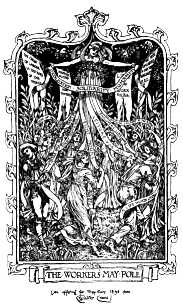
MAY DAY – The International Labor Day

crane13

Source: The Anarchist International

May 1st, International Workers’ Day, commemorates the historic struggle of working people throughout the world, and is recognized in most countries. The United States of America and Canada are among the exceptions. This despite the fact that the holiday began in the 1880s in the USA, linked to the battle for the eight-hour day, and the Chicago anarchists.

The struggle for the eight-hour day began in the 1860s. In 1884, the Federation of Organized Trades and Labor Unions of the United States and Canada, organized in 1881 (and changing its name in 1886 to American Federation of Labor ) passed a resolution which asserted that “eight hours shall constitute a legal day’s work from and after May 1, 1886, and that we recommend to labor organizations throughout this district that they so direct their laws as to conform to this resolution”. The following year the Federation repeated the declaration that an eight-hour system was to go into effect on May 1, 1886. With workers being forced to work ten, twelve, and fourteen hours a day, support for the eight-hour movement grew rapidly. In the months prior to May 1, 1886, thousands of workers, organized and unorganized, members of the organization Knights of Labor and of the federation, were drawn into the struggle. Chicago was the main center of the agitation for a shorter day. The anarchists were in the forefront of the Central Labor Union of Chicago, which consisted of 22 unions in 1886, among them the seven largest in the city.

During the Railroad strikes of 1877, the workers had been violently attacked by the police and the United States Army. A similar tactic of state terrorism was prepared by the bureaucracy to fight the eight-hour movement. The police and National Guard were increased in size and received new and powerful weapons financed by local business leaders. Chicago’s Commercial Club purchased a $2000 machine gun for the Illinois National Guard to be used against strikers. Nevertheless, by May 1st, the movement had already won gains for many Chicago workers. But on May 3, 1886, police fired into a crowd of strikers at the McCormick Harvester Machine Company, killing at least one striker, seriously wounding five or six others, and injuring an undetermined number. Anarchists called for a mass meeting the next day in Haymarket Square to protest the brutality.

The meeting proceeded without incident, and by the time the last speaker was on the platform, the rainy gathering was already breaking up, with only about two hundred people remaining. It was then a police column of 180 men marched into the square and ordered the meeting to disperse. At the end of the meeting a bomb was thrown at the police, killing one instantly, six others died later. About seventy police officers were wounded. Police responded by firing into the crowd. How many civilians were wounded or killed from police bullits never was ascertained exactly. Although it was never determined who threw the bomb, the incident was used as an excuse to attack anarchists and the labor movement in general. Police ransacked the homes and offices of suspected radicals, and hundreds were arrested without charge. A reign of police terror swept over Chicago. Staging “raids” in the working-class districts, the police rounded up all known anarchists and other socialists. “Make the raids first and look up the law afterward!” publicly counseled the state’s attorney.

Anarchists in particular were harassed, and eight of Chicago’s most active were charged with conspiracy to murder in connection with the Haymarket bombing. A kangaroo court found all eight guilty, despite a lack of evidence connecting any of them to the bomb-thrower, and they were sentenced to die. In October 9, 1886, the weekly journal Knights of Labor published in Chicago, carried on page 1 the following announcement: “Next week we begin the publication of the lives of the anarchists advertised in another column.”

The advertisement, carried on page 14, read: The story of the anarchists, told by themselves; Parsons, Spies, Fielden, Schwab, Fischer, Lingg, Engle, Neebe. The only true history of the men who claim that they are condemned to suffer death for exercising the right of Free Speech: Their association with Labor, Socialistic and Anarchistic Societies, their views as to the aims and objects of these organizations, and how they expect to accomplish them; also their connection with the Chicago Haymarket Affair. Each man is the author of his own story, which will appear only in the “Knights of Labor” during the next three months, – the great labor paper of the United States, a 16-page weekly paper, containing all the latest foreign and domestic labor news of the day, stories, household hints, etc. A co-operative paper owned and controlled by members of the Knights of Labor, and furnished for the small sum of $1.00 per annum. Adress all communications to Knights of Labor Publishing Company, 163 Washington St., Chicago, Ill. Later this journal and the paper Alarm published the autobiographies of the Haymarket men.

Albert Parsons, August Spies, Adolf Fischer and George Engel were hanged on November 11, 1887. Louis Lingg committed suicide in prison. The authorities turned over the bodies to friends for burial, and one of the largest funeral processions in Chicago history was held. It was estimated that between 150,000 to 500,000 persons lined the route taken by the funeral cortege of the Haymarket martyrs. A monument to the executed men was unveiled June 25, 1893 at Waldheim Cemetery in Chicago. The remaining three, Samuel Fielden, Oscar Neebe and Michael Schwab, were finally pardoned in 1893.

On June 26, 1893, the governor of Illinois, John Peter Altgeld, issued the pardon message in which he made it clear that he was not granting the pardon because he believed that the men had suffered enough, but because they were innocent of the crime for which they had been tried, and that they and the hanged men had been the victims of hysteria, packed juries and a biased judge. He noted that the defendants were not proven guilty because the state “has never discovered who it was that threw the bomb which killed the policeman, and the evidence does not show any connection whatsoever between the defendants and the man who threw it.”

International Workers’ Day is the commemoration of the Haymarket Event in Chicago in 1886. In 1889, the first congress of the Second International, meeting in Paris for the centennial of the French Revolution and the Exposition Universelle (1889), following an initiative from the American Federation of Labor, called for international demonstrations on the 1890 anniversary of the Chicago protests. These were so successful that May Day was formally recognized as an annual event at the International’s second congress in 1891.

It is not surprising that the state, business leaders, mainstream union officials, and the media would want to hide the true history of May Day. In its attempt to erase the history and significance of May Day, the United States government declared May 1st to be “Law Day”, and gave the workers instead Labor Day, the first Monday of September – a holiday devoid of any historical significance.

Nevertheless, rather than suppressing the labor and anarchist movements, the events of 1886 and the execution of the Chicago anarchists, spokesmen of the movement for the eight-hour day, mobilized many generations of radicals. Emma Goldman, a young immigrant at the time, later pointed to the Haymarket affair as her political birth. Instead of disappearing, the anarchist movement only grew in the wake of Haymarket.

As workers, we must recognize and commemorate May Day not only for it’s historical significance, but also as a time to organize around issues of vital importance of today for the working-class broadly defined, i.e. the grassroots – the people seen as a class in contrast to the superiors in income and/or rank – economically and/or political/administrative.

The May Day Manifestos of the International Workers of the World affiliated to the Anarchist International, from the latest years are published on its Webpage, click here!

Baltimore and the Human Right to Resistance: Rejecting the Framework of the Oppressor

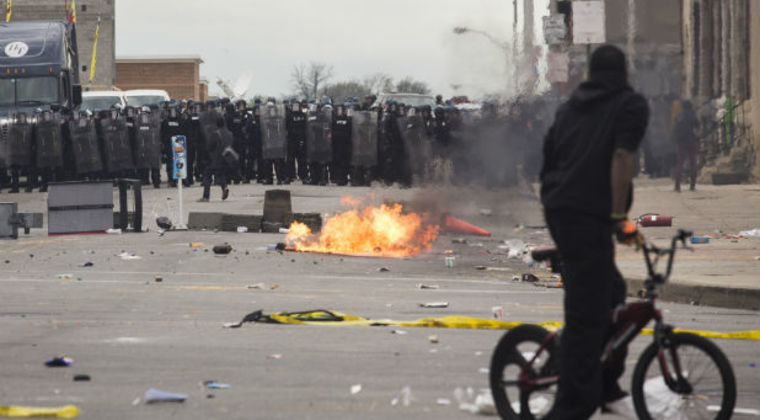
Baltimore-Riots.jpg_23790e32da49a4d09d45db82b7634b69To hear President Obama and Baltimore mayor Rawlings tell it, politeness, nonviolence and respect for law and property are the fundamental obligations of those confronting the brazen and lawless violence of police in Baltimore and beyond. This is a truly upside-down reality.

By Ajamu Baraka

Source: Black Agenda Report

Anti-Black racism, always just beneath the surface of polite racial discourse in the U.S., has exploded in reaction to the resistance of black youth to another brutal murder by the agents of this racist, settler-colonialist state. With the resistance, the focus shifted from the brutal murder of Freddie Gray and the systematic state violence that historically has been deployed to control and contain the black population in the colonized urban zones of North America, to the forms of resistance by African Americans to the trauma of ongoing state violence.

The narrative being advanced by corporate media spokespeople gives the impression that the resistance has no rational basis. The impression being established is that this is just another manifestation of the irrationality of non-European people – in particular, Black people – and how they are prone to violence. This is the classic colonial projection employed by all white supremacist settler states, from the U.S., to South Africa and Israel.

The accompanying narrative is that any kind of resistance that does not fit the narrow definition of “non-violent” resistance is illegitimate violence and, therefore, counter-productive because – “violence doesn’t accomplish anything.”  Not only does this position falsely equate resistance to oppression as being morally equivalent to the violence of the oppressor, it also attempts to erase the role of violence as being fundamental to the U.S. colonial project.

The history of colonial conquest saw the U.S. settler state shoot and murdered its’ way across the land mass of what became the U.S. in the process of stealing indigenous land to expand the racist White republic from “sea to shining sea.”  And the marginalization of the role of violence certainly does not reflect the values of the Obama administration that dutifully implements the bi-partisan dictates of the U.S. strategy of full spectrum dominance that privileges military power and oppressive violence to protect and advance U.S. global supremacy. The destruction of Libya; the reinvasion of Iraq; the civil war in Syria; Obama’s continued war in Afghanistan; the pathological assault by Israel on Palestinians in Gaza and the U.S. supported attack on Yemen by the Saudi dictatorship, are just a few of the horrific consequences of this criminal doctrine.

Race and oppressive violence has always been at the center of the racist colonial project that is the U.S. It is only when the oppressed resist — when we decide, like Malcolm X said, that we must fight for our human rights — that we are counseled  to be like Dr. King, including by war mongers like Barack Obama. However, resistance to oppression is a right that the oppressed claim for themselves. It does not matter if it is sanctioned by the oppressor state, because that state has no legitimacy.

No rational person exalts violence and the loss of life. But violence is structured into the everyday institutional practices of all oppressive societies. It is the deliberate de-humanization of the person in order to turn them into a ‘thing’ — a process Dr. King called “thing-afication.” It is a necessary process for the oppressor in order to more effectively control and exploit. Resistance, informed by the conscious understanding of the equal humanity of all people, reverses this process of de-humanization. Struggle and resistance are the highest expressions of the collective demand for people-centered human rights – human rights defined and in the service of the people and not governments and middle-class lawyers.

That resistance may look chaotic at this point – spontaneous resistance almost always looks like that. But since the internal logic of neoliberal capital is incapable of resolving the contradiction that it created, expect more repression and more resistance that will eventually take a higher form of organization and permanence. In the meantime, we are watching to see who aligns with us or the racist state.

The contradictions of the colonial/capitalist system in its current expression of neoliberalism have obstructed the creation of decent, humane societies in which all people are valued and have democratic and human rights. What we are witnessing in the U.S. is a confirmation that neoliberal capitalism has created what Chris Hedges called “sacrificial zones” in which large numbers of black and Latino people have been confined and written off as disposable by the system. It is in those zones that we find the escalation of repressive violence by the militarized police forces. And it is in those zones where the people are deciding to fight back and take control of their communities and lives.

These are defining times for all those who give verbal support to anti-racist struggles and transformative politics. For many of our young white comrades, people of color and even some black ones who were too young to have lived through the last period of intensified struggle in the 1960s and ‘70s and have not understood the centrality of African American resistance to the historical social struggles in the U.S., it may be a little disconcerting to see the emergence of resistance that is not dependent on and validated by white folks or anyone else.

The repression will continue, and so will the resistance. The fact that the resistance emerged in a so-called black city provides some complications, but those are rich and welcoming because they provide an opportunity to highlight one of the defining elements that will serve as a line of demarcation in the African American community – the issue of class.  We are going to see a vicious ideological assault by the black middle class, probably led by their champion – Barack Obama – over the next few days. Yet the events over the last year are making it more difficult for these middle-class forces to distort and confuse the issue of their class collaboration with the white supremacist capitalist/colonialist patriarchy. The battle lines are being drawn; the only question that people must ask themselves is which side they’ll be on.

Ajamu Baraka is a human rights activist, organizer, geo-political analyst and editor and contributing columnist for the Black Agenda Report. Baraka serves as the Public Intervenor for Human Rights as a member of the Green Shadow Cabinet and coordinates the International Affairs Committee of the Black Left Unity Network. He is also an Associate Fellow at the Institute for Policy Studies (IPS) in Washington, D.C.