
The Culture of Vehicular Attacks

On the Murder of Deona Marie Erickson

By CrimethInc.

On June 13, a driver attacked a demonstration in Minneapolis, killing Deona Marie Erickson. This is the result of years of right-wing efforts to normalize—and even legalize—vehicular attacks. Now the corporate media has ceased to prioritize covering them, paving the way for more killings. In dialogue with our comrades at It’s Going Down and on the ground in Minneapolis, we have prepared the following reflections on the implications of this.


Shortly before midnight on June 13, while demonstrators gathered at Lake Street and Girard Avenue to protest the murder of Winston Smith by sheriff’s deputies and US Marshals, a man named Nicholas Kraus drove his SUV into the crowd at high speed, killing Deona Marie Erickson. One Black anti-fascist militant who was on the ground at the time of the attack reports that it was clear to those present that it was an intentional attack: “You heard his engine from three blocks away.”

According to Unicorn Riot,

“Deona Erickson’s car was parked on the side of the street in a way that would protect the people who were gathering. She was sitting down on the sidewalk about 15 feet from her car moments before the perpetrator smashed directly against her car at a very high speed. Witnesses say she was then hit by her car and sent flying. Street medics on the scene resuscitated her but she later died at the hospital.”

Deona Marie Erickson had two daughters. She worked as a program manager at a center for disabled adults. Today would have been her 32nd birthday. She gave her life to protect those who protest police murder.

Demonstrators detained the driver, Nicholas Kraus. Eyewitnesses dispute police allegations that he was “pulled from his car”; reportedly, police did not respond until after the attack, sending riot police to threaten the crowd before an ambulance could arrive. Under the circumstances, the demonstrators’ response was measured, to say the least.

https://twitter.com/aishaforward10/status/1404509174516625408


The Culture of Vehicular Attacks

Let’s put this attack in context.

Fox News and the Daily Caller circulated a video encouraging their viewers to carry out vehicular attacks against protesters months ahead of the fascist “Unite the Right” rally in Charlottesville at which a self-identified neo-Nazi did exactly that, killing Heather Heyer and injuring 35 people. Afterwards, leaked chats showed other neo-Nazis also planning to use vehicles to attack protesters.

In summer 2020, vehicular attacks surged in response to protests against the police murders of George Floyd, Breonna Taylor, and others. Over a dozen people were killed in these and other attacks on the movement.

https://twitter.com/IGD_News/status/1404699241570705408

Today, legislators around the United States are taking steps to criminalize protest activity, introducing a wide range of anti-protest bills. Foremost among them, Oklahoma and Florida lawmakers have passed laws guaranteeing civil and criminal immunity to drivers who hit demonstrators with vehicles, effectively granting vigilantes the right to crash cars into demonstrators. At the same time, Florida has introduced penalties of up to 15 years imprisonment for blocking traffic.

The message is clear enough. In short, lawmakers and police seek to crack down on pedestrians acting collectively to oppose state violence, while extending additional privileges to drivers who act individually to support state violence via their own attacks. The official institutions of the state have failed to leverage enough violence to suppress movements against police violence and white supremacy, so they are deputizing others to do so—a longstanding counterinsurgency strategy reflective of the colonial heritage of the United States.

On a fundamental level, the form of subjectivity that these lawmakers are promoting is what we might call a motorist subjectivity: consumerist, individualized, invested in the smooth functioning of the existing order, and regarding all other possibilities as threats. Structurally speaking, for the motorist, all other human beings—traffic as well as pedestrians—are obstacles, and the only imaginable journeys are dictated by the routes established by the state and the economy. The motorist wants to see the laws enforced on others, on the premise that it will reduce the ways that others might inconvenience him, but he doesn’t want the laws enforced on himself. Conceiving of our society as an entirely mapped world—the way that Google Maps does—in which all means of locomotion, all forms of agency, are individualized according to financial means, the motorist cannot imagine why people would assemble, off road or not, to challenge law enforcement itself.

As shocking as vehicular attacks are when they occur, they are an extension of the society in which they take place. They are anti-social, but they express and intensify the anti-social premises of our day-to-day relations with each other. Motorist versus pedestrian is a classic class opposition in a society in which transportation and mobility are fundamentally racialized. People who were raised on advertisements depicting jeeps off-roading across the suspiciously vacant landscape of the frontier only to find themselves sitting in bumper-to-bumper traffic on the freeway for an hour every day look around for someone to blame, and—as if by design—blame those with even less power than themselves. Road rage.
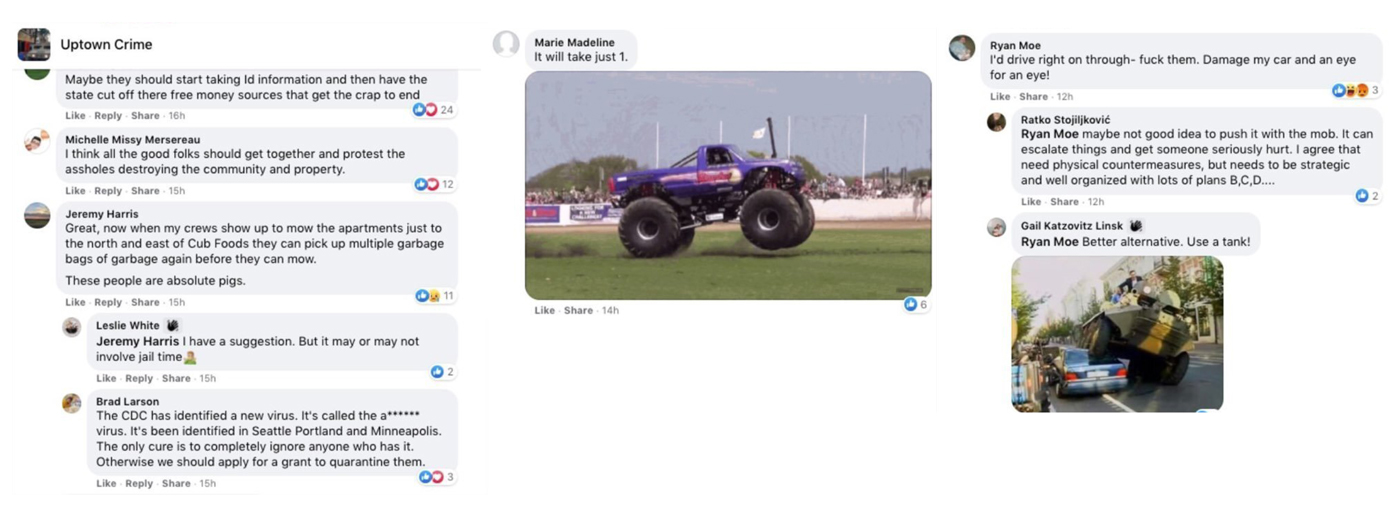
Right-wing online chatter in Minneapolis ahead of the attack that took Deona Marie Erickson’s life.

In this context, the chant “Whose streets? Our streets!” asserts another form of life, another way of relating to each other and conceiving of what our lives could be. Rather than framing vehicular attacks as aberrations from an otherwise peaceful social order—to be addressed, for example, by more policing—we have to understand them as one of the ugliest manifestations of a social structure that is fundamentally racist and anti-human, which can only be addressed via new forms of togetherness.

Honoring those whose lives have been taken by police and pro-police vigilantes is a first step towards this, and it is important that people have been doing this through shared presence in particular physical spaces. The internet—the information superhighway—tends to reinforce the motorist mentality of abstract competition and hostility. One of the most basic steps we can take towards creating a new social fabric on egalitarian terms is to encounter each other in person in ways that affirm the specificity of place.

This gives us more perspective on the ongoing efforts of city officials to evict the autonomous zone at the site where George Floyd was murdered, in order to open it up for “the free passage of traffic.” Rhetoric about “culture wars” is usually used to evoke a conflict between those on the fringe of the left and right, but here, we see centrist officials forcibly imposing a particular model for what our lives, relationships, and forms of grieving should be, even as they purport to be neutral.


Far-Right Murderers and Centrist Beneficiaries

Nicholas Kraus, a man with a history of domestic violence and abuse, is representative of the sort of dysfunctional, alienated men that far-right provocateurs aim to weaponize to carry out stochastic attacks on social movements.

This is effectively a watered-down version of the same strategy that ISIS has used in the Mideast in territories it does not control: taking advantage of the desperation, prejudice, and mental health issues of an entitled but disenfranchised population, the far right aims to disrupt popular mobilizations through consistent but deniable terror attacks. Their goal is to raise the risks of public organizing to such an extent that it becomes hard for movements to maintain momentum, in order to support state repression while opening up space for fascist groups to recruit and mobilize. In Turkey, this approach helped the despotic government of Recep Tayyip Erdoğan to crush what had been powerful social movements. The ultimate beneficiaries of this are not just far-right politicians, but also centrist capitalists who do not wish to see fundamental changes that could threaten their power.

Vigilante attacks are also advantageous for the city officials who would like to present themselves as “neutral” while suppressing the protest movements against the murders that the police they oversee regularly carry out. Vigilante attacks enable these officials to change the subject from the violence of the institutions they represent back to the question of how to “maintain order.”

“Some of these people with the megaphones, I guess their role is to get people riled up and get them in a space and march them around and educate them and tell them what their next big plans are and who they’re backing politics-wise and things like that.

“I like community, organic—no microphones, no megaphones, like right now. It’s about fifty people—but fifty people got Lake and Hennepin shut down right now, you know what I’m saying? We’re moving and grooving right now. As opposed to two or three hundred people holding signs, marching around, and then feeling accomplished, patting themselves on the back and then leaving—ain’t shit get shut down really. Police don’t even monitor the marches no more. No change will come from that.”

-Anonymous Black anti-fascist militant in Minneapolis, evening of June 15, 2021

But Who’s Paying Attention?

“You protested because it was trendy and ‘everyone was doing it.’ I protest because people are out here dying!”
-Deona Marie Erickson, June 10
In 2021, many liberals and progressives have left the streets, relying on the Biden administration to roll back the policies of the Trump administration. Consequently, the murder of Deona Marie Erickson has attracted considerably less attention than it might have just last year. This withdrawal from social struggles creates the conditions for more attacks like this to take place.
This reminds us of the situation before the murder of Heather Heyer made world news, when the far right carried out a series of murders around the United States without drawing the attention of corporate media. Corporate media outlets were only forced to cover the events in Charlottesville because it was not possible to sweep under the rug the fact that a thousand fascists had gathered in one place and killed a white woman. Because the events took news editors—though not anti-fascists—by surprise, they were not prepared to spin the story according to the preferences of their corporate backers; so for a week, fairly honest coverage of the threat represented by the far right suddenly appeared in a variety of news outlets. Subsequently, although this coverage was tempered by efforts to demonize anti-fascists, centrist media outlets continued to report on far-right attacks in order to associate them with the agenda of Donald Trump’s administration.
But now that centrists can’t leverage Deona Marie’s death against Trump, they are prepared to treat it as simply another sad facet of American life, to sweep it under the rug once more.
This coincides with widespread emotional numbness arising from several years of constant tragedies. The COVID-19 pandemic has already accustomed many people to thinking of human life as expendable. Last weekend saw multiple mass shootings across several states. Poverty has reached the highest levels since the beginning of the pandemic. These are the forces that drive desperate people to adopt far-right politics wherever there are no models for a collective pursuit of liberation, creating a feedback loop that will generate more and more tragedies.
“We keep us safe.” “We protect us.” These slogans spread far and wide in the course of the movements that burst onto the world stage in Ferguson, Missouri because it has become eminently apparent that no one else is going to protect us. Deona Marie died doing her best to keep her companions safe—to open up a space in which people can come to know each other on different terms, as part of a community premised on shared consideration for all human beings, not individualized capitalist competition. We should do the same, so that everyone like her, and like George Floyd, Breonna Taylor, and Winston Smith—might live. We should do the same, because the alternative means isolation, means eventually being treated as expendable ourselves.
“If the fascists would have run over Deona Marie and we would have not been holding space, not erected the barricades that the city just tried to tear down, then Deona Marie’s voice would be in vain. We’ve got to be out here. That fascist wins—that fascist who drove his car right here, he wins. ‘Oh, I got them off the street. They’re gone now. My fellow white supremacists can enjoy Lake Street now, because I got them fuckers off the street,’ you know what I’m saying?
“We’re out here stronger now. We have to be.”
-Anonymous Black anti-fascist militant in Minneapolis, June 15, 2021

https://twitter.com/TigerWorku/status/1404329351211016192

“Concerning Deona Marie”

From an internationalist anarchist woman in Rojava:
From half a world away, I hear about this sacrifice, this martyrdom. I use the words sacrifice and martyrdom and not the word “tragedy” because I am hearing about a woman comrade who chose to defend her community, and there are few things more beautiful and free in this world than that choice. She thought beyond herself, felt beyond her own personal safety, to defend those who struggled together side by side with her for freedom.
When a life is given and taken in struggle, it’s not an easy thing for those of us left to continue. It would dishonest for me to say this is not something heavy, but we do not have to let the weight of it become a burden—this weight can give us strength and power, and with it, we can continue her struggle.
Every martyr is another reason to continue, another example to hold ourselves up to. For every woman whose life they take, for every comrade, for every person who stands up to defend their community, whose light they try to extinguish, we can make sure that a hundred rise up in their place. The time when we could be separated on the basis of race, class and gender is coming to an end. When we sacrifice for each other in this way, as comrades, as people who share a freedom struggle, the methods of our enemies turn to dust.
This is the time for us to defend our communities like Deona did. Anything else, and we won’t have risen to her standard. Her choice to defend was a sacred act of love—let us all be led by it.
Revolutionary greetings, respect, and love from Rojava.

If the goal of those who seek to encourage vigilante attacks is to discourage movements based in direct action, this dovetails with the goals of city officials who seek to use the Non-Profit Industrial Complex to buy off a layer of activists to oppose and undermine effective strategies from within the movement. In that regard, one of the most important ways to prevent the attackers from achieving their goals is to preserve the horizontal, grassroots structure of movements against police, while continuing to emphasize systemic forms of white supremacist violence alongside vigilante attacks.
Lessons from George Orwell’s ‘1984’

1984

By Ethan Indigo Smith

Source: Waking Times

“Political language is designed to make lies sound truthful and murder respectable, and to give an appearance of solidity to pure wind.” — George Orwell

Some fictional literature is so profound as to be relevant for decades. George Orwell’s timeless 1984 is one such literary work. One of the most influential books of our time, its message resonates today as much as it did when it was first published over 65 years ago — as shown by its recent surge to the #1 spot on Amazon’s bestseller list.

So what can 1984 teach us about the modern day?

At its core, 1984 is a post-WWII interpretation of the relationship between individuals and institutions. It changed the course of social history by spawning new language relating to the structure and mechanisms of our society, expanding the scope of human language and thought, and therefore, humanity’s understanding of itself. And that legacy seems perfectly fitting, for in the story of 1984, the world is controlled by so many restrictions that even the expressiveness of the official language, “Newspeak”, is deliberately narrowed by the ruling institutions in a way that limits the ability of individuals to express “thoughtcrime” — that which is deemed illegal by the “Inner Party”, the State.

As a work of fiction, 1984 provides a stark view of a burgeoning culture of totalitarianism. As a work of symbolism, however, it stands as a reflection of modern fact in The U.S.A. and the world today. Within its narrative, the five freedoms of the First Amendment of the United States Constitution were infringed and removed; in particular, the freedom of speech was so restricted that there was only one source of news operated by the official governing body and an entire branch of government was dedicated to steadily eliminating language deemed detrimental to the State.

Orwell created new phrases like “Newspeak” (the official, limited language) and its antonym “Oldspeak”, “Goodthink” (thoughts that are approved by the Party) and its antonym “Crimethink”, and “Doublethink” (the normalized act of simultaneously accepting two contradictory beliefs). The new language allowed his narrative to portray and expose age-old structures of thought and language manipulation – structures that have exponentially escalated in the modern day.

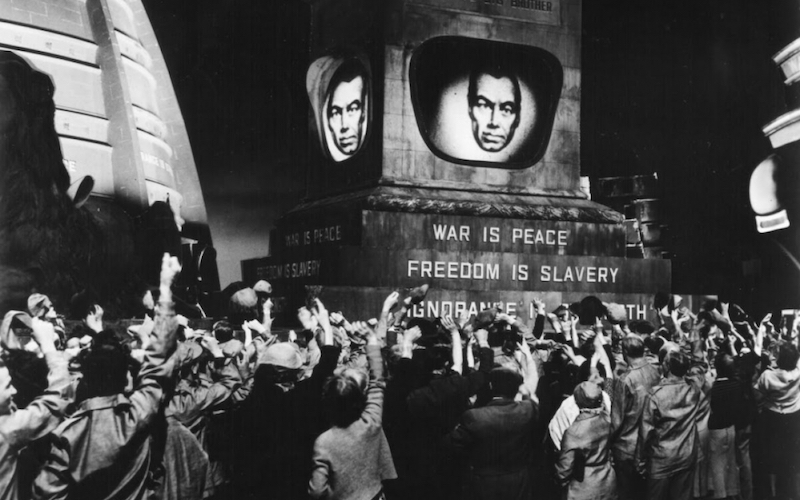
In 1984 all opposition is controlled and absorbed into the background. ‘Big Brother’ is the human image that represents The Inner Party (and the Party line) via the Telescreen providing an ‘official’ narrative while appropriating and misrepresenting the notion of brotherhood and unity into a ‘brand name’ — one that actually instills a psychology of collectivism, not brotherhood, just as the controllers in our own world instill nationalism and war-mindedness in the name of “freedom” and “liberty”. Indeed, the Telescreen is the primary means through which norms were forced on the society and false imagery and narratives embedded in its collective consciousness. Totally transfixed on the Party line, as told by the Telescreen, the fictional society of 1984 has lost the ability to think such that it will believe two plus two is five, as the saying goes, as long as it is presented as such on the Telescreen. They have been captive to this set up their entire lives, and, with language and thought restricted and outlawed, they are blind to their own captivity, unable to discern for themselves. Thus, lies are made to be “truths” using logic so distorted that it not only convinces the masses that two plus two equal five, but that war is peace, freedom is slavery, and ignorance is strength.

In reality, individual ignorance is strength to institutions. Such distortions of language and thought (and, incidentally, history) are the perfect means by which to disempower and co-opt an entire society — means that are not limited to the works of fiction. Orwell knew that ideas do not exist separately from language. Language, in both spoken and written forms, is essential to our ability to form and communicate thoughts and ideas. That is why today the United States government, the shadow powerbrokers that control it, and the mainstream media that support it (the entirety of which is owned by only 6 corporations) continue their war on “fake news” — i.e. ideas that are skeptical of government pronouncements, and information that proves them to be false — taking aim not just at independent journalism but independent thought itself. While government surveillance of its own people continues to increase, government secrecy is at an all-time high, the sharing of ideas that challenge the status quo is becoming more heavily censored, releasing information on institutional and State activity is now punishable by law, and whistleblowers from inside the State are systematically destroyed. If that wasn’t Orwellian enough, Donald Trump’s advisors have begun coining phrases like “alternative facts”, and we have even seen the creation of an Orwellian “Ministry of Truth”, an “international fact-checking network” charged with deciding what is “truth” and what is “fake news”.

If the events of 1984 continue to hold true, and the ruling Party of today gets its way, words and ideas will soon become not only censored, but illegal and eliminated altogether, controlled by increasingly totalitarian governments steering our society down a dystopian path of censorship, blind belief, and misinformation — all in the name of the State. However, as our minds are freed, one at a time, we are ultimately finding that our society is heavily embedded with such norms and structures that perpetuate false imagery, preserving the status quo of the State from the ‘threat’ of individual thinking — hence the modern war on “fake news”. We are beginning, as a society, to question such falsehood, and exercise our inherent freedom to expose it.

“Freedom is the freedom to say that two plus two make four. If that is granted, all else follows”. ~ George Orwell

The Last Man in Europe

The original working title to 1984 was ‘The Last Man in Europe.’ This descriptive and evocative title idea provides a clear glimpse into George Orwell’s intent, and encapsulates a main point of 1984, a title perhaps too revealing to be anything but a working title. Certainly, that is the way many of us feel when we first become aware of lies and partial-truths that are presented as reality by those in control of our society today, and accepted in totality by seemingly everyone else – it is as if we are the last lone person. Indeed, the road of the freethinker can be a lonely one, and the story’s protagonist, patriot Winston Smith, is made to believe he is the last person who questions, who looks, listens and speaks.

In a totalitarian society — be it Orwell’s fictional world or the increasingly authoritarian political regimes of today — the official narratives portrayed by the “official” media portray that a society is in consensus with the State, and that those engaged in Thoughtcrime (whether or not it is legally a crime) are isolated social outcasts and lunatics, and demeaned as “rebels” and “conspiracy theorists” (despite the existence of actual conspiracy, against which the truly conscious mind must inevitably rebel.) Yet in reality, Crimethink is what differentiates we freethinkers from those who are lost in the spell of societal illusion and, therefore, pose a threat to the status quo of the State. But this is part of the trap of Goodthink — it creates the illusion of consensus, and therefore, engenders isolation in those who do not concede.

As a master of his craft, nothing Orwell wrote was off the cuff. Now it is not overtly spoken in the book, but there are four types of people in the fictional realm of 1984. There are three described classes and a suggested fourth, only later is it implied that the Brotherhood, anti-establishment rebels — has been eliminated from the narrative jut as those in power sought to eliminate them from the society.

The Secret to 1984 is ‘4’

1984 is in part an expose on the four basic types of people in a society, the four types of institutions and the four types of institutional lies that enable them.

Characterized by how they respond to information, modern societies are made up of four archetypes of people — idiots, zealots, elitists and patriots. Idiots refuse information, zealots blindly refute information, elitists misuse information, and patriots seek and distribute information. Despite dramatic alterations in the world’s geopolitical landscape, and some fluctuation of individuals from one group/role to another over time, the dynamic between these groups has historically remained the same, and are inevitably intertwined: Idiots avoid all new pertinent information in order to maintain their perspective, never questioning the status quo. Zealots ask certain questions of certain information, ignoring unaligned information in order to maintain their perspective, supporting the status quo at all costs. Elitists question information in order to manipulate and reap gains off those who don’t know, benefiting from the status quo. Patriots question information to educate themselves and share it with others, in order that we might enhance our lives and progress beyond the status quo.

It is no wonder, then, that the patriot has been all but deleted from today’s socio-political landscape, with those acting as true patriots being demonized by the State, and the meaning of the word “patriot” distorted and confused (by the likes of George W. Bush Jr.) to mean an unquestioning, flag-waving, with-us-or-against-us brand of nationalistic idiocy. (Check out my article, The First Amendment – The REAL Patriot Act for a deeper discussion of this.) Using a practice so well-defined by Orwell that it is known today as Orwellian speak, institutions transfer and confuse words and ideas by mixing up themselves, their policies and their products with patriotic ideas and words. They take the meaning of words and archetypes, and flip them on their heads: War is peace, freedom is slavery, ignorance is strength, and true patriotism (such as that shown by government whistleblowers) is traitorous.

In reality, the true patriots, the rebels who see through the lies of institutions and act accordingly, are removed from public consciousness in exactly the same way. In “Orwellian” fashion, the fourth deleted class of people in 1984, the Brotherhood, who are working to bring down the fascist Inner Party, are deleted through the admission of language. The other three types, which are specifically mentioned in the-book-within-the-book, the fictional The Theory and Practice of Oligarchical Collectivism, are the High, the Middle and the Low castes. Similarly, the other three types of people depicted in the society of Oceania are the Inner Party, the Outer Party and the Proles. The social classes interact very little.

The Inner Party and Outer Party make up 2% of the population, and are the institutionalized controllers of Oceania. They are akin to modern politicians and the financial elite, working with and against one another, and clamoring to gain and maintain power. They have privileges the other castes do not, including being able to (temporarily) turn off the propaganda-spewing Telescreens.

However, there is a pecking order within the Party. The Outer Party are given state administrative jobs and are composed of the more educated members of society. They are responsible for the direct implementation of the Party’s policies but have no say in decision making. They are the “artificial middle class” and as such, have strict rules applied to them. They are allowed “no vices other than cigarettes and Victory Gin”, are spied on via their Telescreens, and are encouraged to spy on each other, and to report suspicious activities to Big Brother.

The lower class of workers that perform the majority of menial tasks and labors are known as the Proles. They live in the poorest of conditions, are not educated, and instead are kept entertained with alcohol, gambling, sports, fiction and pornography (called “prolefeed”) — the 1984 equivalent of “bread and circus”.

According to the Inner Party and the Telescreen it controls, those who might challenge the system – the important fourth type of person – simply do not exist. The Brotherhood, the organization of patriots, are portrayed by the controlling ‘Inner Party’ as only a rumor, and the notion of their existence is belittled by the Inner Party, via the Telescreen. In Oceania, if the Telescreen is t be believed, there are no patriots, nor is such action allowed — and any who think that way are isolated by the divide-and-conquer tactic used by empires past and present. Thus, like so many in our failing society, Smith believes himself to be ‘The Last Man in Europe’…

“During times of universal deceit, telling the truth becomes a revolutionary act.” – George Orwell

And yet, as the character of Winston Smith accurately observes in his diary, “If there is any hope, it lies with the Proles” — just as our hope for today lies with the so-called “99%”. The “proles” in our society must begin to look beyond the bread and circus, beyond the prolefeed, and become a true brotherhood, and sisterhood, by questioning information, educating themselves, and sharing what they learn with others in order that we might overcome institutional oppression and finally create the ‘golden age’ that is our combined potential.

God and Gold is Within

“We shall meet in the place where there is no darkness.” — George Orwell, 1984

Nothing Orwell wrote was by accident. The name of the character who leads the Brotherhood rebellion is named Emmanuel Goldstein, a name that translates roughly to mean God (Emmanuel) and gold are within (Goldstein). The use of this character name by Orwell asserts a developed, even transmuted human being, who has transcended the imposed limitations of the system he is opposed to, and grown from dull to refined, disempowered to empowered. It also reveals Orwell’s knowledge of how such patriotism and rebellion can become revolution.

The word “prole” is short for prolétariat, a French word derived from the Latin proletarius, meaning “a man whose only wealth is his offspring, or whose sole service to the state is as father”. A word evoking pure institutionalized collectivism, it suggests that the individual has no value other than the labor and progeny he provides to the State. (If you’re only value to the state is as a breeder and consumer, well what kind of world does, sorry, would that result in??) Now compare that definition to the name Emmanuel Goldstein, Golden Godliness is Within. In complete contrast, it is a statement of inner development, of individual enlightenment and empowerment — which, as Orwell knew, are the only forces that can successfully lead a rebellion against the institutional oppression of both fiction and reality.

So, you see, the secret to 1984 is ‘4’. Its most powerful message is in its omissions: in the omission of information, which is the only way the Party/State can maintain authoritarian control, and in the deliberately-omitted fourth human archetype, the righteous rebel, the marginalized voice of descent who is led to believe he is the “last man in Europe”. But in fact, the last man in Europe is you and I. We are everywhere. And, as we open our minds and our mouths, and embrace the gold within, we re-tell the lost narrative of the Brotherhood, and turn our Proles into our Brothers.

Saturday Matinee: Max Headroom

“Max Headroom: 20 Minutes Into the Future” (1985) was a television movie originally broadcast on Britain’s Channel 4 and served as a pilot for a series co-produced with ABC in 1987. It’s widely considered the earliest science fiction TV movie and series of the cyberpunk subgenre. Part of the reason for its enduring cult status is the sharp social satire of its vision of the future which remains topical to this day.

The film takes place in a corporate dystopia controlled by an oligarchy of media conglomerates. Like in Orwell’s 1984, television is used as a tool for propaganda as well as mass surveillance. Similar to Winston Smith, the protagonist of 1984, reporter Edison Carter works within the system while questioning the ethics of his employer, but unlike Smith, Carter has enough clout and connections to challenge the system and whistleblow  while retaining relative autonomy. He is helped by his producer Theora Jones, computer hacker Bryce Lynch, pirate broadcaster Blank Reg, and rogue artificial intelligence personality Max Headroom.

In Max Headroom: 20 Minutes Into the Future, Edison uncovers a conspiracy involving a new commercial technology called blip-verts: subliminal advertising that can cram greater amounts of data into minds of viewers but with devastating side-effects. During the struggle to bring the investigative report to the airwaves, Max Headroom is accidentally unleashed.