Everything Is a Weapon: The U.S. Government Is Waging Psychological Warfare on the Nation

By John W. Whitehead & Nisha Whitehead

Source: The Rutherford Institute

Have you ever wondered who’s pulling the strings? … Anything we touch is a weapon. We can deceive, persuade, change, influence, inspire. We come in many forms. We are everywhere.”— U.S. Army Psychological Operations recruitment video

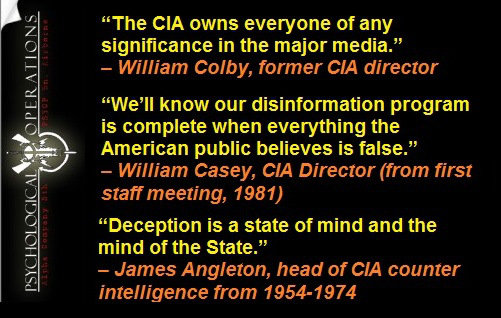
The U.S. government is waging psychological warfare on the American people.

No, this is not a conspiracy theory.

Psychological warfare, according to the Rand Corporation, “involves the planned use of propaganda and other psychological operations to influence the opinions, emotions, attitudes, and behavior of opposition groups.”

For years now, the government has been bombarding the citizenry with propaganda campaigns and psychological operations aimed at keeping us compliant, easily controlled and supportive of the police state’s various efforts abroad and domestically.

The government is so confident in its Orwellian powers of manipulation that it’s taken to bragging about them. Just recently, for example, the U.S. Army’s 4th Psychological Operations Group, the branch of the military responsible for psychological warfare, released a recruiting video that touts its efforts to pull the strings, turn everything they touch into a weapon, be everywhere, deceive, persuade, change, influence, and inspire.

This is the danger that lurks in plain sight.

Of the many weapons in the government’s vast arsenal, psychological warfare may be the most devastating in terms of the long-term consequences.

As the military journal Task and Purpose explains, “Psychological warfare is all about influencing governments, people of power, and everyday citizens… PSYOP soldiers’ key missions are to influence ‘emotions, notices, reasoning, and behavior of foreign governments and citizens,’ ‘deliberately deceive’ enemy forces, advise governments, and provide communications for disaster relief and rescue efforts.”

Yet don’t be fooled into thinking these psyops (psychological operations) campaigns are only aimed at foreign enemies. The government has made clear in word and deed that “we the people” are domestic enemies to be targeted, tracked, manipulated, micromanaged, surveilled, viewed as suspects, and treated as if our fundamental rights are mere privileges that can be easily discarded.

Aided and abetted by technological advances and scientific experimentation, the government has been subjecting the American people to “apple-pie propaganda” for the better part of the last century.

Consider some of the ways in which the government continues to wage psychological warfare on a largely unsuspecting citizenry.

Weaponizing violence. With alarming regularity, the nation continues to be subjected to spates of violence that terrorizes the public, destabilizes the country’s ecosystem, and gives the government greater justifications to crack down, lock down, and institute even more authoritarian policies for the so-called sake of national security without many objections from the citizenry.

Weaponizing surveillance, pre-crime and pre-thought campaigns. Surveillance, digital stalking and the data mining of the American people add up to a society in which there’s little room for indiscretions, imperfections, or acts of independence. When the government sees all and knows all and has an abundance of laws to render even the most seemingly upstanding citizen a criminal and lawbreaker, then the old adage that you’ve got nothing to worry about if you’ve got nothing to hide no longer applies. Add pre-crime programs into the mix with government agencies and corporations working in tandem to determine who is a potential danger and spin a sticky spider-web of threat assessments, behavioral sensing warnings, flagged “words,” and “suspicious” activity reports using automated eyes and ears, social media, behavior sensing software, and citizen spies, and you having the makings for a perfect dystopian nightmare. The government’s war on crime has now veered into the realm of social media and technological entrapment, with government agents adopting fake social media identities and AI-created profile pictures in order to surveil, target and capture potential suspects.

Weaponizing digital currencies, social media scores and censorship. Tech giants, working with the government, have been meting out their own version of social justice by way of digital tyranny and corporate censorship, muzzling whomever they want, whenever they want, on whatever pretext they want in the absence of any real due process, review or appeal. Unfortunately, digital censorship is just the beginning. Digital currencies (which can be used as “a tool for government surveillance of citizens and control over their financial transactions”), combined with social media scores and surveillance capitalism create a litmus test to determine who is worthy enough to be part of society and punish individuals for moral lapses and social transgressions (and reward them for adhering to government-sanctioned behavior). In China, millions of individuals and businesses, blacklisted as “unworthy” based on social media credit scores that grade them based on whether they are “good” citizens, have been banned from accessing financial markets, buying real estate or travelling by air or train.

Weaponizing compliance. Even the most well-intentioned government law or program can be—and has been—perverted, corrupted and used to advance illegitimate purposes once profit and power are added to the equation. The war on terror, the war on drugs, the war on COVID-19, the war on illegal immigration, asset forfeiture schemes, road safety schemes, school safety schemes, eminent domain: all of these programs started out as legitimate responses to pressing concerns and have since become weapons of compliance and control in the police state’s hands.

Weaponizing entertainment. For the past century, the Department of Defense’s Entertainment Media Office has provided Hollywood with equipment, personnel and technical expertise at taxpayer expense. In exchange, the military industrial complex has gotten a starring role in such blockbusters as Top Gun and its rebooted sequel Top Gun: Maverick, which translates to free advertising for the war hawks, recruitment of foot soldiers for the military empire, patriotic fervor by the taxpayers who have to foot the bill for the nation’s endless wars, and Hollywood visionaries working to churn out dystopian thrillers that make the war machine appear relevant, heroic and necessary. As Elmer Davis, a CBS broadcaster who was appointed the head of the Office of War Information, observed, “The easiest way to inject a propaganda idea into most people’s minds is to let it go through the medium of an entertainment picture when they do not realize that they are being propagandized.”

Weaponizing behavioral science and nudging. Apart from the overt dangers posed by a government that feels justified and empowered to spy on its people and use its ever-expanding arsenal of weapons and technology to monitor and control them, there’s also the covert dangers associated with a government empowered to use these same technologies to influence behaviors en masse and control the populace. In fact, it was President Obama who issued an executive order directing federal agencies to use “behavioral science” methods to minimize bureaucracy and influence the way people respond to government programs. It’s a short hop, skip and a jump from a behavioral program that tries to influence how people respond to paperwork to a government program that tries to shape the public’s views about other, more consequential matters. Thus, increasingly, governments around the world—including in the United States—are relying on “nudge units” to steer citizens in the direction the powers-that-be want them to go, while preserving the appearance of free will.

Weaponizing desensitization campaigns aimed at lulling us into a false sense of security. The events of recent years—the invasive surveillance, the extremism reports, the civil unrest, the protests, the shootings, the bombings, the military exercises and active shooter drills, the lockdowns, the color-coded alerts and threat assessments, the fusion centers, the transformation of local police into extensions of the military, the distribution of military equipment and weapons to local police forces, the government databases containing the names of dissidents and potential troublemakers—have conspired to acclimate the populace to accept a police state willingly, even gratefully.

Weaponizing fear and paranoia. The language of fear is spoken effectively by politicians on both sides of the aisle, shouted by media pundits from their cable TV pulpits, marketed by corporations, and codified into bureaucratic laws that do little to make our lives safer or more secure. Fear, as history shows, is the method most often used by politicians to increase the power of government and control a populace, dividing the people into factions, and persuading them to see each other as the enemy. This Machiavellian scheme has so ensnared the nation that few Americans even realize they are being manipulated into adopting an “us” against “them” mindset. Instead, fueled with fear and loathing for phantom opponents, they agree to pour millions of dollars and resources into political elections, militarized police, spy technology and endless wars, hoping for a guarantee of safety that never comes. All the while, those in power—bought and paid for by lobbyists and corporations—move their costly agendas forward, and “we the suckers” get saddled with the tax bills and subjected to pat downs, police raids and round-the-clock surveillance.

Weaponizing genetics. Not only does fear grease the wheels of the transition to fascism by cultivating fearful, controlled, pacified, cowed citizens, but it also embeds itself in our very DNA so that we pass on our fear and compliance to our offspring. It’s called epigenetic inheritance, the transmission through DNA of traumatic experiences. For example, neuroscientists observed that fear can travel through generations of mice DNA. As The Washington Post reports, “Studies on humans suggest that children and grandchildren may have felt the epigenetic impact of such traumatic events such as famine, the Holocaust and the Sept. 11, 2001, terrorist attacks.”

Weaponizing the future. With greater frequency, the government has been issuing warnings about the dire need to prepare for the dystopian future that awaits us. For instance, the Pentagon training video, “Megacities: Urban Future, the Emerging Complexity,” predicts that by 2030 (coincidentally, the same year that society begins to achieve singularity with the metaverse) the military would be called on to use armed forces to solve future domestic political and social problems. What they’re really talking about is martial law, packaged as a well-meaning and overriding concern for the nation’s security. The chilling five-minute training video paints an ominous picture of the future bedeviled by “criminal networks,” “substandard infrastructure,” “religious and ethnic tensions,” “impoverishment, slums,” “open landfills, over-burdened sewers,” a “growing mass of unemployed,” and an urban landscape in which the prosperous economic elite must be protected from the impoverishment of the have nots. “We the people” are the have-nots.

The end goal of these mind control campaigns—packaged in the guise of the greater good—is to see how far the American people will allow the government to go in re-shaping the country in the image of a totalitarian police state.

The facts speak for themselves.

Whatever else it may be—a danger, a menace, a threat—the U.S. government is certainly not looking out for our best interests, nor is it in any way a friend to freedom.

When the government views itself as superior to the citizenry, when it no longer operates for the benefit of the people, when the people are no longer able to peacefully reform their government, when government officials cease to act like public servants, when elected officials no longer represent the will of the people, when the government routinely violates the rights of the people and perpetrates more violence against the citizenry than the criminal class, when government spending is unaccountable and unaccounted for, when the judiciary act as courts of order rather than justice, and when the government is no longer bound by the laws of the Constitution, then you no longer have a government “of the people, by the people and for the people.”

What we have is a government of wolves.

Our backs are against the proverbial wall.

“We the people”—who think, who reason, who take a stand, who resist, who demand to be treated with dignity and care, who believe in freedom and justice for all—have become undervalued citizens of a totalitarian state that views people as expendable once they have outgrown their usefulness to the State.

Brace yourselves.

As I make clear in my book Battlefield America: The War on the American People and in its fictional counterpart The Erik Blair Diaries, “we the people” have become enemies of the Deep State.
Resolution for 2022: Dare to Build Your Own Opinions and Then Defend Them!

By Alfred De Zayas

Source: CounterPunch

– Sapere aude!, Horace

Anyone who has followed the political culture in the US, Canada, UK, EU over the past twenty years must have realized that a war on epistemology, on truth, on semantics is going on.  We witness the hijacking of concepts like democracy, freedom, peace, patriotism, human rights — and their instrumentalization for domestic and geopolitical purposes.  We observe a process of language destruction not unlike what Orwell foresaw in his sadly visionary book 1984.  “Newspeak” is not the future, it is now, hic et nunc. We recognize it in the jargon of political correctness, the language and practice of the “cancel culture”.

The military-industrial-financial complex in the US, Canada, UK, EU is hell bent on full spectrum cognitive control and inundates the population with plausible “narratives” based on fake news, fake history, fake law, fake diplomacy and fake democracy. We are literally swimming in an ocean of lies – but, remarkably, most people are not conscious of the fact that they are systematically manipulated by governments, corporate media, compliant think tanks and universities. The power of “political correctness” surrounds us in direct and subliminal ways. Most accept it as the “new normal”, as long as they continue having Hollywood entertainment and lots of sports on television. The classical panem et circensis (Juvenal).

A particularly worrisome phenomenon is the gradual emergence of a “human rights industry” that systematically subverts and weaponizes human rights.  The holistic approach to civil, political, economic, social and cultural rights advocated by Eleanor Roosevelt has been quietly denatured, dismantled, discarded.  We see how the “industry” transforms the individual and collective entitlement to assistance, protection, respect and solidarity — based on our common human dignity  — into a hostile arsenal to target competitors and political adversaries.

In the stockpile of weaponized human rights, the technique of “naming and shaming” has become a sort of ubiquitous Kalashnikov. Yet, experience shows that naming and shaming fails to alleviate the suffering of victims and only satisfies the strategic aims of certain governments, non-governmental organizations and of a burgeoning clique of human rights operatives in government, academia and even in international organizations.  Allegations of real and putative human rights violations have proven politically very useful to destabilize rivals, denouncing and demonizing them.  To this end the deliberate use of double-standards, the maximation of human rights violations by a targeted country and the negation or suppression of evidence of violations by our own governments or by our allies, prepares the population to accept patently unjust and illegal actions to prepare “regime change” elsewhere.  Precisely this kind of indoctrination of the population through evidence-free allegations and hyperbole paves the way to barbarism e.g.  the aggression against Iraq in 2003 and against Libya in 2011, to name only two emblematic examples.

The Iraq invasion, which UN Secretary General Kofi Annan repeatedly called an “illegal war” found the support of a “coalition of the willing” – 43 States that turned their backs on the UN Charter and on international law, with the support of many university pundits and the corporate media.  One could affirm without fear of contradiction that the Iraq war constituted an international revolt, an assault on the international order established under the UN Charter and a negation of the Nuremberg Principles.

The Iraq war was preceded by a public relations and disinformation scheme of “naming and shaming”, a concerted campaign about the non-existent weapons of mass destruction, about the extraordinary criminality of Saddam Hussein, who a few years earlier had done the Pentagon’s bidding in the US proxy war against Iran.  Barely eight years later, in 2011, alleged human rights violations were again invoked to denounce Muammar al-Gaddafi for the sole purpose of destabilizing Libya, imposing undemocratic “regime change” and facilitating the looting of Libya’s natural resources.  This occurred in flagrant violation of the customary international law principle of non-intervention in the internal affairs of sovereign States, also contained in treaties and stipulated in the 1986 Judgment of the International Court of Justice in the Military and Paramilitary Activities in and against Nicaragua case[1].

Many rapporteurs of the UN Human Rights Council, European Commission and Inter-American commission also make use of “naming and shaming”, a  strategy that rests on the false premise that the “namer” somehow possesses moral authority and that the “named” will recognize this moral superiority and act accordingly. Theoretically this could function if the “namer” were to practice “naming and shaming” uniformly, in a non-selective manner. Alas, the technique frequently backfires, because the “namer” has many skeletons in the closet and engages in blatant double-standards. Such intellectual dishonesty usually stiffens the resistance of the “named” party, who will be even less inclined to take any measures to remedy the alleged violations.

Another technique of norm-warfare is what is termed “lawfare”, whereby the apparatus of the administration of justice, both civil and criminal, is complicit in the subversion of the rule of law.  We witness how domestic and international criminal law are instrumentalized to demonize certain persons and not others. A self-respecting judge would not betray the profession by playing this kind of game — but some do – as we have seen in the US, UK, Sweden and Ecuador in the Julian Assange case.  The book by UN Rapporteur on Torture Professor Nils Melzer (Switzerland), originally published in German and now being released in English translation (by the author himself) The Trial of Julian Assange  (Verso, New York 2022)[2]  reveals the breakdown of the rule of law in the US, UK, Sweden and Ecuador – a tour de force, far more serious than Emile Zola’s J’accuse in 1898 during the Dreyfus Affaire in France. Instead of safeguarding the ethos of the rule of law, these political judges corrupt it (remember Roland Freisler in Hitler’s infamous Volksgerichtshof!) thus undermining the credibility of the entire system. Quis custodiet ipsos custodes (Juvenal).  This is a crucial question of constitutional law.  Who will guard over the guardians? The corruption of the rule of law by those courts that engage in “lawfare” is far more serious than many will admit, because it is precisely the administration of justice that must be the gatekeeper of truth and equity, the defender of the weak and most vulnerable.  The deliberate corruption of the administration of justice to target political or economic rivals leaves us powerless against tyranny.

Under certain conditions, “naming and shaming” as we know it from politicians, rapporteurs and the media, raise issues of additionalviolations of human rights and the rule of law, contravening Arts. 6, 7, 9, 10, 14, 17, 18, 19 and 26 of the International Covenant on Civil and Political Rights, and could reach the threshold of what is termed “hate speech” under Art. 20 ICCPR.

Experience shows that “naming and shaming” is an ineffective instrument of change. States and ngo’s would do well to revisit Matthew VII, 3-5 and replace the obsolete “naming and shaming” technique by good faith proposals and constructive recommendations, accompanied by the offer of advisory services and technical assistance so as to concretely help the victims on the ground. Sowing honesty and friendship is necessary if we expect to reap cooperation and progress in human rights terms. What is most needed today is mature diplomacy, result-oriented negotiations, a culture of dialogue and mediation, instead of a petulant culture of posturing, grandstanding, intransigence and holier-than-thou pretence.

The arsenal of weaponized human rights also includes non-conventional wars such as economic wars and sanctions regimes, ostensibly justified because of the alleged human rights violations of the targeted State. The result is that, far from helping the victims, entire populations are held hostage –victims not only of violations by their own governments, but also of “collective punishment” by the sanctioning State(s). This can entail crimes against humanity under article 7 of the Statute of the International Criminal Court, when as a consequence food security is impacted, medicines and medical equipment are rendered scarce or are available only at exorbitant prices. Demonstrably, economic sanctions kill[3]. It is particularly disgraceful how several non-governmental organizations including  Amnesty International and Human Rights Watch have preferred to focus on real and alleged violations of civil and political rights by Venezuela’s Nicolas Maduro and forgotten the fundamental human rights of the Venezuelan people and the fact that tens of thousands of Venezuelans have already perished as a direct result of illegal unilateral coercive measures and financial blockades, as we know from independent reports, including the 2019 report “Collective Punishment” by Professor Jeffrey Sachs (Colombia) and Mark Weisbrot (Center for Economic and Policy Research)[4] .

Another grotesque example of weaponization of human rights principles is reflected in UN Security Council Resolution 1973 concerning humanitarian assistance to the Libyan population. This resolution was promptly hijacked by NATO to wage an all-out war on Libya, leading to the assassination of Libya’s head of State, Muammar Gadaffi in 2011. Ten years later the country is still in civil war and chaos, but the natural resources are safely in the hands of Western economic interests. More recently, in February 2019, USAID and the National Endowment for Democracy organized  “humanitarian assistance” for Venezuela and placed an impostor with no constitutional legitimacy, the pretender Juan Guaidó, as the leader who would bring this humanitarian assistance to Venezuela. The operation failed. This was followed by a real coup d’état attempt in April 2019, which again failed, and yet another attempt in May 2020, the Operation Gideon, which similarly failed.  The violations by the US and accomplices of fundamental norms of international law – and common decency – were breathtaking.  And yet, the New York Times, Washington Post, CNN, Fox, etc. whitewashed these operations and sided with the putschists – invoking “principles” such as “democracy”, “humanitarian intervention” and “responsibility to protect”.  Hypocrisy had indeed come a long way.

Yet another form of weaponizing values is the grotesque undermining of peace and human rights by Committees that award such prizes.  A notorious disgrace is the undermining of the last will and testament of Alfred Nobel, who genuinely wanted to promote peace and human rights.  If one regards the laureates over the past years, we realize that most of them do not come within the testamentary purpose.  These days the laureates are not genuine pacifists like Henri Dunant or Bertha von Suttner.  They are chosen for purely political purposes – not to advance peace and dialogue, but to denounce certain governments (in 2021 the Philippines and Russia) and to promote a geopolitical model over another.  This is totally against the letter and spirit the Nobel Peace Prize. The best book on the subject is by the Norwegian lawyer Fredrik Heffermehl, The Nobel Peace Prize – What Nobel really wanted.

And let us not forget the politicization and weaponization of sports.  We are being manipulated into thinking that boycotting the Beijing Olympics is a good and honourable thing.  It is not.  It is an oxymoron, a public relations stunt.

What can we average citizens do?  First and foremost we must know the facts.  And because the corporate media lies to us, we must pro-actively get the information.  Thanks to the internet, it is still possible to access information that we do not get in the New York Times (“all the news that’s fit to print”), Washington Post, CNN and Fox.  We must demand transparency and accountability from our democratically elected leaders, when instead of formulating constructive solutions to problems they engage in confrontational politics.  We must demand that our elected officials learn the habits of collaboration and compromise, enable true competition by guaranteeing a level playing field for everyone, both domestically and internationally. Our politicians, the media and the university pundits should embrace a new paradigm:  competition in solidarity.  I incorporate these thoughts into my 25 Principles of International Order,presented to the UN Human Rights Council in 2018.[5]

Here our New Year’s Resolutions:

1. Sapere aude (Horace). Get the facts and act thereon.

2. Pushback against the hybrid war being waged by governments and the media. Demand truth from the government and the private sector. Only on the basis of correct information can the citizen exercise his democratic rights.

3. Pushback against the war being waged against whistleblowers, true human rights defenders. Demand the immediate release of Julian Assange. Recognize the contribution of Edward Snowden to the survival of true American values.

4. Pushback against Orwellian newspeak and “political correctness”. Refuse to retreat into self-censorship.

5. Pushback against the military-industrial-financial complex

In 2022 let us  commit to listen more to others, practice self-criticism and intellectual honesty, stop instrumentalizing values for short-term political gain.

Let us reject the weaponization of everything.

Notes.

[1] https://www.icj-cij.org/en/case/70/judgments

[2] https://www.transcend.org/tms/2021/11/the-trial-of-julian-assange-a-book-by-nils-melzer/

[3] https://undocs.org/A/HRC/39/47/Add.1

[4] https://cepr.net/report/economic-sanctions-as-collective-punishment-the-case-of-venezuela/

[5] https://www.claritypress.com/product/building-a-just-world-order/

Freedom Is a Myth: We Are All Prisoners of the Police State’s Panopticon Village

“We’re run by the Pentagon, we’re run by Madison Avenue, we’re run by television, and as long as we accept those things and don’t revolt we’ll have to go along with the stream to the eventual avalanche…. As long as we go out and buy stuff, we’re at their mercy… We all live in a little Village. Your Village may be different from other people’s Villages, but we are all prisoners.”— Patrick McGoohan

By John W. Whitehead

Source: The Rutherford Institute

First broadcast in Great Britain 50 years ago, The Prisoner—a dystopian television series described as “James Bond meets George Orwell filtered through Franz Kafka”—confronted societal themes that are still relevant today: the rise of a police state, the freedom of the individual, round-the-clock surveillance, the corruption of government, totalitarianism, weaponization, group think, mass marketing, and the tendency of humankind to meekly accept their lot in life as a prisoner in a prison of their own making.

Perhaps the best visual debate ever on individuality and freedom, The Prisoner (17 episodes in all) centers around a British secret agent who abruptly resigns only to find himself imprisoned, monitored by militarized drones, and interrogated in a mysterious, self-contained, cosmopolitan, seemingly tranquil retirement community known only as the Village. The Village is an idyllic setting with parks and green fields, recreational activities and even a butler.

While luxurious and resort-like, the Village is a virtual prison disguised as a seaside paradise: its inhabitants have no true freedom, they cannot leave the Village, they are under constant surveillance, their movements are tracked by surveillance drones, and they are stripped of their individuality and identified only by numbers.

The series’ protagonist, played by Patrick McGoohan, is Number Six.

Number Two, the Village administrator, acts as an agent for the unseen and all-powerful Number One, whose identity is not revealed until the final episode.

“I am not a number. I am a free man,” was the mantra chanted on each episode of The Prisoner, which was largely written and directed by McGoohan.

In the opening episode (“The Arrival”), Number Six meets Number Two, who explains to him that he is in The Village because information stored “inside” his head has made him too valuable to be allowed to roam free “outside.”

Throughout the series, Number Six is subjected to interrogation tactics, torture, hallucinogenic drugs, identity theft, mind control, dream manipulation, and various forms of social indoctrination and physical coercion in order to “persuade” him to comply, give up, give in and subjugate himself to the will of the powers-that-be.

Number Six refuses to comply.

In every episode, Number Six resists the Village’s indoctrination methods, struggles to maintain his own identity, and attempts to escape his captors. “I will not make any deals with you,” he pointedly remarks to Number Two. “I’ve resigned. I will not be pushed, filed, stamped, indexed, debriefed or numbered. My life is my own.”

Yet no matter how far Number Six manages to get in his efforts to escape, it’s never far enough.

Watched by surveillance cameras and other devices, Number Six’s getaways are continuously thwarted by ominous white balloon-like spheres known as “rovers.” Still, he refuses to give up. “Unlike me,” he says to his fellow prisoners, “many of you have accepted the situation of your imprisonment, and will die here like rotten cabbages.”

Number Six’s escapes become a surreal exercise in futility, each episode an unfunny, unsettling Groundhog’s Day that builds to the same frustrating denouement: there is no escape.

As journalist Scott Thill concludes for Wired, “Rebellion always comes at a price. During the acclaimed run of The Prisoner, Number Six is tortured, battered and even body-snatched: In the episode ‘Do Not Forsake Me Oh My Darling,’ his mind is transplanted to another man’s body. Number Six repeatedly escapes The Village only to be returned to it in the end, trapped like an animal, overcome by a restless energy he cannot expend, and betrayed by nearly everyone around him.”

The series is a chilling lesson about how difficult it is to gain one’s freedom in a society in which prison walls are disguised within the trappings of technological and scientific progress, national security and so-called democracy.

As Thill noted when McGoohan died in 2009, “The Prisoner was an allegory of the individual, aiming to find peace and freedom in a dystopia masquerading as a utopia.”

The Prisoner’s Village is also an apt allegory for the American Police State: it gives the illusion of freedom while functioning all the while like a prison: controlled, watchful, inflexible, punitive, deadly and inescapable.

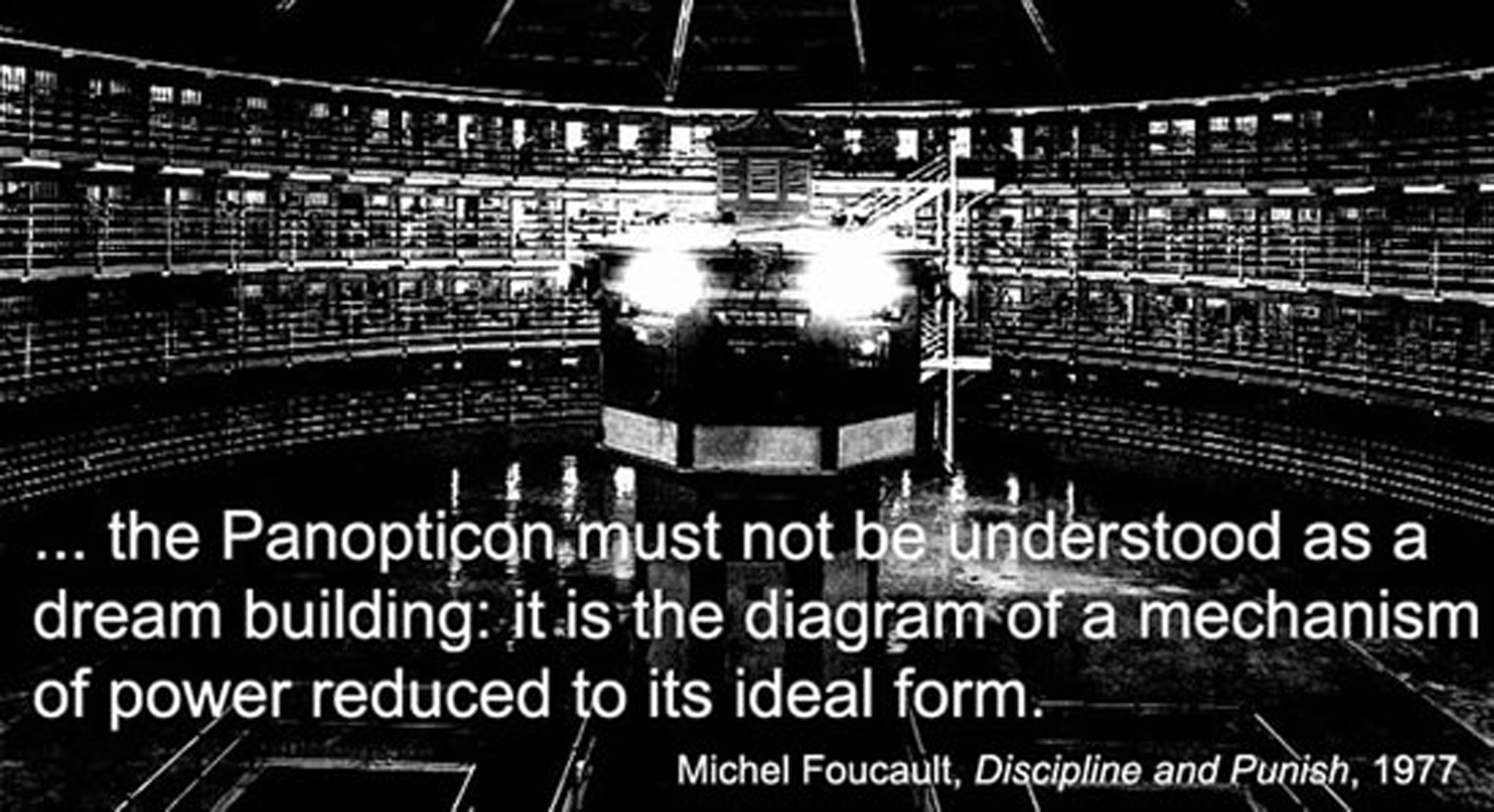
The American Police State, much like The Prisoner’s Village, is a metaphorical panopticon, a circular prison in which the inmates are monitored by a single watchman situated in a central tower. Because the inmates cannot see the watchman, they are unable to tell whether or not they are being watched at any given time and must proceed under the assumption that they are always being watched.

Eighteenth century social theorist Jeremy Bentham envisioned the panopticon prison to be a cheaper and more effective means of “obtaining power of mind over mind, in a quantity hitherto without example.”

Bentham’s panopticon, in which the prisoners are used as a source of cheap, menial labor, has become a model for the modern surveillance state in which the populace is constantly being watched, controlled and managed by the powers-that-be and funding its existence.

Nowhere to run and nowhere to hide: this is the new mantra of the architects of the police state and their corporate collaborators (Facebook, Amazon, Netflix, Google, Instagram, etc.).

Government eyes are watching you.

They see your every move: what you read, how much you spend, where you go, with whom you interact, when you wake up in the morning, what you’re watching on television and reading on the internet.

Every move you make is being monitored, mined for data, crunched, and tabulated in order to form a picture of who you are, what makes you tick, and how best to control you when and if it becomes necessary to bring you in line.

When the government sees all and knows all and has an abundance of laws to render even the most seemingly upstanding citizen a criminal and lawbreaker, then the old adage that you’ve got nothing to worry about if you’ve got nothing to hide no longer applies.

Apart from the obvious dangers posed by a government that feels justified and empowered to spy on its people and use its ever-expanding arsenal of weapons and technology to monitor and control them, we’re approaching a time in which we will be forced to choose between obeying the dictates of the government—i.e., the law, or whatever a government official deems the law to be—and maintaining our individuality, integrity and independence.

When people talk about privacy, they mistakenly assume it protects only that which is hidden behind a wall or under one’s clothing. The courts have fostered this misunderstanding with their constantly shifting delineation of what constitutes an “expectation of privacy.” And technology has furthered muddied the waters.

However, privacy is so much more than what you do or say behind locked doors. It is a way of living one’s life firm in the belief that you are the master of your life, and barring any immediate danger to another person (which is far different from the carefully crafted threats to national security the government uses to justify its actions), it’s no one’s business what you read, what you say, where you go, whom you spend your time with, and how you spend your money.

Unfortunately, George Orwell’s 1984—where “you had to live—did live, from habit that became instinct—in the assumption that every sound you made was overheard, and, except in darkness, every movement scrutinized”—has now become our reality.

We now find ourselves in the unenviable position of being monitored, managed and controlled by our technology, which answers not to us but to our government and corporate rulers.

Consider that on any given day, the average American going about his daily business will be monitored, surveilled, spied on and tracked in more than 20 different ways, by both government and corporate eyes and ears.

A byproduct of this new age in which we live, whether you’re walking through a store, driving your car, checking email, or talking to friends and family on the phone, you can be sure that some government agency, whether the NSA or some other entity, is listening in and tracking your behavior.

This doesn’t even begin to touch on the corporate trackers that monitor your purchases, web browsing, Facebook posts and other activities taking place in the cyber sphere.

Stingray devices mounted on police cars to warrantlessly track cell phones, Doppler radar devices that can detect human breathing and movement within in a home, license plate readers that can record up to 1800 license plates per minute, sidewalk and “public space” cameras coupled with facial recognition and behavior-sensing technology that lay the groundwork for police “pre-crime” programs, police body cameras that turn police officers into roving surveillance cameras, the internet of things: all of these technologies add up to a society in which there’s little room for indiscretions, imperfections, or acts of independence—especially not when the government can listen in on your phone calls, monitor your driving habits, track your movements, scrutinize your purchases and peer through the walls of your home.

As French philosopher Michel Foucault concluded in his 1975 book Discipline and Punish, “Visibility is a trap.”

This is the electronic concentration camp—the panopticon prison—the Village—in which we are now caged.

It is a prison from which there will be no escape if the government gets it way.

As Glenn Greenwald notes:

“The way things are supposed to work is that we’re supposed to know virtually everything about what [government officials] do: that’s why they’re called public servants. They’re supposed to know virtually nothing about what we do: that’s why we’re called private individuals. This dynamic – the hallmark of a healthy and free society – has been radically reversed. Now, they know everything about what we do, and are constantly building systems to know more. Meanwhile, we know less and less about what they do, as they build walls of secrecy behind which they function. That’s the imbalance that needs to come to an end. No democracy can be healthy and functional if the most consequential acts of those who wield political power are completely unknown to those to whom they are supposed to be accountable.”

Even now, the Trump Administration is working to make some of the National Security Agency’s vast spying powers permanent.

In fact, Attorney General Jeff Sessions is pushing for Congress to permanently renew Section 702 of the Foreign Intelligence Surveillance Act, which allows government snoops to warrantlessly comb through and harvest vast quantities of our communications.

And just like that, we’re back in the Village, our escape plans foiled, our future bleak.

Except this is no surprise ending: for those who haven’t been taking the escapist blue pill, who haven’t fallen for the Deep State’s phony rhetoric, who haven’t been lured in by the promise of a political savior, we never stopped being prisoners.

So how do we break out?

For starters, wake up. Resist the urge to comply.

The struggle to remain “oneself in a society increasingly obsessed with conformity to mass consumerism,” writes Steven Paul Davies, means that superficiality and image trump truth and the individual. The result is the group mind and the tyranny of mob-think.

Think for yourself. Be an individual. As McGoohan commented in 1968, “At this moment individuals are being drained of their personalities and being brainwashed into slaves… As long as people feel something, that’s the great thing. It’s when they are walking around not thinking and not feeling, that’s tough. When you get a mob like that, you can turn them into the sort of gang that Hitler had.”

In a media-dominated age in which the lines between entertainment, politics and news reporting are blurred, it is extremely difficult to distinguish fact from fiction. We are so bombarded with images, dictates, rules and punishments and stamped with numbers from the day we are born that it is a wonder we ever ponder a concept such as freedom. As McGoohan declared, “Freedom is a myth.”

In the end, as I make clear in my book Battlefield America: The War on the American People, we are all prisoners of our own mind.

In fact, it is in the mind that prisons are created for us. And in the lockdown of political correctness, it becomes extremely difficult to speak or act individually without being ostracized. Thus, so often we are forced to retreat inwardly into our minds, a prison without bars from which we cannot escape, and into the world of video games and television and the Internet.

We have come full circle from Bentham’s Panopticon to McGoohan’s Village to Huxley’s Brave New World.

As cultural theorist Neil Postman observed:

What Orwell feared were those who would ban books. What Huxley feared was that there would be no reason to ban a book, for there would be no one who wanted to read one. Orwell feared those who would deprive us of information. Huxley feared those who would give us so much that we would be reduced to passivity and egoism. Orwell feared we would become a captive audience. Huxley feared the truth would be drowned in a sea of irrelevance. Orwell feared that we would become a captive culture. Huxley feared we would become a trivial culture, preoccupied with some equivalent of the feelies, the orgy porgy, and the centrifugal bumblepuppy. As Huxley remarked in Brave New World Revisited, the civil libertarians and rationalists who are ever on the alert to oppose tyranny “failed to take into account man’s almost infinite appetite for distractions.” In Brave New World, they are controlled by inflicting pleasure. In short, Orwell feared that what we hate would ruin us. Huxley feared that what we love will ruin us.

You want to be free? Break out of the circle.