The Fourth Turn, Turn, Turn

By Charles Hugh Smith

Source: Of Two Minds

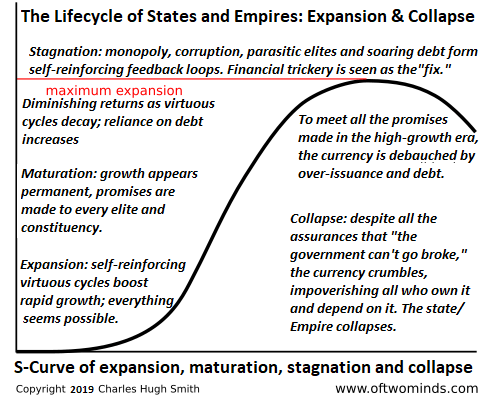
The cycles of The Fourth Turning, Fischer and Turchin are all in alignment at this point in history..

The 1997 book The Fourth Turning: An American Prophecy proposed a cyclical pattern of four 20-year generations which culminate in a national crisis every 80 years. The book identifies these dates as Fourth Turnings: 1781 (Revolutionary War), 1861 (Civil War) and 1941 (global war). add 80 years and voila, 2021.

I use the term Fourth Turning generically to describe an existential crisis that decisively changes the course of national identity and history.

In other words, we don’t have to accept the book’s theory of generational dynamics to accept an 80-year cycle. There are other causal dynamics in play that also tend to cycle: the credit (Kondratieff) cycle, for example.

While each of the previous existential crises were resolved positively, positive outcomes are not guaranteed: dissolution and collapse are also potential outcomes.

David Hackett Fischer’s book The Great Wave: Price Revolutions and the Rhythm of History proposes another cycle: humans expand their numbers and consumption until they’ve exploited and depleted all available resources.

As resources become scarce, societies and economies unravel as humans do not respond well to rising prices generated by scarcities.

The unraveling continues until consumption is realigned with the resources available. In the past this meant either a mass die-off that drastically reduced human numbers and consumption (for example, The Black Plague), a decline in fertility that slowly reduced population to fit resources, mass migration to locales with more resources or the discovery and exploitation of a new scalable energy source that enabled a new cycle of rising consumption.

The 14th century Black Death reduce Europe’s population by roughly 40%, enabling depleted forests to regrow and depleted agricultural land to restore fertility.

Once the human population regained its numbers and consumption in the 17th century, wood was once again under pressure as the key source of energy, shipbuilding, housing, etc.

The development of steam power and the technologies of mining enabled the exploitation of coal, which soon replaced wood as the primary energy source.

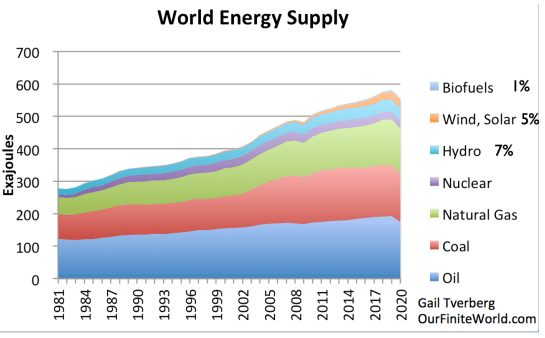
Oil and natural gas added to the energy humans could tap, followed (at a much more modest level) by nuclear power. Despite gargantuan investments, the recent push to develop solar and wind energy has yielded very modest results, as globally these sources provide about 5% of total energy consumption. (See chart below)

It’s self-evident that despite breezy claims of endless expansion of consumption, the global human population has now exceeded the resources available for practical extraction. Energy, fresh water, wild fisheries and fertile soils have all been exploited and the easy/cheap-to-extract resources have been depleted.

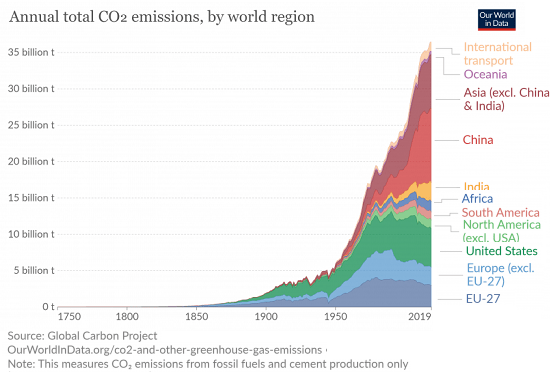
(The chart below of global CO2 emissions is a proxy for energy / resource consumption.)

So once again it’s crunch-time: either we proactively reduce consumption to align with available resources, or Nature will do it for us via scarcities.

Peter Turchin proposed another socio-economic cycle of 50 years in his book Ages of Discord: in the integrative stage, people find reasons to cooperate. In the disintegrative stage at the end of the cycle, people no longer find much common ground or reasons to cooperate. Political, social and financial extremes proliferate, culminating in a rolling crisis.

In Turchin’s analysis, the previous 50-year age of discord began around 1970, and the current era of discord began in 2020. Those who lived through the domestic terrorism, urban decay, stagflation and political/social/legal crises of the 1970s recall how inter-related crises dominated the decade.

In my analysis, the last period of discord in the 1970s was “saved” by the supergiant oil fields discovered in the 60s coming online in the late 1970s and early 1980s. That oil enabled a 40-year boom which is now ending, with no new scalable source of energy available to replace oil, much less enable an expansion of consumption.

In other words, the cycles of The Fourth Turning, Fischer and Turchin are all in alignment at this point in history. We have proliferating political, social and financial extremes and a forced transition to lower consumption to align with declining energy.

Turn, turn, turn. Right when we need to cooperate on transforming a high-consumption, bubble-dependent “waste is growth” Landfill Economy to declining consumption / Degrowth, we’re beset by discord and demographic pressures, as the promises made to the elderly back when it was expected that there would always be 5 workers per retiree cannot possibly be kept now that the worker-retiree ratio is 2-to-1 and there are no limits on healthcare spending for the elderly.

Humans are happy to expand their numbers and consumption and much less happy to consume less. They tend to start revolutions and wars in vain attempts to secure enough resources to maintain their profligate consumption and expansion.

Today’s extremes of wealth and income inequality are optimized to spark political discord and revolts. The wealthiest 20% will be able to pay higher prices, but the bottom 40% will not. The middle 40% will find their disposable income, i.e. their income left over after paying for essentials, will drop to near-zero.

When 80% of the populace are crunched financially, revolutions and the overthrow of governments follow.

As I’ve outlined in previous posts, global inequalities are widening as the Core exploits its built-in advantages at the expense of the vulnerable Periphery.

Core nations will be much better able to maintain their consumption at the expense of the Periphery nations, which will experience sharp declines in purchasing power and consumption.

Previous Fourth Turnings have been resolved one way or another within 5 to 7 years. If this Turning began in 2020, we can expect resolution by 2025 – 2027.

As I explained in my book Global Crisis, National Renewal, those nations that embrace Degrowth will manage the transition, while those that cling to the endless-expansion, bubble-dependent Waste Is Growth model will fail.

This is why I keep talking about making Plans A, B and C to preserve optionality and reduce financial commitments and consumption now rather than passively await crises over which we will have little direct control.

As I’ve endeavored to explain, those anticipating decades of time to adjust are overlooking the systemic fragilities of the current global financial/supply systems. Tightly bound systems of interconnected dependency chains have been optimized to work perfectly in an era of expansion. They’re not optimized to gradually adjust to contraction; they’re optimized to break and trigger domino-like breakdowns in interconnected chains.

We don’t control these macro-trends, we only control our response.
The Long Cycles Have All Turned: Look Out Below

By Charles Hugh Smith

Source: Of Two Minds

Long cycles operate at such a glacial pace they’re easily dismissed as either figments of fevered imagination or this time it’s different.

But since Nature and human nature remain stubbornly grounded by the same old dynamics, cycles eventually turn and the world changes dramatically. Nobody thinks the cyclical turn is possible until it’s already well underway.

Multiple long cycles are turning in unison:

1. The cycle of interest rates: down for 40+ years (last turn, 1981), now up for an unknown but consequential period of time.

2. The cycle of inflation / deflation: the 40-year period of low real-world inflation and rip-roaring speculative debt-asset inflation has ended and now an era of scarcity, real-world inflation and speculative debt-asset deflation begins.

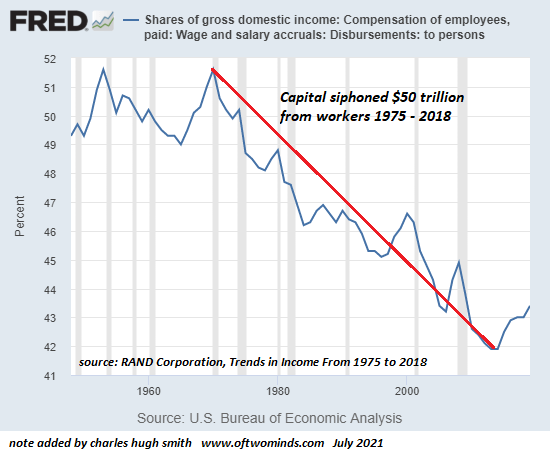
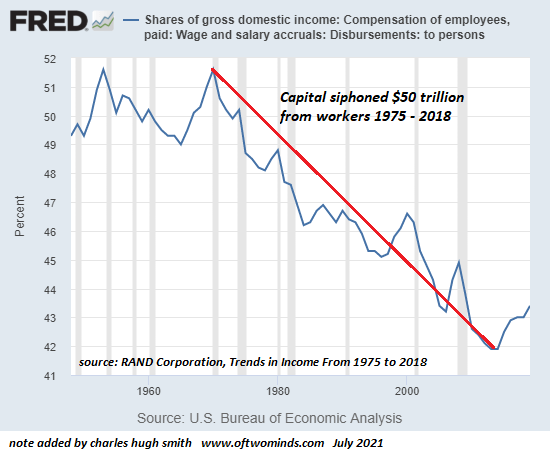
3. The cycle of capital-labor balance: capital has dominated labor for 40+ years, siphoning $50 trillion from labor. This cycle has now turned and the rebalancing is underway: it’s capital’s turn to surrender gains and power.

4. The cycle of social order-disorder: as documented by historian Peter Turchin and others, social order (in Turchin’s phrase, the integrative phase) holds sway for about 50 years and then it gives way to an era of social disorder (the disintegrative phase). This phase doesn’t end with mild reforms nobody even notices, it ends with a rebalancing of social, political and economic power.

5. The cycle of wealth/power inequality: wealth–and the political power it buys–becomes increasingly concentrated in the hands of the few at the expense of the many. This feeds economic and political dysfunction and exploitation that must be remedied by reducing extremes of wealth-power inequality.

6. The cycle of speculative excess: those in power protect their wealth and the wealth of their cronies by instituting moral hazard, the disconnect of risk and consequence: the central state and central bank backstop and bail out the most egregious big speculators, who keep all their gains and transfer their losses to the public.

The public concludes the only way to get ahead in such a rigged financial system is to belly up to the gaming tables and gamble that the next bubble will never pop because those in power won’t ever let it pop.

But alas, humans do not possess god-like powers, they only possess hubris, and so all bubbles pop: the more extreme the bubble, the more devastating the pop. The faint cries that fade to silence are: but this time it’s different! and the Fed will save us! That’s not how cycles work: all the god-like powers are revealed as hubris, which arouses the fatal ire of Nemesis.

Is Inflation “Transitory”? Here’s Your Simple Test

By Charles Hugh Smith

Source: Of Two Minds

Is inflation “transitory” in your household budget? Really? Where?

The Federal Reserve has been bleating that inflation is “transitory”–but what about the real world that we live in, as opposed to the abstract funhouse of rigged statistics? Here’s a simple test to help you decide if inflation is “transitory” in the real world.

Let’s start with some simple stipulations: price is price, there are no tricks like hedonics or substitution. Nobody cares if the truck stereo is better than it was 40 years ago, the price of the truck is the price we pay today, and that’s all that matters.

(Funny, the funhouse statistical adjustments never consider that appliances that used to last 30 years now break down and are junked after 3 years–if we adjusted for that, the $500 washer would be tagged at $5,000 today because it has lost 90% of its durability over the past 30 years.)

Second, inflation must be weighted to “big ticket” nondiscretionary items. The funhouse statistical trickery counts a $10 drop in the price of a TV (which you buy every few years at best) as equal to a $100 rise in childcare, which you pay monthly. No, no, no: a 10% rise in rent, healthcare insurance and childcare is $400 a month or roughly $5,000 a year. A 10% decline in a TV you buy every three years is $50. Even a 50% drop in the price of a TV ($250) is $83 per year–absolutely trivial, absolutely meaningless compared to $5,000 in higher big-ticket expenses.

You can forego the new TV but not the rent, childcare or healthcare. That’s the difference between “big ticket” nondiscretionary and discretionary (meals out, 3rd TV, etc.).

Third, we jettison the painfully obvious manipulation of “owners equivalent rent” for housing costs. Housing costs are the prices we pay for rent, owning a home and paying property taxes, insurance and maintenance costs to own the home. (Have you priced having a new roof put on your house by a licensed, reputable contractor? No? Well, it’s become a lot more expensive than it was a few years ago. Where is that enormous price leap in “owners equivalent rent”? Just how stupid does the Fed reckon we are?)

OK, here’s the test: let’s say markets finally take a deflationary dive from overvalued heights. Housing, stocks and other risk assets fall 30%. Trillions of dollars in “wealth” (that didn’t exist prior to the Everything Bubble inflating) has vanished, generating a reverse wealth effect as all the owners of these assets feel poorer and less inclined to borrow and spend. This is classically considered highly deflationary: demand drops, prices drop.

The three billionaires who own more assets than the bottom 50% of Americans (165 million Americans) will be crying, but how does life change for the 165 million Americans who own a vanishingly thin slice of these assets? Does their rent drop? No, for the reasons I explained in The Fed Is Wrong: Inflation Is Sticky: the big corporate landlords have to keep rents high to placate their lenders. (And let’s not forget greed: the greedy never want to lower prices, preferring to cling to the Fed’s fantasy of “transitory” trouble.)

Now let’s ask about the higher-income 150 million Americans who own homes and pay property taxes, who pay healthcare insurance, college tuition and fees, childcare and elderly care. Even if there is a deflationary crash in stocks and housing, what are the odds the overall costs of owning and maintaining your home will drop significantly?

What are the odds that local government will let property taxes drop with valuations? Shall we be honest and say zero? If real estate valuations plummet, then property tax rates will rise to compensate. Or other “creative” fees will be imposed to make up the shortfall in tax revenues.

What about childcare? What are the odds that childcare costs will drop 30%? Shall we be honest and say zero? The costs paid by childcare providers only go up, and so those who don’t charge enough (marginal providers) will close down, generating a shortage of supply that elevates prices.

What about elderly care? Will assisted living facilities suddenly drop 30% just because asset bubbles pop? No. The costs of assisted living march higher regardless of what asset valuations and interest rates do.

What about healthcare? Will all those costs drop 30% because assets declined? No. Everyone exposed to real-world pricing of healthcare will be paying more.

But what about the roofing contractor? Won’t they charge 30% less? The biggest expenses for the contractor are workers compensation insurance, liability insurance, disability insurance, FICA (Social Security and Medicare) and healthcare insurance, and none of those will drop a single dollar even if stocks drop 30%.

Just as 85% of local government expenses are labor-related, most of the expenses of the roofing contractor are labor-related. The roofing materials dropping a few bucks might lower the cost by a few percentage points, but the material costs are based on the costs of the manufacturers, distributors, truckers, etc., and these are also based on labor-related expenses, taxes, insurance and healthcare–none of which will drop a dime, regardless of what asset prices do.

Economist Michael Spence elucidated the difference between tradable and untradable goods and services. If you want your washer repaired, that service in untradable, as shipping your broken washer to China for repair is not financially viable. As labor costs rise in China and other offshore economies, that raises costs even for tradable goods.

The majority of essential services are untradable and the costs are dependent on “big ticket” expenses which cannot go down without imploding the economy and government: taxes, insurance, healthcare, childcare, elderly care, etc. cannot drop 30% because they’re based on labor costs, highly profitable systemic friction (Big Pharma, the Higher Education Cartel, Big Ag, healthcare and other quasi-monopolies) and the need for ever-higher tax revenues to provide services which the public demands.

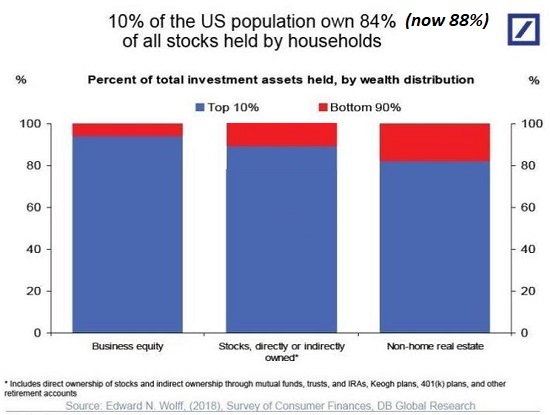
Let’s also ponder the consequences of the extreme concentration of wealth and income in the top 5% of U.S. households. The top 10% own roughly 85% of all wealth, and the top 1% own more than half the financial wealth.

Any significant drop in financial assets will have almost no effect on the bottom 90% because they don’t own enough of these assets to be consequential. So the deflationary effect of the reverse wealth effect will be concentrated in the discretionary spending of the top 10%: the luxury imported vehicles, the $100 per plate dinners (those $60 bottles of wine add up), the $500/day resort vacation, the $2,500/week AirBnB rental, etc.

The declines in the cost of these discretionary luxuries may well be noteworthy, but there are thresholds below which prices cannot drop. The high-end restaurant has equally high-end expenses, and so marginal providers will close, leaving only those few who can maintain profitability as demand for luxury dining craters.

The resort has high expenses as well, and once profitability has been lost, resorts will close just like other marginal providers. Supply shrinks along with demand, and the survivors keep prices high enough or they too will close.

So the essential “big ticket” costs will keep rising and the discretionary luxuries only the top 10% can afford will drop–but not by much as all those luxury providers have the same high fixed costs.

So to recap the test: what are the odds of these “big ticket” expenses dropping 30% if asset prices drop 30%?

Taxes: zero.

Healthcare: zero.

Childcare: zero.

Elderly care: zero.

Costs of doing business: zero.

As for housing: the mortgage doesn’t drop if the market value of the house drops 30%, and any declines in insurance will be modest. The costs of maintenance won’t drop much, either, and might actually increase as the supply of skilled workers declines. (Nothing is more expensive than the “cheap” repair that has to be redone correctly.)

Rents may drop in areas nobody wants to live anymore, but rents will rise in places people do want to live.

The larger point here is the long economic cycles have turned. The 40-year decline in interest rates has turned, whether we admit it or not. The 40-year decline in the prices of goods due to financialization (lower interest rates, higher speculative assets) and globalization has turned. The 40-year expansion of the workforce has turned. The 40-year decline of oil/fuel/resources prices has turned. The 40-year fantasy that we can depend on other nations for our essential resources and components is drawing to a close.

Untradable goods and services, cost thresholds, resource security, the end of financialization / globalization and declining interest rates matter. The fantasy that the top 10% can prop up the economy by borrowing and spending the phantom wealth of insanely overvalued asset bubbles is drawing to a close.

Is inflation “transitory” in your household budget? Really? Where?

The Number Of Billionaires In America Has Absolutely Exploded During The Pandemic

By Michael Snyder

Source: Investment Watch Blog

For the wealthy and the ultra-wealthy, happy days are here again.  Even though we have just been through one of the most difficult 12 months in our history, the number of billionaires has increased dramatically during this pandemic.  That seems rather odd, but there is no denying that the rich have gotten even richer during this crisis.  In fact, Forbes revealed this week that the number of billionaires has risen by about 30 percent over the past year…

The number of newly minted and reissued billionaires soared last year, Forbes reported Tuesday in its annual ranking, a staggering accumulation of personal wealth that stands in sharp contrast with the widespread economic struggles unleashed by the coronavirus pandemic.

The number of billionaires on Forbes’ 35th annual ranking swelled by 660 to 2,755 — a roughly 30 percent jump from a year ago — and 493 of them are first-timers. Seven of eight are richer than they were before the pandemic. Forbes calculates net worth by using stock prices and exchange rates from March 5.

Of course thanks to the reckless policies of our leaders, a billion dollars does not go nearly as far as it once did.

But still, a billion dollars is a whole lot of money.

Needless to say, the biggest reason why the number of billionaires has exploded is because we have been witnessing one of the greatest stock market rallies in history.

A year ago, the Dow Jones Industrial Average was sitting at about 23,000.

Today, it is above 33,000, and some analysts expect it to shoot quite a bit higher throughout the rest of 2021.

Stock prices have never been more detached from economic reality as they have been over the past 12 months, and they have only risen so high because of unprecedented intervention by the Federal Reserve and because of extremely wild spending by the federal government.

Many have warned that the party will inevitably come to a crashing end at some point, but it hasn’t happened yet.

So for now, the market optimists look like champions.

And now that Joe Biden is in the White House, the corporate media is telling us that we are on the verge of a grand new era of American prosperity.  The corporate media insists that the pandemic will soon be behind us thanks to the vaccines, and the talking heads on television envision a return to the good old days very quickly.

In fact, Barron’s is already declaring that the “U.S. economy might be stronger than it’s ever been”.

And CNN is trying to convince us that “America’s economy could be heading for a golden era of growth”.

Really?

If the U.S. economy is actually improving, then why are new claims for unemployment benefits going up?

The number of Americans filing first-time unemployment benefits unexpectedly rose last week, according to the Labor Department.

Data released Thursday showed 744,000 Americans filed first-time jobless claims in the week ended April 3. Analysts surveyed by Refinitiv were expecting 680,000 filings. The previous week’s total was revised higher by 9,000 to 728,000.

If economic conditions were getting better, that number should be going the other way.

Even I didn’t expect a number this bad.

Prior to 2020, the all-time record high for new unemployment claims in a single week was 695,000.  That record was established in October 1982, and it stood all the way until the COVID pandemic hit the U.S. early last year.

Sadly, we have been above 695,000 almost every single week since then.

The numbers compiled by the states tell us that nearly three-quarters of a million Americans filed new claims for unemployment benefits last week.  That is an absolutely catastrophic number.  Nobody should be talking about a “golden era of growth” or claiming that the “economy might be stronger than it’s ever been” until we get that number back down to pre-pandemic levels.

And right now, we are at a level that is about three times as high as pre-pandemic levels.

Look, the truth is that anyone that tells you that unemployment is low in the United States is lying to you.

According to John Williams of shadowstats.com, if honest numbers were being used the unemployment rate in the United States would be 25.7 percent right now.

That is the sort of number that we would expect to see during an economic depression, and the truth is that we are in an economic depression.

Over the past year, more than 70 million new claims for unemployment benefits have been filed, and approximately 4 million U.S. businesses have gone out of existence permanently.

But don’t worry, the stock market is hovering near all-time record highs and the corporate media is telling you that everything is going to be wonderful now that Joe Biden is in control.

Come on man!

You can’t really believe that stuff that they are shoveling.

With each passing day, more Americans are losing their jobs, more Americans are falling out of the middle class, and the cost of living just keeps going up even higher.

In fact, we just learned that global food prices have now gone up for 10 months in a row

The global food-price rally that’s stoking inflation worries and hitting consumers around the world shows little sign of slowing.

Even with grain prices taking a breather on good crop prospects, a United Nations gauge of global food costs rose for a 10th month in March to the highest since 2014. Last month’s advance was driven by a surge in vegetable oils amid stronger demand and tight inventories, according to Abdolreza Abbassian, a senior economist at the UN’s Food and Agriculture Organization.

I am going to continue to watch global food prices very carefully, because I believe that it will be a very important trend in the months and years ahead.

But for now, the good news is that at least economic conditions are relatively stable.

Yes, things are not nearly as good as they were before the pandemic, but at least they are not getting a whole lot worse.

So even though things are not great, we should enjoy this period of relative stability while we still can, because it definitely will not last.

The Coming War on Wealth and the Wealthy

By Charles Hugh Smith

Source: Of Two Minds

Here’s looking at you, Federal Reserve–thanks for perfecting ‘legalized looting’ and neofeudalism in America.

The problem with pushing a pendulum to its maximum extreme on one end is that it will swing back to the other extreme minus a tiny bit of friction.

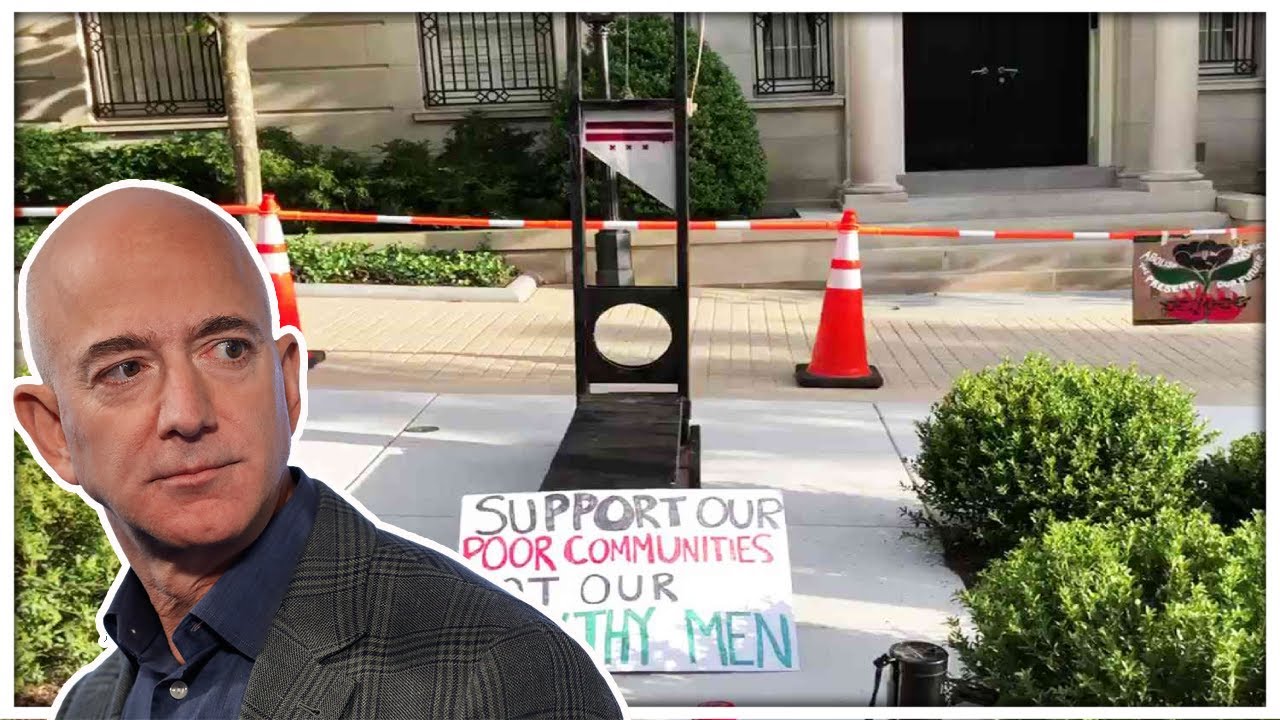
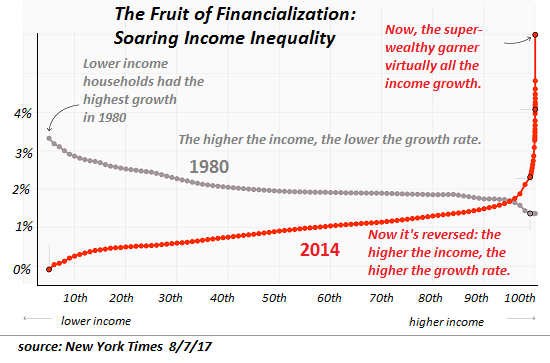
America has pushed wealth/income inequality, unfairness and legalized looting to the maximum extreme. Now it will experience the swing back to the other extreme. This will manifest in a number of ways, one of which is a self-organizing populist war on wealth and the wealthy.

To say the system is rigged to benefit the already-wealthy and powerful is a gross understatement. Take the tax code as an example–thousands of pages of arcane tax breaks and giveaways passed by a thoroughly corrupted Congress and thousands more pages of arcane regulations and legal precedents.

How many pages apply to the bottom 95% of American taxpayers? Very few. There’s the standard deductions for mortgage interest, healthcare costs, etc., but virtually no other tax breaks. Very few pages apply to even the 99%–go talk to a CPA and you’ll find there are no more tax breaks for a sole proprietor making $500,000 in earned income than than there are for a sole proprietor making $50,000.

99.9% of the tax code benefits the top 0.1% and the corporations, LLCs and philanthro-capitalist foundations and trusts they own / control. Stripped of artifice and spin, America’s tax code is nothing but legalized looting. This is only one small slice of the entire pie of legalized looting, of course, but it’s one we can all understand.

A sole proprietor pays 15.3% in Social Security and Medicare taxes. Why don’t America’s billionaires pay 15.3% in Social Security and Medicare taxes? Aren’t Social Security and Medicare/Medicaid the bedrock social safety net programs of the American people? Then why does a struggling sole proprietor pay 15.3% tax to support these essential programs and billionaires pay essentially zero?

There’s a term for this disparity / injustice / unfairness: legalized looting. The super-wealthy pay essentially zero percent of their income and wealth to the programs that provide basic economic security for the disabled/elderly citizenry, while Jose the sole proprietor pays 15.3% of every dollar he earns.

So explain to us again why Mr. Buffett can’t afford to pay 15.3% of every dollar of his income to help fund basic economic security for the disabled/elderly. In a system of even the most basic fairness, every dollar of income would be taxed at the same rate. In a system of even the most basic fairness, those with incomes of $100 million would pay the same 15.3% Social Security and Medicare tax as the sole proprietor earning $100,000.

Needless to say, if this most basic fairness was applied to America’s wealthy and powerful, these programs would not be facing insolvency.

If Joe the sole proprietor hits the bigtime, he pays 32% federal tax over $165,000, 35% over $210,000 and 37% over $524,000. If we add 15.3% to 37%, we get 52.3%. How many of America’s super-wealthy / billionaires pay 52% in Social Security-Medicare and income taxes? Zero.

Could America’s super-wealthy / billionaires afford to pay 52%? Of course they could–they own the majority all financial assets and skim the majority of all income. But they won’t, because the system is rigged to benefit the few at the expense of the many via legalized looting.

It isn’t just the inequality of ownership of capital and power that enrages the oppressed; it’s the blatant unfairness of our neofeudal / neocolonial system. As I explained in Neofeudalism and the Neocolonial-Financialization Model (May 24, 2012) and Welcome to Neocolonialism, Exploited Peasants! (October 21, 2016), the Financial Nobility have “come home” and applied the same rapacious exploitation they perfected in colonialism to the domestic populace.

Here’s looking at you, Federal Reserve–thanks for perfecting legalized looting and neofeudalism in America.

The gulf between the lavishly praised American ideals and the putrid, corrupt reality of America’s neofeudal system is wider than the Grand Canyon. As the pendulum accelerates to an extreme equal but opposite to the current extremes of unfairness, exploitation and legalized looting, those who have suffered the consequences of this systemic inequality will find expression in whatever ways are available.

Since it’s difficult to get to the protected compounds of the super-wealthy, the signifiers of the merely wealthy will offer readily available targets. The new Tesla won’t just get keyed; it will be “reworked,” to the great satisfaction of the “workers.”

Please note that I am not promoting a war on wealth and the wealthy, I am merely pointing out that it is as inevitable as the gravity pulling the pendulum.

The war on wealth and the wealthy will manifest politically, socially and economically. It won’t be a tightly controlled, top-down movement. It will be spontaneous, self-organizing and unquenchable.

If you don’t understand why a war on wealth and the wealthy is inevitable, please study this chart: the way of the Tao is reversal.

Our Frustrations Run Far Deeper Than Covid Lockdowns

By Charles Hugh Smith

Source: Of Two Minds

The reality is the roulette wheel is rigged and only chumps believe it’s a fair game.

It’s easy to lay America’s visible frustrations at the feet of Covid lockdowns or political polarization, but this conveniently ignores the real driver: systemic unfairness. The status quo has been increasingly rigged to benefit insiders and elites as the powers of central banks and governments have picked the winners (cronies, insiders, cartels and monopolies) and shifted the losses and risks onto the losers (the rest of us).

We now live in the world the 19th-century French economist Frederic Bastiat so aptly described: “When plunder becomes a way of life for a group of men in a society, over the course of time they create for themselves a legal system that authorizes it and a moral code that glorifies it.”

As I noted in The One Chart That Predicts our Future, ours is a two-tier society and economy with a broken ladder of social mobility for those trying to reach the security of the technocrat class and a well-greased slide for everyone who trips and slides from relative security down to the ever-expanding ALICE-precariat class: assets limited, income constrained, employed.

As Bastiat observed, those rigging the system to benefit themselves always create a legal system that lets them off scot-free and a PR scheme that glorifies their predation as well-deserved rewards that are the natural due of their enormous appetite for hard work and innovation.

You know, hard work and innovation like this:

JPMorgan Makes $1 Billion From Gold Trading After Paying $1 Billion Fine For Manipulating Gold Trading.

Embezzling a couple billion dollars also earns you a get out of jail free card: none of the perps in Wall Street’s skims, scams and frauds ever gets indicted, much less convicted, and none of Wall Street’s legalized looters ever goes to prison.

And this is a fair and just system? Uh, right. Meanwhile, the reality is the roulette wheel is rigged and only chumps believe it’s a fair game. Those who know it’s rigged have essentially zero agency (control / power) or capital to demand an unrigged game or finagle their way into the elite class doing the skimming.

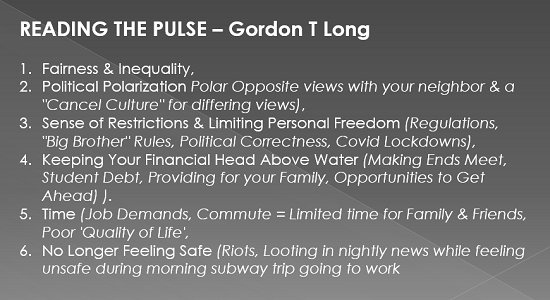
The net result is soaring frustration with a patently unfair system that’s touted as the fairest in the entire world. Gordon Long and I do a deep dive into the frustrations with systemic unfairness in our new video, The Frustrations of Unfairness Are Reaching a Boiling Point.

The key takeaway in my view is the unfairness isn’t limited to the economy, society or politics– it’s manifesting in all three realms. It isn’t just frustration with domestic issues–the global economic order is also a source of unfairness and powerlessness.

We each drew up a list of specific drivers of unfairness / frustration. Here’s my list:

And here’s Gordon’s list:

There is much more in our presentation. These are the dynamics that are tearing apart our social cohesion and that will soon start destabilizing the economy–regardless of how much “money” the Federal Reserve prints.

‘$2.5 TRILLION THEFT’ – STUDY SHOWS RICHEST 1% OF AMERICANS HAVE TAKEN $50 TRILLION FROM BOTTOM 90% IN RECENT DECADES


The median U.S. worker salary would be around twice as high today if wages kept pace with economic output since World War II, new research revealed.

By Brett Wilkins

Source: Common Dreams

New research published Monday found that the top 1% of U.S. income earners have taken $50 trillion from the bottom 90% over the past several decades, and that the median worker salary would be around twice as high today as it was in 1945 if pay had kept pace with economic output over that period.

The study’s authors, Carter C. Price and Kathryn Edwards of the RAND Corporation, examined income distribution and economic growth in the United States from 1945 to the present. The researchers found stark differences between income distribution from 1945 to 1974 and 1975 to 2018.

According to the study—which was funded by the Seattle-based Fair Work Center—the median salary of a full-time U.S. worker is currently about $50,000. Adjusted for inflation using the consumer price index, workers at or below the current median income now earn less than half of what they would have if incomes had kept pace with economic growth. This means that if salaries had kept pace with economic output, the median worker pay would be between $92,000 and $102,000 today, depending on how inflation is calculated.

Had the more equitable distribution of the roughly 30-year postwar period continued apace, the total annual income of the bottom 90% of American workers would have been $2.5 trillion higher in 2018, or an amount equal to about 12% of GDP.  In other words, the upward redistribution of income has enriched the 1% by some $47 trillion—which would now be more than $50 trillion—at the expense of American workers.

David Rolf, a Seattle labor organizer, president of the Fair Work Center, and founder of Service Employees International Union (SEIU) Local 775, is more blunt. He calls this “the $2.5 trillion theft.”

“From the standpoint of people who have worked hard and played by the rules and yet are participating far less in economic growth than Americans did a generation ago, whether you call it ‘reverse distribution’ or ‘theft,’ it demands to be called something,” Rolf, who helped lead the fight for a $15 hourly minimum wage in Seattle and beyond, told Fast Company.

Remarkably, the study found that workers at all income levels would be better off today if income kept pace with output. Full-time, prime-age workers in the 25th percentile, for example, would be earning $61,000 instead of $33,000. Workers in the 75th percentile, who in 2018 earned $81,000, would be making $126,000. Even 90th-percentile workers, who earn $133,000, would be making $168,000 under the more equitable distribution.

On the other hand, had the economic pie been divided more equitably, the income of the top 1% would fall from around $1.2 million to a still-affluent $549,000.

“We were shocked by the numbers,” said Nick Hanauer, a venture capitalist and self-described “zillionaire” who, along with Rolf, came up with the idea for the study. “It explains almost everything,” Hanauer told Fast Company. “It explains why people are so pissed off. It explains why they are so economically precarious.”

Sen. Bernie Sanders (I-Vt.), who made correcting economic inequality a pillar of both of his presidential bids, lamented the “h-u-g-e redistribution of income in America” in a Monday tweet.

The researchers’ findings, which come amid a deadly coronavirus/Covid-19 pandemic, shine light on the injustice of an economy—by far the wealthiest in the history of civilization—in which essential workers struggle mightily, and often in vain, to survive while the richest people grow ever richer at their expense.

According to Americans for Tax Fairness, the total wealth of U.S. billionaires increased by $792 billion, or 27%, during the first five months of the Covid-19 pandemic. During this period, Amazon CEO Jeff Bezos, the world’s wealthiest person, has become the world’s first multi-centibillionaire, with a net worth now surpassing $200 billion. Meanwhile, his employees struggle to make ends meet, and Amazon workers who speak out against poor pay and hazardous working conditions during the pandemic have been fired and derided by company executives.

Compared to other most-developed nations, the U.S. has done a relatively poor job of taking care of its people during the pandemic. In addition to the U.S. being the only developed nation without universal healthcare, its workers have received less in direct payments and government support than people in many comparable countries.

The gap between the richest and poorest U.S. households is now wider than it has ever been in the past 50 years, according to the most recently available data from the U.S. Census Bureau. The pandemic has only exacerbated the situation, as around half of lower-income American households have reported a job or wage loss due to Covid-19.

Internationally, the U.S. ranks 39th out of over 150 nations in income inequality, according to Gini coefficient data compiled by the CIA, placing it roughly on par with nations like Peru and Cameroon. Among Organization for Economic Cooperation and Development (OECD) nations, the U.S. has the seventh-highest level of income inequality.

The U.S. has the highest poverty rate among the world’s most-developed nations, and the fourth-highest poverty rate among OECD nations after South Africa, Costa Rica, and Romania. According to UNICEF, the U.S. also has the second-highest rate of childhood poverty in the developed world behind Romania, with more than one in five U.S. children—and over one in four Latinx children, and nearly one in three Black and Native American children—living in poverty.

This year, more than 54 million Americans, or roughly one in every six people—including 18 million children—may experience food insecurity, according to the nonprofit group Feeding America.

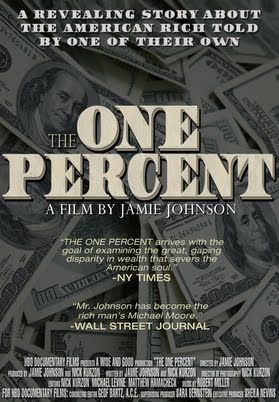
Saturday Matinee: The One Percent

This 80-minute documentary focuses on the growing “wealth gap” in America, as seen through the eyes of filmmaker Jamie Johnson, a 27-year-old heir to the Johnson & Johnson pharmaceutical fortune. Johnson, who cut his film teeth at NYU and made the Emmy®-nominated 2003 HBO documentary Born Rich, here sets his sights on exploring the political, moral and emotional rationale that enables a tiny percentage of Americans – the one percent – to control nearly half the wealth of the entire United States. The film Includes interviews with Nicole Buffett, Bill Gates Sr., Adnan Khashoggi, Milton Friedman, Robert Reich, Ralph Nader and other luminaries.