Millions Around the World Fleeing from Neoliberal Policy

Source: The Real News Network

Economist Michael Hudson says neoliberal policy will pressure U.S. citizens to emigrate, just as it caused millions to leave Russia, the Baltic States, and now Greece in search of a better life.

A research team from Columbia University’s Mailman School of Public Health in New York estimates 875,000 deaths in the United States in year 2000 could be attributed to social factors related to poverty and income inequality.

According to U.S. government statistics, 2.45 million Americans died in the same year. When compared to the Columbia research team’s finding, social deprivation could account for some 36% of the total deaths in 2000.

“Almost all of the British economists of the late 18th century said when you have poverty, when you have a transfer of wealth to the rich, you’re going to have shorter lifespans, and you’re also going to have emigration,” says Michael Hudson, Distinguished Research Professor of Economics at the University of Missouri-Kansas City.

Many countries, such as Russia, the Baltic States, and now Greece, have seen a massive outflow of their populations due to worsening social conditions after the implementation of neoliberal policy.

Hudson predicts the United States will undergo the same trend, as greater hardship results from the passage of the Trans-Pacific Partnership, changes to social security, and broader policy shifts due to prospective appointments to the U.S. Supreme Court and the next presidential cabinet.

“Now, the question is, in America, now that you’re having as a result of this polarization shorter lifespans, worse health, worse diets, where are the Americans going to emigrate? Nobody can figure that one out yet,” says Hudson.

Transcript

SHARMINI PERIES, TRNN: It’s the Real News Network. I’m Sharmini Peries coming to you from Baltimore.

After decades of sustained attacks on social programs and consistently high unemployment rates, it is no surprise that mortality rates in the country have increased. A research team from Columbia University’s Mailman School of Public Health in New York has estimated that 875,000 deaths in the United States in the year 2000 could be attributed to clusters of social factors bound up with poverty and income inequality. According to U.S. government statistics, some 2.45 million Americans died in the year 2000, thus the researchers’ estimate means that social deprivation was responsible for some 36 percent of the total deaths that year. A staggering total.

Now joining us to discuss all of this from New York City is Michael Hudson. Michael is a Distinguished Research Professor of Economics at the University of Missouri Kansas City. His latest book is Killing the Host: How Financial Parasites and Debt Bondage Destroy the Global Economy. Michael, good to have you with us.

MICHAEL HUDSON: Good to be back here.

PERIES: So, Michael, what do you make of these recent research and what it’s telling us about the death total in this country?

HUDSON: What it tells is almost identical to what has already been narrated for Russia and Greece. And what’s responsible for the increasing death rates is actually neoliberal economic policy, neoliberal trade policy, and the polarization and impoverishment of a large part of society. After the Soviet Union broke up in 1991, death rates soared, lifespans shortened, health standards decreased all throughout the Yeltsin administration, until finally President Putin came in and stabilized matters. Putin said that the destruction caused by neoliberal economic policies had killed more Russians than all of whom died in World War II, the 22 million people. That’s the devastation that polarization caused there.

Same thing in Greece. In the last five years, Greek lifespans have shortened. They’re getting sicker, they’re dying faster, they’re not healthy. Almost all of the British economists of the late 18th century said when you have poverty, when you have a transfer of wealth to the rich, you’re going to have shorter lifespans, and you’re also going to have immigration. The countries that have a hard money policy, a creditor policy, people are going to emigrate. Now, at that time that was why England was gaining immigrants. It was gaining skilled labor. It was gaining people to work in its industry because other countries were still in the post-feudal system and were driving them out. Russia had a huge emigration of skilled labor, largely to Germany and to the United States, especially in information technology. Greece has a heavy outflow of labor. The Baltic states have had almost a 10 percent decline in their population in the last decade as a result of their neoliberal policies. Also, health problems are rising.

Now, the question is, in America, now that you’re having as a result of this polarization shorter lifespans, worse health, worse diets, where are the Americans going to emigrate? Nobody can figure that one out yet. There’s no, seems nowhere for them to go, because they don’t speak a foreign language. The Russians, the Greeks, most Europeans all somehow have to learn English in school. They’’re able to get by in other countries. They’re not sure where on earth can the Americans come from? Nobody can really figure this out.

And the amazing thing, what’s going to make this worse, is the trade, the Trans-Pacific trade agreement, and the counterpart with the Atlantic states. In today’s news there’s news that President Obama plans to make a big push for the Trans-Pacific trade agreement, essentially the giveaway to corporations preventing governments from environmental protection, preventing them from imposing health standards, preventing them from having cigarette warnings or warning about bad food. Obama says he wants to push this in after the election. And the plan is the Republicans also are sort of working with them and saying okay, we’re going to wait and see. Maybe Donald Trump will come in and he’ll really do things. Or maybe we can get Hillary, who will move way further to the right than any Republican could, and bring the Congress.

But let’s say that we don’t know what’s happening after the elections, and the Republicans don’t want a risk. They’re going to do a number of things. They’re going to approve Obama’s Republican nominee to the Supreme Court that he’s already done, figuring, well, maybe Hillary will put in someone worse, or even Trump may put in someone worse. They may go along, at this point, with ratifying a trade agreement that’s going to vastly increase unemployment here, especially in industrial labor, turning much of the American industrial urban complex into a rust belt. And they’’re also talking about an October surprise or an early November surprise. It’s the last chance that Obama has, really, to start a war with Russia.

And there’s Stephen Cohen and a number of other sites have warned that there’s going to be a danger when they put in the atomic weapons in Romania. President Putin has said this is a red line. We’re not going to warn. We don’t have an army. We can only use atomic weapons. So you have danger coming not only from domestic decline in population, you have a real chance of war. And Obama has stepped things up. Hillary has, I think, almost announced that she is going to appoint Victoria Nuland as secretary of state, and Nuland is the person who was pushing the Ukrainian fascists in the [inaud.] assassinations and shootout.

So it looks, this trend looks very bad. If you want to see where America is going demographically, best to look at Greece, Latvia, Russia, and also in England. A Dr. Miller has done studies of health and longevity, and he’s found that the lower the income status of any group in England, the shorter the lifespan. Now, this is very important for the current debate about Social Security. You’’re having people talk about extending the Social Security age because people are living longer. Who’s living longer in America? The rich are living longer. The wealthy are living longer. But if you make under $30,000 a year, or even under $50,000 a year, you’re not living longer.

So the idea is how do we avoid having to pay Social Security for the lower-income people, you know, the middle class and the working class that die quicker, and only pay social security for the wealthier classes that live longer? Nobody’s somehow plugged this discussion of lifespans and longevity into the Social Security debate that Obama and Hillary are trying to raise the retirement age, to ostensibly save Social Security. By save Social Security she means to avoid taxing the higher brackets and paying for Social Security out of the general budget, which of course would entail taxing the higher-income people as well as the lower-income people.

PERIES: All right, Michael. Thank you for your report today, and we look forward to seeing you next week.

HUDSON: Thank you.

PERIES: And thank you for joining us on the Real News Network.

End


Michael Hudson is a Distinguished Research Professor of Economics at the University of Missouri, Kansas City. He is the author of The Bubble and Beyond and Finance Capitalism and its Discontents. His most recent book is titled Killing the Host: How Financial Parasites and Debt Bondage Destroy the Global Economy.
And the Beat Goes On: Mega-rich get richer. Society Crumbles

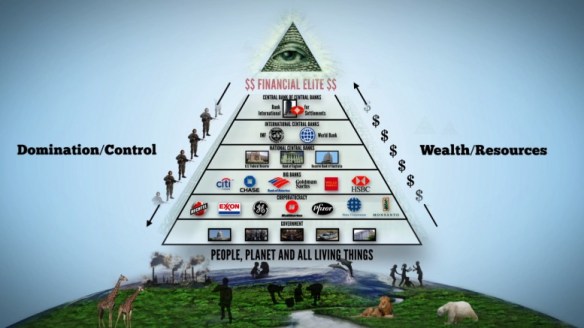
FollowTheMoney-Bank-Pyramid

By Robert De Filippis

(OpEdNews.com)

While most of us have been taking our kids to Little League games, betting on the Super Bowl, taking an occasional vacation and waiting for the American Dream to become a reality, we haven’t noticed something important happening all around us. Society has been crumbling at the edges for the last several decades.

This is not to say that lots of human beings haven’t already experienced the early stages of this societal disintegration. But they tend to be the people at the margins. People without a voice. People whose interests are not understood, let alone represented in the great debates of our times.

Think of the Mideast. Think ISIS here. Think of terrorism. Terrorists don’t attack us because of our freedoms. They attack out of desperation. Out of a frustration that comes with no future, and a feeling of impotence in the face of the continued economic violence committed in the name of corporate profits and greed. Corporations protected by the most powerful military in the history of the world. Ours!

Is it any mystery why we have over six hundred military installations in other countries around the world? We’re not under threat from anyone, but our corporation’s interests in those countries must be protected while they rape them of their labor and natural resources.

History is written by the victors and the popular public narratives are circumscribed by those whose interests they serve and not those who suffer. At the core of this phenomenon is complicity. A subconscious complicity made up of an ultra-resistant trifecta of human thinking — greed, ignorance, and certainty.

Greed now normalized has made the great American dream indistinguishable from having basic financial security to making everyone a billionaire-in-waiting. An inability to distinguish fact from opinion leads the wave of ignorance that engulfs us. Our arrogance disguised as fervent patriotism defends our ignorance and allows us to reject the knowledge we need to save ourselves.

Our generalized confusion of what constitutes a fact allows an individual’s certainty to form a resistance similar to the bacterial infections that threaten to make modern antibiotics useless. It continues to evolve. “If I can’t figure out who’s lying, I’ll believe the one who confirms my point of view. Of that I’m certain.”

Until we learn that having our beliefs validated by a media being paid to manipulate us for political gain, society will continue to disintegrate for larger and larger groups of people.

Seems like a stretch, I know. But think about how we’ve become polarized. How we are so sure of our positions that we just can’t have a conversation with those from the other side. The very conversation we need to have to figure out how we’re being duped. Then think about how our politicians use the greed, ignorance and certainty on both sides to work us up into an emotional lather. And finally, how they ignore our interests while they do the bidding of their owners keeping us distracted with our petty differences with each other.

This will come to an end. There will either be a major social revolution at the least or outright raw violence at the worst. As the authority structures lose the willing conformance of the masses, all that’s left to police them is force. And at some point – like is beginning now — the response will be violence in return. Think of the proliferation of guns in America. Think of people shooting police.

It doesn’t take much discernment to see that corporate structures are highly sophisticated mechanisms for funneling money upwards. That government collusion protects the interests of the owners of capital at the expense of the employees, customers, the general public. And the military protects their international interests.

The largest wealth producer in the world is the financial industry that simply makes money from money and produces nothing. It serves no interests but its own. Yes, some of us fortunate to have salvaged what’s left of our life savings after repeated financial crashes still enjoy the crumbs from the tables of the elite. I do mean crumbs.

Do the math. At the current rate of the upward movement of wealth, there is no other outcome but final disaster. The top 1/10th of 1 percent — not 1 percent — but 1/10th of 1 percent in America owns almost as much wealth as the bottom 90 percent in America, and it gets worse as you leave our shores.

At this rate, the world will eventually consist of gated enclaves of the mega-wealthy guarded by elite corps of paid mercenaries surrounded by billions of impoverished people.

This trajectory has increased dramatically for the last several decades. More and more of the world’s wealth is pouring into the coffers of the mega-rich. This is a zero sum game. When the masses have no wealth left, the game will be over. No matter how powerful the wealthy are, no matter how much wealth they possess, the game will be over.

Five Ways America Is Like a Third-World Country

Some+of+the+90,000+abandoned+and+derelict+homes+of+Detroit

By Nathan Wellman

Source: U.S. Uncut

The United States of America is possibly the wealthiest nation in the history of the world. However, many third-world countries actually surpass America in many of the most vital gauges for measuring human development.

Here are five of the most jaw-droppingly unforgivable ways in which America is lagging behind the rest of the world:

1. America’s criminal justice system is broken

The U.S. represents only 5% of the world’s population, but this one country comprises 25% of the world’s prison population. According to the NAACP, a disproportionate 58% of America’s prisoners are African-American or Hispanic despite these demographics only adding up to about 30% of the U.S. population.

The only nation that imprisons a greater percentage of its citizens than America is North Korea. The U.S. jails 716 people for every 100,000 Americans, according to the International Center for Prison Studies. That’s nearly twice as many as Russia (484 prisoners per 100,000), and far more than Iran (284) or China (121). For context, the U.S. only jailed around 100-200 people per 100,000 citizens in the 1970s, and the incarcerated rate is only getting worse today, even as crime rates fall. A staggering 60% of prisoners are in jail for nonviolent drug charges.

Inside prison, about 600 victims are raped every day, according to an estimate from the Justice Department. An in-depth DOJ investigation found that of the approximate 217,000 prisoners raped each year, 17,000 were juveniles.

2. Gun Violence is an epidemic

America has 20 times more murders when compared to the average rate of the developed world. Even terrorism-plagued Iraq has half the murder rate of the U.S. Over half of the deadliest mass shootings from the last 50 years happened in America, and 79% of those shooters got ahold of their guns legally. Some American cities, particularly New Orleans and Detroit, even surpass many Latin American countries, which suffer from some of the highest gun violence rates in the world.

3. Healthcare costs too much and delivers too little

America is the only developed country that does not ensure healthcare to all of its citizens. Even in the wake of the Affordable Care Act, millions of poverty-stricken Americans have no medical insurance because Republican governors have refused to expand Medicaid, even though the federal government is paying the cost and the simple measure would actually save money for their states.

Life expectancy in many American counties is lower than Nicaragua, Algeria, or Bangladesh. The U.S. is unusual among developed countries in that Americans die in the tens of thousands as a direct result of a lack of health insurance. America also spends twice the percentage of our GDP on healthcare than the average wealthy country for these substandard results.

America also suffers from the highest infant mortality and teen pregnancy rate in the developed world.

4. Inequality is rampant

Researchers have shown that economic inequality directly correlates to public distrust in government representatives, as well as a decrease in health and well-being.

Unfortunately, the U.S. has the worst rates of income inequality in the world, according to the 2015 Global Wealth Report conducted by Allianz. The wealthiest one percent of Americans own nearly half of the nation’s wealth invested in stocks and mutual funds, and the overall gap between rich and poor has only grown since the recession, with almost all income gains going to the top 1% since 2009.

Despite the idea of America being a meritocracy, those born in the poorest 20% of the American population have less than a 3% chance of making it to the top quintile.

5. Infrastructure is crumbling

America is quite literally falling apart.

One study concludes that the U.S. needs to invest $3.6 trillion into infrastructure over the next six years. One out of every nine American bridges (66,405 bridges) have been labeled “structurally deficient.”

Water runs through dilapidated wooden pipes in certain parts of South Dakota, Alaska, and Pennsylvania. Some of Detroit’s sewer lines still used today were originally constructed in the mid-1800s.

A whopping 45% of Americans have no access to public transit, and the construction of the infamously still-incomplete Second Avenue subway line in New York City has been hit with delays dating all the way back to World War II.


America certainly has and continues to achieve greatness in many ways. But if we want to truly earn our oft-proclaimed slogan of “Greatest Country in the World,” these fatal flaws in our system must be acknowledged and addressed. Otherwise, the emperor will continue to parade about with no clothes, and we run the risk of being completely surpassed by a world marveling at our oblivious nakedness.

The American Dream is Dead

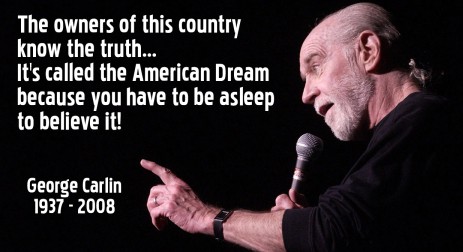
george-carlin-american-dream

By Dustin Meyer

Source: The Evolutionary Mind

To say the American Dream is Dead couldn’t be more true. The American people as a whole are ignorant. They grow up believing that there is a perfect lifestyle in which they will get once they get older and “pay their dues”. Unfortunately this is very far from wrong, the system is corrupt and is against anyone who thinks this way. Simply put, there is no American dream.

What is it? The American Dream, at least as I knew it was where you would live an ideal life, work a 9-5 job, have a house with a white picket fence, a yard, car, and a dog. More in a modern sense, it is getting rich and famous, owning a huge house, fancy car, having all the fanciest clothes and things. This is why it had been dying but not why it is dead. People are greedy, they want more and more, and forget to appreciate the simple life they have. Some people don’t even have their lives anymore, and yet so many people take theirs for granted.

Pop culture can be given much of the credit due to the skewing of the American dream. Since the people are influenced by anything and everything, they will believe any message conveyed to them. Music and film are the main mediums where this is, but a huge culprit is the news and daytime television. Also, unfortunately people are losing their individualism, which is leading to them falling more into this hole in which you cannot escape, you just aren’t you anymore once you’ve given in.

But a big question is why do I say it is dead? Well, the system in general is against us. The gap between rich and poor is expanding exponentially each and every day. The odds are not in the average person’s favor. People are working until they are 60+ years old and barely being able to retire, and with that work, most aren’t in executive type jobs. For the small business owner, you have huge corporations that are destroying your chances to even provide for your family. So why is it dead? Opening you eyes will show you.

People have to stand up, to realize that something is wrong. With this upcoming election (being quite possibly the worst election/selection of candidates’ ever.) we have to fight for the people. No matter who is in office no one will ever fight for you, unless you do. The people are for the people, we have a choice to change. The change must happen!

The Rise of the Corporatocracy

After Empowering the 1% and Impoverishing Millions, IMF Admits Neoliberalism a Failure

neoliberalizam

By

Source: CounterPunch

Last week a research wing of the International Monetary Fund came out with a report admitting that neoliberalism has been a failure. The report, entitled, “Neoliberalism: Oversold?” is hopefully a sign of the ideology’s death. They were only about 40 years late. As Naomi Klein tweeted about the report, “So all the billionaires it created are going to give back their money, right?”

Many of the report’s findings which strike to the core of the ideology echo what critics and victims of neoliberalism have been saying for decades.

“Instead of delivering growth,” the report explains that neoliberal policies of austerity and lowered regulation for capital movement have in fact “increased inequality.” This inequality “might itself undercut growth…” As a result, the report states that “policymakers should be more open to redistribution than they are.”

However, the report leaves out a few notable items on neoliberalism’s history and impact.

The IMF suggests neoliberalism has been a failure. But it has worked very well for the global 1%, which was always the IMF and World Bank’s intent. As Oxfam reported earlier this year, the wealthiest 1% in the world now has as much wealth as the rest of the planet’s population combined. (Similarly, investigative journalist Dawn Paley has proven in her book Drug War Capitalism that far from being a failure, the Drug War has been a huge success for Washington and multinational corporations.)

The IMF report cites Chile as a case study for neoliberalism, but never mentions once that the economic vision was applied in the country through the US-backed Augusto Pinochet dictatorship – a major omission which was no casual oversight on the part of the researchers. Across Latin America, neoliberalism and state terror typically went hand in hand.

The fearless Argentine journalist Rodolfo Walsh, in a 1977 Open Letter to the Argentine Military Junta, denounced the oppression of that regime, a dictatorship which orchestrated the murder and disappearance of over 30,000 people.

“These events, which stir the conscience of the civilized world, are not, however, the greatest suffering inflicted on the Argentinean people, nor the worst violation for human rights which you have committed,” Walsh wrote of the torture and killing. “It is in the economic policy of this government where one discovers not only the explanation for the crimes, but a greater atrocity which punishes millions of human beings through planned misery. . . . You only have to walk around greater Buenos Aires for a few hours to check the speed with which such a policy transforms the city into a ‘shantytown’ of ten million people.”

This “planned misery,” as Naomi Klein’s Shock Doctrine vividly demonstrates, was the neoliberal agenda the IMF has pushed for decades.

The day after Walsh mailed the letter to the Junta he was captured by the regime, killed, burned, and dumped into a river, one of neoliberalism’s millions of casualties.


Benjamin Dangl has worked as a journalist throughout Latin America, covering social movements and politics in the region for over a decade. He is the author of the books Dancing with Dynamite: Social Movements and States in Latin America, and The Price of Fire: Resource Wars and Social Movements in Bolivia. Dangl is currently a doctoral candidate in Latin American History at McGill University, and edits UpsideDownWorld.org, a website on activism and politics in Latin America, and TowardFreedom.com, a progressive perspective on world events. Twitter: https://twitter.com/bendangl Email: BenDangl(at)gmail(dot)com

The 1 Percent’s Houses Are Getting Bigger and Swankier While Average Americans Struggle To Make Rent

0aar7AZ9VX8C5_3820homeless-read-tweets

For a view of the inefficiencies of the free market, there’s no clearer view than the U.S. housing market, where there are as many as 29 empty homes for every homeless person.

By Bob Larson

Source: In These Times

Today’s gigantic class cleavages bring to mind Matthew 8:20, where Jesus describes his persecution: “The foxes have holes, and the birds of the air have nests, but the Son of man hath not where to lay his head.” This description could increasingly also apply to the wrong end of our lopsided capitalist society, which shows itself nowhere more clearly than in housing.

The Wall Street Journal has characteristically thorough reporting on the current housing market, in which it observes “a severe shortage of midtier apartments,” meaning those “aimed at the working class.” This “dearth of lower-priced apartments” has driven up rents for lower- and middle-income-earners, with a market segment average of $845 a month—a daunting figure for many of today’s part-timers and even full-timers.

The reason for this “severe shortage” is pure market economics: “Construction costs are generally too high to justify building new complexes for low- and middle-income tenants. …The difference in costs between installing granite countertops and stainless-steel appliances is so slight compared to buying land and installing elevators that economists say developing a luxury apartment and a midtier one comes out roughly the same.” This has meant that “the supply of less expensive apartments…had decreased 1.6% since 2002. Over that time, high-end apartment inventory has increased 31%.” Not surprising, since rents for the higher-income occupants average $1,702. This isn’t exactly a glowing review of capitalism’s alleged ability to meet consumer demand, regardless of income level.

These market dynamics are especially important for today’s generation of young “millennials,” as the business press observes they tend to rent more, “younger Americans either can’t afford to buy a house or don’t want to.” They’re willing to accept small apartment sizes also, and for reasons that reflect the economic realities of the new generation: “They have diminished expectations, less access to financing and a strong desire to stay in cities.” The tendency for normal working families to be squeezed by high rents out of safe neighborhoods, or into tinier spaces, is another example of the invisible hand giving the finger.

Condo or castle?

On the other hand, a convenient place to observe how the other side of the market works is “Mansion,” a weekly section of the elite-oriented Wall Street Journal, which profiles various different playground properties of elite management and the 1%. Like a lot of print and online media that cover housing, it’s part journalism of lifestyle trends and part naked sales pitch. But the window it provides on the day-to-day life of the ruling class is fascinating.

A conspicuous Mansion headline, “Masters of the Universe,” refers to the infamous phrase used to describe Wall Street power-brokers. But this reference is to the incredible scale of high-end master suites, “With square footage that rivals the average American home.”

The features are gobsmacking: “Amenities have included everything from small kitchens to beauty salons and pedicure stations. Some clients have requested private pools just off the master, separate from the home’s main pool.” At another development, private suites have separate “laundry rooms, small gyms or Pilates areas and ‘super closets’ within the master.” These super closets are their own embarrassment of riches: “closets have evolved from utilitarian storage spaces to showpieces modeled after designer stores, with fireplaces, seating areas and separate dressing rooms.” Illustrated with enormous color photos (often software-generated in the small print), you can easily see that several of these condo and mansion designs have bedroom suites that alone exceed the median modern US house size of 2300 square feet.

Elsewhere, the Mansion section observes that in New York City’s always record-setting property market, “At least two new developments in Manhattan are asking $1 million for a single parking spot,” not failing to notice that this is “about four times the cost of an average single-family home in the U.S.” Spaces can be had for less, but these particular concrete patches are associated with units sporting super-high price tags themselves.

A more old-world example comes from the Financial Times, where a recent edition of its high-living Town & Country section profiles a Scottish Duke with a fair-sized castle in the Argyles. The Times is eager to show a self-effacing, status-disregarding picture of the Duke, encouraging us to see the particularly ludicrous institution of Anglo-Scottish aristocracy with Downton Abbey post-status charm. But the local history is more realist: “To the distress of some Inveraray residents, the whole town was moved in the 1770s to give the castle a more secluded setting.”

Today His Grace is most concerned with fending off the increasingly left-leaning Scottish National Party’s proposals to increase the tax on landed estates like his, and split up the great family fortunes—although estates managed through corporations are exempt. But while he hopes to avoid any splitting of his assets, the Duke also confesses he seldom uses his castle’s two-story library: “I’m just not a book person.”

For the urbane London CEO needing a break from city noise, the WSJ Magazine recommends the “Soho Farmhouse,” actually a fantastically expensive members-only rural retreat with a country club, ice rink, horse stable, football field, event barn, boathouse and tennis courts. To ease rich members into their relaxation time, “a hidden camera scans license plates as guests enter the property,” and “guests are handed cocktails as their vehicles are whisked away…guests can specify their height and foot measurements when checking in online to ensure that they are given properly sized bicycles and Wellington boots for their stay.”

Knowing its audience, the magazine mentions an “Added bonus: If guests don’t want to make their own cocktails, they can summon one of two 24-hour roving milk trucks that have been converted into portable bars with bartenders on hand.” Look, no one appreciates the appeal of a roving bar more than me. But 160,000 kids will die from cheaply-treatable diarrhea-related diseases this month, and these fun cash-burning novelties are pretty obscene to African mothers watching their kids die from conditions that could be cured for far less than an executive’s artisan cocktail.

No vacancies, more vagrancies

But the gaping chasm in housing classes is most dramatically seen by comparing the often-mentioned number of empty houses and apartments, relative to the number of homeless citizens living on the streets or shelters around the United States. Real numbers can be looked up—the Census Bureau’s homeownership survey found that in the first quarter of 2015, 17.3 million housing units were vacant, excluding properties only vacant for part of the year. (Notably, the Mansion survey of gigantic master suites notes that these condos and mansions will often “most likely be a second residence for the potential buyer.”)

The number of homeless Americans is of course somewhat harder to pin down, with the Department of Housing and Urban Development in its Annual Homeless Assessment Report for 2014 (the most recent available) finding 578,424 people homeless on a given night. However this HUD number is considered to be at best incomplete, as its “point-in-time” data reporting tends to underestimate the issue. Nonprofits and advocacy groups like the Urban League approach the number in a longer time frame, trying to estimate how many people experience homelessness over the course of a year. The numbers found through this approach are startlingly different, with older research suggesting numbers around 2.3 million, reflecting high turnover among the homeless population.

The most gross calculation from this data would suggest a ratio of 17.3 million year-round vacant units to 2.3 million homeless, or about 7.5 units per homeless individual. Using the HUD’s more conservative “Homelessness measured on a single night” data would give us an even more insane 29 homes or apartments for each homeless person!

Obviously, numbers anything like these point to a hugely irrational economic system, where people, including families with kids, are spending the nights in dangerous shelters or on the streets while millions of empty apartments and houses sit silently still.

This staggering inefficiency of housing markets throws the irrationality of capitalism into stark relief. Much like crumbling bridges and the unemployed construction workforce, the market economy’s failure to bring these economic factors together is pretty damning. Were Christ to return in our capitalist epoch, He’d need to ante up a lot more than the Word to find a place to lay His head—unless He, like other young Americans, had “diminished expectations” for housing.

About the Author

Rob Larson is Professor of Economics at Tacoma Community College in Washington State, and author of Bleakonomics: A Heartwarming Introduction to Financial Catastrophe, the Jobs Crisis and Environmental Destruction. Follow him on Twitter: @ironicprofessor.

The 1% Versus the 99%: Realignment, Repression or Revolution

640px-Standard_oil_octopus_loc_color

Wealth Inequality Is Putting the US on Course for a Showdown

By Klaus Marre

Source: WhoWhatWhy.org

The richest 20 Americans now own as much wealth as the country’s poorest 152 million people combined.

That is just one of the findings of noted inequality scholar and author Chuck Collins’s most recent report, “Billionaire Bonanza, The Forbes 400 and the Rest of Us.”

In a wide-ranging interview, which will be available in its entirety as a podcast tomorrow, Collins likened the current situation to the “Gilded Age,” the time just before the turn of the 20th century, when there was a similar accumulation of wealth at the top and political power was concentrated in the hands of a few rich men.

And Americans are slowly realizing that the extreme accumulation of wealth at the very top is hurting their own prospects.  But grassroots efforts to redress economic inequality must contend with the political power that comes with great wealth.

This is an unstable situation. With pressure building for change but potent forces stacked against it, there are only three options, Collins told WhoWhatWhy: “Realignment, revolution or repression.”

Rules Rigged, and the Rich Get Richer

Back in the Gilded Age, the country managed to convert the pressure that was building from the bottom up into meaningful changes that resulted in a realignment of political power and the rise of the middle class. Those gains, however, are now being reversed. In fact, a new report found that, for the first time in decades, the middle class no longer constitutes the economic majority in the United States.

The shift toward increasing inequality began in the 1970s. At that time, Collins says (and research shows), “we stopped being an economy in which most people grew together” and instead became a “society that is dramatically pulled apart.”

Wages have now been stagnant for three decades and the median wealth of Americans has actually declined since 1990. At the same time, the rich have gotten richer. A lot richer.

Like the Great Depression in the early 1930s, the economic crisis of 2008 has been a wake-up call for the country. Polls historically have shown that people are indifferent to great wealth as long as they feel the rules are fair and that they at least have the option of moving up the ladder. But for many, the latest crash is changing that perception.

“In the economic meltdown of 2008, people realized the rules are rigged, that the big financial industry people … are tipping the scale in their favor,” Collins said. This has led to a perception that upward mobility in America is stalled — a perception supported by statistical data.

Collins believes that this sentiment has helped boost the candidacies of presidential hopefuls as diverse as Donald Trump and Bernie Sanders.

The collapsing middle class, including groups like recent college students whose prospects are blighted by crushing debt burdens, represents an “angry and mobilized constituency.” These are the people whose dissatisfactions are articulated by populists like Trump.

At the other end of the spectrum, the success of self-avowed “democratic socialist” Sanders shows how fluid the situation is. Collins pointed out that the Vermont senator has been saying the same things for 30 years — but only now are they resonating with a larger proportion of the electorate.

Collins pointed out that Sanders is the only major candidate who does not need a billionaire bankrolling his primary campaign to do well in the polls.

One bloc of voters who can cause a tectonic shift in the near future are millennials, many of whom are resentful of the obstacles they face in pursuing the American dream while paying off their college loans. With 40 million households shouldering a burden of $1.2 trillion in college debt, Collins believes that if this segment of the population were to organize, they could force significant change.

“Otherwise, the machinery of inequality will just keep chugging along as it currently is and it will get more concentrated,” Collins said. In any case, all of the ingredients are there for a major political realignment.

“We’re headed for a showdown.”

[audio http://www.whowhatwhy.org/files/Chuck%20Collins%20WWW%20Final.mp3 ]

http://www.whowhatwhy.org/files/Chuck%20Collins%20WWW%20Final.mp3