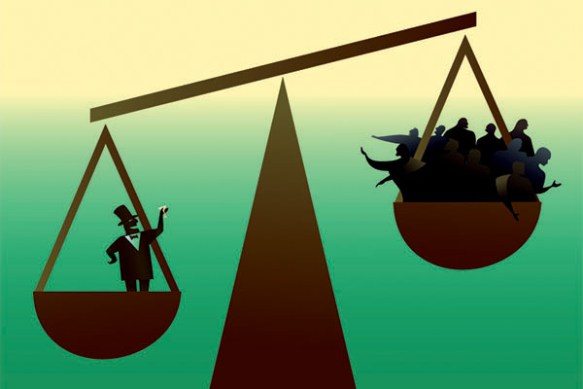
Economic effect of coronavirus could be revolutionary

By Paul Craig Roberts

Source: Intrepid Report

Coronavirus and globalism will teach us vital lessons. The question is whether we can learn vital lessons that do not serve the ruling interest groups and ideologies.

Coronavirus will teach us that a country without free national health care is severely handicapped. Millions of Americans live paycheck to paycheck. They cannot afford health care premiums, deductions, and copays. Millions have no insurance. This means millions of people infected with coronavirus who cannot get medical help. The morbidity from this is intolerable in any society.

Shutdowns associated with efforts to contain the spread of coronavirus will deny income to millions of Americans who live paycheck to paycheck. What do they do for food, shelter, transportation?  You don’t have to think very long along these lines to see a very frightening scenario.

Globalism has taken down the ladders of upward mobility by exporting American middle class jobs to Asia. A population once able to save now lives on debt, the service of which is interrupted by recession/depression and by debt service absorbing all net disposable income.

Globalism has also reduced the survivability of our society by making it dependent  on externally produced goods, the supply of which can be cut off by disruptions in other societies, by policy disagreements leading to sanctions, and by an inability to export enough to pay for imports, which is what the offshored production of US firms is.

The United States has an unprotected population and an economy in trouble. For years, corporate executives have run the companies for the benefit of their bonuses, which are largely dependent on rises in their company’s share price. Consequently, profits and borrowings have been invested in buying back the companies’ shares and not in new investment in the businesses. Corporate indebtedness is extreme and will threaten many corporations and many jobs in a downturn. Boeing is a case in point.

Economist Michael Hudson has for many decades studied the use of debt-forgiveness to restart economies killed by debt burdens. Debt forgiveness for corporations has a different implication than debt forgiveness for individuals. For corporations, forgiving debts lets those who financialized and indebted the economy and the population off the hook. To avoid rewarding them for the catastrophe they produced and to prevent widespread public outcry and distrust, nationalization is implied for insolvent companies and banks.

Nationalization would be limited to insolvent companies and financial institutions and doesn’t mean that there would be no private companies or businesses. Additional nationalization could be used to prevent strategic companies from substituting their interests for national interests, which they do when they move American jobs and factories offshore. Pharmaceuticals could be nationalized along with health care. Energy which often sacrifices the environment to its profits could be considered for nationalization. A successful society has to have more driving it than private profit.

For most Americans nationalization is a dirty word, but it has many benefits. For example, a national health care system reduces costs tremendously by taking profits out of the system. Additionally, nationalized pharmaceutical companies could be made more focused on research and cures than on profit avenues. Everyone knows how Big Pharma influences medical schools and medical practice in line with Big Pharma’s approach. A more open-minded approach to medicine would be beneficial.

Socialist is another American dirty word, one that is being used against Bernie Sanders.  I have not turned into a socialist overnight. I am simply thinking outloud. How can the economy recover when the population and corporations are smothered by debt?  Debt forgiveness is the only way out of this debt suffocation. Can debts be forgiven without nationalization? Not without a huge giveaway to financial mangers and Wall Street. It is the members of the “one percent” who have received 95% of the increase in us income and wealth since 2008. Do we want to reward them for smothering the economy with debt by bailing them out without nationalizing them?

The combination of an economy covered in debt and an unprotected population is clearly revolutionary. Do we have leadership capable of breaking out of interest group politics and ruling ideologies in order to save our society and put it on a more sustainable basis?

Or will the economic hardships be blamed on the virus, the catalyst that ignited the debt timebomb?

‘What More Do You Need to Know?’ Health Insurance Stocks Drive Wall Street Rebound on Biden Super Tuesday Wins

“Biden is the preferred candidate for the financial markets.”

By Eoin Higgins

Source: CommonDreams

Health insurance industry stocks surged Wednesday morning in the wake of former Vice President Joe Biden’s strong showing in the Democratic presidential primary’s Super Tuesday contests, opening up 600 points after traders appeared to bet the candidate’s resurgence would box out any chance of single-payer universal healthcare.

“What more do you need to know,” tweeted journalist Jack Mirkinson of the market’s spike.

Sanders has made Medicare for All a centerpiece of his campaign. The healthcare industry has poured millions in ad buys against Sanders after the Vermont senator won primaries in Iowa, New Hampshire, and Nevada.

“The industry has long seen Biden as their white knight,” said Dr. Adam Gaffney, the president of Physicians for a National Health Program and an outspoken Medicare for All advocate.

Biden on Tuesday won at least nine of the 14 states up for grabs to Sanders’ four. At press time, Maine was yet to be called, with Sanders and Biden locked in a razor-thin contest.

The market surge came after a rough week for the stock market, which at the end of February saw its biggest decline since the 2008 financial crisis after fears of the economic cost of a worldwide coronvirus pandemic increased.

Business commentators also made the connection between Sanders’ victories in the early primary states, particularly in Nevada, and the market’s poor performance last week.

On Fox Business February 28, billionaire Steve Forbes remarked that the weeklong drop was not only about fears of the coronavirus.

“There’s the political side,” Forbes said of the reason for the poor performance. “In the last week, week-and-a-half, the possibility of Bernie Sanders becoming president of the United States has increased, exponentially.”

According to the Washington Post:

Stocks of healthcare companies roared in response to Biden’s performance. Cigna was up more than 10 percent in morning trading, while UnitedHealth Group rose nearly 12 percent. Humana jumped 1.25 percent and Anthem soared nearly 14 percent.

Investor Ed Yardeni told the Post that Wednesday’s spike was a correction to earlier fears of what he called “Bernie Sanders’ socialist program.”

“The market’s sell-off last week on Sanders’ primary victories and rebound on Monday after Biden’s big win in South Carolina and this morning after Super Tuesday suggest that domestic U.S. politics may matter as much as the global health crisis on investors,” said Yardeni.

As Common Dreams reported, the results—which saw billionaire Michael Bloomberg and Sen. Elizabeth Warren (D-Mass.) coming in far behind the two frontrunners—transformed a once-crowded primary into a two-man race. Though Biden put up a good showing, exit polls from the contests showed a majority of Democratic voters backing the elimination of private insurance in favor of a government-run system guaranteeing healthcare for all.

Subcomandante Bloomberg

By CJ Hopkins

Source: Consent Factory, Inc.

Break out the pussyhats and vuvuzelas, folks, because the neoliberal Resistance is back, and this time they’re not playing around. No more impeachments and investigations. It’s time to go mano-a-mano with Trump, and they’ve finally got just the bad hombre to do it. No, not Bernie Sanders, you commies. A battle-hardened Resistance fighter. El Caballo Pequeño! El Jefe Mínimo! Subcomandante Michael Bloomberg!

Yes, that’s right, Michael Bloomberg, multi-billionaire Republicrat oligarch, has mobilized a guerilla army of overpaid PR professionals, Wall Street sociopaths, liberal racists, and anti-outdoor-smoking fanatics, and is steamrolling toward the Democratic convention to buy a brokered nomination and save America from “Putinism.” He’s had it with you sugary-soft-drink-drinking, chain-smoking, gun-toting, Oxy-gobbling, Hitler-loving, Putinist peasants and your infatuation with Donald Trump. So he’s decided to transform the entire country into a sterile, upscale, fascist themepark where you can rent a studio for $3,000 a month and the cops keep “the darkies” in their place, like he successfully did to New York City.

Although his campaign seemed to come out of nowhere (and sort of resembles a desperate attempt to prevent a Bernie Sanders nomination), the Resistance have been planning this corporatist Tet Offensive for quite some time. Apparently, Subcomandante Bloomberg and his inner circle of sub-subcomandantes have been hiding out deep in the mountainous jungles of Manhattan’s affluent Upper East Side (or in the Hamptons, or London, or in one of El Jefe’s other multi-million-dollar homes) since Trump and the Russians invaded the country, waiting for the perfect moment to start inundating the American people with television commercials and social media posts informing them of his “electability.”

Clearly, that moment has now arrived.

Bloomberg has spent over $400 million on TV, radio, and digital ads, and it isn’t even Super Tuesday yet. He bought the Democratic National Committee and had them change the rules so he could join the debates (which, based on his poor performance in Las Vegas, might not have been the most brilliant strategy). He has been buying politicians, community organizers, journalists, pundits, his opponents’ campaign staff, Instagram and Facebook influencers, and everyone else he can possibly buy to support his campaign to buy the presidency … which is totally legal, and the American way, and is our only hope of overthrowing the Putin-Nazi Occupation Government and regaining our God-given capitalist freedom!

Sure, to some folks, it looks … well, unseemly (not to mention decidedly undemocratic), this Wall Street oligarch attempting to bribe and bully his way into the White House, but, given the stakes, what choice do we have? As the corporate media and intelligence agencies have been telling us for the last three years, the country is under occupation by an evil conspiracy of Russian-backed Nazis personally controlled by Vladimir Putin! More or less any moment now, Putin is going to order Trump to nullify the U.S. Constitution, declare martial law, appoint himself Führer, and start rounding up and murdering the Jews … or investigating Hunter Biden, or the spooks who have been trying to force him out of office.

This Putin-Nazism cannot continue! Trump must be deposed, no matter the cost. As Robert Reich put it in this piece in The Guardian:

“If the only way we can get rid of the sociopathic tyrant named Trump is with an oligarch named Bloomberg, we will have to choose the oligarch.”

There you have it, folks. We’ll have to choose Bloomberg, or else his golf buddy, Literal Hitler, will destroy the fabric of democracy, or whatever.

Another op-ed in The Washington PostIt Might Be Time to Take Bloomberg Seriously, wondered, if it comes down to Bloomberg versus Bernie:

“Do you choose socialism or capitalism? An ideologue or an executive? Are you really going to ask Americans to trade one extreme for the other, or do you want to offer them a certified, electable moderate?”

Vox, in its “Case for Michael Bloomberg — Mike Bloomberg and His Billions Are What Democrats Need to Beat Trump,” observes that, sure, Bloomberg has drawbacks, like his history of racist remarks and policies, abusing women, oppressing the poor, and just generally being an arrogant little authoritarian corporatist creep, but hey, he’s apologized for all that stuff, and he’ll probably never do it again.

Plus, according to this piece in …uh, Bloomberg Opinion (which “does not necessarily reflect the views and opinions of Bloomberg LP and its owners”), The 2020 Election Is a Choice Between Democracy and Putinism! At the end of the day, once the dust has settled:

“It will come down to rule of law. In November, Americans will decide whether they will fight for the foundation of liberal democracy and democratic capitalism or whether they will accede to Putinism.”

You’ll be hearing variations of this message over and over, and over again, as we approach election day in November … that is, assuming Bloomberg and the rest of the Resistance can buy, bribe, badger, and bamboozle enough Democratic voters into nominating him. First, they need to deal with Bernie Sanders and his swarm of kill-crazy commie terrorists (who rumor has it are also being remotely controlled by Vladimir Putin). To do this, all they will need to do is deny Sanders a first ballot win in Milwaukee, which shouldn’t be too hard to accomplish. Sure, a brokered convention will be ugly, but, as Robert Reich said, they’ll have to do it, or else … well, you know, end of democracy.

Yes, I’m aware that Subcomandante Bloomberg blew his first debate (prompting Twitter pundits to pronounce him DOA) and that millions of “progressive” Democrats hate him, and that the corporate media are running a lot of “Bloomberg’s Nasty Past” pieces now (in order to maintain the appearance of journalism), but, make no mistake, if he secures the nomination, they’ll be lining up to “reluctantly” endorse him, because the alternative will be Russian Hitler!

Look, it’s easy to get distracted by the day-to-day ups and downs of the horse race (which is the primary purpose of the horse race, after all) and forget that we are in the middle of a global capitalist War on Populism … a war that GloboCap intends to win. Sure, they will survive another four years of Trump (or even four years of Sanders if they have to), but, at some point, in order to restore “normality,” or “democratic capitalism,” or whatever, they are probably going to need to stop dicking around and install a bona fide global capitalist oligarch in the Oval Office. They are going to need to do this in order to crush the hopes of the populist insurgency that erupted in the Spring of 2016, and led to the rise of Donald Trump, Bernie Sanders, Jeremy Corbyn, the Brexit, the ongoing protests in France, the downfall of Angela Merkel, etc.

Another Obama is not going to cut it … people aren’t buying that con anymore. No, if the empire is going to reestablish control, it is going to need to take its liberal mask off, and shove a blatant corporatist oligarch like Bloomberg down the public’s throat in order to remind everyone who’s boss. It may not be Michael Bloomberg this time, but it is going to be someone like Bloomberg eventually. Someone powerful, and extremely unpleasant, who will be sold to us as the only one who can save the world from the “Nazis” and the “Russians” … which will necessitate taking some very extreme measures, like the ones we took during the War on Terror. You remember the measures we took back then, don’t you?

Or what, you think that GloboCap has been manufacturing all this mass hysteria over “Russian election interference” and “Nazi terrorism” for their own amusement? Yeah, that’s probably all it is. It’s probably not a prelude to anything.

“It’s Crucial to Break Up Facebook”

By Asher Schechter

Source: ProMarket

Four decades ago, writes Tim Wu in the introduction to his recent book The Curse of Bigness, the United States and other countries entered into a sweeping experiment that radically transformed their economies and politics. The experiment in question consisted of abandoning most checks on anticompetitive conduct, thus allowing concentrated corporate power to grow undisturbed.

The result: an increasingly concentrated global economy marked by historic levels of inequality and extreme concentrations of economic and political power, with disaffected voters being lured by radical far-right nationalists across the West. “We have managed to recreate both the economics and politics of a century ago—the first Gilded Age,” Wu writes.

Now, he warns, liberal democracies risk making yet another grave historical error by ignoring the well-established link between the concentration of economic power and the rise of authoritarianism. That monopolization poses an existential threat to democracy has been widely known throughout history: Louis Brandeis famously referred to this threat as the “curse of bigness”; in Germany, the rise of fascism was partly facilitated by monopolists and industrial cartels.

Yet in recent decades, explained Wu in an interview with ProMarket, much of this history has been forgotten. The legacy of Brandeis, America’s leading defender against bigness, has been “neglected, almost forgotten,” along with the greater antimonopoly tradition that has been an integral part of US politics for over 200 years. Which is why he decided to write The Curse of Bigness, a slim book that is equal parts historical polemic and urgent call to action. 

Wu, the Julius Silver Professor of Law, Science and Technology at Columbia Law School and also the author of The Attention Merchants and The Master Switch, is perhaps best known for coining the term “net neutrality.” In his interview with ProMarket, he discussed the parallels between the monopolies of today and those of the first Gilded Age and explained why breaking up dominant companies is crucial, particularly when it comes to Facebook.

[This conversation has been edited and condensed for length and clarity]

Q: I want to start with Brandeis, who famously coined the phrase “curse of bigness.” In the book, you write that Brandeis “has been done a disservice.”

Yes, I think he has been. I think his economic vision has been forgotten. There are powerful ideas in it, very appealing in our times, very appealing through much of American history. So I wanted to try to do justice to and resurrect the Brandeisian strain of thought when it comes to economic policy.

Q: You point to many parallels between Brandeis’s time and ours, but one that especially haunts the book is the rise of neo-fascist movements around the world and the potential link between large business groups and aspiring authoritarians. Did you feel a certain sense of urgency in writing this book and making this link at this particular moment in time?

There is something alarming about the rise of extremist governments around the world. It has something to do with a sense of discontent as to how the economy functions for people, and that did give the writing of this a sense of a sense of urgency and a sense of a historic moment.

It’s a dangerous moment around the world and in the United States. I don’t think we have a complete understanding of what causes fascist uprisings, but I have a strong instinct, and I think many people do too, that there are economic origins to fascism that are very important and that, among other things, we really need to understand how to prevent people from turning to fascist, neo-nationalist, and extremist answers. I would suggest that has a lot more to do with economic policy than people think.

Q: That is something many of the “big is beautiful”-type arguments about private monopolies seem to ignore: the historical precedents of concentrated economic power contributing to the rise of authoritarian regimes.

I think that’s right. Also, it ignores [the fact] that there’s more to people’s lives than their lives as customers. People are also workers, and it’s one thing to face scale when you’re buying things and another thing to face scale when you’re an employee looking for a job and in a difficult bargaining position.

To take this further: I don’t like excessive pricing or price gouging, but the vision of antitrust over the last 40 years has been that the best of all possible worlds is one where you have relatively mild reductions in prices for consumer goods. Let’s just say there’s more to life than that. It’s not always clear that economics can get at it, but the focus on price in antitrust yields very narrow results.

“I don’t like excessive pricing or price gouging, but the vision of antitrust over the last 40 years has been that the best of all possible worlds is one where you have relatively mild reductions in prices for consumer goods. Let’s just say there’s more to life than that.”

Q: Unlike many people involved in the antitrust debate, even those that support vigorous enforcement, you don’t shy away from what Robert Pitofsky called the “political content of antitrust.” In fact, you seem to embrace it. What would you say is the political role of antitrust?

Ultimately, antitrust is a kind of constitutional check on private power. You can’t understand antitrust law without understanding its relationship with power. This is the centerpiece of the book and the original soul of antitrust law. It wasn’t so concerned with the details with price. It just had a sense that there needed to be some kind of outer limit on private power, much like there’s a limit on public power set by the constitution.

Q: What do you say to criticisms that you’re leading antitrust through uncharted waters, and that reinstilling political values into antitrust risks turning antitrust into a blunt political tool, much like what Trump is threatening to do with tech platforms?

I think this is confusing two meanings of the word “political.” There’s a narrow political sense in which a law can be used to punish your opponents or save your friends—consumer welfare antitrust can be used to do that already. But there’s also the broader sense of the law informed by constitutional values or concerns about power. That is also political, but in a much broader sense. That is the best sense in which the law has been enforced in the best moments of its history—the sense that a firm has become too powerful and too dominant to be tolerated in a land which calls itself free. It’s important not to confuse those two ideas of the term “political.”

Q: You compare the first Gilded Age to our own. Where do you see parallels between the monopolists of the Gilded Age, people like John D. Rockefeller and Andrew Carnegie, and present day dominant firms? Google and Facebook are not shooting workers, after all. 

There’s some traces of the same ideology. Peter Thiel is a prominent example: He calls his [ideology] libertarianism, but it’s not much different than 19th century social Darwinism, which worships the monopoly form and holds the idea that we should see our society as a winner-take-all, survival of the fittest, “The strong shall rule, the weak shall serve them” kind of undertaking. Google and Facebook have much kinder public faces, but—particularly with Facebook—I’m not sure underlying it they think that much differently.

There are other parallels as well, particularly levels of individualized personal wealth that the world has never seen before. In the concentration of wealth is a glorification of wealth, and almost a fetishization with accumulating amounts of money that no person could spend in their lifetime. A lot of projects in Silicon Valley get bent to the need for monstrous payouts and it ends up getting in the way of what would otherwise be good projects or better ways to run companies.

Obviously, as I explore in the book, the economic structure is also similar, where you have an overall economy dominated by fewer entities and greater levels of inequality.

Q: Another parallel seems to be this belief in the goodness of monopolies and the benefits they bring humanity. The ruthless robber barons, who threatened to crush rivals who didn’t submit to their will, genuinely believed they were doing the good, moral thing, for the betterment of humankind.

That’s right. But I think this has less to do with Silicon Valley and more to do with Wall Street today, this very fragmented morality, the idea that somehow the right thing to do is not exactly what we would usually call the ethical thing: It’s right to destroy your rivals, it’s right to lie and cheat so long as you get away with it.

“If you’re looking for the one big signal failure of the last 20 years, it’s got to be merger review. There has been an inexplicable allowance of so many industries to merge down to four or three players, sometimes two, sometimes even a monopoly. Europe is as guilty of this as the United States.”

Q: You write that the priority for neo-Brandeisian antitrust would be reforming the process of merger review. Why is merger review the top priority, and how should it be reformed?

If you’re looking for the one big signal failure of the last 20 years, it’s got to be merger review. There has been an inexplicable allowance of so many industries to merge down to four or three players, sometimes two, sometimes even a monopoly. Europe is as guilty of this as the United States. In many cases, it seems like the question was not how are we going to stop this [merger], but what kind of conditions are [merging companies] going to agree to, which is not the way merger review was intended. Merger review is not intended to be a big set of commitments that companies make, but rather the actual blocking of mergers. There’s been some recovery from that, particularly in the United States near the end of the Obama administration, but merger review has been in a crisis point.

It’s possible Congress could act and reaffirm that it meant what it said when it passed the 1950 Merger Act. It’s possible you could add greater burdens for larger mergers, or mergers that pass some structural threshold. Another way would be to open merger review to more public scrutiny. I understand some of the arguments in favor of secrecy, but I think that in the case of really big blockbuster mergers there’s just too much at stake. Having more public awareness and more groups involved would be good actually, given the important political consequences.

Q: What’s interesting about European antitrust is that although they’ve taken on several big cases in recent years, in terms of mergers European competition authorities don’t put up a lot of a fight. 

I agree. I think that Europe, if anything, has been worse than the United States for the last ten years. The beer merger of Anheuser-Busch InBev and SABMiller was inexplicably approved, creating a monopoly. Telecom mergers across Europe have been allowed, bringing multiple markets down to three [competitors].They allowed the Monsanto-Bayer merger—I’m not sure what they were thinking with that one.

Overall, I think consent decrees appeal to academic economists, but they have a bad track record. One problem with consent decrees is that you have the most talented attorneys and economists negotiating these on the government side, but once they’re done, they’re given to an enforcement bureau which is typically not heavily staffed. And sometimes it can be forgotten, and certainly not enforced with any kind of vigor.

Structural separation is self-executing. The blocking of mergers is self-executing. You don’t have to have the government constantly trying to make sure the thing is working. I think Europe has really gone down the wrong path in that direction.

Q: Another solution you explore in the book is breaking up dominant companies. One company you point to in this regard is Facebook—you call for breaking up Facebook, separating it from Instagram and WhatsApp. Why single out Facebook? And what would breaking up Facebook accomplish, considering its business model is at this point shared by the majority of online platforms?

I think it’s crucial to break up Facebook, particularly from WhatsApp and Instagram. In some ways, I think the burden should be on Facebook to explain why they shouldn’t be broken up.

Will that make a difference? I think it will. I have faith in improved competition. I don’t think there’s strong evidence of great efficiencies that come from having all of the major social networks under one roof. It’s hard to see any real loss of so-called efficiencies, at least ones that matter to consumers.

People are looking for somewhere to switch, but they don’t have anywhere to go. WhatsApp can easily be that platform, and its leadership has different values, or at least had different values before they left.

“I think it’s crucial to break up Facebook, particularly from WhatsApp and Instagram. In some ways, I think the burden should be on Facebook to explain why they shouldn’t be broken up.”

Q: In a recent post in Medium, you laid out ten antitrust cases the government should be investigating. Which ones would you say are the most pressing?

Someone has to stop the T-Mobile/Sprint merger. Maybe it will be the states, but someone has to stop that merger. I already mentioned the Facebook breakup, which I think is big and symbolically important.

I think the Justice Department actually is already working on this, but the Live Nation-Ticketmaster matter has been sitting there for a long time. It’s not the biggest industry, but it’s still a case with a lot of anticompetitive conduct.

And I would like to take a look back at the airline mergers and ask whether we should consider breaking down the triopoly. The state of the airlines is really unacceptable.

Q: It’s been roughly a year since the repeal of net neutrality. You, of course, famously coined the term net neutrality. What would you say is the importance of net neutrality, in terms of competition and the bigness debate?

It’s really a parallel discussion but the same issue, which is: When you have monopolies that don’t seem to be going anywhere, should they be completely unconstrained? Or should there be some rules as to how they conduct themselves? It’s always been a parallel to this question of antitrust, but they’re part of the same discussion. For some reason, we’ve moved in the direction of extreme, radical, laissez faire [responses] for all of these questions. But people are starting to move in different directions now, and the backlash is inevitable.

Wall Street, Banks, and Angry Citizens

The Inequality Gap on a Planet Growing More Extreme

By Nomi Prins

Source: TomDispatch.com

As we head into 2019, leaving the chaos of this year behind, a major question remains unanswered when it comes to the state of Main Street, not just here but across the planet. If the global economy really is booming, as many politicians claim, why are leaders and their parties around the world continuing to get booted out of office in such a sweeping fashion?

One obvious answer: the post-Great Recession economic “recovery” was largely reserved for the few who could participate in the rising financial markets of those years, not the majority who continued to work longer hours, sometimes at multiple jobs, to stay afloat. In other words, the good times have left out so many people, like those struggling to keep even a few hundred dollars in their bank accounts to cover an emergency or the 80% of American workers who live paycheck to paycheck.

In today’s global economy, financial security is increasingly the property of the 1%. No surprise, then, that, as a sense of economic instability continued to grow over the past decade, angst turned to anger, a transition that — from the U.S. to the Philippines, Hungary to Brazil, Poland to Mexico — has provoked a plethora of voter upheavals. In the process, a 1930s-style brew of rising nationalism and blaming the “other” — whether that other was an immigrant, a religious group, a country, or the rest of the world — emerged.

This phenomenon offered a series of Trumpian figures, including of course The Donald himself, an opening to ride a wave of “populism” to the heights of the political system. That the backgrounds and records of none of them — whether you’re talking about Donald Trump, Viktor Orbán, Rodrigo Duterte, or Jair Bolsonaro (among others) — reflected the daily concerns of the “common people,” as the classic definition of populism might have it, hardly mattered. Even a billionaire could, it turned out, exploit economic insecurity effectively and use it to rise to ultimate power.

Ironically, as that American master at evoking the fears of apprentices everywhere showed, to assume the highest office in the land was only to begin a process of creating yet more fear and insecurity. Trump’s trade wars, for instance, have typically infused the world with increased anxiety and distrust toward the U.S., even as they thwarted the ability of domestic business leaders and ordinary people to plan for the future. Meanwhile, just under the surface of the reputed good times, the damage to that future only intensified. In other words, the groundwork has already been laid for what could be a frightening transformation, both domestically and globally.

That Old Financial Crisis

To understand how we got here, let’s take a step back. Only a decade ago, the world experienced a genuine global financial crisis, a meltdown of the first order. Economic growth ended; shrinking economies threatened to collapse; countless jobs were cut; homes were foreclosed upon and lives wrecked. For regular people, access to credit suddenly disappeared. No wonder fears rose. No wonder for so many a brighter tomorrow ceased to exist.

The details of just why the Great Recession happened have since been glossed over by time and partisan spin. This September, when the 10th anniversary of the collapse of the global financial services firm Lehman Brothers came around, major business news channels considered whether the world might be at risk of another such crisis. However, coverage of such fears, like so many other topics, was quickly tossed aside in favor of paying yet more attention to Donald Trump’s latest tweets, complaints, insults, and lies. Why? Because such a crisis was so 2008 in a year in which, it was claimed, we were enjoying a first class economic high and edging toward the longest bull-market in Wall Street history. When it came to “boom versus gloom,” boom won hands down.

None of that changed one thing, though: most people still feel left behind both in the U.S. and globally. Thanks to the massive accumulation of wealth by a 1% skilled at gaming the system, the roots of a crisis that didn’t end with the end of the Great Recession have spread across the planet, while the dividing line between the “have-nots” and the “have-a-lots” only sharpened and widened.

Though the media hasn’t been paying much attention to the resulting inequality, the statistics (when you see them) on that ever-widening wealth gap are mind-boggling. According to Inequality.org, for instance, those with at least $30 million in wealth globally had the fastest growth rate of any group between 2016 and 2017. The size of that club rose by 25.5% during those years, to 174,800 members. Or if you really want to grasp what’s been happening, consider that, between 2009 and 2017, the number of billionaires whose combined wealth was greater than that of the world’s poorest 50% fell from 380 to just eight. And by the way, despite claims by the president that every other country is screwing America, the U.S. leads the pack when it comes to the growth of inequality. As Inequality.org notes, it has “much greater shares of national wealth and income going to the richest 1% than any other country.”

That, in part, is due to an institution many in the U.S. normally pay little attention to: the U.S. central bank, the Federal Reserve. It helped spark that increase in wealth disparity domestically and globally by adopting a post-crisis monetary policy in which electronically fabricated money (via a program called quantitative easing, or QE) was offered to banks and corporations at significantly cheaper rates than to ordinary Americans.

Pumped into financial markets, that money sent stock prices soaring, which naturally ballooned the wealth of the small percentage of the population that actually owned stocks. According to economist Stephen Roach, considering the Fed’s Survey of Consumer Finances, “It is hardly a stretch to conclude that QE exacerbated America’s already severe income disparities.”

Wall Street, Central Banks, and Everyday People

What has since taken place around the world seems right out of the 1930s. At that time, as the world was emerging from the Great Depression, a sense of broad economic security was slow to return. Instead, fascism and other forms of nationalism only gained steam as people turned on the usual cast of politicians, on other countries, and on each other. (If that sounds faintly Trumpian to you, it should.)

In our post-2008 era, people have witnessed trillions of dollars flowing into bank bailouts and other financial subsidies, not just from governments but from the world’s major central banks. Theoretically, private banks, as a result, would have more money and pay less interest to get it. They would then lend that money to Main Street. Businesses, big and small, would tap into those funds and, in turn, produce real economic growth through expansion, hiring sprees, and wage increases. People would then have more dollars in their pockets and, feeling more financially secure, would spend that money driving the economy to new heights — and all, of course, would then be well.

That fairy tale was pitched around the globe. In fact, cheap money also pushed debt to epic levels, while the share prices of banks rose, as did those of all sorts of other firms, to record-shattering heights.

Even in the U.S., however, where a magnificent recovery was supposed to have been in place for years, actual economic growth simply didn’t materialize at the levels promised. At 2% per year, the average growth of the American gross domestic product over the past decade, for instance, has been half the average of 4% before the 2008 crisis. Similar numbers were repeated throughout the developed world and most emerging markets. In the meantime, total global debt hit $247 trillion in the first quarter of 2018. As the Institute of International Finance found, countries were, on average, borrowing about three dollars for every dollar of goods or services created.

Global Consequences

What the Fed (along with central banks from Europe to Japan) ignited, in fact, was a disproportionate rise in the stock and bond markets with the money they created. That capital sought higher and faster returns than could be achieved in crucial infrastructure or social strengthening projects like building roads, high-speed railways, hospitals, or schools.

What followed was anything but fair. As former Federal Reserve Chair Janet Yellen noted four years ago, “It is no secret that the past few decades of widening inequality can be summed up as significant income and wealth gains for those at the very top and stagnant living standards for the majority.” And, of course, continuing to pour money into the highest levels of the private banking system was anything but a formula for walking that back.

Instead, as more citizens fell behind, a sense of disenfranchisement and bitterness with existing governments only grew. In the U.S., that meant Donald Trump. In the United Kingdom, similar discontent was reflected in the June 2016 Brexit vote to leave the European Union (EU), which those who felt economically squeezed to death clearly meant as a slap at both the establishment domestically and EU leaders abroad.

Since then, multiple governments in the European Union, too, have shifted toward the populist right. In Germany, recent elections swung both right and left just six years after, in July 2012, European Central Bank (ECB) head Mario Draghi exuded optimism over the ability of such banks to protect the financial system, the Euro, and generally hold things together.

Like the Fed in the U.S., the ECB went on to manufacture money, adding another $3 trillion to its books that would be deployed to buy bonds from favored countries and companies. That artificial stimulus, too, only increased inequality within and between countries in Europe. Meanwhile, Brexit negotiations remain ruinously divisive, threatening to rip Great Britain apart.

Nor was such a story the captive of the North Atlantic. In Brazil, where left-wing president Dilma Rouseff was ousted from power in 2016, her successor Michel Temer oversaw plummeting economic growth and escalating unemployment. That, in turn, led to the election of that country’s own Donald Trump, nationalistic far-right candidate Jair Bolsonaro who won a striking 55.2% of the vote against a backdrop of popular discontent. In true Trumpian style, he is disposed against both the very idea of climate change and multilateral trade agreements.

In Mexico, dissatisfied voters similarly rejected the political known, but by swinging left for the first time in 70 years. New president Andrés Manuel López Obrador, popularly known by his initials AMLO, promised to put the needs of ordinary Mexicans first. However, he has the U.S. — and the whims of Donald Trump and his “great wall” — to contend with, which could hamper those efforts.

As AMLO took office on December 1st, the G20 summit of world leaders was unfolding in Argentina. There, amid a glittering backdrop of power and influence, the trade war between the U.S. and the world’s rising superpower, China, came even more clearly into focus. While its president, Xi Jinping, having fully consolidated power amid a wave of Chinese nationalism, could become his country’s longest serving leader, he faces an international landscape that would have amazed and befuddled Mao Zedong.

Though Trump declared his meeting with Xi a success because the two sides agreed on a 90-day tariff truce, his prompt appointment of an anti-Chinese hardliner, Robert Lighthizer, to head negotiations, a tweet in which he referred to himself in superhero fashion as a “Tariff Man,” and news that the U.S. had requested that Canada arrest and extradite an executive of a key Chinese tech company, caused the Dow to take its fourth largest plunge in history and then fluctuate wildly as economic fears of a future “Great Something” rose. More uncertainty and distrust were the true product of that meeting.

In fact, we are now in a world whose key leaders, especially the president of the United States, remain willfully oblivious to its long-term problems, putting policies like deregulation, fake nationalist solutions, and profits for the already grotesquely wealthy ahead of the future lives of the mass of citizens. Consider the yellow-vest protests that have broken out in France, where protestors identifying with left and right political parties are calling for the resignation of neoliberal French President Emmanuel Macron. Many of them, from financially starved provincial towns, are angry that their purchasing power has dropped so low they can barely make ends meet.

Ultimately, what transcends geography and geopolitics is an underlying level of economic discontent sparked by twenty-first-century economics and a resulting Grand Canyon-sized global inequality gap that is still widening. Whether the protests go left or right, what continues to lie at the heart of the matter is the way failed policies and stop-gap measures put in place around the world are no longer working, not when it comes to the non-1% anyway. People from Washington to Paris, London to Beijing, increasingly grasp that their economic circumstances are not getting better and are not likely to in any presently imaginable future, given those now in power.

A Dangerous Recipe

The financial crisis of 2008 initially fostered a policy of bailing out banks with cheap money that went not into Main Street economies but into markets enriching the few. As a result, large numbers of people increasingly felt that they were being left behind and so turned against their leaders and sometimes each other as well.

This situation was then exploited by a set of self-appointed politicians of the people, including a billionaire TV personality who capitalized on an increasingly widespread fear of a future at risk. Their promises of economic prosperity were wrapped in populist platitudes, normally (but not always) of a right-wing sort. Lost in this shift away from previously dominant political parties and the systems that went with them was a true form of populism, which would genuinely put the needs of the majority of people over the elite few, build real things including infrastructure, foster organic wealth distribution, and stabilize economies above financial markets.

In the meantime, what we have is, of course, a recipe for an increasingly unstable and vicious world.

Reflections on 2018, Forecasting 2019

By Robert J. Burrowes

In many ways it is painful to reflect on the year 2018; a year of vital opportunities lost when so much is at stake.

Whether politically, militarily, socially, economically, financially or ecologically, humanity took some giant strides backwards while passing up endless opportunities to make a positive difference in our world.

Let me, very briefly, identify some of the more crucial backward steps, starting with the recognition by the Bulletin of the Atomic Scientists in January that the year had already started badly when they moved the Doomsday Clock to two minutes to midnight, the closest it has ever been to ‘doomsday’ (and equal to 1953 when the Soviet Union first exploded a thermonuclear weapon matching the US capacity). See ‘It is now two minutes to midnight’.

This change reflected the perilous state of our world, particularly given the renewed threat of nuclear war and the ongoing climate catastrophe. It didn’t even mention the massive and unrelenting assault on the biosphere (apart from the climate) nor, of course, the ongoing monumental atrocities against fellow human beings.

Some Lowlights of 2018

  1. The global elite, using key elite fora such as the Group of 30, the Trilateral Commission, the Bilderberg Group and the World Economic Forum, continued to plan, generate and exacerbate the many ongoing wars, deepening exploitation within the global economy, climate and environmental destruction, and the refugee crisis, among many other violent impacts, in pursuit of greater elite power, profit and privilege.
  1. International organizations (such as the United Nations, the World Bank and International Monetary Fund) and national governments used military forces, legal systems, police forces and prison systems around the world to serve the global elite by defending its interests against the bulk of the human population, including those individuals and organizations audacious enough to challenge elite power, profit and privilege.
  1. $US1.7 trillion was officially spent worldwide on military weapons to kill fellow human beings and other lifeforms, and to destroy the biosphere. See ‘Global military spending remains high at $1.7 trillion’.

However, so out-of-control is this spending that the United States has now spent $US21trillion on its military in the past 20 years for which it cannot even account! That’s right, $US1trillion each year, including 2018, above the official US national budget for killing is ‘lost’. See Army General Fund Adjustments Not Adequately Documented or Supported, ‘Has Our Government Spent $21 Trillion Of Our Money Without Telling Us?’ and ‘The Pentagon Can’t Account for $21 Trillion (That’s Not a Typo)’.

  1. War and other military violence continued to rage across the planet wreaking devastation on many countries and regions, particularly in the Middle East and Africa. If you missed this, read what is happening to Yemen, described as ‘ the world’s worst [humanitarian] crisis in decades’ with ‘three quarters of the entire Yemeni population – 22 million women, children and men – dependent on some form of humanitarian assistance to survive.’ See ‘Yemen: UN chief hails “signs of hope” in world’s worst man-made humanitarian disaster’.
  1. Not content with the nature and extent of the military violence they are inflicting already, during 2018 elites continued to plan how to do it more effectively in future with research and development of artificial intelligence just one manifestation of this: ‘an “arms race in AI” is now underway, with the U.S., China, Russia, and other nations (including Britain, Israel, and South Korea) seeking to gain a critical advantage in the weaponization of artificial intelligence and robotics’ so that ‘artificial intelligence will be applied to every aspect of warfare, from logistics and surveillance to target identification and battle management’. See ‘“Alexa, Launch Our Nukes!” Artificial Intelligence and the Future of War’.
  1. The United States government unilaterally withdrew from the Intermediate Nuclear Forces (INF) Treaty (which limits the deployment of intermediate range nuclear weapons).
  1. Another significant proportion of global private financial wealth – conservatively estimated by the Tax Justice Network in 2010 to already total between $US21 and $US32 trillion – has been invested virtually tax-free through the world’s still-expanding black hole of more than 80 ‘offshore’ tax havens (such as the City of London Corporation, Jersey, Guernsey, the Isle of Man, Bermuda, the Cayman Islands, Hong Kong, Nauru, St. Kitts, Antigua, Tortola, Switzerland, the Channel Islands, Monaco, Cyprus, Gibraltar and Liechtenstein). This is just financial wealth. ‘A big share of the real estate, yachts, racehorses, gold bricks – and many other things that count as non-financial wealth – are also owned via offshore structures where it is impossible to identify the owners.’ See Tax Justice Network.

Controlled by the global elite, Wall Street and other major banks manage this monstrous diversion of wealth under Government protection. ‘Their business is fraud and grand theft.’ Tax haven locations offer more than tax avoidance. ‘Almost anything goes on.’ It includes ‘bribery, illegal gambling, money laundering, human and sex trafficking, arms dealing, toxic waste dumping, conflict diamonds and endangered species trafficking, bootlegged software, and endless other lawless practices.’ See ‘Trillions Stashed in Offshore Tax Havens’.

  1. The world’s major corporations continued to inflict enormous ongoing violence (in a myriad of ways) in their pursuit of endless profit at the expense of living beings (human and otherwise) and Earth’s biosphere by producing and marketing a wide range of life-destroying products ranging from nuclear weapons and nuclear power to junk food, pharmaceutical drugs, synthetic poisons and genetically mutilated organisms (GMOs). These corporations include those involved in the following industries: weapons manufacturers, major banks and their ‘industry groups’ like the International Monetary Conference, asset management firms, investment companies, financial services companies, fossil fuel (coal, oil and gas) corporations, technology corporations, media corporations, major marketing and public relations corporations, agrochemical (pesticides, seeds, fertilizers) giants, pharmaceutical corporations, biotechnology (genetic mutilation) corporations, mining corporations, nuclear power corporations, food multinationals and water corporations. You can see a list of the major corporations in this article: ‘The Global Elite is Insane Revisited’.
  1. More than a billion people continued to live under occupation, dictatorship or threat of genocidal assault. See, for example, ‘500 Years is Long Enough! Human Depravity in the Congo’.
  1. 36,500,000 human beings (mainly in Africa, Asia and Central/South America) were starved to death.
  1. 18,250,000 children were killed by adults in wars, by starving them to death, and in a large variety of other ways.
  1. 8,000,000 children were trafficked into sexual slavery; executed in sacrificial killings after being kidnapped; bred to be sold as a ‘cash crop’ for sexual violation, to produce child pornography (‘kiddie porn’) and ‘snuff’ movies (in which children are killed during the filming); ritually tortured and murdered as well as raped by dogs trained for the purpose. See ‘Humanity’s “Dirty Little Secret”: Starving, Enslaving, Raping, Torturing and Killing our Children’.
  1. Hundreds of thousands of individuals were kidnapped or tricked into slavery, which now denies 46,000,000 human beings the right to live the life of their choice, condemning many individuals – especially women and children – to lives of sexual slavery, forced labor or as child soldiers. See The Global Slavery Index’ and 46 million people living as slaves, latest global index reveals’.
  1. Well over 100,000 people (particularly Falun Gong practitioners) in China, where an extensive state-controlled program is conducted, were subjected to forced organ removal for the trade in human organs. See Bloody Harvest and The Slaughter.
  1. 15,750,000 people were displaced by war, persecution or famine. There are now 68,500,000 people, more that half of whom are children and 10,000,000 of whom are stateless, who have been forcibly displaced worldwide and remain precariously unsettled, usually in adverse circumstances. One person in the world is forcibly displaced every two seconds. See ‘Figures at a Glance’.
  1. Millions of people were made homeless in their own country as a result of war, persecution, ‘natural’ disasters, internal conflict, poverty or as a result of elite-driven national economic policy. The last time a global survey was attempted – by the United Nations back in 2005 – an estimated 100 million people were homeless worldwide. As many as 1.6 billion people lack adequate housing (living in slums, for example). See ‘Global Homelessness Statistics’.
  1. 73,000 species of life (plants, birds, animals, fish, amphibians, insects and reptiles) on Earth were driven to extinction with the worldwide loss of insects, including vital pollinators such as bees, now between 75% and 90%, depending on the species. See ‘Insect Decimation Upstages Global Warming’. Have you seen a butterfly recently?
  1. Separately from global species extinctions, Earth continued to experience ‘a huge episode of population declines and extirpations, which will have negative cascading consequences on ecosystem functioning and services vital to sustaining civilization. We describe this as a “biological annihilation” to highlight the current magnitude of Earth’s ongoing sixth major extinction event.’ Moreover, local population extinctions ‘are orders of magnitude more frequent than species extinctions. Population extinctions, however, are a prelude to species extinctions, so Earth’s sixth mass extinction episode has proceeded further than most assume.’ See ‘Biological annihilation via the ongoing sixth mass extinction signaled by vertebrate population losses and declines’ and ‘Biological Annihilation on Earth Accelerating’.
  1. Wildlife trafficking, worth up to $20 billion in 2018, is pushing many endangered species to the brink of extinction. Illegal wildlife products include jewelry, traditional medicine, clothing, furniture, and souvenirs, as well as some exotic pets, most of which are sold to unaware/unconcerned consumers in the West. See, for example, Stop Wildlife Trafficking.
  1. 16,000,000 acres of pristine rainforest were destroyed (with more than 40,000 tropical tree species now threatened with extinction). See ‘Measuring the Daily Destruction of the World’s Rainforests’, ‘Estimating the global conservation status of more than 15,000 Amazonian tree species’ and ‘Half of Amazon Tree Species Face Extinction’.
  1. Vast quantities of soil were washed away as we destroyed the rainforests, and enormous quantities of both inorganic constituents (such as heavy metals like cadmium, chromium, lead, mercury, nickel and zinc) and organic pollutants (particularly synthetic chemicals in the form of fertilizers, pesticides and herbicides) were dumped into the soil as well, thus reducing its nutrients and killing the microbes within it. We also contaminated enormous quantities of soil with radioactive waste. See Soil-net, ‘Glyphosate effects on soil rhizosphere-associated bacterial communities’ and ‘Disposing of Nuclear Waste is a Challenge for Humanity’.
  1. The TEPCO nuclear power plant in Fukushima, Japan discharged 109,000 tons of radioactive waste into the Pacific Ocean killing an incalculable number of fish and other marine organisms and indefinitely contaminating expanding areas of that ocean. See ‘Fukushima: A Nuclear War without a War: The Unspoken Crisis of Worldwide Nuclear Radiation’.
  1. Human use of fossil fuels to power aircraft, shipping and vehicles (among other purposes) released 10 billion metric tons (gigatons) of carbon dioxide into Earth’s atmosphere, a 2.7% increase over 2017. See ‘Global Carbon Budget 2018’ and ‘Carbon dioxide emissions will hit a record high globally in 2018’. As a measure of their concern elite-controlled governments and corporations around the world are currently planning or have under construction 1,380 new coal plants? That’s right. 1,380 new coal plants. In 59 countries. See ‘NGOs Release List of World’s Top Coal Plant Developers’ and ‘2018 Coal Plant Developers List’.
  1. 90 billion land animals and 60 billion marine animals were killed for human consumption, more than 100 million animals were killed for laboratory purposes in the United States alone and there were other animal deaths in shelters, zoos and in blood sports. See ‘How Many Animals Are Killed Each Year?’

In addition, 40 million animals were killed for their fur. Approximately 30 million of these animals were raised on fur farms and killed, about 10 million wild animals were trapped and killed, and hundreds of thousands of seals were killed for their fur. See ‘How Many Animals are Killed Each Year?’

  1. Farming of animals for human consumption released 7,100,000,000 tonnes of CO2-equivalent into Earth’s atmosphere. About 44% of livestock emissions were in the form of methane (which was 44% of anthropogenic CH4 emissions), 29% as Nitrous Oxide (which was 53% of anthropogenic N2O emissions) and 27% as Carbon Dioxide (which was 5% of anthropogenic CO2 emissions). See ‘GHG Emissions by Livestock’.
  1. Human use of fossil fuels and farming of animals released 3.2 million metric tons of (CO2 equivalent) nitrous oxide (N2O) into Earth’s atmosphere. See ‘Nitrous oxide emissions’.
  1. As a result of previous greenhouse gas (GHG) emissions and the consequent rise of about one degree celsius in the global temperature, causing the melting of Arctic permafrost and undersea methane ice clathrates, an incalculable quantity of methane was uncontrollably released into the atmosphere during 2018 (with the quantity being released getting ever closer to ‘exploding’). See ‘7,000 underground gas bubbles poised to “explode” in Arctic’ and ‘Release of Arctic Methane “May Be Apocalyptic,” Study Warns’.
  1. Ice in the Antarctic is melting at a record-breaking rate, losing 219 billion tonnes of ice in 2018 at a rate that has accelerated threefold in the last five years. See ‘Antarctic ice melting faster than ever, studies show’.
  1. An incalculable amount of agricultural poisons, fossil fuels and other wastes was discharged into the ocean, adversely impacting life at all ocean depths – see ‘Staggering level of toxic chemicals found in creatures at the bottom of the sea, scientists say’ – and generating ocean ‘dead zones’: regions that have too little oxygen to support marine organisms. See ‘Our Planet Is Exploding With Marine “Dead Zones”’.
  1. At least 8 million metric tons of plastic, of which 236,000 tons were microplastics, was discharged into the ocean. See ‘Plastic waste inputs from land into the ocean’ and ‘Plastics in the Ocean’.
  1. Earth’s fresh water and ground water was further depleted and contaminated. These contaminants included bacteria, viruses and household chemicals from faulty septic systems; hazardous wastes from abandoned and uncontrolled hazardous waste sites (of which there are over 20,000 in the USA alone); leaks from landfill items such as car battery acid, paint and household cleaners; the pesticides, herbicides and other poisons used on farms and home gardens; radioactive waste from nuclear tests; and the chemical contamination caused by hydraulic fracturing (fracking) in search of shale gas, for which about 750 chemicals and components, some extremely toxic and carcinogenic like lead and benzene, have been used. See ‘Groundwater contamination’, ‘Groundwater drunk by BILLIONS of people may be contaminated by radioactive material spread across the world by nuclear testing in the 1950s’ and ‘Fracking chemicals’.
  1. The longstanding covert military use of geoengineering – spraying tens of millions of tons of highly toxic metals (including aluminium, barium and strontium) and toxic coal fly ash nanoparticulates (containing arsenic, chromium, thallium, chlorine, bromine, fluorine, iodine, mercury and radioactive elements) into the atmosphere from jet aircraft to weaponize the atmosphere and weather – in order to enhance elite control of human populations, continued unchecked. Geoengneering is systematically destroying Earth’s ozone layer – which blocks the deadly portion of solar radiation, UV-C and most UV-B, from reaching Earth’s surface – as well as adversely altering Earth’s weather patterns and polluting its air, water and soil at incredible cost to the health and well-being of living organisms and the biosphere. See ‘Geoengineering Watch’.
  1. As one outcome of our dysfunctional parenting model and political systems, fascism continued to rise around the world. See ‘The Psychology of Fascism’.
  1. Despite the belief that we have ‘the right to privacy’, privacy (in any sense of the word) was ongoingly eroded in 2018 and is now effectively non-existent, particularly thanks to Alphabet (owner of Google). Taken together, ‘Uber, Amazon, Facebook, eBay, Tinder, Apple, Lyft, Foursquare, Airbnb, Spotify, Instagram, Twitter, Angry Birds… have turned our computers and phones into bugs that are plugged in to a vast corporate-owned surveillance network. Where we go, what we do, what we talk about, who we talk to, and who we see – everything is recorded and, at some point, leveraged for value.’ Moreover, given Google’s integrated relationship with the US government, the US military, the CIA, and major US weapons manufacturers, there isn’t really anything you can do that isn’t known by those who want to know it. In essence, Google is ‘a powerful global corporation with its own political agenda and a mission to maximise profits for shareholders’ and it partly achieves this by expanding the surveillance programs of the national security state at the direction of the global elite. See ‘Google’s Earth: How the Tech Giant Is Helping the State Spy on Us’ and the documentary ‘The Modern Surveillance State’.
  1. The right to free speech was ongoingly eroded in 2018. For just a couple of examples in the United States alone, see ‘Marc Lamont Hill On Getting Fired From CNN, His Remarks On Palestine + More’ and ‘A Texas Elementary School Speech Pathologist Refused to Sign a Pro-Israel Oath, Now Mandatory in Many States – so She Lost Her Job’.
  1. Believing that we know better than evolution, humans created the first gene-edited baby in 2018. See ‘Why we are not ready for genetically designed babies’ and China’s Golem Babies: There is Another Agenda’.
  1. An incalculable amount of junk was added to the 100 trillion items of junk already in Space. See ‘Space Junk: Tracking & Removing Orbital Debris’.
  1. Incalculable amounts of antibiotic waste, nuclear waste, nanowaste and genetically engineered organisms were released into Earth’s biosphere. See ‘Junk Planet: Is Earth the Largest Garbage Dump in the Universe?’
  1. Ongoing violence against children – see Why Violence? and Fearless Psychology and Fearful Psychology: Principles and Practice – ensured that more people will grow up accepting (and quite powerless to challenge) our dysfunctional and violent world, as described above.
  1. The corporate media, education and entertainment industries continued to distract us from reality ensuring that most people remain oblivious to our predicament and their own role in it, let alone what they can do to respond powerfully.

While the above list of the setbacks humanity and the Earth suffered in 2018 is very incomplete, it still provides clear evidence that humanity is rapidly entering a dystopian future far more horrific than the worst novel or film in the genre. The good news is that, at the current rate, this dystopian world will be shortlived as humans drive themselves over the edge of extinction. See ‘Human Extinction by 2026? A Last Ditch Strategy to Fight for Human Survival’.

But so that the picture is clear and ‘balanced’: were there any gains made against this onslaught?

Of course, it goes without saying that the global elite, international organizations (such as the United Nations), governments, corporations and other elite agents continued to live in delusion/denial endlessly blocking any initiative requiring serious action that would cut into corporate profits, or arguing over tangential issues of insignificant consequence to humanity’s future.

In short, I could find no record of official efforts during the year to plan for the development and implementation of a comprehensive, just and sustainable peace, but perhaps I missed it.

Separately from this, there have been some minor activist gains: for example, some western banks and insurance companies are no longer financially supporting the expansion of the western weapons industry and the western coal industry, some rainforest groups have managed to save portions of Earth’s rainforest heritage, and activist groups continue to work on a variety of issues sometimes making modest gains.

In essence however, as you probably realize, many of the issues above are not even being tackled and, even when they are, activist efforts have been hampered by inadequate analysis of the forces driving conflicts and problems, limited vision (particularly unambitious aims such as those in relation to ending war and the climate catastrophe), unsophisticated strategy (necessary to have profound impact against a deeply entrenched, highly organized and well-resourced opponent, with the endless lobbying of elite institutions, such as governments and corporations, despite this effort simply absorbing and dissipating our dissent, as is intended – as Mark Twain once noted: ‘If voting made a difference, they wouldn’t let us do it.’) and failure to make the difficult decisions to promote necessary solutions that are ‘unpopular’.

Fundamentally, these ‘difficult decisions’ include the vital need to campaign for the human population, particularly in the West, to substantially reduce their consumption – by 80% – involving both energy and resources of every kind as the central feature of any strategy to curtail destruction of the environment and climate, to undermine capitalism and to eliminate the primary driver of war: violent resource acquisition from Middle Eastern and developing nations for the production of consumer goods and services for western consumers.

While we live in the delusion that we can simply substitute renewable energy for fossil fuels and nuclear power (or believe such delusions that a 1.5 degrees celsius increase above the preindustrial temperature is acceptable or that we have an ‘end of century’ timeframe to solve the climate crisis), we ignore the fundamental reality that Earth’s biosphere is under siege on many fronts as a result of our endless extraction of its natural resources – such as fresh water, minerals, timber and, again, fossil fuels – for consumer production and the provision of services that go well beyond energy.

In short, for example, we will not save the world’s rainforests because we switch to renewable energy. We must reduce demand for the consumer products that require rainforest inputs. We must stop mining the Earth for minerals that end up in our mobile phones, computers, vehicles, ships and aircraft by not using the products and services these minerals make possible. We must stop eating meat and other animal products. And so the list goes on.

Forecasting 2019

In many ways it is painful to forecast what will happen in 2019 mainly because of the absurd simplicity of doing so: It will be another year when vital opportunities will be lost when so much is at stake.

Given the insanity of the global elite – see ‘The Global Elite is Insane Revisited’ – which will continue to drive the dynamics producing the lowlights mentioned above with the active complicity of their agents in governments and corporations coupled with a human population that is largely terrified, self-hating and powerless to resist – see ‘In Defense of the Human Individual’ – it is a straightforward task to forecast what will happen in 2019.

So let me forecast 40 lowlights for 2019:

  1. See list above.
  2. See list above.
  3. See list above.

.
.

  1. See list above.

So unless you play your part, 2019 and the few years thereafter will simply be increasingly worse versions of 2018 and it will all be over by 2026. See ‘Human Extinction by 2026? A Last Ditch Strategy to Fight for Human Survival’ which cites a wide range of scientific and other evidence which you are welcome to consider for yourself if this date seems premature.

Responding Powerfully

If you already feel able to act powerfully in response to this multifaceted crisis, in a way that will have strategic impact, you are invited to consider joining those participating in The Flame Tree Project to Save Life on Earth, which outlines a simple plan for you to systematically reduce your consumption, by at least 80%, involving both energy and resources of every kind – water, household energy, transport fuels, metals, meat, paper and plastic – while dramatically expanding your individual and community self-reliance in 16 areas, so that all environmental and climate concerns are effectively addressed.

If you are also interested in conducting or participating in a campaign to systematically address one of the issues identified above, you are welcome to consider acting strategically in the way that Mohandas K. Gandhi did. Whether you are engaged in a peace, climate, environment or social justice campaign, the 12-point strategic framework and principles are the same. See Nonviolent Campaign Strategy. And, for example, you can see a basic list of the strategic goals necessary to end war and halt the climate catastrophe. See ‘Strategic Aims’.

If you want to know how to nonviolently defend against a foreign invading power or a political/military coup, to liberate your country from a dictatorship or a foreign occupation, or to defeat a genocidal assault, you will learn how to do so in Nonviolent Defense/Liberation Strategy.

If you are interested in nurturing children to live by their conscience and to gain the courage necessary to resist elite violence fearlessly, while living sustainably despite the entreaties of capitalism to over-consume, then you are welcome to make ‘My Promise to Children’.

To reiterate: capitalism, war and destruction of the environment and climate are outcomes of our dysfunctional parenting of children which distorts their intellectual and emotional capacities, destroys their conscience and courage, and actively teaches them to over-consume as compensation for having vital emotional needs denied. See ‘Love Denied: The Psychology of Materialism, Violence and War’.

If your own intellectual and/or emotional functionality is the issue and you have the self-awareness to perceive that, and wish to access the conscience and courage that would enable you to act powerfully, try ‘Putting Feelings First’.

And if you want to be part of the worldwide movement committed to ending all of the violence identified above, consider signing the online pledge of ‘The People’s Charter to Create a Nonviolent World’.

In summary: if we do not rapidly, systematically and substantially reduce our consumption in several key areas and radically alter our parenting model, while resisting elite violence strategically on several fronts, homo sapiens will enter Earth’s fossil record within a few years. Given the fear, self-hatred and powerlessness that paralyses most humans, your choices in these regards are even more vital than you realize.


Biodata: Robert J. Burrowes has a lifetime commitment to understanding and ending human violence. He has done extensive research since 1966 in an effort to understand why human beings are violent and has been a nonviolent activist since 1981. He is the author of Why Violence? His email address is flametree@riseup.net and his website is here.

Robert J. Burrowes
P.O. Box 68
Daylesford, Victoria 3460
Australia

Email: flametree@riseup.net

Websites:
Nonviolence Charter
Flame Tree Project to Save Life on Earth
‘Why Violence?’
Feelings First
Nonviolent Campaign Strategy
Nonviolent Defense/Liberation Strategy
Anita: Songs of Nonviolence
Robert Burrowes
Global Nonviolence Network

CEOs should have been the fall guys; why are they still heroes?

By Carl Rhodes

Source: aeon

On 15 September 2008, the giant financial services firm Lehman Brothers filed for bankruptcy, starting a chain reaction that saw the global economy spiralling toward total collapse. The global financial crisis that ensued revealed just how fragile and unstable the world economic order really was. If there was ever a time that neoliberal capitalism should have faced a legitimation crisis, this was it.

One only needs to think back to December 2008 when the then US president Barack Obama scolded the heads of the largest US auto firms for flying to Washington in private jets to ask for financial bailouts. As one Democratic Party representative added: ‘Couldn’t you all have downgraded to first class or jet-pooled or something to get here? It would have at least sent a message that you do get it.’

For a short time after the crash, those on the top of the corporate ladder seemed as powerless as those on the bottom. The failure demonstrated that neither chief executive officers (CEOs) nor their financial advisors had much of an idea of how the market worked or how to control it. All that was left for modern citizens was to brace themselves as a runaway global free market fell off the proverbial cliff. The CEO suddenly appeared like a fall guy for the crash rather than as a hero.

Fast-forward 10 years, and it’s hard to believe that the economic and political supremacy of the CEO could have even been put into radical question the way it was in 2008. CEOs never really lost their stride and, now more than ever, they are considered to be visionaries and idealised as leaders. Nor did they lose their corporate jets. Other than for a brief symbolic belt-tightening immediately after the crisis, CEOs were soon flying high again on company planes.

Today, business founders such as Elon Musk, Mark Zuckerberg or even Larry Fink epitomise a new class of celebrity CEOs, seen by so many as personal heroes who can save the world, and the same goes for the larger array of employee CEOs such as Jamie Dimon at JPMorgan Chase or Tim Cook at Apple. Yet all the while, CEOs participate in a world economy wracked by increasing inequality, as epitomised by the kind of obscene CEO remuneration that sees the likes of Amazon’s boss Jeff Bezos earning almost a million times that of the workers in his warehouses.

More ominously, millions of Americans voted for an ostentatiously super-rich CEO, electing Donald Trump as their president. In his acceptance speech, Trump praised his own business acumen as being key to his political success: ‘I’ve spent my entire life in business, looking at the untapped potential in projects and in people all over the world. That is now what I want to do for our country.’

The barely interrupted veneration of the CEO as a hero, marked most expressively by the Trump presidency, has brought us to a point today where CEOs are not just valued for their skills in business but have become role models in all walks of life. We now live in what we call a ‘CEO society’: a society where corporate leadership has become the model for transforming not just business, but all human activity, where everyone from politicians to jobseekers to even those seeking love are expected to imitate the qualities of the lionised corporate executive.

The contemporary adulation and admiration of CEOs raises the question of what enabled their continued idolisation, given what could well have been their fall from grace 10 years ago? At the time, many hoped that the sad devastation of the crisis might open the door for an economic and political paradigm shift that would usher in a fairer, more equal and just society. It’s not that this promise of change has not arrived, it’s that it seems farther away than ever.

After 2008, for a brief time, people clamoured for CEOs to be held accountable and be prosecuted. This was, not least, a practical matter. With jobs being lost, shop fronts being boarded up, and politicians crying austerity, what people wanted above all else was economic recovery. Yet with the world’s top executives in disgrace, who could lead such a dramatic economic revival?

What arose from peril was a novel fantasy of executive-led recovery that allowed the shattered reputation of the CEO to stage a prompt, if not miraculous, comeback. This played into an appealing crisis narrative. With such a narrative, all faith must be invested in the recuperation of an imaginary golden past that existed before the upheaval. Most recently, this has manifested in Brexit’s investment in the promise of a renewed British sovereignty, as well as in populist political rallying cries such as ‘Make America Great Again’.

These desires for recovery and return are of course perfectly understandable, and they clearly shed light on why ideologies of free-market heroism thrived again after crisis. But this still only scratches the surface of why CEOs continue to be idolised by so many. Whereas individual executives from Martin Shkreli of Turing Pharmaceuticals to Harvey Weinstein of Miramax might be reviled for their greed, corruption or abuse of power, the CEO – as an ideal – has been reinstated with a solid-gold allure.

The financial crisis pointed to a deep insecurity rested in the fear that it was futile for humans to control the economic world that we had created, and this reverberated with a more general fear that we lack agency more widely. Suddenly, people were pushed into facing the possibility that their lives were lost to the whims and unpredictable fate of a supernatural market. Where since the advent of the 20th century it had been righteously condemned that ‘money is the secular God of the world’, now it was feared that finance had become an even more reckless God, one who cared little for the humans who worshiped at his gilded altar.

The quick rehabilitation of the image of the CEO in the popular imagination was not just a practical matter of wanting to hold on to the material benefits afforded by neoliberal capitalism. It was a psychic measure needed to counteract the fear of dehumanisation at the hands of a runaway Frankenstein economy. In other words, we just wanted to pretend that someone was in control, even if all the facts and evidence were telling us that this wasn’t the case. Everything could be forgiven if hope could be returned.

The retention of the CEO myth was an assertion of the power of individuals to shape events and control their destiny. To achieve this meant holding on to the heroic character of the CEO such that people might regain a sense of control over their own lives too.

Maintaining faith in the CEO was less a matter of empirical fact and more a symptom of a human need to find something to believe in at the end of a hard-earned day; with the reality too hard to bear, the fantasy had to return. Held out was the promise that everyone could receive grace if only he accepted the modern CEO gospel. This is the very same faith that allows people to believe that the business acumen of an impetuous, loud-mouthed, misogynist bully is able to lead America to greatness. When Trump said that he would run the US like a business project, ‘under budget and ahead of schedule’, enough people believed him to pave his way to the White House.

CEOs represent the ability to be in control of a market that appears uncontrollable and uncaring of its profound human costs. This desire for control belies the reality for too many people of being on the wrong side of the rising tide of inequality, and of being subjected to the tyranny of a new singleminded political authoritarian intolerance. Let’s hope that with the next crisis we learn that we need to let go of the fantasy of the CEO.

Wealth of 400 richest Americans hits record $2.9 trillion

These six men own as much wealth as half the world’s population

By Alec Anderson

Source: WSWS.org

On Wednesday, the US finance magazine Forbes released its annual “Forbes 400” list of wealthiest Americans, revealing an immense increase in wealth among the top social stratum in the United States.

The total net worth of the 400 people included on the list hit a record $2.9 trillion this year, up from $2.7 trillion last year. The most heavily represented sector was finance, from which 88 people on the list, including bank executives, hedge fund managers and investors, drew their wealth.

The next highest proportion comes from technology giants such as Google and Facebook. The CEO of Twitter and payments firm Square, Jack Dorsey, registered the greatest percentage growth in wealth from the previous year, an increase of 186 percent to $6.3 billion. This was due in large part to a jump in Square’s stock price.

The threshold necessary for inclusion on the list rose to $2.2 billion in 2018, up $100 billion from last year’s threshold. Fully one-third of billionaires in the United States, a record 204 individuals, failed to make this year’s Forbes 400 list.

The average net worth of billionaires on the list rose to $7.2 billion, an increase of a half-billion over last year’s average of $6.7 billion.

As Forbes notes, the vast increase in wealth among the very richest Americans is largely thanks to a continuing surge in US stock indexes. They have reached new record highs in part due to unprecedented levels of stock buybacks and dividend increases, which are parasitic diversions of wealth away from productive investment in areas that produce decent-paying jobs and to the detriment of pursuits such as research and development. The billionaires on the Forbes 400 list have also benefited immensely from the Trump tax cuts for corporations and the wealthy signed into law in December 2017.

Topping the list is Amazon CEO and world’s richest person Jeff Bezos, whose $160 billion is $63 billion more than the second-wealthiest person on the list, Bill Gates, and a full $78.5 billion more than last year. Bezos has made his fortune through the super-exploitation of warehouse workers around the world, enabling Amazon to move its products faster and at cheaper prices than its retail competitors.

The staggering increase in Bezos’s wealth over the past year has been due to the more than 100 percent increase in Amazon’s stock price. The $2,950 Jeff Bezos has earned per second in 2018 is more than the $2,796 a fulfillment center worker in India makes in an entire year.

Ironically, the Forbes report was published the same day that the press was full of praise for Bezos’s supposed generosity and humanitarian concern for his workers, occasioned by the announcement that he was raising the minimum wage of his US-based employees to the poverty-level wage of $15 an hour.

If the $160 billion fortune Bezos holds were divided among Amazon’s global workforce of 500,000, each worker would receive $320,000.

Coming in second on the list with a net worth of $97 billion is Microsoft co-founder and former CEO Bill Gates, who had topped the Forbes list since 1994. The top 10 wealthiest people on the list alone have a total net worth of $730 billion, up from $610 billion in 2018.

However, just the top 45 individuals out of the 400 on the list accounted for fully half of the total wealth, or $1.45 trillion. That amounts to an average fortune of more than $32 billion each, which is more than the estimated $30 billion required to end world hunger, according to a United Nations estimate.

The Forbes report illustrates that the barrier to resolving societal ills, such as poverty, hunger and disease, is the siphoning off and hoarding of a growing proportion of society’s resources by the wealthiest segment of society.

The $2.9 trillion in the hands of these 400 richest people in the United States is roughly three-quarters of the total federal budget. It represents nearly three times the 2018 budget for the Department of Health and Human Services, which was slashed from over $1.126 trillion in 2017 to $1.112 trillion this year, and 176 times the $16.4 billion budget for the Department of Education in 2018.

Rather than addressing these issues, the Democratic Party’s midterm election campaign has instead been centered on a right-wing effort to channel opposition to Supreme Court nominee Brett Kavanaugh and Donald Trump behind a #MeToo-style hysteria over alleged sexual abuse. This is accompanied by the ongoing campaign to demonize Russia and Vladimir Putin and brand Trump as a stooge of the Kremlin.

The timing of the release of the Forbes list is significant, coming as it does on the 10-year anniversary of the passage of the Troubled Asset Relief Program (TARP)—the $700 billion bank bailout that set the stage for the trillions that were essentially stolen from the working class to rescue the financial oligarchy and make it richer than ever. The result of the decade-long plundering of society since the crash, carried out by both Republican and Democratic administrations, is the ever-increasing concentration of wealth at the very top reflected in the new Forbes 400 list.