Trust No One

By Michael Krieger

Source: Liberty Blitzkrieg

The title of today’s post is not meant to be taken literally. I trust plenty of people. I trust friends who’ve demonstrated their trustworthiness over the years. I trust my family. Having people in my life I love and trust makes everything far more meaningful and pleasant. I hope people reading this likewise have a circle of trust they’ve built over the years.

On the other hand, you should never trust anyone or anything that hasn’t given you good reason to do so, and if someone or something gives you good reason not to trust them, you should never forget that. The more power a person or institution has in society, the less trustworthy they tend to be. I don’t say this because it’s fun to be cynical, I say this because my life experience has demonstrated its accuracy.

In the 21st century alone, I’ve been given good reason to distrust all sorts of things around me, including the U.S. government (all governments really), intelligence agencies, politicians, mass media, Wall Street and Silicon Valley, to name a few. These power centers make up “society” as we know it in 2020, which is really just massive concentrations of lawless financial and political power obfuscating rampant criminality behind the cover of various ostensibly venerable institutions. What’s most remarkable is how many people still maintain trust in so many of these provably untrustworthy organizations and industries, which speaks to the power of propaganda as well as the comfort of denial.

That said, the ground is clearly beginning to shift on this front. As more and more people recognize that the system’s designed to work against them, increased numbers will reject conventional wisdom and search for an alternative framework. Unfortunately, this next step can be equally treacherous and it’s important not to jump from the frying pan into the fire.

This is where social media comes into play. It offers an endless array of opinions and analysis that you don’t get from mass media, but it’s also filled with bad actors, professional propagandists and con artists. At this point, everyone knows that social media is the new information battleground, so every character or institution with malicious intent is aggressively playing in this arena and often with boatloads of money. The charlatans at MSNBC will have you believe it’s just the Russians or Chinese, but every government and every single special interest on the planet is now involved. They’re all on social media in one form or another, trying to push you in a specific direction that’s usually not in your best interests.

It took me a while, but I’ve finally recognized how unthoughtful and treacherous social media is whenever some big news event hits. Important arguments quickly lose all nuance and devolve into binary talking points and agendas. People split into teams in a way that feels very much akin to the traditional, and now largely discredited, red/blue political theater. For covid-19, it felt like half of Twitter thought it was an extinction-level event, while the other half was convinced the whole thing was a hoax. In the aftermath of George Floyd, you were either cheering on the civil unrest, or wanted to send in the military. Increasingly, if you aren’t in one of two manufactured camps on any issue you’ll be shouted down and ostracized.  That’s not the kind of discussion I’m here for.

As someone who’s found great value in Twitter over the years, I’ve become far more careful in how I use it and where to direct my attention and energy. It reminds me of Mos Eisley in Star Wars, a wretched hive of scum and villainy, but simultaneously a place you can connect with Han Solo and get a spaceship.

As we move forward, it’s going to feel like the world’s ending, and in some ways it will be. No the world isn’t literally ending, but a specific kind of world is ending, and it’ll be extremely difficult for many people to tell the difference as it’s happening. This will likely lead to many more episodes of mass insanity as professional manipulators take advantage of millions upon millions of disoriented people. Priority number one should be to stand guard at the gate of your mind during this time so as not to become a victim.

The best thing you can do from here on out is use your time and energy as productively as possible. We’re going to need builders, creators and inventors more than ever before, because we’re past the point of putting this thing back together. We’ll need to recreate, reimagine and rebuild, and all of this must spring from a point of consciousness in order to bring forth something that is both better and sustainable. Become more beautiful and resilient as others become ugly and unhinged. Focus on what’s within your capacity to control and always remember to resist the crazy.

Another Bank Bailout Under Cover of a Virus

By Ellen Brown

Source: Web of Debt

Insolvent Wall Street banks have been quietly bailed out again. Banks made risk-free by the government should be public utilities.  

When the Dodd Frank Act was passed in 2010, President Obama triumphantly declared, “No more bailouts!” But what the Act actually said was that the next time the banks failed, they would be subject to “bail ins” – the funds of their creditors, including their large depositors, would be tapped to cover their bad loans.

Then bail-ins were tried in Europe. The results were disastrous.

Many economists in the US and Europe argued that the next time the banks failed, they should be nationalized – taken over by the government as public utilities. But that opportunity was lost when, in September 2019 and again in March 2020, Wall Street banks were quietly bailed out from a liquidity crisis in the repo market that could otherwise have bankrupted them. There was no bail-in of private funds, no heated congressional debate, and no public vote. It was all done unilaterally by unelected bureaucrats at the Federal Reserve.

“The justification of private profit,” said President Franklin Roosevelt in a 1938 address, “is private risk.” Banking has now been made virtually risk-free, backed by the full faith and credit of the United States and its people. The American people are therefore entitled to share in the benefits and the profits. Banking needs to be made a public utility.

The Risky Business of Borrowing Short to Lend Long

Individual banks can go bankrupt from too many bad loans, but the crises that can trigger system-wide collapse are “liquidity crises.” Banks “borrow short to lend long.” They borrow from their depositors to make long-term loans or investments while promising the depositors that they can come for their money “on demand.” To pull off this sleight of hand, when the depositors and the borrowers want the money at the same time, the banks have to borrow from somewhere else. If they can’t find lenders on short notice, or if the price of borrowing suddenly becomes prohibitive, the result is a “liquidity crisis.”

Before 1933, when the government stepped in with FDIC deposit insurance, bank panics and bank runs were common. When people suspected a bank was in trouble, they would all rush to withdraw their funds at once, exposing the fact that the banks did not have the money they purported to have. During the Great Depression, more than one-third of all private US banks were closed due to bank runs.

But President Franklin D. Roosevelt, who took office in 1933, was skeptical about insuring bank deposits. He warned, “We do not wish to make the United States Government liable for the mistakes and errors of individual banks, and put a premium on unsound banking in the future.” The government had a viable public alternative, a US postal banking system established in 1911. Postal banks became especially popular during the Depression, because they were backed by the US government. But Roosevelt was pressured into signing the 1933 Banking Act, creating the Federal Deposit Insurance Corporation that insured private banks with public funds.

Congress, however, was unwilling to insure more than $5,000 per depositor (about $100,000 today), a sum raised temporarily in 2008 and permanently in 2010 to $250,000. That meant large institutional investors (pension funds, mutual funds, hedge funds, sovereign wealth funds) had nowhere to park the millions of dollars they held between investments. They wanted a place to put their funds that was secure, provided them with some interest, and was liquid like a traditional deposit account, allowing quick withdrawal. They wanted the same “ironclad moneyback guarantee” provided by FDIC deposit insurance, with the ability to get their money back on demand.

It was largely in response to that need that the private repo market evolved. Repo trades, although technically “sales and repurchases” of collateral, are in effect secured short-term loans, usually repayable the next day or in two weeks. Repo replaces the security of deposit insurance with the security of highly liquid collateral, typically Treasury debt or mortgage-backed securities. Although the repo market evolved chiefly to satisfy the needs of the large institutional investors that were its chief lenders, it also served the interests of the banks, since it allowed them to get around the capital requirements imposed by regulators on the conventional banking system. Borrowing from the repo market became so popular that by 2008, it provided half the credit in the country. By 2020, this massive market had a turnover of $1 trillion a day.

Before 2008, banks also borrowed from each other in the fed funds market, allowing the Fed to manipulate interest rates by controlling the fed funds rate. But after 2008, banks were afraid to lend to each other for fear the borrowing banks might be insolvent and might not pay the loans back. Instead the lenders turned to the repo market, where loans were supposedly secured with collateral. The problem was that the collateral could be “rehypothecated,” or used for several loans at once; and by September 2019, the borrower side of the repo market had been taken over by hedge funds, which were notorious for risky rehypothecation. Many large institutional lenders therefore pulled out, driving the cost of borrowing at one point from 2% to 10%.

Rather than letting the banks fail and forcing a bail-in of private creditors’ funds, the Fed quietly stepped in and saved the banks by becoming the “repo lender of last resort.” But the liquidity crunch did not abate, and by March the Fed was making $1 trillion per day available in overnight loans. The central bank was backstopping the whole repo market, including the hedge funds, an untenable situation.

In March 2020, under cover of a national crisis, the Fed therefore flung the doors open to its discount window, where only banks could borrow. Previously, banks were reluctant to apply there because the interest was at a penalty rate and carried a stigma, signaling that the bank must be in distress. But that concern was eliminated when the Fed announced in a March 15 press release that the interest rate had been dropped to 0.25% (virtually zero). The reserve requirement was also eliminated, the capital requirement was relaxed, and all banks in good standing were offered loans of up to 90 days, “renewable on a daily basis.” The loans could be continually rolled over. And while the alleged intent was “to help meet demands for credit from households and businesses at this time,” no strings were attached to this interest-free money. There was no obligation to lend to small businesses, reduce credit card rates, or write down underwater mortgages.

The Fed’s scheme worked, and demand for repo loans plummeted. Even J.P. Morgan Chase, the largest bank in the country, has acknowledged borrowing at the Fed’s discount window for super cheap loans. But the windfall to Wall Street has not been shared with the public. In Canada, some of the biggest banks slashed their credit card interest rates in half, from 21 percent to 11 percent, to help relieve borrowers during the COVID-19 crisis. But US banks have felt no such compunction. US credit card rates dropped in April only by half a percentage point, to 20.15%. The giant Wall Street banks continue to favor their largest clients, doling out CARES Act benefits to them first, emptying the trough before many smaller businesses could drink there.

In 1969, Prime Minister Indira Gandhi nationalized 14 of India’s largest banks, not because they were bankrupt (the usual justification today) but to ensure that credit would be allocated according to planned priorities, including getting banks into rural areas and making cheap financing available to Indian farmers.  Congress could do the same today, but the odds are it won’t. As Sen. Dick Durbin said in 2009, “the banks … are still the most powerful lobby on Capitol Hill. And they frankly own the place.”

Time for the States to Step In

State and local governments could make cheap credit available to their communities, but today they too are second class citizens when it comes to borrowing. Unlike the banks, which can borrow virtually interest-free with no strings attached, states can sell their bonds to the Fed only at market rates of 3% or 4% or more plus a penalty. Why are elected local governments, which are required to serve the public, penalized for shortfalls in their budgets caused by a mandatory shutdown, when private banks that serve private stockholders are not?

States can borrow from the federal unemployment trust fund, as California just did for $348 million, but these loans too must be paid back with interest, and they must be used to cover soaring claims for state unemployment benefits. States remain desperately short of funds to repair holes in their budgets from lost revenues and increased costs due to the shutdown.

States are excellent credit risks – far better than banks would be without the life-support of the federal government. States have a tax base, they aren’t going anywhere, they are legally required to pay their bills, and they are forbidden to file for bankruptcy. Banks are considered better credit risks than states only because their deposits are insured by the federal government and they are gifted with routine bailouts from the Fed, without which they would have collapsed decades ago.

State and local governments with a mandate to serve the public interest deserve to be treated as well as private Wall Street banks that have repeatedly been found guilty of frauds on the public. How can states get parity with the banks? If Congress won’t address that need, states can borrow interest-free at the Fed’s discount window by forming their own publicly-owned banks. For more on that possibility, see my earlier article here.

As Buckminster Fuller said, “You never change things by fighting the existing reality. To change something, create a new model that makes the old model obsolete.” Post-COVID-19, the world will need to explore new models; and publicly-owned banks should be high on the list.

Why Assets Will Crash

By Charles Hugh Smith

Source: Of Two Minds

This is how it happens that boats that were once worth tens of thousands of dollars are set adrift by owners who can no longer afford to pay slip fees.

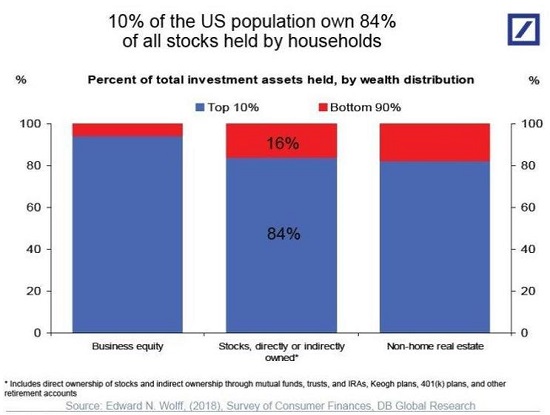
The increasing concentration of the ownership of wealth/assets in the top 10% has an under-appreciated consequence: when only the top 10% can afford to buy assets, that unleashes an almost karmic payback for the narrowing of ownership, a.k.a. soaring wealth and income inequality: assets crash.

Most of you are aware that the bottom 90% own very little other than their labor (tradeable only in full employment) and modest amounts of home equity that are highly vulnerable to a collapse of the housing bubble. (The same can be said of China’s middle class, only more so, as 75% of China’s household wealth is in real estate, more than double the percentage of wealth held in housing in U.S. households.)

As the chart illustrates, the top 10% own 84% of all stocks, over 90% of all business equity and over 80% of all non-home real estate. The concentration of ownership of assets such as vintage autos, collectibles, art, pleasure craft and second homes in the top 10% is likely even greater.

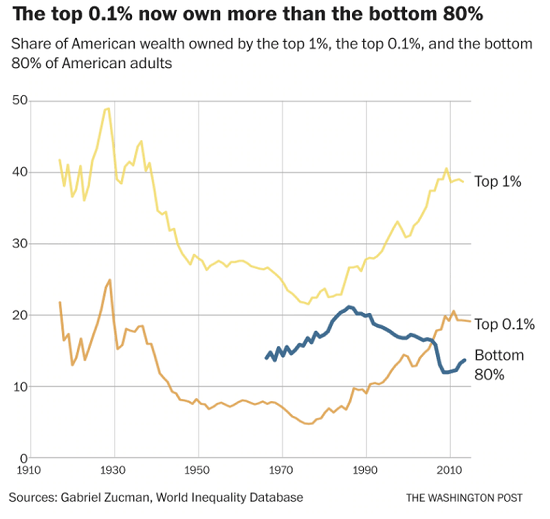
The more expensive the asset, the greater the concentration of ownership, as the top 5% own roughly 2/3 of all wealth, the top 1% own 40% and the top 0.1% own 20%. In other words, the more costly the asset, the narrower the ownership. (Total number of US households is about 128 million, so the top 5% is around 6 million households and the top 1% is 1.2 million households.)

This means the pool of potential buyers is relatively small, even if we include global wealth owners.

Since price is set on the margins, and assets like houses are illiquid, then we can anticipate all the markets for assets owned solely by the wealthy to go bidless–yachts, collectibles, vacation real estate–because the pool of buyers is small, and if that pool gets cautious due to a drop in net worth/unearned income, there won’t be any buyers except at the margins, at incredible discounts.

As we know, in a neighborhood of 100 homes currently valued ar $1 million each, when a desperate seller accepts $500,000, the value of the other 99 homes immediately drops to $500,000.

Since few of the current bubble-era asset valuations are supported by actual income fundamentals, then the sales price boils down to a very small number of potential buyers and what they’re willing to pay.

Houses have a value based on rent, of course, but rents will drop very quickly for the same reason: prices are set on the margins. The most desperate landlords will drop rents and re-set the rental market from the margins. If demand plummets (which it will as people can no longer afford rents in hot urban markets once they lose their jobs), then vacancies will soar and rents will crash as a few desperate landlords will take $1200/month instead of $2500/month.

Due to the multi-year building boom of multi-family buildings in hot job markets (which inevitably leads to an over-supply once the boom ends), there are now hundreds of vacancies where there were once only a few dozen, and thousands where there were previously only hundreds.

As millions of wait staff, bartenders, etc. who made good money in tips find their jobs have vanished, all the urban hotspots will see mass out-migration: Seattle, Portland, the S.F. Bay Area, L.A., NYC, Denver, etc. as demand for rentals will evaporate and rents will be set on the margins by the most desperate landlords. Everyone holding out for the previous bubble-era rent will have $0 income as their units are vacant.

Tech start-ups and Unicorns are melting like ice cubes in Death Valley, and tech-sector layoffs are already in the tens of thousands. This wave of highly paid techies losing their jobs will become a tsunami, further reducing the pool of people who can afford rents of $2,500 to $3,000 for a studio or one-bedroom apartment.)

The concentration of ownership generates a self-reinforcing feedback that further depresses prices: since the top 10% own most of the assets of the nation, they are most prone to a reversal of “the wealth effect.” As their assets soared in value, the top 10% felt wealthier and more confident in future gains, enabling them to borrow and spend freely on second homes, pleasure craft, new vehicles, collectibles, luxury travel, etc.

Once even one class of assets plummets in value–for example, the recent decline in the stock market– the wealth effect reverses and the top 10% feel poorer and less confident about future gains, and thus less enthused about borrowing and spending. The demand for other costly assets quickly evaporates, further reducing the wealth of the “ownership class,” which further reduces their desire and ability to buy bubble-era assets.

The high-priced assets owned by the top 10% will be the assets least in demand due to their high cost and potential for enormous losses: nothing loses value faster in a recession that narrowly owned assets such as vintage cars, art, vacation homes, yachts, etc.

Once assets start sliding in value, the reverse wealth effect quickly dries up demand for all asset classes with narrow ownership. Since these assets are illiquid–that is, the market for them is thin, with buyers few and far between–the prices are set by a very shallow pool of buyers and desperate sellers.

Consider a pleasure craft that retails new for $120,000. In the boom era of rising stocks and housing, a used boat might fetch $65,000. But as the wealth of the small pool of households able to buy and maintain a costly craft evaporates, the number of qualified buyers evaporates, too.

The seller might be aghast by an offer of $35,000 and reject it angrily. Six months later, he’s praying someone will take it off his hands for $15,000, and in another six months, he’ll accept $500 just to get out from underneath the insurance, slip-rental and licencing fees.

This is how it happens that boats that were once worth tens of thousands of dollars are set adrift by owners who can no longer afford to pay slip fees, and vacation homes are abandoned and auctioned off for overdue property taxes: the market for these luxuries dries up and blows away, i.e. goes bidless–there are no buyers at any price.

Once housing and real estate valuations fall, that will trigger a decline in the value of all other costly, narrowly owned assets, which will reinforce the reverse wealth effect.

This is the systemic payback for concentrating ownership of assets in the hands of the few: when their bubble-era priced assets plummet in value, the bottom falls out of all assets with narrow ownership. The price of superfluous assets such as boats, vintage cars, collectibles, art and vacation homes can quickly fall to a fraction of bubble-era valuations, destroying much of what was always fictional capital.

(For more on the intrinsic fragility of a system that concentrates ownership in the hands of the few, please read Our Inevitable Collapse: We Can’t Save a Fragile Economy With Bailouts That Increase Fragility May 1, 2020.)

The Federal Reserve reckons it can “save” the bubble-era valuations of junk bonds by being the “buyer of last resort,” but it will end up being the “only buyer,” effectively making the system even more fragile and prone to collapse.

The public will eventually have to decide if the nation’s central bank should be bailing out assets owned by the financial elite while the upper-middle class watches its assets collapse in value.

No, This Is Not Another 1929, 1973, 1987, 2000, or 2008

By Charles Hugh Smith

Source: Of Two Minds

Basing one’s decisions on analogs from the past is entering a fool’s paradise of folly.

Like addicts who cannot control their cravings, financial analysts cannot stop themselves from seeking some analog situation in the past which will clarify the swirling chaos in their crystal balls. So we’ve been swamped with charts overlaying recent stock market action over 1929, 1987,2000 and 2008–though the closest analogy is actually the Oil Shock of 1973, an exogenous shock to a weakening, fragile economy.

But the reality is there is no analogous situation in the past to the present, and so all the predictions based on past performance will be misleading. The chartists and analysts claim that all markets act on the same patterns, which are reflections of human nature, and so seeking correlations of volatility and valuation that “worked” in the past will work in 2020.

Does anyone really believe the correlations of the past decade or two are high-probability predictors of the future as the entire brittle construct of fictional capital and extremes of globalization and financialization all unravel at once?

Here are a few of the many consequential differences between all previous recessions and the current situation:

1. Households have never been so dependent on debt as a substitute for stagnating wages.

2. Real earnings (adjusted for inflation) have never been so stagnant for the bottom 90% for so long.

3. Corporations have never been so dependent on debt (selling bonds or taking on loans) to fund money-losing operations (see Netflix) or stock buybacks designed to saddle the company with debt service expenses to enrich insiders.

4. The stock market has never been so dependent on what amounts to fraud–stock buybacks–to push valuations higher.

5. The economy has never been so dependent on absurdly overvalued stock valuations to prop up pension funds and the spending of the top 10% who own 85% of all stocks, i.e. “the wealth effect.”

6. The economy and the stock market have never been so dependent on central bank free money for financiers and corporations, money creation for the few at the expense of the many, what amounts to an embezzlement scheme.

7. Federal statistics have never been so gamed, rigged or distorted to support a neofeudal agenda of claiming a level of wide-spread prosperity that is entirely fictitious.

8. Major sectors of the economy have never been such rackets, i.e. cartels and quasi-monopolies that use obscure pricing and manipulation of government mandates to maximize profits while the quality and quantity of the goods and services they produce declines.

9. The economy has never been in such thrall to sociopaths who have mastered the exploitation of the letter of the law while completely overturning the spirit of the law.

10. Households and companies have never been so dependent on “free money” gained from asset appreciation based on speculation, not an actual increase in productivity or value.

11. The ascendancy of self-interest as the one organizing directive in politics and finance has never been so complete, and the resulting moral rot never more pervasive.

12. The dependence on fictitious capital masquerading as “wealth” has never been greater.

13. The dependence on simulacra, simulations and false fronts to hide the decay of trust, credibility, transparency and accountability has never been so pervasive and complete.

14. The corrupt linkage of political power, media ownership, “national security” agencies and corporate power has never been so widely accepted as “normal” and “unavoidable.”

15. Primary institutions such as higher education, healthcare and national defense have never been so dysfunctional, ineffective, sclerotic, resistant to reform or costly.

16. The economy has never been so dependent on constant central bank manipulation of the stock and housing markets.

17. The economy has never been so fragile or brittle, and so dependent on convenient fictions to stave off a crash in asset valuations.

18. Never before in U.S. history have the most valuable corporations all been engaged in selling goods and services that actively reduce productivity and human happiness.

This is only a selection of a much longer list, but you get the idea. Basing one’s decisions on analogs from the past is entering a fool’s paradise of folly.

Weimar America, Here We Come! Virus Hysteria Adds $10 Trillion to the National Debt

By Mike Whitney

Source: The Unz Review

There’s no doubt that the Coronavirus is a serious infection that can lead to severe illness or death. There’s also no doubt that ‘virus hysteria’ has been used for other purposes. Wall Street, for example, has used virus-panic to advance its own agenda and get another round of trillion dollar bailouts. In fact, it took less than a week to get the pushover congress to ram through a massive $2.2 trillion boondoggle without even one lousy congressman offering a peep of protest. That’s got to be some kind of record.

In 2008, at the peak of the financial crisis, Congress voted “No” to the $700 billion TARP bill. Some readers might recall how a number of GOP congressmen bravely banded together and flipped Wall Street “the bird”. That didn’t happen this time around. Even though the bill is three times bigger than the TARP ( $2.2 trillion), no one lifted a finger to stop it. Why?

Fear, that’s why. Everyone in congress was scared to death that if they didn’t rush this debt-turd through the House pronto, the economy would collapse while tens of thousands of corpses would be stacking up in cities across the country. Of course the reason they believed this nonsense was because the goofy infectious disease experts confidently assured everyone that the body-count would be “in the hundreds of thousands if not millions.” Remember that fiction? The most recent estimate is somewhere in the neighborhood of 60,000 total. I don’t need to tell you that the difference between 60,000 and “millions” is a little more than a rounding-error.

So we’ve had the wool pulled over our eyes, right? Not as bad as congress, but, all the same, we’ve been hoodwinked and we’ve been fleeced. And the people who have axes to grind have been very successful in taking advantage of the hysteria and promoting their own agendas. Maybe you’ve noticed the reemergence of creepy Bill Gates and the Vaccine Gestapo or NWO Henry Kissinger warning us that, “the world will never be the same after the coronavirus”.

What do these people know that we don’t know? Doesn’t it all make you a bit suspicious? And when you see nonstop commercials on TV telling you to “wash your hands”or “keep your distance” or “stay inside” and, oh yeah, “We’re all in this together”, doesn’t it leave you scratching your head and wondering who the hell is orchestrating this virus-charade and what do they really have in mind for us unwashed masses??

At least in the case of Wall Street, we know what they want. They want money and lots of it.

Have you looked over the $2.2 trillion CARES bill that Trump just signed into law a couple weeks ago? It’s pretty grim reading, so I’ll save you the effort. Here’s a rough breakdown:

$250 billion will go for the $1,200 checks that most of us will receive in a couple weeks. And $250 billion will be provided for extended unemployment insurance benefits.

That’s $500 billion.

Working people will get $500 billion while Wall Street and Corporate America will get 3 times that amount. ($1.7 trillion) And even that’s a mere fraction of the total sum because– hidden in the small print– is a section that allows the Fed to lever-up the base-capital by 10-to-1 ($450 billion to $4.5 trillion) which means the Fed can buy as many “toxic” bonds and garbage assets as it chooses. The Fed is turning itself into a hedge fund in order to buy the sludge that has accumulated on the balance sheets of corporations and financial institutions for the last decade. It’s another gigantic ripoff that’s being cleverly concealed behind the ridiculous coronavirus hype. It’s infuriating.

So here’s the question: Do you think Congress knew that working people would only get a pittance while the bulk of the dough would go to Wall Street?

It’s hard to say, but they certainly knew that the economy was cratering and that $500 billion wasn’t going to put much of a dent in a $20 trillion economy. In other words, even if everyone goes out and blows their measly $1,200 checks on Day 1, we’re still going to experience the sharpest economic contraction on record, a second Great Depression.

Maybe they should have talked about that in congress before they voted for this trillion-dollar turkey? Maybe they should have thought a little more about how the money should be distributed: Should it go to the people who actually buy things, generate activity and produce growth, or to the parasite class that blows up the system every decade and drags the economy down a black hole? That seems like something you might want to know before you pass a multi-trillion dollar bill that’s supposed to fix the economy.

It’s also worth noting that the $5.8 trillion is not nearly the total amount that Wall Street will eventually get. The Fed has already spent $2 trillion via its QE program (to shore up the dysfunctional repo market) and Fed chair Jay Powell announced on Thursday that another $2.3 trillion in loans and purchases would be used to buy municipal bonds, corporate bonds and loans to small businesses. The allocation for small businesses, which falls under the, Main Street Lending Program, has been widely touted as a sign of how much the Fed really cares about struggling Mom and Pop businesses that employ the majority of working Americans. But, once again, it’s a sham and a boondoggle. The program is on-track to get $600 billion funding of which the US Treasury will provide the base-capital of $75 billion. The rest will be levered-up by 9-to-1 by the Fed, which means it’s just more smoke and mirrors.

What readers need to realize is that the Treasury has accepted the credit risk for all of the loans that default. In other words, the American people are now on the hook for 100% of all of the loans that go south, and there’s going to be alot of them because the banks have no reason to find creditworthy borrowers. They get a 5% cut off-the-top whether the loans blow up or not. And, that, my friend, is how you incentivize fraud which, as Bernie Sanders noted, “is Wall Street’s business model.”

It also helps to explain why Trump has repeatedly rejected congressional oversight of the various bailout programs. He’s smart enough to know a good swindle when he sees one, and this one is a corker. The government is essentially waving trillions of dollars right under the noses of the world’s most ravenous hyenas expecting them not to act in character. But of course they will act in character and hundreds of billions of dollars will be siphoned off by scheming sharpies who figure out how game the system and turn the whole fiasco into another Wall Street looting operation. You can bet on it.

So, what is the final tally?

Well, according to Trump’s chief economic advisor, Larry Kudlow, the first bailout installment is $6.2 trillion (after the Fed ramps up the Treasury’s contribution of $450 billion.). Then there’s the $2.3 trillion in additional programs the Fed announced on Thursday. Finally, the Fed’s QE program adds another $2 trillion in bond purchases since September 17, when the repo market went haywire.

Altogether, the total sum amounts to $10.5 trillion.

You know what they say, “A trillion here, a trillion there, pretty soon you’re talking real money.”

Of course, no one on Capitol Hill worries about trivialities like money because, “We’re the United States of America, and our dollar will always be King.” But there’s a fundamental flaw to this type of thinking. Yes, the dollar is the world’s reserve currency, but that’s a privilege that the US has greatly abused over the years, and it’s certainly not going to survive this latest wacky helicopter drop. No, I am not suggesting the US would ever default on its debt, that’s not going to happen. But, yes, I am suggesting that the US will have to repay its debts in a currency that has lost a significant amount of its value. You don’t have to be Einstein to figure out that you can’t willy-nilly print-up $10 or $20 trillion dollars without eroding the value of the currency. That’s a no-brainer. Central bankers around the world are now looking at their piles of USDs thinking, “Hmmm, maybe it’s time I traded some of these greenbacks in for a few yen, euros or even Swiss francs?”

So how does this end? Can the Fed continue to write trillion dollar checks on an account that is already $23 trillion overdrawn? Will Central banks around the world continue to stockpile dollars when the Fed is printing them up faster than anyone can count? And what about China? How long before China realizes that US Treasuries are grossly overvalued, that US equities markets are unreformable, that the dollar is backed by nothing but red ink, and that Wall Street is the biggest and most corrupt cesspit on earth?

Not long, I’d wager. So, how does this end? It ends in a flash of monetary debasement preceded by a violent and destabilizing currency crisis. It’s plain as the nose on your face. The Fed knows that when a nation’s sovereign debt exceeds 100% of GDP, “there’s almost no mathematical way to service that debt in real terms.” Well, the US passed that milestone way-back in 2019 before this latest drunken spending-spree even began. It’s safe to say, we’ve now entered the financial Twilight Zone, the Land of No Return. If we add the Fed’s bulging balance sheet to the final estimate, (after all, it’s just another shady Enron-type Special Purpose Vehicle) the national debt will be somewhere north of $33 trillion by year-end, which means that Uncle Sam will be the greatest credit risk on Planet Earth. Imagine how jaws will drop on the day that Moodys and Fitch slash the ratings on US Treasuries to Triple B “junk” status. That should turn a few heads.

So what can we expect in the months to come?

First, the economy is going to slip into a deflationary period as people get back to work and slowly resume their spending. But once demand picks up and the Fed’s liquidity starts to kick in, the economy will rebound sharply followed by steadily rising prices. That’s the red flag that will signal a weakening dollar. Similar to 1933, when Roosevelt took the U.S. off the gold standard and printed money like crazy, economic activity picked up but the value of the dollar dropped by 40%. A similar scenario seems likely here as well. Economist Lyn Alden Schwartzer summed it up like this in an article at Seeking Alpha:

“One of the common debates is whether all of this debt, counteracted by a tremendous monetary expansion by the Federal Reserve in response, will cause a deflationary bust or an inflationary problem…..Fundamentally, evidence points to a period of deflation due to this global shutdown and demand destruction shock, likely followed in the coming years by rising inflation….

In the coming years, the United States will be effectively printing money to fund large fiscal deficits, while also having a large current account deficit and negative net international investment position. This is one of the main variables for my view that the dollar will likely decrease in value relative to a basket of foreign currencies in the coming years….” (“Why This Is Unlike The Great Depression”, Seeking Alpha)

So, after decades of lethal low interest rates, relentless meddling and gross regulatory malpractice, the Fed has led us to this final, fatal crossroads: Inflate or default. From the looks of things, the choice has already been made. Weimar America, here we come!


Who Profits from the Pandemic?

West Virginia National Guard members reporting to a Charleston nursing home to assist with Covid-19 testing. April 6, 2020. (U.S. Army National Guard, Edwin L. Wriston)

By Pepe Escobar

Source: Consortium News

You don’t need to read Michel Foucault’s work on biopolitics to understand that neoliberalism – in deep crisis since at least 2008 – is a control/governing technique in which surveillance capitalism is deeply embedded.

But now, with the world-system collapsing at breathtaking speed, neoliberalism is at a loss to deal with the next stage of dystopia, ever present in our hyper-connected angst: global mass unemployment.

Henry Kissinger, anointed oracle/gatekeeper of the ruling class, is predictably scared. He claims that, “sustaining the public trust is crucial to social solidarity.” He’s convinced the Hegemon should “safeguard the principles of the liberal world order.” Otherwise, “failure could set the world on fire.”

That’s so quaint. Public trust is dead across the spectrum. The liberal world “order” is now social Darwinist chaos. Just wait for the fire to rage.

The numbers are staggering. The Japan-based Asian Development Bank (ADB), in its annual economic report, may not have been exactly original. But it did note that the impact of the “worst pandemic in a century” will be as high as $4.1 trillion, or 4.8 percent of global GDP.

This an underestimation, as “supply disruptions, interrupted remittances, possible social and financial crises, and long-term effects on health care and education are excluded from the analysis.”

We cannot even start to imagine the cataclysmic social consequences of the crash. Entire sub-sectors of the global economy may not be recomposed at all.

The International Labor Organization (ILO) forecasts global unemployment at a conservative, additonal 24.7 million people – especially in aviation, tourism and hospitality.

The global aviation industry is a humongous $2.7 trillion business. That’s 3.6 percent of global GDP. It employs 2.7 million people. When you add air transport and tourism —everything from hotels and restaurants to theme parks and museums — it accounts for a minimum of 65.5 million jobs around the world.

According to the ILO, income losses for workers may range from $860 billion to an astonishing $3.4 trillion. “Working poverty” will be the new normal – especially across the Global South.

“Working poor,” in ILO terminology, means employed people living in households with a per capita income below the poverty line of $2 a day. As many as an additional 35 million people worldwide will become working poor in 2020.

Switching to feasible perspectives for global trade, it’s enlightening to examine that this report about how the economy may rebound is centered on the notorious hyperactive merchants and traders of Yiwu in eastern China – the world’s busiest small-commodity, business hub.

Their experience spells out a long and difficult recovery. As the rest of the world is in a coma, Lu Ting, chief China economist at Nomura in Hong Kong stresses that China faces a 30 percent decline in external demand at least until next Fall.

Neoliberalism in Reverse?

In the next stage, the strategic competition between the U.S. and China will be no-holds-barred, as emerging narratives of China’s new, multifaceted global role – on trade, technology, cyberspace, climate change – will set in, even more far-reaching than the New Silk Roads. That will also be the case in global public health policies. Get ready for an accelerated Hybrid War between the “Chinese virus” narrative and the Health Silk Road.

The latest report by the China Institute of International Studies would be quite helpful for the West — hubris permitting — to understand how Beijing adopted key measures putting the health and safety of the general population first.

Now, as the Chinese economy slowly picks up, hordes of fund managers from across Asia are tracking everything from trips on the metro to noodle consumption to preview what kind of economy may emerge post-lockdown.

In contrast, across the West, the prevailing doom and gloom elicited a priceless editorial from The Financial Times. Like James Brown in the 1980s Blues Brothers pop epic, the City of London seems to have seen the light, or at least giving the impression it really means it. Neoliberalism in reverse. New social contract. “Secure” labor markets. Redistribution.

Cynics won’t be fooled. The cryogenic state of the global economy spells out a vicious Great Depression 2.0 and an unemployment tsunami. The plebs eventually reaching for the pitchforks and the AR-15s en masse is now a distinct possibility. Might as well start throwing a few breadcrumbs to the beggars’ banquet.

That may apply to European latitudes. But the American story is in a class by itself.

For decades, we were led to believe that the world-system put in place after WWII provided the U.S. with unrivalled structural power. Now, all that’s left is structural fragility, grotesque inequalities, unpayable Himalayas of debt, and a rolling crisis.

No one is fooled anymore by the Fed’s magic quantitative easing powers, or the acronym salad – TALF, ESF, SPV – built into the Fed/U.S. Treasury exclusive obsession with big banks, corporations and the Goddess of the Market, to the detriment of the average American.

It was only a few months ago that a serious discussion evolved around the $2.5 quadrillion derivatives market imploding and collapsing the global economy, based on the price of oil skyrocketing, in case the Strait of Hormuz – for whatever reason – was shut down.

Now it’s about Great Depression 2.0: the whole system crashing as a result of the shutdown of the global economy. The questions are absolutely legitimate: is the political and social cataclysm of the global economic crisis arguably a larger catastrophe than Covid-19 itself?  And will it provide an opportunity to end neoliberalism and usher in a more equitable system, or something even worse?

 ‘Transparent’ BlackRock

Wall Street, of course, lives in an alternative universe. In a nutshell, Wall Street turned the Fed into a hedge fund. The Fed is going to own at least two thirds of all U.S. Treasury bills in the market before the end of 2020.

The U.S. Treasury will be buying every security and loan in sight while the Fed will be the banker – financing the whole scheme.

So essentially this is a Fed/Treasury merger. A behemoth dispensing loads of helicopter money.

And the winner is BlackRock—the biggest money manager on the planet, with tentacles everywhere, managing the assets of over 170 pension funds, banks, foundations, insurance companies, in fact a great deal of the money in private equity and hedge funds. BlackRock — promising to be fully  “transparent” — will buy these securities and manage those dodgy SPVs on behalf of the Treasury.

BlackRock, founded in 1988 by Larry Fink, may not be as big as Vanguard, but it’s the top investor in Goldman Sachs, along with Vanguard and State Street, and with $6.5 trillion in assets, bigger than Goldman Sachs, JP Morgan and Deutsche Bank combined.

Now, BlackRock is the new operating system (OS) of the Fed and the Treasury. The world’s biggest shadow bank – and no, it’s not Chinese.

Compared to this high-stakes game, mini-scandals such as the one around Georgia Senator Kelly Loffler are peanuts. Loffler allegedly profited from inside information on Covid-19 by the CDC to make a stock market killing. Loffler is married to Jeffrey Sprecher – who happens to be the chairman of the NYSE, installed by Goldman Sachs.

While corporate media followed this story like headless chickens, post-Covid-19 plans, in Pentagon parlance, “move forward” by stealth.

The price? A meager $1,200 check per person for a month. Anyone knows that, based on median salary income, a typical American family would need $12,000 to survive for two months. Treasury Secretary Steven Mnuchin, in an act of supreme effrontry, allows them a mere 10 percent of that. So American taxpayers will be left with a tsunami of debt while selected Wall Street players grab the whole loot, part of an unparalleled transfer of wealth upwards, complete with bankruptcies en masse of small and medium businesses.

Fink’s letter to his shareholders almost gives the game away: “I believe we are on the edge of a fundamental reshaping of finance.”

And right on cue, he forecasted that, “in the near future – and sooner than most anticipate – there will be a significant reallocation of capital.”

He was referring, then, to climate change. Now that refers to Covid-19.

Implant Our Nanochip, Or Else?

The game ahead for the elites, taking advantage of the crisis, might well contain these four elements: a social credit system, mandatory vaccination, a digital currency and a Universal Basic Income (UBI). This is what used to be called, according to the decades-old, time-tested CIA playbook, a “conspiracy theory.” Well, it might actually happen.

A social credit system is something that China set up already in 2014. Before the end of 2020, every Chinese citizen will be assigned his/her own credit score – a de facto “dynamic profile”, elaborated with extensive use of AI and the internet of things (IoT), including ubiquitous facial recognition technology. This implies, of course, 24/7 surveillance, complete with Blade Runner-style roving robotic birds.

The U.S., the U.K., France, Germany, Canada, Russia and India may not be far behind. Germany, for instance, is tweaking its universal credit rating system, SCHUFA. France has an ID app very similar to the Chinese model, verified by facial recognition.

Mandatory vaccination is Bill Gates’s dream, working in conjunction with the WHO, the World Economic Forum (WEF) and Big Pharma. He wants “billions of doses” to be enforced over the Global South. And it could be a cover to everyone getting a digital implant.

Here it is, in his own words. At 34:15: “Eventually what we’ll have to have is certificates of who’s a recovered person, who’s a vaccinated person…Because you don’t want people moving around the world where you’ll have some countries that won’t have it under control, sadly. You don’t want to completely block off the ability for people to go there and come back and move around.”

Then comes the last sentence which was erased from the official TED video. This was noted by Rosemary Frei, who has a master on molecular biology and is an independent investigative journalist in Canada. Gates says: “So eventually there will be this digital immunity proof that will help facilitate the global reopening up.”

This “digital immunity proof” is crucial to keep in mind, something that could be misused by the state for nefarious purposes.

The three top candidates to produce a coronavirus vaccine are American biotech firm Moderna, as well as Germans CureVac and BioNTech.

Digital cash might then become an offspring of blockchain. Not only the U.S., but China and Russia are also interested in a national crypto-currency. A global currency – of course controlled by central bankers – may soon be adopted in the form of a basket of currencies, and would circulate virtually. Endless permutations of the toxic cocktail of IoT, blockchain technology and the social credit system could loom ahead.

Already Spain has announced that it is introducing UBI, and wants it to be permanent. It’s a form insurance for the elite against social uprisings, especially if millions of jobs never come back.

So the key working hypothesis is that Covid-19 could be used as cover for the usual suspects to bring in a new digital financial system and a mandatory vaccine with a “digital identity” nanochip with dissent not tolerated: what Slavoj Zizek calls the “erotic dream” of every totalitarian government.

Yet underneath it all, amid so much anxiety, a pent-up rage seems to be gathering strength, to eventually explode in unforeseeable ways. As much as the system may be changing at breakneck speed, there’s no guarantee even the 0.1 percent will be safe.
Question Everything

By Michael Krieger

Source: Liberty Blitzkrieg

Crises, like pandemics, don’t break things in and of themselves; they show you what’s already broken.

– Patrick Wyman

Big macro crises in any form are scary, massively disruptive, and in some cases, literally deadly. This is why governments and entrenched institutions always see such events as opportunities to further consolidate wealth and power.

The current global pandemic is no exception, as I detailed in last week’s piece: Power Grab. While it’s necessary to be aware of this reality — and to push back against it wherever possible — it’s equally important to recognize there’s a silver lining to all of this.

The paradigm we live under depends on us not thinking too hard about how power functions. It relies on us being so busy with the basics of survival, or distracted by superficial consumerism and endless entertainment, to contemplate how the system actually works. This method of social control has been wildly successful throughout my lifetime, but what’s interesting about moments of global crises is the mask is forced off for a period. In a desperate scramble to marshal all of the corporate-imperial state’s resources to save the interests of the oligarchy, we’re shown in full color who really matters and who doesn’t.

You do not matter. The imperial state doesn’t care about you. Oligarchs don’t care about you. Mega corporations don’t care about you. This truth is cleverly hidden from much of the public during “normal” times when the machine is humming along as intended, but it’s far more in your face during a crisis period. It’s much harder to hide the truth when the world gets turned upside down.

Aside from the grotesque spectacle of the U.S. government funneling all of its resources toward propping up Wall Street and large corporations, this crisis has exposed the rot and disfunction in another meaningful way. Our health experts, ostensibly there to help the public navigate exactly this sort of event, have failed us in spectacular fashion.

https://twitter.com/Surgeon_General/status/1233725785283932160

This is what political actors masquerading as experts do in a crisis. They either give bad advice, or intentionally mislead the public to hide the fact the U.S. simply doesn’t have adequate mask supply and sent its manufacturing capacity overseas. Which brings up an important topic worthy of further discussion: the crucial distinction between experts and expertise.

An “expert” in our society is someone with expertise in a particular field who’s been propped up by either the media, government or both as an authoritative source to listen to on a particular topic. This individual’s elevated stature is artificially created by an external source that’s selected this particular person as someone you should listen to. It tends to be a political appointment. This person has been chosen, not only because he or she has expertise (many others also do), but due to other attributes that appeal to those who’ve decided to prop them up. Anyone who’s worked in corporate America knows full well that many of those promoted to middle management, or higher, often end up there not because they’re particularly skilled, but because they’re good at playing politics and know the right ass to kiss. The same is true in all large organizations, and government is no exception.

In the days before the internet and social media, the public might know that government/media experts were behaving dishonestly, but didn’t have realtime access to competitive nonpolitical voices with equal or superior expertise to the government experts. What many of us discovered during this pandemic is people with expertise engaging publicly on Twitter provided far better and more timely advice than the government/media experts. This makes perfect sense because these people tend to not be political actors, but rather humans attempting to share information in an honest and selfless manner. If we’ve learned anything in the 21st century, it’s that actual track records don’t matter when it comes to media and government positions. In fact, the more catastrophically wrong you are in the interests of oligarchy, the more likely you are to be promoted and elevated.

Fortunately, I entered this crisis with a well established distrust of mass media and government, and therefore knew better than to look toward their experts for any useful guidance. Rather, I sought out the opinions of various nonpolitical individuals with relevant expertise who helped me see things for how they were very early on. Others have not been as lucky, but will no doubt emerge from this crisis with a deep distrust of established institutions and individuals, and with very good reason.

We’ve just witnessed a catastrophic failure of the centralized state in America, and the blowback will resonate within the larger culture for years if not decades. Similar to how many people were shaken to their core during the financial crisis a decade ago, I think this pandemic event will lead to an even larger wave of people awakening to how completely rotten, pernicious and corrupt the whole system is. Once you see that reality in all its glory, you can’t unsee it.

Of course, recognizing how broken things are isn’t enough. We need to have a thoughtful conversation about what we have too much of versus what we need. If we’re going to change the world, we need a vision. I have some thoughts on the matter.

Nothing is set in stone. The world as it is today is not some divine eternal paradigm beyond reproach. Humans shape the world through their choices, actions and mentality.

For additional thoughts on that and much more, check out my recent interview with Tales From the Crypt.

Risings and Fallings

By James Howard Kunstler

Source: Kunstler.com

In the corkscrewing anguish of the social sequester, with careers, savings, futures, and dreams whirling down the drain, voices rise above the din of conflicting statistics to ask: what is going on here? To some, it looks like a deliberate attempt to demolish what’s left of the economy for political advantage. Clouds of suspicion gather over the two medical superstars of the Daily Briefing show, Doctors Fauci and Birx, as they somewhat sheepishly revise their numbers for contagion and death downward and attempt to “balance” the formula of modeled projections versus mitigation efforts. Was the stay-at-home panic necessary, after all? Will it save the day or kill off modern life as we knew it?

Well, everyplace else in the world was shutting down, weren’t they? Did they all go off their rockers, too? At least a hundred doctors died in Italy heroically tending the stricken, so they say. South Korea, Taiwan, and Singapore opted for flat-out medical Gestapo action. Britain, Spain, France, and Germany about the same, but minus testing at the grand scale and tracing of contacts. Honestly, how is it possible the whole planet punked itself?

I certainly don’t know the answer to all this, though readers are twanging on me to declare the whole Covid-19 story “a hoax,” which I’m not ready to do. I do know this: America has become utterly intolerant of uncertainty. And in the absence of certainty, that age-old human cognitive skill called pattern recognition, which has made us such a successful species, kicks into high gear scanning the field-of-view for answers. Any string-of-dots that affords even the slimmest plausibility goes on the table for review, including a lot of stories tagged as “conspiracy theories.”

I know this, too: the financial side of the gasping global economy was running off the rails well before Covid-19 flew out of its bat-cave into somebody’s soup bowl… or out of China’s Wuhan virus lab, if that’s how you like it… or before it seeped out of the Bill and Melinda Gates Foundation’s ark of world-saving secrets. In the USA and Europe, finance had come to mostly eclipse every other human endeavor of wealth production ­– with the catch that finance actually didn’t produce any real wealth, it only winkled and swindled wealth (or the mere ghosts of wealth) with its asset-stripping magic, from the places where wealth once did truly dwell. Or else it ginned up abstruse rackets that attempted to replace the utility of money with sheer math. Or, when all else failed, it just resorted to plain old accounting fraud… until, finally, there was so much there not actually there, that the whole holographic fantasy flickered out.

The pre-Easter bear market rally on Wall Street has been a wonder, don’t you think? As the numbers of able-bodied people out-of-work rocketed up past ten million during the same period, the stock indexes shot up three, five, six percent a day? Say, what? You’re telling me that’s based on the prospect of magnificent earnings in the third quarter? With every business on God’s green earth writhing in the dust like squashed bugs? And every supply line for basic goods and the gazillion spare parts for everything… all choked off?

And meanwhile, the American public sequesters and festers, waiting for those $1,200 checks that will fix… everything! Let’s face it: this is a twilight zone between stupor and fury. Nobody is paying anything to anyone. All obligations are suspended: rents, mortgages, bills, loans, bets, and vigs, all up in the air somewhere, but definitely not moving to their assigned destinations. The velocity of money is zero and all the various new term facilities and structured vehicles conjured by the Federal Reserve and Congress amount to a mere shadow of money moving ­– even though they are represented by trillions of brand-new alleged dollars. For every ten points that the Standard & Poor’s rose this week, somewhere down the line as many hedge funders will be dribbled like so many basketballs to the hoop of judgment.

The nation now has the long Easter weekend to stew and ruminate over its fate with spring achingly vivid and beckoning beyond the grim, streaked windows of sequestering. Those little cans of Easter Spam with pineapple rings won’t offer much consolation, combined with the abject discovery that even Netflix only has so many sequels to Frozen for children going catatonic with ennui. Kids are generally not so excited by stock and bond markets, but that’s probably where the genuine melodrama picks up on Monday. The weeks ahead there will give the phrase down-to-earth a whole new meaning.