Saker interview with Michael Hudson on Venezuela, February 7, 2019

By The Saker and Michael Hudson

Source: The Saker

Introduction: There is a great deal of controversy about the true shape of the Venezuelan economy and whether Hugo Chavez’ and Nicholas Maduro’s reform and policies were crucial for the people of Venezuela or whether they were completely misguided and precipitated the current crises.  Anybody and everybody seems to have very strong held views about this.  But I don’t simply because I lack the expertise to have any such opinions.  So I decided to ask one of the most respected independent economists out there, Michael Hudson, for whom I have immense respect and whose analyses (including those he co-authored with Paul Craig Roberts) seem to be the most credible and honest ones you can find.  In fact, Paul Craig Roberts considers Hudson the “best economist in the world“!
I am deeply grateful to Michael for his replies which, I hope, will contribute to a honest and objective understanding of what really is taking place in Venezuela.
The Saker

The Saker: Could you summarize the state of Venezuela’s economy when Chavez came to power?

Michael Hudson: Venezuela was an oil monoculture. Its export revenue was spent largely on importing food and other necessities that it could have produced at home. Its trade was largely with the United States. So despite its oil wealth, it ran up foreign debt.

From the outset, U.S. oil companies have feared that Venezuela might someday use its oil revenues to benefit its overall population instead of letting the U.S. oil industry and its local comprador aristocracy siphon off its wealth. So the oil industry – backed by U.S. diplomacy – held Venezuela hostage in two ways.

First of all, oil refineries were not built in Venezuela, but in Trinidad and in the southern U.S. Gulf Coast states. This enabled U.S. oil companies – or the U.S. Government – to leave Venezuela without a means of “going it alone” and pursuing an independent policy with its oil, as it needed to have this oil refined. It doesn’t help to have oil reserves if you are unable to get this oil refined so as to be usable.

Second, Venezuela’s central bankers were persuaded to pledge their oil reserves and all assets of the state oil sector (including Citgo) as collateral for its foreign debt. This meant that if Venezuela defaulted (or was forced into default by U.S. banks refusing to make timely payment on its foreign debt), bondholders and U.S. oil majors would be in a legal position to take possession of Venezuelan oil assets.

These pro-U.S. policies made Venezuela a typically polarized Latin American oligarchy. Despite being nominally rich in oil revenue, its wealth was concentrated in the hands of a pro-U.S. oligarchy that let its domestic development be steered by the World Bank and IMF. The indigenous population, especially its rural racial minority as well as the urban underclass, was excluded from sharing in the country’s oil wealth. The oligarchy’s arrogant refusal to share the wealth, or even to make Venezuela self-sufficient in essentials, made the election of Hugo Chavez a natural outcome.

The Saker: Could you outline the various reforms and changes introduced by Hugo Chavez? What did he do right, and what did he do wrong?

Michael Hudson: Chavez sought to restore a mixed economy to Venezuela, using its government revenue – mainly from oil, of course – to develop infrastructure and domestic spending on health care, education, employment to raise living standards and productivity for his electoral constituency.

What he was unable to do was to clean up the embezzlement and built-in rake-off of income from the oil sector. And he was unable to stem the capital flight of the oligarchy, taking its wealth and moving it abroad – while running away themselves.

This was not “wrong”. It merely takes a long time to change an economy’s disruption – while the U.S. is using sanctions and “dirty tricks” to stop that process.

The Saker: What are, in your opinion, the causes of the current economic crisis in Venezuela – is it primarily due to mistakes by Chavez and Maduro or is the main cause US sabotage, subversion and sanctions?

Michael Hudson: There is no way that’s Chavez and Maduro could have pursued a pro-Venezuelan policy aimed at achieving economic independence without inciting fury, subversion and sanctions from the United States. American foreign policy remains as focused on oil as it was when it invaded Iraq under Dick Cheney’s regime. U.S. policy is to treat Venezuela as an extension of the U.S. economy, running a trade surplus in oil to spend in the United States or transfer its savings to U.S. banks.

By imposing sanctions that prevent Venezuela from gaining access to its U.S. bank deposits and the assets of its state-owned Citco, the United States is making it impossible for Venezuela to pay its foreign debt. This is forcing it into default, which U.S. diplomats hope to use as an excuse to foreclose on Venezuela’s oil resources and seize its foreign assets much as Paul Singer hedge fund sought to do with Argentina’s foreign assets.

Just as U.S. policy under Kissinger was to make Chile’s “economy scream,” so the U.S. is following the same path against Venezuela. It is using that country as a “demonstration effect” to warn other countries not to act in their self-interest in any way that prevents their economic surplus from being siphoned off by U.S. investors.

The Saker: What in your opinion should Maduro do next (assuming he stays in power and the USA does not overthrow him) to rescue the Venezuelan economy?

Michael Hudson: I cannot think of anything that President Maduro can do that he is not doing. At best, he can seek foreign support – and demonstrate to the world the need for an alternative international financial and economic system.

He already has begun to do this by trying to withdraw Venezuela’s gold from the Bank of England and Federal Reserve. This is turning into “asymmetrical warfare,” threatening what to de-sanctify the dollar standard in international finance. The refusal of England and the United States to grant an elected government control of its foreign assets demonstrates to the entire world that U.S. diplomats and courts alone can and will control foreign countries as an extension of U.S. nationalism.

The price of the U.S. economic attack on Venezuela is thus to fracture the global monetary system. Maduro’s defensive move is showing other countries the need to protect themselves from becoming “another Venezuela” by finding a new safe haven and paying agent for their gold, foreign exchange reserves and foreign debt financing, away from the dollar, sterling and euro areas.

The only way that Maduro can fight successfully is on the institutional level, upping the ante to move “outside the box.” His plan – and of course it is a longer-term plan – is to help catalyze a new international economic order independent of the U.S. dollar standard. It will work in the short run only if the United States believes that it can emerge from this fight as an honest financial broker, honest banking system and supporter of democratically elected regimes. The Trump administration is destroying illusion more thoroughly than any anti-imperialist critic or economic rival could do!

Over the longer run, Maduro also must develop Venezuelan agriculture, along much the same lines that the United States protected and developed its agriculture under the New Deal legislation of the 1930s – rural extension services, rural credit, seed advice, state marketing organizations for crop purchase and supply of mechanization, and the same kind of price supports that the United States has long used to subsidize domestic farm investment to increase productivity.

The Saker: What about the plan to introduce a oil-based crypto currency? Will that be an effective alternative to the dying Venezuelan Bolivar?

Michael Hudson: Only a national government can issue a currency. A “crypto” currency tied to the price of oil would become a hedging vehicle, prone to manipulation and price swings by forward sellers and buyers. A national currency must be based on the ability to tax, and Venezuela’s main tax source is oil revenue, which is being blocked from the United States. So Venezuela’s position is like that of the German mark coming out of its hyperinflation of the early 1920s. The only solution involves balance-of-payments support. It looks like the only such support will come from outside the dollar sphere.

The solution to any hyperinflation must be negotiated diplomatically and be supported by other governments. My history of international trade and financial theory, Trade, Development and Foreign Debt, describes the German reparations problem and how its hyperinflation was solved by the Rentenmark.

Venezuela’s economic-rent tax would fall on oil, and luxury real estate sites, as well as monopoly prices, and on high incomes (mainly financial and monopoly income). This requires a logic to frame such tax and monetary policy. I have tried to explain how to achieve monetary and hence political independence for the past half-century. China is applying such policy most effectively. It is able to do so because it is a large and self-sufficient economy in essentials, running a large enough export surplus to pay for its food imports. Venezuela is in no such position. That is why it is looking to China for support at this time.

The Saker: How much assistance do China, Russia and Iran provide and how much can they do to help? Do you think that these three countries together can help counter-act US sabotage, subversion and sanctions?

Michael Hudson: None of these countries have a current capacity to refine Venezuelan oil. This makes it difficult for them to take payment in Venezuelan oil. Only a long-term supply contract (paid for in advance) would be workable. And even in that case, what would China and Russia do if the United States simply grabbed their property in Venezuela, or refused to let Russia’s oil company take possession of Citco? In that case, the only response would be to seize U.S. investments in their own country as compensation.

At least China and Russia can provide an alternative bank clearing mechanism to SWIFT, so that Venezuela can by pass the U.S. financial system and keep its assets from being grabbed at will by U.S. authorities or bondholders. And of course, they can provide safe-keeping for however much of Venezuela’s gold it can get back from New York and London.

Looking ahead, therefore, China, Russia, Iran and other countries need to set up a new international court to adjudicate the coming diplomatic crisis and its financial and military consequences. Such a court – and its associated international bank as an alternative to the U.S.-controlled IMF and World Bank – needs a clear ideology to frame a set of principles of nationhood and international rights with power to implement and enforce its judgments.

This would confront U.S. financial strategists with a choice: if they continue to treat the IMF, World Bank, ITO and NATO as extensions of increasingly aggressive U.S. foreign policy, they will risk isolating the United States. Europe will have to choose whether to remain a U.S. economic and military satellite, or to throw in its lot with Eurasia.

However, Daniel Yergin reports in the Wall Street Journal (Feb. 7) that China is trying to hedge its bets by opening a back-door negotiation with Guaido’s group, apparently to get the same deal that it has negotiated with Maduro’s government. But any such deal seems unlikely to be honored in practice, given U.S. animosity toward China and Guaido’s total reliance on U.S. covert support.

The Saker: Venezuela kept a lot of its gold in the UK and money in the USA. How could Chavez and Maduro trust these countries or did they not have another choice? Are there viable alternatives to New York and London or are they still the “only game in town” for the world’s central banks?
Michael Hudson: There was never real trust in the Bank of England or Federal Reserve, but it seemed unthinkable that they would refuse to permit an official depositor from withdrawing its own gold. The usual motto is “Trust but verify.” But the unwillingness (or inability) of the Bank of England to verify means that the formerly unthinkable has now arrived: Have these central banks sold this gold forward in the post-London Gold Pool and its successor commodity markets in their attempt to keep down the price so as to maintain the appearance of a solvent U.S. dollar standard.

Paul Craig Roberts has described how this system works. There are forward markets for currencies, stocks and bonds. The Federal Reserve can offer to buy a stock in three months at, say, 10% over the current price. Speculators will by the stock, bidding up the price, so as to take advantage of “the market’s” promise to buy the stock. So by the time three months have passed, the price will have risen. That is largely how the U.S. “Plunge Protection Team” has supported the U.S. stock market.

The system works in reverse to hold down gold prices. The central banks holding gold can get together and offer to sell gold at a low price in three months. “The market” will realize that with low-priced gold being sold, there’s no point in buying more gold and bidding its price up. So the forward-settlement market shapes today’s market.

The question is, have gold buyers (such as the Russian and Chinese government) bought so much gold that the U.S. Fed and the Bank of England have actually had to “make good” on their forward sales, and steadily depleted their gold? In this case, they would have been “living for the moment,” keeping down gold prices for as long as they could, knowing that once the world returns to the pre-1971 gold-exchange standard for intergovernmental balance-of-payments deficits, the U.S. will run out of gold and be unable to maintain its overseas military spending (not to mention its trade deficit and foreign disinvestment in the U.S. stock and bond markets). My book on Super-Imperialism explains why running out of gold forced the Vietnam War to an end. The same logic would apply today to America’s vast network of military bases throughout the world.

Refusal of England and the U.S. to pay Venezuela means that other countries means that foreign official gold reserves can be held hostage to U.S. foreign policy, and even to judgments by U.S. courts to award this gold to foreign creditors or to whoever might bring a lawsuit under U.S. law against these countries.

This hostage-taking now makes it urgent for other countries to develop a viable alternative, especially as the world de-dedollarizes and a gold-exchange standard remains the only way of constraining the military-induced balance of payments deficit of the United States or any other country mounting a military attack. A military empire is very expensive – and gold is a “peaceful” constraint on military-induced payments deficits. (I spell out the details in my Super Imperialism: The Economic Strategy of American Empire (1972), updated in German as Finanzimperium(2017).

The U.S. has overplayed its hand in destroying the foundation of the dollar-centered global financial order. That order has enabled the United States to be “the exceptional nation” able to run balance-of-payments deficits and foreign debt that it has no intention (or ability) to pay, claiming that the dollars thrown off by its foreign military spending “supply” other countries with their central bank reserves (held in the form of loans to the U.S. Treasury – Treasury bonds and bills – to finance the U.S. budget deficit and its military spending, as well as the largely military U.S. balance-of-payments deficit.

Given the fact that the EU is acting as a branch of NATO and the U.S. banking system, that alternative would have to be associated with the Shanghai Cooperation Organization, and the gold would have to be kept in Russia and/or China.

The Saker:  What can other Latin American countries such as Bolivia, Nicaragua, Cuba and, maybe, Uruguay and Mexico do to help Venezuela?

Michael Hudson: The best thing neighboring Latin American countries can do is to join in creating a vehicle to promote de-dollarization and, with it, an international institution to oversee the writedown of debts that are beyond the ability of countries to pay without imposing austerity and thereby destroying their economies.

An alternative also is needed to the World Bank that would make loans in domestic currency, above all to subsidize investment in domestic food production so as to protect the economy against foreign food-sanctions – the equivalent of a military siege to force surrender by imposing famine conditions. This World Bank for Economic Acceleration would put the development of self-reliance for its members first, instead of promoting export competition while loading borrowers down with foreign debt that would make them prone to the kind of financial blackmail that Venezuela is experiencing.

Being a Roman Catholic country, Venezuela might ask for papal support for a debt write-down and an international institution to oversee the ability to pay by debtor countries without imposing austerity, emigration, depopulation and forced privatization of the public domain.

Two international principles are needed. First, no country should be obliged to pay foreign debt in a currency (such as the dollar or its satellites) whose banking system acts to prevents payment.

Second, no country should be obliged to pay foreign debt at the price of losing its domestic autonomy as a state: the right to determine its own foreign policy, to tax and to create its own money, and to be free of having to privatize its public assets to pay foreign creditors. Any such debt is a “bad loan” reflecting the creditor’s own irresponsibility or, even worse, pernicious asset grab in a foreclosure that was the whole point of the loan.

The Saker:  Thank you very much for taking the time to reply to my questions!

A Nonviolent Strategy to Defeat the US Coup Attempt in Venezuela

By Robert J. Burrowes

To the People of Venezuela

Yet again, the United States elite has decided to attempt to impose its will on the people of another nation, in this case, and not for the first time either, your country Venezuela.

On 23 January 2019, following careful secret planning in the preceding weeks and a late night telephone call the previous day from US Vice President Mike Pence – see ‘Pence Pledged U.S. Backing Before Venezuela Opposition Leader’s Move’ and ‘Venezuela – Trump’s Coup Plan Has Big Flaws’ – the US initiated a coup against your President, Nicolás Maduro, and his Government, whom you democratically re-elected to represent you on 20 May 2018. See ‘The Case for the Legitimacy of Maduro’s Second Term’.

By organizing, recognizing and supporting as ‘interim president’ the US puppet trained for the purpose over the past decade – see ‘The Making of Juan Guaidó: How the US Regime Change Laboratory Created Venezuela’s Coup Leader’ – the United States government has simply brought into clearer focus and now precipitated its long-standing plan to seize control of Venezuela’s huge oil, gas, gold, water and other natural resources, with the oil and gas conveniently close to Texan refineries. In relation to gold, for example, see ‘Bank of England refused to return $1.2bn in gold to Venezuela – reports’ and then ‘Bank Of England Urged To Hand Over Venezuela’s Gold To Guaidó’.

Of course, this coup is perfectly consistent with US foreign policy for the past two centuries, the essential focus of which has been to secure control over key geostrategic areas of the world and to steal the resources of foreign nations. For a list of only the ‘most notable U.S. interventions’ in Central/South America over that period, see ‘Before Venezuela: The long history of U.S. intervention in Latin America’. But you can also read a more complete list of US interventions overseas (only since 1945) in William Blum’s ‘Overthrowing other people’s governments: The Master List’.

Needless to say, this latest attempt at ‘regime change’ is in clear violation of international law on so many counts it is difficult to document them concisely. First, the ongoing US intervention over an extended period has always been a violation of international law, including Chapter IV, Article 19 of the Charter of the Organization of American States. Second, sanctions are illegal under so many treaties it is sickening. See ‘Practice Relating to Rule 103. Collective Punishments’. And third, the coup is a violation of Venezuela’s constitution. See ‘The Failure of Guaido’s Constitutional Claim to the Presidency of Venezuela’.

Unfortunately, international law (like domestic law) is simply used as another means to inflict violence on those outside the elite circle and, as casual observation of the record demonstrates, is routinely ignored by elites in the US and elsewhere when their geopolitical, economic and/or other interests ‘require’ it.

As usual, there is no remotely reasonable pretext for this coup, despite the usual alphabet of sycophantic US allies such as Australia, Britain, Canada, France, Germany, Israel…. – see, for example, ‘Australia recognises Juan Guaidó as Venezuela president’ and ‘Emmanuel Macron, Pedro Sanchez, Angela Merkel and Theresa May Have No Right to Issue an Ultimatum to Venezuela’ – as well as the elite-controlled corporate media, lying that there is such pretext. Mind you, given the flagging domestic support for many of these political leaders in light of their obvious incompetence in dealing with issues of critical import to their own constituencies – is this where we mention words like ‘Brexit’ and ‘Yellow Vests’, for example? – it is little wonder that the distraction offered by events elsewhere is also used to provide some relief from the glare focused on their own ineptitude.

Of course, Luis Almagro, the submissive head of the Organization of American States (OAS), recognized Guaidó in violation of both the OAS Charter and a majority vote of that organization – see ‘Message of the OAS Secretary General on Venezuela’ and ‘Caricom to Almagro: “You Don’t Speak For The Entire OAS”’ – and the cowardly European Union (EU), also kneeling in the face of US pressure to ignore international law, simply add to the picture of a global system devoid of moral compass and the rule of law, let alone courage.

It is true, as most of you are well aware, that Venezuela has been experiencing dire economic circumstances but, as most of you also know, these circumstances have been caused by ‘outside intervention, internal sabotage and the decline in oil prices’, particularly including the deepening economic sanctions imposed by the United States in recent years. For solid accounts of what has taken place in Venezuela in recent times, particularly the external factors causing these dire economic circumstances, see the report on behalf of the United Nations Human Rights Council written by Alfred de Zayas ‘Report of the Independent Expert on the promotion of a democratic and equitable international order on his mission to the Bolivarian Republic of Venezuela and Ecuador’ which identified the crisis the US ‘economic warfare’ was precipitating – see ‘Former UN Rapporteur: US Sanctions Against Venezuela Causing Economic and Humanitarian Crisis’ – as well as the research reported in ‘Opposition Protests In Venezuela Rooted In Falsehoods’, ‘Trump’s Sanctions Make Economic Recovery in Venezuela Nearly Impossible’, ‘US Regime Change in Venezuela: The Documented Evidence’ and ‘Venezuela: What Activists Need To Know About The US-Led Coup’.

But lest some people think this US coup is only about resources, geopolitical control is also vital. As noted by Garikai Chengu: ‘America seeks control of Venezuela because it sits atop the strategic intersection of the Caribbean, South and Central American worlds. Control of the nation, has always been a remarkably effective way to project power into these three regions and beyond.’ See ‘Sanctions of Mass Destruction: America’s War on Venezuela’.

Of course, even though the outstanding problems in Venezuela have been primarily caused by the ongoing illegal US inteference, the eminently reasonable government of your country remains willing to engage in dialogue to resolve these problems. See, for example, ‘Venezuela leader Nicolas Maduro seeks talks with Obama’ and ‘Maduro Reaffirms Willingness For Dialogue’. However, this willingness for dialogue does not interest the US elite or its sycophantic western and local (both within Central/South America and within Venezuela) allies who, as noted above, are intent on usurping control from the people of Venezuela and stealing your resources.

In any case, and most importantly, for those of us paying attention to the truth, rather than the garbage reported in the elite-controlled corporate media – see, for example, ‘Can Venezuela Have a Peaceful Transition?’ but outlined more fully in ‘“Resistance” Media Side With Trump to Promote Coup in Venezuela’ – we are well aware of what you all think about this. Because, according to recent polling, you are heavily against US and other outside intervention in any form. See 86% of Venezuelans Oppose Military Intervention, 81% Are Against U.S. Sanctions, Local Polling Shows’.

Fortunately, of course, you have many solidarity allies including countries such as Russia, China, Cuba and Turkey who acknowledge your right to live with the government you elected and do not wish to steal your resources. Moreover, at an ‘emergency’ meeting of the UN Security Council on 26 January 2019, called by the United States to seek authorization for interference in Venezuela, the Council was divided as China, Equatorial Guinea, Russia and South Africa opposed the move, with Côte d’Ivoire and Indonesia abstaining. See ‘UN political chief calls for dialogue to ease tensions in Venezuela; Security Council divided over path to end crisis’.

And there is a vast number of people, including prominent public intellectuals, former diplomats and ordinary people who are solidly on your side as you defend yourselves from the latest bout of western imperialism. For example, Professor Noam Chomsky and other prominent individuals have publicly declared their support – see ‘Open Letter by Over 70 Scholars and Experts Condemns US-Backed Coup Attempt in Venezuela’ – and former UK ambassador Craig Murray has argued that ‘The Coup in Venezuela Must Be Resisted’.

Anyway, given your existing and ongoing resistance to the coup in defense of your elected government, I would like to offer another avenue of support for you to consider. My support, if you like, to plan and implement a comprehensive nonviolent strategy to defeat the coup.

So what is required?

I have explained in detail how to formulate and implement a strategy for defeating coup attempts such as this in the book The Strategy of Nonviolent Defense: A Gandhian Approach.

However, I have also outlined the essential points of this strategy on the website Nonviolent Defense/Liberation Strategy. The pages of this website provide clear guidance on how to easily plan and then implement the twelve components of this strategy.

If you like, you can see a diagrammatic representation of this strategy by looking at the Nonviolent Strategy Wheel.

And on the Strategic Aims page you can see the basic list of 23 strategic goals necessary to defeat a coup of the type you are resisting at the moment. These strategic goals can easily be adopted, modified and/or added to if necessary, in accordance with your precise circumstances as you decide.

If you want to read a straightforward account of how to plan and conduct a nonviolent tactic so that it has strategic impact, you can do so here: ‘Nonviolent Action: Why and How it Works’.

This will require awareness of the difference between ‘The Political Objective and Strategic Goal of Nonviolent Actions’.

And, to ensure that your courage is most powerfully utilized, you are welcome to consider the 20 points designed to ensure that you are ‘Minimizing the Risk of Violent Repression’ whenever you take nonviolent action where repression is a risk. The information is useful for both neutralizing violent provocateurs but also in the event that sections of the police or army defect to support the US puppet Guaidó in the days or weeks ahead, as often happens in contexts such as these.

In essence, your ongoing resistance to the coup is essential if you are to defeat the coupmakers and defend your elected government. But the chances of success are vastly enhanced if your struggle, and that of your solidarity allies around the world, is focused for maximum strategic impact and designed to spread the cost of doing so.

Remember, it is you who will decide the fate of Venezuela. Not the US elite and not even your President and government.

Of course, whether or not you decide to consider and/or adopt my proposed strategy, you have my solidarity.


Biodata: Robert J. Burrowes has a lifetime commitment to understanding and ending human violence. He has done extensive research since 1966 in an effort to understand why human beings are violent and has been a nonviolent activist since 1981. He is the author of Why Violence? His email address is flametree@riseup.net and his website is here.

Robert J. Burrowes
P.O. Box 68
Daylesford, Victoria 3460
Australia

Email: flametree@riseup.net

Websites:
Nonviolence Charter
Flame Tree Project to Save Life on Earth
‘Why Violence?’
Feelings First
Nonviolent Campaign Strategy
Nonviolent Defense/Liberation Strategy
Anita: Songs of Nonviolence
Robert Burrowes
Global Nonviolence Network

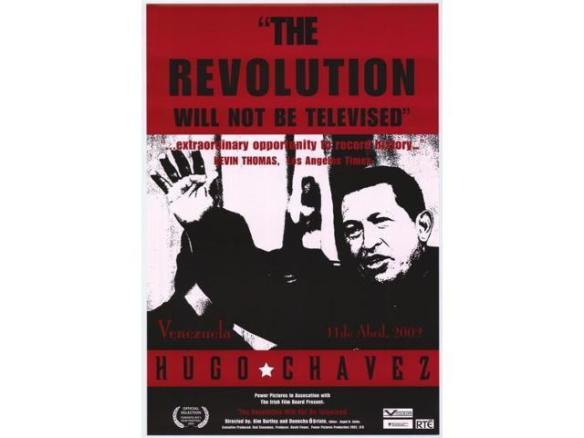
Saturday Matinee: The Revolution Will Not Be Televised

Source: Top Documentary Films

The Revolution Will Not Be Televised (a.k.a. Chavez: Inside the Coup) is a 2002 documentary about the April 2002 Venezuelan coup attempt which briefly deposed Venezuelan President Hugo Chávez.

A television crew from Ireland’s Radio Telifís Éireann happened to be recording a documentary about Chávez during the events of April 11, 2002.

Shifting focus, they followed the events as they occurred. During their filming, the crew recorded images of the events that they say contradict explanations given by Chávez opposition, the private media, the US State Department, and then White House Press Secretary Ari Fleischer.

The documentary says that the coup was the result of a conspiracy between various old guard and anti-Chávez factions within Venezuela and the United States.

US Backs Coup in Oil-Rich Venezuela, Right-Wing Opposition Plans Mass Privatization and Hyper-Capitalism

The US has effectively declared a coup in Venezuela. Trump recognized unelected right-wing opposition leader Juan Guaidó as new “president,” who plans mass privatization and neoliberal capitalist policies.

By Ben Norton

Source: GrayZone

The United States has effectively declared a political coup d’état in Venezuela, from abroad. Trump announced on January 23 that the US recognizes the unelected, illegitimate right-wing opposition leader Juan Guaidó as the supposed new “interim president” of Venezuela’s supposed new “government.”

Venezuela’s US-backed opposition has pledged to carry out a mass privatization of state assets and to implement harsh neoliberal capitalist policies. The opposition-controlled legislatures declared in its “transition” plans that the “centralized model of controls of the economy will be replaced by a model of freedom and market based on the right of each Venezuelan to work under the guarantees of property rights and freedom of enterprise.”

The US has also hinted at violence in Venezuela. During a background briefing after Trump’s declaration, journalist Dan Cohen heard a US official declare that if the government of actual President Nicolás Maduro responds with any violence, “They have no immediate future, they have no immediate livelihood. One way or another they have their days counted.”

Trump administration officials added, “When we say all options are on the table, all options are on the table… Let’s hope Maduro and his cronies see the magnitude of the message.”

Region’s Right-Wing Countries Join US in Recognizing Coup

Canada’s Liberal government, led by Prime Minister Justin Trudeau; Brazil’s new far-right leader Jair Bolsonaro; and the overtly pro-US Organization of American States (OAS) and its Secretary General Luis Almagro have joined Trump in endorsing this diplomatic coup in Venezuela.

Likewise, the right-wing, US-allied countries in Latin America, including Argentina, Chile, Colombia, Costa Rica, and Ecuador have joined Trump in anointing Guaidó as leader.

The region’s few remaining leftist governments, Bolivia, Cuba, and Nicaragua, have continued recognizing Venezuela’s legitimate government, as has Mexico’s newly elected left-wing President Andrés Manuel López Obrador.

Bolivian President Evo Morales warned that “the claws of imperialism again seek to fatally wound the democracy and self-determination of the peoples of South America,” adding, “No longer will we be the backyard of the US.”

The US government, its right-wing allies, and an obeisant corporate media have repeatedly referred to Venezuela’s actual president, Nicolás Maduro, as an “authoritarian dictator.” What they have failed to mention is that Venezuela still has regular elections, but the US-backed right-wing opposition, which is notoriously disunited and incompetent, has chosen to boycott these elections, preferring to call for foreign-backed military coups instead.

One of the only elected officials in the US who has spoken out against the coup is left-wing California Congressman Ro Khanna. Other progressive and anti-Trump US politicians, including self-declared “democratic socialists,” have remained silent on Trump’s effective declaration of a coup in Latin America.

Opposition Plans for Privatized ‘Free Market’ Economy

While supporters of regime change in Venezuela insist this blatantly undemocratic move is necessary to “defend democracy,” make no mistake, the upheaval is clearly not motivated by resistance to authoritarianism.

Venezuela, which has the world’s largest oil reserves and has challenged the hegemony of the US dollar, has long been a target of US aggression. In 2002, the United States supported a military coup that briefly ousted democratically elected President Hugo Chávez and replaced him with the right-wing oligarch Pedro Carmona. US intervention, including crippling economic sanctions, has only continued since then.

Elements of Venezeula’s opposition have portrayed themselves to credulous foreign observers as “social democratic,” but their real intentions are very clear: The opposition-controlled legislature has demanded mass privatization of state assets and a return to a capitalist oligarch-controlled economic system built on “property rights and freedom of enterprise.”

In 2017, the Venezuelan government declared the creation of the Constituent Assembly, to rewrite the constitution. Venezuela’s opposition refused to recognize this body and boycotted the elections. The opposition instead remained in control of the National Assembly and decided to run it as a separate parallel legislature.

The opposition-controlled National Assembly drafted a “transition” law that openly outlines what policies the opposition, led by Juan Guaidó, would pursue in its illegitimate, US-recognized “government” in Venezuela. Analyst Jorge Martín, explained what this means in an article published by VenezuelaAnalysis:

The “transition law” drafted by the Assembly National (in contempt) is explicit about the central objectives of the coup in the political and economic field:

“[C]entralized controls, arbitrary measures of expropriation and other similar measures will be abolished… For these purposes, the centralized model of controls of the economy will be replaced by a model of freedom and market based on the right of each Venezuelan to work under the guarantees of property rights and freedom of enterprise.”

In other words, the nationalised companies will be returned to their former private owners (including telecommunications, electrical, SIDOR, cement, etc), as will expropriated landed estates. It is noteworthy that there is a lot of talk of property and business rights, but no mention is made of workers’ rights, which would certainly be abolished. It continues:

“Public companies will be subject to a restructuring process that ensures their efficient and transparent management, including through public-private agreements.”

What this means, in plain language, is massive dismissal of workers from state companies and the entry of private capital into them: a policy of looting which has already proved to be a disaster in all countries where it has been applied.

The model of the opposition’s new coup regime in Venezuela — backed by the US, Canada, and Brazil — is the reimposition of neoliberal capitalism and the recolonization of Latin America. Any bluster about restoring democracy is a mere pretense at this point.

US plotting coups in Venezuela, Cuba and Nicaragua?

By Stephen Lendman

Source: Intrepid Report

The US wants all nations worldwide colonized, their resources looted, their people exploited as serfs, including ordinary Americans.

Sovereign independent governments everywhere are targeted for regime change—by coups d’état or wars.

That’s what imperialism is all about, a diabolical plot for unchallenged global dominance by whatever it takes for the US to achieve its aims, Republicans and undemocratic Dems allied for the same geopolitical objectives.

Humanitarian intervention, responsibility to protect, and democracy building are code words by both right wings of America’s war party for wanting fascist tyranny replacing governance of, by, and for everyone equitably everywhere—legitimate governments replaced by US-controlled puppet ones.

Post-9/11 alone, the US orchestrated coups in Haiti, Honduras, Paraguay, Brazil, Ukraine, Egypt, and elsewhere in the Middle East.

The so-called Arab spring was made in the USA. Uprisings were orchestrated. Nothing was spontaneous. CIA dirty hands were involved in replacing unpopular regimes with despotic ones considered more reliable.

Spring never bloomed, just the illusion of change for the better. It was pure deception. Everything changed in targeted countries but stayed the same.

In Egypt, Yemen and elsewhere things worsened, notably in Occupied Palestine. No spring bloomed there or anywhere else in the Middle East.

Plan Colombia was and remains all about Washington’s aim to control Latin America, eliminating opposition to regimes it controls, plotting coups against ruling authorities unwilling to bend to its will, along with pursuing anti-Sino/Russian regional policies.

Since Soviet Russia’s dissolution, the US escalated wars on humanity, using NATO as a killing machine. Republicans and Dems colluded to thirdworldize America, banana republicanize it, wrecking the economy, handing its wealth to Wall Street, war-profiteers and other corporate predators.

Both right wings of duopoly governance mock democratic values and rule of law principles they abhor, governing under a police state apparatus, hardened over time, risking global war to achieve its aims.

Venezuela, Cuba, Nicaragua, and Bolivia are the remaining sovereign independent Latin and Central American nations.

Trump regime hardliners want fascist tyranny replacing their legitimate governments. In early January, State Department deputy spokesman Robert Palladino turned truth on its head, saying the US “support[s] the people of Venezuela, Cuba and Nicaragua in restoring democratic governance and their human rights”—notions Washington abhors.

Venezuelan Bolivarian social democracy is the Trump regime’s top Latin American target for regime change. Pompeo made US intentions clear.

He turned truth on its head, saying President Nicolas Maduro is “illegitimate and the United States will continue . . . to work diligently to restore a real democracy to that country,” adding, “We are very hopeful that we can be a force for good to allow the region to come together to deliver that.”

Fact: Last May, Maduro was overwhelmingly re-elected by a two-thirds majority.

Fact: Scores of international observers from 30 countries monitored the election, judging it open, free and fair.

Fact: Venezuela’s political process is the world’s best.

Fact: It’s polar opposite America’s money-controlled system, one-party rule with two right wings, ordinary people having no say over how they’re governed.

Fact: US democracy is pure fantasy. Venezuelans have the real thing, why Republicans and Dems want its government toppled, their eyes on the prize—the world’s largest oil reserves they want handed to Big Oil.

On January 10, Maduro was inaugurated for a second six-year term, saying he’s committed to continue “fight[ing] for social and economic prosperity and to build 21st century socialism”—despite relentless US political, economic, financial, and propaganda war against the country’s social democracy.

Despite the Trump regime’s all-out efforts to mobilize international opposition to his legitimate rule, delegations from over 90 countries attended the inaugural ceremonies—including from Russia, China, Cuba, Nicaragua, Bolivia, Mexico, El Salvador, Iran, Turkey, and Ireland’s Sinn Fein.

Representatives from US colonized EU nations were absent, a spokeswoman for foreign policy chief Federica Mogherini lied saying that “the presidential elections were not free nor fair”—a falsified statement, serving US imperial interests.

Representatives from the African Union, CARICOM, the Arab League, the ALBA Bolivarian Alliance for the Peoples of Our Americas, OPEC, and the UN also attended.

In his inaugural address, Maduro said, “I tell the people. This presidential sash is yours. This power is yours. It does not belong to the oligarchy or to imperialism. It belongs to the sovereign people of Venezuela.”

He denounced the diabolical aims of “the most powerful empire in history,” urging dialogue to serve Venezuelan interests, including UN support for “peace, mutual recognition, harmony, (and) coexistence of different political visions,” adding: “I would like to sit down with the opposition, stop the sterile, useless, unnecessary conflict, talk about economic issues; with the experience of the UN we can achieve it.”

Trump regime hardliners falsely call genuine democracies dictatorships, how neocon John Bolton reacted to Maduro’s inauguration, saying the US “will not recognize” his legitimacy to rule.

The US-controlled Organization of American States (OAS), headquartered in Washington, reacted the same way. Most of its member states support longstanding US plans for regime change.

The US-controlled 13-nation Lima Group issued a statement, refusing to recognize Maduro’s legitimacy.

Caracas slammed what it called a “humiliating subordination” to US imperial interests—applying to all nations allied with Washington against Venezuela’s social democracy and sovereign independence.

On January 12, State Department deputy spokesman Palladino openly called for regime change, saying, “It is time to begin the orderly transition to a new government.”

Previous US orchestrated coup attempts failed—against Hugo Chavez and Maduro. Will the Trump regime try again in the new year?

If unable to succeed by coup d’etat, will an attempt be made to assassinate Maduro? If economic, financial, political, and other tactics fail, will military intervention be the Trump regime’s fallback option?

Will Iran be targeted the same way in the new year? Imperialism isn’t pretty.

Endless US belligerence and state-sponsored terrorism is virtually certain ahead, the way hardliners in Washington always operate—hostile to peace, stability, equity and justice at home and abroad.

The Troika of Tyranny: The Imperialist Project in Latin America and Its Epigones

By Roger Harris

Source: CounterPunch

Cuba, Nicaragua, and Venezuela are today threatened by US imperialism. The first salvo of the modern Age of Imperialism started back in 1898 when the US seized Cuba along with Puerto Rico and the Philippines in the Spanish-American War.

The Age of Imperialism, as Lenin observed, is characterized by the competition of the various imperial powers for dominance. That inter-imperialist rivalry led to World War I. Lenin called those putative socialists who supported their own national imperialist projects “social imperialists.” Social imperialism is a tendency that is socialist in name and imperialist in deed. Imperialism and its social imperialist minions are still with us today.

US Emerges as the World’s Hegemon

The United States emerged after World War II as the leading imperialist power. With the implosion of the Socialist Bloc around 1991, US hegemony became even more consolidated. Today the US is the undisputed world’s hegemon.

Hegemony means to rule but even more so to dominate. As the world’s hegemon, the US will not tolerate neutral parties, let alone hostile ones. As articulated in the Bush Doctrine, the US will try to asphyxiate any nascent counter-hegemonic project, no matter how insignificant.

In the Caribbean, for instance, the US snuffed out the leftist government of Grenada in 1983 in what was code named Operation Urgent Fury. Grenada has a population smaller than Vacaville, California.

The only powers that the world’s hegemon will tolerate are junior partners such as Colombia in Latin America. The junior partner must accept a neoliberal economic regime designed to serve the interests of capital. Structural adjustment of the economy is demanded such that the neoliberal “reforms” become irreversible; so that you can’t put the toothpaste back in the tube.

Colombia recently joined NATO, putting that junior partner’s military under direct interaction with the Pentagon bypassing its civilian government. The US has seven military bases in Colombia in order to project – in the words of the US government – “full spectrum” military dominance in the Latin American theatre.

Needless-to-say, no Colombian military bases are in the US. Nor does any other country have military bases on US soil. The world’s hegemon has some 1000 foreign military bases. Even the most sycophantic of the US’s junior partners, Great Britain, is militarily occupied by 10,000 US troops.

The US is clear on its enemies list. On November 1, US National Security Advisor John Bolton, speaking in Miami, labelled Venezuela, Nicaragua, and Cuba the “troika of tyranny.” He described a “triangle of terror stretching from Havana to Caracas to Managua.”

Venezuela, Nicaragua, and Cuba are targeted by US imperialism because they pose what might be called the “threat of a good example;” that is, an alternative to the neoliberal world order.

These countries are suffering attacks from the imperialists because of the things they have done right, not for their flaws. They are attempting to make a more inclusive society for women, people of color, and the poor; to have a state that, instead of serving the rich and powerful, has a special option for working people, because these are the people most in need of social assistance.

Sanctions: The Economic War against Venezuela, Nicaragua, and Cuba

The US imperialist rhetoric is backed with action. In 2015, US President Obama declared Venezuela an “extraordinary threat to US security” and imposed sanctions. These sanctions have been extended and deepened by the Trump administration. The US has likewise subjected Cuba to sanctions in a seamless bipartisan policy of both Republicans and Democrats for over half a century. Now the US is the process of imposing sanctions on Nicaragua.

Unilateral sanctions, such as those imposed by the US, are illegal under the charters of both the UN and the Organization of American States, because they are a form of collective punishment targeting the people.

The US sanctions are designed to make life so miserable for the masses of people that they will reject their democratically elected government. Yet in Venezuela, those most adversely affected by the sanctions are the most militantly in support of their President Nicolás Maduro.

Consequently, the Trump administration is also floating the option of military intervention against Venezuela. The recently elected rightwing leaders Bolsonaro in Brazil and Duque in Colombia, representing the two powerful states on the western and southern borders of Venezuela, are colluding with the hegemon of the north.

The inside-the-beltway human rights organizations, such as Human Rights Watch, fail to condemn these illegal and immoral sanctions. They lament the human suffering caused by the sanctions, all the while supporting the imposition of the sanctions. Nor do they raise their voices against military intervention, perhaps the gravest of all crimes against humanity.

Liberal establishments such as the advocacy group Washington Office on Latin America (WOLA) try to distinguish themselves from hardline imperialists by opposing a military invasion in Venezuela while calling for yet more effective and punishing sanctions. In effect, they play the role of the good cop, providing a liberal cover for interference in the internal affairs of Latin American nations.

These billionaire-funded NGOs have a revolving-door staffing arrangement with the US government. So it is not surprising that they will reflect Washington’s foreign policies initiatives.

But why do some organizations claiming to be leftist so unerringly echo the imperialists, taking such umbrage over Venezuela, Cuba, and Nicaragua while ignoring far greater problems in, say, Mexico, Colombia, and Honduras, which are US client states?

Most Progressive Country in Central America Targeted

Let’s take Nicaragua. A year ago, the polling organization Latinobarómetro, found the approval rating of Nicaraguans for their democracy to be the highest in Central America and second highest in Latin America.

Daniel Ortega had won the Nicaraguan presidency in 2006 with a 38% plurality, in 2011 with 63%, and 72.5% in 2016. The Organization of American States officially observed and certified the vote. Polls indicated Ortega was perhaps the most popular head of state in the entire western hemisphere. As longtime Nicaraguan solidarity activist Chuck Kaufman noted, “Dictators don’t win fair elections by growing margins.”

Nicaragua is a member of theanti-imperialist Bolivarian Alliance for the Peoples of Our America with Cuba, Venezuela, Bolivia, and some Caribbean states. Speaking at the UN, the Nicaraguan foreign minister had the temerity to catalogue the many transgressions of what Martin Luther King called “the greatest purveyor of violence in the world” and express Nicaragua’s opposition.

These are reasons enough for a progressive alternative such as Nicaragua to curry the enmity of the US. The enigma is why those claiming to be leftists would target a country that had:

+ Second highest economic growth rates and the most stable economy in Central America.

+ Only country in the region producing 90% of the food it consumes.

+ Poverty and extreme poverty halved; country with the greatest reduction of extreme poverty.

+ Reached the UN Millennium Development Goal of cutting malnutrition by half.

+ Nicaraguans enjoyed free basic healthcare and education.

+ Illiteracy had been virtually eliminated, down from 36% in 2006 when Ortega took office.

+ Average economic growth of 5.2% for the past 5 years (IMF and the World Bank).

+ Safest country in Central America (UN Development Program) with one of the lowest crime rates in Latin America.

+ Highest level of gender equality in the Americas (World Economic Forum Global Gender Gap Report 2017).

+ Did not contribute to the migrant exodus to the US, unlike neighboring Honduras, El Salvador, and Guatemala.

+ Unlike its neighbors, kept out the drug cartels and pioneered community policing.

In April of this year, all of this was threatened. The US had poured millions of dollars into “democracy promotion” programs, a euphemism for regime change operations. Suddenly and unexpectedly, a cabal of the reactionary Catholic Church hierarchy, conservative business associations, remnants of the US-sponsored Contras, and students from private universities attempted a coup.

Former members of Ortega’s Sandinista Party, who had long ago splintered off into political oblivion and drifted to the right, became effective propogandists for the opposition. Through inciting violence and the skillful use of disinformation in a concerted social media barrage, they attempted to achieve by extra-legal means what they could not achieve democratically.

Imperialism with a Happy Face

We who live in the “belly of the beast” are constantly bombarded by the corporate media, framing the issues (e.g., “humanitarian bombing). Some leftish groups and individuals pick up these signals, amplify, and rebroadcast them. While they may genuinely believe what they are promulgating, there are also rewards such as funding,media coverage, hobnobbing with prominent US politicians, and winning awards for abhorring the excesses of imperialism while accepting its premises.

Today’s organizations that are socialist in name and imperialist in deed echo the imperial demand that the state leaders of the progressive movements in Latin America “must go” and legitimize the rationale that such leaders must be “dictators.”

They try to differentiate their position from the imperialists by proffering a mythic movement, which will create a triumphant socialist alternative that fits their particular sect’s line: chavismo without Maduro in Venezuela, sandinismo without Ortega in Nicaragua, and the Cuban Revolution without the Cuban Communist Party in Cuba.

The political reality in Latin America is that a rightwing offensive is attacking standing left-leaning governments. President George W. Bush was right: “Either you are with us, or you are with the terrorists.” There is no utopian third way. Each of us has to determine who are the real terrorists, as the juggernaut of US imperialism rolls out a neoliberal world order.

Chaos: The New Imperialist Game Plan

For now, the coup in Nicaragua has been averted. Had it succeeded, chaos would have reigned. As even the most ardent apologists for the opposition admit, the only organized force in the opposition was the US-sponsored rightwing which would have instigated a reign of terror against the Sandinista base.

The US would prefer to install stable rightwing client states or even military dictatorships. But if neither can be achieved, chaos is the preferred alternative. Libya, where rival warlords contest for power and slaves are openly bartered on the street, is the model coming to Latin America.

Chaos is the new imperialist game plan, especially for Bolton’s so-called troika of tyranny. The imperialists understand that the progressive social movements in Venezuela, Nicaragua, and Cuba are too popular and entrenched to be eradicated by a mere change of personnel in the presidential palace. Much more drastic means are envisioned; means that would make the bloody aftermath of the US-backed Pinochet coup in 1973 in Chile pale by comparison.

In Venezuela, for example, the opposition might well have won the May 2018 presidential election given the dire economic situation caused in large part by the US sanctions. The opposition split between a moderate wing that was willing to engage in electoral struggle and a hard-right wing that advocated a violent takeover and jailing the chavistas.

When Venezuelan President Maduro rejected the US demand to call off the elections and resign, he was labelled a dictator by Washington. And when moderate Henri Falcon ran in the Venezuelan presidential race on a platform of a complete neoliberal transition, Washington, instead of rejoicing, threatened sanctions against him for running. The US belligerently floated a military option for Venezuela, stiffened the suffocating sanctions, and tipped the balance within the Venezuelan opposition to the radical right.

The US is not about to allow Venezuela a soft landing. Their intent is to exterminate the contagion of progressive social programs and international policy that has been the legacy of nearly two decades chavismo. Likewise, for Cuba and Nicaragua. We should also add Bolivia in the crosshairs of the empire.

We’ve seen what Pax Americana has meant for the Middle East. The same imperial playbook is being implemented in Latin America. Solidarity with the progressive social movements and their governments in Latin America is needed, especially when their defeat would mean chaos.

Facebook’s New Propaganda Partners

By Alan Mcleod

Source: FAIR

Media giant Facebook recently announced (Reuters, 9/19/18) it would combat “fake news” by partnering with two propaganda organizations founded and funded by the US government: the National Democratic Institute (NDI) and the International Republican Institute (IRI). The social media platform was already working closely with the NATO-sponsored Atlantic Council think tank (FAIR.org, 5/21/18).

In a previous FAIR article (8/22/18), I noted that the “fake news” issue was being used as a pretext to attack the left and progressive news sites. Changes to Facebook’s algorithm have reduced traffic significantly for progressive outlets like Common Dreams (5/3/18), while the pages of Venezuelan government–backed TeleSur English and the independent Venezuelanalysis were shut down without warning, and only reinstated after a public outcry.

The Washington, DC–based NDI and IRI are staffed with senior Democratic and Republican politicians; the NDI is chaired by former Secretary of State Madeleine Albright, while the late Sen. John McCain was the longtime IRI chair. Both groups were created in 1983 as arms of the National Endowment for Democracy (NED), a Cold War enterprise backed by then–CIA director William Casey (Jacobin, 3/7/18). That these two US government creations, along with a NATO offshoot like the Atlantic Council, are used by Facebook to distinguish real from fake news is effectively state censorship.

Facebook’s collaboration with the NED organizations is particularly troubling, as both have aggressively pursued regime change against leftist governments overseas. The NDI undermined the Sandinista government of Nicaragua in the 1980s, and continues to do so to this day, while the IRI claimed a key role in the 2002 coup against leftist President Hugo Chávez of Venezuela, announcing that it had

served as a bridge between the nation’s political parties and all civil society groups to help Venezuelans forge a new democratic future…. We stand ready to continue our partnership with the courageous Venezuelan people.

The Reuters report (9/19/18) mentioned that Facebook was anxious to better curate what Brazilians saw on their feeds in the run-up to their presidential elections, which pits far-right Jair Bolsonaro against leftist Fernando Haddad. The US government has a long history of undermining democracy in Brazil, from supporting a coup in 1964 against the progressive Goulart administration to continually spying on leftist President Dilma Rousseff (BBC, 7/4/15) in the run-up to the parliamentary coup against her in 2016 (CounterSpin, 6/2/17).

Soon after it partnered with the Atlantic Council, Facebook moved to delete accounts and pages connected with Iranian broadcasting channels (CNBC, 8/23/18), while The Intercept (12/30/17) reported that in 2017 the social media platform met with Israeli government officials to discuss which Palestinian voices it should censor. Ninety-five percent of Israeli government requests for deletion were granted. Thus the US government and its allies are effectively using the platform to silence dissenting opinion, both at home and on the world stage, controlling what Facebook‘s 2 billion users see and do not see.

Progressives should be deeply skeptical that these moves have anything to do with their stated objective of promoting democracy. Bloomberg Businessweek (9/29/17) reported that the far-right Alternative fur Deutschland (AfD) party went to Facebook headquarters for discussions with US companies about how it could use the platform for recruitment and micro-targeting in the 2017 elections. AfD tripled its previous vote share, becoming the third-largest party in Germany, the far right’s best showing since World War II.

Public trust in government is at 18 percent—an all-time low (Pew, 12/14/17). There is similar mistrust of Facebook, with only 20 percent of Americans agreeing social media sites do a good job separating fact from fiction. And yet, worldwide, Facebook is a crucial news source. Fifty-two percent of Brazilians, 61 percent of Mexicans, and 51 percent of Italians and Turks use the platform for news; 39 percent of the US gets their news from the site.

This means that, despite the fact that even its own public mistrusts it, the US government has effectively become the arbiter of what the world sees and hears, with the ability to marginalize or simply delete news from organizations or countries that do not share its opinions. This power could be used at sensitive times, like elections. This is not an idle threat. The US created an entire fake social network for Cubans that aimed to stir unrest and overthrow the Cuban government, according to the Guardian (4/3/14).

That a single corporation has such a monopoly over the flow of worldwide news is already problematic, but the increasing meshing of corporate and US government control over the means of communication is particularly worrying. All those who believe in free and open exchange of information should oppose Facebook becoming a tool of US foreign policy.

Facebook is Filtering Out News That Doesn’t Bolster US Foreign Policy

Facebook has shed any pretense of neutrality in handling political information concerning the foreign affairs of the U.S. government.

By WT Whitney

Source: Mint Press News

Facebook has its admirers. Shareholders are enamored of its profits – $15.9 billion in 2017 – and hordes of the world’s population – 1.47 billion people – look at Facebook every day.  Individually on their Facebook pages they are communicating with, on average, 338 so-called “friends.” Editors, the media, and political commentators are similarly entranced. One unpretentious website receiving the present writer’s contributions claims 89,834 Facebook friends and another, 125,060 of them.

But now anyone dealing with political news and analyses of a progressive nature has reason to re-evaluate, even to draw back. Facebook apparently is now primed to censor that kind of information and discussion.

Facebook, for example, has its sights on Venezuela.  Revolutionary currents there have rankled the U.S. government and dominant U.S. media. The latter has frequently referred to the failed violent anti-government coup of August 4 as an “apparent” or “alleged” coup while identifying it as a future pretext for repression by Venezuela’s government.

Venezuelanalysis.com, almost alone, has provided English-language news and views that “challenge the corporate mainstream media narrative on Venezuela” Recently that platform has reported on “the growing international campaign to End US and Canadian Sanctions against Venezuela.” On August 9 Facebook removed the website’s account from its rolls; it was restored two days later. There were no explanations.

In 2005, the government of former Venezuelan president Hugo Chavez, vilified by the U.S. government, took the lead in forming TeleSUR news service which has provided information on resistance and integration movements throughout Latin America and the Caribbean. TeleSUR’s English-language page briefly disappeared from Facebook in January, 2018 and again on August 13 – for two days on that occasion.

These disruptions of two Facebook accounts are, by themselves, of no great moment.  But in Facebook’s hands, the flow of English-language political information on Latin America now seems generally precarious, the more so when it deviates from U.S. official doctrine.

At a press briefing July 31, Facebook’s chief operating officer, Sheryl Sandberg, indicated that “32 pages and accounts from Facebook and Instagram” had been removed because they “involve and coordinate inauthentic behavior.” TeleSUR English and the Venezuelanalysis may have been among the offenders.

The social media giant on May 17 announced that, “We’re doubling the number of people who work on safety and security and using technology like artificial intelligence to more effectively block fake accounts. [Additionally] we’re more actively working with outside experts, governments and other companies because we know that we can’t solve these challenges on our own … Today, we’re excited to launch a new partnership with the Atlantic Council.”

The new alliance bolsters suspicions that Facebook has shed any pretense of neutrality in handling political information concerning the foreign affairs of the U.S. government.

The context is a Facebook damage-control mission undertaken presumably to shore up profitability.  The social media giant came under criticism in Washington for allowing private information to fall into the hands of Cambridge Analytica. That British firm used it to provide data to Donald Trump’s 2016 presidential campaign viewed as injurious to contender Hillary Clinton.

Testifying April 10 before the Senate commerce and judiciary committees, Facebook CEO and founder Mark Zuckerberg declared, “It was my mistake.” He apologized for Facebook’s tolerance of “fake news, foreign interference in elections, and hate speech.” The office of influential Republican Sen. Mark Warner in July issued a draft white paper titled, in part, “Proposals for Regulation of Social Media.”

Facebook outlined a plan to “outsource many of the most sensitive political decisions” and henceforth to rely upon the Atlantic Council and its Digital Forensic Research Lab. According to Reutersthe Lab uses “its own software and other tools [and] sorts through social media postings for patterns.” Facebook’s recent donation to the Lab, Reuters said, was substantial enough, “to vault the company to the top of the Atlantic Council’s donor list, alongside the British government.”

The Washington-based Atlantic Council, founded in 1961, takes in $21million in revenue annually. By means of “galvanizing its uniquely influential network of global leaders,” the Council claims to foster “co­op­er­a­tion be­tween North Amer­ica and Europe that be­gan af­ter World War II.” Drawing together “political leaders, academics, military officials, journalists and diplomats in an effort to further the values set forth in the North Atlantic Treaty,” the Council is supposedly  a “network facilitator” that, according to the New York Times, offers “access to United States and foreign government officials in exchange for contributions.”

Contributors include NATO member governments, defense contractors, oil companies, aerospace companies, U.S. military services, the State Department, and multiple banks and fi­nan­cial or­ga­ni­za­tions. High U.S. military, intelligence, and diplomatic officials, both retired and on their way to top jobs, serve the Atlantic Council as leaders.

For one critic, the Council is “a leading geopolitical strategy think-tank seen as a de facto PR agency for the U.S. government and NATO military alliance.” Another, writing for alternet.org, is blunt: journalist Max Blumenthal characterizes the Council “as a pro-regime change think tank that is funded by Western governments and their allies.”

The Atlantic Council is most certainly aligned with the objectives of U.S foreign policies. Now Facebook is using the Council as authenticator-in-chief of international news and views flowing through its portals.  On both accounts, therefore, Facebook may have already lost any claim to promoting the free flow of political information.