MSM Adamantly Avoids The Word “Coup” In Bolivia Reporting

By Caitlin Johnstone

Source: CaitlinJohnstone.com

There has been a military coup in Bolivia backed by violent right-wing rioters and the US government, but you’d hardly know this from any of the mainstream media headlines.

“Bolivian President Evo Morales steps down following accusations of election fraud” proclaims CNN.

“Bolivia’s Morales resigns amid scathing election report, rising protests” reports The Washington Post.

“Bolivian Leader Evo Morales Steps Down” says The New York Times.

“Bolivian President Evo Morales resigns amid fraud poll protests” declares the BBC.

“President of Bolivia steps down amid allegations of election rigging” we are informed by Telegraph.

“Bolivia’s President Morales resigns after backlash to disputed election” says the Sydney Morning Herald.

So there you have it. The indigenous leader of a socialist South American government which has successfully lifted masses of people out of crushing poverty, which happens to control the world’s largest reserves of lithium (which may one day replace oil as a crucial energy resource due to its use in powering smartphones, laptops, hybrid and electric cars), which has an extensive and well-documented history of being targeted for regime change by the US government, simply stepped down due to some sort of scandal involving a “disputed election”. Nothing to do with the fact that right-wing mobs had been terrorizing this leader’s family, or the fact that the nation’s military literally commanded him to step down and are now currently searching for him to arrest him, leading to ousted government officials being rounded up and held captive by soldiers wearing masks.

All perfectly normal and not suspicious at all.

As is usual, mass media’s reporting on this story is in full alignment with the US State Department, with Secretary of State Mike Pompeo also advancing the “disputed election” line in a tweet shortly before the forced resignation of Morales. Pompeo cited the evidence-free and discredited allegation of suspicious vote tallies during Morales’ re-election last month from the Washington-based Organization of American States (OAS). As Mark Weisbrot of the Center for Economic & Policy Research explains in a recent article for The Nation, the OAS receives 60 percent of its funding from Washington, which gives the US tremendous leverage over the supposedly neutral and international body. This ties in interestingly with what we discussed the other day about Washington’s known history of using its disproportionate financial support for the Organization for the Prohibition of Chemical Weapons as leverage to force that supposedly neutral and international body to comply with US agendas.

The field of narrative management keeps making more and more advances.

The US-centralized empire just keeps throwing coup attempts at unabsorbed governments until they stick. The coup in Venezuela failed in 2002 and again in 2019, but they’ll just keep attempting them until one takes hold. A kickboxer throws strikes in combinations with the understanding that most attacks will miss or do minimal damage against a trained opponent, but eventually one will get through and score the knockout blow. Imperialist regime change agendas employ the same punches-in-bunches philosophy: just keep attacking and undermining at every possible turn, and eventually something will stick.

And the empire can afford to do this. When you have all the power and resources, you can bide your time, knowing that if the current attempt at toppling the government in a sovereign nation fails, there’s always tomorrow.

At a United Nations Security Council meeting last year, President Morales summed up the true nature of America’s role in the world very accurately, and, it turns out, very presciently.

“I would like to say to you, frankly and openly here, that in no way is the United States interested in upholding democracy,” Morales said. “If such were the case it would not have financed coups d’etat and supported dictators. It would not have threatened with military intervention democratically elected governments as it has done with Venezuela. The United States could not care less about human rights or justice. If this were the case, it would have signed the international conventions and treaties that have protected human rights. It would not have threatened the investigation mechanism of the International Criminal Court, nor would it promote the use of torture, nor would it have walked away from the Human Rights Council. And nor would it have separated migrant children from their families, nor put them in cages.”

“The United States is not interested in multilateralism,” Morales continued. “If it were interested in multilateralism it would not have withdrawn from the Paris Agreement or given the cold shoulder to the global compact on migration, it would not have launched unilateral attacks, nor have taken decisions such as illegally declaring Jerusalem to be the capital of Israel. This contempt for multilateralism is motivated by the thirst of the United States for political control and for the seizing of natural resources.”

“Each time that the United States invades nations, launches missiles, or finances regime change, it does so behind a propaganda campaign which incessantly repeats the message that it is acting in the course of justice, freedom and democracy, in the cause of human rights or for humanitarian reasons,” Morales also said.

“The responsibility of our generation is to hand over a fairer and more secure world to the following generation,” Morales concluded. “We will only achieve this dream if we work together to consolidate a multipolar world, a world with common rules that are respected by and defended from all the threats ranged against the United Nations.”

Indeed, the only reason the US is able to wage its endless campaign of regime change agendas against unabsorbed governments is because the unipolar world order it rules has allowed it the power, resources and leisure to do so. A multipolar world would enable the citizenry of this planet to have a say in what happens to them in a way that is not dictated by a few sociopaths in and around Washington, DC. A multipolar world is to democracy as a unipolar world is to monarchy. The citizens of the world should oppose this unipolarity.


EMPIRES ARE A SECRET UNTIL THEY START FALLING

By Margaret Flowers and Kevin Zeese

Source: Popular Resistance

In the past, we have written about the 2020s as a decade when the United States Empire will end. This is based on Alfred McCoy’s predictions (listen to our interview with him on Clearing the FOG). Sociologist and peace scholar John Galtung believes US Empire will fall much faster, losing world dominance by 2020. Much of what he predicted when he said this in 2016 is happening now. In particular, there is a rise in “reactionary fascism” or a desire to go back to the “good old days,” the cost of maintaining the empire is taking an increasing economic toll and other countries are starting to rebuke the US, both its requests for military assistance and its unfair economic demands.

What this means for people in the United States and around the world depends on whether we can build a mass popular movement with the clarity of vision, skills, and solidarity necessary to navigate what is and will surely be a turbulent period. There are no guarantees as to the outcome. Failure to act could result in a disastrous scenario – at best, that the US will continue to try to hold onto power by waging economic and military warfare abroad weakening the economy at home and undermining necessities such as housing, healthcare, education and the transition to a Green economy. At worst, as Galtung describes, there could be “an inevitable and final war” involving nuclear weapons.

When Empire Is In Decline

Alfred McCoy says that it is only when empires are in decline that people begin to recognize they live in an empire and start to talk about it. While discussion of empire hasn’t broken into the corporate media, it is certainly happening in the independent media. A concerted effort by a popular movement could bring it to the fore, just as Occupy changed the political dialogue about wealth inequality and the power of money. People in the US need to face some stark realities when it comes to declining US global power.

For starters, the United States does not currently have the capacity to wage a “Great Power Conflict” even though that is the goal of the national security strategy. The loss of its manufacturing base and lack of access to minerals necessary for producing weapons and electronics means the US does not have the resources to fight a great war. Much of the US’ manufacturing has been outsourced to other countries, including those targeted by US foreign policy. Resources necessary for weapons and electronics are in China, Afghanistan, the Democratic Republic of the Congo and Venezuela. It’s no surprise that the US is maintaining a military presence in Afghanistan, has increased its presence in Africa through AFRICOM and is struggling to wrest control of Venezuela.

Despite these attempts, the US is not having success. There is no military solution for the US in Afghanistan. As Moon of Alabama explains, the Taliban has taken control of more territory than it has had since the US started the war and has no reason to negotiate with the US. He advises, “The U.S. should just leave as long as it can. There will come a point when the only way out will be by helicopter from the embassy roof.”

Alexander Rubinstein writes the failures in Afghanistan can be attributed to Zalmay Khalilzad, currently the US Special Representative for Afghanistan Reconciliation. Khalilzad has led US foreign policy in Afganistan and Iraq since the presidency of George W. Bush, and before that worked with Carter’s National Security Advisor Zbigniew Brzezinski, who provided crucial support for the Mujahideen to draw the Soviet Union into a quagmire. The writing is on the wall that the US must leave Afghanistan, but that is unlikely to happen as long as people such as Khalilzad and Elliott Abrams, who has a similar ideology, are in charge.

As the US-led coup in Venezuela continues to fail due to a lack of support for it within the country, resilience to the effects of the unilateral coercive economic measures (sanctions) and exposure of attempts to create chaos and terror by paramilitary mercenaries, the US grows increasingly desperate in its tactics. There has already been a failed assassination attempt against President Maduro, a US freight company tied to the CIA has been caught smuggling weapons and the US and its Puppet Guaido have been implicated in a terrorist plot as the failed coup enters a more dangerous phase. This week, the Organization of American States voted to invoke a treaty, the Inter-American Treaty of Reciprocal Assistance (TIAR), which would allow military intervention. Mexico strongly opposed that possibility. This comes as Venezuela has strengthened troops at the Colombian border after discovering terrorist training camps on the Colombian side. With allies such as Russia and China, an attack on Venezuela would not only hurt the region but could go global.

Despite the Asian Pivot under President Obama during his first administration and Secretary of Defense Mark Esper’s comment this week that the US is directing a lot of energy toward China, analysts predict the US will fail to achieve dominance in the Asia-Pacific. China is purchasing weapons from Russia that are superior to US systems, is strengthening its military coordination with Russia through drills and is expanding its global ties through the Belt and Road Initiative. Matthew Ehret writes in Strategic Culture, “Those American military officials promoting the obsolete doctrine of Full Spectrum dominance are dancing to the tune of a song that stopped playing some time ago. Both Russia and China have changed the rules of the game on a multitude of levels….”

Protests in Hong Kong, as we described in a recent newsletter, are being used to stoke greater anti-China sentiment in the US. As often occurs, the sophisticated propaganda arm of US-backed color revolutions excites leftist activists, but each day it becomes clearer just how deep the US’ influence is. K. J. Noh provides a helpful guide – a list of seven signs a protest is not a popular progressive uprising. One sign is Hong Kong protesters are supporting a bill in the US Congress, the so-called “Hong Kong Human Rights and Democracy Act.” The bill would allow the United States to sanction Hong Kong officials.

Andre Vltchek attended a recent protest and interviewed some of the participants. He found the democracy protesters have little grasp on the oppression Hong Kongers faced under British colonization, they attack anyone who disagrees with them and they are destroying public infrastructure. One of the protest leaders, Joshua Wong, is openly meeting with figures connected to US regime change efforts, and NED-backed organizations are planning an anti-China protest in Washington, DC on September 29. Their new propaganda symbol is a Chinese flag with a Swastika on it. No surprise that was evident at the protests in Hong Kong this weekend.

The US is already at war with China with battlefronts on trade and the Asian Pacific. The propaganda around Hong Kong showing prejudice against China is part of manufacturing consent for the conflict between the US and China, which will define the 21st Century. US militarism is also escalating to involve space. This week, the US conducted its first space war game and Putin warned of a space arms race.

Our Tasks as Activists

It was good news this past week that President Trump asked John Bolton, a white supremacist neocon who disrupted any attempts at negotiation, to resign from his position as National Security Adviser. Glen Ford of Black Agenda Report writes, “Every sane person on the planet should be glad to see Bolton go.” But, even with Bolton gone, the US War Machine will rage on with bi-partisan support. Whether Trump starts to live up to his campaign rhetoric of non-intervention remains to be seen. The appointment of Michael Kozak as the new US envoy to Latin America is a bad sign.

Almost two centuries of Manifest Destiny that went beyond North America to spread US Empire across the globe will not end overnight. It will take a concerted effort to build a national consensus against the dominant ideologies of white supremacy and US exceptionalism to change the course of US foreign policy. Fundamental tasks of that effort include education, organizing and mobilizing. Below are some examples of each.

Education:

The Palestinian Great March of Return, a weekly nonviolent protest in Gaza demanding the right of return granted by the United Nations, continues and each week Israelis injure and murder unarmed Palestinians. Abby Martin and Mike Prysner of The Empire Files produced an excellent documentary about it, “Gaza Fights For Freedom,” and are touring the country to raise awareness. Listen to our interview with Abby Martin on Clearing the FOG. Find a showing near you or organize one.

The United States uses unilateral coercive measures (sanctions) that are illegal under international law to wage war on other countries. The Treasury Department currently lists 20 countries sanctioned by the US, but the US also uses threats of sanctions to wield power. Sanctions are warfare, even though they are not commonly viewed that way. They result in the suffering and death of mostly civilians. Kevin Cashman and Cavan Kharrazian explain how sanctions work, why they violate international law and how they threaten global stability.

Organizing:

Alison Bodine and Ali Yerevani encourage activists to avoid the organizing pitfall of getting caught up in debates about the internal politics of countries targeted by US imperialism. Our tasks, as citizens of imperialist countries, are to stop our governments from intervening in the affairs of other countries and demand they respect international law. We also have a task of building solidarity with civilians of other countries. It will require a global mass movement to address major issues such as the climate crisis, wealth inequality, colonization, and violence.

Citizen to citizen diplomacy is critical in building this mass movement and solidarity. Ann Wright, retired from the military and State Department, writes about the challenges of citizen to citizen diplomacy as she tours Russia. Ajamu Baraka, national organizer of Black Alliance for Peace, reminds us that war and militarism are class issues in his address to an international meeting of trade unions held in Syria.

We are strong believers in breaking out of the confines of the narrative presented by corporate media about countries outside the US. Our trips to Iran and Venezuela this year were invaluable learning experiences. We hope to visit more targeted countries. An effort that came out of these trips is the new Global Appeal for Peace, first steps toward creating an international network to complement the more than 120 non-aligned movement countries that are resolved to respect international law and sovereignty and take action to create peace and prevent the catastrophic climate crisis. Sign on to this effort at GlobalAppeal4Peace.net.

Mobilizing:

The People’s Mobilization to Stop the US War Machine and Save the Planet starts next weekend. On Saturday night, Black Alliance for Peace is sponsoring a discussion, “Race, Militarism and Black Resistance in the ‘Americas’” in the Bronx. On Sunday we will rally and march to the UN with Embassy Protectors, Roger Waters and many more. On Monday night, we have a special solidarity night at Community Church of New York. Registration is required as there will be high-level representatives of impacted countries speaking about the challenges they face. Click here to register.

Rage Against the US War Machine will take place October 11 and 12 in Washington, DC. This is the second annual event organized by March on the Pentagon. Click here for details.

We also ask you to join the Embassy Protectors Defense Committee. Sign the petition to drop the Trump administration’s charges against us for protecting the Venezuelan Embassy this spring. We are facing up to a year in prison and exorbitant fines even though it was the US State Department that violated the Vienna Convention by raiding the embassy in May. We will tour Northern California in October and are planning more tours to raise awareness that the struggle to end the US  coup and interventions in Venezuela continues.

John Galtung predicts that the fall of the US Empire could have a devastating impact on domestic cohesion in the United States. As the US loses its position of global supremacy, we have an opportunity to fundamentally reshape what we as a nation represent. We can become cooperative global citizens in a world free of oppression, violence, and poverty if we do the work of joining in international solidarity for these goals.

Freedom Rider: Hollywood Propaganda Attack on Venezuela

By Margaret Kimberly

Source: Black Agenda Report

The US is starving and killing Venezuelans in real life and, for your family’s viewing pleasure, on television screens.

“Imperialism is quite bipartisan and liberal Hollywood never saw propaganda it didn’t want to hype.”

“The military intervention of #Venezuela, put ‘on the table’ by @realDonaldTrump and his gang of fanatic supremacists, is supported by the gringo propaganda machine. Here is a fragment of their ‘cultural offerings.’”— Ernesto Villegas, Venezuela Minister of Culture

Americans are loathe to think of themselves as being propagandized.  The idea is inconsistent with notions of exceptional goodness and superiority that are constantly evoked in this country. But government propaganda does not work in a vacuum. It is bolstered by the corporate media and that includes the entertainment industry.

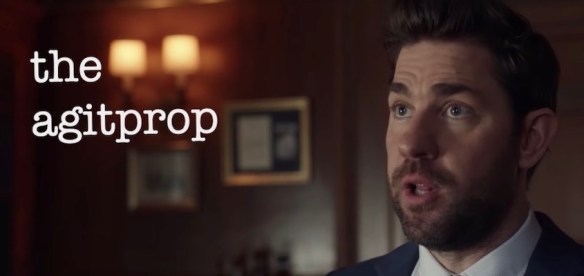
The latest in the story of fictitious CIA agent Jack Ryan is a case in point. The Ryan character appeared in five different feature films before moving to the small screen via Amazon Prime Video. The new season premieres in November and in this latest incarnation Ryan fights to prevent a nuclear armed Venezuela .

The upside down presentation is typical of the perversion of truth so prevalent in the United State. This country is the only one to have used nuclear weapons and still possesses more than any other. It is the United States that recently withdrew unilaterally from decades old nuclear agreements with Russia. Yet Hollywood has woven a tale of Russia, the country which wanted to keep the non-proliferation agreements, as a villain giving nuclear weapons to Venezuela.

“Government propaganda is bolstered by the entertainment industry.”

Venezuela is the victim of United States aggression in reality and now on the screen. The doctrine of “maximum pressure” has killed 40,000 Venezuelans through sanctions that have deprived that nation of food and medical care. That proof of U.S. aggression is known only to those who access independent media sources. The corporate media, even those who are allegedly liberal, parrot Donald Trump administration talking points, even if they otherwise deride the president and his team. Imperialism is quite bipartisan and liberal Hollywood never saw propaganda it didn’t want to hype.

Of course liberals who are usually overcome by Trump derangement syndrome are happy to go along with aggression schemes. Very few Democrats have expressed opposition to the anti-Venezuelan plots hatched by Trump. There is indeed foreign policy collusion but it doesn’t exist in a relationship with a foreign government. The determination to support American hegemony is an important part of the elite consensus.

That obvious truth is also disappeared and is not to be discussed in what passes for polite and “serious” company. According to myth, America is a classless, post-racial meritocracy and accepting of every political viewpoint. Of course it is anything but. The hierarchies are rigid and tenaciously defended.

“The corporate media, even those who are allegedly liberal, parrot Donald Trump administration talking points.”

Propaganda delivered via popular entertainment plays a particularly insidious role in this process. The goal is to change minds and ensure support for any act the government should choose to make. If this particular iteration of the Jack Ryan story isn’t challenged then no act or aggression will be challenged either.Media imagery is very powerful, that is why governments work so closely with corporate media to present their narratives.

Mace Neufeld  created the Jack Ryan film franchise. In 2014 he received a lifetime achievement award from the Israeli Film Festival. Curiously, the event wasn’t held in Israel at all. Instead Beverly Hills was the venue. Neufeld’s co-honoree was Arnon Milchan, a former Mossad operative who parlayed that career into producing hit films such as Twelve Years a Slave.

Israel isn’t alone in this regard. The CIA and the Pentagon both have film liaison offices . Movie credits often end with thanks to the department of defense. That always means that the plot line is approved by the military and the surveillance state.

“Movie credits often end with thanks to the department of defense.”

This grotesque lying on a mass scale cannot be ignored. The propagandists know that repetition plays a huge role in the process of indoctrination. For years Venezuela has been used as a bogeyman to convince people in this country to act against their own interests. “Socialism doesn’t work, just look at Venezuela,” is a statement made to end discussion of free health care or college education or housing or anything else that people need and want. After the 100th New York Times article which says nothing about the U.S. attack but points out that Venezuelans are hungry, the job has been done. Venezuela is now so thoroughly demonized that only a small number of people will come to its defense or even question their government’s policy against that nation.

“Venezuela is now so thoroughly demonized that only a small number of people will come to its defense.”

In 2002 and 2003 the president, the corporate media, and members of Congress all claimed that Iraq possessed chemical weapons. They wanted to make a case for war and they succeeded. Nearly 20 years later there has been no explanation or apology from the guilty parties. The same people claimed that Syria had chemical weapons and advocated for a larger war there. It isn’t hard to believe that a lie about chemicals or nukes in Venezuela could be used to do the same thing if that is what the establishment desired.

Entertainment isn’t harmless. That is why the ruling clique work together to ensure that they all stay on message. They haven’t spent millions of dollars honing the false message that Venezuela is a failed state with evil leadership for no reason. Venezuela’s culture minister, Ernesto Villegas, hits the nail squarely on the head when he describes this latest insult as “crass war propaganda masquerading as entertainment.”  If the U.S. should take military action or continue its regime change efforts, the plot will have succeeded. A few well informed people will speak out but the masses will either support an atrocity or ignore any horror that their leadership cares to visit upon the Venezuelan people. Washington and Hollywood are still working hand in hand.


Margaret Kimberley’s Freedom Rider column appears weekly in BAR, and is widely reprinted elsewhere. She maintains a frequently updated blog as well at http://freedomrider.blogspot.com . Ms. Kimberley lives in New York City, and can be reached via e-Mail at Margaret.Kimberley(at)BlackAgendaReport.com.

Suddenly West is Failing to Overthrow “Regimes”

By Andre Vltchek

Source: New Eastern Outlook

It used to be done regularly and it worked: The West identified a country as its enemy, unleashed its professional propaganda against it, then administered a series of sanctions, starving and murdering children, the elderly and other vulnerable groups. If the country did not collapse within months or just couple of years, the bombing would begin. And the nation, totally shaken, in pain, and in disarray, would collapse like a house of cards, once the first NATO boots hit its ground.

Such scenarios were re-enacted, again and again, from Yugoslavia to Iraq.

But suddenly, something significant has happened. This horrific lawlessness, this chaos stopped; was deterred.

The West keeps using the same tactics, it tries to terrorize independent-minded countries, to frighten people into submission, to overthrow what it defines as ‘regimes’, but its power, its monstrously destructive power, has all of a sudden become ineffective.

It hits, and the attacked nation shakes, screams, sheds blood, but keeps standing, keeps proudly erect.

What we are experiencing is a great moment in human history. Imperialism has not yet been defeated, but it is losing its global grip on power.

Now we have to clearly understand ‘Why?’, so we can continue our struggle, with even greater determination, with even greater effectiveness.

First of all, by now we know that the West cannot fight. It can spend trillions on ‘defense’, it can build nuclear bombs, ‘smart missiles’ and strategic warplanes. But it is too cowardly, too spoiled to risk the lives of its soldiers. It either kills remotely, or by using regional mercenaries. Whenever it becomes clear that the presence of its troops would be required, it backs up.

Secondly, it, the West, is totally horrified of the fact that there are now two super-powerful countries – China and Russia – which are unwilling to abandon their allies. Washington and London do all they can to smear Russia and to intimidate China. Russia is being provoked continuously: by propaganda, by military bases, sanctions and by new and newer bizarre mass media inventions that depict it as the villain in all imaginable circumstances. China has been provoked practically and insanely, ‘on all fronts’ – from Taiwan, Hong Kong, Tibet and the so-called ‘Uyghur Issue’, to trade.

Any strategy that could weaken these two countries, is applied. Yet, Russia and China do not crumble. They do not surrender. And they do not abandon their friends. Instead, they are building great railroads in Africa and Asia, they educate people from almost all poor and desperate countries, and stand by those who are being terrorized by both North America and Europe.

Thirdly, all the countries in the world are now clearly aware of what would happen to them, if they give up and get ‘liberated’ by the Western empire. Iraq, Honduras, Indonesia, Libya and Afghanistan, are the ‘best’ examples. Submitting themselves to the West, countries can only expect misery, absolute collapse and the ruthless extraction of their resources. The poorest country in Asia – Afghanistan – has totally collapsed under NATO occupation.

The suffering and pain of the Afghan and Iraqi people is very well known to the citizens of Iran and Venezuela. They are not giving up, because no matter how tough their life is under sanctions and the West-administered terror, they are well-aware of the fact that things could get worse, much worse, if their countries were to be occupied and governed by the Washington and London-injected maniacs.

And everyone knows the fate of the people living in Palestine or Golan Heights, places which have been overrun by the closest ally of the West in the Middle East, Israel.

Of course, there are other reasons why the West cannot get any of its adversaries to kneel.

One is – that the toughest ones are left. Russia, Cuba, China, North Korea (DPRK), Iran, Syria and Venezuela are not going to run away from the battlefield. These are the most determined nations on earth. These are the countries that have already lost thousands, millions, even tens of millions of their people, in the fight against Western imperialism and colonialism.

If one is following the latest attacks of the West carefully, the scenario is pathetic, almost grotesque: Washington and often the EU, too, are trying hard; they are hitting, they are spending billions of dollars, using the local mercenaries (or call it ‘local opposition’), and then they quickly withdraw after wretched but anticipated defeat. So far, Venezuela has survived. Syria survived. Iran survived. China is fighting horrible Western-backed subversions, but it is proudly surviving. Russia is standing tall.

This is a tremendous moment in human history. For the first time, Western imperialism is being not only defeated, but fully unveiled and humiliated. Many are now laughing at it, openly.

But we should not celebrate, yet. We should understand what and why this is happening, and then continue fighting. There are many, many battles ahead of us. But we are on the right track.

Let them try. We know how to fight. We know how to prevail. We have already fought fascism in many of its forms. We know what freedom is. Their ‘freedom’ is not our freedom. Their ‘liberty’ is not our liberty. What they call ‘democracy’ is not how we want our people to rule and to be ruled. Let them go away; we, our people, do not want them!

Freedom Rider: Protest and the Corporate Media

By Margaret Kimberly

Source: Black Agenda Report

The corporate media are steadfast partners with the United States government and faithfully follow the party line on foreign policy issues.

“The networks and the newspapers can seldom be believed.”

Corporate media always let us know who is in with the in-crowd and who is on the outs with the United States government. They don’t do so with any transparency, but by promoting some stories and disappearing others. They give great attention to events that they believe are advancing U.S. interests. The invisibility treatment goes to those who tell inconvenient truths and defy American dictates.

Protests in Hong Kong against the Chinese government and in Moscow against the Russian government are covered extensively. But only those who know where to look are aware that the #NoMoreTrump campaign in Venezuela drew thousands of people into the streets of Caracas. Likewise only the most discerning are aware that Haitians are part of the Venezuela story. Their corrupt leadership stole millions of dollars that the pre-sanctions Venezuela government set aside for the benefit of the Haitian people. Thousands of Haitians expressed their anger in the only way they can, with sustained mass demonstrations.

“Only those who know where to look are aware that the #NoMoreTrump campaign in Venezuela drew thousands of people into the streets of Caracas.”

The bias isn’t confined to the global south. The yellow vest protests continue throughout France after nearly one year with no sign of letting up, but media coverage has diminished. Of course, even in this instance there is a pecking order. The yellow vests get some attention but African immigrants protesting their plight in France receive hardly any.

The corporate media are steadfast partners with the United States government and faithfully follow the party line on foreign policy issues. They may provide hours of coverage to protests in Hong Kong but won’t mention that the organizers meet with State Department officials. They don’t bother to tell the history of Hong Kong and how it was stolen by the British during the Opium Wars. Hong Kong is part of China and it is up to that government to make decisions about its future. It is indeed suspicious when “pro democracy” demonstrators wave the American flag and the Union Jack.

“The yellow vest protests continue throughout France after nearly one year with no sign of letting up.”

The story of the Moscow protests is similar. Alexei Navalny is once again the leader. He is supported by Mikhail Khodorkovsky, a former oligarch now living in exile after Vladimir Putin imprisoned him for 10 years. Khodorkovsky uses his remaining wealth to further many anti-government actions. This easily verified fact is seldom mentioned when American media tell the story.

The reporting about these manipulated protests is blatant in its disregard for the truth. Yellow vest protesters have been shot in the eyes by police bullets and hundreds have been injured. The Moscow police release most arrested protesters within a day, and unlike in France no one has lost an eye.

The yellow vests put Emanuel Macron on the ropes and he is unlikely to be re-elected. The depth of anger directed at the neo-liberal schemes which tear at the French safety net is clear and his political viability is in doubt. But the Moscow protests orchestrated by a media savvy movement are of far less significance. There is no indication that they have moved beyond a core group of Vladimir Putin opponents or that they reflect the ideology of the nation at large.

“It is indeed suspicious when “pro democracy” demonstrators wave the American flag and the Union Jack.”

Russians were very angry when Putin proposed raising the retirement age, a quite logical response to neo-liberal mischief. But there is no indication that the inability of his opponents to get on the ballot for Moscow municipal elections is a cause for concern among the masses of people.

In Hong Kong the hand of the United States government and its NGOs is obvious. Following the money shows who is leading the less than spontaneous demonstrations. In Moscow the new neo-liberals want to replace the old ones and do so at the urging of people who would attack Russian sovereignty vis a vis the United States.

China and Russia are full of contradictions that cause confusion among the uninformed. Neither country is democratic in the way that Americans understand but, then again, their country isn’t either. The important point is that they are viewed as enemies by a nation which isn’t satisfied unless all others are allies, lap dogs or utterly destroyed.

Every act condoned by the U.S. is a sign of desperation, including threats to physically blockade Venezuela, or goading subservient allies like the U.K. to seize Iranian oil tankers, and now to making it appear that those labeled adversaries are endangered by street protests. The tanker has now sailed on after Iran proved that it wouldn’t be intimidated and can play the same game. Nicolas Maduro is still the president of Venezuela and all the attempts of the U.S. and the cheer leading of friends in media won’t change that fact.

“The task is to oppose U.S. interventions and to defend the rights of all people to practice self-determination.”

Trump administration “maximum pressure” has led to China buying Venezuela’s oil and Iran leaving the nuclear power agreement that allies wanted to preserve. American foreign policy victories exist only as propaganda. The ship, like the seized Iranian oil tanker, has sailed and they are left with lies spread by a compliant media. As always, beware when the designation of friends and foes come from the networks and the newspapers. They can seldom be believed.

One need not like or dislike targeted foreign leaders in order to understand what is happening. The hegemon is in trouble and has picked a foolish trade fight with China which has been no more successful than any other policy decision. The task is to oppose U.S. interventions and to defend the rights of all people to practice self-determination. Supporting faux democracy movements will not lead to justice. Every effort to disrupt the world order just leads to more defeats for the U.S. and that is the best outcome of all.


Margaret Kimberley’s Freedom Rider column appears weekly in BAR, and is widely reprinted elsewhere. She maintains a frequently updated blog as well at http://freedomrider.blogspot.com . Ms. Kimberley lives in New York City, and can be reached via e-Mail at Margaret.Kimberley(at)BlackAgendaReport.com.

How GMO Seeds and Monsanto/Bayer’s “RoundUp” are Driving US Policy in Venezuela

Hugo Chavez and Luiz Inacio Lula da Silva visit a soy farm in El Tigre in Venezuela’s Anzoategui state, Oct. 30, 2009. Ariana Cubillos | AP

With Juan Guaidó’s parallel government attempting to take power with the backing of the U.S., it is telling that the top political donors of those in the U.S. most fervently pushing regime change in Venezuela have close ties to Monsanto and major financial stakes in Bayer.

By Whitney Webb

Source: MintPress News

As the political crisis in Venezuela has unfolded, much has been said about the Trump administration’s clear interest in the privatization and exploitation of Venezuela’s oil reserves, the largest in the world, by American oil giants like Chevron and ExxonMobil.

Yet the influence of another notorious American company, Monsanto — now a subsidiary of Bayer — has gone largely unmentioned.

While numerous other Latin American nations have become a “free for all” for the biotech company and its affiliates, Venezuela has been one of the few countries to fight Monsanto and other international agrochemical giants and win. However, since that victory — which was won under Chavista rule — the U.S.-backed Venezuelan opposition has been working to undo it.

Now, with Juan Guaidó’s parallel government attempting to take power with the backing of the U.S., it is telling that the top political donors of those in the U.S. most fervently pushing regime change in Venezuela have close ties to Monsanto and major financial stakes in Bayer.

In recent months, Monsanto’s most controversial and notorious product — the pesticide glyphosate, branded as Roundup, and linked to cancer in recent U.S. court rulings — has threatened Bayer’s financial future as never before, with a litany of new court cases barking at Bayer’s door. It appears that many of the forces in the U.S. now seeking to overthrow the Venezuelan government are hoping that a new Guaidó-led government will provide Bayer with a fresh, much-needed market for its agrochemicals and transgenic seeds, particularly those products that now face bans in countries all over the world, including once-defoliated and still-poisoned Vietnam.


U.S.-Backed Venezuelan opposition seeks to reverse Chavista seed law and GMO ban

In 2004, then-president of Venezuela, Hugo Chávez, surprised many when he announced the cancellation of Monsanto’s plans to plant 500,000 acres of Venezuelan agricultural land in genetically modified (GM) soybeans. The cancellation of Monsanto’s Venezuela contract led to what became an ad hoc ban on all GM seeds in the entire country, a move that was praised by local farmer groups and environmental activists. In contrast to anti-GM movements that have sprung up in other countries, Venezuela’s resistance to GM crops was based more on concerns about the country’s food sovereignty and protecting the livelihoods of farmers.

Although the ban has failed to keep GM products out of Venezuela — as Venezuela has long imported a majority of its food, much of it originating in countries that are among the world’s largest producers of genetically modified foods — one clear effect has been preventing companies like Monsanto and other major agrochemical and seed companies from gaining any significant foothold in the Venezuelan market.

In 2013, a new seed law was nearly passed that would have allowed GM seeds to be sold in Venezuela through a legal loophole. That law, which was authored by a member of the Chavista United Socialist Party of Venezuela (PSUV), was widely protested by farmers, indigenous activists, environmentalists, and eco-socialist groups, which led to the law’s transformation into what has been nicknamed the “People’s Seed Law.” That law, passed in 2015, went even farther than the original 2004 ban by banning not just GM seeds but several toxic agrochemicals, while also strengthening heirloom seed varieties through the creation of the National Seed Institute.

Soon after the new seed law was passed in 2015, the U.S.-backed Venezuelan opposition led by the Roundtable of Democratic Unity (MUD) — a group comprised of numerous U.S.-funded political parties, including Guaidó’s Popular Will — took control of the country’s National Assembly. Until Venezuela’s Supreme Court dissolved the assembly in 2017, the MUD-legislature attempted to repeal the seed law on several occasions. Those in favor of the repeal called the seed bill “anti-scientific” and damaging to the economy.

Despite the 2017 Supreme Court decision, the National Assembly has continued to meet, but the body holds no real power in the current Venezuelan government. However, if the current government is overthrown and Guaidó  — the “interim president” who is also president of the dissolved National Assembly — comes to power, it seems almost certain that the “People’s Seed Law” will be one of the first pieces of legislation on the chopping block.


The AEI axis

Some of the key figures and loudest voices supporting the efforts of the Trump administration to overthrow the Venezuelan government in the United States are well-connected to one particular think-tank, the American Enterprise Institute (AEI). For instance, John Bolton — now Trump’s national security advisor and a major player in the administration’s aggressive Venezuela policy — was a senior fellow at AEI until he became Trump’s top national security official. As national security adviser, Bolton advises the president on foreign policy and issues of national security while also advising both the Secretary of State and the Secretary of Defense. As of late, he has been pushing for military action in Venezuela, according to media reports.

Another key figure in Trump’s Venezuela policy — Elliott Abrams, the State Department’s Special Representative for Venezuela — has been regularly featured at AEI summits and as a guest on its panels and podcasts. According to Secretary of State Mike Pompeo, Abrams’ current role gives him the “responsibility for all things related to our efforts to restore democracy” in Venezuela. Other top figures in the administration, including Vice President Mike Pence and Secretary of State Mike Pompeo, were featured guests at the AEI’s “secretive” gathering in early March. As MintPress and other outlets have reported, Guaidó declared himself “interim president” of Venezuela at Pence’s behest. Pompeo is also intimately involved in directing Trump’s Venezuela policy as the president’s main adviser on foreign affairs.

Other connections to the Trump administration include Secretary of Education Betsy DeVos who was previously on AEI’s board of trustees.

AEI has long been a key part of the “neoconservative” establishment and employs well-known neoconservatives such as Fred Kagan — the architect of the Iraq “troop surge” — and Paul Wolfowitz, the architect of the Iraq War. Its connections to the George W. Bush administration were particularly notable and controversial, as more than 20 AEI employees were given top positions under Bush. Several of them, such as Bolton, have enjoyed new prominence in Trump’s administration.

Other key Bush officials joined the AEI soon after leaving their posts in the administration. One such was Roger Noriega, who was the U.S. representative to the Organization of American States (OAS) during the failed, U.S.-backed 2002 coup and went on to be assistant secretary of state for Western Hemisphere affairs from 2003 to 2005, where he was extremely influential in the administration’s policies towards Venezuela and Cuba.

Since leaving the Bush administration and promptly joining the AEI, Noriega has been instrumental in pushing claims that lack evidence but aim to paint Venezuela’s current President Nicolas Maduro-led government as a national security threat, such as claiming that Venezuela is helping Iran acquire nuclear weapons and hosts soldiers from Lebanon’s Hezbollah. He also lobbied Congress to support Venezuelan opposition leader Leopoldo López, Guaidó’s political mentor and leader of his political party, Popular Will.

Not only that, but Noreiga teamed up with Martin Rodil, a Venezuelan exile formerly employed by the IMF, and José Cardenas, who served in the Bush administration, to found Visión Américas, a private risk-assessment and lobbying firm that was hired to “support the efforts of the Honduran private sector to help consolidate the democratic transition in their country” after the U.S.-backed Honduran coup in 2009. In recent months, Noriega and his associates have been very focused on Venezuela, with Cardenas offering Trump public advice about how “to hasten Maduro’s exit,” while Rodil has publicly offered “to get you a deal” if you have dirt on Venezuela’s government.

While the AEI is best known for its hawkishness, it is also a promoter of big agricultural interests. Since 2000, It has hosted several conferences on the promise of “biotechnology” and genetically modified seeds and has heavily promoted the work of former Monsanto lobbyist Jon Entine, who was an AEI visiting fellow for several years. The AEI also has long-time connections to Dow Chemical.

The most likely reason for the AEI’s interest in promoting biotech, however, can be found in its links to Monsanto. In 2013, The Nation acquired a 2009 AEI document, obtained through a filing error and not intended for public disclosure, that revealed the think tank’s top donors. The form, known as the “schedule of contributors,” revealed that the AEI’s top two donors at the time were the Donors Capital Fund and billionaire Paul Singer.

The Donors Capital Fund, which remains a major contributor to the AEI, is linked to Monsanto interests through the vice chairman of its board, Kimberly O. Dennis, who is also currently a member of the AEI’s National Council. According to AEI, the National Council is composed of “business and community leaders from across the country who are committed to AEI’s success and serve as ambassadors for AEI, providing us with advice, insight, and guidance.”

Dennis is the long-time executive chairwoman of the Searle Freedom Trust, which was founded in 1988 by Daniel Searle after he oversaw the sale of his family pharmaceutical company — G.D. Searle and Company — to Monsanto in 1985 for $2.7 billion. The money Searle had made from that merger was used to fund the trust that now funds the AEI and other right-wing think tanks. Searle was also close to Donald Rumsfeld, who led G.D. Searle and Co. for years and was Secretary of Defense under Gerald Ford and George W. Bush. Searle was also a trustee of the Hudson Institute, which once employed Elliott Abrams.

After the family company — which gained notoriety for faking research about the safety of its sweetener, aspartame or NutraSweet — was sold to Monsanto, G.D. Searle executives close to Daniel Searle rose to prominence within the company. Robert Shapiro, who was G.D. Searle’s long-time attorney and head of its NutraSweet division, would go on to become Monsanto’s vice president, president and later CEO. Notably, Daniel Searle’s grandson, D. Gideon Searle, was an AEI trustee until relatively recently.


Why is a top to Marco Rubio increasing his stake in Bayer while others flee?

Yet, it is AEI’s top individual donor noted in the accidental “schedule of contributors” disclosure who is most telling about the private biotech interests guiding the Trump administration’s Venezuela policy. Paul Singer, the controversial billionaire hedge fund manager, has long been a major donor to neoconservative and Zionist causes — helping fund the Foreign Policy Initiative (FPI), the successor to the Project for a New American Century (PNAC); and the neoconservative and islamophobic Foundation for the Defense of Democracies (FDD), in addition to the AEI.

Singer is notably one of the top political donors to Senator Marco Rubio (R-FL) and has been intimately involved in the recent chaos in Venezuela. He has been called one of the architects of the administration’s current regime-change policy, and was the top donor to Rubio’s presidential campaign, as well as a key figure behind the controversial “dossier” on Donald Trump that was compiled by Fusion GPS. Indeed, Singer had been the first person to hire Fusion GPS to do “opposition research” on Trump. However, Singer has largely since evaded much scrutiny for his role in the dossier’s creation, likely because he became a key donor to Trump following his election win in 2016, giving $1 million to Trump’s inauguration fund.

Singer has a storied history in South America, though he has been relatively quiet about Venezuela. However, a long-time manager of Singer’s hedge fund, Jay Newman, recently told Bloomberg that a Guaidó-led government would recognize that foreign creditors “aren’t the enemy,” and hinted that Newman himself was weighing whether to join a growing “list of bond veterans [that have] already begun staking out positions, anticipating a $60 billion debt restructuring once the U.S.-backed Guaidó manages to oust President Nicolas Maduro and take control.” In addition, the Washington Free Beacon, which is largely funded by Singer, has been a vocal advocate for the Trump administration’s regime-change policy in Venezuela.

Beyond that, Singer’s Elliott Management Corporation gave Roger Noriega, the former assistant secretary of state for Western Hemisphere affairs under Bush, $60,000 in 2007 to lobby on the issue of sovereign debt and for “federal advocacy on behalf of U.S. investors in Latin America.” During the time Noriega was on Singer’s payroll, he wrote articles linking Argentina and Venezuela to Iran’s nonexistent nuclear program. At the time, Singer was aggressively pursuing the government of Argentina in an effort to obtain more money from the country’s prior default on its sovereign debt.

While Singer has been mum himself on Venezuela, he has been making business decisions that have raised eyebrows, such as significantly increasing his stake in Bayer. This move seems at odds with Bayer’s financial troubles, a direct result of the slew of court cases regarding the link between Monsanto’s glyphosate and cancer. The first ruling that signaled trouble for Monsanto and its new parent company Bayer took place last August, but Singer increased his stake in the company starting last December, even though it was already clear by then that Bayer’s financial troubles in relation to the glyphosate court cases were only beginning.

Since the year began, Bayer’s problems with the Monsanto merger have only worsened, with Bayer’s CEO recently stating that the lawsuits had “massively affected” the company’s stock prices and financial performance.


Forcing open a new market for RoundUp

Part of Singer’s interest in Bayer may relate to Venezuela, given that Juan Guaido’s “Plan País” to “rescue” the Venezuelan economy includes a focus on the country’s agricultural sector. Notably, prior to and under Chavismo, agricultural productivity and investment in the agricultural sector took a backseat to oil production, resulting in under 25 percent of Venezuelan land being used for agricultural purposes despite the fact that the nation has a wealth of arable land. The result has been that Venezuela needs to import much of its food from abroad, most of which originate in Colombia or the United States.

Under Chávez and his successor, Maduro, there has been a renewed focus on small-scale farming, food sovereignty and organic agriculture. However, if Maduro is ousted and Guaidó moves to implement his “Plan País,” the opposition’s coziness with foreign corporations, the interests of U.S. coup architects in Bayer/Monsanto, and the opposition’s past efforts to overturn the GM seed ban all suggest that a new market for Bayer/Monsanto products — particularly glyphosate — will open up.

South America has long been a key market for Monsanto and — as the company’s problems began to mount prior to the merger with Bayer — it became a lifeline for the company due to less stringent environmental and consumer regulations that many Western countries. In recent years, when South American governments have opened their countries to more “market-friendly” policies in their agricultural sectors, Monsanto has made millions.

For instance, when Brazil sought to expand biotechnology (i.e. GM seed) investment in 2012, Monsanto saw a 21% increase in its sales of GM corn seed alone, generating an additional $1 billion in profits for the company. A similar comeback scenario is needed more than every by Bayer/Monsanto, as Monsanto’s legal troubles saw the company’s profits plunge late last year.

With countries around the world now weighing glyphosate bans as a result of increased litigation over the chemical’s links to cancer, Bayer needs a new market for the chemical to avoid financial ruin. As Singer now has a significant stake in the company, he — along with the politicians and think tanks he funds — may see promise in the end of the anti-GM seed ban that a Guaidó-led government would bring.

Furthermore, given that Guaidó’s top adviser wants the Trump administration to have a direct role in governing Venezuela if Maduro is ousted, it seems likely that Singer would leverage his connections to keep Bayer/Monsanto afloat amid the growing controversy surrounding glyphosate. Such behavior on the part of Singer would hardly be surprising in light of the fact that international financial media have characterized him as a “ruthless opportunist” and “overly aggressive.”

Such an outcome would be in keeping with the increased profit margins for Monsanto and related companies that have followed its expansion into countries following U.S.-backed coups. For instance, after the U.S.-backed coup in Ukraine in 2014, the loans given to Ukraine by the International Monetary Fund and the World Bank forced the country to open up and expand the use of “biotechnology” and GM crops in its agricultural sector, and Monsanto, in particular, made millions as the prior government’s ban on GM seeds and their associated agrochemicals was reversed. If Maduro is ousted, a similar scenario is likely to play out in Venezuela, given that the Guaidó-led government made known its intention to borrow heavily from these institutions just days after Guaidó declared himself “interim president.”


Whitney Webb is a MintPress News journalist based in Chile. She has contributed to several independent media outlets including Global Research, EcoWatch, the Ron Paul Institute and 21st Century Wire, among others. She has made several radio and television appearances and is the 2019 winner of the Serena Shim Award for Uncompromised Integrity in Journalism.

Kieran Barr contributed to the research used in this report.

Freedom Rider: U.S. Wages War Against the World

By Margaret Kimberly

Source: Black Agenda Report

The U.S. “troika of tyranny,” Trump, Bolton and Pompeo, are making things up as they go along, seeking to bend the planet to their lawless will.

“The activists who chose to protect the Venezuelan embassy from Guaido and the other Venezuelan traitors are showing us the way to move forward.”

This columnist has spent many years predicting a United States war on Iran. There is now a president who may finally make good on that long expressed threat. Donald Trump is deep in the thrall of Saudi Arabia and Israel, the two nations that pose the greatest risk to Iran. He happily does their bidding and is in a position to bring the sick neocon fantasy to reality.

But the U.S. excels at nothing except creating misery for millions of people and raising the risk of an all out hot war.  Cuba recently instituted rationing after Trump returned to the bad old days of strict sanctions enacted against that nation. More than 40,000 Venezuelans have lost their lives as a result of the crushing sanctions imposed on that country. Iran suffered catastrophic flooding but not one country would provide them with needed aid because U.S. sanctions prevented them from doing so.

“More than 40,000 Venezuelans have lost their lives as a result of the crushing sanctions.”

Aside from starving civilians and depriving them of medical care, the U.S. can’t do much else that doesn’t create dangerous consequences. The latest regime change attempt failed miserably and exposed the limits of U.S. power.  The Venezuelan coup attempt was a complete farce . Hand-picked puppet Juan Guaido never had more than 25 soldiers on his side, and those few were tricked into showing up for what amounted to a photo-op.

In the interim, National Security Adviser John Bolton and Secretary of State Pompeo have proven themselves to be the worst in a long line of bad foreign policy decision making. First they accused Iran of some unspecified aggressive act and sent a fleet of ships to make their case for a war of aggression. Then Pompeo scheduled meetings with Russian foreign minister Sergei Lavrov to be followed by talks with Vladimir Putin himself. But he chose to cut short his time in Russia in order to meet with Europeans and enlist their support for action against Iran.

“Hand-picked puppet Juan Guaido never had more than 25 soldiers on his side.”

All of the bluster, meeting changes and dispatching navy vessels to the Persian gulf prove one important point. The U.S. “troika of tyranny,” Trump, Bolton and Pompeo, are making things up as they go along. They picked a trade fight with China that they could not win. They want regime change in Iran and Venezuela but they won’t get the results they want even if they carry out military attacks.

In the meantime they fall back on the old tricks of false flags, in this case blaming Iran for a mysterious and conveniently timed oil tanker explosion in the United Arab Emirates. The Saudi puppets are obviously part of the plan and right on cue claim to have been sabotaged .

The United States has willing vassals such as the NATO member states. It has the biggest military in the world. It can attack Venezuela or Iran but faces serious consequences should it do so. Iran and Venezuela have friends, namely Russia and China. Those two countries have developed a strong alliance in order to protect themselves from the crazed and unpredictable Americans.

“They fall back on the old tricks of false flags.”

The U.S. continues to up the ante with phony requests to attack Venezuela allegedly coming from the dupes who thought the United States would put them in power. It isn’t coincidental that the activists protecting the Venezuelan embassy were expelled at the same time.

The evil war mongers are very stupid but that it isn’t a cause for celebration. Unintended consequences have already lead to two world wars and millions of dead.  Unfortunately no one who ought to educate the public on this subject are doing what they should. The corporate media always support presidents at war. Even supposedly liberal outlets have spent years demonizing Russia, Venezuela and Iran. In so doing they have made the population ignorant and or blood thirsty. Democrats in congress are equally imperialist and will say nothing as the government plans a humanitarian catastrophe. At most they will mutter that Trump must ask for their approval before killing thousands of people. Instead they carry on the discredited Russiagate story but oppose none of the things that actually make the Trump administration so dangerous.

“At most Democrats will mutter that Trump must ask for their approval before killing thousands of people.”

But Russiagate and phony claims of a constitutional crisis were intentionally created for this moment. When the United States most needs détente and a lessening of tensions, the lies meant to make Russia look like an aggressor are repeated and make war more likely.

Only the people can lead the United States away from disaster. The activists who chose to protect the Venezuelan embassy from Guaido and the other Venezuelan traitors are showing us the way to move forward. Leftish Democrats won’t help us. The media will continue to lie in service to the state. The “resistance” aren’t angry about anything except a faux scandal. Those of us who want peace will have to say so and demand that our representatives work for the people and not for the cause of war and suffering. There will be no saviors for this country or for the rest of the world. We can only rely on ourselves.

Corporate Media Target Gabbard for Her Anti-Interventionism—a Word They Can Barely Pronounce

Tulsi Gabbard being asked by CBS‘s Stephen Colbert (3/11/19) why she doesn’t see the US as a “force for good in the world.”

By Owen Marsh

Source: FAIR

Presidential hopeful Tulsi Gabbard has not garnered much press coverage since announcing her bid on February 2; she’s the 13th-most-mentioned Democratic candidate on TV news, according to FAIR’s most recent count (4/14/19).

But when corporate media do talk about the Hawaii congressmember, they tend to reveal more about themselves than about her.

A veteran of the Iraq War, Gabbard is centering her presidential campaign around anti-interventionism (2/3/19): the belief that US interference in foreign countries, especially in the form of regime-change wars, increases the suffering of the citizens in those countries.

When corporate outlets talk about this anti-interventionist position, they primarily use it to negatively characterize the candidates who espouse it. Few in establishment media seem interested in going any deeper or considering the veracity of arguments raised by anti-interventionists.

The Washington Post (1/15/19) listed Gabbard’s anti-interventionism as a factor that hurts her electability in a video titled, “Why Some See Tulsi Gabbard as a Controversial 2020 Candidate.” Part of the video’s explanation: “The congresswoman has raised concern among Democrats in the past when she criticized Obama’s strategy on Iran, ISIS and Syria.”

CBS News (2/4/19) briefly interviewed Honolulu Civil Beats reporter Nick Grube regarding Gabbard’s campaign announcement. The anchors had clearly never encountered the term anti-interventionism before, struggling to even pronounce the word, then laughing and saying it “doesn’t roll off the tongue.” When asked to define the candidate’s position, Grube equated it to President Trump’s foreign policy. But “America First” rallying cries aside, it hardly seems accurate to call Trump an anti-interventionist, given his administration’s regime change efforts in Venezuela, his unilateral reimposition of sanctions on Iran (FAIR.org5/2/19) and his escalation of the drone wars (Daily Beast11/25/18).

When Gabbard appears on talkshows, she is typically on the receiving end of baseless questions coated in assumptions of military altruism. Gabbard appeared on ABC’s The View (2/20/19) and articulated her argument that US intervention does more harm than good to the people purportedly being helped. Rather than respond to any of the points she raised, however, the hosts resorted to the kinds of shallow questions that have been supporting interventionism for decades.

Sunny Hostin asked, “So should we not get involved when we see atrocities abroad?” Fellow panelist Ana Navarro elaborated:

I’m very troubled by the tweets about Venezuela that you’ve put out…. [Maduro] is not allowing humanitarian aid, he is a thug, he is a dictator, he is corrupt. And I am very supportive of what the United States is doing right now…. Why are you so against intervention in Venezuela?

On CBS’s Late Show With Stephen Colbert (3/11/19), the host resorted to old-fashioned American exceptionalism and Cold War–style paranoia to counter the congressmember:

Nature abhors a vacuum. If we are not involved in international conflicts, or trying to quell international conflicts, certainly the Russians and the Chinese will fill that vacuum…. That might destabilize the world, because the United States, however flawed, is a force for good in the world, in my opinion.

Comments like these may seem harmless; why not, after all, fight “atrocities”? In fact, they contain the same language that media have used for decades to justify interventionism and quiet dissenters.

Colbert’s exceptionalism argument, in particular, is reminiscent of the centuries-old vision of the US as a “shining city upon a hill.” It’s also a frame historically employed by media to rationalize the country’s foreign policy. As communications scholar Andrew Rojecki wrote in his 2008 research article (Political Communication2/4/08) on elite commentary of George W. Bush’s military interventions in Afghanistan and Iraq, “Over the course of the two crises, American exceptionalist themes made up a constant background presence in elite commentary and opinion.”

In other words, the assurance that Colbert has that the US has been “a force for good in the world” has paved the way for some of the greatest disasters of the modern world, including the 17-year-old war in Afghanistan (or almost 40 years, if you date from the US deliberately provoking the 1979 Soviet intervention) and the half-million-plus killed in the Iraq War. Other difficult cases for proponents of intervention include Libya, where removing an authoritarian ruler devastated the nation and brought back slave markets, and Syria, where hawks evade responsibility for the hundreds of thousands killed in a US-backed effort to overthrow the government by pretending that the US has failed to intervene.

Currently, in Venezuela, where Navarro is “very supportive of what the United States is doing,” Washington has imposed sanctions that are blamed for killing 40,000 in the last two years (CEPR, 4/25/19). Meanwhile, the US offers as a publicity stunt a convoy with “humanitarian aid” valued at less than 1 percent of the assets it has blocked Venezuela from spending.

Another easy to way to discredit anti-war critics is to accuse them of siding with the enemy (FAIR.org4/1/06). So it’s not much of a surprise that when Gabbard gets mentioned in establishment news, a comment about her meeting with Syrian President Bashar al-Assad is usually soon to follow.

Gabbard traveled to Syria in 2017, on what her office called a “fact-finding mission.” During her trip, she met and spoke with al-Assad, prompting the media to question her loyalties ever since, equating her meeting to tacit support of his regime. (Gabbard calls Assad a “brutal dictator,” but says US efforts to overthrow his government are “illegal and counterproductive.”)

New York Times columnist Bari Weiss appeared on the popular Joe Rogan Experience podcast (1/21/19) and confidently called Gabbard an “Assad toadie.” When Rogan asked her what “toadie” meant, she couldn’t define the word, asking the show’s producer to look it up for her. (It means “sycophant”).

The New York Times (1/11/19) and Associated Press (Washington Post5/2/19) both identified Gabbard’s meeting with Assad as a factor that made her a controversial candidate. In an article about Gabbard’s apparent fall from grace within the Democratic party, Vox (1/17/19) characterized Gabbard’s opposition to the funding of Syrian rebels as “quasi-support for Syrian President Bashar al-Assad, the dictator responsible for the outbreak of the Syrian civil war and the conflict’s worst atrocities.”

Interviewers from MSNBC’s Morning JoeABC’s The ViewCBS’s Late Show and CNN’s Van Jones Show all asked Gabbard to justify her meeting with Assad, or pressured her to renounce him as an enemy. None were interested in asking even the most basic question of substance, “What did you and Assad talk about during your meeting?” The implication is clear: When it comes to those designated by the state as official enemies, communication is suspect.

So perhaps the simplest explanation for corporate media’s treatment of Gabbard is that she opposes the kind of intervention that they have historically been complicit in.

FAIR (e.g, 4/913/19/078/11) has documented mainstream media’s consistent support for US intervention across the globe. FAIR has also been documenting corporate media’s support for intervention in Venezuela, finding recently that zero percent of elite commentators opposed regime change in that country (4/30/19) and noting corporate media’s harsh admonishment of Bernie Sanders after he tepidly questioned US intervention in Venezuela (3/5/19).

Gabbard’s campaign is just one small piece of a larger phenomenon in the mainstream media: Space for dissenting opinions on the US’s neoliberal, interventionist foreign policies must not be allowed.