
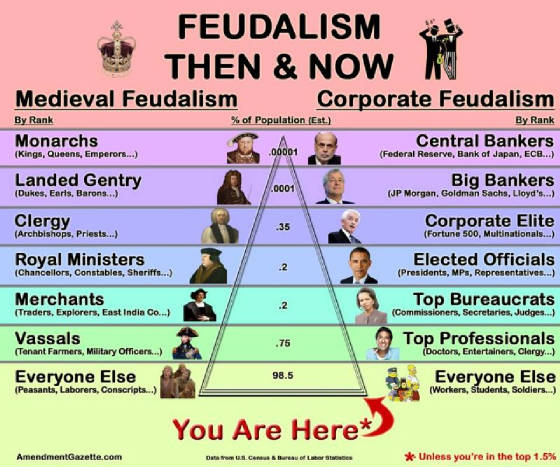
An Introduction to Technofeudalism Ascending

feudalism-then-and-now-hierarchy.jpg.w560h467

By SARTRE

Source: BATR.org

The future of the planetary Reign of Terror has never been clearer. The pattern for global governance has been set into motion and operates under a model that has been used throughout much of history. The modern day version of command and control can be effectively described as Technofeudalism. The purpose of this introduction is to provide an outline of the arguments used by Steven Yates, Ph.D. The link to this significant treatise is provided below. In addition News With Views maintains an extensive archives of Dr. Yates’ work. Invest the time to read the entire essay for a full understanding of the linkage behind Technofeudalis and the course for top down dominance.

Technofeudalism Ascending comprises nine sections. Dr. Yates provides the following preface.

My book Four Cardinal Errors (2011) introduced the idea of technofeudalism. Though a bit of a mouthful, this is the best term for the political economy towards which an intergenerational superelite has been directing as much of the world as possible for at least a century. This existence of this group, I argue, is the foremost political-economic reality of our times.

Their goal, I argued in Four Cardinal Errors, is to institute corporate controlled global governance: de facto world government, managed for private profit and for control over national governments and populations. Technofeudalism is the resulting political economy. While preserving some of the vocabulary and outward features of market capitalism, technofeudalism has almost nothing to do with free markets, or free enterprise, as generally understood. It is about instituting whatever policies, instigating whatever wars, bringing about whatever revolutions, and causing whatever levels of misery are deemed necessary for enforced mass compliance. Its tools include both neoliberal and neoconservative ideology, artificial scarcity, education reduced to job training, and fear induction through constant pontificating about “terrorism” amidst random and often-depraved acts of violence, reducing as many as possible to a status of permanently cash-strapped, mentally paralyzed subjects — living amidst the most advanced technology in human history, but equivalent to serfs (“owned” as de facto property by “their” governments, employers, etc., as in medieval feudal systems of old). Hence, the term technofeudalism.

Introduction:  Why Technofeudalism? (Technofeudalism is the best term for a kind of political economy that has been coming together very gradually for much of the past century, but accelerating in recent decades: it is technologically advanced but populations are controlled by various means and, in effect, made into serfs who are tied to whatever work they can find and to government programs. Technofeudalism is driven by those I call the superelite—a group of globalist-minded extended families whose primary motivation is wealth and power. It illustrates the primary problem of practical political philosophy and strategy: how to contain that minority in our midst that is drawn to power.)

  1. The End of History? (The collapse of the Soviet Union seemed to leave the world at a major turning point; Communism was dead, the combination of market capitalism and liberal democracy seemed to be catching on everywhere, and the U.S. was the sole superpower. It seemed conceivable that it really was, as Francis Fukuyama described, the end of history.)
  1. The Neoliberal Illusion.  (Things began to unravel almost at once, as trade deals such as NAFTA began to put an end to the largest financially independent middle class in history. Neoliberal ideology proved to have a dark side, as wealth began to be redistributed upward and millions of people ended up out of work.)
  1. Precariatization and the Destruction of the American Mind.  (Higher education faced multiple crises: rising radical left “scholarship” in the humanities, a rising corporate or business mindset in expanding administrations, the collapse of the academic job market creating conditions where control was possible, and the impoverishing of faculty via adjunctification, one species of the creation of a precariat — workers in an environment of part-time, temporary, and short term work. Liberal arts learning itself came under assault, as the thinking skills it provides threaten a political economy of power, domination, precarity, and corruption.)
  1. The Empire of Corruption.  (Ensuing decades have seen rising corruption and financial manipulation which eventually caused the 2008 meltdown and have brought about a steadily lowering of the standard of living in the U.S. Supreme Court decisions such as Citizens United ensure a bought-and-paid-for political class, and articles now appear in refereed journals indicating that the U.S. is now a plutocratic oligarchy.)
  1. The Global Corporatist Leviathan.  (If the present political system is plutocratic oligarchy, the correct term for the present economy is corporatism, with technofeudalism its broader political-economic-technocratic instrument. Poor education ensures a systematic confusion between capitalism and corporatism. Under corporatism, corporations are in the driver’s seat behind governments, as we can see from their latest effort to dominate a section of the world’s economy: the Trans-Pacific Partnership.)
  1. The New Serfdom.  (You are living in a feudal system when there is one set of rules for those with power and another set of rules for those without power, with only token representation. Technofeudalism emerges in that its subjects are technologically advanced serfs — surrounded by technology but tied to low-wage work or to a government-based support system.)
  1. “What Can We Do?”  (You can educate yourself on issues ranging from the possibilities of expatriation to that of peoples separating politically from empires, which may become possible as a very severe downturn, worse than the Great Recession — a Greater Depression — is almost certainly inevitable.)
  1. Preparing for the Greater Depression.  (The world is on the verge of having to face the realities of financialization that will bring on the Greater Depression. You can prepare by building proper skills now. It is conceivable that the global superelite is planning on a Greater Depression. You should prepare anyway.)
  1. Grounds for Hope: Real Sustainability and the Cycles of History.  (Technofeudalism will prove unsustainable. It may be put in place, but its structure and the mindset that gave rise to it will cause it to decay and eventually disintegrate. We have come this way before, as empires have risen and fallen before. This provides hope, in that with the collapse of the technofeudalist state, separation and the building of a world of small states will become possible — again if we begin to prepare now.)

This summary outline attempts to persuade the compelling case to review the entire critique. Filling in the connections and relationships to achieve the eternal objective of worldwide ascendancy in an age of technological supremacy, means that the return to a feudal society becomes the undeniable 21th century danger.

Technofeudalism is based upon herding marginal and unneeded humans into ghettos of subsistent serfdom existence. The technocrats who administer the process of dehumanization become the executioners of civilization. Utopia for the select, built on the misery of the masses is a future not worth living. This fact is exactly the objective of the globalist. Destroying resistance through marginalizing survival rules a feudal society. However, building the achievement of a renaissance culture is based upon the liberation of the human spirit and decentralization of authority.

The global elites depend on acquiesce of the masses to accept and adopt the tyrannical systems and indoctrination methods propagated by the technocratic matrix. Liberty is despised by authoritarians. Technofeudalism is the enemy of all human beings. Once armed with the knowledge of this threat, what will be the response of the populace targeted for slavery or extinction?


 

The Asshole Factory

index

Our economy doesn’t make stuff anymore. So what does it make?

By Umair Haque

Source: Medium

My good friend Mara has not one but two graduate degrees. From fine, storied universities. Surprise, surprise: the only “job” she was able to find was at a retail store.

Hey—it’s only minimum wage, but at least she’s working, right? And at a major-league, blue-chip company, An American icon; an institution; a name every man, woman, and child in this country knows; an historic company that rings of the American Dream the world over, besides. Surely, if nothing else, it’s a start.

Perhaps you’re right. Maybe it isn’t the start she always dreamed of…but at least it is one. If so…then awaits her at the finish?

What is Mara’s job like? Her sales figures are monitored…by the microsecond. By hidden cameras and mics. They listen to her every word; they capture her every movement; that track and stalk her as if she were an animal; or a prisoner; or both. She’s jacked into a headset that literally barks algorithmic, programmed “orders” at her, parroting her own “performance” back to her, telling her how she compares with quotas calculated…down to the second…for all the hundreds of items in the store…which recites “influence and manipulation techniques” to her…to use on unsuspecting customers…that sound suspiciously like psychological warfare. It’s as if the NSA was following you around……and it was stuck in your head…telling you what an inadequate failure you were…psychologically waterboarding you…all day long…every day for the rest of your life.

Mara’s boss sits in the back. Monitoring all twelve, or fifteen, or twenty people that work in the store. On a set of screens. Half camera displays, half spreadsheets; numbers blinking in real-time. Glued to it like a zombie. Chewing slowly with her mouth open. Jacked into a headset. A drone-pilot… piloting a fleet of human drones…pressure-selling disposable mass-made shit…as if it were luxury yachts…through robo-programmed info-warfare…like zombies…to other zombies…who look stunned…like they just got laser blasted, cluster-bombed, shock-and-awed…

WTF?

It’s bananas. The whole scene is like a maximum-security mental asylum designed by sadomasochists in a sci-fi movie. If Jeffrey Dahmer, Rasputin, and Michael Bay designed a “store” together, they couldn’t do any better. Her “job” will begin to drive her crazy—paranoid, depressed, deluded—in a matter of years if she continues doing it. No human psyche can bear that kind of relentless, systematic abuse.

Now. Note what all the technology and bureaucracy that wonderful, noble company has invested hundreds of millions in doesn’t ask her to do. Learn. Think. Reflect. Teach. Inspire. Lead. Connect. Imagine. Create. Grow. Dream. Actually…serve customers. Heaven forbid. It just beats her over the head, over and over again, three times a minute, every twenty seconds, with how much she hasn’t sold; hasn’t made; hasn’t produced. For her shitty .0003% commission. According to the quota that’s been set for her. By her boss. For his boss. For their boss. And so on all the way up the food chain.

See my point? Mara’s job isn’t to benefit customers. It isn’t to educate, understand, listen to, or even to chat with them. It isn’t to stop them from buying what they don’t want; to help them find what they might need; to match them with the right stuff. Nope. It’s merely to push more and more and more and more shit at them…faster, meaner, and dumber than any sane person would think is humanly possible…using advanced military technology and techniques… programmed to abuse her…so she can wage advanced psychological warfare…on her customers. And they were just suckers, gaping maws, fools, marks. And be yelled at…by a robot…if she doesn’t.

Really? This is the best our economy can do? To take the stuff of 21st century warfare and use them them to…rack up the profit? To turn a bright young woman with two grad degrees…into a Superprofitable Human Weapon of Mass Consumption…a half-crazed algorithmically-programmed asshole…a human drone…so even bigger, actually crazy assholes…can get super-rich…by slinging entire supertankers full of junk…at people getting poorer at four thousand percent interest a year…by using drones and bots to wage psy-warfare against them…so they’re conned into buying too much?

The economy doesn’t make stuff anymore. That much you know. So what does it make?

It makes assholes.

The Great Enterprise of this age is the Asshole Industry.

And that’s not just a tragedy. It is something approaching the moral equivalent of a crime. For it demolishes human potential in precisely the same way as locking someone innocent up, and throwing away the key.

Consider Mara again. Who in Christ’s name would design such an inhuman system? Whose sick joke of an idea is a “store” like that? What do you even call it? Because it’s surely not a “store”.

Only a monstrous asshole of the highest order could assemble such a demonically vampiric bullshit machine to prey on…everyone. Customers, managers, workers alike. Such a carefully sophisticated engine of human misery; of finessed cruelty; all to rake in a few extra pennies an hour, at the expense of dignity, intelligence, creativity, commitment, fairness, craft, service, sovereignty…sanity.

The store is an Asshole Factory.

Allow me to explain.

What happens to Mara when she’s “doing her job”? Think about it for a second. She turns into precisely the kind of asshole that the heartless dweebs who thought up this infernal torture-machine no doubt already are. Not because she wants to. But because she has to.

That’s exactly what the store was designed to do. Turn everyone into the same kind of asshole as the assholes that made it, run it, and benefit from it…want everyone to be.

The store is an Asshole Factory.

Our world is now full of Asshole Factories. That’s what the stores, offices, industrial parks, skyscrapers, malls, low-rise blocks, gleaming headquarters, whimsically designed corporate campuses, really are.

It’s the grand endeavor of today. We don’t make stuff anymore. We make assholes. The Great Enterprise of this age is the Asshole Industry.

Consider, for a moment, my tiny hypothesis.

Have you noticed, lately, that people seem to be more, well, assholish…than before? That everywhere you go, people seem to be meaner, nastier, dumber, angrier, more brutish?

Why?

It is the last and greatest industry left in an economy that has been impoverished, emptied, hollowed out, drained.

The Great Enterprise of the Age of Stagnation is the wholesale manufacture not of great, world-shaking, ground-breaking ideas, inventions, concerns…but of bigger and bigger assholes.

The chain-store; the mall; the hypermarket. The corporation; the firm; the partnership. B-school; law school; med school. The boardroom; the backroom; the trading floor.

These are, by and large, Asshole Factories. They don’t make people. Capable of great things. Who create and build and touch and soar. They make assholes.

They are designed to disinfect us of our fragility. To cleanse us of our flaws. To disinfect us of weakness. Love, grace, mercy, longing, forgiveness, passion, truth, nobility, dreams. Their objective is to stamp all that out; to eradicate it; to erase it. To replace it with calculation, ruthlessness, self-concern; gluttony; cruelty; anxiety, despair. By using the most sophisticated technology ever made to subjugate, oppress, and goad us into being little torturers ourselves.

And in so doing, they emotionally sterilize us. They psychically traumatize us. They intellectually castrate us. They socially neuter us. They cheat us of greatness. That is how they turn us into assholes.

They are designed to deprive us into depriving everyone else of the lives we could and have, at our highest and truest and noblest.

The assholes haven’t just taken our incomes, our savings, our careers, our educations. They’ve taken something far more precious; something priceless. It is our lives—the full, true lives we should be living—that have been taken from us. And in the gaping void where the lives we should be living are, the assholes have deftly inserted carbon copies of…themselves.

When you think about it that way…is it any wonder that society seems to be stuck? That the economy seems headed into oblivion? That life for so pretty much anyone under the age of 35 and/or worth less than $20 million or so appears to be going…nowhere?

Remember my friend Mara? She’s probably being piloted like a drone…yelled at by a bot…three times a minute…into waging advanced techniques of psycho-war…designed to traumatize prisoners…over and over and over again…right this very second…

Until she’s cleansed. Perfect. Flawless. Pure. Another gleaming, brand-new asshole, rolling proudly off the assembly line of the Asshole Factory.

We’re obedient constructivists. Pragmatists. Rationalists. So you probably want to know: what can we do about it?

It’s pretty simple.

Don’t be an asshole. Remember the Asshole Factories? Here’s a secret: they’re churning out assholes by the millions. And so should you bravely decide to be an asshole, what you’ll really be is just another interchangeable, forgettable, rapidly depreciating commodity.

So who should you be?

Be yourself. The person you were meant to be. Whether you believe in heaven or the inferno, freedom or fate, the simple fact is: each and every one of us was put here to be something greater than Just Another Asshole stealing pennies from his neighbors to pay off Even Bigger Assholes.

So let me say it again. Don’t be an asshole. Be yourself. The miracle of being that you were meant to be. A person that, consumed with passion, seared with happiness, aglow with meaning, brings forth all that is great, noble, and true in the world, and so, with love, mercy, and wisdom, lifts every life that you meet into the light.

Thank you and goodbye.

America’s Mania for Positive Thinking and Denial of Reality Will Be Our Downfall

tomorrowland-trailer-poster-2015-movie-george-clooney

The ridiculous positivism, the belief that we are headed toward some glorious future, defies reality.

By Chris Hedges

Source: Alternet

The naive belief that history is linear, that moral progress accompanies technical progress, is a form of collective self-delusion. It cripples our capacity for radical action and lulls us into a false sense of security. Those who cling to the myth of human progress, who believe that the world inevitably moves toward a higher material and moral state, are held captive by power. Only those who accept the very real possibility of dystopia, of the rise of a ruthless corporate totalitarianism, buttressed by the most terrifying security and surveillance apparatus in human history, are likely to carry out the self-sacrifice necessary for revolt.

The yearning for positivism that pervades our corporate culture ignores human nature and human history. But to challenge it, to state the obvious fact that things are getting worse, and may soon get much worse, is to be tossed out of the circle of magical thinking that defines American and much of Western culture. The left is as infected with this mania for hope as the right. It is a mania that obscures reality even as global capitalism disintegrates and the ecosystem unravels, potentially dooming us all.

The 19th century theorist Louis-Auguste Blanqui, unlike nearly all of his contemporaries, dismissed the belief, central to Karl Marx, that human history is a linear progression toward equality and greater morality. He warned that this absurd positivism is the lie perpetrated by oppressors: “All atrocities of the victor, the long series of his attacks are coldly transformed into constant, inevitable evolution, like that of nature. … But the sequence of human things is not inevitable like that of the universe. It can be changed at any moment.” He foresaw that scientific and technological advancement, rather than being a harbinger of progress, could be “a terrible weapon in the hands of Capital against Work and Thought.” And in a day when few others did so, he decried the despoiling of the natural world. “The axe fells, nobody replants. There is no concern for the future’s ill health.”

“Humanity,” Blanqui wrote, “is never stationary. It advances or goes backwards. Its progressive march leads it to equality. Its regressive march goes back through every stage of privilege to human slavery, the final word of the right to property.” Further, he wrote, “I am not amongst those who claim that progress can be taken for granted, that humanity cannot go backwards.”

Blanqui understood that history has long periods of cultural barrenness and brutal repression. The fall of the Roman Empire, for example, led to misery throughout Europe during the Dark Ages, roughly from the sixth through the 13th centuries. There was a loss of technical knowledge (one prominent example being how to build and maintain aqueducts), and a cultural and intellectual impoverishment led to a vast historical amnesia that blotted out the greatest thinkers and artists of the classical world. None of this loss was regained until the 14th century when Europe saw the beginning of the Renaissance, a development made possible largely by the cultural flourishing of Islam, which through translating Aristotle into Arabic and other intellectual accomplishments kept alive the knowledge and wisdom of the past. The Dark Ages were marked by arbitrary rule, incessant wars, insecurity, anarchy and terror. And I see nothing to prevent the rise of a new Dark Age if we do not abolish the corporate state. Indeed, the longer the corporate state holds power the more likely a new Dark Age becomes. To trust in some mythical force called progress to save us is to become passive before corporate power. The people alone can defy these forces. And fate and history do not ensure our victory.

Blanqui tasted history’s tragic reverses. He took part in a series of French revolts, including an attempted armed insurrection in May 1839, the 1848 uprising and the Paris Commune—a socialist uprising that controlled France’s capital from March 18 until May 28 in 1871. Workers in cities such as Marseilles and Lyon attempted but failed to organize similar communes before the Paris Commune was militarily crushed.

The blundering history of the human race is always given coherence by power elites and their courtiers in the press and academia who endow it with a meaning and coherence it lacks. They need to manufacture national myths to hide the greed, violence and stupidity that characterize the march of most human societies. For the United States, refusal to confront the crisis of climate change and our endless and costly wars in the Middle East are but two examples of the follies that propel us toward catastrophe.

Wisdom is not knowledge. Knowledge deals with the particular and the actual. Knowledge is the domain of science and technology. Wisdom is about transcendence. Wisdom allows us to see and accept reality, no matter how bleak that reality may be. It is only through wisdom that we are able to cope with the messiness and absurdity of life. Wisdom is about detachment. Once wisdom is achieved, the idea of moral progress is obliterated. Wisdom throughout the ages is a constant. Did Shakespeare supersede Sophocles? Is Homer inferior to Dante? Does the Book of Ecclesiastes not have the same deep powers of observation about life that Samuel Beckett offers? Systems of power fear and seek to silence those who achieve wisdom, which is what the war by corporate forces against the humanities and art is about. Wisdom, because it sees through the facade, is a threat to power. It exposes the lies and ideologies that power uses to maintain its privilege and its warped ideology of progress.

Knowledge does not lead to wisdom. Knowledge is more often a tool for repression. Knowledge, through the careful selection and manipulation of facts, gives a false unity to reality. It creates a fictitious collective memory and narrative. It manufactures abstract concepts of honor, glory, heroism, duty and destiny that buttress the power of the state, feed the disease of nationalism and call for blind obedience in the name of patriotism. It allows human beings to explain the advances and reverses in human achievement and morality, as well as the process of birth and decay in the natural world, as parts of a vast movement forward in time. The collective enthusiasm for manufactured national and personal narratives, which is a form of self-exaltation, blots out reality. The myths we create that foster a fictitious hope and false sense of superiority are celebrations of ourselves. They mock wisdom. And they keep us passive.

Wisdom connects us with forces that cannot be measured empirically and that are outside the confines of the rational world. To be wise is to pay homage to beauty, truth, grief, the brevity of life, our own mortality, love and the absurdity and mystery of existence. It is, in short, to honor the sacred. Those who remain trapped in the dogmas perpetuated by technology and knowledge, who believe in the inevitability of human progress, are idiot savants.

“Self-awareness is as much a disability as a power,” the philosopher John Gray writes. “The most accomplished pianist is not the one who is most aware of her movements when she plays. The best craftsman may not know how he works. Very often we are at our most skillful when we are least self-aware. That may be why many cultures have sought to disrupt or diminish self-conscious awareness. In Japan, archers are taught that they will hit the target only when they no longer think of it—or themselves.”

Artists and philosophers, who expose the mercurial undercurrents of the subconscious, allow us to face an unvarnished truth. Works of art and philosophy informed by the intuitive, unarticulated meanderings of the human psyche transcend those constructed by the plodding conscious mind. The freeing potency of visceral memories does not arrive through the intellect. These memories are impervious to rational control. And they alone lead to wisdom.

Those with power have always manipulated reality and created ideologies defined as progress to justify systems of exploitation. Monarchs and religious authorities did this in the Middle Ages. Today this is done by the high priests of modernity—the technocrats, scholars, scientists, politicians, journalists and economists. They deform reality. They foster the myth of preordained inevitability and pure rationality. But such knowledge—which dominates our universities—is anti-thought. It precludes all alternatives. It is used to end discussion. It is designed to give to the forces of science or the free market or globalization a veneer of rational discourse, to persuade us to place our faith in these forces and trust our fate to them. These forces, the experts assure us, are as unalterable as nature. They will lead us forward. To question them is heresy.

The Austrian writer Stefan Zweig, in his 1942 novella “Chess Story,” chronicles the arcane specializations that have created technocrats unable to question the systems they serve, as well as a society that foolishly reveres them. Mirko Czentovic, the world chess champion, represents the technocrat. His mental energy is invested solely in the 64 squares of the chessboard. Apart from the game, he is a dolt, a monomaniac like all monomaniacs, who “burrow like termites into their own particular material to construct, in miniature, a strange and utterly individual image of the world.” When Czentovic “senses an educated person he crawls into his shell. That way no one will ever be able to boast of having heard him say something stupid or of having plumbed the depths of his seemingly boundless ignorance.”

An Austrian lawyer known as Dr. B, whom the Gestapo had held for many months in solitary confinement, challenges Czentovic to a game of chess. During his confinement, the lawyer’s only reading material was a chess manual, which he memorized. He reconstructed games in his head. Forced by his captivity to replicate the single-minded obsession of the technocrat Czentovic, Dr. B too became trapped inside a specialized world, and, unlike Czentovic, he became insane temporarily as he focused on a tiny, specialized piece of human activity. When he challenges the chess champion, his insanity returns.

Zweig, who mourned for the broad liberal culture of educated Europe swallowed up by fascism and modern bureaucracy, warns of the absurdity and danger of a planet run by technocrats. For him, the rise of the Industrial Age and the industrial man and woman is a terrifying metamorphosis in the relationship of human beings to the world. As specialists and bureaucrats, human beings become tools, able to make systems of exploitation and even terror function efficiently without the slightest sense of personal responsibility or understanding. They retreat into the arcane language of all specialists, to mask what they are doing and give to their work a sanitized, clinical veneer.

This is Hannah Arendt’s central point in “Eichmann in Jerusalem.” Technocratic human beings are spiritually dead. They are capable of anything, no matter how heinous, because they do not reflect upon or question the ultimate goal. “The longer one listened to him,” Arendt writes of the Nazi Adolf Eichmann on trial, “the more obvious it became that his inability to speak was closely connected with an inability to think, namely, to think from the standpoint of somebody else. No communication was possible with him, not because he lied but because he was surrounded by the most reliable of all safeguards against the words and presence of others, and hence against reality as such.”

Zweig, horrified by a world run by technocrats, committed suicide with his wife in 1942. He knew that from then on, the Czentovics would be exalted in the service of state and corporate monstrosities.

Resistance, as Alexander Berkman points out, is first about learning to speak differently and abandoning the vocabulary of the “rational” technocrats who rule. Once we discover new words and ideas through which to perceive and explain reality, we free ourselves from neoliberal capitalism, which functions, as Walter Benjamin knew, like a state religion. Resistance will take place outside the boundaries of popular culture and academia, where the deadening weight of the dominant ideology curtails creativity and independent thought.

As global capitalism disintegrates, the heresy our corporate masters fear is gaining currency. But that heresy will not be effective until it is divorced from the mania for hope that is an essential part of corporate indoctrination. The ridiculous positivism, the belief that we are headed toward some glorious future, defies reality. Hope, in this sense, is a form of disempowerment.

There is nothing inevitable about human existence except birth and death. There are no forces, whether divine or technical, that will guarantee us a better future. When we give up false hopes, when we see human nature and history for what they are, when we accept that progress is not preordained, then we can act with an urgency and passion that comprehends the grim possibilities ahead.

Chris Hedges, a Pulitzer Prize-winning reporter, writes a regular column for Truthdig every Monday. Hedges’ most recent book is “Empire of Illusion: The End of Literacy and the Triumph of Spectacle.”

Rollerball Amerika 2015

2294daf5b5813dc444407ada1b2c4df8

By Philip A. Farruggio

Source: World News Trust

You must see or revisit Norman Jewison’s 1975 film Rollerball, starring James Caan as superstar player Jonathan E.

In it, we see a world no longer made up of countries, but of corporations that control every bit of life for the people. There are no longer wars, just a complacent populace who “go along to get along.”

A very select few are chosen by the corporations to become executives, giving them elite status. It seems everyone loves the violent sport Rollerball, which is like our current NFL football on steroids.

Jonathan E. is their Michael Jordan or Lebron James superplayer who is revered worldwide, even by the fans of opposing teams. He has everything a man could wish to have: a fine sprawling ranch, with servants and horses, and gorgeous female companions chosen for him by the Energy corporation that rules Houston and the surrounding areas.

Yet, even someone as popular and valued as he must sacrifice, such as when the corporation took away his wife and gave her to an executive. There is a scene in the film, when the highest corporation board decides they want Jonathan E. to retire due to the fear that his popularity has become too great. A man like that becomes too influential, thus too dangerous to control.

They send his ex wife, whom he still pines for, to visit him at his ranch and get him to agree to retire without any complications. They go for a walk and he expresses reservations about doing this. He tells her of his newfound epiphany about their society.

He knows now that the corporations long ago offered them all the choice between freedom and comfort… and the masses chose the latter. Her brief answer becomes the gist of the whole film: “Comfort IS freedom.”

And that is what we have here in 21st Century Amerika for many of our fellow citizens. The “Good German” lives on.

To study Nazi Germany in the early 40s allows us to see how the German public, to a great degree, was either apathetic or voluntarily blind as to what their regime was doing. Kristallnact was not an event that went unseen or even unheard about by multitudes of German citizens.

When the Wehrmacht invaded Russia along with the SS death squads, word did leak out through many soldiers of what had transpired. Even the most heinous of all crimes committed by the Nazis, the death camps AKA Concentration Camps, was not totally kept from the populace as many revisionists have always alleged. When tons of human hair and millions of personal effects were shipped back to companies in Germany, surely word got out.

We can, and we should forgive, the many Germans who did care about the terrible wrongs of their government at that time. Why? Well, it was a police state and dissent was stomped out rather brutally. Not everyone can be as heroic as Sophie Scholl and her brother and friends, to risk being tortured and finally beheaded.

Yet, there is this terrible pain that gnaws at this writer. That being the pain of realizing how many out there just do NOT give a shit unless it is happening to one of their own!

The late and great New Orleans district attorney Jim Garrison, who Oliver Stone centered his fine film JFK on, understood so much more than many of his peers in the 1960s. Years after his defeat in the case against Clay Shaw and others for the assassination of JFK, Garrison wrote this:

What worries me deeply is that we in America are in great danger of slowly evolving into a proto-fascist state. It will be a different kind of fascist state from the one of the Germans; theirs grew out of depression and promised bread and work, while ours is based on power and on the inability to put human goals and human conscience above the dictates of the state. It’s origins can be traced to the tremendous war machine we’ve built since 1945, the ‘Military Industrial Complex’ that Eisenhower vainly warned us against, which now dominates every aspect of our lives… In a very real and terrifying sense, our government IS the CIA and the Pentagon, with Congress reduced to a ‘debating society.'”

Cassius had said it most succinctly: “The fault dear Brutus is not in our stars but in our selves.”

(Philip A. Farruggio is son and grandson of Brooklyn, NYC longshoremen. He is a freelance columnist (found on Nation of Change Blog, Truthout.org, TheSleuthJournal.com, Worldnewstrust.com, The Intrepid Report, The Peoples Voice, Information Clearing house, Dandelion Salad, Activist Post, Dissident Voice and many other sites worldwide). Philip works as an environmental products sales rep and has been an activist leader since 2000. In 2010 he became a local spokesperson for the 25% Solution Movement to Save Our Cities by cutting military spending 25%. Philip can be reached at PAF1222@bellsouth.net)