ISIS, Weapons Makers, Thugs Benefit from Bombing

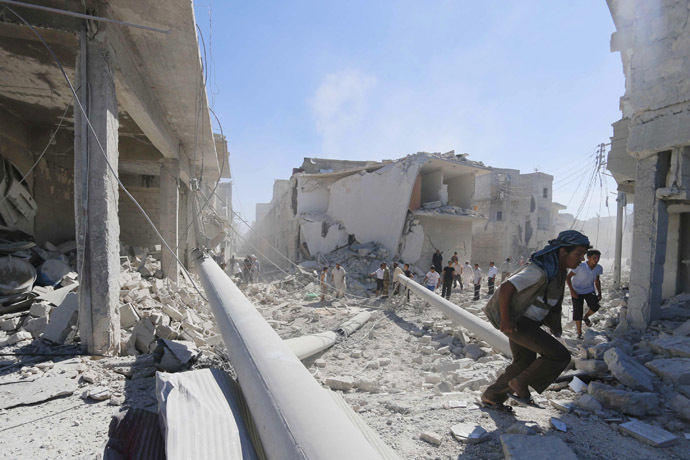
Residents inspect damage at a site hit by what activists said were barrel bombs dropped by forces of Syria's President Assad in Aleppo

By David Swanson

Source: Washington’s Blog

President Obama is bombing the opposite side in Syria from the side he swore we needed to attack one year ago, and those pleased by this declare that he is “doing something.”

U.S. polls suggest that the same people recognize that this something will make the U.S. more likely to be attacked and nonetheless favor this action. This is unthinking fear produced by slick beheading videos for audiences too distracted to notice that the Iraqi government, Saudi government and numerous other U.S. friends and allies behead. And are we to imagine that when Obama kills a 16 year old American and the 6 kids near him his head remains intact? Should we pretend that the people being killed by U.S. missiles right now aren’t losing their heads?

This action is illegal under the UN Charter, Kellogg-Briand Pact, and U.S. Constitution. This action is immoral as it fuels violence that needs to be reduced. This action is knowingly, maddeningly counterproductive, guaranteed to build hostility to the United States, which is already so hated that ISIS openly advocates for a U.S. attack on it. This action by this White House is what ISIS wants and what weapons makers want. It is not what the people of Syria or Iraq or the world want. It further shreds the rule of law while dumping gasoline on a fire of U.S. creation.

What’s needed is, contrary to what your television suggests, not to “do nothing” or love beheadings. What’s needed is an arms embargo. The U.S. ships 79% of the weapons shipped to the Middle East, not counting the weapons of the U.S. military. An arms embargo could be 79% successful with just one country participating, and others could certainly be brought to do so.

What’s needed is actual aid on a massive scale, restitution to the people of the region for the crimes of the U.S. government. An aid program sufficient to make the United States beloved rather than hated would cost a lot less money than the missiles and bombs for which price seems to be no concern at all.

What’s needed is diplomacy. The U.S. government is happy to talk with Syria or Iran or Russia when the object is war. Why can it not talk to them when the object is peace?

Our Constitutional scholar Nobel peace laureate no-dumb-wars end-the-mindset president will be protested today at the White House and at his appearance in New York, and should be protested everywhere he goes.

Congress members should not know a moment’s peace, but should be taught that cowardice is not a campaign strategy. None who voted for weapons to Syria should be returned to Washington next year.

War as a first resort, as our biggest public program, as the be all and end all of U.S. foreign policy is a form of insanity that has no redeeming feature. War is our top destroyer of the natural environment, of the economy, of civil liberties, of self-governance, and of morality. This is a case of a doctor trying to cure the world while suffering from a deadly and highly infectious disease that in his own mind is the epitome of health.

You can’t cure war fever with more war. You can only get to peace through peace.

Stop the bombing.

The US and Global Wars: Empire or Vampire?

GIF by WhatReallyHappened.com

GIF by WhatReallyHappened.com

By James Petras

Source: Axis of Logic

Introduction

To the growing army of critics of US military intervention, who also reject the mendacious claims by American officials and their apologists of ‘world leadership’, Washington is engaged in ‘empire-building”.

But the notion that the US is building an empire, by engaging in wars to exploit and plunder countries’ markets, resources and labor, defies the realities of the past two decades. US wars, including invasions, bombings, occupations, sanctions, coups and clandestine operations have not resulted in the expansion of markets, greater control and exploitation of resources or the ability to exploit cheap labor. Instead US wars have destroyed enterprises, reduced access to raw materials, killed, wounded or displaced productive workers around the world, and limited access to lucrative investment sites and markets via sanctions.

In other words, US global military interventions and wars have done the exact opposite of what all previous empires have pursued: Washington has exploited (and depleted) the domestic economy to expand militarily abroad instead of enriching it.

Why and how the US global wars differ from those of previous empires requires us to examine (1) the forces driving overseas expansion; (2) the political conceptions accompanying the conquest, the displacement of incumbent rulers and the seizure of power and; (3) the reorganization of the conquered states and the accompanying economic and social structures to sustain long-term neo-colonial relations.

Empire Building: The Past

Europe built durable, profitable and extensive empires, which enriched the ‘mother country’, stimulated local industry, reduced unemployment and ‘trickled down’ wealth in the form of better wages to privileged sectors of the working class. Imperial military expeditions were preceded by the entry of major trade enterprises (British East India Company) and followed by large-scale manufacturing, banking and commercial firms. Military invasions and political takeovers were driven by competition with economic rivals in Europe, and later, by the US and Japan.

The goal of military interventions was to monopolize control over the most lucrative economic resources and markets in the colonized regions. Imperial repression was directed at creating a docile low wage labor force and buttressing subordinate local collaborators or client-rulers who facilitated the flow of profits, debt payments, taxes and export revenues back to the empire.

Imperial wars were the beginning, not the end, of ‘empire building’. What followed these wars of conquest was the incorporation of pre-existing elites into subordinate positions in the administration of the empire. The ‘sharing of revenues’, between the imperial economic enterprises and pre-existing elites, was a crucial part of ‘empire building’. The imperial powers sought to ‘instrumentalize’ existing religious, political, and economic elites’ and harness them to the new imperial-centered division of labor. Pre-existing economic activity, including local manufacturers and agricultural producers, which competed with imperial industrial exporters, were destroyed and replaced by malleable local traders and importers (compradors). In summary, the military dimensions of empire building were informed by economic interests in the mother country. The occupation was pre-eminently concerned with preserving local collaborative powers and, above all, restoring and expanding the intensive and extensive exploitation of local resources and labor, as well as the capture and saturation of local markets with goods from the imperial center.

“Empire-building” Today

The results of contemporary US military interventions and invasions stand in stark contrast with those of past imperial powers. The targets of military aggression are selected on the basis of ideological and political criteria. Military action does not follow the lead of ‘pioneer’ economic entrepreneurs – like the British East India Company. Military action is not accompanied by large-scale, long-term capitalist enterprises. Multi-national construction companies of the empire, which build great military bases are a drain on the imperial treasury.

Contemporary US intervention does not seek to secure and take over the existing military and civilian state apparatus; instead the invaders fragment the conquered state, decimate its cadres, professionals and experts at all levels, thus providing an entry for the most retrograde ethno-religious, regional, tribal and clan leaders to engage in intra-ethnic, sectarian wars against each other, in other words – chaos. Even the Nazis, in their expansion phase, chose to rule through local collaborator elites and maintained established administrative structures at all levels.

With US invasions, entire existing socio-economic structures are undermined, not ‘taken over’: all productive activity is subject to the military priorities of leaders bent on permanently crippling the conquered state and its advanced economic, administrative, educational, cultural and social sectors. While this is militarily successful in the short-run, the medium and long-term results are non-functioning states, not a sustained inflow of plunder and expanding market for an empire. Instead what we have is a chain of US military bases surrounded by a sea of hostile, largely unemployed populations and warring ethno-religious groups in decimated economies.

The US claims to ‘world leadership’ is based exclusively on failed-state empire building. Nevertheless, the dynamic for continuing to expand into new regions, to militarily and politically intervene and establish new client entities continues. And, most importantly, this expansionist dynamic further undermines domestic economic interests, which, theoretically and historically, form the basis for empire. We, therefore, have imperialism without empire, a vampire state preying on the vulnerable and devouring its own in the process.

Empire or Vampire: The Results of US Global Warfare

Empires, throughout history, have violently seized political power and exploited the riches and resources (both material and human) of the targeted regions. Over time, they would consolidate a ‘working relation’, insuring the ever-increasing flow of wealth into the mother country and the expanding presence of imperial enterprises in the colony. Contemporary US military interventions have had the opposite effect after every recent major military conquest and occupation.

Iraq: Vampires Pillage

Under Saddam Hussein, the Republic of Iraq was a major oil producer and profitable partner for major US oil companies, as well as a lucrative market for US exports. It was a stable, unified secular state. The first Gulf War in the 1990s led to the first phase of its fragmentation with the de facto establishment of a Kurdish mini-state in the north under US protection. The US withdrew its military forces but imposed brutal economic sanctions limiting economic reconstruction from the devastation of the first Gulf War. The second US-led invasion and full-scale occupation in 2003 devastated the economy and dismantled the state dismissing tens of thousands of experienced civil servants, teachers and police. This led to utter social collapse and fomented ethno-religious warfare leading to the killing, wounding or displacement of millions of Iraqis. The result of GW Bush’s conquest of Baghdad was a ‘failed state’. US oil and energy companies lost billions of dollars in trade and investment and the US economy was pushed into recession.

Afghanistan: Endless Wars, Endless Losses

The US war against Afghanistan began with the arming, financing and political support of Islamist jihadi-fundamentalists in 1979. They succeeded in destroying and dismantling a secular, national government. With the decision to invade Afghanistan in October 2001 the US became an occupier in Southwest Asia. For the next thirteen years, the US-puppet regime of Hamad Karzai and the ‘NATO coalition’ occupation forces proved incapable of defeating the Taliban guerrilla army. Billions of dollars were spent devastating the economy and impoverishing the vast majority of Afghans. Only the opium trade flourished. The effort to create an army loyal to the puppet regime failed. The forced retreat of US armed forces beginning in 2014 signals the bitter demise of US ‘empire building’ in Southwest Asia.

Libya: From Lucrative Trading Partner to Failed State

Libya, under President Gadhafi, was evolving into a major US and European trading partner and influential power in Africa. The regime signed large-scale, long-term contracts with major international oil companies that were backed by a stable secular government. The relationship with the US and EU was profitable. The US opted to impose a ‘regime change’ through massive US-EU missile and bombing strikes and the arming of a motley collection of Islamist terrorists, ex-pat neo-liberals and tribal militias. While these attacks succeeded in killing President Gadhafi and most of his family (including many of his grandchildren) and dismantling the secular Libyan government and administrative infrastructure, the country was ripped apart by tribal war-lord conflicts, political disintegration and the utter destruction of the economy. Oil investors fled. Over one million Libyans and immigrant workers were displaced. The US and EU ‘partners-in-regime-change’ have even fled their own embassies in Tripoli – while the Libyan ‘parliament’ operates off-shore from a casino boat. None of this devastation would have been possible under President Gadhafi. The US vampire bled its new prize, Libya, but certainly could not incorporate it into a profitable ‘empire’. Not only were its oil resources denied to the empire, but even oil exports disappeared. Not even an imperial military base has been secured in North Africa!

Syria: Wars on Behalf of Terrorists not Empire

Washington and its EU allies backed an armed uprising in Syria hoping to install a puppet regime and bring Damascus into their “empire”. The mercenary assaults have caused the deaths of nearly 200,000 Syrians, the displacement of over 30% of the population and the seizure of the Syrian oil fields by the Sunni extremist army, ISIS. ISIS has decimated the pro-US mercenary army, recruiting and arming thousands of terrorists from around the world It invaded neighboring Iraq conquering the northern third of that country. This was the ultimate result of the deliberate US dismantling of the Iraqi state in 2003.

The US strategy, once again, is to arm Islamist extremists to overthrow the secular Bashar Assad regime in Damascus and then to discard them for a more pliable client. The strategy ‘boomeranged’ on Washington. ISIS devastated the ineffective Iraqi armed forces of the Maliki regime in Baghdad and America’s much over-rated Peshmerga proxy ‘fighters’ in Iraqi ‘Kurdistan’. Washington’s mercenary war in Syria didn’t expand the ‘empire’; indeed it undermined existing imperial outposts.

The Ukrainian Power Grab, Russian Sanctions and Empire Building

In the aftermath of the collapse of the USSR, the US and EU incorporated the Baltic, Eastern European and Balkan ex-communist countries into their orbit. This clearly violated major agreements with Russia, by incorporating most of the neo-liberal regimes into NATO and bringing NATO forces to the very border of Russia. During the corrupt regime of Boris Yeltsin, the ‘West’ absolutely looted the Russian economy in co-operation with local gangster – oligarchs, who took up EU or Israeli citizenship to recycle their pillaged wealth. The demise of the vassal Yeltsin regime and the ascent and recovery of Russia under Vladimir Putin led the US and EU to formulate a strategy to deepen and extend its ‘empire’ by seizing power in the Caucuses and the Ukraine. A power and land grab by the puppet regime in Georgia attacking Russian forces in Ossetia in 2012 was decisively beaten back. This was a mere dress rehearsal for the coup in Kiev. In late 2013-early 2014, the US financed a violent rightwing putsch ousting the elected government and imposing a hand-picked pro-NATO client to assume power in Kiev.

The new pro-US regime moved quickly to purge all independent, democratic, federalist, bilingual and anti-NATO voices especially among the bi-lingual citizens concentrated in the South-Eastern Ukraine. The coup and the subsequent purge provoked a major armed uprising in the southeast, which successfully resisted the invading NATO-backed neo-fascist armed forces and private armies of the oligarchs. The failure of the Kiev regime to subdue the resistance fighters of the Donbass region resulted in a multi-pronged US-EU intervention designed to isolate, weaken and undermine the resistance. First and foremost they attempted to pressure Russia to close its borders on the eastern front where hundreds of thousands of Ukrainian civilians eventually fled the bombardment. Secondly, the US and EU applied economic sanctions on Russia to abandon its political support for the southeast region’s democratic and federalist demands. Thirdly, it sought to use the Ukraine conflict as a pretext for a major military build-up on Russia’s borders, expanding NATO missile sites and organizing an elite rapid interventionist military force capable of bolstering a faltering puppet regime or backing a future NATO sponsored putsch against any adversary.

The Kiev regime is economically bankrupt. Its war against its own civilians in the southeast has devastated Ukraine’s economy. Hundreds of thousands of skilled professionals, workers and their families have fled to Russia. Kiev’s embrace of the EU has resulted in the breakdown of vital gas and oil agreements with Russia, undermining the Ukraine’s principle source of energy and heating with winter only months away. Kiev cannot pay its debts and faces default. The rivalries between neo-fascists and neo-liberals in Kiev will further erode the regime. In sum, the US-EU power grab in the Ukraine has not led to the effective ‘expansion of empire’; rather it has ushered in the total destruction of an emerging economy and precipitated a sharp reversal of financial, trade and investment relations with Russia and Ukraine. The economic sanctions against Russia exacerbate the EU current economic crisis. The belligerent posture of military confrontation toward Russia will result in an increase in military spending among the EU states and further divert scarce economic resources form job creation and social programs. The loss by significant sectors of the EU of agricultural export markets, as well as the loss of several billion-dollar military-industrial contracts with Russia, certainly weakens, rather than expands, the ‘empire’ as an economic force

Iran: 100 Billion Dollar Punitive Sanctions Don’t Build Empires

The US-EU sanctions on Iran carry a very high political, economic and political price tag. They do not strengthen empire, if we understand ‘empire’ to mean the expansion of multi-national corporations, and increasing access to oil and gas resources to ensure stable, cheap energy for strategic economic sectors within the imperial center.

The economic war on Iran has been at the behest of US allies, including the Gulf Monarchies and especially Israel. These are dubious ‘allies’ for US ‘empire’ . . . widely reviled potentates and a racist regime which manage to exact tribute from the imperial center!

In Afghanistan, Iraq and elsewhere, Iran has demonstrated its willingness to co-operate in power sharing agreements with US global interest. However, Iran is a regional power, which will not submit to becoming a vassal state of the US. The sanctions policy has not provoked an uprising among the Iranian masses nor has it led to regime change. Sanctions have not weakened Iran to the extent of making it an easy military target. While sanctions have weakened Iran’s economy, they has also worked against any kind of long-range empire building strategy, because Iran has strengthened its economic and diplomatic ties with the US’ rivals, Russia and China.

Conclusion

As this brief survey indicates, US-EU wars have not been instruments of empire-building in the conventional or historical sense. At most they have destroyed some adversaries of empire. But these have been pyrrhic victories. Along with the overthrow of a target regime, the systematic break-up of the state has unleashed powerful chaotic forces, which have doomed any possibility of creating stable neo-colonial regimes capable of controlling their societies and securing opportunities for imperialist enrichment via economic exploitation.

At most the US overseas wars have secured military outposts, foreign islands in seas of desperate and hostile populations. Imperial wars have provoked continuous underground resistance movements, ethnic civil wars and violent terrorist organizations that threaten ‘blowback’ on the imperial center.

The US and EU’s easy annexations of the ex-communist countries, usually via the stage-managed ballot-box or ‘color revolutions’, led to the take-over of great national wealth and skilled labor. However, Euro-American empires bloody campaigns to invade and conquer the Middle East, South Asia, North Africa and the Caucuses have created nightmarish ‘failed states’ – continuously draining imperial coffers and leading to a state of permanent occupation and warfare.

The bloodless takeover of the Eastern European satellites with their accommodating, corrupt elites has ended. The 21st century reliance on militarist strategies contrasts sharply with the successful multi-pronged colonial expansions of the 19th–20th century, where economic penetration and large scale economic development accompanied military intervention and political change. Today’s imperial wars cause economic decay and misery within the domestic economy, as well as perpetual wars abroad, an unsustainable drain.

The current US/EU military expansion into Ukraine, the encirclement of Russia, NATO missiles aimed at the very heart of a major nuclear power and the economic sanctions may lead to a global nuclear war, which may indeed put an end to militarist empire-building… and the rest of humanity.

US to rapidly expand war in Iraq and Syria

Screenshot from 2014-09-11 15_16_14(1)

By Peter Symonds

Source: World Socialist Web Site

In the wake of President Obama’s speech Wednesday night, the US is preparing to rapidly ramp up its military operations in Syria and Iraq. Over the past month, the American military has carried out about 150 air strikes against Islamic State of Iraq and Syria (ISIS) militias inside Iraq. Now, Obama declared, the US will “go on offense,” extending the war in Iraq and into Syria.

While ISIS “terrorists” are the nominal target, the new US-led war in the Middle East is above all a revival of plans shelved a year ago for the toppling of Syrian President Bashar al-Assad.

Immediately after Obama’s address, a senior American defence official briefed the media on the Pentagon’s plans, declaring that it “is ready to conduct direct action against ISIL [ISIS] targets in Syria.” Of the nearly 500 additional US troops due to arrive in Iraq next week, more than half will be allocated to boosting joint operational command centres in Baghdad and the northern Kurdish city of Erbil, closer to the Syrian border. Another 125 military personnel are to go to Erbil to boost the number of drone strikes inside Iraq and Syria.

US Special Forces are already operating in Iraq and undoubtedly will be deployed inside Syria. A senior Air Force commander told USA Today that, while spy planes could identify targets in Iraq and Syria, it was “absolutely crucial that pilots are talking to an American on the ground.” He drew a parallel with the US invasion of Afghanistan in 2001 when US Special Forces and CIA operatives infiltrated into the country to guide US air strikes on Taliban targets and lay the ground work for the military occupation.

The Obama administration is pressing for Congress to authorise $500 million to train and equip anti-Assad militias, which is likely to proceed quickly with bipartisan support. At the same time, US Secretary of State John Kerry is touring the Middle East to enlist political and military support for anti-Assad forces inside Syria.

Twelve months ago, Obama called off a US air war against the Assad regime at the last minute amid widespread popular hostility, divisions in US ruling circles, lack of support from key allies such as Britain and opposition, particularly from Russia. Now the White House has seized on the spectre of ISIS—which the US and its allies in the Gulf States helped foster and fund—as the pretext for dusting off its plans for regime-change in Syria.

Saudi Arabia, which was bitter about the US decision to cancel the air strikes last year, is enthusiastically supporting the new war against ISIS, even though significant sections of the Saudi elite have been backing ISIS. The Saudi monarchy is well aware that the US has Assad firmly in its sights. Assad’s overthrow would greatly weaken the Saudi regime’s arch rival, Iran, by removing Iran’s ally in the Middle East.

The Saudi regime has offered facilities on its soil for the US to train and arm “moderate” anti-Assad militias and yesterday hosted a meeting between Kerry and Middle Eastern foreign ministers, including from the Gulf States, Turkey, Jordan, Egypt, Lebanon and Iraq. A joint communiqué between the US and 10 Arab states endorsed efforts to cut off funding to ISIS and block the flow of volunteers to ISIS.

The statement called for a coordinated military campaign, to which each country would contribute “as appropriate.” No specifics were spelled out, but a US State Department official traveling with Kerry told the media that “there’s going to be a meeting soon of defence ministers to work out the details,” including “enhanced basing and overflights” for US military forces.

Speaking after the meeting, Saudi Foreign Minister Saud al-Faisal enthused: “There is no limit to what the kingdom can provide.” Asked about previous criticism of Obama’s decision last year to call off air strikes on Syria, he played down past differences, declaring: “I don’t see disagreement. I see agreement about the present situation.” Any Saudi involvement in military operations inside Syria would dramatically heighten tensions with Iran and throughout the region.

The presence of the new Iraqi foreign minister is significant because Saudi Arabia branded the previous Baghdad government headed by Prime Minister Nouri al-Maliki as an Iranian puppet and cut diplomatic relations. Washington’s determination to oust Maliki to make way for “a more inclusive government,” formed this week, was aimed at drawing Iraq toward Saudi Arabia and other Arab states, and isolating Iran.

Kerry, who met with new government ministers in Baghdad on Wednesday, underlined how critical Maliki’s removal was to Washington’s war plans. “Now that the Iraqi parliament has approved a new cabinet with new leaders and representative from all Iraqi communities, it’s full speed ahead. A new, inclusive Iraqi government has to be the engine of our global strategy against ISIL.”

While repeating the line that the US would not deploy combat troops, Kerry left the door wide open by adding the rider, “unless, obviously, something very, very dramatic changes.” Dramatic changes are virtually inevitable as the US plunges recklessly into a military conflict in Iraq and Syria. If a sufficiently dramatic event does not emerge, it can always be provoked or manufactured.

The governments in Syria, Iran and Russia understand that they are the targets of this phony new “war on terror.” Syrian National Reconciliation Minister Ali Haidar declared yesterday that “any action of any type without the approval of the Syrian government is an attack against Syria.” Haidar insisted “there must be cooperation with Syria,” but Obama has emphatically ruled that out.

Russia’s foreign ministry warned that any US action, “in the absence of a UN Security Council decision, would be an act of aggression, a gross violation of international law.” Obama has indicated that, while he will seek a UN resolution, the US is prepared to act without it. Already confronted by the intervention of the US and its European partners in Ukraine, Russia now faces the prospect of losing its only ally in the Middle East and access to a Mediterranean port for its naval vessels.

Just as the 2003 invasion of Iraq was never about weapons of mass destruction, so the latest US military intervention in the Middle East has nothing to do with fighting terrorism, but is aimed at securing American domination throughout the region. A decade on, under conditions of greatly heightened geo-political tensions, this new expanded war of aggression threatens to embroil the entire region and trigger a far broader conflagration.


Beyond Propaganda: Discourse of War and Doublethink. “When the Lie Becomes the Truth”

aa-Dees-mass-media-matrix1

By Jean-Claude Paye and Tülay Umay

Source: Global Research

Since the attacks of September 11, we are witnessing a transformation of the way the media report the news. They lock us in the unreal. They base truth not on the coherence of a presentation, but on its shocking character. Thus, the observer remains petrified and cannot establish a relation to reality.

The media are lying to us, but at the same time, they show us that they are lying. It is no longer a matter of changing our perception of facts in order to get our support, but to lock us in the spectacle of the omnipotence of power. Showing the annihilation of reason is based on images that serve to replace facts. Information no longer focuses on the ability to perceive and represent a thing, but the need to experience it, or rather to experience oneself through it.

From Bin Laden to Merah, through the “tyrant” Bashar al-Assad, media discourse has become the permanent production of fetishes, ordering surrender to what is “given to see.” The injunction does not aim, as propaganda, to convince. It simply directs the subject to give flesh to the image of the “war of civilizations”. The discursive device of “War of Good against Evil,” updating the Orwellian doublethink process must become a new reality that de-structures our entire existence, of everyday life in global political relations.

Such an approch has become ubiquitous, especially regarding the war in Syria. It consists of cancelling a statement at the same time as it is pronounced, while maintaining what has been previously given to see and hear. The individual must have the ability to accept opposing elements, without raising the existing contradiction. Language is thus reduced to communication and cannot fulfill its function of representation. The deconstruction of the faculty to symbolize prevents any protection vis-à-vis the real to which we are in submission.

Enunciating a Statement And its Opposite at the Same Time

In the reports on the conflict in Syria, the double think procedure is omnipresent. Stating at the same time a thing and its opposite produces a decay of consciousness. It is no longer possible to perceive and analyze reality. Unable to put emotion at a distance, we cannot but feel the real and thus be submitted to it.

Opponents of the regime of Bashar al-Assad are dubbed “freedom fighters” and Islamic fundamentalist enemies of democracy at the same time. It is the same with regard to the use of chemical weapons by belligerents. The media, in the absence of evidence, express certainty as to the Syrian regime’s responsability, although they mention the use of such weapons by the “rebels”. In particular, they relayed the statements of magistrate Carla Del Ponte, a member of the UN independent commission of inquiry into violence in Syria, who said, on May 5, 2013 on Swiss television, “According to the testimonies we have gathered, the rebels have used chemical weapons, making use of sarin gas.” This magistrate, who is also the former prosecutor of the International Criminal Tribunal for the former Yugoslavia can hardly be called indulgent toward the “regime of Bashar Assad.” “Our investigations should be further developed, verified and confirmed through new evidence, but according to what we have established so far, it is the opponents who used sarin,” she added. [1]

The White House, for its part, did not want to consider this evidence and has always expressed an opposite position. Thus, as regards the August 21 Ghouta massacre, it released a statement explaining that there is “little doubt” of the use by Syria of chemical weapons against its opposition. The statement added that the Syrian agreement to allow the UN inspectors in the area is “too late to be credible.”

Reduction of qualitative to quantitative.

Following the use, August 21, 2013, of chemical weapons in the suburbs of Damascus, Kerry reiterated the “strong certainty” of the United States concerning the liability of the Syrian regime. A U.S. intelligence report, released by the White House and said to rely on “multiple” sources, also said that the Syrian government used nerve gas in the attack, the use of which by the rebels is “highly unlikely”. [2]

The individual is placed outside the differentiating power of language. That which is qualitative, that which is certain, is reduced to that which is quantitative, to the “different degrees of certainty” expressed previously by Obama or the “high certainty” pronounced by J. Kerry. The “very little doubt”, as to the liability of the Syrian regime, also mirrors the “highly unlikely” responsibility attributed to opponents. Quality is thereby restricted to a quantitative difference. Quality, that which is, becomes at the same time, that which is not or at least that which may not be, because it no longer expresses a certainty, but a certain amount or degree of certainty or doubt. The opposites, “certainty” and “doubt” become equivalent. The qualitative difference is reduced to a quantitative gap. There is no longer any quality other than that of measurement.

This reduction of qualitative to quantitative has otherwise already invaded our daily lives. We no longer refer to the poor but to the “less fortunate”. Similarly, we no longer encounter invalids, but “less able persons”. The least skilled jobs are now given names that deny de-qualification. Thus, a cleaning woman becomes a ” housekeeper”, the cashier disappears in favour of the “sales assistant” and garbage Collector are now called « sanitation worker ».

The separating power of language is annihilated. Words are turned into verbal phrases that build a homogenized world. We are in a world in which everyone is advantaged. No more are there qualitative differences between human beings, but only quantitative differences. The vision of a world of perfect homogeneity where only equals exist, no longer differing other than quantitatively, was already foreseen by George Orwell in Animal Farm: « All are equal, but some would be more so than others » « [3].

Absolute Certainty in the Absence of Evidence.

The word, which describes and differentiates things, is replaced by an image, by that which is everything at the same time as being nothing. Instead of a word referring to an object, degrees of certainty concern only the feelings of the speaker. These verbal phrases are not intended to designate objective things, but to place the person who receives the message in the perspective of the speaker, to lock them in the warped meaning created by the latter.

Expressed certainty can detach itself from facts and present itself as purely subjective. It does not refer to an observation, but refers to a condition posing as objective through a quantization operation.

The certainty of U.S. and French authorities also distinguishes itself in that it is built on equivocal data, on the invocation of evidence of liability of the Syrian regime, although they recall the impossibility of knowing who struck and how chemical weapons were used. It is no longer possible to construct an objective certainty, because the observation of facts is defused and leaves room for the stupefaction of the observer. Expressed certainty no longer separates true from false, since the ability to judge is suspended.

Precisely, subjective and objective certainty is undifferentiated. It is not a matter of believing what is stated, but of believing the authority who speaks, no matter what he says. Statements of Presidents Obama and Holland are immediately given as absolute certainty, ie: they occupy the place that Descartes gives to God “as a principle guaranteeing the objective truth of subjective experience…” [4]. The matter of going through the steps of objective verification, through the judgment of existence, does not arise to the extent that certainty is set free from all spatial and temporal constraints. It is posited in the absence of limits, in the absence of what psychoanalysis calls the “Third Person”, the place of the Other. [5]

Removal of the “Third Person”

Absolute certainty, posing as the be all and end all, installs a denial of reality, that which escapes us. It does not recognize loss. Constituting “we” is no longer possible because it can only be formed from that which is missing. The monad, for its part, lacks nothing because it is fused with state power. Fetishes fabricated by “the news” fill the void of reality, occupy the place of that which is missing and operate a denial of the third party.

Absolute certainty is opposed to the establishment of a symbolic order integrating the “third person” [6], the domain of language. The proper function of language is to signify that which is real, knowing that the word is not reality itself, but that by which it is represented. Jacques Lacan expresses this necessity with his aphorism “the thing must be lost in order to be represented”. [7]

On the contrary, absolute certainty attaches words to things and does not take into account their relationships. In the absence of a ’third person’, it prevents any real articulation with the symbolic. This absence of linkage is the formation of a social psychosis wherein that which is stated by power becomes reality. The deficiency also allows the emergence of a perverse structure that reverses the speech act and prevents identifying the reality of the psychosis.

Enrolling us in psychosis, the discourse of French and American authorities originates in perverse denial. It constitutes a coup against language “coup because disavowal is situated at the logical basis of language” [8]. Denial of reality is realized by a commodification of words and a procedure of cleavage. The cynical coup is this: “pervert that by which law is articulated, make language the reasonable discourse of unreason” [9] as with “humanitarian war” or “counter-terrorism”.

Counter-terrorism legislation is presented as rational actions to dismantle the law in favour of the fabrication of images. U.S. law is particularly rich in these pictorial constructions, such as the “lone wolf”, a lone terrorist related to an international movement, the “enemy combatant” or “unlawful belligerent” that exist, because they are designated as such by the U.S. President. The enemy combatant, as illegal belligerent, may be a U.S. citizen who has never been on a battlefield and whose “military action” amounts to an act of protest against a military engagement. Deviation from that which is stated by the powers that be is no longer possible. Similarly, any protection against its real threat is removed. The reality manifests itself without dissimilation and can henceforth petrify us.

The suppression of the Third Person reducing the individual to a monad, no longer having an Other outside of state power, allows authority, especially as regards discourse on the war in Syria, to produce a new reality. Evidence of the guilt of the Syrian regime exists, because authority says so.

A “disturbing strangeness”.

The absence of a “third person” settles us in transparency, in a never-never land beyond language. It removes the relationship between interior and exterior. The expression of the omnipotence of the U.S. President, his will to break free from the constraints of language and of any judicial order, reveals our condition, its reduction to “naked life.” There then occurs “a special kind of scary” Freud calls Unheimliche [10], a term which has no equivalent in French and which can as well be translated as “disturbing strangeness” and as “disturbing familiarity.”

It would be, as defined by Schelling, something that should have remained hidden and which has reappeared. Unveiled, worldly things appear in their raw presence as Real. Where the individual believed himself at home, he suddenly feels driven from his home and becomes strangely foreign to himself. The inside of our condition, our annihilation is thrown out and appears to us as a plaything of the U.S. executive branch. The staging of our division, “disturbing strangeness”, becoming that which is most familiar to us, suppresses intimateness by replacing it.

Freud suggests a dissociation of the ego. The latter is then pulverised and can no longer display the Real, the threat that petrifies it. Freud speaks of the formation of a stranger “I” that can turn itself into moral conscience and treat the other part as an object [11].

This mechanism reappears as the return of the repressed archaic, that which is intended to hide the distress of the nursing child. The “disturbing strangeness”, produced by Obama’s speech is of the same order. It instrumentalises what happened in Iraq in order to prevent us from forgetting our impotence. Thus, it reinforces “the permanent return of the same” constitutive of a sense of “disturbing strangeness” or disturbing familiarity. The process of repetition presents itself as an inexorable process, like a power that we cannot confront.

Jacques Lacan confirms this reading. Echoing the work of Freud on the “disturbing strangeness”, he shows that anxiety arises when the subject is facing the “lack of lack” that is to say, an all-powerful otherness that invades the self to the point of destroying every faculty of desire. [12]

In fact, the two translations, the first highlighting the strangeness, the second its familiar character, make each highlight one aspect of this particular anxiety that one can also deal with thanks to the notion of transparency. Interior and exterior confusing themselves, the individual is at once struck by the strangeness of seeing his impotence, by his interior deprivation exhibited outside himself and by the colonization of his intimacy by the spectacle, become familiar, of the enjoyment of the other.

Denial and Splitting of the Ego.

Dissociation is an archaic defense attempt when faced with a power with which one cannot cope. This disintegration of the Ego allows the return of a “déjà vu”. The Superego calls one to see oneself as an infant, as one who does not speak, thus causing a feeling of “disturbing strangeness”.

Faced with the imperative need to believe in the responsibility of Bashar Assad, the individual must suspend contrary information and treat it as if it did not exist. He proceeds to a denial of all that is different, then couched in the regressive position, that of the umbilical union with the mother, a stage preceding language, before the appearance of the function of the father. [13]

The denial of the contradiction between a thing and its opposite, the responsibility of the Syrian government and the use of chemical weapons by the rebels, is the act of denying the reality of perception seen as dangerous because the individual would then have to face the omniscience displayed by the powers that be. To contain the anxiety produced by the “disturbing strangeness”, the subject is forced to juxtapose two opposing and parallel ways of reasoning. The individual then has two incompatible unlinked visions. The denial of the opposition between these two elements removes any confliction; because there coexists within oneself two opposing statements that are juxtaposed without influencing each other. This denial rests on what psychoanalysis calls the “splitting of the ego.”

The cleavage gives one the opportunity to live on two different levels, placing side by side, on the one hand, “knowledge”, the use of sarin gas by the rebels, and on the other hand a dodging of confrontation with a suspension of information. This is to prevent any struggle, any symbolism in order to enjoy the full omnipotence of the powers that be. In the absence of a perceived lack in what one is told, one finds oneself beneath the conflict in an annulment of any judgment.

Orwell has also highlighted this procedure in his definition of “doublethink.” It consists in the following: “to hold simultaneously two opinions which cancel each other out, knowing them to be contradictory and believing in both of them,” while being able to forget, « whatever it was necessary to forget, then to draw it back into memory again at the moment when it was needed ». Then one must forget, ie: “consciously to induce unconsciousness, and then, once again, to become unconscious of the act of hypnosis you have just performed. ” [14]

Cleavage is recurrent in the speech surrounding the war in Syria. Things here are regularly affirmed, at the same time as that which contradicts them without a relationship being established between the different enunciations. Contrary to statements by Carla Del Ponte, Washington would first have arrived, “with varying degrees of certainty,” at the conclusion that the Syrian government forces had used sarin gas against their own people. However, Barack Obama, at the same time, said the United States didn’t know ” how [these weapons] were used, when they were used or who used them” [15]. The operation places the subject in fragmentation, unable to react to the nonsense of what is said and shown. One cannot cope with a certainty that is claimed in the absence of evidence.

The logical reversal of language building becomes a manifestation of the power of the U.S. executive. It exhibits a capacity to overcome any language organisation and thus all symbolic order. The absurdity reclaimed by the statement is as a coup against the logical basis of language. It henceforth has a petrification effect on people and captivates them in psychosis.

Notes

[1] « Les rebelles syriens ont utilisé du gaz sarin, selon Carla Del Ponte », Le Monde.fr avec Reuters, le 6 mai 2013.

[2] « Syrie : les États-Unis ont la “forte certitude” que Damas a eu recours à des armes chimiques », Le Monde.fr, le 30 août 2013.

[3] « All are equal but some than others », Georges Orwell, in Animal Farm.

[4] Charles-Éric de Saint Germain, L’Avènement de la vérité Hegel, Kierkegaard, Heidegger, L’Harmattan 2003, p. 37.

[5]Dominique Temple, “Lacan et la réciprocité”, 2008, http://dominique.temple.free.fr/reciprocite.php?page=reciprocite_2&id_article=202

[6] Le « Tiers » est ce qui défusionne l’enfant de la mère, lui donnant ainsi accès au champ du langage et de la parole. Il permet l’assujettissement du sujet à un ordre symbolique.

[7] Jacques Lacan, « Fonction et champ de la parole et du langage en psychanalyse » – in : Écrits 1, Le Seuil, Paris, 1966.

[8] Houriya Abdellouahed, « La tactilité d’une parole. Le pervers et la substance », in Cliniques méditerranéennes N° 72,  Érès , p.5, http://www.cairn.info/revue-cliniques-mediterraneennes-2005-2.htm

[9] Op. Cit., p. 8.

[10] Unheimliche est un adjectif substantivé, formé à partir de deux termes : le préfixe Un, exprimant la privation et l’adjectif heimlich (familier). La traduction « l’inquiétante étrangeté », d’abord proposée par Marie Bonaparte, ne tient compte ni de la familiarité signifié par heimlich, ni de la négation marquée par le Un. Aussi d’autres traductions ont été proposées telle que « l’inquiétante familiarité ». Lire les remarques préliminaires de François Stirn à la traduction de Une inquiétante étrangeté, par Marie Bonaparte et E. Marty, Profil Textes Philosophiques, Philosophie, octobre 2008, www.esparedes.pt/escola/images/freud_etrangete.pdf

[11] Le partage en deux éléments séparés a pour conséquence « que l’un participe au savoir, aux sentiments et aux expériences de l’autre, de l’unification à une autre personne, de sorte que l’on ne sait plus à quoi s’en tenir quant au moi propre, ou qu’on met le moi étranger à la place du Moi propre —donc dédoublement du Moi, division du Moi, permutation du Moi— et enfin, le retour permanent du même », S. Freud, « Inquiétante étrangeté et clivage », in L’Inquiétante étrangeté et autres essais, Gallimard 1988, p. 236.

[12] Régine Detambel, « Sigmund Freud, L’inquiétante étrangeté  autres essais, http://www.detambel.com/f/index.php?sp=liv&livre_id=656

[13] « Inquiétante étrangeté et clivage », http://theses.univ-lyon2.fr/documents/getpart.php?id=lyon2.2002.ravit_m&part=66598

[14] « Retenir simultanément deux opinions qui s’annulent alors qu’on les sait contradictoires et croire à toutes deux… Oublier tout ce qu’il est nécessaire d’oublier, puis le rappeler à sa mémoire quand on en a besoin, pour l’oublier plus rapidement encore. Surtout, appliquer le même processus au processus lui-même. Là, était l’ultime subtilité. Persuader consciemment l’inconscient, puis devenir ensuite inconscient de l’acte d’hypnose que l’on vient de perpétrer. La compréhension même du mot « double pensée » impliquait l’emploi de la double pensée. »,  George Orwell, 1984, première partie, chapitre III, Gallimard Folio 1980, p.55

[15] « Les rebelles syriens ont utilisé du gaz sarin, selon Carla Del Ponte », Op. Cit.


This article was first published on our French language website www.mondialisation.ca

Article in French :

Discours de la guerre et double pensée. L’exemple de la Syrie. Mondialisation.ca, 29 of June of 2014

Jeremy Hammond Speaks Out on FBI Entrapment

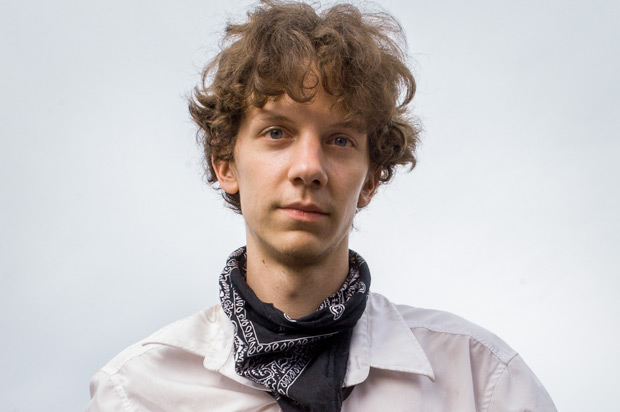
Jeremy Hammond Photo: Jim Newberry, FreeHammond.com

Jeremy Hammond Photo: Jim Newberry, FreeHammond.com

By Sparrow Media and Jeremy Hammond

[NEW YORK, NY] Jeremy Hammond, a 28-year-old political activist, was sentenced today to 10 years in prison after pleading guilty to participating in the Anonymous hack into the computers of the private intelligence firm Strategic Forecasting (Stratfor). The Ceremonial Courtroom at the Federal Court for the Southern District of New York was filled today with an outpouring of support by journalists, activists and other whistleblowers who see Jeremy Hammond’s actions as a form of civil disobedience, motivated by a desire to protest and expose the secret activities of private intelligence corporations.

The hearing opened with arguments as to what sections of the court record will remain redacted after sentencing. While Jeremy’s attorneys initially erred on the side of caution in previous memorandums and kept large pieces of the record redacted, both the defense and prosecution agreed this morning that many of the sections should now be made available for public view. The prosecution, however took stiff exception to portions of the court record being made public that indicate victims, specifically foreign governments, that Jeremy allegedly hacked under the direction of Hector “Sabu” Monsegur, the FBI informant at the helm of Jeremy’s alleged actions. Judge Preska ordered that the names of these foreign governments remain sealed.

Jeremy’s counsel, Sarah Kunstler, who is 9 months pregnant and due to give birth today, delivered a passionate testimonial as to the person that Jeremy is, and the need for people like Jeremy during this era of exponential changes in our socio-political landscape. (Read Sarah Kunstler’s complete argument HERE) She was followed by co-counsel, Susan Kellman, who wept as she recalled her own experiences reading the hundreds of letters from supporters to the court detailing Jeremy Hammond’s unbridled selflessness and enthusiastic volunteerism. She pointed out that it was this same selflessness that motivated Jeremy’s actions in this case. She closed her testimony by underscoring that, “The centerpiece of our argument is a young man with high hopes and unbelievably laudable expectations in this world.”

Susan was followed by Jeremy Hammond himself, who gave a detailed, touching and consequential allocution to the court. The following is Jeremy’s statement to the court. We have redacted a portion [marked in red] upon the orders of Judge Preska. While we believe the public has a right to know the redacted information therein, we refuse to publish information that could adversely effect Jeremy or his counsel.

JEREMY HAMMOND’S SENTENCING STATEMENT | 11/15/2013

Good morning. Thank you for this opportunity. My name is Jeremy Hammond and I’m here to be sentenced for hacking activities carried out during my involvement with Anonymous. I have been locked up at MCC for the past 20 months and have had a lot of time to think about how I would explain my actions.

Before I begin, I want to take a moment to recognize the work of the people who have supported me. I want to thank all the lawyers and others who worked on my case: Elizabeth Fink, Susan Kellman, Sarah Kunstler, Emily Kunstler, Margaret Kunstler, and Grainne O’Neill. I also want to thank the National Lawyers Guild, the Jeremy Hammond Defense Committee and Support Network, Free Anons, the Anonymous Solidarity Network, Anarchist Black Cross, and all others who have helped me by writing a letter of support, sending me letters, attending my court dates, and spreading the word about my case. I also want to shout out my brothers and sisters behind bars and those who are still out there fighting the power.

The acts of civil disobedience and direct action that I am being sentenced for today are in line with the principles of community and equality that have guided my life. I hacked into dozens of high profile corporations and government institutions, understanding very clearly that what I was doing was against the law, and that my actions could land me back in federal prison. But I felt that I had an obligation to use my skills to expose and confront injustice—and to bring the truth to light.

Could I have achieved the same goals through legal means? I have tried everything from voting petitions to peaceful protest and have found that those in power do not want the truth to be exposed. When we speak truth to power we are ignored at best and brutally suppressed at worst. We are confronting a power structure that does not respect its own system of checks and balances, never mind the rights of it’s own citizens or the international community.

My introduction to politics was when George W. Bush stole the Presidential election in 2000, then took advantage of the waves of racism and patriotism after 9/11 to launch unprovoked imperialist wars against Iraq and Afghanistan. I took to the streets in protest naively believing our voices would be heard in Washington and we could stop the war. Instead, we were labeled as traitors, beaten, and arrested.

I have been arrested for numerous acts of civil disobedience on the streets of Chicago, but it wasn’t until 2005 that I used my computer skills to break the law in political protest. I was arrested by the FBI for hacking into the computer systems of a right-wing, pro-war group called Protest Warrior, an organization that sold racist t-shirts on their website and harassed anti-war groups. I was charged under the Computer Fraud and Abuse Act, and the “intended loss” in my case was arbitrarily calculated by multiplying the 5000 credit cards in Protest Warrior’s database by $500, resulting in a total of $2.5 million.My sentencing guidelines were calculated on the basis of this “loss,” even though not a single credit card was used or distributed – by me or anyone else. I was sentenced to two years in prison.

While in prison I have seen for myself the ugly reality of how the criminal justice system destroys the lives of the millions of people held captive behind bars. The experience solidified my opposition to repressive forms of power and the importance of standing up for what you believe.

When I was released, I was eager to continue my involvement in struggles for social change. I didn’t want to go back to prison, so I focused on above-ground community organizing. But over time, I became frustrated with the limitations, of peaceful protest, seeing it as reformist and ineffective. The Obama administration continued the wars in Iraq and Afghanistan, escalated the use of drones, and failed to close Guantanamo Bay.

Around this time, I was following the work of groups like Wikileaks and Anonymous. It was very inspiring to see the ideas of hactivism coming to fruition. I was particularly moved by the heroic actions of Chelsea Manning, who had exposed the atrocities committed by U.S. forces in Iraq and Afghanistan. She took an enormous personal risk to leak this information – believing that the public had a right to know and hoping that her disclosures would be a positive step to end these abuses. It is heart-wrenching to hear about her cruel treatment in military lockup.

I thought long and hard about choosing this path again. I had to ask myself, if Chelsea Manning fell into the abysmal nightmare of prison fighting for the truth, could I in good conscience do any less, if I was able? I thought the best way to demonstrate solidarity was to continue the work of exposing and confronting corruption.

I was drawn to Anonymous because I believe in autonomous, decentralized direct action. At the time Anonymous was involved in operations in support of the Arab Spring uprisings, against censorship, and in defense of Wikileaks. I had a lot to contribute, including technical skills, and how to better articulate ideas and goals. It was an exciting time – the birth of a digital dissent movement, where the definitions and capabilities of hacktivism were being shaped.

I was especially interested in the work of the hackers of LulzSec who were breaking into some significant targets and becoming increasingly political. Around this time, I first started talking to Sabu, who was very open about the hacks he supposedly committed, and was encouraging hackers to unite and attack major government and corporate systems under the banner of Anti Security. But very early in my involvement, the other Lulzsec hackers were arrested, leaving me to break into systems and write press releases. Later, I would learn that Sabu had been the first one arrested, and that the entire time I was talking to him he was an FBI informant.

Anonymous was also involved in the early stages of Occupy Wall Street. I was regularly participating on the streets as part of Occupy Chicago and was very excited to see a worldwide mass movement against the injustices of capitalism and racism. In several short months, the “Occupations” came to an end, closed by police crackdowns and mass arrests of protestors who were kicked out of their own public parks. The repression of Anonymous and the Occupy Movement set the tone for Antisec in the following months – the majority of our hacks against police targets were in retaliation for the arrests of our comrades.

I targeted law enforcement systems because of the racism and inequality with which the criminal law is enforced. I targeted the manufacturers and distributors of military and police equipment who profit from weaponry used to advance U.S. political and economic interests abroad and to repress people at home. I targeted information security firms because they work in secret to protect government and corporate interests at the expense of individual rights, undermining and discrediting activists, journalists and other truth seekers, and spreading disinformation.

I had never even heard of Stratfor until Sabu brought it to my attention. Sabu was encouraging people to invade systems, and helping to strategize and facilitate attacks. He even provided me with vulnerabilities of targets passed on by other hackers, so it came as a great surprise when I learned that Sabu had been working with the FBI the entire time.

On December 4, 2011, Sabu was approached by another hacker who had already broken into Stratfor’s credit card database. Sabu, under the watchful eye of his government handlers, then brought the hack to Antisec by inviting this hacker to our private chatroom, where he supplied download links to the full credit card database as well as the initial vulnerability access point to Stratfor’s systems.

I spent some time researching Stratfor and reviewing the information we were given, and decided that their activities and client base made them a deserving target. I did find it ironic that Stratfor’s wealthy and powerful customer base had their credit cards used to donate to humanitarian organizations, but my main role in the attack was to retrieve Stratfor’s private email spools which is where all the dirty secrets are typically found.

It took me more than a week to gain further access into Stratfor’s internal systems, but I eventually broke into their mail server. There was so much information, we needed several servers of our own in order to transfer the emails. Sabu, who was involved with the operation at every step, offered a server, which was provided and monitored by the FBI. Over the next weeks, the emails were transferred, the credit cards were used for donations, and Stratfor’s systems were defaced and destroyed. Why the FBI would introduce us to the hacker who found the initial vulnerability and allow this hack to continue remains a mystery.

As a result of the Stratfor hack, some of the dangers of the unregulated private intelligence industry are now known. It has been revealed through Wikileaks and other journalists around the world that Stratfor maintained a worldwide network of informants that they used to engage in intrusive and possibly illegal surveillance activities on behalf of large multinational corporations.

After Stratfor, I continued to break into other targets, using a powerful “zero day exploit” allowing me administrator access to systems running the popular Plesk webhosting platform. Sabu asked me many times for access to this exploit, which I refused to give him. Without his own independent access, Sabu continued to supply me with lists of vulnerable targets. I broke into numerous websites he supplied, uploaded the stolen email accounts and databases onto Sabu’s FBI server, and handed over passwords and backdoors that enabled Sabu (and, by extension, his FBI handlers) to control these targets.

These intrusions, all of which were suggested by Sabu while cooperating with the FBI, affected thousands of domain names and consisted largely of foreign government websites, including those of XXXXXXX, XXXXXXXX, XXXX, XXXXXX, XXXXX, XXXXXXXX, XXXXXXX and the XXXXXX XXXXXXX. In one instance, Sabu and I provided access information to hackers who went on to deface and destroy many government websites in XXXXXX. I don’t know how other information I provided to him may have been used, but I think the government’s collection and use of this data needs to be investigated.

The government celebrates my conviction and imprisonment, hoping that it will close the door on the full story. I took responsibility for my actions, by pleading guilty, but when will the government be made to answer for its crimes?

The U.S. hypes the threat of hackers in order to justify the multi billion dollar cyber security industrial complex, but it is also responsible for the same conduct it aggressively prosecutes and claims to work to prevent. The hypocrisy of “law and order” and the injustices caused by capitalism cannot be cured by institutional reform but through civil disobedience and direct action. Yes I broke the law, but I believe that sometimes laws must be broken in order to make room for change.

In the immortal word of Frederick Douglas, “Power concedes nothing without a demand. It never did and it never will. Find out just what any people will quietly submit to and you have found out the exact measure of injustice and wrong which will be imposed upon them, and these will continue till they are resisted with either words or blows, or both. The limits of tyrants are prescribed by the endurance of those whom they oppress.”

This is not to say that I do not have any regrets. I realize that I released the personal information of innocent people who had nothing to do with the operations of the institutions I targeted. I apologize for the release of data that was harmful to individuals and irrelevant to my goals. I believe in the individual right to privacy – from government surveillance, and from actors like myself, and I appreciate the irony of my own involvement in the trampling of these rights. I am committed to working to make this world a better place for all of us. I still believe in the importance of hactivism as a form of civil disobedience, but it is time for me to move on to other ways of seeking change. My time in prison has taken a toll on my family, friends, and community. I know I am needed at home. I recognize that 7 years ago I stood before a different federal judge, facing similar charges, but this does not lessen the sincerity of what I say to you today.

It has taken a lot for me to write this, to explain my actions, knowing that doing so — honestly — could cost me more years of my life in prison. I am aware that I could get as many as 10 years, but I hope that I do not, as I believe there is so much work to be done.

STAY STRONG AND KEEP STRUGGLING!

To schedule interviews with Jeremy Hammond’s attorneys and supporters following today’s sentencing please contact Andy Stepanian, 631.291.3010, andy@sparrowmedia.net.

The Jeremy Hammond Defense Committee is a coalition of family members, activists, lawyers, and other supporters who are working together to protect free speech and to support Jeremy Hammond. The committee’s goal is to provide information to the public and the press, to organize events related to Jeremy’s case, and to support Jeremy while he is in jail. For more information, please visit http://freejeremy.net.

sparrow donate

Geopolitical Motives Behind Kenya Mass Shooting

Western corporate news has predictably portrayed the recent massacre in Kenya as a senseless terrorist attack by “Muslim fanatics” of Al Shabaab, a Somalian Al Qaeda franchise. If their motive was solely religious, perpetrating a large-scale slaughter drawing international condemnation would be a self-defeating act. Unfortunately, propaganda and mass social conditioning has led many in the West to accept that Muslim terrorists “hate us for our freedoms” and will do anything to wipe out everyone but themselves. Of course this is a stereotype and is no more true than saying fundamentalist Christian or Jewish terrorists want to kill all Muslims. The reality of terrorism is much more complex and convoluted (and often involves covert intelligence agencies).

Tony Cartalucci of Land Destroyer Report puts the Nairobi mall attack in context, describing how in 2011 the Kenyan military participated in attacks against Somalia with U.S. and French forces. But this wasn’t the first attack against Somalia the U.S. was involved in. According to Cartalucci:

Before using Kenya as a proxy for US aggression in Africa, and amidst two decades of unilateral, covert military operations, the US had backed two Ethiopian invasions into Somalia. The first US-backed invasion, under then US President George Bush, was carried out in 2006. USA Today reported in its 2007 article, “U.S. support key to Ethiopia’s invasion,” that:

The United States has quietly poured weapons and military advisers into Ethiopia, whose recent invasion of Somalia opened a new front in the Bush administration’s war on terrorism.

The second US-backed Ethiopian invasion of Somalia, under US President Barack Obama, was carried out in 2011 – coordinated with Kenya’s 2011 US-French-backed extraterritorial adventure into Somali territory. The UK Independent’s December 2011 article, “UN-backed invasion of Somalia spirals into chaos,” reported that:

Kenya’s invasion of Somalia, hailed by the West and the UN Security Council, was meant to deliver a knockout blow to the militant Islamist group al-Shabaab. Instead it has pulled Somalia’s regional rival Ethiopia back into the country, stirred up the warlords and rekindled popular support for fundamentalists whose willingness to let Somalis starve rather than receive foreign aid had left them widely hated.

It was in fact this US-backed military invasion that served as the alleged motivation of the Al Shabaab terrorists who attacked Kenya’s Westgate Mall this week.

In the same article, Cartalucci describes in detail how and why the same terrorists the U.S. is funding and arming in Syria are behind the massacre in Kenya. He also provides a concise description of what Al Qaeda really is and how they support the objectives of Western superpowers:

Al Qaeda: The Perfect Pretext to Invade, The Perfect Mercenary Army to Covertly Wage War

Al Qaeda, for the West, serves as the ultimate geopolitical tool. It can be used as a pretext to invade, as well as a nearly inexhaustible mercenary army to carry out ruthless terrorist campaigns and even full-scale war as seen in Syria and Libya, to achieve Western objectives. Additionally, the omnipresent, nebulous nature of Al Qaeda serves as justification to strip away the rights and liberties of people at home, across Western civilization – perpetuating a climate of fear within which the seeds of very profitable war can be sown and continuously reaped.

How profitable? A Harvard’s Kennedy School research paper titled, “The Financial Legacy of Iraq and Afghanistan,” places the total expenditures of the Afghanistan and Iraq wars alone somewhere between 4-6 trillion dollars. That isn’t 4-6 trillion dollars that went into a black hole. That is 4-6 trillion dollars that went to the Fortune 500 corporations that engineered and sold these conflicts to the American public in the first place.

Read the full article here: http://landdestroyer.blogspot.com/2013/09/kenyan-bloodbath-reaping-benefits-of-us.html#more

Channel Surfing

A compilation of some of the best non-corporate alternative news clips from the past few days.

9/17 On Episode 237 of Breaking the Set,  Abby Martin and guests commemorate the second Occupy Wall Street anniversary.

9/18 At the WeAreChange channel, Luke Rudkowski interviews Everett Stern, a former employee of HSBC who blew the whistle on the company’s criminal schemes.

9/19 Ben Swann of Reality Check takes a look at three of the biggest current controversies surrounding Monsanto (one of the world’s most hated corporations).

9/19 Global Research TV’s James Corbett reports on inconsistencies and video manipulation that calls into question the official narrative of the Syrian chemical weapons attack.

9/19 Secular Talk gives a blistering critique of John McCain’s recent Pravda op-ed.

Joy Camp and WeAreChange.org introduce the iPhone 5nSa.