What’s Wrong with the Economy: 9 Toxic Dynamics

By Charles Hugh Smith

Source: Of Two Minds

These nine dynamics are mutually reinforcing.

Beneath the surface signals of an eternally rising stock market and expanding GDP, we all sense something is deeply, systemically wrong with the U.S. economy. These nine structural dynamics generate secondary dynamics, all of which are toxic to social mobility, sustainable prosperity, accountability and democracy:

1. The financialization of the economy, which transformed services, credit, risk and labor into commodities that could be traded globally. Financialization generates enormously asymmetric returns: those with access to low-cost credit, global markets and expertise in finance collect the lion’s share of gains in income and wealth.

2. The technological transformation of the economy, which has placed a substantial scarcity premium on specific tech/managerial/communication skills and devalued ordinary labor and capital. As a result, the majority of gains in wealth and income flow to those with the scarce skills and forms of capital, leaving little for ordinary labor and capital.

3. The end of cheap fossil fuels. The fracking boom/bubble has obscured the long-term secular trend: the depletion of cheap-to-access and process oil. As many analysts have observed (Nate Hagens, Gail Tverberg, Richard Heinberg, Chris Martenson et al.), the global economy only grows if energy and credit are both cheap.

4. Globalization, which transformed the developing world into the environmental dumping ground of the wealthy nations and enabled the owners of capital to offshore waste and labor.

5. The destructive consequences of “growth at any cost” are piling up. “Growth” is the one constant of all existing political-economic systems, and none of the current Modes of Production (i.e. the structures that organize production, consumption, the economy and society) recognize that “growth” is not sustainable.

The first two dynamics drive three other dynamics that have hollowed out the productive economy:

6. The dominance of debt-funded speculation as the means of “getting ahead” as opposed to producing products and services of intrinsic value that serve the core needs of communities.

7. The economy’s gains in income and wealth are concentrated in the very top of the wealth-power pyramid: the top 5%–entrepreneurs, professionals and technocrats, etc., and within this class, most of the gains go to the top 1/10th of 1% –the existing owners of wealth, and financiers/speculators with access to cheap credit.

The net result is the bottom 95% have few opportunities to “get ahead” outside of gambling in the asset bubbles du jour: the stock and housing market. While the average middle class household may be able to borrow enough to speculate in the housing bubble, two factors limit the odds of success for ordinary investors/gamblers:

A. The gains in housing are concentrated in specific markets; outside these hot markets, gains are modest.

B. Asset bubbles eventually pop, leaving those still owning the assets with losses. The risks are thus intrinsic and high. The average investor/gambler lacks the experience needed to recognize the bubble has stopped expanding and exit the market before ll the other speculators rush for the narrowing exit.

8. The devaluation of ordinary labor and capital means the bottom 60% of the economy that lacks the requisite skills with a scarcity premium in the Emerging Economy have lost easy access to the ladder of social mobility.

9. The concentration of wealth and power in the hands of the self-serving few corrupts the economy and democracy. The U.S. economy is dominated by insider and elite rackets, skims, scams and cartels/quasi-monopolies, all of which corrupt the economy by creating perverse incentives for exploitation and gaming the system to benefit the few at the expense of the many.

This corruption in service of maximizing private/personal gains at the expense of the system itself also corrupts the mechanisms of governance, which are now little more than cloaking devices that protect insiders and elites from scrutiny and consequences.

The 20% above the bottom 60% may appear to have some access to social/economic mobility, but this is largely an artifact of the bubble economy since 2009. Once the bubble deflates, the illusion of social mobility for the “middle class” between the bottom 60% and the upper 20% vanishes.

The “upper middle class” between the bottom 80% and the top 5% is being squeezed by the over-production of elites, i.e. the over-abundance of those with college degrees and the relative scarcity of secure jobs within the top 5%. As a result, credential inflation is rampant, with Masters Degrees replacing Bachelors Degrees as the default for a white-collar job, and PhDs replacing Masters diplomas as the new default for positions that lack security and upward mobility.

In other words, the number of people who qualify for and desire a slot in the elite class (top 5%) far exceeds the number of slots available. As Peter Turchin has explained, this competition generates social disorder at the top of economic heap as the top 20% fight over the few positions open in the top 5%. The disgruntled, frustrated losers far outnumber the relatively few winners.

These nine dynamics are mutually reinforcing, meaning that each dynamic strengthens one or more of the others, reinforcing each other so the sum of the nine is far more powerful than a mere addition might suggest.

The New Aristocracy (the top 9.9%) (The Atlantic)


A 2% Financial Wealth Tax Would Provide A $12,000 Annual Stipend To Every American Household

Careful analysis reveals a number of excellent arguments for the implementation of a Universal Basic Income.

By Paul Buchheit

Source: Nation of Change

It’s not hard to envision the benefits in work opportunities, stress reduction, child care, entrepreneurial activity, and artistic pursuits for American households with an extra $1,000 per month. It’s also very easy to justify a financial wealth tax, given that the dramatic stock market surge in recent years is largely due to an unprecedented degree of technological and financial productivity that derives from the work efforts and taxes of ALL Americans. A 2% annual tax on financial wealth is a small price to pay for the great fortunes bestowed on the most fortunate Americans.

The REASONS? Careful analysis reveals a number of excellent arguments for the implementation of a Universal Basic Income (UBI).

(1) Our Jobs are Disappearing

A 2013 Oxford study determined that nearly HALF of American jobs are at risk of being replaced by computers, AI, and robots. Society simply can’t keep up with technology. As for the skeptics who cite the Industrial Revolution and its job-enhancing aftermath (which actually took 60 years to develop), the McKinsey Global Institute says that society is being transformed at a pace “ten times faster and at 300 times the scale” of the radical changes of two hundred years ago.

(2) Half of America is Stressed Out or Sick

Half of Americans are in or near poverty, unable to meet emergency expenses, living from paycheck to paycheck, and getting physically and emotionally ill because of it. Numerous UBI experiments have led to increased well-being for their participants. A guaranteed income reduces the debilitating effects of inequality. As one recipient put it, “It takes me out of depression…I feel more sociable.”

(3) Children Need Our Help

This could be the best reason for monthly household stipends. Parents, especially mothers, are unable to work outside the home because of the all-important need to care for their children. Because we currently lack a UBI, more and more children are facing hunger and health problems and educational disadvantages.

(4) We Need More Entrepreneurs

A sudden influx of $12,000 per year for 126 million households will greatly stimulate the economy, potentially allowing millions of Americans to TAKE RISKS that could lead to new forms of innovation and productivity.

Perhaps most significantly, a guaranteed income could relieve some of the pressure on our newest generation of young adults, who are deep in debt, underemployed, increasingly unable to live on their own, and ill-positioned to take the entrepreneurial chances that are needed to spur innovative business growth. No other group of Americans could make more productive use of an immediate boost in income.

(5) We Need the Arts & Sciences

A recent Gallup poll found that nearly 70% of workers don’t feel ‘engaged’ (enthusiastic and committed) in their jobs. The work chosen by UBI recipients could unleash artistic talents and creative impulses that have been suppressed by personal financial concerns, leading, very possibly, to a repeat of the 1930s, when the Works Progress Administration hired thousands of artists and actors and musicians to help sustain the cultural needs of the nation.

Arguments against

The usual uninformed and condescending opposing argument is that UBI recipients will waste the money, spending it on alcohol and drugs and other ‘temptation’ goods. Not true. Studies from the World Bank and the Brooks World Poverty Institute found that money going to poor families is used primarily for essential needs, and that the recipients experience greater physical and mental well-being as a result of their increased incomes. Other arguments against the workability of the UBI are countered by the many successful experiments conducted in the present and recent past: FinlandCanada, Netherlands, Kenya, IndiaGreat Britain, Uganda, Namibia, and in the U.S. in Alaska and California.

How to pay for it

Largely because of the stock market, U.S. financial wealth has surged to $77 trillion, with the richest 10% owning over three-quarters of it. Just a 2 percent tax on total financial wealth would generate enough revenue to provide a $12,000 annual stipend to every American household (including those of the richest families).

It’s easy to justify a wealth tax. Over half of all basic research is paid for by our tax dollars. All the technology in our phones and computers started with government research and funding. Pharmaceutical companies wouldn’t exist without decades of support from the National Institutes of Health. Yet the tech and pharmaceutical companies claim patents on the products paid for and developed by the American people.

The collection of a wealth tax would not be simple, since only about half of U.S. financial wealth is held directly in equities and liquid assets (Table 5-2). But it’s doable. As Thomas Piketty notes, “A progressive tax on net wealth is better than a progressive tax on consumption because first, net wealth is better defined for very wealthy individuals..”

And certainly a financial industry that knows how to package worthless loans into A-rated mortgage-backed securities should be able to figure out how to tax the investment companies that manage the rest of our ever-increasing national wealth.


A Stock Market Primer, in Six Easy Steps

By

Source: CounterPunch

What is the stock market?

1) It’s not real economic activity—it’s a form of mass hysteria or mass psychosis.

2) Stock prices reflect a mass-hysteria impression of the worth of a piece of paper you hold—a stock certificate. The worth of that piece of paper is sometimes tethered to some economic reality of some corporation—at least partially—but sometimes not. Often a stock price bears little relation to the economic health of a company, as illustrated in the wildly gyrating stock price-to-earnings ratios through the decades. Hence the stock price is often a matter of caprice, covert manipulation, and/or unfathomable crowd psychology, not necessarily real economic “health” or productivity.

If, say, you are fortunate enough to own a stock that has doubled or tripled in price, this does not mean that you have accrued new wealth—that stock valuation is meaningless as long as you still own the piece of paper (the stock certificate); you realize that wealth only by selling the stock. And if you do cash out—sell the piece of paper—to someone else, you are transferring to another person the hazard of seeing that valuation drop or evaporate—an opportune fobbing off of risk to someone else, a transfer of cash to you, but no real creation of wealth—just the passing on of a piece of paper in exchange for currency. Eventually, down the road, your gain will be someone else’s loss when the music stops playing and the last holder of the piece of paper finds there is no chair for him to land on—the stock market as Ponzi scheme.

If everyone or most people decide to sell their pieces of paper—to take their profits—all at once, then the stock prices tumble, so the idea that everyone can cash out and realize this imaginary wealth equally and universally is a mirage: if everyone tried to access it at once, it would evaporate. Hence the common notion that rising stock prices indicate a general increase in wealth or national prosperity is delusional. A stock crash does not erase billions or trillions in “wealth” overnight, as we are commonly told. There was never any “wealth” there to begin with, in the sense that a stock price rationally or measurably reflects the worth of tangible goods or services; that price is just a mass fever dream, a collective, chaotic, bidding war about the worth of pieces of paper.

3) The stock market is a swindle.

Much of the movement of these equities markets originates in the decisions of large funds or high-speed traders who have access to esoteric information, advanced algorithms, or trading networks from which Joe Trader, playing the market at home on his laptop, is excluded. Hence Joe Trader inevitably gets screwed. The author Michael Lewis draws the veil from this complicated high-tech rigging in a 2014 interview with CBS’s 60 Minutes:

Steve Kroft: What’s the headline here?

Michael Lewis: Stock market’s rigged. The United States stock market, the most iconic market in global capitalism is rigged.

Steve Kroft: By whom?

Michael Lewis: By a combination of these stock exchanges, the big Wall Street banks and high-frequency traders.

Steve Kroft: Who are the victims?

Michael Lewis: Everybody who has an investment in the stock market. . . .

Steve Kroft: And this is all being done by computers?

Michael Lewis: All being done by computers. It’s too fast to be done by humans. Humans have been completely removed from the marketplace. “Fast” is the operative word. Machines with secret programs are now trading stocks in tiny fractions of a second, way too fast to be seen or recorded on a stock ticker or computer screen. Faster than the market itself. High-frequency traders, big Wall Street firms and stock exchanges have spent billions to gain an advantage of a millisecond for themselves and their customers, just to get a peek at stock market prices and orders a flash before everyone else, along with the opportunity to act on it. . . . The insiders are able to move faster than you. They’re able to see your order and play it against other orders in ways that you don’t understand. They’re able to front run your order.

Steve Kroft: What do you mean front run?

Michael Lewis: Means they’re able to identify your desire to, to buy shares in Microsoft and buy ‘em in front of you and sell ‘em back to you at a higher price. It all happens in infinitesimally small periods of time. There’s speed advantage that the faster traders have is milliseconds, some of it is fractions of milliseconds. But it’s enough for them to identify what you’re gonna do and do it before you do it at your expense.

4) The MSM commentators on the markets are all industry touts.

Their unvarying counsel, under all circumstances, is this: Get into the market. Get in if you’re not in already. Stay in if you’re already in. A plunge is a buying opportunity. A surge is a buying opportunity. A buying opportunity is that which puts a commission in their pockets. A mass exit from the stock market is the end of their livelihood. I don’t know the Latin term for the logical fallacy at work here, but I think the English translation is something like this: bullshit being slung by greedy con artists. These are people with no more conscience or expertise than the barking guy with the Australian accent on the three a.m. informercial raving about a miracle degreaser or stain remover.

5) This market, more than most, is a big fat bubble, ready to pop.

This bubble is a cloistered biosphere of Teslas and beach houses, of con artists, kleptocrats, and financial sorcerers. It is rigorously insulated from the dolorous real economy inhabited by the 99 percent: declining living standards; stagnant real hourly wages; lousy service-industry jobs; debilitating consumer and student debt peonage; soaring medical insurance premiums and deductibles that render many people’s swiss-cheese policies unusable; crumbling cities and infrastructure; climate disasters of biblical proportions; and toxic food, water, and air. This stock-market bubble has been artificially inflated by historically low interest rates (so the suckers have to go into the market to get a return on their money) and Fed “quantitative easing,” a technocratic euphemism for a novel form of welfare for the one percent that has left untold trillions of “liquidity” sloshing around among the financial elites with which to play Monopoly with one another and pad their net worth by buying back shares of their own companies to inflate stock prices. Moreover, this bubble is even more perilous and tenuous than previous ones because the “air” inside is being pumped by unprecedented levels of consumer and institutional debt that will cause a deafening “pop” when some of the key players start to lose their shirts, and suddenly all the Peters start calling in the debts of all the Pauls who can’t pay.

6) The end game is near. We can console ourselves that these latest innovations in financial prestidigitation and fraud are stretched about as far as they can go. The financial elites are out of three-card monte scams to suck the wealth out of the economy. The heroic productivist heyday of capitalism, celebrated by Marx himself, is over in this country—no more driven visionary builders of railroads, factories, skyscrapers, and highways to a better tomorrow: just endless financial skullduggery and hoarding at the top, and for the rest of us the cold comforts of cell phones, smart televisions, and the endless streams of plastic consumer junk circulating through Amazon and Walmart. What Baudrillard called “the mirror of production” is a prison for the planet earth and every species on it. All that is left for the bipartisan predator class of the United States is scavenging: massive tax breaks for the rich today and tomorrow, perhaps, no more Medicare, no more Social Security, no more public schools—if they have their way, and they probably will. Pop goes the stock market, the illusion of prosperity, the whole unsustainable carbon-poison “economy,” and pop goes the planet and the human race. But look at it this way: it’s a buying opportunity.

Slowly, Then All at Once

imageedit_4850_9701377216

By James Howard Kunstler

Source: Clusterfuck Nation

The staggering incoherence of the election campaign only mirrors the shocking incapacity of the American public, from top to bottom, to process the tendings of our time. The chief tending is permanent worldwide economic contraction. Having hit the resource wall, especially of affordable oil, the global techno-industrial economy has sucked a valve in its engine.

For sure there are ways for human beings to inhabit this planet, perhaps in a civilized mode, but not at the gigantic scale of the current economic regime. The fate of this order has nothing to do with our wishes or preferences. It’s going down whether we like it or not because it was such a violent anomaly in world history and the salient question is: how do we manage our journey to a new disposition of things. Neither Trump or Clinton show that they have a clue about the situation.

The quandary I describe is often labeled the end of growth. The semantic impact of this phrase tends to paralyze even well-educated minds, most particularly the eminent econ professors, the Yale lawyers-turned-politicos, the Wall Street Journal editors, the corporate poobahs of the “C-Suites,” the hedge fund maverick-geniuses, and the bureaucratic errand boys (and girls) of Washington. In the absence of this “growth,” as defined by the employment and productivity statistics extruded like poisoned bratwursts from the sausage grinders of government agencies, this elite can see only the yawning abyss. The poverty of imagination among our elites is really something to behold.

As is usually the case with troubled, over-ripe societies, these elites have begun to resort to magic to prop up failing living arrangements. This is why the Federal Reserve, once an obscure institution deep in the background of normal life, has come downstage front and center, holding the rest of us literally spellbound with its incantations against the intractable ravages of debt deflation. (For a brilliant gloss on this phenomenon, read Ben Hunt’s essay “Magical thinking” at the Epsilon Theory website.)

One way out of this quandary would be to substitute the word “activity” for “growth.” A society of human beings can choose different activities that would produce different effects than the techno-industrial model of behavior. They can organize ten-acre farms instead of cell phone game app companies. They can do physical labor instead of watching television. They can build compact walkable towns instead of suburban wastelands (probably even out of the salvaged detritus of those wastelands). They can put on plays, concerts, sing-alongs, and puppet shows instead of Super Bowl halftime shows and Internet porn videos. They can make things of quality by hand instead of stamping out a million things guaranteed to fall apart next week. None of these alt-activities would be classifiable as “growth” in the current mode. In fact, they are consistent with the reality of contraction. And they could produce a workable and satisfying living arrangement.

The rackets and swindles unleashed in our futile quest to keep up appearances have disabled the financial operating system that the regime depends on. It’s all an illusion sustained by accounting fraud to conceal promises that won’t be kept. All the mighty efforts of central bank authorities to borrow “wealth” from the future in the form of “money” — to “paper over” the absence of growth — will not conceal the impossibility of paying that borrowed money back. The future’s revenge for these empty promises will be the disclosure that the supposed wealth is not really there — especially as represented in currencies, stock shares, bonds, and other ephemeral “instruments” designed to be storage vehicles for wealth. The stocks are not worth what they pretend. The bonds will never be paid off. The currencies will not store value. How did this happen? Slowly, then all at once.

We’re on a collision course with these stark realities. They are coinciding with the sickening vectors of national politics in a great wave of latent consequences built up by the sheer inertia of the scale at which we have been doing things. Trump, convinced of his own brilliance, knows nothing, and wears his incoherence like a medal of honor. Clinton literally personifies the horror of these coiled consequences waiting to spring — and the pretense that everything will continue to be okay with her in the White House (not). When these two gargoyle combatants meet in the debate arena a week from now, you will hear nothing about the journey we’re on to a different way of life.

But there is a clear synergy between the mismanagement of our money and the mismanagement of our politics. They have the ability to amplify each other’s disorders. The awful vibe from this depraved election might be enough to bring down markets and banks. The markets and banks are unstable enough to affect the election.

In history, elites commonly fail spectacularly. Ask yourself: how could these two ancient institutions, the Democratic and Republican parties, cough up such human hairballs? And having done so, do they deserve to continue to exist? And if they go up in a vapor, along with the public’s incomes and savings, what happens next?

Enter the generals.

How Do You Know When Your Society Is In The Midst Of Collapse?

boot

By Brandon Smith

Source: Activist Post

As economic turmoil worldwide becomes increasingly apparent, I have been receiving messages from readers expressing some concerns on the public “perception” of collapse. That is to say, there are questions on the average person’s concept of collapse versus the reality of collapse. This is a vital issue that I have discussed briefly in the past, but it deserves a more in-depth analysis.

What is collapse? How do we define it? And, are some of the notions of collapse in the public consciousness completely wrong?

It’s funny, because skeptics opposed to the idea of a U.S. collapse in particular will most often retort with a question they think I cannot or will not answer – “So, Mr. Smith, when specifically is this supposed collapse going to take place? What day and time?”

My response has always been – “We’re in the middle of a collapse right now; you really can’t see it right in front of your sneering face?”

The reason these people are incapable of grasping this kind of answer is in large part due to the popular mainstream conceptions of systemic collapse. These are conceptions that are for the most part delusional and not in line with the facts. The public idea of collapse comes predominantly from Hollywood, and not from personal experience. For the masses (and some preppers, unfortunately), a collapse is an “event” that happens visibly and usually swiftly. You wake up one morning and behold; the television and phones don’t work anymore and zombies are at your doorstep! Yes, it’s childish and cartoonish, but anything less than a Walking Dead/Mad Max scenario and many people act as if all other threats are benign.

This is the driving reason why many Americans are absolutely oblivious to the economic instability that is rampant and blatant within our system the past few months. They might see the same signals that alternative analysts see, but these signals do not register in their brains as dangers.

Look at it this way; say you told a person their whole life that a tiger is a 10-foot tall behemoth with four heads that breathes fire while urinating flesh-rending acid. Say you make movies and TV shows about it and they never have any experience to the contrary. When they finally come across a real tiger, they might try to pet the damn thing instead of running in terror or searching for a means of defense.

To use another vicious animal analogy, when I encounter skeptics with false assumptions of what a collapse actually is, I am often reminded of that woman in Anchorage, Alaska who jumped an enclosure fence at the zoo to get a closer picture of Binky the polar bear. These people have been made so inept when it comes to identifying threats that they will continue arguing with you as the animal takes a football-sized bite out of their meaty thigh.

So what is the root of the problem beyond Hollywood fantasies? Well, the problem is that social and economic collapse is not a singular event, it is a PROCESS. Collapse is a series of events that sometimes span years. Each event increases in volatility over the last event, but as time goes on these events tend to condition the masses. The public develops a normalcy bias towards crisis (like the old “frog in a boiling pot” analogy). They lose all sense of what a healthy system looks like.

It is not uncommon for a society to wade through almost a decade or more of violent decline before finally acknowledging the system is imploding on a fundamental level. It is also not uncommon for societies to endure years of abuse by corrupt governments before either organizing effectively to rebel, or caving in and submitting to totalitarianism.

But how does one recognize a failing system? How does a person know if they are in the middle of a collapse rather than on the “verge” of collapse? Here are some signals I have derived from research of various breakdowns in modern nations and why they indicate we are experiencing collapse right now…

The Criminals Openly Admit To Their Crimes

The surest way to know if your society is in the midst of disintegration is to see if the criminals who created the instability in the first place are openly discussing a collapse scenario or warning that one is imminent.

A year ago, central bankers presented little more than a chorus of recovery propaganda. Today, not so much. The Royal Bank of Scotland is now warning investors to “sell everything” ahead of a “cataclysmic” year in markets.

The Federal Reserve’s Richard Fisher has admitted that the Fed “frontloaded” (manipulated) stock markets into a bubble and that payment is about to come due in the form of severe economic volatility (up to 20% crash in equities).

The Bank for International Settlements, the central bank of central banks, has a track record of warning the public about collapse conditions – right before they happen, leaving little or no time for people to prepare. They have followed their habit by warning in September and December that a Fed rate hike would “shatter” the uneasy calm in markets.

The former Chief Economist of the BIS now says the economy is in worse shape than it was in 2008 and is headed for a larger fall.

What happened between last year and this year and why are these internationalists suddenly so forthcoming about our economic reality? The fact that central bankers are the cause of our current collapse leads me to believe that such admissions are designed to deflect guilt. If they put out a few warnings now, they can then later claim they are prognosticators rather than culprits, and that they were trying to “help us.” Beyond that, the reality is that our situation was just as dire in 2014/2015 as it is today; the difference is that now we are about to enter a new phase in the ongoing collapse, a much more detrimental phase, but still a phase of a breakdown that has been progressing since at least 2008.

The Fundamentals Break Through The Manipulation Barrier

Governments and central banks do not have the capacity to artificially create demand for goods or a supply of well-paying jobs in a crashing economy. What they can do, though, is hide the visible problems in supply and demand with false numbers.

I examined such false economic statistics in great detail last year in a six-part series titled “One Last Look At The Real Economy Before It Implodes.” I will not cover them all again here. I would only point out that recently the fundamentals of supply and demand have begun to break through the deceit of manipulated numbers, and this is a sign that the collapse is about to move from one stage to the next.

With global shipping and trucking freight in steep decline, with retail inventories in stasis and current oil consumption falling to levels not seen since 1997 despite a larger population, the mainstream can no longer deny that consumer demand is crumbling. If demand is falling dramatically, then the financial system is in the middle of falling dramatically; there is simply no way around this truth.

Stocks And Commodities Become Violently Erratic

Let’s be clear, if stock markets represent anything at all, they are merely lagging indicators of economic instability.  Stock markets are NOT predictive indicators of anything useful.  Therefore, any person who does nothing but track equities each day is going to be completely oblivious to the bigger picture behind the economy until it is too late.  They will be so mesmerized by the green numbers and red numbers and lines on minute-to-minute graphs that they will lose all sense of reality.

Violent swings in stocks are a sign of a financial system that is at the middle or end of the collapse process, not the beginning.

It is also important to note that extreme shifts in stocks and commodity values to the upside are just as much a signal of instability as shifts to the downside.  For instance, if you witnessed the recent 9% explosion in oil markets and thought to yourself “Ah, the markets are being stabilized again and nothing is different this time…”, then you are an idiot.

Of course, the next day oil markets lost almost all of the gains they made the day before.  And this is how markets behave when they are about to die; they expand and implode chaotically each day on nothing more that meaningless news headlines rather than hard data.  This heart attack in equities inevitably trends downwards as the weeks and months pass.  Keep in mind, equities are down nearly 10% from their recent highs, and oil is down approximately 50% in the past six months.  Every time there is a dead cat bounce in stocks skeptics come out of the woodwork to call alternative analysts “doomers”, yet they are nowhere to be found when markets come crashing back down.  They are not looking at the overall trend because their short attention spans hinder them.  Again, extreme swings in markets, whether up or down, are a sign of progressing collapse.

Deterioration Of Cultural Values, Heritage And Identity

I have written extensively over the years about the Cloward-Piven strategy; a strategy used by collectivists to destabilize social systems by dumping overt numbers of foreign immigrants into the population without demand for integration. This process has been obvious in the U.S. and Europe for quite some time, but only now is it peaking to the point that collapse is seen as an inevitable result by the public. Europe is worse off than the U.S. in this regard as millions upon millions of Muslim immigrants are injected into the EU’s already dying body; immigrants that intend to transplant their culture from their own failed societies rather than adopting the values and principles of the societies that have invited them in.

Natural-born Americans and legal immigrants with aspiration of integration appear to be fighting back against the Cloward-Piven strategy with some success by holding onto traditional American values despite being labeled “barbarians” and “racists.” Illegal immigration, though, is still completely unchecked.

In the EU, the long campaign of cultural Marxism has made natural-born Europeans perhaps the most self-hating people on the planet as well as the most passive and weak. Organized opposition to massive immigration programs in the EU should have taken place years ago. Now it is far too late, and the European system is finishing a social implosion which should have already been obvious to average citizens.

Open Discussion Of Totalitarian Measures

When corrupt leadership moves from quiet totalitarianism to more open totalitarianism, your society is in the FINAL stages of collapse, not the beginning of a collapse. The U.S. in particular has been slowly strangled with subversive legal directives and political policies ever since the so called “War on Terror” began. However, there are now multiple signals of a much deeper and open tyranny in the works.

A few recent examples stand out, including Barack Obama’s insistence that the office of the president has the legal authority to issues executive orders that affect constitutional protections such as the 2nd Amendment. As many liberty movement activists are aware, there is absolutely no constitutional precedent for the use of executive orders and such powers are not mentioned anywhere in the document. They were simply created out of thin air to be used by the federal government and sometimes state governments to supersede normal checks and balances.

While numerous presidents have issued executive orders, including some that were outright tyrannical, like Franklin Delano Roosevelt’s unconstitutional internment of Japanese Americans into concentration camps, George W. Bush and Barack Obama have been the most subversive in their bypassing of the Constitution. Obama, in particular, has tried to hide the number of executive actions he has taken by issuing hundreds of “presidential memorandums,” which are basically the same dirty play by another name.

These actions have been progressively setting the stage for the removal of checks and balances entirely in the name of crisis management. They are so broad in their nature and vague in their definitions and applications that they could be interpreted by federal authorities to mean just about anything in any given situation.

If executive actions are not scary enough, corrupt politicians are now becoming blunt in their demands for dominance. Two Republican Senators, Mitch McConnel and Lindsay Graham, are calling for unlimited AUMF-style (authorization of use of military force) war powers to be given to the president. Such powers would allow the president to project U.S. military forces anywhere in the world for any reason without review or time limits. This includes the use of military forces on U.S. soil.

The rationale for this is, of course, the threat of ISIS. The same group of terrorists the U.S. government helped to create.

And finally, if you want perhaps the most nonchalant admission of future tyranny in recent days, check out former General Wesley Clark’s call for “disloyal” Americans to be placed in internment camps through the duration of the war on terror, a war that could ostensibly go on forever.

One could argue that all of these measures are meant only to deter “Islamic extremism.” I would point out that government officials could have stemmed that tide at any time by enforcing existing immigration laws, or, by stopping all immigration for a period of years until the problem is handled. Instead, they have allowed open borders to remain, and have even imported potential terrorists while focusing Department of Homeland Security efforts more on evil white guys with guns.

If we accept the violation of the constitutional rights of any group of citizens, if we allow the concept of “thought crime” to become commonplace, then we leave the door open to the violation of our own rights someday. And that is how tyrants trick populations through incremental collapse; by applying despotism to a claimed dangerous minority, then expanding it to everyone else.

America is sitting near the end of the spectrum in terms of economic collapse and in the middle of the spectrum in terms of social collapse.  While more violent events are certainly gestating and are likely to be triggered in the near term, we should not overlook the reality that collapse is happening in stages all around us.  This process gives us at least some time.  All is not lost yet, and the steps we take to organize and prepare today will affect how the collapse process unfolds tomorrow. People who continue to ignore the outright evidence of collapse based on false assumptions of what collapse should look like are only preventing themselves from taking proper action until it is too late. Make no mistake, our system is dying. We cannot allow our false perceptions of this death to cloud the reality of it, or our response to it.


You can read more from Brandon Smith at his site Alt-Market.com. If you would like to support the publishing of articles like the one you have just read, visit our donations page here.  We greatly appreciate your patronage. You can contact Brandon Smith at: brandon@alt-market.com

Markets Ignore Fundamentals And Chase Headlines Because They Are Dying

DIY_Preparedness_Normalcy_Bias_Head_In_Sand_2

By Brandon Smith

Source: Alt-Market.com

Normalcy bias is a rather horrifying thing. It is so frightening because it is so final; much like death, there is simply no coming back. Rather than a physical death, normalcy bias represents the death of reason and simple observation. It is the death of the mind and cognitive thought instead of the death of the body.

Ever since the derivatives collapse of 2008 the public has been regaled with wondrous stories of recovery in the mainstream to the point that such fantasies have become the “new normal”. These are grand tales of the daring heroics of central bankers who “saved us all” from impending collapse through gutsy monetary policy and no-holds-barred stimulus measures.

Alternative economists have not been so easy to dazzle. Most of us found that the recovery narrative lacked a certain something; namely hard data that took the wider picture into account. It seemed as though the mainstream media (MSM) as well as the establishment was attempting to cherry-pick certain numbers out of context while demanding we ignore all other factors as “unimportant.”

We just haven’t been buying into the magic show of the so called “professional economists” and the academics, and now that the real and very unstable fiscal reality of the world is bubbling to the surface, the general public will begin to see why we have been right all these years and the MSM has been utterly wrong.

Mainstream economists have done absolutely nothing in the way of investigative journalism and have instead joined a chorus cheerleading for the false narrative, singing a siren’s song of misinterpreted statistics and outright lies drawing the masses ever nearer to the deadly shoals of financial crisis.

Why do they do this? Are they part of some vast conspiracy to mislead the public?

Not necessarily. While central banks and governments have indeed been proven time and again to collude in efforts to cover up financial dangers, most economists in the media are simply greedy and ignorant. You have to remember, they have a considerable stake in this game.

Many mainstream economists tend to have sizable investment portfolios and they base their careers partly on the successes they garner in the annual profits they accumulate playing the equities roulette. They also have invested so much of their public image into their pro-market and recovery arguments that there is no going back. That is to say, they have a personal interest in using their positions in the media to engineer positive market psychology (if they are able) so that their portfolios remain profitable. Not to mention, their professional image is at stake if they ever acknowledge that they were wrong for so long about the underlying health of the real economy.

This atmosphere of deluded self interest also generates a cult-like collectivist attitude. There is a lot of mutual back scratching and mutual ego stroking in the MSM; a kind of inbred conduit of regurgitated arguments and unoriginal talking points, and people in the club rarely step out of line because they not only hurt their own investment future and career, they also hurt everyone in their professional circles.  Meaning, no more cocktail party invitations to the Forbes rumpus room…

This is not to say that I am excusing their self interested lies and disinformation. I think that many of these people should be tarred and feathered in a public square for attempting to dissuade the public from preparing in a practical way for severe economic instability. I do not think they see themselves as being responsible to the people who actually take their nonsense seriously and their attitude needs adjustment. I am only explaining how it is possible for an entire profession of supposed “experts” to be so wrong so often. Mainstream financial analysts WANT to believe their own lies as much as many in the public want to believe them.

Like I said, normalcy bias is a rather horrifying thing.

One of the root pieces of disinformation in the mainstream that feeds all other lies is the disinformation surrounding falling global demand. MSM pundits cannot and will never fully admit to the cold hard reality of collapsing demand within the global economy. If they are forced to admit to falling demand, then the facade of a steady or recovering U.S. economy crumbles.

I covered the facts behind falling global demand for raw goods and consumer goods last year in part one of my six-part article series, ‘One Last Look At The Real Economy Before It Implodes.’ The hard evidence and numbers I presented have only become more important in recent months.

For example, U.S. inventories are building and freight shipments are declining in the U.S. as retailers cite falling demand for goods as the primary culprit. Official retail sales numbers for the holiday season of 2015 have come in flat. When one takes into account real inflation in prices, consumer sales are actually far in the negative. According to the more accurate methods the U.S. government used to use in their calculations of CPI in the 1980’s, we are looking at annual price inflation rate of around 7%. Price inflation does not necessarily equal improved sales.

Energy usage has been crushed since 2008. Despite a growing population and supposedly a growing economic system, oil consumption in 2014 according to the World Economic Forum dropped to levels not seen since 1997.

This is the exact opposite of what should be happening and it is the opposite of mainstream projections for oil consumption made back in 2003. This is why inventories and storage for oil across the globe are reaching capacity in a manner never seen before. American demand for oil is not growing exponentially as expected because Americans cannot afford to support such growth anymore. Falling energy demand at these extreme levels is an undeniable indicator of a failing economic system.

Of course, mainstream economists in their desperation to keep market psychology rolling forward and the equities casino producing profits seek to spin this problem as an “oversupply” issue rather than a demand issue. And this is where the disparity in their arguments begins to bleed through.

Here is the problem presented in the mainstream; what came first, the chicken or the egg? Did falling demand lead to oversupply and thus a fall in prices? Or, is demand remaining steady and is overproduction the cause of falling prices?  Yes, let’s confuse the issue instead of looking at the obvious.

As already linked above, it was falling demand which came first in 2008, and demand which continues to fall in relation to past trends. Have producers failed to reduce oil production to match falling demand? Yes. But this does not change the fact that oil demand today is well below levels needed to sustain the kind of economic growth markets have come to expect. Mainstream economists attempt to distract by hyper-focusing on supply, or twisting the discussion into an either/or scenario. Either it is a supply problem, or it is a demand problem, and they assert it is only a supply problem. This is not reality.

In fact, both can and often do exist at the same time, though one problem usually feeds the other. Falling demand does tend to result in oversupply in any particular sector of the economy. The bottom line, however, is that in our current crisis demand is the driving force and supply is a secondary issue. Supply is NOT the driving force behind the volatility in oil markets. Period.

This same chicken and egg distraction rears its ugly head in discussions on shipping markets as well.

The mainstream claim that the historic implosion of the Baltic Dry Index is nothing more than a problem of “too many ships” operating in the cargo market has been throttled, dissected and debunked so many times that you would think that it is surely dead. But the lie just will not die.

Mainstream propaganda houses like The Economist and Forbes continue to produce articles on a regular basis which deny the issue of falling demand for raw goods and claim that oversupply of vessels is the root cause of the BDI losing around 98 percent of its value since its highs in 2008.

I haven’t seen any of these articles offer actual stats or evidence to back their claims that oversupply of ships is the culprit and that demand is not a legitimate issue. But beyond that, why does the mainstream seem so hell bent on dismissing the BDI as a reliable economic indicator? Well, because shipping rates fall when demand falls, thus, when the BDI falls, it signals a lack of global demand. This is a fact they refuse to accept. When the BDI falls by 98 percent since the 2008 highs preceding the derivatives crisis, this signals a disaster in the making.

So, let’s stamp out the “too many ships came first” disinformation once and for all, shall we?

Shipping companies like Maersk Lines have already publicly admitted that falling global demand is the core problem behind falling rates and that supply is a secondary driver. They view the current financial crisis to be “worse than 2008”.

The fact that the largest shipping company in the world is warning of falling demand does not seem to be having any effect on the mainstream talking heads, though.

So, what do major shipping companies do when demand is falling and too many ships are operating on the market? Do they field those ships anyway and drive rates down even further? No, that makes no sense.

What companies do is either leave ships idle in port or scrap them. According to BIMCO (Baltic And International Maritime Council), 2015 was the busiest year since 2012 for the scrapping of older ships to make way for new arrivals. This process of scrapping ships or storing them idle destroys the argument that too many ships are driving falling rates in the BDI. In fact, as chief shipping analyst Peter Sand of BIMCO stated last year:

“The increase in Capesize scrapping comes at a much needed time for the market. Looking at the development so far this year the fleet growth has actually been negative, with a reduction of 0.8 %.”

I hope the garbage peddlers at Forbes and The Economist caught that — NEGATIVE growth of ship supply, not massive over-growth of ship supply. The scrapping increase was also across the board for other models of ships, not just the Capsize, and the increase of cargo capacity by new ships has been negligible.  Yet, shipping rates continue to plummet to historical lows.  Only falling demand, as Maersk Lines admits, explains the crash of the BDI in light of this information.

China in particular has been offering considerable incentives to those companies that do scrap older ships, to the point that some are even scrapping semi-new ships in order to cash in.

Now, this is not to say there is not an “oversupply” of ships. There are indeed many ships within cargo fleets that are not in operation. But again, this is because demand has declined so completely that even with increased scrapping and idling, shipping companies cannot keep up.  Falling demand OCCURRED FIRST, and oversupply is nothing more than a symptom of this root problem.

So, mainstream hacks, can we please put the “too many ships” nonsense to rest and get on with a real discussion on obvious issues of demand?  Stop focusing on the symptoms and examine the cause for once.

These are just a few of the hundreds of fundamental problems plaguing the global economy today, and they are all problems that the mainstream continues to ignore or dismiss out of hand. Which brings us to the now accelerating volatility in stock markets.

Stock markets are crashing, there is no other way to paint it. They are crashing incrementally, but crashing nonetheless. When you have violent swings in equities and commodities between 5 percent and 10 percent a day, then something is very wrong with your economy and has been wrong for some time. If global consumption and demand were really steady or growing, then you would not see the kind of systemic backlash in the financial system that we are now seeing.  If companies listed on the Dow were making legitimate profits due to a healthy consumer base and enjoying solid expansion, stocks would not be increasingly volatile.  If investors and mainstream analysts actually looked at the real numbers in demand (among other things), then the strange behavior in markets would be easy for them to understand. They will not look at such numbers until it is too late.

Instead, markets have chosen to chase headlines, and here is where the ugly circle of normalcy bias and cognitive dissonance completes itself. There are no positive indicators within the fundamentals today to energize market faith or market investment. So, investors and algorithmic trading computers track news headlines instead. The MSM hacks now have the power (along with central banks and governments) to create massive stock rallies with one or two carefully placed news tags, such as “Russia To Discuss Oil Production Cuts With OPEC.”

Market speculators and trading computers jump on these headlines without verifying if they are true. In most cases, they end up being false or just hearsay from an “unnamed source.” And so, the markets then crash further down into the abyss, waiting for the next headline to bolster activity even for a day.

The sad truth is, if any of these headlines turned out to be legitimate, their effect would still be meaningless in the long run as the overwhelming weight of the fundamentals continues to topple poorly placed optimism. Now that the investment world no longer has the certainty of central bank intervention as a useful tool, they don’t know if bad news is good news or if good news is bad news. The fact that the system is moving into a death spiral without the psychological crutch of central bank stimulus measures should tell you all you need to know about the supposed recovery since 2008.

No society wants to admit economic failure or economic sabotage, and this is why the con-game is able to continue in the face of so much concrete truth. Ultimately, the market trends and economic trends will flow into the negative. In the meantime, expect massive market rallies, rallies which will then disintegrate in a matter of days. And, whatever happens, never take what mainstream economists say very seriously. They have failed the public for long enough.

Where is Neo When We Need Him — Paul Craig Roberts

images

By Paul Craig Roberts

Source: PaulCraigRoberts.org

In The Matrix in which Americans live, nothing is ever their fault. For example, the current decline in the US stock market is not because years of excessive liquidity supplied by the Federal Reserve have created a bubble so overblown that a mere six stocks, some of which have no earnings commiserate with their price, accounted for more than all of the gain in market capitalization in the S&P 500 prior to the current disruption.

In our Matrix existence, the stock market decline is not due to corporations using their profits, and even taking out loans, to repurchase their shares, thus creating an artificial demand for their equity shares.

The decline is not due to the latest monthly reporting of durable goods orders falling on a year-to-year basis for the sixth consecutive month.

The stock market decline is not due to a week economy in which after a decade of alleged economy recovery, new and existing home sales are still down by 63% and 23% from the peak in July 2005.

The stock market decline is not due to the collapse in real median family income and, thereby, consumer demand, resulting from two decades of offshoring middle class jobs and partially replacing them with minimum wage part-time Walmart jobs without benefits that do not provide sufficient income to form a household.

No, none of these facts can be blamed. The decline in the US stock market is the fault of China.

What did China do? China is accused of devaluing by a small amount its currency.

Why would a slight adjustment in the yuan’s exchange value to the dollar cause the US and European stock markets to decline?

It wouldn’t. But facts don’t matter to the presstitute media. They lie for a living.

Moreover, it was not a devaluation.

When China began the transition from communism to capitalism, China pegged its currency to the US dollar in order to demonstrate that its currency was as good as the world’s reserve currency. Over time China has allowed its currency to appreciate relative to the dollar. For example, in 2006 one US dollar was worth 8.1 Chinese yuan. Recently, prior to the alleged “devaluation” one US dollar was worth 6.1 or 6.2 yuan. After China’s adjustment to its floating peg, one US dollar is worth 6.4 yuan. Clearly, a change in the value of the yuan from 6.1 or 6.2 to the dollar to 6.4 to the dollar did not collapse the US and European stock markets.

Furthermore, the change in the range of the floating peg to the US dollar did not devalue China’s currency with regard to its non-US trading partners. What had happened, and what China corrected, is that as a result of the QE money printing policies currently underway by the Japanese and European central banks, the dollar appreciated against other currencies. As China’s yuan is pegged to the dollar, China’s currency appreciated with regard to its Asian and European trading partners. The appreciation of China’s currency (due to its peg to the US dollar) is not a good thing for Chinese exports during a time of struggling economies. China merely altered its peg to the dollar in order to eliminate the appreciation of its currency against its other trading partners.

Why did not the financial press tell us this? Is the Western financial press so incompetent that they do not know this? Yes.

Or is it simply that America itself cannot possibly be responsible for anything that goes wrong. That’s it. Who, us?! We are innocent! It was those damn Chinese!

Look, for example, at the hordes of refugees from America’s invasions and bombings of seven countries who are currently overrunning Europe. The huge inflows of peoples from America’s massive slaughter of populations in seven countries, enabled by the Europeans themselves, is causing political consternation in Europe and the revival of far-right political parties. Today, for example, neo-nazis shouted down German Chancellor Merkel, who tried to make a speech asking for compassion for refugees.

But, of course, Merkel herself is responsible for the refugee problem that is destabilizing Europe. Without Germany as Washington’s two-bit punk puppet state, a non-entity devoid of sovereignty, a non-country, a mere vassal, an outpost of the Empire, ruled from Washington, America could not be conducting the illegal wars that are producing the hordes of refugees that are over-taxing Europe’s ability to accept refugees and encouraging neo-nazi parties.

The corrupt European and American press present the refugee problem as if it has nothing whatsoever to do with America’s war crimes against seven countries. I mean, really, why should peoples flee countries when America is bringing them “freedom and democracy?”

Nowhere in the Western media other than a few alternative media websites is there an ounce of integrity. The Western media is a Ministry of Truth that operates full-time in support of the artificial existence that Westerners live inside The Matrix where Westerners exist without thought. Considering their inaptitude and inaction, Western peoples might as well not exist.

More is going to collapse on the brainwashed Western fools than mere stock values.

Wall Street Panic

panicked trader

By Mike Whitney

Source: Counterpunch

“Not only is the equity market at the second most overvalued point in U.S. history, it is also more leveraged against probable long-term corporate cash flows than at any previous point in history.”

— John P. Hussman, Ph.D. “Debt-Financed Buybacks Have Quietly Placed Investors On Margin“, Hussman Funds

“This year feels like the last days of Pompeii: everyone is wondering when the volcano will erupt.”

— Senior banker commenting to the Financial Times

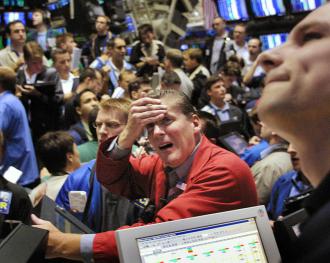
Last Friday’s stock market bloodbath was the worst one-day crash since 2008. The Dow Jones dropped 531 points, while the S&P 500 fell 64, and the tech-heavy Nasdaq slid 171. The Dow lost more than 1,000 points on the week dipping back into the red for the year. At the same time, commodities continued to get hammered with oil prices briefly dropping below the critical $40 per barrel mark. More tellingly, the market’s so called “fear gauge” (VIX) skyrocketed to a 2015 high indicating more volatility to come.  The VIX has remained at unusually low levels for a number of years as investors have grown more complacent figuring the Fed will intervene whenever stocks fall too far. But last week’s massacre cast doubts on  the Central Bank’s intentions. Will the Fed ride to the rescue again or not? To the vast majority of institutional investors, who now base their buying decisions on Fed policy rather than market fundamentals, that is the crucial question.

Ostensibly, last week’s selloff  was triggered by China’s unexpected decision to devalue its currency, the juan.   The announcement confirmed that the world’s second biggest economy is rapidly cooling off increasing the likelihood of a global slowdown. Over the last decade, China has accounted  “for a third of the expansion in the global economy,… almost double the contribution of the US and more than triple the impacts of Europe and Japan.” Fears of a slowdown were greatly intensified on Friday when a survey showed that manufacturing in China shrank at the fastest pace since the recession in 2009. That’s all it took to put the global markets into a nosedive. According to the World Socialist Web Site:

“The deceleration of growth in China, reflected in figures on production, exports and imports, business investment and producer prices, is fueling a near-collapse in so-called “emerging market” economies that depend on the Chinese market for exports of raw materials. The past week saw a further plunge in stock prices and currency rates in Russia, Turkey, Brazil, South Africa and other countries. These economies are being hit by a massive outflow of capital, placing in doubt their ability to meet debt obligations.”

(“Panic sell-off on world financial markets”, World Socialist Web Site)

While a correction was not entirely unexpected following a 6-year long bull market, the sudden drop in equities does have analysts rethinking the effectiveness of the Fed’s monetary policies which have had little impact on personal consumption, retail spending, wages, productivity, household income, or economic growth all of which remain weaker than they have been following any recession in the post war era.  For all intents and purposes, the plan to inflate asset prices by dropping rates to zero and injecting trillions in liquidity into the financial system has been an abject failure.   GDP continues to hover at an abysmal 1.5% while  signs of a strong, self sustaining recovery are nowhere to be seen. At the same time, government and corporate debt continue to balloon at a near-record pace draining capital  away from productive investments that could lay the groundwork for higher employment and stronger growth.

What’s so odd about last week’s market action is that the bad news on China put shares into a tailspin instead of sending them into the stratosphere which has been the pattern for the last four years. In fact, the reason volatility has stayed so low and investors have grown so complacent is because every announcement of bad economic data has been followed by cheery promises from the Fed to keep the easy-money sluicegates open until the storm passes.  That hasn’t been the case this time, in fact, Fed chair Janet Yellen hasn’t even scrapped the idea of jacking up rates some time in September which is almost unthinkable given last week’s market ructions.

Why? What’s changed?   Surely, Yellen isn’t going to sit back and let six years of stock market gains be wiped out in a few sessions, is she?  Or is there something we’re missing here that is beyond the Fed’s powers to change? Is that it?

My own feeling is that China is not the real issue. Yes, it is the catalyst for the selloff, but the real problem is in the credit markets where the spreads on high yield bonds continue to widen relative to US Treasuries.

What does that mean?

It means the price of capital is going up, and when the price of capital goes up, it costs more for businesses to borrow. And when it costs more for businesses to borrow, they reduce their borrowing, which decreases the demand for credit. And when the demand for credit decreases in a credit-based system, then there’s a corresponding slowdown in business investment which impacts stock prices and growth. And that is particularly significant now, since the bulk of corporate investment is being diverted into stock buybacks. Check out this excerpt from a post at Wall Street on Parade:

“According to data from Bloomberg, corporations have issued a stunning $9.3 trillion in bonds since the beginning of 2009. The major beneficiary of this debt binge has been the stock market rather than investment in modernizing the plant, equipment or new hires to make the company more competitive for the future. Bond proceeds frequently ended up buying back shares or boosting dividends, thus elevating the stock market on the back of heavier debt levels on corporate balance sheets.

Now, with commodity prices resuming their plunge and currency wars spreading, concerns of financial contagion are back in the markets and spreads on corporate bonds versus safer, more liquid instruments like U.S. Treasury notes, are widening in a fashion similar to the warning signs heading into the 2008 crash. The $2.2 trillion junk bond market (high-yield) as well as the investment grade market have seen spreads widen as outflows from Exchange Traded Funds (ETFs) and bond funds pick up steam.” (“Keep Your Eye on Junk Bonds: They’re Starting to Behave Like ‘08 “, Wall Street on Parade)

As you can see, the nation’s corporations don’t borrow at zero rates from the Fed. They borrow at market rates in the bond market, and those rates are gradually inching up. And while that hasn’t slowed the stock buyback craze so far,  the clock is quickly running out. We are fast approaching the point where debt servicing, shrinking revenues, too much leverage, and higher rates will no longer make stock repurchases a sensible option, at which point stocks are going to fall off a cliff. Here’s more from Andrew Ross Sorkin at the New York Times:

“Since 2004, companies have spent nearly $7 trillion purchasing their own stock — often at inflated prices, according to data from Mustafa Erdem Sakinc of the Academic-Industry Research Network. That amounts to about 54 percent of all profits from Standard & Poor’s 500-stock index companies between 2003 and 2012, according to William Lazonick, a professor of economics at the University of Massachusetts Lowell.”

You can see the game that’s being played here. Mom and Pop investors are getting fleeced again. They’ve been lending trillions of dollars to corporate CEOs (via bond purchases) who’ve taken the money, split it up among themselves and their wealthy shareholder buddies, (through buybacks and dividends neither of which add a thing to a company’s productive capacity) and made out like bandits.  This, in essence, is how stock buybacks work. Ordinary working people stick their life savings into bonds (because they were told “Stocks are risky, but bonds are safe”.) that offer a slightly better return than ultra-safe, low-yield government debt (US Treasuries) and, in doing so, provide lavish rewards for scheming executives who use it to shower themselves and their cutthroat shareholders with windfall profits that will never be repaid. When analysts talk about “liquidity issues” in the bond market, what they really mean is that they’ve already divvied up the money between themselves and you’ll be lucky if you ever see a dime of it back. Sound familiar?

Of course, it does. The same thing happened before the Crash of ’08. Now we are reaching the end of the credit cycle which could produce the same result. According to one analyst:

“There’s been worrying deterioration in the overall global demand picture with the continuation of EM (Emerging Markets) FX (Currency Markets) onslaught, deterioration in credit metrics with rising leverage in the US as well as outflows in credit funds in conjunction with significant widening in credit spreads…..The goldilocks period of “low rates volatility-stable carry trade environment of the last couple of years is likely coming to an end.”

(“Credit: Magical Thinking“, Macronomics)

In other words, the good times are behind us while hard times are just ahead. And while the end of the credit cycle doesn’t always signal a stock market crash, the massive buildup of leverage in unproductive financial assets like buybacks suggest that equities are in line for a serious whooping. Here’s more from Bloomberg:

“Credit traders have an uncanny knack for sounding alarm bells well before stocks realize there’s a problem. This time may be no different. Investors yanked $1.1 billion from U.S. investment-grade bond funds last week, the biggest withdrawal since 2013, according to data compiled by Wells Fargo & Co…..

“Credit is the warning signal that everyone’s been looking for,” said Jim Bianco, founder of Bianco Research LLC in Chicago. “That is something that’s been a very good leading indicator for the past 15 years.”

Bond buyers are less interested in piling into notes that yield a historically low 3.4 percent at a time when companies are increasingly using the proceeds for acquisitions, share buybacks and dividend payments. Also, the Federal Reserve is moving to raise interest rates for the first time since 2006, possibly as soon as next month, ending an era of unprecedented easy-money policies that have suppressed borrowing costs….

“Unlike the credit market, the equity market well into 2008 was very complacent about the subprime crisis that led to a full blown financial crisis,” the analysts wrote…..

So if you’re very excited about buying stocks right now, just beware of the credit traders out there who are sending some pretty big warning signs.”  (“U.S. Credit Traders Send Warning Signal to Rest of World Markets”, Bloomberg)

It’s worth noting that the above article was written on August 14, a week before the stock market blew up. But credit was “flashing red” long before stock traders ever took notice.

But that’s beside the point. Whether the troubles started with China or the credit markets, probably doesn’t matter. What matters is that the system about to be put-to-the-test once again because the appropriate safeguards haven’t been put in place, because bubbles are unwinding, and because the policymakers who were supposed to monitor and regulate the system decided that they were more interested in shifting  wealth to their voracious colleagues on Wall Street than building a strong foundation for a healthy economy. That’s why a simple correction could turn into something much worse.

NOTE: As of posting time, Sunday night, the Nikkei Index is down 710, Shanghai down 296, HSI down 1,031. US equity futures are all deep in the red

MIKE WHITNEY lives in Washington state. He is a contributor to Hopeless: Barack Obama and the Politics of Illusion (AK Press). Hopeless is also available in a Kindle edition. He can be reached at fergiewhitney@msn.com.