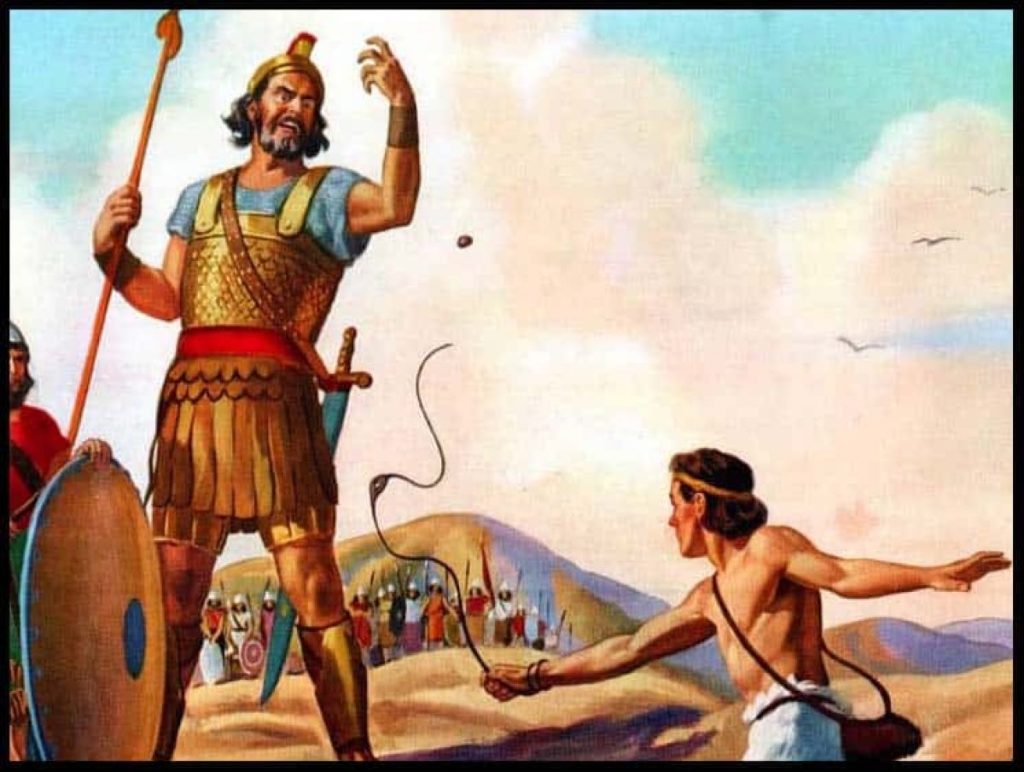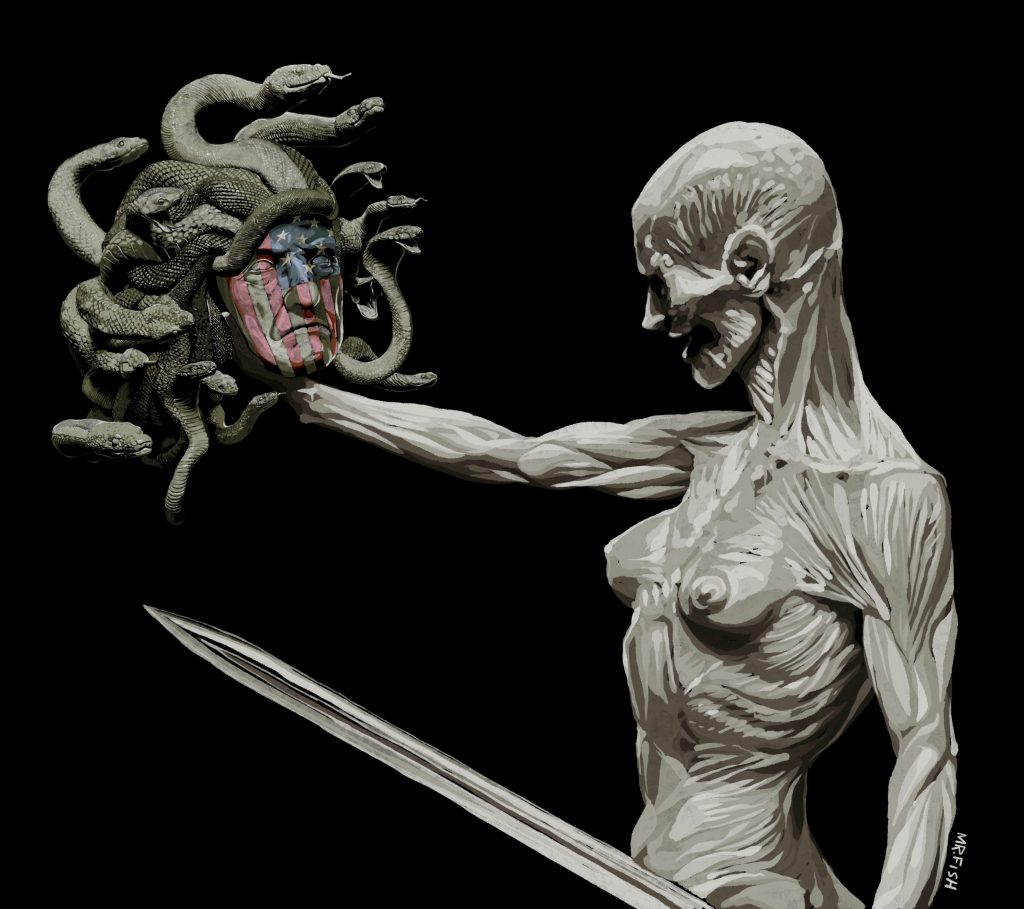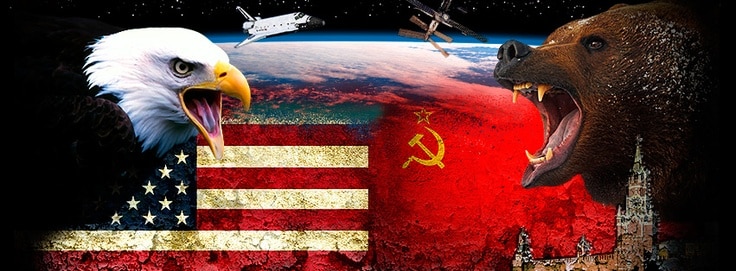
How the Russian David Can Finally Defeat the U.S.-NATO Goliath

By Eric Zuesse

Source: The Duran

When the Soviet Union broke up, and ended its Warsaw Pact military alliance, and ended its communism — all of which happened in 1991 — there was a very clearly understood verbal agreement that the U.S. and its NATO military alliance against the Soviet Union made to the Soviet leaders, repeatedly promising that NATO would not expand toward Russia’s borders; or, as George Herbert Walker Bush’s U.S. Secretary of State, James Baker, famously put it at the time, that NATO would not expand even “one inch to the east.” In other words, America promised that if the Cold War would end on the Soviet side, then it would end also on the American side, and so its military alliance wouldn’t expand to become nearer to Russia’s command-center The Kremlin, which would constitute a threat to blitz-invade Russia from that more-nearby nation.

Mikhail Gorbachev, the last Soviet leader, didn’t demand the termination of America’s military alliance against the Soviet Union, as a condition for the Soviet Union to end its military alliance against America and its NATO, but demanded only that NATO no longer would be a military alliance against Russia — that NATO would not take any of the former Warsaw Pact countries, nor any of the former Soviet countries, the countries that adjoin or are near to Russia and that would then become a threat to become a staging-area to invade Russia.

That was the agreement: to end the Cold War on both sides, not merely on the Russian side. But, on 24 February 1990, G.H.W. Bush secretly started telling his allied European heads-of-state that he and they would not be keeping their part of the bargain, because “We prevailed, they didn’t.” In other words, he was saying that they would go for conquest against Russia itself, and that they all had actually been liars to the contrary — that their instructions now were to go for conquest against Russia.

However, the expansion toward Russia’s borders couldn’t take place immediately, because they needed to continue the pretense of friendliness at least for a while in order to infiltrate their billionaires into Russia’s economy in partnership with whomever in Russia would get privatized Russian businesses so as to make Russia so dependent upon American capital as to become peacefully an American colony. That’s what happened during the 1990s, the Yeltsin years. Then, in 1999, Bill Clinton finally sprung upon Russia the start of NATO’s expansion, by adding Czechoslovakia and Poland to NATO. By the time that Putin came into power in 2000, it was already clear that America was an imperialistic, hostile, nation, and a liar, never to be trusted on anything.

In 2007 — after George W. Bush brought, into NATO, Bulgaria, Estonia, Latvia, Lithuania, Romania, Slovakia, and Slovenia — Putin said at the Munich Security Conference, on 10 February 2007, that NATO’s expansion “represents a serious provocation that reduces the level of mutual trust. And we have the right to ask: against whom is this expansion intended?” It was a remarkably weak statement on the matter, but even so was unacceptable to the imperialists. And, from that moment on, the U.S. Government and media started turning openly against him and for “regime-change in Russia.” Americans’ favorability ratings of Russia, which had been 58% in 2006, never again reached that high a level, and reached a new low of 24% in 2015 (after America’s coup grabbed Ukraine), and a new all-time low of 9% in 2023, while American’s favorability toward Ukraine as a new U.S. vassal nation reached an all-time high of 68% in 2023. The American masses were interpreting things in precisely the ways that America’s Government and billionaires, and their media, wanted them to.

If America wins its war against Russia in the battlefields of Ukraine, then the next step will be placing its missiles against The Kremlin onto Ukraine’s border 300 miles and five minutes of missile-flying distance away from their target, to blitz-behead Russia, and so to ‘win’ WW III.

At this stage, Russia has only two realistic options to achieve national security: either it will form a mutual-defense pact with China guaranteeing that any nation which invades either Russia or China will immediately find itself in a WW III against BOTH China and Russia; or else, it will relocate Russia’s capital city out of Moscow, which is now only seven minutes away from NATO, into Novosibirsk, which is nearly 2,000 miles and 40 minutes away from NATO and also away from Japan — truly a safe location for Russia’s capital city (which no western-Russian city can be). Russia is the only nation that is so vast it contains a city located nearly 2,000 miles away from any U.S.-or-allied military base or launching site. It needs to take advantage of this unique national-security asset which it contains.

Other countries have moved their capital cities, for far lesser reasons; so, Russia should do it now, in order to achieve national security (which is the biggest reason imaginable).  And, then, all of the trillions of dollars that America has been spending to conquer Russia will be immediately turned to dust. Once Russia has moved its capital to Novosibirsk, nothing that America does will be able to threaten Russia seriously again. It would radically transform international relations, because U.S.-and-allied aggression would finally have a natural limit. There would then be one country, at last, that the voracious U.S. empire won’t be able to grab. And this, of course, would also make Russia a magnet for all other countries that haven’t yet been successfully grabbed by the U.S. and now hosting any of its 900 foreign military bases. So: the number of U.S.-occupied countries might then finally begin to decline — which decline would add yet more to the entire world’s security, by removing the world’s biggest national-security threat. America’s foreign military bases threaten every nation, and don’t merely vassalize the given nation. Simply moving Russia’s capital to Novosibirsk would achieve all of this — for Russia, and for the world.

—————

Investigative historian Eric Zuesse’s new book, AMERICA’S EMPIRE OF EVIL: Hitler’s Posthumous Victory, and Why the Social Sciences Need to Change, is about how America took over the world after World War II in order to enslave it to U.S.-and-allied billionaires. Their cartels extract the world’s wealth by control of not only their ‘news’ media but the social ‘sciences’ — duping the public.

The Empire Does Not Forgive

The Americans, like the British and the Soviets before them, dug their own graveyard in Afghanistan.

By Chris Hedges

Source: ScheerPost.com

The Carthaginian general Hannibal, who came close to defeating the Roman Republic in the Second Punic War, committed suicide in 181 BC in exile as Roman soldiers closed in on his residence in the Bithynian village of Libyssa, now modern-day Turkey. It had been more than thirty years since he led his army across the alps and annihilated Roman legions at the Battle of Trebia, Lake Trasimene and Cannae, considered one of the most brilliant tactical victories in warfare which centuries later inspired the plans of the German Army Command in World War I when they invaded Belgium and France. Rome was only able to finally save itself from defeat by replicating Hannibal’s military tactics. 

It did not matter in 181 BC that there had been over 20 Roman emperors since Hannibal’s invasion. It did not matter that Hannibal had been hunted for decades and forced to perpetually flee, always just beyond the reach of Roman authorities. He had humiliated Rome. He had punctured its myth of omnipotence. And he would pay. With his life. Years after Hannibal was gone, the Romans were still not satisfied. They finished their work of apocalyptic vengeance in 146 BC by razing Carthage to the ground and selling its remaining population into slavery. Cato the Censor summed up the sentiments of empire: Carthāgō dēlenda est (Carthage must be destroyed). Nothing about empire, from then until now, has changed.

Imperial powers do not forgive those who expose their weaknesses or make public the sordid and immoral inner workings of empire. Empires are fragile constructions. Their power is as much one of perception as of military strength. The virtues they claim to uphold and defend, usually in the name of their superior civilization, are a mask for pillage, the exploitation of cheap labor, indiscriminate violence, and state terror.

The current American empire, damaged and humiliated by the troves of internal documents published by WikiLeaks, will, for this reason, persecute Julian Assange for the rest of his life. It does not matter who is president or which political party is in power. Imperialists speak with one voice. The killing of thirteen U.S. troops by a suicide bomber at the Hamid Karzai International Airport in Kabul on Thursday evoked from Joe Biden the full-throated cry of all imperialists: “To those who carried out this attack … we will not forgive, we will not forget, we will hunt you down and make you pay.” This was swiftly followed by two drone strikes in Kabul against suspected members of the Islamic State in Khorasan Province, ISKP (ISIS-K), which took credit for the suicide bombing that left some 170 dead, including 28 members of the Taliban.

The Taliban, which defeated U.S. and coalition forces in a 20-year war, is about to be confronted with the wrath of a wounded empire. The Cuban, Vietnamese, Iranian, Venezuelan and Haitian governments know what comes next. The ghosts of Toussaint Louverture, Emilio Aguinaldo, Mohammad Mossadegh, Jacobo Arbenz, Omar Torrijos, Gamal Abdul Nasser, Juan Velasco, Salvador Allende, Andreas Papandreou, Juan Bosh, Patrice Lumumba, and Hugo Chavez know what comes next. It isn’t pretty. It will be paid for by the poorest and most vulnerable Afghans. 

The faux pity for the Afghan people, which has defined the coverage of the desperate collaborators with the U.S. and coalition occupying forces and educated elites fleeing to the Kabul airport, begins and ends with the plight of the evacuees. There were few tears shed for the families routinely terrorized by coalition forces or the some 70,000 civilians who were obliterated by U.S. air strikes, drone attacks, missiles, and artillery, or gunned down by nervous occupying forces who saw every Afghan, with some justification, as the enemy during the war. And there will be few tears for the humanitarian catastrophe the empire is orchestrating on the 38 million Afghans, who live in one of the poorest and most aid-dependent countries in the world.

Since the 2001 invasion the United States deployed about 775,000 military personnel to subdue Afghanistan and poured $143 billion into the country, with 60 percent of the money going to prop up the corrupt Afghan military and the rest devoted to funding economic development projects, aid programs and anti-drug initiatives, with the bulk of those funds being siphoned off by foreign aid groups, private contractors, and outside consultants.

Grants from the United States and other countries accounted for 75 percent of the Afghan government budget. That assistance has evaporated. Afghanistan’s reserves and other financial accounts have been frozen, meaning the new government cannot access some $9.5 billion in assets belonging to the Afghan central bank. Shipments of cash to Afghanistan have been stopped. The International Monetary Fund (IMF) announced that Afghanistan will no longer be able to access the lender’s resources.

Things are already dire. There are some 14 million Afghans, one in three, who lack sufficient food. There are two million Afghan children who are malnourished. There are 3.5 million people in Afghanistan who have been displaced from their homes. The war has wrecked infrastructure. A drought destroyed 40 percent of the nation’s crops last year. The assault on the Afghan economy is already seeing food prices skyrocket. The sanctions and severance of aid will force civil servants to go without salaries and the health service, already chronically short of medicine and equipment, will collapse. The suffering orchestrated by the empire will be of Biblical proportions. And this is what the empire wants.

UNICEF estimates that 500,000 children were killed as a direct result of sanctions on Iraq.  Expect child deaths in Afghanistan to soar above that horrifying figure. And expect the same imperial heartlessness Madeline Albright, then the U.S. Ambassador to the United Nations, exhibited when she told “60 Minutes” correspondent Lesley Stahl that the deaths of half a million Iraqi children because of the sanctions was “worth it.” Or the heartlessness of Hillary Clinton who joked “We came, we saw, he died,” when informed of Libyan leader Muammar Qaddafi’s brutal death. Or the demand by Democratic Senator Zell Miller of Georgia who after the attacks of 9/11 declared, “I say, bomb the hell out of them. If there’s collateral damage, so be it.” No matter that the empire has since turned Libya along with Afghanistan, Iraq, Syria, and Yemen into cauldrons of violence, chaos, and misery. The power to destroy is an intoxicating drug that is its own justification.

Like Cato the Censor, the U.S. military and intelligence agencies are, if history is any guide, at this moment planning to destabilize Afghanistan by funding, arming, and backing any militia, warlord or terrorist organization willing to strike at the Taliban. The CIA, which should exclusively gather intelligence, is a rogue paramilitary organization that oversees secret kidnappings, interrogation at black sites, torture, manhunts, and targeted assassinations across the globe. It carried out commando raids in Afghanistan that killed a large number of Afghan civilians, which repeatedly sent enraged family members and villagers into the arms of the Taliban. It is, I expect, reaching out to Amrullah Saleh, who was Ashraf Ghani’s vice president and who has declared himself “the legitimate caretaker president” of Afghanistan. Saleh is holed up in the Panjashir Valley.  He, along with warlords Afgand Massoud, Mohammad Atta Noor and Abdul Rashid Dostum, are clamoring to be armed and supported to perpetuate conflict in Afghanistan.

“I write from the Panjshir Valley today, ready to follow in my father’s footsteps, with mujahideen fighters who are prepared to once again take on the Taliban,” Ahmad Massoud wrote in an opinion piece in The Washington Post. “The United States and its allies have left the battlefield, but America can still be a ‘great arsenal of democracy,’ as Franklin D. Roosevelt said when coming to the aid of the beleaguered British before the U.S. entry into World War II,” he went on, adding that he and his fighters need “more weapons, more ammunition and more supplies.”

These warlords have done the bidding of the Americans before. They will do the bidding of the Americans again. And since the hubris of empire is unaffected by reality, the empire will continue to sow dragon’s teeth in Afghanistan as it has since it spent $9 billion—some estimates double that figure—to back the mujahedeen that fought the Soviets, leading to a bloody civil war between rival warlords once the Soviets withdrew in 1989 and the ascendancy in 1996 of the Taliban.

The cynicism of arming and funding the mujahedeen against the Soviets exposes the lie of America’s humanitarian concerns in Afghanistan. One million Afghan civilians were killed in the nine-year conflict with the Soviets, along with 90,000 mujahedeen fighters, 18,000 Afghan troops, and 14,500 Soviet soldiers.  But these deaths, along with the destruction of Afghanistan, were “worth it” to cripple the Soviets.

Jimmy Carter’s national security advisor, Zbigniew Brzezinski, along with the Pakistan’s Inter-Services Intelligence (ISI) agency, oversaw the arming of the most radical Islamic mujahedeen groups fighting the Soviet occupation forces, leading to the extinguishing of the secular, democratic Afghan opposition. Brzezinski detailed the strategy, designed as he said to give the Soviet Union its Vietnam, taken by the Carter administration following the 1979 Soviet invasion to prop up the Marxist regime of Hafizullah Amin in Kabul:

We immediately launched a twofold process when we heard that the Soviets had entered Afghanistan. The first involved direct reactions and sanctions focused on the Soviet   Union, and both the State Department and the National Security Agency prepared long lists of sanctions to be adopted, of steps to be taken to increase the international costs to the Soviet Union of their actions. And the second course of action led to my going to Pakistan a month or so after the Soviet invasion of Afghanistan, for the purpose of coordinating with the Pakistanis a joint response, the purpose of which would be to   make the Soviets bleed for as much and as long as is possible; and we engaged in that effort in a collaborative sense with the Saudis, the Egyptians, the British, the Chinese, and we started providing weapons to the Mujaheddin, from various sources again — for example, some Soviet arms from the Egyptians and the Chinese. We even got Soviet arms from the Czechoslovak communist government, since it was obviously susceptible to material incentives; and at some point we started buying arms for the Mujahedeen from the Soviet army in Afghanistan, because that army was increasingly corrupt.

The clandestine campaign to destabilize the Soviet Union by making it “bleed for as much and as long as is possible” was carried out, like the arming of the contra forces in Nicaragua, largely off the books. It did not, as far as official Washington was concerned, exist, a way to avoid the unwelcome scrutiny of covert operations carried out by the Church Committee hearings in the 1970s that made public the three decades of CIA-backed coups, assassinations, blackmail, intimidation, dark propaganda, and torture. The Saudi government agreed to match the U.S. funding for the Afghan insurgents. The Saudi involvement gave rise to Osama bin Laden and Al Qaeda, which fought with the mujahedeen. The rogue operation, led by Brzezinski, organized secret units of assassination teams and paramilitary squads that carried out lethal attacks on perceived enemies around the globe. It trained Afghan mujahedeen in Pakistan and China’s Xinjiang province. It shifted the heroin trade, used to fund the insurgency, from southeast Asia to the border between Afghanistan and Pakistan.

This pattern of behavior, which destabilized Afghanistan and the region, is reflexive in the military and the intelligence community. It will, without doubt, be repeated now in Afghanistan, with the same catastrophic results. The chaos these intelligence agencies create becomes the chaos that justifies their existence and the chaos that sees them demand more resources and ever greater levels of violence.

All empires die. The end is usually unpleasant. The American empire, humiliated in Afghanistan, as it was in Syria, Iraq, and Libya, as it was at the Bay of Pigs and in Vietnam, is blind to its own declining strength, ineptitude, and savagery. Its entire economy, a “military Keynesianism,” revolves around the war industry. Military spending and war are the engine behind the nation’s economic survival and identity. It does not matter that with each new debacle the United States turns larger and larger parts of the globe against it and all it claims to represent. It has no mechanism to stop itself, despite its numerous defeats, fiascos, blunders and diminishing power, from striking out irrationally like a wounded animal. The mandarins who oversee our collective suicide, despite repeated failure, doggedly insist we can reshape the world in our own image. This myopia creates the very conditions that accelerate the empire’s demise.

The Soviet Union collapsed, like all empires, because of its ossified, out-of-touch rulers, its imperial overreach, and its inability to critique and reform itself. We are not immune from these fatal diseases. We silence our most prescient critics of empire, such as Noam Chomsky, Angela Davis, Andrew Bacevich, Alfred McCoy, and Ralph Nader, and persecute those who expose the truths about empire, including Julian Assange, Edward Snowden, Daniel Hale, and John Kiriakou. At the same time a bankrupt media, whether on MSNBC, CNN or FOX, lionizes and amplifies the voices of the inept and corrupt political, military and intelligence class including John Bolton, Leon Panetta, Karl Rove, H.R. McMaster and David Petraeus, which blindly drives the nation into the morass.

Chalmers Johnson in his trilogy on the fall of the American empire – “Blowback,” “The Sorrows of Empire” and “Nemesis” – reminds readers that the Greek goddess Nemesis is “the spirit of retribution, a corrective to the greed and stupidity that sometimes governs relations among people.” She stands for “righteous anger,” a deity who “punishes human transgression of the natural, right order of things and the arrogance that causes it.” He warns that if we continue to cling to our empire, as the Roman Republic did, “we will certainly lose our democracy and grimly await the eventual blowback that imperialism generates.”

“I believe that to maintain our empire abroad requires resources and commitments that will inevitably undercut our domestic democracy and, in the end, produce a military dictatorship or its civilian equivalent,” Johnson writes. “The founders of our nation understood this well and tried to create a form of government – a republic – that would prevent this from occurring. But the combination of huge standing armies, almost continuous wars, military Keynesianism, and ruinous military expenses have destroyed our republican structure in favor of an imperial presidency. We are on the cusp of losing our democracy for the sake of keeping our empire. Once a nation is started down that path, the dynamics that apply to all empires come into play – isolation, overstretch, the uniting of forces opposed to imperialism, and bankruptcy. Nemesis stalks our life as a free nation.”

If the empire was capable of introspection and forgiveness, it could free itself from its death spiral. If the empire disbanded, much as the British empire did, and retreated to focus on the ills that beset the United States it could free itself from its death spiral. But those who manipulate the levers of empire are unaccountable. They are hidden from public view and beyond public scrutiny. They are determined to keep playing the great game, rolling the dice with lives and national treasure. They will, I expect, preside gleefully over the deaths of even more Afghans, assuring themselves it is worth it, without realizing that the gallows they erect are for themselves.  

Generation of Vipers: The Original Sin and Continuous Crimes of America’s Involvement in Afghanistan

By Chris Floyd

Source: Empire Burlesque

O generation of vipers, how can ye, being evil, speak good things? – Matthew 12:34

I.
People need to understand something about Afghanistan, and the debacle we’re witnessing there. America’s involvement in Afghanistan didn’t begin in 2001, after the 9/11 attacks. It began in the last years of the Carter Administration, when he and his advisor Zbigniew Brzezinski set out to “give the Soviets their own Vietnam.” They did this by funding and arming an international cohort of violent fundamentalist extremists and training them in terror tactics. (Osama bin Laden was one of those who joined this jihad army supported by the US, Saudia Arabia and Pakistan.)

At that time, there was a modern, secular regime in Afghanistan. It wasn’t a paradise. It was ridden by internal factionalism, sometimes violent. It was supported by the Soviet Union. It was beset by fundamentalist extremists. It had repressive features. But it was a secular regime. Women were emancipated; many held high positions. Children, including girls, were educated. Science was honored and promoted. Religion was tolerated, albeit uneasily.

Carter and Brzezinski decided to empower the extremist militias attacking the regime, hoping to induce so much chaos that the Soviets would intervene militarily to help their client state. Again, as Brzezinski himself put it, they wanted to give the USSR “its own Vietnam.”

Think about this for a moment. What Carter and Brzezinski wanted was to subject the Afghan people to the years of suffering and death that the Vietnamese had experienced. They WANTED Afghanistan to suffer this fate, and they ACTED to make sure it happened. And it did. If you like, it was one of the great successes of US foreign policy in the post-war period. They deliberately plunged Afghanistan into blood-soaked chaos; and the Soviets – after fierce debate in the Politburo – did send in troops to try to stabilize the country. What followed was year after year after year of horror and death. Again, please note: this was the stated INTENTION of US policy: mass death, terrorism and suffering.

When Carter lost in 1980, Reagan took up his policy in Afghanistan and magnified it. More arms and money to religious extremists. More terrorist training, with CIA manuals. The US even produced textbooks for Afghan children lauding fundamentalist extremism and jihad terror. (All of this was reported in the Washington Post and other mainstream outlets.) Reagan invited the precursors of the Taliban to the White House, where he called them the “moral equivalent of our Founding Fathers” and “freedom fighters.” These men were dedicated to undoing the emancipation of women, destroying all vestiges of secular society and imposing the most harsh and hidebound fundamentalist strictures imaginable.

These were the people who were armed, trained, funded, lauded and supported by the United States government for years on end. The Taliban would not exist if not for these long-running, bipartisan policies of the United States.

II.
At last, the Soviets were bled dry, as Carter and Reagan intended, and pulled out of Afghanistan, leaving ruin and chaos behind. There followed years of civil war between atrocious warlords who tortured and looted the Afghan people. The Taliban arose from the midst of the extremists backed by the United States. They managed to take over the country in the early 1990s. They were then supported by the United States once again. Taliban members came to Texas seeking business deals under then-Governor George W. Bush. They sent representatives to Washington, meeting mostly with Republican leaders. When Bush was president, he hooked up with the Taliban in drug eradication efforts.

As noted, Osama bin Laden had been part of the US-backed extremist jihad against the secular regime. However, when the US stationed troops in his homeland of Saudi Arabia during the first Iraq War, he and other fundamentalists regarded this as a profanation of the holy land and vowed to drive American troops from Saudi Arabia. This was the main purpose behind al-Qaeda’s terror attacks, which culminated on 9/11: an attack carried out almost entirely by Saudi nationals, with no involvement of the Taliban or any Afghan citizens.

Bin Laden, a hero of the extremists’ triumph over the USSR, was by now back in Afghanistan. After the 9/11 attacks – which the US itself has said occurred without any foreknowledge by the Taliban – the Taliban offered several times to turn Bin Laden over to international justice in some accredited forum. Bush adamantly refused to even entertain the offer, and launched a full-scale military invasion and occupation of Afghanistan.

As is well known, just after the attack, the Bush Administration launched a frantic, extraordinary effort to spirit many top Saudi figures out of the United States. It could be noted here that the Bush family had long-standing business ties with the Saudis, including the Bin Laden family. (Indeed, Osama bin Laden’s father died in a plane crash in Texas while doing business there.)

In any case, the war was on. Although bin Laden and his forces were seemingly trapped in their mountain fortress early on, somehow they managed to escape to Pakistan, where bin Laden lived untroubled for many years.

By 2002, the Taliban regime had fallen. But the “nation-building” efforts of the United States very soon took a backseat to the goal that Dick Cheney and Donald Rumsfeld (and Jeb Bush, among others) had publicly announced before Dubya’s election: war on Iraq. A Cheney-Rumsfeld group called “Project for the New American Century” laid out its plans before the 2000 election, calling for massive new military expenditures, extensive new military operations overseas and war on Iraq. The PNAC document clearly stated that they realized it would be very difficult to achieve this wholesale militarization of US society and policy, unless – their words, in 2000 – the American people were “catalyzed” by a “new Pearl Harbor.”

In 2003, massive military resources and political attention were shifted from Afghanistan to the real war that Bush, Cheney and Rumsfeld wanted: Iraq. It would be tedious to recite all the deceptions they practiced to perpetrate their deliberate, knowing lie about “Iraqi WMDs” or the collusion of Democrats like Biden in furthering the war fever. The war came and we all know what happened. Hundreds of thousands of innocent people died, the whole region became destablized, thousands became radicalized by the death and torture visited upon their lands, and vast, almost incomprehensible levels of corruption attended every aspect of the long, bloody American occupation.

Meanwhile, the “backwater” of Afghanistan became little more than a long exercise in war profiteering. The “government” installed by the Americans looted the country on an almost incomprehensible scale. American and Afghan officials colluded with the Taliban to ship drugs and money out of the country. At one point, US and NATO officials were actually paying the Taliban to allow shipments of supplies through their checkpoints. Bombings went on, drone strikes went on, civilians were slaughtered by both the occupiers and the Taliban: a long, pointless hell that so radicalized the populace that in the end, as we saw this week, there was no longer any resistance to the Taliban and the order they promised – however harsh and brutal it will be.

The “Afghanistan Papers” of official US documents leaked a few years ago showed that the top US military and political officials had no idea what they were doing in Afghanistan. There was no real mission, no focus, no goal; it was essentially just a perpetual motion machine of death, suffering, procurement, profiteering and corruption. The Taliban had long since regained control of most of the country. The Afghans, which down through the centuries had defeated Alexander the Great, the British Empire and the Soviet Union has now defeated the United States as well.

III.
But again we must go back to the beginning of the current situation. It started when the United States and its allies created an army of Islamic extremists in order to impose years of Vietnam-style hell on the Afghan people – as part of the “Great Game” of geopolitics, which uses innocent lives, and whole nations, as dispensable pieces on a chessboard. Jimmy Carter and Ronald Reagan WANTED to create vast, hellish civil war in Afghanistan to ensnare the Soviets; that was their stated goal, and they spent vast amounts of US taxpayer to money to make it happen. They WANTED thousands of people to die in horrific conditions – Afghan civilians, Soviet conscripts, anyone, they didn’t care – as long as the Soviets “got their own Vietnam.” To me, this is a monstrous crime of near-demonic proportions: to deliberately work to create such an outcome. But they did work at it. And they succeeded.

Later, George W. Bush decided to throw the lives of US soldiers into the mix by invading a country that nothing to do with the 9/11 attacks, as he well knew. Obama, with the eternal anxiety of Democrats not to look “weak” in the eyes of the morally depraved “foreign policy establishment,” then launched a pointless “surge” in Afghanistan that killed many more thousands of people (including US and allied soldiers). Again, as the “Afghanistan Papers” showed, all this was done with no real plan or aim, and with rampant corruption at every turn.

After this, the US largely stepped back from direct actions on the ground, and let the Afghan army do the dying, while the US concentrated on bombing and droning. Yet still the war went on, year after year, as tens of thousands were radicalized by their suffering and joined or supported the Taliban, which controlled most of the country outside the major cities. Finally Trump decided to cut a hasty and ill-thought out deal with the Taliban that ensured they would take over the country the moment the Americans pulled out – which immediately leeched away any remaining support for the corrupt and inept American-installed government. (Of course, if that government had promised to build a big Trump hotel in Baghdad, he probably would’ve sent in 30 divisions to keep it in power until he got his loot.)

This was the deal Biden inherited. But instead of treating it as what it really was – the inevitable handover of Afghanistan to the only local force capable of forming a government – Biden pretended that the Potemkin state installed by the Americans could somehow survive after the American withdrawal … at least long enough to save some face. Instead of spending six months in a negotiated, orderly transfer of power, the US simply kept up the 20-year farce for a time then bugged out, literally in the dead of night, in most cases without even telling the Afghan forces what was happening.

The Afghan forces knew the jig was up last year when Trump freed the co-founder of the Taliban, who then duly appeared with Mike Pompeo for a cozy photo-op. The Afghan soldiers knew it was only a matter of time before the Taliban was in power again. So when the Americans bugged out, the Afghan army began negotiating with the Taliban to avoid needless destruction and bloodshed. Thus city after city was surrendered without a pointless fight: a grim but humane course taken by Afghan soldiers in these dire circumstances.

But Joe Biden, seeking to avoid blame for his vastly inept mishandling of the inevitable takeover by the Taliban, is now blaming the Afghan people themselves, and the Afghan military forces in particular, for not wanting to “fight for their country.” This is a moral obscenity. Although he, like Trump, was absolutely correct in saying that the woebegone US occupation of Afghanistan had to end, he would not acknowledge the truth of how we got to this point, or why the Taliban even exists in the first place: because of deliberate US policy choices going back more than 40 years, all the way to the “original sin” by Carter and Brzezinski of empowering a global network of religious extremists that has given rise to the Taliban, al Qaeda, ISIS and others.

In none of these policies – from Carter, Reagan, Bush I, Clinton, Bush II, Obama, Trump and Biden – has concern for the lives and welfare of the Afghan people played the slightest part. The good Southern Baptist Jimmy Carter WANTED to create hell on earth like Vietnam in Afghanistan. He WANTED thousands upon thousands of innocent people to die, so that the Soviet Union could be “bled dry” in a geopolitical game. I know it’s hard to get one’s head around this, that this gentle, soft-spoken old man, who lives frugally, built houses for the poor and fought for free elections in other countrie ,etc., made the deliberate choice to inflict unimaginable grief, pain and suffering on multitudes of innocent people. But he did. This is what actually happened in our history.

Ronald Reagan extended this policy (which he also practiced in Central America, aiding the mass slaughter of tens of thousands of innocent people by the repressive regimes he supported and armed.) George W. Bush then plunged American forces directly into the fray, stupidly, callously and corruptly replicating “Russia’s own Vietnam” of endless warfare against an extremist insurgency, while tens of thousands innocent civilians died at the hands of all the forces involved.

Now this 40-year chapter of American involvement has come to an end. But unless we actually know how we got here – and the absolutely fundamental role the US has played in these decades of death, destruction and radicalization – we will simply be waiting for the next monstrous, long-running atrocity to arise, with the same horseshit rationalizations (“Liberty! Freedom! Emancipation!”) that our leaders – all of them, every one – have used to cover up their deliberate policies of mass murder, war profiteering and corruption.

Manufacturing War With Russia

By Chris Hedges

Source: Information Clearing House

Despite the Robert Mueller report’s conclusion that Donald Trump and his campaign did not collude with Russia during the 2016 presidential race, the new Cold War with Moscow shows little sign of abating. It is used to justify the expansion of NATO to Russia’s borders, a move that has made billions in profits for U.S. arms manufacturers. It is used to demonize domestic critics and alternative media outlets as agents of a foreign power. It is used to paper over the Democratic Party’s betrayal of the working class and the party’s subservience to corporate power. It is used to discredit détente between the world’s two largest nuclear powers. It is used to justify both the curtailment of civil liberties in the United States and U.S. interventions overseas—including in countries such as Syria and Venezuela. This new Cold War predates the Trump presidential campaign. It was manufactured over a decade ago by a war industry and intelligence community that understood that, by fueling a conflict with Russia, they could consolidate their power and increase their profits. (Seventy percent of intelligence is carried out by private corporations such as Booz Allen Hamilton, which has been called the world’s most profitable spy operation.)

“This began long before Trump and ‘Russiagate,’ ” Stephen F. Cohen said when I interviewed him for my television show, “On Contact.” Cohen is professor emeritus of politics at Princeton University, where he was the director of the Russian studies program, and professor emeritus of Russian studies and history at New York University. “You have to ask yourself, why is it that Washington had no problem doing productive diplomacy with Soviet communist leaders. Remember Richard Nixon and Leonid Brezhnev? It was a love fest. They went hunting together [in the Soviet Union]. Yet along comes a post-Soviet leader, Vladimir Putin, who is not only not a communist but a professed anti-communist. Washington has been hating on him ever since 2003, 2004. It requires some explanation. Why do we like communist leaders in Russia better than we like Russia’s anti-communist leader? It’s a riddle.”

“If you’re trying to explain how the Washington establishment has dealt with Putin in a hateful and demonizing way, you have to go back to the 1990s before Putin,” said Cohen, whose new book is “War With Russia? From Putin & Ukraine to Trump & Russiagate.” The first post-Soviet leader is Boris Yeltsin. Clinton is president. And they have this fake, pseudo-partnership and friendship, whereas essentially the Clinton administration took advantage of the fact that Russia was in collapse. It almost lost its sovereignty. I lived there in the ’90s. Middle-class people lost their professions. Elderly people lost their pensions. I think it’s correct to say that industrial production fell more in the Russian 1990s than it did during our own Great Depression. It was the worst economic and social depression ever in peacetime. It was a catastrophe for Russia.”

In September 1993 Russians took to the streets to protest the collapse of the economy—the gross domestic product had fallen by 50% and the country was convulsed by hyperinflation—along with the rampant corruption that saw state enterprises sold for paltry fees to Russian oligarchs and foreign corporations in exchange for lavish kickbacks and bribes; food and fuel shortages; the nonpayment of wages and pensions; the lack of basic services, including medical services; falling life expectancy; the explosion of violent crime; and Yeltsin’s increasing authoritarianism and his unpopular war with Chechnya.

In October 1993 Yeltsin, after dissolving the parliament, ordered army tanks to shell the Russian parliament building, which was being occupied by democratic protesters. The assault left 2,000 dead. Yet during his presidency Yeltsin was effusively praised and supported by Washington. This included U.S. support for a $10.2 billion International Monetary Fund loan to Russia during his 1996 re-election campaign. The loan enabled the Yeltsin government to pay huge sums in back wages and pensions to millions of Russians, with checks often arriving on the eve of the election. Also, an estimated $1.5 billion from the loan was used to directly fund the Yeltsin presidential campaign. But by the time Yeltsin was forced out of office in December 1999 his approval rating had sunk to 2%. Washington, losing Yeltsin, went in search of another malleable Russian leader and, at first, thought it had found one in Putin.

“Putin went to Texas,” Cohen said. “He had a barbecue with Bush, second Bush. Bush said he ‘looked into his eyes and saw a good soul.’ There was this honeymoon. Why did they turn against Putin? He turned out not to be Yeltsin. We have a very interesting comment about this from Nicholas Kristof, the New York Times columnist, who wrote, I think in 2003, that his own disillusion with Putin was that he had turned out not to be ‘a sober Yeltsin.’ What Washington was hoping for was a submissive, supplicant, post-Soviet Russian leader, but one who was younger, healthier and not a drinker. They thought they had that in Putin. Yeltsin had put Putin in power, or at least the people around Yeltsin did.”

“When Putin began talking about Russia’s sovereignty, Russia’s independent course in world affairs, they’re aghast,” Cohen said of the Washington elites. “This is not what they expected. Since then, my own thinking is we were pretty lucky after the 1990s to get Putin because there were worst contenders in the wings. I knew some of them. I don’t want to name names. But some of these guys were really harsh people. Putin was kind of the right person for the right time, both for Russia and for Russian world affairs.”

“We have had three years of this,” Cohen said of Russiagate. “We lost sight of the essence of what this allegation is. The people who created Russiagate are literally saying, and have been for almost three years, that the president of the United States is a Russian agent, or he has been compromised by the Kremlin. We grin because it’s so fantastic. But the Washington establishment, mainly the Democrats but not only, have taken this seriously.”

“I don’t know if there has ever been anything like this in American history,” Cohen said. “That accusation does such damage to our own institutions, to the presidency, to our electoral system, to Congress, to the American mainstream media, not to mention the damage it’s done to American-Russian relations, the damage it has done to the way Russians, both elite Russians and young Russians, look at America today. This whole Russiagate has not only been fraudulent, it’s been a catastrophe.”

“There were three major episodes of détente in the 20th century,” Cohen said. “The first was after Stalin died, when the Cold War was very dangerous. That was carried out by Dwight Eisenhower, a Republican president. The second was by Richard Nixon, advised by Henry Kissinger—it was called ‘the Nixon détente with Brezhnev.’ The third, and we thought most successful, was Ronald Reagan with Mikhail Gorbachev. It was such a successful détente Reagan and Gorbachev, and Reagan’s successor, the first Bush, said the Cold War was over forever.”

“The wall had come down,” Cohen said of the 1989 collapse of East Germany and the fall of the Berlin Wall. “Germany was reunifying. The question became ‘where would a united Germany be?’ The West wanted Germany in NATO. For Gorbachev, this was an impossible sell. Twenty-seven point five million Soviet citizens had died in the war against Germany in the Second World War on the eastern front. Contrary to the bunk we’re told, the United States didn’t land on Normandy and defeat Nazi Germany. The defeat of Nazi Germany was done primarily by the Soviet army. How could Gorbachev go home and say, ‘Germany is reunited. Great. And it’s going to be in NATO.’ It was impossible. They told Gorbachev, ‘We promise if you agree to a reunited Germany in NATO, NATO will not move—this was Secretary of State James Baker—one inch to the east. In other words, NATO would not move from Germany toward Russia. And it did.”

“As we speak today, NATO is on Russia’s borders,” Cohen said. “From the Baltics to Ukraine to the former Soviet Republic of Georgia. So, what happened? Later, they said Gorbachev lied or he misunderstood. [That] the promise was never made. But the National Security Archive in Washington has produced all the documents of the discussion in 1990. It was not only [President George H.W.] Bush, it was the French leader François Mitterrand, it was Margaret Thatcher of England. Every Western leader promised Gorbachev NATO would not move eastward.”

“What do you end up with today?” he asked. “Betrayal. Any kind of discussion about Russian-American relations today, an informed Russian is going to say, ‘We worry you will betray us again.’… Putin said he had illusions about the West when he came to power.”

“Trump comes out of nowhere in 2016 and says, ‘I think we should cooperate with Russia,’ ” Cohen said. “This is a statement of détente. It’s what drew my attention to him. It’s then that this talk of Trump being an agent of the Kremlin begins. One has to wonder—I can’t prove it—but you have to think logically. Was this [allegation] begun somewhere high up in America by people who didn’t want a pro-détente president? And [they] thought that Trump, however small it seemed at the time that he could win—they really didn’t like this talk of cooperation with Russia. It set in motion these things we call Russiagate.”

“The forefathers of détente were Republicans,” Cohen said. “How the Democrats behaved during this period of détente was mixed. There was what used to be called the Henry Jackson wing. This was a very hard-line, ideological wing of the Democratic Party that didn’t believe in détente. Some Democrats did. I lived many years in Moscow, both Soviet and post-Soviet times. If you talk to Russian, Soviet policymakers, they generally prefer Republican candidates for the presidency.”

Democrats are perceived by Russian rulers as more ideological, Cohen said.

“Republicans tend to be businessmen who want to do business in Russia,” he said. “The most important pro-détente lobby group, created in the 1970s, was called the American Committee for East-West Accord. It was created by American CEOs who wanted to do business in Soviet Russia.”

“The single most important relationship the United States has is with Russia,” Cohen went on, “not only because of the nuclear weapons. It remains the largest territorial country in the world. It abuts every region we are concerned about. Détente with Russia—not friendship, not partnership, not alliance—but reducing conflict is essential. Yet something happened in 2016.”

The accusations made repeatedly by James Clapper, the former director of the National Security Agency, and John Brennan, the former director of the Central Intelligence Agency, concerning the Kremlin’s supposed control of Trump and Russia’s alleged theft of our elections are deeply disturbing, Cohen said. Clapper and Brennan have described Trump as a Kremlin “asset.” Brennan called Trump’s performance at a news conference with the Russian president in Finland “nothing short of treasonous.”

Clapper in his memoir, “Facts and Fears: Hard Truths From a Life in Intelligence,” claims Putin’s interference in the 2016 presidential election on behalf of Trump was “staggering.”

“Of course, the Russian efforts affected the outcome,” writes Clapper. “Surprising even themselves, they swung the election to a Trump win. To conclude otherwise stretches logic, common sense and credulity to the breaking point. Less than eighty thousand votes in three key states swung the election. I have no doubt that more votes than that were influenced by this massive effort by the Russians.”

Brennan and Clapper have on numerous occasions been caught lying to the public. Brennan, for example, denied, falsely, that the CIA was monitoring the computers that Senate staff members were using to prepare a report on torture. The chairwoman of the Senate Intelligence Committee, Dianne Feinstein, took to the Senate floor to accuse Brennan and the CIA of potentially violating the U.S. Constitution and of criminal activity in its attempts to spy on and thwart her committee’s investigations into the agency’s use of torture. She described the situation as a “defining moment” for political oversight. Brennan also claimed there was not a “single collateral death” in the drone assassination program, that Osama bin Laden used his wife as a human shield before being gunned down in a U.S. raid in Pakistan, and insisted that torture, or what is euphemistically called “enhanced interrogation,” has produced valuable intelligence. None of these statements are true.

Clapper, who at the time of the U.S. invasion of Iraq was the head of the National Geospatial-Intelligence Agency, the Pentagon unit responsible for interpreting spy-satellite photos and intelligence such as air particles and soil samples, concocted a story about Saddam Hussein spiriting his nonexistent weapons of mass destruction and the documents that verified his program to Syria on the eve of the invasion. He blatantly committed perjury before the Senate when being questioned about domestic surveillance programs of the American public. He was asked, “Does the NSA [National Security Agency] collect any type of data at all on millions, or hundreds of millions of Americans?” Clapper responded, “No, sir. … Not wittingly.” It was, as Clapper knew very well, a lie.

Our inability to oversee or control senior intelligence officials and their agencies, which fabricate information to push through agendas embraced by the shadow state, signals the death of democracy. Intelligence officials seemingly empowered to lie—Brennan and Clapper have been among them—ominously have in their hands instruments of surveillance, intimidation and coercion that effectively silence their critics, blunt investigations into their activities, even within the government, and make them and their agencies unaccountable.

“We have the Steele dossier that was spookily floating around American media,” Cohen said of the report compiled by Christopher Steele.

The report was commissioned by Fusion GPS and paid for by the Hillary Clinton presidential campaign and the Democratic National Committee. Bob Woodward reported that Brennan pushed to include the Steele dossier in the intelligence community assessment of Russian election interference.

“He [Steele] got it from newspapers,” Cohen said. “I don’t think he had a single source in Russia. Steele comes forward with this dossier and says, ‘I’ve got information from high-level sources.’ The Clinton campaign is funding this operation. But Steele is very important. He’s a former U.K. intelligence officer, if he’s really former, who had served in Russia and ran Russian cases. He says he has this information in the dossier about Trump frolicking with prostitutes. About Trump having been corrupted decades ago. He got it from ‘high-level’ Kremlin sources. This is preposterous. It’s illogical.”

“The theory is Putin desperately wanted to make Trump president,” Cohen said. “Yet, guys in the Kremlin, around Putin, were feeding Trump dirt to a guy called Steele. Even though the boss wants—does it make any sense to you?”

“Why is this important?” Cohen asked. “Right-wing American media outlets today, in particularly Fox News, are blaming Russia for this whole Russiagate thing. They’re saying that Russia provided this false information to Steele, who pumped it into our system, which led to Russiagate. This is untrue.”

“Who is behind all this? Including the Steele operation?” Cohen asked. “I prefer a good question to an orthodox answer. I’m not dogmatic. I don’t have the evidence. But all the surface information suggests that this originated with Brennan and the CIA. Long before it hit America—maybe as early as late 2015. One of the problems we have today is everybody is hitting on the FBI. Lovers who sent emails. But the FBI is a squishy organization, nobody is afraid of the FBI. It’s not what it used to be under J. Edgar Hoover. Look at James Comey, for God’s sake. He’s a patsy. Brennan and Clapper played Comey. They dumped this stuff on him. Comey couldn’t even handle Mrs. Clinton’s emails. He made a mess of everything. Who were the cunning guys? They were Brennan and Clapper. [Brennan,] the head of the CIA. Clapper, the head of the Office of [the Director of] National Intelligence, who is supposed to oversee these agencies.”

“Is there any reality to these Russiagate allegations against Trump and Putin?” he asked. “Was this dreamed up by our intelligence services? Today investigations are being promised, including by the attorney general of the United States. They all want to investigate the FBI. But they need to investigate what Brennan and the CIA did. This is the worst scandal in American history. It’s the worst, at least since the Civil War. We need to know how this began. If our intelligence services are way off the reservation, to the point that they can try to first destroy a presidential candidate and then a president, and I don’t care that it’s Trump, it may be Harry Smith next time, or a woman; if they can do this, we need to know it.”

“The second Bush left the Anti-Ballistic Missile Treaty in 2002,” Cohen said. “It was a very important treaty. It prevented the deployment of missile defense. If anybody got missile defense that worked, they might think they had a first strike [option]. Russia or the United States could strike the other without retaliation. Once Bush left the treaty, we began to deploy missile defense around Russia. It was very dangerous.”

“The Russians began a new missile program which we learned about last year,” he said. Hypersonic missiles. Russia now has nuclear missiles that can evade and elude any missile defense system. We are in a new and more perilous point in a 50-year nuclear arms race. Putin says, ‘We’ve developed these because of what you did. We can destroy each other.’ Now is the time for a serious, new arms control agreement. What do we get? Russiagate. Russiagate is one of the greatest threats to national security. I have five listed in the book. Russia and China aren’t on there. Russiagate is number one.”


Understanding NATO, Ending War

By Robert J. Burrowes

On 4 April 2019, the North Atlantic Treaty Organization, better known as NATO, marked the 70th anniversary of its existence with a conference attended by the foreign ministers of member nations in Washington DC. This will be complemented by a meeting of the heads of state of member nations in London next December.

Coinciding with the anniversary event on 4 April, peace activists and concerned scholars in several countries conducted a variety of events to draw attention to, and further document, the many war crimes and other atrocities committed by NATO (sometimes by deploying its associate and crony terrorist armies – ISIS, Al Qaeda, Al Nusra – recruited and trained by the CIA and funded by Saudi Arabia, other Gulf countries and the US directly or through one or other of its many agencies: see ‘NATO – No Need – NATO-EXIT: The Florence Declaration’), the threat that NATO poses to global peace and security as an appendage of the US military, and to consider ways that NATO might be terminated.

These protests and related activities included several outlined in ‘No To NATO: Time To End Aggressive Militarism’ which also explains how NATO ‘provides a veneer of legality’ when ‘the US is unable to get the United Nations Security Council to approve military action’ and ‘Congress will not grant authority for US military action’ and despite the clearcut fact that NATO has no ‘international legal authority to go to war’, the grounds for which are clearly defined in the Charter of the United Nations and are limited to just two: authorization by the UN Security Council and a response in self-defense to a military attack.

The most significant gathering of concerned scholars was undoubtedly the ‘Exit NATO!’ conference in Florence, Italy, which culminated in the Florence Declaration calling for an end to NATO. See ‘The Florence Declaration: An International Front Calling for NATO-Exit’.

If NATO’s record of military destruction is so comprehensive – in the last 20 years virtually destroying Yugoslavia (balkanized into various successor states), Iraq and Libya, while inflicting enormous damage on many others, particularly Afghanistan and Syria – how did it come into existence and why does it exist now?

The Origin and Functions of NATO

Different authors offer a variety of reasons for the establishment of NATO. For example, Yves Engler argues that two of the factors driving the creation of NATO were ‘to blunt the European Left’ and ‘a desire to bolster colonial authority and bring the world under a US geopolitical umbrella’. See ‘On NATO’s 70th anniversary important to remember its anti-democratic roots’ and ‘Defense of European empires was original NATO goal’.

But few would disagree with Professor Jan Oberg’s brief statement on the origin of NATO: ‘Its raison d’etre… had always and unambiguously been the very existence of the Soviet Union… and its socialist/communist ideology.’ See ‘NATO at 70: An unlawful organisation with serious psychological problems’.

In other words, NATO was established as one response to the deep fear the United States government harbored in relation to the Soviet Union which, despite western propaganda to the contrary and at staggering cost to its population and industrial infrastructure, had led the defeat of Nazi Germany in World War II.

As Professor Michel Chossudovsky elaborates this point: The NATO ‘alliance’ of 29 member states (with Israel also a de facto member), most with US military bases, US military (and sometimes nuclear) weapons and significant or substantial deployments of US troops on their territory, was designed to sustain ‘the de facto “military occupation” of Western Europe’ and to confront the Soviet Union as the US administration orchestrated the Cold War to justify its imperial agenda – global domination guaranteed by massive US military expansion – in service of elite interests (including the profit maximization of the military industrial complex, its fossil fuel and banking corporations, and its media and information technology giants).

While NATO has the appearance of a multinational military alliance, the US controls NATO command structures with the Pentagon dominating NATO decision-making. NATO’s Supreme Allied Commander Europe (SACEUR) and Supreme Allied Commander Atlantic (SACLANT) are Americans appointed by Washington with the NATO Secretary General Jens Stoltenberg performing merely bureaucratic functions.

In light of the above, Chossudovsky observes: ‘Under the terms of the military alliance, NATO member states are harnessed into endorsing Washington’s imperial design of World conquest under the doctrine of collective security.’ Even worse, he argues, given the lies and fabrications that permeate US-NATO military doctrine, key decision-makers believe their own propaganda. ‘Immediately after the Cold War, a new nuclear doctrine was formulated, focused on the preemptive use of nuclear weapons, meaning a nuclear first strike as a means of self-defense.’ More recently: ‘Not only do they believe that tactical nuclear weapons are peace-making bombs, they are now putting forth the concept of a “Winnable Third World War”. Taking out China and Russia is on the drawing board of the Pentagon.’ See ‘NATO-Exit: Dismantle NATO, Close Down 800 US Military Bases, Prosecute the War Criminals’ and ‘NATO Spending Pushes Europe from Welfare to Warfare’.

So, given the ongoing military threats – with an expanding range of horrific weapons (including, to nominate just two, ‘more usable’ low yield nuclear weapons and technologies on ‘weather warfare’ offered by the military/nuclear corporate war planners) that threaten previously unimagined outcomes – and interventions by a US-led NATO, with Venezuela and now Iran the latest countries to be directly threatened – see ‘“Dangerous game”: US, Europe and the “betrayal” of Iran’ – as well as a gathering consensus among peace activists and scholars of the importance of stopping NATO (particularly given the many opportunities, beginning with aborting its origin, that have been missed already as explained by Professor Peter Kuznick: see ‘“Obscene” Bipartisan Applause for NATO in Congress’) how do we actually stop NATO?

While several authors, including those with articles cited above, offer ideas on what should be done about ending NATO, Chossudovsky offers the most comprehensive list of ideas in this regard well aware that stopping NATO is intimately connected to the struggle to end war and globalization. Chossudovsky’s ideas range from organizational suggestions such as integrating anti-war protest with the campaign against the gamut of neoliberal economic ‘reforms’ and the development of a broad based grassroots network independent of NGOs funded by Wall Street, objectives such as dismantling the propaganda apparatus which sustains the legitimacy of war and neoliberalism, challenging the corporate media (including by using alternative media outlets on the Internet), providing encouragement (including information about the illegality of their orders) for military personnel to refuse to fight (perhaps like the GI coffeehouse movement during the US war on Vietnam: see ‘The story of the GI coffeehouses’), working to close down weapons assembly plants and many other suggestions. See Towards a World War III Scenario: The Dangers of Nuclear War and ‘NATO-Exit: Dismantle NATO, Close Down 800 US Military Bases, Prosecute the War Criminals’.

Given my own deep interest in this subject of US/NATO wars and in developing and implementing a strategy that ends their war-making, let me elaborate Chossudovsky’s explanation of NATO’s function in the world today by introducing a book by Professor Peter Phillips.

In his book Giants: The Global Power Elite, Phillips observes that the power elite continually worries about rebellion by the ‘unruly exploited masses’ against their structure of concentrated wealth. This is why the US military empire has long played the role of defender of global capitalism. As a result, the United States has more than 800 military bases (with some scholars suggesting 1,000) in 70 countries and territories. In comparison, the United Kingdom, France, and Russia have about 30 foreign bases. In addition, US military forces are now deployed in 70 percent of the world’s nations with US Special Operations Command (SOCOM) having troops in 147 countries, an increase of 80 percent since 2010. These forces conduct counterterrorism strikes regularly, including drone assassinations and kill/capture raids.

‘The US military empire stands on hundreds of years of colonial exploitation and continues to support repressive, exploitative governments that cooperate with global capital’s imperial agenda. Governments that accept external capital investment, whereby a small segment of a country’s elite benefits, do so knowing that capital inevitably requires a return on investment that entails using up resources and people for economic gain. The whole system continues wealth concentration for elites and expanded wretched inequality for the masses….

‘Understanding permanent war as an economic relief valve for surplus capital is a vital part of comprehending capitalism in the world today. War provides investment opportunity for the Giants and TCC elites and a guaranteed return on capital. War also serves a repressive function of keeping the suffering masses of humanity afraid and compliant.’

As Phillips elaborates: This is why defense of global capital is the prime reason that NATO countries now account for 85 percent of the world’s military spending; the United States spends more on the military than the rest of the world combined.

In essence, ‘the Global Power Elite uses NATO and the US military empire for its worldwide security. This is part of an expanding strategy of US military domination around the world, whereby the US/ NATO military empire, advised by the power elite’s Atlantic Council, operates in service to the Transnational Corporate Class for the protection of international capital everywhere in the world’.

In short, ending NATO requires recognition of its fundamental role in preserving the US empire (at the expense of national sovereignty) and maintaining geopolitical control to defend the global elite’s capital interests – reflected in the capitalist agenda to endlessly expand economic growth – and particularly the profits the elite makes by inciting, supplying and justifying the massively profitable wars that the US/NATO conduct on its behalf.

So if you thought that wars were fought for reasons other than profit (like defense, a ‘just cause’ or ‘humanitarian’ motives) you have missed the essential function of US/NATO wars. And while these wars might be promoted by the corporate media as conflicts over geostrategic considerations (like ‘keeping open the Straits of Hormuz’), access to resources (‘war for oil’) or even markets (so that we can have US junk-food chains in every country on Earth), these explanations are all merely more palatable versions of the word ‘profit’ and are designed to obscure the truth.

And this raises another question worth pondering. Given that wars are the highly organized industrial-scale killing of fellow human beings (for profit) as well as the primary means of expanding the number of fellow human beings who are drawn into the global capitalist economy to be exploited (for profit) and the primary method used for destroying Earth’s climate and environment (for profit), you might wander if those who conduct wars are sane. Well, as even posing the question suggests, the global elite – which drives wars, the highly exploitative capitalist economy and destruction of the biosphere – is quite insane. And there is a brief explanation of this insanity and how it is caused in the article ‘The Global Elite is Insane Revisited’.

Stopping NATO

So if war is precipitated and now maintained perpetually by an insane elite that controls and utilizes the US and NATO military forces to secure profits by killing and exploiting fellow human beings while destroying the climate and environment, how can we stop it? Clearly, not without a sophisticated strategy that addresses each dimension of the conflict.

Hence, my own suggestion is that we do three things simultaneously:

  1. Invite participation in a comprehensive strategy to end war, of which NATO is a symptom
  2. Invite participation in one or another program to substantially reduce consumption to systematically reduce the vital driver of ‘wars for resources’ (which will also reduce the gross exploitation of fellow human beings and humanity’s adverse impact on the biosphere), and
  3. Invite participation in programs to increase human emotional functionality so that an increasing proportion of the human population is empowered to actively engage in struggles for peace, justice and sustainability and to perceive the propaganda of elites and their agents, including NATO functionaries and corporate media outlets, without being deceived by it.

There is a comprehensive strategy to end war explained on this website – Nonviolent Campaign Strategy – which includes identification of the two strategic aims and a basic list of 37 strategic goals to end war. See ‘Strategic Aims’.

There is a strategy for people to systematically reduce their consumption and increase their self-reliance mapped out in ‘The Flame Tree Project to Save Life on Earth’. But if you want a simpler 12-point list which still has strategic impact, see ‘The Earth Pledge’ included in ‘Why Activists Fail’. If you want to better understand why people over-consume, you can find out here: ‘Love Denied: The Psychology of Materialism, Violence and War’.

There is a process for improving your own emotional functionality (which will develop your conscience, courage and capacity to think strategically) described in the article ‘Putting Feelings First’. If you would like to assist children to grow up without emotional dysfunctionalities, consider making ‘My Promise to Children’. If you want to read the foundation behind these two suggestions, see Why Violence? and Fearless Psychology and Fearful Psychology: Principles and Practice.

Complementary to these suggestions, you might like to sign the online pledge of The Peoples Charter to Create a Nonviolent World which links people working to end violence in all contexts.

There is one question that remains unaddressed by the suggestions above: How do we mobilize sufficient people (both anti-war activists and others) and organizations (including anti-war groups and others) to participate in the effort to end elite-sponsored war, including its organizational structures such as NATO?

Given the notorious difficulty of mobilizing activists to act strategically in any context (a much more complex version of the basic problem of mobilizing people), my primary suggestion is that individuals within the anti-war movement invite other individuals and activist groups to choose and campaign on one or more of the strategic goals necessary to end war listed in ‘Strategic Aims’. While some activist groups are already working to achieve one or more of these strategic goals, we clearly need to engage more groups to work on the many other goals so that each of these goals is being addressed. War will not be ended otherwise.

One thing that a section of the climate movement does well is to research and report on those banks, superannuation funds and insurance companies that provide financial services, loans, investment capital and insurance cover to fossil fuel corporations and to then invite concerned people to sign standard letters sent to these organizations requesting them to cease their support of fossil fuels. The anti-war movement could usefully emulate this tactic (on a far wider scale than has existed previously) in relation to weapons corporations and to invite individuals and organizations everywhere to boycott banks, superannuation funds and insurance companies with any involvement in the weapons industry.

But this is just one simple tactic (involving no risk and little effort) on a small but important range of ‘targets’ in the anti-war struggle. Unfortunately, there are plenty more targets that need our attention and that will require more commitment than signing a letter given that, for example, essential funding for the weapons industry is supplied by government procurement programs using your taxes.

Similarly, we need individuals and groups working to mobilize people to substantially reduce their consumption, and individuals and groups working to mobilize people to prioritize their emotional well-being (the foundation of their courage to act conscientiously and strategically in resisting war, exploitation and destruction of the biosphere generally). If we do not undertake these complementary but essential programs, our efforts to end war will be endlessly undermined by our own fear and over-consumption.

Because, in the final analysis, it is our fearfully surrendered tax dollars and our dollars spent consuming the resources seized in wars that will ensure that elite-driven wars for profit by the US and NATO will be financially sustained, whatever words we utter and actions we take.

So our strategy must address this fear and over-consumption too if it is to have the sophistication and comprehensiveness necessary to shut down NATO and end war.


Biodata: Robert J. Burrowes has a lifetime commitment to understanding and ending human violence. He has done extensive research since 1966 in an effort to understand why human beings are violent and has been a nonviolent activist since 1981. He is the author of Why Violence? His email address is flametree@riseup.net and his website is here.

How the West eats its children

By Thierry Meyssan

Source: VoltaireNet.org

The cause of Western recession

International relations experienced a profound change with the paralysis of the Soviet Union in 1986, when the State was unable to control the civilian nuclear incident in Tchernobyl [1], then with the revocation of the Warsaw Pact in 1989, when the East German Communist Party [2] destroyed the Berlin Wall, and finally, with the dissolution of the USSR in 1991.

At that time, the President of the United States, George Bush Sr., decided to demobilise one million soldiers and devote the efforts of his country to its own prosperity. He wanted to transform US hegemony within its zone of influence, and expand it into that of the leader of the world, the guarantor of world stability. With that, he laid the foundations for a « New World Order », first of all in the speech he gave side by side with British Prime Minister Margaret Thatcher, at the Aspen Institute (2 August 1990), then during his speech to Congress (11 September 1990), announcing operation « Desert Storm » [3].

The world of the après-Soviet Union is one of free circulation, not only of merchandise, but also world capital, under the unique control of the United States. In other words, the passage from capitalism to financialisation – not the triumphant culmination of free exchange, but an exacerbated form of colonial exploitation of the whole world, including the West. Within the space of a quarter of a century, the major US fortunes have multiplied many times, and the global wealth of the world has increased considerably.

By allowing capitalism to run wild, President Bush Sr. hoped to extend prosperity to the world. But capitalism is not a political project, it is simply a system of logic designed for creating profit. The logic of the US multinationals was to increase their profits by delocalising production to China, where it is now possible, and where workers are the lowest paid in the world.

Those who were prepared to measure the cost of this advance for the West were few and far between. New middle classes began to appear in the third world, and although they were, of course, far less wealthy than those in the West, they enabled new, mainly Asian states, to play a rôle on the world stage. But simultaneously, Western middle classes began to disappear [4], meaning that it became impossible for the democratic institutions they built to survive. Above all, the populations of entire regions were to be entirely crushed, starting with those of the African Great Lakes. This first regional war caused 6 million deaths, in Angola, Burundi, Namibia, Uganda, the Democratic Republic of Congo, Rwanda and Zimbabwe, and was met with general incomprehension and indifference. The aim was to continue to seize the natural resources of these countries, but to pay less and less for them, which meant dealing with gangs rather than with the States who had to feed their populations.

The sociological transformation of the world is happening very fast and is clearly without precedent, although we do not have the statistical tools available today to evaluate it with precision. However, everyone can witness the increase in power of Eurasia, (not in the Gaullist sense of « Brest to Vladivostok », but that of Russia and Asia without Western and Central Europe), which seeks liberty and prosperity, while the Western powers, including the United States, are slowly and progressively declining, limiting individual freedom and ejecting half of their population into zones of poverty.

Today, the percentage of imprisonment in China is four times inferior to that of the United States,while their purchasing power is slightly higher. Objectively therefore, with all its faults, Chine has become a freer and more prosperous country than the United States.

This process was predictable from the beginning. Its application was studied for a long time. So, on 1 September 1987, a US forty-year-old published a page of counter-current publicity in the New York Times, the Washington Post and the Boston Globe. He warned his compatriots about the rôle that President Bush Sr. was planning to allocate to the United States – to assume and finance out of their own pockets the responsibility for the developing « New World Order ». People read it and laughed. The author of these texts was real estate promoter, Donald Trump.

The application of the economic model to international relations

One month after the attacks of 11 September 2001, US Secretary of Defense Donald Rumsfeld nominated his friend Admiral Arthur Cebrowski as Director of the new Office of Force Transformation. He was tasked with changing the culture of the entire US military in order to enable it to respond to a complete change in its mission

There was no longer question of using US armies to defend principles or interests, but to use them for a reorganisation of the world by dividing it into two parts – one one side the states integrated into the globalised economy, and on the other, the others [5]. The Pentagon would no longer fight wars in order to steal natural resources, but to control access to those resources by the globalised nations. A division directly inspired by the process of globalisation which had already trashed half of the Western populations. This time, it was half of the world’s population which was to be excluded [6].

The reorganisation of the world began in the political zone known as the « Greater Middle East », that is to say stretching from Afghanistan to Morocco, with the exception of Israël, Lebanon and Jordan. This brought about the alleged epidemic of civil wars in Afghanistan, Iraq, Sudan, Libya, Syria and Yemen, which has already caused several million deaths.

Like a monster eating its own children, the global financial system based in the United States faced its first crisis in 2008, when the subprime bubble burst. Contrary to a commonly-held belief, this was absolutely not a global crisis, but a Western problem. For the first time, the NATO states experienced the first consequences of the policy they were supporting. Yet the upper Western classes changed nothing in their behaviour, as they witnessed with compassion the wreck of the middle classes. The only notable modification was the adoption of the « Volcker rule » [7], which forbade banks from profiting from information obtained from their clients in order to speculate against their interests. But while conflicts of interest enabled a number of crooks to get rich fast, they are not the root of the problem, which is far more wide-reaching.

The revolt of the Western populations

The revolt of the Western middle and working classes against the globalised upper class began two years ago.

Aware of the Western recession as compared with Asia, the people of the United Kingdom were the first to attempt to save its life-style by leaving the European Union and turning to China and the Commonwealth (referendum of 23 June 2016) [8]. Unfortunately, the leaders of the United Kingdom were unable to conclude the agreement they hoped for with China and experienced great difficulty in reactivating their links with the Commonwealth.

Then, witnessing the collapse of their civil industries, a part of the United States voted, on 8 November 2016, for the only Presidential candidate who was opposed to the New World Order, Donald Trump. He spoke of a return to the « American dream ». Unfortunately for his voters, although Donald Trump began to question the rules of globalised commerce, he had no team with him apart from his family, and was only able to modify, but not change, the military strategy of his country. Almost all of the general officers had adopted the Rumsfeld-Cebrowski ideology, and could no longer imagine themselves in any other role than defenders of financial globalisation.

Aware of the collapse of their national industry, and certain that they would be betrayed by their upper class, the Italians voted, on 4 March 2018, for an anti-system party composed of the Ligue and the 5-star Movement. These parties built an alliance in order to implement social policies. Unfortunately, they were rejected by the European Union [9]. In France, tens of thousands of SME’s (small and medium-sized enterprises), subcontractors of industry, had gone bankrupt over the last ten years, but their compulsory tax deductions, already among the highest in the world, increased by 30 % over the same period.

Several hundreds of thousands of French people suddenly took to the streets to demonstrate against abusive financial measures. Unfortunately for them, the French upper classes have been contaminated by the very idea that was rejected by the United States, and therefore did their best to adapt their policies to the popular revolt, but not to change its basic causes.

If we look at each of these four countries separately, we will find four different explanations for what is happening there. But if we analyse the situation as a single phenomenon affecting different cultures, we will discover the same mechanisms across the board. In these four countries, consecutive with the end of capitalism, the middle classes disappeared more or less rapidly, and with them the political system that they incarnated – Democracy.

So either the Western leaders abandon the financial system they have developed and return to the productive capitalism of the Cold War, or they will have to invent a different organisation that no-one has so far been able imagine. Failing that, the West, which has directed the world for five centuries, will sink into a long period of internal chaos.

The Syrians were the first non-globalised People capable of surviving and resisting the destruction of Rumsfeld-Cebrowski’s infra-world. The French were the first globalised people to rise up against the destruction of the West, even if they are not aware that they are fighting the same unique enemy of all of humanity. President Emmanuel Macron is not the man for the situation, not because he has any responsibility for the system that preceded him, but because he is pure product of that system. In response to the riots in his country, he spoke from the G20 in Buenos-Aires, declaring that the meeting was a success in his eyes, (which it was not), and that he intended to advance more efficiently than his predecessors – in the wrong direction.

How to save privilege

It appears that the British ruling class has its solution – if London in particular and the Western nations in general are no longer capable of ruling the world, it will be necessary to cut one’s losses and divide the world into two distinct zones. This is the policy implemented by Obama in the final months of his presidency [10], then by Theresa May, and now by Donald Trump, with their refusal to cooperate and their ready-made accusations, first of all against Russia and now against China.

It also seems that Russia and China, despite their historical rivalry, are aware that they will never be able to ally themselves with these Westerners who have never ceased trying to carve them up. This is the source of their project, the « Eurasian Economic Union » – if the world must be split in two, each participant will have to organise its own. In concrete terms, for Beijing, this means abandoning half of its « Silk Road » project and its redeployment with Moscow only in Greater Eurasia.

How to determine the line of demarcation

For the West and Greater Eurasia, it will be necessary to determine the split line as fast as possible. For example, what side will Ukraine choose? The construction by Russia of the Kertch bridge was aimed at separating the country, absorbing the Donbass and the Azov Sea basin, then Odessa and Transnistria. On the contrary, the incident at Kertch, organised by the Western powers, is aimed at enrolling all of Ukraine into NATO before the country fractures.

Since the ship of financial globalisation is sinking, many people are beginning to save their personal interests without any care for others. For example this is the source of the tension between the European Union and the United States. As far as this game is concerned, the Zionist movement has always had a length’s lead, which explains the mutation of Israëli strategy, which has abandoned Syria to Russia, and turned to both the Gulf States and East Africa.

Perspectives

Taking into account what is at play here, it is obvious that the insurrection in France is only the beginning of a much wider process which is going to spread to other Western countries.

It would be absurd to believe that at a time of financial globalisation, a government, whatever it might be, could resolve the problems of its country without first of all questioning international relations and at the same time regaining its capacity for action. But precisely, foreign policy has been kept on the sidelines of the democratic field since the dissolution of the Soviet Union. It is both necessary and urgent to resign from almost all of the treaties and engagements of the last thirty years. Only the states which are able to re-affirm their sovereignty can hope to recover.

Translation
Pete Kimberley

[1] According to Michaïl Gorbatchev, this was the event that made possible the dissolution of the Warsaw Pact and the Soviet Union in so far as it delegitimised the State.

[2] Contrary to a commonly-held belief in the West, it was the nationalists from the East-German Communist Party (and the Lutheran churches), and not the anti-Communists (and pro-US movements), who broke down the symbol of Soviet domination, the Wall.

[3] The main purpose of the invasion of Iraq was not to liberate Kuwaït, but to use this affair to build the strongest coalition possible under US command, including the USSR.

[4] Global Inequality. A New Approach for the Age of Globalization, Branko Milanovic, Harvard University Press, 2016.

[5] “The US military project for the world”, by Thierry Meyssan, Translation Pete Kimberley, Voltaire Network, 22 August 2017.

[6] It is obvious that the wars of Bush Jr. and Obama were never intended to expand the Empire. First of all because by definition, democracy can only come from the People, not imposed by bombs. And then because the United States was already a plutocracy.

[7] The ex-president of the US Federal Reserve, Paul Volcker, is on the other hand, one of the architects of global financialisation. It is Volcker who took legal action on behalf of the UNO against the people and entities who had helped Iraq to bypass the UN embargo (the « oil for food » affair). Volcker is one of the principal personalities of the Pilgrim’s Society, the trans-Atlantic club presided by Queen Elizabeth II. As such, he became the main economic advisor to President Barack Obama, and organised part of his cabinet.

[8] “The new British Foreign Policy”, by Thierry Meyssan, Translation Pete Kimberley, Voltaire Network, 4 July 2016.

[9] Replacing the European Common Market, which was originally a system for cooperation between states, the European Union, as defined by the Treaty of Maastricht, is a supranational

[10] “Two separate worlds”, by Thierry Meyssan, Translation Pete Kimberley, Al-Watan (Syria) , Voltaire Network, 8 November 2016.

Why the West cannot stomach Russians

By Andre Vltchek

Source: New Eastern Outlook

When it comes to Russia or the Soviet Union, reports and historical accounts do get blurry; in the West they do, and consequently in all of its ‘client states’.

Fairy tales get intermingled with reality, while fabrications are masterfully injected into the subconsciousness of billions of people worldwide. Russia is an enormous country, in fact, the largest country on Earth in terms of territory. It is scarcely inhabited. It is deep, and as a classic once wrote: “It is impossible to understand Russia with one’s brain. One could only believe in it.”

The Western mind generally doesn’t like things unknown, spiritual and complex. Since the ‘old days’, especially since the crusades and monstrous colonialist expeditions to all corners of the world, the Westerners were told fables about their own “noble deeds” performed in the plundered lands. Everything had to be clear and simple: “Virtuous Europeans were civilizing savages and spreading Christianity, therefore, in fact, saving those dark poor primitive souls.”

Of course, tens of millions were dying in the process, while further tens of millions were shackled and brought to the “New Worlds” as slaves. Gold, silver, and other loot, as well as slave labor had been (and still are) paying for all those European palaces, railroads, universities and theatres, but that did not matter, as the bloodshed was most of the time something abstract and far away from those over-sensitive eyes of the Western public.

Westerners like simplicity, particularly when it comes to moral definitions of “good and evil”. It matters nothing if the truth gets systematically ‘massaged’, or even if the reality is fully fabricated. What matters is that there is no deep guilt and no soul-searching. Western rulers and their opinion makers know their people – their ‘subjects’ – perfectly well, and most of the time, they give them what they are asking for. The rulers and the reigned are generally living in symbiosis. They keep bitching about each other, but mostly they have similar goals: to live well, to live extremely well, as long as the others are forced to pay for it; with their riches, with their labor and often with their blood.

Culturally, most of the citizens of Europe and North America hate to pay the bill for their high life; they even detest to admit that their life is extremely ‘high’. They like to feel like victims. They like to feel that they are ‘used’. They like to imagine that they are sacrificing themselves for the rest of the world.

And, above all, they hate real victims: those they have been murdering, raping, plundering and insulting, for decades and centuries.

Recent ‘refugee crises’ showed the spite Europeans feel for their prey. People who made them rich and who lost everything in the process are humiliated, despised and insulted. Be they Afghans or Africans, the Middle Easterners or South Asians. Or Russians, although Russians are falling to its own, unique category.

*****

Many Russians look white. Most of them eat with knife and fork, they drink alcohol, excel at Western classical music, poetry, literature, science and philosophy.

To Western eyes they look ‘normal’, but actually, they are not.

Russians always want ‘something else’; they refuse to play by Western rules.

They are stubbornly demanding to remain different, and to be left alone.

When confronted, when attacked, they fight.

They rarely strike first, almost never invade.

But when threatened, when assaulted, they fight with tremendous determination and force, and they never lose. Villages and cities get converted into invader’s graves. Millions die while defending their Motherland, but the country survives. And it happens again and again and again, as the Western hordes have been, for centuries, assaulting and burning Russian lands, never learning the lesson and never giving up on their sinister dream of conquering and controlling that proud and determined colossus.

In the West, they don’t like those who defend themselves, who fight against them, and especially those who win.

*****

It gets much worse than that.

Russia has this terrible habit… not only does it defend itself and its people, but it also fights for the others, protecting colonized and pillaged nations, as well as those that are unjustly assaulted.

It saved the world from Nazism. It did it at a horrific price of 25 million men, women and children, but it did it; courageously, proudly and altruistically. The West never forgave the Soviet Union for this epic victory either, because all that is unselfish and self-sacrificing, is always in direct conflict with its own principles, and therefore ‘extremely dangerous’.

The Russian people had risen; had fought and won in the 1917 Revolution; an event which terrified the West more than anything else in history, as it had attempted to create a fully egalitarian, classless and racially color-blind society. It also gave birth to Internationalism, an occurrence that I recently described in my book The Great October Socialist Revolution: Impact on the World and the Birth of Internationalism.

Soviet Internationalism, right after the victory in WWII, helped greatly, directly and indirectly, dozens of countries on all continents, to stand up and to confront the European colonialism and the North American imperialism. The West, and especially Europe, never forgave the Soviet people in general and Russians in particular, for helping to liberate its slaves.

That is when the greatest wave of propaganda in human history really began to roll. From London to New York, from Paris to Toronto, an elaborate web of anti-Soviet and covertly anti-Russian hysteria was unleashed with monstrously destructive force. Tens of thousands of ‘journalists’, intelligence officers, psychologists, historians, as well as academics, were employed. Nothing Soviet, nothing Russian (except those glorified and often ‘manufactured’ Russian dissidents) was spared.

The excesses of the Great October Socialist Revolution and the pre-WWII era were systematically fabricated, exaggerated, and then engraved into the Western history textbooks and mass media narrative. In those tales, there was nothing about the vicious invasions and attacks coming from the West, aimed at destroying the young Bolshevik state. Naturally, there was no space for mentioning the British, French, U.S., Czech, Polish, Japanese, German and others’ monstrous cruelties.

Soviet and Russian views were hardly ever allowed to penetrate the monolithic and one-sided Western propaganda narrative.

Like obedient sheep, the Western public accepted the disinformation it was fed with. Eventually, many people living in the Western colonies and ‘client states’, did the same. A great number of colonized people were taught how to blame themselves for their misery.

The most absurd but somehow logical occurrence then took place: many men, women and even children living in the USSR, succumbed to Western propaganda. Instead of trying to reform their imperfect but still greatly progressive country, they gave up, became cynical, aggressively ‘disillusioned’, corrupt and naively but staunchly pro-Western.

*****

It was the first and most likely the last time in the history, Russia got defeated by the West. It happened through deceit, through shameless lies, through Western propaganda.

What followed could be easily described as genocide.

The Soviet Union was first lulled into Afghanistan, then it was mortally injured by the war there, by an arms race with the United States, and by the final stage of propaganda that was literally flowing like lava from various hostile Western state-sponsored radio stations. Of course, local ‘dissidents’ also played an important role.

Under Gorbachev, a ‘useful idiot’ of the West, things got extremely bizarre. I don’t believe that he was paid to ruin his own country, but he did almost everything to run it into the ground; precisely what Washington wanted him to do. Then, in front of the entire world, a mighty and proud Union of the Soviet Socialist Republics suddenly shook in agony, then uttered a loud cry, and collapsed; died painfully but swiftly.

A new turbo-capitalist, bandit, pro-oligarch and confusedly pro-Western Russia was born. Russia which was governed by an alcoholic Boris Yeltsin; a man loved and supported by Washington, London and other Western centers of power.

It was a totally unnatural, sick Russia – cynical and compassionless, built with someone else’s ideas – Russia of Radio Liberty and Voice of America, of the BBC, of black marketers, of oligarchs and multi-national corporations.

Is the West now daring to say that Russians are ‘interfering’ in something in Washington? Are they out of their minds?

Washington and other Western capitals did not only ‘interfere’, they openly broke the Soviet Union into pieces and then they began kicking Russia which was at that point half-alive. Is it all forgotten, or is Western public again fully ‘unaware’ of what took place during those dark days?

The West kept spitting at the impoverished and injured country, refused to honor international agreements and treaties. It offered no help. Multi-nationals were unleashed, and began ‘privatizing’ Russian state companies, basically stealing what was built by the sweat and blood of Soviet workers, during long decades.

Interference? Let me repeat: it was direct intervention, invasion, a grab of resources, shameless theft! I want to read and write about it, but we don’t hear much about it, anymore, do we?

Now we are told that Russia is paranoid, that its President is paranoid! With straight face, the West is lying; pretending that it has not been trying to murder Russia.

Those years… Those pro-Western years when Russia became a semi-client state of the West, or call it a semi-colony! There was no mercy, no compassion coming from abroad. Many of those idiots – kitchen intellectuals from Moscow and provinces – suddenly woke up but it was too late. Many of them had suddenly nothing to eat. They got what they were told to ask for: their Western ‘freedom and democracy’, and Western-style capitalism or in summary: total collapse.

I remember well how it was ‘then’. I began returning to Russia, horrified, working in Moscow, Tomsk, Novosibirsk, Leningrad. Academics from Akadem Gorodok outside Novosibirsk were selling their libraries in the bitter cold, in dark metro underpasses of Novosibirsk… Runs on the banks… Old retired people dying from hunger and cold behind massive doors of concrete blocks… unpaid salaries and starving miners, teachers…

Russia under the deadly embrace of the West, for the first and hopefully last time! Russia whose life expectancy suddenly dropped to African Sub-Saharan levels. Russia humiliated, wild, in terrible pain.

*****

But that nightmare did not last long.

And what happened – those short but horrible years under both Gorbachev and Yeltsin, but above all under the Western diktat – will never be forgotten, not forgiven.

Russians know perfectly well what they do not want, anymore!

Russia stood up again. Huge, indignant and determined to live its own life, its own way. From an impoverished, humiliated and robbed nation, subservient to the West, the country evolved and within a few years, the free and independent Russia once again joined ranks of the most developed and powerful countries on Earth.

And as before Gorbachev, Russia is once again able to help those nations which are under unjust and vicious attacks of the Western empire.

A man who is leading this renaissance, President Vladimir Putin, is tough, but Russia is under great threat and so is the world – this is no time for weaklings.

President Putin is not perfect (who is, really?), but he is a true patriot, and I dare say, an internationalist.

Now the West, once again, hates both Russia and its leader. No wonder; undefeated, strong and free Russia is the worst imaginable foe of Washington and its lieutenants.

That’s how the West feels, not Russia. Despite all that was done to it, despite tens of millions of lost and ruined lives, Russia has always been ready to compromise, even to forgive, if not forget.

*****

There is something deeply pathological in the psyche of the West. It cannot accept anything less than full and unconditional submission. It has to control, to be in charge, and on top of everything; it has to feel exceptional. Even when it murders and ruins the entire Planet, it insists on feeling superior to the rest of the world.

This faith in exceptionalism is the true Western religion, much more than even Christianity, which for decades has not really played any important role there. Exceptionalism is fanatical, it is fundamentalist and unquestionable.

It also insists that its narrative is the only one available anywhere in the World. That the West is seen as a moral leader, as a beacon of progress, as the only competent judge and guru.

Lies are piling on top of lies. As in all religions, the more absurd the pseudo-reality is, the more brutal and extreme are the methods used to uphold it. The more laughable the fabrications are, the more powerful the techniques used to suppress the truth are.

Today, hundreds of thousands of ‘academics’, teachers, journalists, artists, psychologists and other highly paid professionals, in all parts of the world, are employed by the Empire, for two goals only – to glorify the Western narrative and to discredit all that is standing in its way; daring to challenge it.

Russia is the most hated adversary of the West, with China, Russia’s close ally being near second.

The propaganda war unleashed by the West is so insane, so intense, that even some of the European and North American citizens are beginning to question tales coming from Washington, London and elsewhere.

Wherever one turns, there is a tremendous medley of lies, of semi-lies, half-truths; a complex and unnavigable swamp of conspiracy theories. Russia is being attacked for interfering in U.S. domestic affairs, for defending Syria, for standing by defenseless and intimidated nations, for having its own powerful media, for doping its athletes, for still being Communist, for not being socialist anymore; in brief: for everything imaginable and unimaginable.

Criticism of the country is so thorough and ludicrous, that one begins to ask very legitimate questions: “what about the past? What about the Western narrative regarding the Soviet past, particularly the post-Revolutionary period, and the period between two world wars?”

The more I analyze this present-day Western anti-Russian and anti-Chinese propaganda, the more determined I am to study and write about the Western narrative regarding Soviet history. I’m definitely planning to investigate these matters in the future, together with my friends – Russian and Ukrainian historians.

*****

In the eyes of the West, Russians are ‘traitors’.

Instead of joining the looters, they have been standing by the ‘wretched of the world’, in the past, as well as now. They refused to sell their Motherland, and to enslave their own people. Their government is doing all it can to make Russia self-sufficient, fully independent, prosperous, proud and free.

Remember that ‘freedom’, ‘democracy’ and many other terms, mean totally different things in distinctive parts of the world. What is happening in the West could never be described as ‘freedom’ in Russia or in China, and vice versa.

Frustrated, collapsing, atomized and egotistic societies of Europe and North America do not inspire even their own people anymore. They are escaping by millions annually, to Asia, Latin America, and even to Africa. Escaping from emptiness, meaninglessness and emotional cold. But it is not Russia’s or China’s business to tell them how to live or not to live!

In the meantime, great cultures like Russia and China do not need, and do not want, to be told by the Westerners, what freedom is, and what democracy is.

They do not attack the West, and expect the same in return.

It is truly embarrassing that the countries responsible for hundreds of genocides, for hundreds of millions of murdered people on all continents, still dare to lecture others.

Many victims are too scared to speak.

Russia is not.

It is composed, gracious, but fully determined to defend itself if necessary; itself as well as many other human beings living on this beautiful but deeply scarred Planet.

Russian culture is enormous: from poetry and literature, to music, ballet, philosophy… Russian hearts are soft, they easily melt when approached with love and kindness. But when millions of lives of innocent people are threatened, both the hearts and muscles of Russians quickly turn to stone and steel. During such moments, when only victory could save the world, Russian fists are hard, and the same is true about the Russian armor.

There is no match to Russian courage in the sadistic but cowardly West.

Irreversibly, both hope and future are moving towards the east.

And that is why Russia is desperately hated by the West.

Saturday Matinee: There Will Come Soft Rains

“If Mankind Perished Utterly”: Nazim Tulyahodzhaev’s ‘There Will Come Soft Rains’, 1984

Source: We Are the Mutants

Object NameThere Will Come Soft Rains
Maker and Year: Nazim Tulyahodzhaev (Director), UzbekFilm, 1984
Object Type: Film
Description: (Steve Toyoshima)

There Will Come Soft Rains (Будет ласковый дождь) is an animated film produced in the former Soviet Union, based on the Ray Bradbury short story of the same name. Though obscure in the rest of the world during the Cold War, it has gained a cult following in recent years. A VHS-quality copy of the film has been uploaded to YouTube, and appears to be the only version available at this time.

Originally printed in 1950, Bradbury’s story follows the last day of an automated house in the wake of a nuclear apocalypse. The title is from a poem by Sarah Teasdale, written after she witnessed the horrors of the First World War. It described a world that nature reclaims after humanity has ceased to be. Bradbury adopts this poem’s tone and features it in his story.

Written just a few years after the bombings of Hiroshima and Nagasaki, and a few months before the start of the Korean War, There Will Come Soft Rains and the UzbekFilm adaptation reflect the fears of their respective eras. During the years between the original story and the 1984 version, the Cold War had broadened, touching off violence around the world as the two superpowers supported smaller proxy conflicts. In 1983, Soviet jets shot down a Korean airliner that they believed was on an espionage mission, provoking condemnation from the United States. The militant stance of new American President Ronald Reagan, his announcement of a US Strategic Defense Initiative (SDI, nicknamed “Star Wars” by the media), and plans to install missiles in Europe set nuclear tensions at an all-time high. In fact, much of the world felt that a nuclear war was inevitable. The invasion of Grenada and NATO war games exercises that simulated pre-nuclear attack communications put Soviet leadership at high alert for a first strike by their Western foes; the Kremlin wanted to avoid making the same mistake that Stalin had in 1941—ignoring Hitler’s aggression until it was nearly too late.

It was in this tense political environment that UzbekFilm‘s There Will Come Soft Rains was released. A studio in current day Uzbekistan that was originally founded in the 1920s, UzbekFilm expanded from art cinema to producing children’s fantasy films and animated features in the 1980s. There is a marionette show-like sense of playfulness and movement to the cartoons they produced, with a heavy emphasis on colors and textures. There Will Come Soft Rains was directed by Nazim Tulyahodzhaev, a prolific director and actor who had graduated from the Moscow State Institute of the Theatrical Arts in the 1970s and is still working today.

Tulyahodzhaev adapted Bradbury’s story for the 1980s, creating the character of the robot caretaker of the house, which didn’t exist in Bradbury’s original story. (The unsettling design of Robot was based on Lou Cameron’s Classics Illustrated cover for H.G. Wells’ War of the Worlds.) Where the automated house in the original story gradually fell apart after its owners were vaporized while playing outside, it’s the paranoia of Robot that leads to the destruction of the home in Tulyahodzhaev’s version.

When the film opens, it’s December 31st, 2026, in Allendale, California. It’s not entirely clear how long ago the nuclear war happened, or how long the McClellan family lived in a post-apocalyptic world. The McClellan home has been fortified for a nuclear war, with radiation suits hiding behind sliding cabinet doors for daily use by the family. Everything in the home is automated. The preparation of food, movement through the house, even religion is administered by the omnipresent Robot. During the time of prayer, a small crucifix slides out of a small door on the wall of the elder Mrs. McClellan’s room as a somber organ tune plays.

The McClellans themselves can no longer benefit from any of these conveniences, as we find out they were vaporized sometime before the events of the film. Somehow, the nuclear attack was able to breach the windows of the bunker, and the family has been reduced to ash. In a horrifying scene, Robot attempts to wake his charges by swiveling their beds upwards, spilling the remains of the family to the floor. Likely this is meant to invoke the neutron bomb, an atomic weapon designed to maximize radiation damage to humans caught within the radius and minimize damage to nearby structures. Its development became a focal point of the anti-nuke movement in the United States, with President Jimmy Carter only finding out about the program in the newspaper. Though Carter shelved the project, Reagan would become its champion. As he said in the late 1970s:

Very simply, it is the dreamed of death ray weapon of science fiction. It kills enemy soldiers but doesn’t blow up the surrounding countryside or destroy villages, towns and cities…..Here is a deterrent weapon available to us at much lower cost than trying to match the enemy gun for gun, tank for tank, plane for plane.

The fate of the McClellans is a visceral reminder of what it would mean to use such a weapon. Though they have been destroyed, their possessions are intact, with even small toys in the children’s room still walking around on battery power.

In the end, it is the intrusion of a curious bird through one of the broken windows of the home that sends Robot into a frenzy. The robotic arm sprouts sharp steel talons and attempts to smash the bird, which it sees as an intruder and danger to the family. The furniture, Mrs. McClellan’s wheelchair, and the crucifix are demolished during the rampage. Blinded after colliding with a wall, the final target of Robot is its own power source. It destroys itself and the house in a final blow.

The machine created to protect humans was engineered too well, a fear that has only become closer to reality in our modern age of militarized robotic drones. Though intended for peaceful purposes, Robot loses control after its owners are gone and only bits are left behind. The film closes with the poignant moment of the bird, unharmed, trying to fly into a peaceful scene on a video screen while one of Mrs. McClellan’s songs plays on the phonograph. Over the ending, Sarah Teasdale’s haunting poem is read.

This somber short and several more, including the light-hearted Contact (directed by Vladimir Tarasov), represent a wealth of animated films from the former Soviet Union that show the world through a lens that many of us who grew up in the West haven’t yet seen, but whose universal appeal carries the message past the boundaries of culture and language.