To experience Zen-like awakening, try going the headless way

By Brentyn J. Ramm

Source: Psyche

A prominent theme in Asian religious traditions such as the Advaita Vedanta and Zen Buddhism is that our everyday human experience is like a dream. The dream is that you are merely a person – a thing in the world bounded by your skin, a self that is separate from things and other people. But you are not separate from things and other people. And when you see through the illusion of separation, you become ‘awakened’.

In Chinese Zen Buddhism (Ch’an), a significant form of awakening experience is known as ‘Kensho’. This literally translates as ‘seeing one’s true nature’. In Zen, one’s true nature is often described as ‘empty’ – and at the same time identical with the given world. Kensho isn’t the end point of practice. It isn’t some supreme final state such as ‘enlightenment’ or ‘nirvana’ (if these states are even possible). Rather, it is the beginning, for awakening is in fact a life-long practice, never truly completed. This is the type of awakening experience that I am interested in here.

Hui Hai, an 8th-century Zen Master renowned for establishing a monastery and insisting on the importance of manual work, said that your true nature should not be sought externally. He described your true nature as follows:

Mind has no colour, such as green or yellow, red or white; it is not long or short; it does not vanish or appear; it is free from purity and impurity alike; and its duration is eternal. It is utter stillness. Such then is the form and shape of our original mind, which is also our original body.

Our true nature, then, is like a void. It lacks all objective qualities. It is shapeless, colourless, limitless, motionless. So how exactly does one see one’s own true nature, if it is so shorn of discernible features? The traditional method is to sit for many years in an intense meditation practice under the guidance of an experienced teacher. Unfortunately, most practitioners never experience ‘the void’. There is however a tradition in Zen of spontaneous awakening even in the absence of any meditation practice. This suggests that there is a far quicker and more direct means of awakening.

Early Chinese Zen masters referred to the need to ‘chop off one’s head’

Let’s look at a method of self-enquiry called ‘the headless way’, which provides a modern method of approaching awakening. These first-person experiments were developed by the English philosopher and mystic Douglas Harding in his influential book On Having No Head: Zen and the Rediscovery of the Obvious (1961). Harding grew up in a fundamentalist Christian sect in which he wasn’t allowed to go to the cinema and the only book he was permitted to read was the Bible. When he left the sect at 21, he was determined to seek the truth for himself and to be his own authority. The approach he developed was unconventional and can be considered a form of radical empiricism.

The key to his method is noticing that you cannot see your own head. Rather than looking out of a head, visually speaking, there is just a gap here. Indeed, early Chinese Zen masters referred to the need to ‘chop off one’s head’. Hui Hai claimed that he could teach nothing as he had no tongue to teach with. The heart sutra, which distils the essence of Zen teaching, states that ‘in emptiness there is no form, no eye, no ear, no nose, no tongue, no body, no mind.’ Zen masters also urge practitioners to recognise their ‘original face’ – another name for one’s true nature.

How does one see their true nature according to Zen? One of the best places to start is with the mysterious figure Bodhidharma, the First Patriarch of Zen, who reputedly brought Buddhism to China from India around the 5th century. A legend about him tells us that he attained enlightenment after sitting for nine years facing a cave wall, and also that he cut off his own eyelids to stop himself from falling asleep. Bodhidharma is attributed with the following verse, which is often thought to express the core of Zen teaching:

A special transmission outside the scriptures,
Not founded upon words and letters;
By pointing directly to one’s mind
It lets one see into one’s own true nature and thus attain Buddhahood.

How exactly does one directly point to one’s mind or true nature? Harding’s ‘pointing experiment’ assists in turning one’s attention within, starting with the exercise of pointing a finger literally to the spot from which you are looking. Note that if these exercises are not carried out, or if they are merely thought about, this article will make no sense. So please do the following:

Point at a distant thing, such as a wall. Notice its shape and colour. It is a thing that is extended in space. It is also opaque. You cannot see through it. Point to the floor. Again, notice the coloured expanse and its textures. Point to your foot. Again, it is a shaped and coloured thing. Point to your chest and notice its colours and shape and the movement from your breathing. Now point to where you are looking from. In your present experience, is there any colour here? Any shape? Any texture? Any movement? Are there any eyes, mouth or cheeks here? Are there any features of a person? Notice that this spot is totally lacking in any personally identifying characteristics. Is there anything at all here? Or is it just a transparent opening?

When I look within, when I turn my attention 180 degrees from objects over there to where I am, I find that I am not a coloured, limited thing in the world, but rather a colourless, unchanging capacity for the world, exactly as described by Zen. Is this the much sought-after ‘void’ that is referred to by contemplative traditions across times and cultures?

When you were an infant, you did not recognise that face in the mirror as your own. It was just a baby behind some glass

A well-known story in Zen is of Tung-Shan’s awakening, in the 9th century, which also shows intriguing parallels with Harding’s observations. Once, as a child, Tung-Shan was reading the heart sutra with his tutor when he came upon the passage ‘no eye, no ear, no nose, no tongue, no body, no mind’. He was confused. He used his hands to feel his face and then asked his tutor why the sutra said they didn’t exist. His tutor told Tung-Shan that he could not help him, so Tung-Shan spent many years searching for a worthy master to explain this and other mysteries of the Dharma to him. One day he was crossing a river and saw his face reflected in the water. He saw where his face was in his lived experience, and he instantly had a great awakening.

Zen goes beyond words and letters, so merely thinking about this story would be against the spirit of Zen. To test this out directly in your own experience, please carry out the ‘mirror experiment’:

Look into a mirror. You can now see your human face. Notice where it is. In my experience, it is over there, a couple of feet away, not on my shoulders. Is this true for you? It is also facing the wrong way. It is looking in, rather than outwards. How many faces do you see? Two, or just one? Notice the shapes, textures and colours of that little face trapped behind the glass. By contrast, notice the lack of shapes, textures, colours and indeed boundaries to the spot you are looking from.

That face over there is your acquired face. When you were an infant, you did not recognise it as your own. It was just a baby behind some glass. It took many months to learn to identify with that face. You learnt to marry that visual thing over there with the ‘facial’ sensations you feel here, and hence you became boxed in (at least apparently so). Isn’t how you are for yourself – that is, your ‘original face’ – in total contrast to that little face in the mirror? In fact, as lacking any characteristics of its own, isn’t this ‘gap’ seamlessly united with the world? Couldn’t you equally say that your ‘original face’ is the given world itself?

All this might sound a little esoteric, so let’s look at one potential practical benefit of the ‘headless’ practice in the case of personal relationships. We think that we meet each other face-to-face, thing-to-thing. Of course, this is how it looks to others from the outside. But you relate to others from your first-person perspective, not from over there. The lived experience of being with others isn’t in fact of being face-to-face, but rather face-to-no-face. My face never gets in the way of the faces of others – including those you dislike. The ‘space’ you are looking out of has no preferences. It takes on everyone completely, no matter who they are, without judgement. Noticing this is a rather simple and concrete way to see that you are not, in fact, separate from others. In theory, this could provide a basis for true compassion towards others.

One can meditate for many years without seeing their own true nature. Most never do. The precision and apparent reliability of these experiments open up a form of Zen-like awakening to empirical investigation. Yet these techniques have so far received little attention from philosophers and scientists. (I describe these experiments and discuss their relation to Zen more fully in my recent article ‘The Technology of Awakening’.) The results of the experiments suggest that it doesn’t require a lifetime or many lifetimes to see your true nature. You can do so right now. It is simply to see who or what you are at this very moment – that which is seeing these very words.

THE POWER OF MAGIC ELIXIR

By Gary Z McGee

Source: Waking Times

“Solitude is fine, but you need someone to tell that solitude is fine.” ~Honoré de Balzac

Solitude and meditation are a combination of the most powerful tools known to mankind, provided one can eventually swap them out for the equally powerful tool of magic elixir.

But let’s not get ahead of ourselves. Let’s not make the mistake of putting the cart in front of the horse. In order to discover magic elixir, one must first dare solitude and meditation. This requires a Hero’s Journey of sorts: a separation phase, an initiation phase, and a return phase. Let’s break it down.

Into the Wild (Separation Phase):

“It is what one takes into solitude that grows there, the beast within included.” ~Nietzsche

Sometimes the only way to realize that life is beautiful is to look at it in a beautiful way.

This is not a plea for donning rose-colored glasses. Not at all. It is an appeal to leave the all-too-familiar rust, dust, dullness, naivete, softness, and fragility of the comfort zone. It’s a call to beauty, the beauty of adventure. The beauty of living between worlds and gaining the wherewithal to migrate back and forth.

Solitude is powerful because it separates us from the rat race and reveals interconnected beauty. We go from being a rat in a cage to a creature enthralled by its connection with Nature as a whole. We go from being a millstone in a daily grind to being a whetstone that we can sharpen ourselves against. We go from being a cog in the clockwork to an alarm clock that awakens us to higher awareness. In solitude, we can no longer pretend that we are asleep.

Most members of the herd never taste solitude. They get caught up in the rat race, trapped in their cultural conditioning, stuck in religious indoctrination, or imprisoned in political brainwashing. They lose sight of the underlying essence. They sacrifice their wildness for mildness. And when it comes that their life requires a little bite, they discover that they have no teeth.

Solitude rewilds the domesticated animal and teaches it how to regrow its teeth. In conservation biology the term “rewilding” is the rehabilitation process of captive animals. In the case of rewilding the world, or The Great Rewilding, the captive animal just happens to be human.

Understand: rewilding does not mean regressing. It’s not a call back into the cave. Not at all. It’s exactly the opposite. It’s the call of the wild which helps us realize that civilization has become the modern-day Plato’s Cave. The call of the wild is the heart’s longing for itself to become open-hearted once again. Rewilding is simply a healthy means toward achieving that end.

Rewilding begins within. If you rewild yourself again and again, you might earn the right to rewild the world.

Learn to be nourished by solitude rather than defeated by it. Solitude will break you. That’s fine. Let it. You have to feel your brokenness. You have to fall in love with it. Otherwise, you will only ever be a fool of your hope and never authentically hopeful.

The Hope-fool, Hopeless, Hopeful Dynamic (Initiation Phase):

“Life has no meaning. Each of us has meaning and we bring it to life. It is a waste to be asking the question when you are the answer.” ~Joseph Campbell

Confucius described the “fasting of the heart” as a form of meditation which leads to letting our preconceptions go and making room to receive.

The Hope-fool enters their solitude filled with preconceptions and expectations. Their cup is overflowing with delusions of grandeur and pigeonholed meaning. They have yet to bring their own meaning to life because they are drowning in the delusion that existence is meaningful.

In order to bring one’s own meaning to life, the individual must die to their preconceived notion that life is meaningful. That is to say, the individual must become hopeless.

Losing all hope is the beginning of meaningful hope. It’s the crossing of the first threshold. It’s surrendering to the fall into the rabbit hole. It’s taking the red pill after forsaking the blue. It’s embracing the Desert of the Real upon exiting Plato’s Cave. It’s “making room to receive.” What does one receive? Truth. Hard truth. The harsh truth that reality is fundamentally meaningless.

This harsh truth is a dark gift. It’s the psychological death of the old self and the birth of a new more capable self. It’s a painful rebirth. It’s tempest-testing, honor-honing, humor-sharpening. The reward is deep insight.

This deep insight forms a mirror inside us which reflects the world as it is rather than how we were conditioned, indoctrinated, or brainwashed into seeing it. From this deep reflection we become a drop on Indra’s Web, reflecting the whole. We fractal out. We fractal in. We interconnect. The hope-fool collapses into hopelessness only to be resurrected into Hope, into providence. The uninitiated (Hope-fool) becomes the initiated (hopeless) becomes individuated (Hopeful).

Hopelessness is the crucible in which the elixir is cooked. Hope is the integration, containment, and encapsulation of the elixir that makes it magical.

Provident Reciprocity (The Return Phase):

“Everything that is formulated becomes more tolerable.” ~Emil Cioran

Having gleaned otherworldly secrets (deep wisdom, hopeless love, the experience of survival), it’s now time to transform it all into art.

Pain is the magic ingredient within art that makes it meaningful, valuable, and worthwhile. Art without pain is mere makeup. Art infused with pain is transcendent, otherworldly, transformative and transportive. The pain strikes at the heart of the human condition and drags us into heightened levels of experience.

This reveals a profound revelation: the heart of hope is hopelessness. It’s yin-yang perfect. It’s existentially masochistic. These are the profound ingredients of the storytelling medicine of magic elixir.

It’s painful to put yourself out there. It’s painful to be vulnerable, but those people who do that are the dreamers, the innovators, and the creators of magic elixir. They bring hard-earned secrets back to the tribe as a gift of tough love. They choose to become medicine, which could only be discovered while in the deep throes of allowing the journey to be the thing (hopelessness). Then they bring that powerful medicine back to the tribe in the form of hope.

Magic elixir is a squaring of the circle. It’s a hacking of the mind of God. Where the circle is the infinite interconnectedness between all things (God) and the square is the magic elixir (the meaning which contains it) that we bring back to the world.

Those carrying magic elixir have access to the crossroads between Nature and the human soul. They can bridge the gap between the sacred and the banal. It’s on the bridge back to the tribe where they repackage and recode their wisdom. They take what they learned in the wild and develop new forms of courage and endurance which they inject into their elixir.

They have learned how to compress Infinity into bounded form. They fit it into a frame, a book, a painting, a potion, or even a red pill. They bring it back to the tribe, or they leave it on the trail for others to discover. It becomes legendary, mythological, something that ordinary people can get drunk on and gain access to extraordinary experience.

Cultural transformation is the raison d’être of magic elixir. It keeps culture progressively evolving in a healthy way so that it doesn’t become stagnant, congealed, or stuck in dead patterns.

This provident reciprocity does not end. No. Process over outcome. Journey over destination. Those who once dared solitude must dare again. They are too busy connecting the finite with the infinite, dancing between worlds, and bridging gaps with mystic recalibrations and relearned myth to be overwhelmed by the tribe. They must flip scripts. They must turn tables. They must keep rediscovering solitude and returning with updated magic elixir that will continue to overwhelm the tribe.

Joe Rogan shows us the real purpose of cancel culture

By Kit Knightly

Source: Off-Guardian

Joe Rogan has just been cancelled. Again. It’s not about covid “misinformation” this time.

No, now he’s a racist.

Some enterprising young mind combed through 13 years and hundreds of episodes of The Joe Rogan Experience, and cut together around twenty instances of Rogan using “the n-word”.

This video was shared by award-winning musician India Arie, and used to explain her pulling her music from Spotify’s platform in protest of Rogan’s continued presence there.

Rogan claims that these clips are all taken out of context in his recent apology video, and none were ever intended to be racist. This may well be true…we can’t check for ourselves, because Spotify removed all the episodes.

These important bits of context were, naturally, removed from the viral video. Besides, it has since been said that context doesn’t even matter.

And you know what, they’re right. The context doesn’t matter, perhaps the intention doesn’t even matter, what matters is “Why now?”

Some of these clips are over twelve years old, and yet there have never been any calls to boycott Spotify or cancel his show until just the last couple of days.

Were they not racist before? Or was everyone just OK with the racism? Could there be something else behind this?

…but why bother pausing the hate-fest to ask questions, right?

The only message that matters is – Joe Rogan is a racist now, and streaming giant Spotify have pulled over seventy episodes of his show from their platform as a result.

Of course the cyber-torches and internet-pitchforks coming for Joe Rogan is nothing new. Having preached the tenets of a healthy lifestyle, promoted alternate Covid treatments, and invited dissenting experts onto his show, Rogan has obviously been on the establishment’s hit list for a while.

This reached a peak in January when ageing rock royalty Neil Young gave Spotify an ultimatum: Remove Joe Rogan’s “misinformation”, or take my music down.

Despite adding a weasely disclaimer to the beginning of the podcast’s episodes, Spotify essentially sided with Rogan, probably because they couldn’t be seen to bow to that kind of pressure, and because they figured most people had forgotten Neil Young was still alive.

In short, and despite other musicians like Joni Mitchell adding their voices to Young’s, the gambit failed and Rogan remained on the air.

Then, just last week, White House Press Secretary Jen Psaki added fuel to the fire by announcing the President would like to see “more done” by tech companies to “limit the amount of misinformation” on their platforms.

Within days of that press conference, the viral video compilation of racial slurs had appeared, and Rogan is now a racist as well as an “anti-vax covidiot” or whatever they are calling us these days.

He’s also an object lesson in the entire purpose of cancel culture, and extreme identity politics in general.

I don’t know how many of our readers are gamers, or remember Half Life 2, but go with me here…

Around two-thirds of the way through the game you encounter giant insect-like aliens called Ant Lions, and soon afterwards get a special attack: The ability to “paint” enemies with pheromones which cause an unending swarm of Ant Lions to attack them.

Of course, the giant insects don’t know WHY they are attacking your enemies, they don’t sympathise with your aims and are not capable of understanding your plans, all they know is the chemical signals driving them to fits of rage.

You probably don’t need me to explain the metaphor.

This is the purpose of rampant, hysterical identity politics. You can paint your enemies as a target and watch the mindless swarm do its work.

As much as “cancel culture” is portrayed as a totally organic process, without any top-down control, this is simply not the case.

It is almost NEVER organic, and seemingly ALWAYS contrived.

If you need to be persuaded of that, simply look at who is immune to it.

Both Joe Biden and Justin Trudeau have got enough racist (or at least racist-seeming) scandals to get them cancelled if the process really was anything but a covert tool of maintaining the status quo. And yet still they stand.

To show how selective it is, we have examples of the same exact behaviour eliciting complete opposite responses depending on the person involved.

When Gina Carano compared the hatred of the unmasked and unvaccinated to the way Jews were treated in Nazi Germany, she lost her job and her agent.

When Margaret Hodge made similar comments about Corbyn’s Labour party, there was no rebuke at all.

It seems only people outside the establishment, or promoting the ‘wrong’ opinions, are ever in real danger of falling victim to ‘organic’ cancellation.

Indeed, one can be a totally white-bread member of the entertainment industry for years and be safe in the knowledge your racism/homophobia/misogyny etc will never really come to light, but step out of line on the wrong subject at the wrong time, and you will suddenly find yourself facing a tidal wave of past “sins” about to wash over you.

Look at Donald Trump, an insider to the bone when he was just a billionaire reality TV host, but then he ran against Hillary and became “literally Hitler” overnight.

Rogan is a perfect examplar of this phenomenon. Spend ten years going on about legalising weed, taking DMT and talking about martial arts and you can say “the n-word” as much as you want and nobody notices or cares. But the minute you even mildly interrogate an important media narrative, then the mob ‘organically’ remembers you were a racist the whole time.

The evidence of contrivance is obvious. Simply ask yourself: where did this video compilation of racial slurs actually come from? Who made it?

Rogan’s uses of “the n-word” are not new. They are all several years old and from 23 separate episodes, all multiple hours long. And there are almost 1800 episodes of the show to plough through if you decide to go searching. So making this video is at least two days’ work of simply watching the episodes – and that’s assuming you know where to start looking.

And that’s before editing or trying to make it “go viral”.

Was all this done on a whim by some bored pro-vaxxer?

Does that sound likely?

Far more likely is that it was created and deployed to discredit Rogan’s COVID-questioning without having to engage with the Covid sceptic evidence or arguments.

It’s even possible the video may even have already existed before the current controversy. After all, why create this climate of stifling sensitivity if you don’t have the tools to use it?

Perhaps most authors, actors, comedians etc. have a “tape” in the vault somewhere. A database of racism, homophobia or transphobia just waiting to be released when needed. A collection of neo-kompromat that works best as a deterrent, but is always ready to be loosed if needed.

Those people who do step too far out of their box are taken down, and act as an example to others. Ensuring everyone on the public stage is singing from the same hymn sheet.

Because that, it seems, is what cancel culture is for.

Can a Nation Prosper as its Institutions Fail?

By Charles Hugh Smith

Source: Of Two Minds

Economists focus on what can be easily measured: sales, profits, prices, tax revenues, etc. Since the decay and failure of institutions isn’t easily quantified, this decay doesn’t register in the realm of economics. Since it isn’t measured, it doesn’t exist.

But institutional decay and failure is all too real, and it begs the question: how can a society and economy thrive if its core institutions fail? The short answer is they cannot thrive, as institutions are the foundations of the social and economic orders.

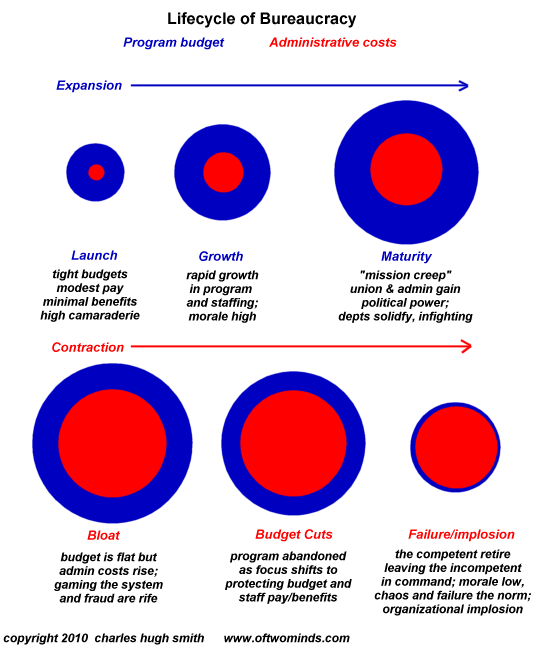
As I explain in my new book, Global Crisis, National Renewal, the conventional view has a naive faith that “great leaders” can reverse institutional rot. This faith overlooks the systemic sources of institutional decay and failure which are outlined in the graphic below, The Lifecycle of Bureaucracy, a.k.a. institutions.

Leaders are constrained by the nature of centralized organizations and the incentive structure that slowly shifts from rewarding efforts to further the institution’s core mission to self-service and protecting an ossified, failing institution from outside scrutiny and reform.

As Samo Burja explains in his insightful essay, Why Civilizations Collapse, those inside institutions are by design so compartmentalized that few (if any) even recognize the institution is failing. As long as everything is glued together in each little compartment, no one grasps the entire institution has lost its way. And since no one recognizes it, no one attempts to save it.

Institutions end up advancing caretaker managers who excel at the political game of rising to the top of a sprawling institution. When the decay (or budget cuts) finally trigger a crisis, the institution has been stripped of visionaries with a bold grasp of what’s needed to restore the focus on the core mission and institute new incentives. The bold leaders quit in disgust or were sent to bureaucratic Siberia as potential threats to the status quo.

The problem is institutions fail by the very nature of their centralized design. The organization is centralized so directives flow down the chain of command, and every branch is compartmentalized to limit the power of each department and employee to disrupt the orderly flow of top-down directives.

Within this compartmentalized, top-down structure, the incentives are to follow procedures rather than get results. The rewards go to those who dutifully follow procedures rather than to those who raise the alarm about the loss of transparency, effectiveness and focus on fulfilling the mission.

The path of least resistance is to protect the existing structure and add more compartments, i.e. “mission creep.” Rather than focus on the dissipation of resources and the decline of the core mission, leaders add “feel good” missions and PR promotions of phony reforms and initiatives that bleed more resources from the core mission.

Consider the institution of democracy, which has been corrupted into an invitation-only auction of state favors and rentier skims. Democracies have another fatal flaw: politicians win re-election by promising virtually everyone something for nothing: more benefits and entitlements and lower taxes. The gap between higher costs and declining revenues will be filled by government borrowing.

All this additional borrowing will supposedly be paid by the magic of “growth”, which will expand tax revenues at a rate that exceeds the cost of borrowing.

But demographics, resource depletion and the diminishing returns of a consumer economy fueled by rapidly expanding public and private debt have sapped “growth” in fundamental ways. Ironically, borrowing and spending more to spur “growth” only hastens the diminishing returns of increasing debt to fund consumption today.

Democracies are thus optimized for rapid “growth” and are ill-suited to transition to DeGrowth, i.e. less of everything for the vast majority of the citizenry as resources become scarce and debt eats the economy alive. (DeGrowth could work to everyone’s benefit, which is the point of Global Crisis, National Renewal.)

Central banking is another failing institution. When faced with fiscal crises, central states/banks inevitably succumb to the temptation to print/borrow currency in whatever sums are needed to fill the shortfall of the moment, i.e. political expediency. This profligate creation of currency seems to be magic at first; everyone accepts the “new money” at the current value. But eventually gravity takes hold and the currency’s purchasing power declines, as the real economy (the production of goods and services) grows at rates far below the expansion of credit and currency.

Even the greatest empires in human history have been unable to resist the “easy” solution of devaluing currency as the means of fulfilling all the promises that were made in more prosperous times.

The progression of centralized power slowly but surely replaces the self-organizing, resilient, decentralized structures of civil society with tightly bound hierarchical centralized structures that are increasingly ineffective, increasingly costly and increasingly fragile, i.e. increasingly prone to failure or collapse.

The irony of institutional decay and failure is everyone inside is so busy following procedures that nobody notices the decay until the whole worm-eaten structure collapses. Look no farther than financialized asset bubbles, healthcare and education for examples of institutions in run-to-failure decline.

We are in effect so busy arranging the beach umbrellas per our instructions that we don’t notice the approaching tsunami. Can a nation prosper as its institutions decay and collapse? Only in the fantasies and magical thinking of the delusional.

Revolution, Awakening, And Leaving Abusive Relationships All Happen In Unexpected Ways

By Caitlin Johnstone

Source: CaitlinJohnstone.com

People don’t generally leave abusive relationships in egoically satisfying, Hollywood-friendly ways.

I point this out because those of us who are watching the people’s abusive relationship with predatory power structures and hoping for revolutionary change often tend to envision the status quo ending in an epic way that will make for a good story and let us feel good about ourselves and how right we were. And that just isn’t how these things tend to go.

One of the most shameful things about being in an abusive relationship is how much longer you’ll let it go on for than an outside observer would expect. How much brutality you’ll put up with and the ways you’ll justify it to yourself.

The shame of this can be soul-crushing. A friend once said, “The worst part wasn’t when he raped me, it was having to make him breakfast afterward.” The shamefulness of the abuse and degradation you’ll put up with because of where you’re at in your mind is why people don’t discuss this aspect more, which is why the loved ones of people in those relationships often have such a hard time understanding it. People don’t talk about it, so many don’t understand how common it is.

Generally when someone leaves an abusive relationship it’s not really because they were hit one too many times. It’s not because it got worse than it used to be. Sometimes it will be because the abuser started to assault the victim’s child, but even that will often happen in ways that are a lot more complicated and shameful than the victim acknowledges when telling the story later on.

Generally when someone leaves an abusive relationship it happens for the same reason flowers bloom: because it was time. Something just shifts, and suddenly you’re seeing things you weren’t seeing before. You start noticing patterns, noticing manipulations, noticing the malice in the abuser’s face that you’d previously compartmentalized away from seeing.

And then when you leave the reality of it doesn’t often make for a great Hollywood movie or Hallmark TV special. It doesn’t fit well into egoically gratifying stories. A process just kind of plays itself out, some things happen in ways you probably didn’t anticipate, and then one day you’re not waking up next to the same person anymore. You might try to tell heroic stories about it, or others might do that on your behalf, but really it just kind of happened when the happening was ripe.

Spiritual enlightenment often happens in the same way. Zen Buddhism is full of stories of sudden awakenings where a monk meditates for thirty years while remaining locked in delusion and then suddenly experiences satori after slipping and falling or hearing a teacher say something unexpected or whatever.

It happens when it’s time. A good teacher might offer some spiritual practices to help “lay the groundwork” for awakening, but one person can take those practices and never awaken while another can awaken very quickly. It’s not like building a house or learning a new language where you set to work and do certain things in a certain way and then eventually you have what you set out to obtain. Awakening doesn’t work that way. It’s not the product of personal will. It happens when it happens.

A pot of water can sit there on the stove for minutes without looking like much is happening. When people look at our current environment of murderous exploitative status quo systems and deeply propagandized populations they’ll often despair because it’s very much the same: it doesn’t look like much is happening.

But then the water begins to boil. But then the battered wife escapes to safety. But then the spiritual aspirant sees beyond the veil of illusion. But then the people rise up.

Humans are storytelling creatures; that’s why it’s possible to gain such a tremendous amount of power over us by controlling our stories. We are storytelling creatures whose primate brains weren’t evolved for the purpose of giving us any absolute understanding of ultimate reality, whose senses only take in a tiny fraction of our surroundings, whose minds don’t process what’s happening in the ways science tells us things are actually happening.

What do you get when you have a storytelling animal with a very limited capacity to perceive life as it really is? You get a lot of things happening in ways that the creature did not expect, because none of their mental stories told them to anticipate it happening in that way. And then probably telling a bunch of stories about what happened which don’t truly reflect reality.

If and when humanity does wake up from its propaganda-induced coma and push for the changes needed for us to evade extinction and create a healthy world together, it will happen in ways we’re not expecting. It will happen in ways that aren’t pleasing to the ego. It will happen in ways that don’t allow us to stand up and say “Aha! You see? I was right all along!” It will happen in ways that don’t form a compelling narrative.

And how could it? If humanity is to survive into the distant future we’re going to have to transcend the egoic mental habits which led us into this mess. We’re going to have to transcend our unhealthy relationship with mental narrative which made us so easy to manipulate and propagandize. We’re going to have to transcend our self-destructive patterning, which will necessarily have to come from an unpatterned, and therefore unexpected direction.

It will happen when it happens, in a way we couldn’t possibly have predicted it would happen.

So don’t despair if it looks like things aren’t headed toward change. The boiling water, the escaped abuse victim, and the deeply enlightened mind all looked the same at one point.

Don’t despair, and don’t fear the unknown. The unknown is the only direction humanity’s salvation can possibly come from.

Politics Is Dead, Here’s What Killed It

By Charles Hugh Smith

Source: Of Two Minds

Representational democracy–a.k.a. politics as a solution to social and economic problems–has passed away. It did not die a natural death. Politics developed a cancer very early in life (circa the early 1800s), caused by wealth outweighing public opinion. This cancer spread slowly but metastasized in the past few decades, spreading to every nook and cranny of our society and economy as “democracy” devolved into an invitation-only auction of elections and political favors.

Politics might have had a fighting chance but three forces betrayed the nation and its citizenry.

1. The Federal Reserve transferred trillions of dollars of unearned wealth into the feeding troughs of the super-wealthy and corporations, vastly increasing the wealth the top 0.01% had to buy elections and favors. The Federal Reserve cloaked its treachery with jargon– quantitative easing, stimulus, etc.–and then stabbed the nation’s representational democracy in the back.

2. The Supreme Court betrayed the nation’s representative democracy by labeling corporations buying elections and political favors a form of “free speech.” (Please don’t hurt yourself laughing too hard.) The Supreme Court’s equating wealth buying elections and favors with individual citizens’ sacrosanct right of free speech was a knife in the back of the nation and its citizenry.

3. The two political parties betrayed their traditional voter bases to kneel at the altar of corporate / elite wealth, wealth which bought elections and political favors. The Democrats, traditional champions of the workforce in the 20th century, abandoned workers in favor of serving their corporate masters, masking their betrayal with fine-sounding phrases.

The Republican Party, traditionally promoters of Big Business (Wall Street, banks, mega-corporations), had maintained a narrow but crucial interest in trust-busting (limiting monopolies) to defend free enterprise and small business from the predations of monopolies and cartels. Those days are long past; just as the Democratic Party tossed the working class overboard to the sharks, the Republican Party walked small business off the gangplank right into the voracious jaws of cartels and globalized, financialized corporate sharks.

To cloak their betrayal and treachery, the parties have pursued a divide-and-conquer distraction game, pushing half the nation into one-size-fits-all “enemies lists” with labels that have lost all meaning other than as means to promote divisiveness and rancor: Liberal and Conservative, socialist and capitalist, etc.

It’s not the citizenry who are “deplorable,” it’s the parties’ corporate-derriere-kissing toadies, lackeys, apparatchiks, purveyors of propaganda, enforcers, apologists, sycophants, grifters and “leaders” who manage to greatly increase their private wealth while “serving the public” (heh).

These three betrayals of public trust and representational democracy caused the demise of politics as a solution to social and economic problems. “Politics” has been stripped to its essence: an invitation-only auction of elections and political favors. The price to watch from the rear of the auction is $1 million; to actually place a bid, the minimum is $10 million, but the winning bids are generally much higher.

(Lobbying, campaign contributions, bogus think-tanks, and philanthro-capitalist foundations are all part of the auction funding.)

Here’s “politics” in America now: come with mega-millions or don’t even bother to show up. Choose which “enemies list” you want to be on; there’s not much choice. And don’t forget to put a flower on the grave of representational democracy.

THE POWER OF DISCERNMENT

By Kingsley L. Dennis

Source: Waking Times

At our general level of awareness there is often no perceptible or discernible pattern to the flow of events. Partly this stems from having been conditioned into perceiving a particular dominant reality program. We do not have access to objective reality, although there can be moments and instances when glimpses occur. The phenomenon of miracles is an example of this, when the laws of a reality outside of our own intervene/operate within our subjective reality. Likewise, many ancient tales, fables, allegories, etc, are representations of what we refer to as a ‘higher dimension’ operating within our own. Such impulses help us, whether we are conscious of it or not, to re-orientate our perception against the indoctrinated programming. What we often take to be reality is in fact only a very thin slice of a much ‘bigger picture.’

The act of discernment is an inward one; as such, it requires a disciplined focus. Yet as we have seen, modern societies not only do they not cater to such practices, but they also actively dissuade us from approaching them. The result of this is that people in general do not see – or feel – a need for such a discernment. Modern life keeps us occupied and diverted by other pursuits. Unfortunately, it is often the case that ‘shock impacts’ are required in order for us to shift our attention away from the ‘straight path’ of normalized living. And we’ve been living with such a ‘shock event’ for almost two years now since the outbreak of the pandemic. We could see our current predicament from this perspective: that modern life was in need of a ‘crisis point’ within its old patterns for there to arise within people the need for something else. It is in such moments of deep reflection that an inner realization may occur: the recognition that common (i.e., consensus) culture does not provide sufficient meaning for our lives. That is, there is the lack of any transcendental, metaphysical impulse. An awareness of such lack often occurs in times when there is a noticeable deterioration in social and cultural systems. Such recognition – or re-cognition – is not yet dominant among the majority of our modern so-called ‘civilized’ nations. Yet we are soon reaching that tipping point.

For too long we have been absent from the vale of ‘soul-making,’ to quote the poet John Keats. And yet the signs have always been there to guide the way. When our early cave-dwelling ancestors first made their handprints upon the walls of their caves they were signalling to the external world: ‘I am here – I exist.’ The inner spark of the human being was attempting to be heard – to be imprinted onto the outer life. It was an early stage in the expression of an interiorized human consciousness. In each epoch our consciousness perceives and interprets reality in a particular way. How we experience the reality around us influences our perception of it, and vice-versa. This is why our perceptions have always been a target for direct manipulation – it is our reality-sensing software.

As part of our steps toward discernment we can begin by a recognition of the following factors: i) acknowledgement of one’s situation and the need for self-development and/or life adjustment; and ii) the need for partial detachment from one’s social and cultural conditioning and external influences. By recognizing these two factors a person can make the first step to self-aware discernment. A gradual de-conditioning of the social personality (the persona) helps to develop a detached perspective and to see external impacts for what they are. In order to see and think clearly, we need to methodically de-clutter our social personality. Then, and only then, can a conscious step be taken toward inner freedom and genuine liberty. That is, the old patterns must become less determined, dogmatic, and fixed. Then through this space, where old belief patterns have left their moorings, can new perceptions emerge. As this process gradually unfolds it is important that each person stays grounded in the world – in their everyday lives – and not to entertain themselves with amusing fantasies or unwarranted intoxications. Furthermore, it is important to remember that in all we do we should be in harmony and balance, and not in conflict with our everyday life. Our dignity and decency is not in what it has achieved, nor what it is, but in what it can become. And this is a choice each person can make.

Our Choice

As in everything in our lives, we make a choice. When it comes down to basics – which it inevitably must do – then we find that we have a fundamental choice between living a life in Love or in Fear. In other words, if we choose Love then we side with compassion, empathy, creativity, connection, support, sharing, and resilience. And if we choose to align with the Fear then we give ourselves over to control, manipulation, anxiety, and vulnerability – all the expressions of a culture of oppression.

If we ascribe to a life lived as islands of separation, then inevitably we learn (or are conditioned) to place our trust externally upon a range of institutions; these may range from religious, work/career, social, educational, political, etc. And if these institutions fail us then we naturally feel vulnerability, or even betrayed. And yet the truth of the matter is that we betrayed ourselves in the first place by outsourcing our trust. If we live a life relying upon external systems, then we must be prepared to feel distraught should those external systems break-down. In such times of great transition, such as now, these social institutions are themselves very fragile. Further, many of these systems are now revealing themselves to be corrupt – or being utilized by corrupt human agents. Right now, I would say that we are witnessing the ‘great unravelling’ of many of our once trusted systems. We are seeing head-on the undoing of many dishonest, unethical, and toxic structures that inevitably can no longer serve our interests. This unravelling is revealing that our sense of vulnerability is partly the dismantling of our false assumptions. And further, that our sense of vulnerability is the fear of letting go. It is important to be open to receiving information, even if it is of the disagreeable kind. Yet in being open to such information does not mean we should adopt a position of fear. We have to make a choice of not accepting, or adopting, these external aspects of fear and toxicity. They do not ‘belong’ to us.

In knowing this, we are compelled to seek out those experiences that feel real to us, and which can assist us in developing as human beings. If there is a ‘truth’ to be discerned, then it must surely come not through artificial constructs but through our everyday personal experiences. To understand that which we call the ‘self’ is only a construct until we can experience it through the revelation brought about by others. Alone, we are unable to ‘see’ the self – no more than we can see our own faces. And just as we need a mirror in order to view our face, so too do we need other people and experiences in life to be as mirrors to reveal the workings of the inner Self. In the end, it is our participation in life that shall teach us the discernment we need to tell truth from falsehood. No online course or TV program can teach us this. Let us not back away from ourselves – let us invite us closer in.

Is it already too late to say goodbye?

By Jonathan Cook

Source: Jonathan Cook Blog

It seems we may have reached the moment when it is time to say goodbye. It has been fun, educational and sometimes cathartic – for me at least. I hope you got something from our time together too.

I am not going anywhere, of course. Not for now at least. I love to write. For as long as I feasibly can, I will continue to rail against injustice, call out corporate power and its abuses, and demand a fairer and more open society.

But I have to be realistic. I have to recognise that a growing number of you will not be joining me here on this page for much longer. And it feels rude after so much time together not to bid you a fond farewell before it is too late. I will miss you.

Many of you may have assumed it wouldn’t end this way. You probably imagined that I would get banned by Facebook or Twitter. You would be able to rally round, send in complaints worded in the strongest possible terms, and lobby for my reinstatement. Maybe even sign a petition.

But it isn’t going to end like that. There will be no bang. I have been too careful for that to be my fate. I have avoided rude and crude words. I have steered clear of insults (apologies if my responses have sometimes been a little caustic). I have not defamed anyone. I have avoided “fake news” – except to critique it. I have not peddled “conspiracy theories”, unless quoting the British Medical Journal on Covid now counts as misinformation (yes, I know for a few of you it does).

But none of that has helped. My blog posts once attracted tens of thousands of shares. Then, as the algorithms tightened, it became thousands. Now, as they throttle me further, shares can often be counted in the hundreds. “Going viral” is a distant memory.

No, I won’t be banned. I will fade incrementally, like a small star in the night sky – one among millions – gradually eclipsed as its neighbouring suns grow ever bigger and brighter. I will disappear from view so slowly you won’t even notice.

Which is why I am saying my goodbyes now while I can still reach you, my most obstinate followers.

But this isn’t really about one small light being snuffed out. This isn’t just about our relationship coming to an end. Something bigger, and more disturbing, is taking place.

Journalists like me are part of an experiment – in a new, more democratised media landscape. We have developed new reader-funded models so that we can break free of the media corporations, which until now ensured billionaires and the state controlled the flow of information in one direction only: to speak down to us.

The corporate media need corporate advertising – or their owners’ deep pockets – to survive. They don’t need you, except as a captive audience. You’re both their prisoner and their product.

But the lifeblood of a reader-funded journalist, as the name suggests, are readers. The more of you we attract, the better chance there is that we can generate donations and income and make the model sustainable. Our Achilles’ heel is our dependence on social media to find you, to keep reaching you, to offer you an alternative from the corporate media.

If Facebook (sorry, the Meta universe) and Twitter stop independent writers from growing their readerships by manipulating the algorithms, by ghosting and shadow-banning them, and by all the other trickery we do not yet understand, then new voices cannot grow their funding base and break free of corporate control.

And equally, for those like me who are already established and have significant numbers of readers, these tech giants can whittle them away one by one. Ostensibly, I have many tens of thousands of followers, but for several years now I have been reaching fewer and fewer of you. I am starved of connection. The danger, already only too obvious, is that my readership, and funding model, will slowly start to shrivel and die.

Joe Rogan, Russell Brand and a handful of titans of the new media age are so big they can probably weather it out. But the rest of us will not be so lucky.

Readers will lose sight of us, as our light slowly fades, and then we will be gone completely. Vanished.

I have lost count of the followers who – because, god knows, an algorithm slipped up? – tell me they have received a social media post many months after they last saw one from me. In the cacophony of media noise, they had not noticed that I had unexpectedly gone quiet until that reminder arrived or else they assumed I had given up writing.

Which is why, if you want to keep seeing posts from me and writers like me, if this is not soon to be a final goodbye, if you think it important to read non-corporate analysis and commentary, then you need to act. You should be bookmarking your favourite writers and visiting their sites regularly – not just when you are prompted to by Mark Zuckerberg.

You need to be an active consumer of news – not a passive one, as you were raised to be when the choice was between three TV channels and a dozen print newspapers.

You need to search out and maintain those connections before they are gone entirely and the window has closed. Because those voices you prize now will wither and decay like autumn leaves if they have no audience. If you leave it too long, even when you finally remember to go search for them, you may find they are no longer there to be discovered. You will have missed the chance to say goodbye.

So let us say it now, while we still can: Farewell.

UPDATE:

Writing is a solitary activity, and it can be easy to imagine that what was obvious inside your head will be clear to others when that idea takes its place in the outside world. But a proportion of early readers of this post have mistaken it for an actual goodbye, rather than as a cautionary tale of what has been happening and what is still to come. So let me reassure you: I am going to continue writing and you can continue reading me, so long as either Twitter and Facebook direct you to me or you make the effort to find me.

Here’s hoping that my goodbye will prove unnecessary.