RUDOLF STEINER DESCRIBES THE HOSTILE SPIRITUAL BEINGS WHO FEED OFF YOUR FEAR AND ANXIETY

By Dylan Charles

Source: Waking Times

Anxiety, depression, and fear ravage so many today, but few pause to consider that in addition to the material influences in our lives, we may be also under the influence of beings which exist in dimensions outside of our ordinary perception.

But there is much more to reality than what we can see. feel, hear, taste and touch. In fact, an accounting of the matter that makes up the universe reveals that some 73% of it is made up of dark energy, and another 23% is made up of dark matter, neither of which can we see, nor understand. Furthermore, the human eye is only capable of seeing around .0035% of the entire spectrum of electromagnetic (EM) radiation. When we look into the heavens, 96% of it is invisible to us. Include in this the spiritual realms and there is an entire universe of possibilities which exists beyond our five senses.

Very few scientists today are willing to explore metaphysics to examine life beyond ordinary perception in order to make a connection between the seen and the unseen.

Rudolf Steiner, though, one of the most prolific and gifted scientists, philosophers, and esotericists of his time, devoted much of his work to the task of peering behind the veil, sharing his insight into the deeper nature of life and of the world beyond.

Regarding anxiety and depression, Steiner spoke of hostile beings in the spiritual world which influence and feed off of human emotion; a concept flatly rejected by most today. Yet this also analysis holds true for shamans and others who access the spiritual dimensions in order to alleviate mental suffering for their patients.

Many are familiar with the notion of energy vampires, or people who suck your energy and feed off your negative emotions. On the existence of similar entities which exist in other dimensions, Steiner wrote:

“There are beings in the spiritual realms for whom anxiety and fear emanating from human beings offer welcome food. When humans have no anxiety and fear, then these creatures starve. People not yet sufficiently convinced of this statement could understand it to be meant comparatively only. But for those who are familiar with this phenomenon, it is a reality. If fear and anxiety radiates from people and they break out in panic, then these creatures find welcome nutrition and they become more and more powerful. These beings are hostile towards humanity.

Everything that feeds on negative feelings, on anxiety, fear and superstition, despair or doubt, are in reality hostile forces in supersensible worlds, launching cruel attacks on human beings, while they are being fed. Therefore, it is above all necessary to begin with that the person who enters the spiritual world overcomes fear, feelings of helplessness, despair and anxiety. But these are exactly the feelings that belong to contemporary culture and materialism; because it estranges people from the spiritual world, it is especially suited to evoke hopelessness and fear of the unknown in people, thereby calling up the above mentioned hostile forces against them.” ~Rudolf Steiner

Negative emotions are food for inimical spirits. 

A concept such as this isn’t readily accepted into the everyday conversation steered by rigid skepticism and scientific materialism. The traditions of today have sought to expel ancient metaphysical wisdom and its practical application from our lives, and though scientific inquiry is exceptionally valuable, spiritual perception has always been a part of our experience.

“And yet, despite the cynical skepticism, all of the ancient mystery schools, true shamanic insights, and esoteric teachings (much of which have been suppressed and/or distorted over thousands of years for obvious reasons) have conveyed this truth for ‘the ones with eyes to see and ears to hear’, using their own language and symbolism, be it “The General Law” (Esoteric Christianity), Archons (Gnostics), “Lords of Destiny” (Hermeticism), Predator/Fliers – “The topic of all topics” (Shamanism, Castaneda), “The Evil Magician” (Gurdjieff), The Shaitans (Sufism), The Jinn (Arabian mythology), Wetiko (Native American Spirituality), Occult Hostile Forces (Sri Aurobindo & The Mother, The Integral Yoga), etc.” ~Bernhard Guenther

Dealings with extra-sensory or hyper-dimensional beings have long been a part of our history, and are directly accessible to any of us when proper practice and attention is given to the matter. I know this to be true from my experiences with plant medicine shamanism where it is entirely possible to enter into states of consciousness where entire cosmologies of life exist and are available to interact with.

Finding oneself in the rut of spiraling negative self-talk, depression, crippling anxiety, or uncontrollable, irrational fear, is a sign, as Steiner points out, of a disconnection from our true spiritual nature, exacerbated by beings who operate in the spiritual realms. This is why some consider disorders like this to be spiritual illnesses, and until the rift is healed with proper attention given to the development of spirit, the feelings tend to exacerbate and drive one further into distress.

“When humans have no anxiety and fear, then these creatures starve.” ~Rudolph Steiner

RETURN OF THE WARRIOR

By Elva Thompson

Source: Waking Times

“It may be that some little root of the sacred tree still lives.
Nourish it then
That it may leaf
And bloom
And fill with singing birds!

Hear me, that the people may once again
Find the good road
And the shielding tree.”  – Black Elk

Dystopic reality

Are you wondering what the HELL is going on in this shit show reality? The sheer insanity of world events and the palpable madness of our spiritually unplugged leaders is spectacularly obvious even though the masses cannot see it. Floods and fires ravage the planet leaving disaster in their wake. Seventy percent of wildlife has been destroyed in the last decade. Hundreds of thousands of birds are dropping lifeless from the sky, dead fish line many coast lines and whales are beaching and dying.

So what is going on?

The end of a grand cycle

We are men and our lot in life is to learn and to be hurled into inconceivable new worlds.”― Carlos Castaneda,

Planetary cycles within cycles are all ending in crescendo. December 21st 2012 was the marker for the end of the twenty six thousand year period known as the Grand Cosmic Year. And, the Old Year has to die before the New Year can begin. Everything is about to change…. and we will be literally hurled into an inconceivable new world. The signs are already here for those who can see beyond the narrative pedaled by the matrix hive mind.

As we speak, there is a magnetic pole reversal in event mode. Two north poles battling it out and playing havoc with the jet stream. The magnetosphere is weakening and as cosmic rays increase we can expect many challenges in the days and years to come. Catastrophe is served up not only by the evil that runs this world but the cosmos in its cycles of creation and destruction. It is time to choose our path amid the chaos that is erupting all around us. We can either ride the mental fear train into oblivion or we can return to the wisdom of our ancestral way of life and find inner peace.

Becoming brave

“We don’t need anyone to teach us sorcery, because there is really nothing to learn. What we need is a teacher to convince us that there is incalculable power at our fingertips. What a strange paradox!”― Carlos Castaneda

Strange paradox, indeed! For we do have incalculable power at our fingertips. The question is how do we find it?

There is much truth in the old adages: “Knock and the door will open.” “Ask and you will receive.” Visualise and knock on the spiritual door. The gate that leads to a re-connection with archetypal aspects of Self. Our eagle nature, wolf nature, bear nature, fox nature, hare nature, deer nature, etc. – our natures both predator and prey. Shaman’s of the older days understood that all things in the outer world were One in inner space and everything that exists is contactable.

All tribal once

Do not forget that we were all tribal once before evil overtook us. It is no accident that our shamans and healers were taken by the government to lunatic asylums many in a ball and chain and later murdered. No accident that sonic language – the language of the spirits was banned along with sacred ceremonies and spirit calling. Indigenous children all over the world were brutalized by the bible toting invaders for speaking their native language.

What was the invading evil so afraid of?

Could it be our spiritual power and the realities attached to them?

The spirit realm

Shamans know that man is two beings. One is physical flesh and earth bound, and the other is his energetic or non physical counterpart…a realm of unlimited possibility. Man also has two minds: the physical rational thinking mind called intellect which constantly talks and argues with itself – and the quiet mind that is connected to the spiritual reality of Source – the mysterious force that vitalises all living things with the energy that we call ‘life’.

I live with Native People. My husband is a ‘medicine man’ in the Sundance way of life. I have had the honour of being taught many things and to become cognizant that all physical life is energetic in essence.

“In the life of the Indian there was only one inevitable duty, – the duty of prayer – the daily recognition of the Unseen and Eternal. His daily devotions were more necessary to him than daily food. He wakes at day break, puts on his moccasins and steps down to the water’s edge. Here he throws handfuls of clear, cold water into his face, or plunges in bodily. After the bath, he stands erect before the advancing dawn, facing the sun as it dances upon the horizon, and offers his unspoken orison. His mate may precede or follow him in his devotions, but never accompanies him. Each soul must meet the morning sun, the new sweet earth and the Great Silence alone!” – Ohiyesa

Indigenous shamans knew that reality consisted of two parallel worlds that in the Yaqui tradition are known as the tonal(physical) and the nagual(the non physical). Because their spiritual power points were not atrophied as ours are today, the shamans of old knew that all life was infused with the spiritual power of Source, and that this invisible realm penetrated every aspect of our being. And, that under certain conditions this power could be contacted and even become visible.

Spirit helpers or allies

To focus power, a shaman needs allies in spiritual reality – this helper can be an animal, bird, reptile, insect, a wanagi (ghost) or any inanimate object such as stones or power infused objects. The allies being non physical beings can in fact take any form they like.The mystical mind of the shaman can fuse with all of life and become it. He can shapeshift into a crow, a wolf  or start a fire with his fingers! See my article https://www.heartstarbooks.com/a-thunder-being-nation/

Making contact

If you are reading these words, the chances are you will have already experienced magic moments of connection. A space where time, the I and the world disappears and, for a brief moment we are in the joyous state of connection to Source. This can happen during a walk in the forest surrounded by the beautiful, patient energy of the trees. Earthing with bare feet on the ground. Drumming to the heartbeat of the planet. Working with plants in the garden is a wonderful opportunity to commune with the standing nations.

For me, sun gazing is the ultimate spiritual experience. A practice that allows me through visualisation to intentionally connect the little sun in my solar plexus to the outside sun in the sky… and the inner sun at the centre of the earth. One sun is positive, the other negative and we are the third estate. The children of the two suns and the apex of the triangle. The tetrahedron of the third dimension

Touching base

Research the old religion of your ancestors and even though you might not know how to proceed with ceremonies of your own, if you open your heart and are ready to commit to Source with no agenda, no strings attached, then synchronicity will guide you. Do not be afraid to sail uncharted seas for when we restore our natural energetic balance magic happens. You will soon become aware that everything in the natural world is listening. When we ask questions of spiritual reality the answer can suddenly appear within our mind. This response can be immediate or may take days and even weeks but reply they will.

The obstacle

Have no doubt, there is a spiritual war raging on this planet, and we need to get up to speed. The first obstacle we have to overcome on the road to freedom is our thinking mind, the little ‘I’ that primps and postulates. Somehow we have to shut it up!

I recommend ritual, a reptilian trait that we can use to our advantage. Ritual is ceremonial repetition or mantra and can help us stop the infernal chattering of the ego’s frightened mind. We need a ceremonial direction in our lives as a stepping stone to mastery of ourselves.

Contact

If human beings and nature are a holistic living whole, then we should be able to contact planetary intelligence and awareness directly, and furthermore, we should have the spiritual ability to make changes in physical reality by the use of focused spiritual attention. This is the Art of causing change to occur in conformity with will, and births the sacred magician in ourselves.

This reality we call life, is an all pervading matrix of electromagnetic charge and no matter where we are, whether it be in our front room, prison cell, hospital bed, or high rise block of flats in the middle of the city, our thoughts can with intent, affect the energetic reality of Earth, i.e. physical events can take place ‘outside of ourselves’ without us actually being present. A directed loving spiritual action can have a physical response at any point on the planet. Long distance doctoring and absent healings work on the same principle.

If we are the planet, and everything that exists, think of the energy that would be available to us, if we can overcome the deliberately designed and re-enforced illusion of separation. If we focused our spiritual attention and intent without emotion, on a polluted site or waterway, a politician, or an individual that holds the purse strings of the world…think what might be possible.

This is a very exciting time to be alive. The Rainbow Warriors have returned and like a silent wave waits for the appointed time to rise above the third world and wield the spiritual power so long denied us.

Get together with like minded people, find each other and pray for this world. All you need is love in your heart and the desire to be of service to the planet. You will get your answers and you will intuitively know how to proceed.

Be sure to listen to Wolf Totem by the Mongolian band The Hu.

Until next time, stay strong in spiritual reality.

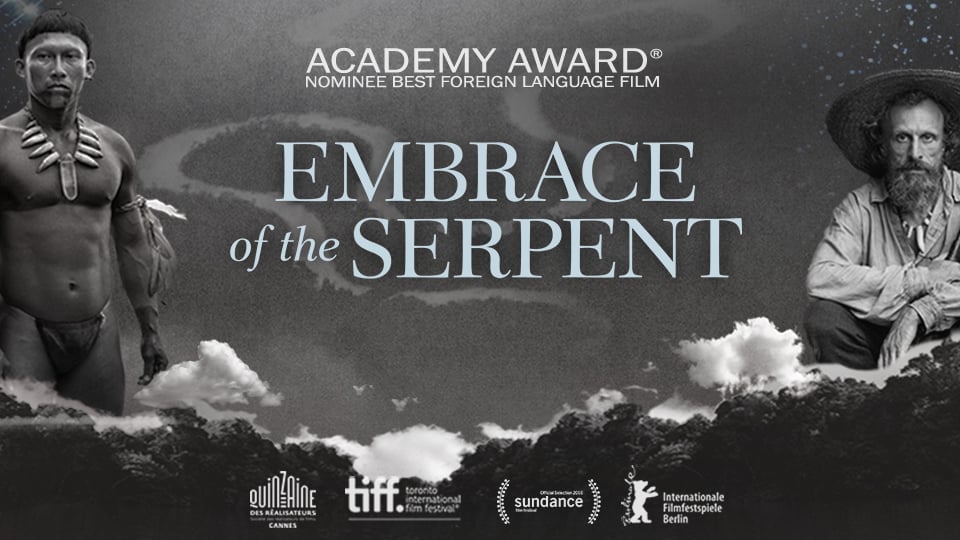
Saturday Matinee: Embrace of the Serpent

From Wikipedia:

Embrace of the Serpent (Spanish: El abrazo de la serpiente) is a 2015 internationally co-produced adventure drama film directed by Ciro Guerra, and written by Guerra and Jacques Toulemonde Vidal. Shot almost entirely in black and white, the film follows two journeys made thirty years apart by the indigenous shaman Karamakate in the Colombian Amazonian jungle, one with Theo, a German ethnographer, and the other with Evan, an American botanist, both of whom are searching for the rare plant yakruna. It was inspired by the travel diaries of Theodor Koch-Grunberg and Richard Evans Schultes, and dedicated to lost Amazonian cultures.

Embrace of the Serpent was premiered on 15 May 2015 during the Directors’ Fortnight section at the 2015 Cannes Film Festival, where it won the Art Cinema Award. The film was released in Colombia on 21 May 2015, and worldwide over the course of the following twelve months. It has received universal acclaim from critics, who praised the cinematography and the story’s impact of the destruction of the Amazon rainforest and way of life by white colonialism. It has won numerous awards, including the Alfred P. Sloan Prize at the 2016 Sundance Film Festival, the Grand Jury Prize for Best Picture at the 2017 Riviera International Film Festival, and seven awards at the 3rd Platino Awards to recognise the best Ibero-American films of 2015, including the Platino Award for Best Ibero-American Film. In 2016 the film was submitted as Colombia’s entry for the category of Best Foreign Language Film at the 88th Academy Awards and was included among the final five nominees, becoming the first Colombian film ever to receive a nomination for an Academy Award.

The film tells two stories thirty years apart, both featuring Karamakate, an Amazonian shaman and last survivor of his tribe. He travels with two scientists, firstly with the German Theo von Martius in 1909 and then with an American named Evan in 1940, to look for the rare yakruna, a sacred plant.[4]

Theo, an ethnographer from Tübingen who has already been residing in the Amazon for several years, is very sick and is travelling by canoe with his field notes and a westernised local named Manduca who he saved from enslavement on a rubber plantation. Karamakate prolongs his life, blasting white powder called “the sun’s semen” (possibly a hallucinogenic made from virola[5]) up his nose, but is reluctant to become involved with a westerner and refuses his money. Theo is searching for yakruna as the only cure for his disease and the three set off in the canoe to search for it.

Many years later an American botanist, Evan (Brionne Davis), paddles up to a much older Karamakate (Antonio Bolívar) who has apparently forgotten the customs of his own people. Evan says he is hoping to complete Theo’s quest and Karamakate does assist, again reluctantly, saying his knowledge is spent. Evan has a book of Theo’s final trek, which his aide had sent back to Europe, as he did not survive the jungle. The book includes an image of Karamakate, which he refers to as his chullachaqui, a native term for hollow spirit. Karamakate agrees to help him only when Evan describes himself as someone who has devoted himself to plants, although Evan’s real purpose is actually to secure disease-free rubber trees, since the United States’s supplies of rubber from South East Asia had dwindled due to the Japanese wartime advance.

Both expeditions feature a Spanish Catholic Mission by the side of an Amazon tributary, run in 1909 by a sadistic, lone Spanish priest who beats orphan boys for any “pagan” behaviour, and in 1940 by a delusional Brazilian figure who believes he is the Messiah. He only trusts the visitors when he believes they are the Biblical Magi, but Karamakate wins his respect when he heals his wife. By now the children of 1909 have grown into disturbed and violent acolytes.

In 1909, we are left with Theo, sick and having fled the Mission, arriving at a frontier post just about to be invaded by Colombian soldiers during the Amazon rubber boom, where the sacred yakruna is being abused by drunken men, and cultivated, against local traditions. Karamakate is furious and destroys it. In 1940, Karamakate does show Evan the origin of the plant in striking denuded dome-shaped mountains (Cerros de Mavecure), allegedly the home of yakruna. He reveals one yakruna flower that is on the last plant – he has destroyed all the others – and prepares it for Evan. The preparation being hallucinogenic, aids Evan in undergoing a superconscious experience. While most of the film is in black-and-white, a part of this experience is shown in colour to signify its intensity. The film ends with a transformed Evan remaining enamoured by a group of butterflies.

Watch the full film on Kanopy.

Art and Dreaming: Realizing our Power to Co-Create Reality

By Ruth Gordon

Source: Reality Sandwich

“True creativity doesn’t just make things; it feeds what feeds life. In modern culture where people are no longer initiated, the spirit goes unfed. To be seen, the uninitiated create insane things, some destructive to life, to feel visible and powerful. These creations are touted as the real world. They are actually forms of untutored grief signaling a longing for the true reality of village togetherness.”

Martín Prechtel, Secrets of the Talking Jaguar, p.232

These words, from a book detailing Martín Prechtel’s initiation as a Mayan Shaman, accurately sum up our modern world. In the humanitarian, ecological, and political crises we are facing, we are witnessing the effects of a severe spiritual hunger.

We in the Western world are a deeply wounded culture; our Indigenous traditions long destroyed, our common land stolen by the rich and powerful, we often now desperately seek comfort by any means possible – over-consumption of food, of social media, of drugs and alcohol, of our natural resources.

This way of being is known among North American Indigenous people by the name of “wetiko,” or the “disease of the white man.” In the traditional Algonquin myth, the “wetiko” is a rapacious spirit who lives in the dark forest and possesses people, filling them with an insane compulsion to consume and destroy. This spirit makes monsters out of humans, filling them with an insatiable drive to devour everything that crosses their path.

Today, we see wetiko everywhere – in our cruel systems of governance that refuse sanctuary to refugees fleeing conflict, while at the same time escalating those very conflicts, mostly for the single purpose of the highest possible short-term profit, in the disintegration of human community through separating and atomizing social structures and the corresponding upsurge of loneliness and despair, and in the continued addiction to economic growth despite clear and repeated warnings that this kind of globalized industry is killing our planet.

Wetiko functions like a virus – it’s highly contagious and most of us are infected with it to some degree. It’s at the root of the human conflicts that often derail attempts to create alternative ways of life. It’s not enough to simply wish for a better world, it’s not even enough to work hard at creating one. We need to be ready to transform our entire mode of perception, to boil down our ways of thinking and being and reconstruct ourselves from scratch, with consciousness of the wetiko-ized habits we often fall into.

In Dispelling Wetiko: Breaking the Curse of Evil, Paul Levy writes:

“The evil that is incarnating in our world simultaneously beckons and potentially actualizes an expansion of consciousness, all depending on our recognition of what is being revealed. It is as if hidden in the darkness is a spark of light that has descended into its depths, and when recognized in the darkness, this light returns to its source.”

(Levy, 2013, p. 145)

Levy’s idea, that hidden in the poison of wetiko lies its own antidote, offers a healing reference for how to approach what Prechtel calls “untutored grief”: the fecund raw material that, if not used to grow something new, becomes destructive. However, when we are educated, or “initiated” into ways of transforming our grief, of understanding what the darkness in us wants to bring to light, we often find we have stumbled upon a store of incredible potentiality – an almost boundless source of energy and power that we can refocus towards healing, if we choose to do so. Our collective shadows are potential treasure, showing us wounds that need healing, the deep behavioral structures that create conflict, and pushing us to grow beyond our self-limiting patterns. We find the light by going through the dark, not by avoiding it. We can only unfold our full potential for love, beauty, and creativity by recognizing the life-force that’s bound up in our trauma. It’s releasing that closed-off and separated aspect of ourselves that will make us whole.

There’s an interesting symbolic parallel in the human compulsion to dig, mine and extract precious metal. If we instead dug into the fertile ground of our consciousness and our imagination rather than into the physical Earth, would we then finally be able to create a sustainable form of the “treasure” we long for – the “true reality of village togetherness,” so overcoming our addiction to exploiting the Earth?

Consciousness and Creativity: We are the Universe Observing Itself

In Quantum Revelation: A Radical Synthesis of Science and Spirituality, Paul Levy describes how the science of quantum mechanics, although yet to really inform our everyday mode of being, could be a gateway for us: enabling us to understand the dreamlike nature of the world, to reconnect with the divine and infinitely creative aspects of existence. The central insight of quantum mechanics is that quantum particles respond differently depending on whether we are observing them or not. They are waves when we do not observe them and become particles when we do. This implies that quantum matter somehow knows when it is being observed, and subsequently changes both its form and behavior. This points to an astounding idea: that the world we perceive not only perceives us, but also manifests itself depending on our very mode of perception. Or, to put it another way, that the world we encounter depends on how we dream it up. It seems as if there are infinite possibilities of reality. The one that is activated depends only on our capacity to envision it, on the expansiveness and daring of our imagination.

Levy goes even further, asserting that we are living in a world that consciously responds to our consciousness, that, in fact, has created us for the purpose of understanding itself:

“[T]hrough us, the universe questions itself and tries out various answers on itself in an effort parallel to our own to decipher its own being. In the process of observing and reflecting upon our universe we are actually changing the universe’s idea of itself.”

(Chapter 5, “Cosmogenesis,” 2018)

If Levy is right, we are part of a cosmos that is self-creating and self-understanding. It is as if, through consciousness, the universe is craning its neck around to look at itself. We are its eyes, and its senses.

If we want to escape the hold of wetiko, to transition to a way of life that serves all beings, we need to value the power of our own creativity, and to understand that we are always creating the reality we experience, whether we are aware of it or not. The more conscious we are of our creative power, the more we can use it to dream up a world we want to live in; to orchestrate our lives with the same skill and precision as a highly trained conductor.

For this, we need to build a network of communities, (as in Tamera’s Healing Biotopes Plan), where we can study the raw matter of our cultural grief, where we can learn to compost it, and use it to grow new life, where we can discover how to create the “village togetherness” we all long for. We need spaces where we can experiment with and test out our powers of dreaming, encountering, understanding and interacting with the dreamlike nature of reality. We need spaces where we can build the self-confidence and courage that a “life artist” needs. We need public forums where our “life-art” is seen and honored. And all this needs to happen in a large enough group of people for our actions to hold weight, gather momentum and give courage to others.

As Paul Levy writes:

“The universe is a collectively shared dream that is too seemingly dense and solidified for any one person’s change in perspective to transform, but when a critical mass of people get into alignment and consciously put together what I call our “sacred power of dreaming” (our innate power to dream the universe into materialization), we can, literally, change the (waking) dream we are having.”

(Levy, Chapter 5: “Self-Excited Circuit,” 2018)

This is why it is so vital to build communities of trust – we will not be able to change the reality we are currently experiencing alone. However, by cooperating with others we will find the power to co-create paradise on Earth: a reality in which war and violence will be completely unthinkable, where we honor and respect the Earth as the sacred life giver it is, where we are able to fully use the creative potential that lies coiled within each of us. The field-creating power of a group of people can both activate our imaginative potential and provide the vessel in which to create the life we long for.

Waking Up to the Dreamlike Nature of Reality

Paying attention to our powers of dreaming is a simple first step towards comprehending the dreamlike nature of reality, as even those of us who believe that we are “not artistic” still dream each and every night, effortlessly creating symbols and stories that resonate through and inform us, if we take the time to remember and listen to them.

In the Tzutujil culture that Prechtel describes, families gathered each morning to share their dreams, which they saw as being the other half of waking life – just as real, and just as important:

“To a shaman a dream is not a creation of the mind, psyche or soul. It is the remembered fragment of the experience of one’s natural spirit in the twin world, the dreamworld … Although the landscape of dreams may seem different than the landscape of the awake world, it is actually the balanced opposite, reversed version, where our souls live out our bodies’ lives reenacted as if in a complex kind of mirror. Like the two opposing wings of a butterfly, the dreamworld is one wing and the awake world is the other wing. The butterfly must have both wings connected at the Heart in order to fly and function. Neither wing – dreams or waking – contains all of life. Real life occurs as a result of the interaction between the two. The life is the butterfly’s heart, and both dreaming and awake life are necessary to keep the heart alive.”

(Secrets of the Talking Jaguar, pp. 169–170)

As Prechtel goes on to say, “dreams read life back to us like a storyteller” and as such, can be excellent and often uncanny guides in life. I’m sure all of us have had the experience of a dream that seems wiser than we are, a dream that gives an answer to a problem, or that seems to foretell future events.

I’ve experienced personally how dreams can come into creative play with waking life. I once had a powerful dream in which a man, who in my waking life I was on the brink of falling in love with, guided me as I climbed down a building. He was agile, he knew the structure well, as it was his parent’s house, and he helped me down, showing me where to put my hands and feet. After I had this dream, I felt a deep certainty that I could trust this man. I understood that his role in my life right now was to accompany and guide me so that I could move forward, leaving behind the old structures of thought and being that no longer served me (structures he knew well, that he’d also “climbed down from” before). In my waking life, I had very little basis for such a deep trust at that point. I’d known this man a few months. And yet the indication of this dream turned out to be true. It encouraged me to trust him as a guide, and in turn, this faith allowed him (perhaps even prompted him) to actually play out this role in my waking life.

Was this dream reality not only informing but actually creating waking life? I think so. By believing in the certainty this dream instilled in me, I was able to act with faith and courage, which then allowed trust and intimacy to develop in waking reality.

For me, this is an example of those twin butterfly wings of the dreamworld and the waking world meeting at the heart’s center. Both dreamworld and waking life kept my heart alive at that time, nourishing and feeding it. These dual realities prompted me to be an artist: to act on my desires and impulses, to paint the world as I wished it to be.

Consciously Shaping Reality

The consequence of accepting our own creative powers and the dreamlike logic of existence are that we can begin to consciously shape reality. This is a deep responsibility – not anything we can take lightly.

Wetiko disrupts our natural experience of unity with all life. But in truth, we are inextricably interrelated with all other living beings, in the same way that a whirlpool is both identifiably different and part of the river it forms in. This knowledge comes with an immense duty to everything else that exists.

Our every thought, our every action, has an effect on the whole, unavoidably altering everything else in some way, however subtle. We do not need to become megalomaniacs about this – we are no more and no less important than any other human, plant or animal being. But we must understand, if we are to overcome wetiko’s hold on us, that all life, and all activity, constantly shifts the pattern of the whole.

Once we realize this, our everyday lives become imbued with a new sense of purpose and responsibility. Knowing that what we think, say and do alters the whole, guiding a new form of reality into being in each and every moment, means considering carefully how we want to exist in this world. It’s much easier to believe that we are powerless; then we can escape any sense of responsibility. Victimhood is much more comfortable than agency. But if we want to realize the role human beings can play in global transformation, we must be willing to step into agency. We must understand that our inherent creative powers are a divine gift. We’ve been given the capacity to make drastic alterations to the world – in the natural environment, in human society, perhaps even to outer space. Now we must choose whether we want to use these gifts in service of life or continue using them against it—and so push ourselves off the brink of abyss.

Let’s choose to use the wetiko virus rampaging through our human system to actualize an expansion of consciousness, to shine a light deep into the roots of our “untutored grief,” and begin to dream into our potential as deeply creative beings with the ability to create the reality of togetherness that we all long for.

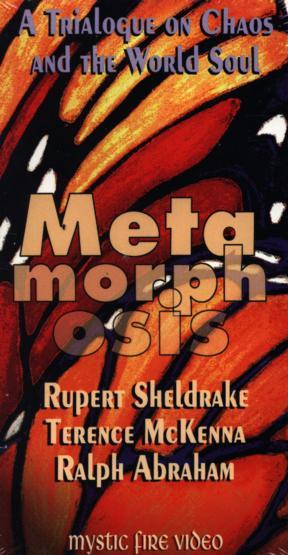
Saturday Matinee: Metamorphosis

(In memory of Terence McKenna, November 16, 1946 – April 3, 2000)

CHAOS AND THE WORLD SOUL

By Richard Kadrey

Source: Wired

METAMORPHOSIS – A video “trialogue” featuring Ralph Abraham, Terence McKenna, and Rupert Sheldrake – is part shamanic journey and part New Physics 101. It’s mostly talk, with touches of simple computer graphics and music adorning the presentation. But what talk it is. We’ve got Abraham, a mathematician and the godfather of chaos theory; McKenna, a shamanologist, ethnopharmacologist, and psychedelic philosopher; and Sheldrake, a radical biologist and originator of the idea of “morphic resonance,” a memory embedded in all natural systems. Their free-form discussion ranges from drug experiments to the anima mundi (world soul), chaos and complexity, and the effects of language and imagination on the shape of the universe – all in search of a new field theory that encompasses art, science, and philosophy.

In this particular chaotic system, McKenna is the strange attractor around which Abraham and Sheldrake orbit. The three unite in a quest for knowledge and an exchange about the sciences they’ve studied. Sheldrake talks passionately about trying to redefine biology in terms of living organisms, not the abstract dead things found in textbooks and labs. Abraham, not surprisingly, explains how protests over the Vietnam War lead him to leave his sheltered academic life, pursue meditation in the Himalayas, and study chaos theory.

With McKenna as the ringleader (and biggest talker), imagination and chaos are the principal themes. Chaos, as McKenna describes it, is a science to study, an opportunity to reshape the world by looking through the lens of nonlinear processes, and a metaphor to help us think about our place in the universe. In McKenna’s words, chaos “is telling us that the intimation of mysticism, the intimation of a possibility of transcendence, is all firmly grounded in science.”

This is heady stuff. Though you half expect the psychedelic proselytizing to drift off into some kind of Birkenstock-and-bean-sprout dead end, the rigor, intelligence, and wit of these three minds keep the ideas sharp and fast. For anyone interested in the edge of science, this video is both entertaining and inspiring.

The Four Pillars of Disaster Shamanism

By Gary Z McGee

Source: The Mind Unleashed

“We need shamans, and if society doesn’t provide them, the universe will.” ~Joe Lewels

In the article The Archetypal Path to Getting Your Shit Together, I wrote about the power of archetypes. A Disaster Shaman is an example of using an archetype to make the world a better place; to become the change we want to see in the world.

The Disaster Shaman recipe combines aspects of The Shadow with aspects of The Hero and then mixes in a little Trickster tomfoolery. The combination of these archetypes creates a particular flavor of nontraditional shamanism that spearheads healthy Cosmic Law through the heart of unhealthy lawfulness.

A Disaster Shaman is a force of nature first, a person second; sowing radical revolution in order to reap progressive evolution. Healthy balance is primary. Even if it comes at the expense of comfort and security. Disaster Shamanism (otherwise known as Apocalyptic Shamanism) is the interdependent shamanic response to apocalyptic times.

The primary tasks of a Disaster Shaman are as follows:

–Heal disaster situations through shamanic cosmology and ecopsychology.

–Listen to Universal Laws to discern the difference between healthy and unhealthy.

–Live moderately so that others may moderately live.

–Diagnose and heal Nature Deprivation.

–Transform weaponry into livingry.

–Bring “water” to the Wasteland.

The sub archetypes of the Disaster Shaman archetype are The New Hero, The Fifth Horseman of the Apocalypse, The Sacred Clown, and The New Oracle. The four pillars of Disaster Shamanism subsume these sub archetypes. Let’s break them down…

Hero-expiation (New Hero or Cosmic Hero):

“Our sole responsibility is to produce something smarter than we are; any problems beyond that are not ours to solve.” ~Ray Kurzweil

The average person is not heroic (courageous). Likewise, the average hero is not prestigious (provident). A New Hero, as opposed to a typical hero, is a hero with prestige. A New Hero has gone Meta with the concept of heroism itself.

The New Hero sub archetype is the first pillar of Disaster Shamanism. New heroism is gained through hero-expiation. Hero-expiation is the voluntary, wise, honorable, moral, and compassionate distribution of power so that power doesn’t get to the point that it corrupts.

It is through the wise distribution of power that a typical hero becomes a New-hero (cosmic hero, next-level hero) with skill, power, honor, and prestige, as opposed to just a typical hero with only skill and power.

Hero expiation is all about getting power over power. Whether one’s own power or the overreaching power of others. It’s about turning the tables on entrenched power by “counting coup” on it.

A Disaster Shaman as New Hero is a social leveling mechanism par excellence. They count coup on power through strategic humiliation (shaming) so that power never has the chance to become absolute.

When a New Hero comes to town, fear-filled blue pills are swapped with wisdom-filled red pills. The Disaster Shaman has come to set the record straight. To recondition the culture that has been conditioned into believing in competition over cooperation and narrow-minded one-upmanship over open-minded compassion. They teach that competition has always been secondary to cooperation; otherwise we wouldn’t have survived as a species (Darwin).

Eco-consciousness (Fifth Horseman of the Apocalypse):

“Extreme positions are not succeeded by moderate ones, but by contrary extreme positions.” ~Friedrich Nietzsche

Eco-consciousness is about uncontrolled order overcoming controlled chaos. Whether the culture (tribe) has become too obese, too greedy, too violent or some other unhealthy excess, the Disaster Shaman arrives to set the record straight; to plant a seed of overt moderation within the covert immoderation.

The Fifth Horseman is the one that cleans up after the original Four Horsemen (the Four Horsemen is a metaphor for anyone caught up (aware or not) in any kind of unsustainable, unhealthy, violent, immoral, or mass-destructive social system). The Fifth Horseman of the Apocalypse is an archetype representing rebirth and renewal in the face of conquest, war, famine, and death.

The Fifth Horseman is ruthless with her healing powers. Her name is Providence, Phoenix-like, she rises up from the ashes of war & decay to spread self-actualized love, open-mindedness, and progressive sustainability by digging up the decay and unsustainable residue of past and present civilizations and then using it all as compost in cultivating and growing a healthier more balanced future.

In that capacity she has devoted herself to planting gardens of eco-centric heroism in the humus of war, hate, close-mindedness and greed, and anything else left behind by the original four horsemen. She is dedicated to, as Buckminster Fuller said, transforming weaponry into livingry.

She subsumes the original four horsemen by teaching them that the new definition of right & wrong must be derived from the universal dictation of healthy & unhealthy rather than the human opinion of good & evil.

The Fifth Horseman is the Goddess of Recompense. She is the Verdant Force. She is the soft hammer of evolution. She has come to blur the false boundaries that have been erected between nature and the human soul.

She is Gaia. She is Lady Justice. She is the return of the Sacred Feminine. She is all of us, men and women, realizing that we are nature first and humans second, that we are soul first and ego second. She is weighing the worth of the human world with the Scales of Justice. With or without us, she will not fail to bring water to the wasteland.

High humor (Sacred Clown):

“What is a tragedy but a misunderstood comedy.” ~Shakespeare

Most of us are familiar with the prototypical clowns: red-nosed clowns, court jesters, and Tarot fools. But sacred clowns take clowning to a whole other level.

Almost all types of sacred clowns combine trickster spirit with shamanic wisdom to create a kind of sacred tomfoolery that keeps the zeitgeist in check. Their methods are unconventional and typically antithetical to the status quo, but extremely effective. They indirectly re-enforce societal customs by directly enforcing their own powerful sense of humor into the social dynamic.

The main function of a sacred clown is to deflate the ego of power by reminding those in power of their own fallibility, while also reminding those who are not in power that power has the potential to become corrupt if it’s not balanced with other forces, namely with humor. But sacred clowns don’t out-rightly derive things. They’re not comedians, per se. Though they can be. They are more like personified trickster gods, poking holes in things that people take too seriously.

Through acts of satire and showy displays of blasphemy, sacred clowns create a cultural dissonance born from their Crazy Wisdom, from which serious anxiety is free to collapse on itself into sincere laughter.

The high humor of Sacred Clowns leads to a higher courage and the audacity to speak truth to power. And they do so with silver-tongued proficiency. There exists no perceived construct of power that’s above their enlightened rebellion. No idol too golden. No high horse too high. No pedestal too revered. No “wizard” too disguised. No God too godly. No title too contrived.

Nothing is immune to the exactness of a Sacred Clown’s rebellion. It’s all merely procrastinating compost. It’s all just well-arranged armor waiting to rust. It’s all an illusion within a delusion. And the Sacred Clown has the enlightened sense of humor to reveal that absolute fact.

Lest we write our lives off to unhealthy stagnation and devolving inertia, we must become something that has the power to perpetually overcome itself. The sacred clown has this power. Paraphrasing William Blake, “If the fool (Sacred Clown) would persist in his folly, he would become wise (New Oracle).”

Self-overcoming (New Oracle):

“To attain knowledge, add things every day. To attain wisdom, remove things every day.” ~Lao Tzu

A Disaster Shaman is a New Oracle who has come to inform the old oracles that they have failed. The self-centered “culture” has been declared a wasteland, and the unhealthy surroundings dubbed unworthy for healthy humans attempting to evolve into a more robust species.

The New Oracle teaches this, above all: Pain should not be avoided at the expense of love. Love should be embraced at the risk of pain.

As such, a master with high humor is needed to resolve the disaster of the self; to usher in an eco-centric, as opposed to an ego-centric, perspective. This master lies dormant inside us all. It can only be found by having the out-of-mind experience of no-mind, in the courageous throes of self-overcoming. There, in the stillness, the master is meditating. The master is connected to the source of all things, his thousand-petalled lotus spinning like a galaxy above his head.

He is radiating inside of you, bursting with wisdom and nth-degree-questions. She pirouettes like Shakti. He foxtrots like Shiva. He/she is the all-dancing, all-laughing oracle of the primordial self, interconnected with all things. And it can only be found there in the silence, between inhale and exhale, between being and non-being, between mind and no-mind, between finitude and infinity.

After disaster, but just before mastery, the Disaster Shaman as New Oracle persistently self-actualizes toward enlightenment.

There, above thought, is the source of human creativity: the place where artists, poets, musicians, and even scientists have discovered the secrets of the universe. Like Leonard Cohen said, “You lose your grip, and then you slip into the masterpiece.”

The mind of Everything holds the heart of Nothingness; the void of Nothingness holds the core of Everything. The masterpiece is the working, self-overcoming, canvas of the New Oracle’s life. The New Oracle is forever in the process of seizing the moment in order to seize the day in order to seize the life.

In the end, the Disaster Shaman is a healthy response to our unhealthy times. Wielding the courage of the New Hero, brandishing the mettle of the Fifth Horseman, harnessing the humor of the Sacred Clown, and channeling the wisdom of the New Oracle, the Disaster Shaman is determined to tonalize an otherwise atonal world.

Santa, the Reindeer Shaman

origins-of-santa-claus-01

By Jerry B. Brown Ph.D. and Julie M. Brown M.A.

Source: Reality Sandwich

The following is excerpted from The Psychedelic Gospels by Jerry B. Brown, Ph.D. and Julie M. Brown, M.A., published by Inner Traditions. 

On Christmas Eve, when the streets are all covered with snow and a hush falls over the land, parents recite the story of Santa Claus to wide-eyed children. They discreetly wink as they tell the timeworn tale of a jolly old elf who is dressed all in red and white from his head to his toes. Miraculously, Santa travels around the world in one night, in a sleigh pulled by flying reindeer, stopping at each home to place gifts under the Christmas tree festively decorated in tinsel and colorful ornaments with a star on top.

How improbable! How curious! But what if this snow-white lie, which we dutifully recount each year, was grounded in an ancient reality whose roots reach back thousands of years to the vast forests of Siberia? What if the real story of Santa was even stranger than that of the commercial myth of Saint Nick, the little sleigh driver “so lively and quick”? What if it was stranger than most of us could ever imagine?

It was high in the Cairngorms in the heart of the Scottish Highlands that Julie first heard the true story of Santa Claus and his flying ­reindeer. Driving east from the Isle of Skye, where we spent our twenty-fifth anniversary, Julie and I stopped in Inverness, located at the north end of Loch Ness. From there, we followed route A9 as it twisted and turned up into Cairngorms National Park. After lunch in the alpine resort town of Aviemore, Julie made a few phone calls and found lodging at the Braeriach Guest House. Sitting on the banks of the River Spey in the quaint village of Kingcraig, this two-story stone-walled Victorian inn has five guest rooms, all furnished with wooden sleigh beds. The view from our bedroom window looked out past a flower garden to the fast-moving river, on to a wide pastoral valley dotted with black-and-white cows, and up to the peaks of the snow-capped mountains. Over tea that afternoon, we asked our innkeeper Fiona, a refugee from the hubbub of London, what we should see during our stay.

“Oh, my favorite place would be to visit the wild reindeer. When you return, you can have dinner at the Boathouse Restaurant, only a twenty-minute walk from here through the forest.”

The following morning we drove to the long wooden cabin that housed the Cairngorm Reindeer Center. There we met three other couples and our guides, Beth and William, who would lead us up into the mountains. Beth explained that the “reindeer were reintroduced into Scotland in 1952 by a Swedish reindeer herder, Mikel Utsi. Starting from a few reindeer, the herd has grown in numbers over the years and is currently held at between a hundred and thirty and a hundred and fifty by controlling breeding.”1 About fifty of these reindeer live in a natural environment in the forests and highland plateaus nearby. The region is rich with lichen, the chief food of reindeer.

After the orientation we drove in a car caravan up a steep, curvy road. After parking in a small clearing, everyone donned knee-high Wellington boots. It was a cold day, and the trail was wet and muddy from a drizzling rain. We were excited and a bit apprehensive at the thought of encountering creatures in the wild. As the trail opened onto a large pasture, bordered by a dense dark-green forest, the sun broke through the clouds and the rain lifted. As we shed our rain gear, Will put down the sack of food he had carried on his shoulder and instructed us how to behave around the reindeer—who were still nowhere to be seen. “You can pet them, even touch their noses, but not their antlers. They grow very fast, a couple of inches a week, and are very sensitive.”

Just then, Beth began bellowing loudly. It felt eerie to be huddled together on a chilly hilltop while our guide howled into the wilderness. It took a minute before we realized that she was rounding up reindeer. Suddenly, we saw a huge light-brown stag emerge from the woods. He strode majestically toward us, his giant antlers swaying to and fro. Another reindeer followed and then another, slowly walking toward us, a plodding procession of caribou.

As the males, females, and calves drew closer Beth began calling them by name: Sting, Marley, Cranna, Oryx, Gandhi, Magnus . . . Elvis. As the herd approached, Will opened the sack and scooped pellets of food into our hands, telling us to pick a reindeer and go up to him slowly with outstretched arms. I walked up to a large bull. He nuzzled his warm, silky nose into my palms, gently licking them clean. Julie stood back and observed. Soon, everyone was talking, smiling, and even giggling at the sheer delight of being in the presence of these gentle caribou.

Julie noticed an albino reindeer standing off to the side, away from the herd. She asked Beth why he did not join the group.

“Oh, him. Sircus is his name,” Beth replied. “He only takes food from me or Will. He’s a real loner.”

“Really? Do you know why?” Julie inquired.

“I think it’s because he loves mushrooms so much,” Beth said.

At the mention of mushrooms, Julie’s ears perked up. She glanced over at me with a knowing look. Aha, she thought.

“Now, don’t get me wrong,” Beth continued. “All reindeer love fly agaric, but for Sircus they are his favorite food, even more than lichen. Sometimes, during the summer mushroom season, he eats so many that he just stands there mesmerized, staring into the sun, swaying back and forth. That’s why his face is so blotched and pink. It’s sunburned.”

As Beth finished speaking, Sircus turned toward Julie and without hesitation walked up to her. He placed his soft muzzle into her palms and ate slowly, all the while looking into her eyes. Julie glanced toward me, her face beaming. She stood still for a long while, gently petting Sircus. Then, just as quickly as they had appeared, the reindeer turned and ambled back toward the forest. Sircus followed. Everyone was silent on the downhill walk back to the cars.

“Jer,” Julie said softly to me, taking my hand along the trail, “I swear I had a real connection with Sircus, as if we knew each other. Don’t you think it strange that I could have such a spiritual encounter with a reindeer?”

“Yes, you must be Saint Francis of the animals,” I said.

Julie laughed and nodded her head in affirmation.

Rudolph, the Red-Nosed Reindeer

Once back at the inn, I was tired from our excursion and lay down to take a nap. But when I happened to glance over at the bookshelf next to the bed, I noticed the Field Guide to Mushrooms of Great Britain. Soon, I was turning its richly illustrated pages. After finding Sircus’s favorite, the red-and-white Amanita muscaria, I eventually fell into a deep and restful sleep.

When I awoke, I carried the field guide downstairs, planning to show it to Julie. I found her sitting near a roaring fireplace. She was engaged in animated conversation about our reindeer adventure with the other houseguests: Anne and John, a well-groomed, middle-aged couple from Devon, whose English accent I could understand if I listened carefully, and Bonny and Sid, young punk bikers from Liverpool whom I could barely understand at all. No wonder George Bernard Shaw observed, “England and America are two countries separated by a common language.”

After Julie mentioned that the Reindeer Center rented the caribou out during the Yuletide season to pull sleighs bearing gifts for children across Great Britain, the conversation turned to Christmas and Santa Claus.

“Does anyone know what Santa has to do with Christmas, the birth of Jesus, and this?” I asked, opening the mushroom field guide and showing everyone the photo of the bright red Amanita mushroom covered with snowy white dots.

Before I could finish the sentence, I felt Julie’s two hands firmly tugging on my arm, as she said in her calming therapist’s voice, “Sorry to interrupt, honey, but if we don’t leave now, we won’t be able to walk to dinner and back before dark.”

We strolled under tall trees whose leaves sparkled in the late afternoon sunlight. The air carried a sweet scent of wildflowers. Soon we came to the rustic restaurant on the banks of an alpine lake. After finishing the delectable grilled trout fresh from the lake, Julie asked pointedly, “What were you thinking back there?”

“I was just trying to explain my theory of Santa Claus,” I said defensively.

“I . . .” “Come on. You know what I’m talking about,” Julie objected. “What about our vow of secrecy, the one we made to each other at the beginning of this trip? Right before I escorted you out the door, you were about to blurt out that we were searching for the psychedelic roots of Christianity. I need to know that you won’t go around talking to people about our work while we are on this research trip.”

“Okay, I promise,” I replied.

“Now, tell me,” Julie said with a sigh of relief, “what were you trying to say about Santa back there at the inn?”

“While most people think of Christmas in terms of the quintessential Christian celebration,” I began, “the truth is that nearly all of the symbols associated with Santa Claus are based on the shamanic traditions of pre-Christian Europe.”

“I always thought of shamanism as a tribal religion,” Julie said. “I certainly never thought of Santa as a shaman! What do you mean?”

Archaic Techniques of Ecstasy

The classic anthropological definition of shamanism comes from ­Mircea Eliade (1907–1986), who described it as “archaic techniques of ecstasy.” By “ecstasy” he was invoking the Greek term ekstasis, which literally means “to be outside oneself” and in this context figuratively means “flight of the soul.” In essence, shamanism refers to ancient methods for inducing the flight of the soul, for both the living and the recently deceased. One of the most concise descriptions of the ­universal ­foundations of shamanism is found in Peter Furst’s Hallucinogens and Culture. These foundations include “the skeletal soul of man and animal and the restitution of life from the bones; all phenomena in the environment as animate; [and] separability of the soul from the body during life.”

At the very center of these belief systems stands the persona of the shaman and his or her unique ecstatic experience. With the aid of spirit helpers he can travel to and intercede with the supernatural forces of the Upperworld and Underworld whose mystical geography he has traversed through training and trance. Frequently, although not always, his mastery comes from the use of sacred psychoactive plants, which serve both as a portal to other realms and as a source of transforming power or “soul stuff.” With the concept of “transformation” so fundamental to this worldview, it is easy to see why sacred plants with the power to radically alter consciousness and provide direct access to these supernatural realms would be universally revered in ancient religions. Throughout prehistory the religions of our ancestors were shamanistic.

“But how does shamanism work?” Julie asked.

Seeing a puzzled look on Julie’s face, I searched for an analogy.

“Imagine yourself,” I replied, “as a Koryak reindeer herder living a nomadic existence in the endless boreal forest belt of Siberia. You live in a world without maps, compasses, or clocks and certainly without GPS. Season upon season you travel with your clan and reindeer herd through a seamless landscape of green and brown forests sometimes interrupted by the blues and grays of lakes and rivers. Then one day you watch your favorite reindeer nibble on a bright red-and-white mushroom that popped up out of the moist ground overnight. Suddenly, the reindeer begins to cavort about in a very un-reindeer-like fashion. You try the mushroom and soon find yourself transported through magical landscapes filled with talking spirits who instruct you how to live well and prosper.”

Julie was listening intently as I asked her, “So what would you think about this world?”

“That it was showing me a spirit world that could help me thrive in the natural world,” Julie replied.

“Precisely,” I agreed, “and that’s the point. For tribal peoples, these supernatural realms were accessed through the shamanic flight of the soul. It’s only within the context of shamanism that we can understand the true origins of Santa Claus.”

Mushroom Rock Art of the Chukchi

Often overlooked and certainly overshadowed by Wasson’s cracking of the Soma code in the Rigveda is his equally surprising discovery of an ancient “Siberian fly-agaric complex” among the ancient indigenous peoples of the Arctic Circle. Peering deep into the wellsprings of time long before the Aryan invasion on the Indus Valley,* Wasson traced the roots of Aryan worship of the Soma mushroom back some six thousand years to the semi-nomadic reindeer herders of Eurasia known to anthropologists as the fathers of shamanism. Today there remain some three hundred thousand reindeer herders divided into thirty ethnolinguistic groups.

*According to the widely accepted Aryan invasion theory, between the fourth and second centuries BCE, several migrations occurred involving different Proto-Indo-Aryan groups from the steppes of central Asia toward the alluvial plains and valleys of northwest India. However, academics continue to debate whether the Indo-Aryans invaded and assimilated the less sophisticated Indus Valley cultures, or whether the Indo-Aryans moved in as the superior Indus Valley civilization was in a state of decline, adopting their mythologies and technologies. They inhabit three far-flung, forest-belt regions of Russia and Scandinavia. Among them are the Lapps and Nenets in the Far West; the Ostyak, Samoyed, and Vogul of the central tundra and taiga zones; and the Chukchi, Koryak, and Kamchadal who live in the extreme Far East of Russia.

When Wasson published Soma in 1968, he had to rely on secondhand data derived from folk tales and linguistic analysis and on the firsthand accounts of “explorers, travelers, and anthropologists” who visited these remote regions as far back as the late eighteenth century.4 At that time he was unaware of recent Russian archaeological expeditions that had found iconic evidence—dramatic images etched in stone—of the use of psychoactive mushrooms among the ancient Chukchi.

During field expeditions in 1967 and 1968, Russian archaeologist N. N. Dikov discovered numerous mushroom and reindeer petroglyphs (rock carvings dating from 1000 BCE) on the banks of the Pegtymel River in the Far Eastern Chukotka region, located across the Bering Sea from Alaska. These rock drawings graphically reflect the worldview of nomadic herders and their traditional shamanic practice of ingesting Amanita muscaria. Since that initial discovery, Russian researchers have identified more than two hundred similar compositions at rock art centers in northern Russian, mainly in areas inhabited by reindeer herders.

The central images of these carvings are reindeer and an increasing number of “incomparable” anthropomorphic images of people, mainly women, wearing huge mushroom-shaped hats or, in another interpretation, dancing women with mushrooms hovering over or emanating from the crowns of their heads.

The northern region where these figures are found is one where fly agaric thrive. In a later work, observing that these “doubtless” Amanita muscaria “mushrooms were much larger in scale than normal,” certainly when compared to the humanlike figures, Wasson concurs that this suggests “mushroom possession.” A common theme in these visions is the personification of the spirit (wapaq) of the mushroom as “little men or women.” The Koryak believe that the spirits residing in the fly agaric appear in the form of tiny mushroom folk who give instructions to the be-mushroomed person. One observer reports that among the Ob-Ungrians, “the mushroom eater enters the realm of the little people, talks with them, learns from them what he wishes to know—the future, the outlook for a sick person, etc.”

Santa, the Reindeer Shaman

“So are you saying that the story of Santa Claus originated with the reindeer herders?” Julie asked.

“Not at all,” I replied, “simply this: while most people think of Christmas in terms of the classic Christian holiday, the truth is that most of the symbols associated with Santa Claus are based on the religious traditions of pre-Christian Europe. In fact, every major meme of our modern myth of Santa Claus can be found in Wasson’s pioneering description of a Siberian fly agaric–reindeer culture.

“Convince me,” Julie insisted.

“Okay, I will,” I replied.

Flying Reindeer

In Soma, Wasson notes that “reindeer have a passion for mushrooms and especially for the fly-agaric, on which they inebriate themselves. Reindeer have a passion for urine and especially human urine. (When the human urine is impregnated with fly-agaric, what regal cate is there, to be served to a favored reindeer!)”9 In fact, some herders carry sealskins filled with their own urine to lure stray reindeer back to the herd.

Reindeer have a seminal place in the lives of these semi-nomadic herders as the primary source of useful everyday articles and of spiritual significance. Practically, the reindeer provide transporation by sleigh, food and milk, clothing, shelter in the form of skins for yurts, tools, and many other necessities. Spiritually, flying reindeer serve as guides for shamans, transporting them through the spirit world. The hundreds of flying reindeer megaliths found in Siberia and Mongolia offer graphic representations of myths and legends about winged reindeer who transport their ecstatic riders up into the highest branches of the Cosmic Tree, universally revered by ancient peoples as the Tree of Life.

Christmas Tree as Cosmic Tree

In addition to the nearly universal flood myth similar to the story of Noah in the Bible, many tribal cultures have a deep belief in a sacred Cosmic Tree. In the context of shamanism, this tree provides a cosmic axis around which the three planes of the universe revolve. Its roots run deep into the Underworld, its trunk holds Middle Earth, and its branches reach skyward into the Upperworld.

The birch, pine, cedar, and fir trees play a conspicuous role among Siberian cultures and serve as the nodal points for shamanism. But it was Wasson who first pointed out that birches and evergreens play an essential role in the life cycle of the fly agaric. This is because fly agaric has a symbiotic relationship with these trees in that its invisible spores colonize the host trees’ roots prior to the mushroom bursting into view aboveground as an early stage Amanita muscaria, wrapped in a pure white veil. As a result, tribespeople were amazed to witness how these mushrooms apparently sprang from the earth without any visible seeds in what appears to be a virgin birth.

Like the Cosmic Tree, the center point between heaven and earth, the North Star is also considered sacred. Among reindeer herders, it is also known as the “Immobile Star” or the “Pole Star,” because all the stars in the heavens revolve around it. Thus today we symbolically place a star at the tippy-top of the Christmas tree, and for this reason Santa makes his home in the North Pole.

Santa, the Archetypal Shaman

Our contemporary image of Santa Claus as a rotund, jolly, white-bearded fellow in a red suit (or robe) with white fir trim is a modern version of the archetypal Siberian mushroom shaman. In fact, even today some Siberian male shamans and female mushroom gatherers still dress in ceremonial red-and-white trimmed jackets when they go to gather the sacred mushrooms. The biochemical effects of Soma are most pleasant and transformative when the mushrooms are dried before consumption. For this reason, the shaman initially hangs the fresh fungi to dry in the branches of pine trees (like the colorful ornaments that decorate the Christmas tree).

After the mushroom harvest is complete, the shaman collects his gifts in a sack and places them on his sleigh, which a team of reindeer pulls back to his yurt (Santa’s sleigh full of toys, pulled by flying reindeer). A yurt is the nomad’s teepee-like dwelling typically made out of birch branches and reindeer hides. In winter, snow drifts can cover the yurt’s main entrance, so the shaman enters through the smoke hole at the top (Santa coming down the chimney) to deliver his gifts to appreciative clan members. To further dry the mushrooms, they string them up around the fireplace, and in the morning they awaken to a ritual feast of dried magic mushrooms (Christmas gifts placed in stockings over the fireplace). Once they ingest the mushrooms, the celebrants leave the physical plane and are transported to the mystical realms of the Cosmic Tree, guided by spirits that live within the mushrooms (Santa’s helpers, elves that live in the North Pole).

All of these Christmas themes include the image of Santa Claus: the Christmas tree, the flying reindeer pulling Santa’s sleigh, Santa coming down the chimney, the exchange of gifts—even the elves who live in Santa’s workshop at the North Pole.

Dusk was falling as we started to walk back around the lake toward the inn. The Santa Claus conversation had sparked Julie’s inquisitiveness. “What about the Christian Saint Nicholas?”

“To be sure, religious historians argue that many saints were simply Christian versions of earlier pagan gods, adapted by the church to encourage heathens to accept the new religion of Rome. It is said that Saint Nicholas’s legends were created mainly out of folk tales about the Teutonic god Hold Nickar, a malevolent water spirit who tips over boats and torments sailors, or even about Alte Hoerner, which stands for ‘Old Horney.’

Julie smiled at the sexual reference to Santa Claus.

“No, no, it’s not what you’re thinking. In old German, Alte Hoerner literally means ‘old horned one’ and in this case the ‘ancient horned god,’ referring to the headdress of reindeer antlers worn by Eurasian shamans. Later on, when pagan deities were demonized by the medieval church under Pope Gregory, the horned god of shamanism became the devil of Christianity. And ‘Santa’ became ‘Satan.’”

“Rings of Smoke through the Trees”

“Look, look around us!” whispered Julie. A low-hanging cloud was slowly creeping through the woods, completely encircling us in a ring of ghostly white gossamer. The mist moved silent as cat paws, covering the ground and the trunks of the trees in a blanket of clouds. The tops of trees stood bare, silhouetted against the gun-metal sky and the fading sun, silent sentinels of the forest.

“Jer,” Julie spoke, in hushed tones, “this is unearthly. All evening, we’ve been talking about the way of the shaman, portals between the worlds, about how all things are alive with spirit.”

“Look,” I said, patiently, “just because this rare cloud rolls in just as we were discussing shamanism doesn’t mean there’s a connection. You can’t prove that; no one can.”

“No, I can’t prove it,” Julie spoke quietly, “but think about what’s happened today! We came to the mountains for vacation, and I met Sircus, an albino, Amanita-loving reindeer, who walks up to me and peers into my soul. We spend the evening talking about mystical realms. And now all around us the forest is alive, as if the living spirit of nature was welcoming us to the world of the shaman . . . affirming our decision to retrace Wasson’s steps.”

I was about to object, but just then these lines from Led Zeppelin’s “Stairway to Heaven” ran through my head: “There’s a feeling I get when I look to the west/ And my spirit is crying for leaving. In my thoughts I have seen rings of smoke through the trees/ And the voices of those who stand looking. Ooh, it makes me wonder/ Ooh, it really makes me wonder.”

We stood silently in the middle of the mist-filled forest, wondering what the future would bring. At our next stop in Greece, the cradle of Western civilization, we walked among the monumental ruins of Eleusis, where rituals involving entheogens had been practiced for two thousand years.
The Journey of a Psychedelic Marine

high-res-psymar-683x1024

The following is excerpted from Psychedelic Marine: A Transformational Journey from Afghanistan to the Amazon by Alex Seymour, published by Inner Traditions. This book follows Royal Marine Commando Alex Seymour as he copes with the extremes he’s experienced in the war through ayahuasca ceremonies in the Amazon.

By Alex Seymour

Source: Reality Sandwich


Force is temporary, consumes energy, moves from one location to another. Power is self-sustaining, permanent, stationery and invincible.
David R. Hawkins

We boarded the large motorized canoe that would take us all to where the riverbank met the jungle. The moon shone overhead, the water reflecting its brilliance like a mirror. The air temperature was a comfortable 75˚F. Ten minutes later the boatman killed the motor, and the canoe began to drift toward the riverbank. Waiting on shore to greet us was Alfredo, who prepared the ayahuasca, and his crew of four men, who had already cleared a space in the jungle for the ceremony and would act as a safety team.

We stepped ashore. Torches flicked on, and everyone trod off in single file into the jungle, each person walking quickly and staying close to the person in front. No one wanted to get left behind or stray off the freshly beaten path. We came to the clearing. A quick flick of the torch revealed it to be about twenty meters wide. Standing in the middle were eight tiny Shipibo women. None of these medicine or holy women was taller than five feet and most appeared to be quite old. None flinched as our torchlights passed over their faces, their eyes shining brightly in the swathes of light.

Torchlight was the only light. Insects buzzing, and occasional whispers from group members were the only sounds apart from the gentle footfall of people as they moved around, choosing a place to sit. Twenty thin mattresses had been laid out around the edge of the clearing. The Shipibo shamanas—all trained ayahuasqueros—sat in a row in the middle. César, an elderly man with a wide, beatific smile—the Shipibo master ayahuasquero—was seated on the ground at one end of the line of women. He nodded a welcome to each of us as we settled in.

The mood was somber. We all attended to our own needs, making ourselves comfortable as best we could, aware of the implications of where we were and what we were about to do. Most checked to ensure their torch, water, and other comfort items were close to hand.

Andreas called us all to rise from our mattresses and move toward the middle of the clearing and form a circle. He said “Argonauts . . . happiness is a choice! And know this: it’s also a skill, and with intention you can commit to making that choice and learning that skill.”

He instructed us to face north and hold our arms up toward the sky with hands outstretched. He began an incantation, his voice booming into the darkness: “To the eagle of the north, soar above us. Look out for us and guide us as we journey inside.”

He shuffled his bulk a quarter to the left, and we followed suit. “To the hummingbirds in the west, fly near and protect us, let your wings beat softly over us as we make this journey inside to peace.”

We turned south. “To the spirit of the Anaconda, encircle us with your protective strength as we seek love from the Divine Mother of the forest.”

Facing east. “To the spirit of the jaguar, give us your courage, your agility as we seek a connection to you and the spirit of the forest and of the Earth and the mighty river.”

Turning for the last time back to the center of the clearing, we lowered our arms, completing the calling in of the directions with a loud ho. This ritual would start the ceremony each night.

César began to sing very softly. Andreas called out names in groups of four, and we crept forward to receive a cup from one of the female ayahuasqueros. Each person stoically drank the foul-tasting brew, a few shuddered in disgust as the thick brown gloop made its way from mouth to throat to stomach. We crept back to our mattresses and prepared to journey. Andreas admonished us to remain sitting upright for the next twenty minutes to ensure the ayahuasca sank deep into our stomachs. César stopped singing, and we sat in silence, waiting for the brew to take effect.

Out of nowhere a long swathe of light snaked into my peripheral vision. OK, here we go . . . Within minutes phantasmagorical visions erupted volcanically in cataclysmic sensory overload. I watched multicolored geometrical shapes morph into organic sentient forms. As the visions came on in full force, I steadied myself. You’re grounded, you are sane.Despite the attempt to self-soothe, the sensations escalated to the completely otherworldly.

The eight tiny Shipibo women singing icaros were unbelievable! Their voices harmonized beautifully in layer upon layer of exquisite choral vibration. Each of them was singing an entirely different song, but it was woven into an aural tapestry, a giant sound-shawl gently laid over us. Alien, yet soothing. Pure South American genius.

The singing was the cue for us to lie down flat on our mats. A few people had already started purging into their buckets. I glanced up at the sky and the jungle canopy above. Wow! I could only see a chunk of sky filling one-third of my visual field. The rest was a mass of dark foliage. The jungle was dancing! This was my first session outdoors, and everywhere the branches, shrubs, and vines were bathed in neon light and were in motion in a primordial dance. Through the dancing canopy, stars were shining like I’d never seen light shine before. Luminescence from a thousand fireflies flickered on and off. Seeing them burst here and there, flashing one second, dark the next, it seemed Peter Pan’s Tinkerbell and her friends had come to visit. I extended my arms trying to grab them, like a child reaching for bubbles. Then I lay still, and they landed on my outstretched forearms, lights flickering on and off in concert. This couldn’t be happening! It was too magical!

The visual fireworks began to settle down, and I focused on my intention: show me how to trust. Overwhelmingly the thoughts were of my friend JJ. Over the next hour there wasn’t a minute that went by when I didn’t think of him. Here was that sense of the divine once again. I was feeling interconnected to everything, sensing how life on Earth was about us, the collective, not the individual. It’s our separation that’s causing our dis-ease and war. We are connected! My sense of ego diminished to something infinitesimally insignificant—to practically nothing—and it felt so good. For the first time in my life, I actually felt sensations emanating from my heart—emotions literally becoming heartfelt. Much of this energy was directed toward JJ. I sensed the pain from the catastrophe he had suffered in a way that was far more than empathy. JJ, I feel you—all the way from the Amazon. My God, our God, dear God, I feel you in my soul, brother. I felt comparable to a disciple and sensed that JJ was a true holy man. These were the extraordinarily peculiar thoughts that looped over and over for an hour. I got a sense that JJ had been born before and had been revered. It sounds insane, of course, but if you met him, you would know this was not an entirely insane thought.

My hands moved involuntarily, forming into a prayer position. An energy was controlling the actual physical position of my hands, so much so that when my hands moved away from one another, within a minute they mysteriously drew back together again in the prayer position, fingertips extended, touching lightly. Why did this always happen? I’m not religious but had an overwhelming sense that ayahuasca was teaching me something. JJ is a schoolteacher. I thought that he should come to the Amazon and drink. It was such a natural fit: the plant teacher and the schoolteacher. Together a formidable force for good. JJ come to the Amazon and drink ayahuasca. I recommend it 100 percent. I recommend it 1,000 percent. How ridiculous does that sound? But the same thought spilled over and over and over. I recommend it 1,000 percent. The words refused to go away.

The reverie was disturbed by queer noises coming from the people lying nearby. Until now everyone had remained disciplined and quiet. Occasionally, someone called out for Andreas, and he strode into the middle of the circle, his huge bulk silhouetted against ambient light from the moon and asked, “Who called me?”

When the person identified him- or herself, he went over and solved the problem. During the briefing on the ship, Andreas had told us that if someone appeared to be troubled or in need of assistance, we were to ignore them. He and his team would be on hand immediately to lend any assistance. He asked us to be selfish, to focus only on ourselves, to pay attention only to our intention. Hard as it might be, if someone needed assistance, we should not concern ourselves or take action—no matter how anguished the person seemed to be. “Do not help anyone!” he had explicitly commanded. Taking that instruction to heart had amplified the anticipation of what was to come.

But now exceptionally unusual noises were coming from a woman lying a few mattresses away. She was making a weirdahhh sound, more than a sigh, lasting as it did for five to ten seconds at a time. It started at a low pitch and rose higher and higher, or sometimes the reverse. Initially, rather than a woman in ecstasy, it sounded eerie. But it developed into much more than that—as if she were encountering an entity that possessed majesty so astounding that she was awed to a state where mere words were useless to express its magnificence. It was unnerving, the feeling you’d get from a wolf howling in the wild. She uttered occasional gasps of wonder, although she sounded simultaneously fearful and humbled in her rapture. At times it seemed as if she were on the cusp of either a scream or an uncontrollable laugh. I’d never heard anything like it. The noise must have been involuntary, because Andreas had instructed us to remain silent throughout the ceremony unless we needed his assistance. But as the ceremonies unfolded over the coming nights, this woman continued to make the same sounds.

In between my own intermittent gasps of wonder, introspection reigned. Understanding the significance of being able to detach my self from the ego was as insightful as learning the magnitude of the golden rule as a child. If only I could have parked my ego before now. It was infuriating that the solution to much of life’s angst had always been hidden in plain sight if only the veil could have been lifted. The fights I could have sidestepped, the conflicts and squabbles, the overwhelming enormity of self-inflicted suffering that could have been avoided didn’t bear thinking about. And with new comprehension I realized that it is entirely possible to cruise through life, from birth to death, and never even get out of the third gear of consciousness: asleep, awake, occasionally drunk. Repeat for eighty years. Die. There are men I know who will do this, of that there is no doubt. The unholy triumvirate of laws, beliefs, and culture will tragically exclude them from the psychedelic experience. A psychedelic encounter for many men would be like food to an anorexic—what could nourish them is denied, and denied by their own volition.

When the ceremony ended I lay there for a couple of minutes and watched the scene unfold as people rose up, shook themselves out of their introspection, and began talking. Robert, the heart surgeon, was near the foot of my mattress with Andreas, and I watched them embrace, two giants hugging. They held each other for a long while, an intimate moment. Andreas whispered in Robert’s ear. He listened intently for what seemed like an eternity, then slowly nodded and embraced Andreas again, only this time they placed their hands on each other’s upper arms and stared at each other in deep affection. Then they parted. I smiled, noticing a queue had formed behind Robert of other people who also wanted to thank Andreas. He asked us to thank César and the shamanas. We all clapped appreciatively, and they smiled rather shyly and nodded their heads in acknowledgment.

Back on board the ship, there was a celebratory atmosphere. Everyone seemed relieved that they’d gotten through the ceremony and were safe, sanity intact. Everyone I talked to was still very much feeling the aftereffects of the brew. People laughed, hugged, and kissed, inquiring, “So, how was it for you?”

I sat up on the top deck and shared a cigarette with Josh and Julian, the two young Americans. We were still feeling spaced out and woozy. I was thirsty and went to the dining room to grab a fruit juice. Glancing through the dining-room window, I saw Andreas sitting at the head of the long dining table on a high-backed chair reminiscent of a throne. He held a huge staff in his hand—a silent monarch. Two Australians—Phil and Trey—flanked him, sitting on each side, eyes closed, perhaps meditating. It was comically theatrical. I crashed into the room, breaking their trance. Andreas looked over, unfazed.

“Alex, how are you?” he asked, smiling warmly.

“Feeling supergood!” I gushed.

I got the juice, we said good night, and I trotted off to my cabin. Panos was still not back, and so I went over to the full-length mirror and stared at my reflection. My pupils were dilated. The beard—my first—longer than ever. Stripped to the waist, I could see ribs poking through. A pendulous crystal wrapped in a cross-section of ayahuasca vine hung on a leather cord around my neck. A castaway stared back at me—a grown-up Lord of the Flies survivor.

Panos returned, and we greeted each other like old friends. He looked deeply vulnerable as he described how he had developed what he referred to as a dark energy, a shadow, in his stomach area. He even had a specific name for this darkness—an Erebus, a kind of entity living in him. One of the reasons he had come on this trip was to try to manage his relationship with this Erebus. I surmised that Erebus were common to his part of Europe, a kind of ghoul that took up residence in certain unlucky people. He asked earnestly, “Do you have the same kind of thing where you come from?”

“I really don’t think so.”

Every night when he went to bed, he would liberally sprinkle Agua de Florida around him and tap his stomach with an eagle feather. While waiting to join the group back in Iquitos, he’d purchased the enormous feather, which was two feet long and six inches at its widest. He loved it, so much so that, before going to sleep each night, he gently waved it up and down, tapping the tip of the feather on his midriff, where the Erebus resided, furnishing himself the comfort he needed. The Agua de Florida is a sweet perfume often used by shamans and ayahuasqueros in ceremony to cleanse a person or environment of dark energy. It made our room stink.

Now, with this story of the Erebus, I understood that ritual—and that Panos was very superstitious. Sweet and gentle but plagued with doubts and conflicts exacerbated not only by his inability to see without glasses—to see things as they really are—but also by archaic beliefs about energies that could only be managed with rituals and potions. Then again, the shamans believed in and did the same thing. At the quantum level who really knows exactly what is happening?

In all the time we shared a room, Panos never once inquired about my life outside the Mythic Voyage: where I came from, who I was, if I had a family. I think he just enjoyed using his imagination.

I lay down and began to think about the war and the unorthodox possibility of how ayahuasca could help military men prepare for war and heal from war. If we could give modern combatants a sense of the possibility of an afterlife, as I had had with my very first experience with DMT, based on their own direct mystical experience and not something that was merely taught or dependent on faith, then this had to be worth exploring and a potential source of comfort. I lay there thinking that so much pain is endured by emotionally wounded troops. On returning to the US, more troops were committing suicide each year than were actually killed in Afghanistan. There are many men I know who have returned from serving in Iraq and Afghanistan who have suffered greatly, who are, at the very least, disillusioned. A friend of mine has serious post-traumatic stress disorder, is addicted to nicotine, and has been prescribed strong antidepressant medication for the last three years. Veterans like these are denied legal access to natural substances that can induce mystical states. Many feel misunderstood. Some go rogue and postal. Suicides are rife. Everyone loses. Surely, if a natural psychedelic could inspire me with such renewed optimism and faith in the value of life, then it could conceivably be of benefit to other veterans, too.

A totally unexpected gateway had opened in me to compassion, empathy, and a sense of everlasting life after death. The time for being culturally nudged into the seemingly blunt binary choice of being a religious believer or an atheist was over. This was a new alternative: spiritual. A new third way.

I drifted off to sleep feeling a genuine sense of forgiveness for my father and stepfathers. Once and for all, I had to just let that shit go.