
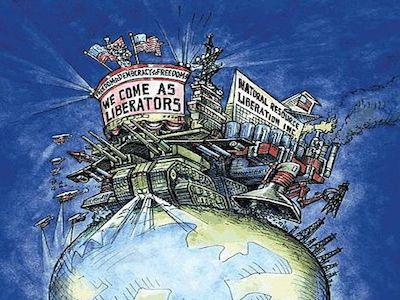
How Empires Die

By Charles Hugh Smith

Source: Of Two Minds

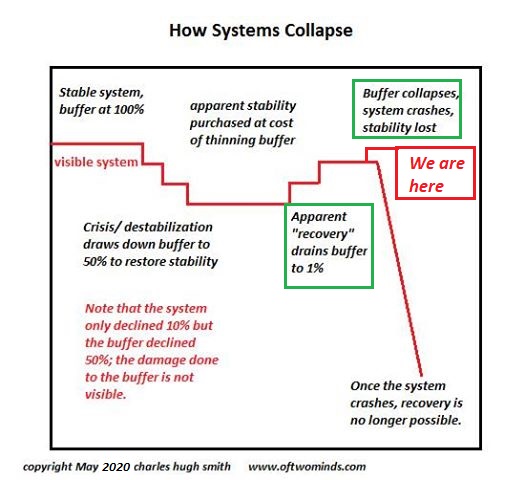
From a systems perspective, nation-states and empires arise when they are superior solutions to security compared to whatever arrangement they replace: feudalism, warlords, tribal confederations, etc.

States and empires fail when they are no longer the solution, they are the problem. As the book The Upside of Down: Catastrophe, Creativity, and the Renewal of Civilization explains, when the dissolution of the state / empire becomes the pain-reducing solution, the inhabitants withdraw their support and the empire loses its grip and expires.

As I explain in my new book, Global Crisis, National Renewal, states and markets are problem-solving structures. These structures solve problems by optimizing adaptability and beneficial synergies that reinforce one another as evolutionary advances.

The rise of the middle class is an example of beneficial synergies: as this new class gains access to credit, expertise, trade, enterprise and pricing power for their labor, they have the means to transform their labor into capital by saving earnings and investing the capital in assets, new enterprises, etc. which then generate income from capital which fuels synergistic increases in credit, expertise, assets and income from investments.

States / empires fail and expire when they elevate the fatal synergies created by self-serving elites. Rather than encourage the dynamics of adaptation–competition, transparency, accountability, experimentation and dissent– the elites suppresses these forces as threats to their monopolies, cartels and wealth.

Stripped of adaptability and beneficial synergies, the state / empire is no longer able to solve problems. It becomes the problem which cannot be resolved.

A key dynamic fueling fatal synergies is the hubristic confidence that low-cost abundance is a birthright bestowed by the state /empire, so resources can be endlessly squandered on excess and extremes of consumption and waste. The state / empire no longer focuses on securing the material sources of security (food, energy, etc.) or the accountability, competition, dissent and transparency required to solve systemic problems.

Instead, the state / empire dissolves into divisive camps seeking to protect their petty fiefdoms and expanding their wealth at the expense of the populace. The super-wealthy build $500 million yachts and palaces, politicians trade on their positions to accumulate fortunes, and corruption replaces governance.

Markets spiral into fatal synergies as low quality products and services, speculative excess, extremes of grotesque consumption and blood-soaked entertainment become “growth industries” while blackouts dim electrical grids and store shelves empty of essentials.

The market solution to everyone already owning everything is to engineer planned obsolescence into every product and form service-sector cartels that then strip services to the bone to juice profits, a.k.a. the crapification of all goods and services.

The state / empire also fails to maintain basic security and functions such as tax collection and a fair enforcement. Petty crimes are exploited by those in power (civil forfeiture) while resistance to the state is severely punished. There are two legal systems, one for the commoners and another for the elite.

The state / empire protects those profiting from the status quo and then calls this profiteering a “solution.” But this profiteering doesn’t solve any problems; it is the problem, as self-serving profiteering protects its privileges by corrupting the state, finance and the economy.

For its part, the market seeks to maximize profits in excesses of consumption, predatory lending (student loans), the wholesale destruction of quality by monopolies and cartels and extremes of speculation.Maximizing profits by any means available has no moral foundation; predatory student loans are profitable, obscure medical billing is profitable, selling products designed to fail is profitable, declaring software outdated is profitable, deceiving consumers is profitable, and so on, in an endless array of shoddy, unhealthy products, rapacious services, fraudulent overcharges, etc.

Since problems go unresolved, things fall apart and the masses veer into extremes of derangement and magical thinking: fanaticism is substituted for friendship, cults abound, common ground vanishes and all the failures of the system are papered over with Bread and Circuses, free money, gaudy entertainments and lifeless displays of conspicuous consumption that reveal the decay and degradation.

Protecting the few stripmining the system at the expense of the many is not problem-solving. It adds a layer of problems that the state /empire is incapable of resolving. Ossified, sclerotic, self-serving, corrupt, focused on virtue-signaling and the appearance of tackling problems rather than actually solving problems because some sacred cow would lose its privileges and income stream, the state / empire is the problem, not the solution.

When the state / empire loses the ability to recognize and solve core problems of security and fairness, it will be replaced by another arrangement that is more adaptable and adept at solving problems. Artifice, fantasy, magical thinking, excuses and absurd cover stories are not part of problem-solving. Problems can only be solved if reality is faced directly.

When reality is unacceptable because it negatively impacts those stripmining the system for private gain, the state / empire is already on its fatal spiral to collapse.
Eternity, nature, society and the absurd fantasies of the rich

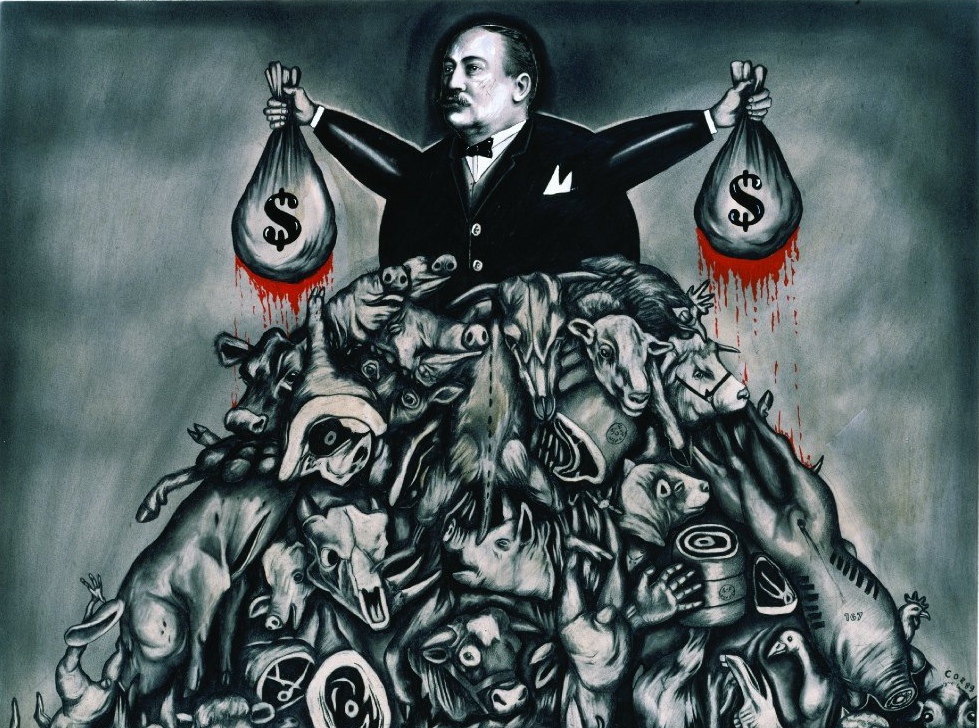
Fragment of “Butcher to the World” by Sue Coe.

By Kurt Cobb

Source: Resilience

Professor and author Douglas Rushkoff recently wrote about a group of wealthy individuals who paid him to answer questions about how to manage their lives after what they believe will be the collapse of society. He only knew at the time he was engaged that the group wanted to talk about the future of technology.

Rushkoff afterwards explained that the group assumed they would need armed guards after this collapse to defend themselves. But they rightly wondered in a collapsed society how they could even control such guards. What would they pay those guards with when the normal forms of payment ceased to mean anything? Would the guards organize against them?

Rushkoff provides a compelling analysis of a group of frightened wealthy men trying to escape the troubles of this world while alive and wishing to leave a decaying body behind when the time comes and transfer their consciousness digitally into a computer. (I’ve written about consciousness and computers previously.)

Here I want to focus on what I see as the failure of these people to understand the single most salient fact about their situations: Their wealth and their identities are social constructs that depend on thousands if not millions of people who are employees; customers; employees of vendors; government workers who maintain and run the law courts, the police force, the public physical infrastructure, legislative bodies, the administrative agencies and the educational institutions—and who thereby maintain public order, public health and public support for our current systems.

Those wealthy men aren’t taking all this with them when they die. And, while they are alive, their identities will shift radically if the intellectual, social, economic and governmental infrastructure degrades to the point where their safety is no longer guaranteed by at least minimal well-being among others in society. If the hunt for diminishing food and other resources comes to their doors, no army of guards will ultimately protect them against the masses who want to survive just as badly but lack the means.

One would think that pondering this, the rich who are capable of pondering it would have an epiphany: Since their security and well-being ultimately hinges on the security and well-being of all, they ought to get started helping to create a society that provides that in the face of the immense challenges we face such as climate change, resource depletion, possible epidemics, growing inequality and other devils waiting in the wings of the modern world. (In fairness, some do understand this.)

At least one reason for the failure of this epiphany to occur is described by author and student of risk Nassim Nicholas Taleb. Taleb describes how the lives the rich become increasingly detached from the rest of society as arbiters of taste for the wealthy convince them that this detachment is the reward of wealth. The rich visit restaurants that include only people like themselves. They purchase larger and larger homes with fewer and fewer people in them until they can spend whole days without seeing another person. For the wealthiest, neighbors are a nuisance. Better to surround oneself with a depopulated forest than people next door.

The rich are convinced by this experience that they are lone heroes and at the same time lone victims, pilloried by the media as out of touch and heartless. These self-proclaimed victims may give to the Cato Institute to reinforce the idea that the individual can go it alone and should. They themselves have done it (or at least think they have). Why can’t everyone else?

The wealthier they are, the more their fear and paranoia mounts that others not so wealthy will try to take their wealth; or that impersonal forces in the marketplace will destroy it or at least diminish it significantly; or that government will be taken over by the mob and expropriate their wealth through high taxes or outright seizure. And, of course, there are the natural disasters of uncontrolled climate change and plague, just to name two.

It’s no wonder some of the super rich are buying luxury bunkers to ride out the apocalypse. These bunkers come with an array of amenities  that include a cinema, indoor pool and spa, medical first aid center, bar, rock climbing wall, gym, and library. High-speed internet is included though one wonders how it will work after the apocalypse.

But strangely, even in these luxury bunkers built in former missile silos, dependence on and trust in others cannot be avoided. The units are actually condominiums. And while they contain supplies and ammunition said to be enough for five years, it will be incumbent on the owners, whether they like it not, to become intimately acquainted with their neighbors in order to coordinate a defense of the compound should that need arise.

The irony, of course, is that this is precisely the kind of communal entanglement which their wealth is supposed to allow them to avoid. Society, it seems, is everywhere you go. You cannot avoid it even when eternity is advancing on your door. And, you cannot escape with your consciousness into a computer (assuming that will one day be possible) if there’s no stable technical society to tend to computer maintenance and no power to keep the computer on.

It turns out that we are here for a limited time and that trusting and reciprocal relationships with others are ultimately the most important possessions we have—unless we are too rich or too frightened to realize it.

To France from a Post-9/11 America: Lessons We Learned Too Late

us-imperialism-nepal-south-asia-revolution

By John W. Whitehead

Source: The Rutherford Institute

“They that can give up essential liberty to obtain a little temporary safety deserve neither liberty nor safety.” ― Benjamin Franklin

“Voice or no voice, the people can always be brought to the bidding of the leaders. All you have to do is tell them they are being attacked and denounce the pacifists for lack of patriotism and exposing the country to danger. It works the same in any country.”—Hermann Goering, German military commander and Hitler’s designated successor

For those who remember when the first towers fell on 9/11, there is an unnerving feeling of déjà vu about the Paris attacks.

Once again, there is that same sense of shock. The same shocking images of carnage and grief dominating the news. The same disbelief that anyone could be so hateful, so monstrous, so evil as to do this to another human being. The same outpourings of support and unity from around the world. The same shared fear that this could easily have happened to us or our loved ones.

Now the drums of war are sounding. French fighter jets have carried out a series of “symbolic” air strikes on Syrian targets. France’s borders have been closed, Paris has been locked down and military personnel are patrolling its streets.

What remains to be seen is whether France, standing where the United States did 14 years ago, will follow in America’s footsteps as she grapples with the best way to shore up her defenses, where to draw the delicate line in balancing security with liberty, and what it means to secure justice for those whose lives were taken.

Here are some of the lessons we in the United States learned too late about allowing our freedoms to be eviscerated in exchange for the phantom promise of security.

Beware of mammoth legislation that expands the government’s powers at the citizenry’s expense. Rushed through Congress a mere 45 days after the 9/11 attacks, the USA Patriot Act drove a stake through the heart of the Bill of Rights, undermined civil liberties, expanded the government’s powers and opened the door to far-reaching surveillance by the government on American citizens.

Pre-emptive strikes will only lead to further blowback. Not content to wage war against Afghanistan, which served as the base for Osama bin Laden, the U.S. embarked on a pre-emptive war against Iraq in order to “stop any adversary challenging America’s military superiority and adopt a strike-first policy against terrorist threats ‘before they’re fully formed.’” We are still suffering the consequences of this failed policy, which has resulted in lives lost, taxpayer dollars wasted, the fomenting of hatred against the U.S. and the further radicalization of terrorist cells.

War is costly. There are many reasons to go to war, but those who have advocated that the U.S. remain at war, year after year, are the very entities that have profited most from these endless military occupations and exercises. Thus far, the U.S. taxpayer has been made to shell out more than $1.6 trillion on “military operations, the training of security forces in Afghanistan and Iraq, weapons maintenance, base support, reconstruction, embassy maintenance, foreign aid, and veterans’ medical care, as well as war-related intelligence operations not tracked by the Pentagon” since 2001. Other estimates that account for war-related spending, veterans’ benefits and various promissory notes place that figure closer to $4.4 trillion. That also does not include the more than 210,000 civilians killed so far, or the 7.6 million refugees displaced from their homes as a result of the endless drone strikes and violence.

Advocating torture makes you no better than terrorists. The horrors that took place at Abu Ghraib, the American-run prison in Iraq, continue to shock those with any decency. Photographs leaked to the media depicted “US military personnel humiliating, hurting and abusing Iraqi prisoners in a myriad of perverse ways. While American servicemen and women smiled and gave thumbs up, naked men were threatened by dogs, or were hooded, forced into sexual positions, placed standing with wires attached to their bodies, or left bleeding on prison floors.” Adding to the descent into moral depravity, the United States government legalized the use of torture, including waterboarding, in violation of international law and continues to sanction human rights violations in the pursuit of national security. The ramifications have been far-reaching, with local police now employing similar torture tactics at secret locations such as Homan Square in Chicago.

Allowing the government to spy on the citizenry will not reduce acts of terrorism, but it will result in a watched, submissive, surveillance society. A byproduct of this post 9/11-age in which we live, whether you’re walking through a store, driving your car, checking email, or talking to friends and family on the phone, you can be sure that some government agency, whether the NSA or some other entity, is listening in and tracking your behavior. This doesn’t even begin to touch on the corporate trackers such as Google that monitor your purchases, web browsing, Facebook posts and other activities taking place in the cyber sphere. We are all becoming data collected in government files. The chilling effect of this endless surveillance is a more anxious and submissive citizenry.

Don’t become so distracted by the news cycle that you lose sight of what the government is doing. The average American has a hard time keeping up with and remembering all of the “events,” manufactured or otherwise, which occur like clockwork and keep us distracted, deluded, amused, and insulated from the reality of the American police state. Whether these events are critical or unimportant, when we’re being bombarded with wall-to-wall news coverage and news cycles that change every few days, it’s difficult to stay focused on one thing—namely, holding the government accountable to abiding by the rule of law—and the powers-that-be understand this. In this way, regularly scheduled trivia and/or distractions that keep the citizenry tuned into the various breaking news headlines and entertainment spectacles also keep them tuned out to the government’s steady encroachments on their freedoms.

If you stop holding the government accountable to the rule of law, the only laws it abides by will be the ones used to clamp down on the citizenry. Having failed to hold government officials accountable to abiding by the rule of law, the American people have found themselves saddled with a government that skirts, flouts and violates the Constitution with little consequence. Overcriminalization, asset forfeiture schemes, police brutality, profit-driven prisons, warrantless surveillance, SWAT team raids, indefinite detentions, covert agencies, and secret courts are just a few of the egregious practices carried out by a government that operates beyond the reach of the law.

Do not turn your country into a battlefield, your citizens into enemy combatants, and your law enforcement officers into extensions of the military. A standing army—something that propelled the early colonists into revolution—strips the citizenry of any vestige of freedom. How can there be any semblance of freedom when there are tanks in the streets, military encampments in cities, Blackhawk helicopters and armed drones patrolling overhead? It was for this reason that those who established America vested control of the military in a civilian government, with a civilian commander-in-chief. They did not want a military government, ruled by force. Rather, they opted for a republic bound by the rule of law: the U.S. Constitution. Unfortunately, we in America now find ourselves struggling to retain some semblance of freedom in the face of police and law enforcement agencies that look and act like the military and have just as little regard for the Fourth Amendment, laws such as the NDAA that allow the military to arrest and indefinitely detain American citizens, and military drills that acclimate the American people to the sight of armored tanks in the streets, military encampments in cities, and combat aircraft patrolling overhead.

As long as you remain fearful and distrustful of each other, you will be incapable of standing united against any threats posed by a power-hungry government. Early on, U.S. officials solved the problem of how to implement their authoritarian policies without incurring a citizen uprising: fear. The powers-that-be want us to feel threatened by forces beyond our control (terrorists, shooters, bombers). They want us afraid and dependent on the government and its militarized armies for our safety and well-being. Most of all, they want us distrustful of each other, divided by our prejudices, and at each other’s throats.

If you trade your freedom for security, the terrorists win. We’ve walked a strange and harrowing road since September 11, 2001, littered with the debris of our once-vaunted liberties. We have gone from a nation that took great pride in being a model of a representative democracy to being a model of how to persuade a freedom-loving people to march in lockstep with a police state. And in so doing, we have proven Osama Bin Laden right. He warned that “freedom and human rights in America are doomed. The U.S. government will lead the American people in — and the West in general — into an unbearable hell and a choking life.”

To sum things up, the destruction that began with the 9/11 terror attacks has expanded into an all-out campaign of terror, trauma, acclimation and indoctrination aimed at getting Americans used to life in the American Police State. The bogeyman’s names and faces change over time, but the end result remains the same: our unquestioning acquiescence to anything the government wants to do in exchange for the phantom promise of safety and security has transitioned us to life in a society where government agents routinely practice violence on the citizens while, in conjunction with the Corporate State, spying on the most intimate details of our personal lives.

The lesson learned, as I document in my book Battlefield America: The War on the American People, is simply this: once you start down the road towards a police state, it will be very difficult to turn back.