Saturday Matinee: Wizards

By Ian Cullen

Source: Scifi Pulse

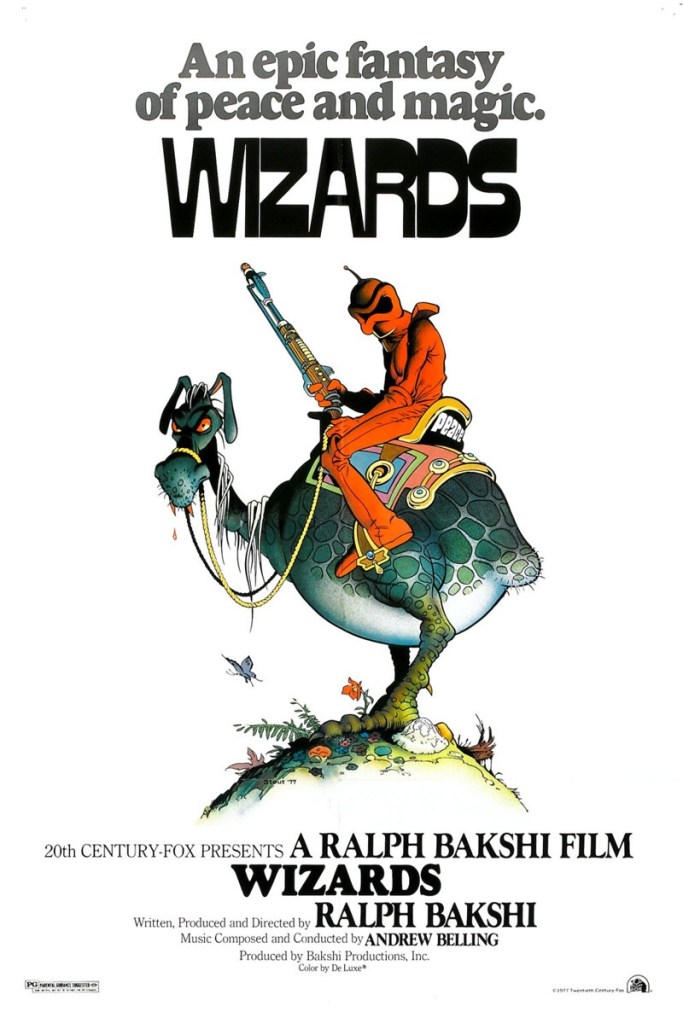
The animation in this film is a weird psychedelic hodgepodge of various styles. It seems both very cool and experimental at the same time.

Synopsis: In Wizards After the death of his mother. An evil mutant wizard Blackwolf discovers some long-lost military technologies. Blackwolf claims his mother’s throne, assembles an army, and sets out to brainwash and conquer Earth. Meanwhile, Blackwolf’s gentle twin brother, the bearded and sage Avatar calls upon his own magical abilities to foil Blackwolf’s plans for world domination — even if it means destroying his own flesh and blood.

The Story

Wizards begins with the destruction of the earth via a nuclear explosion. After several thousand years. The few survivors of humanity have become mutants and hide in the shadows. But from the ashes the fae folk of long-forgotten earth is reborn. They live in peace and tranquility for many thousands of years until their Queen gives birth to twin Wizards. Avatar a goodly and kind Wizard and his evil brother Blackwolf.

When their mother the Queen dies. The two brothers fight and Blackwolf is defeated by Avatar and journeys to form his new kingdom of Scorch. While in exile for 3000 years. Blackwolf sends his demonic forces out to search the earth for old technologies that he can use to defeat the forces of good and ultimately defeat his brother.

Meanwhile, in Montagar Avatar and his girlfriend, Elinore are blissfully unaware of Blackwolf’s plans until one of his soldiers Necron 99 attacks and kills their President.

Voice Acting

The acting throughout this films is really solid. Bob Holt is excellent as the kindly Wizard Avatar who justs wants to live a peaceful and hassle-free life. His interactions with Elinore (Jesse Welles) are a lot of fun and full of innuendo, which is something the film features a lot of. Richard Romanus puts the swashbuckler in Weehawk the soldier Elf who will fight to the death to defend his lands.

We also get Mark Hamill in perhaps his shortest animated role ever as Sean the ill-fated king of the Fairie folk. No sooner as he introduces himself. He gets wasted by one of Blackwolf’s soldiers.

Finally, special mention must go to Steve Gravers who puts in a great performance as the evil Wizard Blackwolf.

Animation

Directed and produced by Ralph Bakshi who is better known for his more adult-orientated animated films and series such as ‘Fritz The Cat’. ‘Wizards’ was supposed to be Bakshi’s first attempt at doing something for a family audience. Although we’d have to agree to differ on that front given that within the first five minutes we meet three fairy prostitutes. And Then we get Elinore sporting curves that would make most glamour models jealous.

The animation in this film is a weird psychedelic hodgepodge of various styles. It seems both very cool and experimental at the same time. I particularly loved the Rotoscoping effects that are used fairly heavily in the film. Especially when it came to the use of it with old world war 2 footage of tanks and planes. For its time, which was the late 70s. The animation in this movie was likely cutting edge. And I think it holds up pretty well considering.

Overall

Some of the themes and storylines within this film are probably more for the older kids than for younger viewers. How Bakshi managed to get a PG rating for this film will forever be a mystery. Especially given how little Elinore is wearing. Added to which the debate about Technology versus Nature and Magic while fun would probably go over the heads of younger viewers.

The film was made in a time where things like duck and cover were still fresh in the minds of most adults that saw the film at the time. If anything it was a film warning about the threat of nuclear war and it was very on the nose in that respect. I was about 12 when I first saw this movie as a video rental back in around 1982 and it stuck in my memory because this review is based on only my second viewing of the movie since back then.

That said though. The more mature version of me did spot a few contradictions in the film. The ones that stand out are to do with Avatar and his land of Montagar where technology is supposed to be outlawed. In the scene that establishes Avatar, we see him conjure up a jukebox. And later on as we get to the final battle. He uses a gun. Now back when I was 12 I wasn’t to bothered by this. But the grown-up me thinks Avatar is a hypocrite and a cheat for breaking his own rules.

Overall though. Despite those two issues I spotted. It is still quite an enjoyable film with some killer 70s funk and prog-rock guitar licks making up a killer soundtrack.


Watch Wizards at Internet Archive here: https://archive.org/details/y2mate.combernievstrumprzlyugsut7q360p

Saturday Matinee: Fantastic Planet

Surrealism and political critique in the animated medium: Fantastic Planet (1973)

By Dan Stalcup

Source: The Goods Firm Reviews

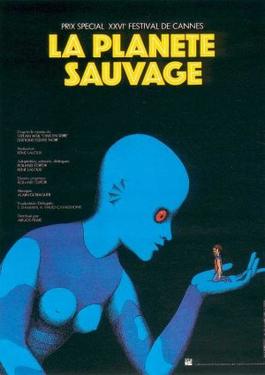
Coming from the “Panic Movement” surrealist art collective is one of the most bizarre animated films of all time: Fantastic Planet, a French-Czech production by director/co-writer René Laloux and co-writer/production designer Roland Topor.

With its title, Fantastic Planet sounds like it should be a cheesy sci-fi flick, and in some ways, it is. (The French title, La Planète sauvage, is much more pleasing.) But this is something much more insular and experimental than most genre films of the era. Thanks to its distinctive pencil-sketched, cutout animation technique (also seen in Monty Python interludes), the film has the look of a history or biology book come to life. The grotesqueries depicted have a diagrammatic, almost clinical look to them, making every alien and bit of worldbuilding feel all the more strange.

Fantastic Planet chronicles a far future when humans have been transplanted to the distant planet Ygam by giant blue aliens with red bug eyes called Draags (or, in some translations, Traags). There, humans serve the role of something resembling a rodent or small dog: occasionally domesticated by Draags, occasionally living in wild colonies as feral creatures. The humans on Ygam are called “Oms” by the Draags. They’re mostly viewed as harmless by the aliens, but often casually exploited and exterminated when convenient.

The story follows Terr, an orphaned human/Om, who is adopted by a Draag, but escapes before organizing an resistance to the giant aliens. Terr’s life has a vaguely mythological arc to it, further enhancing the sense the we’re witnessing some passed-down story. The entire telling is detached and emotionless — when Terr’s mother or compatriots die, there is no mourning or reaction, just a progression to the next item of the story. It’s disquieting.

What really makes Fantastic Planet so bizarre and unforgettable is the depiction of the alien life and planet: flora and fauna that look like something out of a fever dream or acid trip. The ground shifts into squirming intestines; a hookah bar causes the inhabitants to meld into a blur; twirling headless statues perform a mating ritual. It’s baroque and occasionally whimsical; half Dr. Seuss, half Salvador Dali.

Despite the strangeness of the imagery, the film avoids slipping into an all-out dissociated psychedelic trip thanks to its linear and straightforward narrative. This, paradoxically, makes everything feel even more alien: The story takes logical, coherent leaps, but the images and details within are so nonchalantly unearthly. It’s a dizzying juxtaposition.

The story is clearly allegorical: Animal rights is an obvious interpretation given the way that humans are chattelized. It’s not hard to squint and see anti-racism or anti-imperialism in its parable, either — any scenario where the majority or oppressors are negligent, systemic participators rather than active aggressors would fit.

There’s also a lot of coming of age imagery in the film, blown out into absurdism. The semi-comprehending way the humans perceive the Draag world is not too detached from the way kids see the adult world: full of obtuse rituals and norms. Plenty of the designs are charged with phallic and sexual imagery (not to mention casual nudity), but it’s secondary to the overall sweep of the visual invention of the film.

In the half century since its release, Fantastic Planet has become a cult legend, even inducted into the Criterion Collection — one of only a few animated films with the honor. According to Letterboxd, it’s among the most popular films of 1973. I can’t say I blame cinephiles out there. Even at 72 minutes, Fantastic Planet is a bit exhausting, but it’s such a unique and evocative experience that it is essential viewing. At least for weirdos like me.

Saturday Matinee: Puffball Studio double feature

With films like Swipe, Shehr e Tabassum, Pakistan’s Puffball Studio depicts dystopias that feel all too real

An app that mirrors mob justice. A dystopia where smiling is the only expression allowed. Pakistan’s Puffball Studio and its founder Arafat Mazhar skewer the mechanisms of intolerance and hate through their films.

By Manik Sharma

Source: Firstpost.

In the animated short film Shehr e Tabassum, the ‘Supreme Leader’ of a dystopian Pakistan in 2071 passes a law declaring all expressions other than smiling a crime. It’s the state’s way of manufacturing both consent and a flimsy yet persuasive image of a happy civilisation. People who refuse are deemed as traitors. The drugged, exclusionary vision of the future that the short film offers is eerily echoed by the present of many countries around the world.

Mimicking to an extent the consumerist hell of Blade RunnerShehr e Tabassum released earlier this year on YouTube. Behind the film is Puffball Studio, a group of young creators from the country, led by Arafat Mazhar. In November, Puffball released its second film Swipe, a Black Mirror-ish reflection of the intolerance of today, through the lens of technology. In Swipe, an app basically mimics mob justice, by enabling users to have people executed via a simple swipe.

“My research has been centered around the way ideas like ghairat (honour), ishq (love) ghaddar (traitor) and tauheen (insult) have been distorted in the recent past and forcibly circumscribed to violence while at the same time, the definition for blasphemous or traitorous acts continue to broaden,” Mazhar says. Curiously, the protagonist of Swipe is a child. “I have seen so many videos of young people at rallies organised by religious activists and NGOs calling for violence against other groups, videos of children taking part in mob violence. I can’t help but think that we’re failing our children when we teach them manufactured meanings of honour and love that are devoid of any spirituality,” he adds.

Mazhar and his team created Swipe during the pandemic. The intersection of technology and culture is something the filmmaker has always been interested in. He also leads other initiatives like Engage Pakistan, a project that counters the country’s blasphemy laws with research and alternative histories. Procuring funding for all these projects can’t possibly be a cakewalk.

Swipe and Shehr e Tabassum were both self-financed for the most part,” Mazhar explains. “What helps is that our team is very versatile: we have excellent traditional artists but also an excellent 3D and motion graphics team which means that we do premium service work for clients too. Aside from that, we also have an alternative critical histories channel called Hashiya, where we collaborate with local and international universities to create historical short films and explainers.”

Both Shehr e Tabasum and Swipe cross paths with technology, intolerance and the brutalising nature of consumerist economies. If empathy and humanism are shown the door, the natural course culture takes is the commodification of everything human — from faith to love. It’s a lesson the young protagonist of Swipe learns the hard way.

“We knew from the outset that both Shehr e Tabassum and Swipe would be unapologetically political films but I was just as set on making them a thrilling and evocative experience for viewers. So when we wanted to explore how different fundamental freedoms — to express, to protest etc. — are stifled in a hyper-surveillant and increasingly oppressive society, we used the allegory of a smile as the only expression allowed to citizens,” Mazhar says of his first film.

“Other times, the story writes itself: when we wanted to show a city hooked to an app (iFatwa) that generates allegations against citizens and gamifies extrajudicial violence, we would look to news stories around us to draw inspiration for the app cases,” he adds about Swipe. (The anecdotal stories that feature on iFatwa are reminiscent of outrage we witness every other day on this side of the border.)

Through both films, Mazhar channels a kind of activism that he promises the group will continue to work on. But with activism these days comes the risk of outing yourself to trolls and self-appointed moralists. It’s a price some have paid heavily for on both sides of the border, and perhaps around the world.

“I believe storytelling, fiction or otherwise, speaks to possibilities of greater awareness, understanding and connection between people and communities. I believe in creating art that speaks to our collective humanity, that forces us to think beyond our biases and our conditioned hate towards those who are different from us. With Swipe, there was no pretense about what we had set out to do: we aren’t claiming to change the fabric of our society or our thinking. Swipe is just a heartfelt plea to pause and reflect collectively,” Mazhar says.

Filmmaking is hard enough; such provocative, truthful and political filmmaking even more so. “For those who attack us online because they fear an agenda behind our films, I always try and respond to their anxieties which usually stem from perceived threats to tradition, religion, etc. Beyond that, there isn’t much that anyone can do. I think our viewers recognise and appreciate that though our films are uncomfortable to watch, they go beyond mere cynicism and derision,” Mazhar says, optimistic that his work will be afforded the tolerance his films paint the absence of.

Saturday Matinee: Ghost in the Shell

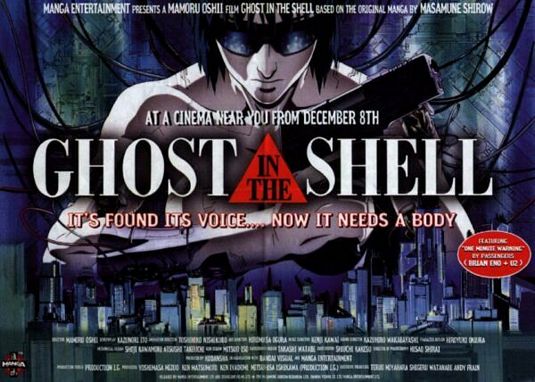
“Ghost in the Shell” (1995) is a cyberpunk anime directed by Mamoru Oshii and based on the manga of the same name by Masamune Shirow. Set in 2029 Japan, the plot centers on Motoko Kusanagi, a cyborg public-security agent hunting a mysterious hacker known as the Puppet Master who has manipulated the minds of cyborg-human hybrids. With her partner Batou she corners the hacker, but questions about her own identity sends her quest in an unforeseen direction.

Saturday Matinee: Videodrome

“Videodrome” (1983) is a Canadian science fiction/body horror film written and directed by David Cronenberg. Set in Toronto during the early 1980s, it follows Max Renn (James Woods) the CEO of a small UHF television station who stumbles upon a broadcast signal featuring extreme violence and torture. Layers of deception and mind-control conspiracy unfold as he uncovers the signal’s source, and loses touch with reality in a series of increasingly bizarre and violent organic hallucinations.

Watch the full film here.

Saturday Matinee: Beyond the Black Rainbow

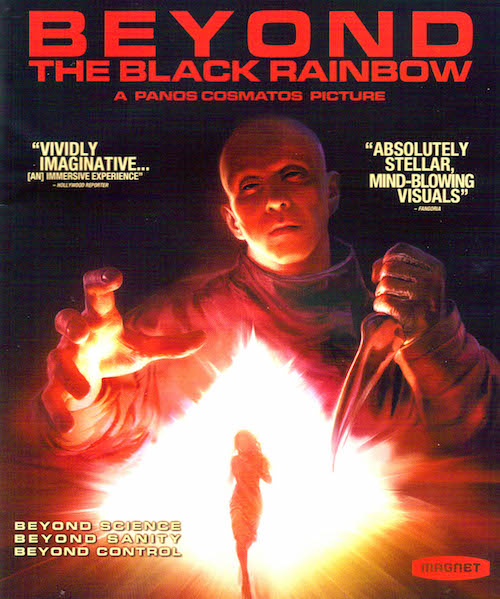
“Beyond the Black Rainbow” (2010) is a Canadian experimental sci-fi film written and directed by Panos Cosmatos. The Cronenberg-esque plot focuses on Elena, a test subject with ESP abilities, who struggles to escape a New Age lab facility called the Arboria Institute headed by the psychopathic Dr. Nyle. Set in 1983, the film is infused with a retro aesthetic heavily influenced by the director’s childhood experiences and recent tragedies as described in the following passage from Wikipedia about the film’s development:

As a child, Cosmatos frequented a video store named Video Addict. During these trips he would browse the horror film section looking at the boxes although he was not allowed to watch such films. During such times he would instead imagine what the film was. He would later reflect upon this experience when making Black Rainbow where one of his goals was “to create a film that is a sort of imagining of an old film that doesn’t exist.” The year 1983 was chosen for the story as it’s the first year he went to Video Addict. Additionally he thought the idea of setting such a film one year before 1984 was funny. The film’s genesis was an overlap between two projects Cosmatos wanted to do. One of these was a film about a girl trapped in an asylum while the other was an installation promoting a research facility that didn’t exist. Eventually Cosmatos realized that he could use both ideas in the same project.

The presence of his parents haunts “every frame of this film”, said the Rome-born filmmaker. His father was film director George P. Cosmatos (whose credits include Rambo: First Blood Part II and Cobra), deceased in April 2005, and his mother Swedish sculptor Birgitta Ljungberg-Cosmatos, who died in July 1997 after a lengthy battle with cancer. Unable to deal with his mother’s death, Panos “drifted into a slow motion mode of self-destruction and binge drinking”. When elder Cosmatos died, the grief he felt compounded. After that the aspiring writer/director started therapy and decided he wanted to make a film as part of the healing process. Cosmatos felt that his “filmmaking sensibility is a weird hybrid of both of them” – his father’s “popcorn movies” and his mother’s haunting, experimental art.

Beyond the Black Rainbow was financed by DVD residuals from Tombstone (1993), directed by Panos’ father. The film was shot in three weeks using a modified Panavision35 mm camera. This was suggested by cinematographer Norm Li, for he noted that Panos’ references – mostly films from the ’70s and ’80s – “were all grainy, colorful, and full of texture”, and he felt the 35 mm format was “the only way to shoot.”

Borrow and view the film from Hoopla here: https://www.hoopladigital.com/title/11910372

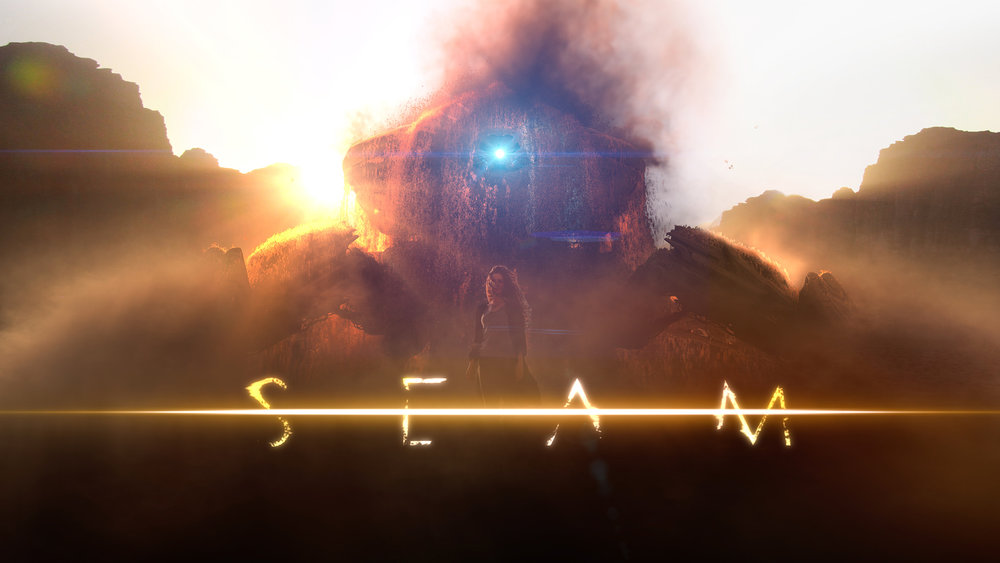
Saturday Matinee: Seam

A Synthetic Human Fights to Survive in Visually Stunning Scifi Short Seam 

By Cheryl Eddy

Source: io9

In the not-too-distant future, a tenuous peace between humans and remarkably humanlike “machines”—some don’t even know they’re not real—is tested when synthetics begin spontaneously exploding. A military-led search for these unwitting suicide bombers begins, sending a terrified machine woman and her human partner on the run.

Seam—named for a volatile border area sandwiched between the designated machine containment zone and the human world—borrows from some excellent inspirations, including Blade Runner. But the 20-minute short, made by twin brothers Rajeev and Elan Dassani, makes its mark with outstanding special effects and well-chosen location shooting. Though the film begins in sleek Hong Kong, its visual style is most unique when it contrasts the futuristic tech used by its characters with ancient settings, including a chase scene that winds through the narrow streets of Salt, Jordan. The climactic sequence takes place in Wadi Rum, the otherworldly desert last seen playing Jedha in Rogue One.

Philip K. Dick and the Fake Humans

(Editor’s note: on this 36th anniversary of the passing of Philip K. Dick, it seems an appropriate time to note the relevance of his work to our current dystopia as Henry Farrell does in the following essay. Unfortunately the author is less astute regarding the ways in which the dystopias of Orwell and Huxley are equally relevant to our current milieu.)

By Henry Farrell

Source: Boston Review

This is not the dystopia we were promised. We are not learning to love Big Brother, who lives, if he lives at all, on a cluster of server farms, cooled by environmentally friendly technologies. Nor have we been lulled by Soma and subliminal brain programming into a hazy acquiescence to pervasive social hierarchies.

Dystopias tend toward fantasies of absolute control, in which the system sees all, knows all, and controls all. And our world is indeed one of ubiquitous surveillance. Phones and household devices produce trails of data, like particles in a cloud chamber, indicating our wants and behaviors to companies such as Facebook, Amazon, and Google. Yet the information thus produced is imperfect and classified by machine-learning algorithms that themselves make mistakes. The efforts of these businesses to manipulate our wants leads to further complexity. It is becoming ever harder for companies to distinguish the behavior which they want to analyze from their own and others’ manipulations.

This does not look like totalitarianism unless you squint very hard indeed. As the sociologist Kieran Healy has suggested, sweeping political critiques of new technology often bear a strong family resemblance to the arguments of Silicon Valley boosters. Both assume that the technology works as advertised, which is not necessarily true at all.

Standard utopias and standard dystopias are each perfect after their own particular fashion. We live somewhere queasier—a world in which technology is developing in ways that make it increasingly hard to distinguish human beings from artificial things. The world that the Internet and social media have created is less a system than an ecology, a proliferation of unexpected niches, and entities created and adapted to exploit them in deceptive ways. Vast commercial architectures are being colonized by quasi-autonomous parasites. Scammers have built algorithms to write fake books from scratch to sell on Amazon, compiling and modifying text from other books and online sources such as Wikipedia, to fool buyers or to take advantage of loopholes in Amazon’s compensation structure. Much of the world’s financial system is made out of bots—automated systems designed to continually probe markets for fleeting arbitrage opportunities. Less sophisticated programs plague online commerce systems such as eBay and Amazon, occasionally with extraordinary consequences, as when two warring bots bid the price of a biology book up to $23,698,655.93 (plus $3.99 shipping).

In other words, we live in Philip K. Dick’s future, not George Orwell’s or Aldous Huxley’s. Dick was no better a prophet of technology than any science fiction writer, and was arguably worse than most. His imagined worlds jam together odd bits of fifties’ and sixties’ California with rocket ships, drugs, and social speculation. Dick usually wrote in a hurry and for money, and sometimes under the influence of drugs or a recent and urgent personal religious revelation.

Still, what he captured with genius was the ontological unease of a world in which the human and the abhuman, the real and the fake, blur together. As Dick described his work (in the opening essay to his 1985 collection, I Hope I Shall Arrive Soon):

The two basic topics which fascinate me are “What is reality?” and “What constitutes the authentic human being?” Over the twenty-seven years in which I have published novels and stories I have investigated these two interrelated topics over and over again.

These obsessions had some of their roots in Dick’s complex and ever-evolving personal mythology (in which it was perfectly plausible that the “real” world was a fake, and that we were all living in Palestine sometime in the first century AD). Yet they were also based on a keen interest in the processes through which reality is socially constructed. Dick believed that we all live in a world where “spurious realities are manufactured by the media, by governments, by big corporations, by religious groups, political groups—and the electronic hardware exists by which to deliver these pseudo-worlds right into heads of the reader.” He argued:

the bombardment of pseudo-realities begins to produce inauthentic humans very quickly, spurious humans—as fake as the data pressing at them from all sides. My two topics are really one topic; they unite at this point. Fake realities will create fake humans. Or, fake humans will generate fake realities and then sell them to other humans, turning them, eventually, into forgeries of themselves. So we wind up with fake humans inventing fake realities and then peddling them to other fake humans.

In Dick’s books, the real and the unreal infect each other, so that it becomes increasingly impossible to tell the difference between them. The worlds of the dead and the living merge in Ubik (1969), the experiences of a disturbed child infect the world around him in Martian Time-Slip (1964), and consensual drug-based hallucinations become the vector for an invasive alien intelligence in The Three Stigmata of Palmer Eldritch (1965). Humans are impersonated by malign androids in Do Androids Dream of Electric Sheep? (1968) and “Second Variety” (1953); by aliens in “The Hanging Stranger” (1953) and “The Father-Thing” (1954); and by mutants in “The Golden Man” (1954).

This concern with unreal worlds and unreal people led to a consequent worry about an increasing difficulty of distinguishing between them. Factories pump out fake Americana in The Man in the High Castle (1962), mirroring the problem of living in a world that is not, in fact, the real one. Entrepreneurs build increasingly human-like androids in Do Androids Dream of Electric Sheep?, reasoning that if they do not, then their competitors will. Figuring out what is real and what is not is not easy. Scientific tools such as the famous Voight-Kampff test in Do Androids Dream of Electric Sheep? (and Blade Runner, Ridley Scott’s 1982 movie based loosely on it) do not work very well, leaving us with little more than hope in some mystical force—the I Ching, God in a spray can, a Martian water-witch—to guide us back toward the real.

We live in Dick’s world—but with little hope of divine intervention or invasion. The world where we communicate and interact at a distance is increasingly filled with algorithms that appear human, but are not—fake people generated by fake realities. When Ashley Madison, a dating site for people who want to cheat on their spouses, was hacked, it turned out that tens of thousands of the women on the site were fake “fembots” programmed to send millions of chatty messages to male customers, so as to delude them into thinking that they were surrounded by vast numbers of potential sexual partners.

These problems are only likely to get worse as the physical world and the world of information become increasingly interpenetrated in an Internet of (badly functioning) Things. Many of the aspects of Joe Chip’s future world in Ubik look horrendously dated to modern eyes: the archaic role of women, the assumption that nearly everyone smokes. Yet the door to Joe’s apartment—which argues with him and refuses to open because he has not paid it the obligatory tip—sounds ominously plausible. Someone, somewhere, is pitching this as a viable business plan to Y Combinator or the venture capitalists in Menlo Park.

This invasion of the real by the unreal has had consequences for politics. The hallucinatory realities in Dick’s worlds—the empathetic religion of Do Androids Dream of Electric Sheep?, the drug-produced worlds of The Three Stigmata of Palmer Eldritch, the quasi–Tibetan Buddhist death realm of Ubik—are usually experienced by many people, like the television shows of Dick’s America. But as network television has given way to the Internet, it has become easy for people to create their own idiosyncratic mix of sources. The imposed media consensus that Dick detested has shattered into a myriad of different realities, each with its own partially shared assumptions and facts. Sometimes this creates tragedy or near-tragedy. The deluded gunman who stormed into Washington, D.C.’s Comet Ping Pong pizzeria had been convinced by online conspiracy sites that it was the coordinating center for Hillary Clinton’s child–sex trafficking ring [likewise, the masses may have been convinced by mainstream media that a real child-sex trafficking ring never existed].

Such fractured worlds are more vulnerable to invasion by the non-human. Many Twitter accounts are bots, often with the names and stolen photographs of implausibly beautiful young women, looking to pitch this or that product (one recent academic study found that between 9 and 15 percent of all Twitter accounts are likely fake). Twitterbots vary in sophistication from automated accounts that do no more than retweet what other bots have said, to sophisticated algorithms deploying so-called “Sybil attacks,” creating fake identities in peer-to-peer networks to invade specific organizations or degrade particular kinds of conversation.

Twitter has failed to become a true mass medium, but remains extraordinarily important to politics, since it is where many politicians, journalists, and other elites turn to get their news. One research project suggests that around 20 percent of the measurable political discussion around the last presidential election came from bots. Humans appear to be no better at detecting bots than we are, in Dick’s novel, at detecting replicant androids: people are about as likely to retweet a bot’s message as the message of another human being. Most notoriously, the current U.S. president recently retweeted a flattering message that appears to have come from a bot densely connected to a network of other bots, which some believe to be controlled by the Russian government and used for propaganda purposes.

In his novels Dick was interested in seeing how people react when their reality starts to break down. A world in which the real commingles with the fake, so that no one can tell where the one ends and the other begins, is ripe for paranoia. The most toxic consequence of social media manipulation, whether by the Russian government or others, may have nothing to do with its success as propaganda. Instead, it is that it sows an existential distrust. People simply do not know what or who to believe anymore. Rumors that are spread by Twitterbots merge into other rumors about the ubiquity of Twitterbots, and whether this or that trend is being driven by malign algorithms rather than real human beings.

Such widespread falsehood is especially explosive when combined with our fragmented politics. Liberals’ favorite term for the right-wing propaganda machine, “fake news,” has been turned back on them by conservatives, who treat conventional news as propaganda, and hence ignore it. On the obverse, it may be easier for many people on the liberal left to blame Russian propaganda for the last presidential election than to accept that many voters had a very different understanding of America than they do.

Dick had other obsessions—most notably the politics of Richard Nixon and the Cold War. It is not hard to imagine him writing a novel combining an immature and predatory tycoon (half Arnie Kott, half Jory Miller) who becomes the president of the United States, secret Russian political manipulation, an invasion of empathy-free robotic intelligences masquerading as human beings, and a breakdown in our shared understanding of what is real and what is fake.

These different elements probably would not cohere particularly well, but as in Dick’s best novels, the whole might still work, somehow. Indeed, it is in the incongruities of Dick’s novels that salvation is to be found (even at his battiest, he retains a sense of humor). Obviously, it is less easy to see the joke when one is living through it. Dystopias may sometimes be grimly funny—but rarely from the inside.