RAY McGOVERN: Catapulting Russian-Meddling Propaganda

By Ray McGovern

Source: Consortium News

The fresh orgy of anti-Russian invective in the lickspittle media (LSM) has the feel of fin de siècle. The last four reality-impaired years do seem as though they add up to a century. And no definitive fin is in sight, as long as most people don’t know what’s going on.

The LSM should be confronted: “At long last have you left no sense of decency?” But who would hear the question — much less any answer? The corporate media have a lock on what Americans are permitted or not permitted to hear. Checking the truth, once routine in journalism, is a thing of the past.

Thus the reckless abandon with which The New York Times is leading the current full-court press to improve on what it regards as Special Counsel Robert Mueller’s weak-kneed effort to blame the Russians for giving us Donald Trump. The press is on, and there are no referees to call the fouls.

The recent release of a 1,000-page, sans bombshells and already out-of-date report by the Senate Intelligence Committee has provided the occasion to “catapult the propaganda,” as President George W. Bush once put it.

As the the Times‘s Mark Mazzetti put it in his article Wednesday:

“Releasing the report less than 100 days before Election Day, Republican-majority senators hoped it would refocus attention on the interference by Russia and other hostile foreign powers in the American political process, which has continued unabated.”

Mazzetti is telling his readers, soto voce: regarding that interference four years ago, and the “continued-unabated” part, you just have to trust us and our intelligence community sources who would never lie to you. And if, nevertheless, you persist in asking for actual evidence, you are clearly in Putin’s pocket.

Incidentally, Mueller’s report apparently was insufficient, only two years in the making, and just 448 pages. The Senate committee’s magnum opus took three years, is almost 1,000 pages — and fortified. So there.

Iron Pills

Recall how disappointed the LSM and the rest of the Establishment were with Mueller’s anemic findings in spring 2019. His report claimed that the Russian government “interfered in the 2016 presidential election in sweeping and systematic fashion” via a social media campaign run by the Internet Research Agency (IRA) and by “hacking” Democratic emails. But the evidence behind those charges could not bear close scrutiny.

You would hardly know it from the LSM, but the accusation against the IRA was thrown out of court when the U.S. government admitted it could not prove that the IRA was working for the Russian government. Mueller’s ipse dixit did not suffice, as we explained a year ago in “Sic Transit Gloria Mueller.”

The Best Defense …

… is a good offense, and the Senate Intelligence Committee’s release of its study — call it “Mueller (Enhanced)” — and the propaganda fanfare — come at a key point in the Russiagate/Spygate imbroglio. It also came, curiously, as the Democratic Convention was beginning, as if the Republican-controlled Senate was sending Trump a message.

One chief worry, of course, derives from the uncertainty as to whether John Durham, the US Attorney investigating those FBI and other officials who launched the Trump-Russia investigation will let some heavy shoes drop before the election. Barr has said he expects “developments in Durham’s investigation hopefully before the end of the summer.”

FBI attorney Kevin Clinesmith already has decided to plead guilty to the felony of falsifying evidence used to support a warrant from the Foreign Intelligence Surveillance Court to surveillance to spy on Trump associate Carter Page. It is abundantly clear that Clinesmith was just a small cog in the deep-state machine in action against candidate and then President Trump. And those running the machine are well known. The president has named names, and Barr has made no bones about his disdain for what he calls spying on the president.

The cognoscenti and the big fish themselves may be guessing that Trump/Barr/Durham will not throw out heavier lines for former FBI Director James Comey, his deputy Andrew McCabe, CIA Director John Brennan, and Director of National Intelligence James Clapper, for example. But how can they be sure? What has become clear is that the certainty they all shared that Hillary Clinton would be the next president prompted them not only to take serious liberties with the Constitution and the law, but also to do so without taking rudimentary steps to hide their tracks.

The incriminating evidence is there. And as Trump becomes more and more vulnerable and defensive about his ineptness — particularly with regard to Covid-19 — he may summon the courage to order Barr and Durham to hook the big fish, not just minnows like Clinesmith. The neuralgic reality is that no one knows at this point how far Trump will go. To say that this kind of uncertainty is unsettling to all concerned is to say the obvious.

So, the stakes are high — for the Democrats, as well — and, not least, the LSM. In these circumstances it would seem imperative not just to circle the wagons but to mount the best offense/defense possible, despite the fact that virtually all the ammunition (as in the Senate report) is familiar and stale (“enhanced” or not).

Black eyes might well be in store for the very top former law enforcement and intelligence officials, the Democrats, and the LSM — and in the key pre-election period. So, the calculation: launch “Mueller Report (Enhanced)” and catapult the truth now with propaganda, before it is too late.

No Evidence of Hacking

The “hacking of the DNC” charge suffered a fatal blow three months ago when it became known that Shawn Henry, president of the DNC-hired cyber-security firm CrowdStrike, admitted under oath that his firm had no evidence that the DNC emails were hacked — by Russia or anyone else.

Henry gave his testimony on Dec. 5, 2017, but House Intelligence Committee chair Adam Schiff was able to keep it hidden until May 7, 2020.

Here’s a brief taste of how Henry’s testimony went: Asked by Schiff for “the date on which the Russians exfiltrated the data”, Henry replied, “We just don’t have the evidence that says it actually left.”

You did not know that? You may be forgiven — up until now — if your information diet is limited to the LSM and you believe The New York Times still publishes “all the news that’s fit to print.”  I am taking bets on how much longer the NYT will be able to keep Henry’s testimony hidden; Schiff’s record of 29 months will be hard to beat.

Putting Lipstick on the Pig of Russian ‘Tampering’

Worse still for the LSM and other Russiagate diehards, Mueller’s findings last year enabled Trump to shout “No Collusion” with Russia. What seems clear at this point is that a key objective of the current catapulting of the truth is to apply lipstick to Mueller’s findings.

After all, he was supposed to find treacherous plotting between the Trump campaign and the Russians and failed miserably. Most LSM-suffused Americans remain blissfully unaware of this, and the likes of Pulitzer Prize winner Mazzetti have been commissioned to keep it that way.

In Wednesday’s article, for example, Mazzetti puts it somewhat plaintively:

“Like the special counsel … the Senate report did not conclude that the Trump campaign engaged in a coordinated conspiracy with the Russian government — a fact that the Republicans seized on to argue that there was ‘no collusion’.”

How could they!

Mazzetti is playing with words. “Collusion,” however one defines it, is not a crime; conspiracy is.

‘Breathtaking’ Contacts: Mueller (Enhanced)

Mazzetti emphasizes that the Senate report “showed extensive evidence of contacts between Trump campaign advisers and people tied to the Kremlin,” and Sen. Mark Warner (D-VA), the intelligence committee’s vice chairman, said the committee report details “a breathtaking level of contacts between Trump officials and Russian government operatives that is a very real counterintelligence threat to our elections.”

None of that takes us much beyond the Mueller report and other things generally well known — even in the LSM. Nor does the drivel about people like Paul Manafort “sharing polling data with Russians” who might be intelligence officers. That data was “mostly public” the Times itself reported, and the paper had to correct a story that the data was intended for Russian oligarchs, when it was meant for Ukrainian oligarchs instead. That Manafort was working to turn Ukraine towards the West and not Russia is rarely mentioned.

Recent revelations regarding the false data given the FISA court by an FBI lawyer to “justify” eavesdropping on Trump associate Carter Page show the Senate report to be not up to date and misguided in endorsing the FBI’s decision to investigate Page. The committee may wish to revisit that endorsement — at least.

On the Steele Dossier, the committee also missed a ruling by a British judge against Christopher Steele, labeling his dossier an attempt to help Hillary Clinton get elected. Consortium News explained back in October 2017 that both CrowdStrike and Steele were paid for by the Democratic Party and Clinton campaign to push Russiagate.

Also missed by the intelligence committee was a document released by the Senate Judiciary Committee last month that revealed that Steele’s “Primary Subsource and his friends peddled warmed-over rumors and laughable gossip that Steele dressed up as formal intelligence memos.”

Smearing WikiLeaks

The Intelligence Committee report also repeats thoroughly debunked myths about WikiLeaks and, like Mueller, the committee made no effort to interview Julian Assange before launching its smears. Italian journalist Stefania Maurizi, who partnered with WikiLeaks in the publication of the Podesta emails, described the report’s treatment of WikiLeaks in this Twitter thread:

2. the description of #WikiLeaks‘ publishing activities by this #SenateIntelligenceCommittee‘s Report appears a true #EdgarHoover‘s disinformation campaign to make a legitimate media org completely radioactive

3. Clearly, to describe #WikiLeaks and its publishing activities the #SenateIntelligenceCommittee’s Report completely rely on #US intelligence community+ #MikePompeo’s characterisation of #WikiLeaks. There is not even any pretense of an independent approach

4. there are also unsubstantiated claims like:
– “[WikiLeaks’] disclosures have jeopardized the safety of individual Americans and foreign allies” (p.200)
– “WikiLeaks has passed information to U.S. adversaries” (p.201)

5. it’s completely false that “#WikiLeaks does not seem to weigh whether its disclosures add any public interest value” (p.200) and any longtime media partner like me could provide you dozens of examples on how wrong this characterisation [is].

Titillating

Mazzetti did add some spice to the version of his article that dominated the two top right columns of Wednesday’s Times with the blaring headline: “Senate Panel Ties Russian Officials to Trump’s Aides: G.O.P.-Led Committee Echoes Mueller’s Findings on Election Tampering.”

Those who make it to the end of Mazzetti’s piece will learn that the Senate committee report “did not establish” that the Russian government obtained any compromising material on Mr. Trump or that they tried to use such materials [that they didn’t have] as leverage against him.” However, Mazzetti adds,

“According to the report, Mr. Trump met a former Miss Moscow at a party during one trip in 1996. After the party, a Trump associate told others he had seen Mr. Trump with the woman on multiple occasions and that they ‘might have had a brief romantic relationship.’

“The report also raised the possibility that, during that trip, Mr. Trump spent the night with two young women who joined him the next morning at a business meeting with the mayor of Moscow.”

This is journalism?

Another Pulitzer in Store?

The Times appends a note reminding us that Mazzetti was part of a team that won a Pulitzer Prize in 2018 for reporting on Donald Trump’s advisers and their connections to Russia.

And that’s not the half of it. In September 2018, Mazzetti and his NYT colleague Scott Shane wrote a 10,000-word feature, “The Plot to Subvert an Election,” trying to convince readers that the Russian Internet Research Agency (IRA) had successfully swayed U.S. opinion during the 2016 election with 80,000 Facebook posts that they said had reached 126 million Americans.

That turned out to be a grotesquely deceptive claim. Mazzetti and Shane failed to mention the fact that those 80,000 IRA posts (from early 2015 through 2017, meaning about half came after the election), had been engulfed in a vast ocean of more than 33 trillion Facebook posts in people’s news feeds – 413 million times more than the IRA posts. Not to mention the lack of evidence that the IRA was the Russian government, as Mueller claimed.

In exposing that chicanery, prize-winning investigative reporter Gareth Porter commented:

“The descent of The New York Times into this unprecedented level of propagandizing for the narrative of Russia’s threat to U.S. democracy is dramatic evidence of a broader problem of abuses by corporate media … Greater awareness of the dishonesty at the heart of the Times’ coverage of that issue is a key to leveraging media reform and political change.”

Nothingburgers With Russian Dressing: the Backstory

“It’s too much; it’s just too much, too much”, a sedated, semi-conscious Robert Parry kept telling me from his hospital bed in late January 2018 a couple of days before he died. Bob was founder of Consortium News.

It was already clear what Bob meant; he had taken care to see to that. On Dec. 31, 2017 the reason for saying that came in what he titled “An Apology & Explanation” for “spotty production in recent days.” A stroke on Christmas Eve had left Bob with impaired vision, but he was able to summon enough strength to write an Apologia — his vision for honest journalism and his dismay at what had happened to his profession before he died on Jan. 27, 2018. The dichotomy was “just too much”.

Parry rued the role that journalism was playing in the “unrelenting ugliness that has become Official Washington. … Facts and logic no longer mattered. It was a case of using whatever you had to diminish and destroy your opponent … this loss of objective standards reached deeply into the most prestigious halls of American media.”

What bothered Bob most was the needless, dishonest tweaking of the Russian bear. “The U.S. media’s approach to Russia,” he wrote, “is now virtually 100 percent propaganda. Does any sentient human being read The New York Times’ or The Washington Post’s coverage of Russia and think that he or she is getting a neutral or unbiased treatment of the facts? … Western journalists now apparently see it as their patriotic duty to hide facts that otherwise would undermine the demonizing of Putin and Russia.”

Parry, who was no conservative, continued:

“Liberals are embracing every negative claim about Russia just because elements of the CIA, FBI and National Security Agency produced a report last Jan. 6 that blamed Russia for ‘hacking’ Democratic emails and releasing them to WikiLeaks.”

Bob noted that the ‘hand-picked’ authors “evinced no evidence and even admitted that they weren’t asserting any of this as fact.”

It was just too much.

Robert Parry’s Last Article

Bob posted his last substantive article on Dec. 13, 2017, the day after text exchanges between senior FBI officials Peter Strzok and Lisa Page were made public. (Typically, readers of The New York Times the following day would altogether miss the importance of the text-exchanges.)

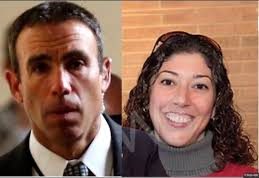
Bob Parry rarely felt any need for a “sanity check.” Dec. 12, 2017 was an exception. He called me about the Strzok-Page texts; we agreed they were explosive. FBI Agent Peter Strzok was on Special Counsel Robert Mueller’s staff investigating alleged Russian interference, until Mueller removed him.

Strzok reportedly was a “hand-picked” FBI agent taking part in the Jan 2017 evidence-impoverished, rump, misnomered “intelligence community” assessment that blamed Russia for hacking and other election meddling. And he had helped lead the investigation into Hillary Clinton’s misuse of her computer servers. Page was Deputy Director Andrew McCabe’s right-hand lawyer.

His Dec. 13, 2017 piece would be his fourth related article in less than two weeks; it turned out to be his last substantive article.  All three of the earlier ones are worth a re-read as examples of fearless, unbiased, perceptive journalism. Here are the links.

Bob began his article on the Strzok-Page bombshell:

“The disclosure of fiercely anti-Trump text messages between two romantically involved senior FBI officials who played key roles in the early Russia-gate inquiry has turned the supposed Russian-election-meddling “scandal” into its own scandal, by providing evidence that some government investigators saw it as their duty to block or destroy Donald Trump’s presidency.?

“As much as the U.S. mainstream media has mocked the idea that an American ‘deep state’ exists and that it has maneuvered to remove Trump from office, the text messages between senior FBI counterintelligence official Peter Strzok and senior FBI lawyer Lisa Page reveal how two high-ranking members of the government’s intelligence/legal bureaucracy saw their role as protecting the United States from an election that might elevate to the presidency someone as unfit as Trump.”

Not a fragment of Bob’s or other Consortium News analysis made any impact on what Bob used to call the Establishment media. As a matter of fact, eight months later during a talk in Seattle that I titled “Russia-gate: Can You Handle the Truth?”, only three out of a very progressive audience of some 150 had ever heard of Strzok and Page.

And so it goes.

Lest I am accused of being “in Putin’s pocket,” let me add the explanatory note that we Veteran Intelligence Professionals for Sanity included in our most explosive Memorandum for President Trump, on “Russian hacking.”

Full Disclosure: Over recent decades the ethos of our intelligence profession has eroded in the public mind to the point that agenda-free analysis is deemed well nigh impossible. Thus, we add this disclaimer, which applies to everything we in VIPS say and do: We have no political agenda; our sole purpose is to spread truth around and, when necessary, hold to account our former intelligence colleagues.

We speak and write without fear or favor. Consequently, any resemblance between what we say and what presidents, politicians and pundits say is purely coincidental. The fact we find it is necessary to include that reminder speaks volumes about these highly politicized times.

Ray McGovern works with Tell the Word, a publishing arm of the ecumenical Church of the Saviour in inner-city Washington. A CIA analyst for 27 years, he served as Chief of the Soviet Foreign Policy Branch and as a downtown morning briefer of the President’s Daily Brief.

Western Media Attacks Critics of the White Helmets

By Rick Sterling

Source: Dissident Voice

Introduction

The October 16 issue of NY Review of Books has an article by Janine di Giovani titled “Why Assad and Russia Target the White Helmets“. The article exemplifies how western media promotes the White Helmets uncritically and attacks those who challenge the myth.

Crude and Disingenuous Attack

Giovani’s article attacks several journalists by name. She singles out Janine di Giovani and echoes the Guardian’s characterization of Beeley as the “high priestess of Syria propaganda”. She does this without challenging a single article or claim by the journalist. She might have acknowledged that Vanessa Beeley has some familiarity with the Middle East; she is the daughter of one of the foremost British Arabists and diplomats including British Ambassador to Egypt. Giovanni might have explored Beeley’s research in Syria that revealed the White Helmets founder (British military contractor James LeMesurier) assigned the name Syria Civil Defence despite the fact there is a real Syrian organization by that name that has existed since the 1950’s. For the past several years, Beeley has done many on-the-ground reports and investigations in Syria. None of these are challenged by Giovanni. Just days ago Beeley published a report on her visit to the White Helmets headquarters in Deraa.

Giovanni similarly dismisses another alternative journalist, Eva Bartlett. Again, Giovanni ignores the fact that Bartlett has substantial Middle East experience including having lived in Gaza for years. Instead of objectively evaluating the journalistic work of these independent journalists, Giovanni smears their work as “disinformation”. Presumably that is because their work is published at alternative sites such as 21st Century Wire and Russian media such as RT and Sputnik. Beeley and Bartlett surely would have been happy to have their reports published at the New York Review of Books, Newsweek or other mainstream outlets. But it’s evident that such reporting is not welcome there. Even Seymour Hersh had to go abroad to have his investigations on Syria published.

The New McCarthyism

Max Blumenthal is another journalist singled out by Giovanni. Blumenthal is the author of three books, including a New York Times bestseller and the highly acclaimed “Goliath: Life and Loathing in Greater Israel”. Giovanni describes his transition from “anti-Assad” to “pro-Assad” and suggests his change of perspective was due to Russian influence. She says, “Blumenthal went to Moscow on a junket to celebrate RT’s tenth anniversary. We don’t know what happened during that visit, but afterwards, Blumenthal’s views completely flipped.” Instead of examining the facts presented by Blumenthal in articles such as “Inside the Shadowy PR Firm that’s Lobyying for Regime Change in Syria“, Giovanni engages in fact-free McCarthyism. Blumenthal explained the transition in his thinking in a public interview. He also described the threats he experienced when he started to criticize the White Helmets and their public relations firm, but this is ignored by Giovanni.

Contrary to Giovanni’s assumptions, some western journalists and activists were exposing the White Helmets long before the story was publicized on Russian media. In spring 2015 the basic facts about the White Helmets including their origins, funding and role in the information war on Syria were exposed in my article “Seven Steps of Highly Effective Manipulators“. The article showed how the White Helmets were a key component in a campaign pushing for a “No Fly Zone” in Syria. It confirmed that the White Helmets is a political lobby force.

In spring 2016, Vanessa Beeley launched a petition “Do NOT give the Nobel Peace Prize to the White Helmets“. That petition garnered more support than a contrary petition urging the Nobel Prize committee to give the award to the White Helmets. Perhaps because of that, the petition was abruptly removed without explanation from the Change.org website. It was only at this time, with publicity around the heavily promoted nomination of the White Helmets for a Nobel Peace Prize that RT and other Russian media started to publicize and expose the White Helmets. That is one-and-a-half years after they were first exposed in western alternative media.

White Helmets and Chemical Weapons Accusations 

Giovanni ignores the investigations and conclusions of some of the most esteemed American journalists regarding the White Helmets and chemical weapons incidents in Syria.

The late Robert Parry published many articles exposing the White Helmets, for example “The White Helmets Controversy” and “Syria War Propaganda at the Oscars“. Parry wrote and published numerous investigations of the August 2013 chemical weapons attack and concluded the attacks were carried out by an opposition faction with the goal of pressuring the US to intervene militarily. Parry also challenged western conclusions regarding incidents such as April 4, 2017 at Khan Shaykhun. Giovanni breathlessly opens her article with this story while Parry revealed the impossibility of it being as described.

Buried deep inside a new U.N. report is evidence that could exonerate the Syrian government in the April 4 sarin atrocity and make President Trump look like an Al Qaeda dupe.

Legendary American journalist, Seymour Hersh, researched and refuted the assumptions of Giovanni and the media establishment regarding the August 2013 chemical weapons attacks near Damascus. Hersh’s investigation, titled “The Red Line and Rat Line“, provided evidence the atrocity was carried out by an armed opposition group with active support from Turkey. A Turkish member of parliament provided additional evidence. The fact that Hersh had to go across the Atlantic to have his investigation published suggests American not Russian disinformation and censorship.

In addition to ignoring the findings of widely esteemed journalists with proven track records, Giovanni plays loose with the truth. In her article she implies that a UN investigation blamed the Syrian government for the August 2013 attack. On the contrary, the head of the UN investigation team, Ake Sellstrom, said they did not determine who was responsible.

We do not have the evidence to say who did what ….The conflict in Syria is surrounded by a lot of rumors and a lot of propaganda, particularly when comes to the sensitive issue of chemical weapons.

First Responders or Western Funded Propagandists?

Giovanni says, “But the White Helmets’ financial backing is not the real reason why the pro-Assad camp is so bent on defaming them. Since 2015, the year the Russians began fighting in Syria, the White Helmets have been filming attacks on opposition-held areas with GoPro cameras affixed to their helmets.”

In reality, the ‘White Helmets” have a sophisticated media production and distribution operation. They have much more than GoPro cameras. In many of their movie segments one can see numerous people with video and still cameras. Sometimes the same incident will be shown with one segment with an Al Qaeda logo blending into the same scene with a White Helmets logo.

Giovanni claims “The Assad regime and the Russians are trying to neutralize the White Helmets because they are potential witnesses to war crimes.” However, the claims of White Helmet “witnesses” have little credibility. The White Helmet “volunteers” are paid three times as much as Syrian soldiers. They are trained, supplied and promoted by the same western states which have sought to regime change in Syria since 2011. An example of misleading and false claims by a White Helmets leader is exposed in Gareth Porter’s investigation titled “How a Syrian White Helmets Leader Played Western Media” . His conclusion could be directed to Giovanni and the NYReview of Books:

The uncritical reliance on claims by the White Helmets without any effort to investigate their credibility is yet another telling example of journalistic malpractice by media outlets with a long record of skewing coverage of conflicts toward an interventionist narrative.

When the militants (mostly Nusra/al Qaeda) were expelled from East Aleppo, civilians reported that the White Helmets were mostly concerned with saving their own and performing publicity stunts. For example, the photo of the little boy in east Aleppo looking dazed and confused in the back of a brand new White Helmet ambulance was essentially a White Helmet media stunt eagerly promoted in the West. It was later revealed the boy was not injured, he was grabbed without his parent’s consent. Eva Bartlett interviewed and photographed the father and family for her story “Mintpress Meets the Father of Iconic Aleppo Boy and says Media Lied About his Son“.

A Brilliant Marketing Success

The media and political impact of the White Helmets shows what money and marketing can do. An organization that was founded by a military contractor with funding from western governments was awarded the Rights Livelihood Award. The organization was seriously considered to receive the 2016 Nobel Peace Prize just three years after its formation.

The Netflix infomercial “The White Helmets” is an example of the propaganda. The scripted propaganda piece, where the producers did not set foot in Syria, won the Oscar award for best short documentary. It’s clear that lots of money and professional marketing can fool a lot of people. At $30 million per year, the White Helmets budget for one year is more than a decade of funding for the real Syrian Civil Defence which covers all of Syria not just pockets controlled by armed insurgents.

Unsurprisingly, it has been announced that White Helmets will receive the 2019 “Elie Wiesel” award from the heavily politicized and pro-Israel Holocaust Memorial Museum in Washington. This, plus the recent “rescue” of White Helmets by the Israeli government, is more proof of the true colors of the White Helmets. Vanessa Beeley’s recent interview with a White Helmet leader in Deraa revealed that ISIS and Nusra terrorists were part of the group “rescued” through Israel.

The Collapsing White Helmets Fraud

Giovanni is outraged that some journalists have successfully challenged and put a big dent in the White Helmets aura. She complains, “The damage the bloggers do is immense.”

Giovanni and western propagandists are upset because the myth is deflating. Increasing numbers of people – from a famous rock musician to a former UK Ambassador – see and acknowledge the reality.

As described in Blumenthal’s article, “How the White Helmets Tried to Recruit Roger Waters with Saudi Money“, rock legend Roger Waters says:

If we were to listen to the propaganda of the White Helmets and others, we would encourage our governments to start dropping bombs on people in Syria. This would be a mistake of monumental proportions…

Peter Ford, the former UK Ambassador to Syria, sums it up like this:

The White Helmets are jihadi auxiliaries… They are not, as claimed by themselves and by their supporters… simple rescuers. They are not volunteers. They are paid professionals of disinformation.

Giovanni claims her article is a “forensic take down of the Russian disinformation campaign to distort the truth in Syria.” In reality, Giovanni’s article is an example of western disinformation using subjective attacks on critics and evidence-free assertions aligned with the regime change goals of the West.

Moon-Strzok No More, Lisa Page Spills the Beans

The meaning of a crucial text message between two FBI officials appears to have been finally explained, and it’s not good news for the Russia-gate faithful, as Ray McGovern explains.

By Ray McGovern

Source: Consortium News

Former FBI attorney Lisa Page has reportedly told a joint committee of the House of Representatives that when FBI counterintelligence official Peter Strzok texted her on May 19, 2017 saying there was “no big there there,” he meant there was no evidence of collusion between the Trump campaign and Russia.

It was clearly a bad-luck day for Strzok, when on Friday the 13th this month Page gave her explanation of the text to the House Judiciary and Oversight/Government Reform Committees and in effect threw her lover, Strzok, under the bus.

Strzok’s apparent admission to Page about there being “no big there there” was reported on Friday by John Solomon in the Opinion section of The Hill based on multiple sources who he said were present during Page’s closed door interview.

Strzok’s text did not come out of the blue. For the previous ten months he and his FBI subordinates had been trying every-which-way to ferret out some “there” — preferably a big “there” — but had failed miserably. If Solomon’s sources are accurate, it is appearing more and more likely that there was nothing left for them to do but to make it up out of whole cloth, with the baton then passed to special counsel Robert Mueller.

The “no there there” text came just two days after former FBI Director James Comey succeeded in getting his friend Mueller appointed to investigate the alleged collusion that Strzok was all but certain wasn’t there.

Robert Parry, the late founder and editor of Consortium News whom Solomon described to me last year as his model for journalistic courage and professionalism, was already able to discern as early as March 2017 the outlines of what is now Deep State-gate, and, typically, was the first to dare report on its implications.

Parry’s article, written two and a half months before Strzok texted the self-incriminating comment to Page on there being “no big there there,” is a case study in professional journalism. His very first sentence entirely anticipated Strzok’s text: “The hysteria over ‘Russia-gate’ continues to grow … but at its core there may be no there there.”(Emphasis added.)

As for “witch-hunts,” Bob and others at Consortiumnews.com, who didn’t succumb to the virulent HWHW (Hillary Would Have Won) virus, and refused to slurp the Kool-Aid offered at the deep Deep State trough, have come close to being burned at the stake — virtually. Typically, Bob stuck to his guns: he ran an organ (now vestigial in most Establishment publications) that sifted through and digested actual evidence and expelled drivel out the other end.

Those of us following the example set by Bob Parry are still taking a lot of incoming fire — including from folks on formerly serious — even progressive — websites. Nor do we expect a cease-fire now, even with Page’s statement (about which, ten days after her interview, the Establishment media keep a timorous silence). Far too much is at stake.

As Mark Twain put it, “It is easier to fool people than to convince them that they have been fooled.” And, as we have seen over the past couple of years, that goes in spades for “Russia-gate.” For many of us who have looked into it objectively and written about it dispassionately, we are aware, that on this issue, we are looked upon as being in sync with President Donald Trump.

Blind hatred for the man seems to thwart any acknowledgment that he could ever be right about something—anything. This brings considerable awkwardness. Chalk it up to the price of pursuing the truth, no matter what bedfellows you end up with.

Courage at The Hill 

Solomon’s article merits a careful read, in toto. Here are the most germane paragraphs:

“It turns out that what Strzok and Lisa Page were really doing that day [May 19, 2017] was debating whether they should stay with the FBI and try to rise through the ranks to the level of an assistant director (AD) or join Mueller’s special counsel team. [Page has since left the FBI.]

“‘Who gives a f*ck, one more AD [Assistant Director] like [redacted] or whoever?’” Strzok wrote, weighing the merits of promotion, before apparently suggesting what would be a more attractive role: ‘An investigation leading to impeachment?’ …

“A few minutes later Strzok texted his own handicap of the Russia evidence: ‘You and I both know the odds are nothing. If I thought it was likely, I’d be there no question. I hesitate in part because of my gut sense and concern there’s no big there there.’

“So the FBI agents who helped drive the Russia collusion narrative — as well as Rosenstein’s decision to appoint Mueller — apparently knew all along that the evidence was going to lead to ‘nothing’ and, yet, they proceeded because they thought there was still a possibility of impeachment.”

Solomon adds: “How concerned you are by this conduct is almost certainly affected by your love or hatred for Trump. But put yourself for a second in the hot seat of an investigation by the same FBI cast of characters: You are under investigation for a crime the agents don’t think occurred, but the investigation still advances because the desired outcome is to get you fired from your job. Is that an FBI you can live with?”

The Timing

As noted, Strzok’s text was written two days after Mueller was appointed on May 17, 2017. The day before, on May 16,The New York Times published a story that Comey leaked to it through an intermediary that was expressly designed (as Comey admitted in Congressional testimony three weeks later) to lead to the appointment of a special prosecutor to investigate collusion between the Trump campaign and Russia. Hmmmmm.

Had Strzok forgotten to tell his boss that after ten months of his best investigative efforts — legal and other—he could find no “there there”?

Comey’s leak, by the way, was about alleged pressure from Trump on Comey to go easy on Gen. Michael Flynn for lying at an impromptu interrogation led by — you guessed it — the ubiquitous, indispensable Peter Strzok.

In any event, the operation worked like a charm — at least at first. And — absent revelation of the Strzok-Page texts — it might well have continued to succeed. After Deputy Attorney General Rod Rosenstein named Mueller, one of Comey’s best buddies, to be special counsel, Mueller, in turn, picked Strzok to lead the Russia-gate team, until the summer, when the Department of Justice Inspector General was given the Strzok-Page texts and refused to sit on them.

A Timeline

Here’s a timeline, which might be helpful:

2017

May 16: Comey leak to NY Times to get a special counsel appointed

May 17: Special counsel appointed — namely, Robert Mueller.

May 19: Strzok confides to girlfriend Page, “No big there there.”

July: Mueller appoints Strzok lead FBI Agent on collusion investigation.

August: Mueller removes Strzok after learning of his anti-Trump texts to Page.

Dec. 12: DOJ IG releases some, but by no means all, relevant Strzok-Page texts to Congress and the media, which firstreports on Strzok’s removal in August.

2018

June 14: DOJ IG Report Published.

June 15; Strzok escorted out of FBI Headquarters.

June 21: Attorney General Jeff Sessions announces Strzok has lost his security clearances.

July 12: Strzok testifies to House committees. Solomon reports he refused to answer question about the “there there” text.

July 13: Lisa Page interviewed by same committees. Answers the question.

Earlier: Bob Parry in Action

On December 12, 2017, as soon as first news broke of the Strzok-Page texts, Bob Parry and I compared notes by phone. We agreed that this was quite big and that, clearly, Russia-gate had begun to morph into something like FBI-gate. It was rare for Bob to call me before he wrote; in retrospect, it seemed to have been merely a sanity check.

The piece Bob posted early the following morning was typical Bob. Many of those who click on the link will be surprised that, last December, he already had pieced together most of the story. Sadly, it turned out to be Bob’s last substantive piece before he fell seriously ill. Earlier last year he had successfully shot downother Russia-gate-related canards on which he found Establishment media sorely lacking — “Facebook-gate,” for example.

Remarkably, it has taken another half-year for Congress and the media to address — haltingly — the significance of Deep State-gate — however easy it has become to dissect the plot, and identify the main plotters. With Bob having prepared the way with his Dec.13 article, I followed up a few weeks later with “The FBI Hand Behind Russia-gate,” in the process winning no friends among those still suffering from the highly resistant HWHW virus.

VIPS

Parry also deserves credit for his recognition and appreciation of the unique expertise and analytical integrity among Veteran Intelligence Professionals for Sanity (VIPS) and giving us a secure, well respected home at Consortium News.

It is almost exactly a year since Bob took a whole lot of flak for publishing what quickly became VIPS’ most controversial, and at the same time perhaps most important, Memorandum For the President; namely, “Intelligence Veterans Challenge ‘Russia Hack’ Evidence.”

Critics have landed no serious blows on the key judgments of that Memorandum, which rely largely on the type of forensic evidence that Comey failed to ensure was done by his FBI because the Bureau never seized the DNC server. Still more forensic evidence has become available over recent months soon to be revealed on Consortium News, confirming our conclusions.

Remembering Investigative Journalist Robert Parry

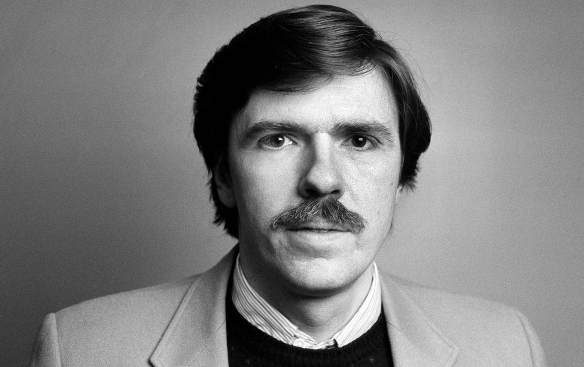
Robert Parry in Washington, D.C. (AP, February 1987)

By Norman Soloman

Source: TheRealNews.com

After Robert Parry died on January 27, I asked another great investigative journalist, Seymour Hersh, for some words. “I ran into Bob more than three decades ago when he was the first to warn of the Iran/Contra affair, to little avail,” Hersh replied. “He was widely seen over the next years as a critic of the mainstream media in America. That was not so. He was a critic of lousy reporting, be it in Pravda or The New York Times. He wanted every journalist, everywhere, to do the research and the interviewing that it takes to get beyond the accepted headline.”

What made Bob Parry a trailblazer for independent journalism also made him a bridge burner with the media establishment. He refused to take on faith the official story, whether from governments or news outlets. After winning acclaim, including a Polk Award, as an Associated Press reporter who broke many big stories on deadly US policies in Central America, he spent three years at Newsweek—where he saw top editors collaborating with officials of the George H.W. Bush administration on what should be shared or withheld from the public. Bob left the magazine in 1990, and soon his relations with mainstream media had a whistle-blower quality. His 1992 book Fooling America: How Washington Insiders Twist the Truth and Manufacture the Conventional Wisdom named names and pulled no punches.

Midway through the decade, Bob did a stint as director of the Nation Institute’s investigative unit. His writing for The Nation during 1996 included pieces about the CIA and drug trafficking by the Nicaraguan contras, the bankrolled power of right-wing foundations, and a seven-page expose that is chilling to read more than 30 years later—an investigative report on the Koch brothers.

In 1995, Parry launched a unique journalistic space, Consortiumnews.com, where he worked intensely as publisher, editor, and writer. For the next 22 years, Parry oversaw the website’s scrutiny of elite wisdom. His work, which included authoring six books, won the I.F. Stone Medal for Journalistic Independence from Harvard’s Nieman Foundation in 2015 and, last year, the Martha Gellhorn Prize for Journalism.

I got to see Bob at work up close, in 1996, when we co-wrote a series on a media darling: “Behind Colin Powell’s Legend.” During interviews, Bob was politely unrelenting. He had a methodical zest for plowing through documents, determined to “master the material.” And he was professionally generous; I wrote just a small proportion of the articles, but he insisted that I share the byline on every one.

Bob was notably non-ideological. What propelled him was a moral core and determination to follow the facts. That devotion led him to expose the lethal deceptions and machinations of Reagan-era figures like Oliver North, Elliott Abrams, and Caspar Weinberger. Three decades later, the same resolve to separate fact from spun fiction put him on a collision course with the conventional wisdom of “Russiagate.”

No one knew better than Bob Parry how intelligence agencies and major media outlets can create a cascading frenzy. Beginning in late 2016, Bob was prolific as he debunked the torrent of hyperbolic claims about Russia that became an ever-present flood across the US media landscape. Some progressive sites went from often posting his articles in 2016 to rarely or never posting them in 2017.

“For years, the mainstream, establishment media have, by their malpractices in covering US-Russian relations from Ukraine to ‘Russiagate,’ been deeply complicit in the unfolding of this new Cold War and its unprecedented dangers,” said Russia scholar Stephen F. Cohen, a contributing editor at The Nation. “Bob Parry, very often alone, exposed those malpractices, especially those committed by the powerful New York Times and Washington Post, misreported story by misreported story, sometimes daily. For this, he was ostracized, slurred, certainly ignored by mainstream media.”

At the end of December, a week after his first stroke left him with badly blurred eyesight, Bob somehow was able to write what turned out to be his final article, brilliant and transcendent, a kind of cri de coeur that is a stunning last testament to “the journalistic principles of skepticism and evenhandedness.” Western journalists, he wrote, “now apparently see it as their patriotic duty to hide key facts that otherwise would undermine the demonizing of Putin and Russia. Ironically, many ‘liberals’ who cut their teeth on skepticism about the Cold War and the bogus justifications for the Vietnam War now insist that we must all accept whatever the US intelligence community feeds us, even if we’re told to accept the assertions on faith.”

At the close of a lengthy tribute that appeared the day after his father’s death, Nat Parry wrote that, “ultimately, Bob was motivated by a concern over the future of life on Earth. As someone who grew up at the height of the Cold War, he understood the dangers of allowing tensions and hysteria to spiral out of control, especially in a world such as ours with enough nuclear weapons to wipe out all life on the planet many times over.”

Robert Parry carried the lantern high. Now others will need to carry it on.


Read Robert Parry’s final article (posted 12/31/17) at https://consortiumnews.com/2017/12/31/an-apology-and-explanation/

Untying PropOrNot: Who They Are … and a Look at 2017’s Biggest Fake News Story

By George Eliason, an American journalist living in Ukraine.

Source: Washington’s Blog

Preface by Washington’s Blog: A leading cybersecurity expert has publicly said that Mr. Eliason’s research as  presented in this article does not violate the law.  Washington’s Blog does not express an opinion about whether or not the claims set forth in this article are accurate or not. Make up your own mind.

A little over a year ago, the deep-state graced the world with Propornot. Thanks to them, 2017 became the year of fake news. Every news website and opinion column now had the potential to be linked to the Steele dossier and Trump collusion with Russia. Every journalist was either with us or against us. Every one that was against us became Russia’s trolls.

Fortunately for the free world, the anonymous group known as Propornot that tried to “out” every website as a potential Russian colluder, in the end only implicated themselves.

Turnabout is fair play and that’s always the fun part, isn’t it? With that in mind, I know the dogs are going to howl this evening over this one.

The damage Propornot did to scores of news and opinions websites in late 2016-2017 provides the basis of a massive civil suit. I mean huge, as in the potential is there for a tobacco company sized  class-action sized lawsuit. I can say that because I know a lot about a number of entities that are involved and the enormous amount of money behind them.

How serious is this? In 2016, a $10,000 reward was put out for the identities of Propornot players. No one has claimed it yet, and now, I guess no one will. There are times in your life that taking a stand has a cost. To make sure the story gets out and is taken seriously, this is one of those times.

If that’s what it takes for you to understand the danger Propornot and the groups around them pose to everyone you love, if you understand it, everything will have been well worth it.

In this article, you’ll meet some of the people staffing Propornot. You’ll meet the people and publications that provide their expenses and cover the logistics. You’ll meet a few of the deep state players. We’ll deal with them very soon. They need to see this as the warning shot over the bow and start playing nice with regular people.  After that, you’ll meet the NGO’s that are funding and orchestrating all of it. How am I doing so far?

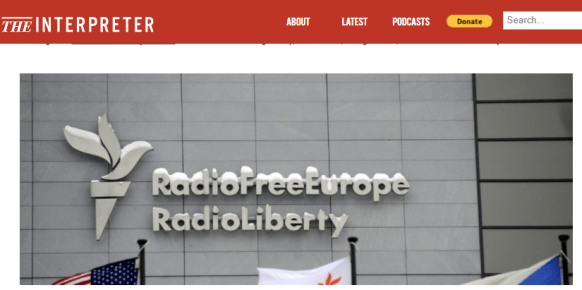
The image that you see is the clincher or game winner that supplies the necessary proof up front and the direct path to Propornot. This was a passive scan of propornot.com showing the administrative dashboard belongs to the InterpreterMag.com as shown on the left of the image. On the right, it shows that uploads to Propornot.com come from InterpreterMag.com and is a product of that publication.

Now we have the first layer of Propornot, fake news, and our 1st four contestants. We havea slew of new media organizations that are influenced by, or feeding Propornot. Remember, fake news got off the ground and got its wings because of the attention this website received from the Washington Post in Dec. 2016.

At the Interpreter Mag level, here are the people:

  • Michael Weiss is the Editor-in-Chief at the InterpreterMag.com. According to his Linkd profile, he is also a National Security Analyst for CNN since Jul 2017 as well as an Investigative Reporter for International Affairs for CNN since Apr 2017. He has been a contributor there since 2015. He has been a Senior Editor at The Daily Beast since Jun 2015.

With the lengthy CNN cred’s, how much involvement does CNN have in fake news? Yes, I know, but we’re talking about Propornot.

  • James Miller’s bio at the InterpreterMag.com includes Managing Editor of The Interpreter where he reports on Russia, Ukraine, and Syria. James runs the “Under The Black Flag” column at RFE/RL which provides news, opinion, and analysis about the impact of the Islamic State extremist group in Syria, Iraq, and beyond. He is a contributor at Reuters, The Daily Beast, Foreign Policy, and other publications. He is an expert on verifying citizen journalism and has been covering developments in the Middle East, specifically Syria and Iran, since 2009. Follow him on Twitter: @MillerMENA- Miller even works for the US Embassy in Kiev “diplo-page” the Kiev Post.

The Interpreter is a product of the Atlantic Council. The Digital Forensics Research Lab has been carrying the weight in Ukrainian-Russian affairs for the Atlantic Council. Fellows working with the Atlantic Council in this area include:

  • Bellingcat- Aric Toler and Eliot Higgins- This linked article shows how an underwear salesman became one of the most important faces of the deep state.  Don’t laugh, the image is really appropriate. Higgins’ insecurity runs so deep because of his failures that Higgins tries to get publications censured that question his author-i-tie.
  • Anne Applebaum
  • StopFake- Irena Chalupa- Chalupa is the sister to the same Alexandra Chalupa that brought the term Russian hacking to worldwide attention. Irena Chalupa is a nonresident fellow with the Atlantic Council’s Dinu Patriciu Eurasia Center. She is also a senior correspondent at Radio Free Europe/Radio Liberty (RFE/RL), where she has worked for more than twenty years. Ms. Chalupa previously served as an editor for the Atlantic Council, where she covered Ukraine and Eastern Europe. Irena Chalupa is also the news anchor for Ukraine’s propaganda channel Stopfake.org She is a Ukrainian Diaspora leader. The Chalupa’s are the 1st family of Ukrainian propaganda. She works with and for Ukrainian Intelligence through the Atlantic Council, Stopfake, and her sisters Andrea (Euromaidanpr) and Alexandra.

The strand that ties this crew together is they all work for Ukrainian Intelligence. If you hit the links, the ties are documented very clearly. We’ll get to that point again shortly, but let’s go further:

Propornot-> Atlantic Council -> Broadcasting Board of Governors (BBG)

Who are the BBG? According to Wikipedia- “The Broadcasting Board of Governors (BBG) is an independent agency of the United States government. According to its website, its mission is to “inform, engage, and connect people around the world in support of freedom and democracy. The BBG supervised Voice of America (VOA), Radio Free Europe/Radio Liberty, Radio y Television Marti, Radio Free Asia, and the Middle East Broadcast Networks.

The board of the BBG was eliminated and replaced with a single appointed chief executive officer as part of the National Defense Authorization Act for Fiscal Year 2017, which was passed in December 2016.”

On January 1, 2016, the  Interpreter became a special project of RFE/RL and under the oversight of the BBG. The Secretary of State had a seat on the board of the BBG until December 2016. Why the change?

During the 2016 election, the BBG developed a major conflict of interest. At least two BBG board members worked actively for the Hillary Clinton presidential campaign. These government officials were working against the president-elect after the election. It looks like it didn’t go unnoticed. In the following linked article, it shows that they should be investigated for their part in an attempted coup.

From a Nov 7, 2016, article– “Karen Kornbluh is helping refine and to get Hillary Clinton’s message out. ” All of them are names to watch if Clinton wins — and key jobs at the FCC and other federal agencies are up for grabs.”

According to her bio: Karen founded the New America Foundation’s Work and Family Program and is a senior fellow for Digital Policy at the Council on Foreign Relations. Karen has written extensively about technology policy, women, and family policy for The AtlanticThe New York Times and The Washington PostNew York Times columnist David Brooks cited her Democracy article “Families Valued,” focused on “juggler families” as one of the best magazine articles of 2006.

Michael Kempner is the founder, President and Chief Executive Officer of MWW Group, a staunch Hillary Clinton supporter, and may get a greater role if she is elected.  Kempner is a member of the Public Relations Hall of Fame. Michael Kempner hired Anthony Weiner after the sexting scandal broke in 2011.

Jeff Shell, chairman of the BBG and  Universal Filmed Entertainment is supporting a secondary role by being an honor roll donor to the Atlantic Council. While the BBG is supposed to be neutral it has continuously helped increase tensions in Eastern Europe. While giving to the Atlantic Council may not be illegal while in his position, currently, the Atlantic Council’s main effort is to ignite a war with Russia. This may set up a major conflict of interest.

According to journalist Robert Parry “The people that will be taking senior positions and especially in foreign policy believe “This consensus is driven by a broad-based backlash against a president who has repeatedly stressed the dangers of overreach and the need for restraint, especially in the Middle East.”

Parry goes on to say that at the forefront of this is the Atlantic Council, a think tank associated with NATO. Their main goal is a major confrontation with nuclear-armed Russia.”

So, to make sense of all this, most of the people listed would have held cabinet positions in a Hillary Clinton presidency. If the Interpreter is a project of RFE/RL then the decision to go ahead with Propornot would have to go across their desk. That includes then Sec of State, John Kerry.

The unasked question of why would a US Government Agency do this (?) needs to be addressed. All the people listed above were actively working for Clinton to get her elected and throw Donald Trump’s campaign off the rails.

After the election, they were going to take care of Clinton’s “deplorables” by dissecting alternative media. I wrote about this before the election and I warned several major new sites what they could expect. I was right on the money. After she lost, it was already in motion. The deplorable media didn’t fall into a particular political pattern other than they did not promote Hillary Clinton.

The purpose of Propornot has been to get people to demand freedom of speech be rolled back. This was/is to be done by destroying fact-based media. If you read further, the entire plan is laid out starting from 2015 when it started coming together.

These people want reality shaped on what the perceived majority (louder) group believes to be true, regardless of what the facts are. Perception based reality is only a Facebook like away from killing one person or elevating another to hero status regardless of what they have done.

That little statement about the free speech rally says it all. It’s something that would hardly be noticed unless you were looking for it because it is part of the meta-data.

Now you can say it’s only a sentence and who cares? Nobody communicates through metadata do they? Wasn’t that what Propornot was all about? Yes, they do communicate through metadata. That’s why I look at it.

Do you see it? No? Look again. There in the metadata, at the bottom of the image is an ad for a job. Go for it and remember to mention the header. It could just as easily be hacking instructions, or a do not disturb sign. That’s why it pays to really research carefully.

The Boston ‘Free Speech’ Rally was billed by the social networks and MSM as a fascist rally. It was really a Free Speech Rally. What they learned is that with just a little nudge, they can make you demand nationalist repression. Nice going Boston!

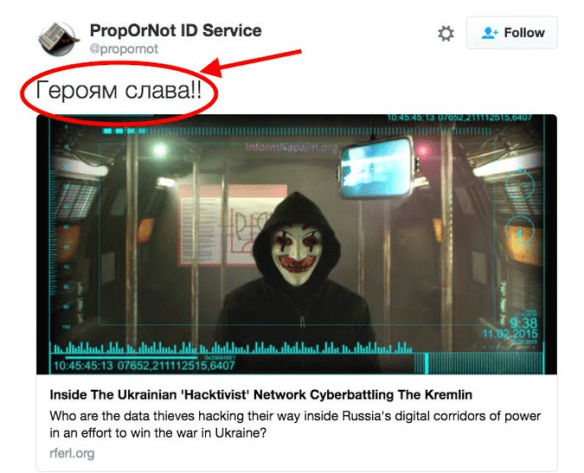
Hey, is this starting to sound a little conspiratorial? If it is, we need ruskie hackers with Guy Fawkes masks to make this work. They have to admit to changing international politics through hacking in 2016, belong to a foreign country, code in Russian, and use spear phishing techniques to lure people in. Let’s not forget that they also have to work for some form of Intelligence.

Most importantly, they have to work with and influence all of the people above. They will definitely impact US foreign policy toward Russia. Let’s raise the stakes even more. The hackers have to answer to whoever is funding a lot of the illegal and immoral activities.

They are not even savvy enough to stay clear of outing each other. This is the Pravy Sektor hacker RUH8.  The common thread for these hackers is clear if you read the linked material on the profiles that make up these organizations. They work for Bellingcat, Informnapalm, the Atlantic Council, Ukrainian Intel, and the Diaspora.

In a follow-up article, I have reason to ask if they were given access to United States Government Top Secret Secure Servers. I’m not kidding.

In a Euromaidan Press article dated November 2nd, 2016, the hackers state enthusiastically “Ukrainian hackers have a rather high level of work. So the help of the USA… I don’t know, why would we need it? We have all the talent and special means for this. And I don’t think that the USA or any NATO country would make such sharp movements in international politics.”

And we have a winner. In 2016 the sharp movement in international politics was caused by…survey says….hacking!!!!

According to Donna Brazille, the Democratic Party servers were hacked multiple times and the hacking didn’t stop until December 2016. At this juncture, we should be able to agree that Seth Rich leaked the information to Wikileaks. But, now we are talking about other hacks. In the above linked article, these hacker specifically say their favorite route is spear phishing email accounts.

In the article, you’ll also see they work directly for Ukrainian Intel. Bellingcat works directly for Ukrainian Intel and works with them and the Atlantic Council. Stopfake is a product of Irena Chalupa who works for RFE/RL, the Atlantic Council and the Ukrainian government. Stopfake works directly with them and is a product of the Ukrainian government. Crowdstrike has an ongoing relationship with Ukrainian Intel and these particular hackers. Crowdstrike conjured up Fancy Bear. Well say, hello to the real fancy bear of 2016 (*fancybear is technically a set of tools and not people).

This means that former Secretary of State John Kerry approved of Ukrainian Intelligence hackers having access to servers inside a US Government Agency because of Propornot and the Atlantic Councils reliance on the hackers.

How are the Ukrainian hackers tied into Propornot at any level? James Miller isn’t shy about using their work. Propornot relies on the work of the Atlantic Council, Aric Toler, Aaron Weisburd, Clint Watts, and Joel Harding. The Ukrainian hackers work directly with InformNapalm and are the go-to resource for most of the people involved and all of the people just named.

Below we have assessed the details of the reports from InformNapalm, and have expanded on their investigation. — James Miller

Americans are attacking Americans for a foreign country for what amounts to pennies. We’ll deal with them again soon.

Who does the Atlantic Council work for? It’s the same people that staff RFE/RL.

“On 29 January 2016 in Washington, U.S.A., Ukrainian World Congress (UWC) President Eugene Czolij and Atlantic Council President and CEO Frederick Kempe officially signed a Memorandum of Agreement to renew the cooperation between the UWC and the Atlantic Council, that began in September 2014.

In accordance with this Memorandum, the UWC will continue its cooperation with the Atlantic Council on implementing the “Ukraine in Europe Initiative”, which aims to galvanize international support for an independent, sovereign and territorially integral Ukraine, including Crimea. This initiative is also intended to support reforms in Ukraine and its EuroAtlantic integration, and to counter Russian disinformation.”

This one little paragraph spells out clearly what I have shown in detail throughout this article.

The Ukrainian World Congress is represented in the US Congress by the Ukrainian Caucus headed up by ISIS supporter and Nazi cheerleader Marcy Kaptur. Her Ukrainian Caucus represents people  with political positions that scared Adolf Hitler in WWII.

The obvious takeaway is that a lawsuit is a bare minimum that needs to happen. People need to be investigated for crimes against the state. When we take a closer look at who had potential access to top-secret servers, that will become painfully obvious.

These people have tried and are trying to rip the fabric of society in pieces. At the very least, they have earned a good tarring…and feathering. When you look at the financial end of this a lawsuit in the billions would barely touch it.

Just one company the Ukrainian Diaspora started for this is valued over 100 million dollars. This will need to be a class action suit with a cease and desist to the BBG.

In early 2015, almost 2 years before most people took the idea of censorship seriously, I documented its inception. In the same way, it happens with many of the biggest stories of our times, I stumbled onto it by accident.

In early March 2015, Ukrainian Information Policy designer Joel Harding laid out what to expect going forward in the following statements: “In military IIO operations center on the ability to influence foreign audiences, US, and global audiences, and adversely affect enemy decision making through an integrated approach. Even current event news is released in this fashion. Each portal is given messages that follow the same themes because it is an across the board mainstream effort that fills the information space entirely when it is working correctly.

The purpose of “Inform and Influence Operations”  is not to provide a perspective, opinion, or lay out a policy. It is defined as the ability to make audiences “think and act” in a manner favorable to the mission objectives. This is done through applying perception management techniques which target the audiences emotions, motives, and reasoning.

These techniques are not geared for debate. It is to overwhelm and change the target psyche.

Using these techniques information sources can be manipulated and those that write, speak, or think counter to the objective are relegated as propaganda, ill-informed, or irrelevant.”- Harding

While the above sounds gloriously overoptimistic, Harding, along with his little band of Kremlin Troll hunters personally started developing the idea of organizations capable of blackballing journalists and publications in a way that could not be construed as censorship.

From another March 2015 articleA “Disinformation Charter” for Media and BloggersTop-down censorship should be avoided. But rival media, from Al-Jazeera to the BBC, Fox and beyond, need to get together to create a charter of acceptable and unacceptable behavior. Vigorous debate and disagreement qre ,of course, to be encouraged—but media organizations that practice conscious deception should be excluded from the community. A similar code can be accepted by bloggers and other online influencers.

This “Disinformation Charter” for responsible behavior (Ministry of Truth?) he describes is to fight “conscious deception” can only be weighed against how he describes Propaganda. “The word is frequently used to describe any news emerging one’s opponent.”– Harding

Journalists that need to be excluded are those “our side” label as propagandists or active measure agents.”

Harding’s connections in media are very large. Through his friend Mathew Armstrong, Harding had access to and the ear of the board of the Broadcasting Board of Governors (BBG). The BBG board is staffed by the who’s who of network and radio broadcast, print media and shortwave CEO’s and heavy hitters. They are behind RFE/RL (Radio Free Europe/ Radio Liberty).

On the other end of this in 2015, Joel Harding was assembling a group of miscreants to attack the social networks of different journalist and publications. The crude logic behind a direct assault was that by developing, training, and overseeing vast troll networks they could speak over their opposition (people that their employers wanted to be silenced) and subdue dissident online conversation and control the information.

Where this wasn’t feasible, they set up hack and harass attacks at various publication to get them to stop publishing hard-hitting journalists. This still hasn’t been effective because it caused publishers to dig in and harden their internet properties instead.

The softer more indirect approach Harding pushed in March 2015 quickly developed into the unified media strategy he wanted for the US and Europe. Control the information and don’t allow contradicting information or news into the media stream. When it does get in, call it propaganda.

Enter Propornot.


The Other Side of the Post’s Katharine Graham

By Norman Solomon

Source: Consortium News

Movie critics are already hailing “The Post,” directed by Steven Spielberg and starring Meryl Streep as Washington Post publisher Katharine Graham. Millions of people will see the film in early winter. But the real-life political story of Graham and her newspaper is not a narrative that’s headed to the multiplexes.

“The Post” comes 20 years after Graham’s autobiography Personal History appeared and won enormous praise. Read as a memoir, the book is a poignant account of Graham’s long quest to overcome sexism, learn the newspaper business and gain self-esteem. Read as media history, however, it is deceptive.

“I don’t believe that whom I was or wasn’t friends with interfered with our reporting at any of our publications,” Graham wrote. However, Robert Parry — who was a Washington correspondent for Newsweek during the last three years of the 1980s — has shed some light on the shadows of Graham’s reassuring prose. Contrary to the claims in her book, Parry said he witnessed “self-censorship because of the coziness between Post-Newsweek executives and senior national security figures.”

Among Parry’s examples: “On one occasion in 1987, I was told that my story about the CIA funneling anti-Sandinista money through Nicaragua’s Catholic Church had been watered down because the story needed to be run past Mrs. Graham, and Henry Kissinger was her house guest that weekend. Apparently, there was fear among the top editors that the story as written might cause some consternation.” (The 1996 memoir of former CIA Director Robert Gates confirmed that Parry had the story right all along.)

Graham’s book exudes affection for Kissinger as well as Robert McNamara and other luminaries of various administrations who remained her close friends until she died in 2001. To Graham, men like McNamara and Kissinger — the main war architects for Presidents Lyndon Johnson and Richard Nixon — were wonderful human beings.

In sharp contrast, Graham devoted dozens of righteous pages to vilifying Post press operators who went on strike in 1975. She stressed the damage done to printing equipment as the walkout began and “the unforgivable acts of violence throughout the strike.” It is a profound commentary on her outlook that thuggish deeds by a few of the strikers were “unforgivable” — but men like McNamara and Kissinger were lovable after they oversaw horrendous slaughter in Southeast Asia.

Graham’s autobiography portrays union stalwarts as mostly ruffians or dupes. “Only a handful of [Newspaper Guild] members had gone out for reasons I respected,” she told readers. “One was John Hanrahan, a good reporter and a nice man who came from a longtime labor family and simply couldn’t cross a picket line. He never did come back. Living your beliefs is a rare virtue and greatly to be admired.”

But for Hanrahan (whose Republican parents actually never belonged to a union) the admiration was far from mutual. As he put it, “The Washington Post under Katharine Graham pioneered the union-busting ‘replacement worker’ strategy that Ronald Reagan subsequently used against the air-traffic controllers and that corporate America — in the Caterpillar, Bridgestone/Firestone and other strikes — used to throw thousands of workers out of their jobs in the 1980s and the ’90s.”

The Washington Post deserves credit for publishing sections of the Pentagon Papers immediately after a federal court injunction in mid-June 1971 stopped the New York Times from continuing to print excerpts from the secret document. That’s the high point of the Washington Post’s record in relation to the Vietnam War. The newspaper strongly supported the war for many years.

Yet Graham’s book avoids any semblance of introspection about the Vietnam War and the human costs of the Post’s support for it. Her book recounts that she huddled with a writer in line to take charge of the editorial page in August 1966: “We agreed that the Post ought to work its way out of the very supportive editorial position it had taken, but we couldn’t be precipitous; we had to move away gradually from where we had been.” Vast carnage resulted from such unwillingness to be “precipitous.”

Although widely touted as a feminist parable, Graham’s Pulitzer Prize-winning autobiography is notably bereft of solidarity for women without affluence or white skin. They barely seemed to exist in her range of vision; painful realities of class and racial biases were dim, faraway specks. Overall the 625-page book gives short shrift to the unrich and unfamous, whose lives are peripheral to the drama played out by the wealthy publisher’s dazzling peers. The name of Martin Luther King Jr. does not appear in her star-studded, history-drenched book.

Katharine Graham’s decision to publish the Pentagon Papers was indeed laudable, helping to expose lies that had greased the wheels of the war machinery with such horrific consequences in Vietnam. But the Washington Post was instrumental in avidly promoting the lies that made the Vietnam War possible in the first place. No amount of rave reviews or Oscar nominations for “The Post” will change that awful truth.


Norman Solomon is the coordinator of the online activist group RootsAction.org and the executive director of the Institute for Public Accuracy. He is the author of a dozen books including “War Made Easy: How Presidents and Pundits Keep Spinning Us to Death.”

The Victory of ‘Perception Management’

wpid-facebook_-1640825551

By Robert Parry

Source: Consortium News

To understand how the American people find themselves trapped in today’s Orwellian dystopia of endless warfare against an ever-shifting collection of “evil” enemies, you have to think back to the Vietnam War and the shock to the ruling elite caused by an unprecedented popular uprising against that war.

While on the surface Official Washington pretended that the mass protests didn’t change policy, a panicky reality existed behind the scenes, a recognition that a major investment in domestic propaganda would be needed to ensure that future imperial adventures would have the public’s eager support or at least its confused acquiescence.

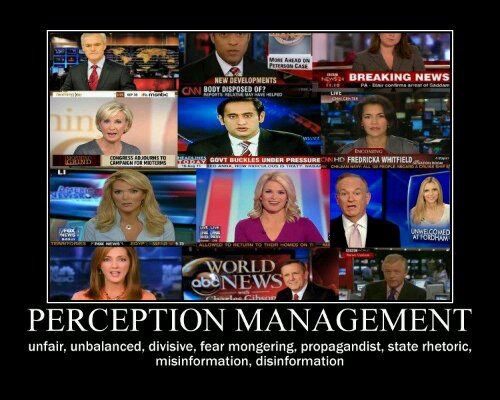
This commitment to what the insiders called “perception management” began in earnest with the Reagan administration in the 1980s but it would come to be the accepted practice of all subsequent administrations, including the present one of President Barack Obama.

In that sense, propaganda in pursuit of foreign policy goals would trump the democratic ideal of an informed electorate. The point would be not to honestly inform the American people about events around the world but to manage their perceptions by ramping up fear in some cases and defusing outrage in others – depending on the U.S. government’s needs.

Thus, you have the current hysteria over Russia’s supposed “aggression” in Ukraine when the crisis was actually provoked by the West, including by U.S. neocons who helped create today’s humanitarian crisis in eastern Ukraine that they now cynically blame on Russian President Vladimir Putin.

Yet, many of these same U.S. foreign policy operatives – outraged over Russia’s limited intervention to protect ethic Russians in eastern Ukraine – are demanding that President Obama launch an air war against the Syrian military as a “humanitarian” intervention there.

In other words, if the Russians act to shield ethnic Russians on their border who are being bombarded by a coup regime in Kiev that was installed with U.S. support, the Russians are the villains blamed for the thousands of civilian deaths, even though the vast majority of the casualties have been inflicted by the Kiev regime from indiscriminate bombing and from dispatching neo-Nazi militias to do the street fighting.

In Ukraine, the exigent circumstances don’t matter, including the violent overthrow of the constitutionally elected president last February. It’s all about white hats for the current Kiev regime and black hats for the ethnic Russians and especially for Putin.

But an entirely different set of standards has applied to Syria where a U.S.-backed rebellion, which included violent Sunni jihadists from the start, wore the white hats and the relatively secular Syrian government, which has responded with excessive violence of its own, wears the black hats. But a problem to that neat dichotomy arose when one of the major Sunni rebel forces, the Islamic State, started seizing Iraqi territory and beheading Westerners.

Faced with those grisly scenes, President Obama authorized bombing the Islamic State forces in both Iraq and Syria, but neocons and other U.S. hardliners have been hectoring Obama to go after their preferred target, Syria’s President Bashar al-Assad, despite the risk that destroying the Syrian military could open the gates of Damascus to the Islamic State or al-Qaeda’s Nusra Front.

Lost on the Dark Side

You might think that the American public would begin to rebel against these messy entangling alliances with the 1984-like demonizing of one new “enemy” after another. Not only have these endless wars drained trillions of dollars from the U.S. taxpayers, they have led to the deaths of thousands of U.S. troops and to the tarnishing of America’s image from the attendant evils of war, including a lengthy detour into the “dark side” of torture, assassinations and “collateral” killings of children and other innocents.

But that is where the history of “perception management” comes in, the need to keep the American people compliant and confused. In the 1980s, the Reagan administration was determined to “kick the Vietnam Syndrome,” the revulsion that many Americans felt for warfare after all those years in the blood-soaked jungles of Vietnam and all the lies that clumsily justified the war.

So, the challenge for the U.S. government became: how to present the actions of “enemies” always in the darkest light while bathing the behavior of the U.S. “side” in a rosy glow. You also had to stage this propaganda theater in an ostensibly “free country” with a supposedly “independent press.”

From documents declassified or leaked over the past several decades, including an unpublished draft chapter of the congressional Iran-Contra investigation, we now know a great deal about how this remarkable project was undertaken and who the key players were.

Perhaps not surprisingly much of the initiative came from the Central Intelligence Agency, which housed the expertise for manipulating target populations through propaganda and disinformation. The only difference this time would be that the American people would be the target population.

For this project, Ronald Reagan’s CIA Director William J. Casey sent his top propaganda specialist Walter Raymond Jr. to the National Security Council staff to manage the inter-agency task forces that would brainstorm and coordinate this “public diplomacy” strategy.

Many of the old intelligence operatives, including Casey and Raymond, are now dead, but other influential Washington figures who were deeply involved by these strategies remain, such as neocon stalwart Robert Kagan, whose first major job in Washington was as chief of Reagan’s State Department Office of Public Diplomacy for Latin America.

Now a fellow at the Brookings Institution and a columnist at the Washington Post, Kagan remains an expert in presenting foreign policy initiatives within the “good guy/bad guy” frames that he learned in the 1980s. He is also the husband of Assistant Secretary of State for European Affairs Victoria Nuland, who oversaw the overthrow of Ukraine’s elected President Viktor Yanukovych last February amid a very effective U.S. propaganda strategy.

During the Reagan years, Kagan worked closely on propaganda schemes with Elliott Abrams, then the Assistant Secretary of State for Latin America. After getting convicted and then pardoned in the Iran-Contra scandal, Abrams reemerged on President George W. Bush’s National Security Council handling Middle East issues, including the Iraq War, and later “global democracy strategy.” Abrams is now a senior fellow at the Council on Foreign Relations.

These and other neocons were among the most diligent students learning the art of “perception management” from the likes of Raymond and Casey, but those propaganda skills have spread much more widely as “public diplomacy” and “information warfare” have now become an integral part of every U.S. foreign policy initiative.

A Propaganda Bureaucracy

Declassified documents now reveal how extensive Reagan’s propaganda project became with inter-agency task forces assigned to develop “themes” that would push American “hot buttons.” Scores of documents came out during the Iran-Contra scandal in 1987 and hundreds more are now available at the Reagan presidential library in Simi Valley, California.

What the documents reveal is that at the start of the Reagan administration, CIA Director Casey faced a daunting challenge in trying to rally public opinion behind aggressive U.S. interventions, especially in Central America. Bitter memories of the Vietnam War were still fresh and many Americans were horrified at the brutality of right-wing regimes in Guatemala and El Salvador, where Salvadoran soldiers raped and murdered four American churchwomen in December 1980.

The new leftist Sandinista government in Nicaragua also was not viewed with much alarm. After all, Nicaragua was an impoverished country of only about three million people who had just cast off the brutal dictatorship of Anastasio Somoza.

So, Reagan’s initial strategy of bolstering the Salvadoran and Guatemalan armies required defusing the negative publicity about them and somehow rallying the American people into supporting a covert CIA intervention inside Nicaragua via a counterrevolutionary force known as the Contras led by Somoza’s ex-National Guard officers.

Reagan’s task was made tougher by the fact that the Cold War’s anti-communist arguments had so recently been discredited in Vietnam. As deputy assistant secretary to the Air Force, J. Michael Kelly, put it, “the most critical special operations mission we have … is to persuade the American people that the communists are out to get us.”

At the same time, the White House worked to weed out American reporters who uncovered facts that undercut the desired public images. As part of that effort, the administration attacked New York Times correspondent Raymond Bonner for disclosing the Salvadoran regime’s massacre of about 800 men, women and children in the village of El Mozote in northeast El Salvador in December 1981. Accuracy in Media and conservative news organizations, such as The Wall Street Journal’s editorial page, joined in pummeling Bonner, who was soon ousted from his job.

But these were largely ad hoc efforts. A more comprehensive “public diplomacy” operation took shape beginning in 1982 when Raymond, a 30-year veteran of CIA clandestine services, was transferred to the NSC.

A slight, soft-spoken New Yorker who reminded some of a character from a John le Carré spy novel, Raymond was an intelligence officer who “easily fades into the woodwork,” according to one acquaintance. But Raymond would become the sparkplug for this high-powered propaganda network, according to a draft chapter of the Iran-Contra report.

Though the draft chapter didn’t use Raymond’s name in its opening pages, apparently because some of the information came from classified depositions, Raymond’s name was used later in the chapter and the earlier citations matched Raymond’s known role. According to the draft report, the CIA officer who was recruited for the NSC job had served as Director of the Covert Action Staff at the CIA from 1978 to 1982 and was a “specialist in propaganda and disinformation.”

“The CIA official [Raymond] discussed the transfer with [CIA Director] Casey and NSC Advisor William Clark that he be assigned to the NSC as [Donald] Gregg’s successor [as coordinator of intelligence operations in June 1982] and received approval for his involvement in setting up the public diplomacy program along with his intelligence responsibilities,” the chapter said.

“In the early part of 1983, documents obtained by the Select [Iran-Contra] Committees indicate that the Director of the Intelligence Staff of the NSC [Raymond] successfully recommended the establishment of an inter-governmental network to promote and manage a public diplomacy plan designed to create support for Reagan Administration policies at home and abroad.”

During his Iran-Contra deposition, Raymond explained the need for this propaganda structure, saying: “We were not configured effectively to deal with the war of ideas.”

One reason for this shortcoming was that federal law forbade taxpayers’ money from being spent on domestic propaganda or grassroots lobbying to pressure congressional representatives. Of course, every president and his team had vast resources to make their case in public, but by tradition and law, they were restricted to speeches, testimony and one-on-one persuasion of lawmakers.

But things were about to change. In a Jan. 13, 1983, memo, NSC Advisor Clark foresaw the need for non-governmental money to advance this cause. “We will develop a scenario for obtaining private funding,” Clark wrote. (Just five days later, President Reagan personally welcomed media magnate Rupert Murdoch into the Oval Office for a private meeting, according to records on file at the Reagan library.)

As administration officials reached out to wealthy supporters, lines against domestic propaganda soon were crossed as the operation took aim not only at foreign audiences but at U.S. public opinion, the press and congressional Democrats who opposed funding the Nicaraguan Contras.

At the time, the Contras were earning a gruesome reputation as human rights violators and terrorists. To change this negative perception of the Contras as well as of the U.S.-backed regimes in El Salvador and Guatemala, the Reagan administration created a full-blown, clandestine propaganda network.

In January 1983, President Reagan took the first formal step to create this unprecedented peacetime propaganda bureaucracy by signing National Security Decision Directive 77, entitled “Management of Public Diplomacy Relative to National Security.” Reagan deemed it “necessary to strengthen the organization, planning and coordination of the various aspects of public diplomacy of the United States Government.”

Reagan ordered the creation of a special planning group within the National Security Council to direct these “public diplomacy” campaigns. The planning group would be headed by the CIA’s Walter Raymond Jr. and one of its principal arms would be a new Office of Public Diplomacy for Latin America, housed at the State Department but under the control of the NSC.

CIA Taint

Worried about the legal prohibition barring the CIA from engaging in domestic propaganda, Raymond formally resigned from the CIA in April 1983, so, he said, “there would be no question whatsoever of any contamination of this.” But Raymond continued to act toward the U.S. public much like a CIA officer would in directing a propaganda operation in a hostile foreign country.

Raymond fretted, too, about the legality of Casey’s ongoing involvement. Raymond confided in one memo that it was important “to get [Casey] out of the loop,” but Casey never backed off and Raymond continued to send progress reports to his old boss well into 1986. It was “the kind of thing which [Casey] had a broad catholic interest in,” Raymond shrugged during his Iran-Contra deposition. He then offered the excuse that Casey undertook this apparently illegal interference in domestic politics “not so much in his CIA hat, but in his adviser to the president hat.”

As a result of Reagan’s decision directive, “an elaborate system of inter-agency committees was eventually formed and charged with the task of working closely with private groups and individuals involved in fundraising, lobbying campaigns and propagandistic activities aimed at influencing public opinion and governmental action,” the draft Iran-Contra chapter said. “This effort resulted in the creation of the Office of Public Diplomacy for Latin America and the Caribbean in the Department of State (S/LPD), headed by Otto Reich,” a right-wing Cuban exile from Miami.

Though Secretary of State George Shultz wanted the office under his control, President Reagan insisted that Reich “report directly to the NSC,” where Raymond oversaw the operations as a special assistant to the President and the NSC’s director of international communications, the chapter said.

“Reich relied heavily on Raymond to secure personnel transfers from other government agencies to beef up the limited resources made available to S/LPD by the Department of State,” the chapter said. “Personnel made available to the new office included intelligence specialists from the U.S. Air Force and the U.S. Army. On one occasion, five intelligence experts from the Army’s 4th Psychological Operations Group at Fort Bragg, North Carolina, were assigned to work with Reich’s fast-growing operation.”

A “public diplomacy strategy paper,” dated May 5, 1983, summed up the administration’s problem. “As far as our Central American policy is concerned, the press perceives that: the USG [U.S. government] is placing too much emphasis on a military solution, as well as being allied with inept, right-wing governments and groups. …The focus on Nicaragua [is] on the alleged U.S.-backed ‘covert’ war against the Sandinistas. Moreover, the opposition … is widely perceived as being led by former Somozistas.”

The administration’s difficulty with most of these press perceptions was that they were correct. But the strategy paper recommended ways to influence various groups of Americans to “correct” the impressions anyway, removing what another planning document called “perceptional obstacles.”

“Themes will obviously have to be tailored to the target audience,” the strategy paper said.

Casey’s Hand

As the Reagan administration struggled to manage public perceptions, CIA Director Casey kept his personal hand in the effort. On one muggy day in August 1983, Casey convened a meeting of Reagan administration officials and five leading ad executives at the Old Executive Office Building next to the White House to come up with ideas for selling Reagan’s Central American policies to the American people.

Earlier that day, a national security aide had warmed the P.R. men to their task with dire predictions that leftist governments would send waves of refugees into the United States and cynically flood America with drugs. The P.R. executives jotted down some thoughts over lunch and then pitched their ideas to the CIA director in the afternoon as he sat hunched behind a desk taking notes.

“Casey was kind of spearheading a recommendation” for better public relations for Reagan’s Central America policies, recalled William I. Greener Jr., one of the ad men. Two top proposals arising from the meeting were for a high-powered communications operation inside the White House and private money for an outreach program to build support for U.S. intervention.

The results from the discussions were summed up in an Aug. 9, 1983, memo written by Raymond who described Casey’s participation in the meeting to brainstorm how “to sell a ‘new product’ – Central America – by generating interest across-the-spectrum.”

In the memo to then-U.S. Information Agency director Charles Wick, Raymond also noted that “via Murdock [sic] may be able to draw down added funds” to support pro-Reagan initiatives. Raymond’s reference to Rupert Murdoch possibly drawing down “added funds” suggests that the right-wing media mogul had been recruited to be part of the covert propaganda operation. During this period, Wick arranged at least two face-to-face meetings between Murdoch and Reagan.

In line with the clandestine nature of the operation, Raymond also suggested routing the “funding via Freedom House or some other structure that has credibility in the political center.” (Freedom House would later emerge as a principal beneficiary of funding from the National Endowment for Democracy, which was also created under the umbrella of Raymond’s operation.)

As the Reagan administration pushed the envelope on domestic propaganda, Raymond continued to worry about Casey’s involvement. In an Aug. 29, 1983, memo, Raymond recounted a call from Casey pushing his P.R. ideas. Alarmed at a CIA director participating so brazenly in domestic propaganda, Raymond wrote that “I philosophized a bit with Bill Casey (in an effort to get him out of the loop)” but with little success.

Meanwhile, Reich’s Office of Public Diplomacy for Latin America (S/LPD) proved extremely effective in selecting “hot buttons” that would anger Americans about the Sandinistas. He also browbeat news correspondents who produced stories that conflicted with the administration’s “themes.” Reich’s basic M.O. was to dispatch his propaganda teams to lobby news executives to remove or punish out-of-step reporters – with a disturbing degree of success. Reich once bragged that his office “did not give the critics of the policy any quarter in the debate.”

Another part of the office’s job was to plant “white propaganda” in the news media through op-eds secretly financed by the government. In one memo, Jonathan Miller, a senior public diplomacy official, informed White House aide Patrick Buchanan about success placing an anti-Sandinista piece in The Wall Street Journal’s friendly pages. “Officially, this office had no role in its preparation,” Miller wrote.

Other times, the administration put out “black propaganda,” outright falsehoods. In 1983, one such theme was designed to anger American Jews by portraying the Sandinistas as anti-Semitic because much of Nicaragua’s small Jewish community fled after the revolution in 1979.

However, the U.S. embassy in Managua investigated the charges and “found no verifiable ground on which to accuse the GRN [the Sandinista government] of anti-Semitism,” according to a July 28, 1983, cable. But the administration kept the cable secret and pushed the “hot button” anyway.

Black Hats/White Hats

Repeatedly, Raymond lectured his subordinates on the chief goal of the operation: “in the specific case of Nica[ragua], concentrate on gluing black hats on the Sandinistas and white hats on UNO [the Contras’ United Nicaraguan Opposition].” So Reagan’s speechwriters dutifully penned descriptions of Sandinista-ruled Nicaragua as a “totalitarian dungeon” and the Contras as the “moral equivalent of the Founding Fathers.”

As one NSC official told me, the campaign was modeled after CIA covert operations abroad where a political goal is more important than the truth. “They were trying to manipulate [U.S.] public opinion … using the tools of Walt Raymond’s trade craft which he learned from his career in the CIA covert operation shop,” the official admitted.

Another administration official gave a similar description to The Miami Herald’s Alfonso Chardy. “If you look at it as a whole, the Office of Public Diplomacy was carrying out a huge psychological operation, the kind the military conduct to influence the population in denied or enemy territory,” that official explained. [For more details, see Parry’s Lost History.]

Another important figure in the pro-Contra propaganda was NSC staffer Oliver North, who spent a great deal of his time on the Nicaraguan public diplomacy operation even though he is better known for arranging secret arms shipments to the Contras and to Iran’s radical Islamic government, leading to the Iran-Contra scandal.

The draft Iran-Contra chapter depicted a Byzantine network of contract and private operatives who handled details of the domestic propaganda while concealing the hand of the White House and the CIA. “Richard R. Miller, former head of public affairs at AID, and Francis D. Gomez, former public affairs specialist at the State Department and USIA, were hired by S/LPD through sole-source, no-bid contracts to carry out a variety of activities on behalf of the Reagan administration policies in Central America,” the chapter said.

“Supported by the State Department and White House, Miller and Gomez became the outside managers of [North operative] Spitz Channel’s fundraising and lobbying activities. They also served as the managers of Central American political figures, defectors, Nicaraguan opposition leaders and Sandinista atrocity victims who were made available to the press, the Congress and private groups, to tell the story of the Contra cause.”

Miller and Gomez facilitated transfers of money to Swiss and offshore banks at North’s direction, as they “became the key link between the State Department and the Reagan White House with the private groups and individuals engaged in a myriad of endeavors aimed at influencing the Congress, the media and public opinion,” the chapter said.

The Iran-Contra draft chapter also cited a March 10, 1985, memo from North describing his assistance to CIA Director Casey in timing disclosures of pro-Contra news “aimed at securing Congressional approval for renewed support to the Nicaraguan Resistance Forces.”

The chapter added: “Casey’s involvement in the public diplomacy effort apparently continued throughout the period under investigation by the Committees,” including a 1985 role in pressuring Congress to renew Contra aid and a 1986 hand in further shielding the Office of Public Diplomacy for Latin America from the oversight of Secretary Shultz.

A Raymond-authored memo to Casey in August 1986 described the shift of the S/LPD office – where Robert Kagan had replaced Reich – to the control of the Bureau of Inter-American Affairs, which was headed by Assistant Secretary of State Elliott Abrams, who had tapped Kagan for the public diplomacy job.

Even after the Iran-Contra scandal unraveled in 1986-87 and Casey died of brain cancer on May 6, 1987, the Republicans fought to keep secret the remarkable story of the public diplomacy apparatus. As part of a deal to get three moderate Republican senators to join Democrats in signing the Iran-Contra majority report, Democratic leaders agreed to drop the draft chapter detailing the CIA’s domestic propaganda role (although a few references were included in the executive summary). But other Republicans, including Rep. Dick Cheney, still issued a minority report defending broad presidential powers in foreign affairs.

Thus, the American people were spared the chapter’s troubling conclusion: that a secret propaganda apparatus had existed, run by “one of the CIA’s most senior specialists, sent to the NSC by Bill Casey, to create and coordinate an inter-agency public-diplomacy mechanism [which] did what a covert CIA operation in a foreign country might do. [It] attempted to manipulate the media, the Congress and public opinion to support the Reagan administration’s policies.”

Kicking the Vietnam Syndrome

The ultimate success of Reagan’s propaganda strategy was affirmed during the tenure of his successor, George H.W. Bush, when Bush ordered a 100-hour ground war on Feb. 23, 1991, to oust Iraqi troops from Kuwait, which had been invaded the previous August.

Though Iraqi dictator Saddam Hussein had long been signaling a readiness to withdraw – and Soviet President Mikhail Gorbachev had negotiated a withdrawal arrangement that even had the blessings of top U.S. commanders in the field – President Bush insisted on pressing ahead with the ground attack.

Bush’s chief reason was that he – and his Defense Secretary Dick Cheney – saw the assault against Iraq’s already decimated forces as an easy victory, one that would demonstrate America’s new military capacity for high-tech warfare and would cap the process begun a decade earlier to erase the Vietnam Syndrome from the minds of average Americans.

Those strategic aspects of Bush’s grand plan for a “new world order” began to emerge after the U.S.-led coalition started pummeling Iraq with air strikes in mid-January 1991. The bombings inflicted severe damage on Iraq’s military and civilian infrastructure and slaughtered a large number of non-combatants, including the incineration of some 400 women and children in a Baghdad bomb shelter on Feb. 13. [For details, see Consortiumnews.com’s “Recalling the Slaughter of Innocents.”]

The air war’s damage was so severe that some world leaders looked for a way to end the carnage and arrange Iraq’s departure from Kuwait. Even senior U.S. military field commanders, such as Gen. Norman Schwarzkopf, looked favorably on proposals for sparing lives.

But Bush was fixated on a ground war. Though secret from the American people at that time, Bush had long determined that a peaceful Iraqi withdrawal from Kuwait would not be allowed. Indeed, Bush was privately fearful that the Iraqis might capitulate before the United States could attack.

At the time, conservative columnists Rowland Evans and Robert Novak were among the few outsiders who described Bush’s obsession with exorcising the Vietnam Syndrome. On Feb. 25, 1991, they wrote that the Gorbachev initiative brokering Iraq’s surrender of Kuwait “stirred fears” among Bush’s advisers that the Vietnam Syndrome might survive the Gulf War.

“There was considerable relief, therefore, when the President … made clear he was having nothing to do with the deal that would enable Saddam Hussein to bring his troops out of Kuwait with flags flying,” Evans and Novak wrote. “Fear of a peace deal at the Bush White House had less to do with oil, Israel or Iraqi expansionism than with the bitter legacy of a lost war. ‘This is the chance to get rid of the Vietnam Syndrome,’ one senior aide told us.”

In the 1999 book, Shadow, author Bob Woodward confirmed that Bush was adamant about fighting a war, even as the White House pretended it would be satisfied with an unconditional Iraqi withdrawal. “We have to have a war,” Bush told his inner circle of Secretary of State James Baker, national security adviser Brent Scowcroft and Gen. Colin Powell, according to Woodward.

“Scowcroft was aware that this understanding could never be stated publicly or be permitted to leak out. An American president who declared the necessity of war would probably be thrown out of office. Americans were peacemakers, not warmongers,” Woodward wrote.

The Ground War

However, the “fear of a peace deal” resurfaced in the wake of the U.S.-led bombing campaign. Soviet diplomats met with Iraqi leaders who let it be known that they were prepared to withdraw their troops from Kuwait unconditionally.

Learning of Gorbachev’s proposed settlement, Schwarzkopf also saw little reason for U.S. soldiers to die if the Iraqis were prepared to withdraw and leave their heavy weapons behind. There was also the prospect of chemical warfare that the Iraqis might use against advancing American troops. Schwarzkopf saw the possibility of heavy U.S. casualties.

But Gorbachev’s plan was running into trouble with President Bush and his political subordinates who wanted a ground war to crown the U.S. victory. Schwarzkopf reached out to Gen. Powell, chairman of the Joint Chiefs of Staff, to make the case for peace with the President.

On Feb. 21, 1991, the two generals hammered out a cease-fire proposal for presentation to the NSC. The peace deal would give Iraqi forces one week to march out of Kuwait while leaving their armor and heavy equipment behind. Schwarzkopf thought he had Powell’s commitment to pitch the plan at the White House.

But Powell found himself caught in the middle. He wanted to please Bush while still representing the concerns of the field commanders. When Powell arrived at the White House late on the evening of Feb. 21, he found Bush angry about the Soviet peace initiative. Still, according to Woodward’s Shadow, Powell reiterated that he and Schwarzkopf “would rather see the Iraqis walk out than be driven out.”

In My American Journey, Powell expressed sympathy for Bush’s predicament. “The President’s problem was how to say no to Gorbachev without appearing to throw away a chance for peace,” Powell wrote. “I could hear the President’s growing distress in his voice. ‘I don’t want to take this deal,’ he said. ‘But I don’t want to stiff Gorbachev, not after he’s come this far with us. We’ve got to find a way out’.”

Powell sought Bush’s attention. “I raised a finger,” Powell wrote. “The President turned to me. ‘Got something, Colin?’,” Bush asked. But Powell did not outline Schwarzkopf’s one-week cease-fire plan. Instead, Powell offered a different idea intended to make the ground offensive inevitable.

“We don’t stiff Gorbachev,” Powell explained. “Let’s put a deadline on Gorby’s proposal. We say, great idea, as long as they’re completely on their way out by, say, noon Saturday,” Feb. 23, less than two days away.

Powell understood that the two-day deadline would not give the Iraqis enough time to act, especially with their command-and-control systems severely damaged by the air war. The plan was a public-relations strategy to guarantee that the White House got its ground war. “If, as I suspect, they don’t move, then the flogging begins,” Powell told a gratified president.

The next day, at 10:30 a.m., a Friday, Bush announced his ultimatum. There would be a Saturday noon deadline for the Iraqi withdrawal, as Powell had recommended. Schwarzkopf and his field commanders in Saudi Arabia watched Bush on television and immediately grasped its meaning.

“We all knew by then which it would be,” Schwarzkopf wrote. “We were marching toward a Sunday morning attack.”

When the Iraqis predictably missed the deadline, American and allied forces launched the ground offensive at 0400 on Feb. 24, Persian Gulf time.

Though Iraqi forces were soon in full retreat, the allies pursued and slaughtered tens of thousands of Iraqi soldiers in the 100-hour war. U.S. casualties were light, 147 killed in combat and another 236 killed in accidents or from other causes. “Small losses as military statistics go,” wrote Powell, “but a tragedy for each family.”

On Feb. 28, the day the war ended, Bush celebrated the victory. “By God, we’ve kicked the Vietnam Syndrome once and for all,” the President exulted, speaking to a group at the White House. [For more details, see Robert Parry’s Secrecy & Privilege.]

So as not to put a damper on the post-war happy feelings, the U.S. news media decided not to show many of the grisliest photos, such as charred Iraqi soldiers ghoulishly still seated in their burned-out trucks where they had been incinerated while trying to flee. By that point, U.S. journalists knew it wasn’t smart for their careers to present a reality that didn’t make the war look good.

Enduring Legacy

Though Reagan’s creation of a domestic propaganda bureaucracy began more than three decades ago – and Bush’s vanquishing of the Vietnam Syndrome was more than two decades ago – the legacy of those actions continue to reverberate today in how the perceptions of the American people are now routinely managed. That was true during last decade’s Iraq War and this decade’s conflicts in Libya, Syria and Ukraine as well as the economic sanctions against Iran and Russia.

Indeed, while the older generation that pioneered these domestic propaganda techniques has passed from the scene, many of their protégés are still around along with some of the same organizations. The National Endowment for Democracy, which was formed in 1983 under the supervision of Walter Raymond’s NSC operation, is still run by the same neocon, Carl Gershman, and has an even bigger budget, now exceeding $100 million a year.

Gershman and his NED played important behind-the-scenes roles in instigating the Ukraine crisis by financing activists, journalists and other operatives who supported the coup against elected President Yanukovych. The NED-backed Freedom House also beat the propaganda drums. [See Consortiumnews.com’s “A Shadow Foreign Policy.”]

Two other Reagan-era veterans, Elliott Abrams and Robert Kagan, have both provided important intellectual support for continuing U.S. interventionism around the world. Earlier this year, Kagan’s article for The New Republic, entitled “Superpowers Don’t Get to Retire,” touched such a raw nerve with President Obama that he hosted Kagan at a White House lunch and crafted the presidential commencement speech at West Point to deflect some of Kagan’s criticism of Obama’s hesitancy to use military force.

A New York Times article about Kagan’s influence over Obama reported that Kagan’s wife, Assistant Secretary of State Victoria Nuland, apparently had a hand in crafting the attack on her ostensible boss, President Obama.

According to the Times article, the husband-and-wife team share both a common world view and professional ambitions, Nuland editing Kagan’s articles and Kagan “not permitted to use any official information he overhears or picks up around the house” – a suggestion that Kagan’s thinking at least may be informed by foreign policy secrets passed on by his wife.

Though Nuland wouldn’t comment specifically on Kagan’s attack on President Obama, she indicated that she holds similar views. “But suffice to say,” Nuland said, “that nothing goes out of the house that I don’t think is worthy of his talents. Let’s put it that way.”

Misguided Media

In the three decades since Reagan’s propaganda machine was launched, the American press corps also has fallen more and more into line with an aggressive U.S. government’s foreign policy strategies. Those of us in the mainstream media who resisted the propaganda pressures mostly saw our careers suffer while those who played along moved steadily up the ranks into positions of more money and more status.

Even after the Iraq War debacle when nearly the entire mainstream media went with the pro-invasion flow, there was almost no accountability for that historic journalistic failure. Indeed, the neocon influence at major newspapers, such as the Washington Post and the New York Times, only has solidified since.

Today’s coverage of the Syrian civil war or the Ukraine crisis is so firmly in line with the State Department’s propaganda “themes” that it would put smiles on the faces of William Casey and Walter Raymond if they were around today to see how seamlessly the “perception management” now works. There’s no need any more to send out “public diplomacy” teams to bully editors and news executives. Everyone is already onboard.

Rupert Murdoch’s media empire is bigger than ever, but his neocon messaging barely stands out as distinctive, given how the neocons also have gained control of the editorial and foreign-reporting sections of the Washington Post, the New York Times and virtually every other major news outlet. For instance, the demonizing of Russian President Putin is now so total that no honest person could look at those articles and see anything approaching objective or evenhanded journalism. Yet, no one loses a job over this lack of professionalism.

The Reagan administration’s dreams of harnessing private foundations and non-governmental organizations have also come true. The Orwellian circle has been completed with many American “anti-war” groups advocating for “humanitarian” wars in Syria and other countries targeted by U.S. propaganda. [See Consortiumnews.com’s “Selling ‘Peace Groups’ on US-Led Wars.”]

Much as Reagan’s “public diplomacy” apparatus once sent around “defectors” to lambaste Nicaragua’s Sandinistas by citing hyped-up human rights violations now the work is done by NGOs with barely perceptible threads back to the U.S. government. Just as Freedom House had “credibility” in the 1980s because of its earlier reputation as a human rights group, now other groups carrying the “human rights” tag, such as Human Rights Watch, are in the forefront of urging U.S. military interventions based on murky or propagandistic claims. [See Consortiumnews.com’s “The Collapsing Syria-Sarin Case.”]

At this advanced stage of America’s quiet surrender to “perception management,” it is even hard to envision how one could retrace the many steps that would lead back to the concept of a democratic Republic based on an informed electorate. Many on the American Right remain entranced by the old propaganda theme about the “liberal media” and still embrace Reagan as their beloved icon. Meanwhile, many liberals can’t break away from their own wistful trust in the New York Times and their empty hope that the media really is “liberal.”

To confront the hard truth is not easy. Indeed, in this case, it can cause despair because there are so few voices to trust and they are easily drowned out by floods of disinformation that can come from any angle – right, left or center. Yet, for the American democratic Republic to reset its goal toward an informed electorate, there is no option other than to build institutions that are determinedly committed to the truth.

Investigative reporter Robert Parry broke many of the Iran-Contra stories for The Associated Press and Newsweek in the 1980s. You can buy his latest book, America’s Stolen Narrative, either in print here or as an e-book (from Amazon and barnesandnoble.com). You also can order Robert Parry’s trilogy on the Bush Family and its connections to various right-wing operatives for only $34. The trilogy includes America’s Stolen Narrative. For details on this offer, click here.

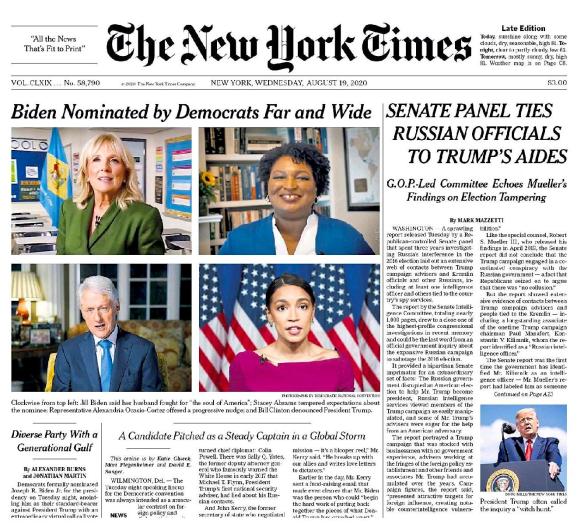
How ‘Awesome’ Is America?

599730_640x640wc

By Robert Parry

Source: ConsortiumNews.com

Fox News host Andrea Tantaros is facing some well-deserved ridicule for refuting the stomach-turning Senate Intelligence Committee report on torture by declaring that “The United States is awesome. We are awesome” and claiming that the Democrats and President Barack Obama released the report because they want “to show us how we’re not awesome.”

Tantaros’s rant did have the feel of a Saturday Night Live satire, but her upbeat jingoism was only a slight exaggeration of what Americans have been hearing from much of their media and politicians for decades. At least since the presidency of Ronald Reagan, any substantive criticism of the United States has been treated as unpatriotic.

Indeed, a journalist or a politician who dares point out any fundamental flaws in the country or even its actual history can expect to have his or her patriotism challenged. That is how debate over “how we’re not awesome” is silenced.

Fox News may be the poster child of this anti-intellectualism but the same sentiments can be found on the Washington Post’s neocon editorial pages or in the higher-brow New Republic. If you dare point out that America or one of its favored “allies” has done some wrong around the world, you’re an enemy “apologist.” If you regularly adopt a critical stance, you will be marginalized.

That’s why so many serious national problems have lingered or gotten worse. If we don’t kill the messenger, we denounce him or her as un-American.

For instance, the data on racial disparities in police killings and prison incarcerations have long been available, but the vast majority of whites seem oblivious to these continued injustices. To point out that the United States has still not done the necessary hard work to correct these history-based imbalances makes you seem out of step amid the happy-face belief that whatever racism there was is now gone. We have a black president, you know.

So, when white police shoot or otherwise apply excessive violence against blacks at a wildly disproportionate rate to whites, many white Americans just shrug. They even get annoyed if black athletes join in some symbolic protests like raising their hands as Michael Brown did before he was shot to death in Ferguson, Missouri. Many people hate to have the real world intrude on their sports entertainment.

In reaction to such events, Fox News and much of talk radio find reasons to ridicule the victims and the protesters rather than address the real problems. The unwelcome evidence of racism is just another excuse to roll the eyes and infuse the voice with dripping sarcasm.

Mundane Neglect

On a more mundane level in Arlington County, Virginia, where I live, many whites simply don’t see the racial disparities though they are all around. While overwhelmingly white North Arlington benefits from all manner of public investments, including a state-of-the-art subway system which cost billions upon billions of dollars and amenities likes a $2 million “dog park renovation,” racially diverse South Arlington, the historic home of the County’s black population, is systematically shortchanged, except when it comes to expanding the sewage treatment plant.

When the County Board finally approved a much cheaper light-rail mass-transit plan for South Arlington’s Columbia Pike and voted for a public pool complex in another South Arlington neighborhood, North Arlington residents rose up in fury. The local newspaper, the Sun-Gazette, which doesn’t even distribute in much of South Arlington – due to the demographics – rallied the political opposition.

Before long, the County Board was in retreat, killing both the public pools and the light-rail plan, all the better to free up taxpayer money for more North Arlington projects. Yet, when I have noted the racial component to how the two halves of the county are treated, many Arlington whites get furious. They simply don’t see the residual racism or don’t want to see it. They view themselves as enlightened even as they favor neglecting their black and brown neighbors.

After I wrote a column about the history of Columbia Pike, which became an African-American freedom trail after President Abraham Lincoln signed the Emancipation Proclamation and ex-slaves escaped up the roadway toward Washington, one reader complained that I had slighted Robert E. Lee by saying he had “deserted” the U.S. Army when his fans prefer saying that he “resigned his commission,” which sounds so much more proper.

The point is interesting not only because the commenter didn’t seem nearly as concerned about the fate of the African-Americans, some of whom joined the U.S. Colored Troops to fight for the final defeat of slavery. And not only because General Lee violated his oath as a U.S. officer in which he swore to “bear true allegiance to the United States of America” and to “serve them honestly and faithfully against all their enemies or opposers whatsoever, and observe and obey the orders of the President of the United States.”

But the commenter’s point is also interesting because it underscores how white Americans have excused and even glorified the Confederate “heroes” who were fighting to protect a system based on the ownership of other human beings. If you have any doubt about the glorification, just visit Monument Avenue in Richmond, Virginia, where towering statues of Confederate generals dominate the skyline.

Or, if you’re in Arlington and driving on Route One, you might notice that it is still named in honor of Jefferson Davis, the president of the Confederacy who was a fervent white supremacist and a major slaveholder. And, if President Davis and General Lee had been successful in their war of secession, it could have meant that slavery might never have ended. Yet, these protectors of slavery are treated with the utmost respect and any slight toward them requires a protest.

Crude Racism

My writings about Thomas Jefferson also have elicited anger from some people who wish to idolize him as a noble philosopher/statesman when the reality was that he was a crude racist (see his Notes on the State of Virginia) who mistreated his Monticello slaves, including having boys as young as ten whipped and raping one and likely other of his slave girls. [See Consortiumnews.com’s “Thomas Jefferson: America’s Founding Sociopath.”]

Much like the defender of Robert E. Lee who preferred more polite phrasing about the general’s betrayal of his oath, defenders of the Jefferson myth expressed much more outrage over my pointing out these inconvenient truths about their hero than they did about the victims of Jefferson’s despicable behavior and stunning hypocrisies.

Which gets us back to Andrea Tantaros and how “awesome” America is. The context for her remarks was the release of the Senate Intelligence Committee’s torture report which detailed what can no longer be euphemized away as “enhanced interrogation techniques” or EITs as CIA officials prefer.

The only word that can now apply is torture, at least for anyone who has read the page-after-page of near drownings via waterboard, the hallucinatory effects of sleep deprivation, the pain inflicted by hanging people from ceilings, and the sexual sadism of keeping detainees naked and subjecting them to anal rape under the pretext of “rectal rehydration” and “rectal feeding.”

The various apologists for this torture – people like Tantaros, Vice President Dick Cheney and Washington Post columnist Charles Krauthammer – prefer to counterattack by questioning the patriotism or the intellectual consistency of those Americans who are outraged at these actions. The torture defenders excuse the behavior because we were scared after 9/11 and wanted the Bush administration to do whatever it took to keep us safe.

All of these excuses are designed to prevent the sort of soul-searching that one should expect from a mature democratic Republic, a country that seeks to learn from its mistakes, not cover them up or forget them.

Instead of Americans confronting these dark realities of both their history and their present – and making whatever amends and adjustments are necessary – the torture apologists or those who don’t see racism would simply have us wave the flag and declare how “awesome” we are.

Investigative reporter Robert Parry broke many of the Iran-Contra stories for The Associated Press and Newsweek in the 1980s. You can buy his latest book, America’s Stolen Narrative, either in print here or as an e-book (from Amazon and barnesandnoble.com). For a limited time, you also can order Robert Parry’s trilogy on the Bush Family and its connections to various right-wing operatives for only $34. The trilogy includes America’s Stolen Narrative. For details on this offer, click here.