Punishment is Violent and Counterproductive

stpp

By Robert J. Burrowes

Punishment is a popular pastime for humans. Parents punish children. Teachers punish students. Employers punish workers. Courts punish lawbreakers. People punish each other. Governments punish ‘enemies’. And, according to some, God punishes evildoers.

What is ‘punishment’? Punishment is the infliction of violence as revenge on a person who is judged to have behaved inappropriately. It is a key word we use when we want to obscure from ourselves that we are being violent.

The violence inflicted as punishment can take many forms, depending on the context. It might involve inflicting physical injury and/or pain, withdrawal of approval or love, confinement/imprisonment, a financial penalty, dismissal, withdrawal of rights/privileges, denial of promised rewards, an order to perform a service, banishment, torture or death, among others.

Given the human preoccupation with punishment, it is perhaps surprising that this behaviour is not subjected to more widespread scrutiny. Mind you, I can think of many human behaviours that get less scrutiny than would be useful.

Anyway, because I am committed to facilitating functional human behaviour, I want to explain why using violence to ‘punish’ people is highly dysfunctional and virtually guarantees an outcome opposite to that intended.

Punishment is usually inflicted by someone who makes a judgment that another person has behaved ‘badly’ or ‘wrongly’. At its most basic, disobedience (that is, failure to comply with elite imposed norms) is often judged in this way, whether by parents, teachers, religious figures, lawmakers or national governments.

But is obedience functional or even appropriate?

Consider this. In order to behave optimally, the human organism requires that all mental functions – feelings, thoughts, memory, conscience, sensory perception (sight, sound, touch, smell, taste), truth register, intuition… – must be developed and readily involved, without interference, in our life. If this happens, then all of these individual functions will play an integrated role in determining our behaviour in any given circumstance. This is a very sophisticated mental apparatus that has evolved over billions of years and if it was allowed to function without interference in each individual, human beings would indeed be highly functional.

So where does obedience fit into all of this? It doesn’t. A child is genetically programmed to seek to meet their own needs, not obey the will of another. And they will behave functionally in endeavouring to meet these needs unless terrorized out of doing so. Moreover, they will learn to meet their own needs, by acting individually in some circumstances and by cooperating with others when appropriate, if their social environment models this.

However, if a child is terrorized into being obedient – including by being punished when they are not – then the child will have no choice but to suppress their awareness of the innate mental capacities that evolved over billions of years to guide their behaviour until they have ‘learned’ what they must do to avoid being punished. For a fuller explanation of this, see ‘Why Violence?’ and ‘Fearless Psychology and Fearful Psychology: Principles and
Practice’.

Unfortunately, as you can probably readily perceive, this process of terrorizing a child into suppressing their awareness of what they want to do so that they do what someone else directs is highly problematical. And it leads to a virtually infinite variety of dysfunctional
behaviours, even for those who appear to have been successfully ‘socialized’ into performing effectively in their society. This is readily illustrated.

Perhaps the central problem of terrorizing individuals into obedience of conventions, commands, rules and the law is that once the individual has been so terrorized, it is virtually impossible for them to change their behaviour because they are now terrified of doing so. If the obedient behaviours were functional in the circumstances then, apart from the obviously enormous damage suffered by the individual, there would be no other adverse social or environmental consequences.

Unfortunately, when all humans have been terrorized into behaving dysfunctionally on a routine basis (in the Western context, for example, by engaging in over-consumption) then changing their behaviour, even in the direction of functionality, is now unconsciously associated with the fear of violence (in the form of punishment) and so desirable behavioural change (in the direction of reduced consumption, for example) is much more difficult. It is not just that many Western humans are reluctant to reduce their consumption in line with environmental (including climatic) imperatives, they are unconsciously terrified of
doing so.

By now you might be able to see the wider ramifications of using violence and threats of violence to force children into being obedient. Apart from terrorizing each child into suppressing their awareness of their innate mental capacities, we create individuals whose entire (unconscious) ‘understanding’ of human existence is limited to the notion that violence, mislabeled ‘punishment’, drives socialization and society.

As just one result, for example, most people consider punishment to be appropriate in the context of the legal system: they expect courts to inflict legally-sanctioned violence on those ‘guilty’ of disobeying the law. As in the case of the punishment of children, how many people ask ‘Does violence restore functional behaviour? Or does it simply inflict violence as revenge? What do we really want to achieve? And how will we achieve that?’

Fundamentally, the flaw with violence as punishment is that violence terrifies people. And you cannot terrorize someone into behaving functionally. At very best, you can terrorize someone into changing their behaviour in an extremely limited context and/or for an extremely limited period of time. But if you want functional and lasting change in an individual’s behaviour, then considerable emotional healing will be necessary. This will allow the suppressed fear, anger, sadness and other feelings resulting from childhood terrorization to safely resurface and be expressed so that the individual can perceive their own needs and identify ways of fulfilling them (which does not mean that they will be obedient). For an explanation of what is required, see ‘Nisteling: The Art of Deep Listening’ which is referenced in ‘My Promise to Children‘.

So next time you hear a political leader or corporate executive advocating or using violence (such as war, the curtailment of civil liberties, an economically exploitative and/or ecologically destructive initiative), remember that you are observing a highly dysfunctionalized individual. Moreover, this dysfunctional individual is a logical product of our society’s unrelenting use of violence, much of it in the form of what is euphemistically called ‘punishment’, against our children in the delusional belief that it will give us obedience and hence social control.

Or next time you hear a public official, judge, terrorist or police officer promising ‘justice’ (that is, retribution), remember that you are listening to an emotionally damaged individual who suffered enormous violence as a child and internalized the delusional message that ‘punishment works’.

You might also ponder how bad it could be if we didn’t require obedience and use punishment to get it, but loved and nurtured children, by listening to them deeply, to become the unique, enormously loving and powerful individuals for which evolution genetically programmed them.

I am well aware that what I am suggesting will take an enormous amount of societal rethinking and a profound reallocation of resources away from violent and highly profitable police, legal, prison and military systems. But, as I wrote above, I am committed to facilitating functional human behaviour. I can also think of some useful ways that we could allocate the resources if we didn’t waste them on violence.

If you share this commitment and working towards this world appeals to you too, then you are welcome to consider participating in the fifteen-year strategy outlined in ‘The Flame Tree Project to Save Life on Earth‘ and to consider signing the online pledge of ‘The People’s Charter to Create a Nonviolent World‘.

Punishment can sometimes appear to get you the outcome you want in the short term. The cost is that it always moves you further away from any desirable outcome in the long run.


Biodata: Robert J. Burrowes has a lifetime commitment to understanding and ending human violence. He has done extensive research since 1966 in an effort to understand why human beings are violent and has been a nonviolent activist since 1981. He is the author of ‘Why Violence?‘ His email address is flametree@riseup.netand his website is at http://robertjburrowes.wordpress.com

Robert J. Burrowes
P.O. Box 68
Daylesford
Victoria 3460
Australia
Email: flametree@riseup.net

Websites:
Nonviolence Charter
Flame Tree Project to Save Life on Earth
‘Why Violence?’
Nonviolent Campaign Strategy
Nonviolent Defense/Liberation Strategy
Anita: Songs of Nonviolence
Robert Burrowes
Global Nonviolence Network

How Do You Prepare a Child for Life in the American Police State?

index

By John W. Whitehead

Source: The Rutherford Institute

“Fear isn’t so difficult to understand. After all, weren’t we all frightened as children? Nothing has changed since Little Red Riding Hood faced the big bad wolf. What frightens us today is exactly the same sort of thing that frightened us yesterday. It’s just a different wolf.” ― Alfred Hitchcock

In an age dominated with news of school shootings, school lockdowns, police shootings of unarmed citizens (including children), SWAT team raids gone awry (leaving children devastated and damaged), reports of school resource officers tasering and shackling unruly students, and public schools undergoing lockdowns and active drills, I find myself wrestling with the question: how do you prepare a child for life in the American police state?

Every parent lives with a fear of the dangers that prey on young children: the predators who lurk at bus stops and playgrounds, the traffickers who make a living by selling young bodies, the peddlers who push drugs that ensnare and addict, the gangs that deal in violence and bullets, the drunk drivers, the school bullies, the madmen with guns, the diseases that can end a life before it’s truly begun, the cynicism of a modern age that can tarnish innocence, and the greed of a corporate age that makes its living by trading on young consumers.

It’s difficult enough raising a child in a world ravaged by war, disease, poverty and hate, but when you add the police state into the mix—with its battlefield mindset, weaponry, rigidity, surveillance, fascism, indoctrination, violence, etc.—it becomes near impossible to guard against the toxic stress of police shootings, SWAT team raids, students being tasered and shackled, lockdown drills, and a growing unease that some of the monsters of our age come dressed in government uniforms.

Children are taught from an early age that there are consequences for their actions. Hurt somebody, lie, steal, cheat, etc., and you will get punished. But how do you explain to a child that a police officer can shoot someone who was doing nothing wrong and get away with it? That a cop can lie, steal, cheat, or kill and still not be punished?

Kids understand accidents: sometimes drinks get spilled, dishes get broken, people slip and fall and hurt themselves, or you bump into someone without meaning to, and they get hurt. As long as it wasn’t intentional and done with malice, you forgive them and you move on. Police shootings of unarmed people—of children and old people and disabled people—can’t just be shrugged off as accidents, however.

Tamir Rice was no accident. Cleveland police shot and killed the 12-year-old, who was seen playing on a playground with a pellet gun. Surveillance footage shows police shooting the boy two seconds after getting out of a moving patrol car. Incredibly, the shooting was deemed “reasonable” and “justified” by two law enforcement experts who concluded that the police use of force “did not violate Tamir’s constitutional rights.”

Aiyana Jones was also no accident. The 7-year-old was killed after a Detroit SWAT team launched a flash-bang grenade into her family’s apartment, broke through the door and opened fire, hitting the little girl who was asleep on the living room couch. The cops weren’t even in the right apartment. Ironically, on the same day that President Obama refused to stop equipping police with the very same kinds of military weapons and gear used to raid Aiyana’s home, it was reported that the police officer who shot and killed the little girl would not face involuntary manslaughter charges.

Obama insists that $263 million to purchase body cameras for police will prevent any further erosions of trust, but a body camera would not have prevented Aiyana from being shot in the head. Indeed, the entire sorry affair was captured on camera: a TV crew was filming the raid for an episode of The First 48, a true-crime reality show in which homicide detectives have 48 hours to crack a case.

While that $263 million will make Taser International, the manufacturer of the body cameras, a whole lot richer, it’s doubtful it would have prevented a SWAT team from shooting 14-month-old Sincere in the shoulder and hand and killing his mother.

No body camera could have stopped a Georgia SWAT team from launching a flash-bang grenade into the house in which Baby Bou Bou, his three sisters and his parents were staying. The grenade landed in the 2-year-old’s crib, burning a hole in his chest and leaving him with scarring that a lifetime of surgeries will not be able to easily undo.

No body camera could have prevented 10-year-old Dakota Corbitt from being shot by a Georgia police officer who tried to shoot an inquisitive dog, missed, and hit the young boy, instead.

When police shot 4-year-old Ava Ellis in the leg, shattering the bone, it actually was an accident, but it was an accident that could have been prevented. Police reported to Ava’s house after being told that Ava’s mother, who had cut her arm, was in need of a paramedic. Cops claimed that the family pet charged the officer who was approaching the house, causing him to fire his gun and hit the little girl.

Alberto Sepulveda, 11, died from one “accidental” shotgun round to the back, after a SWAT team raided his parents’ home. Thirteen-year-old Andy Lopez Cruz was shot 7 times in 10 seconds by a California police officer who mistook the boy’s toy gun for an assault rifle. Christopher Roupe, 17, was shot and killed after opening the door to a police officer. The officer, mistaking the Wii remote control in Roupe’s hand for a gun, shot him in the chest.

These children are more than grim statistics on a police blotter. They are the heartbreaking casualties of the government’s endless, deadly wars on terror, on drugs, and on the American people themselves.

Not even the children who survive their encounters with police escape unscathed. Increasingly, their lives are daily lessons in compliance and terror, meted out with every SWAT team raid, roadside strip search, and school drill.

Who is calculating the damage being done to the young people forced to watch as their homes are trashed and their dogs are shot during SWAT team raids? A Minnesota SWAT team actually burst into one family’s house, shot the family’s dog, handcuffed the children and forced them to “sit next to the carcass of their dead and bloody pet for more than an hour.” They later claimed it was the wrong house.

More than 80% of American communities have their own SWAT teams, with more than 80,000 of these paramilitary raids are carried out every year. That translates to more than 200 SWAT team raids every day in which police crash through doors, damage private property, terrorize adults and children alike, kill family pets, assault or shoot anyone that is perceived as threatening—and all in the pursuit of someone merely suspected of a crime, usually some small amount of drugs.

What are we to tell our nation’s children about the role of police in their lives? Do you parrot the government line thatpolice officers are community helpers who are to be trusted and obeyed at all times? Do you caution them to steer clear of a police officer, warning them that any interactions could have disastrous consequences? Or is there some happy medium between the two that, while being neither fairy tale nor horror story, can serve as a cautionary tale for young people who will encounter police at virtually every turn?

No matter what you say, there can be no avoiding the hands-on lessons being taught in the schools about the role of police in our lives, ranging from active shooter drills and school-wide lockdowns to incidents in which children engaging in typically childlike behavior are suspended (for shooting an imaginary “arrow” at a fellow classmate), handcuffed (for being disruptive at school), arrested (for throwing water balloons as part of a school prank), and even tasered (for not obeying instructions).

For example, a middle school in Washington State went on lockdown after a student brought a toy gun to class. A Boston high school went into lockdown for four hours after a bullet was discovered in a classroom. A North Carolina elementary school locked down and called in police after a fifth grader reported seeing an unfamiliar man in the school (it turned out to be a parent).

Better safe than sorry is the rationale offered to those who worry that these drills are terrorizing and traumatizing young children. As journalist Dahlia Lithwick points out: “I don’t recall any serious national public dialogue about lockdown protocols or how they became the norm. It seems simply to have begun, modeling itself on the lockdowns that occur during prison riots, and then spread until school lockdowns and lockdown drills are as common for our children as fire drills, and as routine as duck-and-cover drills were in the 1950s.”

These drills have, indeed, become routine.

As the New York Times reports: “Most states have passed laws requiring schools to devise safety plans, and several states, including Michigan, Kentucky and North Dakota, specifically require lockdown drills. Some drills are as simple as a principal making an announcement and students sitting quietly in a darkened classroom. At other schools, police officers and school officials playact a shooting, stalking through the halls like gunmen and testing whether doors have been locked.”

Police officers at a Florida middle school carried out an active shooter drill in an effort to educate students about how to respond in the event of an actual shooting crisis. Two armed officers, guns loaded and drawn, burst into classrooms, terrorizing the students and placing the school into lockdown mode.

What is particularly chilling is how effective these lessons in compliance are in indoctrinating young people to accept their role in the police state, either as criminals or prison guards. If these exercises are intended to instill fear and compliance into young people, they’re working.

Sociologist Alice Goffman understands how far-reaching the impact of such “exercises” can be on young people. For six years, Goffman lived in a low-income urban neighborhood, documenting the impact such an environment—a microcosm of the police state—on its residents. Her account of neighborhood children playing cops and robbers speaks volumes about how constant exposure to pat downs, strip searches, surveillance and arrests can result in a populace that meekly allows itself to be prodded, poked and stripped.

As journalist Malcolm Gladwell writing for the New Yorker reports:

Goffman sometimes saw young children playing the age-old game of cops and robbers in the street, only the child acting the part of the robber wouldn’t even bother to run away: I saw children give up running and simply stick their hands behind their back, as if in handcuffs; push their body up against a car without being asked; or lie flat on the ground and put their hands over their head. The children yelled, “I’m going to lock you up! I’m going to lock you up, and you ain’t never coming home!” I once saw a six-year-old pull another child’s pants down to do a “cavity search.”

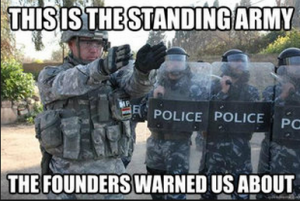
Clearly, our children are getting the message, but it’s not the message that was intended by those who fomented a revolution and wrote our founding documents. Their philosophy was that the police work for us, and “we the people” are the masters, and they are to be our servants. Now that has been turned on its head, fueled by our fears (some legitimate, some hyped along by the government and its media mouthpieces) about the terrors and terrorists that lurk among us.

It’s getting harder by the day to tell young people that we live in a nation that values freedom and which is governed by the rule of law without feeling like a teller of tall tales. Yet as I point out in my book Battlefield America: The War on the American People, unless something changes and soon for the young people growing up, there will be nothing left of freedom as we have known it but a fairy tale without a happy ending.

Militarization of the Police: A Reflection of United States Foreign Policy

By Abayomi Azikiwe

Source: Global Research

Over the last 14 months the notion of the United States as a bastion of human rights and democracy has been further shattered.

With the police killing of 18-year-old Michael Brown in Ferguson, Missouri, it set off not only a rebellion in this St. Louis County suburb but nationwide demonstrations across the country. The rebellion in Ferguson forced the Obama administration to pay some symbolic attention to the plight of African American people who have been largely ignored as it relates to domestic policy over the last several decades.

In fact when it comes to Civil Rights and Human Rights, there has only been regressive legislation and “benign neglect” since the late 1960s. Realizing the complexity of the crisis facing the African American people, other people of color communities and working people in general, the system would rather ignore the problems rather pay any attention to them.

Nonetheless, Ferguson proved to be a turning point in U.S. history. Periodicals published in states that are aligned with Washington issued editorial questioning the domestic and foreign policy posture of the administration of President Barack Obama.

Even though the Justice Department was sent into to St. Louis County to investigate the circumstances surrounding the killing of Michael Brown, no federal charges were ever filed against Darren Wilson or anyone else within the law-enforcement, judicial and municipal systems in the area. The lack of critical response by the Obama administration compounded the discontent after the local authorities decided that there was no probable cause for charges to be brought against Wilson and others in Ferguson.

The report issued by the Justice Department Civil Rights Division did demonstrate clearly that collusion was rampant within these various departments in St. Louis County. Electronic communications were retrieved which illustrated that the African American community was being grossly exploited through traffic stops, citations, questionable arrests and prosecutions.

Many of the suburban municipalities within St. Louis County are economically unviable and consequently utilized racial profiling and targeting as a means of generating revenue. The New York Times reported several weeks after the rebellion and mass demonstrations began in Ferguson that over 12,000 outstanding warrants existed in the small city of barely over 20,000 residents. This came out to approximately two warrants per household in Ferguson.

Residents with outstanding warrants were subjected to immediate arrests and even higher fines or possible jail terms. Such legal problems hampered people’s abilities to find and retain employment as well as maintain a stable family life.

What appears to have happened in regard to the situation in Ferguson and St. Louis County is there was an apparent agreement that Wilson and other officials would resign their positions in exchange for not being pursued further by the federal government. It was also announced that some form of amnesty would be granted for residents facing high fines and jail time after being systematically targeted by the police throughout the County.

Such a compromise does not approach the resolution of the deeper problems of national oppression and racism so prevalent within law-enforcement culture. High rates of unemployment and poverty are by-products of national oppression and class exploitation which the American system is built upon.

Militarization Unveiled in Ferguson

Rather than examine the causes behind the explosion in Ferguson, the response of the political superstructure and the law-enforcement agencies was to put down the rebellion with a vengeance. Police came on the scene with armored vehicles, batons, rubber bullets, tear gas, pepper spray, long range acoustic devices (LRAD) and other forms of highly-sophisticated and deadly weaponry.

Numerous law-enforcement departments were deployed in Ferguson along with the National Guard. Missouri Governor Jay Nixon declared a “state of emergency” while law-enforcement implemented a “no-fly zone” over the region.

The youth and workers who took to the streets both violently and non-violently were immediately criminalized. Journalists seeking to cover the story were attacked and arrested.

Corporate media pundits took to the airwaves over cable television networks to put their own spin on developments surrounding the mass demonstrations and rebellions. Those who fought back against the police and destroyed private property were labeled as criminals and thugs. These characterizations provided a rationale for the use of deadly force and the denial of basic democratic rights of due process.

Governor Nixon and local authorities blamed the unrest on “outside agitators” seeking to deflect attention away from the exploitative and repressive conditions so widespread in St. Louis County. President Obama and former U.S. Attorney General Eric Holder sought to define the forms of dissent that were acceptable those that were not.

Moreover, the question becomes: where did these weapons, tanks, noxious gases and sound devices come from? These are the same weapons that have been used against the people of Afghanistan, Iraq, Libya, Syria, Palestine, Lebanon, Yemen and other geo-political regions over the last several decades.

The federal government through the Pentagon supplies these armaments through grants to local law-enforcement agencies. Are these the best tools to fight street crime? Or are these weapons supplied to fight existing unrest and more violent rebellions and revolts that are bound to come in the future?

We Can’t Breathe: Eric Garner and the Impunity of the State

In Staten Island New York the police killing of Eric Garner provided additional lessons in our understanding of the current character of state repression. Garner’s encounter with the police was caught on a cellphone video and transmitted worldwide. His last words gasping “I Can’t Breathe” became a rallying cry for those who went into the streets by the tens of thousands in New York and across the country.

Apparently recording of this crime did not matter to the grand jury that acquitted the only police officer investigated in the killing. The billions around the world who saw the video knew that there were many officers who were involved in Garner’s death by holding him down, applying pressure to his vital areas and refusing to provide any medical attention while he lay dying.

The youth who videoed the killing was himself targeted for prosecution and jailed. Once again the Justice Department did not take any action against the cops or the grand jury which allowed the police and emergency medical technicians to walk free.

In response to the grand jury decision, tens of thousands of people went out in protest in Manhattan and other areas of New York City. They blocked streets, expressways, businesses and bridges. The city had not seen such an outpouring of spontaneous demonstrations in many years.

New York City has been notorious for its “stop and frisk” and “broken windows” theory of policing. This style of law-enforcement conduct rides the waves of gentrification and forced removals of African Americans, Latinos and working class people in general throughout the municipality.

Obviously there is a concerted effort to drive millions of oppressed, working class and poor people out of the cities throughout the U.S. In New York, despite claims by officials that crime has been reduced by 80 percent, the plight of marginalized working class has worsened.

The homeless problem in New York is worse than it has ever been in the city’s history. A recent front-page article in the Sunday New York Times published on August 29 exposed the plight of those living in homeless shelters.

Those are the ones who are inside although living with bed bugs and other vermin in over-crowded buildings. Others are unfortunately sleeping on the streets in subways, storefronts, in Times Square and other areas.

Nonetheless, the liberal administration of De Blassio has no program for providing decent housing to those who need it. Wall Street with all of its propaganda about an economic recovery ignores the conditions of the most vulnerable and miserable.

Baltimore: A Flashpoint for Repression and Impoverishment

Just earlier this year in late April young Freddie Grey was killed by the Baltimore Police Department. This was by no means an isolated incident since the city has a long tradition of systematic racism in housing and police-community relations.

However, after the killing of Grey who died in police custody, the community rose up in rebellion. Immediately the Governor declared yet another “state of emergency” moving into Baltimore personally and effectively taking control of the city from its African American woman Mayor Stephanie Rawlings-Blake.

What was interesting about the rebellion in Baltimore was the more developed counter-insurgency strategy and tactics implemented. Thousands of police officers from various agencies were deployed from across the state as was the case in Ferguson, along with thousands more National Guard troops.

Nonetheless, the authorities utilized a cadre of so-called “community groups” including churches, gang members, elected officials, and other operatives to come into the unrest areas encouraging youth and workers to leave the streets and go home. They were told by these “community activists” to abide by an unjust curfew and to work with the cops and the National Guard.

Tactically they were also covered by the corporate and government-controlled media to present another face of the community to the public. After the first three days of demonstrations and unrest, the media portrayed the community as being hostile to law-enforcement and private property. Suddenly by the time the National Guard and Governor had entered the city, the people who were presented to the press were residents opposed to the unrest and working towards “restoring order”, or we should say restoring the existing order.

Hundreds of these “community activists” stood between the crowds and the police with their backs to the law-enforcement agents and their faces towards the people. This was quite a symbolic effort to turn a section of the city against those who were fed up with the repression and exploitation.

Baltimore, like Detroit, has been hit over the last decade by massive home foreclosures and neighborhood blight. Hundreds of thousands have been forced out of their neighborhoods in East and West Baltimore to make room for the “developers and investors.” The banks were at the root cause of this displacement.

Also in Baltimore, it was announced during the spring that 25,000 households would be subjected to water shut-offs as what has been happening here since the imposition of emergency management and bankruptcy in 2013-2014. Although the emergency managers are being ostensibly withdrawn in Michigan, those who are the purported “elected officials” are carrying out the same draconian program of forced removals and benign neglect of the masses.

The lessons of Baltimore, Ferguson, New York and here in Detroit is that the workers and oppressed must be organized independently of the established two-party system. There must be a link drawn between law-enforcement repression, economic deprivation, gentrification and the denial of public services. The militarization of the police is designed to reinforce the system of oppression. All of these variables must be taken into consideration in any program of resistance and fightback against the structures of exploitation and political repression.

Militarization: From the 1960s to 2015

The militarization of U.S. society is as old as the American system itself. However, for the purpose of this discussion tonight we must look to events of the 1960s when cities exploded from Watts to Detroit during the period of 1965-1968.

Detroit proved to be a turning point in the militarization of the U.S. police when thousands of National Guard and federal troops were deployed to put down the rebellion in July 1967. The National Advisory Commission on Civil Disorder found in its report that the police played an integral part in sparking urban rebellions.

Rather than heed to a program of reform, the society became more militarized and repressive. Under the presidential administration of Lyndon B. Johnson an Office of Law Enforcement Assistance was created.

According to a website entitled “What-When-How”, it says that “In 1965, the Office of Law Enforcement Assistance was created in the U.S. Department of Justice. This was the predecessor to the Law Enforcement Assistance Administration (LEAA), which was established as a result of the work of the President’s Commission on Law Enforcement and Administration of Justice.”

By 1968, as a result of a Congressional Commission on crime in the streets, the Law-Enforcement Assistance Administration (LEAA) was created continuing to the early 1980s. This same above-mentioned website notes that to ostensibly achieve the aims of reducing crime in the cities:

“To achieve this objective, the notion of criminal justice planning was introduced to the country. Heretofore, planning in criminal justice was virtually nonexistent. With the passage of the Omnibus Crime Control and Safe Streets Act (1968), LEAA was authorized to provide funds to create a ‘state planning agency’ in each state that would have as its primary function the responsibility to develop a comprehensive statewide plan for the improvement of law enforcement throughout the state. The act also authorized the states to make grants from a population-based block grant allocation to units of local government to carry out programs and projects in accordance with the planning effort to improve law enforcement.”

By the early 1980s the further criminalization of African American and other oppressed communities was well underway. We have witness the growth in the prison-industrial-complex with a rise in the incarcerated population by 500 percent over the last three decades. The “school to prison pipeline” is a reality for the majority of the African American people.

A recent article in Atlantic magazine looks at this phenomena through the experiences of former inmates and the families whose loved ones have been incarcerated. With no real jobs program on a federal level and the rising rates of poverty and marginalization, this problem will not be solved short of drastic and sweeping policy initiatives that are well beyond anything that is being advocated by the White House, Congress and the corporate community.

Therefore, the struggle for justice in the U.S. is up to the people themselves. The organized masses working in solidarity with the oppressed and working people around the globe are the remedies to seriously address these concerns.

This is the charge of the labor movement and the international solidarity struggle. We are part of both and will work with any and every one to achieve total freedom.

Abayomi Azikiwe is the editor of Pan-African News Wire.

Note: This address was delivered on October 7, 2015 before the UAW Local 140 School of the Americas Watch (SOAW) Labor Caucus mobilization and recruitment meeting held at the union hall in Warren, Michigan right outside of Detroit.

The meeting entitled “Resisting Oppression: Reflecting on Our Communities a Global and Local Perspective,” also featured Maria Luisa Rosal, Field Organizer for SOA Watch, who presented a historical review of the SOA in Latin America. Jerry and Laronda King of the Civil and Human Rights Committee co-chaired the meeting. Azikiwe began his talk with expressions of solidarity with the UAW members at Fiat Chrysler who were just hours away from a possible strike that would have shut down auto production. Another tentative deal was reached prior to the Midnight deadline at least temporarily averting a strike. This tentative deal like the first one will have to be voted on by the rank and file workers.

#ACAB: Why the Institution of Policing Makes All Cops Bastards

police-state-founders-warning

By PM Beers

Source: AntiMedia

All cops are bastards because all cops, if ordered to, will enforce laws that oppress poor people.

Many people would like to believe that there are good cops and bad cops. I’m going to explain why this is simply not true. When we are children, we are ingrained with the belief that police officers are good people who want to help us. Children are taught that if they need help, they should ask a police officer. These early beliefs are so deeply ingrained that it is very hard to shake them off. For me, it took over two years to finally understand the concept of ACAB—all cops really ARE bastards, even if they believe themselves to be good people.

When you learn the history of policing, you will better understand the need to dismantle the inherently racist institution. When we were new to the anti-police brutality movement, we all thought there were good cops and bad cops. As with most binary thinking, this is incorrect. All cops are indeed bastards as they blindly enforce laws which were written to oppress poor people, such as laws against feeding the homeless. The primary role of the first police departments was to catch runaway slaves. Racism is ingrained in policing. Racism is the root cause of police brutality.

There are no good cops. Laws and ethics are not the same thing. Laws don’t prevent crime from happening—people having their needs met does. One cannot be a good person and enforce unjust laws.

Someone once asked me, “But how is the statement ‘ALL cops are bastards’ any different from ‘ALL priests are pedophiles,’ or ‘All women are lousy drivers?’“ Another friend replied,  “Nobody is born a cop. Joining that institution is a choice. It’s more akin to saying ‘all KKK are bastards.” Priests are not required to molest children, but cops are required to follow orders which oppress poor people and target people of color.

Every cop must obey orders without question. They are required to enforce unethical laws or risk losing a job that provides them with a comfortable income if they refuse. In the rare occasion that a cop does blow the whistle on an injustice, the thin blue line is immediately invoked and the seemingly well-intentioned cops are ostracized by their peers, almost always neutralizing their intentions.

Some cops think they are actually good people. Of course, they have to think they are good to rationalize what they are doing since in our society, one’s occupation is one’s identity.

We all know that many cops have done horrible things. They have abused their power, murdered people, and attempted to cover up those murders with lies. I’m not going to talk about those obvious injustices that we are already so aware of. I’m going to talk about more subtle ways that cops do unethical things under the color of law. The job of the police is not to protect people but to protect corporate assets.

When a person becomes a police officer, their job is to enforce the laws. Not all laws are good. Police are unthinking, unquestioning robots protecting a corrupt, unjust state. They simply do as they are told without question. The institution of policing is inherently corrupt because they enforce laws which have nothing to do with ethics and everything to do with serving corporate interests.

If your job requires you to do unethical things and you continue to do that job for a paycheck, you have sold out and can no longer consider yourself an ethical person.  Every cop has sold their soul for a middle class income. Their price is low.

But wait…what about that one cop who bought groceries for a mom who stole food for her kids?

Yes, that cop did a good thing. That doesn’t erase the unethical things the cop does or would do if given the order. I like to call these types of news stories #copaganda because they are often played by mainstream media to try to get us to think that cops are good people, when in reality, the news stations want to appease police departments so that they can keep access to information for their news stories. TV news folks do unethical things for money, as well, and that’s a whole other rant for another day. If cops did these kinds of things on a daily basis, they wouldn’t be newsworthy. Cops are not as lovely as the TV would have us think they are.

When protests are held, police say they are there to make sure no one gets hurt. Yet on most occasions, they are the ones hurting protesters with batons, “less lethal” bullets, and tear gas.  Sometimes, undercover cops are placed into crowds and are sometimes suspected by protesters of being the ones agitating the police. They use actions, such as throwing bottles, in order to give the police an excuse to become violent with the protesters.

Police have to enforce other unjust laws, like the criminalization of the medical use a cannabis. Smoking cannabis harms no one and is a victimless crime. Is it even a crime at all? Filling up jails with pot smokers only has negative consequences on society, as taxpayers are burdened and people prosecuted for drug offenses often have a difficult time finding employment after being released from prison. Children also suffer under the burden of having one less parent to care for them. This lack of need fulfillment leads to more crime as children mature.

Further, according to the LAPD, all cars are now under investigation. License plate scanners mounted on police cars and on light poles track drivers all over Los Angeles. The ACLU and the Electronic Frontier Foundation are currently suing the LAPD to find out how the technology is being used.  There is no probable cause to collect such data, making this practice a violation of our civil rights.

Police enforce unjust laws that harass and criminalize people who have no home. Sleep is a primary human need like air, food, and water. Is it ethically permissible to wake someone up at six AM because the only place they can afford to sleep is the sidewalk? Would a good cop do that?

In the summer of 2012, I participated in a sleepful protest in downtown Los Angeles in support of rights for people who didn’t have homes. Every morning, Officer Massey would come honk his horn to wake us up at 6 AM.  He was baffled at why I would scream at him every morning. He thought he was a good cop. He had no clue that waking up unhoused people at 6 AM is an unethical thing to do. In his mind, he was just doing his job—just following orders. Officer Massey tried his best to be polite, but what he was doing was still wrong. Is he going to quit his job?  What other job is he even qualified to do that can  still provide him such a comfortable middle-class income?  He is not going to quit his job. Instead, he will rationalize in his mind that he is a good cop. He never once kicked an unhoused person, so isn’t he lovely?

The police are an inherently violent institution where force is used to extort money from poor people and property is stolen. The racism and bias against the oppressed and poor is pervasive. The entire institution is so corrupt and violent that participating in it makes one corrupt and violent by silent consent. It is impossible to be a good person and participate in violence and oppression.

For example, a person unable to pay $150 for a car registration will have that car stolen from them with the assistance of the police. The car will then be held for ransom. If the person who was too poor to pay the $150 can’t pay the ransom, then the car, which has a value of thousands of dollars, will be sold and the state will profit off of the backs of the poor. Anyone willingly accepting money from such an institution that extorts poor people is by default not a good person.

People want to believe they are good without challenging their false beliefs. There are no good cops. Ethical and legal are completely separate things—therefore, there are no good cops as they are required to enforce unethical laws.

Are there decent individuals that become cops? Of course. However, the institution of policing means police officers, by default, are oppressors by occupation—meaning there truly are no good active-duty cops.

What is the alternative to policing? Community policing by the people who live in the community is a viable solution. Further, the situation will be improved by legalizing victimless crimes, making sure everyone’s needs are met, and reducing income inequality.

A conscious cop would think about quitting, realize they are not qualified for any other job that pays anything even close to what they currently get, and would quickly adjust their thinking back into justifying what they are doing.

All cops oppress poor people and are therefore evil. All cops make threats of death and are therefore evil.

Dismantling the institution of policing does not mean anarchy in the context of chaos. The word “anarchy” is a beautiful thing when used in certain contexts where people understand what the word actually means.  For me, anarchy means equality, horizontalism, and no false authority. Communities can and should police themselves.


This article (#ACAB: Why the Institution of Policing Makes All Cops Bastards) is free and open source. You have permission to republish this article under a Creative Commons license with attribution to the author and theAntiMedia.org. Tune in! Anti-Media Radio airs Monday through Friday @ 11pm Eastern/8pm Pacific. Help us fix our typos:edits@theantimedia.org.

PM Beers joined Anti-Media as an independent journalist in April of 2014. Her topics of interest include mental illness, neurology, quantum physics, Tourette’s, Autism, compassionate parenting, horizontal democracy, activism, and art. Born in Long Beach, California, she currently resides in Los Angeles, California. Learn more about Beers here!

Police Teargas Family’s Vigil for Handcuffed Teen Shot in the Back of the Head

Suspect Death

Besides being one of the saddest headlines I’ve seen in awhile, it says a lot about the current state of law enforcement in America. This is the full story behind it as reported by Jean Paul Zodeaux of Collapse.com:

A vigil for the deceased Jesus Huerta yesterday went from peace to pandemonium last night in Durham, North Carolina after police, who showed up in full riot gear tear gassed those at the vigil, including the family of the deceased, and arresting six people.

A month ago, in North Carolina, Jesus Huerta, a teen aged boy living in Durham, North Carolina allegedly committed suicide sitting in the back of a police cruiser, after being searched, with hands cuffed behind his back, shooting himself in the head. It is as implausible a story as one can think of. Of course, a good writer will take the implausible and make it look plausible. Too bad the Chief of Police, Jose Lopez in Durham doesn’t have any writers on hand. Instead, what Chief Lopez did was wait a few weeks, issue a statement that Jesus Huerta was found slumped over and dead in the back of a patrol car after the officer who was driving the vehicle heard what he thought to be a gunshot:

“Our department continues to investigate the origin of the weapon but can confirm that it was not a departmental weapon and no officer fired a weapon during this incident.”

Not only lacking good enough writers to make the implausible seem plausible, Chief Lopez also appears to lack any valid public relations department. At a press conference a week ago, presumably for the purposes of calming the public, Lopez only made matters worse by stating the investigation was seeking to find whether Huerta “shot himself’ on purpose or if it was accidental. Understandably, much of the public was interested in an investigation of the police involved. Instead they got Chief Lopez.

Crazy things can happen, this much is understood, and even if we’re are to accept the story that a teenage boy who was searched by a police officer before handcuffed and placed in the back seat of his patrol car wound up producing a gun missed in the search and shot himself, it would take a person disconnected with reality to think that the reaction to such a story would be one of quiet acceptance. Of course people are going to be suspicious of the story, particularly since Jesus Huerta is not the first person who has died while in the custody of Durham Police in the last five months.

On July 27th of this year, police responding to reports of a stabbing, and surrounding Jose Ocampo who was holding a knife and refused to drop it, shot him four times in the chest. Ocampo did not speak English and did not understand the commands being given him. Of course, no matter what language you speak, it should be common sense that when you are surrounded by police while holding a knife you drop it, but it was once common sense that shooting a man four times in the chest because he’s not relinquishing a knife sounds an awful lot like excessive force.

According to a friend of Ocampo’s who was on the scene, that Ocampo was attempting to give the knife to police:

“You know the part you use to cut? He put his hand on that part and gave the other end to police.”

Still, and in today’s environment, it should be expected that police will find such an thing as an excuse to open fire, but people are getting quite tired of what is to now be expected, and any police officer, and certainly a police chief should understand this, and instead of responding with defiance and more dubious tactics of force such as the full force in riot gear at a vigil for a teenager who was shot in the head while in handcuffs in the back seat of a Durham police patrol car.

Chief Lopez’ strategy of intimidation and his clear lack of compassion for the Huerta family only makes the Durham police come off as more suspicious. That is no way to sell the implausible story they’re attempting to sell the public. What Lopez should have done was accept responsibility for his part in the death of Jesus Huerta, which would be to admit that there is an obvious break down of procedure and put the whole police department on review. This is not what Lopez did, and increasingly, as more police departments expect a suspicious public to buy implausible stories, this is not what is getting done.

Nationwide Active Shooter Drills

Via: GlobalResearch.org:

The FBI has teamed up with an existing active-shooter training program —Advanced Law Enforcement Rapid Response Training (ALERRT) — begun in Texas after the 1999 Columbine High School shootings and funded in part by the US Department of Justice. The FBI sent roughly 100 tactical instructors to ALERRT training and then placed them throughout the US to oversee mock terror exercises with local law enforcement agencies.

…Since these exercises are designed to be as realistic as possible, students, school personnel and the broader public may be unsuspectingly caught up in the contrived terror, unable distinguish whether the “actors” alongside the accompanying gunfire and explosions are real or fake. This important facet is left up to the relevant agencies to explain to the press.

Further, such events are purportedly carried out to ensure civilians’ “safety” while sharpening police officers’ skills in “real life” environments. Yet local communities and the families of frightened children might wonder why military training-style maneuvers have to be carried out with their loved ones as props, especially in light of the fact that the entire program is based on an event the public still has only limited information about.

Read the full story at :http://www.globalresearch.ca/nationwide-post-sandy-hook-terror-drills/5346612

Such “mock terror excercises” carried out in the name of “safety” and “preparedness” also serve as conditioning for increased militarization of society and is terrorism in the literal sense of the word (the use of violence and intimidation in the pursuit of political aims). It wouldn’t be surprising if kids victimized in the drills suffer some form of combat shock, but that’s not a problem for authorities and pharmaceutical companies who’ll gladly hook them on SSRI drugs.

Perhaps if government was less power hungry and violent it wouldn’t have to waste valuable resources on wars, weapons, SWAT teams, prisons, active shooter drills, etc. Antoinette Tuff recently demonstrated how potentially dangerous situations can be effectively diffused non-violently. If corporations were less driven by the bottom line there would be more ethical considerations regarding the physical, mental and economic health of all citizens. This is relevant to food, mass media, education, and medicine (especially in light of correlations between SRRI use and violent behavior). With a more ethical banking system that didn’t profit from bubbles, crashes and bailouts, there would be more opportunities for fulfilling work, affordable housing and better social services which could also prevent people from cracking.

Not surprisingly, those who profit most from the current system would rather keep the status quo despite increasing problems while providing authoritarian solutions that benefit them even more.

It’s the Law

privacyNOT

Interesting commentary by James E. Miller, editor-in-chief of the Ludwig von Mises Institute of Canada. It connects recent current events in a logical narrative and offers a plausable explanation for the apparant wind-down of the war on (some) drugs.

excerpt:

With today’s nation-state, the monopoly on law enforcement has eroded the traditional notion of justice. Certainly various levels of government still prosecute those who commit malum in se wrongs. But the granting of sole discretion over societal function to the state has brought about a litany of prohibitions on otherwise harmless actions. The most widespread and destructive example of this gross perversion of law has been the American drug war. In major metropolitan areas, large numbers of users of substances designated harmful to public tranquility are fined, detained, and imprisoned. The very act of ingesting mentally-altering narcotics constitutes no harm absent the self-imposed kind. The outlawing of drug use superimposes control of the individual, and makes him beholden to the political class. As Will Grigg posits, the malum prohibitum on narcotics is a subset of human slavery as the premise denies complete self-ownership.

In an act of supposed moral revelation, U.S. Attorney General Eric Holder recently announced the federal government would begin relaxing indictments of low-level, nonviolent possessors of drugs. In a speech before the sleazebag of litigating opportunists known as the American Bar Association, the nation’s top mob enforcer declared “too many Americans go to too many prisons for far too long and for no good law enforcement reason.” The mandatory minimum sentencing laws passed by Congress will simply go ignored.

The gullible reader might assume the odious basis for the war on drugs may finally be visible to the heavily armed buffoons who raid private homes and the sloth-resembling chief law enforcer, but that would be a naive supposition. The wind down has little to do with morality and everything to do with cost. Imprisoning thousands of junkies takes a great deal of resources. With a corpulent debt financing military adventurism and welfare pocket-padding, Holder and the rest of the federal government racket are feeling the squeeze.

The very same penalty relaxation occurred at the height of the Great Depression. While Franklin Roosevelt busied himself with turning American business into a quasi-fascist state, he was intelligent enough to recognize the civil demolition wrought by alcohol prohibition. As the black market for booze paved the way for organized crime during the roaring 1920s, the stock market crash left state and local governments hamstrung by a lack of tax revenue. If action was not taken, thousands of wealth-sucking bureaucrats would be thrown to the streets. So the Democratic Party endorsed making America wet again, while nominating the craze-minded Roosevelt in 1932. After the Twenty-first Amendment to the Constitution was ratified, excise taxes were levied on wine and spirits. As economists Mark Thornton and Chetley Weise document, the resulting tax receipts staved off what would have been shriveling bankruptcy.

Rarely does the state cede authority when it comes to corralling the citizenry. The only barrier that stands between government domineering is always the cost of its behemoth, sluggish operation. The relaxation of penalties for drug ingestion is demonstrative of this rule. At the same time, it is a mockery of the concept of reasoned law. If using narcotics were truly an affront to the natural order, there would be no leniency. The immoral act would be opposed root and branch, similar to rape or murder. Current legal prohibitions on various forms of opiates are not grounded in justice but are merely a form of societal control. In the classic bootleggers and baptists sense, these restrictions enrich those who profit from sale, distribution, and incarceration while satisfying the warped psyche of taskmaster puritans.
To read the complete essay, visit the Ludwig von Mises link or the repost at Zerohedge.com.